
Pew Research Center

FOR RELEASE AUGUST 21, 2008

More Americans Question Religion’s Role In Politics

Overview Some Americans are having a change of heart about mixing religion and politics. A new survey finds a narrow majority of the public saying that churches and other houses of worship should keep out of political matters and not express their views on day-to-day social and political matters. For a decade, majorities of Americans […]

FOR MEDIA OR OTHER INQUIRIES:

Communications Department
202.419.4372
www.pewresearch.org

RECOMMENDED CITATION

Pew Research Center, August 2008, "More Americans Question Religion’s Role In Politics"

About Pew Research Center

Pew Research Center is a nonpartisan, nonadvocacy fact tank that informs the public about the issues, attitudes and trends shaping the world. It does not take policy positions. The Center conducts public opinion polling, demographic research, computational social science research and other data-driven research. It studies politics and policy; news habits and media; the internet and technology; religion; race and ethnicity; international affairs; social, demographic and economic trends; science; research methodology and data science; and immigration and migration. Pew Research Center is a subsidiary of The Pew Charitable Trusts, its primary funder.

© Pew Research Center 2026

Table of contents

  • About Pew Research Center
  • More Americans Question Religion’s Role In Politics
  • Section 1: The Mix of Religion and Politics
  • Section 2: The Campaign, Candidates and Bush
  • Section 3: Issues and the 2008 Election
  • Section 4: Faith-Based Aid Favored – Qualifications
  • About the Survey

More Americans Question Religion’s Role In Politics

Overview Some Americans are having a change of heart about mixing religion and politics. A new survey finds a narrow majority of the public saying that churches and other houses of worship should keep out of political matters and not express their views on day-to-day social and political matters. For a decade, majorities of Americans […]

Overview
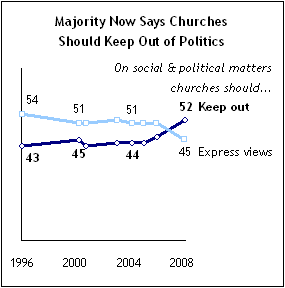
Some Americans are having a change of heart about mixing religion and politics. A new survey finds a narrow majority of the public saying that churches and other houses of worship should keep out of political matters and not express their views on day-to-day social and political matters. For a decade, majorities of Americans had voiced support for religious institutions speaking out on such issues.

The new national survey by the Pew Research Center reveals that most of the reconsideration of the desirability of religious involvement in politics has occurred among conservatives. Four years ago, just 30% of conservatives believed that churches and other houses of worship should stay out of politics. Today, 50% of conservatives express this view.
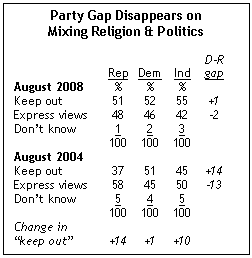
As a result, conservatives’ views on this issue are much more in line with the views of moderates and liberals than was previously the case. Similarly, the sharp divisions between Republicans and Democrats that previously existed on this issue have disappeared.

There are other signs in the new poll about a potential change in the climate of opinion about mixing religion and politics. First, the survey finds a small but significant increase since 2004 in the percentage of respondents saying that they are uncomfortable when they hear politicians talk about how religious they are – from 40% to 46%. Again, the increase in negative sentiment about religion and politics is much more apparent among Republicans than among Democrats.

Second, while the Republican Party is most often seen as the party friendly toward religion, the Democratic Party has made gains in this area. Nearly four-in-ten (38%) now say the Democratic Party is generally friendly toward religion, up from just 26% two years ago. Nevertheless, considerably more people (52%) continue to view the GOP as friendly toward religion.
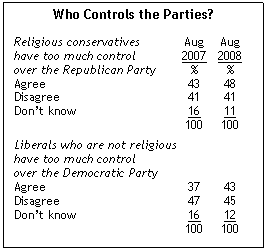
The poll by Pew Research Center for the People & the Press and the Pew Forum on Religion & Public Life finds increasing numbers of Americans believing that religiously defined ideological groups have too much control over the parties themselves. Nearly half (48%) say religious conservatives have too much influence over the Republican Party, up from 43% in August 2007. At the same time, more people say that liberals who are not religious have too much sway over the Democrats than did so last year (43% today vs. 37% then).

Social Conservatives’ Discontents
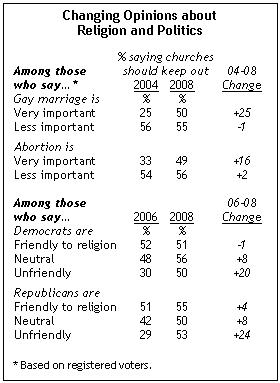
In addition to somewhat greater worries about the way religious and non-religious groups are influencing the parties, the survey suggests that frustration and disillusionment among social conservatives may be a part of the reason why a greater number now think that religious institutions should keep out of politics. However, there is little to suggest that social conservatives want religion to be a less important element in American politics.

The greatest increases since 2004 in the view that churches and other houses of worship should not express themselves on political matters have occurred among less-educated Republicans and people who say that social issues such as abortion and same-sex marriage will be important to their vote. For example, among people who rate gay marriage as a top voting issue, the percentage saying that churches should stay out of politics soared from 25% in 2004 to 50% currently; there was little change over this period on this question among people who do not view same-sex marriage as a very important issue.

Another indication that disillusionment may be in play in increased opposition to the mixing of religion and politics is seen in the fact that this sentiment has increased most among people who rate the major parties as unfriendly toward religion. The views of citizens who see the parties as neutral or friendly toward religion have been more stable on the question of whether churches and other houses of worship should speak out on political issues.

In short, the change of mind about the role of religious institutions in politics is most apparent among people who are most concerned about the very issues that churches and other houses of worship have focused on, and among those who fault the parties for their friendliness toward religion.

Changes in views about the role of churches in politics notwithstanding, many of the contours of American public opinion relating to broad questions of religion and politics remain largely unchanged. Two-thirds of the public (66%) say that churches and other houses of worship should not endorse one candidate over another, which is unchanged since 2004 (65%). And while most say it is important for presidents to have strong religious beliefs, they are divided about whether there currently is too much, or too little, in the way of expressions of faith by contemporary political leaders. Roughly comparable numbers say political leaders express their religious beliefs too much (29%), too little (36%) or the right amount (28%).

Despite their increased reluctance to see religious institutions speaking out on politics, conservatives and Republicans continue to express very strong support for a religious president and relatively high levels of support for expressions of religious faith and prayer by political leaders.

Soft Support Among Social Conservatives for McCain

While some social conservatives are expressing changed views about religion and politics, there is little indication that they are changing their voting preferences: John McCain has about as large a lead over Barack Obama among conservatives and white evangelicals as George Bush did at this stage in the campaign four years ago.
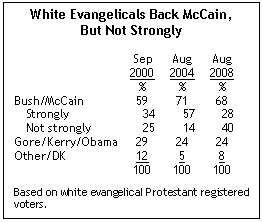
However, as has been the case since June, the current survey shows much more tepid support for McCain among white evangelical Protestants and conservatives generally than Bush enjoyed in August 2004. Just 28% of white evangelical Protestants say they are strong backers of the Arizona senator. Four years ago, 57% of white evangelicals described themselves as strong backers of President Bush.

As was the case in previous presidential elections, the voting inclinations of Catholic voters – especially white non-Hispanic Catholics – remain fluid. Four years ago at this time John Kerry held a slight edge over Bush among white non-Hispanic Catholics; but he lost that lead by the election. In the current poll, this group, which accounts for 18% of the electorate, is divided almost evenly: 45% support McCain, while 44% favor Obama.

Other Findings

The survey was conducted by telephone – both landline phones and cell phones – from July 31-Aug. 10 among a national sample of 2,905 adults. It finds that as the Democratic Party’s advantage in party identification has grown, there have been some notable changes in party affiliation within key religious groups. In 2008, about half of registered voters (51%) identify themselves as Democrats or lean toward the Democratic Party, while just 38% identify as Republicans or Republican leaners. In 2004, Democrats held only a slight, three-point advantage in party affiliation (47% to 44%).

While white non-Hispanic Catholics are divided in their presidential choices, they are increasingly identifying as Democrats. In surveys conducted this year, 49% of white non-Hispanic Catholics either affiliate with or lean toward the Democratic Party, while 40% identify with the GOP. In 2004, 47% of white non-Hispanic Catholics identified with the GOP while 45% affiliated with the Democratic Party.

The survey finds that the economy continues to dominate the concerns of voters. Nearly nine-in-ten (87%) say the economy will be very important to their vote this fall, up from 78% in October 2004. Energy has surged among voters’ concerns: 77% view energy as very important, compared with only 54% in the closing weeks of the last campaign.

For the most part, the issues that are important to the public as a whole are also important to particular religious groups. However, social issues, such as same-sex marriage, continue to be more important for white evangelicals than for other registered voters. Currently, 46% of white evangelicals say same-sex marriage will be a very important voting issue, compared with 28% of all voters. That is only somewhat less than the percentage of white evangelical voters who viewed same-sex marriage as very important in October 2004 (49%).

Section 1: The Mix of Religion and Politics

More Say Churches Should Keep Out of Politics

A slim majority of the public (52%) says that churches and other houses of worship should keep out of politics, an eight point increase compared with 2004. Fewer (45%) take the view that churches should express their views on day-to-day social and political questions. This marks the first time since the Pew Research Center began asking the question in 1996 that those who say churches should keep out of politics outnumber those who say churches should express their political views.

While Democrats and liberals have traditionally been the most wary of church involvement in political matters, the increase in opposition over the past four years has come mostly from Republicans and conservatives. As a result, where there was once a substantial partisan and ideological gap on this question, there is now far less of a divide.

The share of Republicans who say churches should keep out of social and political matters has increased from 37% to 51% since 2004. Opposition to church involvement also is up 10 points among political independents (from 45% to 55%). Meanwhile, Democratic views remain largely unchanged. The sharp partisan divisions on this question that existed in 2004, when Democrats were significantly more opposed than Republicans to church involvement in politics, have disappeared almost completely, with slim majorities of both parties now agreeing that churches should keep out of politics.

This pattern is equally stark along ideological lines. In 2004, liberals were twice as likely as conservatives (62% vs. 30%) to say churches should keep out of political matters. Today, the ideological divide is much smaller, with 57% of liberals and 50% of conservatives holding this view.

As a result of the shifting opinions on the right, this is no longer an issue that divides supporters of the Democratic and Republican presidential candidates. In August of 2004, just 38% of Bush’s supporters felt that churches should keep out of political matters, compared with 54% of Kerry’s supporters. Today, supporters of McCain and Obama are nearly identical in their views on this question (52% and 54%, respectively, say churches should keep out of politics).

Among demographic and religious groups, the increase is seen primarily among those with lower levels of education, Protestants and the religiously unaffiliated. A majority of those with less than a college education now oppose churches expressing their political views, an 11 point increase since 2004. Similarly, white Protestants, both evangelical and mainline alike, are significantly more wary of church involvement today as compared with 2004. And nearly half (45%) of those who attend religious services weekly or more now say that churches should keep out of politics, up 14 points in four years.

Further analysis shows that among Republicans, opposition to churches expressing their political views has increased most among conservatives, Protestants, weekly churchgoers and those with lower levels of education. Roughly half of conservative Republicans now want churches to keep out of politics, up 18 points over four years ago. Similarly, 46% of Republican Protestants now express reservations about church involvement in politics, up from 28% in 2004. Even among white evangelical Republicans, more than one-third (36%) now want churches to keep out of politics, up 16 points since 2004.

Continuing Opposition to Church Endorsement of Candidates

Two-thirds of all adults say that churches should not come out in favor of one political candidate over another. The high level of opposition to church endorsement of candidates is consistent with Pew polling conducted in recent years and is found across a wide variety of groups in the population.

Older adults are more likely than younger adults to say churches should refrain from endorsing candidates (75% of those over the age of 65 take this point of view); but even among those under 30, more than six-in-ten (62%) say churches should avoid favoring one candidate over another. Similarly, majorities of every religious group, including black Protestants (55%), white evangelicals (64%) and those who attend church at least once a week (63%) oppose church endorsements of political candidates.

While the overall balance of public opinion has been steady on this question, Republicans have become significantly more opposed to churches endorsing candidates today as compared with 2004 (64% vs. 53%). The trend is even more pronounced among white evangelical Republicans, who are nearly 20 points more likely to oppose church endorsements now compared with four years ago. Whereas Republicans were much less concerned with church endorsements in 2004 as compared with Democrats, partisan differences on this issue are now virtually nonexistent.

When Candidates Talk About Their Faith

Overall, half of Americans (50%) say that it does not bother them when politicians talk about how religious they are, but the number expressing discomfort has edged upward over the past four years. Today, 46% say they are uncomfortable when politicians talk about how religious they are, up from 40% in 2004. More Republicans, in particular, are expressing discomfort with politicians talking about their own religion. McCain supporters, for instance, are substantially more likely than were Bush supporters in 2004 to say they are uncomfortable with politicians talking about how religious they are (40% of McCain backers today vs. 30% of Bush backers in 2004).

Despite increasing Republican discomfort with politicians’ religious talk, Democrats (49%) and political independents (48%) remain more likely than Republicans (40%) to say they are uncomfortable hearing politicians talk about their religion.

Protestants – especially white evangelicals (58%) – tend to be most comfortable with politicians’ talking about how religious they are. White Catholics, by contrast, are evenly divided on this issue (47% say this makes them uncomfortable while 49% disagree), and a large majority of the religiously unaffiliated (57%) express discomfort with hearing about politicians’ religion.

Important That a President Have Strong Religious Beliefs

An overwhelming majority of the public continues to say that it is important to them that a president have strong religious beliefs. More than seven-in-ten Americans express this opinion, and attitudes on this issue have not changed in recent years.

Republicans especially want to have a president who has strong religious beliefs, with 86% expressing this opinion. But even among Democrats and independents, more than two-thirds (68% and 66%, respectively) say that presidents should have strong religious beliefs. A similar consensus exists across religious groups; only among the religiously unaffiliated do fewer than half (36%) express a desire for a president with strong religious beliefs.

The poll also finds that public opinion about the amount of religious expression by political leaders has held steady in recent years. A 36% plurality of Americans say that there is too little expression of religious faith and prayer by political leaders, while 29% say there is too much and 28% say there is the right amount. Compared with 2004, there has been a slight increase among the public overall in the number saying there has been too little religious talk from politicians (36% now vs. 31% in 2004), and a ten point increase among Republicans taking this point of view (46% now compared with 36% in 2004).

Are the Parties Religion Friendly?

The Republican Party has long been viewed as being religion-friendly. Currently, about half of Americans (52%) say the GOP is friendly toward religion, 29% say it is neutral and just 9% say the party is unfriendly toward religion. These views have remained stable over the past five years.

By contrast, views of the Democratic Party’s relationship with religion have varied substantially in recent years. The latest Pew survey finds a significant increase in the number saying that the Democratic Party is friendly toward religion; 38% of the public now expresses this point of view, up from just 26% in 2006. An additional 37% say that the Democratic Party is neutral toward religion, down from 42% two years ago and just 15% say the party is unfriendly toward religion, down from 20% in 2006.

Despite these gains, the Democrats still trail Republicans in perceptions of friendliness toward religion. A slim majority (52%) says the GOP is friendly toward religion, compared with 38% who say the same about the Democratic Party.

For the most part, views of the Democratic Party’s friendliness toward religion mirror opinions in 2004, when 40% said the party was friendly toward religion. This perception changed in 2005, when just 29% said the Democratic Party was friendly toward religion.

People who view a party as unfriendly toward religion tend to express unfavorable views of that party, while those who see a party as neutral or friendly toward religion are much more positively inclined toward that party overall. This is particularly true when it comes to the Democratic Party. Overall, 57% of Americans have a positive view of the Democratic Party. This number is highest (70%) among those who see the party as friendly toward religion and lowest (22%) among those who say the party is unfriendly toward religion. The Republican Party’s image is far less favorable than that of the Democratic Party – just 43% overall have a favorable opinion of the GOP. Even among those who say it is friendly toward religion, just 48% view the Republican Party favorably. Favorability falls to just 21% among the small number who say the Republican Party is unfriendly toward religion.

Who Controls the Parties?

It is also possible for a party to be viewed as too closely tied to particular religious groups, and the poll indicates that the public increasingly sees polarization between the two parties; for example, nearly half of adults (48%) say that religious conservatives have too much power over the GOP, up from 43% one year ago. And nearly as many (43%) say that liberals who are not religious have too much control over the Democratic Party, an impression that has also become more widespread over the past year (37% held this view a year ago).

Not surprisingly, Democrats (57%) and political independents (51%) are each substantially more likely than Republicans (31%) to see the GOP as overly beholden to religious conservatives. Within religious groups, white evangelicals are less likely than other groups to say religious conservatives have too much power over the Republican Party; 36% of evangelicals take this view, compared with 48% of white Catholics, 49% of black Protestants, 53% of white mainline Protestants, and 62% of the religiously unaffiliated. While low, the number of white evangelicals who see the GOP as unduly influenced by religious conservatives has increased significantly from 28% a year ago to 36% today.

Most Republicans (62%) believe that secular liberals have too much power over the Democratic Party. Far fewer independents (44%) or Democrats (31%) hold this impression. Among religious groups, white evangelical Protestants express the most concern about secular liberals’ control over the Democratic Party (60%); among all other religious traditions, fewer than half espouse this point of view.

Section 2: The Campaign, Candidates and Bush

Overview

The broad contours of religion in the 2008 election campaign remain largely unchanged from previous election cycles. White evangelical Protestants remain overwhelmingly Republican, and they favor McCain over Obama by roughly the same margins that they favored Bush over his 2000 and 2004 Democratic opponents. But white evangelical Protestants express far less enthusiasm for McCain than they did for Bush. And despite Democratic gains in party identification in two key swing constituencies – white mainline Protestants and white Catholics – Obama is doing no better against McCain than either Gore or Kerry did against Bush.

While Obama leads McCain as the candidate who voters think shares their values overall, when voters rate their own moral values on a liberal/conservative spectrum, they place themselves far closer to McCain – on the conservative side of the scale – than they do to Obama on the liberal side. McCain is not seen as being as conservative on moral issues as Bush, and Obama is not seen as being as liberal as Bill Clinton on morality.

Religion and the Horserace

Several of the patterns of religious support seen in the 2004 presidential race continue to hold in 2008. White evangelical Protestants, mainstays of Bush’s base in both 2000 and 2004, support McCain over Obama by a wide margin. McCain leads Obama by 44-percentage points among white evangelicals – comparable to Bush’s 47-point lead over Kerry with this group in the summer of 2004, and even larger than Bush’s 30-point lead over Gore in the summer of 2000. As was the case four years ago, this advantage is more pronounced among the most religiously observant – evangelicals who attend church at least once a week favor McCain over Obama by a 74% to 20% margin. Even among younger evangelicals, McCain holds a substantial lead over Obama (71% to 23% among those 18 to 49 years old, and 70% to 24% among those under the age of 40).

Support among white mainline Protestants shows little change from the 2004 election cycle; McCain’s 50% to 39% lead over Obama among white mainline Protestants is roughly similar to the 49% to 43% lead Bush held over Kerry with this group. Among Catholics, however, there has been a small shift. Fewer than half of white non-Hispanic Catholics (44%) now support Obama; in August 2004, half (50%) supported Kerry.

As in past elections, black Protestants, who have supported Democratic candidates by ratios of greater than ten-to-one, now support Barack Obama to a similar degree (88% support Obama, compared with just 6% who support McCain). The religiously unaffiliated – another traditionally Democratic group – also heavily back Obama; he enjoys a greater than two-to-one (59% to 27%) advantage over McCain among those with no religious affiliation .

Little Enthusiasm for McCain

While the overall religious contours of the horserace are little changed from 2004, the strength of voters’ commitment to the candidates differs substantially from four years ago. McCain has lower levels of strong support than Bush did in 2004, and this decline in commitment to the Republican candidate is most apparent among white evangelicals and the most religiously observant. By contrast, Obama’s overall level of strong support is almost identical to Kerry’s four years ago, as is his level of strong support among the religiously observant. However he enjoys less strong support among Catholics.

Among the 43% of voters who favor John McCain in Pew’s August survey, only 17% say they support him “strongly,” while 26% just lean toward him or favor him “only moderately.” This is roughly half the number of strong supporters that Bush had in August of 2004, when 32% of voters backed him strongly. Among voters who attend religious services at least once a week, this decline is even more pronounced – fully 45% of weekly attenders supported Bush strongly four years ago, compared with 21% who say the same about McCain today.

While white evangelicals back McCain at high levels overall, they express much less strong support than they did for Bush four years ago. Only 28% of this group supports McCain strongly, compared with fully 57% who asserted strong support for Bush in 2004. Further, evangelicals who support McCain today are far more likely to describe their vote as mostly a vote against Barack Obama than evangelicals who supported Bush four years ago in his race against John Kerry.

While overall strength of support for Barack Obama differs little from that of his Democratic predecessor, the strength of his support among Catholics is considerably weaker than Kerry’s. Today, only 19% of white non-Hispanic Catholics strongly support Obama; by contrast, Kerry enjoyed strong support from 31% of this group. At the same time, Catholic enthusiasm for John McCain is also substantially lower than it was for Bush four years ago.

Who “Shares My Values”?

A small plurality of American voters say that Barack Obama (47%) more than John McCain (39%) is the presidential candidate who most shares their values. But views differ substantially across religious lines. Most white evangelical Protestant voters (60%) – more than any other major religious group – say that McCain shares their values compared with just 27% who attribute this characteristic to Obama. White mainline Protestant voters are more evenly divided on the question of which presumptive nominee, McCain or Obama, most closely shares their values (45% vs. 37%, respectively). White non-Hispanic Catholics are also split, with 41% citing McCain and 45% Obama. The majority (56%) of voters with no religious affiliation say Obama shares their values, while 28% say this about McCain.

A “Moral Values” Scale

When asked to describe McCain’s moral values on an ideological scale from very liberal to very conservative, most voters (58%) say McCain has moral values that are either conservative (45%) or very conservative (13%). The average rating places McCain well to the right on the spectrum of moral values, but not quite as far right as Bush, who 62% rate as conservative or very conservative.

Meanwhile, just under half (48%) of voters say Obama has moral values that are either liberal (32%) or very liberal (16%). This places him well to the left of center in this dimension, though not quite as far left as Bill Clinton, who 55% rate as liberal or very liberal.

The average voter places themselves much closer to McCain than to Obama. When asked to assess their own moral values on a scale from liberal to conservative, 49% of Americans place themselves on the conservative side of the scale, while just 20% place themselves on the liberal side (29% describe themselves as moderate.)

Not surprisingly, ratings of one’s own moral values, as well as of political figures, often differ substantially between voters of different religious affiliations. More than seven-in-ten (72%) white evangelical Protestant voters see themselves as morally conservative. Fewer (59%) say the same about John McCain, placing the average evangelical voter to the right of McCain. By a smaller margin, white evangelical Protestants also see themselves to the right of Bush – 33% rate themselves as very conservative when it comes to moral values, while just 18% say the same about Bush.

The average white mainline Protestant and white non-Hispanic Catholic offers a more moderate assessment of their moral values, though conservatives still outnumber liberals in both groups, making the average voter in either group more closely aligned with how they see McCain than Obama on this matter. By contrast, there are more liberals than conservatives when it comes to the moral values of religiously unaffiliated voters. As a result, the average religiously unaffiliated voter is closer to where they place Obama on this scale than where they place McCain.

Voters in all four of these religious groups give similar ratings of John McCain’s moral values – half or more see him as conservative. There is more variation in how these voters see Obama on this scale, with white evangelicals and white mainline Protestants placing Obama further to the left than white non-Hispanic Catholics. Most white evangelicals (58%) and white mainline Protestants (55%) see Obama as having liberal moral values, compared with 44% of white non-Hispanic Catholics. About half (51%) of religiously unaffiliated voters say the same.

All Religious Groups Highly Engaged

As has been the case throughout the campaign, engagement with the current election is considerably higher than in previous years. Almost three-in-four voters (74%) say they have given “quite a lot” of thought to the election, compared with 69% four years ago, and just 59% in 2000. This increased engagement cuts across most religious groups. In particular, white evangelical engagement with the campaign remains high, despite their low level of enthusiasm for either candidate.

Support for Candidates’ Religiosity Associated With the Vote

While most (73%) voters say that it is important to them that a president have strong religious beliefs, those who feel most strongly about this favor McCain over Obama by a substantial margin (55% to 37%), while those voters who “mostly agree” with the statement are nearly evenly split between the two candidates and Obama has a clear edge (60% to 25%) among those who do not share this belief.

Views about displays of religious faith by politicians are also related to the vote – Obama leads McCain by 23 points among those who agree completely with the statement “it makes me uncomfortable when politicians talk about how religious they are,” while McCain leads Obama by 12 points among those who say they completely disagree. These patterns are similar to, if slightly weaker than, those seen in 2004.

Party Affiliation and Religion

Democrats hold a substantial 13-point advantage in party identification in 2008 – 51% of registered voters either call themselves Democratic or lean toward the Democratic Party, while 38% are Republicans or Republican-leaners. By comparison, Democrats held only a three-point identification advantage in 2004 (47% to 44%), and a four-point edge (46% to 42%) in 2000.

The balance of party identification has shifted little among white evangelical Protestants. In polling since January, 62% identify with the Republican Party, while about half as many (30%) are Democrats or Democratic-leaners. Four years ago the margin was 66% to 28%. Democrats have made some gains among white mainline Protestants – the balance of party ID is now about even (45% Democratic, 44% Republican), compared with a 49% to 43% GOP advantage in 2004.

Democrats have opened a substantial 49% to 40% advantage among white non-Hispanic Catholics – four years ago the GOP held a slim 47% to 45% edge with this group. The last election year in which Democrats led by this kind of margin among Catholics was 1996, when they held a 51% to 41% edge in party identification.

Voters without a religious affiliation have become substantially more aligned with the Democratic Party over the past eight years. In 2000 just over half (53%) of those who describe themselves as atheists, agnostics or simply as having no religious preference said they were Democrats or leaned Democratic. That grew to 62% in 2004 and stands at 64% today. Meanwhile, the share of religiously unaffiliated voters who are Republicans fell from 30% in 2000 to 26% in 2004 to 23% today.

Bush Approval Among Religious Groups

In the current survey, roughly two-thirds of Americans (66%) disapprove of the job George W. Bush is doing as president, while 28% approve of his performance. This performance rating has barely moved since March.

White evangelical Protestants remain more supportive of Bush than any other major religious group. But even among evangelicals, fewer than half (47%) approve of Bush’s performance in office, while 48% disapprove. Among white mainline Protestants, 61% disapprove and 32% approve, and the margin is even larger among white non-Hispanic Catholics (67% disapprove, 25% approve). Not surprisingly, black Protestants express the most criticism of President Bush, with fully 88% disapproving of his performance in office.

Broad Dissatisfaction with National Conditions

Almost three-quarters of Americans (74%) say they are dissatisfied with the way things are going in the country today, while 21% say they are satisfied. These figures have varied little since early February, when 70% were dissatisfied and 24% were satisfied. However, dissatisfaction is up substantially from recent years. Dissatisfaction has risen eight points since October 2007 and 19 points since the summer of 2004.

When it comes to evaluating the state of the nation, Americans of all religious faiths largely agree. Across all religious groups, more than seven-in-ten express dissatisfaction with the way things are going, with the highest rate among black Protestants (80%) and the lowest among white mainline and white evangelical Protestants (72% and 73%, respectively).

Democratic Leaders in Congress

Nearly six-in-ten Americans (58%) disapprove of the job Democratic leaders in Congress are doing, the highest proportion giving a negative assessment since the question was first asked in June 2001. Disapproval has risen 24 points from January 2007, when Democrats took control of both houses of Congress.

White Protestants are more critical of Democratic leaders than are black Protestants or the unaffiliated: 67% of white evangelicals and 64% of white mainline Protestants disapprove of the job congressional Democratic leaders are doing, a view shared by fewer than half of black Protestants (49%) and the unaffiliated (49%). Catholics fall between these groups in assessing the job Democratic congressional leaders have done: 55% of all Catholics and 59% of white non-Hispanic Catholics disapprove of the job Democratic leaders in Congress are doing. Disapproval has grown among all these religious groups since the start of this year.

Section 3: Issues and the 2008 Election

Top Issues for 2008

The economy continues to lead the list of issues voters say will be very important to their candidate choice this fall. Fully 87% of voters say the economy will be very important to their vote this fall, which is virtually unchanged since May (88%) but greater than the proportion of voters citing the economy as very important in October 2004 (78%). And while terrorism, Iraq and other issues rivaled the economy in importance four years ago, the economy rates 10 points higher than any other issue this year.

Energy ranks second, with 77% saying this issue will be very important. That represents a substantial increase of 23 percentage points from October 2004. Four other issues cluster just below, with 72%-73% mentioning health care, education, the war in Iraq and terrorism. The number citing terrorism as very important has declined five points since October 2004. Majorities also mention moral values (61% very important), the environment (59%) and immigration (52%). About half (49%) say trade policy will be very important.

Two social issues are at the bottom of the list in terms of perceived importance to voters: abortion was mentioned by 39% as very important, down eight points from October 2004, while gay marriage is mentioned by 28%, compared with 32% during the closing weeks of the 2004 campaign.

Voters who are strongly opposed to abortion and gay marriage are much more likely than other voters to say that these are very important voting issues. More than half of those who are strongly opposed to gay marriage say that it is very important (54% vs. 28% overall). Among the 13% of voters who say abortion should never be permitted, more than three-quarters (78%) say it will be a very important issue in their vote this fall.

Dueling Issue Agendas

As in 2004, there are substantial differences between supporters of the two major candidates in how they prioritize the issues. Voters who say they are certain they will vote for McCain are far more likely than those who are certain they will vote for Obamato rate terrorism as a very important issue: 83% of committed McCain voters say this, compared with 64% of committed Obama voters and 70% of swing voters. In October 2004, 88% of committed Bush voters said terrorism was very important, a higher percentage than for any other issue. And as with committed Bush supporters, significantly more committed McCain voters than his opponent’s supporters say moral values will be very important to their vote.

By contrast, more Obama voters than McCain voters mention health care and education as very important. The economy ranks high among all voters, but slightly more Obama supporters and swing voters (92% and 88%, respectively) than McCain voters (81%) view the economy as very important. Abortion is somewhat more important for McCain voters than for others. Gay marriage trails all issues among the committed voters for both candidates (and for swing voters as well), although more McCain voters than Obama supporters view it as very important (38% vs. 22%).

Religion and Issue Priorities

For the most part, the issues that are important to the public as a whole are also important to particular religious groups. But there are some notable differences. Two groups of voters defined by their religious identity are of particular interest in the election this year: white evangelical Protestants, at approximately 23% of all voters, and white non-Hispanic Catholics (18%). White evangelicals have been among the most dependably Republican groups in the population, while Catholics have become a strongly contested swing voter group.

Social issues, and especially the question of moral values, are more important for white evangelicals than for other voters: 77% say moral values will be very important to their vote, and 54% say this about abortion. Slightly fewer (46%) say gay marriage will be very important. The percentage of white evangelicals citing these issues as very important in October 2004 was similar: 81% for moral values, 61% for abortion and 49% for gay marriage.

More religiously observant white evangelicals are more likely to stress social issues than those who are less observant. Among white evangelicals who attend church at least weekly, moral values rate at the top of the issues agenda, along with the economy and terrorism; 85% cite moral values as very important, compared with 83% who mention the economy and 82% terrorism. White evangelical voters who attend church less frequently are far less likely to cite moral values as very important (62%).

More-observant evangelical voters cite abortion and gay marriage far more often than do other religious groups: 64% say abortion will be a very important issue and 56% cite gay marriage. White evangelicals who do not attend church as frequently are much less concerned about these issues: just 35% cite abortion and 27% say gay marriage will be very important.

The issue of moral values and abortion also are more important for white non-Hispanic Catholic voters who attend Mass regularly than for white Catholics who attend less frequently. Among white Catholics who attend church regularly, 71% say moral values will be very important, compared with 53% among those who attend less frequently. Abortion is cited as very important by 47% of regular churchgoing white Catholics and by only 23% of the less observant.

Issue Priorities Among Younger and Older Voters

The focus on young voters this year has raised the question of whether this voting group has different priorities than other voters. In fact, there are relatively few age differences in the importance assigned to various issues. Only one issue, education, stands out as more important for voters younger than 30 than for their older counterparts. The economy ranks first among issues for all age groups. Similarly, all age groups place gay marriage at the bottom of the list in importance, and abortion also ranks low among all age groups.

There is a sizable gender gap regarding the importance of most issues, including the environment, health care, education and moral values. Nearly two-thirds of women voters (65%) say the environment will be very important to their vote compared with only about half of men (51%). The differences are nearly as large over other domestic issues, such as health care (11 points) and education (10 points), as well as over moral values (10 points) and abortion (9 points).

More women than men also view terrorism and Iraq as very important. Views about the importance of other issues, including the economy and energy, do not significantly differ by gender.

Views on Issues: Government-Funded Health Insurance

A government guarantee of universal health insurance, even if it means raising taxes, continues to attract broad support. Nearly two-thirds of Americans (63%) favor such a proposal, while 34% are opposed. Public support for government-backed health insurance was somewhat greater at a comparable stage in the 2004 campaign; in early September of that year, 66% supported this proposal, while 26% were opposed.

Democrats continue to be the most supportive of government-guaranteed health insurance – 79% of Democrats, including 85% of liberal Democrats, favor it. A majority of independents (63%) and moderate and liberal Republicans (54%) also say the government should guarantee health insurance for all, even if it means raising taxes. Conservative Republicans disagree; 59% of conservative Republicans oppose government-backed insurance and just 38% favor it.

Among religious groups, about half of white evangelicals (53%) favor the government guaranteeing health insurance for all. Considerably larger majorities of black Protestants (66%) and Catholics (67%) – including 78% of Hispanic Catholics – favor government-funded health insurance, as do 68% of the religiously unaffiliated.

Same-Sex Marriage

About half of Americans (52%) oppose allowing gays and lesbians to marry legally, which is little changed from measures in June (52%) and late May (49%) of this year. But there is somewhat less opposition to same-sex marriage currently than at this stage in the campaign four years ago; in August 2004, 60% opposed allowing gays and lesbians to marry legally, while just 29% favored that idea (compared with 39% currently).

Compared with four years ago, support for same-sex marriage has increased among Democrats. In August 2004, half of Democrats opposed allowing gays and lesbians to marry legally, while 38% favored it. Today, 51% favor same-sex marriage and 42% oppose it.

White evangelical Protestants and Republicans – especially conservative Republicans – continue to be overwhelmingly opposed to same-sex marriage. About seven-in-ten Republicans (72%) – including 78% of conservative Republicans – oppose same-sex marriage. Three-quarters of white evangelicals oppose allowing gays and lesbians to marry legally.

There is less opposition to same-sex marriage among younger white evangelicals than among older white evangelicals, though majorities in both groups oppose same-sex marriage. Among white evangelicals younger than 35, 64% oppose and 31% favor same-sex marriage, while 78% of those 35 and older oppose it and 16% favor it. Across all Christian groups, those who attend church weekly or more are significantly more opposed to same-sex marriage than those who attend church less often.

Most Americans Favor Civil Unions

While most Americans oppose allowing gays and lesbians to marry legally, 54% say they favor allowing gays and lesbians to enter into legal agreements with each other that would give them many of the same rights as married couples, while 40% oppose civil unions. In August 2004, the public was more evenly split over this issue: 48% favored civil unions while 45% were opposed.

Support for civil unions is higher than support for same-sex marriage across all demographic groups. The contrast is especially notable among Republicans and independents. More than seven-in-ten Republicans (72%) oppose legalizing same-sex marriage and just 21% favor it; when it comes to civil unions, a much narrower majority of Republicans (55%) oppose it and 40% favor it. Independents, who are split on same-sex marriage (42% for and 46% against), are solidly in support of civil unions – fully six-in-ten favor it.

As with same-sex marriage, white evangelical Protestants and black Protestants express more opposition to civil unions than do members of other religious groups. About six-in-ten white evangelicals (59%) and a similar share of black Protestants (55%) oppose allowing gays and lesbians to enter into civil unions.

More than six-in-ten white mainline Protestants (64%) and white non-Hispanic Catholics (62%) favor civil unions, as does a smaller majority of Hispanic Catholics (52%). The religiously unaffiliated are among the most likely to support civil unions: 71% favor such arrangements while just 23% oppose them.

Mixed Views on Adoption by Homosexuals

Public opinion is divided on the issue of allowing gays and lesbians to adopt children. About the same number say they favor adoption by same-sex couples (46%) as say they oppose it (48%), which is little changed from 2006.

As is the case with support for same-sex marriage and for civil unions, support for allowing same-sex couples to adopt is more prevalent among women (50%) than men (42%) and also more among whites (48%) than among blacks (35%). Solid majorities of college graduates (59%), those younger than 30 (58%) and the religiously unaffiliated (64%) favor allowing gays and lesbians to adopt children, as do smaller majorities of Democrats (54%) and independents (53%). Only 31% of Republicans are in favor of adoption by same-sex couples and fully 64% oppose it.

Majorities of white mainline Protestants (56%) and white non-Hispanic Catholics (54%) express support for allowing gays and lesbians to adopt children. But white evangelical Protestants and black Protestants oppose it by large margins; 66% of white evangelical Protestants and 59% of black Protestants are against adoption by same-sex couples.

Among white Catholics and white evangelicals, frequent church attendance is associated with higher levels of opposition to gay adoption. Differences between more observant and less observant white mainline Protestants are less pronounced.

Abortion Opinion Stable

Consistent with recent findings, a majority of Americans (54%) say abortion should be legal in most (37%) or all (17%) cases, while 41% oppose legalized abortion in most (26%) or all (15%) circumstances. Men and women are about equally as likely to express support for abortion rights – 53% of men and 54% of women say it should be legal – but women are somewhat more likely than men to say abortion should be legal in all cases (20% of women vs. 14% of men).

Republicans are considerably more likely than Democrats and independents to oppose legalized abortion; 56% of Republicans say abortion should be illegal in most or all cases, compared with 39% of independents and just one-third of Democrats. More than six-in-ten Democrats (63%) express support for legalized abortion in most (41%) or all (22%) cases. And while just 41% of all Republicans say abortion should be legal, fully two-thirds (67%) of moderate and liberal Republicans express this view.

Among major religious groups, only white evangelical Protestants express solid opposition to legalized abortion – 62% say it should be illegal in most (43%) or all (19%) cases, while 33% say abortion should be legal under most (24%) or all (9%) circumstances. Unlike on the issue of same-sex marriage, younger white evangelical Protestants are as opposed to abortion, or even more opposed, than are older white evangelicals.

Opinion on abortion among Catholics is closely divided, with about half (49%) saying abortion should be legal and a similar percentage (47%) saying it should not be. Among white non-Hispanic Catholics, opinion on abortion varies significantly based on frequency of church attendance. Nearly six-in-ten (57%) of those who attend church at least once a week oppose legalized abortion, including 27% who say it should be illegal in all cases. Among white non-Hispanic Catholics who attend church less frequently, a large majority (62%) say abortion should be legal and just 35% say it should not be.

Like Catholics, black Protestants are split in their views on legalized abortion. Just under half say abortion should be legal (48%), and about the same number (47%) say abortion should be illegal. The religiously unaffiliated express the most support for legalized abortion. Nearly three-quarters (72%) of those who do not identify as belonging to any particular religion say abortion should be legal in most (45%) or all (27%) cases.

Section 4: Faith-Based Aid Favored – Qualifications

Public Views of Faith-Based Initiatives

Since early 2001, when the Bush administration first established a White House office to expand the role of religious organizations in providing social services, there have been clear divisions in public attitudes toward faith-based initiatives. The public has continuously supported the principle of allowing houses of worship, along with other organizations, to apply for federal funds to provide social services.

But there remains substantial opposition to the prospect of certain religious groups, notably Muslim mosques, taking on such a role. And the public overwhelmingly continues to reject the idea of groups that encourage religious conversion applying for federal funding to provide social services.

Currently, 67% say they favor allowing churches and other houses of worship to apply, along with other organizations, for government funding to provide social services, such as job training or drug treatment counseling, to those who need them. Support for this practice peaked in March 2001 at 75%.

Republican support for such initiatives, which rose early in Bush’s first term, has declined. Currently, 63% of Republicans say they favor allowing churches and other religious groups to apply for federal funds to provide social services, down from 81% in March 2001.

By contrast, Democratic support for the prospect of faith-based social involvement has remained remarkably consistent (71% today, 70% in March 2001). However, as was the case in 2001, conservative and moderate Democrats are more likely than liberal Democrats to favor this proposal; currently 75% of conservative and moderate Democrats favor faith-based initiatives compared with 62% of the party’s liberals.

African Americans remain strongly supportive of faith-based initiatives, while white support has slipped. About eight-in-ten African Americans (81%) say they favor allowing churches to apply for government funding to provide social services, which is largely unchanged from March 2001 (83%). White support for such programs has fallen by 10 points (from 74% to 64%).

Support for faith-based initiatives has declined among most religious groups, with the exception of black Protestants. Those with no religious affiliation also are increasingly skeptical of faith-based groups applying for government funding to provide services: just 53% favor that idea today, down from 67% in 2001.

The Contributions of Churches

Most Americans continue to say that churches, synagogues and other religious organizations contribute at least some to solving important social problems. But only about a quarter (24%) believes that churches contribute a great deal to solving major problems. These attitudes have changed little in recent years.

Religiously observant people and white evangelical Protestants are much more likely than others to say that churches contribute a great deal to solving important social problems. Nearly four-in-ten white evangelicals (37%) say churches contribute a great deal in this regard, compared with about a quarter of black Protestants (26%) and all Catholics (25%), and even fewer white mainline Protestants (16%) and the unaffiliated (8%).

Who Can Do Best in Helping the Needy?

There is no clear consensus about whether religious organizations – or non-religious groups or government agencies – can do the best job of providing social services. Roughly three-in-ten (31%) say religious organizations can do best in aiding the needy, but about as many say government agencies (31%), or non-religious, community-based groups (29%).

This represents a change since 2001, when a plurality (37%) said religious organizations could do the best job of providing services to people in need. There have been declines in the proportions of both Democrats and Repub licans who say religious organizations can do best in providing services to the needy, though Republicans are still far more likely to express this view than are Democrats (40% vs. 23%).

White evangelicals remain the most likely to believe that religious organizations can do best in delivering social services to the needy, but fewer evangelicals express this view today than did so in 2001 (47% vs. 53% then).

Views on Funding Specific Groups

As was the case in 2001, solid majorities favor religious charitable organizations and individual houses of worship applying for government funding to provide social services for needy people. Fully 68% support religious charities being eligible for such funding, while 60% say the same about individual churches and other houses of worship.

However, the public continues to oppose the idea of groups that encourage religious conversion applying for government funding to provide social services. About six-in-ten (61%) oppose this, which is unchanged from 2001 (59%).

Public views about whether specific religious groups should be eligible for government funding to provide social services also are stable. Solid majorities say Catholic churches (61%), Protestant churches (59%), evangelical Christian churches (55%) and Jewish synagogues (55%) should be able to apply for funding to provide services, though in each case more than a third is opposed.

There is less support for the Church of Jesus Christ of Latter-day Saints applying for such funding (50% favor). And just 40% favor Muslim mosques applying for government funding to aid needy people; 53% oppose mosques applying for government funding, which is up somewhat from 2001 (46%).

Older People Wary

Older Americans, particularly those 65 and older, continue to be very skeptical of faith-based initiatives. And they are far less likely than younger people to favor religious groups generally – and those associated with specific denominations – applying for government funding to provide social services to the needy.

For instance, just 56% of those 65 and older favor charitable organizations with a religious affiliation applying for government funding to provide services to the needy. Larger majorities in younger age groups, including 77% of those younger than 30, favor religious charities applying for government funding for this purpose.

Republican support for groups applying for government funds to provide social services has slipped since 2001. For instance, 72% of Republicans favored Protestant churches applying for funds in 2001, but that has fallen to 60% today. And the share that says charitable organizations with a religious affiliation should apply for funds dropped from 75% to 68% over the same time period. Meanwhile, Democrats are somewhat more likely to back groups applying for funds now than they were in 2001. Generally, Democrats today are at least as likely as Republicans to support religious groups applying for federal funding to provide social services.

Few Favor Funding for Groups that Proselytize

By nearly two-to-one (61% to 32%), people oppose groups that encourage religious conversion from applying for federal funding to provide services for the needy.

By three-to-one, white mainline Protestants reject allowing groups that encourage religious conversion to be eligible for government funding (69% vs. 23%). Even among white evangelicals, 55% oppose these groups applying for government funding while 39% are in favor.

But black Protestants are divided: 46% favor these groups applying for government funding to provide social services while 43% are opposed.

Religious Groups Differ

Catholics, especially Hispanics, are much more likely to favor Catholic churches than other religious groups applying for government funds to provide social services. Fully eight-in-ten Hispanic Catholics support making Catholic churches eligible for such funding; no more than six-in-ten favors making any other group eligible for government funds.

By contrast, white evangelical Protestants are no more supportive of evangelical Christian churches applying for government funding than they are of Protestant churches, or even Catholic churches, applying for funding. Similar percentages of white evangelicals favor Protestant churches (65%), evangelical Christian churches (63%) and Catholic churches (62%) applying for funding to provide services for needy people. Majorities of black Protestants favor permitting every religious group listed, including Muslim mosques, to apply for government finding to provide social services.

Strong Opposition to Religious Hiring

In spite of broad support for a variety of religious groups applying for government aid to provide social services, Americans draw the line at letting religious organizations that use government funds hire only people who share their religious beliefs. An overwhelming majority (73%) say religious groups should not be allowed to do this, down slightly from 78% in 2001.

Even the strongest supporters of funding for faith-based programs are opposed to allowing groups that receive federal funds to hire only people who share their religious beliefs. Majorities of both Republicans and Democrats say religious organizations that use government funds should not be able to do this, although Republicans are nearly twice as likely as Democrats to say such restricted hiring is acceptable (30% vs. 17%).

Religion and religious commitment play a role in shaping attitudes on hiring based on religion. White evangelical Protestants (36%) are about twice as likely as mainline Protestants, black Protestants and white non-Hispanic Catholics to favor permitting groups that receive federal funds to hire based on religious beliefs. Roughly a quarter of Hispanic Catholics (24%) also support this practice. Among Americans who attend worship services at least weekly, nearly a third (29%) say religious groups receiving government funds should be allowed to hire only people who share their religious beliefs, compared with 14% of those who seldom or never attend services.

About the Survey

Results for this survey are based on telephone interviews conducted under the direction of Abt SRBI, Inc., among a nationwide sample of 2,905 adults, 18 years of age or older, from July 31-August 10, 2008 (2,254 respondents were interviewed on a landline telephone, and 651 were interviewed on a cell phone, including 262 who had no landline telephone). Both the landline and cell phone samples were provided by Survey Sampling International.

The combined landline and cell phone data were weighted using demographic weighting parameters derived from the March 2007 Census Bureau’s Current Population Survey, along with an estimate of current patterns of telephone status in the U.S. derived from the 2007 National Health Interview Survey, using an iterative technique that simultaneously balances the distributions of all weighting parameters. The weighting procedure also accounted for the fact that respondents with both landline and cell phones had a greater probability of being included in the sample.

The following table shows the error attributable to sampling that would be expected at the 95% level of confidence for different groups in the survey:

In addition to sampling error, one should bear in mind that question wording and practical difficulties in conducting surveys can introduce error or bias into the findings of opinion polls.

About the Projects

This survey is a joint effort of the Pew Research Center for the People & the Press and the Pew Forum on Religion & Public Life. Both organizations are sponsored by the Pew Charitable Trusts and are projects of the Pew Research Center, a nonpartisan “fact tank” that provides information on the issues, attitudes and trends shaping America and the world.

The Pew Forum on Religion & Public Life seeks to promote a deeper understanding of issues at the intersection of religion and public affairs. It studies public opinion, demographics and other important aspects of religion and public life in the U.S. and around the world. It also provides a neutral venue for discussions of timely issues through roundtables and briefings.

The Pew Research Center for the People & the Press is an independent opinion research group that studies attitudes toward the press, politics and public policy issues. The Center’s purpose is to serve as a forum for ideas on the media and public policy through public opinion research. In this role it serves as an important information resource for political leaders, journalists, scholars, and public interest organizations. All of the Center’s current survey results are made available free of charge.

This report is a collaborative product based on the input and analysis of the following individuals:

Pew Forum on Religion & Public Life

Luis Lugo Director Sandra Stencel Deputy Director John C. Green Senior Fellow in Religion and American Politics Gregory Smith Research Fellow Allison Pond Research Associate Tracy Miller Editor

Pew Research Center for the People & the Press

Andrew Kohut Director Scott Keeter Director of Survey Research Carroll Doherty Michael Dimock Associate Directors Kim Parker Senior Researcher Juliana Menasce Horowitz Robert Suls Shawn Neidorf Leah Christian Jocelyn Kiley Research Associates Kathleen Holzwart Alec Tyson Research Analysts James Albrittain Research Assistant