
by Carroll Doherty, Associate Director, Pew Research Center for the People & the Press
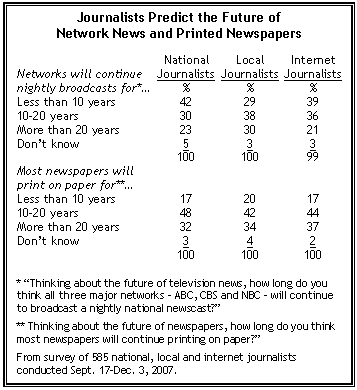
Speculation over Katie Couric’s future as anchor of the CBS Evening News has raised the broader question of how long the three nightly network news broadcasts will be able to survive. A survey of journalists, released last month, found that many news professionals were skeptical about the long-term viability of the three evening broadcasts.
Among national journalists surveyed, more than four-in-ten (42%) said they expect all three nightly network broadcasts to survive for fewer than 10 years. In fact national journalists were more pessimistic about long-term prospects for the three nightly network broadcasts than they were about printed newspapers; just 17% expected that most newspapers will continue printing on paper for less than a decade.
The survey of journalists was conducted Sept. 17-Dec. 3, 2007 among 585 reporters, editors and news executives by the Pew Research Center for the People & the Press and the Project for Excellence in Journalism. The national and internet journalists surveyed also gave sub-par grades to the network news shows for the quality of their coverage, rating them no better than cable outlets.

Just 41% of national journalists and 39% of internet journalists gave network TV news grades of A or B for their coverage. By contrast, large majorities of national and internet journalists gave high grades to the coverage provided by national newspapers and several online news sources, including news aggregator sites such as Google News and Yahoo News.
Local TV journalists gave very favorable ratings to network news coverage. Overall, 55% of local journalists gave network TV outlets grades of A or B. However, among this group, 66% of local broadcast journalists gave high marks to network TV news, compared with just 43% of local print journalists.

National TV and radio journalists also gave higher grades to the three TV networks than did national print journalists. Still, only about half of national TV and radio journalists (51%) gave the networks grades of A or B for coverage; 46% gave the networks lower grades. Only about a third of national print journalists (34%) gave grades of A or B for the coverage of network TV news.
Future of Nightly Broadcasts
National journalists — both print and TV/radio — offered a more negative assessment of the future of the three nightly newscasts than did their local counterparts. About four-in-ten national print journalists (44%) — and slightly fewer journalists at national radio and TV outlets (39%) — believe that all three network broadcasts will survive for less than 10 years. That compares with 33% of local print journalists and 26% of local TV journalists.