Pew Research Center

FOR RELEASE FEBRUARY 28, 2008

Obama Has The Lead, But Potential Problems Too

Increasing Optimism About Iraq

FOR MEDIA OR OTHER INQUIRIES:

Communications Department
202.419.4372
www.pewresearch.org

RECOMMENDED CITATION

Pew Research Center, February 2008, "Obama Has The Lead, But Potential Problems Too"

About Pew Research Center

Pew Research Center is a nonpartisan, nonadvocacy fact tank that informs the public about the issues, attitudes and trends shaping the world. It does not take policy positions. The Center conducts public opinion polling, demographic research, computational social science research and other data-driven research. It studies politics and policy; news habits and media; the internet and technology; religion; race and ethnicity; international affairs; social, demographic and economic trends; science; research methodology and data science; and immigration and migration. Pew Research Center is a subsidiary of The Pew Charitable Trusts, its primary funder.

© Pew Research Center 2026

Table of contents

  • About Pew Research Center
  • Obama Has The Lead, But Potential Problems Too
  • Section 1: General Election Patterns of Support
  • Section 2: Candidate Images
  • Section 3: The Primary Contests
  • Section 4: Opinions of the Parties and Congress
  • Section 5: Iraq, Afghanistan and Terrorism
  • About this Survey

Obama Has The Lead, But Potential Problems Too

Increasing Optimism About Iraq

Summary of Findings

Barack Obama is riding high as the March 4 primaries approach. Obama has moved out to a broad-based advantage over Hillary Clinton in the national Democratic primary contest and holds a 50%-43% lead over John McCain in a general election matchup.

However, the survey results point to several potential hazards for Obama. A solid majority of voters (56%) says Obama has not provided enough information about his plans and policies; in contrast, most voters say Clinton and McCain have disclosed enough information about their plans. Moreover, a plurality of voters (43%) says that Obama would not be “tough enough” in dealing with foreign policy and national security issues.

The latest survey by the Pew Research Center for the People & the Press, conducted Feb. 20-24 among 1,508 adults, also finds signs of trouble for the GOP’s frontrunner. Even as there are indications McCain is consolidating his support within the Republican base, nearly half of conservative Republicans (46%) say his positions on the issues are not conservative enough. McCain’s image among independent voters has slipped since early February, and currently Obama edges McCain by 49% to 43% among independents in a general election matchup.

However, public attitudes about the war in Iraq have turned more positive, which is a favorable development for McCain. A steadily growing number of Americans say progress is being made in Iraq. Moreover, 47% now favor keeping U.S. troops in Iraq until the situation there has stabilized, the highest percentage expressing this view in well more than a year.

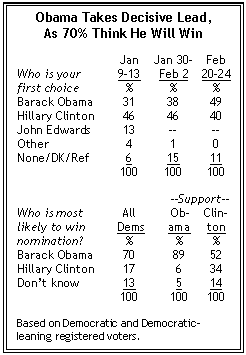
Perceptions of how things are going in Iraq are strongly correlated with support for McCain, among Republicans, Democrats and independents. For example, in a matchup against Barack Obama, McCain does 31 points better among independents who believe the war is going well than among those who think it is not going well. Hillary Clinton’s support levels have slipped across the board among Democrats. Clinton leads Obama only among white women voters, those ages 65 and older, and voters with household incomes of less than $30,000 a year. In addition, overcoming voters’ perceptions of Obama’s momentum is a major challenge for Clinton. Fully 70% of Democratic voters — including 52% of those who support Clinton — say that Obama is most likely to win the Democratic presidential nomination.

Nonetheless, Clinton fares nearly as well as Obama in a head-to-head matchup with McCain, however. The New York senator runs better than Obama among self-described Democrats in the general election test, although Obama fares better than Clinton among independents.

Democratic Base Fissures

Although attention has been focused on McCain’s problems with the GOP base, there are indications that some Democrats might defect if Obama is the party’s nominee. Overall, 20% of white Democratic voters say they would vote for McCain if Obama is the Democratic nominee. That is twice the percentage of white Democrats who say they would support McCain in a Clinton-McCain matchup. Older Democrats (ages 65 and older), lower-income and less educated Democrats also would support McCain at higher levels if Obama rather than Clinton is the party’s nominee.

The three leading presidential candidates have divergent images, which are reflected in the words that voters use to describe Obama, Clinton and McCain. In general, the single words used to describe Obama are very positive, but the word “inexperienced” is used most frequently to describe the Illinois senator.

“Experienced” is the word used most often to describe Clinton, with the words “strong” and untrustworthy” also mentioned frequently. For McCain, the word “old” is used most often as a descriptor, far outnumbering mentions of “honest,” “experienced” and “patriot.”

Nearly a third of all voters (32%) believe that, at 71 years old, McCain is too old to be president, while 66% say that being 71 does not make him too old. Opinions about whether McCain is too old to be president are comparable with views about Bob Dole during the 1996 campaign. In March 1996, 34% said Dole, who would have been 73 upon inauguration, was too old, while 63% said he was not.
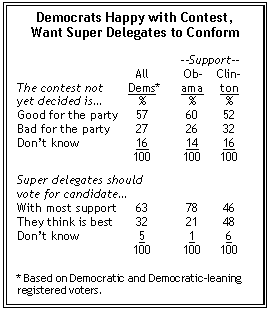
Despite McCain having nearly secured the Republican nomination, freeing him to focus on the general election, most Democrats say the extended contest between Obama and Clinton has been good for the party. Nearly six-in-ten Democratic voters (57%) say the fact that the primary contest is not yet decided is a good thing for the Democratic Party.

There also is broad agreement among Democrats that if neither Obama nor Clinton wins enough support to gain the nomination, the party’s super delegates should support the candidate who has won the most support, rather than the one they personally think is best.

By roughly two-to-one (63% to 32%), more Democratic voters say the super delegates — primarily current and former elected officials and members of the Democratic National Committee — should vote for the candidate who was won the most support in caucuses and primaries. Far more Obama supporters than Clinton supporters say that super delegates should back the candidate who has won the most support during the primaries (78% vs. 46%).

Improvement in Iraq

The survey finds a marked improvement in perceptions of the situation in Iraq over the past year. As was the case in November, as many people say the military effort there is going well as say it is not going well (48% each). A year ago, negative perceptions of the situation in Iraq outnumbered positive assessments by greater than two-to-one (67% to 30%).
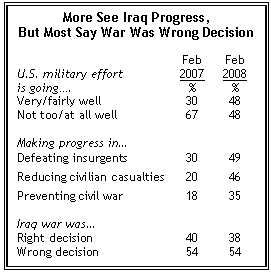
Opinions about progress toward specific objectives, such as defeating the insurgents and reducing civilian casualties, also have become much more positive. In addition, the proportion saying the United States is making progress in preventing a civil war in Iraq has approximately doubled in the past year (from 18% to 35%), though a greater percentage (49%) still says the United States is losing ground in preventing civil war.

Despite the more positive outlook, the balance of opinion about the decision to take military action in Iraq is about the same now as it was a year ago. A majority (54%) says the war was the wrong decision, while 38% say it was the right decision. The balance of opinion on whether the war was right is nearly identical to what it was in February 2007 (54% wrong vs. 40% right).

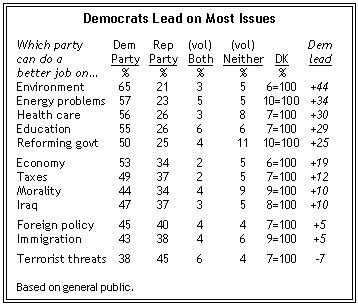
Democrats hold a significant advantage as the party better able to handle Iraq, and have even larger leads on nearly every other issue. By 47%-37%, more people say the Democratic Party rather than the Republican Party is better able to make wise decisions about Iraq. Notably, a majority (53%) also says the Democrats are better able to handle the economy, which has become the leading issue in the presidential campaign. Terrorism is the only issue on which the Republican Party holds even a modest lead (45% to 38%); however, its advantage on dealing with the terrorist threat was approximately twice as great during the 2004 campaign.

In this regard, the poll finds a majority of the public giving the Bush administration credit for preventing another terrorist attack on the U.S. in recent years. More than six-in-ten Americans say the policies and actions Bush has pursued have had a great deal (28%) or fair amount (34%) to do with keeping America safe.
Section 1: General Election Patterns of Support

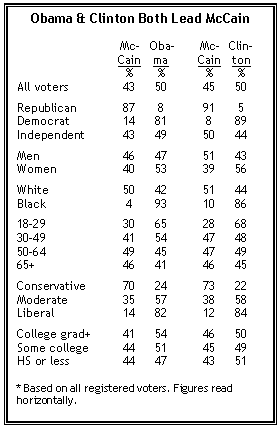
Obama and Clinton both hold modest leads over McCain in a general election matchup; Obama has a 50% to 43% lead and Clinton holds a 50% to 45% edge. But Clinton draws more universal support among Democrats (89%) than does Obama (81%). Conversely, Obama leads McCain slightly among independents (49% to 43%), while McCain edges Clinton among this group by the same margin. There is no evidence that either Obama or Clinton attracts much support from Republicans.

Obama and Clinton both show strength among younger voters and women. But there are demographic differences evident in their respective matchups with McCain. Obama leads McCain among 30-49 year-olds by 13 points, while these voters are divided almost evenly if the race is between Clinton and McCain. Both Democrats run about even with McCain among voters ages 50 and over.

While women favor either possible Democratic nominee over McCain in a general election matchup, Obama fares somewhat better than Clinton among men. Obama runs even with McCain among all male voters (47% Obama to 46% McCain), but McCain holds a 51% to 43% advantage over Clinton among men.

Obama’s Appeal to Independents

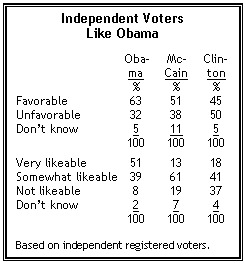
Obama has much greater personal appeal to independent voters than does either McCain or Clinton. Fully 63% of independents rate Obama favorably, nearly twice the percentage expressing an unfavorable view of him (32%). The balance of opinion toward McCain also is favorable, but by a much slimmer 51% to 38% margin. The share of independents with an unfavorable view of Clinton is substantially higher (50%), while just 45% view her favorably.

Roughly half of independent voters (51%) say they personally find Obama very likeable, which is far greater than the percentages saying they find either Clinton (18%) or McCain (13%) very likeable. A substantial minority of independents says that Clinton is not likeable; 37% express this view about Clinton, compared with 19% for McCain and just 8% for Obama.

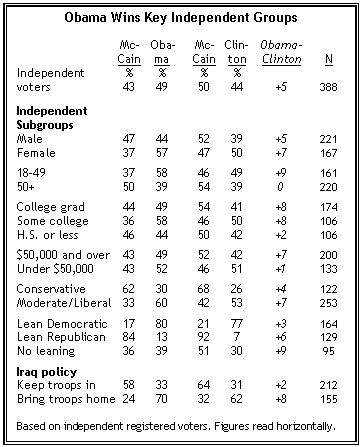
In a general election test against McCain, Obama runs slightly better than Clinton among most subgroups of independent voters. But he shows particular strength among younger and well-educated independents. Obama leads McCain by 21 points among independents under age 50 (58% to 37%); these same younger independents split their vote almost evenly in a race between Clinton and McCain (49% vs. 46%).

In addition, Obama holds a slight 49% to 44% edge among independent college graduates by five points. Clinton trails McCain among this group by 13 points (41% to 54%).

Obama also holds a 20 point lead over McCain among female independent voters (57% to 37%). Clinton’s edge over McCain among independent women is just three points (50% to 47%).

Clinton Draws More Support Among Democrats

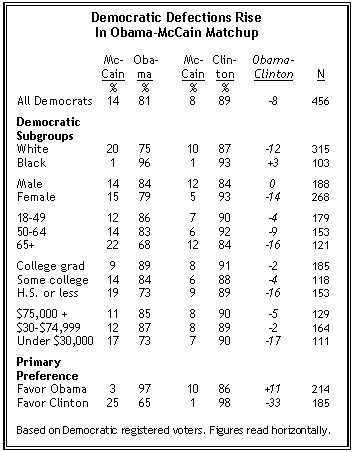
The vast majority of Democratic voters say they would support either Obama or Clinton over McCain. But in an Obama-McCain matchup, 14% of Democratic voters say they would support McCain, compared with 8% who would do so if Clinton is the nominee.

One-in-five white Democrats (20%) say that they will vote for McCain over Obama, double the percentage who say they would switch sides in a Clinton-McCain matchup (10%). Roughly the same number of Democrats age 65 and older say they will vote for McCain if Obama is the party’s choice (22%). Obama also suffers more defections among lower income and less educated Democratic voters than does Clinton.

In addition, female Democrats look at the race differently depending on the matchup. While 93% of women in the party say they would vote for Clinton over McCain, just 79% say they would support Obama over McCain.

A quarter of Democrats (25%) who back Clinton for the nomination say they would favor McCain in a general election test against Obama. The “defection” rate among Obama’s supporters if Clinton wins the nomination is far lower; just 10% say they would vote for McCain in November, while 86% say they would back Clinton.

Obama’s Foreign Policy Challenge

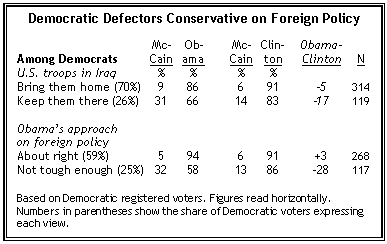
Obama suffers a significant number of defections from Democrats with more conservative foreign policy views, particularly on the issue of Iraq. A large majority of Democrats — 70% — say they want U.S. troops in Iraq to return home as soon as possible; these Democrats overwhelmingly favor either Obama or Clinton over McCain. But roughly a quarter of Democrats believes the troops should remain in Iraq until the situation has stabilized. These voters would support Clinton over McCain by greater than five-to-one (83% vs. 14%). Democrats who support maintaining U. S. forces in Iraq would support Obama over McCain by a smaller margin (66% to 31%).

Similarly, concerns about Obama’s foreign policy among a minority of Democrats also cut into Obama’s standing. A quarter of Democratic voters believe that Obama would not be tough enough in his approach to foreign policy issues; about a third (32%) of these Democrats say they will vote for McCain if Obama wins the nomination. Just 13% of these same Democrats would switch sides if Clinton wins the nomination.

Wary Republicans Rally to McCain

There is little evidence that a significant number of Republican voters find either Obama or Clinton to be acceptable alternatives to John McCain — fully 87% back him in a contest against Barack Obama, and 91% back him if Clinton wins the Democratic nomination.

Yet many Republicans are skeptical about McCain’s commitment to conservative positions. Overall, 38% of Republicans, including 46% of conservative Republicans, believe that McCain’s positions on issues are not conservative enough. But that perception does not appear to have hurt McCain’s image, or support, among GOP voters.

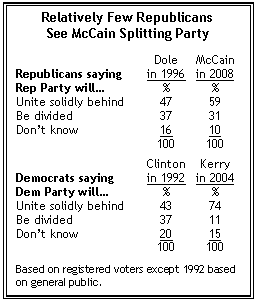
Only a minority of Republicans (31%) believe that differences and disagreements within the party will keep many Republicans from supporting McCain. Instead, roughly six-in-ten (59%) say that the Republican Party will unite solidly behind McCain as their candidate. Notably, the belief that the party can unite behind McCain is equally widespread among both conservative (61%) and moderate and liberal (60%) Republicans.

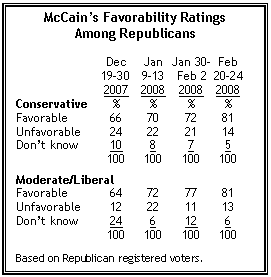
In fact, John McCain’s overall favorability rating among Republican voters has risen sharply, from 65% on the eve of the Iowa caucuses to 80% today. This increase has come across the ideological spectrum. Since late December, McCain’s favorability among conservative Republicans has increased from 66% to 81%, and it is up from 64% to 81% among moderates and liberals in the party.

In fact, conservative Republican voters now rate McCain about as favorably as they do George W. Bush; 81% have a favorable opinion of McCain while 85% have a favorable opinion of Bush. McCain is held in substantially higher regard than the president among moderate and liberal Republicans (81% favorable vs. 63% for Bush).

McCain Seen as Less Divisive Than Dole in 1996

The proportion of Republican voters who believe that their party will unite solidly behind John McCain (59%) exceeds the share of Republicans voters who thought that about Bob Dole in 1996 (47%). Just 31% now say that differences and disagreements in the party will keep many Republicans from supporting McCain, compared with 37% who said that about Dole in 1996.

In 1992, Democrats were divided about prospects the party would unite behind Bill Clinton. Four years ago, an overwhelming proportion of Democrats expected the party to unite behind John Kerry.

Section 2: Candidate Images

While McCain’s image has improved among Republicans, it has slipped decidedly among both Democrats and independents in recent weeks. As a result, the share of registered voters who say they have an unfavorable view of the likely Republican nominee is at a new high of 38%, up from 31% on the eve of Super Tuesday.

Historically, John McCain has not been a polarizing political figure. As recently as two years ago, he received comparably favorable marks from Republicans (61%), Democrats (56%) and independents (57%). But as he has moved closer to winning the GOP nomination, Democratic views of McCain are becoming increasingly critical. Currently, about twice as many Democrats have an unfavorable opinion of McCain as have a favorable view (57% vs. 29%, respectively). Just three weeks ago, Democratic views of McCain were divided (44% unfavorable vs. 42% favorable).

More independent voters also express unfavorable opinions of McCain in the current survey. A narrow majority of independents (51%) now expresses a positive view of McCain, but 38% say they have an unfavorable impression, up 13 points in less than a month.

McCain’s Age an Issue

The vast majority of registered voters (72%) say they do not think John McCain is too old to be president. But about a quarter (26%) say they think he is too old, and this proportion rises to nearly a third (32%) when voters are informed that McCain is currently 71 years old. Concerns about McCain’s age are nearly identical to how voters felt about Bob Dole’s age at a comparable point in the 1996 campaign, according to polls by Gallup and the Los Angeles Times.

In general, McCain’s age is of greater concern to older voters than it is to younger voters. Just 24% of voters under age 35 themselves believe that, at 71, McCain is too old to serve. But among voters who themselves are of retirement age, 40% say that McCain is too old.

Democrats are more than twice as likely as Republicans (33% vs. 14%) to say that McCain is too old to be president, even when his age is not mentioned. Democrats react even more negatively when informed that McCain is 71 years old. About half of Democrats (52%) say that, at 71, McCain is too old, compared with just 16% of Republicans. For independents, roughly a quarter expresses concern about McCain’s age, regardless of whether his current age of 71 is mentioned or not.

Views of the Candidates: Disclosing Plans, Policies

A majority of voters (56%) say that Obama has not provided enough information about his policies and plans for the country. By comparison, just 28% say that Clinton has said too little about her plans and policies, while 37% say that about McCain.

Perceptions that Obama has not provided enough information about his positions are especially apparent among Republicans (71%), but a solid majority of independents (60%) and a considerable minority of Democratic voters (43%) share this concern.

Among Democratic voters, a solid majority of Obama supporters (70%) believes that he has provided sufficient information about his policy plans, but just 28% of Clinton supporters agree. By contrast, 72% of Obama supporters and 87% of Clinton supporters believe that Clinton has provided enough information about her plans and policies.

Foreign Policy Ratings

A sizable minority of voters also expresses concern that Obama’s approach to foreign policy and national security would not be tough enough; 43% say this, compared with 39% who say it would be about right. In contrast, 47% say McCain’s approach would be about right and 44% say Clinton’s would be.

Concern that Obama’s approach to foreign policy and national security would not be tough enough is more widespread among Republican and independent voters (70% and 45%, respectively), but as many as a quarter of voters in Obama’s own party also say he would not be tough enough.

McCain, in turn, is seen by some voters as too tough in dealing with foreign policy and national security. Fully 37% of Democratic voters and 28% of independent voters worry that McCain would be too tough.

Candidate Likeability

Voters have a more positive opinion of Barack Obama personally than they do of Hillary Clinton and John McCain. Fully 85% say Obama is likeable, compared with 76% and 63% who say the same about McCain and Clinton, respectively. And while solid majorities see all three candidates as at least somewhat likeable, fully half say Obama is very likeable. By comparison, just 26% of voters say Clinton is very likeable and even fewer (21%) say the same about McCain.

On balance, Obama and McCain are viewed as personally likeable by voters in their respective parties as well as by members of the opposing party. Nearly eight-in-ten Republican voters (79%) say Obama is at least somewhat likeable and 68% of Democratic voters view McCain as likeable. Conversely, Clinton has little crossover appeal to voters, personally. Fully six-in-ten Republicans say the New York senator is not likeable.

Not surprisingly, those in Obama’s own party are especially likely to offer a strong positive assessment of the Illinois senator — nearly six-in-ten Democrats (59%) say he is very likeable. But Obama is also seen as very likeable by a majority of independent voters (51%) and by a substantial minority of Republicans (37%).

Hillary Clinton and John McCain, on the other hand, are seen as very likeable by considerably fewer independent voters (18% and 13%, respectively). Among Democrats, 44% say Clinton is very likeable, and just about a third (32%) of Republicans express that opinion about their own party’s frontrunner.

Candidate One-Worders

“Inexperience” is the word that most often comes to the minds of voters when asked for the single word that best describes Barack Obama. On balance, however, more voters use positive words than negative ones to describe Obama. His charisma and intelligence are the second and third most commonly mentioned qualities, and such words as “change,” “inspirational,” “young,” and “new” also are mentioned frequently.

In contrast with Obama, the one word most commonly volunteered to describe Hillary Clinton is “experienced.” She also is seen as “intelligent,” “smart,” “knowledgeable,” and “strong,” which has been a top descriptor of Clinton since the mid- to late-1990’s. Yet negative words also are used to describe Clinton, with “untrustworthy” the most common.

McCain is most often described as “old,” but voters also frequently use the words “honest,” “experienced,” and “patriot” to describe him. McCain’s ideology also is on the minds of voters, as several called him “conservative.”

Section 3: The Primary Contests

Barack Obama has taken a nine-point lead over Hillary Clinton among Democratic voters nationwide. Currently, 49% of Democratic and Democratic-leaning registered voters say he would be their first choice for the nomination, while 40% name Clinton as their first choice. This is a reversal of the eight-point lead Clinton held just three weeks ago.

Far more overwhelming, however, is the impression that Barack Obama is going to win. Seven-in-ten Democrats (70%) say Obama is most likely to win the party’s nomination, while just 17% see Clinton as the likely victor. Even a majority (52%) of Clinton’s backers say they think Obama is likely to emerge as the winner. Barely a third (34%) of Clinton backers predict that she will win the nomination.

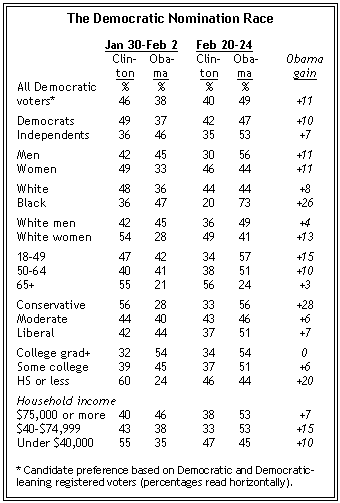
Since early February, Obama has made substantial gains among conservative Democratic voters, African Americans, and those with a high school education or less. He has now pulled even with Clinton among non-college voters, gaining 20 points among this group since early February.

Obama also has gained 11 points among a core Clinton constituency, Democratic women — ncluding 13 points among white Democratic women. He leads Clinton among voters younger than 65, and middle- and upper-income Democratic voters. He now matches Clinton’s support among white Democrats, and holds a commanding 73% to 20% lead among black voters.

GOP Primaries: McCain’s Broad Gains

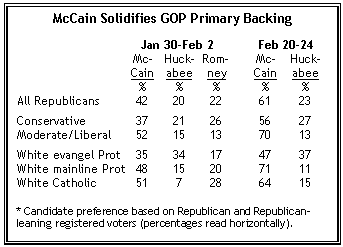
John McCain’s support now spans all major segments of the Republican Party, including conservatives and white evangelical Protestants. He is the first choice nominee of 61% of Republican voters nationwide, up from 42% three weeks ago before the “Super Tuesday” primaries and Mitt Romney’s departure from the race. His support among Conservatives is up 19 points from 37% to 56%, and up 18-points among moderate and liberal Republicans as well. While McCain and Huckabee split the white evangelical Protestant vote three weeks ago, McCain now holds a 10-point lead, though still just shy of a majority (47% McCain, 37% Huckabee).

Section 4: Opinions of the Parties and Congress

The Democratic Party holds a double-digit advantage over the GOP on nine of 12 issues tested, including dealing with the economy, making wise decisions about the war in Iraq, and improving morality in this country.

Majorities say the Democrats can better deal with the economy (53% vs. 34%) and with the nation’s energy problems (57% vs. 23%). The Democratic Party has also opened even larger leads on traditional Democratic strengths like education (55% vs. 26%), health care (56% vs. 26%), the environment (65% vs. 21%), and government reform (50% vs. 25%).

On the environment, even many Republicans believe the Democratic Party, rather than their own party, can better handle the issue. More than four-in-ten Republicans (44%) say the Democratic Party could do a better job of protecting the environment, with about the same percentage of Republicans saying the GOP could do better (43%).

The public also gives the Democrats the edge on issues on which the Republican Party has often held the advantage. Fully 44% favor the Democratic Party when it comes to improving morality in this country, compared with about a third (34%) who favors the GOP. And on making wise decisions about foreign policy, slightly more now say the Democrats can do a better job than the Republicans (45% vs. 40%).

On only one of the 12 issues tested, dealing with terrorist threats at home, is the Republican Party trusted to do a better job: 45% favor the GOP and 38% favor the Democrats. But the GOP advantage has narrowed considerably over the last six years. In January 2002, the Republican Party led the Democratic Party by 30 percentage points on dealing with terrorist threats. The Republican lead had been cut in half by summer of 2004, and it stands at just seven percentage points in the current poll.

Early Look at Anti-Incumbent Sentiment

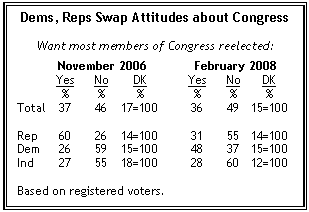
Overall, American voters’ opinions about whether most members of Congress should be reelected have hardly budged since November 2006, just prior to the midterm election in which Democrats gained the majority in both chambers. About half of voters (49%) say they do not want most members returned to Washington, while 36% say most representatives should keep their jobs.

However, attitudes have shifted dramatically among Republicans and Democrats, reflecting the shift in partisan control of Congress. In November 2006, six-in-ten Republicans said they wanted most members of Congress to be reelected. That percentage has fallen by about half — to 31% — in the current survey. Before the 2006 midterms, only about a quarter of Democrats (26%) wanted most representatives to keep their seats; currently, nearly half of Democrats (48%) say they want most Congress members to stay in place. During both surveys, solid majorities of independents expressed the view that most congressional representatives should not be reelected.

As is typically the case, far more voters say they want to see their own member of Congress reelected than say that most members should be reelected. Currently, 60% say they would like to see their own representative reelected, up slightly from the end of the 2006 campaign (55%).

When it comes to whether their own Congress member should be reelected, Democrats have become notably more positive. Currently, 66% favor their own representative’s reelection, up from 52% in November 2006. More independents also say they would like their representative to be reelected (53% now, 45% in November 2006). There has been no significant change in attitude among Republicans; at both points, more than six-in-ten Republicans wanted their own Congress member retained.

Section 5: Iraq, Afghanistan and Terrorism

Public perceptions of the situation in Iraq have become significantly more positive over the past several months, even as opinions about the initial decision to use military force remain mostly negative and unchanged.

The number of Americans who say the military effort is going very or fairly well is much higher now than a year ago (48% vs. 30% in February 2007). There has been a smaller positive change in the number who believe that the U.S. will ultimately succeed in achieving its goals (now 53%, up from 47% in February 2007).

Opinion on the critical question of whether the U.S. should keep troops in Iraq is now about evenly divided, the first time this has happened since late 2006. About half of those surveyed (49%) say they favor bringing troops home as soon as possible, but most of these (33%) favor gradual withdrawal over the next year or two, rather than immediate withdrawal. Similarly, just under half (47%) say that the U.S. should keep troops in Iraq until the situation has stabilized, with most of these (30%) saying that no timetable should be set.

Perceptions of Progress

Public perceptions about U.S. progress in Iraq continue to improve. In fact, in a number of areas those with positive evaluations outnumber those with negative views.

For the first time since Pew began tracking the question in December 2005, more respondents say that the United States is making progress in reducing civilian casualties (46%) than say it is losing ground (40%). Similarly, 49% now say the United States is making progress in defeating the insurgents, while just 35% say it is losing ground. A majority (57%) now says the U.S. is making progress in training Iraqi military forces (29% say the U.S. is losing ground).

Even on the key political objective of establishing democracy in Iraq, a plurality (49%) says the U.S. is making progress (vs. 40% who say the U.S. is losing ground). This is the first time since the fall of 2006 that a plurality sees progress on this measure. On another key objective, however, the plurality view remains negative. While more now say the U.S. is making progress in preventing a civil war between various religious and ethnic groups (35% now vs. 18% a year ago), just under half says the United States is losing ground on this objective (49% vs. 68% a year ago).

Despite the positive views about progress in many areas, the public remains divided on the question of whether the U.S. presence is helpful or harmful to the Iraqi government. Currently, 44% say that the U.S. military presence does more to weaken the Iraqi government by making them too dependent on us; 43% say that the U.S. presence strengthens the Iraqi government by giving it needed support.

Views of the war continue to differ greatly by partisan affiliation. Republicans have consistently been more likely than independents and Democrats to say the use of military force was the right decision, that the war is going well, and that troops should remain in Iraq until the situation has stabilized. This is still true, but all partisan groups have become more positive about the war.

For example, far more Republicans now than in February 2007 see progress in defeating the insurgency (49% now vs. 30% then). This also is the case for Democrats and independents.

A similar pattern is seen on reducing civilian casualties, preventing civil war, and others.

In addition, somewhat more Democrats now than a year ago believe that U.S. troops should remain in Iraq. Currently, 81% of Republicans favor keeping troops in Iraq, the highest percentage recorded since the beginning of 2004. Nearly half of independents (49%) agree, the highest percentage in more than a year. And while only 27% of Democrats hold this view, this is also higher than it has been since January 2007.

Opinions about Afghanistan

Compared with Iraq, many more Americans say that the U.S. made the right decision in using military force in Afghanistan (65%, vs. 38% for Iraq). And while opinion on keeping troops in Iraq is divided, a solid majority (61%) favors keeping U.S. and NATO troops in Afghanistan until the situation has stabilized. The percentage saying the troops should remain in Afghanistan has increased since last May (50% then, 61% today).

However, perceptions of the military situation in Afghanistan are no more favorable than views of Iraq. In each case, 48% say things in the country are going very or fairly well.

As in Iraq, more Republicans than Democrats say the military effort in Afghanistan is going well (71% vs. 38% for Democrats and 46% of independents). More Republicans also say that the U.S. made the right decision in using military force there (85%), although majorities of Democrats (53%) and independents (67%) agree. This difference between Republicans and Democrats (32 points) is smaller than for Iraq, where the partisan gap is 59 points.

Overall support for keeping troops in Afghanistan is higher now than it was about a year ago (61% now, 50% in May 2007). Support for keeping troops in Afghanistan has increased more among Democrats and independents than among Republicans during this time period.

Bush Gets Credit on Terrorism

The president’s overall job approval rating remains low, at 33%, but the public gives his administration considerable credit for preventing terrorist attacks in the United States since 9/11.

More than six-in-ten Americans (62%) say the Bush administration’s policies have had a great deal (28%) or a fair amount (34%) to do with the fact that there have been no terrorist attacks in the United States since 2001. Only about a third (35%) says Bush policies have had not too much or nothing at all to do with the absence of attacks.

Opinions about the administration’s role in preventing terrorism, like other views about Bush and his policies, are deeply divided politically. Nearly half of Republicans (49%) say the administration’s policies and actions have had a great deal to do with the fact that there have been no attacks in more than six years; just 14% of Democrats agree.

Nonetheless, nearly half of Democrats (47%) say those policies have had at least a fair amount to do with the absence of attacks since 2001. A solid majority of conservative and moderate Democrats (56%) credits the administration’s policies with preventing attacks, compared with just 37% of liberal Democrats.

Most See Terrorists’ Capabilities as Undiminished

A solid majority of Americans (66%) say the government has done very well or fairly well in reducing the threat of terrorism. In January 2007, somewhat fewer people (54%) gave the government good ratings in reducing the terrorist threat. The current measure is in line with positive ratings from 2004 to 2006.

Yet most people say that the ability of terrorists to launch a major attack remains greater or the same as it was at the time of the Sept. 11, 2001 attacks. Overall, 16% believe terrorists’ ability to strike is greater than it was then; 41% say their ability is the same. This compares with 39% who say that the ability of terrorists to attack the United States is less now than on 9/11.

There have been some fluctuations in opinions about terrorists’ capabilities since 2002, but majorities have consistently said that terrorists are at least as capable of launching a major attack on the United States as they were at the time of 9/11. Most Republicans (55%) say terrorists are now less able to strike the United States, but only about a third of independents (35%) and Democrats (34%) agree.

Evaluating Anti-Terrorism Policies

As in previous surveys, more people say their bigger concern about U.S. anti-terrorism policies is that they have not gone far enough to adequately protect the country than say the policies have gone too far in restricting civil liberties.

About half (47%) say anti-terrorism policies have not gone far enough in protecting the country while 36% say their greater concern is that they have infringed upon the civil liberties of average Americans. In August 2006, more than twice as many said their greater concern was that the policies inadequately protected the country than cited restrictions on civil liberties (55% vs. 26%).

The balance of opinion among Democrats about anti-terrorism policies has changed considerably since August 2006. At that time, half of Democrats said their greater concern was that government policies had not gone far enough in protecting the country while just a third said they were more worried that the policies went too far in restricting civil liberties. Currently, by a 47%-39% margin, more Democrats say their greater concern is that anti-terrorism policies have restricted civil liberties. Most Republicans and independents continue to express more concern that anti-terror policies have done too little to protect the United States.

Public attitudes regarding specific Bush administration anti-terrorism policies remain divided and highly politicized. A narrow majority (52%) continues to say it is right for the government to monitor the communications of suspected terrorists, without first getting court permission; 44% say this practice is generally wrong. Opinions on this issue have been stable for the past two years.

Views on whether the use of torture against suspected terrorists can be justified to gain important information also have changed little in recent years. Currently, 17% say the use of torture in such circumstances is often justified, 31% say it can be sometimes justified, while half say it either can be rarely (20%) or never justified (30%).

There is somewhat greater agreement that the government’s policies toward the detainees the United States is holding at Guantanamo Bay, Cuba are fair rather than unfair. More than half of the public (52%) views these policies as fair

Nearly twice as many Republicans as Democrats believe it is right for the government to conduct surveillance of suspected terrorists without court permission (74% vs. 39%). The partisan differences in views of the treatment of Guantanamo detainees are nearly identical; 73% of Republicans say the government’s policies toward detainees are fair, compared with 39% of Democrats.

In addition, 31% of Republicans, but just 12% of Democrats, say that the torture of suspected terrorists to gain important information is often justified. By 38% to 14%, more Democrats than Republicans say the use of torture in such circumstances is never justified.

Obama vs. Clinton Supporters on Terrorism

Democratic supporters of Obama and Clinton also differ on several anti-terrorism policies. By greater than two-to-one (65% to 31%), Democratic voters who support Obama believe that government surveillance of suspected terrorists, without court permission, is generally wrong. Clinton supporters are much more closely divided — 51% say such monitoring is wrong, while 47% say it is generally right.

There are significant, though smaller, differences over other issues. A solid majority of Obama supporters (56%) say that government policies toward Guantanamo detainees are unfair, compared with 47% of Clinton supporters. And somewhat more Obama voters than Clinton voters say their greater concern over anti-terrorism policies is that they go too far in restricting civil liberties (47% vs. 37% of Clinton supporters).

About this Survey

Results for this survey are based on telephone interviews conducted under the direction of Princeton Survey Research Associates International among a nationwide sample of 1,508 adults, 18 years of age or older, from February 20-24, 2008. The following table shows the error attributable to sampling that would be expected at the 95% level of confidence for different groups in the survey:

In addition to sampling error, one should bear in mind that question wording and practical difficulties in conducting surveys can introduce error or bias into the findings of opinion polls.