
Nation’s Real Estate Slump Hits Wealthy Areas
Republicans' Views of Economy Sour
Summary of Findings
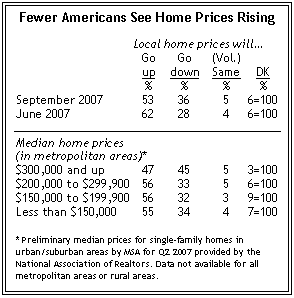
Public assessments of the nation’s economy have fallen to a two-year low, and the nation’s economic outlook remains relatively gloomy. In particular, faced with a steady stream of negative news about the U.S. housing market, Americans are substantially less inclined than they were even a few months ago to say they expect home prices to increase over the next few years. People living in areas with the most expensive homes and middle-income Americans are particularly likely to say that future home prices will decline.
Overall, 53% of Americans think local housing prices will climb in the next few years, down from 62% in June, while the number expecting prices to fall has increased from 28% to 36%. Market predictions differ by the value of housing near where a person lives. In metropolitan areas where the median single-family home sells for $300,000 or more, nearly as many people believe prices will go down (45%) in coming years as say prices will go up (47%). By comparison, most people in metropolitan areas where home prices are lower foresee at least modest gains in housing values.1
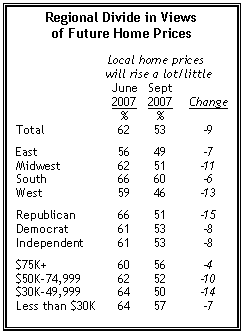
Nationally, Republicans, middle-income Americans and residents of the West and Midwest have become less bullish about the real estate market. Only about half of Republicans (51%) now believe that home prices will rise in coming years, down from 66% in June. Fewer people with annual household incomes of between $30,000 and $49,999 also see house prices increasing (50% vs. 64% in June). Regionally, the largest decline has come in the West (13 points), followed by the Midwest (11 points). Southerners are slightly less likely to say prices will go up than they were in June, but they are substantially more likely to say so than people living in any other region.
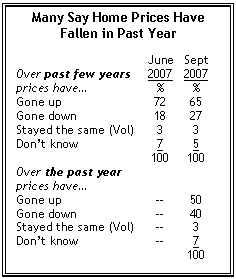
The national survey by the Pew Research Center for the People & the Press, conducted September 12-16 among 1,501 adults, finds that a solid majority (65%) believes that over the past few years, home prices have gone up a lot or a little in their areas. However, the proportion saying that home prices have gone down over the past few years has jumped up in just the last three months — from 18% to 27% currently.
Moreover, people have decidedly different impressions of local real estate conditions over the past year than over the past few years. Just half of Americans say that, over the past 12 months, home prices have gone up in their areas, while 40% say prices have declined. By contrast, 65% say prices have gone up over the past few years, while fewer than half as many (27%) say prices have fallen over this longer timeframe.

People who live in areas with higher-cost housing are the most likely to say prices have gone down over the past year. A solid majority (54%) of those living in metropolitan areas with median home prices of $300,000 or more say home prices in their area are lower today than they were a year ago. That view is shared by 44% of those living in areas with median prices in the $200,000 to $299,000 price range. By contrast, the majority of people living in less costly areas say that home prices in their communities have risen in the past year.
Nationally, those with higher incomes more often say prices in their areas have fallen: 52% of those in households with annual incomes of $75,000 or more in income say prices have gone down, compared with 32% for those in households with incomes of less than $30,000.
Regionally, Midwesterners are the most inclined to believe that prices had fallen in their areas, followed closely by Westerners. Suburbanites are substantially more likely than their urban or rural counterparts to note declines in home prices, and those with more than a high school education see declines more often that those with a high school diploma or less education.
More Republicans than independents or Democrats say home prices have fallen. This follows a larger trend seen in the latest poll in which Republicans have adopted more negative views on several key economic questions.
Homeowners and Renters

Home owners and renters have starkly different views of the real estate market. Homeowners are evenly divided over whether prices in their area have risen (45%) or fallen (46%) from a year ago. But renters, by greater than two-to-one (60% vs. 27%) say that prices have continued to rise. In fact, fully 39% of renters say home prices in their area have gone up “a lot” from a year ago, compared with 23% of homeowners.
When it comes to where the real estate market is headed, there is less of a difference of opinion. On balance, both homeowners and renters see prices rising in coming years, though again, more renters expect substantial increases. Overall, 24% of renters expect home prices to go up “a lot,” compared with 14% of homeowners.
Negative Views of Economy
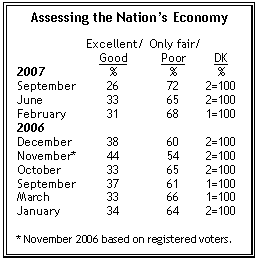
Americans are not optimistic about national economic conditions or the country’s financial future. More than seven-in-ten (72%) rate the economy as “only fair” or “poor,” while only about a quarter (26%) says the economy is “excellent” or “good.” Looking ahead, most people (53%) expect national economic conditions to be the same a year from now, while others are split over whether it will be better (19%) or worse (23%).
Positive views of the economy have slipped since June, when 33% rated the economy as excellent or good. Opinions about the economy remain divided along partisan lines, with Republicans expressing more positive views than either Democrats or independents. But Republicans are noticeably less upbeat than they were in the summer.

Currently 46% of Republicans say the economy is excellent or good, down from 56% in June. Independents also are slightly less positive about the economy; 23% say the economy is excellent or good, compared with 29% in June. Democratic opinions have shown less change, but Democrats remain overwhelmingly negative about the state of the economy.
College graduates and people with relatively high annual household incomes also express less positive opinions about the economy than in June. The proportion of each group saying that the economy is excellent or good has declined by 10 percentage points.
When asked for a one-word impression of the economy, most Americans (64%) offer negative terms, such as “poor,” “bad,” “terrible” or “unstable.” Just 14% use positive words to describe the economy, with “good” mentioned most frequently. Another 16% offer a neutral word or phrase.
Substantial numbers in nearly every demographic and political group cite negative words to characterize their view of the economy. Even among Republicans, negative words outnumber positive ones by 51% to 26%, with 20% using a neutral word or phrase.
Economic Outlook
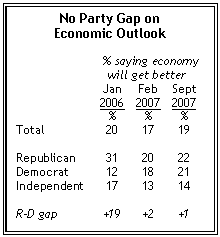
When Americans are asked to predict what the economy will be like in a year, independents tend to be the most cynical. Just 14% think economic conditions will be better next year, while about twice as many (30%) predict things will get worse. Independents have been fairly consistent on this question in recent years: in January 2006, 17% said the economy would get better, and 13% said the same in February of this year.
At the start of 2006, 31% of Republicans said the economy would get better over the coming year, compared with just 12% of Democrats. But by February 2007, Republican optimism dropped 11 points to 20%, while Democratic optimism shifted up six points to 18%. Little has changed since February; in the most recent poll 22% of Republicans expect the economy to improve, as do 21% of Democrats.
Personal Financial Situation
Americans are divided when it comes to assessing their personal finances. However, people’s views of their personal finances are more positive than their opinions of the national economy.

Half of Americans say their personal finances are fair or poor, virtually matched by the 48% who say their finances are good or excellent. Republicans are much more upbeat about their own financial situations. More than six-in-ten Republicans (63%) say their finances are excellent or good, while only 43% of Democrats and 45% of independents say the same.
Men are slightly more positive than women about their finances (51% to 46% excellent or good), while whites are almost twice as likely to say their finances are excellent or good than are blacks (51% vs. 27%). Not surprisingly, those who have the highest incomes are most likely to say their finances are in good or excellent shape: Almost eight-in-ten people (77%) with household incomes of $75,000 or more say so, while only 33% of those making less than $30,000 agree.
These self-assessments of personal finances have remained relatively unchanged over the past year. There are, however, a few exceptions. Those with some college education but no degree, for example, are now notably less likely to describe their personal finances as good or excellent and, correspondingly, more likely to describe them as fair or poor. In October 2006, 52% of those with some college education described their personal financial situations positively; that figure has dropped nine points in the current survey (to 43%), while the percentage describing their finances as fair or poor increased by 10 points (from 46% to 56%).

Jobs Outlook Varies by Personal Circumstances
Half of Americans say jobs are difficult to find in their area, while 36% say jobs are plentiful. Nationally, views of the job situation have remained virtually unchanged over the past year. About six-in-ten people in the Midwest (59%) and East (58%) say jobs are hard to find in their community, while only 47% in the South and 39% in the West agree. Democrats (60%) and independents (52%) are far more likely to say that jobs are hard to find than are Republicans (38%). Women are somewhat more likely than men to say jobs are difficult to find, and blacks are substantially more likely than whites to say so.
Iraq Remains Most Important Problem
The war in Iraq continues to dominate the public’s list of the most important problems facing the nation. About four-in-ten (37%) cite Iraq as the most important problem, down slightly from 42% in January. The economy is a distant second, at 10%, followed by healthcare and dissatisfaction with the government and politics (7% each). Terrorism and immigration also are frequently mentioned as the country’s top problem.

Americans’ perceptions of several national problems are sharply divided along party lines. Democrats (46%) are far more likely than independents (37%) or Republicans (27%) to list the war as the biggest problem for the United States. Overall, 6% of the public volunteers terrorism as a top concern, but 14% of Republicans cite terrorism, compared with just 4% of Democrats and 2% of independents. A similar pattern follows for morality/religion/family values: 7% of Republicans see these issues as a top problem, but only 2% of independents and 1% of Democrats agree.
Men and women also split over several issues. Women are more likely than men to cite the war in Iraq as the most important problem facing the country (41% vs. 32%), but men are somewhat more likely than women to mention terrorism and immigration.
Overall far more people cite international and foreign issues than economic issues: 48% listed foreign and international issues as the country’s most important problem, while only 20% listed economic matters.