
by Carroll Doherty, Associate Director, Editorial, Pew Research Center for the People & the Press
America is a patriotic country. Pew’s political values surveys over the past 20 years have found overwhelming agreement with the statement “I am very patriotic.” In this year’s survey, 90% concurred, which is consistent with measures dating back to 1987.
For many Americans, demonstrating patriotism means showing the flag. Overall, 62% say they display the flag at home, in the office, or on their car, according to the political values survey conducted by the Pew Research Center for the People & the Press (Dec. 12, 2006-Jan. 9, 2007). However, this number has fallen since August 2002; at that time, less than a year after the 9/11 attacks, 75% said they displayed the flag.
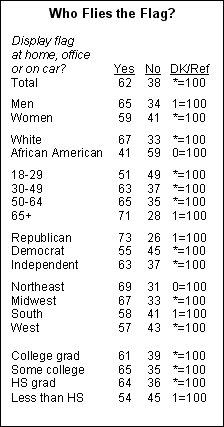
Flying the flag continues to be a much more common practice among some groups in the population than among others. Older Americans – especially those ages 65 and older – are far more likely to say they display the flag than are those under age 30. Racial and political differences in flag flying also are substantial: Fully 67% of whites say they display the flag, compared with just 41% of African Americans. In addition, 73% of Republicans say they display the flag at home, work, or on their car; this compares with 63% of independents and 55% of Democrats.
Notably, significantly more Northeasterners and Midwesterners fly the flag than do residents of the South or the West. Roughly seven-in-ten residents of the Northeast (69%) say they fly the flag, compared with 67% in the Midwest, 58% in the South, and 57% in the West.
In addition, displaying the flag is a somewhat more infrequent practice among people with less education and lower annual incomes than among those who are better educated (and better off). For example, 60% or more of college graduates, those who attended college but did not receive a degree, and high school graduates say they fly the flag, compared with a somewhat smaller majority of those who did not complete high school agree (54%).
Intense Patriotism Slips

While patriotic sentiment has remained at a very high level for a very long time, strong expressions of patriotism have fluctuated in frequency somewhat. The percentage completely agreeing with the statement “I am patriotic” fell from 56% in August 2003 – which was close to an all-time high – to 49% this year. In November 1991, 58% said they completely agreed with the statement.
There have long been partisan differences in strong expressions of patriotism, with more Republicans completely concurring with the statement than either Democrats or independents. The gap between Republicans and Democrats reached an all-time high in 2003 (23 points). Since then, however, the percentage of Republicans voicing complete agreement with the statement has declined from 71% to 61%. Democratic views have remained more stable, so the partisan divide has narrowed to 16 points.