
The political center forcefully asserted itself in Tuesday’s midterms. The national exit poll showed that political independents, who divided their votes evenly between George Bush and John Kerry in 2004, swung decisively in favor of the Democrats. With roughly nine-in-ten Republicans and Democrats casting ballots for representatives of their parties, just as they did two years ago, the Democrats’ 57%-39% advantage among independents proved crucial.
As expected, the election turned out in large measure to be a referendum on President Bush and the war in Iraq — bad news for Republicans. About six-in-ten voters (59%) said they were either dissatisfied (30%) or angry (29%) with the president. By more than two-to-one, those dissatisfied with Bush supported the Democratic candidate in their district (69%-29%); among those angry with the president the margin was more than fifteen-to-one (92%-6%).
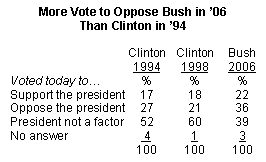
Bush was much more of a drag on his party’s candidates than was former President Clinton in 1994, the year that Republicans won control of Congress. More than a third (36%) of the electorate said they voted to oppose Bush; that compares with 27% who voted to oppose Clinton in 1994, and 21% in 1998, the year Congress impeached the president.
Voters rated a number of issues as extremely important. Roughly four-in-ten (41%) cited corruption and ethics as extremely important — a reflection of the many scandals that ensnared Republicans this year. Yet there seems little doubt that the war weighed heavily on voters as they cast their midterm ballots. The majority of voters who disapproved of the war overwhelmingly favored Democrats (by 80%-18%). War supporters backed the Republican in their district by virtually the same margin, but they were much smaller in number; just 42% approved of the war compared with 56% who disapproved.
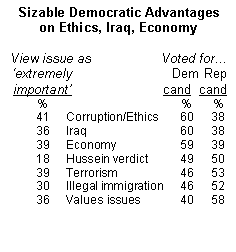
The national exit polls also showed shifts among several key voter groups, and revealed that two issues on which Republicans campaigned — terrorism and illegal immigration — provided modest support for the GOP:
<ul >
- President Bush’s surprisingly strong showing among Hispanic voters was washed away in the strong Democratic tide. In 2004, Bush drew 44% of the Hispanic vote, according to the national exit poll. But in the midterm, Hispanic and Latino voters favored the Democrats by 69%-29%.
- A gender gap was again evident in this year’s election, but it was smaller than in either 1994 or 1998. In contrast to those two elections, majorities of both women and men cast ballots for the same party on Tuesday — in this case the Democrats (56% women/51% men).
- Roughly four-in-ten voters (39%) cited terrorism as extremely important to their vote, about the same number who mentioned corruption (41%) and the economy (39%). Republicans led among terrorism voters, but by a fairly narrow margin (53%-46%). The GOP’s margin among voters focused on illegal immigration was similarly modest (52%-46%).
- Terrorism had long been a Republican strength, but the exit polls suggest that the war in Iraq has undermined the GOP’s advantage. By 59%-35%, voters said that the war in Iraq did not improve U.S. security. Consequently, on the key question of which party would make the country safer from terrorism, just 29% said that only Republicans would make the U.S. safer from terrorism, while 22% said only the Democrats (22%).