Pew Research Center

FOR RELEASE MARCH 30, 2006

America’s Immigration Quandary

No Consensus on Immigration Problem or Proposed Fixes

FOR MEDIA OR OTHER INQUIRIES:

Communications Department
202.419.4372
www.pewresearch.org

RECOMMENDED CITATION

Pew Research Center, March 2006, "America’s Immigration Quandary"

About Pew Research Center

Pew Research Center is a nonpartisan, nonadvocacy fact tank that informs the public about the issues, attitudes and trends shaping the world. It does not take policy positions. The Center conducts public opinion polling, demographic research, computational social science research and other data-driven research. It studies politics and policy; news habits and media; the internet and technology; religion; race and ethnicity; international affairs; social, demographic and economic trends; science; research methodology and data science; and immigration and migration. Pew Research Center is a subsidiary of The Pew Charitable Trusts, its primary funder.

© Pew Research Center 2026

Table of contents

  • About Pew Research Center
  • America’s Immigration Quandary
  • About the Surveys
  • Section I – Immigration: How Big a Problem?
  • Section II – Concerns About Immigrants
  • Section III – Public Opinion About Immigration Policy
  • Section IV – Views and Perceptions of Immigrants
  • Section V – Metropolitan Area Surveys

America’s Immigration Quandary

No Consensus on Immigration Problem or Proposed Fixes

Introduction

Americans are increasingly concerned about immigration. A growing number believe that immigrants are a burden to the country, taking jobs and housing and creating strains on the health care system. Many people also worry about the cultural impact of the expanding number of newcomers in the U.S.

Yet the public remains largely divided in its views of the overall effect of immigration. Roughly as many believe that newcomers to the U.S. strengthen American society as say they threaten traditional American values, and over the longer term, positive views of Latin American immigrants, in particular, have improved dramatically.

Reflecting this ambivalence, the public is split over many of the policy proposals aimed at dealing with the estimated 11.5 million-12 million unauthorized migrants in the U.S. Overall, 53% say people who are in the U.S. illegally should be required to go home, while 40% say they should be granted some kind of legal status that allows them to stay here.

But nearly half of those who believe illegal immigrants should be required to leave nonetheless say that some could stay under a temporary work program. Overall, the public divides about evenly among three main approaches for dealing with people who are in this country illegally: 32% think it should be possible for them to stay permanently; 32% believe some should be allowed to stay under a temporary worker program under the condition that they leave eventually; and 27% think that all illegal immigrants should be required to go home.

There is also a division of opinion over how to stem the flow of illegal immigrants across the Mexican border. When asked to choose among three options, roughly half of Americans (49%) say increasing the penalties for employers who hire illegal immigrants would be most effective in reducing illegal cross-border immigration, while a third prefer boosting the number of border patrol agents. Just 9% of the public says the construction of more fences along the Mexican border would be most effective.

In general, however, the issue of immigration is not a top-tier problem for most Americans. Just 4% volunteer it as the most important problem facing the country, far fewer than the number mentioning the war in Iraq, dissatisfaction with the government, terrorism, and several other issues.

Nor does immigration loom particularly large as a local community issue. The new survey by the Pew Research Center for the People & the Press and the Pew Hispanic Center, conducted Feb. 8-March 7 among 2,000 adults nationally, includes separate surveys of an additional 800 adults in each of five metropolitan areas that have experienced differing rates of immigration in recent years: Phoenix, Las Vegas, Chicago, Raleigh-Durham and Washington DC.

Immigration emerges as a dominant local concern only in Phoenix, near a major entry point for illegal immigrants, where 55% say it is a very big problem. In the four other metropolitan areas, traffic congestion rates as a bigger problem than immigration.

The Bases of Ambivalence

The survey finds a number of opinions about immigrants that may well contribute to ambivalent attitudes toward immigration, especially in areas where immigrants are most numerous. First, attitudes toward both Latin American and Asian immigrants are more positive now than in the 1990s, even as concern over the problems associated with immigration has increased. Both groups are overwhelmingly seen as very hard working and having strong family values. Impressions of Latin American immigrants, in particular, have grown much more positive, with 80% describing them as very hard working compared with 63% nearly a decade ago.

Moreover, native-born Americans who live in areas with the highest concentration of immigrants hold more positive opinions of them. Analysis of the survey indicates that their more favorable views do not merely reflect their demographics or political composition, but suggests that exposure to and experience with immigrants results in a better impression of them. However, Americans living in areas with more immigrants rank immigration as a bigger community problem.

And while there is concern about the impact of immigration on the availability of jobs, nearly two-thirds (65%) say that immigrants coming to the country mostly take jobs that Americans do not want, rather than take jobs away from Americans. In this regard, the recent influx of immigrants into such metropolitan areas as Phoenix, Las Vegas and Raleigh-Durham has not undermined the generally positive perceptions residents have of the local job market.

Yet at the same time, a sizable minority (16%) says they or a family member have lost a job to an immigrant worker. And the perception of being passed over — more common among those with less education and lower incomes — is strongly associated with negative views of immigrants and high levels of support for strong measures to deal with the problem. For example, 75% of those who say they or a family member has lost a job to an immigrant view them as a burden compared with 47% of those who do not think this has happened.

Policy Solutions

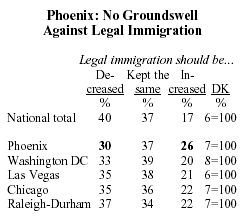
The public’s divisions over illegal immigration are mirrored in views of legal immigration; 40% say the current level should be decreased, but almost the same number (37%) believe it should be kept at its present level, while 17% prefer to see it increased.

But it is illegal immigration, far more than legal immigration, that stirs public anxiety. Six-in-ten say illegal immigration represents a bigger problem than legal immigration. Just 4% say the opposite — that legal immigration is a bigger problem — though nearly a quarter (22%) says both forms of immigration are equally problematic.

Besides economic concerns, many express worries that illegal immigrants contribute to crime and increase the danger of terrorism. Yet fewer see tougher border controls, relative to employer sanctions, as the most effective way to reduce illegal immigration along the Mexican border. Even those who are most worried about the threat of terrorism associated with illegal immigration favor employer fines over border fences and more agents.

In line with these attitudes, two-thirds of the public favors the creation of a new government database for all of those eligible to work — citizens and legal immigrants alike — and a requirement that employers check this database before hiring new workers. Even more Americans support a de facto national identification card — either a Social Security card or new form of driver’s license — that job applicants would be required to show before obtaining a job.

Like policymakers, the public is conflicted about what to do with immigrants who are here illegally. Beyond questions of their legal status, Americans express very different opinions about providing government services for such people — and their children. By a wide margin (67%-29%), Americans believe that illegal immigrants should be ineligible for social services provided by state and local governments. Yet by an equally lopsided margin (71%-26%), most feel that the children of illegal immigrants should be permitted to attend public schools.

The Proximity Factor

The survey finds a complex relationship between exposure to immigrants and opinions about them and the immigration problem, more generally. People who live in areas that have high concentrations of immigrants are less likely to see them as a burden to society and a threat to traditional American customs and values. However, they are more apt than others to see immigration as an important problem for their local community.

In sharp contrast, native-born Americans who live in areas with few immigrants understandably are less inclined to see immigration as a local problem. However, many more of those in areas with relatively low concentrations of foreign-born people see immigrants as a burden to the nation and as a threat to American customs. People living in areas with few immigrants have a considerably more negative opinion of Hispanics and a slightly more negative view of Asians.

In general, the survey shows broad public recognition of the increasing level of immigration in recent years. Significantly more Americans than in the 1990s think that there are “many” recent immigrants living in their communities (35% currently vs. 17% in 1997). In each of the metropolitan areas surveyed separately, with the exception of Chicago, nearly half say there are many recent immigrants in their area.

Similarly, as many as 49% nationwide say they often come in contact with people who speak little or no English, up from 28% in 1997. This experience is very common in Las Vegas and Phoenix — 68% of Las Vegas residents and 66% of Phoenix residents say they often encounter people who speak little or no English. Most Americans who come in contact with people with little English say it does not bother them (61%), compared with 38% who say that it does. The balance of opinion is similar in the five metropolitan area surveys.

Politics in Washington and at Home

The American public is not particularly confident in its political leadership to deal with immigration. President Bush and the Republicans get especially anemic grades. Only 42% have a lot or some confidence in President Bush to do the right thing with regard to the issue. The Republican Party gets a similar rating (45%).

The Democratic Party achieves an only somewhat better evaluation (53%) as do governors (54%) and local leaders (56%). Residents of the five metropolitan areas surveyed separately evaluate their political leadership on the immigration issue about the same way citizens do nationwide. The exception is Governor Janet Napolitano of Arizona and local officials in Phoenix who achieve better ratings than other governors and local leaders.

Hispanics are more critical of all political leaders than are other citizens, but especially with respect to the Republican Party. However, they give President Bush a somewhat better grade than they do the GOP (41% vs. 33%).

For the most part, partisanship has only a modest impact on attitudes toward the severity of the problems associated with immigration and possible solutions. On basic attitudes as to how to reduce illegal immigration from Mexico, roughly half of Republicans, Democrats and independents prefer tougher employer sanctions; only about one-in-ten in each group thinks the construction of more border fences would be the most effective measure. About the same number of Republicans and Democrats also say illegal immigrants in the U.S. must go home. However, it is noteworthy that while Republicans express somewhat more concern about immigration overall, a plurality favors a temporary worker program for immigrants, a position President Bush has championed.

Opinions Marked by Many Divisions

Concerns about immigration, and views of what to do about it, divide the public in many different ways. Significant disagreement exists between college graduates and those who did not attend or complete college, between people who are struggling financially and those who are doing well, between liberals and conservatives, and along ethnic lines. While African Americans differ little from whites in their views about most of these issues, Latinos hold consistently more favorable views of immigrants and the impact of immigration on American society.

As a result, even when Republicans and Democrats do not differ overall, there are often deep divides within the political parties along ideological and socioeconomic lines. Generally financially struggling and less educated people hold more negative views of immigrants and favor more strict policies than do the financially secure and college graduates, and this is the case within both party coalitions.

For example, Republicans who rate their financial situation as “only fair” or “poor” are 20 points more likely than those who say they are in “excellent” or “good” shape to say immigrants are a burden on the country because they take jobs, housing and health care, and the gap between secure and insecure Democrats is comparably large. Within each party, education also plays a major factor — Democrats without a college degree are more than twice as likely to want to see legal immigration decreased compared with those who have a four-year degree.

The Metropolitan Area Surveys

In addition, the survey looked at five metropolitan areas that have experienced a significant increase in the foreign-born population. While respondents in Phoenix, Chicago, Las Vegas, Raleigh-Durham and Washington DC had similar views on some aspects of immigration and immigrants, there were also significant differences.

  • Phoenix is the only metropolitan area where immigration is cited as the most important local problem.
  • In Las Vegas, a majority says that immigrants from Latin America keep to themselves and do not try to fit in, the highest among the metro areas and significantly higher than the national result.
  • Chicago, a historically diverse city, has seen recent population gains primarily from Hispanics. Residents of the area are generally more tolerant of immigrants and less inclined to support punitive measures for illegal immigrants.
  • In Raleigh-Durham, a sizable majority believes that recent immigrants do not pay their share of taxes.
  • Washington DC has a generally more welcoming view of immigrants compared with the other metropolitan areas.

Roadmap to the Report

The report that follows provides detailed analysis and discussion of findings from the national poll and the five metropolitan areas surveys. It begins with a description of how immigration ranks as a problem nationally and in the respondents’ communities. This section also addresses the distinctions the public makes between legal and illegal immigration. Next is a review of concerns about immigration and immigrants, including concerns about immigration’s impact on America’s culture and economy.

The third section of the report turns to the broad range of policy proposals being considered to deal with the issue of immigration. In addition to reviewing the shape of public opinion on each one, divisions in the public and within the parties are explored in detail.

Public perceptions about immigrants are examined in the report’s fourth section. In particular, trends in views of immigrants from Asian and Latin American nations are tracked, along with views about the willingness of recent immigrants to assimilate. Public perceptions about the size of the legal and illegal immigrant populations are described.

In the final section of the report, survey results from each of the five metropolitan areas are summarized, with notable differences highlighted among the cities and between each region and the nation as a whole.

The survey’s questionnaire and results for the nation and the five metropolitan areas are at the back of the report.

About the Surveys

Results for these surveys are based on telephone interviews conducted under the direction of Schulman, Ronca & Bucuvalas, Inc. among a nationwide sample of 2,000 adults, 18 years of age or older, a Chicago area sample of 801 adults, a Las Vegas area sample of 801 adults, a Phoenix area sample of 800 adults, a Raleigh-Durham area sample of 801 adults, and a Washington, DC area sample of 800 adults, each fielded during February 8 — March 7, 2006.

For results based on the total national sample, one can say with 95% confidence that the error attributable to sampling is plus or minus 2.5 percentage points.For national results based on form 1 (N=1000) and form 2 (N=1000), the sampling error is plus or minus 3.5 percentage points.For results based on a metropolitan area survey, the confidence interval is plus or minus 4 percentage points.For metropolitan area survey results based on form 1 and form 2 (N=400 approximately), the sampling error is plus or minus 5.5 percentage points.

Respondents who indicated they would prefer to complete the interview in Spanish, plus Spanish-speaking households in which no eligible English-speaking adult was available, were contacted by a Spanish-speaking interviewer. A total of 324 interviews were conducted in Spanish: National (69), Chicago (45), Las Vegas (73), Phoenix (70), Raleigh-Durham (36), and Washington, DC (31).

In addition to sampling error, one should bear in mind that question wording and practical difficulties in conducting surveys can introduce error or bias into the findings of opinion polls.

Survey Methodology in Detail

The sample for the national survey is a random digit sample of telephone numbers selected from telephone exchanges in the continental United States.The five metropolitan area surveys are random digit samples of telephone numbers selected from exchanges within the following Metropolitan Statistical Areas (MSA) as defined by the U.S. Census Department:

Chicago (Chicago-Naperville-Joliet, IL-IN-WI MSA)

IL: Cook, DeKalb, DuPage, Grundy, Kane, Kendall, Lake, McHenry, Will counties

IN: Jasper, Lake, Newton, Porter counties

WI: Kenosha county

Las Vegas (Las Vegas-Paradise, NV MSA)

NV: Clark county

Phoenix (Phoenix-Mesa-Scottsdale, AZ MSA)

AZ: Maricopa, Pinal counties

Raleigh-Durham (Raleigh-Cary, NC MSA)

NC: Franklin, Johnston, Wake counties

(Durham, NC MSA)

NC: Chatham, Durham, Orange, Person counties

Washington, DC (Washington-Arlington-Alexandria, DC-VA-MD-WV MSA)

DC: District of Columbia

MD: Calvert, Charles, Frederick, Montgomery, Prince George’s counties

VA: Arlington, Clarke, Fairfax, Fauquier, Loudoun, Prince William, Spotsylvania, Stafford, Warren counties;Alexandria, Fairfax City, Falls Church, Fredericksburg, Manassas, Manassas Park independent cities

WV: Jefferson county The telephone exchanges were selected with probabilities proportional to their size.The first eight digits of the sampled telephone numbers (area code, telephone exchange, bank number) were selected to be proportionally stratified by county and by telephone exchange within county.That is, the number of telephone numbers randomly sampled from within a given county is proportional to that county’s share of telephone numbers in the U.S. or within the MSA being surveyed.Only working banks of telephone numbers are selected.A working bank is defined as 100 contiguous telephone numbers containing one or more residential listings.

The random digit aspect of the sample is used to avoid “listing” bias and provides representation of both listed and unlisted numbers (including not-yet-listed).The design of the sample ensures this representation by random generation of the last two digits of telephone numbers selected on the basis of their area code, telephone exchange, and bank number.

The sample was released for interviewing in replicates.Using replicates to control the release of sample to the field ensures that the complete call procedures are followed for the entire sample.The use of replicates also ensures that the regional distribution of numbers called is appropriate.Again, this works to increase the representativeness of the sample.

As many as 10 attempts were made to complete an interview at every sampled telephone number.The calls were staggered over times of day and days of the week to maximize the chances of making a contact with a potential respondent.All interview breakoffs and refusals were re-contacted at least once in order to attempt to convert them to completed interviews.In each contacted household, interviewers asked to speak with the “youngest male, 18 years of age or older, who is now at home.”If there is no eligible man at home, interviewers asked to speak with “the youngest female, 18 years of age or older, who is now at home.”This systematic respondent selection technique has been shown empirically to produce samples that closely mirror the population in terms of age and gender.

Non-response in telephone interview surveys produces some known biases in survey-derived estimates because participation tends to vary for different subgroups of the population, and these subgroups are likely to vary also on questions of substantive interest.In order to compensate for these known biases, the sample data are weighted in analysis.

The demographic weighting parameters for the national survey are derived from a special analysis of the most recently available Census Bureau’s Current Population Survey (March 2005).For the five metropolitan community surveys, data from Census 2000 was used.This analysis produced population parameters for the demographic characteristics of households with adults 18 or older, which are then compared with the sample characteristics to construct sample weights.The analysis only included households in the continental United States that contain a telephone.

The weights are derived using an iterative technique that simultaneously balances the distributions of all weighting parameters.

About the Centers

The Pew Hispanic Center and the Pew Research Center for the People & the Press are nonpartisan research organizations supported by The Pew Charitable Trusts.They are two of the six projects that make up the Pew Research Center, a nonpartisan “fact tank” in Washington, DC that provides information on the issues, attitudes and trends shaping America and the world.

The Pew Hispanic Center’s mission is to improve understanding of the U.S. Hispanic population and to chronicle Latinos’ growing impact on the entire nation.

The Pew Research Center for the People & the Press is an opinion research group that studies attitudes toward the press, politics and public policy issues.

All of our current survey results are made available free of charge.

All of the Centers’ research and reports are collaborative products based on the input and analysis of their entire staffs, consisting of:

Pew Hispanic Center Roberto Suro, Director Gabriel Escobar, Associate Director for Publications Rakesh Kochhar, Associate Director for Research Jeffrey Passel and Richard Fry, Senior Research Associates Sonya Tafoya, Research Associate Dulce Benavides, Research Assistant Mary Seaborn, Administrative Manager Angela Luben, Administrative Assistant Michelle Wunsch, Intern

Pew Research Center for the People & the Press Andrew Kohut, Director Jodie Allen, Senior Editor Scott Keeter, Director of Survey Research Carroll Doherty and Michael Dimock, Associate Directors Carolyn Funk and Richard Wike, Senior Project Directors Nilanthi Samaranayake, Peyton Craighill, Nicole Speulda and Courtney Kennedy, Project Directors Kate DeLuca, Research Assistant

Section I – Immigration: How Big a Problem?

Most Americans do not regard immigration as a pressing concern — either for the nation or for their local community. Just 4% of all Americans volunteer immigration as the most important problem facing the country, and about the same number (3%) point to immigration as the biggest problem facing their community. Yet there are pockets of concern. In the survey of five metropolitan areas, immigration was viewed as the most serious local problem only in Phoenix. But even there, when respondents were asked in an open-ended question to identify the most important problem in the community, fewer than one-in-five (18%) volunteered immigration.

On the other hand, when asked to rate the impact of immigration among a list of five other local concerns, such as crime, traffic and the availability of jobs, 55% of Phoenix residents characterize immigration as a “very big” problem — the highest percentage for any issue — while another 23% say immigration is a “moderately big” local problem.

In Las Vegas, which like Phoenix has experienced an influx of immigrants in recent years, there also is considerable concern over immigration. More than a third of Las Vegas residents (36%) say immigration is a very big local problem, and 28% think it a moderately big problem.

However, immigration rates as less of a concern for the national public or for people living in three other American metropolitan areas with large and growing immigrant populations — Raleigh-Durham, Washington DC, and Chicago.

Just 21% of Americans in the national survey say immigration represents a very big problem, while 20% say it is a moderately big problem.

In Raleigh-Durham, a majority (56%) views immigration as at least a moderately big community problem, but fewer than half of Washington DC residents (44%) express that opinion. For residents of the nation’s capital, traffic overshadows all other local problems; fully 60% see traffic congestion as a very big problem, roughly triple the number who say that about immigration (21%), crime (20%), or education (18%).

Chicago residents, in particular, express only modest concern over the effects of immigration impact on their community. Only about a third of Chicago residents (35%) see immigration as a very big or even a moderately big problem. That compares with 42% of Chicago residents who say immigration is no problem at all for their community and another 19% who view it as a small problem.

National Immigration Concerns

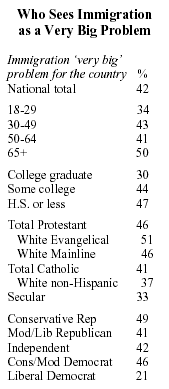
When the general public is asked its views about a comparable list of problems facing the nation, immigration ranks as a middle-tier issue. Overall, 42% of the public rates immigration as a very big problem facing the nation, placing it behind the health care system (55%), terrorism (50%), crime (47%) and corrupt political leaders (46%), but a bit ahead of environmental pollution (39%) and the availability of good-paying jobs (37%).

On a national level, immigration concerns are greatest among senior citizens, those with a high school education or less, and white evangelical Protestants. Roughly half in each of these groups rates immigration as a very big national problem.

As previous Pew surveys have shown, there are differences within both major political parties in views about the seriousness of the immigration problem. Roughly half of conservative Republicans (49%) view immigration as a very big national problem, somewhat greater than the percentage of moderate and liberal Republicans who express this view (41%). Democrats are even more divided over the seriousness of the problem presented by immigration. Fully twice as many conservative and moderate Democrats (46%) as liberal Democrats (21%) say immigration is a very big national problem.

Legal vs. Illegal Immigration

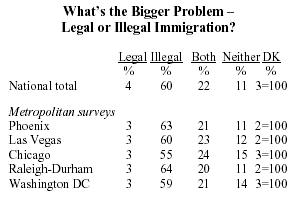
The public overwhelmingly views illegal immigration, rather than legal immigration, as the bigger problem facing the U.S. Six-in-ten Americans say illegal immigration is the bigger problem, compared with just 4% who say legal immigration. However, a sizable minority (22%) believes both illegal and legal immigration are equally worrisome. Just 11% say neither represents a big problem for the U.S.

This balance of opinion is mirrored in the five metropolitan areas experiencing high levels of immigration. Solid majorities in each of the regions surveyed say illegal immigration is a bigger problem than legal immigration. And about one-in-five in each city believes that illegal and legal immigration are equally severe problems.

Biggest Threat: Jobs, Culture or Security?

Americans draw distinctions about the concerns they have over both legal and illegal immigration. Legal immigration is mostly seen as a threat to American jobs; 41% of those who are more worried about legal immigration (or say both forms of immigration are equal problems) say their biggest concern is that legal immigration will hurt American jobs.

By contrast, people who see illegal immigration as a bigger problem (or say both equally) are divided on their concerns. Three-in-ten (31%) say illegal immigration hurts jobs, but nearly as many (27%) say it raises the danger of terrorism, and 16% say it contributes to crime. Terrorism and crime are less frequently cited as concerns by those who say legal immigration is a bigger problem.

The idea that immigrants hurt American customs or the American way of life is a concern, though not a paramount one, of those worried about each form of immigration. About one-in-five (17%) of those more concerned about legal immigration say it is their biggest concern. Just one-in-ten (11%) of those more concerned about illegal immigration feel the same way.

Section II – Concerns About Immigrants

Most Americans express some concern about the growing immigrant population in one way or another, but the nature of those concerns vary and are expressed with varying intensity by different segments of the population. Competition for jobs, the erosion of traditional American values, the costs to local government and the threats of terrorism and crime are all sources of immigration-related concern to some Americans, but none of these is a dominant or primary cause of worry. And on virtually every one of these points, a substantial share of the population takes a positive view of immigrants or finds no cause for concern.

For example, when asked to choose between two contrasting statements about immigrants — one which says that they represent a burden to the country because they take jobs, housing and health care; the other saying that immigrants strengthen the country through their hard work and talents — the public is divided. Just over half (52%) say that immigrants are a burden, but 41% say they strengthen the country. However, the percentage saying that immigrants are a burden is higher now than at any time since 1997. In five other surveys taken since September 2000, the share of the population expressing that view had been 44% or less.

Both whites (55%) and blacks (54%) are more likely than Hispanics (29%) to see immigrants as a burden, though attitudes are by no means uniform within any of these groups.

Views also vary according to levels of education. For example, a majority of whites with a four-year college degree (56%) say that immigrants strengthen the country through their hard work, while more than a third (37%) says that they are a burden. Whites with less than a baccalaureate education split the opposite way, with 63% seeing immigrants as burden and 30% saying that they strengthen the country. Similar, but less pronounced, differences are apparent among non-whites of differing levels of education.

Perceptions about one’s personal economic situation also correlate with attitudes towards immigrants. Those who say their personal finances are only fair or poor express a negative attitude toward immigrants; 58% view them as a burden, compared with 36% who say they strengthen the country. People who rate their finances as excellent or good are divided (44% burden/48% strengthen). Religion is significant too. Among white evangelical Protestants, for example, 64% see immigrants as a burden, compared with 56% of white Catholics and 52% of white mainline Protestants. There are also differences according to political ideologies, with 58% of conservatives seeing immigrants as a burden, compared with 42% of liberals and 52% of moderates who feel this way.

People who live in areas with a high density of immigrants are evenly divided over whether immigrants strengthen the country (48%) or represent a burden (47%). By contrast, those who live where immigrants are a sparse presence voice much higher concern; 66% say they are a burden vs. 27% who believe they strengthen the country.

With respect to immigration’s social impact, Americans are about evenly split between those who say the growing number of newcomers from other countries threaten traditional American customs and values (48%) and those who say that the newcomers strengthen American society (45%). The same basic differences by race, education, perceptions of economic well-being, religion and political ideology are apparent in responses to this question as for the measure of economic and fiscal concerns. And here again, the people who live in places with the sparsest immigrant populations are most likely to express concerns.

A combined total of 63% express concerns over immigration either in response to the question about threats to American values or to the question about being a burden on jobs, housing and health care. But only about four-in-ten (37%) of all respondents voiced concerns about both of these threats and burdens. This suggests that while concerns are widespread, they are not uniform — and that different people find different reasons to be concerned.

A Job Squeeze?

The extent of concern over immigrants’ impact on jobs may be mitigated by perceptions about the kinds of work they perform. Nearly two-thirds of respondents (65%) say that immigrants mostly take jobs that Americans don’t want, while a much smaller number, just 24%, say the newcomers mostly take jobs away from American citizens. Only once before in the past two decades — in 1996 — have views on this question been as lopsided as they are now.

A majority of respondents in every part of the country and across all major socio-economic, political and religious groups say that immigrants mostly take unwanted jobs. But there are some differences in the extent to which people in different groups hold this view. More Hispanics (81%) see immigrants as taking unwanted jobs than do either whites (65%) or blacks (54%). Education is also a factor. For example, among whites, 79% of those with a college education see immigrants as taking unwanted jobs, while 59% of those who do not have a baccalaureate degree hold this view.

Not surprisingly, perceptions of personal economic well-being are also an important factor in shaping these attitudes. Three-in-ten of those who say their personal finances are only fair or poor believe that immigrants take jobs from Americans, compared with 18% of those who have a positive view of their personal finances.

Americans express a mix of views about the impact of immigration on government services and budgets. A majority (56%) says that most recent immigrants do not pay their fair share of taxes, but a similarly large share (60%) say that immigrants moving into their communities have not made much of a difference in the quality of local government services.

The view that most recent immigrants do not pay their fair share of taxes is shared among most segments of the population. Education is a significant factor, particularly among whites; respondents with a four-year college education are more likely to say immigrants pay their fair share than are those with less education.

Most Americans (60%) say that the immigrants moving into their communities in recent years have not made much of a difference in the quality of their local government services, while about a quarter (26%) say that immigrants have made those services worse and 7% say they have made them better. With only small variations, this same basic judgment about the impact of immigration on local government services is expressed by all segments of the population.

Section III – Public Opinion About Immigration Policy

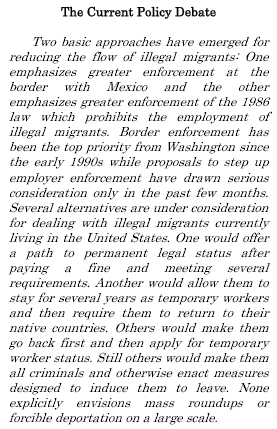
The public is deeply divided over the two fundamental questions lawmakers are struggling with: how to handle illegal immigrants already in the U.S.; and how to stem the flow of illegal immigrants in the future.

A narrow majority of the public (53%) believes that illegal immigrants should be required to go home, compared with 40% who feel they should be granted some kind of legal status allowing them to stay in this country. But when the option of a temporary worker program is introduced, the fissures in public attitudes toward immigration become even more evident.

As championed by President Bush, such a program would allow illegal immigrants to remain in the U.S. for a fixed amount of time on the condition they eventually go home. With this option on the table, opinion is almost evenly divided between those who favor allowing some illegal immigrants to remain in the U.S. under a temporary work program (32%); those who say illegal immigrants should be allowed to stay permanently (32%); and those who believe they should go home (27%).

Partisan and ideological differences are evident in attitudes towards these options. A plurality of conservative Republicans (46%) favors allowing some illegal immigrants to remain in the U.S. under a temporary worker program. In sharp contrast, the preferred option among liberal Democrats is to make it possible for illegal immigrants to say in the country permanently. Other partisan groups and independents split fairly evenly among the three alternatives.
Tougher Employer Penalties

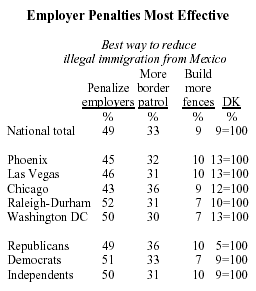
Americans are more united in their attitudes toward stopping the flow of illegal immigration across the Mexican border. A near majority of the public (49%) favors increasing penalties on employers who hire illegal immigrants. Nonetheless, a comparable, though smaller share (42%), favors two initiatives that would step up border enforcement by increasing the number of border patrol agents (33%) and building more fences on the border (9%).

Since the early 1990s substantial stretches of fencing have been built along parts of the border in California and Texas that were once the highest traffic zones for illegal crossings, and the number of Border Patrol agents in those areas has also been greatly increased. As a result, much of the traffic has been funneled into the rugged desert areas of the Arizona border, provoking several years of controversy and political activity in that state on the immigration issue.

Even so, residents of the Phoenix metropolitan area offer views that are similar to those voiced nationally in weighing enforcement priorities. On the question of reducing illegal immigration from Mexico, 45% say the best way to achieve that goal would be to increase penalties on employers who hire illegals; 32% say increasing the number of border patrol agents would be most effective; and just 10% feel that building more fences on the border would be most effective. Similar views emerged in surveys of metropolitan areas that have also had rapid growth of the foreign-born population but that are far from the border, such as Chicago and Washington, DC.

The idea of reducing illegal immigration by prohibiting employment first gained currency in the mid-1970s, and there has been an off-and-on debate about how such a measure should be enforced ever since then. Two critical issues have arisen repeatedly: What kind of documentation should a prospective hire have to present to show they are a U.S. citizen or a legal immigrant and what should an employer have to do to verify that the documents are genuine.

When immigration legislation was enacted in 1986, Congress and the Reagan administration rejected proposals to create a national identity card to prove legal status and employers were given wide latitude in deciding the authenticity of documents. The law has been so difficult to enforce that the number of cases brought against employers is about half what it was a decade ago even though the number of unauthorized workers has roughly doubled in that time.

Few Object to Employment IDs

Americans have clear opinions about how to enforce the law against the employment of illegal migrants. Asked about two of the major proposals that have been before Congress over the past year, two-thirds (66%) said they favored the creation of a new government database of everyone eligible to work–both American citizens and legal immigrants, and requiring employers to check that database before hiring someone for any kind of work. And three-quarters (76%) said they favored requiring everyone seeking a new job to have a new kind of driver’s license or Social Security card that proves they are U.S. citizens or are in the country legally.

Support for both measures is widespread and nearly uniform across a variety of social, economic and political subgroups. More than 60% of Hispanics support both proposals as do a majority of recent immigrants. Most college graduates favor these proposals, though there is more opposition here than among the less educated. And younger people are somewhat more likely to oppose requiring a new government ID card to gain employment, though two-thirds think this is a good idea.

Opposition to Social Services for Illegals

Another approach that is the subject of debate in state capitals around the country is to discourage illegal migration and reduce its fiscal impact by denying social services to the unauthorized. Americans support this idea with two-thirds (67%) saying that illegal immigrants should not be eligible for social services provided by state and local governments. As with support for the measure to enforce the prohibition on employment, this is a broadly based view.

At the same time, however, the public distinguishes between the migrants and their children and is unwilling to penalize the youngsters. More than two-thirds (71%) say that the children of illegal immigrants should be allowed to attend public schools. Public schools are currently obliged to educate youngsters regardless of their immigration status under a 1982 U.S. Supreme Court decision holding that children cannot be held accountable for their parents’ decision to migrate illegally.
There is a sharp divide on these issues between people who themselves or whose parents immigrated to the U.S. and those whose family background is rooted in the United States at least through their grandparents’ generation. Those from more recent immigrant backgrounds support making illegal immigrants eligible for social services by a 54% to 41% margin. By contrast, people whose families have been here longer oppose that idea, by 73%-32%.

Four-in-ten young people, those under age 30, believe illegal immigrants should be eligible for government-provided social services, compared with smaller percentages of older Americans. Even so, a solid majority of those ages 18-29 (57%) say illegal immigrants should not be eligible for these services.

More than twice as many Democrats as Republicans favor permitting illegal immigrants to be eligible for social services (38% vs. 16%). But Democrats, in particular, are split along ideological lines. Conservative and moderate Democrats, by 62%-34% say illegal immigrants should not be eligible for government services, while liberals are evenly divided (48% favor/50% oppose).

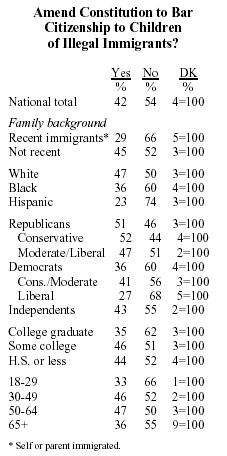
Opinion is more closely divided on another point of law regarding the children of unauthorized migrants. Under the Constitution anyone born in the United States is automatically a U.S. citizen regardless of their parents’ immigration status. A slim majority of Americans (54%) favor keeping the Constitution as it is while a substantial minority (42%) would like to change it so that parents would have to be legal residents of the U.S. for a newborn to be a citizen.
Levels of support for a change in the constitutional definition of citizenship vary significantly by race, education and political ideology. Whites (47%) back the idea more than either blacks (36%) or Hispanics (23%). Among whites, support is notably higher among those with less than a college education (50%) than with those with a degree from a four-year college (36%).

As is the case with allowing illegals to be eligible for government services, Democrats are deeply divided over amending the Constitution so that the parents of a child must be legal residents for their child to be a citizen. Liberal Democrats oppose such a change by more than two-to-one (68%-27%), while conservatives and moderates are more closely divided (41% favor/56% oppose).

Divides Over Legal Immigration, Too

The public’s divisions over policies toward dealing with illegal immigration are mirrored in views of the appropriate level of legal immigration into the U.S. The number of new immigrants admitted for permanent legal residence has averaged a bit more than 900,000 a year over the past decade compared to less than 600,000 in the 1980s and somewhat more than 400,000 in the 1970s. None of the major bills being debated in Congress over the past year propose cuts in legal immigration.

Roughly equal shares of Americans favor the opposite approaches of keeping legal immigration at its present levels (37%) and decreasing it (40%). A much smaller percentage (17%) favors increasing legal immigration.

Partisan and ideological differences are also apparent on this policy issue. Just 26% of liberal Democrats want immigration decreased, compared with 43% of conservative and moderate Democrats, as well as a similar share of independents (39%) and Republicans (43%). In fact, liberal Democrats are just as likely to say immigration should be increased as decreased, a view that diverges starkly from the rest of the population.

Education also plays a significant role in people’s views, particularly in combination with race. A plurality of college graduates (46%) favor keeping legal immigration levels as they are now, while the balance of opinion among those with less education favors reducing immigration. Sentiment for decreasing legal flows is particularly strong among whites who do not have a diploma from a four-year college (49%) than among whites with a four-year degree (27%).

The distinction between attitudes toward legal and illegal immigration is perhaps best seen in Phoenix, where a high proportion rate immigration as a very big local problem. Yet about as many Phoenix residents say legal immigration should be increased (26%) as say it should be decreased (30%). In the four other metropolitan areas, and the national survey, significantly more respondents favor a cutback, rather than an increase, in the rate of legal immigration.

Minutemen: Half in Phoenix Approve

As the policy debate over immigration has heated up in recent months, a considerable amount of attention in the news media has been devoted to the “Minutemen,” a group that looks for illegal migrants along the border with Mexico in order to report them to the authorities. A plurality of Americans (42%) had not heard about them. Among those who have, 33% say they approve of the Minutemen’s patrols of the Mexican border, while 22% disapprove.

These attitudes differ greatly by gender with 42% of men expressing approval compared to 25% of women. Differences also are evident by race and ethnicity. Americans of Hispanic background overwhelmingly disapprove of the Minutemen (55% vs.13% who approve), as do Americans whose parents or who themselves immigrated to the U.S. (43% disapprove/16% approve).

Republicans generally approve of the Minutemen’s activities, and conservative Republicans have an especially positive reaction to this group (56% approve/9% disapprove). Democrats are more evenly divided: 25% approve, 28% disapprove and 44% have not heard about them.

Half of respondents in the survey of the Phoenix metropolitan area say they approve of the Minutemen’s patrols, while 33% disapprove.

Not surprisingly, most Phoenix residents have heard of the group (83%). Las Vegas residents also tend to approve (39%) more than disapprove (28%) of the Minutemen. Residents of Chicago and Raleigh-Durham were the least likely to have heard about the Minutemen, and were divided over their actions, and Washingtonians tended to disapprove (36%) more than approve (27%).

Section IV – Views and Perceptions of Immigrants

The American public views today’s immigrants with a mix of admiration and concern. Overall impressions of recent migrants to the U.S. from Latin American and Asian nations are generally positive, and nearly half of the public believes immigrants today are just as willing to assimilate as those of two centuries ago. Still, majorities express the view that new immigrants do not learn English fast enough and pluralities believe that most immigrants today are here illegally.

A plurality of Americans (44%) believe today’s immigrants are less willing to adapt to the American way of life compared with those who came here in the early 1900s. However, slightly more (49%) say current immigrants are as willing to adapt (30%) or are more willing to adapt (19%) than immigrants from the early 20th century.

Roughly three times as many Hispanics as non-Hispanic whites believe today’s immigrants are more willing to adapt to American customs (40% vs. 13%). Similarly, 31% of recent immigrants credit contemporary immigrants for their adaptability, compared with just 16% of those whose families have not recently emigrated to the U.S.

There are small but significant political differences on this question. By a margin of 54% to 40%, Republicans are more apt than Democrats to think immigrants today resist assimilation. In addition, conservatives are more likely to hold this view than are liberals.

In the national sample, proximity to immigrants does not appear to affect perceptions about willingness to assimilate. However, respondents in the two metropolitan areas where immigration is most often viewed as a serious local problem — Phoenix and Las Vegas — stand out for their negative impressions of the willingness of today’s immigrants to adapt. Roughly half in these two metropolitan areas (52% in Phoenix, 50% in Las Vegas) say immigrants now are less willing to adapt than those in the early 1900s.

Language Seen as a Barrier

One of the continuing sources of conflict over the assimilation of immigrants is language, as seen in recurring battles over English-only policies and statutes. A sizable majority of the survey’s respondents (58%) said they believe that most recent immigrants do not learn English within a reasonable amount of time; slightly more than a third (35%) say that they do.

Within the case study communities, the belief that immigrants lag behind in the adoption of English ranged from a high of 66% in Phoenix and Las Vegas to 51% in the Washington metro area. Hispanics are the only major demographic group in which a majority (55%) believes that most recent immigrants learn English in a reasonable period; however, 39% say this is not the case.

People who live in areas with substantial concentrations of foreign-born people are more likely than those with few immigrants in their area to say that immigrants learn English within a reasonable amount of time. Roughly four-in-ten (39%) in areas with a high proportion of foreign-born people say this, compared with 27% in areas with few immigrants.

An increasing number of Americans say they encounter immigrants who speak little or no English. About three-quarters (74%) say they often (49%) or sometimes (25%) come in contact with immigrants who speak little or no English; that compares with just 51% who said that in 1997.

Residents of Phoenix and Las Vegas report extensive contacts with immigrants who speak English poorly, or not at all. About two-thirds in each city (68% in Phoenix, 66% in Las Vegas) say they often encounter this situation; smaller percentages in Raleigh-Durham (59%), Washington DC (56%) and Chicago (50%) say the same.

Most people nationwide (61%) who say they have contact with immigrants who speak little or no English say it does not bother them; 38% say they are bothered by this experience. While people in Phoenix and Las Vegas report more contact with immigrants who do not speak English well, majorities in both cities say they are not bothered by this (58% in Phoenix, 56% in Las Vegas).

Negative Views of Immigrants Decline

Public impressions of immigrants from Latin American and Asian nations are generally positive and have become significantly more favorable over the past decade or so. Latin American and Asian immigrants have long been viewed as hard-working and as having strong family values, and these impressions are even stronger now. And, negative views have softened substantially. Many fewer people today believe that either Latin American or Asian immigrants end up on welfare, or increase crime.

About eight-in-ten Americans believe that Latino and Asian immigrants are hard working and have strong family values. In particular, the view that Latin American immigrants are industrious has grown notably since 1993 — from 65% to 80% today. In contrast, the public is split on how Latin American immigrants do in school: 41% say they do well, while 33% say they do not. But that represents an improvement compared with 1997, when just 29% felt Latin immigrants did well in school.

Negative impressions of both Latin American and Asian immigrants are much less common now than they were a decade ago. In 1993, majorities believed that Latin American immigrants significantly increased crime (62%) and said they “often end up on welfare” (60%). In the current survey, 37% believe they are prone to end up on welfare and 33% say they significantly increase crime. In 1993, fewer people saw Asian immigrants as likely to increase crime or to need welfare (43% and 38%, respectively), but those numbers have also declined dramatically (now just 19% and 17%).

However, substantial numbers of people believe Asian and Latin American immigrants are reluctant to assimilate. Pluralities say that the phrase — “keep to themselves and don’t try to fit in” — applies to immigrants from Asian countries (49%) and Latin American countries (45%).

Negative opinions about Latin American and Asian immigrants are more prevalent among the less educated, and the financially stressed. For example, the belief that Hispanic immigrants “often end up on welfare” is held by 42% of those with a high school education but just 24% among those with a college degree.

The perception that Latin American immigrants increase crime is much more prevalent in Phoenix and Las Vegas than it is nationally, or in the three other cities surveyed. Nearly half in Phoenix (46%) and Las Vegas (45%) believe that Latin American immigrants significantly increase crime; that compares with fewer than four-in-ten in Raleigh-Durham (37%), Washington DC (31%), and Chicago (30%), and 33% nationally.

More generally, however, people who live in areas with a high proportion of immigrants are less likely to say Latin American immigrants increase crime and go on welfare than are those living in areas with low concentrations of foreign-born people.

Favorable Ratings Positive, Stable

Beyond the view of ethic immigrants in particular, public attitudes about a variety of racial and ethnic groups are generally quite positive and have shown no trend over the past ten years or so. Opinions about Asians, Hispanics, blacks, and Jews are predominantly positive, with 75%-84% of the public saying they have “very” or “mostly” favorable opinions of each group. For each group, more people have a “mostly favorable” than a “very favorable” attitude, but there is no trend within these categories.

Negative opinions about Hispanics are more common among older respondents (27% unfavorable among those 65 and older) and people who live in places with few foreign-born residents (27%) unfavorable. With respect to Asians, in no demographic group do as many as 20% have an unfavorable opinion.

Perceptions of the Immigrant Population

When asked what proportion of the American public born outside the United States, most people choose a figure that is much higher than the Census Bureau figure of 12 percent. Of four options offered, just 34% select the correct response (“closer to 10 percent”). A quarter of the respondents say the number of foreign-born is “closer to 25%,” and nearly three-in-ten (28%) say it is “higher than 25%.” Just 5% of respondents select the lowest option (“closer to 1 percent”).

In addition to overestimating the size of the foreign-born population, there is also substantial public misunderstanding regarding the relative sizes of the legal and the illegal immigrant population.

When asked whether most immigrants now living in the U.S. are here legally or illegally, 44% say illegally (and another 8% volunteered that the numbers were equal); 39% believe most immigrants are here legally. (According to estimates by the Pew Hispanic Center, unauthorized migrants make up 30% of the foreign-born population.)

Experience with Immigrants

A growing number of Americans say they have recent immigrants living in their area. Overall, 62% say they have many (35%) or some (27%) recent immigrants in their area, up from just 39% in 1997.

In four of the five metropolitan areas surveyed, roughly half of respondents say they have many recent immigrants living in the area. The exception is Chicago, where only about a third (32%) expresses this view.

Hispanics are far more likely than whites or African-Americans to report that their area includes many recent immigrants. People living in the West (46%) report many recent newcomers living close to them much more than do those in other regions. In contrast, people in the Midwest are least likely to say many recent immigrants live nearby (22%). Southerners and those in the East reflect the national average (38% and 34%, respectively).

The percentage of Americans who say they have friend or relative who is a recent immigrant has also increased dramatically in the past decade, as the overall rate of immigration has risen. Roughly a quarter say that now (26%), up from 19% in 1997.

Job Loss Linked with Negative Views of Immigrants

A small but significant minority of the public (16%) say they or a family member has either lost a job or not gotten a job because the employer hired an immigrant instead. And this experience is strongly associated with negative views of immigrants and broad support for decreasing legal immigration.

A quarter of those with annual household incomes of less than $20,000 say they or a family member has lost a job to an immigrant. Education also is a factor in these perceptions; 20% of people with a high school education say an immigrant has cost them or a family member a job, compared with 7% of college graduates.

Fully 75% of those who report losing a job to an immigrant say they believe immigrants are burden on the U.S., costing jobs, housing and health care. That compares with just 47% of those who say they have not had this experience.

Losing a job to an immigrant also affects how people look at immigration policy. Six-in-ten (61%) of those who say they have lost a job to an immigrant believe legal immigration should be decreased, compared with 36% of those who say they have not had this occur.

Section V – Metropolitan Area Surveys

In addition to the national survey of 2,000 Americans, separate surveys were conducted in the metropolitan areas of Phoenix, Arizona (N=800), Las Vegas, Nevada (N=801), Chicago, Illinois (N=801), Raleigh-Durham, North Carolina (N=801), and Washington, DC (N=800).

The five metropolitan areas were chosen because they have different histories with respect to immigration and because each has recently experienced significant growth in the foreign-born population.

Chicago was chosen because of its long history of immigration; Phoenix because Arizona is the principal gateway for illegal immigrants; Las Vegas because of its accelerated growth; Raleigh-Durham because it is an example of the new Hispanic concentrations in the South; and Washington DC because it is in an economically thriving area, anchored by a majority black city.

Phoenix

As a principal entry point for illegal immigrants crossing from Mexico, Arizona is at the frontlines in the debate over immigration. The state has been operating under a state of emergency over illegal immigration since last year, and the Minuteman Project, a civilian group demanding more vigilance at the border, has gained national prominence through its patrols in the state.

Arizona has also recently experienced a significant increase in the foreign-born population. Between 1990 and 2000, the share of the foreign-born population almost doubled, to 14%. The number of people who speak English either not well or not at all has more than tripled, from about 53,000 to 182,000.

In light of all this, it is not surprising that among the five case-study cities in the Pew survey, people in the Phoenix metropolitan area stand out for their strong views on immigrants and immigration. Most notably, it is the only metro among the five in which residents cite immigration as the most important local problem. About eight-in-ten (78%) say immigration is a very big or moderately big community problem, the highest of any of the case-study cities and almost double the national rate.

Even though they hold immigrants in high regard for their hard work and strong family values, respondents in Phoenix see negative aspects of immigrants and immigration. Nearly half of Phoenix residents (46%) say that Latin American immigrants increase crime and 42% say they often wind up on welfare.

On questions of immigration policy, 45% of Phoenix residents say the most effective way to reduce illegal immigration from Mexico is by penalizing employers who hire illegals; far fewer say increasing border patrols (32%) or building more fences on the border would be most effective (10%). These views are similar to those of the public nationally.

In their views about what to do with the illegal immigrants already here, Phoenix residents are if anything slightly more welcoming than are the residents of the rest of the country. Some 38% of Phoenix residents, compared with just 32% of the population as a whole, say that illegal immigrants should be allowed to stay permanently, while just 21% of Phoenix residents, compared with 27% of the national public, say that illegal immigrants should be sent home.

A clear majority (63%) of Phoenix residents say that present levels of legal immigration should be maintained or increased, the highest among all case-study cities and higher than the national rate (54%). A majority (53%) also says the growing number of newcomers strengthen society, compared with 38% who say they threaten traditional American values.

However, half of Phoenix respondents approve of the Minutemen, the highest percentage for any of the case-study cities, and well above the 33% of the national public that voices its approval of this citizen group. Nationally, 42% of respondents say they have not heard of the Minutemen, compared with just 14% in Phoenix.

A solid majority in Phoenix (64%) expresses some (37%) or a lot (27%) of confidence in Gov. Janet Napolitano of Arizona to deal with immigration issues. Among the governors of the five states where case-study metro area surveys were conducted, she receives the highest marks.

Las Vegas

The growth of Las Vegas in the last two decades has been driven by migration–people relocating from around the country to a metropolitan area that is expanding every year. With the growth has come another boom: a significant increase in the foreign-born population.

Between 1990 and 2000, the foreign-born population in Las Vegas grew by 250%. Almost one out of every five people (18%) was foreign-born in the year 2000, double the rate as in 1990. The number of people who speak English either not well or not at all increased almost five-fold, and the number who speak Spanish increased by about 300%.

The impact of this demographic change, experienced over a short period of time, can be seen in the survey results. Among the case-study cities, Las Vegas is closest to Phoenix in its perception of immigrants and immigration. Significant majorities in both cities cite immigration as either a very big problem (36% in Las Vegas) or moderately big problem (28% in Las Vegas). In Las Vegas, only traffic congestion ranks higher than immigration as a local problem.

A majority in Las Vegas (54%) say immigrants from Latin America keep to themselves and do not try to fit in; that figure is the highest among case-study cities and significantly higher than for the nation as a whole (45%). About seven-in-ten (68%) say they “often” come into contact with immigrants who do not speak English, significantly higher than the national rate. A majority in Las Vegas (54%) says most immigrants in the U.S. are illegal and almost two-thirds (64%) say most people who have recently moved here are illegal — both significantly higher figures than in the national survey. On immigration policy questions, people in Las Vegas are divided, as is the public nationally. About four-in-ten (38%) believe illegal immigrants now in the U.S should be permitted to stay; 27% favor requiring all illegals to return home; and 26% favor allowing some to stay under a temporary worker program.

On an issue of local concern, almost half of Las Vegas residents (49%) say they favor government-sponsored hiring centers for day laborers, while 38% oppose the day labor centers.

Chicago

Chicago, long a destination for immigrants, saw its foreign-born population increase by 60% between 1990 and 2000. While the city has historically been home to diverse groups of immigrants, the more recent population gains have been primarily driven by Hispanics. Since 2000, Latinos accounted for almost all the population increase in the city and suburban Cook County.

The recent influx of immigrants, especially Hispanics, does not appear to have produced a backlash, according to the survey. On the contrary, the Chicago area emerges as a place that is generally more tolerant of immigrants, even though residents express some concern that immigration could affect jobs. This generally welcoming outlook of Chicagoans is especially evident when their views are compared with those of residents of Phoenix, Las Vegas and Raleigh-Durham, other case-study metropolitan areas that have all experienced recent spikes in immigration. Among the metropolitan areas surveyed, only Washington DC appears more welcoming.

Only about one-in-five Chicago area residents (19%) rate immigration as a “very big” problem for their local community. That is about the same number as the public nationally (21%), but far less than the number citing immigration as a major local problem in Phoenix (55%) or Las Vegas (36%). Nearly two-thirds of Chicago area residents (64%) say that recent immigrants have not had much of an effect on the quality of local government services.

In their views of immigration policy, many in Chicago tend toward the less punitive options. A plurality of Chicago residents say illegal immigrants should be allowed to say in the U.S. permanently (39%). Three-quarters believe children of illegal immigrants should be allowed to attend public schools. More than half (54%) say illegal immigrants who graduate from high school in Illinois should be allowed to attend public colleges at in-state tuition costs. However, as in the other metropolitan areas, a sizable majority (60%) says illegal immigrants should not be eligible to receive social services.

Perceptions in Chicago about immigration harden, however, on some economic issues. Nearly four-in-ten Chicago residents (39%) say their biggest concern about illegal immigration is that it hurts American jobs, the highest among the cities and higher than the national rate (31%). More than a third (36%) say legal immigration is hurting American jobs. Unlike the other metropolitan areas in the study, Chicago suffered a loss in manufacturing jobs during the 1990s.

The response on some economic questions varies by race. For example, among non-Hispanic African Americans, fully 41% say either they or a family member has lost a job to an immigrant, compared with 15% of non-Hispanic whites who say this.

Raleigh-Durham

The population of the Raleigh-Durham metropolitan area increased by 38% between 1990 and 2000. Like other parts of the South, Raleigh-Durham has been transformed by a robust economy and by the people who moved there in search of jobs. The foreign-born population, made up primarily by Hispanics, grew by nearly four-fold in 10 years. But unlike other metropolitan areas where Hispanics have traditionally settled, Raleigh-Durham had no established Latino community before 1990.

The subsequent demographic transformation over a short period of time makes Raleigh-Durham and other similar communities in the South distinct from the rest of the country. In Raleigh-Durham alone, the number of people who speak Spanish increased by nearly five-fold between 1990 and 2000.

About a quarter of Raleigh-Durham residents (26%) cite immigration as a ‘very big’ local problem, slightly more than the national average (21%). And more than a third (36%) say that recent immigrants have had a negative effect on government services, compared with 26% nationally. But as is the case in the other metropolitan areas surveyed, Raleigh-Durham residents overwhelmingly view Latin American immigrants as very hard-working (87%) and having strong family values (85%).

In Raleigh-Durham, about two-thirds (68%) say local police should be required to check someone’s immigration status during routine activities such as traffic stops. A similar majority (67%) says illegal immigrants should not be eligible for social services.

Some 62% of Raleigh-Durham residents say that recent immigrants do not pay their share of taxes. A majority (52%) says that the most effective way to reduce illegal immigration from Mexico is by increasing the penalties for employers who hire illegal workers.

A majority (55%) says today’s immigrants are more willing (20%) or about as willing (35%) to adapt as were immigrants in the early 1900s, higher than the national rate (49%). Nearly eight-in-ten (77%) say children of illegal immigrants should be allowed to attend public school.

Washington, DC

Once defined by the federal government and its vast workforce, the Washington DC area has undergone a dramatic transformation in the last 25 years. It is now home to some of the wealthiest and fastest growing suburban counties in the country; the government is no longer the main employer; and the capital city is ringed by suburbs notable for their diversity.

The metropolitan area is a prime example of immigration altering the suburban landscape. Hispanics, Asians and others have settled in suburban Maryland and Virginia in great numbers. In the metropolitan area, the Hispanic population alone more than doubled in two decades. Between 1990 and 2000, the foreign-born population grew by almost 70%. The number of people who speak Spanish grew by 95% and those who do not speak English or do not speak it well increased by 112%.

In the survey, Washington stands out for its generally welcoming view of immigrants when compared to the others in the case studies. More than half (54%) say the growing number of newcomers to the U.S. strengthens society in general, and most think that immigrants strengthen the country through hard work (56%). A majority in the Washington DC area (54%) supports government-sponsored centers for day laborers, an issue that has divided communities in Northern Virginia and suburban Maryland.

Only about one-in-five Washingtonians (21%) view immigration as a very big local problem; in contrast, nearly three times that number (60%) cites traffic congestion as a major local problem. By a higher rate than in the other cities, people in Washington say immigrants take jobs others do not want and that immigrants pay their fair share of taxes. A majority (55%) also says recent immigrants are not a factor in the quality of local government services. Compared to the other case-study cities, fewer people in Washington DC (40%) say that the country has to be protected against foreign influence.

On policy questions, half say the most effective way of reducing cross-border illegal immigration from Mexico is by penalizing employers who hire illegal workers. And a plurality of Washingtonians (37%) believes that illegal immigrants should be permitted to stay in the country permanently.