Pew Research Center

FOR RELEASE NOVEMBER 17, 2005

Opinion Leaders Turn Cautious, Public Looks Homeward

America's Place in the World

FOR MEDIA OR OTHER INQUIRIES:

Communications Department
202.419.4372
www.pewresearch.org

RECOMMENDED CITATION

Pew Research Center, November 2005, "Opinion Leaders Turn Cautious, Public Looks Homeward"

About Pew Research Center

Pew Research Center is a nonpartisan, nonadvocacy fact tank that informs the public about the issues, attitudes and trends shaping the world. It does not take policy positions. The Center conducts public opinion polling, demographic research, computational social science research and other data-driven research. It studies politics and policy; news habits and media; the internet and technology; religion; race and ethnicity; international affairs; social, demographic and economic trends; science; research methodology and data science; and immigration and migration. Pew Research Center is a subsidiary of The Pew Charitable Trusts, its primary funder.

© Pew Research Center 2026

Table of contents

  • About Pew Research Center
  • Opinion Leaders Turn Cautious, Public Looks Homeward
  • I. The State of the World and America’s Global Role
  • II. Global Policy Goals and Threats
  • III. Iraq and the War on Terrorism
  • IV. Allies, Trade and International Institutions
  • Survey Methodology

Opinion Leaders Turn Cautious, Public Looks Homeward

America's Place in the World

Introduction and Summary

Preoccupied with war abroad and growing problems at home, U.S. opinion leaders and the general public are taking a decidedly cautious view of America’s place in the world. Over the past four years, opinion leaders have become less supportive of the United States playing a “first among equals” role among the world’s leading nations. The goal of promoting democracy in other nations also has lost ground, and while most opinion leaders view President Bush’s calls for expanded democracy in the Middle East as a good idea, far fewer think it will actually succeed.

As the Iraq war has shaken the global outlook of American influentials, it has led to a revival of isolationist sentiment among the general public. Fully 42% of Americans say the United States should “mind its own business internationally and let other countries get along the best they can on their own.” This is on par with the percentage expressing that view during the mid-1970s, following the Vietnam War, and in the 1990s after the Cold War ended.

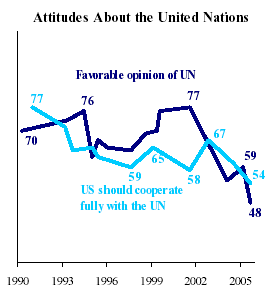
Favorable opinions of the United Nations, which had declined in recent years, have fallen still further. Only about half of Americans (48%) now express a positive opinion of the U.N., down from 77% four years ago.

These are among the principal findings of America’s Place in the World, a survey of opinion leaders and the general public conducted by the Pew Research Center for the People & the Press in collaboration with the Council on Foreign Relations. This quadrennial study examines the foreign policy attitudes of state and local government officials, security and foreign affairs experts, military officers, news media leaders, university and think tank leaders, religious leaders, and scientists and engineers, along with the general public. The new survey, conducted Sept. 5-Oct. 31, reflects the major changes in the world that have occurred since the previous poll, conducted in the summer of 2001 just prior to the 9/11 attacks. There has been continuity in some areas, such as in the broad agreement among opinion leaders and the public that protecting against terrorism and preventing the spread of weapons of mass destruction are top long-term policy objectives.

Yet the war in Iraq has had a profound impact on the way opinion leaders, as well as the public, view America’s global role, looming international threats, and the Bush administration’s stewardship of the nation’s foreign policy. If anything, the opinion leaders are much gloomier about Iraq’s future than is the public. Most opinion leaders feel that the U.S. will fail in establishing a stable democracy in Iraq; a majority of Americans (56%) believe success is still possible. Moreover, the opinion leaders express considerable doubt that Iraq will even survive as a unified country. About four-in-ten or more in every group say that the country will end up being divided into three countries, representing Iraq’s Shiites, Sunnis and Kurds.

The survey finds a continuation of long-standing differences between the public and influentials over issues such as trade and the importance of protecting American jobs as a foreign policy priority. However for both opinion leaders and the public, partisanship is the decisive factor in views of President Bush and his principal policies — especially those related to the war. In effect, the partisan differences are greater than the elite-public divide when it comes to Bush and his policies.

The gap between Republican and Democrat influentials in views of Bush’s performance is about as wide as it is among the general public, and considerably greater than the partisan differences in evaluations of former President Clinton’s job performance at a comparable point early in his second term.

As in past America’s Place in the World surveys, the sample of opinion leaders includes more Democrats than Republicans or independents. Perhaps not surprisingly, the biggest decline in Bush’s approval rating since August 2001 has come among scientists and engineers — the most heavily Democratic group.

By contrast, influential groups that include relatively high percentages of Republicans, such as military leaders, have a more positive view of Bush’s job performance. The military leaders also are more optimistic about prospects for success in Iraq than are members of other groups.

Changing Views of China

The Iraq war and continuing threat of terrorism have dramatically affected the way opinion leaders and the public look at potential threats from other countries. Four years ago, there was broad concurrence, if not a consensus, that China represented the greatest danger to the United States. Today, opinion leaders mention China, North Korea and Iran each about as frequently. The public also is divided as to which country represents the biggest threat to the United States; 18% cite Iraq, 16% China, and 13% North Korea. In 2001, twice as many Americans (32%) named China as the country posing the greatest danger to the U.S.

More generally, China’s emerging global power is not triggering increased concern among opinion leaders or the general public. And while solid majorities in each elite group — and a plurality of the public (45%) — continue to view China as a “serious problem, but not an adversary,” fewer than one-in-five in each group say China is an adversary. Partisanship is at most only a minor factor in attitudes toward China.

Moreover, many influentials predict that in the future China will become an increasingly important U.S. ally. State and local government officials, academics and think tank leaders, and scientists and engineers most frequently name China as a country that will be more important to the U.S. in coming years.

India – the New France

Underscoring the rising importance of Asia generally, foreign affairs specialists and security experts most often name India as a country likely to emerge as a more important U.S. partner. News media leaders cite China and India equally as often.

The influentials are more unified in their opinions of which U.S. allies will decline in importance — France is named far more frequently than any other country. Military leaders, in particular, believe France will be less important to the U.S. in the future; 53% point to France, with 30% mentioning Germany. By contrast, far fewer than one-in-ten military leaders cite any Asian country as being less important to the U.S. in the future. The dominant view among opinion leaders continues to be that the United States should share global leadership with other nations, rather than act as a single leader. But compared with the previous America’s Place in the World, there is generally less support for the U.S. being the “most assertive” of leading nations. The decline has been particularly pronounced among state and local government officials (18 points) and national security specialists (17 points).

Opinion leaders are divided over whether the U.S. should pursue policies to ensure that America remains the world’s only superpower. Religious leaders and scientists and engineers — groups that generally support a more limited leadership role for America — believe it would be acceptable if a rival military power emerged. However, most state and local government officials, military leaders, and foreign affairs experts say U.S. policies should be aimed at retaining America’s status as the sole military superpower. Half of the public also favors U.S. policies to maintain America’s position as the only superpower, while 35% say it would be acceptable if China, another country, or the European Union became as militarily powerful as the U.S.

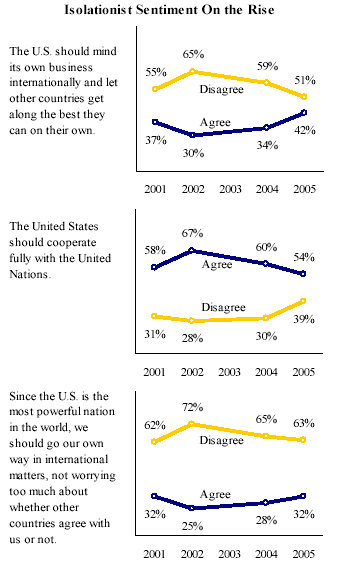
The public’s overall support for global engagement — which increased in the aftermath of the Sept. 11 attacks — has clearly receded. Just a quarter of the public favors the U.S. being the most active of leading nations, which represents a significant decline compared with October 2001 (33%). The percentage of Americans who agree that the “U.S. should mind its own business internationally” has risen from 30% in 2002 to 42% currently. Isolationist sentiment is growing particularly among Democrats and independents. More than half of Democrats (55%) now say the United States should mind its own business internationally up from 40% in 2002; among independents, 42% express that view now, compared with 27% three years ago.

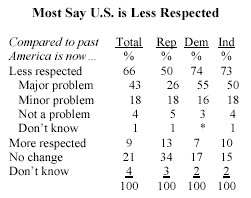
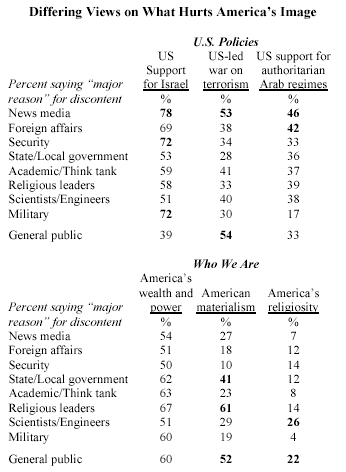
As to public perceptions of the U.S. global image, two-thirds of Americans (66%) say that the U.S. is less respected than in the past. When asked about possible reasons for global discontent with the U.S., overwhelming percentages of Americans (71%) and opinion leaders (87%) cite the war in Iraq as a major factor.

Majorities in each group of influentials, and 60% of the public, also believe that America’s wealth and power are a primary cause of global discontent with the U.S. But opinion leaders are much more inclined than the public to view U.S. support for Israel as a major reason why people around the world dislike the U.S. Majorities in each group of opinion leaders — including 78% of journalists — see this as a major reason for discontent with the U.S. Just 39% of the public agrees.

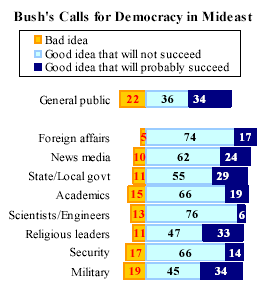
The Bush administration’s strategies for repairing the tattered U.S. image in the Middle East — through the promotion of democracy and by increasing public diplomacy in the region — are viewed skeptically by opinion leaders. No more than a third in any group believe that Bush’s push for democracy in the region will succeed; most believe it is a good idea, but one that will fail. Security specialists and foreign affairs experts, in particular, express little confidence that public diplomacy can do much to help America’s image in the region, though that effort is more highly regarded by religious leaders, state and local government officials and military leaders.

The survey finds continuing differences between the public and influentials over the extent to which the nation’s foreign policy should serve domestic objectives. Fully 84% of the public views the protection of American jobs as a top long-term foreign policy priority; far fewer opinion leaders see this as an important goal. In addition, the public remains much more skeptical than opinion leaders about the benefits of international free trade agreements. Just 44% of Americans see agreements like NAFTA as good for the country; by contrast, solid majorities in all but one group (religious leaders) think such pacts have a positive impact.

The public also favors a more aggressive approach toward the use of military force generally and in tactics in the war on terror than do the opinion leaders. More than half of Americans (52%) believe that using military force is at least sometimes justified against nations that may seriously threaten the U.S., but have not attacked. That represents a decline from previous public surveys — 60% favored such preemptive military action last December. Even so, the public is far more supportive than opinion leaders taking military action against nations that have threatened but not attacked the U.S.

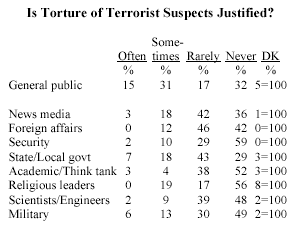
In addition, large majorities in each group of influentials believe the use of torture against terrorist suspects can rarely if ever be justified. The public is much more tolerant of the use of torture against suspected terrorists — 46% say it can be often or sometimes justified, while 49% believe it is rarely or never justified.

Other Findings

  • Solid majorities in every group of opinion leaders — and 84% of the public — say it is important that the partnership between the U.S. and Western Europe remain close. Comparably large majorities of opinion leaders feel a stronger European Union also benefits the U.S., but the public is more divided over this issue.
  • Americans express considerable concern over the spread of AIDS and other infectious diseases. But fewer opinion leaders view reducing the spread of AIDS and other diseases as a major U.S. policy priority.

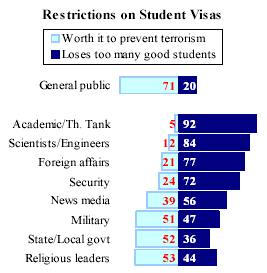
  • The public overwhelmingly believes post-9/11 restrictions on foreign student visas are worth it to prevent terrorists from entering the country. But majorities in five elite groups — including nearly all academics — say the restrictions go too far.
  • Majorities in most groups of influentials say the U.S. should join the International Criminal Court. But military leaders are a notable exception — a narrow majority opposes the U.S. joining the international court.
  • Americans view the goals of reducing the flow of illegal immigration and combating international drug trafficking as much more important long-term priorities than do opinion leaders.
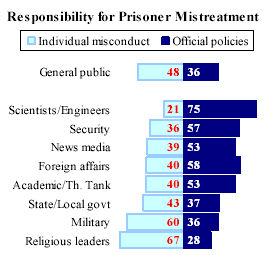
  • The public, on balance, believes cases of U.S. prisoner mistreatment in Iraq and Guantanamo Bay were mostly the result of misconduct by American soldiers rather than the consequence of official policies. Opinion leaders are divided, with solid majorities in five of eight groups saying that the prison abuse scandal was the result of official policies.
  • Pluralities in every group of influentials — as well as the public — attribute the fact that there has not been a terrorist attack in the U.S. since 9/11 to luck. Just a third of the public — and no more than a third in any elite group — says it is because the government has done a good job in protecting the country.

I. The State of the World and America’s Global Role

As dissatisfied as Americans are with things at home, they hold an even more negative opinion of the state of the world. In early October, Pew polling found just 29% of Americans satisfied with the way things are going in their country today, while 65% said they were dissatisfied — the most negative national assessment in nearly ten years. Public views of global conditions are typically more negative than opinions of the state of the nation; even so, just 16% say they are satisfied with the way things are going in the world, down from 21% in July 2004.

There is an element of partisanship in these numbers, as is the case with evaluations of national conditions. By an 86% to 9% margin, Democrats say they are dissatisfied with global conditions, and independents largely agree (80% dissatisfied, 13% satisfied). Among Republicans, 29% say they are satisfied with the way things are going in the world these days, while 64% are dissatisfied.

Terrorism, Iraq Top Problems

Opinion leaders and the public largely agree that terrorism and the situation in Iraq are the biggest international problems confronting the nation. When asked to describe the country’s biggest international problem in their own words, these topics were mentioned most frequently across all groups. Military and media opinion leaders, along with mayors and governors, were most likely to register concern about terrorism and global violence. Religious leaders, security experts, scientists and engineers and the general public more frequently cited Iraq as the nation’s greatest international concern.

Many influentials also identified America’s image in the world and the overall impression that America has lost credibility and respect as the greatest problems facing the nation. As one foreign affairs specialist put it, America has suffered “a loss of international confidence and respect due to the administration ramming a series of ill-considered political, economic and security policies.” A media executive described the problem in similar terms, saying America has “a lack of credibility as a fair and just world leader.” While common among many influential groups, these kinds of concerns were raised by fewer than one-in-twenty Americans generally.

With Iraq and terrorism topping the list, concerns about trade and America’s economic interests, which were mentioned frequently in previous rounds of this survey, have virtually disappeared from the list. Only a handful of military and religious leaders, governors and mayors cited these as the country’s most important international concerns. Among the general public, the proportion referring to trade deficits, jobs moving overseas or other international economic concerns fell from 22% in 1993 to 16% in 1997, 9% in 2001 and just 6% today.

Public Sees U.S. Image Declining

Americans also take the view that the U.S. has lost respect in the world recently. As was the case in July 2004, two-thirds say the U.S. is less respected by other countries than in the past, while just 9% say more respected and 21% say things haven’t changed. Even among Republicans, half say America is less respected than in the past, a view held by nearly three-quarters of both Democrats and independents.

Most who say the nation has lost respect believe that this is an important concern. Roughly four-in-ten Americans (43%) — two-thirds of those who say America is less respected — say this is a major problem for the country. There are larger partisan differences over whether decreasing international respect for the U.S. represents a major problem; roughly half of Democrats (55%) and independents (50%) view this as a major problem compared with about a quarter of Republicans (26%).

War Seen as Fueling Anti-U.S. Sentiment

Opinion leaders and the public overwhelmingly point to the war in Iraq as a major reason for discontent with the U.S. around the world. This belief is nearly unanimous among foreign affairs experts (95%), security specialists (93%), and scientists and engineers (90%). Even military leaders, who express relatively positive opinions of the military operation in Iraq, generally believe the war is a major factor in global unhappiness with the U.S.

The general public concurs in this view. Eight-in-ten Democrats point to the war as a major reason for international discontent with the U.S., and large majorities of independents (70%) and Republicans (64%) agree.

America’s wealth and power also are regarded as primary reasons for dissatisfaction with the U.S. But the public and opinion leaders differ when it comes to the effects of U.S. policies on the Middle East and terrorism on the nation’s image.

Majorities in every influential group say that U.S. support for Israel is a major cause of global discontent with the U.S. This belief is especially widespread among members of the news media (78%), security experts (72%), military leaders (72%) and foreign affairs specialists (69%).

But just 39% of the public sees U.S. support for Israel as a major reason that America’s global image suffers — most (52%) say it is only a minor reason, or not much of a reason. White evangelical Protestants, who are among Israel’s strongest supporters, are more likely than members of other religious groups to view U.S. backing for Israel as major cause of international discontent with America. Half of evangelicals say support for Israel is a major factor for unhappiness with the U.S.; that compares with a third of non-evangelical Protestants (33%) and seculars (34%), and 36% of white Catholics.

For the public, the U.S.-led war on terrorism is a leading factor in global unhappiness with America (54%). But a majority in just one of the eight elite groups shares this opinion (news media 53%). Similarly, American materialism is a bigger factor for the public than for most groups of opinion leaders among causes of international discontent with the U.S.

Notably, U.S. support for authoritarian Arab governments is seen as a relatively minor cause of global discontent with the U.S. Military leaders, in particular, see U.S. backing for such governments as a fairly insignificant factor; just 17% say it is a major reason for discontent with America.

America’s Leadership Role

The American public traditionally has favored a far less expansive role for the United States in world affairs than have opinion leaders. In 1993, 1997 and 2001, sizable majorities in almost all influential groups said the U.S. should play the most assertive leadership role in the world, if not act as the single world leader, while fewer than four-in-ten Americans nationwide agreed.

But the gap between opinion leaders and the general public has narrowed significantly, as a declining number of influentials favor an assertive U.S. leadership role in the world. This shift in opinion can be seen across almost all groups. For example, barely half of security experts today say the U.S. should take a preeminent role in world affairs, compared with roughly three-quarters in previous surveys. State and local government officials and news media leaders are also substantially more likely to say that America should be no more assertive in world affairs than other leading nations. In fact, a majority of both religious leaders and scientists and engineers today say the U.S. should not take a particularly active leadership role in the world.

By comparison, the public’s long-term views on U.S. leadership have remained fairly steady, with an important exception. Following the 9/11 terror attacks, the share of Americans who supported a strong leadership role spiked upward, but has since declined. Today 12% of Americans say the U.S. should be the single world leader, while 25% say it should play a shared leadership role but be the most assertive of leading nations. A 47% plurality believes the U.S. should be no more or less assertive than other nations, while 10% think we shouldn’t play any leadership role at all.

Public Less Internationalist

Following a spike in internationalist sentiment in the wake of the 9/11 attacks, public skepticism about becoming too involved with world affairs has returned. The percentage of Americans who say the U.S. should “mind its own business internationally” has risen to 42%; just 30% expressed this opinion in December of 2002.

Support for full cooperation with the United Nations stands at 54%, down from 67% three years ago and a low point since 1976 (46%). By about two-to-one (63%-32%), the public rejects the idea of America going its own way and “not worrying too much about whether other countries agree with us or not.” But in 2002, Americans rejected this sentiment by nearly three-to-one (72% disagree/25% agree).

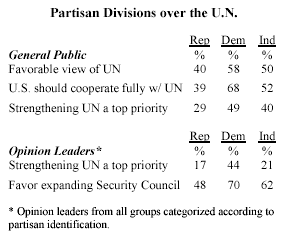
There are partisan divides on these questions, though each has its own dynamic. For example, Democrats are twice as likely as Republicans (55% vs. 27%) to say the U.S. should “mind its own business internationally” and not worry about other countries, and Democrats also are more apt to say we should “concentrate more on our own national problems.” But Republicans clearly take a more unilateralist position on other questions. When it comes to the U.N., Republicans are twice as likely as Democrats (56% vs. 24%) to say the U.S. does not need to cooperate fully with the international body.

Bush’s Foreign Policy Leadership

When asked to name the best things about President Bush’s foreign policy, opinion leaders cited a diverse array of decisions and leadership strengths. Nearly one-in-five news media leaders cited Afghanistan as the greatest success of the administration, and the same proportion of religious leaders referred to advances in the Israeli-Palestinian peace process.

Others referred to Bush’s leadership style as his greatest asset. Many governors and mayors applaud the administration’s efforts to make America’s foreign policy clear and straightforward, and many military leaders cite the president’s decisiveness as the best aspect of his foreign policy.

But a sizable minority of opinion leaders could think of nothing to say when asked what has been best about Bush’s handling of foreign policy.

Fully 37% of scientists and engineers volunteered that they had “nothing” good to say, or offered a sarcastic response such as “Well, he hasn’t bombed Antarctica yet.”

Roughly half of news media, foreign affairs, security and academic leaders, along with scientists and engineers, cite Iraq as the worst aspect of Bush’s foreign policy so far. But a number of other concerns were raised consistently across all groups.

Between 17% and 34% in every group cited weakened relations with allies as Bush’s greatest failure, and between 9% and 18% referred to what they see as an “arrogant” foreign policy stance. The administration is also criticized for being indecisive and unilateral.

The Public’s Views of Bush’s Foreign Policy

Public views of Bush’s foreign policy generally mirror the views of opinion leaders. While Bush’s overall job approval rating stood at 40% in October (Oct. 12-24), a narrow majority (52%) says he is doing a good job handling terrorist threats.

But Bush gets negative marks for his handling of other foreign policy issues. About half (51%) disapprove of Bush’s handling of the nation’s overall foreign policy, and 57% disapprove of his handling of Iraq.

Public opinion is decidedly negative over Bush’s immigration policy. Just 24% say they approve of his job performance on immigration, while 54% disapprove (22% volunteer no opinion). Even Republicans, on balance, disapprove of Bush’s handling of immigration; 36% approve of the job he is doing in this area, while 43% disapprove. Seven-in-ten Democrats (72%) and half about half of independents (52%) also give Bush negative ratings on immigration.

This dissatisfaction is politically relevant because the general public places a far higher priority on issues of immigration than do opinion leaders. Fully 51% of Americans say reducing illegal immigration should be a top foreign policy priority for the nation.

II. Global Policy Goals and Threats

The existential threats posed by terrorism and the spread of weapons of mass destruction rate as leading long-term U.S. policy concerns, in the view of both opinion leaders and the public. But there also is a widely shared belief that decreasing the nation’s dependence on imported energy should be a major policy objective.

Fully 87% of mayors and other state and local government officials say that reducing U.S. dependence on imported energy sources is a top priority; comparable numbers of scientists and engineers (83%) and members of the news media (82%) agree. More than 60% in each group of influentials — and two-thirds of the public (67%) — view energy independence as a major long-term policy objective. Among the public, comparable percentages of Republicans, Democrats and independents say that reducing U.S. dependence on foreign energy is a top priority.

There are wide differences between opinion leaders and the public — and among the groups themselves — over the importance of other goals. For the public, protecting the jobs of American workers ranks about equally important as important as defending the nation against terrorism (84% vs. 86%), and more cite jobs as a top priority than say that about preventing the spread of weapons of mass destruction (75%). But this goal is a far lower priority for influentials; only among state and local government officials (64%) and religious leaders (55%) do majorities believe that protecting U.S. jobs is a top long-term priority.

The public also continues to view the goals of reducing the spread of AIDS and other infectious diseases, and combating international drug trafficking, as more important priorities than do most opinion leaders.

In addition, the public views reducing illegal immigration as a much more important long-term goal than do opinion leaders. About half of Americans (51%) say that reducing illegal immigration should be a top priority; that compares with 34% of military leaders, a third of religious leaders, and far lower percentages in other groups.

Differences among Influentials

The hierarchy of policy concerns varies among the groups of opinion leaders. Nearly nine-in-ten religious leaders (89%) say that protecting groups or nations threatened with genocide should be a top priority. This objective is viewed as a much lower priority by other groups and the general public. In addition, far more religious leaders rate defending human rights in other countries as a top priority than do those in other groups. Military leaders, security and foreign affairs experts, in particular, see the advancement of human rights abroad as a low-ranking objective.

Dealing with global climate change is a dominant concern for scientists and engineers, but is viewed as less important by other groups. Fully 86% of scientists and engineers say dealing with global climate change should be a top long-term priority; the only objective that draws comparable concern among scientists and engineers is reducing American dependence on imported energy (83%).

Among military leaders, there is broad agreement that defending the U.S. against terrorism (96%), preventing the spread of WMD (85%), and reducing dependence on imported energy (72%) are major priorities. Beyond these three issues, however, other potential goals rate as far less important for military leaders.

The survey finds that the goal of strengthening the U.N. is a relatively low priority among both opinion leaders and the public. A narrow majority of scientists and engineers (54%) view bolstering the U.N. as a top priority, but there is far less support for this objective elsewhere. Just 40% of Americans say that strengthening the U.N. is a top priority, down from 48% in July 2004.

Even smaller percentages of opinion leaders and the public view the promotion of democracy in other nations as a top long-range priority. No more than three-in-ten in any group rates the promotion of democracy abroad as major long-term goal of the United States (32% of state and local officials).

National Threats

There is no consensus, among opinion leaders or the public, as to which country represents the greatest danger to the United States. Three countries are cited most frequently by opinion leaders — North Korea, China and Iran. This marks a change from the previous survey in August 2001, when pluralities in each group pointed to China as posing the biggest danger to the United States.

Academics and think tank leaders mention China most frequently as the country presenting the greatest danger to the U.S. (34%). But even among this group, the percentage citing China has fallen from 46% in 2001.

A relatively large proportion of scientists and engineers (21%) cite the U.S. itself as the nation that poses the greatest danger. Only China (at 23%) was mentioned more frequently by scientists and engineers.

Among the general public, roughly equal numbers name Iraq and China as the country representing the greatest danger to the U.S. (18% and 16%, respectively); another 13% pointed to North Korea.

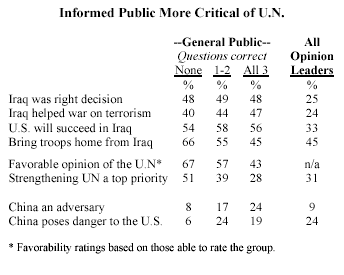
Americans who demonstrate a relatively high degree of awareness of current international issues, based on their responses to several knowledge questions, are divided in their evaluations of national threats, with about one-in-five each citing China, Iran or North Korea. Among those who have little awareness of international issues, a plurality cites Iraq as the country posing the biggest danger to the U.S. (33%).

Specific Threats: N. Korea, Iran

When assessing specific threats to the U.S., opinion leaders and the public express a high level of concern over the nuclear programs of North Korea and Iran. Majorities in all but one group view North Korea’s nuclear program as a major threat to the U.S.; the only exception is scientists and engineers (42%).

Smaller majorities in most groups see Iran’s nuclear program as a major threat; again, scientists and engineers are far less likely to express this view (28%). The general public generally regards both countries’ nuclear programs as worrisome: 66% view North Korea’s nuclear program as a major threat, and 61% say the same about Iran’s nuclear ambitions.

Other possible international threats — including China’s emergence as a world power — trigger less concern. Influentials are deeply divided over whether China’s growing power represents a major threat to the U.S. Far more journalists see China’s increasing power as a major threat than did so four years (64% now, 45% in 2001).

But several other groups express far less concern, and the percentage of security experts who view China’s emergence as a world power as a major threat has declined, from 38% to 21%, since 2001.

Public attitudes toward the potential threat posed by China also have not changed in recent years. About half of Americans (52%) continue to perceive China’s emergence as a serious threat. Nearly six-in-ten Republicans (58%) view China’s growing power as a major threat, compared with about half of Democrats (51%) and 45% of independents.

The public is even less concerned over a possible military clash between China and Taiwan. Only about a third of Americans (34%) regard this scenario as a major threat to the U.S., which is virtually unchanged from May 2001 (36%). However, a possible conflict between China and Taiwan does trigger considerable concern among two groups of opinion leaders — security experts and military leaders. Six-in-ten security experts (62%) say such a clash represents a major threat to the U.S., while about half of military leaders agree (51%).

More Americans see the amount of U.S. debt held by foreign investors as a major threat than say that about a possible China-Taiwan conflict and other long-standing foreign policy concerns. More than half of the public (55%) rates U.S. indebtedness to foreign investors as a major threat to the United States. This is generally less of concern to opinion leaders, although majorities of scientists and engineers (63%) and state and local government officials (59%) also regard U.S. indebtedness as a serious threat.

Relatively small percentages among opinion leaders perceive a possible military conflict between India and Pakistan and growing authoritarianism in Russia as major threats to the United States. Just a third of the public (32%) views a possible India-Pakistan conflict as a major threat, while 23% say that about growing authoritarianism in Russia.

III. Iraq and the War on Terrorism

Opinion leaders express deep doubts about the decision to go to war in Iraq, and most of them believe the war has undermined the struggle against terrorism. Influentials are divided on whether to keep troops in Iraq, but most think that the U.S. will ultimately fail in its effort to create a stable democratic government there. In contrast, the public is more divided on whether the war was a mistake and on how it has affected the war on terrorism. A small majority of the public believes that the U.S. will ultimately succeed in establishing a democratic government in Iraq.

Only one group of influentials, military leaders, is divided over the decision to go to war (49% right decision, 47% wrong decision). In all other groups at least 59% think using force was the wrong decision. Similarly, only in the military sample is there an even division on the impact of the Iraq invasion on the war on terrorism. Half or more in other groups think the war has hurt America’s effort to combat terrorism.

The attitudes of influentials toward the war, like their views of Bush, are politically polarized. Democratic members of the influentials sample are nearly unanimous in the view that the war was a mistake (93%), while a smaller majority of Republicans (72%) think it was the right thing to do. A similar split is seen on Iraq’s impact on the war on terrorism and on the prospects for eventual success in Iraq.

Opinion leaders generally believe the war was a mistake, but they are divided over whether to maintain troops in Iraq. About as many favor a withdrawal of all or some U.S. forces in Iraq (45%) as say the troops should remain, or even be augmented (49%). Except for scientists and engineers, fewer than a quarter in all groups favor a complete U.S. troop withdrawal. Similarly, just 26% of the public supports a total pullout of forces.

Iraq’s Future

The opinion leaders are somewhat skeptical that Iraq will remain a single nation in the future. Military officers and security specialists are the most likely to think Iraq will hold together (55% and 52%, respectively), while religious leaders and scientists and engineers are most apt to think the country will end up divided (58% and 68%, respectively). Among influentials, Republicans (67%) are much more likely than Democrats (30%) to think the country will stay intact.

Asked what a future democracy in Iraq might look like, large majorities in nearly all influential groups believe it would be a religious rather than a secular democracy. Only among religious leaders do as few as half expect an Iraqi democracy to be religious in nature — but even among this group, only 36% think it would be a secular democracy.

Bush’s Calls for Democracy

By wide margins, both the American public and opinion leaders believe that George W. Bush’s calls for more democracy in the Middle East are a good idea, but there is widespread doubt about whether this idea will ultimately succeed, especially among opinion leaders. Except for religious and military leaders, majorities in every group say that Bush’s calls for more democracy are a good idea that will probably fail; even among those two groups, pluralities express this view.

The general public is more divided over this question than any influential group. While a third (34%) are optimistic that Bush’s calls for democracy will probably succeed, 22% believe his calls for democracy are a bad idea altogether.

Assessing the Terrorist Threat

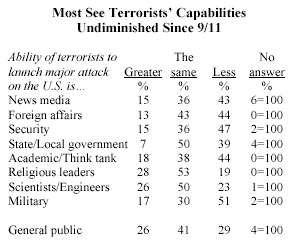
More than four years after the 9/11 attacks, most influentials feel the ability of terrorists to launch another major strike against the U.S. remains undiminished. Only among military leaders does a slim majority (51%) say that the ability of terrorists to attack the U.S. is less than it was around the time of 9/11.

The public is skeptical that the terrorists’ capabilities to attack have been degraded. Overall, 41% say terrorists have the same ability to launch a major strike on the U.S., 26% believe terrorists now have greater ability to engineer a major attack, while just 29% say terrorists’ capabilities are less than they were at the time of 9/11.

Large majorities of influentials say that the absence of another terrorist attack on the U.S. since 9/11 is either a result of good luck or the fact that America is inherently a difficult target for terrorists, rather than due to government efforts to protect the country. Overall, about half (48%) credit luck, and a quarter (24%) say the U.S. is a difficult target, while only one-fifth (22%) say the lack of terrorist attacks is due to the government’s good job in protecting the country. Military officers and state and local government officials are slightly more likely than other leaders to credit the government’s efforts for preventing a new terrorist attack.
The general public’s views are not particularly different from those of the influentials, with nearly half (45%) saying the U.S. has been lucky thus far, and a third (33%) giving the government credit (33%). More generally, the public gives the government fairly good marks for its efforts to reduce the threat of terrorism. Two-thirds (67%) say the government is doing at least “fairly well” in protecting the country (17% “very well,” 50% “fairly well”), down from 2001 (following the attacks) but largely unchanged over the past year and a half.

Public More Willing to Accept Torture

The American public is far more open than opinion leaders to the use of torture against suspected terrorists in order to gain important information. Nearly half of the public (46%) says this can be either often (15%) or sometimes (31%) be justified. This is consistent with results of Pew surveys since July 2004.

By contrast, no more than one-in-four in any of the eight elite groups believes the torture of terrorist suspects can be sometimes or often justified. Strong opposition to torture is particularly pronounced among security experts, religious leaders and academics, majorities of whom say the use of torture to gain important information is never justified. Nearly half (48%) of scientists and engineers also take this position, as do military leaders (49%).

Responsibility for Prisoner Abuse

While influentials largely agree in opposing the use of torture, opinions differ widely on where the responsibility lies for cases of prisoner mistreatment in Iraq and Guantanamo Bay. By more than three-to-one (75%-21%) scientists and engineers say that these abuses were mostly the result of official policies. A majority of security (57%) and foreign affairs experts (58%) agree, along with about half of academics (53%) and news media leaders (53%). But most military (60%) and religious (67%) leaders believe cases of prisoner mistreatment were mostly the result of misconduct on the part of soldiers and contractors.

The general public is divided over this question — 48% believe soldiers and contractors are mostly to blame, while 36% blame official policies. Not surprisingly, the public’s views are highly differentiated by party. By a 67% to 20% margin, Republicans say these abuses mostly reflect misconduct by soldiers and contractors. Democrats and independents are more than twice as likely as Republicans to blame official policies (44% and 46% respectively).

Terrorism and Civil Liberties

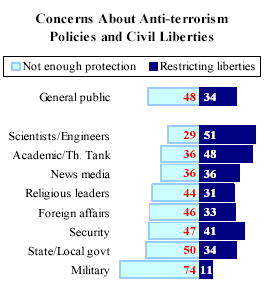
Opinion leaders and the public are split over the proper balance between protecting the nation against future terror attacks and maintaining basic civil liberties for all Americans. Asked which concerned them more about the current anti-terrorism policies, 48% of Americans are more concerned that they have not gone far enough to adequately protect the country, while 34% worry more that they have gone too far in restricting the average person’s civil liberties.

Several of the influential groups interviewed divide over this question in much the same way, but there are some important exceptions. Most notably, military leaders overwhelmingly say the bigger concern is inadequate protection against future attacks — 74% take this view. By contrast, roughly half of scientists and engineers (51%) and academics (48%) worry more that policies have gone too far in restricting civil liberties.

There is a broader split between the public and influential groups over the specific policy that increased restrictions on student visas as part of terrorism defenses. By a 71% to 20% margin, the American public believes these increased security measures are worth it in order to prevent terrorists from getting into the country. But most opinion leaders (67%), including 92% of academic and think-tank leaders and 84% of scientists and engineers, are of the view that such measures go to far because the U.S. loses too many good students to other countries.
While concern about losing too many good students prevails among many influential groups, about half of military leaders (51%), religious leaders (53%) and governors and mayors (52%) say these types of restrictions are worth the costs.

IV. Allies, Trade and International Institutions

Looking into the future, many opinion leaders see China and India, with their huge populations and rapidly expanding economies, as increasingly important partners for the U.S. Pluralities in four of the eight opinion leader groups identify China as a country that will be more important to the U.S. in the future, while pluralities in another three groups name India. The United Kingdom, traditionally a strong U.S. ally, is the most commonly mentioned country among religious and military leaders. Many influentials also mention Japan, the EU, and Russia as countries that will become more important to the U.S.

France, on the other hand, is widely named as a country that will be less important to the U.S. in the years to come. A majority of military leaders see this as an alliance in decline, as do roughly three-in-ten media, foreign affairs and religious leaders. Many also believe Germany will be less relevant to the U.S, particularly those with military backgrounds and from think tanks and the academy. In addition to these two traditional western European allies, Russia, the EU, Great Britain, and Saudi Arabia are also mentioned with some frequency as less important U.S. allies in the future.

Strong EU Good for the U.S.

Despite the growing importance of Asia, and tensions in recent years between the U.S. and many European allies over the Iraq war and other issues, both opinion leaders and the public strongly believe that the U.S. and Western Europe should maintain a close relationship. Fully 84% of the public and over 78% in each group of opinion leaders say it is important for the U.S.-Western Europe partnership to be as close as it has been in the past.

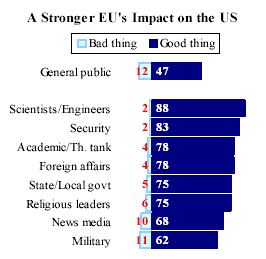
Moreover, there is a solid consensus among influentials that a stronger EU is a good thing for the U.S. In each of the eight groups, at least 60% say a stronger EU would be good for the U.S., while no more than 11% believe this would be a bad thing. The public is slightly less enthusiastic about a strong EU; still, 47% believe this would be a good thing, while 28% say it would not matter and only 12% say it would be bad for the U.S.

One-third of the public has a favorable opinion of the EU, while just over a quarter (27%) hold an unfavorable view. Opinions about the EU have grown slightly less positive since February 2004, when 39% had a favorable view and 26% an unfavorable one. Certain segments of the American public are particularly likely to have a positive outlook toward Europe. Those with higher incomes, the college educated, white men, and Democrats — especially liberal Democrats — give the EU high favorability ratings and are particularly likely to back a strong EU.

Many Americans, however, are unfamiliar with the EU, as a plurality currently say they have either never heard of it (14%) or do not know enough about it to offer an opinion (26%). Pew surveys have generally found that Americans pay relatively little attention to European affairs; for instance, only 16% followed the recent German elections very or fairly closely, and similarly low numbers followed the 2002 French elections (19%) and the 2001 Labour Party victory in Great Britain (15%).

Public Approval of the U.N. Declines

The public’s view of the United Nations has soured since March, continuing a slide that has been relatively steady over the last few years. In March, 59% held a favorable opinion of the U.N.; today just under half (48%) have a positive view. The decline has been steepest among groups that had been some of the U.N.’s strongest supporters, including Democrats (now at 58% favorable, down 17 points since March), blacks (49%, down 20 points), and those with household incomes below $20,000 (48%, down 19 points).

Enthusiasm for U.S.-U.N. cooperation is also waning. An early October Pew survey found that slightly more than half (54%) of the public agrees with the statement “the United States should cooperate fully with the United Nations,” down six points from August. Meanwhile, the percentage disagreeing has risen from 30% to 39%.

The importance Americans attach to strengthening the U.N. has also slipped. Four-in-ten say a stronger U.N. should be a top long-range priority for U.S. foreign policy, down from 48% in July 2004. Opinion leaders also tend to regard strengthening the U.N. as a second tier goal, although there is some variation among groups. For example, 54% of scientists and engineers consider this a top priority, compared with only 14% of security experts.

Opinions about the U.N. break sharply along partisan lines. Among the general public, Democrats have a more favorable view of the institution, are more likely to believe the U.S. should cooperate with the U.N., and place a higher priority on strengthening the U.N. Meanwhile, Republicans are the least enthusiastic about the U.N., with independents occupying a middle ground.

Among influentials, Democrats are considerably more likely than Republicans or independents to rate strengthening the U.N. as a top priority. There are also significant partisan divisions among influentials on the issue of expanding the U.N. Security Council, with 70% of Democrats and 62% of independents favoring a larger Council, compared to 48% of Republicans. Overall, majorities of seven opinion leader groups support enlarging the Security Council, with state and local government leaders the only exception (39% favor, 48% oppose).

Even larger partisan differences emerge over another international institution, the International Criminal Court (ICC). Roughly nine-in-ten (88%) Democratic opinion leaders say the U.S. should join the ICC, compared with 62% of independents and just 33% of Republican influentials. There is also a great deal of variation among the eight groups over this issue, with scientists and engineers (83% favor) and foreign affairs (81% favor) the most supportive, and military (45%) and state and local government leaders (45%) the least supportive.

Influentials, Public Differ Over Trade

Consistently, opinion leaders are more likely to embrace free trade than the general public. Just 44% of the public believes that NAFTA has been a good thing for the U.S., while 34% say it has been a bad thing; these views have been relatively consistent across time (in December 2004, 47% said “good thing” and 34% “bad thing”). Opinions on NAFTA are also fairly consistent across demographic and political categories, with the exception of age — those under 50 (51% good, 29% bad) have a much more favorable opinion of trade agreements than do those over 50 (34% good, 41% bad).

Seven of the opinion leader groups think NAFTA has been a good thing for the U.S. Only religious leaders mirror the mixed feelings of the public. This enthusiasm for free trade extends to CAFTA, the recently passed Central American Free Trade Agreement. Solid majorities of every group except religious leaders favor CAFTA (a 44% plurality of religious leaders support the treaty). Interestingly, the sharp partisan divisions that exist on many other issues are largely muted on trade — 83% of Republican opinion leaders think NAFTA has been good for the U.S., compared with 73% of Democrats and 74% of independents; 84% of GOP leaders approve of CAFTA, compared with 69% of Democrats and 73% of independents.

Another reflection of the gap between influentials and the public on trade can be seen in the relative importance each places on the protection of American jobs. The public rates this as nearly as important as defending the country against terrorism (86% terrorism, 84% jobs). In contrast, few opinion leaders consider jobs a top-tier foreign policy concern. In only two groups, state and local government leaders (64%) and religious leaders (55%), do majorities rate this as a top priority.

Public Divided over Use of Nuclear Weapons

By a 70% to 24% margin, the American public widely supports the idea of the U.S. signing a treaty with other nations to reduce and eventually eliminate all nuclear weapons, including our own. This receives majority support from Republicans (63%) as well as Democrats (77%) and independents (73%). (This question was not asked of opinion leaders).

Despite this general support for multilateral disarmament, many Americans remain willing to use nuclear weapons preemptively if America or one of its allies were faced with a serious threat. Just under half (46%) say the U.S. would be justified in using nuclear weapons first if another nation seriously threatened to use nuclear weapons against us, and nearly as many (41%) say this would also be justified if that serious threat were against a U.S. ally.

The likelihood of nuclear weapons being used against the U.S. or its allies is a real one to some Americans. Nearly a quarter say that within the next few years America is very likely (8%) or fairly likely (16%) to be the target of a nuclear attack. Even more see the possibility of an attack against one or more of America’s allies as very (14%) or fairly (26%) likely.

Public Perceptions of Nuclear States

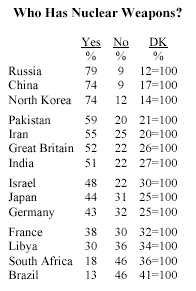
Large majorities of the public believe that Russia (79%), China (74%), and North Korea (74%) possess nuclear weapons. But more than half (55%) also believe Iran currently has nuclear weapons. This is comparable to the percentage saying that Pakistan, India and Great Britain have nuclear weapons capabilities.

By a 48% to 22% margin, more say Israel does have nuclear weapons than say it does not. Fewer than half list Japan (44%), Germany (43%), and France (38%) as members of the nuclear club. At the other end of the spectrum, fewer than one-in-five believe that South Africa and Brazil are in possession of nuclear weapons. While many Americans believe such countries as North Korea, Iran and Libya have developed nuclear capabilities, those who hold this view are no more likely to say that America would be justified in using nuclear weapons preemptively if attacked.

Knowledge of Foreign Affairs

In addition to measuring public attitudes about America’s place in the world, the survey also gauged basic public knowledge about international political issues. For example, when asked what issue has been the focus of international talks with North Korea, 57% correctly identified nuclear weapons. Other questions were less widely known. Just under half (46%) could named Israel as the country that recently ceded control of the Gaza Strip to the Palestinians, and 37% could recall Vladimir Putin as the name of Russia’s president. Overall, 28% answered all three questions correctly, while 38% could answer one or two of the questions correctly, and 34% got none of the questions right.

Informed Public Views World Differently

In general, those who are most knowledgeable about international affairs (those who answered all three of these questions correctly) express a somewhat more internationalist perspective on world affairs. By contrast, people who have relatively little knowledge about these issues (those who answered none of the questions correctly) see the world as a more threatening place, and place more emphasis on taking care of America first.

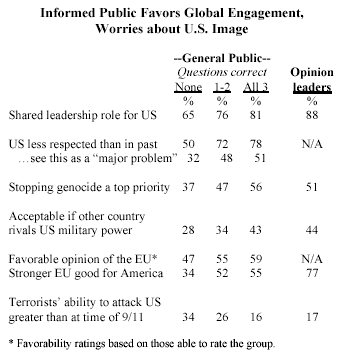
When asked to characterize what role the U.S. should play in world affairs, 81% of those in the high-knowledge group favor a shared leadership role. Fewer low-knowledge Americans agree (65%). The generally multilateral outlook of those who are most knowledgeable is also visible in their stronger support for taking action to stop genocide and global climate change. On all of these issues, knowledgeable Americans largely share the outlook of the opinion leaders surveyed.

Also like opinion leaders, the most knowledgeable Americans express considerable concern over how the United States is viewed globally. More than three-quarters (78%) say America is less respected than in the past, and most (51%) believe this is a major problem. By comparison, just half of low-knowledge Americans think that America has lost respect in the world. In assessing the reasons why America is disliked, those who are knowledgeable about international affairs far more often point to America’s support for Israel as a cause — a view expressed by a majority of opinion leaders as well.

Americans who do not know much about international affairs tend to see the world as a scarier place — they believe that the threat of terrorism is on the rise, and they strongly oppose allowing other countries to become as militarily powerful as the U.S. Less knowledgeable Americans also place a far higher priority on protecting American jobs, and most do not believe that a stronger European Union is a good thing for the United States’ interests. Knowledgeable people view the EU much more favorably, and are far more willing to accept a future in which other countries rival America’s military power.

Both high- and low-knowledge Americans are equally likely to say taking military action in Iraq was the right decision, to say it has helped the war on terrorism, and that U.S. efforts there will ultimately be successful. In all these regards, even the most knowledgeable Americans take a decidedly different view than do opinion leaders.

There is one aspect of Iraq policy where knowledgeable and less knowledgeable Americans disagree, and the knowledgeable share the view of opinion leaders. While two-thirds of low-knowledge Americans favor removing either some or all troops from Iraq now, just 45% of the knowledgeable agree — the same as the share of influentials overall who take this position.

Despite their generally multilateral outlook, knowledgeable Americans are deeply skeptical of the United Nations. Most express an unfavorable view of the institution, and just 28% say strengthening the U.N. should be considered a top priority. By comparison, people with less knowledge of foreign affairs see the United Nations more favorably, and consider it a higher public policy priority.

Survey Methodology

The Opinion Leaders Survey Sample

The results of the opinion leaders survey are based on Americans who are influential in their chosen field. The sample was designed to represent these influentials in eight professional areas of expertise: media; foreign affairs; national security; state and local government; university administration and think tanks; religious organizations; science and engineering; and military. Every effort was made to make the sample as representative of the leadership of each particular field as possible. However, because the goal of the survey was to identify people of particular power or influence, the sampling was purposive in overall design, but systematic with regard to respondent selection wherever possible.

The final selected sample was drawn from eight subsamples. Subsamples were split into replicates, and quotas were set for the number of completed interviews from each subsample. These quotas were set because the size of the sampling frame for each subsample varied a great deal. In order to ensure adequate representation of the smaller groups in the final sample of complete interviews, it was necessary to set quotas. The subsamples and final completed interviews for each are listed below:

The specific sampling procedures for each subsample are outlined below.

News Media
The media sample included people from all types of media: newspapers, magazines, television and radio. Various editors (editors, editors of the editorial page, managing editors) and D.C. bureau chiefs were selected from: the top daily newspapers (based on circulation); additional newspapers selected to round out the geographic representation of the sample; news services; and different types of magazines including news, literary, political, and entertainment and cultural magazines.

For the television sample, people such as D.C. bureau chiefs, news directors or news editors, anchors, news executives, and executive producers were selected from television networks, chains and news services.

The radio sample included news directors and/or D.C. bureau chiefs at several top radio stations.

Top columnists listed in the Leadership Directories’ News Media Yellow Book and Bacon’s MediaSource were also selected as part of the media subsample.

In each part of the media subsample, it is possible that more than one individual at an organization was interviewed.

Foreign Affairs
The Foreign Affairs sample was randomly selected from the membership roster of the Council on Foreign Relations.

Security
The Security sample was randomly selected from a list of American members of the International Institute for Strategic Studies.

State and Local Government
Governors of the 50 states were drawn for the sample, as well as a random sample of mayors of cities with a population of 80,000 or more.

Academic and Think Tank Leaders
The heads of various influential think tanks listed in National Journal’s The Capital Source were selected. For the academic sample, officers (President, Provost, Vice-President, Dean of the Faculty) of the most competitive schools overall and the most competitive state schools (as identified in Peterson’s Guide to Four-Year Colleges 2006) in the United States were selected.

Religious Leaders
For the religion sample, leaders of Protestant, Catholic, Jewish and Muslim organizations with membership over 700,000 each were sampled. Top U.S. figures in each national body were selected in addition to the leading people at the National Council of the Churches of Christ in the U.S.A.

Scientists and Engineers
The science sample was a random sample of scientists drawn from the membership of the National Academy of Sciences.

The engineering sample was a random sample of engineers drawn from the membership of the National Academy of Engineering.

Military
The military leaders sample was drawn from a Lexis-Nexis search of retired generals and admirals quoted in American news sources in the past year. Also included was a sample of outstanding officers selected to participate in the Council on Foreign Relations’ Military Fellowship program since 2000.

The Opinion Leaders Survey Process

Each person sampled for this survey was mailed an advance letter on a joint Pew Research Center for the People & the Press and Council on Foreign Relations letterhead and signed by Andrew Kohut and Richard Haass. These letters were intended to introduce the survey to prospective respondents, describe the nature and purpose of the survey, and encourage participation in the survey.

Unlike previous America’s Place in the World telephone mode surveys, in 2005 respondents were given the option to take this survey via the Internet. The advance letter contained a URL and a password to complete the survey online, a toll-free number to call in to do the survey by phone, as well as notification that interviewers would be calling as well. As soon as the letters were mailed, a website was available for respondents to complete the interview online.

A follow-up email invitation was sent six days after letters were mailed to those for whom email addresses were available, repeating the substance of the letter and providing a URL to click to take the survey.

Approximately one week after the letter was mailed, calling began to sample members who had not yet taken the survey online and had not been sent an email invitation. Interviewers attempted to conduct the survey over the telephone or set up appointments to conduct the survey at a later date. Approximately four days later, interviewers began calling sample members who were sent an email invitation and had not yet taken the survey online.

For groups not meeting the target number of interviews, follow-up letters and emails were sent to those who refused encouraging them to reconsider. Another letter was sent to those who had not participated but had not explicitly refused. Interviewers also continued to call those respondents in the remaining groups who did not explicitly refuse in an attempt to complete the interview.

The “Don’t know/Refused” response category was volunteered exclusively in the telephone survey, while in the online survey mode not selecting a response category and clicking ahead to the next question constituted a “No answer” response.

Interviewers who administered the telephone survey were experienced, executive, and specially trained to ensure their familiarity with the questionnaire and their professionalism in dealing with professionals of this level. The interviewing was conducted from September 5 through October 31, 2005.

About the General Public Survey

Results for the general public survey are based on telephone interviews conducted under the direction of Princeton Survey Research Associates International among a nationwide sample of 2,006 adults, 18 years of age or older, during the period October 12 – 24, 2005. For results based on the total sample, one can say with 95% confidence that the error attributable to sampling and other random effects is plus or minus 2.5 percentage points. For results based on either Form 1 (N=1003) or Form 2 (N=1003), the sampling error is plus or minus 3.5 percentage points. For Q.42 the forms are further divided into Form 1A, 1B, 2A and 2B (N is approximately 500) with a sampling error of plus or minus 5 percentage points.

In addition to sampling error, one should bear in mind that question wording and practical difficulties in conducting surveys can introduce error or bias into the findings of opinion polls.

General Public Survey Methodology in Detail

The sample for this survey is a random digit sample of telephone numbers selected from telephone exchanges in the continental United States. The random digit aspect of the sample is used to avoid “listing” bias and provides representation of both listed and unlisted numbers (including not-yet-listed). The design of the sample ensures this representation by random generation of the last two digits of telephone numbers selected on the basis of their area code, telephone exchange, and bank number.

The telephone exchanges were selected with probabilities proportional to their size. The first eight digits of the sampled telephone numbers (area code, telephone exchange, bank number) were selected to be proportionally stratified by county and by telephone exchange within county. That is, the number of telephone numbers randomly sampled from within a given county is proportional to that county’s share of telephone numbers in the U.S. Only working banks of telephone numbers are selected. A working bank is defined as 100 contiguous telephone numbers containing one or more residential listings.

The sample was released for interviewing in replicates. Using replicates to control the release of sample to the field ensures that the complete call procedures are followed for the entire sample. The use of replicates also ensures that the regional distribution of numbers called is appropriate. Again, this works to increase the representativeness of the sample.

As many as 10 attempts were made to complete an interview at every sampled telephone number. The calls were staggered over times of day and days of the week to maximize the chances of making a contact with a potential respondent. All interview breakoffs and refusals were re-contacted at least once in order to attempt to convert them to completed interviews. In each contacted household, interviewers asked to speak with the “youngest male, 18 years of age or older, who is now at home.” If there is no eligible man at home, interviewers asked to speak with “the youngest female, 18 years of age or older, who is now at home.” This systematic respondent selection technique has been shown empirically to produce samples that closely mirror the population in terms of age and gender.

Non-response in telephone interview surveys produces some known biases in survey-derived estimates because participation tends to vary for different subgroups of the population, and these subgroups are likely to vary also on questions of substantive interest. In order to compensate for these known biases, the sample data are weighted in analysis.

The demographic weighting parameters are derived from a special analysis of the most recently available Census Bureau’s Current Population Survey (March 2004). This analysis produced population parameters for the demographic characteristics of households with adults 18 or older, which are then compared with the sample characteristics to construct sample weights. The analysis only included households in the continental United States that contain a telephone.

The weights are derived using an iterative technique that simultaneously balances the distributions of all weighting parameters.