
9/11 Commission has Bipartisan Support
Summary of Findings The public broadly approves of the performance of the 9/11 commission in investigating the events that led to the terrorist attacks on the World Trade Center and the Pentagon. By more than two-to-one (61%- 24%), Americans approve of the job being done by the commission, which is expected to release its final […]
Summary of Findings
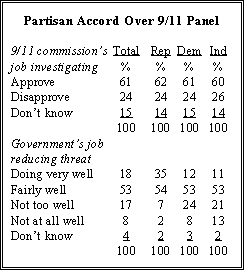
The public broadly approves of the performance of the 9/11 commission in investigating the events that led to the terrorist attacks on the World Trade Center and the Pentagon. By more than two-to-one (61%- 24%), Americans approve of the job being done by the commission, which is expected to release its final report later this week. Significantly, there is no partisan divide in this view as many Republicans (62%) as Democrats (61%) approve of the commission’s performance to date.
The partisan agreement over the commission’s investigation contrasts with the enduring political differences over the government’s efforts to reduce the terrorist threat. Seven-in-ten Americans (71%) say the government has done at least fairly well in reducing the terrorist threat, but just 18% believe it has done very well. These ratings have changed little over the past two years. Three times as many Republicans as Democrats and independents give the government top marks for reducing the threat of terrorism (35% very well vs. 12% and 11%, respectively).
The latest national survey by the Pew Research Center for the People and the Press, conducted July 8-18 among 2,009 adults, shows that in spite of government warnings of a possible terrorist strike to undermine the election, public concern over terrorism has not increased recently. In fact, the percentage saying they are very worried over a new attack on the U.S. fell to 17% from 25% in June, and is on par with the level of concern expressed in multiple surveys conducted over the past year.

However, most Americans continue to believe that the ability of terrorists to launch attacks against the U.S. remains at least as great as it was at the time of the Sept. 11 attacks. A majority of Americans say terrorists have the same (39%) or a greater (24%) ability to launch another major attack in the U.S. today than was the case on Sept. 11, 2001. About a third of Americans (34%) say it is more difficult for terrorists to successfully attack the U.S. now. Opinion on this issue has changed little since 2002, when 39% said the terrorists’ capabilities were about the same as at the time of Sept. 11 and 22% said they were greater.
Partisanship also is linked to opinions of the terrorists’ capabilities to strike. Nearly half of Republicans (48%) say terrorists have less ability to attack the U.S. now, while only 13% say more. Democrats are more divided on this question, with 31% saying terrorists have more ability to attack, 25% less. Independents are closer to Democrats than Republicans: 27% feel the ability of terrorists to launch attacks is greater, while 31% say it has been diminished.