Pew Research Center is a nonpartisan, nonadvocacy fact tank that informs the public about the issues, attitudes and trends shaping the world. It does not take policy positions. The Center conducts public opinion polling, demographic research, computational social science research and other data-driven research. It studies politics and policy; news habits and media; the internet and technology; religion; race and ethnicity; international affairs; social, demographic and economic trends; science; research methodology and data science; and immigration and migration. Pew Research Center is a subsidiary of The Pew Charitable Trusts, its primary funder.
The long general election campaign begins with voters paying much more attention than usual and a decidedly greater number of Americans thinking that it matters who wins in the fall than felt that way four years ago. However, roughly half of Americans already say the campaign is too long, “boring” and “too negative.”
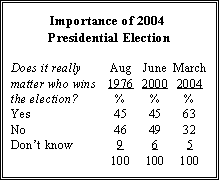
More than six-in-ten Americans (63%) think it really matters more who wins the 2004 presidential election this year, compared with 45% who expressed that view in June 2000. The increase is most notable among Democrats (68%, up from 46% in 2000), but growing numbers of Republicans and independents also believe it really matters who wins in the fall (Republicans up 16%, independents 15%).
Despite the public’s sense of the stakes in this year’s election, many Americans already perceive that the candidates have gone too negative. Fully 48% think that Kerry has been too personally critical of President Bush, while 33% say Bush has been too personally critical of Kerry. The latest Pew Research Center national poll of 1,703 Americans, conducted March 17-21, finds that nearly half of the public (47%) believes that, in general, the campaign is too negative. Republicans are somewhat more critical of the early tone of the campaign than are Democrats 50% of Republicans say it has been too negative compared with 43% of Democrats.
A separate Pew survey of 1,065 Americans, conducted March 22-24, shows that criticisms lodged by former White House counter-terrorism aide Richard Clarke are drawing significant public interest. About four-in-ten Americans (42%) say they have heard “a lot” about Clarke’s claim that the president ignored serious warnings prior to the Sept. 11 attacks and 47% say they have heard “a little” about his claims. Just 10% say they have heard nothing at all about Clarke’s criticisms. The story is attracting comparable levels of interest among Republicans and Democrats.
Perhaps reflecting the early campaign skirmishing, ideological perceptions of the candidates have begun to shift. The survey finds an increasing number of voters placing Kerry at the liberal end of the ideological spectrum. Republicans, in particular, view Kerry as far more liberal today than they did just two months ago, prior to the start of the Democratic primaries.
With seven months to go until Election Day, most voters report they have already seen ads for the Bush and Kerry campaigns, and this is especially the case for those in the swing states. Overall, 65% of voters say they have seen one or more of Bush’s campaign commercials, but that figure rises to 76% of those in swing states. Similarly, 61% of all voters and 69% of those in swing states say they have seen a TV commercial for Kerry. People in those highly-contested states do not have markedly different impressions of the campaign from those living in Republican and Democratic
(Note: States are categorized based on presidential vote in the 1992, 1996 and 2000 elections. Democratic states are those that favored Clinton and Gore by margins significantly higher than the national average. Republican states, likewise, favored the Republican candidates more than the average. Finally, swing states are those that have divided between the candidates or have been won by margins very close to the national average in each year.)
Aside from viewing this year’s election as important, the public also is far more focused on the campaign than in past elections. Nearly two-thirds of voters (65%) say they have thought “quite a lot” about the presidential campaign. That level approaches peak engagement in the 2000 campaign, reached in early November 2000, when 72% said they had thought quite a lot about the campaign. In the spring of 2000, just 48% said they were giving a lot of thought to the campaign. This also is translating into higher interest in campaign news currently, 35% say they are following news about the presidential campaign very closely, up from 24% last month.
Overall, a narrow majority of the public (51%) has a favorable impression of the campaign so far. Democrats and Republicans generally express positive opinions of the campaign so far (56% of Democrats, 54% of Republicans), while the views of independents are more mixed: 45% have a favorable opinion of the campaign, 43% have an unfavorable opinion.
By more than five-to-one (81%-17%), the public sees this year’s election as important rather than unimportant, and this opinion is held by similar numbers of Democrats, Republicans and independents. There also is partisan agreement on the campaign’s length: about half of Republicans, Democrats and independents feel the campaign is too long. Older Americans, in particular, are of the opinion that the presidential campaign is excessively long. By more than two-to-one (64%-28%), people age 65 and older believe the campaign is too long.
The new survey, conducted during the commemoration of the first anniversary of the start of the Iraq war and after the terrorist attacks in Madrid, finds that 55% feel the war was the right decision. Just half of Americans believe the war in Iraq helped the war on terrorism, the lowest percentage to express that view since the war began.
The Madrid attacks have drawn considerable public interest, particularly compared with other foreign news stories. Roughly a third of Americans (34%) followed news of the attacks very closely. There also has been a modest increase in public worries about terrorism 20% say they are very worried about a terrorist attack in the U.S., up from 13% last month.
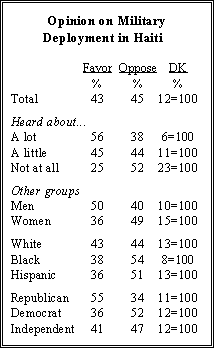
By contrast, the deployment of a small number of U.S. military forces to Haiti has drawn very little attention from the public. Just 15% say they have been following news of civil unrest in Haiti very closely, and an overwhelming majority of Americans say they have heard a little (60%) or nothing at all (22%) about the deployment of U.S. forces there. The public has a divided opinion of the mission 45% are opposed, 43% in favor.
Additional Findings and Analyses
More View Kerry as Liberal
As Kerry has emerged as the Democratic nominee, an increasing percentage of the public, especially Republicans, have come to view him as ideologically liberal. On an ideological scale from 1 to 6 (where 1 is the most conservative and 6 is the most liberal), 40% of those able to rate Kerry give him a relatively liberal “5” or “6”, up from just 28% in January. By comparison, impressions of Bush have moderated slightly over the past two months. Half rate Bush a “1” or “2” on the conservative end of the six-point scale, down from 56% in January.
Republicans have changed their views about both candidates. In January, just 38% of Republicans who were able to place Kerry on the ideological scale rated him as liberal, while most of the rest viewed him more moderately. Today 62% place him at “5” or “6” on the ideological scale. Only half as many Democrats (30%) and independents (34%) place Kerry at the liberal end of the spectrum.
And Republicans have moderated their views about George W. Bush. In January, 60% of Republicans who had an impression of the president rated him a conservative “1” or “2” on the ideological scale. Today, just 47% place Bush clearly to the right, with most of the rest rating the president a more moderate “3” or “4” on the scale.
More Go Online for Campaign News
As the contest between Bush and Kerry heats up, the survey finds growing numbers of voters turning to the Internet for campaign information. One-in-five Americans say they have gone online to get news about the elections; 15% say they go online at least once a week to get such news. That represents an i
ncrease since January when 14% said they had at some point gone on online for election news and 10% reported going online at least weekly for that purpose. The percentage of Americans who have gone online for news or information about the 2004 elections is already comparable to the percentage doing so at the end of the 2000 campaign (18%).
The diversity of viewpoints on the Internet and its convenience are the most frequently cited reasons for why people get election news online. Nearly half (49%) of those who go online for campaign news at least once a week say the most important reason is the wider range of viewpoints available on the web. Convenience is cited by 37% as most important, while just 8% say the most important reason they go online is to get in-depth information about the campaign.
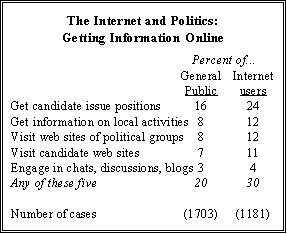
Aside from following campaign news online, 16% of the public (24% of Internet users) say they use the web to research candidates’ positions on the issues. Roughly half as many (8% of the public, 12% of Internet users) go online to get information on local campaign organizations or activities, or to visit web sites set up by groups promoting candidates or positions. Seven percent say they have visited candidates’ campaign web sites, and just 3% of the public reports participating in online discussions, blogs, or chat groups about the elections. While these proportions are small, they are growing. Overall, 20% of Americans report having done one or more of these things, up from 14% in early January.
And the web plays a role in political communications even for those not seeking out news online. A majority of Internet users (52%) say they “bump into” news when going online for other purposes. And many of those who do not go online specifically to get campaign news report inadvertently coming across news election news this way (47%).
Liberal Democrats Active on the Web
For some people, the internet is more than just a place to get information, but also a place to exchange ideas and participate more directly. In the current survey, 15% of the public say they have sent or received e-mail messages about the candidates or campaigns, up slightly from 11% in January. Eight percent of the public say they have participated in campaign activities such as reading online discussion groups, signing ‘e-petitions,’ or donating money over the Internet.
Perhaps reflecting the activity generated during the Democratic presidential primaries, 31% of liberal Democrats say they have exchanged e-mails about the campaign online. Liberal Democrats are considerably more likely to report engaging in other direct political activities as well they are more than twice as likely as other Americans to report donating money, signing petitions, or participating in online discussions.
Smaller Majority Backs Iraq War
Currently, 55% of Americans say it was the right decision to take military action in Iraq while 39% say it was the wrong decision. This is comparable to public views in early February (56%) in late February 60% said they supported military action and 32% opposed.
Since the end of the war almost a year ago, Republicans have been steady in their support of the president’s decision to use military force in Iraq, while opinion has fluctuated among Democrats. In the month following the fall of Baghdad, and again after the capture of Saddam Hussein in December, most Democrats approved of the president’s decision. But in the summer and fall of 2003, and again over the past few months, the predominant view among Democrats has been that military action in Iraq was a mistake. The current divide between Republicans and Democrats over this question is as large as it has ever been, as Democratic support for the war has fallen 26 points since December (from 56% to 30%).
Public views on how well the military operation in Iraq is going have also dipped after rising following the capture of Saddam Hussein. Currently, six-in-ten say things are going very (16%) or fairly (45%) well in Iraq, little changed from 63% in February, and down from a recent high of 75% in December. Prior to Hussein’s capture, a comparable six-in-ten rated the state of affairs in Iraq favorably. Again, there is a sizeable partisan divide in views of how things are going.
Haiti Mission Below the Radar
Just 17% of Americans say they have heard a lot about the deployment of U.S. military forces to Haiti 60% have heard a little and 22% say they have heard nothing at all about this engagement. As with many foreign policy issues, men, older people, and highly educated Americans are the most likely to have heard a lot about the issue.
The minority of Americans who say they have heard a lot about the Haiti deployment are much more supportive of the mission than are those who have heard little or nothing about it. People who have heard a lot about U.S. troops in Haiti favor the decision by a 56% to 38% margin. Those who have heard nothing oppose using force in Haiti by roughly two-to-one (52% to 25%).
There are significant gender and partisan divides on this issue as well. Men feel more favorably toward using American force in Haiti than do women (50% vs. 36%, respectively). Republicans mostly back the use of force in Haiti (55% favor, 34% oppose) while most Democrats are opposed (36% favor, 52% oppose). Political independents are divided, with 41% in favor of using U.S. military force in Haiti, and 47% opposed. Narrow majorities of African Americans (54%) and Hispanics (51%) oppose the U.S. military deployment in Haiti, while whites are divided (43% favor, 44% oppose).
Opposing Gay Marriage and a Constitutional Ban
By a margin of about two-to-one (59% to 32%), most Americans continue to oppose allowing gays and lesbians to marry legally. But only 36% think it would be a good idea to amend the Constitution to prevent gay marriage. About one-in-five Americans (21%) say they oppose gay marriage, but also oppose amending the Constitution to ban such marriages. People who take this position cite a range of reasons for their views, including the belief that government should stay out of the issue of gay marriage or that it is not a constitutional issue.
The public is nearly evenly divided on the question of allowing gay and lesbian couples to enter into civil unions, with 49% in favor and 44% opposed. As with views on gay marriage, there has been little change in public opinion on this issue since previous polling in October.
Many Wary of Changing Constitution
A slight majority of Republicans (54%) and conservatives (52%) favor a constitutional ban on gay marriage, but just 29% of Democrats and 30% of independents agree. Even though older Americans (age 65+) are strongly opposed to gay marriage (75% opposed), they are not enthusiastic about a constitutional amendment: 38% think it’s a good idea but 31% think it’s a bad idea.
Those who oppose gay marriage but also oppose a constitutional amendment were asked why they do not support amending the constitution. Many of the answers (18%) revolved around the theme that the Constitution is too important to change. “I don’t think we have a right to amend the Constitution every time we don’t like something,” said one respondent. “Our forefathers wrote this document and it should stay that way,” said another. In a similar vein, some 5% specifically worried that a gay marriage amendment would open the door to other, less desirable changes in the Constitution.
Eleven percent said the issue should be left to the states to resolve, and 8% offered the view that gay marriage was simply not important enough to warrant amending the Constitution. “It’s a trivial issue on a constitutional basis,” said one. “It’s too big a move for such a small problem,” said another respondent who opposed gay marriage, but also felt an amendment is a bad idea.
And there is another group who express conflicted views on the role of the government in legislating personal affairs in general. Fourteen percent said that government should simply stay out of the issue, and another 2% think such an amendment will not work. Despite their personal opposition to gay marriage, many of these respondents take the view that “human rights come first,” “folks should be able to be whoever they want to be” and “I don’t think it’s the government’s business.”
Plurality Views Trade Pacts Favorably
On balance, somewhat more Americans say free trade agreements like NAFTA and the World Trade Organization have been a good thing (44%) for the U.S. rather than a bad thing (37%). Last December, the public was evenly divided over the benefits of free trade agreements (34% good thing, 33% bad thing).
At this point in the campaign, trade is not as politically divisive as Iraq and other major issues. About half of Republicans (49%) think NAFTA and other free trade agreements have been good for the U.S. while a third disagree. Democrats are split, with roughly the same number saying such agreements are good and bad for the country (41% good, 42% bad).
However, there is a large generation gap in attitudes toward NAFTA and other free trade pacts. Two-thirds of Americans younger than 30 (67%) think free trade agreements are good for the country; fewer than half as many of those age 50 and older agree (31%). On balance, people 50 and older say such agreements have been bad for the country (49%).
Americans who live in rural areas also are more critical of NAFTA, the World Trade organization and other such agreements compared with people who live in suburbs or urban areas. And residents of the Midwest are divided over the benefits of trade agreements, while people who live in other regions have a more positive view of free trade.
Trade Priorities: Growth, Jobs, Low Prices
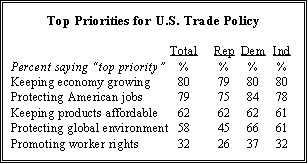
Economic growth and jobs remain the public’s top trade priorities. Eight-in-ten Americans rate keeping the American economy growing as the top priority for trade policy and about as many (79%) say the same about protecting the jobs of American workers. Public views on these issues have changed little in recent years.
A solid majority (62%) also believe that ensuring that products are available at affordable prices is a top priority for trade policy. Nearly as many (58%) think that protecting the global environment is a top priority. But only about third of the public (32%) rates promoting the rights of workers abroad as an important priority.
Iraq, Gas Prices Top News Index
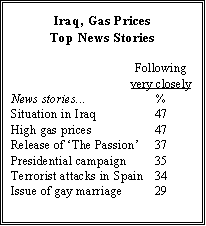
News about the current situation in Iraq and the high price of gasoline are the month’s top stories in terms of public interest. This marks the first time since October 2002 that a non-Iraq story has led the news interest news index.
Rising gas prices have drawn high levels of interest from most demographic groups, but minorities are especially attentive to this story. More than six-in-ten African-Americans (64%) and 55% of Hispanics followed this story very closely, compared with 45% of whites. Men are more attuned than women to reports of higher gas prices (53% vs. 42%).
Nearly four-in-ten Americans (37%) say they followed reports on the release of “The Passion of the Christ” very closely. Roughly half of white evangelical Protestants (51%) followed news on the movie’s release very closely, compared with 37% of white Catholics and 27% of non-evangelical Protestants.
News about the 2004 presidential election is drawing relatively high levels of interest. More than a third of Americans (35%) say they are paying very close attention to news of the campaign. About four-in-ten Democrats (42%) are tracking the campaign very closely compared with 37% of Republicans and 29% of independents. Liberal Democrats, in particular, are highly attentive to campaign news fully 58% are very interested in this news, far more than any other political group.
The overall level of interest in the campaign is higher than at this stage in the 2000 and 1996 campaigns (26% in March of both years). Currently, election interest is on par with March 1992 (35%).
Roughly a third of Americans (34%) paid very close attention to the terrorist bombings in Madrid. Liberal Democrats also paid greater attention to this story than did other political groups: nearly half of liberal Democrats (46%) tracked reports of the Madrid attacks very closely compared with only about a third of other political groups.
The issue of gay and lesbian marriage continues to attract fairly significant public interest 29% say they are following it very closely, up slightly from February (26%). Liberal Democrats also express disproportionate interest in this story compared with conservative and moderate Democrats, moderate Republicans and conservative Republicans.
About one-in-five Americans (18%) say they paid very close attention to the trial and conviction of Martha Stewart. And slightly fewer Americans tracked news of unrest and violence in Haiti very closely (15%). About twice as many African-Americans as whites followed news from Haiti very closely (27% vs. 14%).
About the Survey
Results for the survey are based on telephone interviews conducted under the direction of Princeton Survey Research Associates among a nationwide sample of 1,703 adults, 18 years of age or older, during the period March 17-21, 2004. Based on the total sample, one can say with 95% confidence that the error attributable to sampling and other random effects is plus or minus 3 percentage points. For results based on either Form 1 (N=864) or Form 2 (N=839), the sampling error is plus or minus 4 percentage points. For results based on Registered Voters (N=1306), the sampling error is plus or minus 3 percentage points.
Results for public attention to Richard Clarke’s claims that the president ignored serious warnings prior to the Sept 11 terrorist attacks are from a separate survey of 1,065 adults, 18 years of age or older, during the period March 22-24, 2004. Based on the total sample, one can say with 95% confidence that the error attributable to sampling and other random effects is plus or minus 3.5 percentage points. Data from the March 22-24 survey are unweighted.
In addition to sampling error, one should bear in mind that question wording and practical difficulties in conducting surveys can introduce error or bias into the findings of opinion polls.