
Howard Dean achieved his main objective in New Hampshire he survived to fight another day. But exit polls from Tuesday’s primary underscored the former Vermont governor’s vulnerabilities. Four-in-ten voters in Dean’s neighboring state expressed an unfavorable view of him. He managed to hold on to his liberal base more successfully than in Iowa, but his heavy reliance on liberal support will become a liability as the campaign now heads to more conservative states in the South and West.
The results in New Hampshire underscored one of the major themes in this campaign: the importance Democratic voters place on defeating President Bush. A surprisingly high percentage of New Hampshire voters (33%) backed their candidate because they thought he could defeat Bush, rather than because they agreed with him on major issues. Sen. John Kerry dominated among those who rated electability as more important; he drew a solid majority among this group (56%), to 16% for Ret. Gen. Wesley Clark and 14% for Dean. Kerry also held his own against Dean among the larger group of voters who said that issues matter more (29% each).
Among the other major candidates, Sen. John Edwards narrowly failed in his bid to capture third place, but he demonstrated broad personal appeal. As many voters expressed a favorable view of Edwards as said that abut Kerry. Personal views of Clark, on the other hand, were less positive: 62% viewed him favorably, 33% unfavorably. Clark ran relatively well among those who cited national security and terrorism as their top concerns, but that was fewer than one-in-ten of all New Hampshire voters (7%).
The war in Iraq remains a major issue for Democrats. But voters rated health care and the economy as more urgent concerns. Dean barely bested Kerry among voters who saw Iraq as the leading issue (37%-33%), while Kerry had a large lead among those who rated health care and the economy as top concerns. In addition, there are indications that moderate voters especially those who express concern about terrorism may be turned off by Dean’s strident anti-war message. About one-in-five New Hampshire voters (21%) said they are very worried about a future terrorist attack and they backed Kerry over Dean by two-to-one (40%-21%).
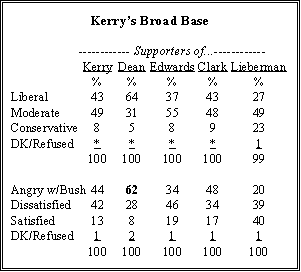
Kerry’s broad base of support is a favorable sign for his candidacy as the campaign moves to more politically diverse states. He draws comparable support among moderates and liberals, those who are “angry” with the Bush administration, and those who are dissatisfied but not angry. Dean’s support, by contrast, is disproportionately comprised of liberals and those who express anger at the administration.
Perhaps most important, there is no reason to believe that Kerry’s momentum from New Hampshire will be materially less than his post-Iowa bounce. Among those who decided who to vote for in the week between Iowa and New Hampshire 54% of the electorate Kerry led by 40%-21% over Dean.