Pew Research Center is a nonpartisan, nonadvocacy fact tank that informs the public about the issues, attitudes and trends shaping the world. It does not take policy positions. The Center conducts public opinion polling, demographic research, computational social science research and other data-driven research. It studies politics and policy; news habits and media; the internet and technology; religion; race and ethnicity; international affairs; social, demographic and economic trends; science; research methodology and data science; and immigration and migration. Pew Research Center is a subsidiary of The Pew Charitable Trusts, its primary funder.
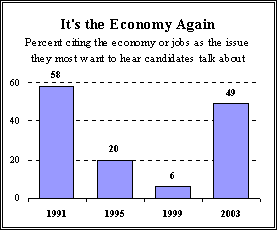
President Bush is facing an electorate that is almost as focused on the economy as it was in the fall of 1991, when rising economic concern began to unravel his father’s reelection chances. In an open-ended format, nearly half (49%) of Americans volunteer the economy or jobs as the single issues they most want the presidential candidates to discuss. That is considerably higher than levels measured at various points during the last two presidential campaigns and is nearly as high as in October 1991 (58%), although more Americans focused on jobs at that time than now.
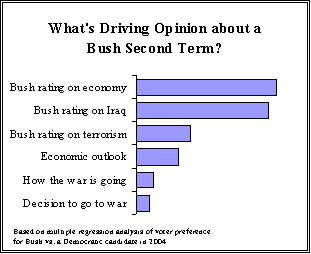
The survey also shows that the percentage of voters who want to see the president reelected continues to inch downward. Bush has a statistically insignificant 45%-43% edge over an unnamed Democrat among registered voters. As recently as July, he held a ten-point advantage over a generic Democratic candidate (47%-37%). And while voters say the economy is by far the top issue they want candidates to discuss, opinions toward Bush’s reelection are now linked as closely to views of his handling of Iraq as they are to his stewardship of the economy. (see chart below)
Analysis of the survey shows that judgments of the way Bush is handling the situation in Iraq is a strong factor in attitudes toward his reelection, while opinions of the decision to go to war are not particularly crucial. This marks a significant change since mid-April, when opinion about the decision to go to war drove voting intentions more than views of the president’s handling of the war. The analysis also shows that the president’s approval rating on handling terrorism, which remain strong at 64%, is not as important a factor in attitudes toward his reelection.
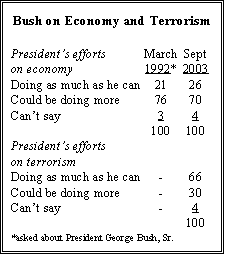
The latest Pew Research Center national survey of 1,500 adults, conducted Sept. 17-22, shows that while two-thirds (66%) say Bush is doing all he can to protect the U.S. from terrorism, fewer than half that many (26%) say the same about his efforts to improve economic conditions. In fact, almost as many believe the president could be doing more to fix the economy as said that about the elder Bush during the 1992 campaign (70% now, 76% in March 1992).
The president’s overall approval rating stands at 55%, largely unchanged from mid-August (56%). However, a daily breakdown of the survey results shows Bush’s approval score slipping to 51% at the end of the polling period (Sept. 21-22). And his approval ratings on specific issues with the notable exception of terrorism are weak. Nearly half (48%) disapprove of his handling of the economy while 43% approve. His rating on health care is even more negative (33% approve, 46% disapprove). And views of Bush’s handling of the situation in Iraq have eroded significantly since April. Fully 77% approved of his performance on Iraq in mid-April, following the fall of Baghdad; today, just 52% do so.
But the president’s twin strengths his handling of the war on terrorism and his personal image continue to anchor his overall job approval in the face of criticism on other fronts. More than six-in-ten Americans (64%) approve of the job Bush has done in dealing with terrorist threats, only a modest decline since January (69%). The president’s ratings on key personal characteristics like empathy and leadership continue to be positive. Roughly two-thirds (68%) say they see Bush as a strong leader, unchanged since the start of his term.
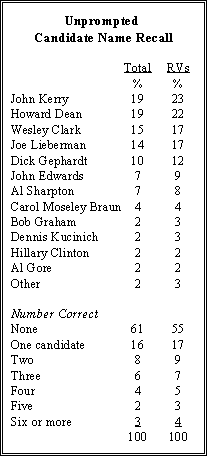
The new survey also shows the race for the Democratic presidential nomination has become more jumbled with Ret. Gen. Wesley Clark’s entrance into the race. Clearly, Clark’s decision to seek the nomination registered strongly with Americans, even though it occurred as news of Hurricane Isabel commanded the public’s attention. Asked to name any of the Democratic candidates, 15% identified Clark, which puts him on par with Sen. John Kerry (19%), former Gov. Howard Dean (19%) and Sen. Joe Lieberman (14%) in public awareness.
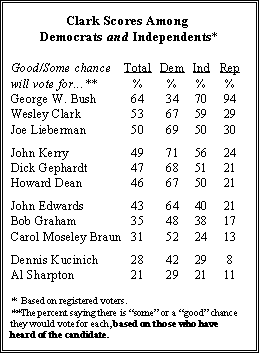
In terms of overall appeal, Clark also has quickly moved into the first tier of Democratic candidates. About half (53%) of those voters who have heard of Clark say there is at least some chance they will vote for the retired general. Four other candidates have roughly comparable levels of potential support Lieberman (50%), Kerry (49%), Rep. Dick Gephardt (47%), and Dean (46%). Bush retains a solid lead over any Democrat on this measure, as 64% say there is at least some chance they would vote for the president.
The survey suggests that Americans may not be all that favorably impressed by Clark’s resume. Asked which types of experience best prepare someone to be president, a 35% plurality cited previous service as a governor and 27% said serving in Congress provided the best experience. Just one-in-ten think that experience as a general or admiral best prepares someone to be president; more (15%) cited experience as a business executive.
Additional Findings and Analyses
Bush’s Base Solid
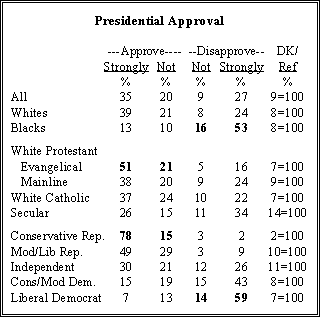
After falling steadily after Saddam Hussein’s regime was overthrown in Iraq, Bush’s ratings stabilized in August and have remained in the low-to-mid 50% range since then. The president continues to draw approval from his political base white southerners, people who live in rural areas, white evangelicals, and especially conservative Republicans.
Over three-quarters of the latter group (78%) very strongly approve of the president’s performance, with another 15% approving not strongly. A majority of white evangelical Protestants (51%) very strongly approve, and another 21% approve less strongly. Criticism of the president is greatest among African-Americans, over two thirds of whom (69%) now disapprove of his performance, 53% of them very strongly. Similarly, three quarters (74%) of liberal Democrats disapprove, 59% very strongly.
Strong Reactions to Bush Matching Clinton Mark
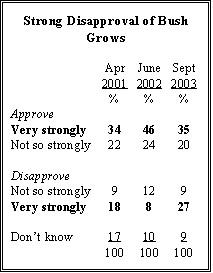
Since June 2002, the percentage of Americans who disapprove of the president’s job performance has increased from 20% to 36%. What is more striking is that the number who strongly disapprove has more than tripled, from 8% to 27%. About a third of Americans (35%) take a very positive view of Bush’s job performance, down from 46% in June 2002.
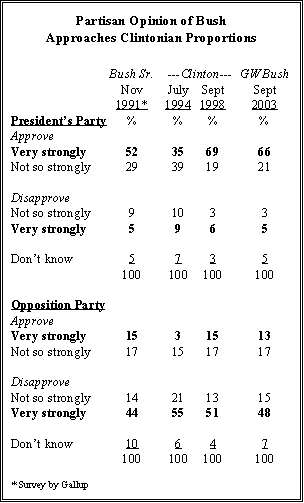
Clearly, Bush elicits intense feelings from members of both parties so much so that partisan opinion of the president is now becoming as strongly held as opinion of former President Clinton at the height of the impeachment scandal. Among Republicans, 66% strongly approve of Bush’s performance, while 21% approve not so strongly. Similarly, among Democrats, more than three times as many strongly disapprove of the president as say their disapproval is not strongly held (48% vs. 15%).
In September 1998, shortly after Clinton admitted his affair to the nation, Democrats rallied around their embattled president, giving him 69% strong approval and just 19% not so strong approval. Half (51%) of Republicans strongly disapproved of Clinton, and just 13% disapproved but not strongly.
But today’s intense climate of opinion is not just a result of Democrats and Republicans moving apart. It is also seen in the opinions of independent voters, 56% of whom hold strong opinions about Bush today (30% strong approval, 26% strong disapproval).
Election 2004: Reelect Margin Narrows
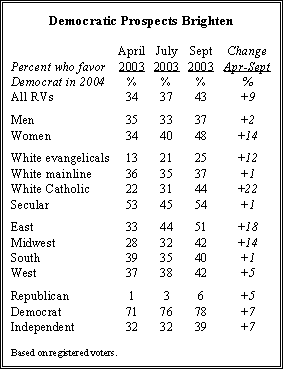
President Bush is now running in a dead heat with a hypothetical Democratic candidate among registered voters (45% for Bush, 43% for a Democrat). As recently as last month, Bush held a five-point lead and was up by 14 percentage points in April, just after the collapse of the Hussein regime in Iraq.
Democratic gains have come as the party’s traditional constituencies have peeled away from the president and returned to the fold. Even though a gender gap has been observed in presidential voting over the past 20 years, men and women in April 2003 were equally likely to favor Bush. Now, by a margin of 48% to 41% women would prefer a Democrat a gain of 14 points for the Democratic alternative.
The biggest shift has occurred among white Catholics, who in July favored Bush by a margin of 52% to 31%. Now Catholics are split, 44% for a Democrat and 43% for Bush. Consistent with this trend, Democrats are doing much better in the East and Midwest now than they were in April.
Low Candidate Familiarity
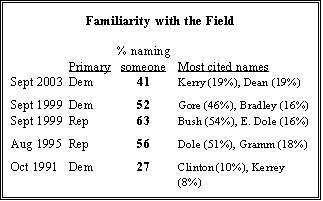
Most Americans (59%) including most Democrats, continue to be unable to call a single candidate’s name to mind when thinking about the upcoming Democratic primary. Asked to name any candidates planning to run for the Democratic nomination, just 41% of Americans were able to give a name (39% correctly citing one of the ten announced candidates).
That is an increase from April and January, when just 32% and 35%, respectively, could offer a name. But far more people could identify candidates in primary campaigns four and eight years ago. In September 1999, 52% could name a Democratic primary candidate, and 63% could name a Republican. In August 1995, 56% could name a Republican candidate.
What set the 1995 and 1999 races apart was the presence of a clear frontrunner, which dramatically increased the public’s ability to recall at least one name. Roughly half could name Al Gore, George W. Bush, and Bob Dole as candidates in these primary races. By comparison, fewer than one-in-five can name any single candidate in this year’s race. In that regard, the 1991 Democratic primary is more similar to this year’s race. In October 1991, just 27% of Americans could name a Democratic candidate, while 73% were unable to name anyone. Future president Bill Clinton was the most visible candidate at that time, with a mere 10% recalling his name.
Currently, Kerry and Dean are the names that come to people’s minds most often (19% each). Kerry’s name recall has nearly doubled from January, when 10% cited him as a candidate, and Dean’s has increased exponentially (just 1% recalled his name in January). Newest candidate Wesley Clark scored well on his first weekend as a candidate as many recalled his name as did Lieberman and more named him than Gephardt.
Democrats, however, are no more familiar with their party’s candidates than are Republicans or independents. Just 41% of Democrats named someone when asked about the candidates (38% gave a correct name). This compares with 45% of Republicans and 40% of independents (43% and 38% correct, respectively). Half of registered voters who say they have absolutely made up their minds to vote for a Democrat next fall can’t name a single candidate in the race at this time.
Lieberman’s Wide Name Recognition
Voters do much better when the candidates’ names are read to them. For example, 85% of voters have heard of Lieberman, although just 17% recalled his name on their own. With the notable exception of Dean, few candidates have made significant strides in increasing their visibility among voters.
In particular, Lieberman, Kerry, Gephardt, Sen. Bob Graham and Rep. Dennis Kucinich are no more widely recognized today than they were in early July. But Dean is much better known. A solid majority (56%) say they have heard of the former Vermont governor today, up from 46% a month ago and 37% in early July.
Dean still lags behind some other front-runners in terms of visibility, however. Nearly three-quarters (74%) recognize Gephardt and 63% recognize Kerry. Clark’s name was familiar to 47% of voters, placing him on par with Sen. John Edwards (46%) and former Sen. Carol Moseley Braun (44%), although Clark had been in the race for just days when the survey was taken.
Clark’s Strong Start, Dean’s Gains
But Clark is clearly among the front-runners in terms of electability. Among voters who have heard of the former general, 53% said they might vote for him, a bit more than any other candidate. In fact, 19% said there was a “good chance” they would vote for Clark, a slightly higher level of enthusiasm than any other candidate received (17% said this about Lieberman and Dean, 16% about Kerry).
Dean’s gains over the summer also are evident. In early July, just 32% of voters who had heard of Dean said they would consider voting for him, compared with 46% in the current survey. In fact, a number of Democratic candidates are receiving more consideration today than they did at the beginning of the summer. In particular, Edwards and Kerry have made electoral gains, though only half the magnitude of Dean’s improvement during this time (7% improvement vs. 14% for Dean).
What puts Clark in the top tier of candidates is not just strong support from Democrats, but the relatively widespread consideration he also is receiving from many independents. While Clark does no better among Democrats than any other leading candidates, 59% of political independents who have heard of the ex-general say they are considering voting for him. Among the other candidates, only Kerry wins this kind of consideration among independents (56%). Lieberman, Dean, Gephardt and Edwards all run 17 to 24 points worse among independents than they do among Democrats.
Interest on Par With Recent Campaigns
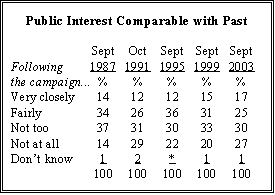
While public interest in the battle for the Democratic nomination pales in comparison to other major news stories such as Iraq, hurricane Isabel, and rising gas prices, the level of public attention is comparable to what it was at this point in previous election cycles. Currently, 42% of Americans say they are following news about the race for the Democratic presidential nomination very (17%) or fairly (25%) closely. This compares with 46% who followed news about the early stages of the primary four years ago, 48% in September of 1995, 38% in 1991 and 48% in 1987.
Still, interest in the campaign is now no higher than it was in January, when the same proportion (42%) said they were following news about candidates who were then getting into the race. Throughout the year, Democrats have expressed significantly more interest in this news story than Republicans or independents.
Ratings of the Field Also Comparable
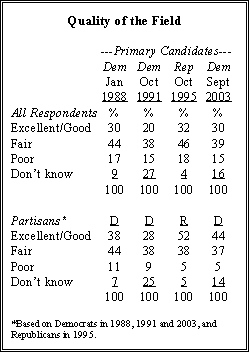
Just three-in-ten Americans say there is currently an excellent (3%) or good (27%) field of Democratic candidates. Most rate the field as fair (39%) or poor (15%). These ratings also are in line with pre-primary measures in previous campaigns. Three-in-ten rated the Democratic candidates favorably in January 1988 and about the same number (32%) had a positive view of Republican candidates in October 1995.
In October 1991, just 20% rated the Democratic field as excellent or good, but the difference was driven primarily by a lack of familiarity more than a quarter (27%) said they did not know enough about the race to rate the candidates.
A plurality of Democrats (44%) say they are satisfied with the choices before them, though only 6% say they pool of candidates is “excellent.” This compares favorably to Democratic ratings of the 1988 and 1991 primary fields when just 38% and 28%, respectively, rated the field favorably. In 1995, over half of Republicans (52%) were satisfied with the candidates contesting their primary.
Campaign Issues: Economy Dominates
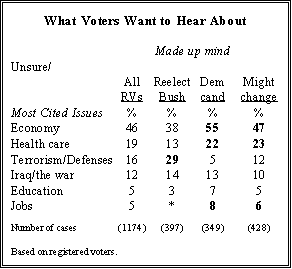
Nearly half of registered voters (46%) cite the economy as the most important issue for presidential candidates to talk about, which is more than the number who express interest in hearing about terrorism, homeland security, and how to handle the situation in Iraq combined. Another 5% list the job situation as the most important concern.
The economy is the most cited issue even among voters who say they have already made up their mind to vote for Bush in 2004; 38% of committed Bush voters cite the economy as the most important issue for candidates to discuss compared with 29% who mention terrorism. A majority of firm Democratic supporters (55%) also say they most want to hear the candidates discuss the economy. Among “swing” voters, who have not committed to either party’s candidate, 47% cite the economy as their number one concern. The job situation is cited by a significant proportion of Democratic and swing voters (8% and 6%, respectively), but is almost never listed by voters who are committed to Bush.
Nearly one-in-five voters (19%) cite health care cost and availability as the issue they want to hear about most in the campaign, slightly more than refer to terrorism (16%) or the situation in Iraq (12%). But health care is a particular concern for both committed Democrats and swing voters. Fully 23% of swing voters cite health care as what they most want to hear candidates discuss, twice as many as cite terrorism (12%) or Iraq (10%) as priorities.
Less Economic Optimism
Compared with March, somewhat more Americans characterize their personal financial situation as only fair or poor. A slight majority (51%) say they are in fair or poor shape financially, while 48% describe their financial situation as good or excellent. In March, 43% said they were in fair or poor condition financially, while a majority (53%) rated their finances as good or excellent.
Personal financial optimism has changed little since spring, or for that matter, over the past few years. About six-in-ten (64%) expect their finances to improve over the next year, which is virtually unchanged since March. Personal financial optimism has generally remained in the 60% range throughout Bush’s presidency.
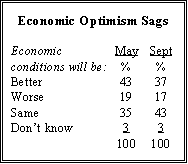
But the uptick in national economic optimism seen in May has largely disappeared. Fewer than four-in-ten (37%) now expect economic conditions in the country to get better over the next year. A 43% plurality believes conditions will stay the same while 17% think the economy will decline. In May, 43% said they expected some economic improvement. The level of economic optimism in May was 10 points higher than in March and the highest since January 2002 (44%).
Divided View of Bush’s Leadership
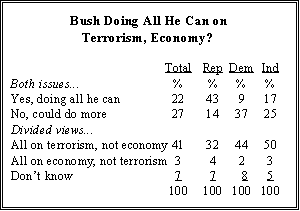
By greater than two-to-one (70%-26%), the public believes Bush could do more to help the faltering economy. Underscoring the sharp division of opinion on Bush’s leadership, nearly as many people (66%) say the president is doing as much as he can to protect the nation from terrorism.
As expected, partisanship is a major factor in these attitudes, but even many Republicans fault the president’s effort on the economy. Overall, Republicans are evenly divided, with 48% saying he is doing as much as can on the economy with 47% saying he could do more. But this masks a deep ideological split among Republicans: six-in-ten moderate and liberal Republicans feel he could be doing more on the economy but just 40% of conservative Republicans agree.
Taking the two issues together, the plurality view among the public (41%) is that the president is doing all he can in the struggle against terrorism, but not the economy. This opinion is particularly prevalent among independents (50%). Even among Democrats, more take a divided view of Bush on the two issues than say he is not doing enough on both (44% vs. 37%).
Views of Bush’s Character Unchanged
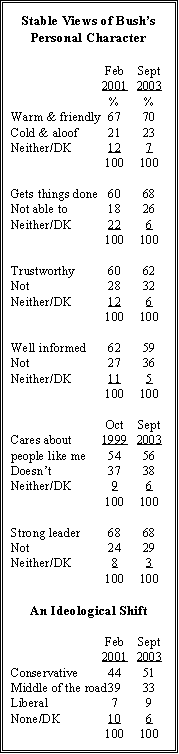
Despite many ups and downs since the 2000 election, public views of the president’s personal character remain consistently positive, and largely unchanged from his first days in office. By three-to-one, the president comes across as “warm and friendly” rather than “cold and aloof” (70% vs. 23%). And by over two-to-one, more see the president as someone “able to get things done” and as “as strong leader” than say these descriptions do not fit. Despite political criticism of the president’s justification for the Iraq war, 62% of Americans continue to see the president as trustworthy, while just 32% say he is not, virtually unchanged from February 2001.
Most Americans (59%) say the president is well-informed, though a growing minority says that he is not (36%, up from 27% in Feb. 2001). Perceptions of whether Bush “cares about people like me” are also generally positive, with 56% saying yes, and 38% no.
Views of the president’s ideology have changed since early in his term, as the perception that the president is politically conservative has become more widespread. Today, 51% of Americans say the president is conservative, 33% middle of the road, and just 9% see him as liberal. In February 2001, 44% described the president as conservative, 39% middle of the road, and 7% liberal.
This shift is driven, primarily, by a reevaluation of the president by conservatives. One month after his inauguration, self-identified conservatives were divided over whether the new president was conservative (46%) or moderate (42%). Today, conservatives are far more confident that the president is one of them. By two-to-one (58% to 28%), they say Bush is conservative, not middle of the road. A majority of liberals have consistently viewed the president as a political conservative. Their current view (57% conservative, 33% middle of the road) is almost identical to the perception of conservatives.
Presidential Qualities: Judgment Matters Most
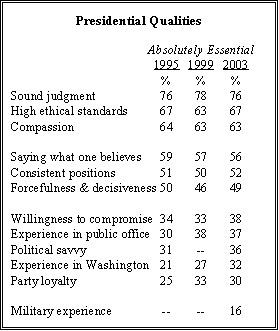
For the past three election cycles, Americans have been consistent in their expectations about the personal qualities that are important for a president. Surveys conducted in 1995 and 1999, as well as the current poll, show that Americans view sound judgment in a crisis as the most important presidential quality.
About three-quarters (76%) say this is an “absolutely essential” quality in a president. High ethical standards, compassion for the average citizen, and saying what one believes even if unpopular are also rated as essential by significant majorities.
Barely half (52%) think that having consistent policy positions is important, while 49% think that forcefulness and decisiveness are necessary. Far fewer rate a willingness to compromise, experience in public office, experience in Washington, or party loyalty as absolutely essential qualities in a president. But experience in Washington is rated more highly than in past years (32% now, 21% in 1995).
While Democratic and Republican voters agree on the importance many of these traits, there are a few key differences that suggest some disagreement on character issues. Voters who say they have already made up their mind to support Bush rate high ethical standards and saying what one believes, even if unpopular, as more important qualities than do swing voters and committed Democrats. And 62% of Bush’s strong backers say forcefulness and decisiveness is essential, compared with just 36% of strong Democrats, who in turn place a far higher priority on a president’s willingness to compromise than do Bush supporters.
Professional Background
Just 16% say it is essential for a president to have military experience, while 62% say this is not of particular importance. This is consistent with another survey question, on which just 10% say that serving as a general or admiral is the best preparation for a president. Far more believe that service as a governor (35%), member of Congress (27%), or business executive (15%) better prepares someone to be president.
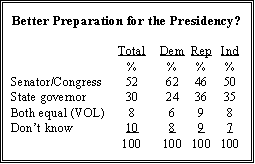
When the alternatives are limited to prior service as a senator and a member of Congress, or as a governor, more Americans view experience in Congress as the best preparation (by 52%-30%). This is consistent with previous surveys conducted in 1999 and 1987.
There is a notable partisan split over these qualities, however, that was also present prior to the 2000 election. More than six-in-ten Democrats (62%) rate service on Capitol Hill as better preparing someone to become president, compared with just 46% of Republicans. More Republicans than Democrats cite service as a governor as better preparation to become president (36% vs. 24%). Independents’ views on this issue are more in line with Republicans than Democrats.
Fewer Expect Bush to Win
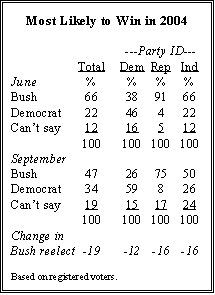
Fewer than half of voters today (47%) say they think George W. Bush is likely to win the coming presidential election, down from 66% three months ago. Roughly a third (34%) say they think a Democratic candidate will win, up from 22% in June.
This shift in expectations has occurred across the political spectrum. Democrats have become significantly more confident about their party’s prospects more than twice as many Democrats say their party’s candidate will win as predict Bush’s reelection (59% vs. 26%). Independents, who expected a Bush victory by three-to-one in June (66% to 22%), still tend to believe he will win reelection, though by a narrower margin (50% to 26%). And while very few Republicans (8%) go so far as to predict a Democratic victory a year from now, fewer are expressing confidence in Bush’s ability to win reelection (75%, down from 91% in June).
Iraq, Isabel Top News Interest Index
The situation in Iraq continues to lead the news interest index, though there was nearly as much public attention this month to Hurricane Isabel and the rising price of gas. Half of Americans say they have been following developments in Iraq very closely, up from 45% last month, and another 33% have been following those events fairly closely.
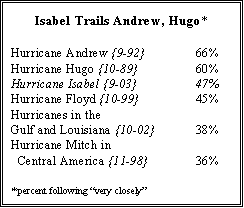
Nearly as many (47%) paid very close attention to Hurricane Isabel, which inflicted heavy damage on the mid-Atlantic region after coming ashore on Sept. 18. Not surprisingly, interest in news about the storm was highest in the South (58%) and East (56%). Compared with other hurricanes, Isabel ranks third in public attention, far behind Hurricanes Andrew and Hugo. Among natural disaster stories asked in 17 years of the Pew News Interest Index, Hurricane Isabel ranks eighth in public interest.
There also was considerable interest in economic stories, especially the high price of gasoline (45%). About four-in-ten Americans paid very close attention to reports about the nation’s economy (39%). Interest in rising gas prices is down slightly from early in the year (53%), while interest in economic conditions has stayed consistently at about 40%.
A third of the public followed news about the electricity blackout that affected much of the Northeast (This survey was conducted approximately a month after the Aug. 14 blackout). As expected, more residents of Northeast followed this story (43% very closely). About a third of the public (32%) also paid very close attention to the removal of a monument of the Ten Commandments from an Alabama courthouse. Residents of the South and evangelical Christians paid the most attention by far to this story (43% and 51%, respectively).
Roughly three-in-ten (31%) closely tracked continued violence in the Middle East between Palestinians and Israelis. But just 19% paid very close attention to California’s recall election. Not surprisingly, this story drew relatively strong interest from those in the West (37% very closely). And just 19% also followed news reports on North Korea’s nuclear weapons program very closely. That is the lowest level of interest in that story since the Center began tracking it in 1994.
About this Survey
Results for the survey are based on telephone interviews conducted under the direction of Princeton Survey Research Associates among a nationwide sample of 1,500 adults, 18 years of age or older, during the period September17 – 22, 2003. Based on the total sample, one can say with 95% confidence that the error attributable to sampling and other random effects is plus or minus 3 percentage points. For results based on either Form 1 (N=757) or Form 2 (N=743), the sampling error is plus or minus 4 percentage points.
In addition to sampling error, one should bear in mind that question wording and practical difficulties in conducting surveys can introduce error or bias into the findings of opinion polls.
Survey Methodology in Detail
The sample for this survey is a random digit sample of telephone numbers selected from telephone exchanges in the continental United States. The random digit aspect of the sample is used to avoid “listing” bias and provides representation of both listed and unlisted numbers (including not-yet-listed). The design of the sample ensures this representation by random generation of the last two digits of telephone numbers selected on the basis of their area code, telephone exchange, and bank number.
The telephone exchanges were selected with probabilities proportional to their size. The first eight digits of the sampled telephone numbers (area code, telephone exchange, bank number) were selected to be proportionally stratified by county and by telephone exchange within county. That is, the number of telephone numbers randomly sampled from within a given county is proportional to that county’s share of telephone numbers in the U.S. Only working banks of telephone numbers are selected. A working bank is defined as 100 contiguous telephone numbers containing one or more residential listings.
The sample was released for interviewing in replicates. Using replicates to control the release of sample to the field ensures that the complete call procedures are followed for the entire sample. The use of replicates also insures that the regional distribution of numbers called is appropriate. Again, this works to increase the representativeness of the sample.
At least 10 attempts were made to complete an interview at every sampled telephone number. The calls were staggered over times of day and days of the week to maximize the chances of making a contact with a potential respondent. All interview breakoffs and refusals were re-contacted at least once in order to attempt to convert them to completed interviews. In each contacted household, interviewers asked to speak with the “youngest male 18 or older who is at home.” If there is no eligible man at home, interviewers asked to speak with “the oldest woman 18 or older who is at home.” This systematic respondent selection technique has been shown empirically to produce samples that closely mirror the population in terms of age and gender.
Non-response in telephone interview surveys produces some known biases in survey-derived estimates because participation tends to vary for different subgroups of the population, and these subgroups are likely to vary also on questions of substantive interest. In order to compensate for these known biases, the sample data are weighted in analysis.
The demographic weighting parameters are derived from a special analysis of the most recently available Census Bureau’s Current Population Survey (March 2002). This analysis produced population parameters for the demographic characteristics of households with adults 18 or older, which are then compared with the sample characteristics to construct sample weights. The analysis only included households in the continental United States that contain a telephone. The weights are derived using an iterative technique that simultaneously balances the distributions of all weighting parameters.