Tax Plan Fails to Connect, Bush’s Economic Ratings Sag
News Media Gets Good Grades for Iraq Coverage
About Pew Research Center
Pew Research Center is a nonpartisan, nonadvocacy fact tank that informs the public about the issues, attitudes and trends shaping the world. It does not take policy positions. The Center conducts public opinion polling, demographic research, computational social science research and other data-driven research. It studies politics and policy; news habits and media; the internet and technology; religion; race and ethnicity; international affairs; social, demographic and economic trends; science; research methodology and data science; and immigration and migration. Pew Research Center is a subsidiary of The Pew Charitable Trusts, its primary funder.
Tax Plan Fails to Connect, Bush’s Economic Ratings Sag
News Media Gets Good Grades for Iraq Coverage
Introduction and Summary
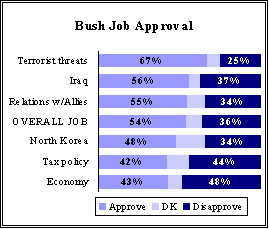
President Bush’s tax-cut plan is getting a tepid reception from the public and has failed to stem a steady erosion of his ratings on the economy. Barely four-in-ten Americans (43%) approve of his handling of the economy, while 48% disapprove. This marks the first time in Bush’s presidency a Pew survey has shown his economic rating in negative territory. His approval mark on tax policy is equally low (42%), despite a high-profile campaign on behalf of his tax plan.
With attention focused on possible war in Iraq and threats of terrorism at home, only about a quarter of the public (26%) is following reports about the president’s tax plan very closely. That is far fewer than the number following the debate over Iraq or even the high price of gas. Casting further doubt on the proposal, more Americans favor paying for higher military spending by scaling back previously enacted tax cuts than with reductions in domestic programs or by adding to the deficit. However, raising taxes is the least preferred option for underwriting increased defense costs.
The latest Pew Research Center survey of 1,254 Americans, conducted Feb. 12-18, shows that events abroad and at home are weighing heavily on Americans. Roughly half (53%) name international issues mostly a possible war in Iraq as the top problems facing the country, while 29% volunteer economic issues. Concerns about both overseas matters and economic issues have increased significantly over the past year, and this anxiety is also reflected in the recent decline in satisfaction with national conditions (“Confidence in Country’s Course at Lowest Ebb Since Bush Took Office,” Jan. 31, 2003).
Bush’s overall job approval rating has slipped to 54%, down four points since last month and seven points since December. The president’s handling of the threat of terrorism remains a strong point fully two-thirds approve of his performance in that area. And a solid majority (56%) approves of his handling of the Iraq crisis, unchanged since October. But positive assessments of his economic policy have slipped from 49% in October to 43% in the current survey.
Politically, the president has been losing ground both on the economy and in his overall ratings among independents. Just 36% of independents approve of his handling of the economy, down from 42% in January. His overall job rating among independents has slipped from 57% in January to 50% in the current survey. There also continues to be a strong partisan cast to Bush’s job approval, with more than eight-in-ten Republicans (84%) and just a third of Democrats (32%) giving him positive marks.
The survey shows the public has become somewhat more supportive of the freedom of the press in covering national security issues than in the fall of 2001, during the war in Afghanistan. The number who believe the government should be able to censor news stories it believes could threaten national security has declined, from 53% to 42%, since November 2001. And a growing majority (78%, up from 64%) prefers that coverage of war be neutral rather than pro-American.
Other Important Findings and Analyses
War Viewed as Top National Problem
Roughly a third of Americans (34%) cite the prospect of war in Iraq as the biggest problem facing the country today, making this the top issue on the public’s agenda. Somewhat fewer (29%) cited economic concerns, including general references to the economy, unemployment and the cost of living. Terrorism and homeland security were ranked as the most important problems by 18% of Americans.
Overall, 54% mentioned war, terrorism or some other international problem, compared with 39% who cited those problems a year ago (24% terrorism). But the number citing economic problems also has increased sharply from 16% to 29% since March 2002.
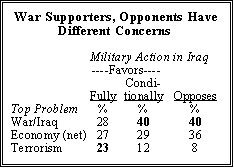
In the current survey, opponents of military action in Iraq, and those who are willing to proceed only with allied support, are most likely to cite a possible war as the top issue facing the nation. Fully 40% of these respondents rate Iraq as the nation’s biggest problem, compared with 28% of those who support military action unconditionally. Unconditional proponents of military action, in turn, place most emphasis on the risks of domestic terrorism. Fully 23% of those who favor unilateral action in Iraq, if necessary, say the threat of terrorism is America’s most important problem, compared with just 8% of those who oppose action in Iraq.
Women are significantly more likely than men to cite the situation in Iraq as the nation’s most important problem (42% vs. 25%). Men place more importance on the economy, unemployment, and terrorism. Overall, economic issues are rated as the biggest national problem by more residents in the Northeast (38%) and West (33%) than in the South (22%) and Midwest (27%). Terrorism ranks higher on the list of concerns in the Northeast (22%), and is least frequently mentioned in the West (11%).
Top Personal Problem: Making Ends Meet
When Americans are asked about their top personal problems, economic issues lead the list. Three-in-ten Americans volunteer that they do not have enough money to pay their bills and make ends meet. The emphasis on personal economic problems has been consistent for several years; in June 2001, 26% cited such concerns as the leading problems confronting them and their families.
Other economic concerns also trouble Americans: 7% cite unemployment as the biggest problem facing them and their families; 5% cite the high cost of health insurance; and 3% specifically mention the high cost of gas and fuel. Those numbers also are largely unchanged from two years ago.
Roughly one-in-ten (9%) mention concerns about war, America’s international involvements, or the risk of a family member being called into service as their biggest personal concern. By comparison, just 1% cite concerns about terrorism as their most important problem.
Financial Concerns: Health Care, Retirement
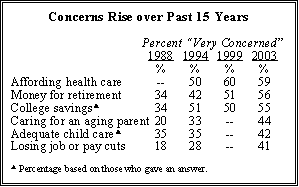
Americans’ specific financial concerns have changed little in recent years, despite the weak economy. Presented with a list of possible concerns ranging from health care to child care, six-in-ten (59%) say they are very concerned about being unable to afford necessary health care when a family member gets sick, and 56% say the same about not having enough money for their retirement. In both cases, these rates of high concern are roughly equivalent to measures taken over the past four years.
There has been some rise in concern about losing a job or taking a cut in pay. Four-in-ten (41%) say they worry a great deal about this, on par with the level in June of last year, but up from 34% two years ago in February 2001.
While these measures have been stable over the past few years, Americans are expressing significantly more personal economic unease than in the late 1980s. The proportion expressing a high level of concern over having enough for retirement has increased from 34% in 1988 to 56% in the current survey.
The number who are very concerned about unemployment and pay cuts has skyrocketed from 18% fifteen years ago to 41% today. College costs are of far greater concern today than in 1988, and the proportion who worry about having to care for an aging parent or relative has more than doubled. In 1988, just 20% worried a great deal about caring for their elders. This increased to 33% in 1994, and 44% in the current survey.
These growing concerns are notable across all age groups, and do not simply reflect the aging of the American population. For example, concern about caring for an aging parent or relative is equally high across all age ranges from those under age 30 (45% very concerned)
to those age 65 and older (40%) and has risen equally across all groups over the past 15 years. And while worries about having enough money for retirement tend to be higher among those under age 65 than among those over, these concerns have increased among all age groups. In 1988, just 19% of seniors were very concerned about retirement costs; today twice as many feel very concerned (43%). A comparable increase in concern is apparent among those under age 30 (from 35% in 1988 to 61% today) as well as among those aged 30 to 64.
Plurality Favors Delaying Tax Cuts for Defense
As was the case last year, a plurality of the public is willing to forgo the tax cuts passed early in Bush’s term in order to pay for increased military and homeland defense costs. But they draw the line at raising taxes to finance those costs; in that case, adding to the deficit and reducing spending become somewhat more palatable.
Four-in-ten say the best way to pay for proposed increases for military and homeland defense is to postpone or reduce tax cuts. That is nearly twice the number who support reducing spending on domestic programs (21%) or adding to the budget deficit (23%). More Democrats favor postponing the tax cuts than the other two options combined, while Republicans are divided evenly over whether deficit spending (28%), domestic cuts (27%) or reduced tax cuts (32%) is the best approach.
While half the sample chose among these three options for paying for military and homeland defense, the other half was asked a different version of the question that presented the alternatives as adding to the deficit, reducing domestic spending, or increasing taxes. While four-in-ten are willing to see the 2001 tax cuts delayed or phased out, the survey finds fewer than a quarter (23%) favor raising taxes to finance military and homeland defense.
Faced with these choices, support for deficit spending rises (from 23% to 31%) and more are willing to see a reduction in spending on domestic programs (28% vs. 21% in the original formulation).
These alternative formulations have the biggest effect on Democratic respondents. While nearly half of Democrats (48%) endorse the postponement or reduction of last year’s tax cuts, just 24% favor increasing taxes. In fact, there is virtually no partisan divide in the second formulation of this question Republicans, Democrats and independents are all similarly divided over whether tax increases, domestic cuts, or deficit spending would be the best approach to pay for higher defense and military costs.
Good Marks for Iraq Coverage
Two-thirds of the public (66%) say the press is doing an excellent or good job providing up-to-date reports on the Iraq crisis, while 28% rate the coverage as only fair or poor. By comparison, 74% of the public rated press coverage favorably in January 1991, just prior to the start of the Persian Gulf War. Supporters of military action are more positive about the coverage, with 73% giving it an excellent or good rating, compared with 57% of opponents.
Ratings are slightly lower, though still positive on balance, for the job the press is doing covering the debate in the United Nations and other countries over how to deal with Iraq (58% excellent or good) and the debate in Washington (57%). But Americans are divided over press coverage of the public’s reaction to the Iraq crisis (48% favorable/47% unfavorable).
Coverage of the breakup and loss of the Space Shuttle Columbia was rated very positively, with 77% saying news organizations did an excellent or good job on that story. Among those following the story very closely or fairly closely, ratings were even more favorable (82%). But the public was slightly less positive about the coverage of the Columbia disaster than it had been about coverage of the Challenger explosion in 1986. In a question asked in July that year, several months after the event, 90% rated the coverage favorably.
Americans feel much less favorably about the coverage of the tax-cut debate in Washington. Only about four-in-ten (39%) give coverage of that story an excellent or good rating; 52% say the coverage has been only fair or poor.
On two issues that have divided political partisans Iraq and President Bush’s tax proposals Republicans give the press higher ratings for its coverage than do Democrats. On Iraq, 74% of Republicans say the coverage has been excellent or good, compared with 64% of Democrats. A similar partisan difference was seen in public opinion 12 years ago on the eve of the Persian Gulf War. On the debate over tax and stimulus plans, 45% of Republicans rate the coverage favorably, compared with 37% of Democrats.
More Oppose Government Censorship
The public is divided over press freedom in coverage of war and national security. Half say it is more important that the media be able to report news it thinks is in the national interest, while 42% place priority on the government’s ability to censor news it views as a threat to national security. By roughly the same margin (50%-40%), more think that decisions about how to cover war should be left to news organizations rather than to the military.
Generally, support for unfettered media coverage is higher now than in November 2001, during the U.S. war in Afghanistan. At that time, 53% said the government should censor news that may threaten national security (42% currently). Support for government censorship was even higher during the Persian Gulf War. Shortly after the war ended in 1991, nearly six-in-ten (58%) favored censorship of news that may threaten national security; in late January of that year, almost the same number (57%) thought the military ought to have more control over how news organizations reported on war.
Questions of military control over the news divide supporters and opponents of military action in Iraq. Half of war supporters think the government should be able to censor news that it feels threatens national security, compared with one-fifth (21%) of those who oppose military action in Iraq. War supporters are evenly divided on the question of whether the military or news organizations should have more control over how a war would be covered, while opponents of military action think news organizations should make the decisions (by a margin of 65% to 25%).
Americans differ over several aspects of the media’s coverage of war and national security, but a growing majority rejects the idea that coverage should be pro-American. Roughly eight-in-ten (78%) favor neutral coverage, compared with just 16% who say news organizations should be pro-American. There has been a significant shift on this question since November 2001, when nearly twice as many (30%) endorsed pro-American coverage. Overwhelming majorities of war supporters and opponents (77%, 86% respectively) favor neutral coverage.
Should Reporters Accompany Troops? Public is Divided
The public is divided on the question of whether a pool of American reporters should be allowed to accompany U.S. forces into combat zones, with 49% saying they should be allowed and 45% saying they should not be. The Bush administration announced recently that journalists will be assigned slots with combat and support units and will accompany them into the field if the U.S. goes to war in Iraq. More than 200 journalists have undergone training for these assignments.
About this Survey
Results for the February News Interest Index survey are based on telephone interviews conducted under the direction of Princeton Survey Research Associates among a nationwide sample of 1,254 adults, 18 years of age or older, during the period February 12-18, 2003. Based on the total sample, one can say with 95% confidence that the error attributable to sampling and other random effects is plus or minus
3 percentage points. For results based on Form 1 (N=629) the sampling error is plus or minus 4.5 percentage points; for Form 2 (N=625) the sampling error is plus or minus 4.5 percentage points.
In addition to sampling error, one should bear in mind that question wording and practical difficulties in conducting surveys can introduce error or bias into the findings of opinion polls.