
Record Public Interest in Middle East Conflict
Findings Fully 44% of Americans are paying very close attention to news of the Middle East conflict, with another 33% following the story fairly closely. That is the highest level of interest ever recorded on this measure, which dates back to 1988. It also makes the Middle East conflict one of the most closely followed […]
Findings
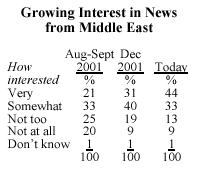
Fully 44% of Americans are paying very close attention to news of the Middle East conflict, with another 33% following the story fairly closely. That is the highest level of interest ever recorded on this measure, which dates back to 1988. It also makes the Middle East conflict one of the most closely followed foreign news stories not directly involving Americans in the 16-year history of the Pew Research Center’s news interest index.
Over the past seven months, interest in the story has risen among all age groups, but particularly among older Americans, leading to a stark difference in interest across generations. Today, 55% of those age 65 and older say they are following news from the Middle East very closely, compared with just 31% of those under age 30. Men are also significantly more interested in news about the Israeli-Palestinian conflict than are women. Just over half of men (51%) say they are following news from the region very closely, compared with 37% of women. As recently as December of 2001, women were just as interested in news from the region as were men.

In a broader context, current interest in Middle East violence is comparable to public interest in the breakup of the Soviet Union in the early 1990s and the political upheaval in China in the late 1980s, each of which were followed very closely by 47% of Americans. But the Middle East conflict still has not garnered as much public interest as the collapse of the Berlin Wall in 1989.
Americans remain very attentive to news about U.S. military efforts in Afghanistan — 45% are following this news very closely, comparable to interest levels throughout the fall and winter. Interest in news about efforts to defend against terrorist attacks at home is equally high (49% following very closely). More men than women are closely following news about the war (51% vs. 39%), while interest in defenses against domestic terrorism is roughly equal among men and women.
By comparison, public interest in reports of child sexual abuse by Catholic priests is significantly lower. Just over a quarter (27%) of Americans are following this news very closely. While 19% of the public is following news about droughts and water shortages in the U.S. very closely, interest is much higher in the drought-stricken Northeast. More than a third of those living in the Northeast (35%) say they have been following stories about the droughts very closely compared with 19% of those in the South and West, and just 9% of Midwesterners.