Pew Research Center

FOR RELEASE MARCH 20, 2002

Americans Struggle with Religion’s Role at Home and Abroad

Conducted in association with the Pew Forum on Religion and Public Life

FOR MEDIA OR OTHER INQUIRIES:

Communications Department
202.419.4372
www.pewresearch.org

RECOMMENDED CITATION

Pew Research Center, March 2002, "Americans Struggle with Religion’s Role at Home and Abroad"

About Pew Research Center

Pew Research Center is a nonpartisan, nonadvocacy fact tank that informs the public about the issues, attitudes and trends shaping the world. It does not take policy positions. The Center conducts public opinion polling, demographic research, computational social science research and other data-driven research. It studies politics and policy; news habits and media; the internet and technology; religion; race and ethnicity; international affairs; social, demographic and economic trends; science; research methodology and data science; and immigration and migration. Pew Research Center is a subsidiary of The Pew Charitable Trusts, its primary funder.

© Pew Research Center 2026

Table of contents

  • About Pew Research Center
  • Americans Struggle with Religion’s Role at Home and Abroad
  • Part 1: Religion in America
  • Part 2: Views of Islam and Religion in the World
  • Part 3: Religion, Politics and Policy

Americans Struggle with Religion’s Role at Home and Abroad

Conducted in association with the Pew Forum on Religion and Public Life

Introduction and Summary
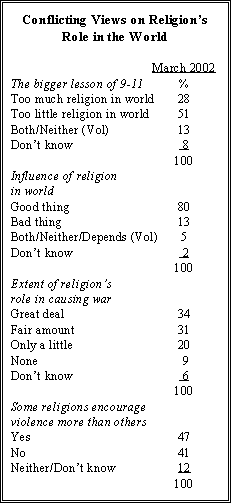
As a religious people, Americans are unsure about how to judge a world that seems increasingly in conflict along religious lines. The public overwhelmingly sees religion’s influence in the world and the nation as a good thing. And by 51%-28%, Americans think the lesson of Sept. 11 is that there is too little, not too much religion in the world.

But the public does not see all of religion’s effects as positive. A 65% majority believes that religion plays a significant role in most wars and conflicts in the world. Further, while most say that Islam is no more likely to encourage violence than other religions, a plurality of Americans believe that, in general, “some religions” are more likely than others to encourage violence. Those who think that some religions are more violent than others are more likely to see widespread anti-American sentiments among Muslims.

In that connection, while the current survey continues to find the public holding a favorable view of Muslims in this country, Muslims not identified as Americans get a more mixed review. When Islam is rated, favorable responses outweigh unfavorable ones by a thin 38%-33% margin.

Americans do not speak with one voice on these difficult questions. The most secular and liberal elements of the country are more critical of the role of religion in general terms, but have a more favorable view of Muslims and Islam. Conservative groups, including white evangelical Protestants, hold the opposite opinions. They are more supportive of the role of religion in the world, but hold more negative views of Muslims.

There are no divides, demographic or political, in the public’s overwhelming rejection of the idea that Sept. 11 was a sign that God no longer protects the United States. Only 5% hold that view, while 91% disagree. It should be noted that about half of Americans believe that the United States has had special protection from God ­ but almost all who hold this view think that other nations besides the United States also receive this protection.
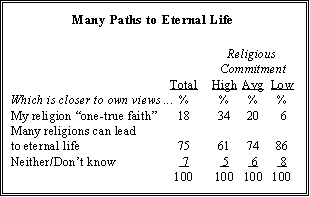
The nationwide survey of 2,002 adults, conducted Feb. 25-March 10 by the Pew Research Center and the Pew Forum on Religion and Public Life, also finds strong expressions of religious inclusiveness. An overwhelming majority (75%) say that many religions can lead to eternal life, compared with only 18% who regard their own religion as the “one true faith.” Those with a high level of religious commitment are more likely to see their own faith as the only path to eternal life. Still, nearly half of highly committed white evangelical Protestants (48%) say many religions can lead to eternal life.
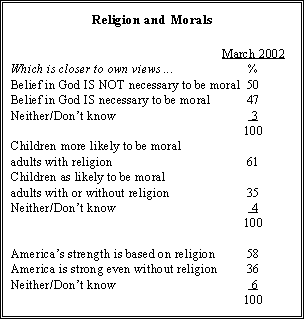
Yet Americans are conflicted over the centrality of religion to personal morality. The public is split about equally over whether belief in God is necessary for one to be a moral person (50% say such belief is not needed, 47% disagree).

There is somewhat more agreement that children raised with religious faith are more likely to grow up to be moral adults. Six-in-ten (61%) believe this, but about a third hold that children raised without religion are just as likely to grow up to be moral. A comparable majority (58%) says the strength of American society is predicated on the religious faith of its people, while 36% think that society would be strong even if most Americans lacked religious faith.

African-Americans, Southerners and older people ­ especially women ­ are among those who see the link between religion and morality as very important; other groups, including men, younger people and college graduates, are less likely to say that religion is a prerequisite for morality. Politically, conservatives ­ especially conservative Republicans ­ place the most importance on the connection between religion and morality. Independents and liberal Democrats attach the least importance to the religion-morality link.

Americans are open to the possibility that many religions lead to eternal life, but they are critical of people who do not believe in God or have no religious affiliation. Atheists get very low ratings (34% favorable/54% unfavorable) and “people who are not religious” are given better but still modest evaluations (51% favorable/30% unfavorable).
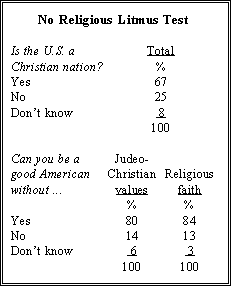
But the public’s low regard for people who are not religious does not undermine its support for religious pluralism. Even though most Americans (67%) consider the United States a “Christian nation,” an 84% majority believes that a person can be a good American even if he or she does not have religious faith. By more than three-to-one, Americans also reject the idea of churches and other houses of worship endorsing political candidates.

There also is broad opposition to the idea of government programs aimed at encouraging marriage. Nearly eight-in-ten Americans (79%) want the government to stay out of this area, while just 18% endorse such pro-marriage programs. Those with a high level of religious commitment are more likely to favor these programs, but as many as two-thirds of this group (66%) do not want the government to get involved.

As Congress prepares to reauthorize the nation’s welfare laws, the public is generally approving of the sweeping changes to the welfare system enacted in 1996. By 46%-17%, people say the current system works better. And though most remain generally critical of welfare, its overall image has improved markedly since the mid-1990s. While Americans are highly supportive of more generous assistance to the poor, they also endorse the concept of individual responsibility. Most people ­ including a majority of those whose families have received welfare benefits ­ blame poverty on the failures of individuals, not on society’s ills.

The growing debate in Washington over requiring young people to give a year of national service has not significantly changed long-standing attitudes on this issue. Roughly six-in-ten favor mandatory national service for men, while fewer (50%) support required service for women. There is a significant age gap on this issue, as Americans under age 30 solidly reject mandatory national service while those in older age groups endorse it.

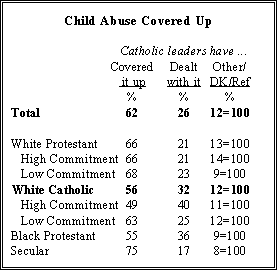
The ongoing sexual abuse scandal involving Catholic priests is attracting considerable attention. There is broad condemnation of the church’s handling of the situation. Solid majorities of all religious groups surveyed ­ including Catholics themselves ­ say Church officials have mostly covered up cases of sexual abuse rather than dealing with the problem.

Other Findings
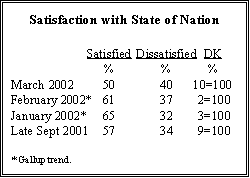
1. Public satisfaction with national conditions, which rose sharply in the wake of the Sept. 11 attacks, is now slipping. Just half say they are satisfied now, compared with about six-in-ten who expressed satisfaction with the state of the nation in Gallup polls in January and February.

2. Despite the public’s traditional aversion to foreign aid, roughly half the public favors providing assistance to help Afghanistan recover from the war.
3. Public attitudes have remained stable over the past year on whether faith-based groups should be eligible for government funding to provide social services. Seven-in-ten back the idea in principle, which is virtually unchanged from last June.

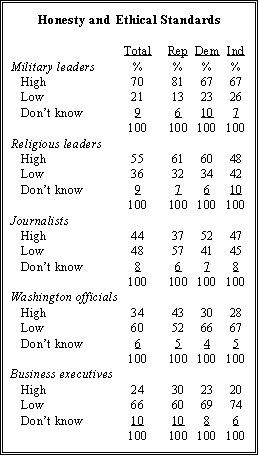
Unlike the mid-1990s, Americans now have higher regard for the ethics of Washington public officials than they have for business executives. And journalists are given higher ratings for ethics than public officials ­ except among Republicans and highly religious Americans. Overall, military leaders get the highest marks for ethics, followed by religious leaders, journalists and Washington officials.


This survey is a joint project of the Pew Research Center and Pew Forum on Religion and Public Life. We wish to thank others who assisted in the design of the questionnaire: Missy Daniel, John Green, Scott Keeter and Kim Parker.

Part 1: Religion in America

In the aftermath of Sept. 11, Americans viewed the country in a new light. Not only did broad measures of patriotism, confidence in government, and concern about the safety of friends and family rise, but the vast majority saw religion playing a significantly greater role in American life. In a mid-November Pew Research Center/Pew Forum on Religion and Public Life poll, fully 78% said the influence of religion on American life was increasing, a figure that decreased only slightly (to 71%) in a December Gallup poll.

But this perception was relatively short-lived, and now, six months after the attacks, the public’s view of religion’s influence on American life has returned to pre-Sept. 11 levels. Today, just 37% see the influence of religion increasing in America, while 52% say it is in decline. This finding mirrors results from similar Pew Research Center polls in recent years, including one in the spring of 2001, which was conducted with the Pew Forum on Religion and Public Life.

This stark turnaround is not a sign that religion is in disfavor, however. As is the case with evaluations of the influence of religion around the world, Americans who think religion is in decline almost unanimously agree that this trend is a bad thing. This view is not limited to the highly religious. Even among seculars and people with weak religious ties, majorities believe America would be better off if religion’s influence were on the rise.

America Is Protected, So Are Others

Nearly half of Americans (48%) think that the United States has had special protection from God for most of its history. Four-in-ten take the opposite view, that America has had no special divine protection. The perception that America has special status clearly links to religious beliefs. Seven-in-ten (71%) white evangelical Protestants believe this to be true, compared with just four-in-ten white mainline Protestants and white non-Hispanic Catholics. And within all religious groups, those with the deepest religious commitment are the most likely to believe the U.S. has a special status.

Yet there is a strong sense that the United States is not alone in receiving special protection from God. Fully 76% of those who say the U.S. receives special protection also say that other nations receive the same protection from God. This viewpoint is consistent across all religious, political, and demographic lines.

The public also overwhelmingly rejects the notion that the terror attacks were a signal that God is no longer protecting America as much as in the past. Just 5% believe this is true, while 91% say it is not. Even among highly committed evangelical Protestants ­ who are most likely to say that the United States has received special divine protection ­ just 12% see the terrorist attacks as a signal that God is no longer protecting the nation as much as in the past.

Religion’s Role in America

Not only do many Americans believe that God protects the U.S., most see the religious belief of the American public as the basis for this country’s success. Nearly six-in-ten Americans (58%) think the strength of American society is based on the religious faith of its people. Just over a third (36%) take the opposing view, that the society would be strong even if most Americans did not have a religious faith.

Not surprisingly, a person’s own religious beliefs, and the strength of those beliefs, shape these views. More than eight-in-ten (83%) white evangelical Protestants say religious faith is at the core of America’s strength, compared with 57% and 58% of white mainline Protestants and white Catholics, respectively. Within each of these groups, highly committed people are much more likely than those with low religious commitment to subscribe to this view.

Overall, just 49% of Hispanics say the nation’s strength is based on the religious faith of its people, fewer than either African-Americans (69%) or whites (58%). But Hispanics with strong religious commitment are twice as likely as those with weaker ties to religion to see religious faith as an essential part of American society (64% to 31%).

Although most people believe that religious faith underlies America’s strength, very few see faith as a prerequisite to being a good citizen. Fully 84% say a person can be a good American if he or she does not have religious faith, while just 13% disagree. White evangelicals and African-Americans are slightly more likely to see religion as a requirement for being a good American; but even among these groups, only about one-in-five take this position. Similarly, while two-thirds consider the United States to be a Christian nation, just 14% say it is essential that a person believe in basic Judeo-Christian values in order to be a good American, while eight-in-ten take the opposite view.

Religion and Morality

Although there is agreement that faith is not a mandatory component of good citizenship, the public is split over whether it is necessary to believe in God to be a moral person. Half say it is not necessary to believe in God in order to have good values, while 47% say that it is.

However, there is more of a sense that religion is central to the moral development of children. Six-in-ten (61%) say that children are more likely to grow up to be moral adults when they are raised in a religious faith, while 35% take the alternate view that children are just as likely to develop morals whether or not they are raised in a religious environment.

White evangelical Protestants strongly believe that religious faith is both an essential component of values and important for children. White mainline Protestants and white non-Hispanic Catholics are far less unified on these issues. While 62% of white evangelicals say one must believe in God in order to be moral, just 39% of white mainline Protestants and 42% of white Catholics agree. More than eight-in-ten (85%) white evangelical Protestants say children are better off when raised religiously, compared with 60% and 63% of white mainline Protestants and white Catholics, respectively, and 66% of black Protestants.

Overall, 87% of those who are highly observant say children raised in a religious faith are more likely to grow up to be moral adults. Among those with weak religious commitment, just 38% hold this view, while a 59% majority says children are just as likely to develop morals without religion. This “commitment gap” is particularly strong among white mainline Protestants and white Catholics.

More Than One Path

While many hold the view that religious faith is important in the development of good values, Americans are open to the idea that many religions can provide a moral foundation and lead to eternal life. Three-quarters of the public say many religions can lead to eternal life, while just 18% think their own religion is the only way to achieve eternal life.

The level of Americans’ commitment to this ecumenical position is seen across all religious faiths and backgrounds. Even the most strongly committed evangelical Protestants are evenly divided (48%-48%) over whether their faith is the only route to eternal life or not.

Atheists and ‘Non-religious’

Americans are relatively positive about people of other faiths, but they tend to look more negatively at those without faith. Atheists, in particular, are viewed unfavorably by a 54% majority, with people in the South and Midwest taking an especially negative view.

However, when people are asked for their view of people who are not religious ­ rather than atheists ­ the response is more positive. Roughly half (51%) say they feel favorably toward the non-religious, with 30% expressing an unfavorable opinion. This is comparable to public opinion about Muslims in the survey.

Morals in Decline

Over the past half-century, there has been a steadily growing sense that people in this country, especially young people, lack the morals that they once had. In 1952, half of Americans saw no decline in public morals, and 57% said young people had as strong a sense of right and wrong as did the youth fifty years previously. Today, just 21% think Americans on the whole are as honest and moral as in the past, and an equally small number (19%) think that young people have the same sense of right and wrong as 50 years ago.

Young people themselves do not disagree with this characterization. While somewhat more likely than their elders to stand up for their generation’s inherent morality, 69% of Americans under age 30 think young people lack the same sense of right and wrong that existed fifty years ago.

Where the Young Differ

Whether younger generations actually lack the morals and honesty of their predecessors or not, there is strong evidence that they do view religion as less essential ­ both to the nation’s strength and to individual morality ­ than do their elders. A clear majority of Americans age 30 and older (62%) believe the strength of American society is based on the religious faith of its people; just 46% of younger people agree, with the other half (52%) saying our society would be strong even if most did not have religious faith.

Half of those under age 30 believe children are just as likely to grow up to be moral adults whether or not they are raised in a religious faith. By more than two-to-one, older Americans take the view that religion increases the likelihood that a child will develop morals rather than this more secular viewpoint. The gap is less pronounced, though still substantial, over whether it is necessary to believe in God to be a moral person. In a similar vein, 42% of young people have a favorable opinion of atheists, compared with just 18% of those age 65 and older.

But this does not mean that younger Americans think religion is irrelevant. Three-quarters of Americans under age 30 who think religion is losing its influence in America say that this is a bad trend, and an equal proportion of those who think religion’s influence is increasing say this is a good trend.

Values Unite Blacks, Evangelicals

Black Protestants take a liberal approach on economic issues, such as increased aid for the poor and the root causes of child poverty. But in terms of religious values, black Protestants share much in common with white evangelical Protestants ­ the most conservative religious group. (The majority of black Protestants are evangelicals. Due to small sample size, black evangelical and mainline Protestants are combined in a single category).

Solid majorities of white evangelicals (71%) and black Protestants (60%) agree that the United States has special protection from God; pluralities of white mainline Protestants and Catholics believe that the U.S. receives no special divine protection. In a similar vein, more than six-in-ten black Protestants and white evangelicals think it is necessary to believe in God to be a moral person; most white mainline Protestants and Catholics disagree.

Black Protestants and white evangelicals have much less common ground politically, but there are points of agreement. About one-third in each group say churches should endorse political candidates; far fewer white mainline Protestants and Catholics agree. And like white evangelical Protestants, black Protestants are somewhat more likely to support government programs to encourage marriage.

Yes to Flag-Waving

The public is generally comfortable with the displays of patriotism and public expressions of religious faith that followed in the wake of Sept. 11. Just 16% say there has been too much showing of the flag; an equal proportion (16%) say there has been too little, with two-thirds saying current flag displays are appropriate. The proportion who think there is too much flag-waving, while relatively small, appears to be growing. Last October, just 8% held this view.

Similarly, few Americans are bothered by post-9/11 expressions of religious faith by political leaders. Just 16% say politicians refer to religion too much, with the rest thinking that current levels of religious expression by politicians are either appropriate (53%), or insufficient (24%).

As with reactions to the showing of the American flag, these views have not changed a great deal over the past six months. Seculars make up the only group that is even marginally troubled by the religious tone of political speech, but even among those who have no religious affiliation, just 32% say politicians refer to faith and prayer too much these days. At the other end of the spectrum, a significant proportion of white evangelical Protestants (35%) and black Protestants (37%) would like to hear more expressions of faith and prayer by political leaders.

Part 2: Views of Islam and Religion in the World

Americans continue to feel favorably toward Muslims and Muslim-Americans, but the public is much less positive in its view of Islam. Few see any common ground between their own religion and the Muslim faith, while more than a third (36%) perceive widespread anti-Americanism among Muslims around the globe.

Familiarity with Islam and its practices does not ease the concerns that many Muslims are anti-American. People who are knowledgeable about Islam tend to feel more favorably toward it, and they see themselves having more in common with Muslims. At the same time, they are just as likely as those who know nothing at all about Islam to see widespread anti-Americanism among Muslims, and just as likely to believe that violence is often linked to religious teachings in general.

Favorable View of Muslims, Less So for Islam

Muslim-Americans are rated favorably by 54% of the public, down slightly from 59% in mid-November, but still significantly higher than this time last year (45%). Fewer than a quarter (22%) express an unfavorable opinion of Muslim-Americans, up slightly from 17% four months ago.

Some respondents were asked for their opinion of “Muslims” without identifying them by nationality and this difference in phrasing has some effect on opinions. A 47% plurality feels favorably toward Muslims, with 29% expressing an unfavorable view.

But the larger distinction is between ratings of Muslims as individuals and perceptions of Islam generally. When asked for its opinion of Islam, the public is divided, with 38% saying they have a favorable view of the religion, and 33% unfavorable. This represents a modest shift from an ABC/Beliefnet poll taken in January, when 41% expressed a favorable opinion of Islam and just 24% felt unfavorably.

While predominantly favorable, public views of Muslims continue to lag behind most other religious groups. Protestants, Catholics and Jews are rated favorable by roughly three-quarters of the public, with only around one-in-ten expressing unfavorable opinions of these groups.

Young People More Positive

A majority of those under age 30 express a favorable view of Muslim-Americans, Muslims, and Islam alike (57%, 57% and 51% respectively). Older Americans generally have a favorable opinion of Muslim-Americans; however, they express more skepticism toward Muslims and Islam.

Americans age 65 and older in particular express mixed views when it comes to Muslims and Islam. By 43%-25%, members of this group say they feel favorably toward Muslim-Americans, but seniors who were asked about Muslims rated them less positively (30% favorable/30% unfavorable). Just one-in-four has a favorable opinion of Islam, while 37% express an unfavorable opinion.

College-educated Americans also express more favorable views of Muslims and Islam than those who did not attend college. Education has a particularly strong effect on perceptions of the Islamic religion. While about half (52%) of college graduates have a favorable view of Islam, just 29% of those who never attended college agree.

Among religious groups, white evangelical Protestants have the least favorable view of Islam. Fully 45% of white evangelicals say they have an unfavorable opinion of Islam, compared with just 29% who rate the religion favorably. White evangelicals also are most likely to say they have an unfavorable view of Muslim-Americans. As many as three-in-ten feel unfavorably toward Muslim-Americans, compared with about two-in-ten among other major religious groups. Still, this is less than the 38% of white evangelicals who rated Muslim-Americans unfavorably a year ago.

Negative views of Islam also have ideological and regional components. Political conservatives express substantially more unfavorable views of Islam than do liberals, and negative opinions of Islam tend to be greatest in rural areas and in the South.

Islam Is Different

Clearly, many Americans make a distinction in their opinions of Muslims and their view of Islam, which is much more negative. So it is perhaps not surprising that relatively few Americans think that their own religion and Islam have much in common. Just 27% see similarities between the Muslim religion and their own religion, while more than half (57%) see Islam as very different. This gap has increased since mid-November, when 52% saw major differences between their religion and Islam, and 31% saw similarities.

Opinion on this issue among college graduates, who hold the most favorable views of Islam, have shifted dramatically over the past four months. In November, roughly half of college graduates saw common ground between their own religion and the Muslim religion, while 38% did not. Today, just 40% see similarities between their religion and Islam, while substantially more (49%) see major differences. Even so, college graduates remain twice as likely as those who did not attend college to see similarities between their religion and Islam (40% vs. 19%).

Roughly a third of white mainline Protestants, black Protestants, and white Catholics say their faith and the Muslim faith have a lot in common. But just 16% of white evangelicals agree, and just 11% of highly committed white evangelicals say there is common ground with Islam, while 78% see wide differences.

These religious divides carry over into regional differences. More residents of the Northeast and West see Islam as having a lot in common with their own religion than those in the South and Midwest. And residents of small towns and rural areas feel they have less in common with Islam than those in larger cities and their suburbs.

Age and gender also are related to perceptions of Islam. Overall, three-in-ten respondents under age 65 say the Muslim religion and their own have a lot in common, compared with just 17% of those 65 and older. And more men than women see Islam as similar to their own faith (34% vs. 22%).

Mixed Views on Religion and Violence

The public is divided over how much of the Islamic world is anti-American. Nearly half (45%) think that just a few or some Muslims are hostile to the United States, but 36% think that as many as half or more of the world’s Muslims are anti-American. By comparison, a recent Gallup poll of nine predominantly Muslim countries found that 53% of respondents held an unfavorable view of the United States.

The public sees much less anti-Americanism among Muslims in this country. Fully 62% say some or just a few hold anti-American sentiments. Still, one-in-five think that at least half of the Muslims living in the U.S. are anti-American.

For the most part, the public rejects the idea that Islam in some way foments violence among its adherents. Roughly half (51%) say Islam is no more likely than other religions to encourage violence, while only a quarter say Islam is more associated with violence than other religions.

Yet there is a clear sense that some religions are more likely to encourage violence. While half of respondents were asked specifically whether Islam is more likely than other religions to encourage violence, half were asked the same about “some religions.” In the latter case, a 47% plurality said that some religions are more likely than others to encourage violence among their believers, while 41% disagreed.

There are similar patterns in the responses to each question. A higher proportion of conservative Republicans and evangelical Christians say “some religions” are more likely than others to encourage violence. More members of these groups also say Islam is more likely than other religions to encourage violence.

In addition, those who believe some religions encourage violence tend to rate Muslim-Americans somewhat less favorably, and see more hostility toward the U.S. among Muslims. More than four-in-ten (45%) of those who believe some religions encourage violence think at least half the Muslims in the world are anti-American. Among those who think all religions are the same in this regard, just 29% see widespread hostility toward America among Muslims.

Young Most Aware of Islam

Few Americans feel they know a lot about the Muslim religion. Roughly two-thirds of Americans (65%) say they know little or nothing about Islam and its practices, while just 5% say they know a great deal about the religion. This is virtually identical to how Americans felt in mid-November 2001.

While just 34% say they know a great deal or some about Islam, nearly half (47%) knew that Muslims use the term “Allah” to refer to God and nearly as many (43%) know that the Islamic equivalent to the Bible is the “Koran.”

Young people tend to be more knowledgeable about Islam than their elders. Among those under age 30, 56% can identify Allah as the correct answer, compared with 35% of those age 65 and older. Overall, more than half of seniors (56%) could answer neither question correctly, compared with just 37% of those under age 30.

Knowledgeable, Still Wary

Americans who are familiar with basic aspects of the Muslim faith ­ those who can correctly identify the Koran and Allah ­ rate Muslims and Islam far more favorably than those who know little or nothing about Islam. And people who are familiar with Islam are almost three times as likely as those who know little or nothing (41% vs. 15%) to think the Muslim faith has a lot in common with their own religion.

Yet knowledge of Islam does not necessarily lead people to believe there is less anti-American hostility among Muslims or that Islam is no more violent than other religions. Americans who know rudimentary facts about Islam are, if anything, more likely to see anti-American sentiment among half or more Muslims around the world. And as to whether some religions or Islam are more likely to encourage violence among believers, familiarity with the religion has no effect on people’s evaluations.

Religion in the World

Regardless of their feelings about Islam, Americans remain staunchly supportive of religion’s influence both in America and in the world. Half think that religion’s influence in the world is currently in decline, and the vast majority who believe this think it is a bad trend (85%), not a good one (9%). Among the minority (38%) who think that religion’s influence in the world is currently on the rise, there is only slightly less uniformity. Three-quarters (73%) say the increasing influence of religion in the world is a good thing, just 18% think it is bad.

When asked to consider lessons from the terrorist attacks, the public’s view does not change. By nearly two-to-one, more believe that the bigger lesson of Sept. 11 is that religion has too little influence in the world (51%) than think the lesson is that religion has too much sway (28%).

Perspectives on the role of religion in the world depend largely on the importance of religion in a person’s own life. Highly religious Americans, by nearly ten-to-one, see the terrorist attacks signifying that religion has too little influence in the world these days (73%), not too much (8%). But among those for whom religion is not particularly important, a 48% plurality say the bigger lesson is that religion is too influential, while 32% take the opposing viewpoint. This “commitment gap” exists within all religious groups.

Aside from those who are not strongly religious, men and younger people also express somewhat more skepticism about the role of religion in the world. Whereas women predominantly say the lesson of Sept. 11 is that religion has too little influence in the world (58%), men are more divided (44% say too little, 35% too much). Those under age 30 are split as to whether the lesson of 9/11 is that there is too much (37%) or too little (44%) religion in the world, while older people strongly believe the latter.

At the same time, Americans believe that religion’s effect is not always positive. One-third of Americans (34%) say religion plays a major role in causing most wars and conflicts in the world, and nearly as many (31%) say it has a fair amount to do with wars and conflicts. This view is most prevalent among seculars, men, and college graduates.

Part 3: Religion, Politics and Policy

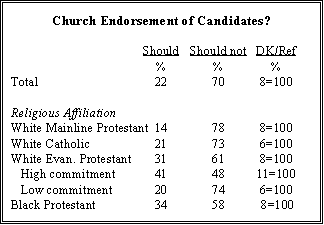
Last year’s survey by the Pew Research Center and Pew Forum on Religion and Public Life showed that nearly half of Americans favored churches expressing their views on social and political subjects. But the public draws the line at churches making political endorsements. By 70%-22%, Americans believe churches should not come out in favor of political candidates. Views on this practice vary, both by denomination and level of religious commitment.

White non-Hispanic Catholics and white mainline Protestants ­ regardless of their level of religious commitment ­ oppose political endorsements by churches by better than three-to-one. Mainline Protestants are even slightly more likely than seculars (78%-74%) to say that churches should not come out in favor of candidates.

White evangelicals and black Protestants also oppose political endorsements by churches and other houses of worship, but by a smaller margin than do white mainline Protestants and Catholics. Highly committed white evangelicals are the most supportive of churches making political endorsements ­ 41% back this practice, while 48% are opposed.

Government Marriage Programs Opposed

As a general proposition, Americans believe the government should not develop programs to encourage people to get and stay married. When asked, nearly eight-in-ten (79%) prefer that the government “stay out” of such activities, while 18% favor this idea.

Overall, more than twice as many white evangelicals as white mainline Protestants (27%-11%) support programs aimed at promoting marriage. Among highly committed white evangelicals, 35% favor government programs to encourage marriage, far more than any other religious or demographic group, although 60% oppose such programs.

Addressing Poverty

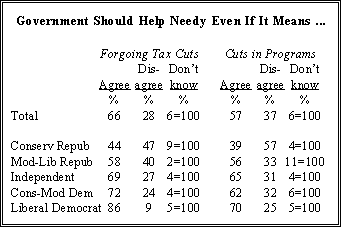
Americans are strongly supportive of helping those in need. Eight-in-ten (79%) say people should do more to help the needy, even if that entails some personal sacrifice, while 67% favor more generous government assistance to the poor. Majorities of all political groups ­ except conservative Republicans ­ support more generous government aid.

Fully two-thirds would be willing to forgo tax cuts to do more to help the needy and 57% would accept cuts in government programs to achieve this goal. Race, ideology and partisanship are more important than religious affiliation in influencing these views. For instance, 85% of African-Americans are in favor of holding back on tax cuts to provide more help to the needy, compared with 62% of whites.

While a majority of conservative Republicans (57%) disagree with the idea of making cuts in government programs to fund more aid to the needy, they are much more evenly divided over reducing tax cuts to fulfill this objective ­ 44% agree with that idea, while 47% disagree.

Religion is not a major factor in opinions on political tradeoffs. But when it comes to attitudes on private charity, those who are highly committed to their religion are more likely than others to completely agree that people have an obligation to do more to help the poor. Overall, 79% agree that people should do more to help others in need, and 31% completely agree with this statement. Four-in-ten (42%) of those with a high degree of religious commitment completely agree with that sentiment, compared with 30% of those with average commitment and 25% of those with weak religious commitment. The biggest gap occurs among white Catholics ­ 37% in the high commitment group completely agree with the need to aid the poor, compared with 21% in the low commitment group.

Welfare ­ Changed for the Better

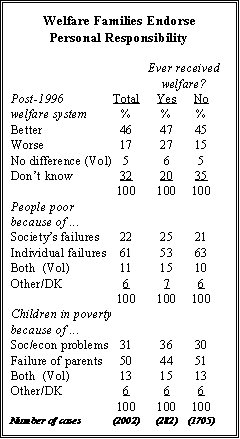
By 46%-17%, Americans say the welfare reform legislation passed in 1996 changed things for the better compared with the previous system. Significantly, those who are most familiar with the system ­ current or former welfare beneficiaries and their families ­ also react positively to the changes. By 47%-27%, this group believes the system has been changed for the better.

There are few major religious, demographic or political differences on this issue, although African-Americans are somewhat more likely than whites to take a negative view of the revamped system. Republicans overwhelmingly endorse the welfare changes (52%-12%); Democrats agree, by a smaller margin (47%-20%).

A majority of the public (53%) still agrees with the traditional critique of the old welfare system: that it encourages recipients to be too dependent on government aid. But in a reflection of how the 1996 law has changed opinions on this subject, 32% say the welfare system improves things by helping recipients support themselves; just 12% expressed that opinion in 1994.

There is a modest gap among religious groups on this question, with black Protestants and white Catholics more likely than white Protestants to view the welfare system in a positive light. Roughly four-in-ten black Protestants and nearly as many white Catholics (36%) say welfare changes things for the better by helping the needy; 28% of white mainline Protestants and 25% of white evangelical Protestants agree.

Poverty Seen as Individual Failure

Despite the support for more private and government aid to the poor, the public shows strong support for individual responsibility. Fully 61% say most people are poor because of their own individual failures, while far fewer (21%) blame society’s failures.

By a smaller margin (50%-31%) Americans also say child poverty is the fault of individual parents, not social and economic problems. Even when reminded that more than ten-million American children currently live in poverty, this perception does not change.

Race and ideology influence attitudes on these issues far more than religion or even income. African-Americans and liberals are the only groups in which pluralities blame child poverty on social and economic problems. These groups also are somewhat more likely to see society as to blame for poverty generally, although 52% of liberals and 48% of African-Americans point the finger at individual failures.

Experience with the welfare system has only a modest effect on these views. Current and former welfare recipients say individual failures, not society, are to blame for poverty by more than two-to-one (53%-25%). And a narrow 44% plurality of those who have received welfare affix responsibility for child poverty on the failures of parents, while 36% blame social and economic problems.

National Service Supported; But Not By Young

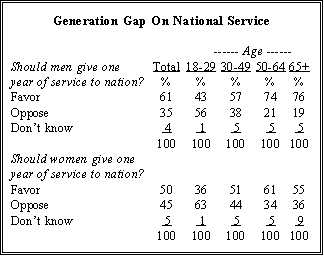
Public opinion on mandatory national service has changed little since the 1980s. Currently, 61% back a one-year service requirement for men, in either the military, Peace Corps, AmeriCorps or a community service program. That represents a modest increase over the 55% who backed mandatory national service in 1987. Half the public supports a national service requirement for women, up from 44% in 1987.

Conservative groups make a clear distinction between mandatory service for men and women. White evangelical Protestants who are highly religious favor mandatory service for men, by 62%-34%, while opposing it for women (52%-41%). By contrast, liberals and seculars tend to support national service at lower rates than conservatives and evangelicals, but make less of a gender distinction.

But age is perhaps the most important factor in opinions on mandatory national service. Solid majorities of Americans under the age of 30 oppose this requirement for men (56% opposed) and women (63%). Older Americans are much more supportive of this idea, especially for men. As many as three-quarters of those over age 50 back national service for men, and 58% favor it for women.

Divisions Over Afghan Aid

Roughly half the public (49%) says the United States should come to the aid of Afghanistan, while 43% believe the U.S. should not get involved. Another group of respondents was asked whether the U.S. has a moral obligation to aid Afghanistan; the result was similar (50% said the U.S. had a moral responsibility, 39% disagreed).

Religious people are more likely to view aid for Afghanistan in moral terms. By 54%-34%, those with a high degree of religious commitment say the U.S. has a moral responsibility to provide aid. Those with average commitment also hold this view (51%-37%), but those with weak religious commitment are split (45%-46%).

Death Penalty Favored for Terrorists

Two-thirds of the public supports the death penalty for those convicted of murder, which is virtually unchanged from last March (66%) but down substantially since 1996 (78%). Support rises to 76% in the case of people convicted of terrorism. While members of all religious groups show stronger support for executing terrorists than convicted murderers, the views of seculars change very little; 72% favor the death penalty for murderers, and 69% favor it for terrorists. African-Americans, who traditionally oppose the death penalty, are the only group in which a significant minority opposes the death penalty for terrorists (39%).

This year’s survey finds that, as in the past, religion strongly influences views on the death penalty. In general, those with a high degree of religious commitment show less support for the death penalty for murder than do fellow church members with less religious commitment. This pattern does not hold for white evangelicals, however; white evangelicals with high levels of religious commitment are just as likely to back the death penalty as those who are not as committed.

The April 2001 report by the Pew Research Center and Pew Forum found that 42% of death penalty opponents cited religion as an influence on their position, compared with just 15% of supporters. (See “Faith-Based Funding Backed, But Church-State Doubts Abound,” April 10, 2001.)

Little Change on Faith-Based Aid

There has been little change in opinion over the past year on whether faith-based groups should receive government funding to provide social services. Currently, seven-in-ten favor permitting such organizations to apply for government funding, down slightly from 72% last June and 75% in March 2001.

Like last year, black Protestants are more likely than other religious groups to favor faith-based aid. More than eight-in-ten (83%) black Protestants back this idea, followed by white Catholics (75%), evangelical Protestants (72%) and mainline Protestants (67%). More than half of seculars (57%) want to allow faith-based organizations to be eligible for government aid, while 39% are opposed.

Church Scandal Draws Strong Criticism

The public is paying close attention to the recent criminal trials involving Catholic priests accused of child sexual abuse ­ and it takes a dim view of the Church’s handling of the problem. More than eight-in-ten (85%) have heard about the recent cases: 39% have heard a lot, 47% a little. By more than two-to-one, the public says that Church leaders have mostly tried to cover up the problem, rather than attempting to deal with it.

Catholics are following this story more closely than are members of other religions. Nearly all Catholics (91%) have heard about the case, and 46% have heard a lot. Interest in the story also is particularly high in the Northeast, the site of a recent high-profile trial of a former priest. Nearly half of northeasterners (49%) have heard a lot about the case.

Americans who have heard a lot about the case are more likely than others to think that Church leaders have covered up the problem. Among those who have heard a lot, 72% believe there was a coverup, compared with 54% of those who have heard only a little. Fewer Catholics say there was a coverup by Church leaders. However, even among Catholics, more than half (56%) fault Church leaders with hiding the problem, while only 32% say that leaders tried to deal with it.

Catholics with a high level of religious commitment are following the story more closely than are members of any other religious group (54% heard a lot), including Catholics with less religious commitment (40%). The highly committed group also is less critical of Church leaders for their handling of the problem. Half of the most observant Catholics (49%) think Church leaders were at fault, compared with 63% of Catholics with low religious commitment. But within both groups of Catholics, those who have heard a lot about the problem are much more likely to say that Church leaders tried to cover it up.

Honesty Up in Washington, Down in Boardrooms

In post-Enron and post-9/11 America, the public’s estimation of the honesty and ethical standards of government officials and corporate heads have switched positions when compared with the mid-1990s. Public officials in Washington are now seen more favorably, heads of major corporations less so.

Today, 34% of Americans say Washington public officials have high or very high standards of honesty and ethics, up from just 18% in 1995. Heads of major companies, however, have dropped from a 33% positive rating to only 24%. Likewise, only 25% say corporate board members have high ethical standards.

The shift in opinion on corporate executives has occurred fairly consistently across political party lines, while the change in attitudes about public officials varies by party affiliation. During the Clinton years, there was uniformity of opinion among Democrats and Republicans: 21% of Americans in both parties rated government officials’ ethics highly.

Today, members of all political parties have an improved view of Washington officials’ ethics, but the change has been most noticeable among Republicans. The share of Republicans who say that public officials in Washington have high ethical standards has doubled (to 43%), which is perhaps not surprising with a Republican administration now in power. By comparison, three-in-ten Democrats and independents give high ratings to the ethics of public officials (30% and 28%, respectively). Republicans continue to view corporate heads more favorably than do Democrats or independents, but those ratings have dropped among all parties.

Military leaders are rated highest, as they were in 1995. Today, 70% of Americans give military leaders a high rating for honesty and ethical standards, up from 63%. Religious leaders rate second on the current list (55% say they have high standards). People who think the Catholic Church has covered up cases of sexual abuse by priests are more critical of religious leaders generally ­ only 49% in those groups rate the clergy positively, compared with 71% of those who think the Church tried to deal with the problem.

Journalists get a relatively strong rating for honesty (44%), higher than either public officials or corporate heads. Among the most religious Americans, however, only 38% rate journalists’ ethics highly.

Most See Business Morals Slipping

Consistent with their diminished view of the ethical standards of corporate heads, Americans also are skeptical of business executives’ adherence to the law. Today, 58% say business executives try to find a way around laws, while just 35% give executives credit for trying to obey laws.

The Enron case, in particular, is seen as a sign that morals in American business are on the decline. Six-in-ten Americans subscribe to this view, compared with fewer than four-in-ten (37%) who don’t see it that way.