Views of Business and Regulation Unchanged by Enron
Reduce Tax Cut to Pay for Guns and Butter
About Pew Research Center
Pew Research Center is a nonpartisan, nonadvocacy fact tank that informs the public about the issues, attitudes and trends shaping the world. It does not take policy positions. The Center conducts public opinion polling, demographic research, computational social science research and other data-driven research. It studies politics and policy; news habits and media; the internet and technology; religion; race and ethnicity; international affairs; social, demographic and economic trends; science; research methodology and data science; and immigration and migration. Pew Research Center is a subsidiary of The Pew Charitable Trusts, its primary funder.
Views of Business and Regulation Unchanged by Enron
Reduce Tax Cut to Pay for Guns and Butter
Introduction and Summary
The American public increasingly recognizes the gravity of the Enron scandal — a greater percentage than in January has been following news about the case, and more now think the collapse of the Houston energy giant is of great importance to the nation. Yet the public’s underlying attitudes toward business and government regulation have been largely unaffected by the scandal. And there is no evidence of significant political fallout from Enron as of yet. Rather, the major lesson being drawn from Enron is that retirement accounts may be less safe than previously believed.
Even as the percentage of Americans paying some attention to news of Enron has steadily risen — from 34% in December, to 43% in January and 61% in February, basic opinions of American business have not changed much. While the vast majority of the public continues to worry about the power wielded by a few companies and many think corporations make too much profit, the public is divided, as in previous surveys, over the necessity of government regulation. The Pew Research Center’s latest nationwide poll of 1,199 adults, conducted Feb. 12-18, finds 50% saying such regulation is needed to protect the public interest, while 41% believe that government regulation does more harm than good. That is similar to the 48%-44% split on this question in 1999.
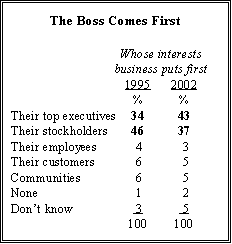
Most people continue to give mixed grades to American business for how it acts toward the public: as in previous surveys going back to the late 1970s, the vast majority (64%) express only some confidence in business to act responsibly, while just 12% express a great deal of confidence. Also, as in the past, relatively small minorities believe corporations put the interests of their employees, their customers or their communities first. But Enron seems to have changed the public’s perception of business’s top priorities — 43% now say corporations put the interests of executives first, while 37% say stockholders come first. In 1995, a plurality took the opposite view (46% said stockholders, 34% executives).
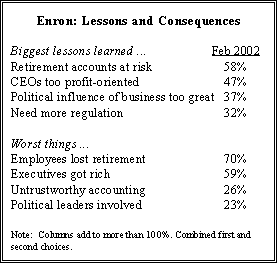
Enron has clearly affected the way Americans view the security of stock-based retirement accounts. A 58% majority said the major lesson of Enron was that such accounts may not be safe. That is a significantly larger percentage than say that Enron shows more government regulation is needed, or that large corporations have too much clout in Washington. The potential vulnerability of retirement accounts was an even bigger lesson for people with stock-based retirement accounts than for others in the survey.
Politically, most Americans see only venial sins arising from the Enron affair. Roughly three-in-ten (31%) think that Enron executives were able to influence Republican leaders a great deal; a smaller number (19%) believe they had sway with Democrats. Only about a quarter (26%) say that Enron officials exerted considerable influence over the White House. A 36% plurality says the Bush administration acted unethically, but not illegally, in connection with Enron, although the percentage who see illegal activity has risen to 24% from 15% in a late January Gallup survey. As in previous polls, an overwhelming majority say the White House should turn over information to Congress on energy policy meetings that involved Enron officials.
Bush: High Approval, Short Coattails
Nonetheless, the Enron scandal has shown no signs of diminishing the president’s standing with the public. The president’s approval rating remains at a lofty 78%, virtually unchanged from January, although down slightly from his fall ratings in the mid-80% range. However, the president’s approval measures are not translating into a partisan advantage for the GOP. Republicans continue to run even with Democrats in a congressional ballot test conducted among registered voters — 46% to 45%.
The lack of a major lift in voting intentions for the GOP also stands in sharp contrast to the fact that more say that President Bush will be a factor in their choice come Election Day than said that about former presidents Clinton, Bush or Reagan. Among the registered voters surveyed, 34% say that their vote in this fall’s midterm elections will be a vote “for” Bush, compared with just 9% who view their ballot as a vote “against” the president. This is a far better for-against ratio than enjoyed by other recent presidents.
But the president’s coattails may be less of a factor than these numbers indicate. An analysis of this attitude in relationship to voting intentions compared with four years ago finds that expressions of support for Bush have less connection to congressional preference than was the case with Bill Clinton. For example, one-in-five (19%) of those who say their midterm vote will be “for” Bush still intend to vote Democratic. Four years ago, just 7% of those who saw their vote as an expression of support for Clinton intended to vote Republican in the midterm balloting.
The findings of the poll also underscore some potential policy trouble spots for the Bush administration. Strong majorities favor increased spending for domestic priorities such as health care, Medicare, and education. Support for higher expenditures in these areas rivals the high levels of backing for boosting defense spending and funding of homeland defenses. When offered a choice of how to pay for defense and security needs, just 22% favor cutting domestic programs, compared with 42% who prefer to postpone or reduce tax cuts. Reducing domestic spending has appeal to some Republicans (33%), but even within Bush’s own party as many as 35% favor postponing or reducing the tax cuts.
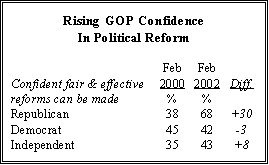
The poll also finds the public reacting with cautious optimism to the first potential policy consequence of the Enron scandal. In the survey, conducted as the House of Representatives debated and passed a ban on “soft money” donations, just 51% expressed confidence that the president and Congress could write new laws that would reduce the role of money in politics. Still, this represents a significant increase from the 39% expressing that view at the outset of the last presidential campaign in February 2000.
Other Important Findings
Business Views Change Little
Interest in the Enron case has been steadily increasing over the past two months, outpacing other news stories such as the Winter Olympics and the congressional debate over the budget and taxes. Currently, 28% say they are following the investigation into the Enron bankruptcy very closely, up from 19% in mid-January, and 11% in mid-December. Another 33% are following the Enron investigation fairly closely. Concern about the Enron case is also on the rise, with roughly half (49%) sayingit is of great importance to the nation today, up from four-in-ten (39%) in January.
Despite this interest and concern, Americans continue to be of two minds when it comes to evaluating the role of business in this country. Most see business success as essential to the nation’s strength. Yet majorities also think too much power is concentrated in the hands of a few large companies, and that the system favors the rich over the poor. As a result, the public is divided over whether regulation of business is necessary or does more harm than good, and whether businesses effectively balance profits with public interests, attitudes which remain unchanged by the Enron case.
Today, 76% say the strength of this country is mostly based on the success of American business, unchanged from previous surveys conducted over the past 15 years. While a comparable number feel that too much power is concentrated in the hands of a few large companies, this concern is also no higher than in the past. In fact, fewer Americans today (66%) than three years ago (72%) subscribe to the axiom that the rich get richer while the poor get poorer.
Americans are no less divided over the value of government regulation than in the recent past, but there has been a modest uptick in pro-regulation sentiment since the mid-1990s. Half the public now sees government regulation of business as a necessity, which is largely unchanged from 1999, but up from 38% in October 1994. Similarly, the number who say government regulation does more harm than good has dropped steadily since 1994.
This continuing ambivalence toward business is perhaps best highlighted by the public’s tempered view of corporate responsibility. Both before and after the Enron story broke, roughly one-in-ten said they have a great deal of confidence in business to live up to its responsibility to the American public, while roughly two-in-ten said they have no confidence in business. The vast majority (about two-thirds) said they have “some” confidence that business will do what is right.
Pro-Business, Less Worried About Enron
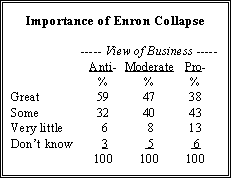
While the public’s underlying views of business have been largely unaffected by Enron, the reverse is true — people’s pre-existing attitudes toward business influence the way they view the seriousness of the case, and its implications. Fully 59% of those who look skeptically at corporate power and practices attach a great deal of importance to the Enron collapse. Those who take a relatively favorable view of business are less concerned — just 38% see the Enron bankruptcy as a major concern. 1
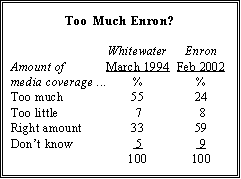
Overall, Americans have been satisfied with the amount of media coverage of the Enron case. Roughly six-in-ten (59%) say the press has spent the right amount of time covering Enron, while 24% say there has been too much coverage and 8% too little. This contrasts sharply with the public’s view of media coverage of the Whitewater scandal during the Clinton administration, when most (55%)said there was too much coverage, and just one-in-three said coverage was adequate.
However, as with the importance of the scandal, general views about business shape perceptions of press coverage. As many as 29% of those with a pro-business outlook think there has been too much coverage, compared with 18% of skeptics.
Business Views Shape Enron Lessons
In similar fashion, Americans’ general beliefs about business affect what they see as the lessons to be derived from the company’s collapse. Overall, 58% cite the potential insecurity of retirement accounts as one of the two most important lessons of Enron, with one-in-three listing it as the single most important thing for Americans to learn.
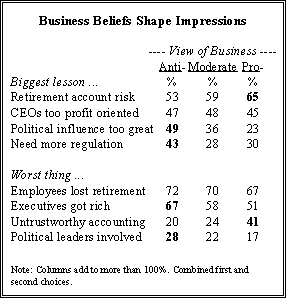
But among those who take a favorable view of business, this stands out as the singular message of Enron — 65% of those with pro-business attitudes see heightened risks in retirement accounts as a central lesson. By comparison, those who tend to be skeptical of business are nearly as likely to see the Enron case as evidence that business has too much influence in Washington, and that corporations are not regulated enough, ideas which those favorable toward business roundly reject.
Worst Consequences: Employees Lost, Execs Gained
Overall, seven-in-ten say the fact that many Enron employees lost their retirement funds is either the worst or second worst thing about the collapse of Enron, and this view is consistent regardless of how one views business overall.
Enron executives walking off wealthy while the company collapsed rates among the worst things about the scandal to a majority (59%), while only about a quarter sees the possibility that accounting firms may be untrustworthy (26%) and that political leaders might be involved (23%) as the worst things about the case.
The Enron case has apparently played into the predispositions of Americans who have an unfavorable view of business. Fully two-thirds of this group say the worst aspect of the Enron affair is that executives may have enriched themselves as the company was collapsing. That sentiment is shared by barely half (51%) of pro-business Americans. Business skeptics also are more likely than the pro-business group to point to potential involvement by top political leaders as the worst thing about the case (28% to 17%). For their part, those with favorable attitudes toward business are much more likely than those with negative views to rate questions about the trustworthiness of accounting reports as one of the worst things about the case (41%-20%).
Shifting Views of Corporate Priorities
Public assessments of whose interests business corporations put first have been affected by recent events, as the public has witnessed top executives benefitting while stockholders and employees suffer.
However, the vast majority of Americans believe that companies should put the interests of their employees (31%), their customers (27%), and their communities (19%) first. Smaller proportions identify stockholders (14%) or top executives (3%) as the proper focus of corporate decision-making. These figures are virtually unchanged from a Pew Research Center survey in October 1995.
Evaluations of corporate behavior could not be more different. A 43% plurality says that top executives are the primary beneficiaries of corporate attention, with another 37% saying the interests of stockholders are put first. In the mid-1990s, the public saw stockholders coming before top executives. Both then and now, only a small minority say that employees (3%), customers (5%) or community interests (5%) are put first by American business.
Retirement Jitters
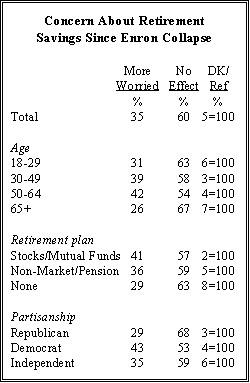
Overall, about one-in-three Americans (35%) say they are more worried about their own retirement savings since the collapse of Enron. Not surprisingly, this concern is highest among those nearing retirement age, and those who have retirement accounts that include stock or mutual fund investments. Fully 42% of those age 50-64 say they are more worried today about their retirement accounts, compared with just one-in-four of those over age 65 and 31% under age 30. Four-in-ten Americans with retirement accounts in the market say they are more concerned since the Enron collapse, compared with 36% of those with non-market retirement accounts, and 29% of those with no retirement plan beyond Social Security.
Though less concerned than Democrats (43%), nearly three-in-ten Republicans (29%) say the Enron case has made them more worried about their own retirement accounts. Roughly a third of independents (35%) agree.
Modest Political Fallout
Relatively few believe that the Bush administration is engaged in illegal activities related to the Enron case. Even among Democrats, just 35% hold this view. But most Americans remain skeptical of the administration’s actions, and many believe that Enron was able to buy political influence in Washington. Partisans divide over these issues in predictable ways, but independents are nearly as suspicious as Democrats of Republican politicians and the Bush administration in particular.
Fully three-quarters (76%) of Democrats see the Bush administration as ethically, if not legally, culpable in the Enron affair, and nearly two-thirds (64%) of independents share this view. By comparison, fewer than half (45%) of Republicans think the White House had any unethical or illegal involvement in the case.
Similarly, while roughly half (49%) of the general public thinks the administration is hiding something related to the Enron case, solid majorities of Democrats (69%) and independents (56%) believe this to be the case.
Two-thirds of Americans think Vice President Cheney should provide Congress with information on the administration’s energy meetings, which included sessions with Enron officials. Here again, Democrats (83%) and independents (72%) overwhelmingly side against Cheney. Even Republicans are divided on this question, with 47% saying he should release the information, and 44% saying the vice president is right to keep such information confidential.
Enron’s Political Influence
Majorities see both parties as tarnished a bit by the Enron affair, though Democrats and independents express particular suspicion about the links between Enron officials and Republicans. Overall, 68% say Enron officials exerted some influence on GOP leaders (31% a great deal, 37% a fair amount), while 58% say the same about Democratic leaders (19% a great deal, 39% a fair amount).
Interestingly, there is no partisan divide over Democratic involvement; roughly six-in-ten within all partisan groups see Democratic leaders as influenced. But there is a perception gap over the GOP’s involvement with Enron. Roughly three-quarters of Democrats and independents, compared with 58% of Republicans, think Enron executives were able to influence the Republican leadership. All in all, fully 34% of political independents think Enron executives had a great deal of influence on Republican leaders, while about half as many (18%) say the same about Democratic leaders.
Many Find Enron Saga Complex, Distant
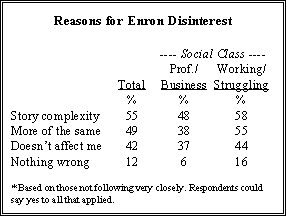
Public attention to the Enron case has been gradually increasing, but many Americans continue to find it too complex or are turned off because it seems far removed or confirms their cynicism about corporate behavior.
More than half (55%) of those who are not following the story, or are paying limited attention, say it is hard to follow the business and financial dealings that occurred. Slightly fewer (49%) say they have not followed the story very closely because they see it as just another example of the wealthy taking advantage of the system. About four-in-ten (42%) say they haven’t been following the story because they think it does not affect them. Just 12% say they haven’t followed the story very closely because there was no serious wrongdoing.
Perhaps not surprisingly, there is a strong socioeconomic component to interest in the Enron case. Americans who describe themselves as “working class” or part of a “struggling family” have been paying less attention to the story than those who describe themselves as part of the “professional” or “business” class. Working class respondents cite a variety of reasons for this many see the story as too complex, less relevant, and just another example of the rich getting rich, all at the same time.
More Confidence in Reform Efforts
There has been a modest increase in public optimism in the ability of Washington politicians to write fair and effective campaign finance reform legislation, and the shift is attributable almost entirely to change among Republicans. Roughly half (51%) of Americans express a lot or some confidence that the president and Congress can reform the campaign finance system, up from 39% early in the presidential primaries of 2000 and 34% in September 1997. Republicans, who two years ago were more skeptical than confident, have changed their view completely. Today, 68% of Republicans have some confidence that campaign finance reform can be achieved, up from 38% two years ago, while the perceptions of Democrats and independents have changed little, if any.
While optimism is up, it is worth noting that confidence in political leaders to enact effective political reforms is lowest among those who see such changes as most necessary. Just 42% of those rating Enron’s political ties as one of the worst things about the case feel confident that the president and Congress will write fair and effective legislation, compared with 54% of those who do not list political involvement as one of the worst things about the case.
Strong Support for Domestic Spending
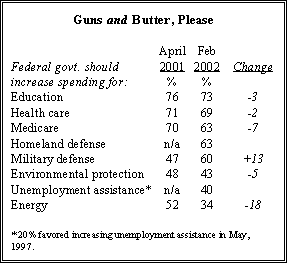
Despite rising support for more military spending in the wake of Sept. 11, Americans continue to place domestic issues at or near the top of their budget priorities. As was the case last spring, three-in-four Americans say they want to increase federal spending on education, more than any other issue. Spending on health care continues to be the second highest concern: 69% favor more spending in this area, largely unchanged since last spring.
This continued emphasis on education and health care exists at the same time that more Americans support increased defense spending. Six-in-ten Americans want more military spending, up from 47% last April. And 63% favor raising the budget for homeland defense, an item not on the agenda last spring.
Republicans are much more supportive of increased military spending than are Democrats or independents, but this was the case before the terrorist attacks. In fact, Republican support for more military spending is almost unchanged, while the shift in priorities comes from Democrats and independents. And as seen in other Pew Research Center surveys since Sept. 11, one of the biggest boosts in backing for defense spending has occurred among women. Last year, 44% of women supported increased military spending; that figure has risen to 58%. A similar jump in support for military spending has occurred among those living in the East.
While the public wants more spending on defense and domestic programs, it is willing to cut energy spending. Last April, when gas prices were rising and energy outages were in the news, 52% wanted more federal dollars to go to energy. Today, only 34% back higher spending on energy programs.
The public also assigns a slightly lower priority to spending on Medicare and environmental protection. Medicare is still near the top, with 63 percent favoring increased spending, but support has dropped from 70 percent last spring. The proportion supporting higher spending for environmental initiatives has fallen from 48% to 43%.
Paying for Priorities
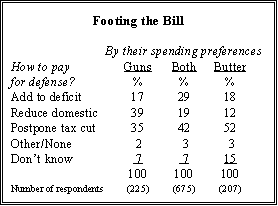
To pay for the increased defense and homeland security spending that President Bush has proposed, a plurality of Americans favor postponing or reducing last year’s tax cut rather than adding to the budget deficit or reducing domestic spending. In large part, people’s spending priorities are linked with preferred means of paying for those priorities.
For instance, among the minority who favor domestic spending increases but do not back Bush’s proposed increases in defense and security spending, most (52%) prefer reducing the tax cut. Among the majority who
want both guns and butter, scaling back the tax cuts remain the plurality choice (42%), though three-in-ten (29%) favor adding to the budget deficit. Only those who primarily want higher defense spending do not clearly favor postponing or reducing last year’s tax cuts (35%).
Americans with higher incomes and better education — those most likely to benefit from the tax cut — are most supportive of postponing or reducing it. More than half (52%) of those with incomes above $50,000 and 56% of college graduates prefer this means of paying for increased defense spending.
Support for the various budgetary options follows party lines, but only to a point. Democrats and independents favor scaling back the tax cut (47% of each group), and fewer than one-in-five would trim domestic spending (15% of Democrats and 19% of independents). Republicans, however, are almost evenly split between these two options.
While Republicans are the most likely to opt for cuts in domestic programs as a way to pay for defense and security (33%), almost the same number would forgo the tax break (35%). Within the Republican party, there is an ideological divide. Conservative Republicans have a slight preference for reducing domestic spending, while a plurality of moderate and liberal Republicans favor reducing or postponing the tax cut.
There is little or no partisan split regarding adding to the budget deficit to pay for increased spending. Only 26% of Democrats, and fewer Republicans and independents (22%), support this alternative.
Energy Conservation Gains
During the energy crisis last May, the public had a slight preference for energy conservation and regulation (49%) over expanding energy sources (44%). Today that gap has widened: 54% favor conservation and regulation, only 37% want to expand exploration and build new power plants.
But when it comes to a choice between protecting the environment and developing new energy sources, Americans continue to be narrowly divided. By a slim 48%-45% margin, Americans rate developing new energy sources as a higher priority than protecting the environment, largely unchanged from last May (49%-42%).
China’s Image Improves
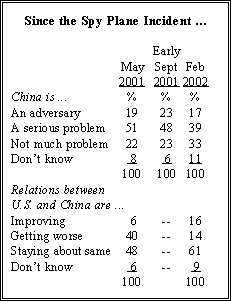
As President Bush tours Asia this week, public opinion of China has improved significantly since tensions were high last spring. While a minority of the public (17%) continues to see China as an adversary, the proportion viewing China as a serious problem for the United States has dropped from 51% in May 2001 to 39% today. Moreover, one-third think China is not much of a problem for the U.S., up from 22% in May.
In May 2001, four-in-ten Americans thought relations between the U.S. and China were deteriorating. Today, just 14% hold this view, with 16% saying relations are improving. Roughly six-in-ten (61%) think U.S.-Chinese relations are staying about the same.
War Leads News Index
The U.S. military effort in Afghanistan led the news interest index for February, with 47% of the public following this story very closely, down slightly from 51% a month ago. As in January, men are paying more attention to this story than are women (52% vs. 42%).
Reports on the state of the economy captured the close attention of slightly more than a third of the public (35%). Interest has rebounded a bit since January, when 30% closely followed this story. Democrats were more likely to follow economic news (41%) than were Republicans or independents (33% and 32%, respectively).
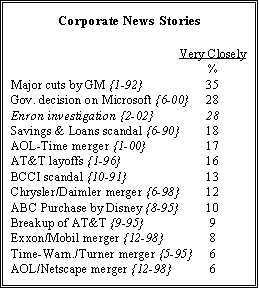
Interest in the Enron investigation is modest compared with news of the war or economy. But it does rank among the most closely followed business stories of the past decade. Of the business and economic news stories surveyed over the past decade, only major job cuts by General Motors in 1992 attracted more public attention.
Interest in the Enron story is highest among older people, especially those age 50-64. Among people who have retirement plans other than Social Security, 31% followed the story very closely, compared with 21% of those who do not.
The abduction in Pakistan of Wall Street Journal reporter Daniel Pearl was followed very closely by about a quarter of the public (24%). It has attracted an audience among groups which, in general, tend to express little interest in news. Americans with less than a high school degree and whose annual household income is less than $20,000 paid the most attention to Pearl’s abduction. Women devoted more attention to this story than did men (28% vs. 20%).
The Winter Olympics in Salt Lake City, Utah drew the attention of 22% of Americans. Attention to this story is significantly lower than for the 1992 Winter Olympics in France, which was followed closely by a third of the public. Not surprisingly, interest is especially high in the West, with one-third in that region following the story very closely.
The debate in Congress over George W. Bush’s budget and tax cut plan was tracked by only 17% of the public. This is down significantly from a year ago when almost a third of the public (31%) followed the budget and tax debate very closely.
Methodology
Results for the survey are based on telephone interviews conducted under the direction of Princeton Survey Research Associates among a nationwide sample of 1,199 adults, 18 years of age or older, during the period February 12-18, 2002. Based on the total sample, one can say with 95% confidence that the error attributable to sampling and other random effects is plus or minus 3.5 percentage points. For results based on either Form 1 (N=594) or Form 2 (N=605), the sampling error is plus or minus 4.5 percentage points. In addition to sampling error, one should bear in mind that question wording and practical difficulties in conducting surveys can introduce error or bias into the findings of opinion polls.