Pew Research Center

FOR RELEASE NOVEMBER 28, 2001

Terror Coverage Boost News Media’s Images

But Military Censorship Backed

FOR MEDIA OR OTHER INQUIRIES:

Communications Department
202.419.4372
www.pewresearch.org

RECOMMENDED CITATION

Pew Research Center, November 2001, "Terror Coverage Boost News Media’s Images"

About Pew Research Center

Pew Research Center is a nonpartisan, nonadvocacy fact tank that informs the public about the issues, attitudes and trends shaping the world. It does not take policy positions. The Center conducts public opinion polling, demographic research, computational social science research and other data-driven research. It studies politics and policy; news habits and media; the internet and technology; religion; race and ethnicity; international affairs; social, demographic and economic trends; science; research methodology and data science; and immigration and migration. Pew Research Center is a subsidiary of The Pew Charitable Trusts, its primary funder.

© Pew Research Center 2026

Table of contents

  • About Pew Research Center
  • Terror Coverage Boost News Media’s Images
  • Public Views of Terrorism Coverage
  • The Media’s Post-9/11 Image
  • The New Media Landscape
  • Methodology

Terror Coverage Boost News Media’s Images

But Military Censorship Backed

Introduction and Summary

These are the best of times and the worst of times for the news media when it comes to public support. By and large, Americans continue to praise the press for its coverage of the war on terrorism, here and abroad. So much so that the general image of the media has, at least temporarily, lost some of its tarnish. At the same time, however, the public shows strong support for government control of the news for the sake of national security.

The latest Pew Research Center survey of 1,500 adults finds the public giving the media better grades for its performance and higher approval ratings for the values of journalists and news organizations. The number who think the media usually gets the facts straight has risen from 35% in early September to 46% today – the best grade for accuracy in Pew Center surveys since 1992. News organizations also continue to get good grades for covering the terrorist attacks and the war on terrorism, though not as high as during the first week after the attacks. The percentage rating media performance as excellent or good has slipped from 89% in mid-September to a still lofty 77% in the current survey.

Mirroring satisfaction with its recent performance, the public now holds more favorable opinions of the press’s professionalism, morality, patriotism and compassion. In particular, the percentage saying that they think news organizations stand up for America jumped from 43% in early September to 69% in the current poll. The previous high for the press on this measure had been 53%, in 1987. Similarly, the percentage seeing the news media as protecting democracy has increased from 46% three months ago to 60% now – again an all-time high for the media on this indicator.

While the public has higher regard for the media, it also favors tight government control over information related to national security – indeed, support for military censorship is as high as it was during the Persian Gulf War. By 53%-39%, respondents say it is more important for the government to be able to censor stories it believes could threaten national security than for the media to be able to report news it sees as in the national interest. By a comparable margin, Americans say the military should exert more control over news about the war rather than leave most decisions to the media.

Despite its support for military censorship, the public is not comfortable with the media substituting propaganda for news, nor does it prefer the press to be a lap dog rather than a watchdog. The survey finds a solid majority in favor of war coverage that is neutral rather than pro-American. An even larger percentage (73%) favors coverage that portrays all points of view, including those of countries unfriendly to the United States, over pro-American news. And by 52%-40%, respondents say that when covering the war, news organizations should dig hard for information rather than trusting government and military officials who refuse to officially release information.

Along these same lines, the survey shows continued respect for the watchdog role played by news organizations, even at a time of national crisis. Roughly half of Americans believe press scrutiny of the military keeps the nation prepared, compared with 37% who say it undermines the country’s defense. By an even larger margin (54%-32%), the public thinks press criticism of political leaders prevents wrongdoing rather than keeping them from doing their jobs.

While most of the public thinks that information about the war has been censored, there is little sense that the government is trying to cover up bad news, either from abroad or at home. Fully 82% believe that Pentagon officials are disclosing as much as they can about military operations in Afghanistan – just 16% think the government has been hiding bad news. Nearly two-thirds (65%) find news reports from the front to be accurate, but fewer (58%) say the same about the sometimes confusing reporting on anthrax and other domestic terrorist threats.

Most Americans are turning to cable news for reports about terrorism and the war, and the number doing so has increased since mid-September. Fully 53% cite cable as their primary source for news on the crisis, versus 17% for network TV and 18% for local TV. Other non-television sources lag well behind cable, although the number relying mostly on newspapers has tripled (from 11% to 34%) since the week of the attacks. All types of media may take comfort in the fact that 66% of respondents say they are more interested in the news now than before Sept. 11. This is appreciably higher than the 49% expressing increased interest a decade ago as a result of the Gulf war.
Public Views of Terrorism Coverage

From the beginning of the crisis, the public has given the press high marks for its coverage of the attacks and the war against terrorism. In the current survey, better than three-quarters of Americans (77%) say coverage has been good or excellent, which is on par with the positive rating the public gave the press during the Gulf war (78% good or excellent).

But there has been a significant decline in the number of people who rate the media’s performance as excellent since the first week of the crisis. Three-in-ten give that rating now, compared with 56% who viewed coverage as excellent in the Sept. 13-17 survey. Nearly all of the drop occurred between mid-September and mid-October; since then, the ratings have remained fairly stable.

There are few notable differences in how major political and demographic groups evaluate the media’s coverage. But Americans who have the strongest interest in the crisis are more satisfied with coverage than those with less interest. Roughly four-in-ten (42%) who are highly interested in terrorism news view the coverage as excellent, compared with 31% of those with a moderate level of interest and 21% who express little interest.

As many as 65% of Americans think that the media’s coverage of the war has been accurate, while only 17% say too many mistakes have been made. This is similar to the media’s accuracy rating during the Gulf war, when 61% judged the reporting as correct and 18% saw it as error-prone.

While still generally favorable, coverage of the homefront gets more mixed reviews for accuracy. A solid majority (58%) views news on anthrax and other homefront threats as accurate, but nearly one-in-three (30%) see too many mistakes in this coverage. In assessing blame for these errors, twice as many people cite misleading information by the government as sloppy reporting by the media (16%-8%).

Two-thirds of Republicans (66%) say the anthrax coverage has for the most part been accurate, compared with barely half of Democrats (52%). Of those who view coverage as error-ridden, most Republicans point the finger at poor reporting by the news media, while Democrats who see errors in coverage overwhelmingly blame the government for providing misleading information.

Confidence in Government Information, As Well

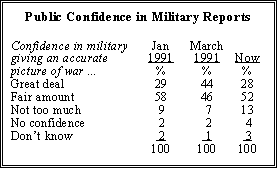
The public also has confidence that information provided by the government on the war and domestic anti-terrorism efforts is accurate, but only a minority has a high degree of confidence. About half (52%) have a fair amount of confidence that the government is giving an accurate picture of the war, while better than a quarter (28%) have a great deal of confidence. That is comparable to confidence levels during the Gulf war, although confidence rose sharply in March 1991 after that conflict’s successful conclusion. Public confidence in information provided by the government on anti-terrorism efforts in the United States is somewhat lower (61% fair amount, 19% great deal).

Partisan differences are evident – Republicans are more likely to express a high degree of confidence that the military and other government agencies are giving a clear picture of what is happening on both fronts. Nearly four-in-ten Republicans (39%) say they have a lot of confidence in government information on the war, compared with 24% of Democrats and 20% of independents. Three-in-ten Republicans express a lot of confidence that the government is giving an accurate picture of developments on the homefront – just 14% of Democrats and independents agree.

Censorship Less Apparent Than In Gulf

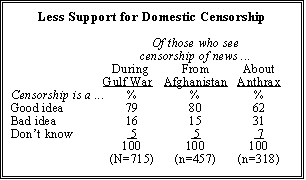
Most Americans believe that news reports from Afghanistan are subject to military censorship, although the number who say that is much lower than it was during the Gulf war (59% vs. 76%). Fewer people (46%) think that news about anthrax and other domestic terrorist threats are being censored by the government.

While most Americans support censorship, some clearly distinguish between restrictions on overseas and domestic news, and they are much more comfortable with the former than the latter. By better than five-to-one, those who believe that news from Afghanistan is being censored favor those restrictions. That is on par with the level of support for censorship measured during the Gulf war. By contrast, there is about two-to-one support for government censorship of news on homefront threats.

Support for tight government control over the flow of information is reflected in other attitudes as well. Half the public believes the military should have greater influence over war reporting, while four-in-ten believe most decisions about how to report about the war should be left to news organizations. The partisan split in opinions toward the press also is seen in attitudes toward censorship and government restrictions: nearly six-in-ten Republicans (59%) want the military to exert more control over war reporting, compared with 41% of Democrats.

Trust or Verify?

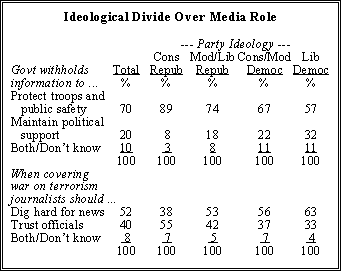
But clearly, the public is of more than one mind when it comes to the competing interests of government and media during war time. Censorship is favored and 70% believe such restrictions are intended to protect the safety of U.S. forces rather than to cover up bad news. At the same time, a 52% majority endorses the idea that the media should aggressively pursue news rather than trust the government when it refuses to release information.

Republicans side strongly with the government on both issues. Fully 84% of Republicans believe that when the government withholds information about the war, it is to protect the security of U.S. troops. And Republicans, especially conservatives, are dubious of aggressive reporting by the media – by a 55%-38% margin, conservative Republicans say the media should trust government officials when they refuse to release information instead of going all-out to break stories.

Democrats are less persuaded than Republicans that the government mostly refuses to release information in the interest of protecting troops – a quarter of all Democrats, and nearly a third of liberal Democrats, say the government mostly withholds information on the war to hide negative news. Democrats strongly back aggressive reporting, with a solid majority (57%) saying the press should dig hard for stories.

Men and women also view the media’s role differently, with men more supportive of aggressive reporting. Better than half of men (56%) say the press should dig hard for facts, while 36% support a more trusting approach. Women are more evenly divided – 47% favor an aggressive approach while 44% believe the press should trust the government. But roughly seven-in-ten men and women agree that government decisions to restrict the flow of war information are based on legitimate security motives.

Divided Over bin Laden Access

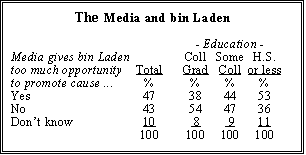
While the public has a better view of the media, Americans are divided about whether news organizations are doing their jobs properly with regard to Osama bin Laden. A 47% plurality says that the media has given bin Laden too much exposure, while 43% say it has been careful to not give him too much opportunity to promote his cause.

College graduates are generally comfortable with the media’s handling of bin Laden – a majority (54%) says he has not been given too much of an opportunity to promote his cause. But those with less education express more concern over bin Laden’s media access. By a 53%-36% margin, those with a high school education or less say the media has given bin Laden too much access.

The Media’s Post-9/11 Image

The favorable reaction to news coverage following Sept. 11 has clearly improved the public’s broader view of the press’s role and performance – especially as to whether news organizations stand up for America and protect democracy. However, there are still important aspects of press behavior that the public views negatively. In particular, roughly half (52%) say that the press tries to cover up its mistakes and nearly as many (47%) think the press is politically biased in its reporting.

In broader terms, just 35% say the news media helps society to solve its problems, only slightly higher than the 31% who felt that way before the attacks. About half of the public (51%) continues to believe that the news media “gets in the way” of society solving its problems.

Moreover, there is little evidence that the ideological gap in press evaluations has narrowed as a result of this new, more favorable climate for the media. Conservative Republicans, for the most part, remain highly critical of the news media, and in many cases the media’s image has improved only on the moderate-to-liberal end of the political spectrum, further exacerbating ideological divisions.


Media’s Weakest Links: Bias and Mistakes

For years, Republicans have been more convinced than Democrats that the press is politically biased in its reporting, and the events of the past few months have done little to change this view. As was the case in early September, a solid majority of Republicans think the press is politically biased. Democrats and independents, on the other hand, have become significantly less cynical about media bias since the terrorist attacks. Today, just four-in-ten independents see the media as biased, down from 57% prior to Sept. 11, and the decline among Democrats has been nearly as great (from 55% to 42% today).

Similarly, while there has been a 15-point overall decline (from 67% to 52%) since early September in the percentage saying the press covers up its mistakes, there is a somewhat larger partisan gap on this question. While 56% of Republicans and independents say the press typically tries to cover up its mistakes, 46% of Democrats agree.


More See Press as Pro-American

Public perceptions that the media both “stands up for America” and “protects democracy” have increased notably since the terrorist attacks, resulting in solid majorities viewing the press favorably in both of these areas. These shifts have been pronounced regardless of party identification, though Democrats are particularly likely to believe news organizations are standing up for America. Fully 78% of Democrats hold this view today, up from 47% in early September.

Gender and education are both related to views of press patriotism, but in contrasting ways. Women are significantly more likely to say that the press stands up for America, but men are more likely to say the press defends democracy. And while those with less education think the press is pro-American, more educated people see the press protecting democracy.


Young People More Positive

One of the most striking turnarounds in the public’s view of the press is the perception of how news organizations treat the subjects of their reports. Prior to the attacks, less than a quarter (23%) said the press cared about the people they report on – the single lowest rating of any press evaluation on the survey. Today, that figure has doubled to a 47% plurality who feel the press cares about the people they report on.

In particular, the perceptions of younger Americans have undergone a dramatic change. Before Sept. 11, just 22% of those under age 30 thought news organizations cared about the people they report on; fully half (52%) hold that view today. Women are more likely to perceive the press as caring than are men (53% to 41%).


Professionalism Bounces Back

Traditionally, the public has rated the press highly for its professionalism. In the mid-1980s, nearly eight-in-ten said the press cared about how good a job it did, and more than seven-in-ten believed the media was highly professional. Even when these measures hit their nadir in 1999, 69% thought the press cared about its job performance, and a majority felt the press was professional. In the wake of the terrorist attacks, these ratings have returned to their previous highs. Today, 78% say the press cares about doing a good job, and 73% think of the press as highly professional.

Despite this perception of professionalism, Americans are divided as to whether news organizations get the facts straight (46%) or whether their stories and reports are often inaccurate (45%). Still, this divided sense of media accuracy represents a significant gain from early September when just 35% said they thought the press was typically accurate and 57% disagreed. This gain has occurred across all demographic and ideological groups fairly evenly, and there is no ideological divide with respect to press accuracy.


The Attentiveness Gap

Americans who have followed the news most closely since Sept. 11 tend to have a more favorable impression of news organizations than those with lower levels of news interest, particularly in their assessments of media values and how news organizations treat people. Of those who have followed the news most closely, 63% see news organizations as moral and 56% say the press cares about the people they report on. This compares with only 44% and 40%, respectively, among those who have paid the least attention to the news.

But attentive Americans are not uniformly more favorable toward the press. While those who are more attentive are much more likely than those who are not to say the press is willing to admit its mistakes, there is no significant gap between the attentive and inattentive with respect to evaluations of media accuracy. In addition, those who follow the news more closely have virtually identical perceptions of media bias as do those who pay little or no attention to the news.


Most See Criticism as Worth It

In spite of the war and the domestic terrorist dangers, general attitudes toward the media’s watchdog role have remained fairly stable. When asked whether media criticism of political leaders keeps them from doing their jobs or keeps them from doing things that shouldn’t be done, more than half (54%) choose the latter, down only slightly from 60% in early September. When asked whether criticism of the military weakens the country’s defenses or keeps the nation militarily prepared, a 49% plurality chooses the latter, down from 59% shortly after the Gulf war.

The New Media Landscape

Americans are following the news more closely than they were before Sept. 11, and cable networks such as CNN, MSNBC and Fox News Channel are their first choice for news about terrorist attacks and the war on terrorism. But cable is not the only source Americans are relying upon. Fully 44% say they at least sometimes get news about issues related to terrorism from talk radio shows, 35% get news from the Internet, and 24% get at least some news from religious radio and television programming.

New Audience for News

Two-thirds of the public agree that they are now more generally interested in the news than before the terrorist attacks, with one-in-four strongly agreeing. This increased interest is particularly noteworthy among less-educated and lower-income Americans who, under normal circumstances, express the least interest in keeping up with the news. Fully 71% of Americans who never attended college say they are more interested in keeping up with the news than they were before the attacks, compared with 57% of those with college degrees.

But the higher interest in news related to terrorism is not distracting attention from other news stories. Just 18% say they find it hard to get interested in news stories that do not deal with terrorism in some way, while 80% reject this statement. The public had a similar reaction during the Gulf war, when 23% said it was hard to get interested in other news, and 74% said it was not.

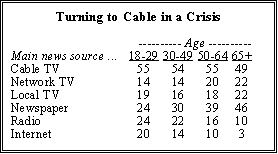
Better than half (57%) of those who say they are more interested in the news cite cable as a main source of information, compared with 46% of those who are no more interested in the news since the attacks. Overall, cable is the top source of news for all Americans (53%), regardless of age, gender, race, or other characteristics. Newspapers rate a distant second, with about one-in-three saying they get most of their news this way. Network television news, which was a top source for three-in-ten Americans immediately following the attacks, is now no more prominent a source of information about terrorism than radio or local television news. As in the past, newspapers and network television news are used more heavily by older Americans, while radio and the Internet are predominantly used by the young.

Late-night TV shows, such as those hosted by David Letterman and Jay Leno, are less important as sources for news on terrorism than they were as sources of political information during the 2000 presidential campaign. During the run-up to the 2000 primaries, nearly one-in-three Americans said they at least sometimes got news about the presidential campaign from these late-night shows. Just 17% say the same today about news related to terrorist attacks and the war on terrorism. However, as was the case during the campaign, Americans under age 30 are more than twice as likely to cite Leno and Letterman as news sources than are those age 30 and older (29% to 14% respectively).

Economy Interest Highest Since ’93

News about terrorism in the United States continues to attract the most interest from the public, with two-thirds (66%) tracking these stories very closely. Roughly half the public (49%) paid very close attention to the U.S. military effort in Afghanistan. While women were more interested in news about terrorism, men paid more attention to news about the military campaign.

The recent crash of an American Airlines plane near Kennedy Airport in New York also attracted very close attention from nearly half the public (48%). Despite the surge in public interest in the news, there was less attention to this crash than in the 1996 TWA crash off the coast of New York, which nearly seven-in-ten Americans (69%) tracked very closely.

About four-in-ten people (41%) paid very close attention to reports of anthrax cases around the country. Minorities paid slightly more attention to this story than did whites. Attention was lower in the West than in other regions of the country. Also, 41% of the public followed reports about the condition of the U.S. economy very closely. This is almost twice the percentage of those who followed the story this past summer and is at its highest level since 1993.

The capture of Kabul by Afghan opponents of the Taliban drew close attention from 36% of the public. At the bottom of this month’s news interest index is the debate in Washington over whether airport security personnel should be federal employees or not. Only 31% of the public followed this story very closely. Republican and Democratic interest mirrored that of the public.

Sustained Support for Bush, Military Action

George W. Bush continues to receive high marks for his job performance, with 84% approving of the way he is handling his job as president. The president’s job approval ratings have not dipped below 80% since the Sept. 11 attacks. Even among African-Americans, who were most critical of Bush in the early months of his presidency, 60% currently approve of his job performance, up nearly two-fold since before the attacks.

Americans also continue to support the use of military force to retaliate against those responsible for the attacks, even if it means U.S. troops might suffer thousands of casualties. Since mid-September, support for military action has barely changed (82% then, 85% now). That number declines only slightly (to 77%) when the possibility of thousands of military casualties is raised.

Minorities and liberals are somewhat more likely to oppose the use of military force – 22% of nonwhites and 26% of liberals oppose military action if it means the loss of thousands of U.S. casualties. Nonetheless, these groups back military force by wide margins even when the prospect of large-scale U.S. casualties is raised.

Methodology

Results for the survey are based on telephone interviews conducted under the direction of Princeton Survey Research Associates among a nationwide sample of 1,500 adults, 18 years of age or older, during the period November 13-19, 2001. Based on the total sample, one can say with 95% confidence that the error attributable to sampling and other random effects is plus or minus 3 percentage points. For results based on either Form 1 (N=769) or Form 2 (N=731), the sampling error is plus or minus 4 percentage points.

In addition to sampling error, one should bear in mind that question wording and practical difficulties in conducting surveys can introduce error or bias into the findings of opinion polls.

Survey Methodology in Detail

The sample for this survey is a random digit sample of telephone numbers selected from telephone exchanges in the continental United States. The random digit aspect of the sample is used to avoid “listing” bias and provides representation of both listed and unlisted numbers (including not-yet-listed). The design of the sample ensures this representation by random generation of the last two digits of telephone numbers selected on the basis of their area code, telephone exchange, and bank number.

The telephone exchanges were selected with probabilities proportional to their size. The first eight digits of the sampled telephone numbers (area code, telephone exchange, bank number) were selected to be proportionally stratified by county and by telephone exchange within county. That is, the number of telephone numbers randomly sampled from within a given county is proportional to that county’s share of telephone numbers in the U.S. Only working banks of telephone numbers are selected. A working bank is defined as 100 contiguous telephone numbers containing one or more residential listings.

The sample was released for interviewing in replicates. Using replicates to control the release of sample to the field ensures that the complete call procedures are followed for the entire sample. The use of replicates also insures that the regional distribution of numbers called is appropriate. Again, this works to increase the representativeness of the sample.

At least 10 attempts were made to complete an interview at every sampled telephone number. The calls were staggered over times of day and days of the week to maximize the chances of making a contact with a potential respondent. All interview breakoffs and refusals were re-contacted at least once in order to attempt to convert them to completed interviews. In each contacted household, interviewers asked to speak with the “youngest male 18 or older who is at home.” If there is no eligible man at home, interviewers asked to speak with “the oldest woman 18 or older who is at home.” This systematic respondent selection technique has been shown empirically to produce samples that closely mirror the population in terms of age and gender.

Non-response in telephone interview surveys produces some known biases in survey-derived estimates because participation tends to vary for different subgroups of the population, and these subgroups are likely to vary also on questions of substantive interest. In order to compensate for these known biases, the sample data are weighted in analysis.

The demographic weighting parameters are derived from a special analysis of the most recently available Census Bureau’s Current Population Survey (March 2000). This analysis produced population parameters for the demographic characteristics of households with adults 18 or older, which are then compared with the sample characteristics to construct sample weights. The analysis only included households in the continental United States that contain a telephone. The weights are derived using an iterative technique that simultaneously balances the distributions of all weighting parameters.