
Economy, Education, Social Security Dominate Public’s Policy Agenda
Introduction and Summary As President Bush and Congress return to work, a trio of long-standing concerns dominate the public’s list of policy priorities. The economy is the public’s leading priority, cited by eight-in-ten Americans, followed closely by education (76%) and Social Security (74%). Democratic leaders on Capitol Hill hold a 44%-37% edge over the president […]
Introduction and Summary
As President Bush and Congress return to work, a trio of long-standing concerns dominate the public’s list of policy priorities. The economy is the public’s leading priority, cited by eight-in-ten Americans, followed closely by education (76%) and Social Security (74%). Democratic leaders on Capitol Hill hold a 44%-37% edge over the president as being better able to handle the nation’s major problems.
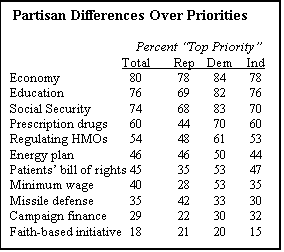
The latest Pew Research Center nationwide survey, conducted Aug. 21-Sept. 5, shows little change in public attitudes on the leading priorities since January, when the economy and education led the list. But there has been a decline in the number of Americans giving top priority to proposals to provide prescription drug benefits under Medicare and regulate health maintenance organizations (HMOs), which are major Democratic agenda items.
Six-in-ten now rate the provision of prescription drug benefits under Medicare as a top priority, down from 73% who felt that way in January. Increased partisanship is a factor in the decline – 44% of Republicans rate this as a major goal now, compared to 60% in January. But Democrats also attach less importance to this issue – 70% rate it a top priority, compared to 80% in January.
A modest majority (54%) cite regulating HMOs as a top priority, down from 66% in January. Democratic concern over this issue is down substantially; 61% regard it as a top priority now, compared to 77% in January. The drop among Republicans is not as large (from 54% to 48%). Some respondents were asked about the proposed patients’ bill of rights, instead of HMO regulations. Among those who received the alternative wording, 45% cited it as a top priority.
The public attaches relatively little importance to several of the most controversial issues. Four-in-ten give top priority to raising the minimum wage. This item provoked the widest partisan split, with 53% of Democrats and just 28% of Republicans rating it as a major priority. Developing a missile defense system, permitting “faith-based” groups to receive government funding, and reforming the campaign finance system are cited as major goals by fewer than four-in-ten Americans.