From News Interest To Lifestyles, Energy Takes Hold
America's New Number One Problem
About Pew Research Center
Pew Research Center is a nonpartisan, nonadvocacy fact tank that informs the public about the issues, attitudes and trends shaping the world. It does not take policy positions. The Center conducts public opinion polling, demographic research, computational social science research and other data-driven research. It studies politics and policy; news habits and media; the internet and technology; religion; race and ethnicity; international affairs; social, demographic and economic trends; science; research methodology and data science; and immigration and migration. Pew Research Center is a subsidiary of The Pew Charitable Trusts, its primary funder.
From News Interest To Lifestyles, Energy Takes Hold
America's New Number One Problem
Introduction and Summary
Rising energy costs are having a major impact on how Americans are living their lives, affecting everything from their driving habits to the news stories they follow. More than two-thirds say they have been adjusting their thermostats to cope with soaring utility bills, and half report cutting back on driving to save money on gasoline. Better than one-in-three say they have considered buying a vehicle that gets better gas mileage, and fully 31% say they have changed summer vacation plans to avoid long drives.
In turn, rising concerns over energy problems have captured the attention of the American public to an extraordinary degree. Six times as many Americans closely followed news about higher gas prices as paid attention to news about former Sen. Bob Kerrey’s troubled Vietnam experiences, which drew intense media coverage in the past month. The gasoline situation even dwarfed news interest in the delayed execution of Oklahoma City bomber Timothy McVeigh: 61% of respondents in the Pew Research Center’s latest national survey paid very close attention to higher prices at the pump, compared to 32% who closely followed McVeigh’s postponed execution.
In a dramatic shift, respondents in the survey, conducted May 15-20, cited energy as the nation’s top concern — 22% identified it as such. This is the first time since the mid-1990’s that any single problem has been identified by this many respondents in a Center survey. This is comparable to the number who cited unemployment as the top problem eight years ago, as President Bill Clinton was settling into office in the midst of a recession.
Despite this obvious public concern, George W. Bush’s new energy plan has not yet registered strongly with most Americans. Just 22% say they paid very close attention to news of the administration’s policy, which was announced as the poll was being conducted. Interest in the Bush plan increased over the period of the survey — from 17% in the days before Bush’s announcement to 28% after the rollout of the plan. But even at that, this is far lower than the attention paid to Clinton’s economic and health care initiatives eight years ago.
Worse for the president, only a bare majority of Americans are expressing confidence that he can solve the nation’s energy problems. While 52% express some confidence in Bush, a large number (43%) say they have little or no confidence in him on this issue. Bush’s mixed ratings may well be a consequence of his perceived lack of sensitivity to the environment and charges he has given short shrift to conservation. Those who put more emphasis on conservation have much less faith in Bush than those who think the answer is more oil drilling and expanded production.
On the other hand, Bush is taking little heat from the public over the claim, made frequently by congressional Democrats, that he is paying too much attention to the nation’s long-term energy needs while focusing too little on current problems. In fact, most of the public — including nearly half of Democrats — give higher priority to finding new sources for the long-term rather than controlling prices and dealing with the immediate energy crunch.
The energy problem — especially rising gasoline prices and higher utility costs — is more problematic for people with family incomes below $50,000, women and non-whites. Politically, Democrats and independents report being stretched by rising costs more than Republicans. Parents, a key political swing group during the 2000 campaign, are more likely than non-parents to report that soaring energy costs are forcing lifestyle changes, including cutting back on summer road trips.
Still, unlike some recent polls, the Center’s survey finds only a modest decline in public evaluations of Bush’s overall job performance. But even as approval of Bush remains fairly high at 53%, disapproval has steadily increased — from 21% in February, to 27% in April to 32% in the current survey.
Criticism of the president has not increased at either end of the political spectrum. Conservative Republicans continue to overwhelmingly endorse Bush’s performance and liberal Democrats continue to oppose him. Rather, there are a growing number of White House critics among moderate and conservative Democrats, as well as among independents.
GOP Leaders’ Improving Image
Meanwhile, the image of GOP leaders at the other end of Pennsylvania Ave. has undergone a quiet transformation. As the public assesses the more narrowly divided Congress produced by the 2000 election, they see less partisanship than in the past, and like its leadership better.
Since the election, Americans have, on balance, approved of the job Republican leaders in Congress are doing — 45% give them good marks now, compared to 36% who disapprove of their job performance. This marks the only sustained period of general approval since 1998, and prior to then, the very beginning of the Republican revolution in late 1994 and early 1995.
A small plurality of Americans (44%) say they are happy that the Republican Party maintained control of the U.S. Congress last fall, while 38% say they are unhappy. Not surprisingly, this opinion reflects a partisan point of view. Fully 83% of Republicans are happy with Republican rule, while just 15% of Democrats agree. Independents are split, with 41% happy, 36% unhappy, and 23% expressing no opinion. The poll was completed prior to reports that Vermont Senator James Jeffords would leave the Republican Party — giving Democrats control of the U.S. Senate.
In a striking change from last year, the public sees a greater level of collegiality and an effort to achieve results in the current Congress, a factor that has likely contributed to the improved ratings for Republican leaders. About one-in-three (34%) say Republicans and Democrats are working together more to solve problems, up from 21% in July 2000 and 20% in the summer of 1999. Though slightly more (41%) say the parties have been bickering more than usual, this is down from 54% last summer and 68% in the summer of 1999.
This perception of increased collegiality plays a role in how Democrats and independents rate the Republican leadership. Independents who see less bickering in Congress approve of the Republican leadership by better than a two-to-one margin (57% approve, 24% disapprove); among independents who say Congress is less collegial, 55% disapprove of the GOP leadership and just 30% approve.
Democrats who see more collegiality on Capitol Hill are split in their view of the leadership — 39% approve and 41% disapprove. But among Democrats who see more partisanship, fully 70% disapprove of the Republican leadership.
Democrats Remain Unimpressed
Nonetheless, the rise in approval of the congressional leadership is mostly driven by a high level of support among Republicans, 82% of whom approve of the leadership’s job performance, up from 64% a year ago. Democrats, on the other hand, are slightly less likely to approve of the Republican leadership today than they were last year, and the views of independents have remained largely unchanged.
In particular, GOP leaders are doing better with both higher income Americans and religious conservatives. Compared to a year ago, more Americans with household incomes of at least $50,000 give good marks to the Republican leadership, while those with incomes under $50,000 have not changed their views.
GOP leaders are getting much more favorable ratings from white evangelical Protestants; fully 63% of this group approve of the job Republican leaders are doing, up from just 46% at this time last year. White mainline Protestants and Catholics give the leadership much lower ratings than evangelicals
, and those evaluations have not changed markedly over the past year.
Other Important Findings and Analyses
Modest Achievements
Perhaps not surprisingly, the achievements of the new Congress — which is just now considering major legislation on taxes and education — have yet to make much of an impression on most Americans. When asked to cite the most important accomplishment of Congress in an open-ended format, only 39% of respondents could come up with an answer.
Republicans are more likely than Democrats or independents to be able to name an achievement by Congress. Half of Republicans could cite an important action in Congress, and one-in-four specifically referred to Bush’s tax cut proposal. By comparison, just over one-third of Democrats and 37% of independents cited any important action in Congress. And though the top issue for these respondents was still Bush’s tax cut, only about one-in-ten in each group (9%) referred to it specifically.
Shifting Views on Divided Government
Overall, the public remains largely indifferent as to whether it is better for one party to control both the White House and Congress, or whether divided government is preferable. As in recent years, a plurality (45%) says it doesn’t matter whether one party controls both institutions or not, while 28% favor divided government and 19% prefer one party in control.
But while pluralities of Republicans and Democrats, as well as independents, say the issue of single-party control doesn’t matter, there have been noticeable shifts among the parties recently, reflecting the GOP’s control over both branches of government and the Democrats’ new status as a minority party.
Whereas Democrats were split over whether single-party control or divided power was better for the country during Clinton’s tenure, they favor split control today by a 35% to 15% margin. As recently as last July, when the possibility still existed for Democrats to gain control over both the White House and Congress, 27% preferred unified power.
By contrast, just 20% of Republicans favor divided government, while 31% prefer one-party control. That is sharply different than the view Republicans held in March 1998, when Clinton was in the White House and the GOP was fighting to retain its congressional majority. At that time, 43% of Republicans favored divided government, while just 17% thought it was better for a single party to have unified control.
GOP Morale Rises
Reflecting the enthusiasm they have for the president and congressional leadership, Republicans think the party is doing a good job of standing up for its traditional positions such as reducing the size of government, cutting taxes and promoting conservative social values. On the other hand, Democrats are noticeably less enthusiastic about their party’s efforts on behalf of minorities, the poor and needy, and working people than they were a year ago.
Six-in-ten Republicans (60%) say their party is doing an excellent or good job standing up for its traditional positions, up from 49% in September of last year. By comparison, fewer than half of Democrats (47%) feel their party is doing a good job of standing up for its traditional positions, down from 63% last September.
Much of the increase in the rating of the Republican party comes from self-described conservatives within the party, 77% of whom say the party is doing an excellent or good job today, up from 56% last September. By comparison, the views of more moderate Republicans have not changed significantly — 49% give an excellent or good rating to their party today, up just 2% from last September.
The drop in partisan enthusiasm among Democrats has occurred across the ideological spectrum, with liberal, moderate, and conservative Democrats all giving lower ratings to their party today than they did last year. Older Democrats, those living in large cities, and women have become especially dispirited with the party over the past year.
Last September, more than seven-in-ten (71%) Democrats 65 and older thought their party was doing at least a good job of standing up for its traditional positions. Just 41% of Democratic seniors feel that way today.
The Issues — Advantage Democrats
The Bush agenda is affecting the image of both political parties. The president’s education plan has allowed the GOP to gain significant ground on what had been a Democratic strong suit. But if anything, Bush’s policies on the environment have worsened the GOP’s already poor image on that issue. By about a two-to-one margin (51%-25%), the public believes the Democrats can do a better job of protecting the environment.
Overall, the GOP holds a slight edge on just one major issue– foreign policy (39%-34%). Neither party holds a clear advantage on energy policy, education or taxes. Democrats are seen as better able to handle Social Security, maintain economic prosperity, strike the proper balance between the economy and environment, and protect the environment.
Despite Bush’s success in moving his tax cut through Congress, the GOP has been unable to seize the advantage on that issue. Perhaps more important, the Democrats have slightly increased their lead on maintaining economic prosperity over the past two years, and now hold an 11-point edge (44%-33%). And as Democrats have added to their formidable advantage on protecting the environment, they also are seen as the party able to strike the right balance between maintaining economic growth and protecting the environment.
Still, Bush’s emphasis on education has enabled the GOP to dramatically reshape its image on that issue, which is among the public’s top concerns. Just two years ago, Democrats held a 52%-29% lead on education; since then, the GOP has gained seven points and the Democrats have lost 14 points to put the two parties in a virtual tie.
Energy # 1 Problem
Energy concerns now top the public’s list of the most important problem facing the country. Fully 22% cite energy-related issues, such as rising gas and heating prices, when asked in an open-ended format to name the nation’s most important problem. This issue wasn’t even on the public’s radar screen until February of this year, and concern is up significantly since then (4% then vs. 22% now).
Concern over morality, ethics and family values, which topped the list in February, has fallen off somewhat in recent months. Today 6% cite this as the most important problem facing the country, placing it behind education (8%) and the economy (7%) and just ahead of unemployment (5%) and teen violence (5%).
Men and women differ substantially in their views on this matter. Men are much more likely than women to cite the energy crisis as the country’s most important problem (28% vs. 16%). And men are much more concerned than women about economic issues overall, including energy: 50% point to economic issues, compared to only 32% of women. Women are more focused than men on education, teen violence, health care, and crime.
While Republicans and Democrats may not agree on the best approach to dealing with the nation’s energy woes, they do agree that this is currently the most important problem facing the country — 20% of Republicans and 22% of Democrats place energy at the top of their list, as do 22% of independents.
Poor, Minorities Most Affected
Washington’s energy policy debate may not be resonating beyond the Beltway, but Americans clearly are feeling the effects of energy price hikes and, to a lesser degree, regional supply shortages. And this is having an impact on a wide range of activities, from people’s driving habits to their choice of vehicles.
Overall, about half of Americans see the rising price of gasoline as a serious problem and four-in-ten say the same about higher costs for electricity and other home utilities. But the effects are greatest on those with lower incomes, as well as members of minority groups.
More than six-in-ten of those with annual family incomes of less than $20,000 — and a solid majority of those with incomes of under $50,000 — call rising gas prices a serious problem. Better than two-thirds of African-Americans (69%) also regard this as a serious problem.
Just 39% of those with annual incomes of at least $50,000 call high gas prices a serious problem; most in this group see it as a minor problem (45%) or no problem at all (16%). While blacks overwhelmingly regard gas prices as a major problem, whites are split — 46% see it as serious, while 39% say it is minor and 15% believe it is not a problem.
The same pattern is evident in attitudes toward rising home utility costs. More than half (52%) of those with annual incomes of below $20,000 rate this as a serious problem — the only income category where a majority feels this way. Among those at the other end of the income scale — people with annual family incomes above $75,000 — relatively few (29%) regard higher home utility costs as a serious problem, while most (52%) regard it as a minor problem.
The regional nature of the nation’s various energy problems is also reflected in how severely people are impacted. A majority of those in the Midwest (58%), where gas prices are generally higher than elsewhere, rate that as a serious problem; fewer than half of those living in other regions rate rising gas prices as very serious.
Thus far, shortages of electricity and other energy supplies have been largely confined to California, so a relatively small percentage of survey respondents nationwide (16%) rate energy shortfalls as a serious problem. Not surprisingly, four-in-ten Californians rate that situation as serious. Majorities of Golden State residents also see the rising price of gas (55%) and spikes in home utility costs (52%) as serious problems.
Most Adjust Thermostats
Though the nation is not struggling with gas lines or widespread electricity shortages, energy problems are putting a crimp in the lifestyles of most Americans. Solid majorities in all income categories and age groups say they have been adjusting thermostats to cut energy costs. This practice is as prevalent in the Midwest (70%) and South (69%) as it is in California (69%).
Rising gas prices are also affecting the habits of the vast majority of Americans, either by inducing them to shop around for lower prices or to cut back on driving altogether. But income differences are clearly evident in whether people are changing their driving habits. Fully six-in-ten of those with annual family incomes under $30,000 say they are driving less to save money on gas; just 39% of those with annual incomes of at least $75,000 have limited their driving. Similarly, those with lower incomes are much more likely than those with higher incomes to cut back on summer travel plans and car-pool to work.
Parents also have been hit hard by energy problems. They are more likely than non-parents to rate higher gas prices and home utility costs as a serious problem. And more parents are altering their behavior as a result — 39% of parents say they have changed summer travel plans to cut back on long-distance driving, compared to 26% of non-parents.
Perhaps surprisingly, there are also political differences in how people are coping with higher energy costs. Those who voted for Al Gore in the 2000 election are more likely than Bush voters to engage in several efforts to conserve energy and cut costs, including lowering their thermostats and cutting back on driving.
When it comes to considering the purchase of fuel-efficient vehicles, however, independents take the lead. Better than four-in-ten independents (44%) say they have thought about buying a car that gets better gas mileage; just 30% of both Republicans and Democrats say they have considered buying a more fuel-efficient car.
Energy Policy Divisions
The public is conflicted over several energy-related issues, including the tradeoffs between energy development and environmental protection, and expanded exploration versus conservation. But on one key point in the energy debate, there is broad agreement. By nearly a two-to-one margin (56%-31%), Americans say that securing long-range energy supplies is more important than finding a fix to the current energy crunch.
Some leading Democrats have argued that Bush’s plan overlooks immediate concerns in favor of long-term supplies, but that criticism appears to be falling mostly on deaf ears even within the Democratic Party. By a 12-point margin (49%-37%) Democrats say long-term energy problems should take precedence over short-term needs. Solid majorities of Republicans (67%) and independents (57%) also endorse a long-term approach.
On other issues, the public is far more divided. By a narrow 49%-42% margin, Americans say that developing energy sources should take precedence over environmental protection. But a slight plurality (49%) rates energy conservation as a higher priority than expanded exploration, mining and drilling. Republicans are far more likely than Democrats to give greater priority to developing new energy sources over either protecting the environment or conserving existing resources.
Nearly two-thirds of Republicans (64%) say developing new energy sources should take precedence over protecting the environment; just 40% of Democrats and 47% of independents agree. Most Republicans (61%) also believe the expansion of energy exploration ranks as more important than increased conservation. Here, the gap is even wider. By nearly a two-to-one margin (62%-32%), Democrats favor increased conservation over expanded energy development. Independents back conservation over increasing exploration by 54%-42%.
Women Favor Conservation
Gender and age are also important factors in attitudes on energy policy. While men and older Americans tend to place greater priority on energy development, women and younger people believe that environmental considerations and conservation should take precedence.
By 52%-38%, men favor developing new energy sources over protecting the environment, and by a similar margin (53%-41%) they support increased exploration and drilling over conservation. Women are divided over whether new energy supplies or environmental protection rates as a higher priority (46% environment, 45% energy supplies). But women, by a substantial margin (57%-36%) favor more conservation over expanded energy exploration.
Americans under age 50 narrowly support environmental protection over developing new energy supplies (50%-45%), and favor conservation over more exploration by a more substantial margin (54%-40%). People over 50, by contrast, strongly back developing new energy sources over protecting the environment (55%-31%) and increased exploration over conservation (52%-40%).
Bush’s Middling Reviews
As one might expect, the public views Bush’s approach for dealing with energy problems through a partisan prism. Nearly eight-in-ten Republicans (78%) express at least some confidence in the president’s ability to handle energy problems, compared to 36% of Democrats and 52% of independents.
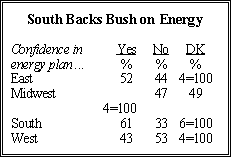
Bush’s plan is playing best in the South, where more than six-in-ten (61%) say they have at least some confidence in the president’s approach. But a majority of those in the West (53%) say they have little or no confidence in the president on energy.
Differences based on gender and age over
how to solve the nation’s energy problems have not figured into Bush’s ratings — in most groups, about half of respondents express confidence in the president. A major exception is African-Americans — just 36% voice confidence in the president, compared to 56% of whites — but blacks generally rate Bush’s performance more critically than whites.
Bush’s release of his comprehensive energy plan on May 17 had virtually no impact on evaluations of his approach to the problem, which is another sign that the public is not yet fully engaged by the policy debate. About the same proportion of Americans expressed at least some confidence in Bush before the plan’s unveiling (May 15-16) as after its release (May 17-20).
Gas Prices Dominate News Interest
Gas prices are clearly the month’s top news story, and this story has attracted considerable interest for a year or more. This month, interest in gas prices has been particularly strong in the Midwest, where prices have generally been among the nation’s highest. More than seven-in-ten people in the Midwest followed this story very closely. In the West, where California’s electricity shortfall is dominating the news, only 50% followed gas prices very closely.
About a third of the public (34%) followed reports about the condition of the U.S. economy very closely. This is largely unchanged from last month. Men paid more attention than women to this story (42% vs. 28%), with men age 50 and older paying the most attention (58%).
Also, about a third of Americans (32%) followed the delay in McVeigh’s execution. Nearly half of African-Americans (47%) followed this story very closely, compared to 31% of whites.
The president’s new energy policy was followed by about one-fifth (22%) of the public. Interest increased somewhat after Bush gave his May 17 speech unveiling the plan — 28% followed it very closely from May 17-20, compared to 17% who paid very close attention May 15-16. Almost twice as many men followed the story as did women.
Only 16% of the public paid very close attention to the trial and conviction of a Ku Klux Klansman for the bombing of a black church in 1963. Four-in-ten blacks followed this story compared to only 12% of whites.
Bush’s announcement of support for a national missile defense system attracted very close attention from 15% of Americans. Again, many more men than women followed this story very closely (23% vs. 8%). Not surprisingly, more conservative Republicans followed this story (20%) than members of other party and ideological groups.
Just one-in-ten Americans paid close attention to the controversy surrounding Bob Kerrey’s role in the death of unarmed civilians during the Vietnam War. The age gap in attention to this story shows that younger people have limited interest in revisiting the history of this conflict. Nearly one-fifth (19%) of Americans 65 and older paid very close attention to the Kerrey story, compared to just 3% of those under age 30.
Methodology
Results for the survey are based on telephone interviews conducted under the direction of Princeton Survey Research Associates among a nationwide sample of 1,202 adults, 18 years of age or older, during the period May 15-20, 2001. For results based on the total sample, one can say with 95% confidence that the error attributable to sampling and other random effects is plus or minus 3.5 percentage points. For results based on either Form 1 (N=621) or Form 2 (N=581), the sampling error is plus or minus 4.5 percentage points.
In addition to sampling error, one should bear in mind that question wording and practical difficulties in conducting surveys can introduce error or bias into the findings of opinion polls.
Survey Methodology in Details
The sample for this survey is a random digit sample of telephone numbers selected from telephone exchanges in the continental United States. The random digit aspect of the sample is used to avoid “listing” bias and provides representation of both listed and unlisted numbers (including not-yet-listed). The design of the sample ensures this representation by random generation of the last two digits of telephone numbers selected on the basis of their area code, telephone exchange, and bank number.
The telephone exchanges were selected with probabilities proportional to their size. The first eight digits of the sampled telephone numbers (area code, telephone exchange, bank number) were selected to be proportionally stratified by county and by telephone exchange within county. That is, the number of telephone numbers randomly sampled from within a given county is proportional to that county’s share of telephone numbers in the U.S. Only working banks of telephone numbers are selected. A working bank is defined as 100 contiguous telephone numbers containing one or more residential listings.
The sample was released for interviewing in replicates. Using replicates to control the release of sample to the field ensures that the complete call procedures are followed for the entire sample. The use of replicates also insures that the regional distribution of numbers called is appropriate. Again, this works to increase the representativeness of the sample.
At least 5 attempts were made to complete an interview at every sampled telephone number. The calls were staggered over times of day and days of the week to maximize the chances of making a contact with a potential respondent. All interview breakoffs and refusals were re-contacted at least once in order to attempt to convert them to completed interviews. In each contacted household, interviewers asked to speak with the “youngest male 18 or older who is at home.” If there is no eligible man at home, interviewers asked to speak with “the oldest woman 18 or older who is at home.” This systematic respondent selection technique has been shown empirically to produce samples that closely mirror the population in terms of age and gender.
Non-response in telephone interview surveys produces some known biases in survey-derived estimates because participation tends to vary for different subgroups of the population, and these subgroups are likely to vary also on questions of substantive interest. In order to compensate for these known biases, the sample data are weighted in analysis.
The demographic weighting parameters are derived from a special analysis of the most recently available Census Bureau’s Current Population Survey (March 2000). This analysis produced population parameters for the demographic characteristics of households with adults 18 or older, which are then compared with the sample characteristics to construct sample weights. The analysis only included households in the continental United States that contain a telephone.
The weights are derived using an iterative technique that simultaneously balances the distributions of all weighting parameters.