Faith-Based Funding Backed, But Church-State Doubts Abound
Introduction and Summary As religion plays a more prominent role in public life, sharp divisions of opinion about the mixing of church and state are apparent. Most notably, while the public expresses strong support for the idea of faith-based groups receiving government funding to provide social services, in practice, it has many reservations. Most Americans […]
About Pew Research Center
Pew Research Center is a nonpartisan, nonadvocacy fact tank that informs the public about the issues, attitudes and trends shaping the world. It does not take policy positions. The Center conducts public opinion polling, demographic research, computational social science research and other data-driven research. It studies politics and policy; news habits and media; the internet and technology; religion; race and ethnicity; international affairs; social, demographic and economic trends; science; research methodology and data science; and immigration and migration. Pew Research Center is a subsidiary of The Pew Charitable Trusts, its primary funder.
Faith-Based Funding Backed, But Church-State Doubts Abound
Introduction and Summary As religion plays a more prominent role in public life, sharp divisions of opinion about the mixing of church and state are apparent. Most notably, while the public expresses strong support for the idea of faith-based groups receiving government funding to provide social services, in practice, it has many reservations. Most Americans […]
Introduction and Summary
As religion plays a more prominent role in public life, sharp divisions of opinion about the mixing of church and state are apparent. Most notably, while the public expresses strong support for the idea of faith-based groups receiving government funding to provide social services, in practice, it has many reservations. Most Americans would not extend that right to non-Judeo-Christian religious groups including: Muslim Americans, Buddhist Americans, Nation of Islam and the Church of Scientology. Many also have reservations about allowing the Church of Jesus Christ of Latter-day Saints — the Mormons — to apply for federal funding to offer social services.
Beyond which religions are acceptable, strong concerns are expressed about what government might do to religion and what religious groups might do to the people they are trying to help. On the one hand, fully 68% worry that faith- based initiatives might lead to too much government involvement with religious organizations. On the other, six-in-ten express concerns that religious groups would proselytize among recipients of social services, and about the same percentage would prohibit groups that encourage religious conversion from receiving government funds. Americans have an even bigger problem with government-funded religious organizations hiring only those people who share their beliefs — 78% oppose that concept.
The survey also determined that attitudes toward faith-based funding have become more politicized. Since last year, Republicans have become more approving of faith-based initiatives, while Democrats have become somewhat less enthusiastic. In that same vein, a Pew survey taken in February found the public was divided over the creation of a White House office to enlarge the role that religious organizations play in providing social services, even though 64% of respondents in that same poll favored funding for faith-based organizations. ( See “Bush Approval on Par,” Feb. 22, 2001.)
While this issue has become more partisan, there also is considerable disagreement within the two political parties. On the Republican side, white evangelicals are more enthusiastic than other conservatives and moderate Republicans. Among Democrats, a bare majority of white liberals favor the idea, while black Democrats embrace it as strongly as Republican evangelicals.1
Still, many Americans find arguments in favor of faith-based funding to be compelling, and a strong majority acknowledges the contributions churches, synagogues and other religious groups make to society. Nearly three-quarters (72%) cite the care and compassion of religious workers as an important reason for supporting the concept of faith-based groups receiving government funding. This reflects a public recognition of the strong connection between religious practice and social service. Three-quarters think that churches and other houses of worship contribute significantly to solving America’s social problems. In fact, the survey shows that people with strong religious commitment are three times as likely as those with little or no belief to regularly volunteer to help needy people.2
Yet the public also makes clear distinctions as to the potential strengths and weaknesses of specific church-based social services. There is a general consensus that government agencies would be better than religious organizations and secular community groups at literacy training, providing health care and job training. By contrast, the public has more faith in religious organizations than other types of agencies to feed the homeless and counsel prisoners. The sharpest divides are over which groups could do a better job of mentoring young people, counseling teens about pregnancy, and treating drug addiction. White evangelicals and black Protestants tend to prefer religious groups for these purposes, while white mainline Protestants and Catholics think secular, community-based efforts would be more effective.
The nation’s divisions over religion and its role in contemporary life go deeper than disagreements over implementing faith-based plans. The public generally holds negative views of atheists and only lukewarm opinions of non-Judeo-Christian Americans. For the most part, these potential tensions remain below the surface as very few Americans say they are bothered by an increasing number of non-Christians and seculars in American society. The public is more openly frustrated with the news and entertainment industries. This is particularly true among highly religious Americans, majorities of whom believe that people of their faith are not treated fairly by the media and Hollywood.
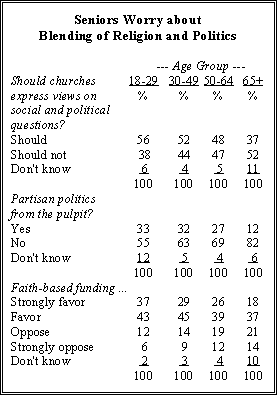
At the same time, many Americans — especially the less religious — are often hesitant to see churches offer opinions on social and political matters, and nearly two-thirds express reservations about the clergy speaking out on partisan politics or issues.
The survey found a surprisingly sharp generational pattern in views about the role religion plays in politics and the possibility of a narrowing divide between church and state. Older people, especially those age 65 and above, are much more worried than younger people about the blurring of these lines. Most seniors do not think it is a good idea for churches to speak out on social and political questions, let alone for the clergy to engage in political advocacy from the pulpit. Older people are also far less enthusiastic than younger people about faith-based initiatives generally, as they worry more about threats to the separation between church and state.
For the most part, those with strong religious beliefs are politically conservative. Republicans outnumber Democrats two-to-one among white evangelical Protestants. While black evangelicals are overwhelmingly Democratic, they tend to hold conservative social attitudes. Americans point to their religious beliefs as a major influence in attitudes toward some of the most contentious social issues of the day. These beliefs generally shape a more conservative point of view — opposition to gay marriages, assisted suicides, and unrestricted research on human cloning. But, there are some liberal effects as well. Many of the growing number of opponents of the death penalty cite the influence of religion in determining their position on this issue.
These are among the most important findings of the joint study by the Pew Forum on Religion and Public Life and the Pew Research Center For The People & The Press. It was conducted among 2,041 adults, including an oversample of African-Americans, March 5-18.
Other Findings
The Christian conservative movement and the entertainment industry — two groups often at odds with each other — earn relatively modest ratings from the public. Christian conservatives get a 58% favorable to 42% unfavorable rating, and the entertainment industry earns a 53% favorable to 47% unfavorable rating.
The public continues to overwhelmingly oppose unrestricted research into human cloning. Eight-in-ten oppose this research while just 13% support it. Religious beliefs are cited as a basis for this opinion most often.
About half of Americans at least sometimes watch religious television or listen to religious radio programming. Only a third (34%) say they never tune into such broadcasts.
Nearly four-in-ten Americans (37%) say they have not heard of Episcopalians or could not evaluate them — far more than the number who could not rate Methodists (19%), Presbyterians (24%) or Lutherans (25%).
When asked, people most often describe God in terms of “power and might” (38%), but as many as 25% point to what God does or provides for them.
This report is divided into five Sections. In Section I we look at opinions on the role religion plays in solving society’s problems and attitudes toward government funding for faith-based groups. Section II examines views on religious diversity and includes the public’s ratings of various religious groups. That is followed by an analysis, in Section III, of the influence of religious belief on attitudes toward policy issues. Sections IV and V cover the nation’s religious landscape, examining practices and beliefs, as well as impressions of God.
Section I. Funding for Faith-Based Organizations: Broader Support, Deeper Differences
The public acknowledges that religious organizations play a constructive role in American life. Three-quarters of Americans say churches, synagogues and other houses of worship contribute to solving important social problems. Roughly one-quarter say churches contribute a great deal to solving important problems, and those who hold this view are among the most likely to strongly support government funding for faith-based programs.
There is no clear public consensus, however, over who can do the best job of providing social services to those in need. When asked, in general, who can do the best job at this, 37% of Americans say religious organizations, 28% choose federal and state government agencies and 27% opt for non-religious, community-based groups.
There are important racial, socio-economic and political differences on this issue. While pluralities of blacks and whites say religious organizations can do the best job, they differ in their views on non-religious groups and government agencies. Whites have more confidence than do blacks in the ability of non-religious groups to provide services (28% vs. 17% of blacks). Blacks, on the other hand, have more confidence in government agencies than do whites (34% vs. 26%).
Income and education are also strongly linked to opinions on this matter. College graduates choose non-religious groups over both religious organizations and government agencies — 39% to 31% and 22%, respectively. Those who never attended college opt for religious groups over government (40% vs. 32%); and very few in this group say non-religious groups can do the best job providing services (19%). In addition, those with the highest incomes are among the strongest backers of non-religious organizations, while those in the lowest-income bracket have the most confidence in religious groups.
Republicans are much more likely than Democrats and independents to say religious organizations can do the best job providing services to the needy. Nearly half of all Republicans and 55% of conservative Republicans choose church-based organizations over secular groups or government agencies. Democrats and independents divide fairly evenly among the three options.
White evangelical Protestants stand out for their strong endorsement of the work that church-based organizations can do. More than half of this group (53%) says churches can do the best job providing services. Among highly-committed white evangelical Protestants, the proportion rises to 61%. White mainline Protestants are evenly divided between backing religious organizations and non-religious groups, with slightly fewer expressing confidence in the government. Among black Protestants, evangelicals say religious groups can do the best job, while non-evangelicals choose the government. Secular Americans favor non-religious based groups over both religious organizations and government agencies.1
Conceptual Support
Proposals to allow religious groups to compete, along with other organizations, for government funds to provide social services enjoy broad public support. It is clear, however, that the public has yet to fully think through the details and implications of using government money to finance social service activities of churches and other houses of worship.
Overall, three-quarters of Americans favor allowing churches and other houses of worship to apply for government funding to provide social services such as job training or drug treatment counseling to people who need them (30% strongly favor this, 45% favor). Support for this proposal has increased somewhat since September 2000 when 67% of voters favored it.
But since then, political divisions over the issue have kicked in. In September, more Democrats than Republicans endorsed the idea of government funding for faith-based social service programs (74% vs. 63%). In the current survey, support among Democrats is down slightly to 70%, while Republican support has surged to 81%. The increase in support among Republicans has come primarily among conservatives — 60% supported the proposal in September, 82% favor it now.
Support for faith-based funding remains somewhat softer when the question is framed in terms of the government “giving” funds to churches and other houses of worship; currently 66% favor the proposal under these terms.2
Underlying these partisan differences over faith-based funding are important divisions within the two major parties. The divisions are driven in part by ideology but more importantly by religion. Among Republicans, evangelical conservatives stand out as the most supportive of faith-based social services, with fully 44% strongly favoring the idea. Non-evangelical conservatives show considerably softer levels of support — 29% strongly favor the proposal — closer to the views of the moderate-to-liberal wing of the party.
Within the Democratic party, there is a significant racial divide over the faith-based proposal. Black Democrats are closer to evangelical Republicans on this issue than they are to either liberal or conservative white Democrats. Among white Democrats, those who consider themselves to be liberal or secular are the least enthusiastic about faith-based funding, with just 52% in favor and fully one-in-five (21%) saying they strongly oppose the idea.
Minorities More Supportive
While most major demographic groups favor government funding for faith-based programs, there are some important differences among key constituencies. Fully 81% of blacks and Hispanics support the proposal, compared to 68% of whites. In addition, there is a significant generation gap. Americans under age 50 are more supportive of the proposal than are those age 50 and older (76% vs. 60% in favor).
Indeed, senior citizens express the lowest level of support for the proposal. This gap can be seen across a whole range of questions dealing with the separation between church and state, and it suggests a fundamental value difference between young and old Americans regarding these issues.
Looking at the major religious groups and denominations, black Protestants stand out as the strongest backers of the proposal. More than eight-in-ten (81%) support the idea of government funding for faith-based social service programs and nearly half (46%) are strongly supportive. This enthusiasm is equally high among black evangelical and mainline Protestants.
This contrasts with the differences among white Protestants on this issue. More white evangelical Protestants support government funding for faith-based programs (73% vs. 63%). And far more white evangelicals are committed to the idea — 35% strongly support it vs. 21% of white mainline Protestants.
Catholics are also strong supporters of faith-based funding. Three-quarters of all Catholics (74%) favor government funding for faith-based programs, with 34% of highly committed Catholics strongly in favor. Not surprisingly, seculars are less enthusiastic about this proposal. Nearly one-in-five strongly opposes government funding for faith-based programs, compared to only one-in-ten of the general public. Still, more seculars favor the proposal than oppose it (57%-39%).
Providing Specific Services
As with most public policy issues, the picture becomes more complicated as the focus shifts from the general to the specific. Respondents were asked who could do the best job of providing services in several specific areas. Here the public made fairly clear distinctions regarding where religious groups could be most effective.
Of the nine problem areas included in the poll, two emerge as issues where the public feels religious organizations can clearly make a difference. First, in the area of feeding the homeless, a 40% plurality say religious groups could do the best job, compared to 28% who choose federal or state government agencies and 25% who choose non-religious, community-based groups. Similarly, in the area of counseling and educating prisoners, 40% say religious organizations could do the best job, 35% choose government agencies and 18% opt for non-religious groups.
Churches also receive a strong signal of support on two other activities — providing youth mentoring programs and teen pregnancy counseling — but so do non-religious organizations. Four-in-ten say religious groups could do the best job in providing mentoring programs for young people, while virtually the same number opt for non-religious groups. Pregnancy counseling is another issue where the public thinks religious organizations and non-religious groups could do a good job (39% choose religious groups, 42% choose secular ones). These two services stand out for the lack of confidence people have in the ability of federal and state agencies to operate effectively. Fewer than one-in-six think government would be best at mentoring and counseling young people.
Secular groups have a slight edge over religious organizations when it comes to drug and alcohol treatment programs (36% pick secular groups, while 27% choose religious ones). Roughly three-in-ten say a government agency could do the best job in this area. Americans are divided over who could do the best job of providing child care services.
There are three problem areas where government is clearly the preferred service provider: job training, health care and literacy training. More than six-in-ten Americans (61%) say a federal or state government agency could do best at providing job training services, 28% choose non-religious groups, and just 5% choose religious organizations. Nearly as many (56%) say government is the preferred provider of health care services. Here 28% choose non-religious groups and 9% choose religious organizations. In the area of literacy training, 49% choose government, 31% choose secular groups, and only 12% choose religious organizations.
Those who believe religious organizations can do the best job in general providing services to the needy apply this philosophy consistently across these various problem areas. In each case, they express a higher than average level of confidence in the ability of religious organizations to do the best job.
Deep Divisions Over Specifics
There are deep divisions among key religious and demographic groups over who can best provide these specific services. White evangelical Protestants are the most consistently supportive of religious organizations in this regard. In fact, they choose religious organizations over secular groups and government agencies in six of the nine issues tested in the poll. They opt for government only in the areas of job training, health care and literacy training. On no issue does a plurality of white evangelical Protestants favor non-religious groups.
White mainline Protestants provide essentially a reverse image of white evangelical Protestants in their attitudes about who could do the best job providing these various services. They choose secular groups four out of nine times: for treating addiction, mentoring, counseling teens about pregnancy, and providing child care. They opt for government in the areas of job training, health care and literacy. They are divided over who could do the best job feeding the homeless and counseling prisoners. In no case does a plurality of white mainline Protestants choose religious groups over the secular alternatives.
White Catholics agree with evangelical Protestants that religious groups could do the best job feeding the homeless, but in most other areas, Catholics tend to share the views of mainline Protestants. In particular, Catholics would prefer to see secular groups handle teen mentoring and pregnancy counseling, and the provision of child care services, and prefer that government agencies handle health care and literacy and job training, as do all groups.
Black Protestants tend to hold views similar to white evangelical Protestants on most social services, but with one important distinction. While religious organizations are favored for mentoring youngsters, counseling teens on pregnancy, prison counseling and feeding the homeless, black Protestants would prefer that the government take the lead in providing child care services.
College Grads More Doubtful
Disagreement over the proper role of religious organizations in public life also takes on important demographic and political characteristics. For example, nearly half (46%) of those who never attended college say religious groups could do the best job counseling teens about pregnancy. This compares with only 26% of college graduates, who tend to favor secular programs.
There are also sharp regional differences. Not surprisingly, support for religious participation in the provision of all types of social services tends to be highest in the South, where more than half (51%) of all white evangelicals live. For example, fully half of southerners say religious organizations would best provide mentoring for young people, followed closely by 42% of those in the Midwest. By comparison, just one-third of residents of the East agree, and 29% of those living in the West.
On a majority of issues, Republicans are much more likely than Democrats to choose religious organizations over secular groups and government agencies. But here again, the sharp religious differences spill over into the partisan realm, creating large gaps within each party. In the area of counseling and educating prisoners, for example, evangelical Republicans overwhelmingly see religious organizations as best able to provide these services, while conservative, non-evangelical Republicans divide evenly between government and religious organizations. This same pattern is repeated on a number of issues.
Within the Democratic Party, there are sharp differences of opinion between whites who are conservative or evangelical and those who are liberal or secular. In the area of counseling teens about pregnancy, liberal or secular Democrats choose non-religious, community-based groups over religious organizations by a margin of 72%-12%. White evangelical Democrats prefer religious groups over secular alternatives — 54%-32%.
Judeo-Christian Groups Favored
The issue of government funding for faith-based social service programs is further complicated by the question of which religious groups should be eligible to compete for government funds. In general, a strong majority of Americans favor allowing most Judeo-Christian groups to participate, but there is considerable skepticism when it comes to non-Judeo-Christian groups.
Nearly seven-in-ten would favor allowing charitable organizations that have a religious affiliation to apply for government funds. A smaller, though still substantial majority (60%), would favor allowing individual churches and other houses of worship to apply. With regard to specific denominations, roughly six-in-ten would favor Catholic churches, Protestant churches and Jewish synagogues applying as well. Smaller majorities would favor allowing evangelical Christian churches and Mormon churches to apply (52% and 51%, respectively).
Other religious groups — particularly those lacking broad national followings — face stiffer opposition. Fewer than four-in-ten Americans (38%) favor allowing Muslim mosques and Buddhist temples to apply for government funds to provide social services. Fewer than three-in-ten (29%) would permit Nation of Islam to apply for government funds, while 52% oppose this. And only 26% favor allowing the Church of Scientology to compete, while 52% are opposed.
In spite of support for the efforts of many religious groups, fully 59% of Americans oppose allowing groups that encourage religious conversion as part of the services they provide to compete for federal funds — the highest level of opposition registered in the poll.
Again, opinion varies by religious affiliation. Seven-in-ten white evangelical Protestants favor allowing individual churches, synagogues and other house of worship to apply for government funds to provide social services, compared to 54% of white mainline Protestants and 60% of white Catholics. This same pattern holds for religiously-based charities, Jewish synagogues, evangelical churches, and groups that encourage religious conversion.
However, when it comes to religious groups outside the Judeo-Christian tradition, evangelicals are more in line with other religious groups. They are less supportive of Buddhist temples seeking federal funds than are white mainline Protestants or Catholics. And they are on a par with mainliners and Catholics in their evaluations of Muslim mosques, Nation of Islam and the Church of Scientology.
Interestingly, these non-Christian groups garner some of their strongest support from seculars. Nearly half of seculars (47%) favor allowing Muslims to apply for federal money, compared to 38% of all Americans. Similarly, 46% of seculars favor allowing Buddhists to compete for government funds vs. 38% overall. The same pattern holds for Nation of Islam and the Church of Scientology.
While blacks are more likely than whites to say Nation of Islam should be eligible for government funding, black Protestants are divided on this issue: 42% say Nation of Islam should be eligible, 47% say they should not. Overall, blacks are more supportive than whites of funding for most religious groups.
Older People Wary
Older Americans are much more resistant to allowing various religious groups to compete for federal funds. Even in cases where a large majority of the public favors allowing a group to be eligible, a sharp generational gap is apparent. For example, while 69% of the public, including 76% of those under age 50, favor allowing religiously-based charities to apply for federal money, only 59% of those age 50 and older agree. The gap is largest for Nation of Islam and Muslim mosques. Roughly 40% of those under age 50 favor allowing Nation of Islam to apply for federal funds, compared to only 15% of those 50 and older.
Republicans are more open than Democrats to most groups competing for government money. As is the case with white evangelical Protestants, however, the main exceptions come for the non-Judeo-Christian groups — Muslims, Buddhists, Nation of Islam and the Church of Scientology.
Government funding for non-Judeo-Christian groups may pose one of the biggest challenges for the proposal overall. Even among the strongest supporters of government funding for faith-based social service programs, fewer than half favor allowing Muslims mosques, Buddhist temples, Nation of Islam and the Church of Scientology to participate in the process. In addition, only 47% of strong supporters of faith-based funding favor allowing organizations that encourage religious conversion as part of the services they provide to apply for government funds.
Concern Over Government’s Involvement
The poll tested a number of arguments for and against allowing churches and other houses of worship to use government money to provide social services. In spite of its broad-based support for the idea of allowing faith-based programs to compete for government funding, the public shares several of the concerns raised by opponents of the proposal. The most powerful argument against this proposal was the notion that government might get too involved in what religious organizations do. More than two-thirds of Americans (68%) say this is an important concern of theirs.
Another strong argument against government funding for faith-based programs is that the people who receive the services might be forced to take part in religious practices. Six-in-ten Americans share this concern. The only other argument endorsed by a majority of the public is that allowing religious groups to use government money would interfere with the separation between church and state (52% say this is an important concern).
The public is somewhat less concerned that faith-based funding might increase religious divisions in the country — 48% say this is a major concern, 48% say it is not. Similarly, Americans are divided over the notion that the faith-based programs might not meet the same standards as government-based programs (47% say this is an important concern, 48% say it is not).
There is a fairly broad consensus among various demographic, political and religious groups regarding the merit of these arguments. Still, some differences emerge. While blacks and whites share many of the same concerns about the proposal, blacks are more concerned than whites about the possibility that this approach might increase religious divisions in the country — 57% of blacks say this is an important concern, compared to 46% of whites.
There are also generational differences, which again show that older Americans put a higher priority on maintaining a strict separation between church and state. Fully 60% of those age 65 and older say the church-state issue is an important concern of theirs, this compares with 52% of those age 30-64 and only 44% of those under age 30.
Democrats are generally more receptive than Republicans to the arguments against government funding for faith-based programs. The one exception is on the argument that government might get too involved in what religious groups do. In this case, slightly more Republicans than Democrats cite this as an important concern (71% vs. 68%).
Options a Selling Point
The poll also laid out several arguments in favor of allowing churches and other houses of worship to use government money to provide social services. These points resonate at least as strongly as the opposing arguments.
The most popular argument in favor of funding for faith-based programs is that people who need social services should have a variety of options to pick from. More than three-quarters of Americans (77%) say this is an important reason to favor the proposal. Nearly as many (72%) cite the argument that the people who provide the services would be more caring and compassionate. Roughly six-in-ten (62%) are persuaded that religious groups could do a better job because the power of religion can change people’s lives and almost as many (60%) believe religious groups could provide services more efficiently than government programs.
The idea that people should have a variety of options is by far the most universally accepted. Even 76% of seculars say this is an important reason to favor government funding for faith-based programs. However, there is less agreement on the other statements. Blacks are more receptive than whites to the argument that religious groups could do a better job because the power of religion can change people lives — 75% of blacks say this is an important reason to favor the proposal compared to 61% of whites. The same pattern holds for the argument that service providers in faith-based programs would be more caring and compassionate — 81% of blacks say this is an important reason compared to 71% of whites.
Education is also an important factor in evaluating these arguments. Only 48% of college graduates support the idea that the power of religion is an important reason to favor government funding for faith-based programs; this compares with 69% of those who never attended college. Similarly, 61% of college graduates accept the argument that service providers would be more compassionate vs. 77% of those who never attended college.
Protestants are divided over these two arguments. The biggest gap exists over the idea that religious groups can do a better job because the power of religion can change people’s lives: 84% of white evangelical Protestants say this is an important reason to favor government funding for faith-based programs, compared to 56% of white mainline Protestants. Fully 84% of white evangelical Protestants endorse the idea that the people who work in religiously-based programs will be more compassionate, compared to 65% of mainline Protestants. These two groups are also divided over whether religious groups could provide services more efficiently than government programs: 74% of white evangelical Protestants say this is an important reason to favor the proposal, 56% of mainline Protestants agree.
Those who support faith-based funding overall are more convinced by these arguments than are those who oppose it. Still a strong majority of opponents agree (62%) that people who need social services should have a variety of options to pick from, and 52% say the idea that service providers working in faith-based program might be more compassionate is an important reason to favor the proposal.
Strongest Arguments — Pro and Con
While each of these arguments, both for and against government funding for faith-based organizations, are clearly related to overall support for or opposition to the proposal, some stand out as more important than others. When all of the opposing arguments are taken together, concerns over people being forced to take part in religious services and the separation between church and state are the strongest predictors of opposition to faith-based funding across a range of problem areas.3 In both cases, the more receptive one is to these arguments against faith-based funding, the less likely that person is to support religious organizations using government funds to provide specific social services.
Looking at the arguments in favor of funding for faith-based programs, the idea that the power of religion can change people’s lives is most strongly linked to support for this approach. The idea that faith-based programs can run more efficiently is also a powerful predictor of support for religious involvement across a variety of areas.
When the arguments for and against allowing churches and other houses of worship to use government money to provide social services are pitted against each other, the positive arguments clearly outweigh the negative ones. The power of religion and efficiency arguments stand out as the most important predictors of support for faith-based funding, even when the five arguments against this approach are factored in.
Hiring Practices, Biggest Hurdle
Probably the biggest red flag the survey raises for proponents of government funding for faith-based social service programs is the widespread resistance to any sort of discriminatory hiring practices on the part of religious organizations that receive government funds. Respondents were asked if religious organizations that use government funds to provide social services should be allowed to only hire people who share their religious beliefs. The answer was a resounding no. More than three-quarters of Americans (78%) say religious organizations should not be allowed to do this.
Even the strongest supporters of funding for faith-based programs are opposed to extending the exemption from federal hiring laws currently accorded to religious groups. Roughly seven-in-ten Republicans say religious organizations that use government funds should not be able to hire only those who share their religious beliefs; 65% of white evangelical Protestants agree.
The poll tested variations on this question and found opposition levels to be relatively constant, regardless of how the question was worded. When respondents were asked a softer version of the question — should religious organizations that use government funds be allowed to hire people on the basis of their religious beliefs — 69% said they should not be allowed to do this. And when people were asked whether such religious organizations should be allowed to only hire people who share their moral values, 62% said they should not be allowed to do this.
Section II. Religion and Culture: The Limits of Tolerance
In general, the public is not unduly concerned over the nation’s growing religious diversity. However, certain groups are worried about a rise of secularism. More generally, there is fairly broad dissatisfaction with the way the news media and Hollywood treat religion and religious people.
Less than half of Americans (45%) say the news media is fair in its portrayal of people who share their religious faith. Even fewer (35%) say Hollywood and the entertainment industry are fair in this regard.
White evangelical Protestants are among the most likely to feel that they are mistreated by major media outlets. More than half of white evangelicals (53%) think that the news media is unfair in its portrayal of people who share their religious faith, compared to less than one-third of white Catholics and white mainline Protestants. This view is especially prevalent among highly-committed evangelicals; 62% say they are portrayed unfairly.
An even bigger concern among white evangelicals is how they are portrayed in movies and entertainment television programs. More than two-thirds (68%) think Hollywood and the entertainment industry are unfair to them. By comparison, white mainline Protestants and Catholics are significantly less concerned, though a substantial 46% of Catholics also feel their religion is portrayed unfairly by the entertainment industry. Black Protestants fall somewhere in the middle, with 58% saying they are portrayed unfairly in movies and on TV.
It is the most committed membership within all of these major religious traditions who are most likely to feel they are misrepresented by Hollywood. Two-thirds (65%) of the most highly religious Americans — those who go to church and pray regularly and for whom religion is an important part of their life — believe that the way their religion is portrayed by Hollywood and the entertainment industry is unfair. Just one-third of those with relatively weak religious ties feel the same. Nearly three-quarters of highly committed white evangelicals think Hollywood portrays them unfairly.
Few Feel Marginalized
Americans may be critical of the news and entertainment industries’ treatment of religion, but very few consider themselves members of a religious minority. Only 19% think of themselves as a member of a minority because of their religious beliefs; fully 78% don’t think of themselves this way.
Clearly, some groups are more likely than others to feel marginalized because of their faith. And the survey does not include large enough numbers of members of non-Christian faiths to provide insight into their feelings on this issue.1 Nonetheless, among most major demographic and religious groups, no fewer than seven-in-ten say they do not feel like a member of a minority.
White evangelical Protestants, black Protestants, and those with the strongest religious attachments are more likely to think of themselves as in the minority because of their religious beliefs. Roughly a quarter of each of these groups say they think of themselves as members of a minority group because of their religious beliefs.
Diversity Not a Major Concern
A plurality of the public acknowledges the increasing religious diversity of America, and most are not bothered by it. More than four-in-ten Americans (44%) say the number of people in the U.S. who practice religions other than Christianity and Judaism is increasing. Only 11% see it decreasing, and 34% say it’s staying about the same. Among those who see the country becoming more religiously diverse, the overwhelming majority (70%) say they are not bothered by this.
College graduates are among the most likely to say the number of non-Judeo-Christians is increasing. Nearly six-in-ten say this, compared to only 37% of those who never attended college. College graduates are also among the least likely to be bothered by this. By a wide margin (45%-12%) they say this trend does not bother them.
Republicans are somewhat more bothered than Democrats and independents by the increasing numbers of non-Judeo-Christians in this country. White evangelical Protestants and those who are highly religious also express higher levels of concern over growing religious diversity. Not surprisingly, seculars are not at all concerned about this.
Over a third of Americans believe that the number of people in the U.S. who don’t believe in God is increasing, and, by a more than two-to-one margin, most who hold this view say they are sometimes bothered by such a trend. One-in-three white evangelical Protestants express concern about a growing number of non-believers in this country, compared to just 17% of mainline Protestants and 15% of Catholics.
Not surprisingly, concern about an increasingly secular society tends to be greatest among those who are the most religious. One-third of those most committed to their religious practices say they are sometimes bothered by what they see as a growth in the number of non-believers, compared to barely one-in-ten of those with relatively weak religious ties. This pattern does not hold among white evangelical Protestants who express relatively high concern about an increase in the number of non-believers regardless of how important a role religion plays in their lives.
Minorities appear to be more concerned about secularization than whites in general. Nearly a third of black respondents, and 43% of Hispanics, say they are sometimes bothered by what they see as a growing number of non-believers in the U.S., compared to just 22% of whites.
Is Fundamentalism Growing?
Over a quarter of Americans think the number of people who are fundamentalist Christians in the U.S. is increasing, just 11% think the number is decreasing. A plurality (44%) sees the number as relatively stable. White evangelicals are among the most likely to see a growth in fundamentalism in America; over a third say the numbers are increasing, compared to 21% of mainline Protestants and 22% of Catholics.
Just 9% of the public is bothered by an increase in fundamentalist Christianity in America, a proportion that remains relatively consistent across most religious traditions. Not surprisingly, non-religious people stand out as an exception. More than three-in-ten seculars think the number of fundamentalist Christians is on the rise, and more than half of those who do (19% of seculars overall) say this sometimes bothers them.
Moderates Troubled by Secularism
Worries about the changing religious landscape also vary by party and political ideology. In general, conservative Republicans are more concerned about the dilution of Judeo-Christian majorities, and less concerned about any growth in fundamentalist Christianity, than are liberal Democrats. What may be more intriguing are the views of moderates, who are far more concerned about growing secularism than growing religious diversity.
When it comes to rising secularism in American society, moderate members of both parties tend to look fairly conservative. Over a quarter of conservative Republicans say they are sometimes bothered by what they see as a growing number of people who don’t believe in God, and virtually identical proportions of moderates in both parties agree with that assessment. Liberal Democrats, on the other hand, are significantly less likely to hold this view. And this group stands out as the only one expressing any level of concern about a growing number of fundamentalist Christians in America.
But when it comes to the question of religious diversity — whether a growing number of people who practice religions other than Christianity and Judaism is a concern — it is the conservative Republicans whose views are not widely shared. Nearly a quarter of conservative Republicans say they are sometimes bothered by growing religious diversity, but only half as many moderates in either party agree, placing their views on this issue much closer to those of liberal Democrats.
Rating Religious Groups
Americans hold largely positive views about the nation’s major religious denominations. Methodists, Presbyterians, Jews, Lutherans, Episcopalians and Catholics are viewed favorably by more than 80% of those able to rate them. Ratings for evangelical Christians are also relatively high at 76% favorable. These ratings are up significantly from 1996, when only 51% viewed evangelicals favorably.
Non-Christian religions receive much lower marks from the American public. Roughly two-thirds of those who can rate Muslim Americans give them a favorable rating (65%), while 35% have an unfavorable opinion. American Buddhists are viewed favorably by 60% of the public, 40% have an unfavorable view of this group.
Atheists receive the lowest ratings of all. Only 34% of those who can rate atheists view them favorably; fully 66% have an unfavorable view. Non-believers are particularly unpopular among the less educated, more conservative, and older segments of society. Nearly three quarters of those who did not finish high school say they feel unfavorably toward people who don’t believe in God, compared to just 37% of those with college degrees.
Aside from Jews, who are generally viewed favorably, there is a diversity of opinion surrounding members of non-Christian religions. The main fault lines appear to be age, education, party and ideology, and religion itself. Young people express more favorable opinions of both Muslims and Buddhists than do older Americans. While 66% of those under age 30 hold a favorable view of American Buddhists, only 46% of those age 65 and older feel the same way.
College graduates have much more favorable views of these groups than do those who never attended college. More than three-quarters of colleges graduates (76%) have a favorable opinion of Muslim Americans, compared to only 57% of those who never attended college.
Republicans are less likely than Democrats or independents to express favorable views of either Muslims or Buddhists. And these differences sharpen when ideology is factored in. While only 47% of conservative Republicans view Muslims in a favorable light, fully 77% of liberal Democrats view them favorably.
White evangelical Protestants are the only religious group in which a majority gives Muslim Americans an unfavorable rating. Majorities of white mainline Protestants, white Catholics, black Protestants and secular Americans all give favorable ratings to Muslim Americans. Both white and black evangelical Protestants view American Buddhists less favorably than do other religious groups, with about six-in-ten offering unfavorable opinions. Majorities of other religious groups offer favorable views.
Low Ratings for Hollywood
But two groups who are often at loggerheads — the Christian conservative movement and the entertainment industry — get relatively low ratings from the public. The Christian conservative movement is viewed favorably by 58% of those who can rate it; 42% have an unfavorable view. The entertainment industry earns a favorable rating from a slim majority (53%) of the public.
Not surprisingly, the Christian conservative movement is viewed much more favorably by evangelicals than it is by mainline Protestants and Catholics. Fully 79% of white evangelical Protestants and 73% of black evangelicals have a favorable view of Christian conservatives. This compares with only 48% of white mainline Protestants, 53% of white Catholics and 58% of black mainline Protestants. There is a major split among Catholics on this issue: 72% of traditional Catholics have a favorable view of the Christian conservative movement, compared to only 38% of liberal Catholics.
White evangelical Protestants are among the least likely to rate the motion picture and entertainment industry favorably. Only 37% of white evangelicals hold a favorable view of the industry, compared to 53% of white mainline Protestants, 54% of Catholics and 60% of black Protestants.
Section III. Religion, Politics and Policy
For decades, Americans have been split over the question of whether organized religion should take an active role in politics. About half of the public (48%) is willing to see churches “express their views on day-to-day social and political questions.” But a comparable number (46%) feel that churches should keep out of political matters.1
Opinion on this question has fluctuated over the past 40 years. In 1968, 53% opposed political expression by the churches (40% favored it). By 1996 majority opinion had shifted — 54% felt that churches should express their views (43% said they should not). Today’s division of opinion is nearly identical to that found when the question was first asked in the late 1950s: in 1957, 48% supported the idea of churches expressing their views, while 44% objected.
Public opinion on this question is divided along religious rather than partisan lines. Republicans are only slightly more likely than Democrats to support the notion of churches expressing their political views. But mainline and evangelical Protestants have vast differences of opinion over whether religious groups should weigh in on politics. Nearly two-thirds (65%) of white evangelicals favor churches expressing political views, while only one-third of white mainline Protestants feel this way.
The gaps are even larger when comparing highly committed evangelicals (75% support) with other groups. Black evangelical Protestants are also very likely to support political expression by churches (70%). Overall levels of religious commitment, regardless of religious tradition, are also
related to opinion on this issue. Roughly two-thirds (68%) of those with a high level of commitment support political expression by churches, compared with 36% among those with a weak level of religious commitment.
Many Americans who may otherwise support political involvement by religious organizations draw the line at politicking from the pulpit. Nearly two-thirds of respondents (65%) say it is never right for clergy to discuss political candidates or issues from the pulpit; just 28% disagree and feel this is appropriate. Even among white evangelicals, 64% oppose politicking from the pulpit.
Again, generational patterns are apparent. The highest level of opposition is found among those age 65 and older — the age group with the highest levels of religious commitment. More than eight-in-ten (82%) senior citizens oppose priests and rabbis discussing politics. As with the question about churches expressing their views, opinion about politicking from the pulpit has been relatively stable over the past several decades.
When it comes to the question of whether publicly-funded facilities can be utilized by religious groups, the public is overwhelmingly supportive. More than eight-in-ten respondents (81%) said they would not object to public schools making facilities available after school hours for use by student religious groups or organizations (17% would object). Even a version of the question that mentioned religious groups or organizations, without reference to students, found 75% approving of this use of public facilities. This question relates to the issues at stake in the case of Good News Club v. Milford Central School, currently pending before the U.S. Supreme Court.
Religion Influences Policy Views
Clearly, religion plays an important role in shaping Americans’ views on public policy issues. When respondents were asked about several controversial issues — ranging from human cloning to gay civil unions — and what was the most important factor in shaping views on these subjects, religious belief tied with personal experience as the most frequently mentioned influence.
Overall, more than six-in-ten (61%) of the survey’s respondents said that religion was the most important influence on their opinion about at least one of seven issues probed. The same number cited personal experience at least once.
Not surprisingly, religion is cited as the most important influence on at least one issue by 88% of Americans who report a high level of religious commitment. But even among those with a low level of commitment, religious beliefs are most important on at least one issue for a third of respondents (33%).
Religion is cited as the most important influence by pluralities of respondents on three of the seven issues, and it comes in second on two others. It is especially important on two cultural issues in the news: gay marriage and human cloning. Forty percent of respondents cite religion as the most important influence on their views about gay marriage, and 35% do so regarding human cloning.
Older respondents are more likely than others to cite religious beliefs as most important on at least one attitude (73%), but even among the youngest respondents, 57% do so. Those who voted for George W. Bush are more likely than those who voted for Al Gore to cite religion on at least one question, but the difference is not as large — 70% among Bush voters, 59% among Gore voters. And even among respondents who say that churches should stay out of politics, 53% acknowledge the strong impact of religious beliefs on at least one of their opinions.
The survey confirms that religion continues to be a key source of conservative political opinion on cultural and sexual issues. Religion is a conservative influence most clearly on the issue of gay marriage, where 65% of those who oppose same-sex unions cite their religious beliefs as the most important influence on their views (among those with high levels of religious commitment, this figure rises to 80%). Similarly, 59% cite religious views as most important in their opposition to physician-assisted suicide, and 42% do so regarding opposition to human cloning.
On the liberal side, 42% of those who oppose the death penalty say their religious views most influenced their position on the issue. Among religiously-committed death penalty opponents, 62% cite their religious beliefs as a source of opposition. But only 15% of respondents who support more generous government assistance to the poor cite religion as their major influence; personal experience is more important on this issue. And just 12% cite religious beliefs as most important in their support for U.S. intervention to prevent genocide; the media is much more important to the views of both supporters and opponents of U.S. intervention.
Religion and Partisanship
The enduring political conservatism of white evangelical Protestants is well reflected in their partisan and ideological leanings. Republicans outnumber Democrats by about a two-to-one margin (47%-23%) among white evangelical Protestants, with 21% describing themselves as independents. A sizable plurality (34%) of white evangelicals identify themselves as conservative Republicans. Not surprisingly, evangelicals overwhelmingly backed Bush over Gore in last fall’s presidential election (52%-17%).
White mainline Protestants are far more moderate politically than white evangelicals and are split equally among Republicans and Democrats (34%-34%). As a group, white mainline Protestants backed Bush over Gore by 36%-31%. Ideologically, this group is divided among moderate-to- conservative Democrats (19%), conservative Republicans (18%), moderate-to-liberal Republicans (14%), and moderate independents (14%).
Black Protestants, by contrast, are far more homogeneous politically than their white counterparts. Both the black evangelical and mainline Protestants are overwhelmingly Democratic (69% mainline, 76% evangelical), and both groups backed Gore by huge margins in the presidential election.
Catholics More Diverse
Once an important part of the Democratic coalition, Catholics have become much more politically diverse. Nearly as many white non-Hispanic Catholics identify themselves as Republicans (33%) as Democrats (35%), and 27% are independents.
As a group, white non-Hispanic Catholics tend to resemble mainline Protestants in their political preferences and ideologies. They are divided similarly along party lines, and also backed Bush over Gore by a slight margin (35% to 31%).
But as is the case with Protestants, the two main groups of Catholics are far apart politically. Although similar proportions of liberal and traditional Catholics identify themselves as Democrats, liberal Catholics strongly supported Gore (40%-25%) in the presidential election, while traditional Catholics backed Bush (36%-29%). In addition, traditional Catholics are more likely than their liberal counterparts to identify with the Republican Party and to align themselves with its conservative wing.
Seculars: Less Connected
While seculars have virtually no association with organized religion, so too they have far less involvement with politics — and the two political parties — than those who are affiliated with churches or synagogues.
A modest majority of seculars (56%) are registered to vote. That is far below the registration rates in the major Christian denominations, which run in the 70%-80% range. Fully half of seculars are independents, while 26% are Democrats and 17% are Republicans. This group supported Gore over Bush for president (24%-17%).
Section IV. Religion in American Life
Religion plays an important role in the personal lives of most Americans. The number of people saying religion is very important to them has gradually increased over the past two decades, after declining sharply between the mid-1960s and late 1970s. Currently, nearly two-thirds of Americans (64%) call religion very important. Fully nine-in-ten pray at least once a week and the overwhelming majority of respondents described God in very personal terms.
Yet there are major differences — based on gender, race, religious affiliation and other factors — in attitudes concerning the personal importance of religion. And these attitudes carry over into religious beliefs and practices.
More than seven-in-ten women (71%) cite religion as very important, compared to 55% of men. The racial divide is even larger — religion is considered very important by 85% of blacks, compared to 61% of whites. And Americans over age 50 place a higher priority on religion than do younger people.
Not surprisingly, evangelical Protestants, both white and black, are the most likely to cite the personal importance of religion. Nearly nine-in-ten white evangelical Protestants (88%) and even more black evangelicals (95%) say religion is very important to them. That compares to just over half (54%) of white mainline Protestants and 78% of black mainline Protestants. Catholics are also divided on this question; 75% of traditional Catholics call religion very important, while just half of liberal Catholics agree.
Only about half (54%) of college graduates consider religion very important, compared to two-thirds of high school graduates and three-quarters of those who have not finished high school. There is also a regional disparity, arising largely from the high concentration of evangelicals in the South. Three-quarters of southerners say religion is very important, while six-in-ten of those in the East and Midwest agree. Only about half (52%) of people living in the West place great personal importance on religion.
Strong majorities in both political parties believe in the importance of religion. Seven-in-ten Republicans and virtually the same percentage of Democrats (69%) say religion is very important. At the same time, ideological differences concerning the importance of religion cut across partisan lines. Conservative-to-moderate Democrats are about as likely as conservative Republicans to mention religion as very important (75% vs. 73%). Fewer moderate-to-liberal Republicans (63%) cite religion as highly important, and just 55% of liberal Democrats agree.
Religion in Daily Life
When it comes to practicing their faith, Americans show fairly high rates of observance. Six-in-ten attend religious services — not including weddings and funerals — at least once a month, while 43% attend at least weekly. But members of religious and other demographic groups vary widely in practicing their faith, and those who cite religion as very important in their lives are usually — though not always — among the most observant.
Nearly four-in-ten (38%) white evangelical Protestants attend church more than once a week, and another third go once a week. Black evangelicals are also frequent church-goers, with 69% attending church at least once a week. More than eight-in-ten in each group attend church at least once a month.
Mainline Protestants and Catholics report going to church at much lower rates. Just 28% of white mainline Protestants attend services a minimum of once a week and only about half (52%) go at least once a month. Black mainline Protestants are more likely than their white counterparts to attend church regularly; 36% go weekly, and 69% go at least once a month. Among white Catholics, 42% go to church at least once a week (54% traditional, 35% liberal), while 62% attend church at least once a month (73% traditional, 56% liberal).
The differences among religious groups stand out more clearly when respondents are asked if they had attended church in the past week. Overall, slightly less than half of the public (46%) said they attended church in the previous seven days, while 53% said they had not. Seven-in-ten white evangelical Protestants said they had been to church in the past week, more than twice as many as mainline Protestants (32%). The gap is nearly as wide among black Protestants, with two-thirds of evangelicals indicating they had been to church in the previous week, compared to 37% of black mainline Protestants.
Women attend church services much more frequently than men. Among adults age 30-49, for instance, nearly half (49%) of women go to church at least once a week, compared to one-third of men. Among those over age 50, the gap on weekly church attendance is also substantial (58% of women, 43% of men). The gender gap is smaller among those under 30, who attend church somewhat less frequently.
While Republicans and Democrats are equally likely to stress religion as very important in their lives, Republicans attend church somewhat more often. A majority of Republicans (54%) say they attend church at least once a week, compared to 45% of Democrats. Just 29% of independents say they attend services at least weekly.
Although college graduates place less of an emphasis on religion in their personal lives, educational levels are not a factor in church attendance. More than four-in-ten college graduates (43%) go to church at least weekly, about the same percentage of those who attended some college (42%) and high school graduates (45%).
Church Involvement
Americans are involved in a wide range of activities at their churches and houses of worship, beyond simply attending religious services. Nearly four-in-ten (38%) attend prayer group meetings or Bible or scripture study groups at least sometimes. Roughly one-third participate in religious education programs, and a similar proportion do community volunteer work through their place of worship. Nearly as many (28%) work with children or youth at their place of worship.
About one-in-six Americans participate in a church choir or other musical program (17%). Roughly one-in-ten are active in a sports league through their place of worship, and 11% receive child care services through a church-based organization.
The most popular extra-curricular church activity takes place outside of people’s individual churches, mosques and synagogues. Nearly half of all Americans watch religious television or listen to religious radio shows at least sometimes — 20% do so frequently. Only a third of Americans (34%) say they never listen to religious broadcasting.
Not surprisingly, those who are highly committed to their religious faith are among the most likely to participate in many of these church-based activities. This is true both across and within various religious groups.
Women are more likely than men to participate in prayer or Bible study groups and to listen to religious radio and TV. But on a range of other activities, they don’t differ markedly from men. Blacks are more likely than whites to attend prayer groups, listen to religious broadcasts and work with children or youth in their place of worship.
There are significant differences in levels of participation among religious groups — with evangelicals (both white and black) more involved than mainline Protestants and Catholics in a host church-related activities. For example, nearly two-thirds of white evangelical Protestants attend prayer or Bible study groups, compared to 28% of white mainline Protestants. Similarly, 72% of black evangelical Protestants participate in these types of groups, compared to 32% of black mainline Protestants. Both white and black evangelical Protestants are much more likely than their mainline counterparts to do community volunteer work through their churches.
Religious beliefs and practices clearly have an impact on the extent to which people get involved in civic life, beyond the boundaries of church, synagogue or mosque. The poll measured involvement in a variety of non-church volunteer activities ranging from working with the homeless to supporting arts and cultural organizations. In virtually every area, those who are heavily involved in activities at their church or house of worship are among the most likely to volunteer their time to non-church-centered activities. The same can be said of those who are highly committed to their faith, though the differences are not as dramatic.
For example, 39% of those who are highly involved in religiously-based activities, reported having volunteered for a child or youth development program, such as a day care center, school or sports league, in the past month. This compares with 24% who are modestly involved in extracurricular religious activities and only 18% of those with low involvement.
This pattern holds for volunteering to help the poor, sick or homeless; neighborhood and community groups; as well as arts and cultural organizations. The only area where church involvement does not make a significant difference is in political activism. Those who are highly involved in activities at their place of worship are no more likely than average to have volunteered their time to any political organization or candidate either in the past month or the past year.
Prayerful Nation
Even those who cite the importance of religion in their lives can be somewhat inconsistent in their church attendance, but an overwhelming majority of Americans say they pray on a fairly frequent basis. Fully nine-in-ten pray at least once a week, and 59% pray every day or even several times a day. Even a majority of seculars (55%) report praying at least weekly.
While many more people pray weekly than attend services, similar patterns of behavior are present. Roughly eight-in-ten white evangelical Protestants pray daily and 61% pray several times a day. That compares to 45% of white mainline Protestants who pray daily, and 23% who pray several times a day. The differences on this question between black evangelicals and mainline Protestants, and traditional and liberal Catholics are not quite as large.
What may be more striking are the high rates of prayer among people who do not attend church very often. For instance, less than one-third (32%) of men under age 30 say they attend church weekly. But 83% of these younger men pray on a weekly basis, and 43% say they pray daily.
Section V. Religious Beliefs
When Americans think about God, they think first and foremost about power and might. Asked to describe God in their own words, nearly four-in-ten respondents gave answers relating to God as creator, architect of the universe, almighty, or supreme power. For a quarter of Americans, their definition of God involves what God does in their lives. Some say God is the most important part of their life. Others describe God as savior, redeemer, protector or provider. Still others describe God as forgiving and merciful and a comforting presence.
More than one-in-ten Americans (12%) define God as loving, caring and compassionate. Another 6% describe God as good or great. And another 5% think of God in terms of the Father, Son and Holy Spirit.
For the most part these definitions cut across demographic and political boundaries. Still there are some differences worth noting. While men and women are equally likely to describe God in terms of power and might, women are much more likely than men to focus on what God does in their lives. A third of white women define God in terms of the redemption, forgiveness or faith God provides them. This compares with only 19% of white men. The same pattern can be seen among black women and men: 30% of black women describe God in these terms compared to 17% of black men. Women are also somewhat more apt than men to point to God’s loving and compassionate ways (14% vs. 10%). More blacks than whites describe God as good or great (14% vs. 5%).
There are bigger differences looking across various religious groups. Evangelical Protestants, regardless of their race, provided the most detailed descriptions of God and were less likely than those from other religious groups to be at a loss for words. More than half of white evangelicals (52%) describe God in terms of power and might. This compares with 36% of white mainline Protestants, 35% of white Catholics and 45% of black Protestants.
More than a third of the white evangelicals (35%) polled spoke of what God does in their lives. Roughly a quarter of white mainline Protestants (23%), white Catholics (25%) and black Protestants (26%) used these same types of terms to describe God. Each of the major religious groups is about equally likely to describe God as loving, caring or compassionate.
Overall, evangelicals, both white and black, had more to say about God in the poll than did mainline Protestants and Catholics. Only 7% of white and 3% of black evangelical Protestants couldn’t come up with an answer when asked to describe God in their own words. This compares with 17% of white mainline Protestants and white Catholics and 12% of black mainline Protestants.
In addition to looking at the broad categories, answers to this question were coded to identify the one or two key words used in the description. From this perspective, when Americans are asked to describe God in their own words, the single word they use most often is “love.” The next two most commonly used words are “creator” and “power.” These three terms clearly dominate the list of top one-word answers — being used by roughly three-in-ten of the poll’s respondents. Rounding out the top five responses are “everything” and “father.”
Men and women use the same words to describe God, though their lists differ slightly. Women place somewhat more emphasis on love than do men. Love is the top response of each of the major religious groups, and beyond that, there is a good deal of overlap in terms of the words these groups use to describe God. There are, however, a few terms that stand out within the various groups. For example, white evangelical Protestants are the only group to put “father” and “savior” in their top five list. Catholics place more emphasis on the word “forgiving.” The words “almighty” and “awesome” rank higher with black Protestants than with other groups.
Differences on Bible’s Meaning
There is no consensus among the public — or Christians for that matter — as to whether the Bible is actually the word of God, intended to be taken literally. A plurality of the public (43%) believes the Bible is indeed the word of God, but that it should not be taken literally. Somewhat fewer (36%) adhere to the literal interpretation of the Bible, while 14% say the Bible is written by men and is not the word of God.
Among religious groups, black evangelical Protestants are most likely to take the Bible literally as the actual word of God. Nearly three-quarters of black evangelicals believe this, compared to 65% of white evangelicals. By contrast, less than half of black mainline Protestants and less than a quarter of white mainline Protestants and white non-Hispanic Catholics say the Bible should be taken literally. Majorities in these groups say the Bible is the word of God, but should not be taken literally.
More women than men believe in the literal interpretation of the Bible, but race and education are bigger factors. A solid majority of African-Americans (61%) take the Bible as the actual word of God, compared to just 34% of whites. Half of those who have not completed high school and nearly as many high school graduates (44%) adhere to the Bible’s literal interpretation, compared to just 18% of college graduates.
Unchanged Landscape
The nation’s population remains overwhelmingly Christian — more than eight-in-ten people (82%) identify themselves as Christian today, virtually the same number as in 1996 (84%). Moreover, there have been no major shifts in religious affiliation in the past five years. Slightly more than half of Americans (53%) identify themselves as Protestants, while 23% are Catholics. Both numbers are unchanged from 1996.
Baptists comprise the largest Protestant denomination, followed by Methodists and Lutherans. Slightly more than one-third of the public (36%) describe themselves as “born again” or evangelical Christians, while 43% say that term does not apply to them. Again, those numbers reflect little change since the mid-1990s, when 34% called themselves evangelicals.
Protestants are fairly evenly divided among those who describe themselves as evangelicals and mainline Protestants who do not identify themselves this way. Among white Protestants (42% of the public), there are somewhat more evangelicals (23%) than mainline Protestants (19%). Black Protestants represent about 9% of the population, and evangelicals outnumber mainline Protestants, 6%-3%.
Just as Protestants are split between evangelical and mainline, Catholics are evenly divided between those who identify themselves as traditional and liberal. About one-in-ten Americans describe themselves as traditional Catholics, compared to 8% who call themselves liberal Catholics.
The nation’s non-Christian religious population remains fairly small — only about 4% of respondents say they practice Judaism or other non-Christian religions. Seculars — self-described atheists and agnostics, and those who profess no religious preference and rarely, if ever, attend church — comprise about one-in-ten Americans.
Methodology
Results for the survey are based on telephone interviews conducted under the direction of Princeton Survey Research Associates among a nationwide sample of 2,041 adults, 18 years of age or older, including an oversample of 197 African-Americans, during the period March 5-18, 2001. Based on the total sample, one can say with 95% confidence that the error attributable to sampling and other random effects is plus or minus 2.5 percentage points. For results based on either Form 1 (N=1,023) or Form 2 (N=1,018), the sampling error is plus or minus 3.5 percentage points.
In addition to sampling error, one should bear in mind that question wording and practical difficulties in conducting surveys can introduce error or bias into the findings of opinion polls.
Survey Methodology in Detail
The sample for this survey is a random digit sample of telephone numbers selected from telephone exchanges in the continental United States. The random digit aspect of the sample is used to avoid “listing” bias and provides representation of both listed and unlisted numbers (including not-yet-listed). The design of the sample ensures this representation by random generation of the last two digits of telephone numbers selected on the basis of their area code, telephone exchange, and bank number.
The telephone exchanges were selected with probabilities proportional to their size. The first eight digits of the sampled telephone numbers (area code, telephone exchange, bank number) were selected to be proportionally stratified by county and by telephone exchange within county. That is, the number of telephone numbers randomly sampled from within a given county is proportional to that county’s share of telephone numbers in the U.S. Only working banks of telephone numbers are selected. A working bank is defined as 100 contiguous telephone numbers containing one or more residential listings.
The sample was released for interviewing in replicates. Using replicates to control the release of sample to the field ensures that the complete call procedures are followed for the entire sample. The use of replicates also insures that the regional distribution of numbers called is appropriate. Again, this works to increase the representativeness of the sample.
At least 10 attempts were made to complete an interview at every sampled telephone number. The calls were staggered over times of day and days of the week to maximize the chances of making a contact with a potential respondent. All interview breakoffs and refusals were re-contacted at least once in order to attempt to convert them to completed interviews. In each contacted household, interviewers asked to speak with the “youngest male 18 or older who is at home.” If there is no eligible man at home, interviewers asked to speak with “the oldest woman 18 or older who is at home.” This systematic respondent selection technique has been shown empirically to produce samples that closely mirror the population in terms of age and gender.
Non-response in telephone interview surveys produces some known biases in survey-derived estimates because participation tends to vary for different subgroups of the population, and these subgroups are likely to vary also on questions of substantive interest. In order to compensate for these known biases, the sample data are weighted in analysis.
The demographic weighting parameters are derived from a special analysis of the most recently available Census Bureau’s Current Population Survey (March 2000). This analysis produced population parameters for the demographic characteristics of households with adults 18 or older, which are then compared with the sample characteristics to construct sample weights. The analysis only included households in the continental United States that contain a telephone.
In addition to the national sample, an oversample of 197 African Americans were interviewed. This prescreened sample of African Americans was combined with the national sample and weighted to national parameters.
The weights are derived using an iterative technique that simultaneously balances the distributions of all weighting parameters.