Introduction and Summary Traditional news outlets are feeling the impact of two distinct and powerful trends. Internet news has not only arrived, it is attracting key segments of the national audience. At the same time, growing numbers of Americans are losing the news habit. Fewer people say they enjoy following the news, and fully half […]
About Pew Research Center
Pew Research Center is a nonpartisan, nonadvocacy fact tank that informs the public about the issues, attitudes and trends shaping the world. It does not take policy positions. The Center conducts public opinion polling, demographic research, computational social science research and other data-driven research. It studies politics and policy; news habits and media; the internet and technology; religion; race and ethnicity; international affairs; social, demographic and economic trends; science; research methodology and data science; and immigration and migration. Pew Research Center is a subsidiary of The Pew Charitable Trusts, its primary funder.
Introduction and Summary Traditional news outlets are feeling the impact of two distinct and powerful trends. Internet news has not only arrived, it is attracting key segments of the national audience. At the same time, growing numbers of Americans are losing the news habit. Fewer people say they enjoy following the news, and fully half […]
Introduction and Summary
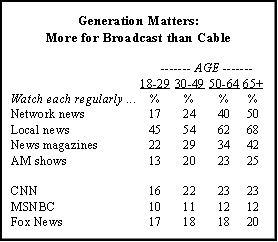
Traditional news outlets are feeling the impact of two distinct and powerful trends. Internet news has not only arrived, it is attracting key segments of the national audience. At the same time, growing numbers of Americans are losing the news habit. Fewer people say they enjoy following the news, and fully half pay attention to national news only when something important is happening. And more Americans than ever say they watch the news with a remote control in hand, ready to dispatch uninteresting stories. To some extent, these trends are affecting all traditional media, but broadcast news outlets — both national and local — have been the most adversely affected.
These are the principal findings of the Pew Research Center’s biennial survey of the national news audience, which documents the rapid emergence of the Internet as a news source, as well as a significant decline in regular viewership of broadcast television news. Fully one-in-three Americans now go online for news at least once a week, compared to 20% in 1998. And 15% say they receive daily reports from the Internet, up from 6% two years ago. At the same time, regular viewership of network news has fallen from 38% to 30% over this period, while local news viewership has fallen from 64% to 56%.
Among younger and better-educated people, the Internet is making even bigger inroads. Many more college graduates under the age of 50 go on the Internet every day than regularly watch one of the nightly network news broadcasts. And generally, the survey finds that people who are interested in the news and go online tend to watch less network TV news. The survey also finds modest declines in the viewership of television news magazines and the morning news shows, but these slips appear unrelated to Internet news competition.
The digital tide is having less of a direct negative impact on cable TV news, radio and print outlets. The Pew Research Center survey finds no evidence that Internet use is driving down regular use of cable news channels, daily newspapers, or radio news. However, all news outlets are being affected by the public’s slowly declining appetite for the news.
Less than half of the public (45%) now says it enjoys keeping up with the news a great deal and just 48% say they follow national news closely most of the time. Both of these percentages represent a modest decline from two years ago, when 50% said they enjoyed keeping up with the news and 52% reported following national news closely most of the time. But the percentage of Americans saying they enjoy keeping up with the news has fallen steadily since the mid-1990s.
The generational divide on these questions is striking. Just one-in-three young adults (31%) enjoy keeping up with the news. In contrast, well more than half (57%) of those age 50 and over enjoy following the news. While younger people don’t like the news so much, they do like having a wide variety of information sources from which to choose. Older Americans, who have a greater affinity for the news, often feel overwhelmed by the increasingly crowded media landscape.
As a consequence, Internet news is attracting many younger people who have only a marginal interest in the news as well as serious news consumers. In fact, Internet news has a relatively larger place in the lives of those with access who don’t enjoy the news than among those who do. The Internet, with its headline news format and capacity for quick updates, is clearly attractive to this type of consumer. On the other hand, the Internet’s capability for providing more depth on a given subject also appeals to those with large news appetites, such as affluent college graduates.
In that regard, the growth of Internet news has had a dramatic impact on the way Americans, particularly those with access to technology, get information on business and financial matters. For active investors — those who have traded stocks within the past six months — the Internet has largely supplanted traditional media as the leading source for stock quotes and investment advice. The Internet’s capacity for personally-designed news and information is clearly a factor here. Nearly six-in-ten (58%) active traders who log on to the Internet for such information have customized online stock portfolios.
So far, this quiet revolution in financial news has had less of an impact on the general public and less active investors, who still tend to go to the traditional media for stock quotes and advice. But underscoring the general popularity of the Internet for financial news, 16% of all Americans volunteered that they would turn first to the Internet for news if the market were to crash 1,000 points; cable news was mentioned second most frequently, at 14%.
As Americans grow more reliant on the Internet for news, they also have come to find online news outlets more credible. Despite the controversy over news-gathering techniques employed by some Internet sites, those who go online generally give Internet news operations high marks for believability. In fact, the online sites of such well-known news organizations as ABC News get better ratings from Internet users than the ratings accorded the traditional broadcast or print outlets.
But having a familiar name clearly helps. Internet-only news sources such as Yahoo, Netscape and America Online’s News Channel get lower ratings than other, better-known news organizations on the Internet. Still, the believability ratings for these organizations are comparable to those of network television news and other traditional sources. Internet news organizations that specialize in providing original content, such as the online magazines Slate and Salon, were less well-known and got lower ratings from Internet news users.
Other Findings
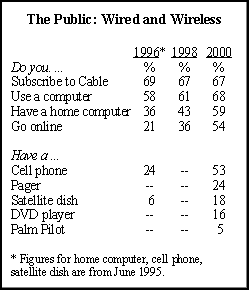
Americans have an ever-expanding appetite for new technology. More than half now own a cell phone, up from 24% just five years ago. One out of five Americans (18%) have a satellite dish, and 5% own a Palm Pilot.
As large numbers of younger Americans turn to the Internet for news, the audience for traditional media is aging. Nearly half of those under age 30 (46%) go online for news at least once a week, compared to just 20% of those age 50 and up. These older Americans are far more likely to say they watched TV news (67%) or read a paper (58%) yesterday.
More people are finding innovative ways to use technology in their personal lives. A sizable minority (15%) of active investors get stock quotes and market updates via some form of wireless device, such as a cell phone or pager.
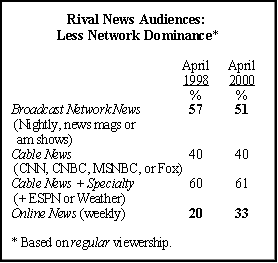
With the viewership of network news declining, and cable news audiences remaining flat, network’s lead over cable has narrowed to 11 percentage points (51%-40%) from 17 points (57%-40%) in 1998. When speciality channels, such as all-sports ESPN are included, the cable audience is 61%.
CNBC, primarily a business network, now draws better than one-in-ten Americans (13%) on a regular basis. But CNBC is the top choice of those active investors who identify television as the main source of stock updates.
More than half of Americans (53%) say they wish they had more time to follow the news. Time pressures are a particularly big factor for working women; nearly two-thirds (65%) want more time to follow the news.
The remote control has become an indispensable tool for most television news viewers, especially young people. Three-quarters of those under age 30 say they watch the news with the remote in hand; 54% of those over age 50 agree.
Men and women have different news interests, and this is reflected in the news they pursue online. Technology is a top draw for men, while women most often seek news on science and health. But overall, weather information is the leading online news topic.
Section I: The Changing Media Landscape
The revolution in communications technology is clearly changing the way Americans live, and it has created a highly competitive environment for those who provide news and information to the public. Nearly seven-in-ten Americans (68%) now use a computer on at least an occasional basis, up from 61% in 1998 and 58% in 1996. Almost as many have a computer in their home — 59%, up from 43% in 1998 and 36% in 1995.
The number of Americans who go online has increased at an even greater rate, more than twice as many people now go online to access the Internet or send and receive email as did just four years ago (54% vs. 21% in 1996).
In addition to computers and the Internet, a large majority of the public has access to a seemingly unlimited number of television outlets through cable TV and satellite dishes. Fully eight-in-ten (79%) Americans have either cable or a satellite dish (5% have both). The numbers for cable have remained relatively stable in recent years, while the percentage of those owning a dish has tripled since 1995.
More than half of Americans (53%) now have a cell phone, up from 24% in 1995. Men, women and people of all races are equally likely to use a cell phone. Older Americans do lag behind, however. Roughly one-quarter of the public has a pager. As many as 16% have a DVD player and 5% own a Palm Pilot.
As these new technologies have taken hold, providing many new avenues for obtaining news and information, the overall media landscape has been drastically altered. As a result, new patterns of news consumption are emerging and the core audiences for traditional news outlets are steadily diminishing.
While newspaper and magazine readership has fallen off moderately in recent years, the impact of the new media environment on television news has been more noticeable. Only 55% of Americans now report having watched the news or a news program on television “yesterday.” This is down from 59% in 1998 and 1996, and from a high of 74% as recently as 1994. In addition, Americans are spending less time watching television news these days. In 1994, 37% of the public reported spending at least one hour watching the news on TV “yesterday.” That number has fallen steadily over time. In 1996, 29% said they had spent an hour or more watching TV news, it was 28% in 1998, and today the number stands at 23%.
The falloff in TV news consumption has taken place primarily among the broadcast network news outlets. The percentage of Americans regularly watching the network evening news has fallen precipitously in the last two years. Viewership of network news magazines, such as 20/20 and Dateline, as well as the morning shows has fallen off too, though less dramatically. As a result, the cumulative network news audience has shrunk significantly in recent years.
Over this same period of time, cable news consumption has remained virtually flat. The cable news audience, encompassing CNN and some of the newer all-news cable networks, amounts to 40% of the population. This number is unchanged from 1998. When specialty cable channels, such as the Weather Channel and ESPN are taken into account, the cable news audience swells to 61%, basically unchanged from 1998.
Fragmented Audiences
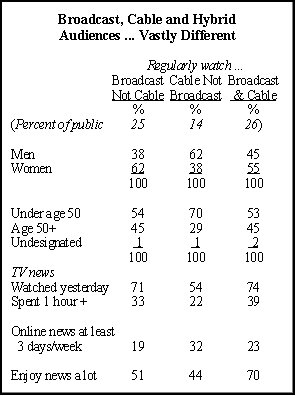
In this age of hybrid news audiences, when many Americans regularly watch the broadcast networks and cable, there is a segment of the population — one-in-four — which regularly watches the networks but not cable news. The counterpart to this group is a smaller audience — 14% of the public — which regularly watches cable news but not broadcast networks. Another 26% fall into a third group, which regularly watches both the broadcast networks and cable news channels.
These three groups are vastly different in terms of demographic characteristics, behavior and attitudes. And they illustrate the challenge which the broadcast networks face today in trying to attract a large, mainstream audience.
The exclusively broadcast audience is largely female and is older than the population at large. The primary news interests of this group are health, crime and community news. The cable-only group is younger than average and dominated by men. The primary news interests for these cable loyalists are sports, crime, and science and technology. The hybrid group is a mix of men and women, but like the broadcast sector, it is considerably older than the public at large.
While both the broadcast group and the hybrid group are extremely loyal television news viewers, the exclusively cable group watches TV news much less frequently. Only 54% report having watched TV news yesterday, compared to 71% of broadcast loyalists and 74% of those who watch both broadcast and cable. On the other hand, the cable group is almost twice as likely as their broadcast counterparts to go to the Internet for news: 32% vs. 19%, respectively, get news online at least three days a week. The cable-only group has different attitudes about the news as well. Only 44% say they enjoy keeping up with the news a lot, vs. 51% of the broadcast-only group and fully 70% of those who watch broadcast and cable.
Just Half Watch Evening News
Americans are increasingly less inclined to tune into the nightly network news broadcasts for their daily dose of news. And for the first time since 1987, the percentage of Americans who report watching a nightly network news program does not reach majority status.
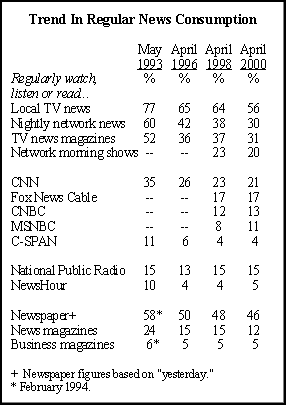
Just 50% now say they tune into the nightly broadcasts anchored by Peter Jennings, Tom Brokaw or Dan Rather, compared with 59% in 1998, 65% in 1995 and 71% in 1987. The percentage who say they regularly watch the network news has fallen eight points in just the last two years — from 38% to 30%. Moreover, the regular audience has been cut in half since May 1993.
Audiences for other network TV offerings have also declined in recent years. Roughly three-in-ten Americans (31%) now regularly watch news magazine shows such as 20/20 and Dateline — down from 37% in 1998. The audience for the three network morning shows has also fallen, though slightly, over the past two years.
TV’s Generation Gap
The rise of the Internet as a news source is only one of several difficult challenges confronting broadcast news organizations. Not only have the audiences for rival cable news outlets remained more stable, those audiences are younger than the viewers of network news offerings.
Only 17% of those under age 30 watch the nightly network news on a regular basis, compared to 50% of those age 65 and older. The same pattern exists with local TV news. News magazine shows such as 60 Minutes, 20/20 and Dateline, as well as the network morning shows, also draw in a disproportionate number of older viewers. In addition, these programs hold much more appeal for women than men. Among the most loyal group of viewers for these shows are women over the age of 50. The generation gap so apparent for the network and local TV news is less dramatic for CNN and virtually nonexistent for the newer all-news cable channels, MSNBC and the Fox News Channel.
CNN’s audience, while smaller than it had been in the mid-1990s, is largely unchanged from 1998. Today 21% of Americans regularly watch CNN, vs. 23% in 1998. Even more Americans watch at least one of the newer all-news cable channels. Fully three-in-ten say they watch at least one of these channels — either CNBC (13%), MSNBC (11%), or the Fox News Cable Channel (17%) — on a regular basis. Not surprisingly, business news enthusiasts are among the most loyal of CNBC’s viewers: nearly one-third of those who follow business news very closely tune in regularly.
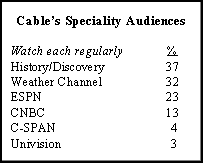
In addition, large proportions of Americans tune into specialty cable news channels, such as the Weather Channel and ESPN. Fully 32% of the public are Weather Channel regulars this year, virtually unchanged from 1998 (33%). Sports news on ESPN attracts about one-quarter of the public on a regular basis (23%). Among men under age 30, the number swells to 46%. The audience for C-SPAN’s live coverage of Congress is much smaller; C-SPAN is viewed regularly by 4% of the public and by one-in-ten of those who are very interested in political news. Republicans and Democrats watch the public affairs network at nearly equal rates.
Documentaries on cable channels such as the History Channel or the Discovery Channel are extremely popular with the public. Fully 37% say they regularly watch these shows. Men dominate this cable venue: 43% watch documentaries regularly vs. 31% of women.
Local News Down, Public Broadcasting Stable
While local TV news remains more popular than the networks, there has been a steady decline in the local audience in recent years as well. Today 56% of Americans watch local TV news regularly, down from 64% in 1998, 72% in 1995 and 77% in 1993.
And like their national counterparts, local broadcast news outlets are facing competition from cable. Local all-news cable channels have become quite popular: Fully 29% regularly watch local cable news, another 23% tune in at least sometimes.
The audience for public radio and television has remained constant in recent years. As was the case in 1998, 15% of Americans say they listen to National Public Radio regularly, while another 17% listen occasionally. NPR’s audience is disproportionately affluent and well-educated. On public television, the NewsHour with Jim Lehrer draws 5% of the public on a regular basis; another 12% sometimes watch.
Univision and other Spanish-speaking TV outlets are staples for Hispanic-Americans. Fully one-quarter of the Hispanics interviewed as part of this survey (all English-speaking) watch Spanish TV regularly. Another 25% tune in at least sometimes.
Graying Newspaper Readers
Newspaper readership, which declined in the 1980s and early 1990s, has leveled off in recent years. While the percentage of Americans saying they read a daily newspaper regularly is down slightly this year from 1998 (63% vs. 68%), the percent saying they read a newspaper yesterday is virtually unchanged (46% now vs. 48% in 1998).
But the generation gap in newspaper readership remains wide. Only 29% of those under age 30 report having read a newspaper yesterday. This compares with 63% of those age 65 and older. College graduates and those with family incomes in excess of $50,000 are among the most likely to read a newspaper.
The weekly news magazines, such as Time and Newsweek, have lost some ground in recent years. Today, 12% regularly read this type of magazine, compared to 15% in 1996 and 24% in 1993. Young people are actually as likely as older Americans to read weekly news magazines. Roughly half (46%) of those under age 30 read a weekly news magazine at least sometimes, compared with 37% of those age 65 and older.
Readership of business magazines such as Fortune and Forbes, as well as literary magazines such as The New Yorker and The Atlantic Monthly has remained relatively stable in recent years.
Court Shows Popular
“Real life” dramas have strong followings. Nearly one-in-five Americans watch TV shows such as Cops or America’s Most Wanted. These shows are most popular among those who never attended college and those with family incomes under $30,000. These same demographic groups are among the more loyal viewers of courtroom shows such as Judge Judy and Divorce Court. Overall, 12% of Americans watch these court shows regularly.
Among daytime TV talk shows, programs like those hosted by Oprah Winfrey and Rosie O’Donnell are somewhat more popular than daytime “tell-all” shows hosted by Ricki Lake or Jerry Springer. Roughly one-third of the public (31%) watches shows like Winfrey’s at least sometimes, while 19% watch Springer and company. The audience for O’Donnell and Winfrey is largely dominated by women. Women of all ages tune into these shows, but they hold little appeal for men of any age.
The tell-all shows, on the other hand, attract both men and women and draw disproportionately from young viewers. Both daytime formats attract viewers with less education and lower-than-average incomes.
Section II: Internet News: More Log On, Tune Out
The same demographic groups which are moving away from the nightly network news in the greatest numbers are some of the very same groups which are moving toward online news use at the highest rates — more affluent, more well-educated Americans.
Indeed, as the number of people regularly getting news online has grown, so has the share of Internet news consumers who say they are using other news sources — like television — less often. Nearly one-in-five (18%) of those who get news online at least once a week say they now use other sources less often, up from 11% two years ago. Those who now use other sources less typically say the Internet is replacing television or newspapers in their lives.
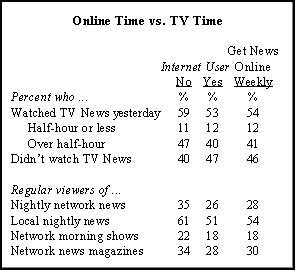
What’s more, several measures show that the decline in the television news audience over the past two years has been greater among Internet users — including users who regularly go online for news — than among non-users. Two years ago, there was no difference in the number of Internet users and non-users who watched television news on a typical day — 59% in each group. Today, just 53% of Internet users watch television news on a typical day, while the number among non-users remains the same, at 59%.
Internet users are also spending less time watching TV news. The number of Internet users who spend a half-hour or more watching television news on a typical day dropped from 48% of viewers two years ago to 40% today. Time spent watching TV news also dropped by 8 percentage points among users who regularly get news online. But among non-users, there has been almost no decline in the time spent watching TV news on a typical day — 49% spent a half-hour or more in 1998, compared to 47% today.
Similarly, just one-in-four Internet users (26%) say they regularly watch a nightly network news broadcast, down from 35% two years ago. This compares with 35% of non-users who regularly watch the network news, down just 4 percentage points in two years. More detailed analyses show that Internet users are significantly less likely than non-users to watch the network news, even when controlling for demographic factors like sex, age, and education that are associated with both news viewership and Internet access. Taking these demographic factors and personal interest in the news into account, Internet users watch the network news at lower rates than non-users.1
Internet users are also slightly less likely than non-users to watch other network broadcast news programming, including morning shows like Today and Good Morning America and evening news magazines like 60 Minutes, 20/20, or Dateline. For example, 28% of Internet users say they regularly watch network news magazines, compared to just over one-third (34%) of non-users. While the differences between Internet users and non-users when it comes to these broadcast news programs are relatively small, they stand in contrast to other types of news sources — such as newspapers, radio, and many cable outlets — which Internet users are as likely, or more likely, to use.
Daily tracking of the public’s online activities also reveals the Internet’s growing status as a primary news source for many Americans. A separate daily tracking poll found that one-in-five Internet users (22%) get news online on a typical day, and most of these users go to Internet sites specifically to learn what is in the news.2 Among those who get news online on a typical day, 55% said they went to an Internet news site to read the news, while 43% said they happened to see news while they were doing something else online.
Narrowing Gender Gap
The Internet is becoming a news source in its own right, with one-in-three Americans (33%) now regularly getting news online, up from just 20% two years ago. This represents a solid majority of all Internet users — 61% — who go online for news at least once a week, including 27% of users who get news online every day.
Although men are still somewhat more likely than women to get news online, the gender gap is closing. Today, the population of regular Internet news consumers is comprised of 57% men and 43% women, a slight narrowing from the 61%-39% split in April 1998. What’s more, some 22% of those who get news online at least once a week are over age 50, compared to just 16% two years ago.
Americans who regularly get news online are more interested than non-Internet users in news about science and technology, business and finance, and sports. For example, 27% of those who get news online at least once a week say they follow news about science and technology very closely, compared to just 14% of those who don’t go online. More than twice as many Internet news consumers (22%) as non-users (10%) pay very close attention to business and finance news.
Notably, these topics are among the leading types of news that Internet users seek out when they go online. Fully 63% of those who get news online use the Internet to get updates on science and health, and nearly as many (59%) get technology news online. Half (53%) get business news online. These topics rank below only the weather, which remains the most popular type of online news — two-thirds (66%) of Internet news consumers say they get weather news and updates online.
Indeed, the popularity of the Internet as a source of weather updates is underscored by growth in the number of women getting weather online. Even as more women have started getting news online on a regular basis, the share of those women who get weather updates on the Internet has jumped substantially, as well. Two years ago, just 41% of women who got news online used the Internet for weather news, compared to 55% of men. Today, the numbers among Internet news consumers are nearly comparable, with 64% of women and 68% of men getting weather news online.
Other types of stories rate somewhat below these major topics — weather, science, health, and business — in popularity among those who get news online. Roughly four-in-ten online news consumers say they check the Internet for international news (45%) and sports news (42%). About as many (44%) get entertainment news online. Just over one-third get political news (39%) or local news (37%) online.
Heavy Users Constantly Connected
Those who are daily Internet news consumers — and are among the most heavily-connected Americans — underscore a number of the trends that are contributing to the Internet’s popularity as a new source. Those who get news online every day are disproportionately well-educated, younger men: 61% of daily Internet news consumers are men, 75% are under 50, and nearly half (47%) have a college education. Half (52%) have family incomes of $50,000 or more.
For these people, technology is clearly a plus. Three out of four (77%) not only go online on a daily basis, but also have a cell phone, pager, or Palm Pilot. Just as many (77%) say they like having access to all the information that comes through television, newspapers and computers, with just 19% saying they feel overloaded. This compares with a much narrower 52%-36% split among non-users.
Daily online news consumers are also heavily-engaged in the stock market and pay especially close attention to business news. Indeed, fully 42% of them personally trade stocks — compared to 21% of all Americans — and one-in-four (26%) made a trade within the last month. Half (52%) say they follow business and financial news closely most of the time, regardless of whether something important is happening, compared to just one-third of all adults (33%). Not surprisingly, an overwhelming majority (74%) get financial news online.
Section III: Financial News: Traders Turn to the Internet
While the crowded landscape has fragmented audiences, it has given the most sophisticated and technology-savvy news consumers an array of options that would have been inconceivable just a few years ago. Americans who are active stock traders and investors are perfectly positioned to take advantage of these choices.
Active traders — those who have bought or sold stock within the last six months — make up only 15% of the population. But reflecting the extent to which high-income Americans now participate in the market, active traders comprise nearly half (45%) of all of those with family incomes of $100,000 or more. Fully nine-in-ten (89%) of those making at least $100,000 are investors, though not as actively engaged.1
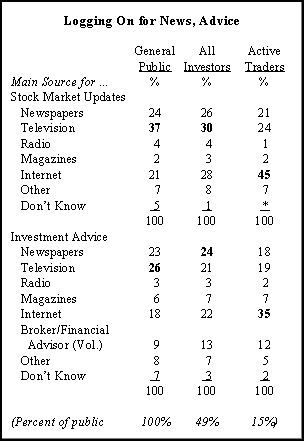
Not surprisingly, active traders have a strong interest in financial news. Fully eight-in-ten (81%) get stock market updates at least once a week and nearly half (45%) get this information on a daily basis. By contrast, 59% of all investors get weekly market updates and 25% check in daily. Among the public, 42% get weekly updates and just 16% get stock information every day.
But what may be most striking about active investors is their extraordinary access to and familiarity with the technological tools of the new information environment. A few years ago, active investors in search of news on the stock market would have been limited to a handful of newspapers and television programs; today, by far their leading source for such information is the Internet.
Nearly half (45%) of active traders turn first to the Internet for stock updates and quotes, with television (24%) running a distant second. By contrast, all investors and the public are more inclined to rely on traditional media — television and newspapers — for stock updates. The preferences of all investors are divided among television (30%), the Internet (28%) and newspapers (26%), while television is clearly the public’s main source for such news (at 37%).
Active traders are also more likely to go online for investment advice. More than one-third (35%) say they go online for information on how and where to invest, compared to 19% who turn to televison and 18% who use newspapers. An additional 12% volunteered that they rely on a stock broker or a financial adviser for this type of information.
Customized Financial News
Active traders not only go online for financial news in greater numbers than all investors or the general public, they also are more likely to possess other communications tools such as cell phones and pagers. While more than eight-in-ten (82%) active investors own a home computer, 70% have a cell phone and 29% have a pager.
With access to a broad range of information technology, active traders are able to tailor their financial news to suit their personal needs and interests. For instance, nearly six-in-ten (58%) active traders who go online for stock updates have a customized online web page that provides prices and other information on their stock portfolio. Roughly one-third (34%) of all investors who go online for market updates (and 25% of all Internet users who go online for this purpose) have such customized portfolios. Moreover, 15% of active traders sometimes use cell phones, pagers or other wireless devices for stock quotes and market updates. Just 9% of all investors and 7% of the public use these technologies to do so.
Access to technology — and the wide range of information sources — helps to give active investors considerable autonomy in making investment decisions. Nearly two-thirds of this group (66%) say they are extremely involved making those decisions; fully nine-in-ten (94%) are at least somewhat involved.
All investors and the public are also personally involved in formulating investment strategies — but to a lesser degree than active traders. Just under half of investors (49%) and the public (48%) say they are extremely involved in making investment-related decisions, while 17% of investors and 23% of the public say they are uninvolved or are minimally involved in making investment decisions.
CNBC Rated Highly
Active traders also turn to different television outlets and newspapers for stock quotes and investment advice, compared to all investors or the public. Cable dwarfs broadcast news in the preferences of those active traders who name television as their main source for market updates.
Again among those active traders who rely on TV for updates, nearly eight-in-ten (77%) say they turn most often to cable outlets, against 14% who most frequently tune in to local or network broadcast news. CNBC is the top choice of active investors who identify television as their main source (at 36%). The percentage of active investors who name CNBC is more than double the percentages of those who tune into local (7%) and network news (7%) combined.
Generally, investors and members of the public who identify television as their main source for market information turn most often to CNN or its cable partner CNNfn (30% of all investors and 28% of the public). But one-in-five (21%) investors and more than a quarter of the public (26%) say they still turn to local television news for stock updates.
Active traders also are more likely than all investors and the public to tune into cable outlets when they are seeking investment advice. Among those who would go first to television for this type of information, CNBC is named most often (at 31%), with CNN/CNNfn second at 27%. All investors divide their preferences between CNN/CNNfn (27%) and local news (25%); the public does so as well, with 27% citing local news and 25% naming CNN/CNNfn.
Among those who choose newspapers as their primary source for stock market news, majorities of active traders (53%), all investors (74%) and the public (71%) turn first to their local papers for stock updates. But fully one-quarter of active investors rely on the Wall Street Journal, significantly more than all investors (12%) or the public (15%).
Beyond Financial News
Active traders are heavy consumers of news on many different subjects — not just financial news and advice — and they get information from a variety of sources. Despite their strong preference for surfing the web for business-related news, the vast majority of active investors have not abandoned traditional media.
Active traders regularly tune into the nightly network news programs at a slightly higher rate (37%) than either all investors (33%) or the general public (30%). Nearly six-in-ten active traders (59%) regularly tune into local news programs, about the same as all investors (58%) and the public (56%).
Nearly three-quarters (73%) of active traders are regular newspaper readers, about the same as all investors (69%) and somewhat more than the public (62%). Nearly six-in-ten active investors (58%) say they read a newspaper yesterday, compared with 53% of all investors and 46% of the public.
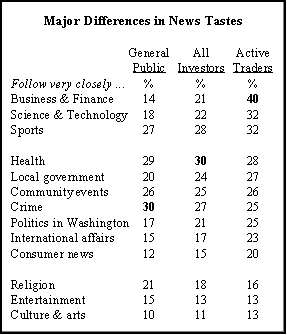
Beyond financial news, active traders are most interested in following news on science and technology, as well as sports. Nearly one-third (32%) follow news on science and technology very closely, while 22% of all investors and 18% of the public say the same. Active traders also have relatively high interest in international news (23% following it very closely). But stories on crime and religion have less appeal to active investors than they do to the public.
Internet Takes a Modest Toll
For a minority of active traders, however, the availability of news on the Internet has cut into their consumption of news from other media — especially newspapers. While most (58%) say there has been no change in their overall news consumption since they started getting news online, about one-in-five are going to other news sources less often. Nearly half (46%) of active traders who have cut their use of traditional media since going online say they are reading newspapers less often, while 40% watch television news less.
Still, the vast majority of active traders are fairly content with the news offerings of the traditional media. More than three-quarters (78%) say they are satisfied with TV news programming, about the same as all investors and the general public. An overwhelming majority (92%) of active traders say they get at least some enjoyment out of keeping up with the news, compared to 91% of all investors and 85% of the public. Four-in-five (80%) active investors disagree with the idea that the news is less important than it once was.
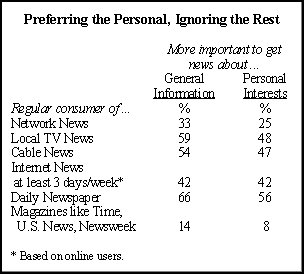
Perhaps most important, while many active investors opt for customized, online financial information, they have little interest in tailoring all news in that manner. Nearly seven-in-ten (68%) active investors prefer to get general information about important events — about the same percentage as all investors (71%) and the public (67%) — while 26% would rather have news mostly about their interests.
Section IV: Attitudes Toward the News
The decline in the number of Americans who say they enjoy the news is a continuation of a long-term trend. In 1995, a majority (54%) said they enjoyed keeping up with the news a lot. That number fell to 50% in 1998 and 45% this year.
While Americans remain generally satisfied with the quality of television news and overall TV programming, the trend here is negative as well. About one-third (32%) say they are very satisfied with the choice of TV news fare, down from 35% in 1998 and 43% in 1994. The number who say they are fairly satisfied fell from 50% in 1998 to 48% today.
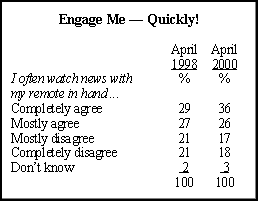
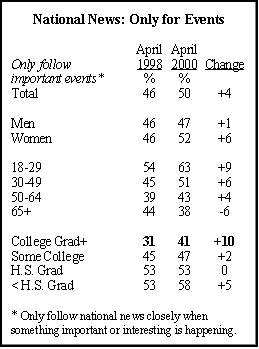
And when they do tune into the news, increasing numbers of today’s adults are fickle consumers. More than six-in-ten (62%) now watch television news with their remote controls in hand. With channel surfing on the rise, it is no surprise that overall news consumption remains largely event-driven. Slightly less than half of the public (48%) actually follows national news on a regular basis; fully 50% tune in only for significant or interesting events.
Still, Americans continue to place a high value on the importance of the news. Nearly three-quarters (73%) think that news today is as important as ever. A strong majority (62%) appreciates having so many news and information choices available, and over half (53%) wish they could devote more time to the news.
Older and Overloaded
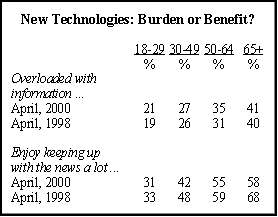
Most Americans enjoy the variety of options brought on by the ever-expanding number of TV news shows, magazines, newspapers and online information services. This is especially true for younger Americans, 70% of whom laud the new technologies. But older adults — the most avid news consumers — are most likely to feel burdened by the expansion and proliferation of news sources.
Four-in-ten senior citizens (41%) say that all the TV shows, magazines, newspapers, and computer information services make them feel overloaded. Just 21% of adults under age 30, 27% of those ages 30-49 and 35% of the 50-64 age group agree. Americans with less education are also more apt than those with more education to feel overwhelmed by the number of news sources currently available.
Online news consumers are especially enthusiastic about the plethora of news choices. Three-quarters (76%) of those who turn to the Internet for news at least once a week appreciate having a variety of options. Only slightly more than half (52%) of those who don’t go online agree.
Age, Education Matter
Beyond the overall decline in the number of Americans who like following the news, there are major differences on this issue based on age and education. As has been true in previous years, older and better-educated Americans enjoy following the news a lot more than do younger adults and those with less schooling.
Only 31% of those age 18-29 like keeping up with the news a great deal. Nearly twice as many (57%) of those age 50 and over agree. Among those without any college experience, just 41% enjoy following the news, compared to 54% of college graduates.
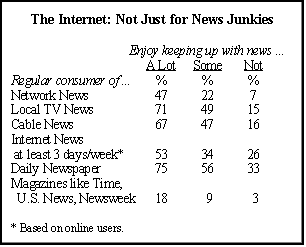
Not surprisingly, those who most enjoy following the news tend to be the heaviest news consumers. This holds true for all types of media. News enthusiasts watch television news more regularly, read newspapers more often, and follow all types of news — international, national and local — at higher rates. They are also more avid consumers of news online. Among Internet regulars, 53% log on for news at least three days a week.
But the Internet is also attracting those who don’t enjoy the news. Fully one-quarter (26%) of online users who say they don’t like following the news still turn to the Internet for news at least three days a week. In fact, these lukewarm news consumers are more likely to log onto the Internet for news than watch network, local and cable television news.
Clearly, time constraints have made it more difficult for Americans to pay attention to the news. Over half (53%) of the public says they wish they had more time to follow the news. Women — especially working mothers — express this desire to a greater degree than do men. Fully 58% of women want more time to follow the news; 48% of men agree. Almost two-thirds (65%) of working mothers want more time to focus on the news.
Most Remain Satisfied with TV
Despite the declining audience for television news, a higher percentage of Americans express satisfaction with the quality of news programs than general television fare. While eight-in-ten are at least fairly satisfied with television news, 58% say the same about all television content.
Young people show a decided lack of enthusiasm for the news, but they tend to be more satisfied with general television programming than do older Americans. Seven-in-ten of those under age 30 say they are satisfied with TV programming; 57% and 52%, respectively, of adults ages 30-49 and 50 and older agree. Parents in the 30-49 age group appear especially frustrated with TV offerings. Only about half (51%) say they are satisfied. Perhaps not surprisingly, cable TV subscribers are more satisfied with the choices available on TV than are those who don’t have cable in their homes.
When it comes to TV news, the satisfaction is more widespread. Majorities of all major demographic, religious and political groups say they are satisfied with TV news choices. Nonetheless, satisfaction levels have fallen somewhat in recent years. And today, among Internet users, those who are dissatisfied with TV news choices turn to online sources for news slightly more often than do those who are satisfied with TV choices, 33% vs. 26%, respectively.
Business Coverage Rated Highly
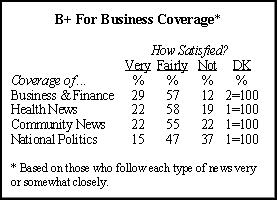
Americans give favorable reviews to the media’s coverage of various types of news. Among those who follow each type of news, over 75% say they are at least fairly satisfied with coverage of business and finance issues, health news and events and people in their communities. Coverage of political events and issues in Washington is less highly rated: 62% say they are satisfied with this coverage.
Women express somewhat more satisfaction with the media’s coverage of Washington politics than do men: 65% vs. 58%, respectively, among those who follow this type of news closely. Less well-educated adults are also more satisfied with national political coverage: 65% of those with no college training are satisfied, compared to 58% of those with college degrees. Regular talk-radio listeners are among the least satisfied. Just 46% express satisfaction, compared to 62% of the population at large.
Hispanics and blacks who follow community news closely are slightly less satisfied with the news media’s coverage in this area than are whites, although large numbers are relatively content. Seven-in-ten blacks and 69% of Hispanics say they are satisfied with this coverage, compared to 79% of whites.
Although solid majorities of all major groups express satisfaction with the media’s coverage of health news, community news and news about business and finance, Americans are divided on in their opinions as to whether executives and editors in the news media are out of touch. Just over half (53%) of the public believe that newspaper and TV news executives are out of touch with people like them; 44% disagree. Older Americans, adults with less education, and white evangelical Protestants are among the most likely to complain about the news media’s connection to the public.
Roaming on the Rise
The public’s propensity for flipping channels has risen six percentage points since 1998 when 56% of the public reported watching TV news with remotes at the ready, compared to 62% today. Young people are especially attached to their clickers — about three-quarters (76%) of those under age 30 watch with remotes in hand, compared to 63% of 30-49 year-olds and 54% of the over 50 crowd.
Daily online news consumers are somewhat more prone to flipping than are regular network news watchers: 67% of Internet news consumers say they click to another channel whenever their interest fades, compared to 62% of the rest of the public. People who don’t enjoy following the news are also more likely to watch TV news with remote controls at the ready. About two-thirds (68%) of adults who don’t get much pleasure from following the news click around; 56% of those who say they enjoy following the news a lot do so.
Event-driven Audiences
Fully 64% of Americans say that they only follow international events closely when something important or interesting is happening; just 33% pay close attention most of the time.
This inattentiveness to international news was evident in 1998, but now more Americans appear to be turning away from national news as well. Half the public now says that they follow national events only when something important is happening, a slight jump from the 46% who said so in 1998. Although college-educated Americans are still the most attentive news followers, attention even among this group is falling off at a fairly rapid pace. Now, 41% of those with college degrees pay attention to national news only when important events are happening; in 1998 just 31% were this inattentive.
Event-driven news consumers are also disproportionately young. Fully 63% of adults under age 30 follow national news closely only when something important or interesting is happening; in 1998, 54% were event-driven news consumers.
Taken together, a sizable group of Americans (43%) follow both national and international news only when something important is happening. There is a very clear generational pattern on this measure. More than half (52%) of those under 30 fall into this group, compared to 45% of those aged 30-49 and only 34% of those over age 50.
These event-driven news consumers are much less likely than those who follow the news consistently to say they enjoy keeping up with the news (26% enjoy this a lot, vs. 70% of those who follow the news most of the time). They’re also more likely to feel overloaded by the myriad of news offerings, and they’re less satisfied with the choice of news programs on available on TV.
Only about a quarter of the public (27%) follows national and international news most of the time, whether or not something important or interesting is happening. More men than women fall into this category. This group is older and more well-educated than average. In addition, those who get news online on a daily basis are more likely than most to follow this pattern of news consumption (34% vs. 27% among the general public).
Just My Facts, Please
While most of the public wants news that contains general information about important events, a substantial 28% say they prefer news that focuses on their own concerns and interests. This group is disproportionately young and male: Fully 39% of men under age 30 say they want news that addresses their interests. About one-third (32%) of all men but just 24% of all women express this view.
Less well-educated Americans express a greater preference for news that caters to their personal interests, rather than more generalized news. Among those whose education ended with high school, 30% want news that addresses their personal concerns. Only 21% of college-educated adults pick the specialized over the general.
Americans who want specialized news consume less mainstream news than do those who favor more generalized news reporting. They watch TV news less frequently, are less apt to read a daily newspaper, and are less likely to be regular viewers of local news programs. Compared to those who prefer generalized reporting, this group is less constant in their attention to international, national and local news, tuning in only for important events.
Indeed, the only way in which those with particularized news interests do not differ substantially from the rest of adults is in their Internet news consumption. Both groups go online for news at equal rates.
Where Americans Go for Breaking News
Given the public’s diverging news tastes and habits, it is perhaps not surprising that Americans would scatter among different media outlets even during times of crisis. The Pew Research Center survey included a series of open-ended questions which asked people where they would go to find out about certain hypothetical breaking news events.
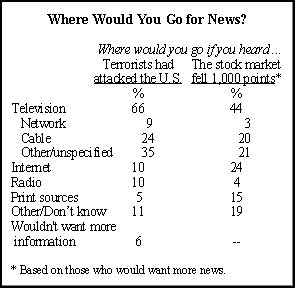
Under one scenario, respondents were asked where they would go for news if there had been a major terrorist attack on a large U.S. city. In this case, most Americans would turn on their television sets, but they wouldn’t tune in to the broadcast networks. By a better than two-to-one margin, they would turn to cable TV outlets, primarily CNN.
As many Americans would go to the Internet for more information on a terrorist attack as would choose network TV. Fully 10% would go online to learn more about such an event. A similar proportion would turn on the radio. Very few (5%) say they would wait for the morning newspaper.
Even more Americans would go online for news and information if they heard that the stock market had fallen 1,000 points. In this case, the Internet outpaces even cable TV. A sizable percentage (32%) say they wouldn’t be interested in getting more information about such a stock market dive. However, among those who would seek out news right away, fully a quarter (24%) say they would go online. One-in-five would turn to cable TV, and a mere 3% would turn to the networks. Fifteen percent would rely on newspapers and magazines.
The Public’s News Interests
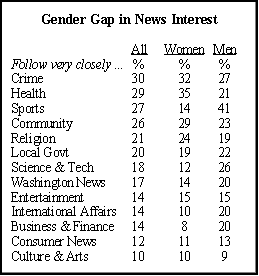
Crime, health, and sports are the three types of news followed most closely by the American public. Fully three-in-ten Americans follow crime stories very closely. Health and sports news weigh in behind crime at 29% and 27%, respectively. Community news and religion round out the top five news interests (26% and 21%).
There are significant gender differences underlying the public’s appetite for news. The top three news interests of women are health, crime and community, while men are mostly interested in sports, crime and science and technology.
Men also follow international affairs and business and financial news at higher rates than women. Fully one-in-five men follow both these types of news very closely, compared to 10% of women who follow international affairs and 8% who follow business and financial news.
News about political figures and events in Washington continues to rank low on the public’s list of news interests. People who identify themselves as independents are the least interested in news about political figures and events in Washington. Only 10% say they follow this kind of news very closely, compared to 20% of Democrats and 21% of Republicans.
Blacks Closely Track Community News
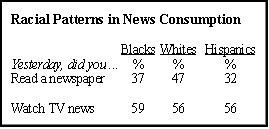
There are some notable differences in news consumption habits among blacks, whites and Hispanics. While fewer African-Americans than whites read a daily newspaper, blacks watch television news at slightly higher rates than whites. Nearly half of whites (47%) report having read a daily newspaper yesterday, compared to 37% of blacks and 32% of Hispanics. On the other hand, nearly six-in-ten blacks report having watched TV news yesterday, compared to 56% of whites.
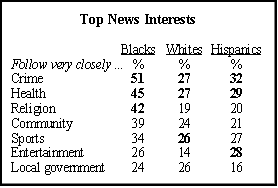
While local community news is popular among more than half of the American public, blacks have a particularly strong interest in this subject. Almost seven-in-ten blacks (67%) say they follow local community news closely most of the time whether or not something important is happening. This compares with 57% of whites and Hispanics. In addition, blacks watch local broadcast and cable news channels at significantly higher rates than whites or Hispanics.
More blacks than whites say they enjoy keeping up with the news a lot (56% to 44%). However, blacks are less satisfied with the media’s coverage of people and events in their community, an area of prime interest to them. Almost three-in-ten African-Americans (29%) say they are dissatisfied with the coverage, while only two-in-ten whites (20%) agree.
Crime and health are the top two news interests of blacks, Hispanics and whites alike, but there are clear differences after that. Blacks follow most types of news at a higher rate than whites and Hispanics. For example, almost twice as many blacks as whites follow crime news very closely (51% to 27%). And more than four-in-ten blacks (42%) follow religious news, compared to only 19% of whites and 20% of Hispanics.
Blacks still lag behind whites and Hispanics in going online, but they are starting to access the Internet at slightly higher rates. The digital divide is still evident: 38% of blacks go online, compared to 56% of whites and 52% of Hispanics. Almost one-quarter of blacks (24%) now get news online at least weekly, compared to 33% of whites.
Section V: Media Credibility
While television news viewership has fallen off in recent years, credibility ratings for the major TV news outlets have remained relatively stable. As was the case in 1998 and 1996, CNN is rated the most believable TV news source. Roughly four-in-ten Americans who are able to rate it (39%) say they can believe all or most of what they see and hear on CNN.
The three major broadcast networks are rated about equally in terms of believability: Roughly three-in-ten say they believe most of what they see on ABC, NBC and CBS. Ratings for the networks are basically unchanged from 1998 and 1996. The network news magazines are rated slightly better than the networks themselves. One-third (34%) give 60 Minutes a high rating for believability, and 32% give the same high rating to NBC’s Dateline. The ratings of local TV are similar to the networks, with 33% saying they can believe all or most of what they see on their local newscasts.
Fewer Americans are able to rate the newer all news cable channels, MSNBC and the Fox News Channel. Nonetheless, among those able to rate them, they rank just slightly below the broadcast networks. Less than three-in-ten (28%) give MSNBC high marks for believability; 26% give the Fox News Channel a high rating. C-SPAN received high believability ratings from 33% of those able to rate it.
Similarly, public broadcasting outlets are less well-known than the large commercial networks, but their credibility ratings are comparable among those who can rate them. Ratings for National Public Radio have improved somewhat since 1998. One-quarter give NPR the highest rating for believability, compared to 19% two years ago. Roughly one-in-five (21%) rate NPR’s All Things Considered as highly believable. The NewsHour with Jim Lehrer is rated highly by roughly one-quarter of the public — 24% say they can believe all or most of what they hear on this show.
Wall Street Journal Stands Out
Compared to television news outlets, print sources are generally seen as less believable, with one exception. The Wall Street Journal is viewed as the most highly credible news source among all the traditional outlets included in the poll. Among those able to rate, fully 41% say they can believe all or most of what they read in the Wall Street Journal.
Time Magazine comes in a distant second on the list of print sources included in the poll. Three-in-ten (29%) give Time a high rating for believability. Newsweek gets a high rating from 24%.
One-in-four Americans give their local daily newspaper high marks for believability. This is down somewhat from 29% in 1998. USA Today is highly rated by 23%, unchanged from two years ago.
Ratings for the Associated Press have risen moderately in recent years. Today 21% of those able to rate the wire service give it high marks for believability, up from 18% in 1998 and 16% in 1996.
Entertainment and tabloid outlets such as People and the National Enquirer receive the lowest ratings overall. Only 10% of those able to rate People say they can believe all or most of what they read in the magazine. Even fewer (4%) give high ratings to the Enquirer.
Online Sites Beat Parent Organizations
This year, for the first time, the Center asked online users to rate the believability of several popular Internet news sites.1 Interestingly, ratings for the online sites of the major national news organizations are substantially higher than ratings for the news organizations themselves.
For example, among online users who could rate, fully 54% give CNN.com a high believability rating, while only 40% give the same rating to CNN. With ABC News, 44% of online users rate the network’s website highly believable, compared with 29% who give the same rating to the organization itself.
A similar pattern can be seen for NBC News vs. MSNBC.com, CBS News vs. CBSNews.com, USA Today vs. USAToday.com., and the Fox News Channel vs. FoxNews.com. In each case, online users give the website a higher rating than the parent news organization. The New York Times’ website is rated highly by 42% of online users, but the newspaper itself was not rated on credibility.
Believability ratings for Internet-only sites vary widely. The two best-known sites receive the highest ratings: Roughly three-in-ten online users say they can believe all or most of what they read on Yahoo (29%) and Netscape (30%). AOL’s News Channel gets a high rating from 23% of the online users able to rate it.
Less well-known are the popular search engines Lycos.com, Go Network and About.com Among those able to rate them, just under one-in-five give Lycos and Go Network high believability ratings. About.com received high marks from 13% of online users.
The poll includes two technology-oriented news sites — CNET.com and ZDNet.com. Each received high believability ratings from roughly one-quarter of users familiar with them.
Two online magazines, Salon and Slate, received the lowest marks overall. Fewer than one-in-five online users were able to rate these sites. Salon received high ratings for credibility from 12% of those who rated it, while Slate got high marks from only 4%.
Methodology
Results for the main survey on Media Consumption are based on telephone interviews conducted under the direction of Princeton Survey Research Associates among a nationwide sample of 3,142 adults, 18 years of age or older, during the period April 20-May 13, 2000. For results based on the total sample, one can say with 95% confidence that the error attributable to sampling and other random effects is plus or minus 2.5 percentage points. For results based on either Form A (N=1,593) or Form B (N=1,549), the sampling error is plus or minus 3 percentage points.
Results for the Believability Study are based on telephone interviews conducted under the direction of Princeton Survey Research Associates among two separate nationwide samples of adults, 18 years of age or older. The questions about believability of traditional print and broadcast news sources were asked of 911 adults, during the period May 5-16, 2000. For results based on this sample, the sampling error is plus or minus 4 percentage points. The questions about believability of online news sources were asked of 308 Internet users, during the period June 1-6, 2000. For results based on this sample, the sampling error is plus or minus 6 percentage points.
In addition to sampling error, one should bear in mind that question wording and practical difficulties in conducting surveys can introduce error or bias into the findings of opinion polls.
Survey Methodology in Detail
The sample for this survey is a random digit sample of telephone numbers selected from telephone exchanges in the continental United States. The random digit aspect of the sample is used to avoid “listing” bias and provides representation of both listed and unlisted numbers (including not-yet-listed). The design of the sample ensures this representation by random generation of the last two digits of telephone numbers selected on the basis of their area code, telephone exchange, and bank number.
The telephone exchanges were selected with probabilities proportional to their size. The first eight digits of the sampled telephone numbers (area code, telephone exchange, bank number) were selected to be proportionally stratified by county and by telephone exchange within county. That is, the number of telephone numbers randomly sampled from within a given county is proportional to that county’s share of telephone numbers in the U.S. Only working banks of telephone numbers are selected. A working bank is defined as 100 contiguous telephone numbers containing three or more residential listings.
The sample was released for interviewing in replicates. Using replicates to control the release of sample to the field ensures that the complete call procedures are followed for the entire sample. The use of replicates also insures that the regional distribution of numbers called is appropriate. Again, this works to increase the representativeness of the sample.
At least five attempts were made to complete an interview at every sampled telephone number. The calls were staggered over times of day and days of the week to maximize the chances of making a contact with a potential respondent. All interview breakoffs and refusals were re-contacted at least once in order to attempt to convert them to completed interviews. In each contacted household, interviewers asked to speak with the “youngest male 18 or older who is at home.” If there is no eligible man at home, interviewers asked to speak with “the oldest woman 18 or older who is at home.” This systematic respondent selection technique has been shown empirically to produce samples that closely mirror the population in terms of age and gender.
Non-response in telephone interview surveys produces some known biases in survey-derived estimates because participation tends to vary for different subgroups of the population, and these subgroups are likely to vary also on questions of substantive interest. In order to compensate for these known biases, the sample data are weighted in analysis.
The demographic weighting parameters are derived from a special analysis of the most recently available Census Bureau’s Current Population Survey (March 1999). This analysis produced population parameters for the demographic characteristics of households with adults 18 or older, which are then compared with the sample characteristics to construct sample weights. The analysis only included households in the continental United States that contain a telephone.
The weights are derived using an iterative technique that simultaneously balances the distributions of all weighting parameters.