Introduction and Summary Americans anticipate many perils in the next century, but none of them, no matter how grave, can dim the public’s positive view of the future. Despite consensus forecasts of natural disasters, environmental calamities and international terrorism, Americans are near unanimous in their confidence that life will get better for themselves, their families […]
About Pew Research Center
Pew Research Center is a nonpartisan, nonadvocacy fact tank that informs the public about the issues, attitudes and trends shaping the world. It does not take policy positions. The Center conducts public opinion polling, demographic research, computational social science research and other data-driven research. It studies politics and policy; news habits and media; the internet and technology; religion; race and ethnicity; international affairs; social, demographic and economic trends; science; research methodology and data science; and immigration and migration. Pew Research Center is a subsidiary of The Pew Charitable Trusts, its primary funder.
Introduction and Summary Americans anticipate many perils in the next century, but none of them, no matter how grave, can dim the public’s positive view of the future. Despite consensus forecasts of natural disasters, environmental calamities and international terrorism, Americans are near unanimous in their confidence that life will get better for themselves, their families […]
Introduction and Summary
Americans anticipate many perils in the next century, but none of them, no matter how grave, can dim the public’s positive view of the future. Despite consensus forecasts of natural disasters, environmental calamities and international terrorism, Americans are near unanimous in their confidence that life will get better for themselves, their families and the country as a whole.
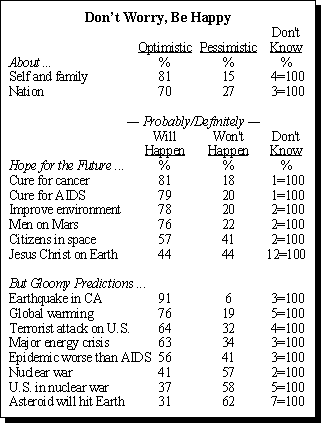
An overwhelming 81% of adults are steadfast in their optimism about what the 21st century holds for them and their families, and 70% believe the country as a whole will do well. Eight-in-ten Americans describe themselves as hopeful about the year 2000, and they anticipate the new millennium will usher in the triumph of science and technology. Majorities predict cancer most likely will be cured, AIDS will be eradicated and ordinary people will travel in space.
At the same time, nearly two-thirds of the public anticipates a serious terrorist attack on the United States within the next 50 years, and more than half say an epidemic worse than AIDS is at least likely. Vast numbers of Americans also view as probable a major earthquake in California, global warming and a severe energy crisis by the middle of the 21st century.
Very sizable minorities expect even more dire things to come, although less than 20% of the public describes themselves as worried about the coming of the year 2000. More than one-third of Americans say the U.S. will most likely be involved in a nuclear war within the next 50 years, and nearly as many believe an asteroid will hit the Earth within that time.
Analysis of the survey finds, however, that these specific ideas of what the future might hold — many of them grim — have relatively little impact upon the general feeling of optimism about it. Even among those who are certain nuclear war is imminent or fully expect the Earth to be struck by an asteroid, majorities remain optimistic about the future. Conversely, general optimism is not necessarily tied to anticipation of specific improvements and progress. Those expecting a cure for cancer or Jesus Christ’s return to Earth are no more hopeful about their lives for the next 50 years than are those who do not anticipate these things.
These are the principal findings of the Pew Research Center survey of 1,546 adults on the millennium. The survey was conducted April 6 – May 6, 1999 and has a margin of error of 3 percentage points. This report details America’s hopes and fears for the future. A previous report, released July 4, 1999, looked back at the past one hundred years. It is available on our website www.pewresearch.org/pewresearch-org/politics/mill1rpt.htm.
One theme that connects many of the public’s fears for the future is globalism: Problems that cannot be controlled by science or by our borders appear most threatening. Environmental problems and international terrorists stand atop the list of threats to the future, with nearly two-thirds of the public citing each as a major threat. The majority also believes the growing world population is likely to cause shortages of food and resources.
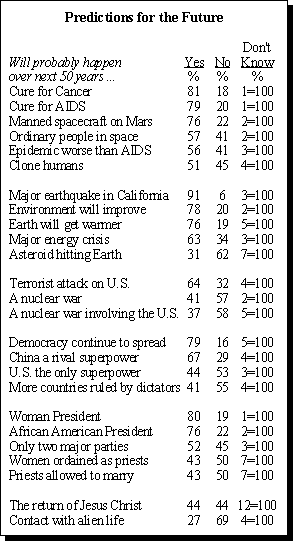
This pattern of global fears extends to American views of the U.S. economy and the country’s role in the world. Although two-thirds (64%) of the public believes the U.S. economy will grow stronger in the next 50 years, half (52%) expect that the average American will be hurt by the global economy. Half of the country does not expect the U.S. to remain the world’s lone superpower (53%); two-thirds believe that China will emerge as our global rival (67%); 41% foresee a nuclear war; 37% think the U.S. will be involved in such a war.
But for all the global worries Americans see looming, public faith is just as strong that science and technology will expand their horizons. Americans overwhelmingly say science and technology, medical advances and education will play major roles is creating a better future. Three-quarters think a manned spacecraft will explore Mars, and nearly six-in-ten go even farther, predicting ordinary people will travel in space before the middle of the 21st century. A 58% majority believe Americans will live much longer in the next century, and 78% of the public anticipates environmental progress.
Social and economic progress are also anticipated, but with smaller margins and more caveats than for scientific achievements. For example, despite faith that the domestic economy will be stronger, 69% say that the gap between rich and poor will widen. Similarly, the share predicting an increase in crime has fallen 9 percentage points over the past three years, but still 59% say the crime rate will climb in the next 50 years. Two-thirds of Americans expect the education system to improve by mid-century; but 60% see less affordable health care and 52% anticipate less honesty from political leaders.
The public is more consistently optimistic about racial matters. Two-thirds (68%) think that race relations will improve, and 76% believe an African American will be elected president by the middle of the 21st century, which is almost as many as think that a woman will be elected. African Americans are notably less optimistic than are whites about the future of race relations and about the prospects of one of their own occupying the Oval Office.
Few Americans, however, say they wish to live another 100 years to see how it will all turn out. This view is shared by optimists and pessimists. Age and religion matter more than outlook. Younger people and those with no formal religious affiliation express more interest in staying alive to greet the 22nd century than do older and more religious people.
A Future Full of Promise
An overwhelming 81% say they are optimistic about their lives and the lives of their families over the next half century; 40% consider themselves very optimistic. These optimists tend to be young, college educated and have higher than average incomes. Among Americans under age 30, 85% report feeling positive about their futures, compared to 72% of senior citizens. This is especially true of young women: About nine-in-ten say they are optimistic, compared to 80% of young men.
Moreover, 90% of those with annual incomes over $75,000 consider themselves optimistic but that number drops 17 percentage points among people with incomes under $20,000. And, the vast majority of college graduates — 87% — report feeling positive about their futures during the next 50 years, while 71% of those with less than a high school education agree.
Parents’ optimism about their children’s futures is robust, although somewhat tempered in comparison. About two-thirds of parents say their children will be better off than they are now. Blacks tend to be more optimistic about their children, with 77% seeing their offspring as having bright futures.
The Nation’s Future Bright Too
A substantial 70% majority of Americans are also optimistic about the future of the United States over the next 50 years. Again, college graduates and those with family incomes of at least $75,000 are among the most optimistic — 75% and 77%, respectively, express optimism about the nation’s future. In comparison, 60% of those without high school degrees and 64% of those with incomes under $20,000 are optimistic about the nation. Also, Easterners are particularly optimistic at 78%.
The public is more reserved when asked to evaluate whether children in the U.S. in general will grow up to be better or worse off than their parents are now. A 55% majority says better. Although this represents an increase of 17 percentage points over the past three years, more than one-third of parents (36%) say worse.
In spite of the overall optimism, almost two-thirds of Americans — 62% — say that even if it were possible, they would rather not live 100 more years. Men and young adults are more apt to want to see the 22nd century, while white evangelical Protestants are among the least likely to desire such long lives.
Among men, 41% would like to live an additional 100 years, a number that drops 10 percentage points among women. Similarly, 41% of Americans under age 30 want to add a century to their lives but only 20% of senior citizens desire to do so. And 46% of those in the highest income bracket — $75,000 and over — would also prefer to live a 100 more years, compared to 31% of those making less than $20,000.
In addition, faithful church goers would rather not live 100 more years. Only 29% of those who attend church weekly would like to add a century more onto their lives compared to 45% of those who seldom or never attend religious services.
Taking the New Millennium in Stride
For most Americans — 68% — the beginning of the new millennium will be just another year on the calendar. Less than one-third say the coming of the year 2000 has any special significance. Among women, 39% see special significance while barely more than a quarter — 26% — of men do. And while 35% of Americans under age 30 consider 2000 to be special, only 20% of those 65 and older agree.
Optimism, however, prevails when the public considers the new year. Fully eight-in-ten say that hopeful describes their feelings about the coming of the year 2000. Slightly more than two-thirds of Americans — 68% — admit to feeling curious about the new year. Among young women, 76% are curious. Young adults tend to feel more excited about the coming of the year 2000. While 42% of Americans overall say they are excited about the new year, 58% of adults under age 30 feel this way, compared to 23% of those age 65 and over; only 28% of men age 50 and older consider themselves excited about the new year. Excitement about the millennium has not grown in recent months. In April 43% overall were excited.
When asked if they feel worried about the year 2000, only 16% of the public says so. Worry over the coming new year has actually decreased since April when the question was first asked. Then 25% of Americans expressed worry. Currently, young adults and those with little formal education express higher than average levels of anxiety. Of those who admit to being worried, the most common concern is the so-called Y2K computer bug with 43% expressing such concern. Additionally, 17% are worried about war or Armageddon.
Americans Wary of Global Threats
The optimism that permeates opinion about the future does not blind Americans to potential threats. As the world becomes more politically, economically and environmentally interconnected, Americans are increasingly wary of globalism. Two-thirds of the public says that environmental problems pose a major threat to our country’s future well-being, and almost as many say the same of international terrorists. Over half of the public says population growth is a major threat to the nation’s welfare.
Other potential threats — from racial conflict to economic competition to immigration — draw moderate levels of public concern. About 45% of Americans see each of these as a major threat to the future well-being of the nation, a position basically unchanged over three years.
At the bottom of the list of possible dangers are the news media and commercial and residential development: Roughly one-third of Americans say each of these poses a major threat to the nation’s health. In 1996, 39% of the public saw the news media as a major danger.
Concerns About Global Developments Surface
Other global issues also make Americans leery. Most Americans (56%) say that the growing world population will be a major problem, and 52% believe the global economy will hurt America. Another 51% are concerned that a growing number of legal immigrants will harm the nation.
Less affluent Americans are more likely to see these problems looming. For example, 63% of those making $20,000 or less think the global economy will hurt America, but only 33% of those with family incomes of at least $75,000 share that view. More than 60% of those without a high school degree see growing immigration as harmful, compared to 32% of college graduates.
Regarding the world population, three-quarters of seculars, meaning those without religious affiliation, see it becoming a major problem. In contrast, only one-half of white evangelicals are concerned about this.
Hispanic-Americans’ views on immigration do not differ markedly from the views of whites: 45% of Hispanics believe increasing legal immigration will harm America while about one-half (51%) of Anglos agree.
Fears of Terrorism Rise
Terrorism is also perceived as a major threat to the future, and one that is growing. Concern about international terrorism jumped 10 percentage points in just three years. It grew particularly fast among those living on the East and West Coasts, by 14 and 15 percentage points, respectively. Older Americans, those ages 50 and up, are particularly worried about terrorism. Three-quarters (72%) of this group sees international terrorists as a major threat, compared to 60% of those under age 50.
In the post-Cold War era, fear of terrorists using biological or chemical weapons against the U.S., is now greater than worry about nuclear war. Fully 64% of the public thinks that a terrorist armed with weapons of mass destruction will probably or definitely attack the U.S. in the next 50 years, compared to 41% who say the same of nuclear war. This is not to say concern about an atomic war is insignificant: 37% of Americans think that a nuclear war involving the U.S. is likely in the next 50 years.
People who tend to be more pessimistic about their own lives and the nation are particularly concerned about the prospect of nuclear war. Roughly half of those in these groups say there will likely be one by 2050 and think it will involve the United States. Curiously, the inverse is not entirely true. A 61% majority of those who think an atomic war involving the U.S. is likely still describe themselves as optimistic about the nation’s future.
A slim majority of people (53%) agree that America’s position as the sole superpower in the world is unlikely to continue through the first half of the next century, with 67% predicting that China will likely become a rival power. Despite this, eight-in-ten people say that democracy will continue to spread, and just half that number (41%) say that more countries will be ruled by dictators in the future.
Concern over the Environment
The American public’s ability to blend optimism with worry is evident in attitudes about the environment. Three-quarters of the public thinks that we will make progress in improving the environment, yet nearly two-thirds (63%) say that we will face a major energy crisis in the next 50 years.
A clear majority of Americans also predict that the Earth will get warmer during the next half century. Some 28% say global warming is definitely going to happen, another 48% say it will probably happen. Opinion on this divides along party lines, with more Democrats than Republicans believing the Earth will get warmer, 81% vs. 68%.
Similarly, while 62% of Americans believe the Earth is safe from an asteroid striking, fully 90% think a major earthquake in California is at least likely. More than one-in-three (35%) say this will definitely occur. Expectations for a major earthquake are greater on both the East and West Coasts (39% and 40%, respectively, say it will definitely happen) than in the Midwest (29%).
Overall, young adults are more worried about potential dangers from the environment. Fully 77% of 18-29 year-olds say environmental issues pose a major threat to the country’s future well-being, compared to about two-thirds of those ages 30-64 and just half of senior citizens.
Economic and Social Trends on the Domestic Front
A similar mix of optimism and fear exists when Americans consider domestic matters. The public expresses less concern about the growth of crime, more faith in the strength of the economy and more hope about the future of race relations than it did just three years ago. Yet, again, public optimism is tempered by equally strong pessimism about other economic and social trends.
For instance, the public’s belief that Americans will live longer by mid-century is dampened by the overall consensus that health care will be less affordable. Fully 58% of the public says that people will live longer; 60% predict a rise in health care costs.
Similarly, optimism about the economy is checked by concern about the distribution of national wealth. Nearly two-thirds of the public (64%) says that the economy will get stronger over the next 50 years, but an even greater percentage (69%) predict that the gap between the rich and poor will grow larger in that time.
For the most part, predictions about the economy — both its continued strength and the growing gap between the rich and poor — are shared by clear majorities of Americans, regardless of age, race, gender, or education. Not surprisingly, however, Americans who feel optimistic about their personal future and that of the country are more upbeat about these economic trends as well. Solid majorities of personal optimists (67%) and national optimists (72%) say that the economy will get stronger over the next 50 years; less than half (47%) of pessimists agree.
Political Ethics
Americans are divided in their attitudes toward the ethical qualifications of future elected leaders: 41% say that they will be more honest and ethical; 52% predict that they will be less so.
Young people stand out for their pessimism on this issue. Adults ages 18-29 predict worsening standards by a margin of 62%-32%. Those ages 30-49 divide 50%-41%, and Americans ages 50 and older split evenly, with 48% saying leaders’ ethics will worsen and 47% saying they’ll improve.
Finally, faith in elected officials is notably low among those living in rural areas and those who are not registered to vote. By a 60%-37% margin those living in rural areas see lower levels of honesty and ethics in the future, and 63% of those who aren’t registered to vote say that standards will be worse; just 30% say they’ll improve. Among registered voters, the margin is 48%-44%.
The public is divided over whether or not the Republican and Democratic parties will continue as the only two major parties in our political system — 52% say yes and 45% say no. However, most Americans see change coming to the Oval Office during the first half of the next century. Eight-in-ten Americans think a woman may be elected president, with nearly the same number (76%) predicting an African American will win the office. More white Americans predict that a woman (82%) or African American (78%) will be elected president within the next 50 years than do blacks (69% and 60%).
Perspectives on Race Relations
Differences between blacks and whites are also clear when Americans think about other racial matters. While most of the public thinks that race relations will improve over the next 50 years, whites are much more apt to hold this view than are blacks. Seven-in-ten whites see improved race relations in the future; just half (51%) of African Americans agree. Those who lack high school degrees, earn less than $20,000 a year or live in the South also stand out for their skepticism on this issue.
On the issue of interracial marriage, a 63% majority says interracial marriages are good because they break down racial barriers; about one-quarter (26%) considers them bad because mixing races reduces the special talents or gifts of each race. At 77%, the vast majority of non-whites sees such unions as good, compared to 60% of whites who agree.
Younger Americans are also more positive about interracial marriages. Nearly eight-in-ten young adults (78%) think they are good. This compares to only 38% of those over age 65. Seven-in-ten urban dwellers (70%) say interracial marriages are good, compared to just 50% of Americans in rural areas.
African Americans See More Dangers
On other questions, blacks see the future of the U.S. as particularly precarious. African Americans are more likely than whites to see many more threats to the country’s future. For example, 62% of blacks but only 44% of whites say that government poses a major threat to the future.
Similarly, over half (53%) of African Americans say that the pace of technological change is a key danger, compared to one-third of whites. Finally, more than two-thirds (69%) of blacks say that racial conflict will be a central threat to the nation’s future, while just 42% of whites agree.
21st Century Players
If conditions in this country are to improve in the future, the public pins its hopes to a large degree on science and technology. Americans look back with pride on the scientific achievements of the past 100 years and, as the 21st century begins, they associate a better future with technological progress and medical successes.
In overwhelming numbers, Americans say that science and technology (89%) and medical advances (85%) will play major roles in making things better in the U.S. Almost as many (79%) say schools and universities will have a prominent position in improving life in the 21st century.
The importance the public places on scientific and technological inventions jumped significantly over the past three years. Today, 89% of the public says that science and technology will play major roles in making things better; in 1996, 77% said so. Notably, the increase is relatively uniform across all major demographic groups.
Most Americans — regardless of age, race, education or gender — see leading 21st century roles for technology, medicine and universities. However, the tendency to emphasize these factors is especially strong among those who feel very optimistic about the future of the nation.
Americans’ Love Affair with Technology
American fascination with scientific advancement extends even to those trends that have clear social implications. Of all the developments tested, medical advances that prolong life received the most approval (66%); only 29% of the public says they are bad because they interfere with the natural cycle of life. College graduates and the more affluent are among the most likely to see this trend as positive. Three-quarters of college graduates endorse medical advances, but only 53% of those with less than a high school diploma do.
More than one-half (55%) of the public is comfortable with growing reliance on technology because of its conveniences. This compares to 39% who say the reliance is bad because we will become too dependent on it and life will become too complicated. Higher income groups tend to like technology more: 73% of those with incomes of at least $75,000 say our growing reliance on it is good; only 46% in the $20,000 and less income bracket agree.
Institutions — A Role for Government
Support for the importance that large institutions — the government, the military, the news media, and multinational corporations — will play in the future is more moderate than the enthusiasm surrounding technology. For example, roughly two-thirds of the public say government will play a major role in improving life; 48% say so about the news media.
Faith in Washington’s ability to make things better is down somewhat from 1996. Then 71% said the government in Washington would play a major role in a better future; today 64% express this view. Women, middle income Americans and those with less education are among the most likely to endorse a major role for the federal government.
Despite increasing public criticism of the news media, the percentage of Americans who consider the press to be a major threat to the nation’s future dropped to 32% in this survey from 39% in 1996. The decline in concern is strongest among the wealthy, those with college degrees and Republicans. Today only 24% of Americans with family incomes in excess of $75,000 say that the news media are a major threat, compared to 43% who said so in 1996. Just 28% of the college-educated and 32% of Republicans agree; in 1996, 43% and 45%, respectively said so.
The Church and the Future
Fewer, but still substantial numbers of Americans see two institutions of civil society — small businesses and organized religion — as key to improving life in the future (44% and 45%, respectively say they will play a major role). Men, the well-educated and the affluent are among the most supportive of small business.
American attitudes toward the role of religion vary by gender, region and self-professed theology. Fewer men than women see organized religion playing a major role (39% vs. 50%, respectively). White men are especially skeptical: Just 38% say it will play a major role, compared to 45% of the public overall and 49% of white women. In contrast, southerners, those living in rural areas and white evangelicals stand out in the prominence they assign organized religion. Half of southerners, the same number of rural dwellers and six-in-ten white evangelicals say that organized religion will play a major role in improving life in the nation.
On balance, Americans are doubtful that the Catholic Church will ordain women as priests within the next 50 years: 43% think this might happen, 50% say it probably won’t. Similar opinions are expressed for the prospect of married priests: 43% say the Catholic Church will allow priests to marry, 50% say the Church won’t allow this. Catholics are no more or less likely to think these changes will occur.
A significant 44% of the population thinks that Jesus Christ will likely return to Earth during the first half of the next century. One-in-five (22%) says Christ will definitely return, a view held by 40% of African Americans and more than one-third of white evangelical Protestants.
Predictions for the Future
When asked to predict the future, public confidence in science and technology is again evident. Eight-in-ten people say that cancer and AIDS will probably be cured; 23% and 19%, respectively, think that cures will definitely be found. Half of the public says scientists may be able to clone humans by the mid-21st century.
Those who are optimistic about the future of the U.S. place more faith in the power of science than do those who are pessimistic about America’s future. Better than eight-in-ten optimists say that cancer and AIDS will be cured in the next 50 years, compared to 68% and 70% of pessimists, respectively.
Thirty years after Neil Armstrong set foot on the moon, Americans are hopeful that we will soon take the next step. Three-quarters say a manned spacecraft could land on Mars in the next 50 years; 18% say it will definitely happen. Just over half of the public thinks that space travel may soon become a feature of everyday life — 57% say it’s likely that ordinary people will travel in space by 2050.
Predictions And Optimism
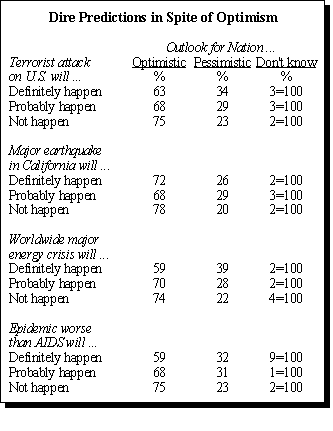
Interestingly, Americans tend to remain positive even when they expect to confront major perils such as terrorism, disease or an energy crisis. Thus, those who forecast grim events are likely to remain optimistic about their personal futures or the future of the U.S. For example, among those who say a terrorist attack on the U.S. will definitely occur, 63% are optimists; of those who believe such an attack won’t happen, 75% are optimists.
Similarly, of those who say an epidemic worse than AIDS will definitely sweep the globe, more than half (59%) are optimistic about America’s future.
However, optimists are more likely than average to endorse positive trends and less likely to agree with negative predictions. For example, roughly seven-in-ten optimists think that the education system will improve, but only half (51%) of national pessimists and 45% of those who are pessimistic about their own lives agree. Similarly, while just over half of optimists think the crime rate will go up, roughly three-quarters of pessimists say so.
This pattern does not always hold, however. For example, the belief that more babies will be born out of wedlock is shared by optimists and pessimists. And, the consensus about the growing division of wealth in society extends to both groups: At least two-thirds in each says that the gap between the rich and poor will grow.
Methodology
Results for the survey are based on telephone interviews conducted under the direction of Princeton Survey Research Associates among a nationwide sample of 1,546 adults, 18 years of age or older, during the period April 6 – May 6, 1999. For results based on the total sample, one can say with 95% confidence that the error attributable to sampling and other random effects is plus or minus 3 percentage points. For results based on either Form 1 (N=789) or Form 2 (N=757), the sampling error is plus or minus 4 percentage points.
In addition to sampling error, one should bear in mind that question wording and practical difficulties in conducting surveys can introduce error or bias into the findings of opinion polls.
Survey Methodology in Detail
The sample for this survey is a random digit sample of telephone numbers selected from telephone exchanges in the continental United States. The random digit aspect of the sample is used to avoid “listing” bias and provides representation of both listed and unlisted numbers (including not-yet-listed). The design of the sample ensures this representation by random generation of the last two digits of telephone numbers selected on the basis of their area code, telephone exchange, and bank number.
The telephone exchanges were selected with probabilities proportional to their size. The first eight digits of the sampled telephone numbers (area code, telephone exchange, bank number) were selected to be proportionally stratified by county and by telephone exchange within county. That is, the number of telephone numbers randomly sampled from within a given county is proportional to that county’s share of telephone numbers in the U.S. Only working banks of telephone numbers are selected. A working bank is defined as 100 contiguous telephone numbers containing three or more residential listings.
The sample was released for interviewing in replicates. Using replicates to control the release of sample to the field ensures that the complete call procedures are followed for the entire sample. The use of replicates also insures that the regional distribution of numbers called is appropriate. Again, this works to increase the representativeness of the sample.
At least five attempts were made to complete an interview at every sampled telephone number. The calls were staggered over times of day and days of the week to maximize the chances of making a contact with a potential respondent. All interview breakoffs and refusals were re-contacted at least once in order to attempt to convert them to completed interviews. In each contacted household, interviewers asked to speak with the “youngest male 18 or older who is at home.” If there is no eligible man at home, interviewers asked to speak with “the oldest woman 18 or older who is at home.” This systematic respondent selection technique has been shown empirically to produce samples that closely mirror the population in terms of age and gender.
Non-response in telephone interview surveys produces some known biases in survey-derived estimates because participation tends to vary for different subgroups of the population, and these subgroups are likely to vary also on questions of substantive interest. In order to compensate for these known biases, the sample data are weighted in analysis.
The demographic weighting parameters are derived from a special analysis of the most recently available Census Bureau’s Current Population Survey (March 1998). This analysis produced population parameters for the demographic characteristics of households with adults 18 or older, which are then compared with the sample characteristics to construct sample weights. The analysis only included households in the continental United States that contain a telephone.
The weights are derived using an iterative technique that simultaneously balances the distributions of all weighting parameters.