Pew Research Center

FOR RELEASE SEPTEMBER 10, 1998

GOP Image Improves, But Congressional Race Remains Close

Clinton Ratings Still Buoy Democrats

FOR MEDIA OR OTHER INQUIRIES:

Communications Department
202.419.4372
www.pewresearch.org

RECOMMENDED CITATION

Pew Research Center, September 1998, "GOP Image Improves, But Congressional Race Remains Close"

About Pew Research Center

Pew Research Center is a nonpartisan, nonadvocacy fact tank that informs the public about the issues, attitudes and trends shaping the world. It does not take policy positions. The Center conducts public opinion polling, demographic research, computational social science research and other data-driven research. It studies politics and policy; news habits and media; the internet and technology; religion; race and ethnicity; international affairs; social, demographic and economic trends; science; research methodology and data science; and immigration and migration. Pew Research Center is a subsidiary of The Pew Charitable Trusts, its primary funder.

© Pew Research Center 2026

Table of contents

  • About Pew Research Center
  • GOP Image Improves, But Congressional Race Remains Close
  • About this Survey
  • Other Important Findings

GOP Image Improves, But Congressional Race Remains Close

Clinton Ratings Still Buoy Democrats

Introduction and Summary

American voters divided their support for Republican and Democratic congressional candidates nearly equally in the weeks between President Clinton’s televised admission that he had an improper relationship with Monica Lewinsky and news of Independent Counsel Kenneth Starr’s report to Congress on the matter.

But with two months to go until the midterm elections, GOP prospects are being bolstered by significant improvements in the party’s national image, while Democrats are on shakier ground. Support for Democratic Party candidates continues to be closely tied to Clinton’s approval ratings, which so far have remained impervious to strong personal dislike of him and renewed public interest in the scandal.

Public esteem for Congress is at a very high level, and approval of the Republican congressional leadership now consistently outdistances disapproval for the first time since the 1995 government shutdowns. Today, the GOP congressional leadership gets a 44%-to-37% job approval rating, and House Speaker Newt Gingrich’s favorability rating has risen to 41% from 30% over the past year.

Consequently, the Republican Party’s image is better than it has been in 18 months. Pew’s latest national survey finds 56% of the public holding a favorable opinion of the GOP, up from 50% in March and 47% in August 1997. The survey also shows improved evaluations of Republicans relative to Democrats on five of 11 issue questions. Importantly for the GOP, the margin seeing Democrats as better able to handle education and health care has narrowed considerably since the spring. More positive views of Republicans by older people are an integral part of their current standing.

Republicans hold a slight edge over the Democrats in the generic House ballot measure. Two Pew surveys over the past month have found somewhat more support for Republican candidates than Democrats among likely voters. In the latest national survey conducted August 27-September 8, the GOP holds a 48%-to-45% edge, almost identical to the 47%-to-43% margin in a August 21-24 survey. The current survey of 2,266 adults has a margin of error of 2.5 percentage points.

The GOP has not widened its lead in popular support over the Democrats in part because of the strong correlation between Clinton’s job approval (61%) and voter backing of Democratic candidates. Today, there is a stronger relationship between opinion of Clinton’s job performance and congressional voting intentions than between opinion of the congressional leadership and voter sentiment.

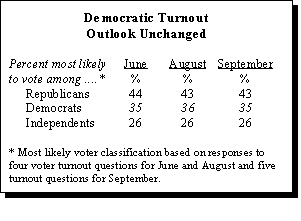
Speculation that interest in voting among core Democrats would decline in response to the Lewinsky scandal is not supported by the survey findings. Democrats were as likely to express interest in casting ballots as they were prior to the President’s August 17 admission of an inappropriate relationship with the White House intern.

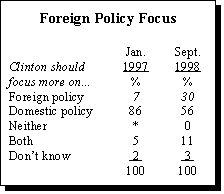
Through late August and early September, approval of Clinton’s job performance remained unaffected by his sagging personal image and the stock market’s flip flops. While there is strong public interest in news about the stock market and greater concern about foreign policy generally and Russia specifically, views about Clinton’s job performance and national conditions remain robust. The polling, which bracketed the stock market volatility, found no decline in economic confidence, no slide in satisfaction with the state of the nation and no dip in Clinton’s approval rating.

Impeachment Opposition

Americans overwhelmingly say that President Clinton should remain in office: 76% of the public today wants Clinton to complete his term. Moreover, a solid majority says (65%) that even if Clinton did lie under oath about his relationship with Lewinsky, he should not be impeached.

Most Americans (57%) also say that they would have an unfavorable opinion of Congress if it should begin impeachment hearings (31% very unfavorable, 26% mostly unfavorable). Of those people, 62% say Clinton’s actions were not serious enough to warrant impeachment; 27% say they do not want the country put through the process. Fully 90% say that even the support of their own representative for impeachment hearings would not change their view.

The public drew these conclusions in a period when they were relatively tuned in to the scandal: 36% were paying very close attention, up 10 percentage points since mid-August. Only 27% said they were not following the news closely or at all, down from 44% last month.

While Clinton’s job performance rating remains high at 61%, his personal connection to the American people shows a steady decline. Today, 64% of Americans say they do not like Clinton personally, up from 53% who felt this way in February soon after reports of the sex scandal broke.

Clinton’s overall support is underpinned by approval of his policies. Americans give Clinton credit for addressing the country’s major problems: 45% say he has made progress toward solving them and another 34% say he tried but failed. Fully 70% of the public likes his policies. But the number of people who say they like both Clinton and his policies slipped to 31% from 39% in early February.
About this Survey

Results for the survey are based on telephone interviews conducted under the direction of Princeton Survey Research Associates among a nationwide sample of 2,266 adults, 18 years of age or older, during the period August 27 – September 8, 1998. The sample included 1,754 registered voters and 838 likely voters. For results based on the total sample, one can say with 95% confidence that the error attributable to sampling and other random effects is plus or minus 2.5 percentage points. For results based on either Form 1 (N=1131) or Form 2 (N=1135), the sampling error is plus or minus 3.5 percentage points.

In addition to sampling error, one should bear in mind that question wording and practical difficulties in conducting surveys can introduce error or bias into the findings of opinion polls.

Other Important Findings

Congressional Ballot Remains Close

Republicans have not garnered a big boost with voters from either the ongoing Clinton scandal or the recent upswing in the GOP’s image. Support for the two parties remains split both among registered voters (45% Republican vs. 46% Democrat) and the more narrowly-defined group of most likely voters (48% Republican vs. 45% Democrat).

But at 46%, support for the Democratic ticket is down substantially from this year’s high of 52% among registered voters in March. The drop in support for Democrats is greatest in some of the party’s core constituencies, including low-income voters (down 10 percentage points).

The outlook for voter turnout also continues to favor GOP prospects. Some 43% of Republicans fall into the most likely to vote category, compared to 35% of Democrats and 26% of Independents.(1) At the same time, there are no signs that the scandal has dampened interest in voting among Democrats, as the percentage likely to go to the polls remained unchanged from June.

Indeed, fully 63% of voters continue to say Clinton will not be much of a factor in their vote. One-third of voters (34%) say state and local issues will make the biggest difference in their choices on Election Day, while nearly as many say the candidate’s character and experience (33%) as well as national issues (22%) will be factors. Party control of Congress will be a consideration for 41% of voters.

Overall, Congress gets higher marks than in recent months. Two-thirds (66%) of the public has a favorable opinion of Congress, up from 50% a year ago. Some 46% of registered voters would like to see most members of Congress reelected this fall (compared to 36% who would not), and 63% want to see their own representative returned to office.

Party Images

Americans view the Republican Party in a better light than they did six months ago. The party’s overall image has improved among all demographic groups, with pronounced jumps among senior citizens and Easterners. In March, seniors gave the Republican Party somewhat negative ratings (42% favorable vs. 48% unfavorable). Now, older people are solidly on the side of the GOP: 55% view the party favorably, 36% have an unfavorable impression. Similarly, while only 46% of Easterners viewed the GOP favorably in March, now fully 61% do.

Opinion of the Democratic Party remains basically unchanged. Fully 60% of the public rates the party favorably; in March, 58% did so.

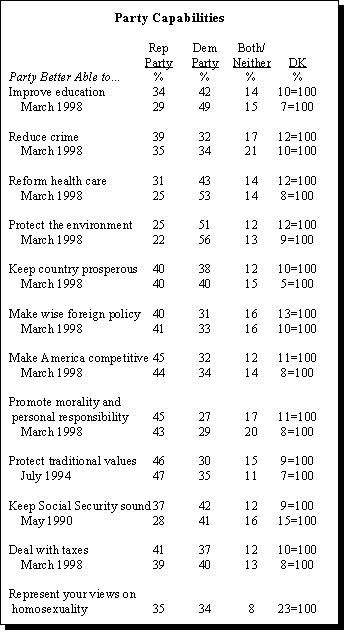
However, the GOP’s improved image has cut into the public’s support of Democrats in the policy arena. Americans’ confidence in the Republican Party’s ability to handle a variety of issues has either risen or remained steady across 11 areas. At the same time, the public has less confidence in the Democratic Party on several of these issues.

This Republican gain and Democratic loss is particularly pronounced for education, health care and Social Security, areas that traditionally favor Democrats. While the public still expresses relatively more confidence in the Democrats, their margin of support is less than half of what it was just 6 months ago. Americans opt for the Democratic Party over the GOP by just 8 percentage points for education and 12 percentage points for health care. In March, these margins were 20 and 28 percentage points, respectively.

Republicans have also made inroads into impressions of which party is better able to keep the Social Security system financially sound. In 1990, 41% of Americans favored the Democrats on this issue, compared to 28% who had more faith in the Republicans. Now, the gap is a slim 5 percentage points, with 42% placing more confidence in the Democratic Party and 37% favoring the GOP.

Moreover, Republicans have gained an advantage with the public on crime. Americans favor the GOP by a margin of 39%-to-32%; in March, they had equal confidence in the ability of the two parties to deal with the issue.

As with the party’s overall image, it is the movement of senior citizens to the GOP camp that is most striking. In March, senior citizens expressed more confidence in the Democratic Party over their Republican rivals by margins of 50%-to-20% for improving education, 49%-to-22% for reforming health care and 32%-to-21% for reducing crime. Now, the Democratic advantage among seniors has narrowed to 37%-to-30% for education and 39%-to-28% for health care. It has disappeared altogether for crime (30% favor GOP vs. 30% for Democrats).

On Voters’ Minds

The White House scandal has clearly moved to the forefront of the public consciousness. Fully 46% of Americans say they discuss the allegations frequently with family and friends. And, among those who are dissatisfied with the course of the country, the Clinton scandal and the broader issue of morality are their top concerns. One-in-five Americans (19%) volunteer the president’s current troubles as the reason they are dissatisfied with the way things are going in the country today. A similar proportion (18%) point to the nation’s moral crisis. The economy topped the list of complaints in 1995 and 1996. Today, it is a distant third behind these moral concerns.

Fully half of Americans say they frequently discuss declining moral standards with family and friends, ranking it first on a list of 13 issues in the poll ranging from crime to the coming of the millennium. Education follows morality as the most talked about issue: 48% discuss it frequently. Close behind is the Clinton scandal. Other popular issues are health insurance and HMOs, crime, terrorism, and taxes.

Republicans place much more emphasis on morality and the Clinton scandal than do Democrats. Fully 63% of Republicans discuss morality frequently compared to 42% of Democrats; 59% of Republicans discuss the scandal vs. 39% of Democrats. A similar pattern can be seen between likely midterm voters and nonvoters, with voters much more focused on the moral issues.

Heightened concern about moral issues has not affected the public’s issue agenda. When asked what one issue they would like to hear the candidates in their state or district talk about, education tops the list, followed by taxes, crime, the economy and health care. This is largely unchanged from June.

No Gender Gap for Gore

Early preferences for the 2000 presidential election carry bad news for Democrats — especially for Vice President Al Gore. Although the vice president’s 57% favorability rating remains largely unchanged from earlier this year, Gore trails Texas Governor George W. Bush in voter preference for the next presidential election by a 53%-to-40% margin.

The presidential race is much closer when voters are simply asked to choose between a Democrat and a Republican, rather than between party frontrunners Gore and Bush. Given the choice of party only, 43% favor a Democratic candidate and 42% pick a Republican.

Notably, the prospect of a Bush candidacy eliminates the gender gap that traditionally boosts Democratic candidates. Bush enjoys a slight edge over Gore among women (48% vs. 44% favoring Gore), even as women support a generic Democrat over a Republican by a 47%-to-38% margin.

Selected Tables