Education, Crime, Social Security Top National Priorities
About Pew Research Center
Pew Research Center is a nonpartisan, nonadvocacy fact tank that informs the public about the issues, attitudes and trends shaping the world. It does not take policy positions. The Center conducts public opinion polling, demographic research, computational social science research and other data-driven research. It studies politics and policy; news habits and media; the internet and technology; religion; race and ethnicity; international affairs; social, demographic and economic trends; science; research methodology and data science; and immigration and migration. Pew Research Center is a subsidiary of The Pew Charitable Trusts, its primary funder.
Education, Crime, Social Security Top National Priorities
Introduction and Summary
In his sixth State of the Union next week, President Clinton will face an American public that retains a healthy appetite for government activism — fully two-thirds advocate spending any budget surplus this year. But that enthusiasm is tempered by often sharp generational differences on federal spending priorities.
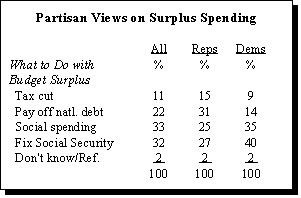
In a clear signal about what not to do with any federal surplus, few Americans would use it to help pay off the federal debt more quickly (22%) and even fewer would devote it to a tax cut (11%). But those prepared to spend the excess revenue divide equally over how to do so: 33% favor new spending on such domestic programs as health, education and the environment; 32% support spending to make the Social Security and Medicare programs financially sound.
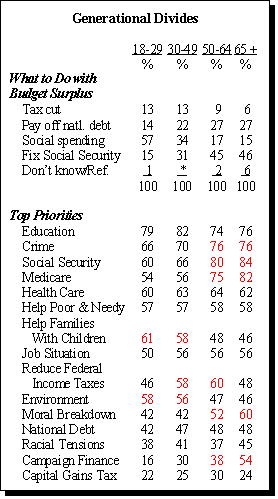
Reflecting broader generational divisions on many policy issues, Americans under 50, particularly Generation Xers, would increase social spending, while older Americans would fix Social Security and Medicare. A similar generation gap is apparent on Clinton’s proposal to extend Medicare to Americans aged 55-64. Younger Americans heartily favor the idea, while a plurality of seniors oppose the proposal. As a result, public opinion is mixed: 51% favor the Clinton initiative; 41% oppose it.
While fixing Social Security and improving the educational system are high priorities for Americans of all ages, Social Security is No. 1 for those over age 50, while education tops the list for younger Americans. Older Americans also place a much higher priority than those under age 50 on dealing with the larger moral breakdown in the country and reforming the campaign finance system. Younger Americans are more likely to cite dealing with the problems of families with children and improving the environment. People aged 30-64 are particularly interested in reducing federal incomes taxes for the middle class.
These are among the most important currents in public opinion according to the latest Pew Research Center survey, conducted January 14-18. As the second session of the 105th Congress opens, the public expresses record levels of personal contentment and relatively high levels of satisfaction with the country. President Clinton’s approval stood at 61% in a poll conducted in part on the weekend of his deposition in a sexual harassment lawsuit. The poll also found good news for Congress: A lofty 66% of Pew Research Center respondents said that their representative deserves reelection.
Other Important Findings and Analyses
Public satisfaction with the state of the nation has lifted out of the doldrums of the early 1990s, with 46% today saying they are satisfied. While this is up 20% points or more from the period 1993 through mid-1996, half of all Americans (50%) still describe themselves as dissatisfied with the way things are going. Evangelical Christians and Clinton detractors are among the least satisfied.
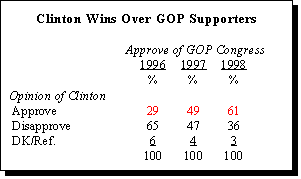
Support for the political establishment in Washington, however, is strong. Clinton’s base of support was extremely broad in the days leading up to and including his testimony in the Paula Jones case. No major demographic group fell below the 58% mark in presidential approval. Moreover, even among those who identify themselves as Republican loyalists, 36% approved of the job he was doing, up 13% points from January 1996. Over the last two years, Clinton has gained the most ground among high income Americans, white males, college graduates and surburbanites. (See table page 12.)
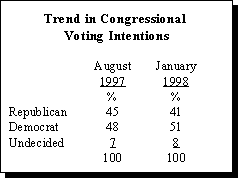
The president’s popularity may be contributing to an uptick in support for Democratic candidates on a generic congressional ballot. Today, the public prefers Democrats over Republicans by a 10% point margin — 51% vs. 41%. In August, the two parties were in a statistical dead heat — 48% Democrat vs. 45% Republican.
Democrats continue to benefit from a wide gender gap. Women prefer Democratic congressional candidates over Republicans by a margin of 54% to 38%. Men divide evenly between the two — 47% Democrat, 45% Republican. Democrats also lead by comfortable margins among other traditional party constituencies such as non-whites and those with low incomes and low levels of education. Republicans lead Democrats only among young people and those in the highest income bracket.
This Democratic strength, however, must be weighed against the public’s even stronger inclination toward reelecting incumbents, most of whom are Republican. Two-thirds of the public (66%) say they would like to see their own representative reelected in 1998 — a higher margin than observed in Center and Gallup surveys in 1996, 1994 and 1990. Republicans at present hold a 227-203 majority in the House of Representatives.
Underlying the widespread support for the current political establishment is evidence that the public has grown comfortable with divided government in Washington. The strong relationship that existed just two years ago between presidential approval and disapproval of Republican congressional leaders has diminished. Today, fans of the GOP leadership in Congress are no different than average Americans when it comes to support for Clinton, and his supporters are no different than the public at-large in their evaluations of Republican leaders. A quarter of the public (26%) approve of both Clinton and the GOP leaders in Congress.
Education, Crime, Social Security Top Agenda
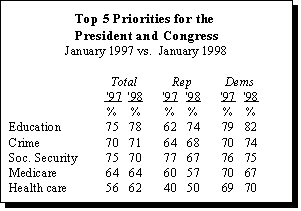
Improving the educational system, reducing crime and fixing Social Security remain at the top of the public’s agenda for President Clinton and Congress in 1998. For the second year in a row, at least 70% of Americans list each of these areas as a “top priority.” The strong economy has apparently eased concern about the job situation, which fell off the public’s top five list and was replaced by health care reform. Fully 62% of Americans now rank health care as a top policy priority.
The increase in support for reforming health care was greater among Republicans than Democrats. Fully 50% list health care reform as a top priority today, up 10% points from a year ago. Similarly, nearly three-in-four Republicans (74%) listed education as a priority, a 12% point increase in the last year.
Democrats continue to express even more support for government action in each of these areas. Fully 70% of Democrats rate health care reform as a top priority, outdistancing GOP support by 20% points. Similarly, three-in-four Democrats say making the Social Security system financially sound should be a priority, compared to 67% of Republicans. In fact, Republicans significantly outnumber Democrats in their support for only two of 15 issues included in the poll — paying off the national debt and cutting the capital gains tax.
Improving the educational system, the public’s top priority for 1998, also draws substantially more support from women than from men (82% vs. 74%) and greater support from blacks than whites (90% vs. 76%). Women and blacks place a higher priority on most other issues as well and are substantially more likely to say a budget surplus should be used for increased spending on domestic programs.
Crime, Rates Notwithstanding
Crime continues to be near the top of the public’s priority list. While overall crime statistics show a downward trend, the public is tuned in to crime news. Asked to name the “first news story that comes to mind,” 17% of Americans mentioned stories involving drugs, murders or other crimes — as many as mentioned the situation in Iraq and more than mentioned the weather or Paula Jones.
Despite the attention to campaign finance scandals generated by several congressional investigations last year, the public remains ambivalent about reforming the system. Less than one-third of Americans (32%) listed campaign finance reform as a “top priority,” while nearly as many (29%) said the issue is “not too important” or “should not” be dealt with this year.
As President Clinton seeks to lead a national discussion about race relations in the U.S., white and black Americans are becoming even more polarized in their level of concern about racial issues. More than two-thirds of blacks (68%) listed reducing racial tensions as a top priority for Clinton and Congress this year, about the same as a year ago. But only 36% of whites said addressing race relations should be a top priority — a drop of 12% points in the last year.
Surplus Spending
Women are far more likely than men to support spending any federal budget surplus. Nearly three-quarters of women (73%) support using any excess revenue for increased spending on domestic programs and entitlements, compared to 57% of men. Less than one-in-five women (18%) would pay off the debt more quickly; a quarter of men would do so (26%). Only 7% of women back a tax cut, twice as many men favor that approach (15%).
Tax cuts and reducing the national debt are more attractive to Republicans than to Democrats, if there is a federal budget surplus this year. Nearly half of those who describe themselves as Republicans would prefer a tax cut or national debt reduction to increased spending (47%), compared to less than a quarter of Democrats who feel that way (23%). In contrast, three-in-four Democrats would spend a budget surplus on domestic programs or Social Security, while just a bare majority of Republicans (52%) would do so.
There are also large differences between older and younger Americans over how to use a possible budget surplus. Nearly half of those 50 and older (46%) would use the surplus to make Social Security and Medicare financially sound, while most of those under 30 (57%) favor increased spending on domestic programs. Americans between the ages of 30 and 49 are more evenly divided, with 34% favoring increased spending, 31% for entitlement reform and 22% for paying off the national debt more quickly.
Support for Clinton Child Care Initiatives
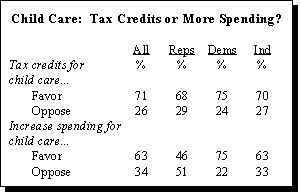
The child care initiative proposed this month by President Clinton draws high marks. Seven-in-ten Americans favor tax credits to help working parents defray the costs of child care, including 68% of Republicans and 74% of Democrats. But another piece of Clinton’s initiative, increased spending for child care, fails to draw the same bipartisan support. While 75% of Democrats favor more spending for child care programs, Republicans oppose the idea by a 51%-46% margin. Both child care proposals also draw less support from seniors than from younger Americans. Even the popular tax credit initiative draws just 49% support among those 65 or older.
The public is less enthusiastic about a Clinton proposal that would expand Medicare by allowing Americans between the ages of 55 and 64 to buy into the federal health insurance program. A majority of Democrats (56%) favor the proposal, while Republicans split 48%-46% against the expansion. The initiative draws slightly more support from those in the 50 to 64 age-group (55%) and from those under 30 (58%).
Americans’ wariness of international trade agreements is evidenced in across-the-board opposition to legislation that would give the President expanded “fast-track” authority to negotiate free trade agreements. While Republicans oppose the legislation by a nearly four-to-one margin (78% to 21%), those in the President’s own party are also strongly against giving Clinton “fast-track” authority (61% to 33%).
Meanwhile, the public also disapproves of Clinton’s decision to keep U.S. troops in Bosnia beyond the original deadline by a 50%- 43% margin. Democrats and Independents are evenly divided on Clinton’s extension of the deadline, while Republicans oppose the decision by a wide margin (60% vs. 36% disapprove).
News Interest Index
Despite several national criminal trials and new Clinton Administration proposals, interest in the news remained low this month. Of the 10 items on the News Interest Index, only two — the conflict in Iraq (32%) and the sentencing of Terry Nichols (24%) — were followed “very closely” by a quarter of the public, the average for most major news stories in past years. Last November, when the United States and Iraq were embroiled in a similar dispute over the U.S. role in international weapons inspection teams, a significantly larger proportion of the public (44%) followed the story “very closely.”
Similarly, the big criminal cases of early 1998 are capturing less interest than earlier trials. Although 39% very closely followed the sentencing of Timothy McVeigh in the Oklahoma bombing case last June, only a quarter of the public (24%) followed the sentencing of fellow defendant Nichols that closely. An even smaller number (18%) very closely followed the pre-trial activity in the case against Theodore Kaczynski, the accused “Unabomber.”
Fewer than one-in-five Americans paid very close attention to Clinton’s plan to expand Medicare benefits (18%), his child care initiatives (16%) or even the broader debate about reforming the Social Security system (18%). Less than half of the public said they paid at least fairly close attention to these stories.
Major news stories about public health or medical issues were only slightly more popular. Half of the public paid some attention to news stories about the Chicago scientist who plans to open a clinic for cloning people (50%) and the outbreak of an Asian flu caused by birds or chickens (55%). Again, however, interest was lackluster; both stories were followed “very closely” by only one-in-five people.
Among these top stories, men paid closer attention than women to the situation in Iraq (38% vs. 27% following very closely), fluctuations in the U.S. stock market (26% vs. 16%) and the financial crisis in Asia (20% vs. 11%). Older Americans paid more attention than their younger counterparts to all of the News Interest Index items, but the differences between those 50 and up and the under 30 crowd were especially sharp for stories about Iraq (14% point difference between those following very closely), Medicare (16% point difference) and the debate over Social Security reform (21% point difference).
Most Americans say Washington based news stories are hard to follow. Fully 61% of the public find stories about what is going on in Washington to be “confusing and unclear.” Predictably, people who find Washington-based stories clear pay more attention to most major news than the majority who find these news accounts confusing.
Talk of Weird Weather
Despite the relative lack of interest in the top news stories this month, a full two-thirds of the public (67%) attest to following the news closely “most of the time, whether or not something important or interesting is happening.” And they stop to talk about the news.
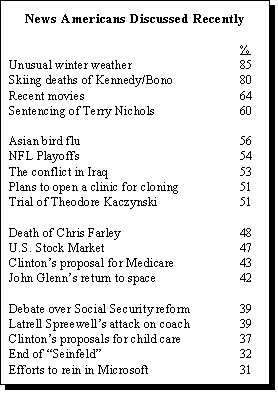
The most popular news items for discussion among friends and family were the unusual winter weather (discussed by 85% of the public) and the skiing accidents of Michael Kennedy and Sonny Bono (discussed by 80%). Recent movies such as “Titanic” and “Amistad” placed third, a topic of conversation among two-thirds of the public (64%), followed by the Terry Nichols trial (discussed by 60%).
The range of items discussed varies greatly from sports to health and medical news to international crises. Slightly over half of the American public has talked about the Asian bird flu (56%), the NFL playoffs (54%), the situation in Iraq (53%), the Chicago scientist’s plan to open a clinic for cloning people (51%) and the trial of Theodore Kaczynski (51%).
Conversely, despite the media attention accorded Jerry Seinfeld’s decision to end his popular television show after this season, less than one-third of the public (32%) discussed it with family or friends. People were more likely to discuss Clinton’s proposals for Medicare (43%) and child care (37%).
Women were more apt to talk about the Asian bird flu than men (62% vs. 48%) and the cloning clinic (58% vs. 44%). Men talked sports more than women. Almost half of men (47%) but less than a third of women (31%) discussed basketball player Latrell Spreewell’s attack on his coach. Fully 62% of men discussed the NFL playoffs vs. 48% of women. But, the differences between the genders was less than that between generations: 65% of the 18-29 age group talked about the football playoffs; only 37% of those 65 and older did so.
Forty percent of computer users discussed efforts to rein in the power of Microsoft, compared to only 15% of non-computer users. Younger Americans also talked about Microsoft more than their elders: 38% of those under 30 discussed the software giant, compared to 20% of those 65 and older.
Methodology
Results for the main survey are based on telephone interviews conducted under the direction of Princeton Survey Research Associates among a nationwide sample of 1,218 adults, 18 years of age or older, during the period January 14-18, 1998. For results based on the total sample, one can say with 95% confidence that the error attributable to sampling and other random effects is plus or minus 3 percentage points. For results based on either Form 1 (N=614) or Form 2 (N=604), the sampling error is plus or minus 4.5 percentage points.
In addition to sampling error, one should bear in mind that question wording and practical difficulties in conducting surveys can introduce error or bias into the findings of opinion polls.
Survey Methodology in Detail
The sample for this survey is a random digit sample of telephone numbers selected from telephone exchanges in the continental United States. The random digit aspect of the sample is used to avoid “listing” bias and provides representation of both listed and unlisted numbers (including not-yet-listed). The design of the sample ensures this representation by random generation of the last two digits of telephone numbers selected on the basis of their area code, telephone exchange, and bank number.
The telephone exchanges were selected with probabilities proportional to their size. The first eight digits of the sampled telephone numbers (area code, telephone exchange, bank number) were selected to be proportionally stratified by county and by telephone exchange within county. That is, the number of telephone numbers randomly sampled from within a given county is proportional to that county’s share of telephone numbers in the U.S. Only working banks of telephone numbers are selected. A working bank is defined as 100 contiguous telephone numbers containing three or more residential listings.
The sample was released for interviewing in replicates. Using replicates to control the release of sample to the field ensures that the complete call procedures are followed for the entire sample. The use of replicates also insures that the regional distribution of numbers called is appropriate. Again, this works to increase the representativeness of the sample.
At least four attempts were made to complete an interview at every sampled telephone number. The calls were staggered over times of day and days of the week to maximize the chances of making a contact with a potential respondent. All interview breakoffs and refusals were re-contacted at least once in order to attempt to convert them to completed interviews. In each contacted household, interviewers asked to speak with the “youngest male 18 or older who is at home”. If there is no eligible man at home, interviewers asked to speak with “the oldest woman 18 or older who lives in the household”. This systematic respondent selection technique has been shown empirically to produce samples that closely mirror the population in terms of age and gender.
Non-response in telephone interview surveys produces some known biases in survey-derived estimates because participation tends to vary for different subgroups of the population, and these subgroups are likely to vary also on questions of substantive interest. In order to compensate for these known biases, the sample data are weighted in analysis.
The demographic weighting parameters are derived from a special analysis of the most recently available Census Bureau’s Current Population Survey (March 1996). This analysis produced population parameters for the demographic characteristics of households with adults 18 or older, which are then compared with the sample characteristics to construct sample weights. The analysis only included households in the continental United States that contain a telephone.
The weights are derived using an iterative technique that simultaneously balances the distributions of all weighting parameters.