
America’s Place in the World II
More Comfort with Post-Cold War Era; Opinion Leaders Say, Public Differs
Introduction and Summary
The post-Cold War era may be less than a decade old, but Americans whose views help shape U.S. foreign policy have grown remarkably comfortable with it. Compared to four years ago when they were deeply troubled, American Opinion Leaders today see the world as a better place, where U.S. influence is enhanced and there are fewer worries about potential trouble spots. In striking contrast, the American public’s global view remains bleak.
Among Opinion Leaders, a substantial increase in confidence in the Clinton administration plays a significant part in this decidedly different climate of opinion. Four years ago, the then-new president received at best a mixed review from a similar group of Influential Americans. Today solid majorities in each group — ranging from corporate CEOs to religious leaders — approve of his overall performance in office. Specifically, Influential Americans credit Clinton for his trade policies, handling of Bosnia and for the quality of his foreign policy appointments.
The public shares this much improved opinion of President Clinton and his foreign policy, but those sentiments have not affected its view of the world. Opening a new and dramatic opinion gap with America’s Opinion Leaders, the general public remains dissatisfied with world conditions and sees no change in America’s influence. The dichotomy between ordinary Americans and Opinion Leaders in part may reflect the public’s scant knowledge of international affairs and a media focus on violence, conflict and instability.
Moreover, most Americans fundamentally doubt the relevance of international events to their own lives. While the percentage of people holding isolationist views did not increase (as it had in previous surveys in this series), majorities — sometimes large majorities — say events in Europe, Mexico, Asia and Canada have little or no impact on them.
These are the principal findings of a four year trend survey that included foreign affairs and security experts, journalists, scholars, scientists, religious leaders, governors and mayors, top business executives, Congressional staff and labor leaders. The Center interviewed nearly 600 of these Opinion Leaders (or Influentials) culled from these ten different groups or professions for the report. A representative sample of two thousand adults was surveyed by phone between September 4 and 11 as well.
A Post, Post -Cold War View
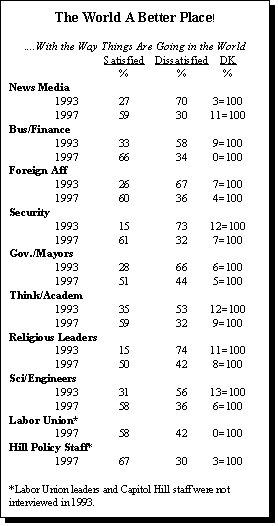
Influential Americans are much more confident about this country’s place in the world now compared to four years ago when they were anxious about the future in the wake of the collapse of the Soviet Union. They are also much more satisfied with the way things are going both in the world and in the United States.
Twice as many Americans in leadership positions believe the United States plays a more important role in the world today than thought so in 1993 when the Center conducted its first poll in this series. Four out of five still prefer a shared leadership role for the nation, but several Influential groups are now more inclined to say the United States should be the single world leader.
Far more are willing to keep defense spending the same than four years ago, 50% vs. 31%, with even some greater sentiment for actually increasing it, despite the lack of an enemy that structured the overarching national strategy of Cold War years. Most of the Influentials surveyed support the current level of preparedness as consistent with U.S. strategy of being able to fight two wars, in Europe and in Asia, at the same time.
American Opinion Leaders have also changed their mind on Bosnia, although not to such a significant degree. Bosnia was the foreign policy issue on which Influentials were most critical of President Clinton four years ago. Now a plurality rate U.S. efforts to bring peace to the Balkans only fair, about on a par with U.S. efforts to deal with China as an emerging world power, but this is higher than they grade U.S. efforts to cope with several other foreign policy problems such as stopping the flow of illegal immigrants or protecting the global environment. Moreover, majorities in all Influential groups, often large majorities, would support extending the U.S. military mission in Bosnia if peace depended on its presence.
The Public Differs
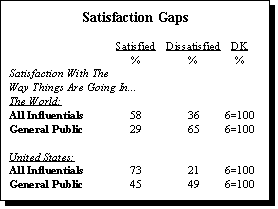
The public, in contrast, does not see a more rosy world. Whereas four years ago the public and the Influentials were essentially in lock-step in their sour evaluation of world conditions (only 28% and 25% satisfied, respectively), the public today remains unchanged in its assessment (29% satisfied) while the Opinion Leaders register 58% satisfaction. Similarly, the public and the Influentials were close together four years ago in assessing the nation (20% and 25% satisfied, respectively); while both are more satisfied now in this respect, the public is considerably less positive than the Opinion Leaders (45% and 73% satisfied, respectively).
The American public does not think the United States today plays a greater global role than it did a decade ago. It is no more inclined to have the United States act as single world leader than before, nor any more generous with money for the military (although support for keeping spending at current levels remains high at 57%). It is also no more willing to use U.S. forces abroad in potential trouble spots than it was four years ago.
Average Americans are not enamored by U.S. activities in Bosnia, either. Barely half (48%) would support continuing the mission of American forces there even if it was necessary to keep the peace. A larger percentage (61%) does not believe U.S. and other NATO forces have improved chances so far for a permanent end to the fighting in the Balkans. A majority (55%) complains that Clinton has not adequately explained the purpose of U.S. forces there, up significantly in two years.
China: A Problem, Not An Adversary
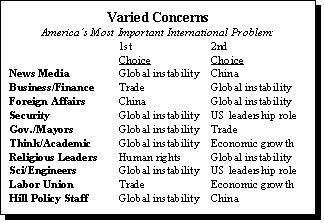
American Influentials in the Pew Center survey also express little alarm about international problems. Concerns about global instability, including nuclear proliferation, continue to be the greatest general worries. China is the one geo-political problem that attracts most attention. But in a number of ways Opinion Leaders express only moderate concern about most other potential problems.
- Pluralities in eight of the ten Influential groups polled see less chance of an attack on the United States with weapons of mass destruction now compared to ten years ago. Security experts notably take a more pessimistic view– with a 63% majority seeing a greater chance of attack. All Influential groups see much less risk of a nuclear exchange between India and Pakistan than they did in 1993.
- Quebec’s secession from Canada is deemed unlikely despite the near success of the separatist referendum two years ago; and if Quebec does secede, only minor difficulties are anticipated for the United States as a result.
- Most Opinion Leaders are sanguine about the effects of European economic and political integration on the U.S.
- Few envision a civil war in Turkey.
While Influentials are twice as certain as in 1993 that China will become an assertive world power, most regard China as a serious problem rather than an adversary. Most are optimistic about the continued economic prosperity in Hong Kong under mainland rule. Opinion Leaders would advocate significant change in U.S. policy toward China after rather grave actions such as invading Taiwan or eliminating civil liberties in Hong Kong.
Significant majorities of all Opinion Leader groups would oppose U.S. insistence on applying American human and civil rights standards throughout the world if it seriously risked antagonizing friendly nations that follow different traditions. But there is a hint of increased priority being placed on protecting weaker nations against foreign aggression even if U.S. vital interests are not at stake.
Absent the single enemy that united disparate interests during the Cold War, Opinion Leaders surveyed show markedly different degrees of willingness to use America’s military might in potential conflict situations. Majority support increased in favor of the use of U.S. forces in two of the four cases posed — if Iraq invaded Saudi Arabia and if Arab forces invaded Israel — and remains steady in the case of North Korea invading South Korea. Majorities of all but one Influential group oppose the fourth case — use of force if the Mexican government were falling to revolution or civil war.
Nuclear Proliferation And Energy Top Goals
The consensus among Influentials on the greatest dangers to world stability remains much the same as four years ago: nationalism and ethnic hatred followed by proliferation of weapons of mass destruction. Reflecting these worries, Influentials overwhelmingly want the main U.S. foreign policy goal to be halting the spread of weapons of mass destruction: fully 86% give it top priority. Second, also as it was four years ago, is insuring adequate energy supplies for the United States (61%). Third is combating international drug trafficking. Fewer respondents now see strengthening the United Nations as a top priority goal. Reducing foreign trade deficits also has lost urgency.
Improving the global environment rates much higher for Union leaders, Governors and Mayors, and Scientists than for Business leaders or Security experts. Improving living standards in developing nations receives much greater support from Religious leaders than from any other group. Reducing foreign trade deficits looms as much more important for Governors and Mayors.
Other notable attitudes found among American Opinion Leaders include:
- Majorities, usually large majorities, endorse the expansion of NATO into Central Europe. Least enthusiasm for the move comes from the Security and Foreign Affairs groups, with Security experts only marginally in favor of including Hungary, Poland and the Czech Republic. There is somewhat less support among Opinion Leaders for a second round of expansion, though majorities in most groups remain in favor, with the Security and Foreign Policy experts again most dubious.
- Overwhelming majorities believe NAFTA is a good thing, except Labor Union leaders, more than two thirds of whom say it is a bad thing. Smaller majorities in most Influential groups favor extending the pact to other Latin American counties. Here again, Union Leaders are the exception — three to one against it. Governors and Mayors, while supportive overall, are the next most reserved about expansion of the free trade association.
- Majorities, sometimes large majorities, of Influentials favor either major reforms of the Central Intelligence Agency or its outright abolition in favor of a new agency. Capitol Hill staffers oppose abolition and lean more than other groups to only minor reforms.
The Public’s Agenda
Public responses suggest that it has not yet caught up to changed conditions over the past few years. While the public at large continues to have a gloomy international outlook, the very small percentage of Americans who are well informed about foreign affairs and have a college degree (about 4% of all Americans) have a positive view of world conditions — one that approaches that of Opinion Leaders. (See page 14.)

Much of the broader public also does not consider foreign affairs important to their lives. Majorities of varying sizes say events in Europe, Asia, Mexico and Canada have little or no impact on them. Similarly large majorities say the news media carries about the right amount of foreign news. Knowledge of international policy and events is minimal. Fully 63% support expansion of NATO, but only 10% can correctly name any one of the three nations to be admitted.
As found four years ago, the public differs with Influentials on the top U.S. foreign policy priority. Protecting American jobs is given most priority, an effort which draws comparatively little attention among Influential groups except for Union leaders and Governors and Mayors. After this bread and butter issue, the public falls into line with Opinion Leaders, giving high priority to preventing nuclear proliferation, as well as to issues with domestic effects such as stopping drug trafficking, protecting U.S. energy supplies and safeguarding the global environment.
Sample
The purpose of the Pew Center survey was primarily to learn what America’s leadership elites believe America’s role in the post Cold War world should be. These leadership respondents, whom we call America’s Influentials or Opinion Leaders, consisted of 591 men and women chosen from recognized lists of top individuals in various fields or by virtue of their leadership positions.1
The Business and Finance group consisted of chief executive officers in industry and finance picked at random from these categories of Fortune 1000’s list of leading companies. The Foreign Affairs group was selected at random from the membership list of the Council on Foreign Relations. The Security group was selected at random from the list of American members of the International Institute for Strategic Studies. The Science and Engineering group was picked at random from members of the National Academy of Sciences and the National Academy of Engineers. Governors and mayors were chosen from among the fifty state governors and mayors of cities with populations over 80,000.
Among respondents selected on a non-random basis, Academics were taken from a list of leaders of the private universities rated as “most difficult” to enter and those state universities rated as “very difficult” to enter. The Think Tank portion of the Academic sample included the heads of major think tanks listed in The Capitol Source. Religion respondents were selected from the leadership of, among others, all Protestant denominations with memberships over 700,000; each of the 33 Catholic Archdioceses of the country; and the three mainstream Jewish movements. Media respondents were selected from among top individuals in television, newspapers, radio and news magazines. Union Leaders were selected from top officials of the nation’s 50 largest unions. And the Capitol Hill staff were selected from committees handling international affairs and the personal staffs of members serving on such committees.
PUBLICS INTERVIEWED
- General Public (2000)
- Media (73)
- Business and Finance (35)
- Foreign Affairs (69)
- Security (57)
- Governors and Mayors (75)
- Think Tanks and Academics (93)
- Religious Leaders (36)
- Science and Engineering (92)
- Labor Union (24)
- Congressional staff (37)
Demographically, Influential respondents were mostly male, white and highly educated: 94% held university degrees, including 27% with masters degrees and 46% with doctorates. About one third (34%) had served in the military. Democrats outnumbered Republicans 41% to 26% overall, with another 32% self-described Independents. Half the sample (50%) described themselves as moderates, with another 27% describing themselves as liberal and 20% as conservative. The 1997 Influential sample closely parallels the 1993 sample in all respects.
The parallel public survey was undertaken to compare with the Influentials. It polled 2,000 adults who form a cross-section of American society in all of the various demographic measures.


