Pew Research Center

FOR RELEASE AUGUST 20, 2025

How Americans View Journalists in the Digital Age

Americans largely value journalists’ role in society but see their influence declining – and often differ over who fits the label

BY Kirsten Eddy, Michael Lipka, Katerina Eva Matsa, Naomi Forman-Katz, Jacob Liedke, Christopher St. Aubin and Luxuan Wang

FOR MEDIA OR OTHER INQUIRIES:

Communications Department
202.419.4372
www.pewresearch.org

RECOMMENDED CITATION

Pew Research Center, August 2025, "How Americans View Journalists in the Digital Age"

About Pew Research Center

Pew Research Center is a nonpartisan, nonadvocacy fact tank that informs the public about the issues, attitudes and trends shaping the world. It does not take policy positions. The Center conducts public opinion polling, demographic research, computational social science research and other data-driven research. It studies politics and policy; news habits and media; the internet and technology; religion; race and ethnicity; international affairs; social, demographic and economic trends; science; research methodology and data science; and immigration and migration. Pew Research Center is a subsidiary of The Pew Charitable Trusts, its primary funder.

© Pew Research Center 2026

Table of contents

  • About Pew Research Center
  • How Americans View Journalists in the Digital Age
  • 1. What do Americans want from their news providers?
  • 2. What makes someone a journalist?
  • 3. How Americans view journalists and their role in society
  • 4. How do Americans think journalists should act?
  • Acknowledgments
  • Methodology

How Americans View Journalists in the Digital Age

Americans largely value journalists’ role in society but see their influence declining – and often differ over who fits the label

How we did this

Pew Research Center has been studying how Americans get news and information for many years, and it has become clear that journalists’ place in society has been changing amid major political and technological shifts. So we asked everyday people for their views on this topic, including how they define a “journalist,” how they view journalists’ role in America, and what they want from their news providers more broadly (whether they are journalists or not).

We used two different methods to explore Americans’ understandings of what it means to be a journalist in the digital age:

Survey

We surveyed 9,397 U.S. adults from April 14 to 20, 2025. Everyone who took part in this survey is a member of the Center’s American Trends Panel (ATP), a group of people recruited through national, random sampling of residential addresses who have agreed to take surveys regularly. This kind of recruitment gives nearly all U.S. adults a chance of selection. Interviews were conducted either online or by telephone with a live interviewer. The survey is weighted to be representative of the U.S. adult population by gender, race, ethnicity, partisan affiliation, education and other factors. Read more about the ATP’s methodology.

Here are the questions used for this report, the topline and the survey methodology.

Focus groups

Pew Research Center worked with PSB Insights to conduct nine 90-minute online focus groups with a total of 45 U.S. adults from June 10 to 18, 2025. These discussions are not nationally representative, and the results are not framed in quantitative terms. This report includes findings and quotes from the focus groups to help illustrate and add nuance to the survey findings. Quotes were lightly edited for spelling, punctuation and clarity. To learn more, refer to the methodology.

As Americans navigate an often-overwhelming stream of news online – some of it coming from nontraditional news providers – what it means to be a journalist has become increasingly open to interpretation.

That is apparent in several ways in a new Pew Research Center study. Who Americans see as a “journalist” depends on both the individual news provider and the news consumer, similar to the variety of ways people define “news.”

Bar chart showing mixed views about whether people who produce various types of news content are journalists

There is a lack of consensus – and perhaps some uncertainty – about whether someone who primarily compiles other people’s reporting or offers opinions on current events is a journalist, according to a new Center survey. Americans are also split over whether people who share news in “new media” spaces like newsletters, podcasts and social media are journalists.

In some ways, Americans’ ideas about journalists are still tied to what the news industry looked like in the 20th century. When asked who comes to mind when they think of a journalist, many everyday Americans who participated in our focus groups said they think of traditional TV newscasters like Walter Cronkite and Tom Brokaw, modern anchors like Lester Holt and Anderson Cooper, and even fictional characters like Clark Kent.

Most Americans say journalists are at least somewhat important to the well-being of society. At the same time, many are critical of journalists’ job performance and say they are declining in influence, an opinion that follows years of financial and technological turmoil in the news industry. And many views toward journalists continue to be sharply divided by political party, with Republicans taking a more skeptical view of the profession than Democrats.

As part of our broader study of how Americans get news and information nowadays, we wanted to know what people think about the role of journalists in the digital age – including what makes someone a journalist, what Americans think is important for journalists to do in their daily work, and what backgrounds and attributes people are looking for in their news providers broadly (whether they are journalists or not). So earlier this year, we posed these questions in a survey of more than 9,000 Americans and in online focus groups with 45 U.S. adults.

Related: Americans’ Complicated Relationship With News

Americans want honesty, accuracy and topical knowledge from their news providers

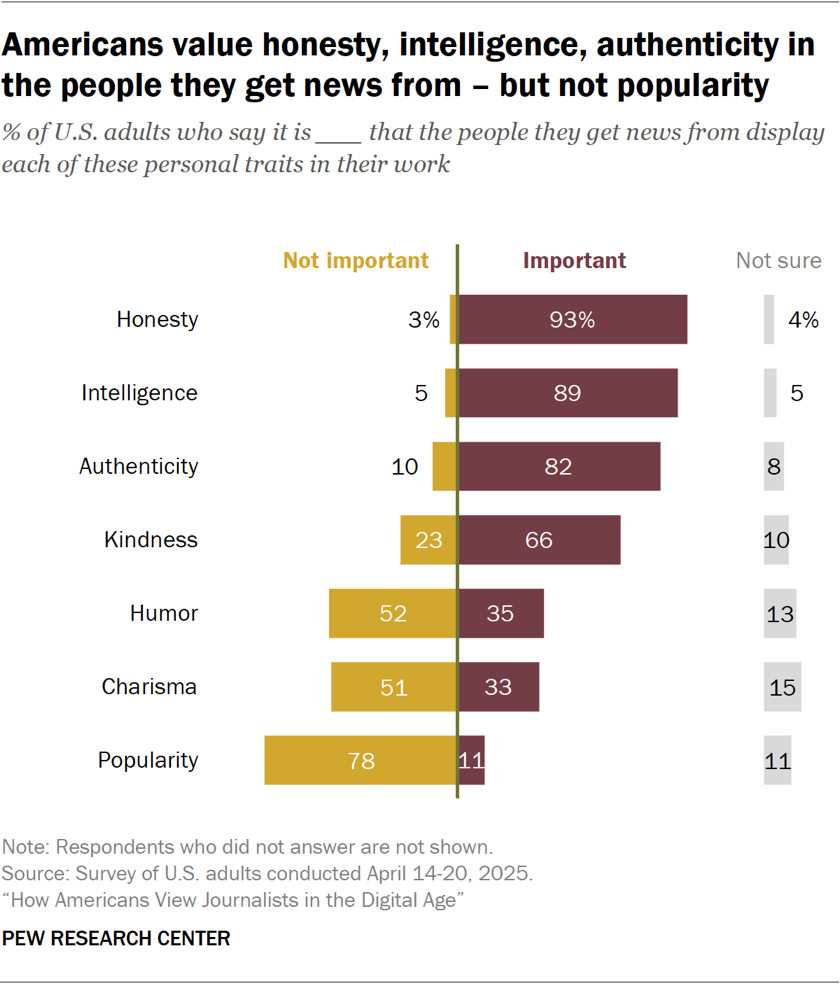
What do people want their news providers to be like, regardless of whether they are journalists? Honesty, intelligence and authenticity are the top three traits in our survey that respondents say are important for the people they get news from to display in their work.
Bar chart showing Americans value honesty, intelligence, authenticity in the people they get news from – but not popularity

However, as our focus group discussions illustrate, people hold differing views of what the term “authenticity” means when it comes to news providers – and some aren’t entirely sure.

Americans also care more that someone they get news from has deep knowledge of the topics they cover than whether they are employed by a news organization or have a university degree in journalism.

Most Americans agree that the people they get news from should definitely report news accurately (84%) and correct false information from public figures (64%) in their daily work. But there is less consensus around several other job functions – and relatively few say their news providers should express personal opinions about current events.

Refer to Chapter 1 for more details on what Americans want from their news providers.

Who counts as a journalist?

Most Americans (79%) agree that someone who writes for a newspaper or news website is a journalist – higher than the share who say the same about someone who reports on TV (65%), radio (59%) or any other medium.

Bar chart showing Americans are most likely to consider newspaper writers, TV and radio reporters to be journalists

There is less consensus about whether people who work in newer media are journalists. Fewer than half of U.S. adults say someone who hosts a news podcast (46%), writes their own newsletter about news (40%) or posts about news on social media (26%) is a journalist. In each of these cases, roughly a quarter of Americans say they aren’t sure whether these people are journalists.

This pattern aligns somewhat with how long each format has been around: Newspapers were associated with journalism for centuries before any of the more modern media existed.

Young adults are far more likely than older adults to view “new media” news providers as journalists – but are also less likely than their elders to care whether the news they get comes from people they think are journalists.

As one focus group participant in her 20s said, “I feel like anyone can do it, in a way. There’s a lot of people out there just starting their own channels taking a little bit of the importance of somebody who maybe went to school to do that …. It can make it feel like a journalist isn’t as important. Although, they are the ones that are really skilled in that job.”

Refer to Chapter 2 for a closer look at how Americans define “journalist.”

Many Americans think journalists are losing influence in society

A majority of Americans (59%) say journalists are extremely or very important to the well-being of society. An additional 31% say journalists are somewhat important, while just 9% say they are not too or not at all important.

Bar chart showing far more say journalists are losing influence in society than gaining it

But about half of U.S. adults (49%) say journalists are losing influence in society, compared with 15% who say they are gaining influence. And fewer than half (45%) say they have a great deal or a fair amount of confidence in journalists to act in the best interests of the public.

As one focus group participant in his 30s said, “It’s a hit or miss, I guess. There are a handful of journalists, the ones that we say we trust, that I think are doing the right thing, following what the code of journalism should be. But the others in today’s world are all about clicks, eyeballs, money, things like that, and they don’t necessarily mind tweaking the truth to suit their audience or their advertisers.”

Chart showing Republicans are more likely than Democrats to say negative traits describe most journalists well

While majorities of the public describe most journalists as intelligent (63%) and well-intentioned (58%), more than half also say most journalists are biased (58%).

Republicans and Republican-leaning independents are far less likely than Democrats and Democratic leaners to express confidence in journalists to act in the public’s best interests and to describe them in positive terms. And Republicans are much more likely than Democrats to say negative words like “elitist” and “dishonest” describe most journalists well.

Refer to Chapter 3 for more details on what Americans think about journalists.

Americans hold mixed views on journalists as community advocates

Americans are split over whether it’s acceptable for journalists to advocate for the communities they cover, but more than half agree that journalists publicly expressing their political or religious views is unacceptable when they report on an issue or event.

Bar chart showing about half of Americans say it’s OK for journalists to advocate for communities, but there is less support for journalists expressing their political or religious views

Those who are open to advocacy by journalists described it in focus groups as serving some communities’ needs or speaking for those who don’t have power.

But as one participant in his 30s said, “If you’re a journalist, let’s stick to journalism. And if you want to be an influencer or a social change warrior or whatever, just stick to that.”

At the same time, more than half of U.S. adults (56%) say journalists are largely unable to separate their personal views from what they report on. Republicans are much more likely than Democrats to express this view.

Refer to Chapter 4 for more details on Americans’ expectations for journalists.

1. What do Americans want from their news providers?

This is the first of four detailed sections in a report on Americans’ views about the role of journalists in the digital age. The report also includes an overview of the key findings.

This report explores several facets of how the public thinks about “journalists” today: what makes someone a journalist, what their role is in society and how they are expected to act.

But as our focus groups with everyday Americans reveal, and as other Pew Research studies have shown, people get news from a wide range of sources online – some of whom they consider journalists, and others they don’t. This section looks at what people want from the “people they get news from” more broadly, without explicitly using the journalist label.

What traits do Americans value in their news providers?

Large majorities of Americans in our survey say it’s important for the people they get news from to display honesty (93%), intelligence (89%) and authenticity, or “being their true selves” (82%), in their work.

Bar chart showing Americans value honesty, intelligence and authenticity in the people they get news from – but not popularity

About two-thirds of U.S. adults (66%) also say it’s important that the people they get news from display kindness. Far smaller shares say humor (35%), charisma (33%) and popularity (11%) are important in the work of their news providers.

In our focus groups, several participants discussed the role of charisma in news providers’ work, especially when it comes to the style of presentation and how a story is delivered. For instance, one man in his 30s said, “I guess you’d say the cadence, the charisma, the voices …. Is it calm? Is it inviting? Or is the person’s voice an absolute ratchet you just want to turn off?”

Some groups are more likely to value certain traits in their news providers’ work:

  • Younger Americans find it more important than their older peers for the people they get news from to display charisma in their work (38% of adults under 50 vs. 28% of those 50 and older). Hispanic (44%) and Black (38%) Americans also are more likely than White (30%) and Asian (28%) adults to see this as important.
  • Women (73%) are more likely than men (58%) to say kindness is important for their news providers to display in their work.

The value of ‘authenticity’ from news providers

It’s clear that most Americans value authenticity in their news providers. But what exactly is authenticity? We posed this question to our focus group participants.

While many participants said they do value authenticity in their news providers, they hold differing views of (or aren’t entirely sure) what the term means.

Authenticity is perceived by some people as integrity and accountability, reflecting “that the person is who they say they are.” By others, it’s “truthfulness”: As one man in his 40s put it, “minimum Pinocchios.”

Several participants see authenticity as the inclusion of “a human touch” and the sharing of personal experience – bringing “your original personal touch to what you’re reporting.” “I think it’s presenting the humanity behind the news,” one man in his 30s said. One woman in her 50s explained it as a “window” into the journalist’s personal experience with a news story: “You have this window, and you can see how the information is coming to them as well as how it’s even affecting them emotionally.”

Participants also discussed differing perceptions of authenticity between journalists and other news providers. Some mentioned caring more about whether they feel an influencer is authentic than whether a journalist is, because they only need or expect the facts from journalists. Others said they think nontraditional news providers have more freedom in general to show their authentic selves than journalists do.

“Podcasts, I think they may be more authentic because they have more freedoms, where if someone’s on a national network or corporately produced newscast, they’re more controlled and could not be as authentic,” one woman in her 50s said.

What roles do Americans expect their news providers to fulfill?

The survey also asked U.S. adults whether they think the people they get news from should perform a variety of functions or responsibilities in their daily work.

Most Americans agree that the people they get news from should definitely report the news accurately (84%) and correct false or misleading information from public figures (64%) in their daily work. And about half (51%) say their news providers definitely should give people the information they need to make decisions.

Bar chart showing most Americans agree the people they get news from should report it accurately, but there is less consensus about other job functions

Smaller shares say the people they get news from definitely should keep an eye on powerful people (41%), give a voice to people often underrepresented in the news (34%) or advocate for the communities they cover (32%).

Americans are least likely to say the people they get news from definitely should seek out audience input (19%) or express personal opinions about current events (8%). In fact, about half of Americans say their news providers probably (27%) or definitely (22%) should not express personal opinions about the news.

Many participants in our focus groups, regardless of party affiliation or age, expressed the view that personal opinion should be separate from the facts of the news. As one man in his 20s said, “I just want to know the news, not how people feel. If I want to hear how people feel, I’ll go on Facebook comments or something and see everybody argue or whatever.”

Like when we asked about journalists advocating for communities, several participants said that journalists expressing personal views or opinions is acceptable as long as they are explicitly distinct from – and follow – the facts. One man in his 60s said, “If somebody passes off their opinion as news, they’re going to lose a lot of credibility with me.”

“I think it’s OK for journalists to show emotion and to show … their own perspective if they have reported the facts,” a woman in her 50s said. “That brings a human touch to it.”

In other cases, participants candidly admitted they are more accepting of opinions they agree with. When asked when, if ever, it’s acceptable for a news source to provide personal opinions, one woman in her 50s simply replied with a laugh, “When they agree with my politics.”

There also was some recognition from participants that nontraditional news providers, such as podcasters or influencers, may be more likely to share their opinions. Participants often discussed granting these sources more leeway to be opinionated – and, at times, specifically said they turn to these sources for their editorializing – while they expect “just the facts” from people they consider to be journalists.

Views by party

Most Republicans and Democrats in our survey (including independents who lean toward each party) agree on which functions they most want the people they get news from to fulfill in their daily work. In both cases, reporting the news accurately rises to the top.

Chart showing Democrats are more likely than Republicans to say the people they get news from should fulfill watchdog or advocacy roles

But there are large gaps between the two parties about some types of roles they think their news providers should fulfill:

  • “Watchdog” roles: Democrats are more likely than Republicans to say the people they get news from should definitely correct false or misleading information from public figures (73% vs. 57%) and keep an eye on powerful people (52% vs. 31%).
  • Advocacy roles: Democrats also are more likely than Republicans to say the people they get news from should definitely give a voice to people often underrepresented in the news (45% vs. 22%) and advocate for the communities they cover (39% vs. 24%).

These differences are largely driven by Democrats and Democratic leaners who describe themselves as liberal. For instance, liberal Democrats are far more likely than moderate or conservative Democrats to say the people they get news from should definitely correct false or misleading information from public figures (81% vs. 66%) and keep an eye on powerful people (64% vs. 44%).

One of the key functions for journalists we discussed with focus group participants was the traditional “watchdog” role that seeks to hold powerful people – including elected officials, public figures, corporations or other institutions – accountable by doing investigative research into what they’re doing.

Many of our focus group participants had heard of and understood the “watchdog” role and said they feel this role is valuable and important, regardless of party affiliation. Several discussed it as fulfilling a need that everyday people could not possibly do for themselves. As one man in his 20s said, “I think it’s pretty important because the size and scope of government is just so large that just an ordinary citizen can’t review everything the government’s doing by themselves.”

As was the case when we asked about people’s confidence in journalists to act in the best interests of the public, some participants saw journalists’ watchdog role as increasingly affected by corporate and financial interests. One man in his 60s said, “I think it’s harder for journalists to be watchdogs nowadays because they have to fight for money, for likes, for that kind of thing, and there’s no independent source …. There’s not an independent means of support, so it’s hard for them to be watchdogs.”

Others noted that performing this role can place journalists at risk, making it difficult to fulfill. A woman in her 20s said, “It takes a lot of courage to do it because there can be a lot of consequence. Like, there are whistleblower protections and whatnot for the people, the sources, but also, the journalists often have negative consequences when they attempt to hold powerful people accountable.”

What types of backgrounds do Americans want their news providers to have?

As people increasingly get news from a range of online sources – including news influencers unaffiliated with a news organization – we asked survey respondents whether certain backgrounds or qualifications are important to them when it comes to their news providers.

Bar chart showing topical knowledge is more important to Americans than organizational affiliation or education for the people they get news from

Seven-in-ten Americans say it is extremely or very important for the people they get news from to have deep knowledge of the topics they cover. People are far more likely to see this as important than to say the same about being employed by a news organization (31%) or having a college or university degree in journalism (25%).

Close to half of Americans (45%) find it not too or not at all important for the people they get news from to have a degree in journalism. And 38% say the same about employment by a news organization.

Certain groups are more likely to find it extremely or very important for the people they get news from to be employed by a news organization:

  • Democrats. Four-in-ten Democrats find this extremely or very important, compared with 22% of Republicans.
  • Older Americans. Americans ages 65 and older (41%) are nearly twice as likely as adults under 30 (22%) to say it’s highly important for their news providers to be employed by a news organization.

According to our focus group participants, topical knowledge and personal experience are key factors when deciding if a news provider is credible. Several participants mentioned caring about “how long they’ve been in the game” or whether a source is “a subject matter expert on anything that they’re talking about.”

As one man in his 40s said, “If they know their topic really well, if they have been in that industry for a long time, I feel like then they’re credible because they’ve been in that industry.”

Other participants focused more on the content – particularly whether the information is factual and easy to understand – than on the news provider’s background or training.

2. What makes someone a journalist?

This is the second of four detailed sections in a report on Americans’ views about the role of journalists in the digital age. The report also includes an overview of the key findings.

People increasingly get news from a wide range of sources online. With that in mind, the questions in this section were intended to explore what makes someone a journalist in the eyes of the American public. We approached this from multiple angles, including the platforms that news providers use and the types of news content they produce.

Bar chart showing Americans are most likely to consider newspaper writers, TV and radio reporters to be journalists

Americans largely think of people who work on news content in “traditional” media as being journalists, while there is less consensus about those in “new” media.

Majorities of U.S. adults say they consider someone who writes for a newspaper or news website (79%), reports on or hosts a TV news show (65%), or reports on or hosts a radio news show (59%) to be a journalist.

Fewer say the same about people who host a news podcast (46%), write their own newsletter about news (40%) or post about the news on social media (26%).

In each of these cases, roughly a quarter of Americans say they aren’t sure whether these people are journalists, perhaps reflecting the wide variety of individuals engaged in these practices. Focus group participants indicated – and some of our survey respondents volunteered – that there are some people who do these things who they would consider journalists, and others they would not.

Focus group participants expressed mixed perspectives on individuals sharing news content via podcasts or social media, though many distinguished them from “journalists.” Some considered these sources “entertaining” but not necessarily accurate. Others appreciated the depth of storytelling individuals can offer via new media formats like podcasts and said these sources’ “hands aren’t tied like traditional media, so they’re able to … get into subjects that main news channels or specific people wouldn’t be willing to talk about.”

Bar chart showing younger Americans are more likely to see people producing news content on podcasts, newsletters or social media as journalists

Our survey finds that these perceptions vary widely by age. Younger adults tend to be much more likely than older Americans to say that people who report on or host a news podcast, write their own newsletter about news, or make posts about news on social media are journalists.

For example, 41% of adults ages 18 to 29 say someone who posts about news on social media is a journalist, while just 14% of those 65 and older say the same.

Some younger participants in our focus groups illustrated these differences when discussing their own news sources.

For instance, one woman in her 30s said, “Back when I was a little kid, I always looked at the journalists on TV and I’m like, oh, OK, this is my news source, this is who my grandparents, my mom … went to to find out information. But now as I’m coming up as a Millennial looking at the news source, I don’t have to rely on them. I can rely on these podcasters and influencers who are actually reporting on every little thing that’s going on that I didn’t know was going on because mainstream [media] didn’t tell me about it.”

Meanwhile, differences by political party are modest. Majorities of both Republicans and Democrats agree that someone who writes for a newspaper or a news website would be considered a journalist: 83% of Democrats and Democratic-leaning independents say this, as do 76% of Republicans and Republican leaners.

Republicans are slightly more likely than Democrats to consider people who host podcasts about the news (50% vs. 43%) or write a newsletter about the news (43% vs. 38%) to be journalists.

Bar chart showing mixed views about whether people who produce various types of news content are journalists

In addition to asking about the medium someone uses to discuss the news, the survey also asked respondents whether they think people who produce various types of news content are journalists.

Americans are most likely to see those who primarily conduct their own reporting (59%) as journalists. Smaller shares say they consider those who compile and share other people’s reporting on current events (36%) or offer opinions or commentary on current events (28%) to be journalists.

Younger Americans are far more likely than older groups to consider each of these three types of news content producers to be journalists. For instance, seven-in-ten adults under 30 say they would consider someone who primarily conducts their own reporting on current events to be a journalist, versus 47% of those 65 and older.

Again, some respondents express uncertainty: In each case, roughly one-in-five Americans say they are not sure if they would consider someone who primarily produces each kind of content to be a journalist.

Focus group participants largely agreed that conducting “original reporting” is an important expectation they hold for journalists specifically. Several participants described compiling news as a “game of telephone,” where information can easily get “lost in translation” or opinions or bias can be introduced. As one man in his 40s explained, “Everybody whispers to the next person one word, and by the time it comes out, it’s a completely different word. When you’re just rephrasing or rewording something that’s already been out there, you lose translation there and sometimes stuff gets inaccurate. So being the first source with info is usually, in my opinion, best.”

At the same time, people’s expectations of what news providers more broadly can reasonably do vary depending on the type of source, their size and resources, and what type of news they’re covering. One woman in her 30s noted that “they all hold different thresholds.”

A woman in her 20s said, “I hold [traditional sources] to that standard. Like, they should have the resources so they should do original reporting. They should check their own facts, be involved in all of that. I don’t think I would hold smaller sources to that same standard because otherwise, if it’s one person creating their podcast, which I think is great because then they have more freedom of … not being bound by sponsors or other editing influences. But then they’re naturally more limited. They can’t be on the ground finding some of this stuff. So they naturally have to be using secondary sources.”

One man in his 20s said, “That’s also why I stay away from getting news from social media platforms – because a lot of times, it’s secondhand reporting.”

Do Americans think journalists should go through formal training?

Six-in-ten Americans say that people should have to go through formal training to be a journalist. Meanwhile, one-in-five say people should not have to go through formal training to be a journalist, while a similar share say they are not sure (19%).

Bar chart showing 60% of Americans say journalists should have to go through formal training

Some groups are more likely to think journalists should have to go through formal training:

  • Older Americans. About two-thirds of Americans ages 50 and older (67%) say formal training should be required, compared with 54% of adults under 50.
  • Democrats. Democrats (69%) are more likely than Republicans (52%) to say that people should have to go through formal training to be a journalist.
  • Those with more formal education. Americans with a college degree (65%) are slightly more likely than those with less education (58%) to say journalists should receive formal training.

Focus group participants shared mixed opinions about whether journalists need formal training. Those who think it is necessary said journalists who go through formal training learn ethical standards and “know how to ask the right questions.” “I think someone who has gone through the schooling and the training, the historical understanding of what journalism is and learned that from other people, either in a class or on the job, from somebody who has experience, is going to have a different perspective and pursuit of things versus someone who’s just a podcaster,” a man in his 50s said.

Some suggested journalism should be no different from other professions that require credentials. A man in his 40s said, “I think, in most professions, usually that’s what separates either someone that’s doing something amateurly from someone that’s doing something professional. We think about it in every other profession. Why not in journalism? Just because it’s easy to get into and start into doesn’t mean you still don’t need to have a certain level of professional credentials.”

Meanwhile, some participants said that other characteristics simply matter more than formal training. “It doesn’t make too much of a difference to me as long as they’re providing factual information,” a man in his 20s said.

Who gets – and prefers to get – news from journalists?

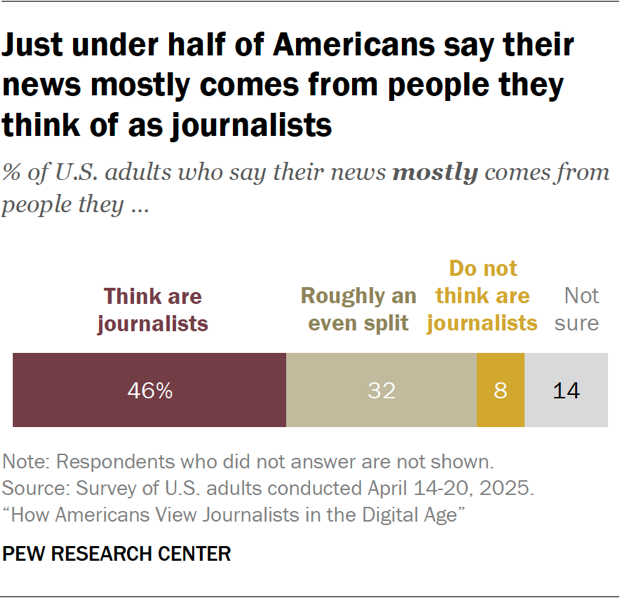
Just under half of Americans (46%) say their news mostly comes from people they think are journalists. Meanwhile, 8% of Americans say their news mostly comes from people they do not think are journalists. About a third (32%) say their news comes from roughly an even split of journalists and others.

Bar chart showing just under half of Americans say their news mostly comes from people they think of as journalists

An additional 14% of Americans say they’re not sure where their news mostly comes from, revealing the difficulty of assessing what a “journalist” is for some people in today’s media environment.

Who is more likely to get news from people they think are journalists?

  • Democrats. More than half of Democrats (54%) say their news mostly comes from people they think are journalists, compared with 39% of Republicans.
  • Regular news consumers. People who say they follow news at least some of the time (51%) are about twice as likely as those who consume news only now and then or hardly ever (28%) to say their news mostly comes from people they think are journalists. They’re also less likely to say they’re not sure where most of their news comes from (10% vs. 27%, respectively).
  • Older adults. Americans ages 50 and older (53%) are more likely than those 30 to 49 (44%) and 18 to 29 (32%) to say their news mostly comes from people they think are journalists. The youngest U.S. adults are most likely to say their news comes from roughly an even split of people they think are journalists and those they do not (40%). And 13% say the news they get mostly comes from people they do not think are journalists.
  • Higher-income Americans. A majority of upper-income adults (57%) say their news mostly comes from people they think are journalists, compared with 47% of middle-income adults and 38% of lower-income adults. Americans in the lowest income group are also more than twice as likely as those in the highest income group to say they’re not sure where their news mostly comes from (19% vs. 8%).
Bar chart showing older Americans, Democrats are more likely to prefer to get news from people they think are journalists

Americans are more likely to say they prefer to get news from people they think are journalists (59%) than to say their news mostly comes from people they think are journalists (46%). Only 7% of Americans say they prefer to get news from people they do not think are journalists, while about a third (32%) do not have a preference.

Aligning with their actual behaviors, Democrats are much more likely than Republicans to say that they prefer to get news from people they think are journalists (71% vs. 49%).

Older Americans also are more likely than younger Americans to prefer getting news from people they consider to be journalists.

3. How Americans view journalists and their role in society

This is the third of four detailed sections in a report on Americans’ views about the role of journalists in the digital age. The report also includes an overview of the key findings.

In both the survey and the focus groups that were part of this study, we asked several questions to better understand how Americans think about journalists broadly, as well as the role they play – or should play – in society.

Bar chart showing Democrats are much more likely than Republicans to say journalists are highly important to society

A majority of Americans (59%) say journalists are extremely or very important to the well-being of society. An additional 31% say journalists are somewhat important, while just 9% say they are not too or not at all important.

These findings mirror those from our focus groups, where participants largely agreed that journalists play, or at least should play, a critical role in informing society about what’s happening in the world. One woman in her 50s said, “I think [journalists’ role is] to make sure that we are informed … to open the door for more questions, more answers, and a deeper understanding of what is happening, whatever it is, whether it’s medical or political or whatever’s happening.”

A woman in her 20s said the role journalists should play in society is of a “watchdog and informer, to let the public know when something’s wrong, to raise the alarm, raise the alert … even things that aren’t an alert, but just things that we need to know to function.”

Some groups of Americans are more likely to say journalists are highly important to the well-being of society:

  • Democrats and independents who lean Democratic are far more likely than Republicans and GOP leaners to say that journalists are extremely or very important to the well-being of society (73% vs. 45%).
  • Americans who consume news more often also see journalists as more important: 63% of those who say they follow the news at least some of the time say journalists are highly important to society, while 43% of those who follow the news less often say the same.
  • About two-thirds of college graduates (68%) say journalists are extremely or very important to society’s well-being, versus 58% of Americans with some college education and 51% of those with a high school diploma or less education.

Many Americans see journalists as losing influence

At the same time, about half of Americans say journalists are losing influence in society (49%). This is much higher than the share who say journalists are gaining influence (15%). Roughly a third (36%) say they are neither gaining nor losing influence.

Bar chart showing far more say journalists are losing influence in society than gaining it

Democrats and Republicans are both much more likely to say that journalists are losing – rather than gaining – influence in society.

However, perceptions vary among Americans with different levels of formal education. A majority of those with at least a college degree (62%) say journalists are losing influence. About half of those with some college education (48%) and roughly a third of those with a high school diploma or less (36%) say the same.

Many of our focus group participants agreed that the rise of alternative news sources has, to some extent, affected the influence of journalists in society. Because people have access to so many sources in the digital age, one woman in her 20s said, “I feel like anyone can do it, in a way. There’s a lot of people out there just starting their own channels taking a little bit of the importance of somebody maybe who went to school to do that. … It can make it feel like a journalist isn’t as important. Although, they are the ones that are really skilled in that job.”

Some participants also noted that this digital shift has lowered barriers to entry for news providers, with consequences for both journalists and their audiences. As one man in his 60s explained: “That’s made the journalism job harder in a good way, in that the truth will hopefully get to it quicker, if you will. If they don’t say something that’s accurate, there’s a lot more folks that are fact-checking and checking things out. And I appreciate that it has made journalism harder, but navigating it for us also makes [our job] harder because who are you listening to becomes more of an issue. There are so many sources out there.”

Public confidence in journalists

While most Americans see journalists as at least somewhat important to society, our recent surveys have not found widespread confidence in journalists to act in the best interests of the public across several years. In our past surveys, journalists have been less trusted than several other institutions and professions, such as the military, scientists and police officers.

Line chart showing Democrats are more confident than Republicans that journalists act in best interests of the public

In the new survey, fewer than half of U.S. adults (45%) say they have a great deal or fair amount of confidence in journalists to act in the best interests of the public. Four-in-ten U.S. adults have not too much confidence in journalists, and 14% have no confidence at all.

Democrats remain far more likely than Republicans to express confidence in journalists. However, party differences have decreased somewhat since 2020.

The share of Democrats who say they have at least a fair amount of confidence in journalists to act in the best interests of the public has fallen over the past five years, from 70% in April 2020 to 62% in April 2025. Meanwhile, the share of Republicans who say this has increased slightly during the same period, from 23% to 27%.

When explaining why they do not have a lot of confidence in journalists to act in the best interests of the public, many focus group participants discussed corporate or political influence. One woman in her 50s mentioned journalists being influenced by “the money they’re going to make by what they say or the punishment they’re going to receive for what they say by the government or consumers or whatever.”

This aligns with prior Pew Research Center surveys finding that large majorities of Americans believe U.S. news organizations are at least somewhat influenced by financial or political interests.

A woman in her 40s described what she felt was a “cultural shift” of journalists increasingly “going after ratings … they want to not only report the news but be entertainment. … I know that they’re reporting the stories in a sensational way that’s going to get people to watch and kind of going for that entertainment value.”

How do Americans describe journalists?

The new survey asked Americans whether several characteristics describe most journalists well or not. Majorities of U.S. adults characterize journalists positively, saying that most journalists are intelligent (63%) and well-intentioned (58%). But 58% also say most journalists are biased. Prior Pew Research Center work has also found political bias in news to be a recurring concern among many participants in our qualitative research.

Bar chart showing more than half of Americans describe most journalists as intelligent and well-intentioned – but also biased

Some focus group participants expressed a lack of confidence in journalists today providing “unbiased” or “factual” information: “We just see them as manipulators of facts trying to bring us to a particular way of thinking or opinion,” one man in his 30s said.

Nearly half of Americans (47%) say that most journalists are relatable. And smaller shares say most journalists are elitist (39%) and dishonest (34%).

Differences by party

Again, Democrats are much more likely than Republicans to associate positive characteristics with most journalists. About three-quarters of Democrats (77%) say that most journalists are intelligent, while half of Republicans say the same. Similar patterns exist when it comes to whether most journalists are well-intentioned or relatable.

Chart showing Republicans are much more likely than Democrats to say negative traits describe most journalists well

Republicans, meanwhile, are far more likely than Democrats to say that negative characteristics describe most journalists well.

For instance, 74% of Republicans and 45% of Democrats say that most journalists are biased. And while 51% of Republicans say most journalists are dishonest, 19% of Democrats say the same.

4. How do Americans think journalists should act?

This is the fourth of four detailed sections in a report on Americans’ views about the role of journalists in the digital age. The report also includes an overview of the key findings.

This section includes several questions we asked Americans (in both a survey and focus groups) about how acceptable it is for journalists to advocate for the communities they cover or express their own personal views and beliefs – both in the context of their work and in public social media posts. With these questions, we hoped to speak to an ongoing debate about the traditional concepts of objectivity and neutrality in journalism.

Bar chart showing about half of Americans say it’s OK for journalists to advocate for communities they cover, but there is less support for them expressing political or religious views

We also asked about how people think journalists should handle some of the decisions they encounter in their day-to-day job.

Attitudes toward journalists advocating for communities they cover and expressing personal views

Americans express mixed views about the role of advocacy in journalists’ work and social media presence.

About half of U.S. adults (51%) say that when journalists are reporting on an issue or event, it is always or usually acceptable for them to advocate for the communities they cover. About a third (34%) say this is sometimes acceptable, while 14% say it is rarely or never acceptable.

People express similar views when asked if it’s acceptable for journalists to advocate for communities they cover when they post publicly on social media.

However, Americans are far less likely to find it acceptable for journalists to express personal views when they are reporting on issues or events.

Equal shares of U.S. adults – 13% each – say it’s always or usually acceptable for journalists to express their political views or religious beliefs when reporting on issues or events. Majorities of Americans say this is rarely or never acceptable (56% and 57%, respectively).

People are somewhat more accepting of journalists sharing political or religious views publicly on social media: 22% think it is always or usually acceptable for journalists to do this in both cases, and about a third (35% and 34%, respectively) say it’s sometimes acceptable. But in each case, the most common view is that it’s rarely or never acceptable for journalists to post these kinds of views publicly on social media.

When asked about journalists advocating for the communities they’re covering or for social or political change, focus group participants expressed mixed views. Some took a hard line against advocacy: As one man in his 30s said, “If you’re a journalist, let’s stick to journalism. And if you want to be an influencer or a social change warrior or whatever, just stick to that … when you expect them to be a journalist, you expect them to be neutral.”  

Others felt advocacy could be acceptable in some cases, as long as journalists are, first and foremost, finding and reporting the facts. As one woman in her 50s said, journalists “should remain neutral until they get all the facts in.” A woman in her 20s said about journalists sharing opinions, “I think good, have it, express it, but just you can’t make the news your opinion. You still have to convey the facts and then explain why your opinion is what it is. … I just think if it’s too mixed, you erase the news and hide it behind a position.”

Some of those who are open to advocacy by journalists described it as serving communities’ needs or speaking for those who don’t have power. One man in his 4os said, “I think the stories that journalists tell are supposed to be reflective of the people that consume the news, so if they’re advocating for certain communities that watch and tune in, look for that type of content, I think it makes sense.” One woman in her 50s said advocacy by journalists can start broader conversations in society, adding, “The ultimate goal, I guess, in reporting is to make our society the best it can be. Or that’s what it should be.”

Some also suggested advocacy is more acceptable in particular types of journalistic work, such as investigative reporting, or when discussing topics they see as “nonpartisan.” One woman in her 20s said, “If it’s something everyone can agree on, like a natural disaster or a mass shooting … there’s a same kind of opinion that it’s sad or those victims should get help.”

Bar chart showing younger adults more likely than older adults to say it’s OK for journalists to express personal views on social media

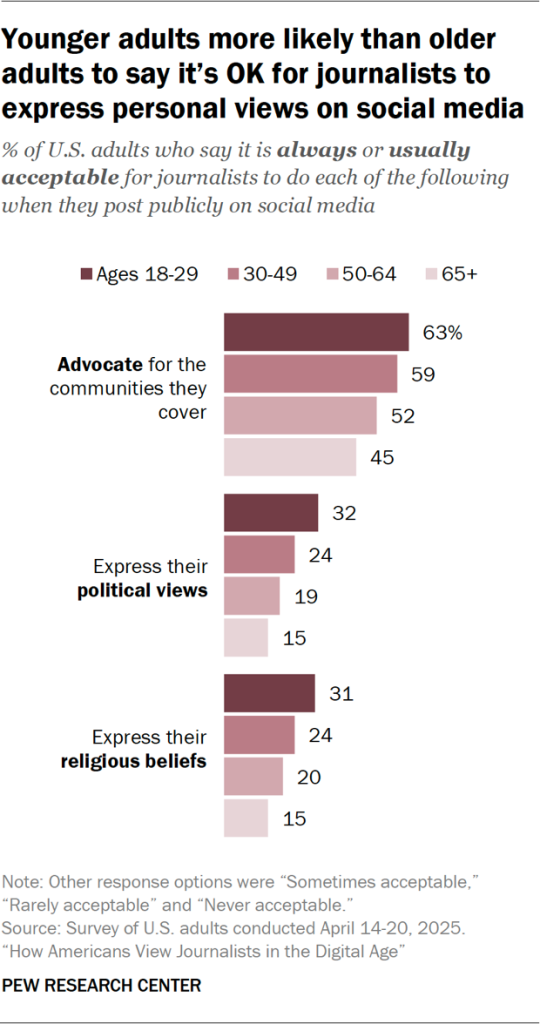
Overall, the survey found that younger adults are more likely than older people to say it is always or usually acceptable for journalists to advocate for communities they cover and express their views – but these age differences are particularly stark when it comes to social media:

  • 63% of Americans ages 18 to 29 say it’s always or usually acceptable for journalists to advocate for the communities they cover when posting publicly on social media, compared with 45% of those 65 and older.
  • About three-in-ten adults under 30 think it’s generally acceptable for journalists to express their political views (32%) or religious beliefs (31%) publicly on social media, roughly double the share of adults 65 and older who say the same (15% on both).

When it comes to political party, Democrats and independents who lean Democratic are more likely than Republicans and Republican leaners to say it is always or usually acceptable for journalists to advocate for communities they cover, both in reporting and on social media.

At the same time, Republicans are slightly more likely than Democrats to see it as acceptable for journalists to express their religious beliefs. (Republicans also tend to be more religious than Democrats by a variety of measures.)

Do Americans think journalists can separate their personal views from their reporting?

While many Americans say it is rarely or never acceptable for journalists to express personal views when reporting, people also commonly express skepticism about whether it’s even possible for journalists to separate their views from their reporting.

Bar chart showing whether Americans think journalists are able to separate their personal views from their reporting

More Americans think journalists are often unable to separate their personal views from what they report on (56%) than think they are largely able to do so (43%).

These perceptions differ drastically by political party, with Republicans far more likely than Democrats to say journalists are often unable to separate their personal views from what they report on (74% vs. 39%).

What should journalists share or cover?

The survey also asked Americans how they think journalists should cover news stories in a few specific ways. One oft-debated question is whether journalists should always strive to give equal coverage to all sides of an issue, sometimes negatively described as “bothsidesism.”

Bar chart showing three-quarters of Americans say all sides of a story always deserve equal coverage

Three-quarters of Americans say that when journalists report on an issue or event, all sides of a story always deserve equal coverage.

Meanwhile, about a quarter (24%) say all sides of a story do not always deserve equal coverage. U.S. journalists are much more likely than the public to express this perspective, according to 2022 Pew Research Center surveys.

Among U.S. adults overall, majorities of both major political parties say that all sides of a story always deserve equal coverage, although Republicans are modestly more likely than Democrats to take this position (81% vs. 68%).

These findings were echoed widely across our focus groups. When asked what a journalist’s job is, participants said journalists should strive to share multiple perspectives and a balanced set of facts. As one man in his 60s explained, journalists should “look at different sides of issues and bring context to things that we might need to know about. But a journalist, the way that I think classically is defined, is not someone who necessarily gives their particular opinion …. But they bring in all the facts, as opposed to the ones [that] support what they might personally believe.”

One man in his 30s said a journalist’s job is to “present the facts rather than necessarily their own views. But if they are going to share opinions, making sure that it’s sort of balanced, they’re showing multiple perspectives, multiple viewpoints and kind of allowing the general public to make their own decisions.”

Most Americans also agree on how journalists should cover false statements by public figures. If a public figure says something that is false or inaccurate, most U.S. adults (82%) believe journalists should report on the statement, while clarifying that it is false or inaccurate.

Bar chart showing most Americans say journalists should report on false statements by public figures and clarify they are false

Small shares think journalists should not report on it at all (9%) or that they should report on the statement without clarifying that it is false or inaccurate (7%).

Supporters of both political parties overwhelmingly agree on this. Most Democrats (87%) and Republicans (79%), including those who lean toward each party, say journalists should report on the statement while clarifying that it is false.

Although small shares of both groups say this, Republicans are slightly more likely than Democrats to say journalists should report on false statements without clarifying that they are false (10% vs. 5%).

The importance of transparency

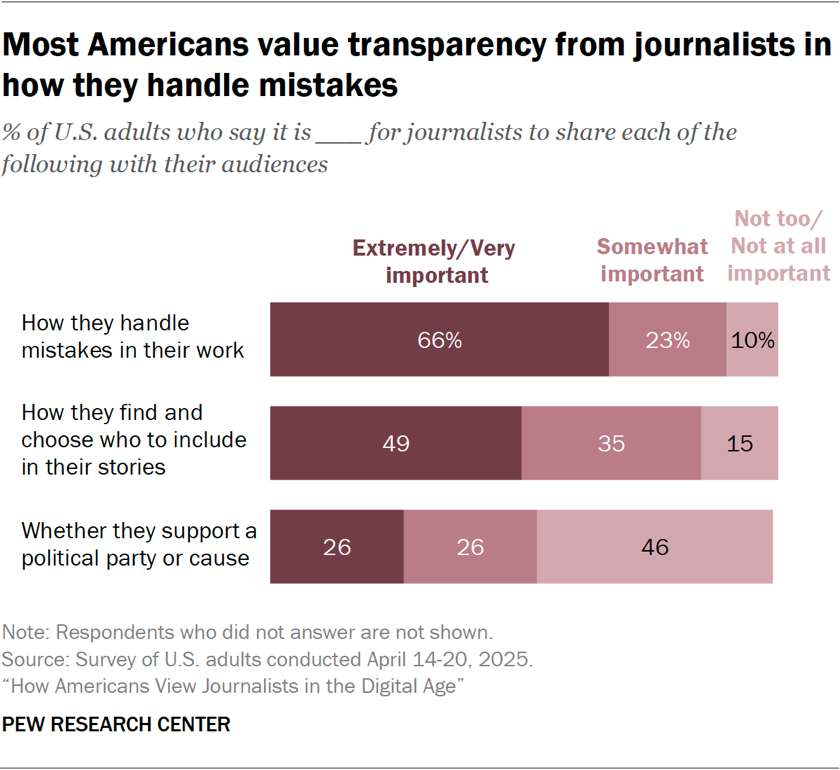
Americans are more likely to value transparency from journalists in certain aspects of their work than others.

Bar chart showing most Americans value transparency from journalists in how they handle mistakes

About two-thirds of U.S. adults (66%) say it is extremely or very important for journalists to share with their audiences how they handle mistakes in their work.

Meanwhile, about half of Americans (49%) think it’s highly important for journalists to share how they find and choose who to include in their stories. A much smaller share (26%) say they think it’s highly important for journalists to tell their audiences whether they support a political party or cause.

When discussing transparency, focus group participants revealed one of the inherent contradictions at play when it comes to how journalists handle mistakes in their work. On the one hand, many said that journalists being transparent about mistakes increased, or would increase, their trust in that source. Participants often discussed the fact that everyone makes mistakes, and journalists owning up to it “makes them human.”

At the same time, they recognized that admitting to mistakes can jeopardize journalists’ credibility. In one focus group, a man in his 60s said, “It seems like people are afraid nowadays to share any mistakes. It’s like if they make a mistake, they’re terrible, you know? And that’s sad because we should realize that we all make mistakes.” A man in his 40s replied, “The bad side of that is, if a journalist shares too many mistakes, they get labeled as misinformation and fake news. So they have an incentive to not admit their mistakes.”

Some participants also shared specific ways in which they believe journalists miss the mark on transparency. One man in his 60s described how newspapers will “put something on the front page that’s not right, and then [the retraction of] the mistake will be on page 820 or something.”

Democrats and Republicans largely agree on these aspects of transparency in the survey; there are no major differences in how supporters of both parties answer these questions.

Acknowledgments

Pew Research Center is a subsidiary of The Pew Charitable Trusts, its primary funder. This is the latest report in Pew Research Center’s ongoing investigation of the state of news, information and journalism in the digital age, a research program funded by The Pew Charitable Trusts. This report is a collaborative effort based on the input and analysis of the Center’s news and information research team, methods, communications, design, digital and editorial teams. Find related reports online at pewresearch.org/topic/news-habits-media/.

Research

Kirsten Eddy, Senior Researcher
Katerina Eva Matsa, Director, News and Information Research
Michael Lipka, Associate Director, News and Information Research
Naomi Forman-Katz, Research Analyst
Jacob Liedke, Research Analyst
Christopher St. Aubin, Research Analyst     
Luxuan Wang, Research Associate
Elisa Shearer, Senior Researcher
Emily Tomasik, Research Analyst    
Joanne Haner, Research Assistant  
Mary Randolph, Intern         

Editorial and Graphic Design

David Kent, Senior Editorial Specialist                               
Kaitlyn Radde, Associate Information Graphics Designer
Peter Bell, Associate Director, Design and Production
Andrea Caumont, Associate Director, Digital Outreach

Communications and Web Publishing

Sogand Afkari, Communications Manager
Talia Price, Communications Associate
Justine Coleman, Associate Digital Producer

In addition, the project benefited greatly from the guidance of our adviser – Joy Mayer, the executive director of Trusting News – and from the Pew Research Center methods team: Courtney Kennedy, Andrew Mercer, Ashley Amaya, Dorene Asare-Marfo, Dana Popky, Anna Brown and Arnold Lau.

Methodology

The American Trends Panel survey methodology

Overview

Data in this report comes from Wave 168 of the American Trends Panel (ATP), Pew Research Center’s nationally representative panel of randomly selected U.S. adults. The survey was conducted from April 14 to April 20, 2025. A total of 9,397 panelists responded out of 10,559 who were sampled, for a survey-level response rate of 89%.

The cumulative response rate accounting for nonresponse to the recruitment surveys and attrition is 3%. The break-off rate among panelists who logged on to the survey and completed at least one item is 1%. The margin of sampling error for the full sample of 9,397 respondents is plus or minus 1.3 percentage points.

SSRS conducted the survey for Pew Research Center via online (n=9,136) and live telephone (n=261) interviewing. Interviews were conducted in both English and Spanish.

To learn more about the ATP, read “About the American Trends Panel.”

Panel recruitment

Since 2018, the ATP has used address-based sampling (ABS) for recruitment. A study cover letter and a pre-incentive are mailed to a stratified, random sample of households selected from the U.S. Postal Service’s Computerized Delivery Sequence File. This Postal Service file has been estimated to cover 90% to 98% of the population.1 Within each sampled household, the adult with the next birthday is selected to participate. Other details of the ABS recruitment protocol have changed over time but are available upon request.2 Prior to 2018, the ATP was recruited using landline and cellphone random-digit-dial surveys administered in English and Spanish.

A national sample of U.S. adults has been recruited to the ATP approximately once per year since 2014. In some years, the recruitment has included additional efforts (known as an “oversample”) to improve the accuracy of data for underrepresented groups. For example, Hispanic adults, Black adults and Asian adults were oversampled in 2019, 2022 and 2023, respectively.

Sample design

The overall target population for this survey was noninstitutionalized persons ages 18 and older living in the United States. All active panel members were invited to participate in this wave.

Questionnaire development and testing

The questionnaire was developed by Pew Research Center in consultation with SSRS. The web program used for online respondents was rigorously tested on both PC and mobile devices by the SSRS project team and Pew Research Center researchers. The SSRS project team also populated test data that was analyzed in SPSS to ensure the logic and randomizations were working as intended before launching the survey.

Incentives

All respondents were offered a post-paid incentive for their participation. Respondents could choose to receive the post-paid incentive in the form of a check or gift code to Amazon.com, Target.com or Walmart.com. Incentive amounts ranged from $5 to $20 depending on whether the respondent belongs to a part of the population that is harder or easier to reach. Differential incentive amounts were designed to increase panel survey participation among groups that traditionally have low survey response propensities.

Data collection protocol

The data collection field period for this survey was April 14 to April 20, 2025. Surveys were conducted via self-administered web survey or by live telephone interviewing.

Table showing the invitation and reminder dates for web respondents for ATP Wave 168

For panelists who take surveys online:3 Postcard notifications were mailed to a subset on April 14.4 Survey invitations were sent out in two separate launches: soft launch and full launch. Sixty panelists were included in the soft launch, which began with an initial invitation sent on April 14. All remaining English- and Spanish-speaking sampled online panelists were included in the full launch and were sent an invitation on April 15.

Panelists participating online were sent an email invitation and up to two email reminders if they did not respond to the survey. ATP panelists who consented to SMS messages were sent an SMS invitation with a link to the survey and up to two SMS reminders.

For panelists who take surveys over the phone with a live interviewer: Prenotification postcards were mailed on April 11. Soft launch took place on April 14 and involved dialing until a total of eight interviews had been completed. All remaining English- and Spanish-speaking sampled phone panelists’ numbers were dialed throughout the remaining field period. Panelists who take surveys via phone can receive up to six calls from trained SSRS interviewers.

Data quality checks

To ensure high-quality data, Center researchers performed data quality checks to identify any respondents showing patterns of satisficing. This includes checking for whether respondents left questions blank at very high rates or always selected the first or last answer presented. As a result of this checking, two ATP respondents were removed from the survey dataset prior to weighting and analysis.

Weighting

The ATP data is weighted in a process that accounts for multiple stages of sampling and nonresponse that occur at different points in the panel survey process. First, each panelist begins with a base weight that reflects their probability of recruitment into the panel. These weights are then calibrated to align with the population benchmarks in the accompanying table to correct for nonresponse to recruitment surveys and panel attrition. If only a subsample of panelists was invited to participate in the wave, this weight is adjusted to account for any differential probabilities of selection.

Among the panelists who completed the survey, this weight is then calibrated again to align with the population benchmarks identified in the accompanying table and trimmed at the 1st and 99th percentiles to reduce the loss in precision stemming from variance in the weights. Sampling errors and tests of statistical significance take into account the effect of weighting.

Table showing the American Trends Panel weighting dimensions

The following table shows the unweighted sample sizes and the error attributable to sampling that would be expected at the 95% level of confidence for different groups in the survey.

Table showing the sample sizes and margins of error in ATP Wave 168

Sample sizes and sampling errors for other subgroups are available upon request. In addition to sampling error, one should bear in mind that question wording and practical difficulties in conducting surveys can introduce error or bias into the findings of opinion polls.

Dispositions and response rates

Table showing the final dispositions in ATP Wave 168
Table showing the cumulative response rate in ATP Wave 168

How family income tiers are calculated

Family income data reported in this study is adjusted for household size and cost-of-living differences by geography. Panelists then are assigned to income tiers that are based on the median adjusted family income of all American Trends Panel members. The process uses the following steps:

  1. First, panelists are assigned to the midpoint of the income range they selected in a family income question that was measured on either the most recent annual profile survey or, for newly recruited panelists, their recruitment survey. This provides an approximate income value that can be used in calculations for the adjustment.
  1. Next, these income values are adjusted for the cost of living in the geographic area where the panelist lives. This is calculated using price indexes published by the U.S. Bureau of Economic Analysis. These indexes, known as Regional Price Parities (RPP), compare the prices of goods and services across all U.S. metropolitan statistical areas as well as non-metro areas with the national average prices for the same goods and services. The most recent available data at the time of the annual profile survey is from 2022. Those who fall outside of metropolitan statistical areas are assigned the overall RPP for their state’s non-metropolitan area.
  1. Family incomes are further adjusted for the number of people in a household using the methodology from Pew Research Center’s previous work on the American middle class. This is done because a four-person household with an income of say, $50,000, faces a tighter budget constraint than a two-person household with the same income.
  1. Panelists are then assigned an income tier. “Middle-income” adults are in families with adjusted family incomes that are between two-thirds and double the median adjusted family income for the full ATP at the time of the most recent annual profile survey. The median adjusted family income for the panel is roughly $74,100. Using this median income, the middle-income range is about $49,400 to $148,200. Lower-income families have adjusted incomes less than $49,400 and upper-income families have adjusted incomes greater than $148,200 (all figures expressed in 2023 dollars and scaled to a household size of three). If a panelist did not provide their income and/or their household size, they are assigned “no answer” in the income tier variable.

Two examples of how a given area’s cost-of-living adjustment was calculated are as follows: the Pine Bluff metropolitan area in Arkansas is a relatively inexpensive area, with a price level that is 19.1% less than the national average. The San Francisco-Oakland-Berkeley metropolitan area in California is one of the most expensive areas, with a price level that is 17.9% higher than the national average. Income in the sample is adjusted to make up for this difference. As a result, a family with an income of $40,400 in the Pine Bluff area is as well off financially as a family of the same size with an income of $58,900 in San Francisco.

Focus groups

Pew Research Center worked with PSB Insights to conduct nine 90-minute online focus groups with a total of 45 U.S. adults from June 10 to 18, 2025. These discussions are not nationally representative, and the results are not framed in quantitative terms. This report includes findings and quotes from the first half of these focus groups to help illustrate and add nuance to the survey findings. Quotes were lightly edited for spelling, punctuation and clarity.

Table showing the demographic characteristics of focus group participants

Recruitment

PSB Insights recruited participants using quotas for gender, age, party affiliation, education, race and ethnicity, self-reported news engagement level and primary medium of news consumption. All participants had to be 18 years of age or older (19 or older if living in Alabama or Nebraska and 21 or older if living in Mississippi), live in the U.S., and have access to a computer or mobile device with high-speed internet access and a working webcam.

Lastly, eligible participants had to be willing and able to contribute to the research, complete an online pre-session activity, attend the focus group on the set date and time, and sign an informed consent form before they could participate. This included agreement that all responses could be used in research reports, though participants’ names and identifying information would remain private and not be used in any reports.

For each focus group, seven participants were recruited and five were ultimately selected to participate. The research team overrecruited participants to account for “no-shows,” as well as participants who may experience other issues preventing participation. Each participant was offered a $225 incentive.

The first six focus groups were segmented by political affiliation (Republicans, Democrats and independents) and primary news source (traditional vs. nontraditional) to ensure that multiple perspectives on news were gathered. Traditional news sources included television, radio, print publications, and news websites or apps noted as a participant’s primary source of news. Nontraditional sources included social media, search engines, podcasts, online forums and email newsletters noted as a participant’s primary source of news.

Additional focus groups were conducted with Americans under the age of 30, those ages 50 and older, and those with low self-reported news engagement.

Online pre-session activity

Before each focus group, participants completed a pre-session activity including both written and video response questions. This assisted the research team in guiding the discussion within the groups. Additionally, it primed the participants on the general topic of the discussion prior to the start of the focus groups.

Discussion

The Pew Research Center and PSB Insights research teams developed the discussion guide through an iterative process. Minor edits were made to the discussion guide after the first focus group, including cutting some questions and tweaking the language of others to dig deeper into our key areas of interest.

After the moderator established ground rules and participants introduced themselves, each focus group discussed two sets of topics included in analyses for this report:

  • What is a journalist? This section examined perceptions of journalists and alternative news sources like podcasters and influencers, focusing on qualities and expectations. It explored views on original reporting, authenticity, opinions in news, and how people assess the credibility and transparency of news providers.
  • The role of journalists: This section explored the role of journalists in society, including their responsibilities, public trust and the impact of newer sources like influencers and podcasters on those perceptions. It examined views on advocacy, neutrality and the importance of watchdog journalism in accountability, as well as where journalists succeed or fall short in these roles.

Analysis

All human-generated transcripts were analyzed and coded by the Pew Research Center research team in ATLAS.ti, a qualitative data analysis and research software program.

Two members of the research team compiled analytical memos while observing each focus group, noting similarities and differences across participants and connecting individual experiences and perspectives to broader themes. Two coders also individually analyzed each focus group transcript in ATLAS.ti, using a codebook generated and revised both deductively (before analysis, based on the survey findings) and inductively (during analysis, based on participants’ responses). Once coding was complete, the research team compiled findings and key quotes.

Together, these exercises allowed us to identify key patterns across the data and then use ATLAS.ti to organize and classify all relevant quotes, as well as to match those quotes to the demographic characteristics of those who said them. We took care to ensure that multiple research team members observed and analyzed the focus groups and that the viewpoints expressed in this report accurately captured the range of opinions and experiences of our participants.

Reporting

This report includes select quotations of responses from participants. Quoted matter was lightly edited by Pew Research Center staff for spelling, punctuation and clarity prior to publication.