Pew-Knight Initiative

FOR RELEASE NOVEMBER 18, 2024

America’s News Influencers

The creators and consumers in the world of news and information on social media

BY Galen Stocking, Luxuan Wang, Michael Lipka, Katerina Eva Matsa, Regina Widjaya, Emily Tomasik and Jacob Liedke

FOR MEDIA OR OTHER INQUIRIES:

Communications Department
202.419.4372
www.pewresearch.org

RECOMMENDED CITATION

Pew Research Center, November 2024, "America’s News Influencers"

About the Pew-Knight Initiative

The Pew-Knight Initiative supports new research on how Americans absorb civic information, form beliefs and identities, and engage in their communities. Pew Research Center is a nonpartisan, nonadvocacy fact tank that informs the public about the issues, attitudes and trends shaping the world. Knight Foundation is a social investor committed to supporting informed and engaged communities.

© Pew Research Center 2026

Table of contents

  • About the Pew-Knight Initiative
  • America’s News Influencers
  • 1. Americans’ experiences with social media news influencers
  • 2. How we created a list of popular news influencers, and where they post
  • 3. A profile of news influencers: Gender, politics and more
  • 4. How news influencers who have worked for news organizations differ from those who haven’t
  • 5. A closer look at the topics of news influencers’ posts
  • 6. News influencers on Facebook
  • 7. News influencers on Instagram
  • 8. News influencers on TikTok
  • 9. News influencers on X (formerly Twitter)
  • 10. News influencers on YouTube
  • Acknowledgments
  • Methodology
  • Appendix A: News influencers studied
  • Appendix B: Detailed tables for analysis of sample of news influencers
  • Appendix C: Detailed tables for analysis of sampled posts from news influencers
  • Appendix D: GPT-4 Topic classification instructions
  • Appendix E: Validation of GPT-4 topic classification

America’s News Influencers

The creators and consumers in the world of news and information on social media

How we did this

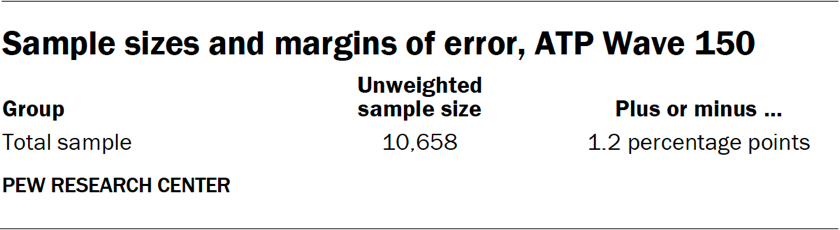
This study uses a multimethod approach to understanding news influencers, an emerging part of the news and information landscape. The project includes three different research components: a nationally representative survey of U.S. adults conducted through Pew Research Center’s American Trends Panel (ATP), an in-depth examination of a sample of 500 news influencers identified across five major social media sites, and a content analysis of 104,786 posts they produced during three distinct time periods in summer 2024.

Survey

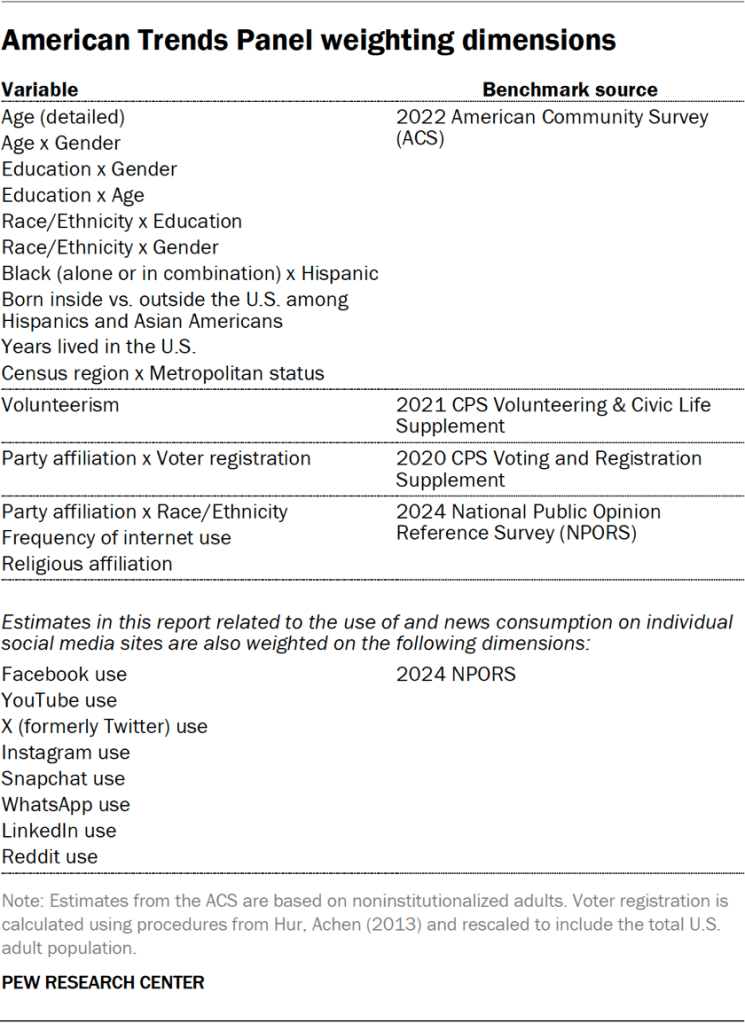
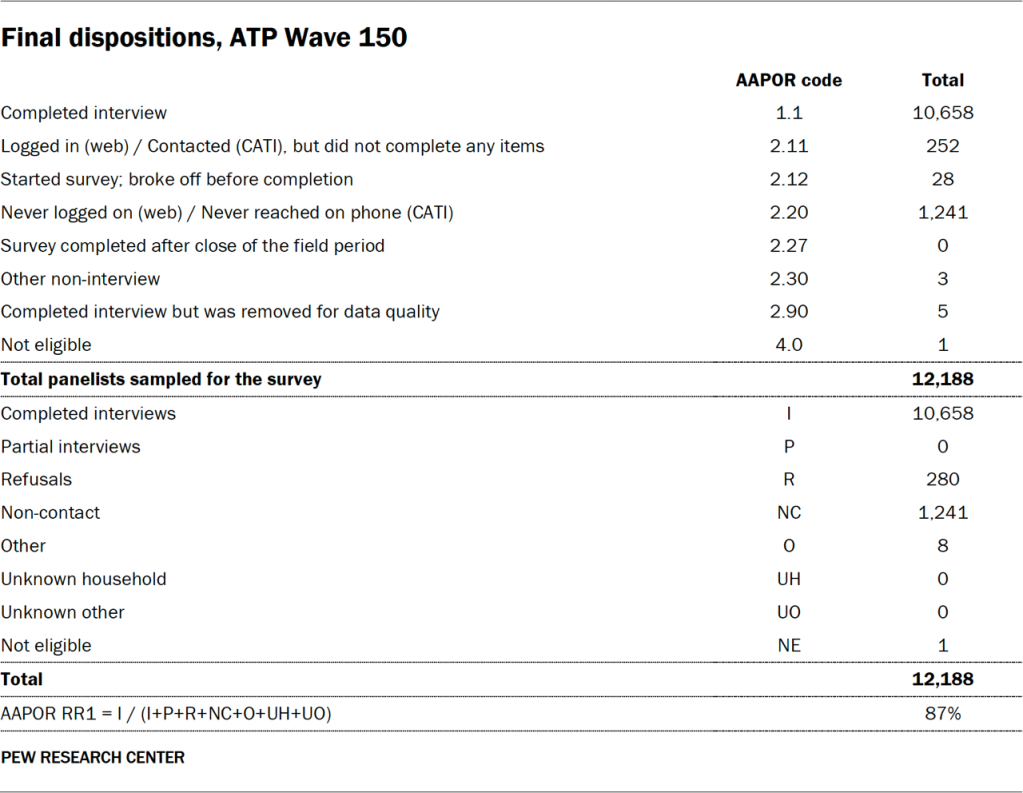
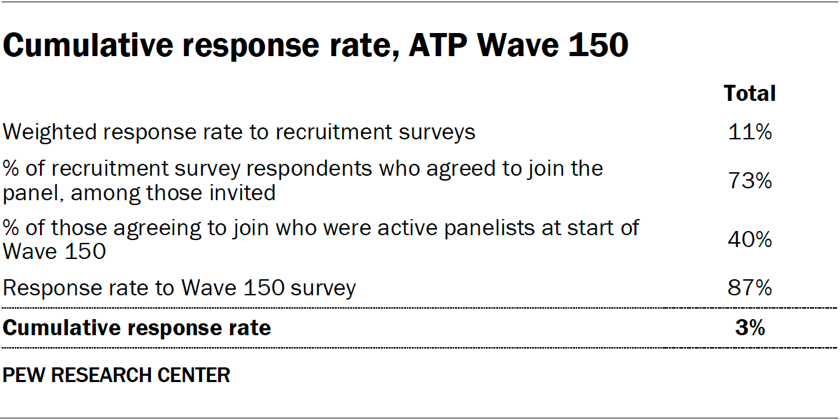
The survey portion of this analysis was conducted from July 15 to Aug. 4, 2024, among 10,658 U.S. adults. Everyone who completed the survey is a member of the Center’s ATP, a group of people recruited through national, random sampling of residential addresses who have agreed to take surveys regularly. This kind of recruitment gives nearly all U.S. adults a chance of selection. Surveys were conducted either online or by telephone with a live interviewer. The survey is weighted to be representative of the U.S. adult population by gender, race, ethnicity, partisan affiliation, education and other factors. Read more about the ATP’s methodology.

Respondents were asked about whether they regularly get news from news influencers on social media. Those who reported doing so were also asked about what types of information they get from news influencers, how they feel about news influencers and more.

Here are the questions used for this report, the topline and the survey methodology. 

News influencers analysis

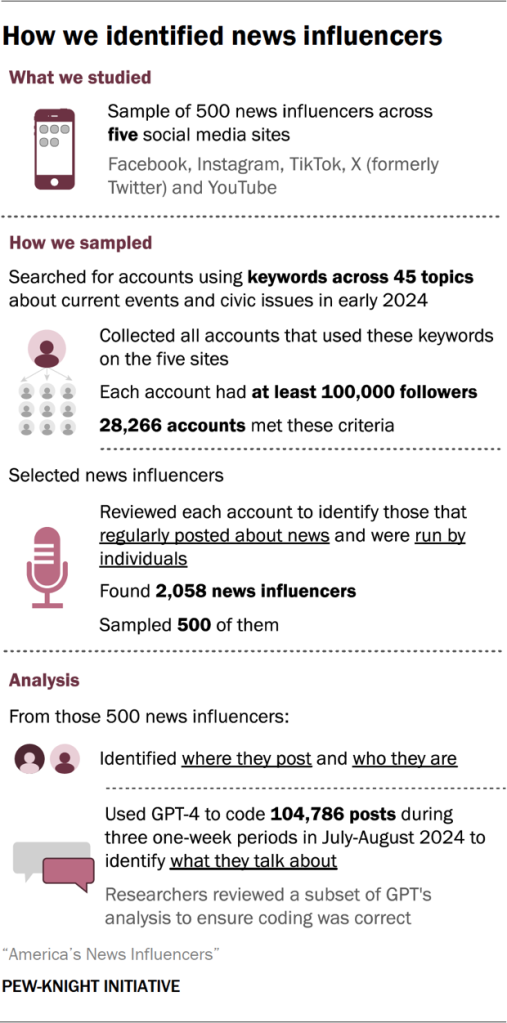
The analysis of news influencers examines a sample of 500 news influencers, derived from a review of 28,266 accounts across five social media sites: Facebook, Instagram, TikTok, X and YouTube. To compile this sample, researchers searched for social media accounts with over 100,000 followers that used news-related keywords in early 2024. A team of trained researchers then reviewed these accounts and found 2,058 news influencers who regularly posted about news and were run by people (not organizations).

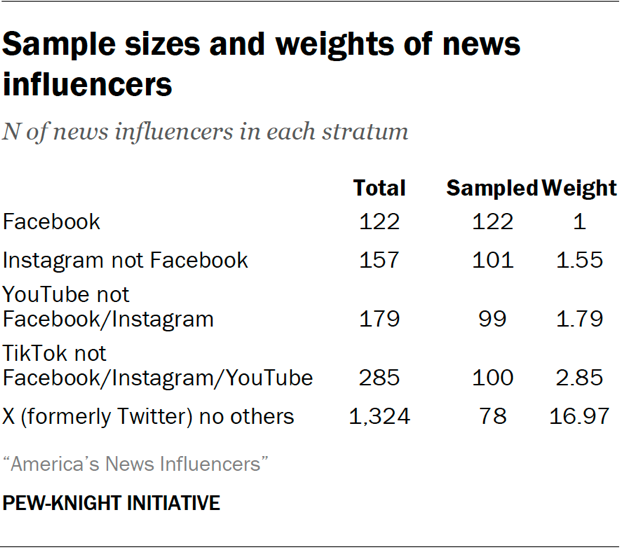
We then used a stratified list-based sampling strategy to sample 500 news influencers from this set for in-depth analysis. A team of trained coders then examined where these news influencers have accounts and various aspects of their public-facing identity. Here is a list of the 500 news influencers analyzed in the study. For more details on how news influencers were identified, sampled and analyzed, refer to the methodology.

Content analysis

The content analysis of posts from news influencers examines a sample of 104,786 posts by the sampled news influencers. Researchers gathered posts from the same five major social media sites – Facebook, Instagram, TikTok, X and YouTube – across three one-week periods: July 15-21, July 29-Aug. 4 and Aug. 19-25, 2024. The titles, text and captions of the posts were used for human-validated machine coding. The audio from video content on Instagram and TikTok was transcribed using audio-to-text and video-to-text models, and closed captioning was collected for YouTube videos.

Researchers then passed this text-based data to OpenAI’s GPT-4 model, along with an instruction prompt to obtain the applicable topic for each post. Two coders were trained to code posts and then validated approximately 1% of the full dataset of posts that had been run through the GPT-4 model.

This is a Pew Research Center report from the Pew-Knight Initiative, a research program funded jointly by The Pew Charitable Trusts and the John S. and James L. Knight Foundation. Find related reports online at https://alpha.pewresearch.org/pewresearch-org/pew-knight/.

Terminology
  • News influencers – People who regularly post about current events and civic issues on social media and have at least 100,000 followers on any of Facebook, Instagram, TikTok, X (formerly Twitter) or YouTube.
  • Political orientation – A measure of a news influencer’s partisan or ideological views. A right-leaning news influencer is one who publicly expresses that they identify as a Republican or conservative or support Donald Trump in the 2024 presidential election. A left-leaning news influencer is one who publicly expresses that they identify as a Democrat, liberal or progressive or support Vice President Kamala Harris (or supported President Joe Biden before he dropped out of the race) in the 2024 election. This information was found in the bio, profile picture, banner image, pinned posts or recent posts on an influencer’s social media account, any personal website or professional page, and prominent media coverage.
  • Values and identities – Language or imagery in the bio, profile picture, banner image or pinned posts on an influencer’s social media account that expresses specific beliefs or identities.
  • News organization affiliation – An influencer with this affiliation is one who either currently works for or previously worked for a news organization, as well as freelancers who have regularly contributed to news organizations. A news organization can be any news outlet that has a staff and multiple bylines. Researchers considered affiliated influencers to have this background regardless of their news organization’s political orientation, audience size or primary publishing method (digital, TV, print, etc.).
  • Major social media sites – The five primary sites we studied, chosen based on audience size and the presence of discussion about news: Facebook, Instagram, TikTok, X (formerly Twitter) and YouTube.

For our latest survey data about news influencers, read the “News Influencers Fact Sheet.”

In the heat of the 2024 election, news influencers seemed to be everywhere. Both Republicans and Democrats credentialed content creators to cover their conventions – and encouraged influencers to share their political messages. Influencers also interviewed the candidates and held fundraisers for them.

What is a news influencer?

In this study, we use the term “news influencers” to refer to individuals who regularly post about current events and civic issues on social media and have at least 100,000 followers on any of Facebook, Instagram, TikTok, X (formerly Twitter) or YouTube. News influencers can be journalists who are or were affiliated with a news organization or independent content creators, but they must be people and not organizations.

Refer to the methodology for more about how we identified news influencers.

But up until now, it has been difficult to get a sense of the size and characteristics of this new wave of news providers.

A unique Pew Research Center study provides a deeper understanding of both the makeup of the news influencer universe and its audience. The project includes an in-depth examination of a sample of 500 popular news influencers and the content they produce, derived from a review of more than 28,000 social media accounts. We also conducted a nationally representative survey of Americans to better understand who regularly gets news from news influencers.

Key findings about news influencers

  • About one-in-five Americans – including a much higher share of adults under 30 (37%) – say they regularly get news from influencers on social media.
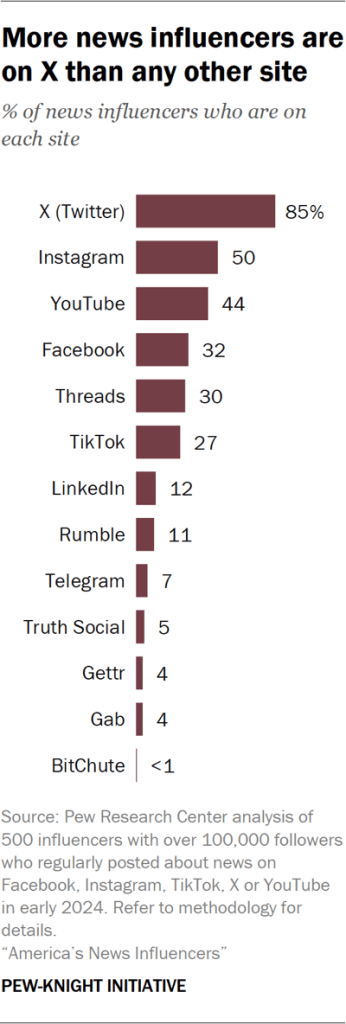
  • News influencers are most likely to be found on the social media site X, where 85% have a presence. But many also are on other social media sites, such as Instagram (where 50% have an account) and YouTube (44%).
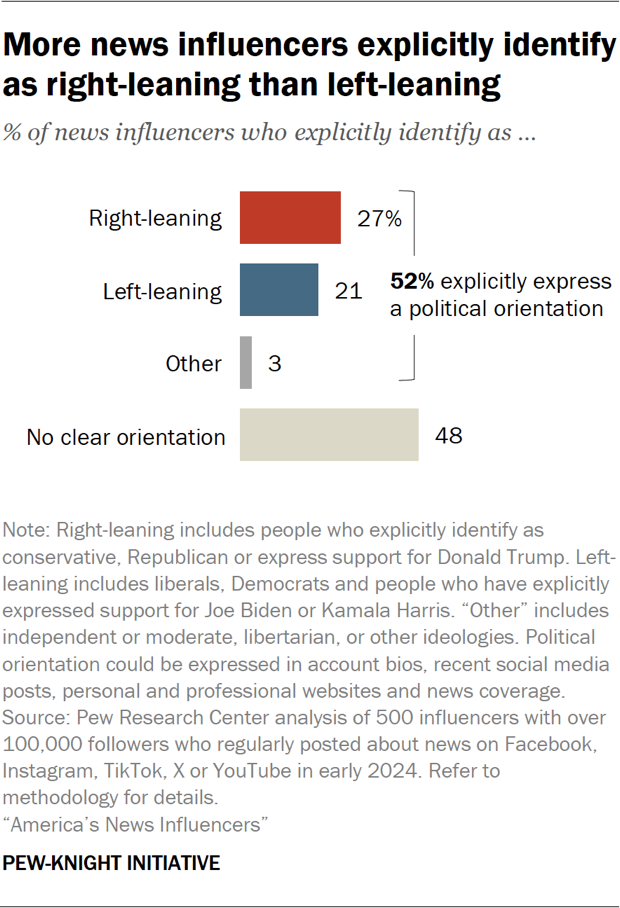
  • Slightly more news influencers explicitly identify as Republican, conservative or pro-Donald Trump (27% of news influencers) than Democratic, liberal or pro-Kamala Harris (21%).
  • A clear majority of news influencers are men (63%).
  • Most (77%) have no affiliation or background with a news organization.

How many Americans get news from influencers, and what is their experience?

Bar chart showing almost 4 in 10 U.S. adults under 30 get news from news influencers
  • About one-in-five U.S. adults (21%) say they regularly get news from news influencers on social media, according to a survey of 10,658 Americans conducted in summer 2024. This is especially common among younger adults: 37% of those ages 18 to 29 say they regularly get news from influencers. But there are minimal differences between Republicans and Democrats on this question.
  • Among Americans who get news from news influencers on social media, most (65%) say news influencers have helped them better understand current events and civic issues. And seven-in-ten say the news they get from news influencers is at least somewhat different from the news they get from other sources. Far fewer (31%) say they feel a personal connection to a news influencer.
  • These Americans also say they get a variety of different types of information, from basic facts and opinions to funny posts and breaking news. When it comes to opinions, most who see them say they are an even mix of opinions they agree and disagree with (61%), but far more say they mostly agree with what they see (30%) than mostly disagree (2%).

Jump to more findings from the survey of U.S. adults, or a broader analysis of Americans’ news habits on social media.

Most news influencers are on multiple sites, but X is the most common
Bar chart showing more news influencers are on X than any other site
  • Far more of the news influencers in our study have an account on X than any other social media site: 85% are on the site, compared with 50% who are on Instagram, the next-most popular site.
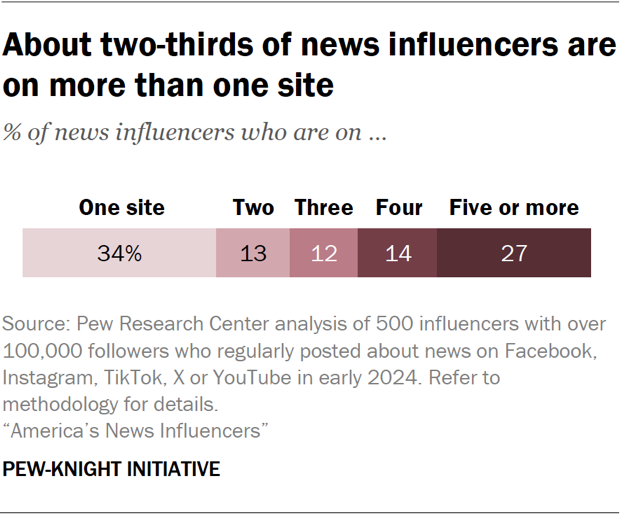
  • At the same time, it is common for influencers to have a cross-site presence to maximize their audience. About two-thirds of news influencers in the study are on more than one site, including 27% who are on five or more sites.
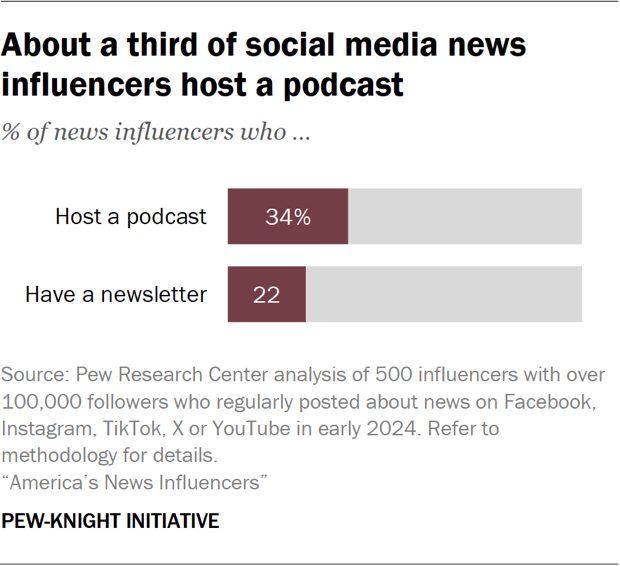
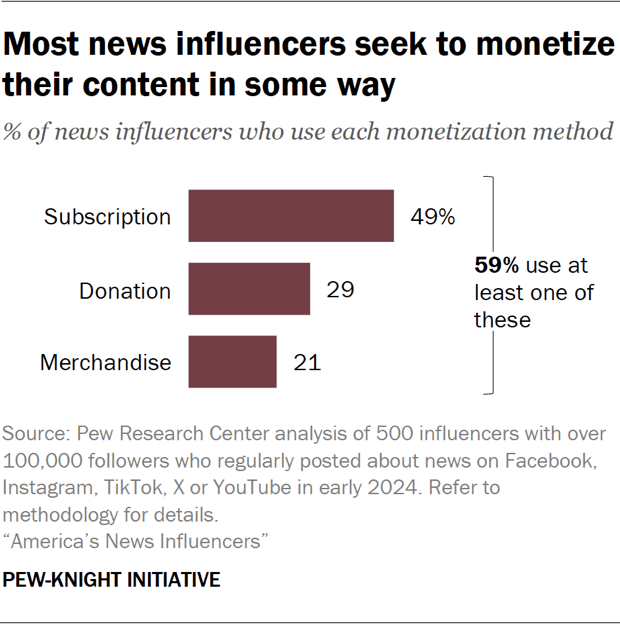
  • Many influencers also share content through podcasts (34%) or newsletters (22%). And across sites, a majority of news influencers (59%) monetize their online presence in some way, whether through subscriptions, donations or merchandise sales.

Jump to more basic details about where news influencers are posting.

News influencers are mostly men; more explicitly identify as right-leaning than left-leaning
Bar chart showing more news influencers explicitly identify as right-leaning than left-leaning
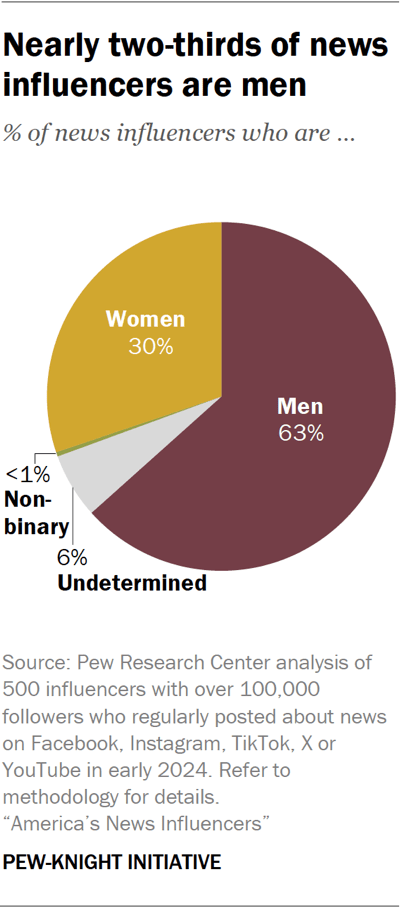
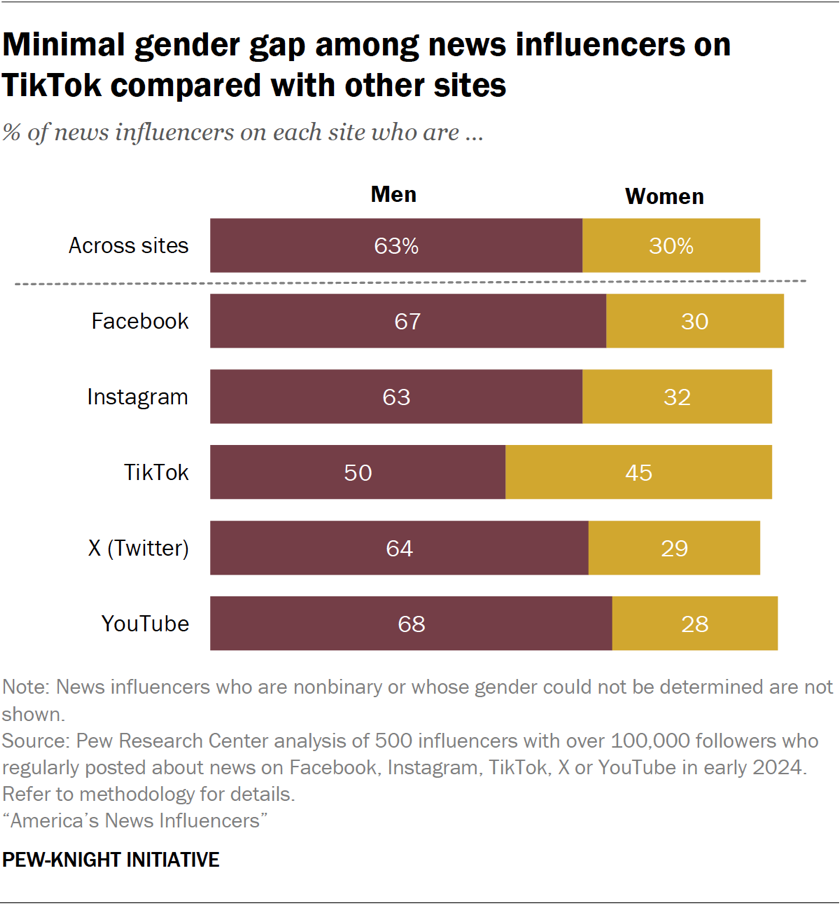
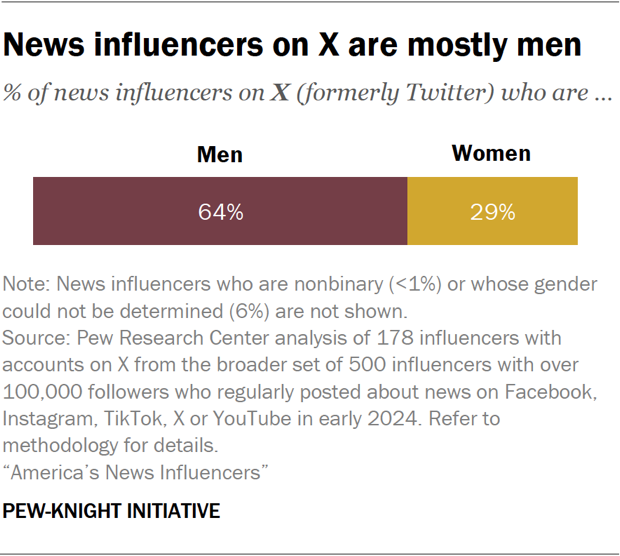
  • Among the news influencers in our sample, men outnumber women by a roughly two-to-one margin: 63% of influencers are men, compared with 30% who are women. (The remainder either are nonbinary or their gender could not be determined by researchers.)
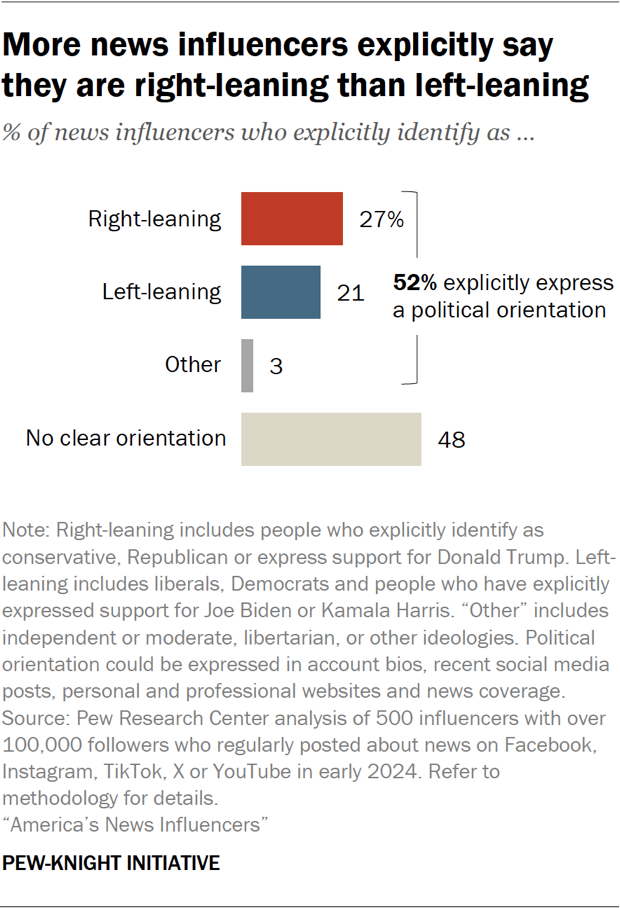
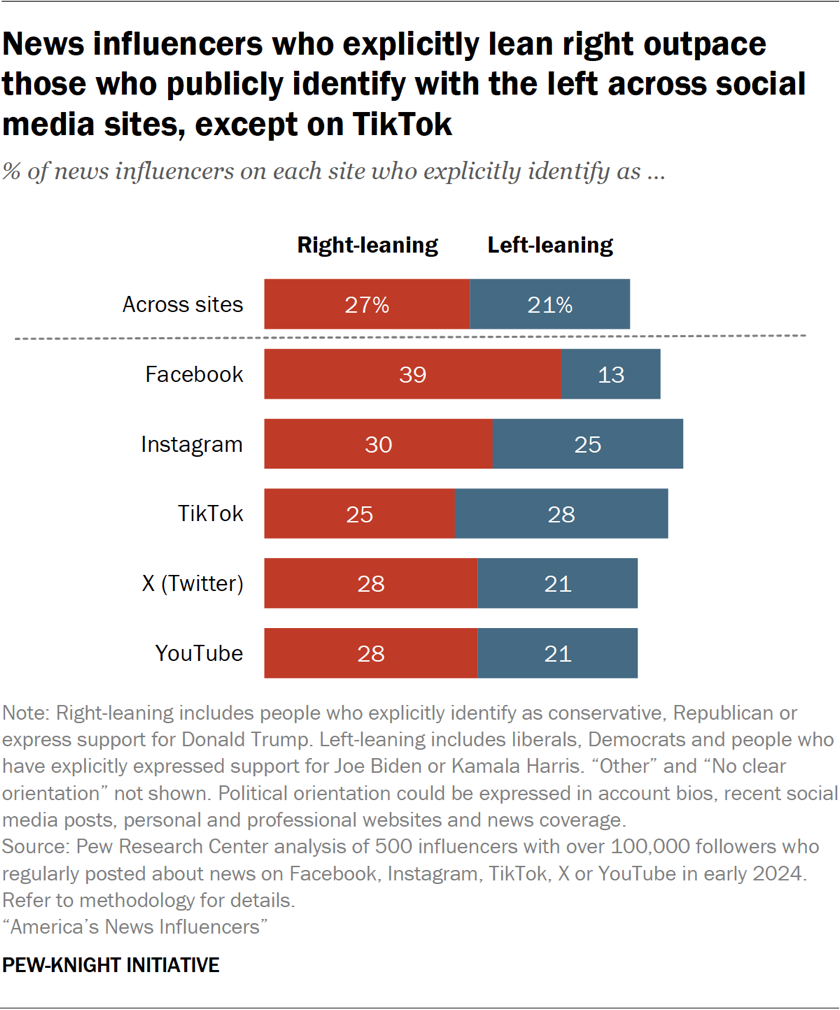
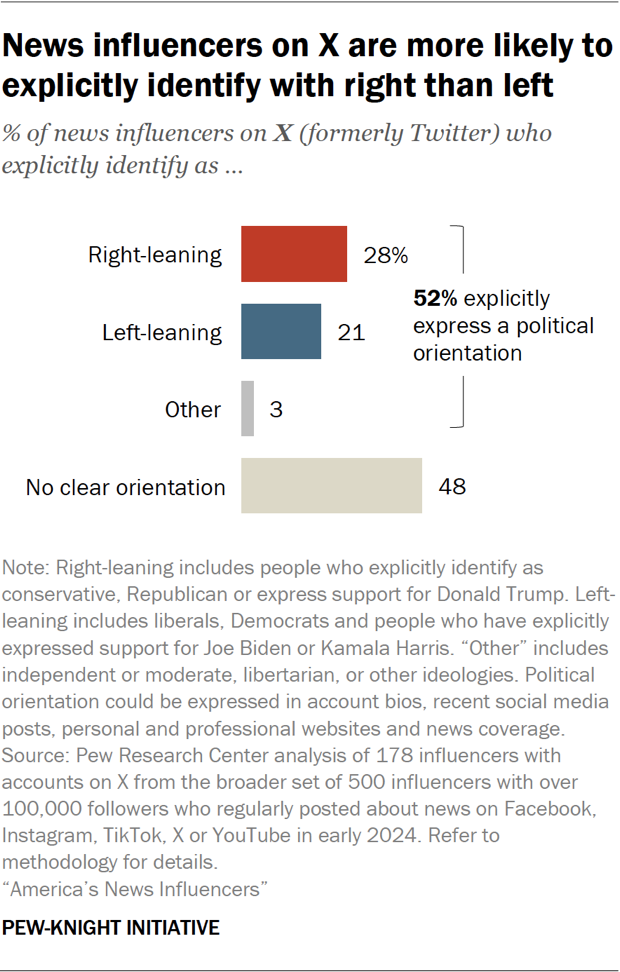
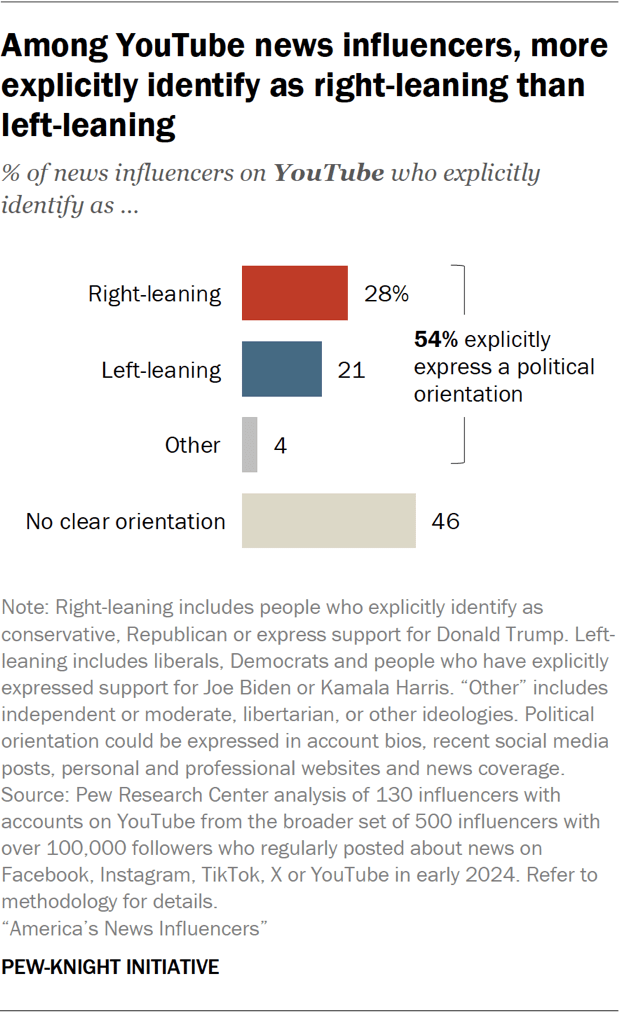
  • Many Republicans have long believed that social media sites censor conservative viewpoints. But overall, more news influencers explicitly present a politically right-leaning orientation than a left-leaning one (27% vs. 21%) in their account bios, posts, websites or media coverage. About half of influencers do not express any clear political orientation. Influencers on Facebook are particularly likely to prominently express right-leaning views: There are three times as many explicitly conservative news influencers (39%) as liberal ones (13%) on the site.
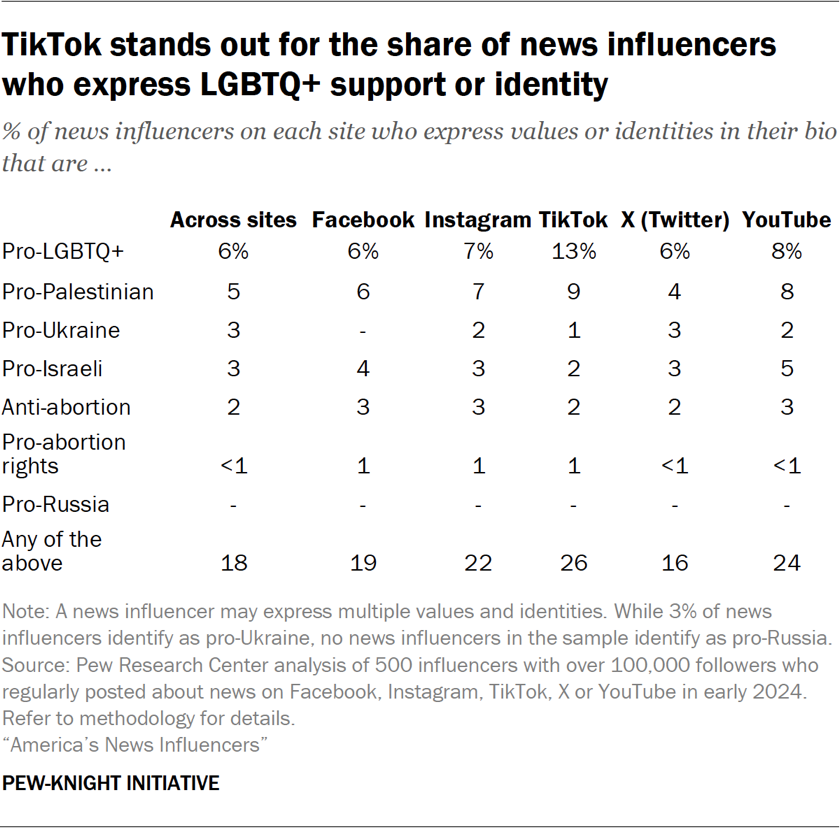
  • Nearly one-in-five news influencers (18%) share part of their identity or beliefs beyond their political orientation, such as expressing support for a specific political cause or value through words, images or emojis on their account page. Among the most common expressions are LGBTQ+ identity or support (6%) or being pro-Palestinian (5%).

Jump to more information on the personal characteristics of news influencers.

How news influencers on TikTok differ from those on other sites

While many news influencers are on multiple sites, there is also a different mix of influencers on each site. A closer look at five major social media sites, Facebook, Instagram, TikTok, X and YouTube, finds that news influencers on TikTok – a fast-growing destination for news in the U.S. – stand out from those on other sites in the following ways: 

Bar chart showing a minimal gender gap among news influencers on TikTok compared with other sites
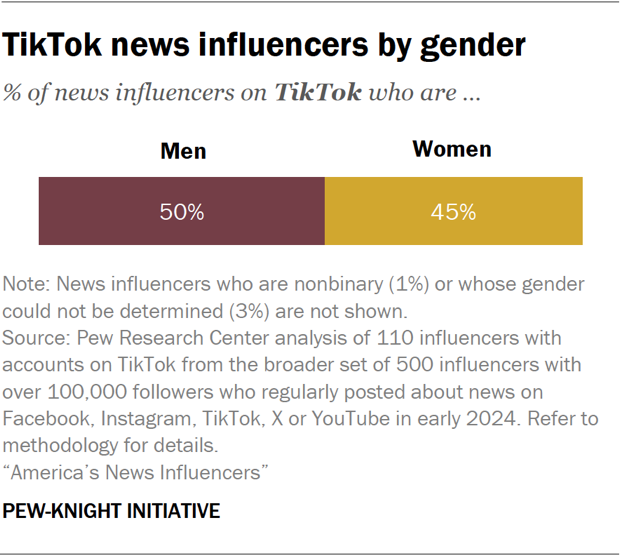
  • Gender: TikTok has the smallest gender gap: 50% of news influencers on TikTok are men, while 45% are women. On all other sites, men outnumber women by a roughly two-to-one margin or more.
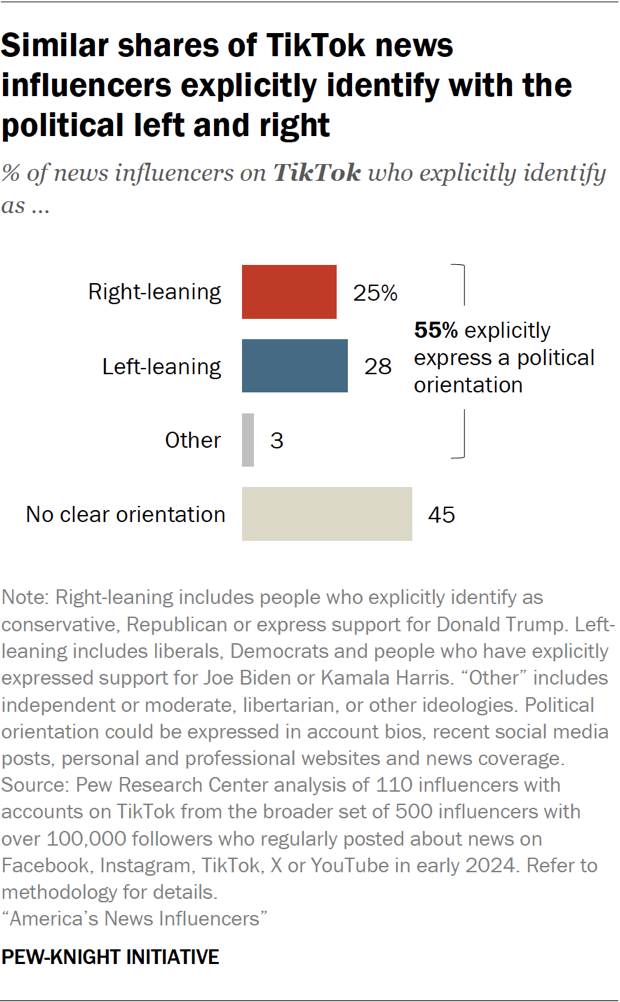
  • Political 0rientation: TikTok also stands out as the only site of the five where news influencers who explicitly identify as right-leaning (25% of TikTok news influencers) do not outnumber those who publicly express a left-leaning political ideology (28%).
  • Values and identities: News influencers on TikTok are more likely than those on other sites to show support for LGBTQ+ rights or identify as LGBTQ+ in their account profiles (13%).

How are news influencers who have worked for news organizations different from those who haven’t?

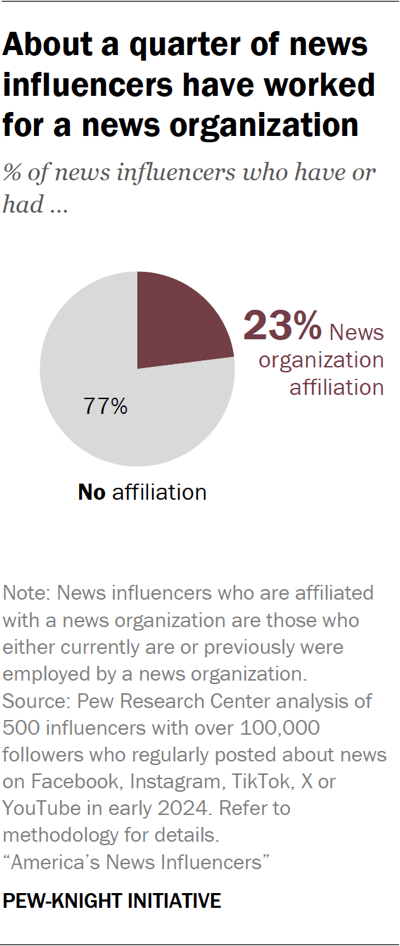
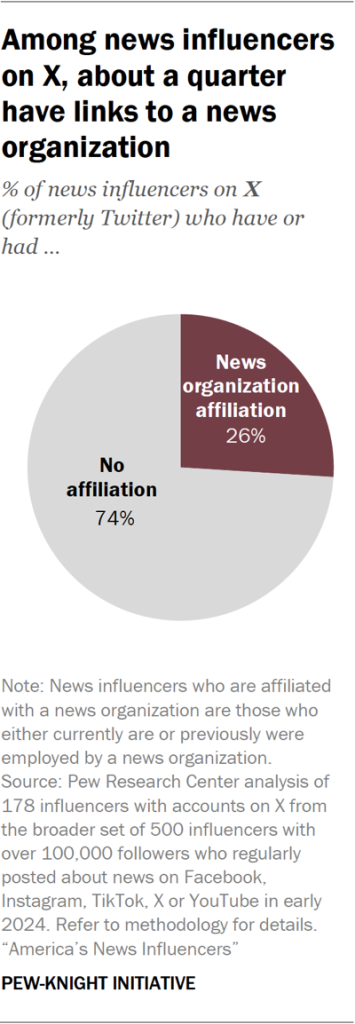
News influencers largely offer independent voices from outside the news media. About three-quarters of news influencers (77%) have no past or present affiliation with a news media organization, while 23% have been employed in the news industry in some way.

How we define ‘news organization affiliation’

Researchers categorized all news influencers based on whether they are currently or were previously employed by a news organization (or freelancers who regularly contributed to news organizations).

The list of news organizations that people in this category work for (or used to work for) is broad, ranging from long-standing newspapers to cable news channels to newer digital outlets. News organizations are defined as all outlets with a staff and multiple bylines. Researchers considered affiliated influencers to have this background regardless of their news organization’s political orientation, audience size or primary publishing method (digital, TV, print, etc.).

Those in the latter category include influencers who are currently affiliated with any news outlet (digital, TV, print, etc.), those who formerly worked in the news industry before becoming an independent influencer, and freelancers who have regularly contributed to news organizations.
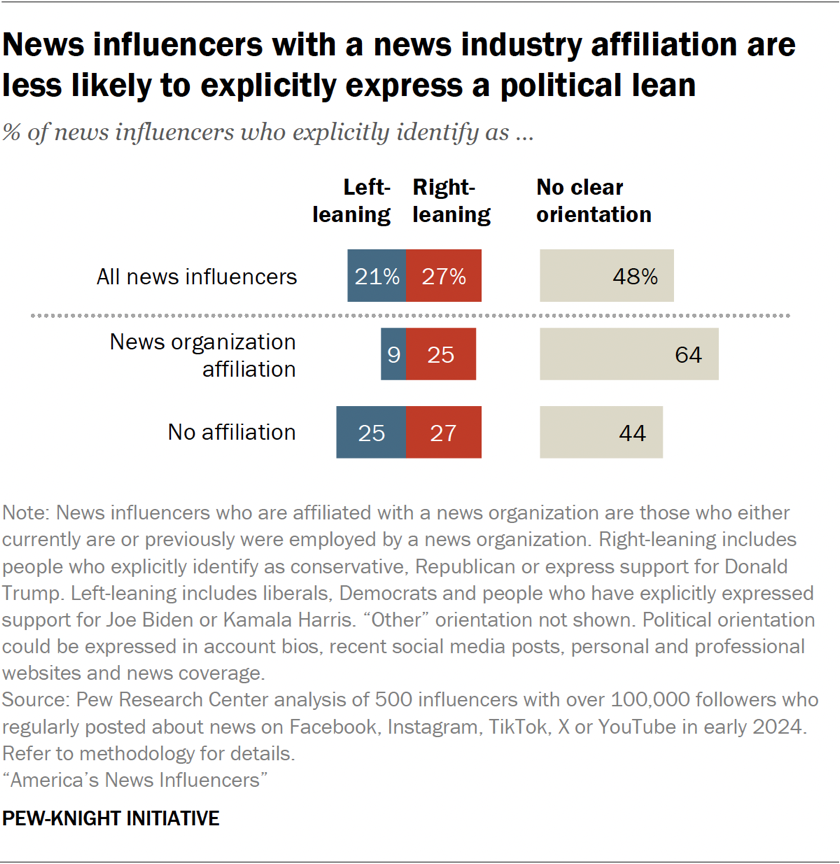
Bar chart showing news influencers with a news industry affiliation are less likely to explicitly express a political lean
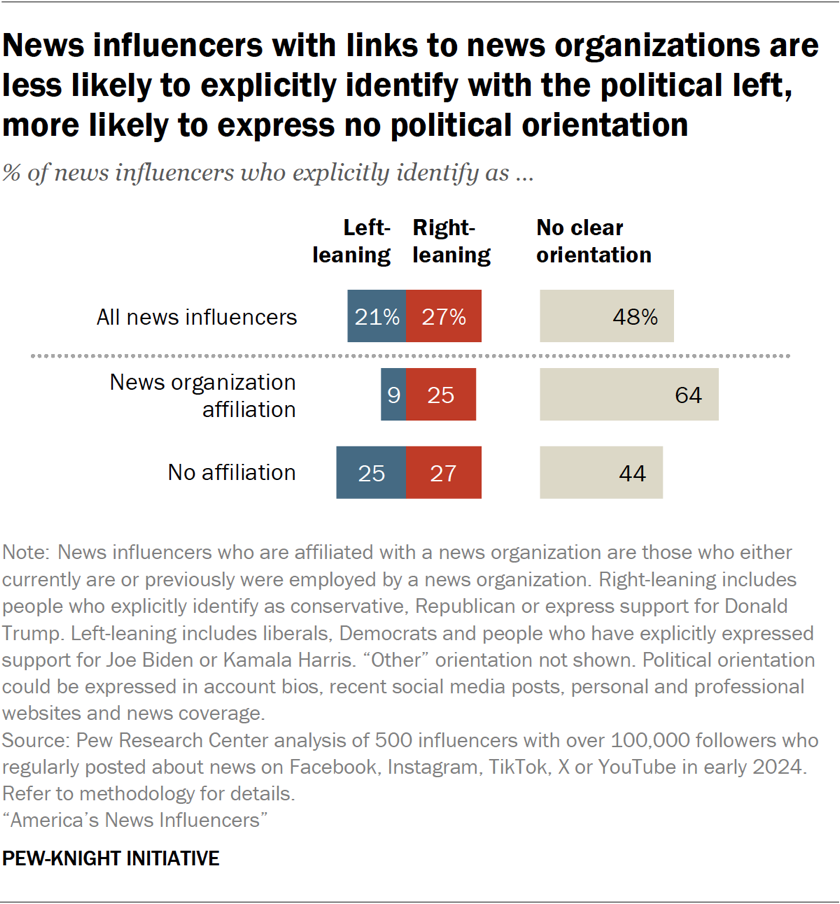
  • News influencers with a news organization affiliation are less likely to express a clear political orientation: 64% have no expressed political stance, compared with 44% of those who have never worked for a news organization.
  • When they do explicitly identify with a political orientation, news influencers with links to a news outlet tend to be right-leaning. A quarter (25%) say they are conservative, Republican or pro-Trump, while just 9% are liberal, Democratic, or pro-Harris or pro-Biden. Among news influencers with no links to a news outlet, roughly equal shares express a right-leaning (27%) and left-leaning (25%) stance.
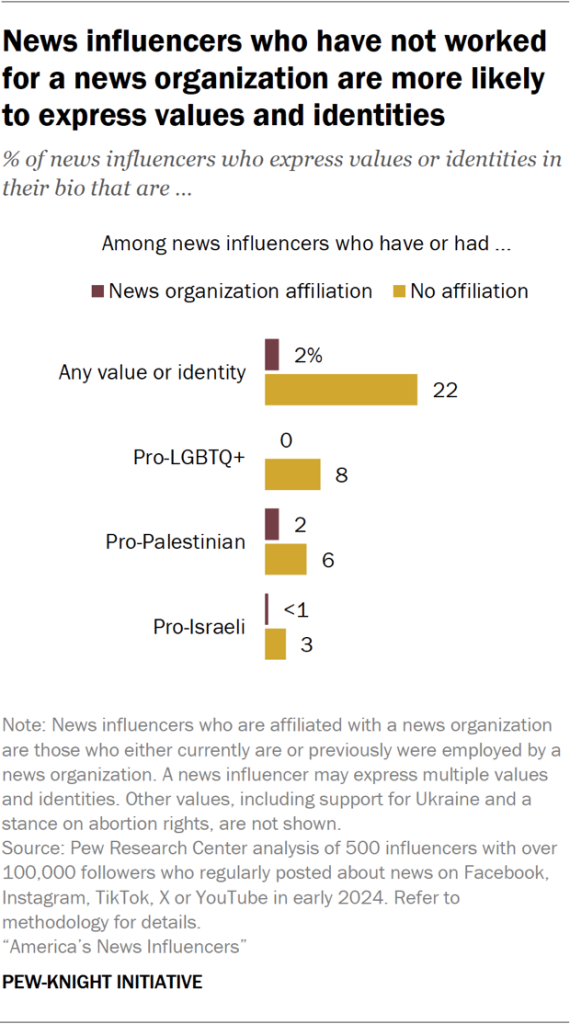
  • News influencers who are or were affiliated with a news organization also are less likely to identify with specific values and identities – for example, to indicate they are pro-LGBTQ+ or support Palestinians.
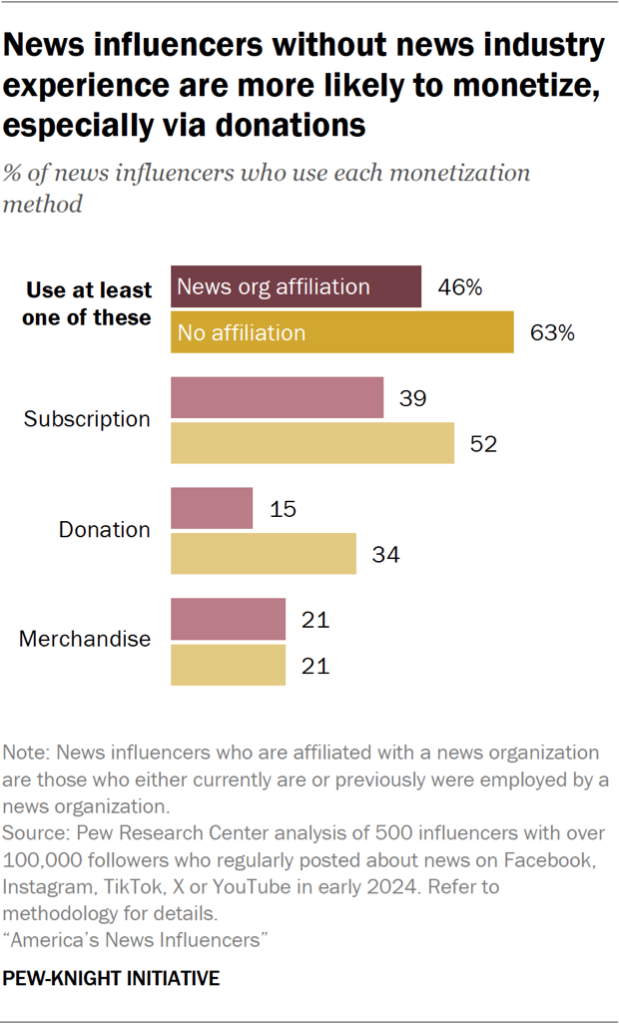
  • Nearly all news influencers who have a news organization affiliation (96%) are on X, compared with a smaller majority of news influencers without that background (82%). In contrast, news influencers without a news industry affiliation are more likely than those with links to the news industry to have accounts on video-based sites like YouTube and TikTok, and also are more likely to monetize their content through subscriptions, donations or merchandise.

Jump to more details on how influencers differ based on whether they have a background in the news industry.

Politics and the election are by far the most common topic for news influencers in 2024

To get a sense of what news influencers are posting about, researchers collected all public posts by the 500 news influencers in our sample for three separate weeks in 2024: July 15-21, July 29-Aug. 4 and Aug. 19-25. We then analyzed these posts using a human-validated large language model.
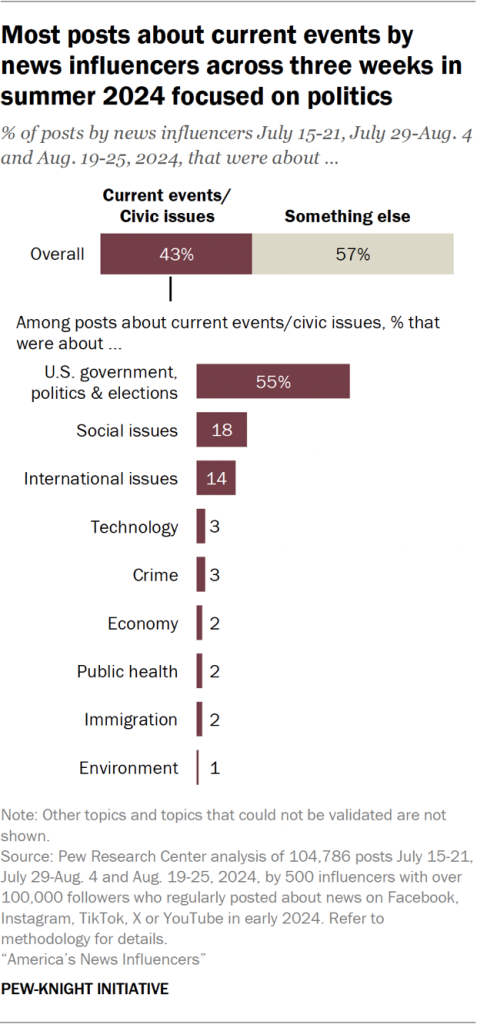
Bar chart showing most posts about current events by news influencers across three weeks in summer 2024 focused on politics

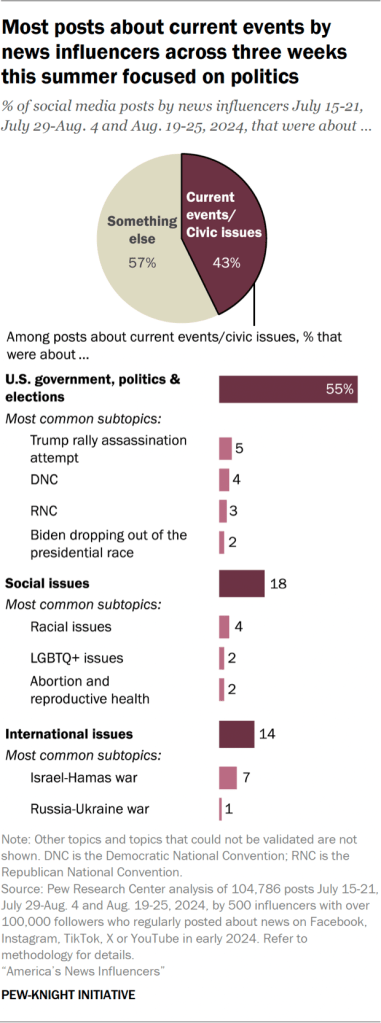
News influencers post about a wide range of topics. In fact, most of the posts by the news influencers in our sample during the three weeks (57%) could not be directly tied to current events or civic issues. (This may in part be a result of examining each post out of context, and not including images in the analysis.)

Some of the key findings from looking at the 43% of the posts that were confirmed to be about current events or civic issues:

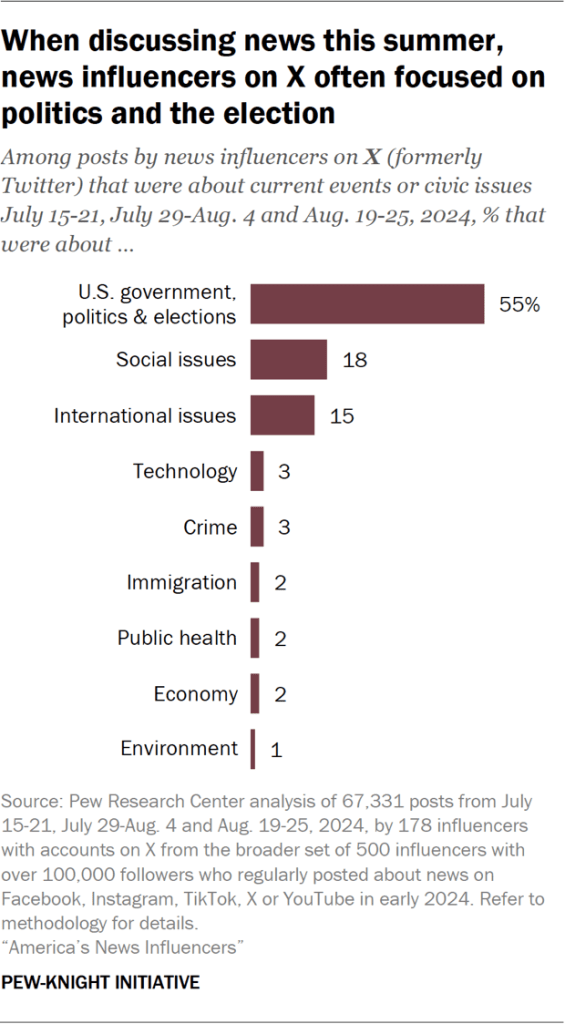
  • Among the posts that referenced current events or civic issues, more than half (55%) were about politics, government or the presidential election. This includes posts that were specifically about the first assassination attempt on Donald Trump (5%), the Democratic National Convention (4%), the Republican National Convention (3%) or President Joe Biden’s withdrawal from the race (2%). For most news influencers (58%), politics, government or the election was the most common post topic.
  • Beyond U.S. politics in general, 18% of posts focused on social issues, including race, LGBTQ+ issues and abortion. A similar share of posts (14%) were about international issues, including the Israel-Hamas war (7%).
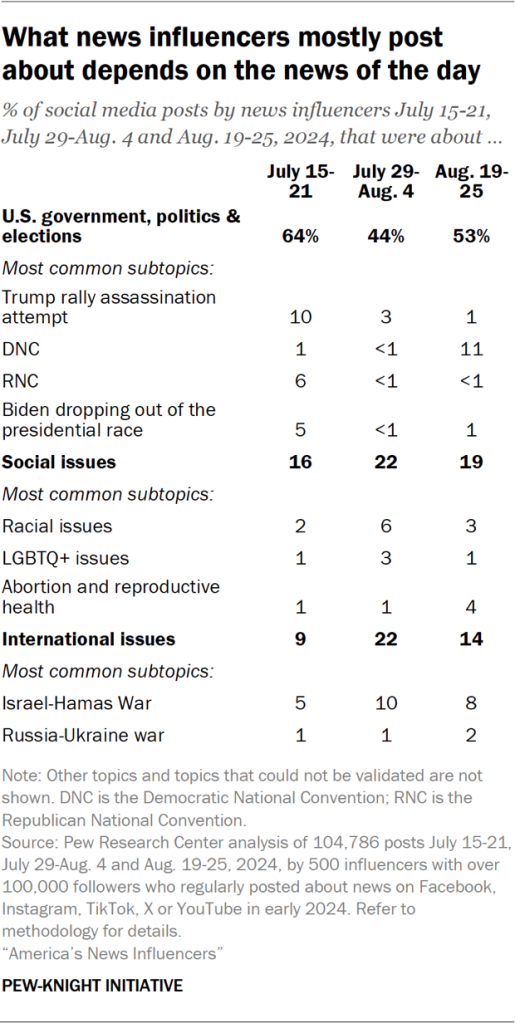
  • The posts each week reflect the events going on at the time. Posts from July 15 to 21 were more likely than other weeks to be about the first assassination attempt on Trump on July 13 (10% of posts), the RNC, held from July 15 to 18 (6%), and Biden dropping out of the race on July 21 (5%). And posts from Aug. 19 to 25 were especially likely to be about the DNC, which was held that week (11%).
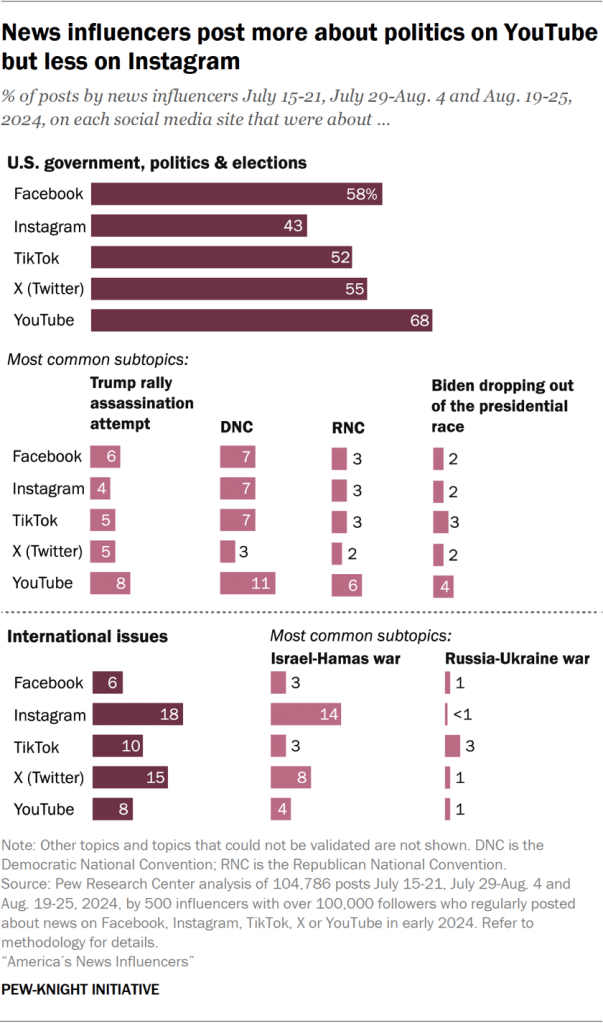
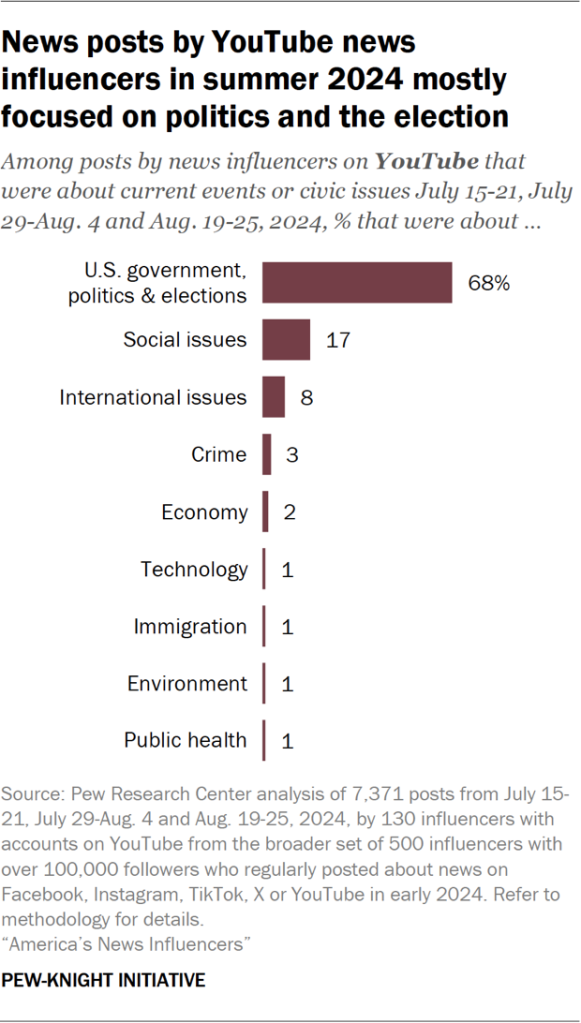
  • Across all weeks, there was some variation across sites in which topics were discussed more or less often. For instance, the Israel-Hamas war was discussed more on Instagram than any other site (14% of Instagram posts, followed by 8% of X posts), while U.S. politics was a less common topic on Instagram than other sites. Politics and the election were discussed in a particularly high share of posts on YouTube (68%).

Jump to the full analysis of topics being discussed by news influencers.

Other Pew Research Center studies on social media

This study is the latest in our ongoing investigation into the news and information Americans are seeing on social media.

For our related research, read:

  • Social media and news fact sheet
  • How Americans get news and navigate politics on social media
  • The news environment on YouTube
  • The role of alternative social media in the news and information ecosystem
  • The landscape of information, entertainment and politics on Twitter and TikTok

The rest of this report looks at these findings in greater detail. One section dives into the opinions and experiences of Americans who regularly get news from influencers. Others include a brief overview of how we created the list of news influencers and where they are posting content, an analysis of their gender and political orientation, and an overview of the differences between news influencers who have worked for news organizations and those who have not.

Finally, one section looks in more detail at the topics discussed by news influencers, and five additional sections profile news influencers on each of the major sites studied: Facebook, Instagram, TikTok, X (formerly Twitter) and YouTube.
1. Americans’ experiences with social media news influencers

For our latest survey data about news influencers, read the “News Influencers Fact Sheet.”

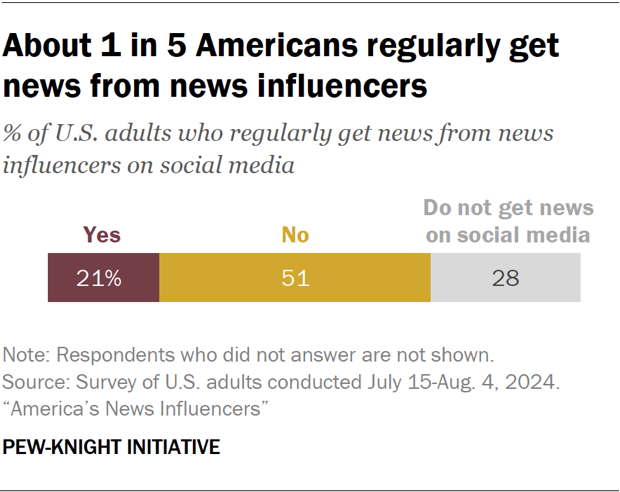
As the wider political and media world has taken notice of news influencers, Americans have begun to incorporate these individuals’ posts into their news habits: About one-in-five (21%) say they regularly get news from news influencers on social media.

Bar chart showing about 1 in 5 Americans regularly get news from news influencers

This data comes from a survey of more than 10,000 U.S. adults conducted in late July and early August 2024. The term “news influencers” was defined for survey respondents as “individuals who have a large following on social media and often post about news or political or social issues.” This is similar to how we define this group in our analysis of a sample of 500 news influencers.

This chapter dives into the attitudes and experiences of Americans who regularly get news from news influencers.

Bar chart showing almost 4 in 10 U.S. adults under 30 get news from news influencers

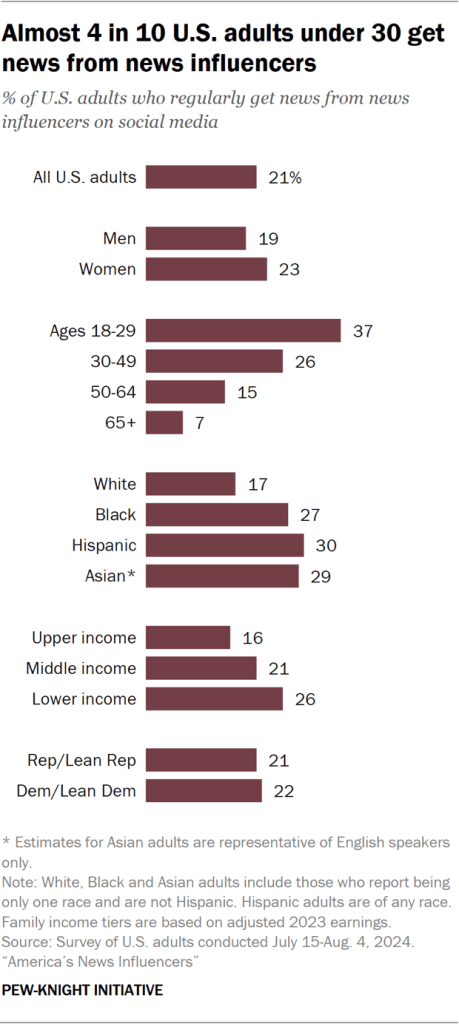
Similar to other patterns of social media use and news consumption on social media, younger adults are much more likely to get news from news influencers on social media. Nearly four-in-ten Americans ages 18 to 29 (37%) say they regularly get news from news influencers, compared with just 7% of those 65 and older.

Virtually identical shares of Republicans (21%) and Democrats (22%), including independents who lean toward each party, say they regularly get news from news influencers.

White Americans are less likely than other racial or ethnic groups to get news from news influencers. Only 17% of White U.S. adults say they do this, versus higher shares among Hispanic (30%), Asian (29%) and Black adults (27%).

In addition, adults with lower incomes are more likely to get news from news influencers. About a quarter of those with lower incomes (26%) do this, compared with 21% of those in the middle-income category and 16% of those with higher incomes.

What types of information do Americans get from news influencers?

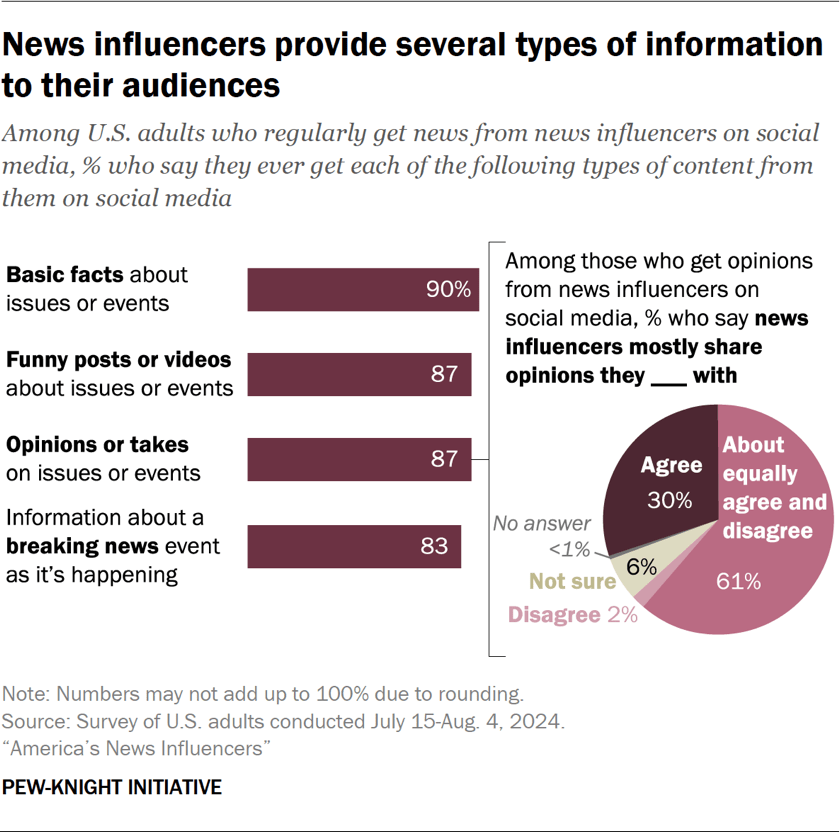
It is common for Americans who regularly get news from news influencers to see several types of information from these creators. Overwhelming majorities say they get all four types of content asked about in the survey: basic facts (90%), opinions (87%), funny posts (87%) and breaking news (83%).

Chart showing news influencers provide several types of information to their audiences

To gauge whether people are seeking out influencers whose opinions align with their own, we asked all Americans who say they get opinions from news influencers whether or not they mostly agree with these opinions.

Most people who get opinions from news influencers (61%) say they see opinions that they agree and disagree with about equally. Three-in-ten say they mostly see opinions they agree with from news influencers, while just 2% say they mostly disagree with them.

Similarly, a 2023 Pew Research Center study of news and information on podcasts found that podcast listeners who hear political opinions are much more likely to say those opinions line up with their own opinions than that they are different (47% vs. 7%).

Most Americans who get news from news influencers see the content as helpful, unique

Adults who regularly get news from news influencers generally say content from news influencers has helped them better understand current events and civic issues and that it is at least somewhat different from the news they get from other sources.

Bar chart showing majorities of Americans who get news from news influencers say the information they share is helpful and say the news from news influencers is at least somewhat different from news from other sources

Among those who get news from news influencers:

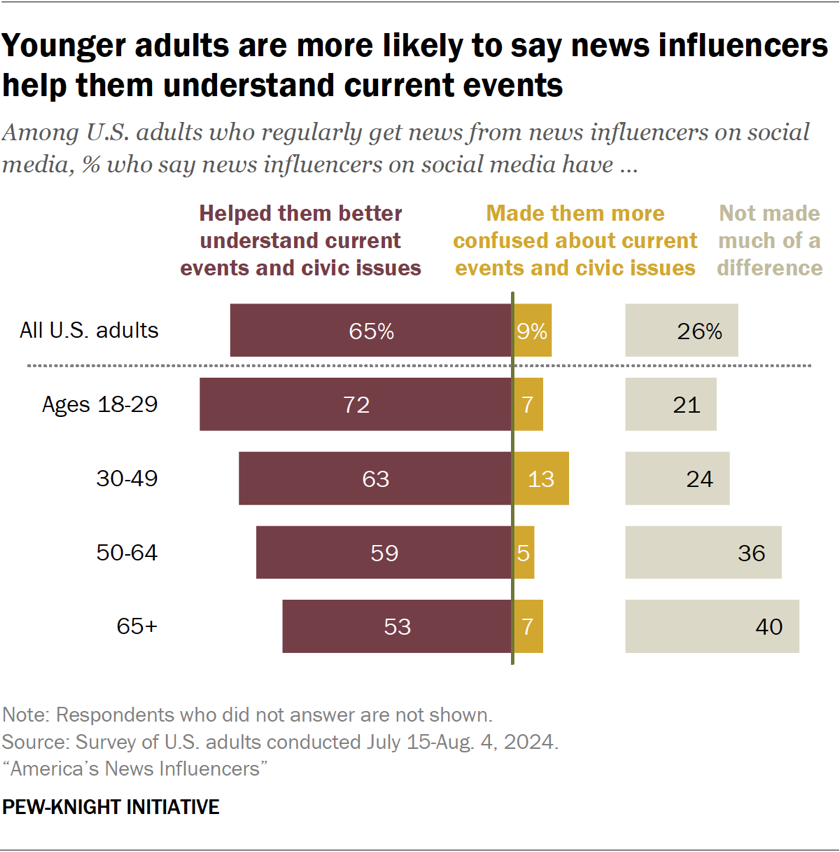
  • 65% say news influencers on social media have helped them better understand current events and civic issues, while just 9% say they have made them more confused. About a quarter (26%) say they have not made much of a difference.
  • Seven-in-ten say the news they get from news influencers is at least somewhat different from the news they get from other sources, including roughly a quarter who say it is extremely or very different (23%). About three-in-ten (29%) say news from news influencers is not too or not at all different from news from other sources.

Americans’ connections with news influencers

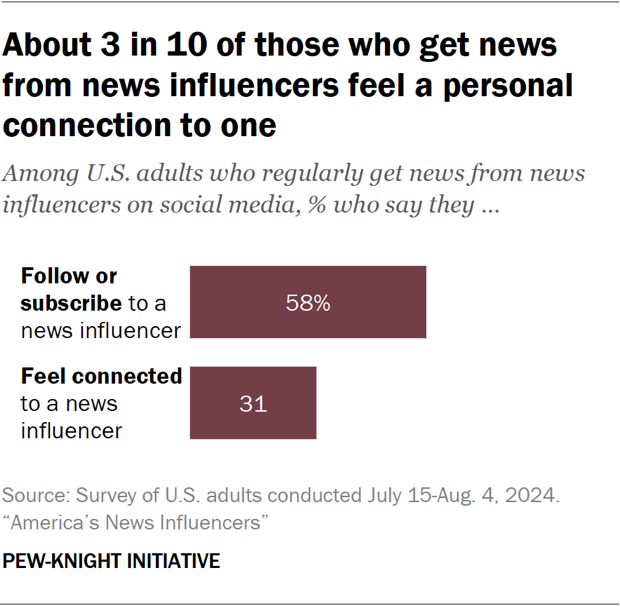
Among U.S. adults who regularly get news from news influencers, 58% say they follow or subscribe to at least one news influencer on social media. The substantial share who do not follow an influencer may be a reflection of algorithmic social media feeds that show people posts from accounts they do not follow.

Bar chart showing about 3 in 10 of those who get news from news influencers feel a personal connection to one

A smaller share of those who get news from news influencers (31%) say they feel personally connected to one of these content creators. When asked if there are any news influencers they feel they have a personal connection to, about seven-in-ten say no (69%).

Political ideology linked with differing views on news influencers

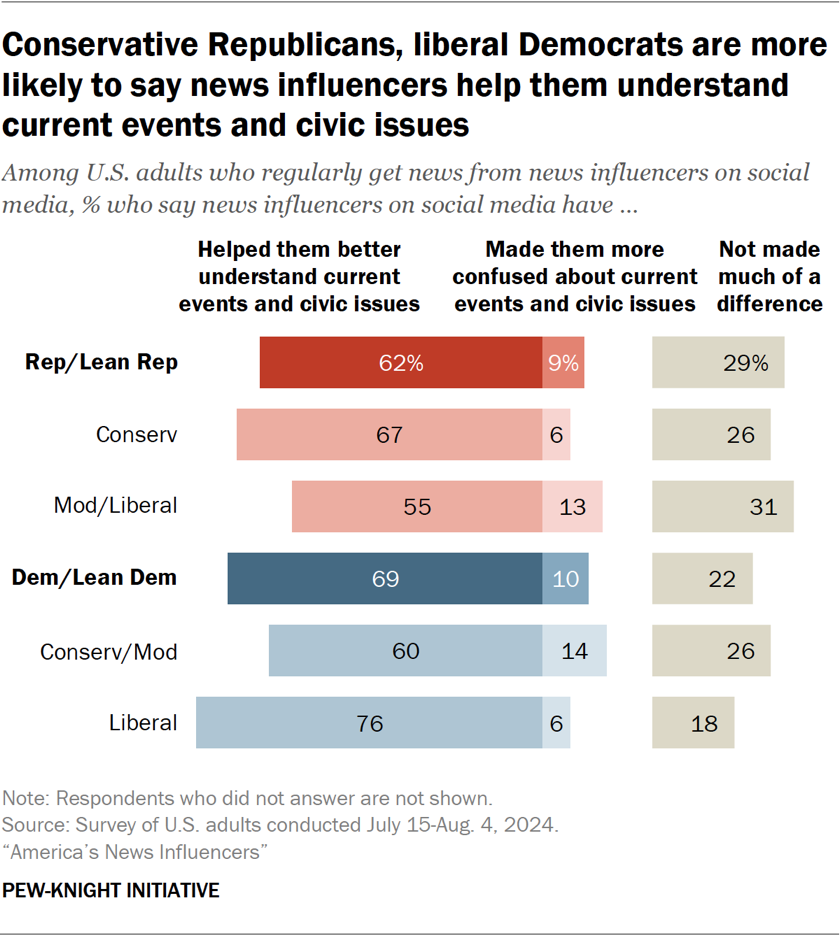
While Republicans and independents who lean toward the Republican Party get news from news influencers at the same rate as Democrats and Democratic leaners, Republicans who get news from news influencers are more inclined to say this news is extremely or very different from the news they get from other sources (28% vs. 19%).

Bar chart showing conservative Republicans, liberal Democrats are more likely to say news influencers help them understand current events and civic issues

On the other hand, Democrats who get news from news influencers are slightly more likely than Republicans to say it helps them better understand current events and civic issues (69% vs. 62%).

People at either end of the ideological spectrum are particularly likely to express this view. Among those who regularly get news from influencers, Republicans who identify as conservative are more inclined than those who say they are moderate or liberal to say news influencers have helped them better understand current events and civic issues (67% vs. 55%). And liberal Democrats are more likely than moderate or conservative Democrats to say this (76% vs. 60%).

Bar chart showing conservative Republicans, liberal Democrats are more likely to say they mostly see news influencers share opinions they agree with

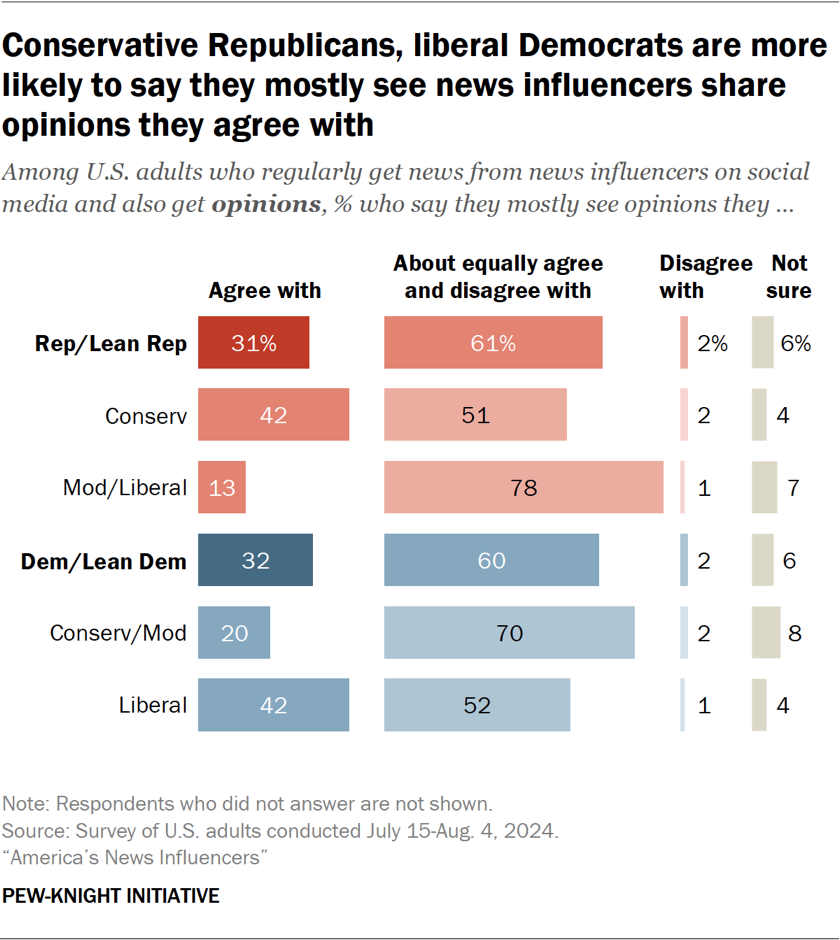
Among those who get opinions from news influencers, similar shares of Republicans (31%) and Democrats (32%) say they mostly get opinions they agree with.

Again, however, those at the ends of the ideological spectrum are more likely to express this view. Among those who regularly get news from news influencers and say opinions are one thing they see, identical shares of conservative Republicans and liberal Democrats (42% each) say they mostly see opinions they agree with.

By contrast, much smaller shares of conservative or moderate Democrats (20%) and moderate or liberal Republicans (13%) say this is the case. Instead, these groups are more likely to say they agree and disagree about equally with the opinions they see from news influencers. 

Young adults more likely to see content from news influencers as helpful, unique

Young adults are much more likely than those in older age groups to get news from news influencers. And among those who do get news from news influencers on social media, young people also are more likely to say the information they get from news influencers is helpful and unique. 

Bar chart showing younger adults are more likely to say news influencers help them understand current events
  • Younger people are more likely to say news influencers help them better understand current events and civic issues. Among those who get news from influencers, almost three-quarters of adults ages 18 to 29 (72%) say this about news influencers on social media, compared with about half of those 65 and older (53%).
  • Younger adults are also more likely to say that the news they get from news influencers is at least somewhat different from the news from other sources. Again looking only at those who regularly get news from news influencers on social media, three-quarters of those ages 18 to 29 say the news they get is at least somewhat different from news they get from other sources. A somewhat smaller share of those 65 and older (65%) say the same.

2. How we created a list of popular news influencers, and where they post

For our latest survey data about news influencers, read the “News Influencers Fact Sheet.”

Social media is vast, with several distinct sites and innumerable accounts spread across them. Because of this complexity, researchers cast a wide net across the most popular sites to create an inclusive list of influencers who discuss news.

Infographic showing how we identified news influencers

First, we developed a set of keywords related to current events and civic issues across 45 topics that were relevant to broad audiences in the U.S. in early 2024. Then we used a set of social media marketing tools to find social media accounts with over 100,000 followers that used those keywords in early 2024. While the keywords used were focused on issues important to the United States, we could not verify the location of the individuals running these accounts.

One thing quickly became clear: Discussion of news, politics and civic issues is widespread on social media. This initial screening led to a list of more than 28,000 accounts across Facebook, Instagram, TikTok, X and YouTube.

Many of these 28,000 accounts are not focused on news most of the time. Researchers examined recent posts from each account to determine if they were talking about news, politics and civic issues regularly, and not just rarely. We also verified that accounts were run by individuals and not organizations. Just over 2,500 accounts – and 2,058 influencers, since influencers can have an account on multiple sites – met these criteria.

To create a more manageable group to analyze, researchers then sampled 500 news influencers from this set of 2,058.1 These 500 form the set of popular news influencers who are examined in this report. Our analysis includes:

  • Detailed human coding of all 500 news influencers to determine where they post and who they are. This includes a look at other places they may post beyond the five major sites we searched for influencers on.
  • Human-validated machine coding of over 100,000 posts from these news influencers during three weeks in July and August 2024, to determine what these accounts are posting about.

For more information, refer to the methodology.

Where are news influencers found?

Bar chart showing more news influencers are on X than any other site

While news influencers can be found on a wide range of social media sites, they are concentrated on a few. The vast majority of news influencers studied (85%) have an account on X, formerly known as Twitter. Half are on Instagram, while a slightly smaller share (44%) are on YouTube.

Roughly three-in-ten are on Facebook (32%), Threads (30%) and TikTok (27%). And smaller shares are on several other sites, including 5% who are on Donald Trump’s site, Truth Social.2 (A 2022 study found that most prominent accounts on Truth Social were individuals.)

More Americans say they regularly get news (in general, not just from news influencers) from Facebook (33%) and YouTube (32%) than other social media sites, while smaller shares get news on Instagram (20%), TikTok (17%) and X (12%). At the same time, a much larger share of X users than users of other sites say getting news is a reason they use the site.

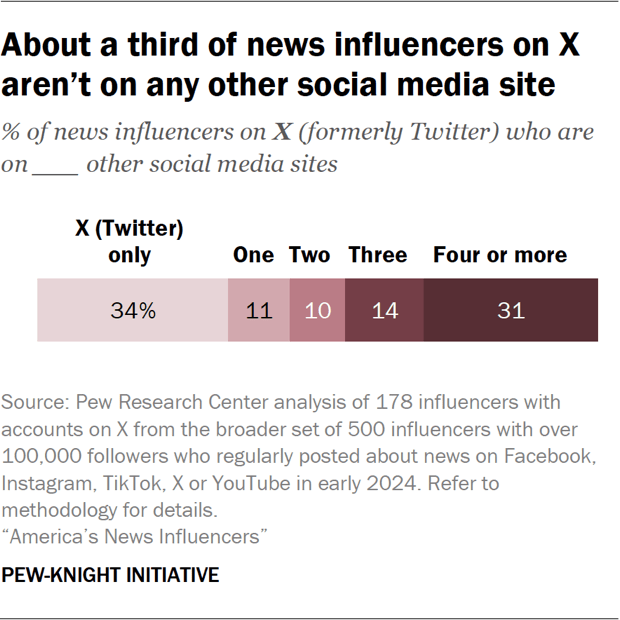
Altogether, about two-thirds of news influencers are on more than one social media site, including 27% who are on five or more sites. Meanwhile, 34% are on just one site – most often X.

Bar chart showing about two-thirds of news influencers are on more than one site

Other ways news influencers connect with their audiences

Bar chart showing about a third of social media news influencers host a podcast

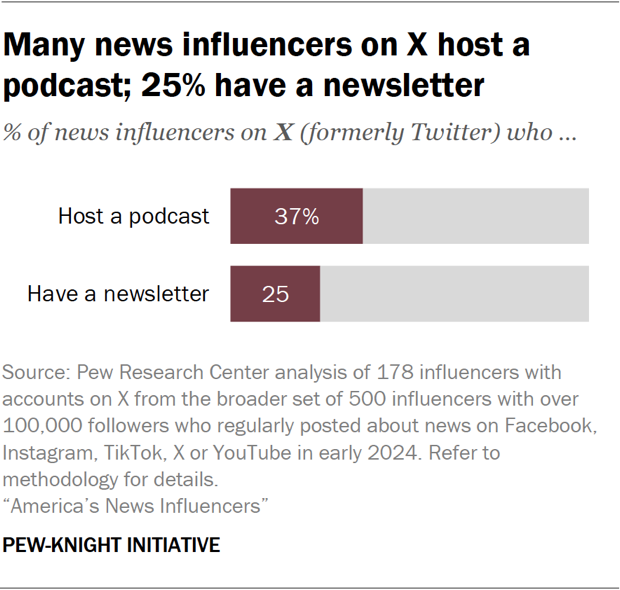
We also looked at other ways that news influencers connect with their audiences beyond social media. About a third (34%) host a podcast, and nearly a quarter (22%) send an email newsletter to subscribers. A small share of news influencers in the sample (6%) have an official Discord server, a chat site on which they can often have private, ongoing chats with fans.

Bar chart showing most news influencers seek to monetize their content in some way

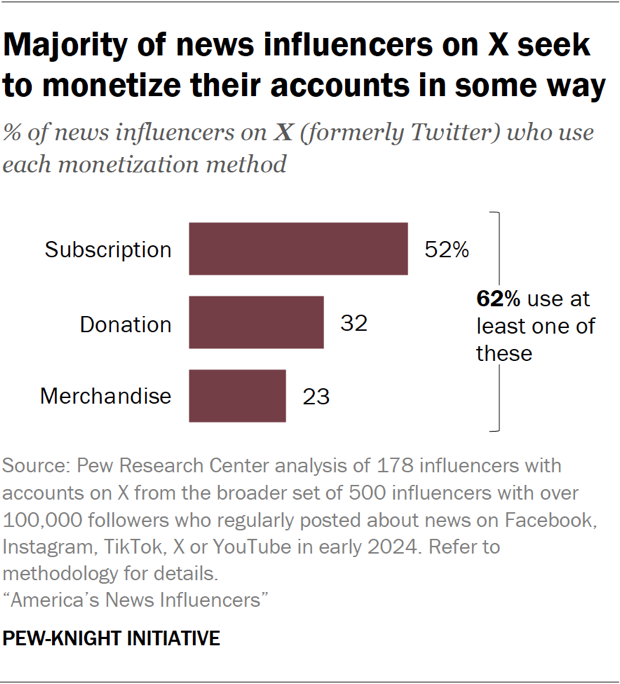
Most news influencers (59%) also make direct financial appeals to their followers. About half (49%) offer a paid subscription to their content, 29% solicit donations, and 21% sell branded merchandise like stickers, coffee mugs and apparel.

3. A profile of news influencers: Gender, politics and more

For our latest survey data about news influencers, read the “News Influencers Fact Sheet.”

Terminology
  • News influencers – People who regularly post about current events and civic issues on social media and have at least 100,000 followers on any of Facebook, Instagram, TikTok, X (formerly Twitter) or YouTube.
  • Political orientation – A measure of a news influencer’s partisan or ideological views. A right-leaning news influencer is one who publicly expresses that they identify as a Republican or conservative or support Donald Trump in the 2024 presidential election. A left-leaning news influencer is one who publicly expresses that they identify as a Democrat, liberal or progressive or support Vice President Kamala Harris (or supported President Joe Biden before he dropped out of the race) in the 2024 election. This information was found in the bio, profile picture, banner image, pinned posts or recent posts on an influencer’s social media account, any personal website or professional page, and prominent media coverage.
  • Values and identities – Language or imagery in the bio, profile picture, banner image or pinned posts on an influencer’s social media account that expresses specific beliefs or identities.
  • News organization affiliation – An influencer with this affiliation is one who either currently works for or previously worked for a news organization, as well as freelancers who have regularly contributed to news organizations. A news organization can be any news outlet that has a staff and multiple bylines. Researchers considered affiliated influencers to have this background regardless of their news organization’s political orientation, audience size or primary publishing method (digital, TV, print, etc.).
  • Major social media sites – The five primary sites we studied, chosen based on audience size and the presence of discussion about news: Facebook, Instagram, TikTok, X (formerly Twitter) and YouTube.
What is a news influencer?

In this study, we use the term “news influencers” to refer to individuals who regularly post about current events and civic issues on social media and have at least 100,000 followers on any of Facebook, Instagram, TikTok, X (formerly Twitter) or YouTube. News influencers can be journalists who are or were affiliated with a news organization or independent content creators, but they must be people and not organizations.

Refer to the methodology for more about how we identified news influencers.

Once we had a sample of 500 popular news influencers to analyze, our researchers combed through each account to characterize who these influencers are. This chapter looks at news influencers’ gender, political orientation, and expression of particular values and

identities.

Pie chart showing nearly two-thirds of news influencers are men

We also looked at whether each influencer is or used to be affiliated with a news organization; details are discussed in Chapter 4. We were unable to code for other attributes of news influencers, such as race, ethnicity and age.

Gender

There is a wide gender gap among news influencers in this study. Almost two-thirds of news influencers (63%) are men, about twice the share who are women (30%). A small number (fewer than 1%) identify as nonbinary in their online profiles. (For details on how researchers coded news influencers’ gender, refer to the methodology.)

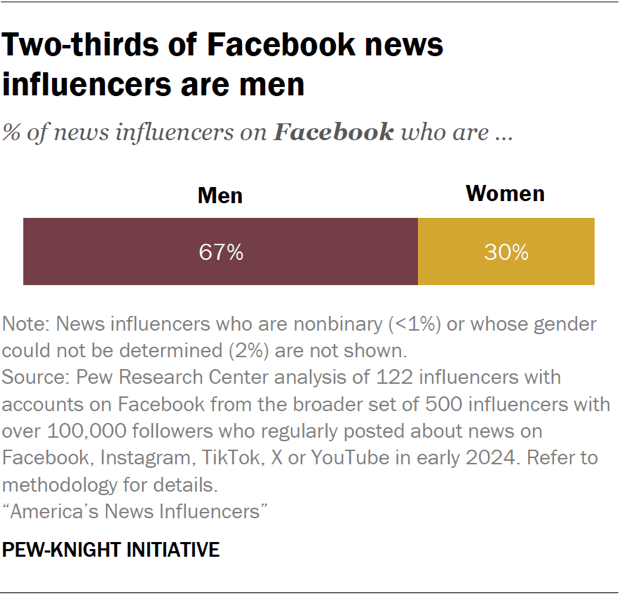
The gender gap among news influencers is present on most major social media sites, with men outnumbering women by about two-to-one or more on YouTube, Facebook, X and Instagram. For instance, 67% of news influencers on Facebook are men, compared with 30% who are women.

However, the gender gap is much smaller on TikTok, where half of the news influencers on the site are men and 45% are women.

Bar chart showing minimal gender gap among news influencers on TikTok compared with other sites

Political orientation

Slightly more news influencers explicitly identify with the political right than the left. About half of news influencers in this study (52%) publicly express a political orientation – including party affiliation, political ideology or support for a presidential candidate – in their social media profile, posts, personal and professional websites or media coverage.

Bar chart showing more news influencers explicitly say they are right-leaning than left-leaning

Researchers also considered other specific keywords or groups: For example, someone with “MAGA” in their account profile would be categorized as right-leaning, while someone who says they are “progressive” would be coded as left-leaning. Left-leaning news influencers include “progressive political host” Brian Tyler Cohen and V Spehar from Under the Desk News, while right-leaning news influencers include radio host and YouTuber Dan Bongino and podcaster Ben Shapiro.

A slightly larger share of these influencers say they are Republican, conservative or Donald Trump supporters (27% of all news influencers) than say they are Democrats, liberals or supporters of Joe Biden or Kamala Harris (21%). An additional 3% of news influencers have other political orientations, including independents or Libertarians.

Bar chart showing news influencers who explicitly lean right outpace those who publicly identify with the left across social media sites, except on TikTok

Similar to its more balanced mix of genders among popular news influencers, TikTok also has the most even balance of news influencers who explicitly identify with either the political left or right: 28% identify as liberal, progressive or Democratic, while 25% are conservative or Republican.

There are more news influencers who identify with the right than the left on all other major social media sites. This difference is particularly stark on Facebook, where about four-in-ten news influencers (39%) explicitly identify as right-leaning, triple the share who say they are left-leaning (13%).

Values and identities

Researchers also assessed accounts for additional political stances or personal identities through an examination of the banner image, profile photo and bio of news influencers’ social media account profiles.

Table showing TikTok stands out for the share of news influencers who express LGBTQ+ support or identity

In these spaces, it’s difficult to distinguish between a value and an identity: A rainbow flag, for instance, could be an expression of support for LGBTQ+ rights or a declaration of the influencer’s LGBTQ+ identity. The content of the posts themselves (except for pinned or featured posts) was not assessed for these values, because we wanted to find influencers who make these values and identities a key part of their public persona.

About two-in-ten news influencers (18%) openly associate themselves with certain political or social causes, values or personal identities. Among the most common are LGBTQ+ identity or support (6%) and support for Palestinians (5%), Israelis (3%) or Ukrainians (3%).

Additionally, 2% prominently declare their opposition to abortion, while only a handful of news influencers in the sample (less than 1%) express support for abortion rights in this way.

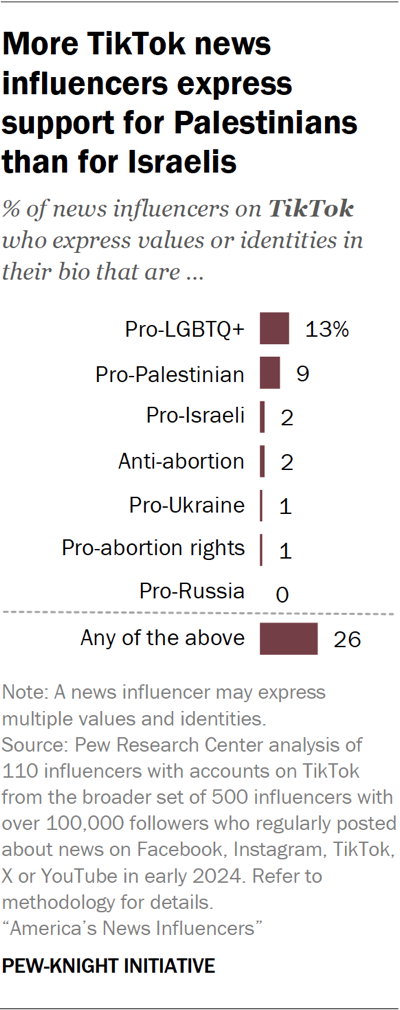
News influencers on TikTok are more likely than those on other sites to show support for LGBTQ+ rights or identity in their profiles (13%). And amid ongoing discussions about the conflict in Gaza, about one-in-ten news influencers on TikTok (9%) express a pro-Palestinian stance, compared with 2% who are pro-Israel.

4. How news influencers who have worked for news organizations differ from those who haven’t

For our latest survey data about news influencers, read the “News Influencers Fact Sheet.”

Terminology
  • News influencers – People who regularly post about current events and civic issues on social media and have at least 100,000 followers on any of Facebook, Instagram, TikTok, X (formerly Twitter) or YouTube.
  • Political orientation – A measure of a news influencer’s partisan or ideological views. A right-leaning news influencer is one who publicly expresses that they identify as a Republican or conservative or support Donald Trump in the 2024 presidential election. A left-leaning news influencer is one who publicly expresses that they identify as a Democrat, liberal or progressive or support Vice President Kamala Harris (or supported President Joe Biden before he dropped out of the race) in the 2024 election. This information was found in the bio, profile picture, banner image, pinned posts or recent posts on an influencer’s social media account, any personal website or professional page, and prominent media coverage.
  • Values and identities – Language or imagery in the bio, profile picture, banner image or pinned posts on an influencer’s social media account that expresses specific beliefs or identities.
  • News organization affiliation – An influencer with this affiliation is one who either currently works for or previously worked for a news organization, as well as freelancers who have regularly contributed to news organizations. A news organization can be any news outlet that has a staff and multiple bylines. Researchers considered affiliated influencers to have this background regardless of their news organization’s political orientation, audience size or primary publishing method (digital, TV, print, etc.).
  • Major social media sites – The five primary sites we studied, chosen based on audience size and the presence of discussion about news: Facebook, Instagram, TikTok, X (formerly Twitter) and YouTube.

On social media, many news consumers get news directly from journalists and news organizations, including both individual reporters and institutional feeds.

Pie chart showing about a quarter of news influencers have worked for a news organization

But news influencers are mostly voices from beyond the newsroom: About three-quarters (77%) have no background or affiliation with a news organization. Roughly a quarter (23%) of news influencers work for a news organization (or did so in the past).

To compare news influencers with experience producing journalism within the news industry and those who came to prominence outside of it, researchers looked for past or present affiliations with news media organizations. These groups have different career experiences and potentially different levels of formal journalistic training.

News influencers with a news organization affiliation include former CNN analyst Chris Cillizza, who now has his own Substack newsletter, as well as people with a current affiliation like Fox News host Jesse Watters and local journalists like Olivia DiVenti. Those without an affiliation have a wide variety of backgrounds, including podcaster Mike Figueredo and activist Charlie Kirk.

How we define ‘news organization affiliation’

Researchers categorized all news influencers based on whether they are currently or were previously employed by a news organization.

The list of news organizations that people in this category work for (or used to work for) is broad, ranging from long-standing newspapers to cable news channels to newer digital outlets. News organizations are defined as all outlets with a staff and multiple bylines. Researchers considered affiliated influencers to have this background regardless of their news organization’s political orientation, audience size or primary publishing method (digital, TV, print, etc.).

News influencers from the news industry are more reserved in expressing political views

There are several differences between news influencers who have worked for a news organization and those who have not.

For one, news influencers with a connection to the news industry are less likely to explicitly advertise their political orientations. About two-thirds of those who’ve worked for a news organization (64%) do not express a clear political orientation in their social media profile, posts, personal website or media coverage, compared with 44% of those without that background.

Bar chart showing news influencers with links to news organizations are less likely to explicitly identify with the political left, more likely to express no political orientation

Similar shares of news influencers with and without connections to news organizations identify as right-leaning (25% and 27%, respectively). But news influencers from news organizations are less likely to explicitly identify as left-leaning.

Just 9% of news influencers with a current or former connection to a news organization say they are liberal or Democratic. Among those with no such background, 25% identify with the political left.

Bar chart showing news influencers who have not worked for a news organization are more likely to express values and identities

It is also much more common for news influencers without a background in the news industry to openly link themselves to certain values or identities in their social media profiles. About one-in-five influencers who have not worked for a news organization (22%) do this, compared with just 2% of those who have worked for a news organization.

In particular, news influencers not tied to the news industry are more likely to show support for LGBTQ+ rights or identify as LGBTQ+ (8%). None of those with news industry backgrounds express this appeal. 

No news influencers in the sample who have worked for news organizations express a position on abortion or a pro-Ukraine stance in their accounts, while small shares of those with no affiliation with a news organization identify with these positions.

News influencers who have not worked for a news organization are more likely to be on video sites and manage fan communities

News influencers with and without links to news organizations also differ in where and how they engage with audiences.

Bar chart showing news influencers who have not worked for a news organization are more likely to be on YouTube, TikTok

X is the most widely used social media site among all news influencers overall, but those who have been affiliated with news organizations are more likely to use the site than other news influencers (96% vs. 82%).

A previous Pew Research Center survey also indicates that the site formerly known as Twitter ranks at the top of social media sites for work-related tasks among journalists. And U.S. adults who regularly get news on X also are more likely to say they get news from journalists and news organizations than those who regularly get news on other social media sites.

By contrast, news influencers without a background in the news industry are more likely to be on YouTube and TikTok than those with that background. Half of these news influencers have a YouTube presence, roughly twice the share of their counterparts who have worked for news organizations (23%). Similarly, three-in-ten news influencers who have not worked for a news organization use TikTok, compared with just 19% of those who have links to a news outlet. 

In addition to social media sites, some news influencers from outside the news industry also turn to Discord (7%) and Patreon forums (3%) to engage directly with followers. Such sites are scarcely used by those who have worked for a news organization (less than 1% each).

Bar chart showing news influencers without news industry experience are more likely to monetize, especially via donations

For news influencers without links to news organizations, it is also more common to make money from creating news content online. A majority of these influencers (63%) do so, compared with 46% of news influencers who have industry experience.

This includes offering subscriptions to additional content, soliciting donations and selling merchandise. In particular, news influencers who have not worked for news organizations are more inclined to solicit donations: Around a third of this group (34%) engages in this practice, compared with just 15% of those who have worked in the news industry.  

5. A closer look at the topics of news influencers’ posts

For our latest survey data about news influencers, read the “News Influencers Fact Sheet.”

Terminology
  • News influencers – People who regularly post about current events and civic issues on social media and have at least 100,000 followers on any of Facebook, Instagram, TikTok, X (formerly Twitter) or YouTube.
  • Political orientation – A measure of a news influencer’s partisan or ideological views. A right-leaning news influencer is one who publicly expresses that they identify as a Republican or conservative or support Donald Trump in the 2024 presidential election. A left-leaning news influencer is one who publicly expresses that they identify as a Democrat, liberal or progressive or support Vice President Kamala Harris (or supported President Joe Biden before he dropped out of the race) in the 2024 election. This information was found in the bio, profile picture, banner image, pinned posts or recent posts on an influencer’s social media account, any personal website or professional page, and prominent media coverage.
  • Values and identities – Language or imagery in the bio, profile picture, banner image or pinned posts on an influencer’s social media account that expresses specific beliefs or identities.
  • News organization affiliation – An influencer with this affiliation is one who either currently works for or previously worked for a news organization, as well as freelancers who have regularly contributed to news organizations. A news organization can be any news outlet that has a staff and multiple bylines. Researchers considered affiliated influencers to have this background regardless of their news organization’s political orientation, audience size or primary publishing method (digital, TV, print, etc.).
  • Major social media sites – The five primary sites we studied, chosen based on audience size and the presence of discussion about news: Facebook, Instagram, TikTok, X (formerly Twitter) and YouTube.
While it’s important to shed light on who these new social media news providers are, a full understanding of the modern news environment also requires getting a sense of what these news influencers are posting about.

What is a news influencer?

In this study, we use the term “news influencers” to refer to individuals who regularly post about current events and civic issues on social media and have at least 100,000 followers on any of Facebook, Instagram, TikTok, X (formerly Twitter) or YouTube. News influencers can be journalists who are or were affiliated with a news organization or independent content creators, but they must be people and not organizations.

Refer to the methodology for more about how we identified news influencers.

Given the sheer volume of posts, this is not an easy task. The seemingly endless stream of content coming from these accounts would be exceedingly time-consuming for a group of human coders to analyze, so we used automated tools to collect these posts and turned to OpenAI’s GPT-4 model for classification. The output of this model was validated by a team of trained human coders.

We collected all public posts by the 500 news influencers in our sample for three weeks over the summer of 2024: July 15-21, July 29-Aug. 4 and Aug. 19-25. Some of these weeks included major election-related events. The first week started just days after an assassination attempt on Donald Trump at a campaign rally and included the Republican National Convention, as well as President Joe Biden dropping out of the race. And the third week included the Democratic National Convention.

We provided the model with the text from all posts, as well as transcriptions of videos on TikTok, Instagram and YouTube, but we did not include videos on other sites or images on any site. Each post was supplied on its own, without the surrounding context, which may limit the ability to categorize the post. Replies – posts directly responding to another message – in particular have less meaning when standing on their own.

The model did not recognize any mentions of current events or civic issues in 57% of the posts by the news influencers in our sample during these three weeks. This may be due to a mix of factors: the analysis limitations mentioned above, as well as news influencers posting about other topics.

Still, 43% of the posts did address these kinds of issues. The remainder of this chapter looks in more detail at these posts.

Chart showing most posts about current events by news influencers across three weeks this summer focused on politics

Among the posts that referenced current events or civic issues, a majority (55%) were about government, politics or the presidential election. This includes posts on several specific events that occurred during the weeks studied, including the first assassination attempt on Trump in July (5%), the Democratic National Convention (DNC) in August (4%), the Republican National Convention (RNC) in July (3%) and Biden’s withdrawal from the race on July 21 (2%). The presence of these topics suggests that news influencers are incorporating discussion of real-time events in their posts.

About one-in-five of the posts about current events (18%) focused on social issues such as racial issues (4%), LGBTQ+ issues (2%) and abortion (2%). Other topics that fell into this category include guns, education and culture war issues.

A slightly smaller share (14%) were about international issues – a sometimes small but often important component of the current events discussion in America. Many internationally focused posts were about the Israel-Hamas war (7% of all news-related posts), while 1% of all posts were about the Russia-Ukraine war.

No other topic was discussed in more than 4% of all posts by news influencers about current events during the study period: 3% of posts were about technology and 3% were about crime.

News influencers often respond to the news of the day

The weeks we chose to collect posts for analysis – and even the year we did this study – impact the findings. The study was conducted not only in the midst of a presidential election year but also during a period of major election-related news events, perhaps contributing to the high percentage of politics-related posts.

Table showing what news influencers mostly post about depends on the news of the day

Compared with other weeks studied, posts from July 15-21 were more likely to be about government and the election: 64% of all posts focused on current events and civic issues had this focus, compared with 44% of these posts July 29-Aug. 4 and 53% of these posts Aug. 19-25. There were several major election-related events around that week, including the first assassination attempt on Trump on July 13 (10% of all news-related posts that week), the RNC, held from July 15-18 (6%), and Biden dropping out of the race on July 21 (5%).

During the week of July 29-Aug. 4, there was a higher share of posts about social issues (22%) and international affairs (22%). There were several major international events that week, including the death of Hamas leader Ismail Haniyeh in a bombing in Tehran on July 31 and Russia’s release of journalist Evan Gershkovich on Aug. 1.

Compared with other weeks, posts from Aug. 19-25 were especially likely to be about the DNC (11%), which was held that week.

How topics vary across social media sites

Across all weeks studied, there was variation across sites in which topics were discussed more or less often.

Bar charts showing news influencers post more about politics on YouTube but less on Instagram
  • On the whole, news influencers on YouTube were more likely to discuss government, politics and the election (68% of all posts related to current events and civic issues), while politics were less central to the conversation on Instagram (43%).
  • The Israel-Hamas war was discussed more on Instagram than any other site (14% of all news-related posts), while just 3% of posts on TikTok and Facebook and 4% of YouTube posts addressed the conflict.
  • News influencers on X (3%) were less likely to cover the Democratic National Convention than YouTube news influencers (11%).

What are influencers’ most common topics?

So far, this chapter has looked at the raw percentage of posts about each topic. But these numbers can be heavily affected by influencers who post much more often than others. Another way of analyzing the topics that news influencers are posting about is to look at the most common topic related to current events and civic issues discussed by each influencer.

Bar charts showing politics is a common topic for most news influencers

In this case as well, the most common topic for the majority of news influencers (58%) is government, politics and the election. Indeed, U.S. politics ranks among the top three topics for 91% of influencers.

Social issues are the primary topic for 17% of influencers, including small shares who focus on race, LGBTQ+ issues and abortion. Most influencers discuss social issues at one time or another: This broad category ranks among the top three topics for 81% of all influencers in our sample.

International issues are the most common topic for 15% of news influencers, including 9% who focus most often on the Israel-Hamas war. But most influencers are not talking about foreign affairs: International issues are not among the three most common topics for 63% of news influencers.

6. News influencers on Facebook

For our latest survey data about news influencers, read the “News Influencers Fact Sheet.”

Terminology
  • News influencers – People who regularly post about current events and civic issues on social media and have at least 100,000 followers on any of Facebook, Instagram, TikTok, X (formerly Twitter) or YouTube.
  • Political orientation – A measure of a news influencer’s partisan or ideological views. A right-leaning news influencer is one who publicly expresses that they identify as a Republican or conservative or support Donald Trump in the 2024 presidential election. A left-leaning news influencer is one who publicly expresses that they identify as a Democrat, liberal or progressive or support Vice President Kamala Harris (or supported President Joe Biden before he dropped out of the race) in the 2024 election. This information was found in the bio, profile picture, banner image, pinned posts or recent posts on an influencer’s social media account, any personal website or professional page, and prominent media coverage.
  • Values and identities – Language or imagery in the bio, profile picture, banner image or pinned posts on an influencer’s social media account that expresses specific beliefs or identities.
  • News organization affiliation – An influencer with this affiliation is one who either currently works for or previously worked for a news organization, as well as freelancers who have regularly contributed to news organizations. A news organization can be any news outlet that has a staff and multiple bylines. Researchers considered affiliated influencers to have this background regardless of their news organization’s political orientation, audience size or primary publishing method (digital, TV, print, etc.).
  • Major social media sites – The five primary sites we studied, chosen based on audience size and the presence of discussion about news: Facebook, Instagram, TikTok, X (formerly Twitter) and YouTube.
Bar chart showing far more Facebook news influencers express right-leaning politics than left

Just over half of news influencers on Facebook explicitly express a clear political orientation. And three times as many say they are right-leaning (39% of all Facebook news influencers) as say they are left-leaning (13%).

Influencers were categorized by whether they identify with a political party or ideology or expressed support for the Democratic or Republican presidential candidate in their social media profile, posts, personal website or media coverage.

About this chapter

This chapter looks at news influencers on Facebook. Virtually all of them also have accounts on other sites. For analysis of news influencers in general across social media sites, read the report overview.

In this report, news influencers are people with large followings on social media sites who regularly post about current events or civic issues. Refer to the methodology for details.

Related: Facebook users’ experiences with news

Smaller shares of Facebook news influencers identify specific values or identities on their pages. This includes 6% who say they are pro-LGBTQ+ (or express an LGBTQ+ identity), 6% who say they are pro-Palestinian and 4% who identify as pro-Israeli. These positions can be indicated in a variety of ways, whether through words, images or emojis (including flags).

Some Facebook news influencers also prominently declare their opposition to (3%) or support for (1%) abortion rights.

Bar chart showing 6% of Facebook news influencers express LGBTQ+, pro-Palestinian values or identities

Similar to news influencers in general, those on Facebook are mostly men. Two-thirds of Facebook news influencers are men, while three-in-ten are women. (Refer to the methodology for details on how we coded news influencers by gender.)

Bar chart showing two-thirds of Facebook news influencers are men

This is a reversal of the gender dynamic of news consumers on Facebook: 60% of U.S. adults who regularly get news on Facebook are women, while 39% are men.

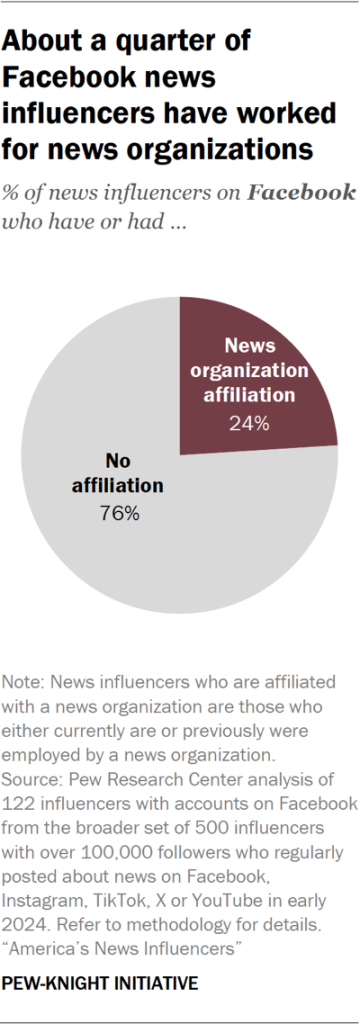
About a quarter of news influencers on Facebook (24%) have a current or former affiliation with a media organization. This is roughly the same as the share of news influencers on X who have links to the news industry, and higher than some other sites.

Still, about three-quarters of news influencers on Facebook (76%) do not have a background or affiliation with a news organization.

For more details on the differences between influencers with and without links to the news industry, read Chapter 4.

Pie chart showing about a quarter of Facebook news influencers have worked for news organizations

What are Facebook news influencers posting about?

To get a sense of what news influencers are posting about, researchers collected and analyzed all public posts by the 500 news influencers in our sample for three separate weeks: July 15-21, July 29-Aug. 4 and Aug. 19-25.

Bar chart showing Facebook news influencers were largely focused on politics during summer 2024

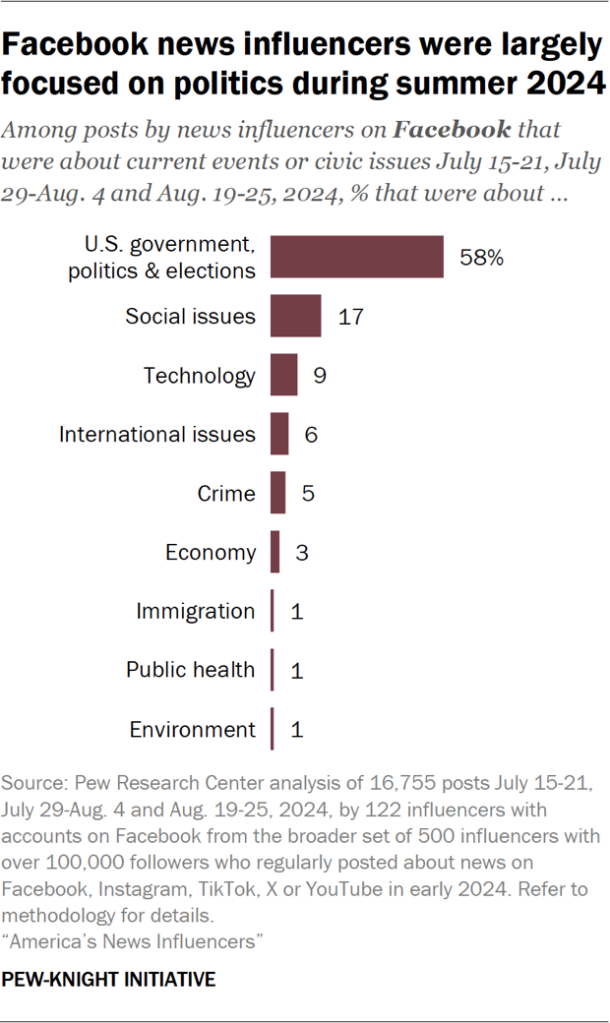
There were many major events related to the election in or around these weeks, including the first assassination attempt on Donald Trump on July 13, the Republican National Convention July 15-18, President Joe Biden’s withdrawal from the race July 21 and the Democratic National Convention Aug. 19-22.

Most posts by Facebook news influencers that addressed current events (58%) focused on the U.S. government, politics or the presidential election.

Facebook stands out for a relatively high share of posts by news influencers focused on technology (9%). Most of these were about cryptocurrencies (8%).

What other sites are Facebook news influencers on?

Bar chart showing most Facebook news influencers are on several other social media sites

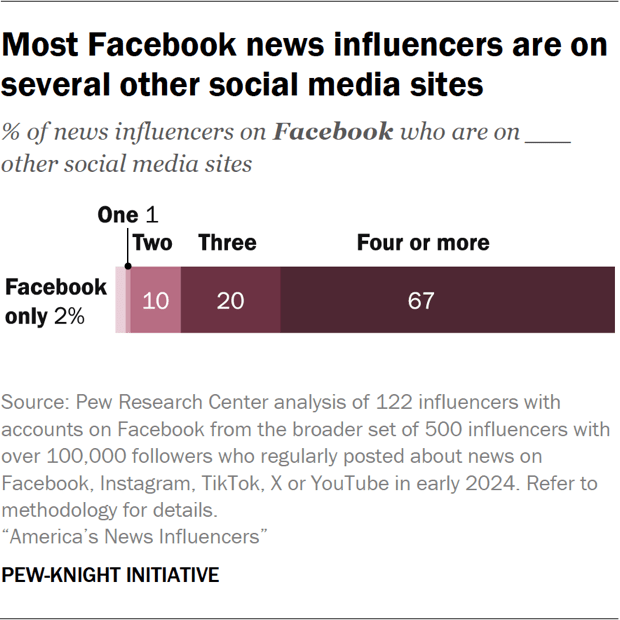
For most news influencers on Facebook, the site is just one piece of a larger social media presence. Only 2% of news influencers on Facebook are only on Facebook, while two-thirds are on at least four other social media sites (five or more in total).

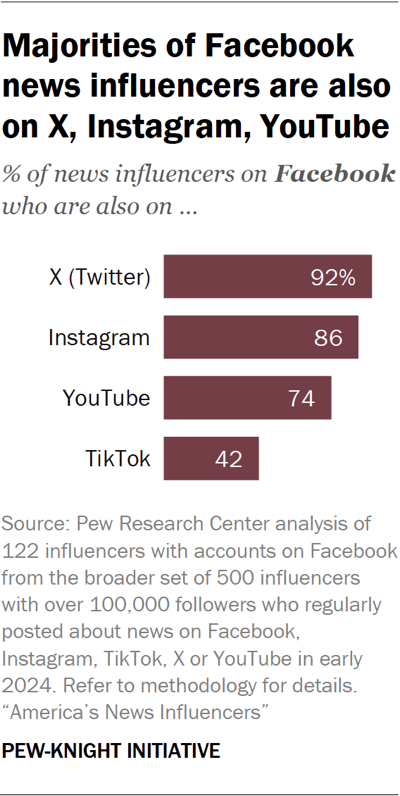
X, YouTube and Instagram are the most common other sites that Facebook news influencers have a presence on. Around three-quarters or more have an account on each of these three sites, while 42% are also on TikTok.

Bar chart showing majorities of Facebook news influencers are also on X, Instagram, YouTube

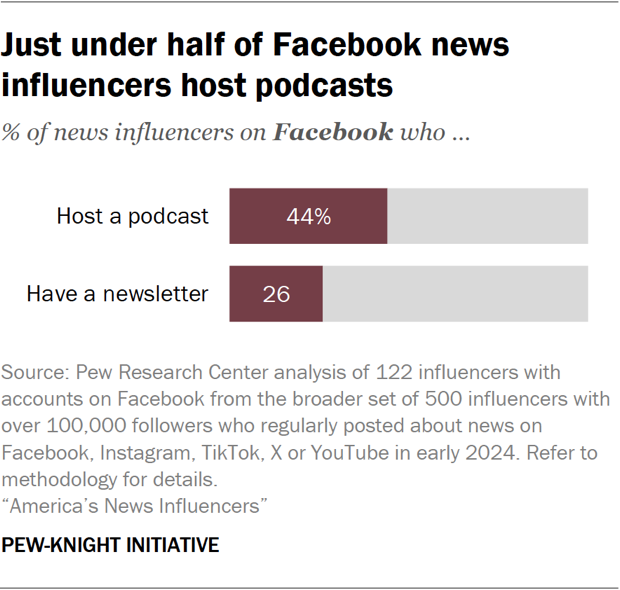
Similar to other sites, many Facebook news influencers (44%) host a podcast, while a somewhat smaller share (26%) maintain an email newsletter that they send out to subscribers.

Bar chart showing just under half of Facebook news influencers host podcasts

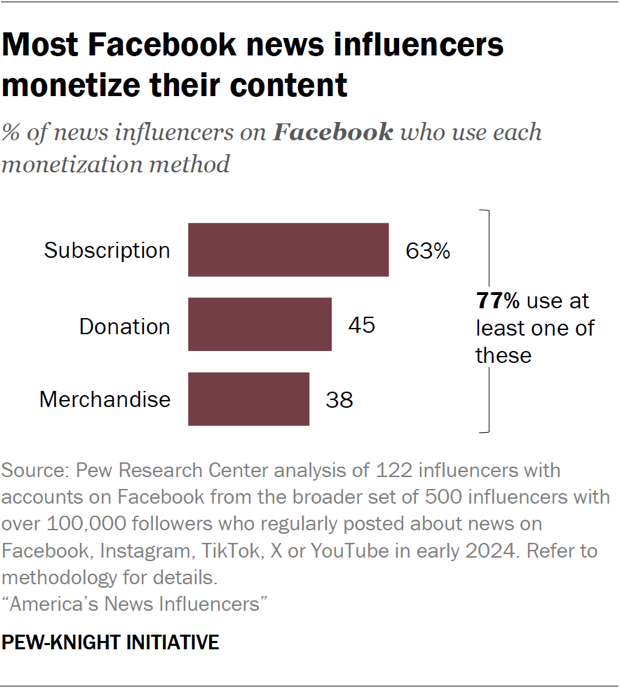
Most news influencers on Facebook are trying to bring in money from their online presence, whether through paid subscriptions to additional content, donations or merchandise sales. About three-quarters of news influencers on the site (77%) use at least one of these monetization strategies. In part this might be due to the structure of the site: Facebook offers subscription tools for page owners.

Bar chart showing most Facebook news influencers monetize their content

Roughly one-in-ten Facebook news influencers (11%) have a public Discord server, where they can further connect with fans and followers.

7. News influencers on Instagram

For our latest survey data about news influencers, read the “News Influencers Fact Sheet.”

Terminology
  • News influencers – People who regularly post about current events and civic issues on social media and have at least 100,000 followers on any of Facebook, Instagram, TikTok, X (formerly Twitter) or YouTube.
  • Political orientation – A measure of a news influencer’s partisan or ideological views. A right-leaning news influencer is one who publicly expresses that they identify as a Republican or conservative or support Donald Trump in the 2024 presidential election. A left-leaning news influencer is one who publicly expresses that they identify as a Democrat, liberal or progressive or support Vice President Kamala Harris (or supported President Joe Biden before he dropped out of the race) in the 2024 election. This information was found in the bio, profile picture, banner image, pinned posts or recent posts on an influencer’s social media account, any personal website or professional page, and prominent media coverage.
  • Values and identities – Language or imagery in the bio, profile picture, banner image or pinned posts on an influencer’s social media account that expresses specific beliefs or identities.
  • News organization affiliation – An influencer with this affiliation is one who either currently works for or previously worked for a news organization, as well as freelancers who have regularly contributed to news organizations. A news organization can be any news outlet that has a staff and multiple bylines. Researchers considered affiliated influencers to have this background regardless of their news organization’s political orientation, audience size or primary publishing method (digital, TV, print, etc.).
  • Major social media sites – The five primary sites we studied, chosen based on audience size and the presence of discussion about news: Facebook, Instagram, TikTok, X (formerly Twitter) and YouTube.
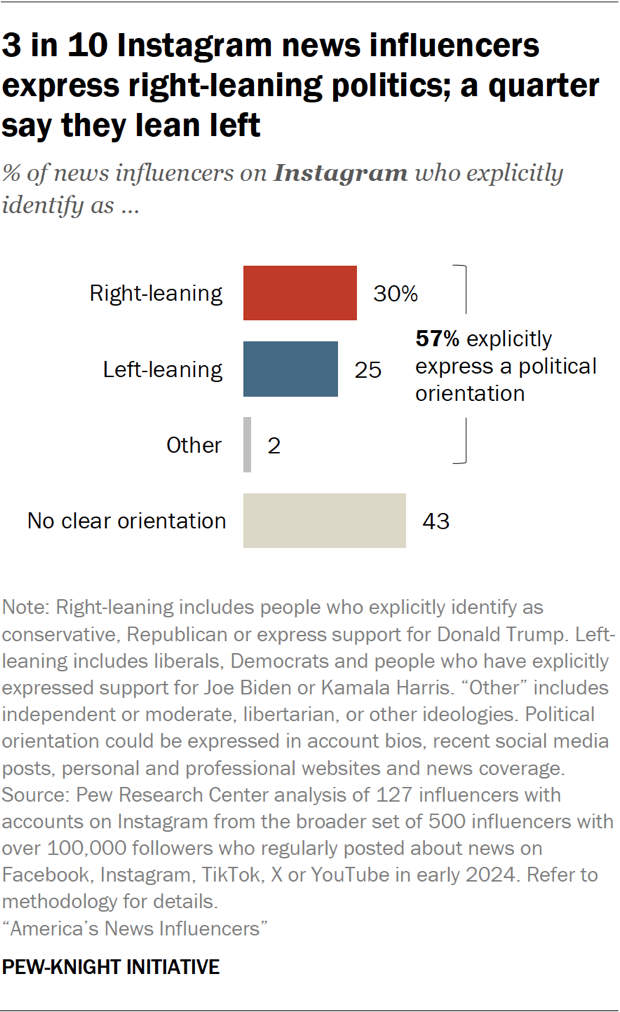
Bar chart showing 3 in 10 Instagram news influencers express right-leaning politics; a quarter say they lean left

A majority of Instagram news influencers (57%) explicitly claim a clear political party or ideology. Within this group, slightly more say they are on the political right (30% of all Instagram news influencers) than the left (25%).

Influencers were categorized by whether they identify with a political party or ideology or expressed support for the Democratic or Republican presidential candidate in their social media profile, posts, personal website or media coverage.

About this chapter

This chapter looks at news influencers on Instagram. Virtually all of them also have accounts on other sites. For analysis of news influencers in general across social media sites, read the report overview.

In this report, news influencers are people with large followings on social media sites who regularly post about current events or civic issues. Refer to the methodology for details.

Related: Instagram users’ experiences with news

Some news influencers on Instagram also identify with specific groups or causes. For instance, 7% identify as LGBTQ+ or pro-LGBTQ+ rights, and 7% are pro-Palestinian, while 3% are pro-Israeli. These positions can be expressed in words, images or emojis (including flags).

Bar chart showing 7% of Instagram news influencers express LGBTQ+, pro-Palestinian values or identities

About twice as many Instagram news influencers are men (63%) as are women (32%). By contrast, among Americans who regularly get news on Instagram, 59% are women.

Bar chart showing among Instagram news influencers, men outnumber women roughly 2-to-1

Refer to the methodology for details on how researchers categorized news influencers by gender.

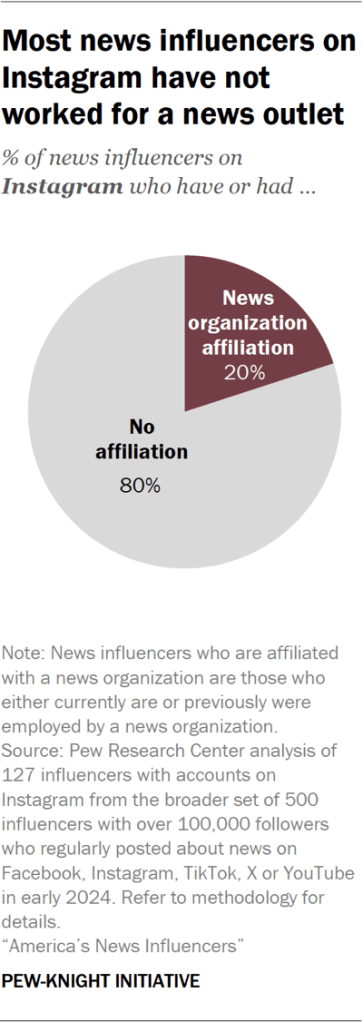
Eight-in-ten news influencers on Instagram (80%) do not have a current or former affiliation with a news organization. But 20% have worked in the news industry in some capacity.

For more details on the differences between influencers who have worked for a news organization and those who have not, read Chapter 4.

Pie chart showing most news influencers on Instagram have not worked for a news outlet

What are Instagram news influencers posting about?

To get a sense of what news influencers are posting about, researchers collected and analyzed all public posts by the 500 news influencers in our sample for three separate weeks: July 15-21, July 29-Aug. 4 and Aug. 19-25.

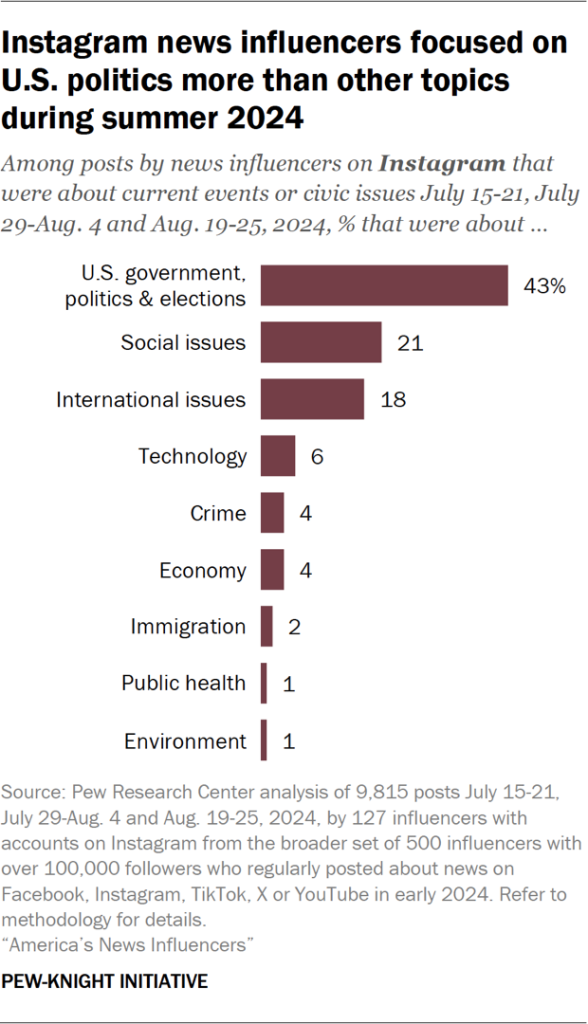
Bar chart showing Instagram news influencers focused on U.S. politics more than other topics during summer 2024

There were many major events related to the election in or around these weeks, including the first assassination attempt on Donald Trump on July 13, the Republican National Convention July 15-18, President Joe Biden’s withdrawal from the race July 21 and the Democratic National Convention Aug. 19-22.

While 43% of posts by Instagram news influencers that focused on current events during this period were about politics or the election, this was lower than the share of political posts on other sites. Instead, a relatively high share of Instagram posts focused on social issues (21%) and international issues (18%).

Many of the posts about social issues focused on race (7% of all news-related posts) or LGBTQ+ issues (3%). And a large majority of the internationally focused posts were about the Israel-Hamas war (14%). Instagram had a much higher percentage of posts about this war than any other site during this period.

What other sites are Instagram news influencers on?

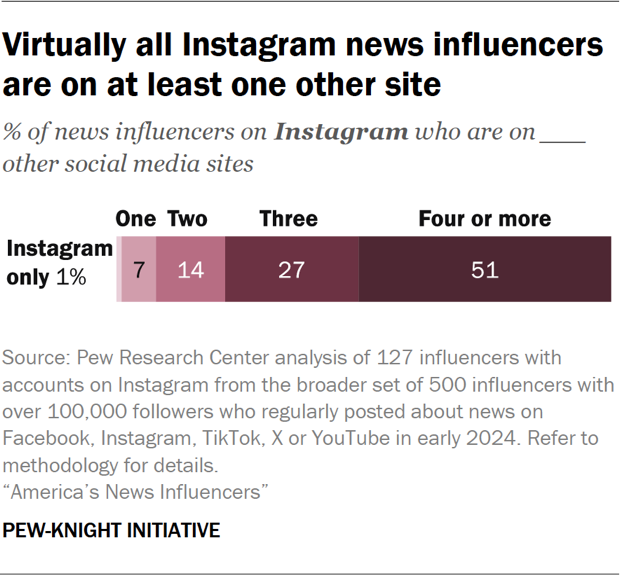
Virtually all news influencers on Instagram are also on at least one other site. In other words, there are almost no influencers whose presence is entirely on Instagram.

Bar chart showing virtually all Instagram news influencers are on at least one other site

In fact, about three-quarters (78%) of all Instagram news influencers are on at least three other sites, including about half (51%) who are on four or more sites (in addition to Instagram).

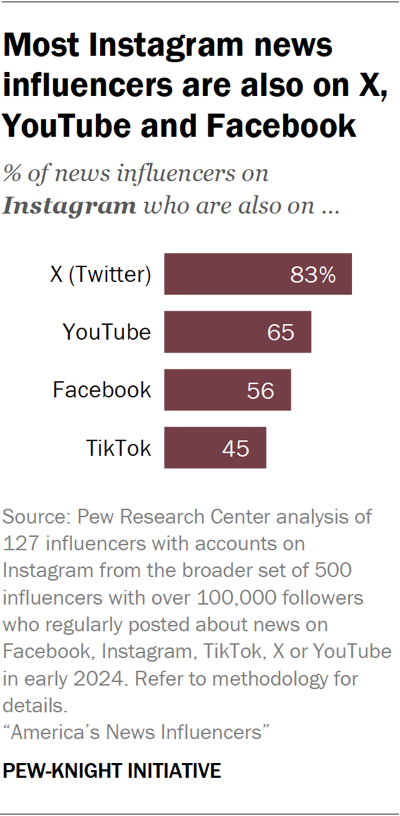
The most common other social media site for Instagram news influencers is X: 83% of Instagram news influencers are also on the site, formerly known as Twitter. About two-thirds (65%) are also on YouTube, and more than half (56%) are on Facebook. Fewer Instagram news influencers are also on TikTok (45%).

Bar chart showing most Instagram news influencers are also on X, YouTube and Facebook
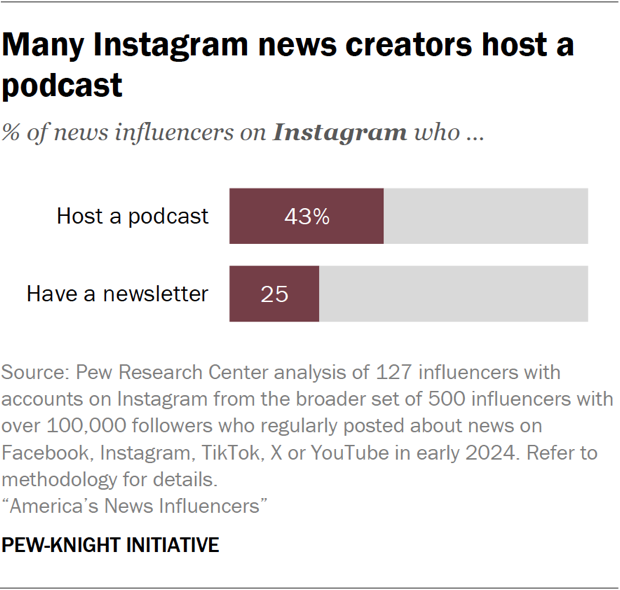
Bar chart showing many Instagram news creators host a podcast

Not only are Instagram news influencers on other sites, but many also have other ways of connecting with their audiences beyond social media. About four-in-ten (43%) host a podcast, and a quarter have a newsletter that fans can subscribe to.

Bar chart showing most Instagram news influencers offer subscriptions to additional content

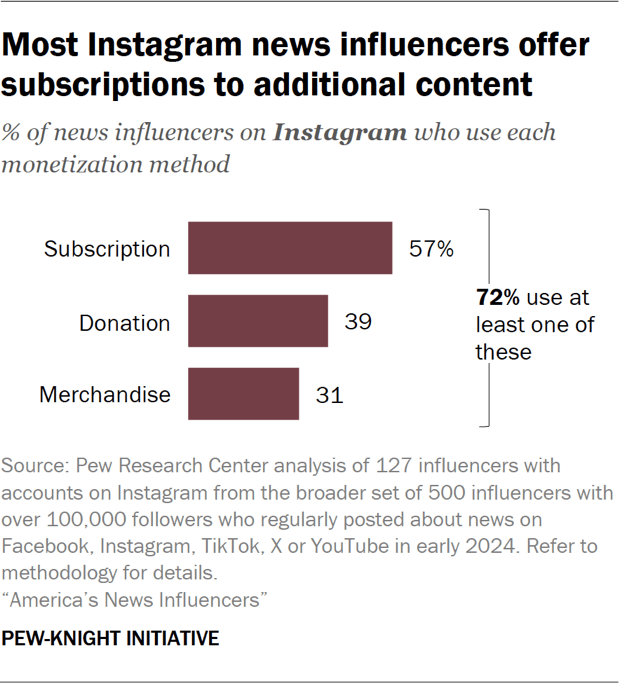
Like news influencers on other social media sites, most of those on Instagram seek financial support from their audiences. This includes 57% who offer subscriptions (Instagram offers a subscription tool), 39% who solicit donations and 31% who sell merchandise. Overall, 72% use at least one of these methods to bring in money.

A small share of Instagram news influencers (8%) also have a public Discord server where they can further connect with fans and followers.

8. News influencers on TikTok

For our latest survey data about news influencers, read the “News Influencers Fact Sheet.”

Terminology
  • News influencers – People who regularly post about current events and civic issues on social media and have at least 100,000 followers on any of Facebook, Instagram, TikTok, X (formerly Twitter) or YouTube.
  • Political orientation – A measure of a news influencer’s partisan or ideological views. A right-leaning news influencer is one who publicly expresses that they identify as a Republican or conservative or support Donald Trump in the 2024 presidential election. A left-leaning news influencer is one who publicly expresses that they identify as a Democrat, liberal or progressive or support Vice President Kamala Harris (or supported President Joe Biden before he dropped out of the race) in the 2024 election. This information was found in the bio, profile picture, banner image, pinned posts or recent posts on an influencer’s social media account, any personal website or professional page, and prominent media coverage.
  • Values and identities – Language or imagery in the bio, profile picture, banner image or pinned posts on an influencer’s social media account that expresses specific beliefs or identities.
  • News organization affiliation – An influencer with this affiliation is one who either currently works for or previously worked for a news organization, as well as freelancers who have regularly contributed to news organizations. A news organization can be any news outlet that has a staff and multiple bylines. Researchers considered affiliated influencers to have this background regardless of their news organization’s political orientation, audience size or primary publishing method (digital, TV, print, etc.).
  • Major social media sites – The five primary sites we studied, chosen based on audience size and the presence of discussion about news: Facebook, Instagram, TikTok, X (formerly Twitter) and YouTube.
Bar chart showing similar shares of TikTok news influencers explicitly identify with the political left and right

About an even balance of TikTok news influencers explicitly identify with the political left and right: 25% of TikTok news influencers publicly express a right-leaning political orientation, while 28% lean left.

Influencers were categorized by whether they identify with a political party or ideology or expressed support for the Democratic or Republican presidential candidate in their social media profile, posts, personal website or media coverage.

About this chapter

This chapter looks at news influencers on TikTok. Virtually all of them also have accounts on other sites. For analysis of news influencers in general across social media sites, read the report overview.

In this report, news influencers are people with large followings on social media sites who regularly post about current events or civic issues. Refer to the methodology for details.

Related: TikTok users’ experiences with news

TikTok also has a higher share of news influencers (relative to other sites studied) who identify as LGBTQ+ or support LGBTQ+ rights (13%).

Bar chart showing more TikTok news influencers express support for Palestinians than for Israelis

Meanwhile, more TikTok news influencers express a pro-Palestinian view (9%) than a pro-Israeli viewpoint (2%).

These values and identities can be indicated in a variety of ways, whether through words, images or emojis (including flags).

Bar chart showing TikTok news influencers by gender

TikTok news influencers are more evenly split between men (50%) and women (45%) than news influencers on other sites, who tend to be mostly men.

For details on how we coded news influencers by gender, refer to the methodology.

The vast majority of news influencers on TikTok (84%) do not have a background with a news organization. But 16% do have links to the news industry, including people who formerly worked for a news organization (e.g., a newspaper, TV station or news website) but are now independent.

For more details on the differences between influencers with and without a news industry background, read Chapter 4.

Pie chart showing about 8 in 10 TikTok news influencers have not worked in the news industry

What are TikTok news influencers posting about?

To get a sense of what news influencers are posting about, researchers collected and analyzed all public posts by the 500 news influencers in our sample for three separate weeks: July 15-21, July 29-Aug. 4 and Aug. 19-25.

Bar chart showing TikTok news influencers covered a range of topics in summer 2024, but politics rose above the rest

There were many major events related to the election in or around these weeks, including the first assassination attempt on Donald Trump on July 13, the Republican National Convention (RNC) July 15-18, President Joe Biden’s withdrawal from the race July 21 and the Democratic National Convention (DNC) Aug. 19-22.

Among posts by TikTok news influencers that addressed current events and civic issues, 52% were focused on U.S. government, politics or elections.

Other common topics were social issues (including racial issues), international issues, crime, and technology (such as cryptocurrencies).

What other sites are TikTok news influencers on?

Bar chart showing most news influencers on TikTok are also on several other sites

It is very common for news influencers on TikTok to also have accounts on several other social media sites. In fact, more than half (57%) have accounts on four or more other sites in addition to TikTok, while only 11% are on TikTok alone.

TikTok news influencers are slightly more likely to have an account on Instagram (82%) than any other site. But a majority also have accounts on YouTube (71%) and X, formerly known as Twitter (64%). And half of influencers on TikTok also have a Facebook account.

Bar chart showing most TikTok news influencers are also on Instagram, YouTube, X
Bar chart showing some TikTok news influencers have podcasts or newsletters

Some TikTok news influencers also engage with their audiences in other ways. Nearly four-in-ten (37%) host a podcast, and 22% produce an email newsletter.

Bar chart showing about three-quarters of news influencers on TikTok try to monetize their presence

Six-in-ten news influencers on TikTok offer paid subscriptions, often to additional content beyond just videos on TikTok, while four-in-ten solicit donations and a similar share (38%) sell branded merchandise. All told, about three-quarters (74%) seek financial support in at least one of these ways. (TikTok has tools to help all creators – not just news influencers – monetize content.)

More than one-in-ten TikTok news influencers (14%) also have a public Discord server where they can further connect with fans and followers.

9. News influencers on X (formerly Twitter)

For our latest survey data about news influencers, read the “News Influencers Fact Sheet.”

Terminology
  • News influencers – People who regularly post about current events and civic issues on social media and have at least 100,000 followers on any of Facebook, Instagram, TikTok, X (formerly Twitter) or YouTube.
  • Political orientation – A measure of a news influencer’s partisan or ideological views. A right-leaning news influencer is one who publicly expresses that they identify as a Republican or conservative or support Donald Trump in the 2024 presidential election. A left-leaning news influencer is one who publicly expresses that they identify as a Democrat, liberal or progressive or support Vice President Kamala Harris (or supported President Joe Biden before he dropped out of the race) in the 2024 election. This information was found in the bio, profile picture, banner image, pinned posts or recent posts on an influencer’s social media account, any personal website or professional page, and prominent media coverage.
  • Values and identities – Language or imagery in the bio, profile picture, banner image or pinned posts on an influencer’s social media account that expresses specific beliefs or identities.
  • News organization affiliation – An influencer with this affiliation is one who either currently works for or previously worked for a news organization, as well as freelancers who have regularly contributed to news organizations. A news organization can be any news outlet that has a staff and multiple bylines. Researchers considered affiliated influencers to have this background regardless of their news organization’s political orientation, audience size or primary publishing method (digital, TV, print, etc.).
  • Major social media sites – The five primary sites we studied, chosen based on audience size and the presence of discussion about news: Facebook, Instagram, TikTok, X (formerly Twitter) and YouTube.
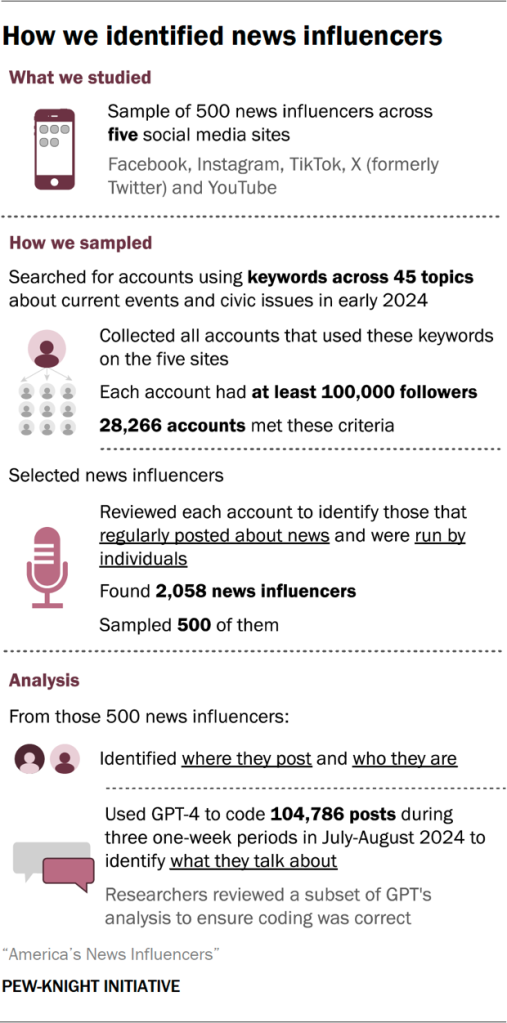
Bar chart showing news influencers on X are more likely to explicitly identify with right than left

A somewhat higher share of news influencers on the social media site X explicitly identify with the political right (28%) than the left (21%). A small share (3%) express some other political affiliation, while about half (48%) do not express any clear political lean.

Influencers were categorized by whether they identify with a political party or ideology or expressed support for the Democratic or Republican presidential candidate in their social media profile, posts, personal website or media coverage.

About this chapter

This chapter looks at news influencers on X (formerly Twitter). Virtually all of them also have accounts on other sites. For analysis of news influencers in general across social media sites, read the report overview.

In this report, news influencers are people with large followings on social media sites who regularly post about current events or civic issues. Refer to the methodology for details.

Related: X users’ experiences with news

Fewer news influencers on X identify specific values or identities on their accounts. This includes 6% who say they are pro-LGBTQ+ (or express a LGBTQ+ identity), 4% who express a pro-Palestinian viewpoint and 3% who identify as pro-Israeli. In addition, 3% of X news influencers express views favoring Ukraine. These positions can be indicated in a variety of ways, whether through words, images or emojis (including flags).

Bar chart showing small shares of news influencers on X identify with values and identities

Some X news influencers also prominently identify as opposing (2%) or supporting abortion rights (fewer than 1%).

Bar chart showing news influencers on X are mostly men

Among news influencers posting on X, 64% are men, while 29% are women. Previous research has found that 64% of Americans who regularly get news on X are men, while 35% are women.

Refer to the methodology for details on how researchers coded news influencers by gender.

Most news influencers on X have not worked for a news organization, but about a quarter (26%) have a current or former affiliation with a news outlet. These organizations range from more traditional news outlets like CNN to newer digital news sources such as The Daily Wire.

For more details on the differences between influencers who have worked for a news organization and those who have not, read Chapter 4.

Pie chart showing among news influencers on X, about a quarter have links to a news organization

What are news influencers on X posting about?

To get a sense of what news influencers are posting about, researchers collected and analyzed all public posts by the 500 news influencers in our sample for three separate weeks: July 15-21, July 29-Aug. 4 and Aug. 19-25.

Bar chart showing when discussing news this summer, news influencers on X often focused on politics and the election

There were many major events related to the election in or around these weeks, including the first assassination attempt on Donald Trump on July 13, the Republican National Convention July 15-18, President Joe Biden’s withdrawal from the race July 21 and the Democratic National Convention Aug. 19-22.

More than half of X posts by news influencers that were about current events or civic issues during those weeks addressed politics or the election (55%).

Social issues were the focus of 18% of all news-focused posts, covering a range of topics from race to abortion to LGBTQ+ issues to the culture wars. And 15% of posts were about international topics, with about half of these covering the Israel-Hamas war (8%).

What other sites are X news influencers on?

Bar chart showing about a third of news influencers on X aren’t on any other social media site

Although a higher percentage of news influencers are on X than any other social media site, most news influencers on X are also on at least one other site.

About a third of news influencers on X (34%) are only on X, while about two-thirds are on at least one other site. This includes 31% who are on four or more other social media sites (five or more in total).

Roughly half of news influencers on X are also on Instagram (49%), while smaller shares are on YouTube (44%), Facebook (35%) and TikTok (21%).

Bar chart showing about half of news influencers on X are also on Instagram
Bar chart showing many news influencers on X host a podcast; 25% have a newsletter
Bar chart showing majority of news influencers on X seek to monetize their accounts in some way

The study also looked at how many news influencers on each site host a podcast or a newsletter. Roughly a third of news influencers on X (37%) host a podcast, while one-quarter send out an email newsletter.

A majority (62%) also seek financial support from their audience in at least one way. This includes 52% who offer subscriptions to additional content (some through subscription tools that X provides), 32% who ask for donations, and 23% who sell merchandise.

A relatively small share of X news influencers (6%) also have a public Discord server where they can further connect with fans and followers.

10. News influencers on YouTube

For our latest survey data about news influencers, read the “News Influencers Fact Sheet.”

Terminology
  • News influencers – People who regularly post about current events and civic issues on social media and have at least 100,000 followers on any of Facebook, Instagram, TikTok, X (formerly Twitter) or YouTube.
  • Political orientation – A measure of a news influencer’s partisan or ideological views. A right-leaning news influencer is one who publicly expresses that they identify as a Republican or conservative or support Donald Trump in the 2024 presidential election. A left-leaning news influencer is one who publicly expresses that they identify as a Democrat, liberal or progressive or support Vice President Kamala Harris (or supported President Joe Biden before he dropped out of the race) in the 2024 election. This information was found in the bio, profile picture, banner image, pinned posts or recent posts on an influencer’s social media account, any personal website or professional page, and prominent media coverage.
  • Values and identities – Language or imagery in the bio, profile picture, banner image or pinned posts on an influencer’s social media account that expresses specific beliefs or identities.
  • News organization affiliation – An influencer with this affiliation is one who either currently works for or previously worked for a news organization, as well as freelancers who have regularly contributed to news organizations. A news organization can be any news outlet that has a staff and multiple bylines. Researchers considered affiliated influencers to have this background regardless of their news organization’s political orientation, audience size or primary publishing method (digital, TV, print, etc.).
  • Major social media sites – The five primary sites we studied, chosen based on audience size and the presence of discussion about news: Facebook, Instagram, TikTok, X (formerly Twitter) and YouTube.
Bar chart showing among YouTube news influencers, more explicitly identify as right-leaning than left-leaning

About half of all YouTube news influencers explicitly express a clear political orientation. Among those who do, a higher share are right-leaning (28% of all YouTube news influencers) than left-leaning (21%). Just 4% have some other kind of political orientation, and about half (46%) do not express any lean.

News influencers were categorized by whether they identify with a political party or ideology or expressed support for the Democratic or Republican presidential candidate in their social media profile, posts, personal website or media coverage.

About this chapter

This chapter looks at news influencers on YouTube. Virtually all of them also have accounts on other sites. For analysis of news influencers in general across social media sites, read the report overview.

In this report, news influencers are people with large followings on social media sites who regularly post about current events or civic issues. Refer to the methodology for details.

Related: Americans’ experiences with news on YouTube

In addition to political ideology, researchers evaluated accounts for any expressed values or identities, finding that 8% of YouTube news influencers express a pro-LGBTQ+ position or identify as LGBTQ+ on their page. An identical share indicate a pro-Palestinian position, while 5% are pro-Israeli. These positions can be indicated in a variety of ways, whether through words, images or emojis (including flags).

Bar chart showing some YouTube news influencers express values or identities in bio

Some YouTube news influencers also prominently display their opposition to abortion (3%) or support for abortion rights (less than 1%).

Bar chart showing most YouTube news influencers are men

On YouTube, roughly two-thirds of news influencers (68%) are men, compared with 28% who are women.

For details on how researchers categorized news influencers by gender, refer to the methodology.

Almost nine-in-ten YouTube news influencers (88%) have not been affiliated with a news organization. About one-in-ten (12%) currently work for (or used to work for) digital, TV and other news organizations.

For more details on the differences between influencers with a news industry background and those without one, read Chapter 4.

Pie chart showing most news influencers on YouTube have not worked in the news industry

What are YouTube news influencers posting about?

In order to get a sense of what news influencers are posting about, researchers collected and analyzed all public posts by the 500 news influencers in our sample for three separate weeks: July 15-21, July 29-Aug. 4 and Aug. 19-25.

Bar chart showing news posts by YouTube news influencers in summer 2024 mostly focused on politics and the election

There were many major events related to the election in or around these weeks, including the first assassination attempt on Donald Trump on July 13, the Republican National Convention (RNC) July 15-18, President Joe Biden’s withdrawal from the race July 21 and the Democratic National Convention (DNC) Aug. 19-22.

Among all YouTube posts that addressed current events and civic issues during these weeks, 68% were about politics or the election – a higher share than other sites. This includes posts about the DNC (11%), the first Trump assassination attempt (8%) and the RNC (6%).

The next-most common topics were social issues (17% of all posts), including racial issues (6%), and international issues (8%), mostly the Israel-Hamas and Russia-Ukraine wars.

What other sites are YouTube news influencers on?

Very few news influencers on YouTube are only on YouTube. The vast majority have a presence on at least four social media sites, including about half (54%) who are on four or more sites in addition to YouTube (five or more in total).

Bar chart showing most news influencers on YouTube are also on several other sites

The most common sites where YouTube news influencers can also be found are X, formerly known as Twitter (86%), and Instagram (74%). Smaller shares are also on Facebook (54%) and TikTok (44%).

About half of all news influencers on YouTube (49%) also host a podcast, slightly higher than the share on any other major social media site we studied. Our previous study of podcasts found that about half of top-ranked podcasts also have a video component, often on YouTube.

Bar chart showing news influencers on YouTube are often on X and Instagram, too
Bar chart showing roughly half of YouTube news influencers host a podcast

A smaller share of YouTube news influencers (28%) have a newsletter that they send out to subscribers or fans.

Bar chart showing 8 in 10 YouTube news influencers monetize their content in some way

Although a majority of news influencers across social media sites (59%) seek financial support from their audiences, this is especially common on YouTube, where 80% of news influencers do this in some way. This includes 68% who offer subscriptions, often providing content that goes beyond their YouTube videos (YouTube has built-in subscription tools for creators).

One-in-ten YouTube news influencers have a public Discord server where they can further connect with audiences.

Acknowledgments

For our latest survey data about news influencers, read the “News Influencers Fact Sheet.”

This is a Pew Research Center report from the Pew-Knight Initiative, a research program funded jointly by The Pew Charitable Trusts and the John S. and James L. Knight Foundation. Find related reports online at https://alpha.pewresearch.org/pewresearch-org/pew-knight/.

Research

Galen Stocking, Senior Computational Social Scientist
Luxuan Wang, Research Associate
Michael Lipka, Associate Director, News and Information Research
Katerina Eva Matsa, Director, News and Information Research
Regina Widjaya, Computational Social Scientist
Emily Tomasik, Research Assistant
Jacob Liedke, Research Analyst
Sam Bestvater, Computational Social Scientist
Christopher St. Aubin, Research Assistant
Elisa Shearer, Senior Researcher
Kirsten Eddy, Senior Researcher
Naomi Forman-Katz, Research Analyst
Sarah Naseer, Research Analyst
Sono Shah, Associate Director, Data Labs
Athena Chapekis, Data Science Analyst
William Halm, Intern
Connor Jansen, Intern
Yen Nguyen, Intern   

Editorial and Graphic Design

David Kent, Senior Copy Editor
Kaitlyn Radde, Associate Information Graphics Designer
Peter Bell, Associate Director, Design and Production
Andrea Caumont, Associate Director, Digital Outreach

Communications and Web Publishing

Sogand Afkari, Communications Manager
Maya Pottiger, Communications Associate
Justine Coleman, Associate Digital Producer

In addition, the project benefited greatly from the guidance of Meredith Conroy, political science professor at California State University, San Bernardino.

Methodology

For our latest survey data about news influencers, read the “News Influencers Fact Sheet.”

This report – a study of popular news influencers – uses three different research components and methodologies, including a nationally representative survey of U.S. adults conducted through Pew Research Center’s American Trends Panel (ATP), as well as an analysis of news influencers and posts from those accounts from three distinct time periods in 2024.

This is the latest report from the Pew-Knight Initiative, a research program funded jointly by The Pew Charitable Trusts and the John S. and James L. Knight Foundation. Find related reports online at https://alpha.pewresearch.org/pewresearch-org/pew-knight/.

Survey

The American Trends Panel survey methodology

Overview

Data in this report comes from Wave 150 of the American Trends Panel (ATP), Pew Research Center’s nationally representative panel of randomly selected U.S. adults. The survey was conducted from July 15 to Aug. 4, 2024. A total of 10,658 panelists responded out of 12,188 who were sampled, for a survey-level response rate of 87%.

The cumulative response rate accounting for nonresponse to the recruitment surveys and attrition is 3%. The break-off rate among panelists who logged on to the survey and completed at least one item is less than 1%. The margin of sampling error for the full sample of 10,658 respondents is plus or minus 1.2 percentage points.

SSRS conducted the survey for Pew Research Center via online (n=10,262) and live telephone (n=396) interviewing. Interviews were conducted in both English and Spanish.

To learn more about the ATP, read “About the American Trends Panel.”

Panel recruitment

Since 2018, the ATP has used address-based sampling (ABS) for recruitment. A study cover letter and a pre-incentive are mailed to a stratified, random sample of households selected from the U.S. Postal Service’s Computerized Delivery Sequence File. This Postal Service file has been estimated to cover 90% to 98% of the population.3 Within each sampled household, the adult with the next birthday is selected to participate. Other details of the ABS recruitment protocol have changed over time but are available upon request.4 Prior to 2018, the ATP was recruited using landline and cellphone random-digit-dial surveys administered in English and Spanish.

A national sample of U.S. adults has been recruited to the ATP approximately once per year since 2014. In some years, the recruitment has included additional efforts (known as an “oversample”) to improve the accuracy of data for underrepresented groups. For example, Hispanic adults, Black adults and Asian adults were oversampled in 2019, 2022 and 2023, respectively.

Sample design

The overall target population for this survey was noninstitutionalized persons ages 18 and older living in the United States. All active panel members were invited to participate in this wave.

Questionnaire development and testing

The questionnaire was developed by Pew Research Center in consultation with SSRS. The web program used for online respondents was rigorously tested on both PC and mobile devices by the SSRS project team and Pew Research Center researchers. The SSRS project team also populated test data that was analyzed in SPSS to ensure the logic and randomizations were working as intended before launching the survey.

Incentives

All respondents were offered a post-paid incentive for their participation. Respondents could choose to receive the post-paid incentive in the form of a check or gift code to Amazon.com. Incentive amounts ranged from $5 to $20 depending on whether the respondent belongs to a part of the population that is harder or easier to reach. Differential incentive amounts were designed to increase panel survey participation among groups that traditionally have low survey response propensities.

Data collection protocol

The data collection field period for this survey was July 15 to Aug. 4, 2024. Surveys were conducted via self-administered web survey or by live telephone interviewing. 

For panelists who take surveys online:5 Postcard notifications were mailed to a subset on July 15.6 Survey invitations were sent out in two separate launches: soft launch and full launch. Sixty panelists were included in the soft launch, which began with an initial invitation sent on July 15. All remaining English- and Spanish-speaking sampled online panelists were included in the full launch and were sent an invitation on July 16.

Table showing the invitation and reminder dates for web respondents in ATP Wave 150

Panelists participating online were sent an email invitation and up to six email reminders if they did not respond to the survey. ATP panelists who consented to SMS messages were sent an SMS invitation with a link to the survey and up to six SMS reminders.

For panelists who take surveys over the phone with a live interviewer: Prenotification postcards were mailed on July 10, and reminder postcards were mailed on July 15. Ten CATI panelists were included in the soft launch, for which dialing began on July 15. CATI panelists receive up to six calls from trained SSRS interviewers.

Data quality checks

To ensure high-quality data, Center researchers performed data quality checks to identify any respondents showing patterns of satisficing. This includes checking for whether respondents left questions blank at very high rates or always selected the first or last answer presented. As a result of this checking, five ATP respondents were removed from the survey dataset prior to weighting and analysis.

Weighting

The ATP data is weighted in a process that accounts for multiple stages of sampling and nonresponse that occur at different points in the panel survey process. First, each panelist begins with a base weight that reflects their probability of recruitment into the panel. These weights are then calibrated to align with the population benchmarks in the accompanying table to correct for nonresponse to recruitment surveys and panel attrition. If only a subsample of panelists was invited to participate in the wave, this weight is adjusted to account for any differential probabilities of selection.

Table showing the American Trends Panel weighting dimensions

Among the panelists who completed the survey, this weight is then calibrated again to align with the population benchmarks identified in the accompanying table. The weight is then trimmed at the 1st and 99th percentiles to reduce the loss in precision stemming from variance in the weights. Sampling errors and tests of statistical significance take into account the effect of weighting.

The following table shows the unweighted sample size and the error attributable to sampling that would be expected at the 95% level of confidence for the full sample in the survey.

Table showing the sample sizes and margins of error in ATP Wave 150

Sample sizes and sampling errors for other subgroups are available upon request. In addition to sampling error, one should bear in mind that question wording and practical difficulties in conducting surveys can introduce error or bias into the findings of opinion polls.

Dispositions and response rates

Table showing the final dispositions in ATP Wave 150
Table showing the cumulative response rate in ATP Wave 150

How family income tiers are calculated

Family income data reported in this study is adjusted for household size and cost-of-living differences by geography. Panelists then are assigned to income tiers that are based on the median adjusted family income of all American Trends Panel members. The process uses the following steps:

  1. First, panelists are assigned to the midpoint of the income range they selected in a family income question that was measured on either the most recent annual profile survey or, for newly recruited panelists, their recruitment survey. This provides an approximate income value that can be used in calculations for the adjustment.
  2. Next, these income values are adjusted for the cost of living in the geographic area where the panelist lives. This is calculated using price indexes published by the U.S. Bureau of Economic Analysis. These indexes, known as Regional Price Parities (RPP), compare the prices of goods and services across all U.S. metropolitan statistical areas as well as non-metro areas with the national average prices for the same goods and services. The most recent available data at the time of the annual profile survey is from 2022. Those who fall outside of metropolitan statistical areas are assigned the overall RPP for their state’s non-metropolitan area.
  3. Family incomes are further adjusted for the number of people in a household using the methodology from Pew Research Center’s previous work on the American middle class. This is done because a four-person household with an income of say, $50,000, faces a tighter budget constraint than a two-person household with the same income.
  4. Panelists are then assigned an income tier. “Middle-income” adults are in families with adjusted family incomes that are between two-thirds and double the median adjusted family income for the full ATP at the time of the most recent annual profile survey. The median adjusted family income for the panel is roughly $74,100. Using this median income, the middle-income range is about $49,400 to $148,200. Lower-income families have adjusted incomes less than $49,400 and upper-income families have adjusted incomes greater than $148,200 (all figures expressed in 2023 dollars and scaled to a household size of three). If a panelist did not provide their income and/or their household size, they are assigned “no answer” in the income tier variable.

Two examples of how a given area’s cost-of-living adjustment was calculated are as follows: The Pine Bluff metropolitan area in Arkansas is a relatively inexpensive area, with a price level that is 19.1% less than the national average. The San Francisco-Oakland-Berkeley metropolitan area in California is one of the most expensive areas, with a price level that is 17.9% higher than the national average. Income in the sample is adjusted to make up for this difference. As a result, a family with an income of $40,400 in the Pine Bluff area is as well off financially as a family of the same size with an income of $58,900 in San Francisco. 

Analysis of news influencers

Overview

To better understand the news influencers that Americans are getting news from on social media, researchers conducted an in-depth analysis of a sample of news influencers who posted about current events and civic issues on at least one of five major social media sites where news is often discussed: Facebook, Instagram, TikTok, X and YouTube. The analysis looked at personal characteristics of each news influencer as well as their online practices.
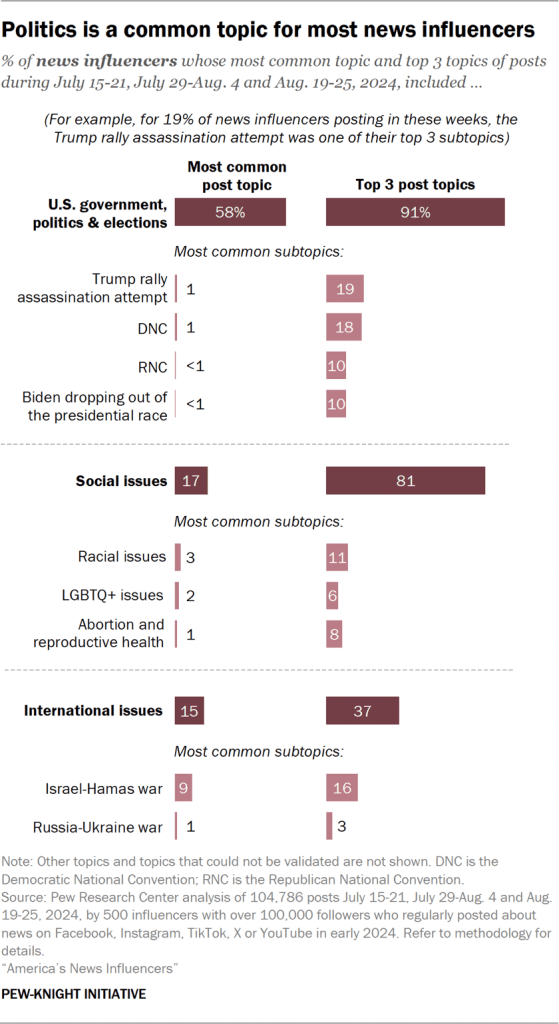
Infographic showing how we identified news influencers

For the purposes of this research, news influencers are defined as people who regularly post about current events and civic issues on social media and have at least 100,000 followers on any of Facebook, Instagram, TikTok, X or YouTube. News influencers can be journalists who are affiliated with a news organization or independent content creators, but they must be people and not institutions.

Account collection

Overview

There are very limited lists of news influencers, and few resources to verify those that do exist. Because of this, we compiled our own list of 2,058 news influencers by searching for accounts that regularly used news-related keywords on Facebook, Instagram, TikTok, X and YouTube.
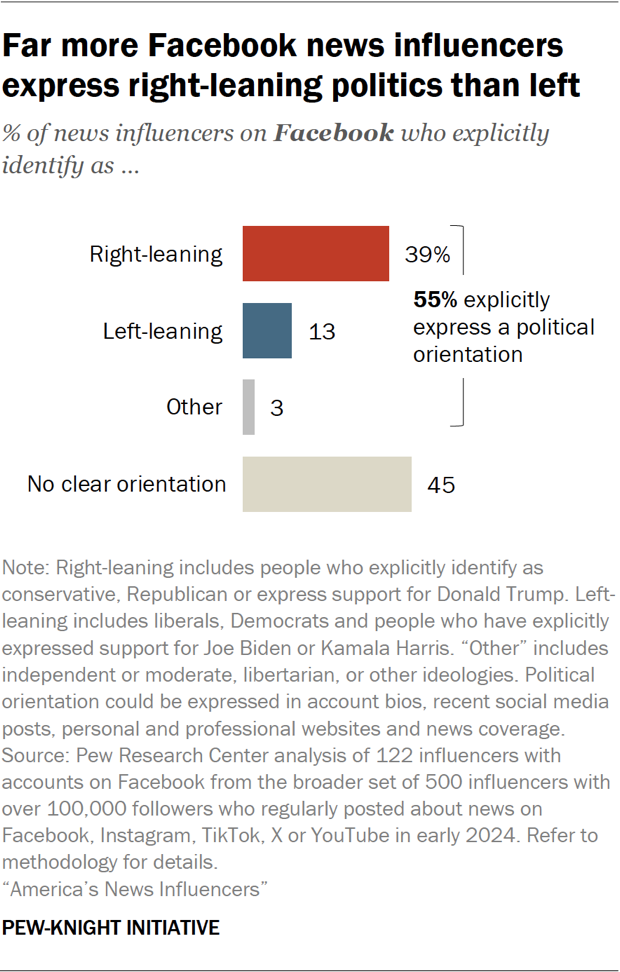
Keyword development

The first step in this process was developing a list of news-related keywords that are relevant to current events and civic issues in the United States. Throughout late 2023 and early 2024, four researchers with expertise in the news media brainstormed related keywords and grouped them into 45 categories ranging from affirmative action to free speech to immigration. Each category had multiple keywords – sometimes dozens.

In order to ensure we were not missing news events as they were occurring, in January 2024, we conducted daily reviews of transcripts of news on CNN, Fox News and MSNBC, as well as news highlights from NewsMax’s YouTube page and a review of Breitbart and Vox’s social media and homepage (to ensure a mix of the key points of discussion across the political spectrum). For the cable news channels, researchers downloaded transcripts from The Internet Archive’s TV Archive for each day in January 2024. Once downloaded, episodes were sent to OpenAI’s GPT-4 model with the instructions:

“You are an AI assistant that helps extract information from text. You will be given a set of transcripts from cable news shows. For each episode, please tell us the main topics that are discussed.”

Each day in January 2024, this team of researchers reviewed each summary statement, along with a manual check of NewsMax’s homepage, YouTube page, and social media; Vox’s homepage and social media; and Breitbart’s homepage and social media to discover major stories and potential related keywords. During the keyword brainstorming process, we searched for these keywords on social media sites to determine the extent to which they were being discussed on social media.

The resulting set of 45 keyword categories plus keywords developed through this daily news review were used on each site, although the keywords were sometimes changed to reflect common practices of the site (such as the tendency to use hashtags) and the tools we used.

Collecting accounts

The general process for collecting accounts was similar across sites. Because automated search capabilities on these sites are limited, we used a set of social media monitoring tools to collect accounts. Once accounts were collected, we filtered for the number of times each account had a post that matched any keywords during the collection period because we wanted to limit the analysis to accounts that were regularly posting about news. The exceptions were TikTok and Instagram, as explained below.

To augment this automated collection, we added influencers who were mentioned in articles about news influencers by prominent news outlets.

This collection process resulted in 3,041,652 accounts across Facebook, Instagram, X and YouTube.
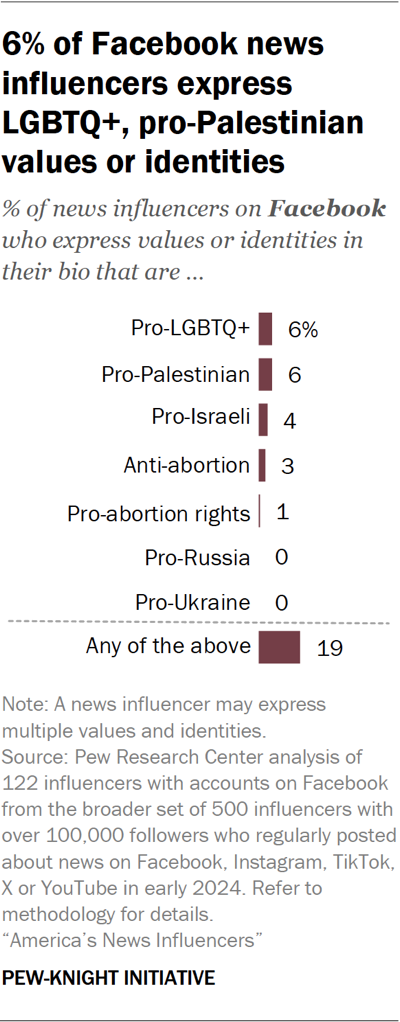
After collection, but before manually visiting any account profiles, we looked at the names of accounts that had terms shared with at least nine other accounts. Those terms included publishing terms like “radio” or “TV” that suggested a news organization, country (e.g., “India”) and place names (e.g., “Boston”), and large institutions like the United Nations (“UN”) or Congress (“Congress”). During this process, two researchers quickly evaluated whether a given account was obviously an organization and not an individual and met to discuss accounts that they disagreed about. A total of 4,566 accounts across Facebook, Instagram, X and YouTube were removed this way.

Facebook

To develop a list of news influencers on Facebook, we turned to CrowdTangle, a social media marketing tool from Meta (Meta shut down CrowdTangle in August 2024). Only public Facebook pages were considered, not groups or private pages. We added two filters to this collection inside CrowdTangle: The minimum number of page followers needed to be 100,000, and they needed to post primarily in English. Across keywords, we collected 358,186 potential news influencer accounts. We further filtered this to only those accounts that posted about any news-related topic at least 30 times in January 2024 (excluding duplicate posts). This resulted in 7,218 accounts, each of which was manually reviewed.

Instagram

To develop a list of news influencers on Instagram, we first turned to CrowdTangle, a social media marketing tool from Meta (Meta shut down CrowdTangle in August 2024). We added two filters to this collection inside CrowdTangle: The minimum number of followers needed to be 50,000 (during the consolidation process, that follower threshold was later raised to 100,000) and they needed to post primarily in English. Across keywords, we collected 181,850 potential news influencer accounts. We further filtered this to only those accounts that posted about any topic at least 15 times in January 2024 (excluding duplicate posts; we noticed in testing that the overall rate of posting was lower on Instagram than other sites, so we lowered this threshold). After removing accounts with organization names, we were left with 3,818 accounts, each of which was manually reviewed.

Upon inspection, we realized that several Instagram accounts that we had found in media coverage were not picked up by CrowdTangle. Out of concern for the comprehensiveness of this data, we augmented the list of influencers from CrowdTangle with those from two sources: first, 49 influencers we had found in news articles that CrowdTangle did not pick up, and second, using Modash.io, a social media marketing tool. Because we already had a list of potential news influencers (including the ones we found in news articles), we used Modash’s account relevancy tool, which returns accounts that are similar to any provided account. For each account provided, we collected 45 relevant accounts (or three pages of results). Because there was some overlap between the sets of relevant accounts, this resulted in an additional 2,460 accounts, each of which was manually reviewed.
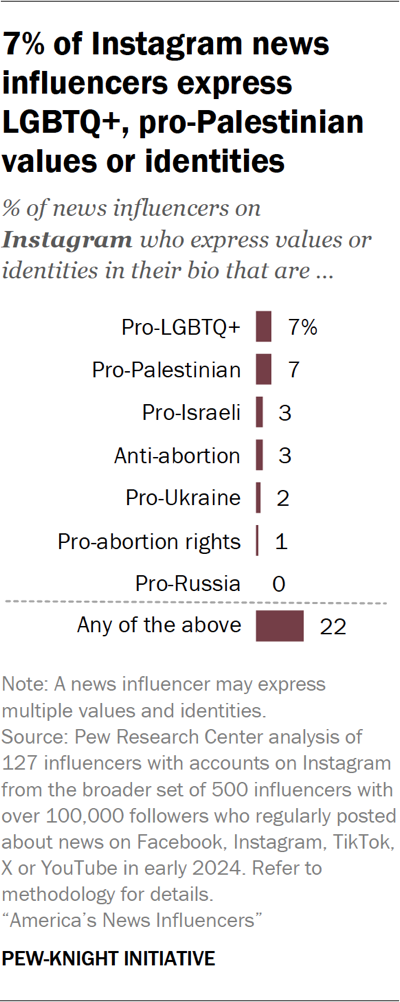
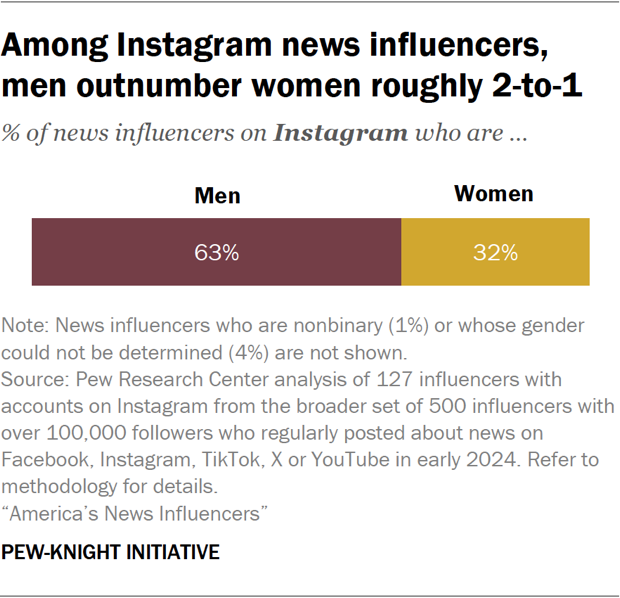
TikTok

To develop a list of news influencers on TikTok we used Modash.io, a social media marketing tool. Whereas other similar tools provide lists of posts that match a set of keywords, Modash’s search function for TikTok lists accounts that used any of the provided keywords in the last two months, resulting in 55,223 accounts. After filtering for accounts with at least 100,000 followers, we were left with 3,342 accounts, each of which was manually reviewed.

X (formerly Twitter)

To develop a list of news influencers on X, we used Meltwater, a social media marketing and analysis tool that can search the entire X firehose. Meltwater includes some advanced filters, which we used in our collection process, as well as some quirks in how it delivers data. We searched for all English-language posts from January 2024 that used our keywords (including in hashtags) and were from accounts with at least 100,000 followers.

Because Meltwater only lets you download 20,000 posts at a time from its dashboard, we removed retweets and accounts that were known to be politicians, and then limited the time and keyword scope of each search we conducted to be below that 20,000-post threshold whenever possible, and posts were sorted by engagement before downloading. After downloading each post, we used only the account information and the number of posts matching each keyword – none of the other post data was used in analysis. This resulted in 39,618 accounts.

We then limited our analysis to accounts that had at least 30 posts in January and that matched our keywords. After removing accounts with organization names, we were left with 7,803 accounts, each of which was manually reviewed.

YouTube

To develop a list of news influencers on YouTube, we used Meltwater, a social media marketing and analysis tool. Meltwater searches the titles and descriptions of YouTube videos from the last 30 days to match keywords but cannot filter YouTube by language or follower count.

Searching YouTube through Meltwater for our keywords in January 2024 resulted in 2,461,998 accounts. We then limited this set to accounts that used those keywords at least 15 times (a lower number than other sites because we found that most accounts posted less frequently). Then, using the YouTube API, we collected follower counts for each account and filtered out accounts with fewer than 100,000 followers. After removing accounts with organization names, we were left with 3,576 accounts, each of which was manually reviewed.

Account verification and consolidation

After this initial sample was concluded, researchers examined all 28,266 accounts that met our criteria to determine if the account was connected to a news influencer. We operationalized the above definition using several criteria:

  • Account must not be connected to an institution or organization
  • Politicians were excluded
  • Main topic needed to be related to U.S. news about current events or civic issues. We included accounts that broadly discussed international affairs, but excluded accounts that focused on one country – with the exception of accounts focused on the Russia-Ukraine war or the Israel-Hamas war, due to the impact these conflicts have on domestic affairs.

A set of coders was trained to identify accounts that met these criteria using a set of sample accounts from each social media site. Any disagreements were discussed between the coders and lead researcher. Intercoder agreement was measured using Krippendorff’s alpha.

The mean alpha across sites was 0.694, with a minimum of 0.631 (YouTube) and a maximum of 0.755 (X).

  • Facebook (0.691)
  • Instagram (0.707)
  • TikTok (0.687)
  • X (0.755)
  • YouTube (0.631)

This resulted in a set of 2,534 news influencer accounts.

At this point, researchers had collected a set of accounts connected to potential news influencers. But an individual influencer can have accounts on multiple sites, and they may use different screen names on each site.

Because this study focuses on influencers, not accounts, researchers examined each news influencer account above and connected it to any other accounts that influencer may have (including ones on the same site).

During this step, researchers also verified that each influencer met the criteria to be a news influencer. Upon examining the number of influencers on each site, we determined that we could raise the minimum number of followers for accounts on Instagram to 100,000 to match other sites.

This resulted in a final population of 2,058 news influencers across one or more of these sites, including:

  • Facebook – 122 news influencers
  • Instagram – 176 news influencers
  • TikTok – 300 news influencers
  • X (formerly Twitter) – 1,458 news influencers
  • YouTube – 207 news influencers

Account sampling

There were vast differences in the number of influencers found on each site, with 122 influencers who had accounts on Facebook and 1,458 news influencers who had accounts on X (formerly Twitter). To account for these differences, and ensure there was a large enough sample size for each site, we sampled 500 influencers using a stratified sampling strategy with five strata, based on the site on which we found the news influencer. Strata were ordered according to the number of influencers, and influencers in smaller strata were removed from later strata so they did not have multiple chances for selection.

Table showing the sample sizes and weights of news influencers

Within each stratum, we sorted influencers by follower count and then selected a set within each stratum using list-based interval sampling. For the remainder of the analysis, each influencer was weighted by the probability of selection; influencers in each stratum were weighted equally because they had an equal chance of selection.

Coding news influencer variables

Once the sample was drawn, a team of coders was trained on a set of variables that analyzed key characteristics of each news influencer.

The first analysis was an inspection of the online practices of the influencer, including the other social media sites they use, whether they host a podcast or offer a newsletter, their interactions with their fans through forums or monetization strategies, and whether they have a news organization affiliation. Coders were trained to find this information only on the news influencer’s social media account profile page (bio, banner image and profile photo, and any pinned post or featured video) and linked personal or professional website (these external links could be available on an influencer’s linktr.ee or similar page). Coders started with the social media account page discovered in the above process and only considered external pages or other social media accounts linked to from that discovered account. Each influencer was coded separately by two researchers, who then met to reconcile any differences.

The second analysis was a more subjective look at each influencer’s personal characteristics: their gender, political orientation and a set of values or identities.

Gender

Researchers attempted to determine each news influencer’s gender by examining how people identify (whether preferred pronouns or other self-descriptions, such as “wife” or “father”) in their social media profiles, personal websites or media coverage. If this information did not yield a result, researchers recorded the gender they perceived the influencer to be based on visual and other cues. While this may not correctly identify the gender of every influencer, the intent of the coding was to capture broad gender patterns among news influencers and not gender identities for individual influencers.

The gender for a small share of news influencers could not be determined; this includes anonymous accounts and accounts run by multiple individuals with different genders (this came up rarely, primarily for accounts connected to podcasts or YouTube shows that were run by two or more co-hosts).

Political orientation

Coders looked at the news influencer’s social media account profile page (bio, banner image and profile photo, and any pinned post or featured video), linked personal and professional websites, and any major news media coverage. For political orientation, we also included each account’s recent posts.

Influencers were categorized by whether they identified with a political party or ideology or expressed support for the Democratic or Republican presidential candidate in their social media profile, posts, personal website or media coverage. People who explicitly identify as conservative, Republican or express support for Donald Trump were categorized as right-leaning, while liberals, Democrats and people who have explicitly expressed support for Joe Biden or Kamala Harris were categorized as left-leaning. Researchers also considered other specific keywords or groups: For example, someone with “MAGA” in their account profile would be categorized as right-leaning, while someone who says they are “progressive” would be coded as left-leaning.

Values/identities

For values and identities, coders only looked at each influencer’s profile page and pinned posts or featured videos, because we wanted to find influencers that make these values and identities a key part of their public persona. These expressions could be made in words, images or emojis, and are often made through emoji flags (e.g., a Palestinian flag, an Israeli flag or a Ukrainian flag).

In these spaces, it is difficult to distinguish between a value and an identity: A rainbow flag, for instance, could be an expression of support for LGBTQ+ rights or a declaration of the influencer’s LGBTQ+ identity. In either case, an account with a rainbow flag would be coded as pro-LGBTQ+.

Intercoder agreement for these variables was measured using Krippendorff’s alpha. The mean alpha across these variables was 0.84, with a minimum of 0.67 (political orientation) and a max of 0.93 (gender and values and identities). Several value/identity variables were found only rarely, so we discussed the examples we saw at length.

Below are the main measures and their alphas (minimum and average reported for variables with multiple, nonexclusive options, like select-alls):

  • Gender (0.93)
  • Political orientation (0.67)
  • Values and identities (min 0.87; average 0.93; max 1.0):
    • Pro-abortion rights (1.0)
    • Anti-abortion (1.0)
    • Pro-LGBTQ+ (1.0)
    • Pro-Ukraine (1.0)
    • Pro-Russia (not found)
    • Pro-Palestine (1.0)
    • Pro-Israel (1.0)
    • Other (0.87)

Analysis of posts from news influencers

Data collection

To get a better sense of what these news influencers were posting about, we next collected posts from each news influencer across three one-week periods: July 15-21, 2024, which was days after an assassination attempt on then-presidential candidate Donald Trump at one of his rallies, included the Republican National Convention, and ended with President Joe Biden dropping out of the race; July 29-Aug. 4, 2024, during which there was speculation about who Harris would pick as her running mate but few major events; and Aug. 19-25, 2024, which featured the Democratic National Convention.

We collected posts from all five main sites using a set of automated scraping tools. Only original posts and quote posts (on X) were included, not reposts. For each post, the scraping tools provided all information that would appear to a person browsing the user’s profile, including the post’s title (where applicable), text or caption, closed captioning (on YouTube) as well as engagement metrics like the number of likes or shares the post received. These tools also were able to collect reels on Instagram and videos on other sites, but not Instagram stories or other short-term posts. Posts were scraped in August 2024. This resulted in 104,786 posts, across each site:

  • Facebook: 16,755 posts
  • Instagram: 9,815
  • TikTok: 3,514
  • X: 67,331
  • YouTube: 7,371

Data processing

After this collection process had concluded, we used a series of audio-to-text and video-to-text models to process and transcribe all video posts found on TikTok and Instagram so that we had all text-based data to work with (we were able to download closed captions for YouTube videos). Once these were converted to text, we passed all posts to OpenAI’s GPT-4 model along with an instruction prompt describing our codebook categories to obtain the applicable topic for each post. This was done using the following steps:

  • First, audio from video files was extracted and passed to an Audio Spectrogram Transformer model finetuned on the AudioSet dataset. This AST model inputs audio sequences, distinguishes speech from music, and then provides additional labels for the clip using a broad ontology of everyday sound types. For this task, we only used this to identify videos that contained speech.
  • For videos where the AST model identified “speech” as the primary audio label, the full audio from the video was then passed to OpenAI’s whisper transcription model. For a balance of accuracy and fast processing time, we used the 769M-parameter “medium” version of this model. 

Classifying post topic

Once all TikTok and YouTube videos were transcribed, we turned to the task of categorizing posts by their main topic. Because the volume of this dataset was too large for humans to code, we turned to OpenAI’s GPT-4 model. We provided the model with the full text, including any links that were in the text.

For Instagram and TikTok videos, we provided the caption along with the full transcription. In testing, we found that long YouTube videos were difficult for both humans and GPT to code, so we only provided the transcript of the first approximately 3 minutes of the video. Additionally, when given YouTube videos to code, both humans and GPT were instructed to code based on the video text and then fall back on the video transcript if the topic was not clear from the video text. We added this instruction because we found that YouTubers often open their videos with a long, multisubject introduction that includes topics beyond the primary video topic, which was better indicated by the title. (To see the full prompt and codebook, refer to Appendix D.)

The output of these models was validated in two stages. First, two coders were trained to code posts, including transcripts from video posts, according to an extensive codebook. The Krippendorff’s alpha for this coding was 0.78.

Next, a validation set of approximately 1% set of the full dataset of posts was run through the GPT-4 model (see Appendix D for the full instructions). Coders validated the set of topics and subtopics in the codebook. Across 10 topics, GPT-4 achieved a weighted average F1 score of 0.849, with a minimum of 0.615 and a maximum of 0.895. Across 26 subtopics, GPT achieved a weighted average F1 score of 0.798, with a minimum of 0.323 and a maximum of 0.932. We did not include any topics or subtopics in the analysis below 0.6; these were mostly general categories within a specific topic area.

Appendix A: News influencers studied

For our latest survey data about news influencers, read the “News Influencers Fact Sheet.”

Table showing account names of news influencers sampled from Facebook
Table showing account names of news influencers sampled from Instagram
Table showing account names of news influencers sampled from TikTok
Table showing account names of news influencers sampled from X (formerly Twitter)
Table showing account names of news influencers sampled from YouTube

Appendix B: Detailed tables for analysis of sample of news influencers

For our latest survey data about news influencers, read the “News Influencers Fact Sheet.”

Table showing news influencers on social media sites
Table showing the number of social media sites news influencers are on
Table showing alternative engagement methods for news influencers
Table showing news influencers’ monetization methods
Table showing news influencers on Discord
Table showing news influencers’ news organization affiliation
Table showing news influencers’ gender
Table showing political orientation of news influencers
Table showing values and identities of news influencers

Appendix C: Detailed tables for analysis of sampled posts from news influencers

For our latest survey data about news influencers, read the “News Influencers Fact Sheet.”

Table showing news influencers’ posts, by topic
Table showing news influencers’ posts, by topic (among posts about current events and civic issues)
Table showing news influencers’ posts, by subtopic
Table showing news influencers’ posts, by subtopic (among posts about current events and civic issues)

Appendix D: GPT-4 Topic classification instructions

For our latest survey data about news influencers, read the “News Influencers Fact Sheet.”

You are an AI assistant trained to look at social media posts and determine what the post is about.

[IF POST IS FROM YOUTUBE:]

You will receive two fields: the post title and a transcript of the first 3 minutes of the video.

If the topic is unclear from the title, include the transcript in your determination. Otherwise ignore the transcript.

[IF POST IS FROM INSTAGRAM:]

You will receive the post text, and, if it was a video, the transcript. Rely on both.

[IF POST IS FROM TIKTOK:]

You will receive both the post text and the transcript of the video. Give more weight to the video text.

[ALL SITES]

You will be given a list of topics. Please tell us what this post is about.

Respond in a JSON with the subtopic number, e.g. 8.5. Call that field “subtopic.”

Topic list:

1. Crime

    1.1. Crime generally

2. Environment

    2.1. Climate change

    2.2. Other environmental issues

3. Immigration

    3.1. Immigration generally

4. Social issues

    4.1. Abortion and reproductive health

    4.2. Guns and gun control

    4.3. LGBTQ+ issues, including transgender issues

    4.4. Racial issues, including affirmative action and racial discrimination

    4.5. Education

    4.6. Other social issues, including culture war issues, labor, and other social issues that are not covered above

5. Public health

    5.1. Covid, including covid vaccines

    5.2. Other vaccines

    5.3. Other public health issues

6. Economy

    6.1. Economy generally

7. Technology

    7.1. AI, LLMs

    7.2. Crypto

    7.3. Other technology issues

8. Government, politics and elections

    8.1. Assassination attempt on Donald Trump

    8.2. Republican National Convention (RNC)

    8.3. Democratic National Convention (DNC)

    8.4. Biden dropping out of the presidential race

    8.5. Other political or government related posts that do not fit into other categories

9. International issues

    9.1. Israel, Gaza or Palestine, including anything about Netanyahu or Hamas

    9.2. Ukraine war

    9.3. Anything outside the US or involve US foreign relations except for Israel, Gaza, Ukraine, or immigration

10. No topic

    10.1. None of the above topics

Some other things to keep in mind:

    – There is an election in November, so many posts will be about that. The Democratic candidates were Joe Biden and Kamala Harris, but Joe Biden dropped out and it’s Kamala Harris and Tim Walz. The Republican candidates are Donald Trump and JD Vance. The independent candidates are Robert F Kennedy Jr (RFK Jr), Cornel West, and Jill Stein.

    – Anything about an assassination attempt on Trump goes into Politics and elections.

    – If there are multiple topics, go with whatever seems the most prominent. If there are two relatively equal topics, go with whatever is mentioned first.

    – If a post seems political, first see if it goes into another category. For example a post about politics and race would go into the race category. Fall back on politics if none other fits, as long as there is something political.

    – With the exception of immigration, most posts that reference a foreign country will go into 10.1.

    Please adhere to the categories listed in the codebook and provide the name of the topic in a machine readable json. Do not provide any additional context or response.

Appendix E: Validation of GPT-4 topic classification

For our latest survey data about news influencers, read the “News Influencers Fact Sheet.”

Table showing topic labeling accuracy metrics
Table showing subtopic labeling accuracy metrics