Pew Research Center

FOR RELEASE SEPTEMBER 26, 2023

Black Americans’ Experiences With News

Black Americans are critical of news coverage of Black people and say educating journalists would make coverage fairer

FOR MEDIA OR OTHER INQUIRIES:

Communications Department
202.419.4372
www.pewresearch.org

RECOMMENDED CITATION

Pew Research Center, September 2023, "Black Americans’ Experiences With News"

About Pew Research Center

Pew Research Center is a nonpartisan, nonadvocacy fact tank that informs the public about the issues, attitudes and trends shaping the world. It does not take policy positions. The Center conducts public opinion polling, demographic research, computational social science research and other data-driven research. It studies politics and policy; news habits and media; the internet and technology; religion; race and ethnicity; international affairs; social, demographic and economic trends; science; research methodology and data science; and immigration and migration. Pew Research Center is a subsidiary of The Pew Charitable Trusts, its primary funder.

© Pew Research Center 2026

Table of contents

  • About Pew Research Center
  • Black Americans’ Experiences With News
  • 1. Views on how Black people are covered in the news
  • 2. How to improve news coverage of Black people
  • 3. Black representation in newsrooms
  • 4. Racial identity and views about the news
  • 5. Black Americans’ news habits
  • Acknowledgments
  • Methodology

Black Americans’ Experiences With News

Black Americans are critical of news coverage of Black people and say educating journalists would make coverage fairer

How we did this

Pew Research Center conducted this study to understand Black Americans’ experiences, habits and attitudes around news and information. The main source of data for this study is a Center survey of 4,742 U.S. adults who identify as Black. Black adults include those who say their race is Black alone and non-Hispanic, Black and at least one other race and non-Hispanic, or Black and Hispanic.

The survey was conducted online from Feb. 22 to March 5, 2023, among a sample of U.S. Black adults. This sample included 1,745 respondents from Pew Research Center’s American Trends Panel (ATP) and an additional 2,997 respondents from Ipsos’ KnowledgePanel (KP). The ATP and KP are both online survey panels recruited through national, random sampling of residential addresses. This way nearly all U.S. adults have a chance of selection. This survey was administered only to adults who identified as Black and was weighted to be representative of the U.S. Black adult population by gender, age, ethnicity, partisan affiliation, education and other categories. 

Here are the questions used for this report, along with responses, and its methodology.

The report also draws on a series of nine Pew Research Center focus groups conducted virtually and facilitated by PSB Insights in July and August 2022. The primary goal of these focus groups was to inform the development of the survey. All participants identified as Black or African American, including those who also identified as Hispanic or multiracial.

The report includes a number of quotations from the focus groups to help illustrate and add nuance to the survey findings. Quotations are chosen to provide context and are not necessarily representative of the majority opinion of any group. Language may have been edited for grammar, spelling and clarity. For more information, read the methodology.

Pew Research Center is a subsidiary of The Pew Charitable Trusts, its primary funder. This is the latest report in Pew Research Center’s ongoing investigation of the state of news, information and journalism in the digital age, a research program funded by The Pew Charitable Trusts, with generous support from the John S. and James L. Knight Foundation.

Key takeaways

  • Black Americans see several problems in news coverage of Black people. Most say that Black people are covered more negatively than people in other racial and ethnic groups.
  • Black Democrats and Republicans, as well as Black adults across all age groups, are similarly critical of news coverage of Black people.
  • Educating all journalists about issues impacting Black people and history is among the steps Black Americans say would help the situation.
  • Many Black Americans say Black journalists are better at understanding them and covering issues related to race, though few see a reporter’s race as a key factor in determining the accuracy of news in general.
A bar chart showing Most Black adults say news about Black people is more negative than news about other groups

Black Americans see a range of problems with how Black people are covered in the news, and few are hopeful that will change in the foreseeable future, according to a new Pew Research Center survey of nearly 5,000 Black adults.

On several questions, Black Americans are far more likely to view news coverage of Black people in a negative rather than positive light:

  • Almost two-thirds of Black adults (63%) say news about Black people is often more negative than news about other racial and ethnic groups; 28% say it is about equal and 7% say it is often more positive.
  • 57% say the news only covers certain segments of Black communities, compared with just 9% who say it covers a wide variety of Black people.
  • Half say coverage is often missing important information, while only 9% say it often reports the full story.
  • 43% say the coverage largely stereotypes Black people, far higher than the 11% who say it largely does not stereotype. An additional 43% say both of these things happen about equally.
Black Democrats and Republicans have largely similar views on how Black people are covered in the news

These critical views of coverage of Black people are widely shared within the Black population, regardless of age, gender and even political party affiliation.

The survey asked Black Americans if they ever come across news that is racist or racially insensitive about Black people in some way. About four-in-ten (39%) say they see this kind of racially problematic news extremely or fairly often, and an additional 41% say they sometimes see such news.

Few Black Americans have high hopes that Black people will be covered fairly in the futurethat Black people will be covered fairly in the future

Those who report coming across racially problematic news coverage of Black people at least sometimes see a few different reasons for this. About half (51%) say outlets pushing agendas is a major factor, and 45% say the same about journalists not being informed. Others say racist views among people at the news outlet (42%), the speed of the news cycle (37%) and a lack of Black staff at the news outlet (36%) are major reasons for racist or racially insensitive coverage.

Just 14% of Black Americans are highly confident that Black people will be covered fairly in their lifetimes, saying that is extremely or very likely to happen. Far more (38%) think that is not too likely or not at all likely to happen, while an additional 40% say it is somewhat likely. (More details on Black Americans’ views of how Black people are covered in the news are in Chapter 1.)

How can news coverage of Black people improve?

Black Americans identify a few steps that could improve what they see as flawed coverage. And one factor consistently stands out – making sure that journalists are informed about the issues affecting Black people.

The survey asked about the importance of several practices for journalists when covering Black people, finding that:

  • 76% of Black Americans cite coverage of all sides of an issue as extremely or very important.
  • A similar percentage, 73%, say it is extremely or very important for journalists to understand the history of the issues in the story.
  • A majority (59%) say journalists personally engaging with the people they cover is of high importance.
  • Roughly half (48%) see having journalists advocate for Black people as extremely or very important.
Many Black Americans say educating all journalists would help make news about Black people fairer

Among those who report at least sometimes seeing racist or racially insensitive coverage about Black people, nearly two-thirds (64%) identify educating all journalists about issues impacting Black Americans as an extremely or very effective way of making coverage fairer.

Substantial shares also say including more Black people as sources (54%) and hiring more Black people as newsroom leaders (53%) and as journalists (44%) at news outlets would be highly effective. Details on these findings are in Chapter 2.

These are some of the key findings of the Center’s nationally representative survey of 4,742 U.S. Black adults conducted from Feb. 22 to March 5, 2023. We undertook this study to take a closer look at the relationship between Black Americans and news in the United States.

In 1967, the Kerner Commission – undertaken by President Lyndon Johnson’s administration to investigate the causes behind urban riots – took a harsh view on the news media’s stance toward Black Americans. The commission’s report cited sensationalist and divisive coverage as well as inaccurate and unfair representations of Black communities, concluding that “the journalistic profession has been shockingly backward in seeking out, hiring and promoting” Black people, and “the press has too long basked in a white world looking out of it, if at all, with white men’s eyes and white perspective.”

More than half a century later, there is continued discussion of many of the themes raised in the report. This new study asks Black Americans themselves about their experience with news today, including views around portrayals of Black people in news stories, representation in newsrooms, and where they go and whom they trust for information.

The focus on the Black population allowed the Center to tailor the study to the experiences of Black Americans rather than comparing them to other groups. It also provided a greater opportunity to look deeply at differences and similarities among groups within the Black population.

To get a deeper understanding of Black Americans’ experiences with and views about the news, we also held a series of nine online focus groups of U.S. Black adults, enabling participants to elaborate on their views. Quotes from these participants are included throughout this report. The methodology includes more details about the survey and focus groups.

Quotes from focus groups on problems in news coverage of Black people:

“There’s not a lot of African American coverage unless it’s February or it’s criminal.” –Black woman, 60

“[News about Black people] is not accurate. They overemphasize the bad, and not some of the good things that are happening in the community, or if they do talk about the good things, it’s just a blurb and they want to focus on the one thing [that] was just terrible.” –Black woman, 55

“I feel like they make us look stupid at times … I have a feeling that any time that I see [a Black person being interviewed on the news] it’s always those people that I feel like that have a hard time speaking correctly or I guess their vocabulary is very limited. And I feel like they do that on purpose.” –Black man, 29

Views about newsroom representation

Many Black Americans see instances when it is important for the news they get to come from Black journalists – particularly in getting news related to race and racial inequality. And as noted earlier, many see hiring more Black journalists and newsroom leaders as ways to improve coverage of Black people. But few think their news in general needs to come from Black journalists, nor do they automatically trust a story because it comes from a Black journalist.

Nearly half of Black Americans think that Black journalists do a better job than other journalists at covering issues related to race and racial inequality (45%) and also at understanding them (44%). Roughly similar percentages say Black journalists do about as well as other journalists in these areas, while much smaller shares say Black journalists do a worse job (5% each).

For many Black Americans, then, it is crucial that the news they get about issues related to race and racial inequality comes from Black journalists. Four-in-ten Black Americans say this is extremely or very important, and an additional 28% say it is somewhat important.

At the same time, just 14% of Black Americans say it is highly important that any news they get, regardless of topic, comes from Black journalists. And a similarly small share (17%) say Black journalists are better than other journalists at reporting the news accurately.

Black Americans take a number of factors into account when assessing the credibility of a news story – but the journalist’s race is not a dominant one. Relatively few Black adults (15%) say that a journalist being Black is an extremely or very important factor in deciding whether a story is trustworthy. That lags well behind other factors, including the sources cited (53% say this is extremely or very important in determining a story’s credibility), whether it is reported by multiple outlets (50%), and the news outlet itself (46%).

Read Chapter 3 for detailed views on newsroom representation.

Quotes from focus groups on the importance of getting news from Black journalists:

“I always love seeing Black journalists do their thing, but I can get the news from any source, to be honest. It doesn’t have to be a Black person delivering me the news. … The news is the news regardless of who delivers it. … Certain topics you kind of want that perspective of [a Black journalist]. A traffic accident, you got that, but then if it’s something more involved like a racial incident I wanna see a Black perspective of it.” –Black man, 61

“In our local newspaper, like I said, I don’t trust it and there are definitely not Black writers employed with that newspaper. … If they were hiring Black people then that would tell me something more about the newspaper itself and their sort of values, so I don’t have that.” –Black woman, 40

Similarities and differences within the Black population 

Concerns about how Black people are covered in the news are widespread across the Black population. For example, Black adults across age groups largely see coverage in a far more negative than positive light, and Black men and women view issues around Black news coverage in very similar ways. There are some differences by education, with Black adults who have more formal education expressing more negative opinions about news coverage of Black people.

Black Democrats and Republicans have largely similar
views on how Black people are covered in the news

But the consensus extends to two groups that typically agree on very little when it comes to views of the news media – Democrats and Republicans. While Republicans in general tend to be much more skeptical of journalists, Black members of the two party coalitions are largely in agreement on identifying problems in news coverage of Black people:

  • Among Black Democrats and those who lean Democratic, 59% say news about Black people covers only certain segments of Black communities, along with 55% of Black Republicans and Republican leaners. Much smaller shares in both groups say the news covers a wide variety of Black people (9% and 11%, respectively).
  • 53% of Black Republicans say coverage is often missing important information, as do 50% of Black Democrats. Far fewer (8% and 9%) say the news often reports the full story.
  • And 46% of Black Republicans say coverage largely stereotypes Black people, virtually identical to the 44% of Democrats who say the same. Just 11% in each group take the positive view that the news largely does not stereotype Black people.

Views about the news media broadly are more reflective of the overall partisan divide on this issue, with Republicans consistently less trusting of journalists. Nearly half of Black Democrats (48%) have a great deal or fair amount of trust in national news outlets, compared with 32% of Black Republicans. The gap is similar – 52% vs. 37% – on trust in local news outlets. (Read Chapter 5 for more on where Black Americans go and whom they trust for news and information.)

There is a large amount of consensus across different age groups about shortcomings in how Black people are covered. And low percentages across all age groups – including the youngest (ages 18 to 29) and the oldest (65 and older) – say it is highly likely that Black people will be covered more fairly in their lifetimes.

Across education and income levels, however, Black adults are less in agreement about news coverage of Black people. While these groups are much more negative than positive in their views of news coverage of Black people, those with more formal education and higher incomes tend to be particularly negative.

  • Roughly two-thirds of Black Americans with at least a bachelor’s degree (68%) say news they see or hear about Black people covers only certain segments of Black communities, versus 49% of those with a high school diploma or less education.
  • Three-quarters of Black Americans with the highest income level (75%) say news coverage of Black people is often more negative than about other racial and ethnic groups, versus 57% of those in the lowest income group.

Differences also emerge within the Black population in views about the role of Black journalists in how people get news. Black Democrats, younger adults, and those with higher levels of education and income often see greater value in getting news from Black journalists.

  • 54% of Black adults ages 18 to 29 say Black journalists are better than other journalists at covering issues related to race or racial inequality, versus 37% of those 65 and older.
  • 54% of Black adults with at least a bachelor’s degree say Black journalists are better at understanding them, compared with 35% of those who have a high school diploma or less.

The importance of Black identity in views about the news

Some of the largest differences within the Black population are based on their sense of Black identity – how important being Black is to how they think about themselves. On a number of issues, wide gaps emerge between Black Americans who say their racial identity is extremely or very important to them and those who say it is less important.  

Black Americans who say being Black is important to their identity are far more supportive of journalists advocating for Black people

One example of this divide involves views about what journalists should do when covering Black people. The vast majority of those who say being Black is highly important to their identity (82%) say it is extremely or very important for journalists to understand the history of the issues in the story when covering Black people. That number falls to 55% among those who say being Black is less important to them (i.e., it’s somewhat, a little or not at all important).

Similarly large differences exist between the two groups over whether journalists should personally engage with the people they cover (69% vs. 40%) and whether they should advocate for Black people (59% vs. 28%). And the same pattern applies to questions about the role of Black journalists: Those who say being Black is highly important to how they think about themselves are more likely to value the impact of Black reporters (read Chapter 4 for details).

Sources of news and information

As with the public broadly, Black Americans stay informed about current issues and events through a range of sources. At least a third of Black Americans say they get news extremely or fairly often from local news outlets, national news outlets, social media sites, and friends, family or acquaintances. Large majorities get news from each of these sources at least sometimes.

In addition, about a quarter of Black Americans (24%) say they get news from Black news outlets extremely or fairly often, with another 40% saying they do so sometimes. In the survey, Black news outlets were defined as outlets created by Black people that focus on providing news and information specifically for Black audiences.

Social media is among the most common sources of news for Black Americans, but relatively few have high trust in it

Social media may be one of the most common ways that Black Americans stay informed, but Black Americans do not trust the news they get there as much as many other types of sources – a pattern similar to views among the broader U.S. population. About one-in-five (18%) say they have a great deal or fair amount of trust in the accuracy of the information from social media, far smaller than the shares who say the same about local and national news outlets (48% and 44%, respectively).

Black Americans who at least sometimes get news on social media are more likely to say they prefer news outlets over social media for several specific types of information, including basic facts or in-depth information about an issue or event (details are in Chapter 5).

1. Views on how Black people are covered in the news

Black Americans express a range of concerns about how Black people are covered in the news.

Our survey asked U.S. Black adults to evaluate several aspects of the news that they see or hear about Black people. In each case, Black Americans are much more likely to offer a negative than positive assessment of news coverage about Black people – but a few areas stand out as particularly negative.

For instance, nearly two-thirds of Black adults (63%) say that the news they see or hear about Black people is often more negative than news about people in other racial and ethnic groups. This is more than twice the share who say Black people are covered about the same as other groups (28%), while just 7% say coverage of Black people is often more positive.

Black Americans are far more likely to see news coverage about Black people in a negative than positive light

At least half of Black adults say the news they see or hear about Black people only covers certain segments of Black communities (57%) or is often missing important information (50%), substantially more than the 9% each who say that news they see covers a wide variety of Black people and that it often reports the full story. And Black Americans are far more likely to say the news largely stereotypes Black people than to say it largely does not stereotype (43% vs. 11%).

In some cases, majorities offer assessments that are somewhere in the middle. For example, 60% of Black adults say news about Black people is equally accurate and inaccurate, although the share who describe it as largely inaccurate is still more than double the share who say it is mostly accurate (26% vs. 11%).

Quotes from focus groups on problems in news coverage of Black people:

“When a White person commits a crime it’s an individual, it is a mental issue. When a Black person commits a crime it’s the total community. It’s the Black community, and it’s an indictment on all of us.” –Black man, 61

“Whenever they don’t say a race, it’s White. And I think everybody on here knows, that’s been around, pays attention knows that. Any time it’s a Black person they’re going to say, it’s a young Black male or Black male with dreads or whatever like that. But any time it’s not a Black person, they’re going to say it was a suspect in his 50s or whatever.” –Black man, 59

Consensus among Black Americans across political parties

Black Democrats and Republicans largely have similar views of how Black people are covered in the news

We looked at various groups within the Black population to see how experiences with news and information differ by political party, age, gender, education and income.

Overall, there is a lot of agreement about a range of shortcomings in news coverage of Black people. Men and women, for instance, are virtually in lockstep in these views. Older and younger respondents also largely align in their criticisms.

Compared with the large divides between Republicans and Democrats overall in their views toward the news media – with Republicans tending to be much more skeptical – there are striking similarities between Black Republicans and Black Democrats in their high levels of dissatisfaction in how news outlets cover Black people.

Both groups are consistently much more likely to offer negative, rather than positive, opinions about how Black people are covered in the news:

  • 55% of Black Republicans (including independents who lean Republican) and 59% of Black Democrats (and Democratic leaners) say the news they see or hear about Black people only includes certain segments of Black communities, rather than covering a wide variety of Black people.
  • Similar shares also say that coverage often is missing important information: 53% of Black Republicans and 50% of Black Democrats express this view.
  • 46% of Black Republicans and 44% of Black Democrats agree that coverage largely stereotypes Black people.
  • No more than about one-in-ten Black Republicans or Black Democrats choose the positive response for any of these questions.

While Black Democrats are somewhat more likely than Black Republicans to say that news coverage of Black people is often more negative than news about other racial and ethnic groups (66% vs. 54%), both groups are much more negative than positive on this question.

Higher levels of education, income linked with more negative views of coverage

Black Americans, especially those with higher levels of education and income, largely think the news covers Black people more negatively

Black Americans across different levels of education and income see problems with the way Black people are covered in the news. But those with higher levels of education and income tend to be especially negative in their assessments.

For instance, about three-quarters of Black adults with at least a bachelor’s degree (74%) say news coverage they see or hear of Black people is more negative than coverage about other racial or ethnic groups, compared with 56% of those who have a high school diploma or less education. A similar gap emerges between the two groups in the shares who say news only covers certain segments of the Black community (68% vs. 49%).

The same pattern exists across income levels. Three-quarters of those in the highest income group say coverage of Black people is often more negative, while 57% in the lowest income group say this. And seven-in-ten of those in the highest income group say news only covers certain segments of Black communities, compared with 52% in the lowest income group (read the methodology for details on income groups.)

Black Americans who say being Black is important to their identity also hold more negative views toward news coverage of Black people than those who say it is less important; details are in Chapter 4.

Reasons why coverage is racially problematic

Overall, a substantial portion of Black Americans say they often come across news about Black people that is racist or racially insensitive. About four-in-ten Black adults (39%) say they extremely or fairly often see this kind of racially problematic news, and an additional 41% say they do so sometimes.

Black Americans commonly cite news outlets pushing an agenda and uninformed journalists as reasons why news coverage of Black people is racially problematic

Those who said they at least sometimes come across news about Black people that is racist or racially insensitive also were asked about five potential reasons why that news is racist or racially insensitive.

Within this group, about half (51%) say that news outlets pushing their agendas is a major reason. This is closely followed by 45% who cite journalists and reporters not being informed, and 42% who say people at news outlets holding racist views is a major reason for racist or racially insensitive coverage. Slightly smaller shares see a lack of time put into news stories (37%) or a lack of Black staff (36%) as major factors.

More than half say that each of these issues contributes to the racially problematic coverage either as a major or minor reason, and far fewer say that each is not a reason at all. 

Quotes from focus groups on why coverage may be racist or racially insensitive:

“[News outlets want White people] to be scared and fear coming to the Black areas or put money in those areas to build up the businesses to help us out. … They want to look at a Black person and think we’re all bad and think we’re all going to hurt them when that’s not true.” –Black man, 59

“[White people are] the targeted audience so they don’t really want us to know what’s really going on. They’d rather have all the White people think, ‘OK, this is what’s happening, so you guys be aware of what’s really happening.’ But then you have us being like, ‘That’s not what happened. We know exactly what happened.’ The news is biased.” –Black woman, 20

Few Black Americans are highly confident that news will cover Black people fairly in their lifetime

Little confidence that Black people will be covered fairly in the future

With these many criticisms about how Black people are covered in the news, relatively few Black Americans express high levels of optimism that Black people will be covered fairly in the future.

Just 14% say it is extremely or very likely that Black Americans will be covered fairly in the news during their lifetime. A far higher percentage – 38% – are deeply pessimistic about this, saying that it is not too or not at all likely to happen. Another 40% fall somewhere in the middle, saying it is somewhat likely to happen.

Black Americans have expressed similar levels of pessimism about the prospects of achieving equality in the U.S. more broadly in previous Center surveys, with just 13% saying in 2021 that equality for Black people in the U.S. is extremely or very likely.

Even the youngest Black adults are largely skeptical that Black people will be covered fairly in their lifetimes. Very few – 12% – of those ages 65 and older say this is extremely or very likely, as do 17% of Black adults under 30. However, the youngest group is somewhat less inclined to see this prospect as not too or not at all likely to happen (31% vs. 44%).

Few Black adults in any age group are optimistic that news will cover Black people fairly in their lifetime

2. How to improve news coverage of Black people

While Black Americans express deep-seated concerns about how they are portrayed in the news, they see several ways in which that coverage could be improved.

Black Americans say journalists should cover all sides, understand history when they cover Black people

About half or more of U.S. Black adults say covering all sides of an issue, understanding the history of the issues in the story, personally engaging with people they cover, and advocating for Black people are each extremely or very important for journalists to do when reporting on stories about Black people.

Two of these tasks stand out as particularly important in the eyes of Black Americans. About three-quarters (76%) say it is extremely or very important for journalists to cover all sides of the issues in a story when covering Black people, and a similar share (73%) say it is crucial for journalists to understand the history of the issues covered in the story.

Nearly six-in-ten Black Americans (59%) also say it is extremely or very important to personally engage with the people they cover, and about half (48%) say the same about advocating for Black people.

There are some differences within the Black population on these questions. Black adults with more formal education are more inclined than other Black adults to say it is crucial for journalists to do each of these things when covering Black people. And Black Democrats (including independents who lean toward the Democratic Party) are more likely than Black Republicans and Republican leaners to say three of the four are crucial. Members of the two political coalitions have similar views about the importance of covering all sides of issues.

Older Black Americans are more likely than younger Black adults to say it is extremely or very important for journalists to cover all sides of the issues in the story and understand the history of the issues in the story when covering Black people, but they are less inclined to say journalists should advocate for Black people. And while Black women and men largely see eye to eye about these tasks, women are somewhat more likely than men to think journalists should advocate for Black people (54% vs. 43%).

Quotes from focus groups on good journalism practices for covering Black Americans:

“You’re watching the news, anybody can tell you a story, but when you can see somebody that you’re relating to, then you know the story becomes more than a story. Especially when it comes to matters of civil rights, disabilities, stuff like that, it’s better when it comes from somebody who knows than somebody who’s just talking it because they don’t, because I can get that anywhere.” –Black woman, 23

“The reporters that I’ve followed and have grown to like have been people that have challenged on air something that’s not right, have been shown as allies especially in the last few years with everything going on and been outspoken when they are even interviewing someone, and they don’t agree with their narrative or what they’re saying.” –Black woman, 54

Key factors in making coverage fairer

Black Americans who said they at least sometimes come across news that is racially problematic about Black people – either because it is racist or racially insensitive (Read Chapter 1) – were asked how effective four potential solutions would be in making coverage fairer. These include educating all journalists about issues facing Black people, as well as three options that focused specifically on the role of Black people: including more Black people as sources in stories, hiring more Black journalists, and hiring more Black people in newsroom leadership roles.

Black Americans say educating all journalists about issues impacting Black people would make news fairer

Overall, many Black Americans say each of these steps would be helpful. Among those who say they at least sometimes come across news about Black people that is racially problematic, at least four-in-ten say each step would be extremely or very effective in making news coverage of Black people fairer, with more than eight-in-ten saying each would be at least somewhat effective.

But one solution rises to the top. Nearly two-thirds of respondents who at least sometimes report seeing racially problematic news (64%) think educating all journalists about issues impacting Black people would be extremely or very effective in making news coverage about Black people fairer.

Slightly more than half of Black Americans who at least sometimes see news about Black people that is racially problematic say including more Black people as sources in news stories and hiring more Black people in leadership roles at news outlets would result in fairer coverage (54% and 53%, respectively). And 44% say hiring more Black journalists at news outlets would also be highly effective.

While Black Democrats and Republicans express largely similar views when it comes to identifying problems with news coverage about Black people (read Chapter 1), there is less consensus about solutions. Among Black adults who say that they at least sometimes see news about Black people that is racially problematic, Democrats are more likely than Republicans to say each of the four steps mentioned in the survey would be effective in making coverage fairer. For example, 67% of Democrats say that educating all journalists about issues impacting Black people would be extremely or very effective, compared with 48% of Republicans.

More highly educated Black adults also are especially inclined to say each of the four steps would make coverage fairer.

Quotes from focus groups on the value of hiring more Black journalists:

“It matters to me too because it may be that Black journalist who challenged the colleagues, who challenged the radio stations to say why does the narrative have to be shaped this way?” –Black man, 61

“And I think it definitely does matter [that there are Black writers and columnists and so forth] and what matters equally usually is if a person is born and raised here because if they are then I think that they carry a certain level of cadence and delicacy than those who have moved here to report the news from someplace else.” –Black man, 29

3. Black representation in newsrooms

Black Americans see an important role for Black people in the newsgathering process as one possible way to improve coverage of race and Black communities. But they largely do not feel that their news broadly needs to come from Black journalists, nor do they see reporters’ race as a dominant factor in whether news is trustworthy. 

40% of Black Americans say it’s crucial for news about race to come from Black reporters, but far fewer say the same about news in general

Just 14% of Black Americans, for example, say it is extremely or very important that any of the news they get, regardless of topic, comes from Black journalists or reporters. But almost three times as many (40%) say it is highly important to get coverage of issues involving race or racial inequality from Black journalists.

About a quarter of Black adults (26%) say it is highly important for news about their local community to come from Black journalists. Among those who say they live in communities where more than half of people are Black, 33% hold this view, compared with 18% among Black adults who say they live in areas where fewer than half of residents are Black.

These findings come amid ongoing discussions about diversity and inclusion in newsrooms. Journalists in the U.S. largely think their news outlets lack racial and ethnic diversity, according to previous Center research. And while experts say that diversity in newsrooms would improve the quality of news, some Black-led newsrooms have reported difficulties with funding.

Quotes from focus groups on getting news from Black journalists:

“For the younger generation, when you have kids, when they watch TV, when they watch the news, they can actually see somebody doing a report that looks like them. Many years ago, that wasn’t the case. The fact that there are news reporters and people of that nature on the screen, different stories from their point of view, I think it means a lot. … It says pride, it says self-esteem, and it says, ‘If this person can do it, I can do it too.’ Again, with all these images in the media of African Americans that’s not always with a positive light, when you have a reporter that’s just doing it the right way, going through these stories, and doing all their research, it really sends them a sense of pride. Me, even as an adult, it sends me pride as well.” –Black man, 44

“I feel like I get a more complete picture than just a White cisgender, heterosexual view. That doesn’t resonate with me, so I tend to seek out people who live a shared experience with me, especially working in the sexuality space. No one knows Black sexuality like Black people. No one knows the things that we face about the nuances that come with that, so being that, that is where my knowledge base is, that’s what I seek out.” –Black woman, 33

Black journalists compared with other journalists

Many Black Americans say that Black journalists do a better job than others at understanding them and at covering issues related to race

Black Americans were asked to compare Black journalists with other journalists in five different areas. The results reinforce the idea that Black Americans value representation especially for issues related to race, as well as in feeling understood.

Just under half (45%) say Black journalists cover issues of race and racial equality better than other journalists. Similarly, 44% say that Black journalists do a better job of understanding them. For these two areas, 49% and 50%, respectively, say that Black journalists do about the same as other journalists – and just 5% each say Black journalists do a worse job.

Previous Center research has found that most Americans do not feel understood by news outlets, including similar shares across racial and ethnic groups. But Black Americans are far more likely to think this misunderstanding is based on their race or some other demographic trait.

Fewer see Black journalists as doing a superior job in three other areas: covering topics important to them (28% say Black journalists are better), covering the most important issues in their community (24%) and reporting the news accurately (17%). Instead, large majorities say that Black journalists and other journalists perform about the same in these three aspects of their job.

Quotes from focus groups on feeling more understood by Black journalists:

“There’s definitely less empathy, I think, for people of color, for working class people from people who are not Black in my opinion, people who don’t understand our experiences, who don’t understand the challenges that we face, who don’t have sympathy for our experiences; I think they deliver the news in a way that is different than how someone who does understand our experiences would deliver the news.” –Black woman, 40

“I do see Black faces [on the news]. Not a lot. And it does matter. … Just seeing Black faces – someone I could relate to; someone that knows about the Black culture that’s not judgmental. A lot of times, I think they’re more empathetic culturally.” –Black woman, 38

Younger Black Americans often more likely to think Black journalists do a better job than other journalists

Younger Black adults see Black journalists as doing a better job than other journalists in a number of ways. For instance, 54% of Black adults ages 18 to 29 say Black journalists are better than other journalists at covering issues related to race or racial inequality, compared with 37% of those 65 and older. The youngest age group also is more likely than the oldest group to say that Black journalists are better at understanding them (50% vs. 40%).      

Black Americans with higher levels of formal education and income also have more positive views toward the work of Black journalists in comparison to other journalists. While 54% of Black Americans with at least a bachelor’s degree say Black journalists are better at understanding them, that view is shared by just 35% of Black Americans who have a high school diploma or less education. A nearly identical pattern exists on whether Black journalists do better at covering issues about race (56% vs. 36%).

And Black Democrats (including those who lean Democratic) tend to be somewhat more positive than Black Republicans and GOP leaners in views of getting news from Black journalists. For instance, while 46% of Black Democrats say Black journalists understand them better than other journalists, a smaller share of Black Republicans agree (34%). A similar gap exists around covering news about issues related to race and racial inequality.

How to decide whether news is trustworthy

Black Americans say factors other than journalists’ race are more important in deciding whether to trust a news story

Relatively few Black Americans say a journalist or reporter being Black is a dominant factor when they decide whether a story should be trusted. Just 15% of Black adults say this is extremely or very important in deciding if a news story is trustworthy, while another 27% say it is somewhat important. Black adults are somewhat more likely to say that including Black people as sources is important in deciding whether a story is trustworthy (27% say extremely or very important; 31% somewhat important). 

But Black Americans place much more weight on a variety of factors unrelated to race when deciding to trust a news story, including which sources are cited in the story, whether a story is reported by multiple outlets, the specific news outlet that publishes the story and their own gut instinct.

At least four-in-ten say each factor is extremely or very important in determining whether to trust a news story, and roughly eight-in-ten say each of these factors is at least somewhat important.

Quotes from focus groups on what makes news trustworthy:

“I piecemeal stuff together and just try to figure out what works best for me. … I can kind of get a complete story from different places be it [news outlet 1], be it [news outlet 2], be it wherever I’m going, articles friends of mine have sent me.” –Black man, 54

“Well, I mean usually everyone is talking about the same thing. You’ll automatically be like OK, so this happened and then you kind of go and look into it or whatever on Google or whatever, and then it shows up so you’re just like, OK it did happen. So usually everybody’s talking about the same thing.” –Black woman, 20

“I think you would have to get to know from your viewership. I think you have to get to know, get familiar with the anchors. For me, it’s that gut instinct, what I feel that’s right that I’ve heard from listening because that’s all you have to go on.” –Black woman, 55

Personal characteristics of journalists

Not only do few Black Americans put much weight solely on the race of a reporter when deciding if a story is trustworthy, but relatively few place much importance on other personal characteristics of journalists.

Most Black Americans say it is not important that they get news from journalists who share personal traits

The survey asked whether it is important that journalists share six different personal characteristics with the respondent: race or ethnicity, gender, age, political views, religious views, and whether the journalist talks or sounds like them.

No more than 14% say it is extremely or very important that the news they get comes from journalists who have any of these traits, although about four-in-ten say it is at least somewhat important that journalists share their political views (43%) or their race or ethnicity (41%). 

Still, majorities of Black Americans say it is not particularly important that the news they get comes from journalists with each of these personal characteristics.

4. Racial identity and views about the news

Americans who say that being Black is important to their identity often differ from other Black adults in their views about coverage of Black people, solutions to unfair coverage and the role of Black journalists. (Previous Center findings provide more details on race being central to the identity of Black Americans.)

Black Americans who say being Black is important to their identity are more likely to think Black people are covered more negatively

For example, about two-thirds of those who say being Black is extremely or very important to how they think about themselves (68%) say news about Black people is often more negative than news about other groups, compared with 53% of those for whom being Black is less important (i.e., who say it is somewhat, a little or not at all important). On whether that coverage largely stereotypes Black people, the gap is 48% vs. 35%. And 62% of those who say being Black is highly important to their identity say news about Black people only covers certain segments of Black communities, compared with 48% among those who say being Black is less important.

How should journalists cover Black people?

Differences based on the importance of racial identity are even more pronounced when it comes to views about the steps journalists should take when covering Black people.

Among those who say that being Black is extremely or very important to how they think about themselves, roughly six-in-ten (59%) say it is extremely or very important for journalists to advocate for Black people when covering them. That number falls to 28% among those who say being Black is less important to their identity.

Black Americans who say being Black is important to their identity are far more supportive of journalists advocating for Black people

There are similar gaps on the question of whether journalists covering Black people should personally engage with the people they cover, understand the history of the issues in the story, and cover all sides of the issues in the story.

Black Americans who say they at least sometimes see news coverage about Black people that is racist or racially insensitive were asked how effective four different actions would be in making coverage of Black people fairer: educating all journalists about issues impacting Black people, including more Black people as sources in stories, hiring more Black people in leadership roles at outlets, and hiring more Black journalists (read Chapter 2). Those who feel strongly that being Black is an important part of their identity are far more likely to think that each of these steps would be highly effective in making news about Black people fairer.

For instance, those who say being Black is a key part of their identity are more than twice as likely as other Black adults to say hiring more Black newsroom leaders would be extremely or very effective in making coverage of Black people fairer (63% vs. 28%).

Black journalists and representation in newsrooms

Black Americans who say being Black is important to them place higher value on getting news from Black journalists

Large gaps also consistently emerge between these groups in how much they value getting news from Black journalists.

Among those who say being Black is central to their identity, about half (49%) say it is extremely or very important that the news they get about issues related to race and racial inequality comes from Black journalists. That’s more than twice the percentage among those who say that being Black is less important to them (21%).

There also is a large gap when it comes to views toward Black journalists covering news about their local community. Fewer in both groups, though, think it is crucial that their news in general comes from Black journalists.

Black Americans who say being Black is central to their identity are more likely to think Black journalists do a better job in several areas

Those who say being Black is highly important to their identity also are more likely to think that Black journalists do a better job than other journalists in a number of ways.

Half in this group say Black journalists are better at understanding them than other journalists, compared with 30% among those who say being Black is less important to them. Americans who say being Black is central to their identity also are especially likely to say Black journalists are better at covering issues related to race and racial inequality and the topics that are most important to them.

5. Black Americans’ news habits

Black Americans stay informed through a variety of sources, with national and local news outlets, interpersonal connections, and social media all playing large roles. While social media is one of the most common sources of information for Black Americans, they generally view it as less credible or reliable than other types of sources.

Sources of news and information

Overall, about a third of Black Americans (32%) say they follow local news extremely or very closely, slightly higher than the 27% who say the same of national news. An additional 35% (local) and 38% (national) say they follow each type of news somewhat closely.

News outlets, social media, friends and family all play major roles in the news diets of Black Americans

Black Americans rely on a variety of source types to stay informed, and there is no single dominant source for the group. About four-in-ten Black Americans (41%) say they get news from local news outlets extremely or fairly often, followed closely by national news outlets (35%), social media sites (35%) and family, friends and acquaintances (33%).

Large majorities say they get news and information from each of these sources at least sometimes. Black Americans are much less likely to say they get news and information directly from political leaders and public officials or from religious leaders.

These findings are largely in line with previous Center research showing the wide mix of sources that the American public broadly relies on for news – including news directly from news outlets, social media sites and search engines, among others. Black adults tend to get news from news websites and apps at about the same rate as the population overall, and more commonly turn to social media.

Quotes from focus groups on where they go for news and information:

“I get a lot of information from [source name]. … They’ll tell you all about the candidates, they’ll tell you new restaurants, they’ll tell you if there’s crime in the area.” –Black woman, 65

“I just like things at my fingertips. If I’m not watching TV, I have my phone. So it’s easy for me to just look on the app or social media.” –Black woman, 38

“Between Google, social media and my mother I can find out anything I need to know. If my mom’s not already telling me about it, I know Google will give it to me or I can search it up on Instagram and find whatever I’m looking for.” –Black woman, 23

About a quarter of Black adults often get news from Black news outlets

This survey also asked about the role of Black news outlets – those created by Black people that focus on providing news and information specifically to Black audiences – in how Black Americans stay informed.

About a quarter of Black Americans (24%) say they get news from Black news outlets extremely or fairly often, and another 40% say they do so sometimes.

Quotes from focus groups on getting news from Black news outlets:

“There’s several newsletters/newspapers in my area … of course, it gives the perspective of what’s going on in the African American community, in my community.” –Black woman, 60

“One of the podcasts I listen to happens to be a podcast with a group of Black lawyers. … More of the information that I’ve got from that has not been on the news, and the things that I’ve seen [have] actually come from people in those communities or those who are not afraid to go to those communities and those who culturally understand those communities.”
–Black woman, 33

The role of social media in news and information diets

Black Americans are most trusting of information from local and national news outlets, least confident in accuracy of news from politicians and social media

Many Black Americans report getting news on social media. But as is the case with Americans more broadly, Black Americans are less likely to trust the news they get there than information that comes directly from local or national news outlets or friends and family.

Black Americans express the highest levels of trust in news and information from local and national outlets. Almost half of Black adults say they have a great deal or fair amount of trust in the accuracy of news and information from local news outlets (48%), closely followed by national news outlets (44%). And about a third trust the accuracy of information from friends, family and acquaintances (35%).

Only about one-in-five Black Americans say they have a great deal or fair amount of trust in information that comes from politicians (20%) or social media sites (18%). In both cases, more than four-in-ten say they have little to no trust in the accuracy of these sources.

Not only do Black Americans express relatively little trust in news from social media, but they are more likely to prefer getting several types of information from news outlets than from social media posts. Sizable shares, though, do not express a preference for one over the other.

Black Americans who get news on social media at least sometimes were asked whether they prefer news outlets or social media posts for five categories of information – such as the basic facts about an issue or event, in-depth information about an issue or event, and opinions on an issue.

For each of the five types of information, Black Americans are more likely to prefer news outlets than social media. Among those who get news on social media, 44% say they prefer news outlets for getting the most in-depth information about an issue or event, with just 9% saying they prefer social media posts for this information (an additional 40% say they value both equally, while 7% say they prefer neither option).

Black Americans often prefer news outlets over social media posts for many different types of news and information

There are similar gaps when it comes to getting the basic facts about an issue or event (40% favor news outlets vs. 11% social media) and getting information about how an issue or event impacts them (37% vs. 10%). Even for up-to-date information about an event as it is happening, news outlets are more often preferred (37% vs. 14%).

Black Americans are more ambivalent about where they get opinions on an issue. News outlets are still the preferred option, but by a much smaller margin (26% vs. 18%).

Where are people getting news on social media?

On social media, Black Americans most often get news from national and local outlets, friends and family

Social media by definition contain information from a wide variety of sources. But within these platforms, Black Americans are most likely to get news from national and local news outlets and friends and family – suggesting a lot of overlap between social media and these broad categories.

Among Black Americans who get news on social media at least sometimes, about a third say that on social media sites they extremely or fairly often get information from national or local news outlets (34%) or family, friends and acquaintances (33%). About three-quarters say they get news from each on social media at least sometimes.

Two other types of sources on social media are used less frequently for news: 17% of Black social media news consumers say they get news on social media at least fairly often from groups or individuals in their local community or from celebrities, influencers or other people who have a lot of followers.

Similarities and differences in news sources within the Black population  

A range of similarities and differences emerge within the Black population across demographic groups in the types of sources they go to and trust for news and information.

For instance, some of the largest differences are between age groups, largely in line with differences by age among all U.S. adults. Black adults 50 and older are far more likely to say they extremely or fairly often get news and information from national and local news outlets, whereas Black adults under 50 are far more likely to say the same of social media sites.

Differences and similarities within the U.S. Black population in the types of sources people use and trust for news and information
Black adults who say being Black is crucial to their identity are more likely to get news from Black news outlets

Black Republicans are less likely than Black Democrats to have high levels of trust in the accuracy of the news and information that they get from national and local news outlets, consistent with differences between the parties overall.

There are only modest differences – if any at all – among Black Americans in the share who get news from Black news outlets across age, gender, education, income and political groups.

For example, there is a slight difference between those at different income levels – 28% of lower-income Black Americans say they get news from Black outlets extremely or fairly often, compared with 20% in the highest income group. And Democrats are modestly more likely than Republicans to say they get news from these sources (25% vs. 19%).

A more substantial difference emerges between those who feel that that being Black is a critical part of their identity and those who feel it is less important. Among those who say that being Black is extremely or very important to how they think about themselves, 30% report they get news from Black news outlets extremely or fairly often – more than double the share among those who say being Black is less central to their identity (13%).

Acknowledgments

Pew Research Center is a subsidiary of The Pew Charitable Trusts, its primary funder. This is the latest report in Pew Research Center’s ongoing investigation of the state of news, information and journalism in the digital age, a research program funded by The Pew Charitable Trusts, with generous support from the John S. and James L. Knight Foundation. This report is a collaborative effort based on the input and analysis of the Center’s news and information research team, race and ethnicity research team, methods, communications, design, digital and editorial teams. Find related reports online at journalism.org.

Primary Researchers

Jeffrey Gottfried, Associate Director, Internet and Technology Research           
Katerina Eva Matsa, Director, News and Information Research
Michael Lipka, Associate Director, News and Information Research
Khadijah Edwards, Research Associate
Mark Jurkowitz, Senior Writer
Naomi Forman-Katz, Research Analyst
Emily Tomasik, Research Assistant                     

Research Team

Elisa Shearer, Senior Researcher
Jacob Liedke, Research Analyst
Sarah Naseer, Research Assistant
Christopher St. Aubin, Research Assistant
Elizabeth Collins, Former Intern
Alexis Moulton, Former Intern

Editorial and Graphic Design

David Kent, Senior Copy Editor
Kaitlyn Radde, Associate Information Graphics Designer
Peter Bell, Associate Director, Digital Production
Andrea Caumont, Associate Director, Digital Outreach

Communications and Web Publishing

Sogand Afkari, Communications Manager
Andrew Grant, Communications Associate
Rachel Weisel, Associate Director, Communications
Sara Atske, Digital Producer                  
Chris Baronavski, Senior Web Developer

In addition, the project benefited greatly from the guidance of the Pew Research Center methodology team: Courtney Kennedy, Andrew Mercer, Ashley Amaya, Dorene Asare-Marfo, Dana Popky, Anna Brown and Arnold Lau. 

Advisers

Pew Research Center is extremely grateful to a group of advisers who helped inform the development of the research study and provided guidance throughout each phase of the project. These include several Pew Research Center staff as well as other experts in related fields who shared their time and expertise with the Center. Pew Research Center remains solely responsible for all aspects of the research, including any errors associated with its products and findings.

The advisers who assisted on this project include:

  • Monica Anderson, Director, Internet and Technology Research, Pew Research Center
  • Dr. Kiana Cox, Senior Researcher, Race and Ethnicity Research, Pew Research Center
  • Rod Hicks, Director of Ethics and Diversity, Society of Professional Journalists
  • Caryn G. Mathes, President and General Manager, Puget Sound Public Radio/KUOW
  • Dr. Besheer Mohamed, Senior Researcher, Religion Research, Pew Research Center
  • Dr. Nicholas A. Pearce, Clinical Professor of Management and Organizations, Kellogg School of Management, Northwestern University
  • Rochelle Riley, Director of Arts and Culture for the City of Detroit

Methodology

The American Trends Panel survey methodology

Overview

The American Trends Panel (ATP), created by Pew Research Center, is a nationally representative panel of randomly selected U.S. adults. Panelists participate via self-administered web surveys. Panelists who do not have internet access at home are provided with a tablet and wireless internet connection. Interviews are conducted in both English and Spanish. The panel is being managed by Ipsos.

Data in this report is drawn from the panel wave conducted from Feb. 22 to March 5, 2023, among a sample of U.S. adults who identify as Black either alone or in combination with another race or ethnicity. A total of 4,742 panelists responded out of 7,518 who were sampled, for a response rate of 66% (AAPOR RR3). This included 1,745 respondents from the ATP and an additional 2,997 from Ipsos’ KnowledgePanel (KP).

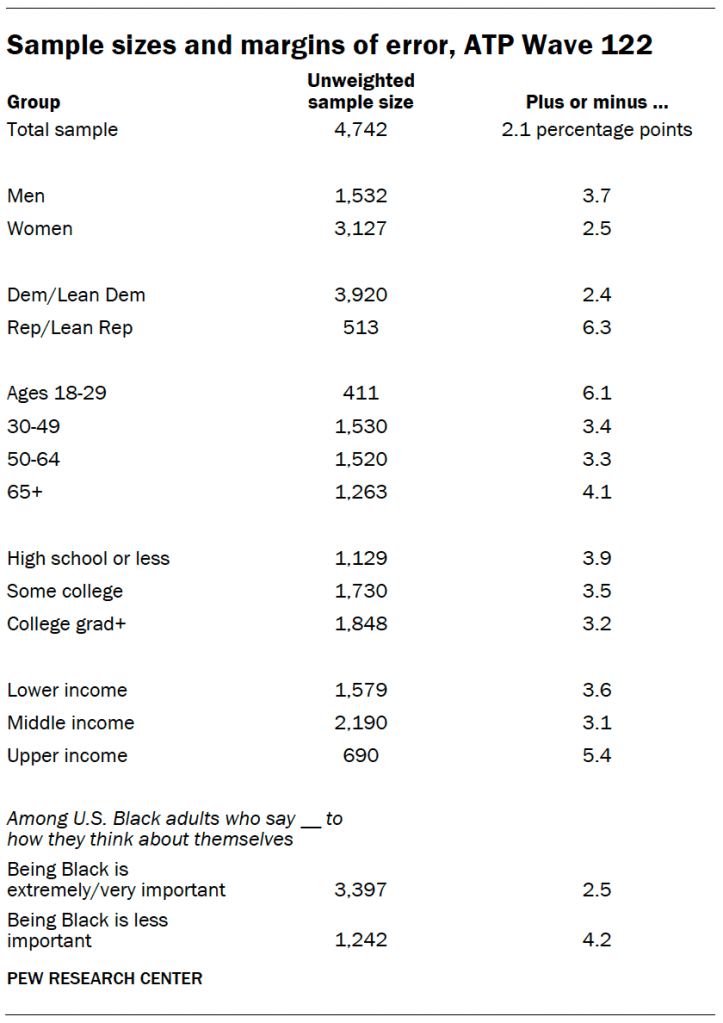
The cumulative response rate accounting for nonresponse to the recruitment surveys and attrition is 2%. The break-off rate among panelists who logged on to the survey and completed at least one item is 5%. The margin of sampling error for the full sample of 4,742 respondents is plus or minus 2.1 percentage points.

Pew Research Center is a subsidiary of The Pew Charitable Trusts, its primary funder. This is the latest report in Pew Research Center’s ongoing investigation of the state of news, information and journalism in the digital age, a research program funded by The Pew Charitable Trusts, with generous support from the John S. and James L. Knight Foundation.

Panel recruitment

The ATP was created in 2014, with the first cohort of panelists invited to join the panel at the end of a large, national, landline and cellphone random-digit-dial survey that was conducted in both English and Spanish. Two additional recruitments were conducted using the same method in 2015 and 2017, respectively. Across these three surveys, a total of 19,718 adults were invited to join the ATP, of whom 9,942 (50%) agreed to participate.

In August 2018, the ATP switched from telephone to address-based recruitment. Invitations were sent to a stratified, random sample of households selected from the U.S. Postal Service’s Delivery Sequence File. Sampled households receive mailings asking a randomly selected adult to complete a survey online. A question at the end of the survey asks if the respondent is willing to join the ATP. In 2020 and 2021 another stage was added to the recruitment. Households that did not respond to the online survey were sent a paper version of the questionnaire, $5 and a postage-paid return envelope. A subset of the adults who returned the paper version of the survey were invited to join the ATP. This subset of adults received a follow-up mailing with a $10 pre-incentive and invitation to join the ATP.

A table showing American Trends Panel recruitment surveys

Across the five address-based recruitments, a total of 23,176 adults were invited to join the ATP, of whom 20,341 agreed to join the panel and completed an initial profile survey. In each household, one adult was selected and asked to go online to complete a survey, at the end of which they were invited to join the panel. Of the 30,283 individuals who have ever joined the ATP, 12,436 remained active panelists and continued to receive survey invitations at the time this survey was conducted.

The U.S. Postal Service’s Delivery Sequence File has been estimated to cover as much as 98% of the population, although some studies suggest that the coverage could be in the low 90% range.1 The American Trends Panel never uses breakout routers or chains that direct respondents to additional surveys.

Sample design

The overall target population for this survey was non-institutionalized persons ages 18 and older living in the U.S., including Alaska and Hawaii who identify as Black either alone or in combination with another race. All eligible members of both the ATP and Ipsos’ KnowledgePanel were invited to participate in this wave.

Questionnaire development and testing

The questionnaire was developed by Pew Research Center in consultation with Ipsos. The web program was rigorously tested on both desktop and mobile devices by the Ipsos project management team and Pew Research Center researchers. The Ipsos project management team also populated test data that was analyzed in SPSS to ensure the logic and randomizations were working as intended before launching the survey.

Incentives

All ATP respondents were offered a post-paid incentive for their participation. Respondents could choose to receive the post-paid incentive in the form of a check or a gift code to Amazon.com or could choose to decline the incentive. Incentive amounts ranged from $5 to $20 depending on whether the respondent belongs to a part of the population that is harder or easier to reach. Differential incentive amounts were designed to increase panel survey participation among groups that traditionally have low survey response propensities.

Ipsos operates an ongoing modest incentive program for KnowledgePanel to encourage participation and create member loyalty. The incentive program includes special raffles and sweepstakes with both cash rewards and other prizes to be won. Typically, panel members are assigned no more than one survey per week. On average, panel members complete two to three surveys per month with durations of 10 to 15 minutes per survey. An additional incentive is usually provided for longer surveys. For this survey, during the last few days of data collection, KnowledgePanel members who self-identified as Black were offered 10,000 points (equivalent to $10) in addition to the regular incentive program in an attempt to boost the number of responses from panel members who identified as Black American.

Data collection protocol

The data collection field period for this survey was Feb. 22 to March 5, 2023. Postcard notifications were mailed to all ATP panelists with a known residential address on Feb. 22. 

Invitations were sent out in two separate launches: soft launch and full launch. Thirty-nine ATP panelists and 300 KP panelists were included in the soft launch, which began with an initial invitation sent on Feb. 22. The ATP panelists chosen for the initial soft launch were known responders who had completed previous ATP surveys within one day of receiving their invitation. All remaining English- and Spanish-speaking panelists were included in the full launch and were sent an invitation on Feb. 23.

All panelists with an email address received an email invitation and up to four email reminders if they did not respond to the survey. All ATP panelists who consented to SMS messages received an SMS invitation and up to four SMS reminders.

A table showing Invitation and reminder dates, ATP Wave 122

Data quality checks

To ensure high-quality data, the Center’s researchers performed data quality checks to identify any respondents showing clear patterns of satisficing. This includes checking for very high rates of leaving questions blank, as well as always selecting the first or last answer presented. As a result of this checking, 13 respondents were removed from the survey dataset prior to weighting and analysis.

Weighting

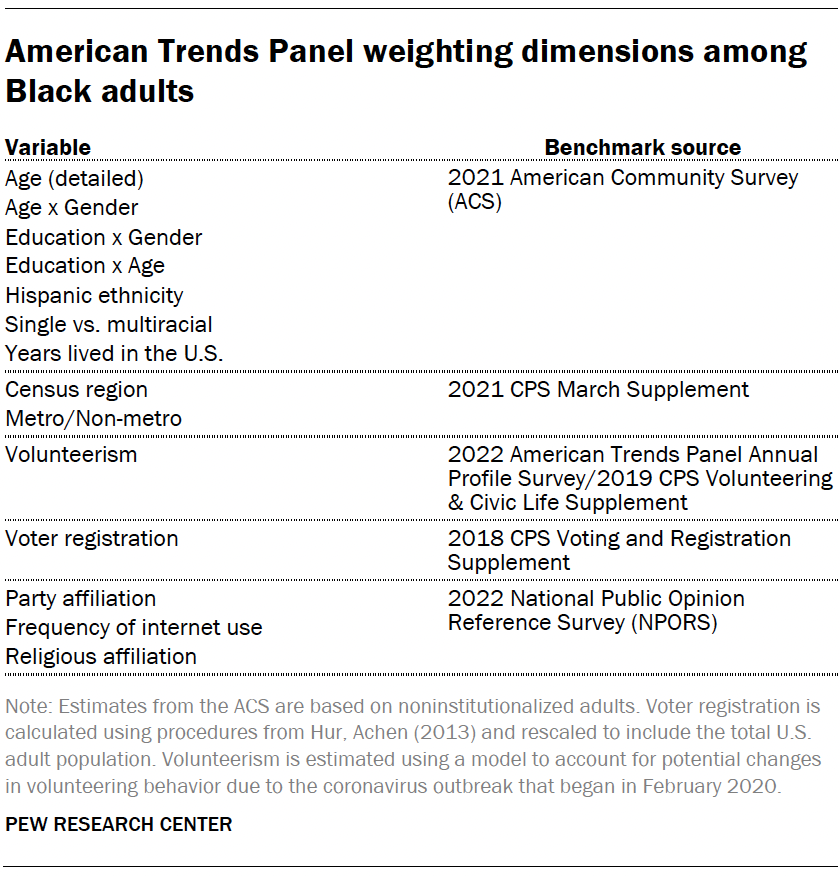
A table showing American Trends Panel weighting dimensions among Black adults

The data is weighted in a multistep process that accounts for multiple stages of sampling and nonresponse that occur at different points in the survey process. First, each panelist begins with a base weight that reflects their probability of selection for their initial recruitment survey. That weight is then adjusted to account for nonresponse to the recruitment survey and panel attrition. Next, the weights for ATP and KnowledgePanel respondents are separately scaled to be proportional to their effective sample size.

The ATP and KnowledgePanel respondents are then recombined and their weights are calibrated to align with the population benchmarks, calculated among respondents to benchmark surveys who identify as Black (alone or in combination), identified in the accompanying table. These weights were then trimmed at the 1st and 99th percentiles to reduce the loss in precision stemming from variance in the weights. Sampling errors and tests of statistical significance take into account the effect of weighting.

The following table shows the unweighted sample sizes and the error attributable to sampling that would be expected at the 95% level of confidence for different groups in the survey.

A table showing Sample sizes and margins of error, ATP Wave 122

Sample sizes and sampling errors for other subgroups are available upon request. In addition to sampling error, one should bear in mind that question wording and practical difficulties in conducting surveys can introduce error or bias into the findings of opinion polls.

Dispositions and response rates

A table showing Final dispositions, ATP Wave 122
A table showing Cumulative response rate as of ATP Wave 122

Adjusting income and defining income tiers

To create upper-, middle- and lower-income tiers, respondents’ 2021 family incomes were adjusted for differences in purchasing power by geographic region and household size. “Middle-income” adults live in families with annual incomes that are two-thirds to double the median family income in the panel (after incomes have been adjusted for the local cost of living and household size). The middle-income range for the American Trends Panel is about $43,800 to $131,500 annually for an average family of three. Lower-income families have incomes less than roughly $43,800, and upper-income families have incomes greater than roughly $131,500 (all figures expressed in 2021 dollars).

Based on these adjustments, 41% of respondents in Wave 122 are lower income, 43% are middle income and 11% fall into the upper-income tier. An additional 5% either didn’t offer a response to the income question or the household size question.

For more information about how the income tiers were determined, please read the methodology here.

Questionnaire pretesting

A portion of the questionnaire was extensively pretested with a series of 15 interviews conducted online with a live interviewer. The purpose was to get a sense of how and why people were responding, reacting and understanding each question. Results from these pretests were used to fine-tune the questions in the final questionnaire.

Focus groups

Pew Research Center conducted a series of focus groups as part of a study exploring Black Americans’ views of and experiences with news and information. The focus groups were facilitated by PSB Insights for Pew Research Center. Nine focus groups were held virtually with participants from across the U.S. Each participant had to meet certain criteria to be eligible:

  1. They must confirm that their race was Black or African American. This included those who also identified as Hispanic or multiracial.
  2. They must have internet access and a computer with a working webcam.
  3. They must be willing to attend an online focus group on a particular date and time.
  4. They must read and sign an informed consent form detailing their participation in the focus group.

Additional demographic data, such as political leaning, household income, and region, were collected to ensure a diverse mix of participants.

The primary goal of these focus groups was to inform the development of the survey. This survey is the main source of data for this report. The report includes a number of quotations from the focus groups to help illustrate and add nuance to the survey findings. Quotations are chosen to provide context and are not necessarily representative of the majority opinion of any group. Quotations may have been edited for grammar, spelling and clarity.

Each focus group consisted of four or five adults coming together for about an hour and a half for a discussion led by a professional moderator using a guide developed by Pew Research Center with support from PSB Insights and the moderator.

In addition to being Black to be eligible for the focus groups, most groups were made up of people who shared a common characteristic. Beyond that common characteristic, each of the groups was recruited to have a mix of other characteristics and attitudes as appropriate, including gender, education, income, age, race or ethnicity, political party affiliation, urban, suburban and rural location, employment status and amount of trust in the news media. The nine focus groups are the following:

  • “General population” – Participants included a mix of demographic characteristics and news habits. Two of these groups were conducted.
  • “Parents” – Participants were parents or guardians of at least one child under the age of 18 living in their household
  • “Younger adults” – Participants were ages 18 to 24
  • “Older adults” – Participants were ages 60 and older
  • “Women” – Participants were those who identified as women
  • “Low news attentiveness” – Participants were those who said they follow the news “only now and then” or “never”
  • “Low household income” – Participants were those whose 2021 pretax household income was less than $35,000
  • “Republican/lean Republican” – Participants were those who identified as Republican or as independents who lean toward the Republican Party

The focus groups were conducted between July 26 and Aug. 4, 2022. Focus groups were about 90 minutes in length with 25 minutes allocated to introductions, warm-up questions and debriefs.

PSB Insights worked with RRU Global to recruit participants using a screener designed by Pew Research Center. Participants were recruited through a targeted email outreach from RRU Global’s panel and from their Facebook page. After participants were screened for eligibility, Pew Research Center ranked participants in order of priority to be seated in each focus group with the goal of getting a diverse range of voices in each focus group.

Participants were given an incentive of $175 for their participation in the focus groups. In addition, in order to encourage participants to arrive early to the focus groups to ensure that audio and video connections were functioning properly, a $25 “early bird” raffle was offered to participants in each group.

The topics for discussion during the focus groups were as follows:

  • Stage I: Introductions
  • Stage II: Daily life
  • Stage III: Community connections and experiences
  • Stage IV: Local news and information
  • Stage V: Trust in media and verification
  • Stage VI: Closing

© Pew Research Center, 2023