How Americans Navigated the News in 2020: A Tumultuous Year in Review
Americans inhabited different information environments, with wide gaps in how they viewed the election and COVID-19
BYAmy Mitchell, Mark Jurkowitz, J. Baxter Oliphant and Elisa Shearer
About Pew Research Center
Pew Research Center is a nonpartisan, nonadvocacy fact tank that informs the public about the issues, attitudes and trends shaping the world. It does not take policy positions. The Center conducts public opinion polling, demographic research, computational social science research and other data-driven research. It studies politics and policy; news habits and media; the internet and technology; religion; race and ethnicity; international affairs; social, demographic and economic trends; science; research methodology and data science; and immigration and migration. Pew Research Center is a subsidiary of The Pew Charitable Trusts, its primary funder.
How Americans Navigated the News in 2020: A Tumultuous Year in Review
Americans inhabited different information environments, with wide gaps in how they viewed the election and COVID-19
How we did this
Pew Research Center’s American News Pathways project conducted this study to understand how Americans interacted with the news and information throughout the 2020 election and the COVID-19 pandemic.
This analysis pulls data from a yearlong project that included 10 separate surveys of 9,000 or more U.S. adults. Everyone who completed each survey is a member of the Center’s American Trends Panel (ATP), an online survey panel that is recruited through national, random sampling of residential addresses. This way nearly all U.S. adults have a chance of selection. The surveys are weighted to be representative of the U.S. adult population by gender, race, ethnicity, partisan affiliation, education and other categories. Read more about the ATP’s methodology.
Americans are divided – that much is obvious after a contentious presidential election and transition, and in the midst of a politicized pandemic that has prompted a wide range of reactions.
But in addition to the familiar fault line of political partisanship, a look back at Pew Research Center’s American News Pathways project finds there have consistently been dramatic divides between different groups of Americans based on where people get their information about what is going on in the world.
For example, Republicans who looked to former President Donald Trump for their news about the 2020 election or the coronavirus pandemic were more likely to believe false or unproven claims about these events. And while Americans widely agree that misinformation is a major problem, they do not see eye to eye about what actually constitutes misinformation. In many cases, one person’s truth is another’s fiction.
From November 2019 through December 2020, the Pathways project explored how Americans’ news habits and attitudes related to what they heard, perceived and knew about the 2020 presidential election and COVID-19. The research was based on 10 different surveys conducted on the Center’s American Trends Panel, a nationally representative panel of U.S. adults. Each survey consisted of about 9,000 or more U.S. adults.
Over the course of the year, as part of the project, the Center published more than 50 individual analyses and made data from more than 580 survey questions available to the public in an interactive data tool. We now have the opportunity to look back at the findings over the full course of the year and gather together the key takeaways that emerged.
Roadmap to the report
This report explores these and other key findings around five areas of discovery. Chapter 1 examines the evidence pointing to media “echo chambers” on the left and the right, and a new analysis of the Americans who consistently turned to these echo chambers over the course of the study. Chapter 2 analyzes Trump’s role as a source of news about the coronavirus outbreak and the presidential election. Chapter 3 explores Americans’ concern about and views of misinformation. Chapter 4 looks at how Americans who rely on social media for news stand apart. And Chapter 5 looks back on views of the COVID-19 outbreak and media coverage over time.
1. About a quarter of Republicans, Democrats consistently turned only to news outlets whose audiences aligned with them politically in 2020
At the outset of the election year, a Pew Research Center study found Democrats and Republicans increasingly relied on two divergent media ecosystems.
During the course of the presidential campaign, the Americans News Pathways project reexamined these news habits multiple times, with a particular focus on partisans who got more news from outlets with audiences that shared their political leanings versus those who got news from outlets with more politically diverse audiences.
Looking at Americans with consistent media diets over the course of a year
This analysis combines information about Americans’ media diets from three separate surveys conducted in November 2019, September 2020 and November 2020.
We look at which Americans had similar media diets in at least in at least two out of those three surveys.
The rest of this report looks at findings from American News Pathways analyses from throughout the year, including analysis based on Americans’ media diets at the time of each survey.
The new analysis in this chapter studies the sources Americans said they used for political and election news across three surveys – in November 2019, September 2020 and November 2020 – to explore those Republicans and Democrats who consistently got news only from outlets whose audiences shared their political views compared with those Republicans and Democrats who turned to news outlets with more politically diverse users.
We define consistency here as having the same type of media diet in at least two out of the three surveys. For example, we identify those Americans who got political news only from sources with like-minded audiences in at least two of the three surveys (e.g., Republicans who only used sources with right-leaning audiences and Democrats who only used sources with left-leaning audiences in at least two surveys) and respondents who got news from sources whose audiences had mixed political views or leaned toward the other side in at least two of the three surveys. See the appendix for more details.
Takeaway #1: About a quarter of Republicans and Democrats consistently turned to partisan news media bubbles
Overall, 24% of Republicans and Republican-leaning independents consistently turned only to sources with right-leaning audiences in at least two of three Pathways surveys, and 25% of Democrats and Democratic-leaning independents chose only outlets with left-leaning audiences in at least two of the three surveys. Another 48% of Democrats and 34% of Republicans used sources with audiences that are politically mixed (e.g., the ABC, CBS or NBC TV networks) or that tilt toward the other end of the political spectrum in at least two of the three surveys.1
The study also reveals that 41% of Republicans and about a quarter of Democrats (27%) did not have either of these consistent media diets across the three surveys. Someone, for example, may have turned only to sources with right-leaning audiences in the November 2019 survey, but then relied on sources with a mix of audiences in September 2020 and didn’t turn to any major sources in November 2020. These Americans often did not use any of the major national sources asked about in the surveys and tended to follow major news storylines such as the COVID-19 outbreak and the 2020 election less closely than others.
Takeaway #2: Republicans and Democrats using news sources with like-minded audiences tend to describe their views as more ideologically consistent
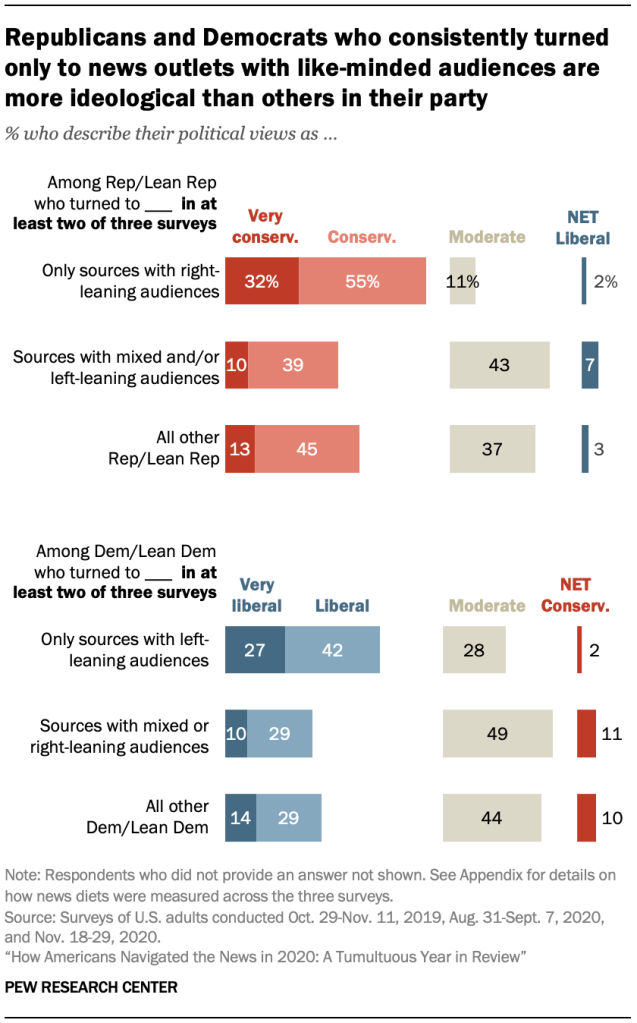
Republicans and Democrats who, during the 2020 presidential election, consistently got their political news only from major news outlets whose audiences share their political leanings are generally more ideological than others in their parties.
Republicans and Republican-leaning independents who generally stuck with news outlets whose audiences lean to the right politically overwhelmingly call themselves conservatives (86%), with more than half saying they are “conservative” and 32% saying they are “very conservative.” Among Republicans who turned to outlets with mixed or left-leaning audiences, fewer describe themselves as conservative or very conservative (48%). Among all other Republicans, 58% are conservative or very conservative.
Similarly, the most liberal group of news media consumers among Democrats are those who consistently used only news outlets with left-leaning audiences: 70% say they are liberals, including about a quarter who are “very liberal” (27%). By contrast, only about a third of Democrats who consistently used news outlets with politically mixed or right-leaning audiences (39%) call their political views liberal; about half in this group say they are moderates (49%).
The study cannot speak to whether news consumption habits shape political ideology, or whether people with stronger ideologies tend to seek out news sources that are friendlier to their perspectives. Still, the data shows that there is a strong relationship between consistently using news outlets whose audiences share respondents’ politics and those respondents’ own political views.
Takeaway #3: Just under half of Republicans who turned only to outlets with like-minded audiences are 65 and older
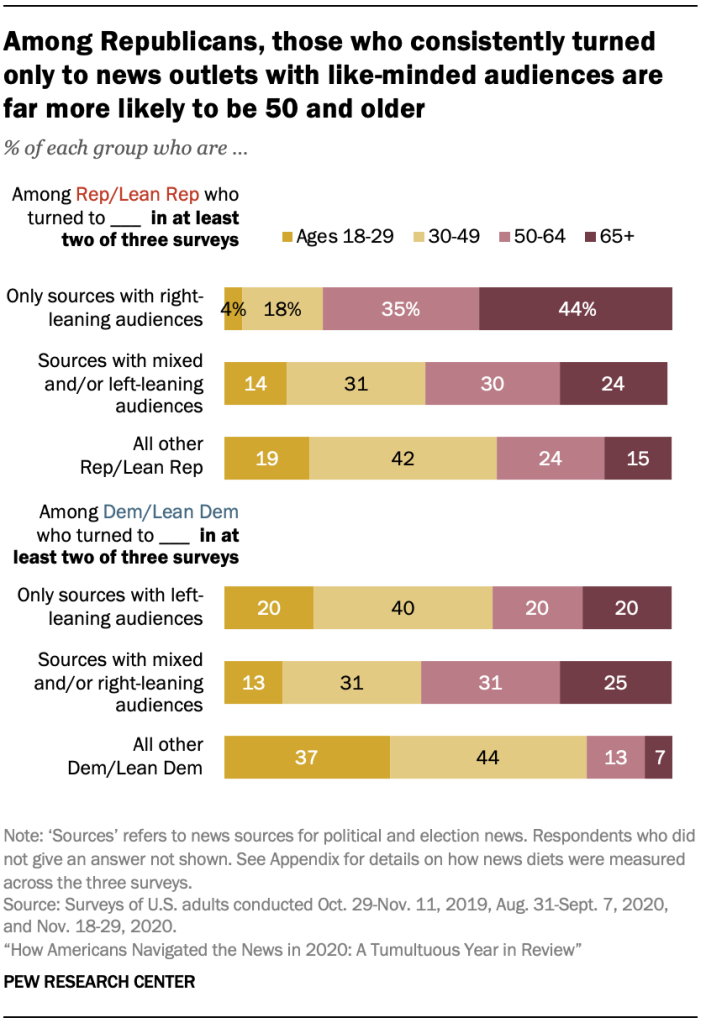
There are stark age differences among Republicans with different media diets. Republicans who consistently turned only to outlets with like-minded audiences are much older than the other groups: 79% are ages 50 and older, while just 4% of the group are 18 to 29.
Among Republicans who consistently turned to outlets with more mixed or left-leaning audiences, fewer are 50 and older (55%), while 14% range from 18 to 29.
Among Democrats, there are somewhat smaller age differences between the group who turned consistently only to outlets with left-leaning audiences and those who consistently turned to outlets with mixed or right-leaning audiences (60% and 44% are under age 50, respectively).
Takeaway #4: Among Democrats, race and ethnicity and education vary across different media diets
There is little difference among Republicans in educational attainment across these news consumption groupings. That is not the case, however, among Democrats.
Democrats who consistently used only news outlets with left-leaning audiences to get political news during the past year have much higher levels of education than Democrats with other news consumption habits. About six-in-ten U.S. adults in this group have college degrees, including about a third (34%) with postgraduate degrees. Among other Democrats, only about three-in-ten or fewer have completed college.
Similarly, looking at the race and ethnicity of each group, there are large differences among Democrats by media diet. While a majority of the group who consistently turned only to outlets with left-leaning audiences are White (71%), a minority (42%) of Democrats who consistently turned to outlets with other types of audiences are. And Democrats who consistently turned to outlets with mixed or right-leaning audiences are more likely than other groups among Democrats to be Black (29%), and 21% of them are Hispanic.
Takeaway #5: Network TV news emerged as the one area of common ground between parties
Looking at the individual news sources within each media group in our study, Republicans and Democrats generally got political news from different outlets throughout the 2020 presidential election, with one notable exception. Sizable shares in both parties (43% of Democrats and 26% of Republicans) turned to network TV news in at least two of the three surveys conducted during the election.
Otherwise, the greatest share of Republicans who stuck with any of these outlets over the year were turning to Fox News (36%), followed by talk radio (17%). Much smaller portions (9% or fewer) of Republicans used any of the other five individual outlets asked about.
Conversely, only 11% of Democrats used Fox News in at least two of the three surveys, and an even smaller portion (1%) turned to talk radio consistently.
Beyond the 43% of Democrats who consistently turned to network TV news, Democrats most often looked to CNN (39% used in at least two of the three surveys), NPR (24%), MSNBC (22%), The New York Times (21%) and The Washington Post (14%). While 9% of Republicans consistently stayed with CNN for political news, 4% or fewer of Republicans consistently turned to each of these other top Democratic sources.
2. Republicans who relied on Trump for news in 2020 diverged from others in GOP in views of COVID-19, election
While large partisan gaps emerged in views of two dominant stories of last year – the COVID-19 pandemic and the presidential election – there also was one clear and consistent difference within a single party. As a whole, Republicans who turned to Donald Trump as a key source of news about these events had different perspectives from Republicans who did not.
Overall, around three-in-ten Republicans and Republican-leaning independents (32%) said in April of 2020 that they relied most on Trump and the White House coronavirus task force for COVID-19 news, while a slightly smaller share (27%) said in September 2020 that the Trump campaign was a major source of news about politics and the presidential election for them. Survey data from the Center’s American News Pathways project reveals that these Republicans were more likely than other Republicans to think the COVID-19 pandemic had been overblown, more likely to see voter fraud as a significant threat to election integrity and more likely to render a harsh verdict on the media. These are all views that are largely in sync with the former president’s messaging and narratives.
Takeaway #1: Those Republicans who relied on Trump for COVID-19 news were more likely to say the pandemic was overblown and that the media covered it poorly
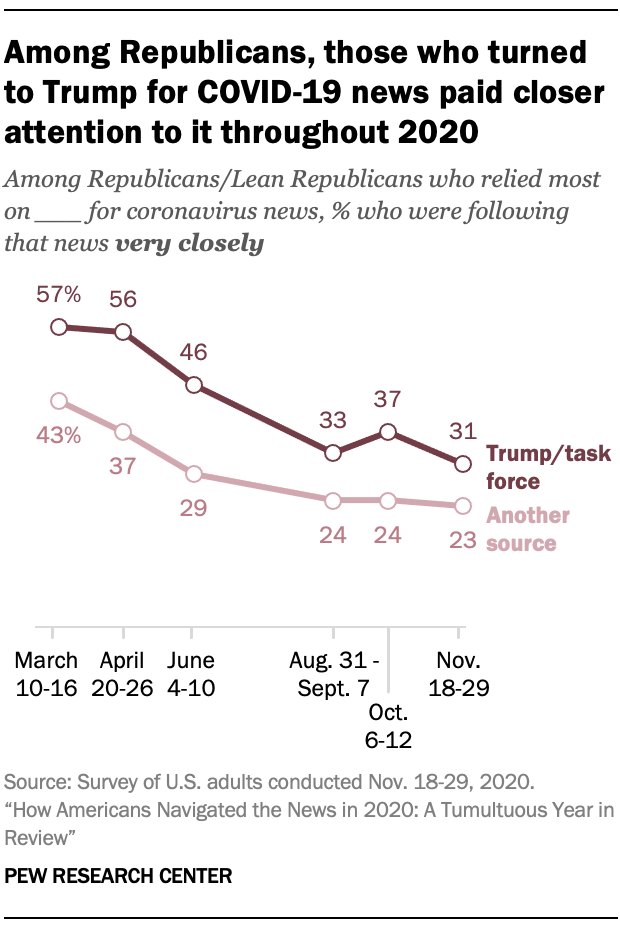
Republicans who relied most on Trump and his coronavirus task force for news about the pandemic followed that coverage more closely than other Republicans. In March, 57% of Republicans who were looking to Trump and the White House said they were following coronavirus news very closely, compared with 43% of other Republicans. By November, with interest in COVID-19 news waning among all Republicans, those who turned to Trump still were more likely to be following coronavirus coverage very closely (31%) than Republicans who were looking elsewhere (23%).
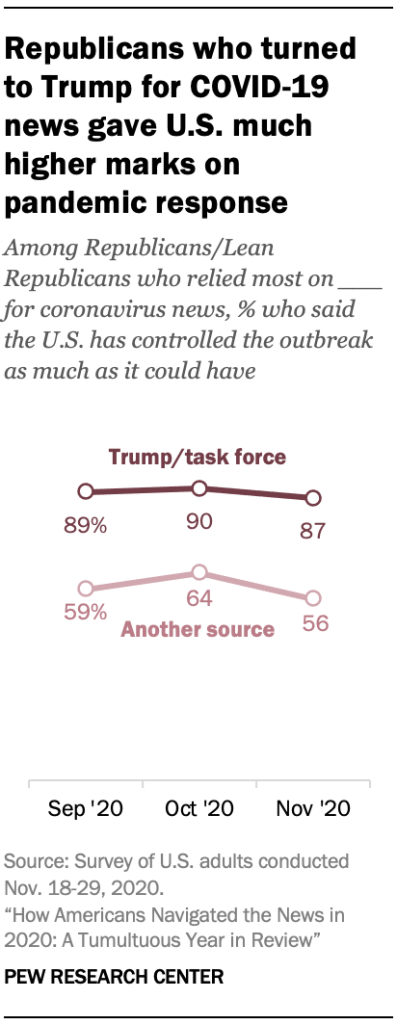
Among those who relied most on Trump and the White House coronavirus task force for news about the pandemic, views were more aligned with Trump’s messaging. For instance, among the consistent messages from then-President Trump were that the COVID-19 pandemic had been overblown, that his administration was handling the situation effectively and that the outbreak would soon abate.
In early September, nearly nine-in-ten Republicans relying on Trump (89%) said the U.S. had controlled the outbreak as much as it could have. That number was 30 percentage points lower (59%) among other Republicans. By late November, even as virus cases surged throughout the country, that difference remained – 87% of Republicans who were turning to Trump for COVID-19 news said the outbreak had been controlled as much as possible, vs. 56% of other Republicans.
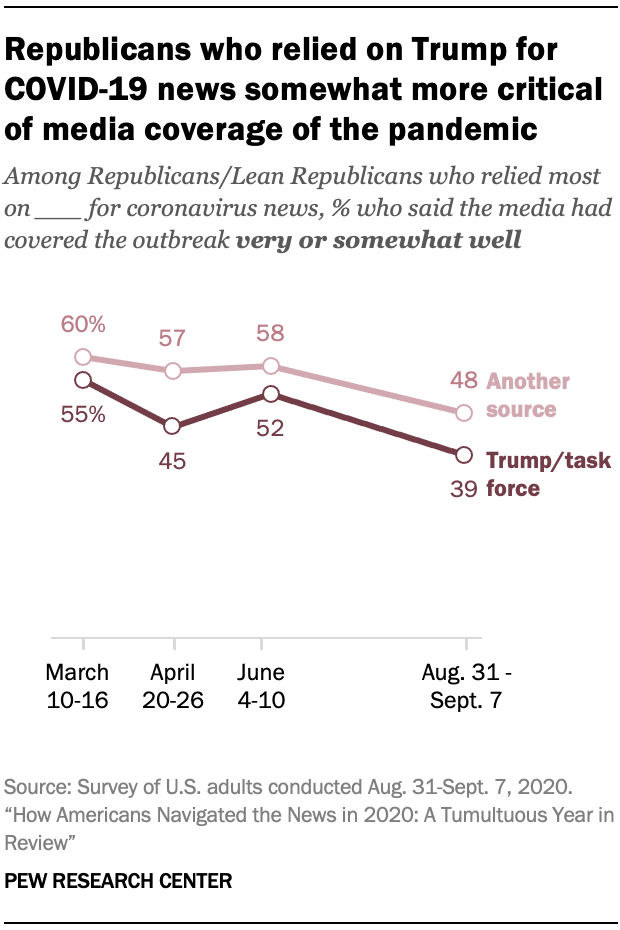
Indeed, the survey data suggests that the group relying on Trump for information about the coronavirus was more likely to be critical of the media. In March, as the COVID-19 outbreak was first being felt in the U.S., Republicans who relied most on Trump and the White House coronavirus task force for news were somewhat less likely than other Republicans to say the media had done “very” or “somewhat” well covering the pandemic (55% vs. 60%). In late April, that gap widened, with 45% of the Trump group saying the media had done well, compared with 57% of Republicans who did not turn to Trump. And in early September, as overall Republican views of coverage grew more critical, 39% of the Trump group said the media had covered the pandemic well.
Another question that was asked multiple times over the course of the year did not mention the media explicitly, but was related: Had the COVID-19 outbreak been overblown or underplayed? Again, the gap between Republicans who relied on Trump for their news about the outbreak and those who didn’t remained steady throughout the year.
In late April, about half of the Republicans who relied on Trump for COVID-19 news (53%) said the pandemic had been made into a bigger deal than it really was, compared with 44% among other Republicans. By September, that number had grown to 75% of those in the Trump group and 63% of other Republicans. In late November, as cases began to spike again nationally, 66% of Republicans relying on Trump still said the outbreak was being exaggerated, again higher than the 53% among other Republicans.
Similarly, in the late April survey, half of Republicans who relied most on Trump and the White House task force for news about the pandemic (50%) said that media coverage of the outbreak was largely inaccurate, compared with about one-third (34%) of Republicans who were not most reliant on Trump. A majority (63%) of those most reliant on Trump also said that same media coverage was hurting the country, while a smaller share of other Republicans (50%) shared this perspective.
In addition, two-thirds of Republicans who turned most to Trump (67%) said pandemic coverage revealed journalists to be working mainly to benefit themselves rather than the public, compared with 52% of Republicans who mostly got their news about the pandemic elsewhere. And 43% in the Trump group said coverage was not providing them the information they needed, while fewer (33%) said it was providing the necessary information. Among those not relying on Trump, the numbers were reversed: 48% reported getting the information they needed, while 31% were not.
Takeaway #2: Republicans turning to Trump for election news expressed more concern about voter fraud connected to mail-in ballots
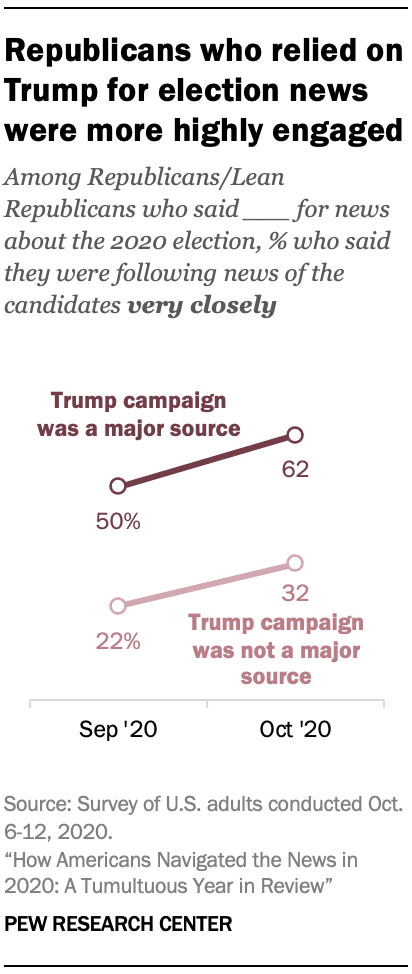
Similar to the pattern on the coronavirus, Republicans who used Trump and his campaign as a major source for election news were much more likely to pay close attention to the 2020 presidential race than Republicans who did not. In early September, 43% of those who said Trump was a major source reported having followed the GOP nominating convention very closely, about four times as many as other Republicans (10%). That same month, half of those who were turning to the Trump campaign reported that they were following news of the candidates very closely, compared with 22% of Republicans who did not use Trump as a major source of election news. And in October, as interest in the election grew across the board, that gap remained: 62% of Republicans who turned to Trump were following very closely, roughly double the share of other Republicans (32%).
Once Election Day passed, this pattern persisted when it came to following Trump’s post-election statements. While 45% of those using Trump as a major source were following those statements very closely, only 17% of the other Republicans were, according to a late November survey.
About seven-in-ten Republicans who used Trump and his campaign as a major source for campaign news (71%) said media coverage after the polls closed on Nov. 3 was largely inaccurate – substantially higher than the 55% of Republicans who did not turn to Trump as a key source. In addition, a similar share of those in the Trump group (69%) said the media’s election coverage did not give them the information they needed, compared with 54% of other Republicans.
Again, roughly seven-in-ten Republicans who relied on Trump for their election news (72%) said post-Election Day coverage hurt democracy, compared with 59% of other Republicans. And 76% of those who used Trump as a major source said the coverage after the polls closed was not professional; that number slipped to 62% among Republicans who did not turn to Trump. To be sure, skepticism toward the media is common among all Republicans, but these findings show that it was especially widespread among those who were getting their news from Trump directly.
On a number of occasions before Election Day, Trump had falsely claimed that mail-in voting, which became more significant in the 2020 election because of concerns about in-person voting during the pandemic, was unreliable and susceptible to fraud. Again, this messaging seems to have sunk in among those who were listening most closely to him.
In early September, a clear majority of Republicans who were using the Trump campaign as a major source for election news (61%) said fraud related to voting by mail was a major concern, compared with 36% of other Republicans.
By late November, with Trump and his allies trying multiple paths to overturn the election results, 73% of Republicans who turned to him as a major source of election news said allegations of voter fraud were getting too little attention. Among those Republicans who did not use the Trump campaign as a major source of news, the percentage who said the fraud charges were getting too little attention fell to just over half, at 55%.
3. Misinformation and competing views of reality abounded throughout 2020
Unprecedented national news events, a sharp and sometimes hostile political divide, and polarized news streams created a ripe environment for misinformation and made-up news in 2020. The truth surrounding the two intense, yearlong storylines – the coronavirus pandemic and the presidential election – was often a matter of dispute, whether due to genuine confusion or the intentional distortion of reality.
Pew Research Center’s American News Pathways project revealed consistent differences in what parts of the population – including political partisans and consumers of particular news outlets – heard and believed about the developments involving COVID-19 and the election. For example, news consumers who consistently turned only to outlets with right-leaning audiences were more likely to hear about and believe in certain false or unproven claims. In some cases, the study also showed that made-up news and misinformation have become labels applied to pieces of news and information that do not fit into people’s preferred worldview or narrative – regardless of whether the information was actually made up.
Of course, differences in political party or news diet are not always linked with differences in perceptions of misinformation, nor are they the only factors that have an impact. As explained in Chapter 2, using Donald Trump himself as a news source connects closely to beliefs about certain false claims and exposure to misinformation. So, too, does the reliance on social media as the primary pathway to one’s news, as discussed in Chapter 4.
The Pathways project, then, revealed the degree to which the spread of misinformation is pervasive, but not uniform. Americans’ exposure to – and belief in – misinformation differs by both the specific news outlets and more general pathways they rely on most. Certain types of misinformation emerge more or less strongly within each of these. For example, Americans who rely most on social media for their news (and who also pay less attention to news generally and are less knowledgeable about it) get exposed to different misinformation threads than those who turn only to sources with right-leaning audiences, or to Trump. Both of these latter groups are also more ideologically united and pay very close attention to news.
Takeaway #1: Most Americans said they saw made-up news and expressed concern about it
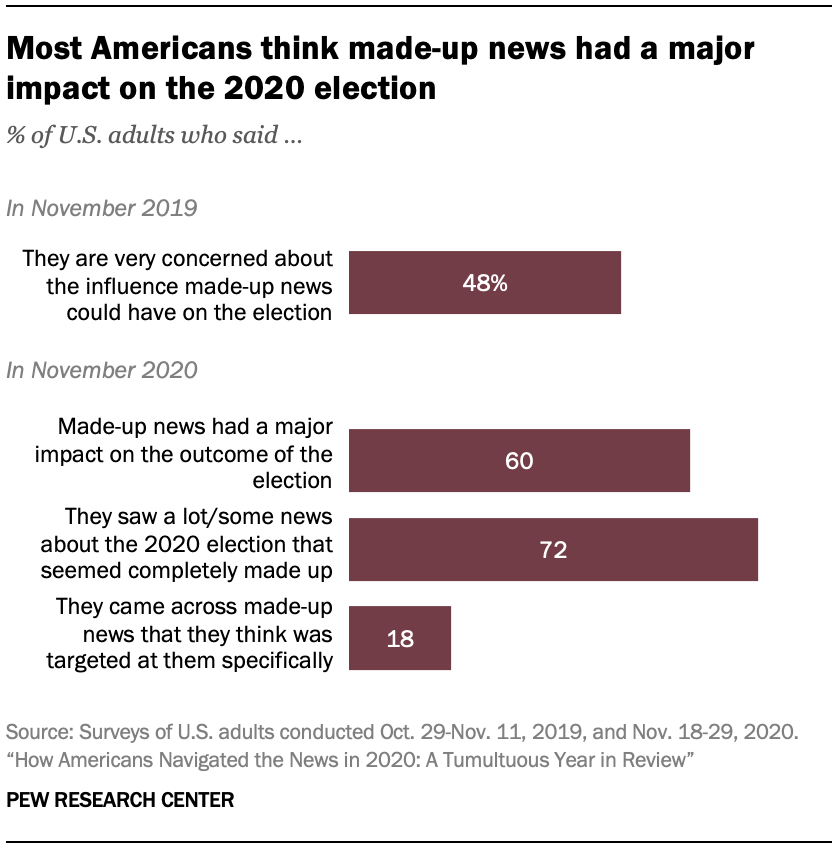
Even a year before the 2020 election, in November 2019, the vast majority of Americans said they were either “very” (48%) or “somewhat” (34%) concerned about the impact made-up news could have on the election. This concern cut across party lines, with almost identical shares of Democrats (including independents who lean toward the Democratic Party) and Republicans (including GOP leaners) expressing these views. But on both sides of the aisle, people were far more concerned that made-up news would be targeted at members of their own party rather than the other party.
A year later, in the weeks following the election, Americans said these fears were borne out: 60% of U.S. adults overall said they felt made-up news had a major impact on the outcome of the election, and an additional 26% said it had a minor impact. Republicans were more likely than Democrats to say it had a major impact (69% vs. 54%). In addition, nearly three-quarters of U.S. adults overall (72%) said they had come across at least “some” election news that seemed completely made up, though far fewer – 18% – felt the made-up news they saw was aimed directly at them.
During the year, many Americans also felt exposed to made-up news related to the coronavirus pandemic, a phenomenon that grew over time. As of mid-March 2020, 48% of Americans said they had seen at least some news related to COVID-19 that seemed completely made up. By mid-April, that figure had risen to 64%.
Overall, older Americans, those who paid more attention to news and those who showed higher levels of knowledge on a range of core political questions expressed greater concern about the impact of made-up news. Republicans also expressed more concern and said it’s harder to identify what is true when it comes to COVID-19 news. Meanwhile, those who relied most on social media for political news tended to express less concern about made-up news.
Takeaway #2: What Americans categorized as made-up news varied widely – and often aligned with partisan views
Especially in America’s polarized political environment, just because people say that something seemed made up doesn’t mean it was. Without a doubt, many Americans who report encountering made-up news actually did, while others likely came across real, fact-based news that did not fit into their perceptions of what is true. Indeed, open-ended survey responses show that people’s examples of made-up news they saw run the gamut – often connected with partisan divides about reality.
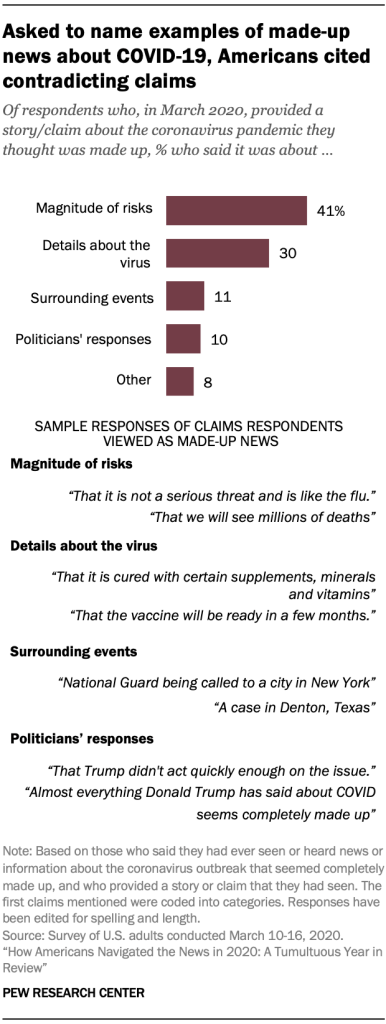
In March of 2020, after asking whether people had come across made-up news related to COVID-19, the American News Pathways project asked respondents to write in an example of something they came across that was made up. The responses were revealing, and sometimes contradictory: Roughly four-in-ten (41%) among those who provided an example named something related to the level of risk associated with the outbreak. Within this category, 22% said the “made-up” information falsely elevated the risks (Republicans were more likely to say this than Democrats), and 15% felt the made-up information was falsely downplaying the risks (Democrats were more likely to give these examples).
Respondents’ examples of made-up news that exaggerated the severity of the pandemic included such claims as numbers of COVID-19 deaths that seemed higher than possible, and the idea that risks had been overplayed by investors so they could make “gobs of money.” Some of these respondents said it was the media overhyping the risk, including one respondent who objected to a front-page newspaper photo designed to equate the coronavirus with the 1918 Spanish flu.
On the flip side, respondents’ examples of made-up news that underplayed COVID-19’s significance included references to statements made by Trump or his administration, including the then-president predicting an early end to the crisis and suggesting that the number of cases in the U.S. would remain low.
Three-in-ten respondents pointed to details about the virus itself. This included some truly made-up claims, such as that it could be “cured with certain supplements, minerals and vitamins,” and others that were perceived by respondents as made up but were not. For example, some respondents listed “wearing a mask for the general public” as an example of a misleading claim. Finally, 10% identified purely political statements as examples of misinformation, such as “That Trump didn’t act quickly enough,” or, by contrast, that “Almost everything Donald Trump has said” about the coronavirus has constituted made-up news.
Takeaway #3: While political divides were a big part of the equation, news diet within party has been a consistent factor in what Americans believe, whether true or untrue
In addition to wholly made-up claims, another finding to emerge from the Pathways project was the degree to which news diet also plays into the storylines – both true and untrue – that people get exposed to, how that feeds into perceptions about those events and, ultimately, different views of reality.
This phenomenon appears more strongly among Republicans than among Democrats, in large part due to the smaller mix of outlets Republicans tend to rely on – and within that, the outsize role of Fox News. (This is in addition to differences in perceptions and beliefs between Republicans who relied on Trump for news and those who didn’t, written about in Chapter 2.)
Trump’s first impeachment
Consider one of the first news topics covered by the project: the 2019 impeachment of Donald Trump, which involved Trump’s behavior and motives in withholding military aid to Ukraine, as well as actions there by Democratic presidential candidate Joe Biden (whom Trump had asked Ukraine’s government to investigate).
A Pathways survey conducted in November 2019 found that Americans’ sense of the impeachment story connected closely with where they got their news. For instance, about half (52%) of Republicans who, among 30 outlets asked about in that survey, got political news only from outlets with right-leaning audiences had heard a lot about Biden’s efforts to remove a prosecutor in Ukraine in 2016. That is more than double the percentage of Democrats who got news only from outlets with left-leaning audiences (20%) who heard a lot. The gap is similar on Biden’s son (Hunter Biden) work with a Ukraine-based natural gas company: 64% of these Republicans had heard a lot about this, compared with 33% of these Democrats. (Details of the news outlet groupings and audience profiles can be found here.)
These patterns also play out in views about Joe Biden’s motivations. When asked, based on what they had heard in the news, whether they thought Biden called for the prosecutor’s removal in order to advance a U.S. government position to reduce corruption in Ukraine or to protect his son from being investigated, 81% of Republicans who got news only from outlets with right-leaning audiences said he wanted to protect his son. Only 2% of these Republicans thought it was part of a U.S. anti-corruption campaign.
Democrats who got news only from outlets with left-leaning audiences were much more inclined to attribute Biden’s actions to anti-corruption efforts (44%) than to a desire to protect his son (13%) – though that 44% is nearly matched by 42% who said they were not sure why Biden called for the prosecutor’s removal.
A similar gap is evident when it comes to views about Trump’s role in the Ukraine affair.
About two-thirds of Republicans and Republican leaners who got their political news only from media outlets with right-leaning audiences (65%) said he did it to advance a U.S. policy to reduce corruption in Ukraine. Just 10% of these Republicans said Trump withheld the aid to help his reelection campaign (23% said they weren’t sure).
Among Republicans who got political news from a combination of outlet types – some of which have right-leaning audiences and some which have mixed and/or left-leaning audiences – that gap narrows significantly. About half (46%) cited the advancement of U.S. policy, and 24% cited political gain. What’s more, Republicans who did not get news from any sources with right-leaning audiences (but did get news from outlets with mixed and/or left-leaning audiences) were more likely to say it was for political gain than to advance U.S. policy (34% vs. 21%), while 43% of Republicans in this group were not sure why he did it.
Among Democrats and Democratic leaners, those who got political news only on outlets with left-leaning audiences and those who got news from outlets with left-leaning audiences plus others that have mixed and/or right-leaning audiences responded similarly. Roughly three-quarters of Democrats in each of these groups (75% and 77%, respectively) said Trump withheld aid to help his reelection effort, while very small minorities of these Democrats (4% and 3%, respectively) cited reducing corruption as the president’s intent.
The coronavirus pandemic
Several false claims related to the pandemic emerged over the course of the study. Not only did Republicans who turned to Trump for news about the pandemic express higher levels of belief in some of these claims (discussed in Chapter 2), but those who only relied on outlets with right-leaning audiences also stood out in this way (from that same initial group of 30).
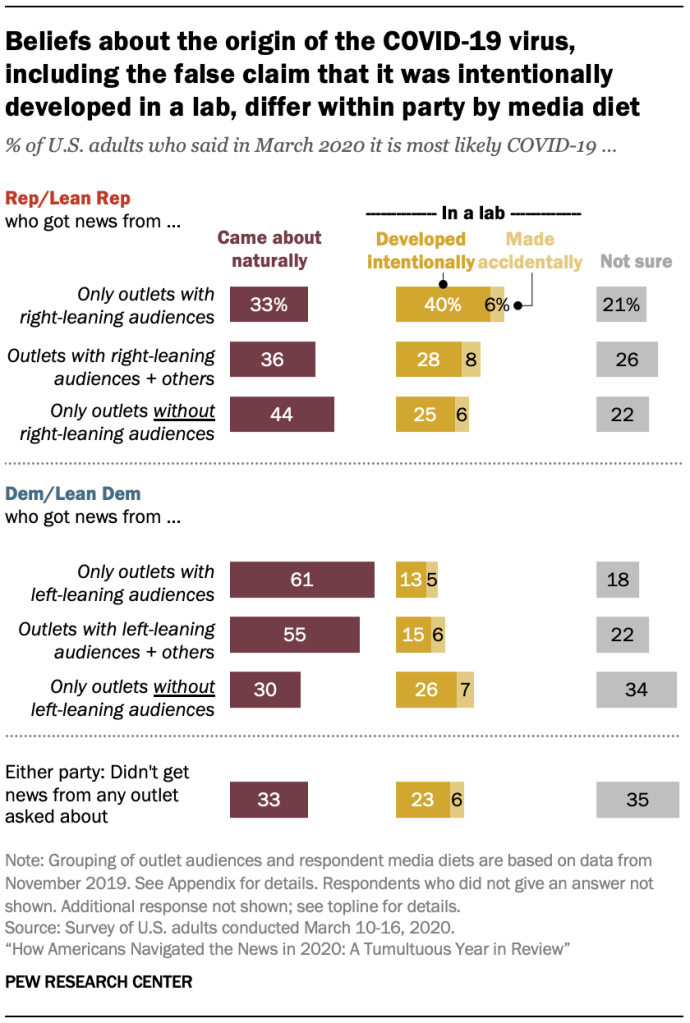
One early claim, made without evidence, was that COVID-19 was created intentionally in a lab. (Scientists have determined that the virus almost certainly came about naturally, but some authorities, while saying it’s unlikely, have not ruled out the possibility that a lab played a role in its release.) When asked in March 2020 what they thought was the most likely way the current strain came about based on what they had seen or heard in the news, 40% of Republicans who only got news from outlets with right-leaning audiences said COVID-19 was most likely created intentionally in a lab, far higher than the 28% of Republicans who got political news from outlets with both right-leaning and mixed audiences and 25% of Republicans who get political news only from outlets without right-leaning audiences.
Among Democrats, those who got political news only from outlets with left-leaning audiences stood out less. They were slightly more likely than Democrats whose news diet included outlets with both left-leaning and non-left-leaning audiences to say the virus strain came about naturally (61% and 55%, respectively). Instead, it was Democrats who didn’t get news from any outlets with left-leaning audiences who stood apart. They were more likely to say COVID-19 was most likely created intentionally in a lab (26%), less likely than other Democrats to say it came about naturally (30%) and more likely to express uncertainty over the virus’ origin (34%).
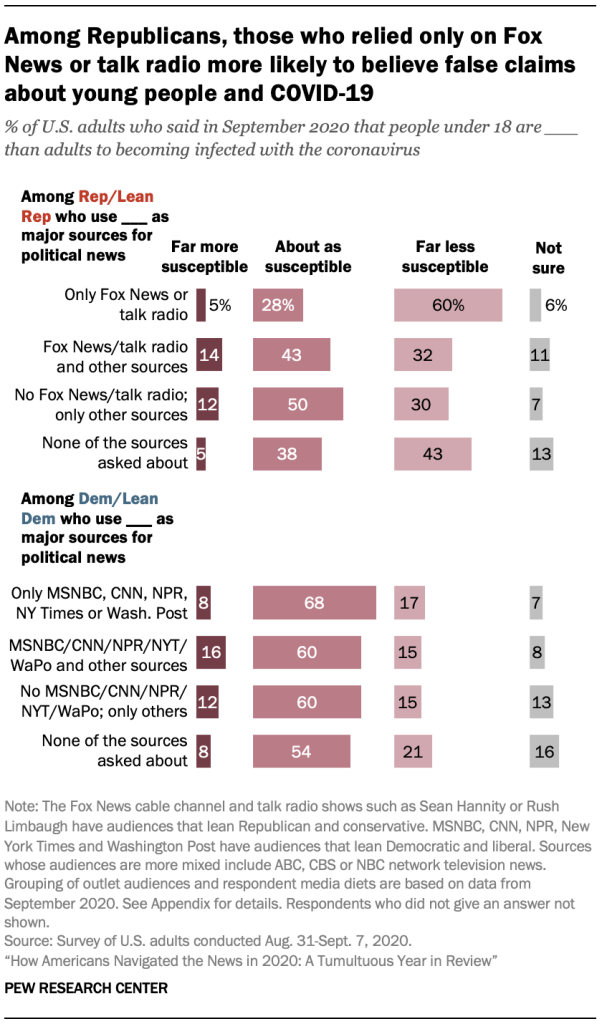
In another area of false claims, Republicans who turned only to outlets with right-leaning audiences (according to whether they used eight sources in September 2020) also stood apart. As of September 2020, they were more likely than other Republicans to believe a much-touted (but false) claim that young people are far less susceptible to catching COVID-19 than older adults. (Young people have much lower rates of severe illness and death from COVID-19, but there is no strong evidence that they are less likely to contract the virus.)
Looking at media diet within party, there were only small differences in responses to this question among Democrats who used different major sources for political news. But among Republicans who used only outlets with right-leaning audiences (in this case among eight asked about), a majority (60%) said that minors under 18 are far less susceptible, compared with far fewer among Republicans who used a mixed media diet (32%) or only major sources without conservative-leaning audiences (30%).
In September, fully 61% of Republicans who only cited Fox News and/or talk radio shows as key news sources said fraud has been a major problem when mail-in ballots are used. That figure drops to 44% for Republicans who cited other outlets alongside Fox News and/or talk radio as major sources, then down to about a quarter (23%) among Republicans who didn’t rely on Fox News or talk radio (but selected at least one of the six other sources mentioned in the survey).
Democrats who cited only outlets with left-leaning audiences as key sources of political news were by far the most likely to say that voter fraud has not been a problem associated with mail-in ballots: 67% said this, compared with 43% of those who relied on some of these sources but also others. Democrats who didn’t rely on any of the outlets with left-leaning audiences (or, in some cases, any of the eight major news sources mentioned in the survey) expressed greater uncertainty on this issue than other Democrats.
Similarly, after the election, Republicans who turned only to outlets with conservative-leaning audiences were much more likely than those who turned to other outlets to say allegations of voter fraud were getting “too little attention.” Just 6% of Republicans who only used Fox News or talk radio as major sources for post-election news said there had been too much attention paid to the fraud allegations, compared with 78% who said there had been too little attention. In the group that used other sources in addition to Fox News and/or talk radio, 26% said there had been too much attention, while 45% said there had been too little. And Republicans who didn’t rely on Fox News or talk radio at all and only relied on other sources for their post-election news were pretty evenly divided between the two responses.
4. Americans who mainly got news via social media knew less about politics and current events, heard more about some unproven stories
Beyond the differences in perceptions between partisans – and within parties based on people’s news sources – those who turn to social media as the most common way they get their political news stand out in some ways from those who get news from other pathways (news websites and apps; local, cable, and network TV; radio; and print).
Throughout 2020, the Center’s American News Pathways project found that those who primarily got political news on social media tended to follow news – about both the 2020 election and the COVID-19 pandemic – less closely than others. Perhaps related to that fact, this group also was less likely to correctly answer a range of fact-based questions about politics and current events. And in some cases, these social media news consumers were more aware of specific false or unproven stories about the coronavirus and said they had seen more misinformation about the pandemic in general.
The 18% of U.S. adults who said in late 2019 that social media was the most common way they got political news also differ from other Americans demographically. Most notably, they are the youngest group by a considerable margin – nearly half of the adults who turned mostly to social media are under 30 (48%), compared with 21% of those who turned to news websites or apps, and even fewer of those who said they mostly turned to other platforms like cable television or print. Compared with all other news consumers, U.S. adults who most commonly used social media for news also are less likely to be White (56% are).
Takeaway #1: Social media served as a source of news for many Americans, even as the information there was widely distrusted
While many Americans get news on social media, the public as a whole largely distrusts these platforms as a source for political news. In November of 2019, both Democrats and Republicans were more likely to express distrust rather than trust in social media sites like Facebook, Twitter and Instagram as sources of political news. For example, among U.S. adults overall, 59% said they distrusted Facebook as a place for political news, compared with just 15% who said they trusted the social networking site.
The public’s general feeling is that the information they see on social media is likely inaccurate – about six-in-ten social media news consumers think so, according to a survey conducted in September 2020.
Takeaway #2: Those who turned to social media were less likely to pay attention to multiple types of news
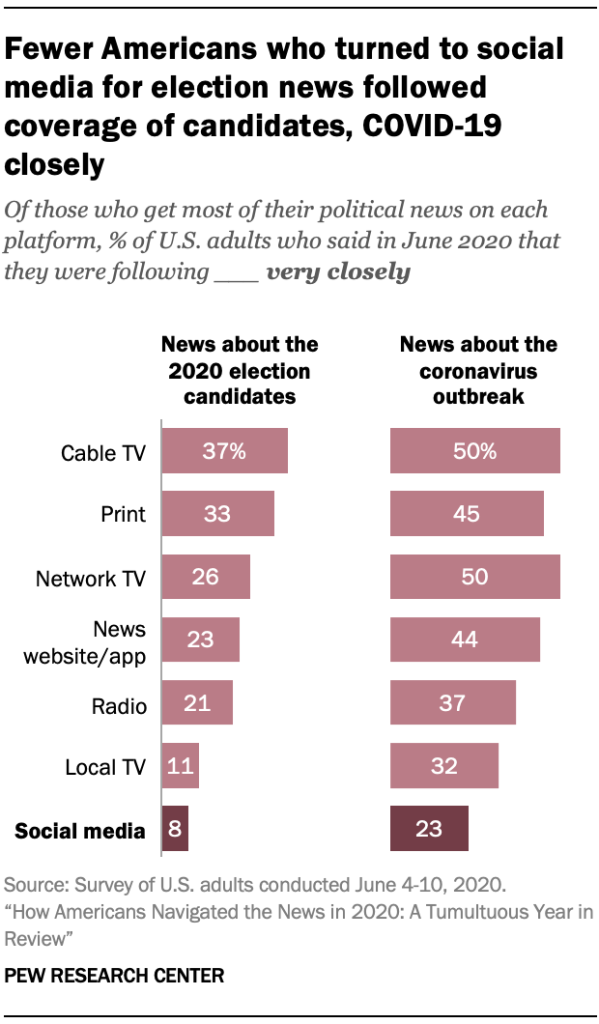
Americans who turn to social media for their news tend to be less engaged with that news than others. They were less likely to say in June 2020, for example, that they had been closely following news about the 2020 election candidates. And those who turned to social media for news also tended to be less aware of a number of specific political storylines early last year, including stories related to Trump’s first impeachment.
The same pattern applies to news about the coronavirus pandemic, even as attention to that topic was very high among the general public overall. About a quarter of social media news consumers (23%) said they were following COVID-19 news very closely in June, lower than the shares among those who got news primarily from any other pathway.
Takeaway #3: Those who relied on social media for news were less likely than most others to be knowledgeable about current events
U.S. adults whose most common way of getting political and election news is social media lag behind Americans who turn to most other sources of news in their knowledge and understanding of national politics, current events and the COVID-19 pandemic.
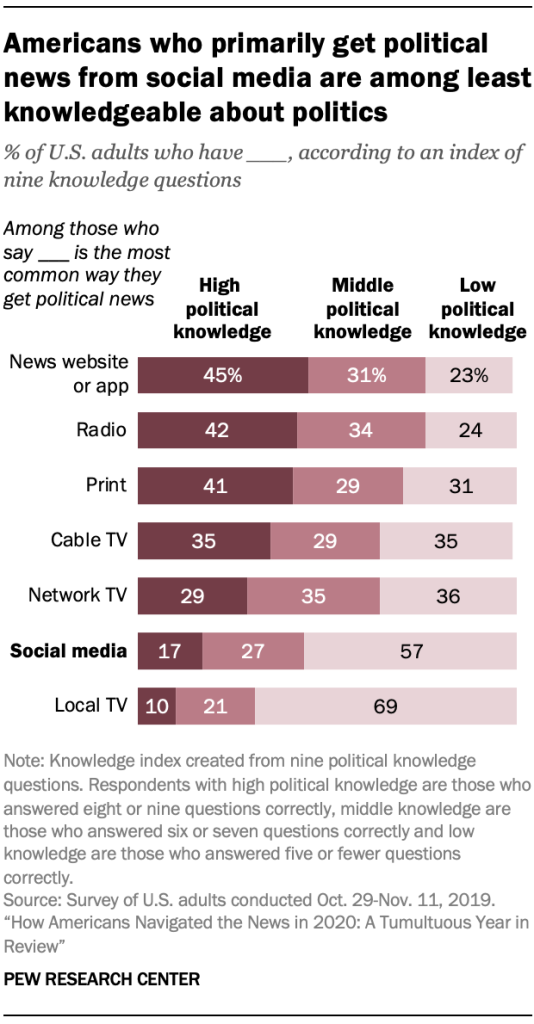
In November 2019, for instance, Americans who turned to social media for news were among the least likely to correctly answer nine fact-based questions about political knowledge; these nine questions gauged respondents’ knowledge about topics such as trends in unemployment, tariffs, the federal budget deficit and which party supports specific political positions.
Fewer than a quarter (17%) of U.S. adults who relied most on social media for political and election news have high political knowledge, according to this index of knowledge questions.1 Another 27% have middle political knowledge, and a majority (57%) have low political knowledge.
All other groups of news consumers in the study have substantially higher levels of knowledge of national politics, with the exception of Americans who most commonly got their political news from local TV.
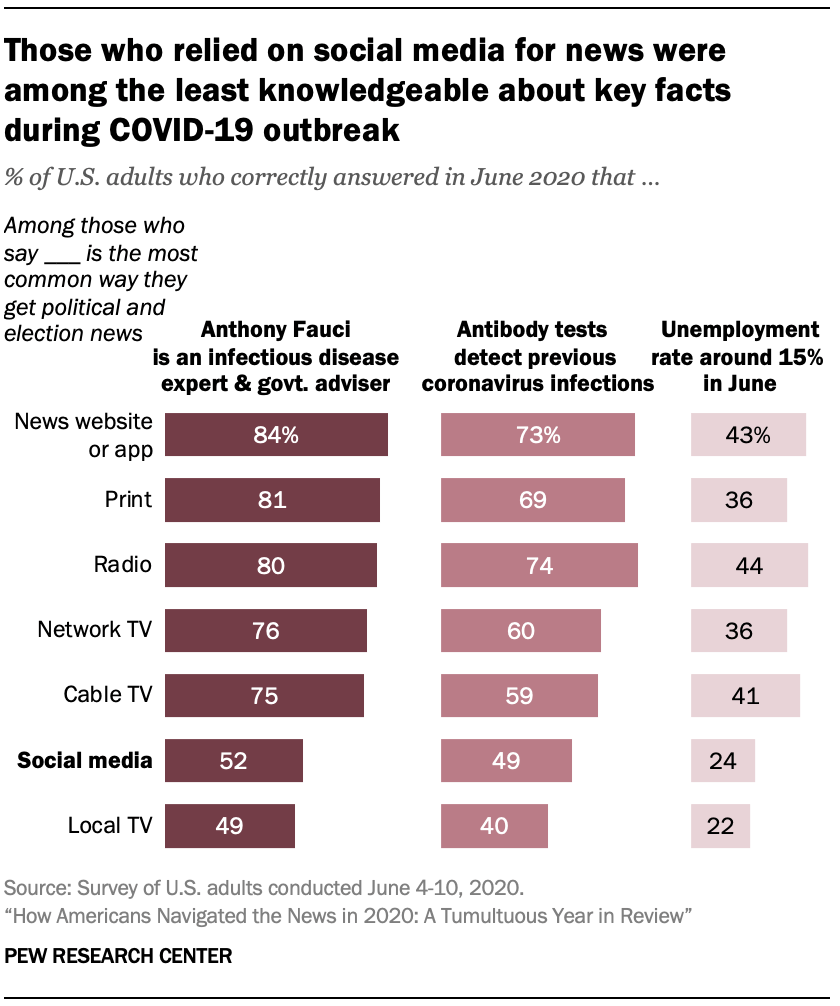
There are similar patterns when it comes to specific questions about the coronavirus pandemic. A June 2020 survey asked U.S. adults what they knew about a few facts relevant to the coronavirus outbreak and its impact on the economy. These questions included one asking respondents to identify Anthony Fauci’s role as an infectious disease expert and government health adviser, another about the purpose of coronavirus antibody tests and a third about the unemployment rate during the pandemic.
Americans who relied most on social media for getting political and election news were among the least likely to get these questions right (again, along with local TV news consumers). For example, about half of the social media group (52%) correctly identified Fauci as an infectious disease expert and government health adviser, similar to the share among those who relied on local TV (49%). The other news consumer groups all performed much better on this question; three-quarters or more knew Fauci’s role.
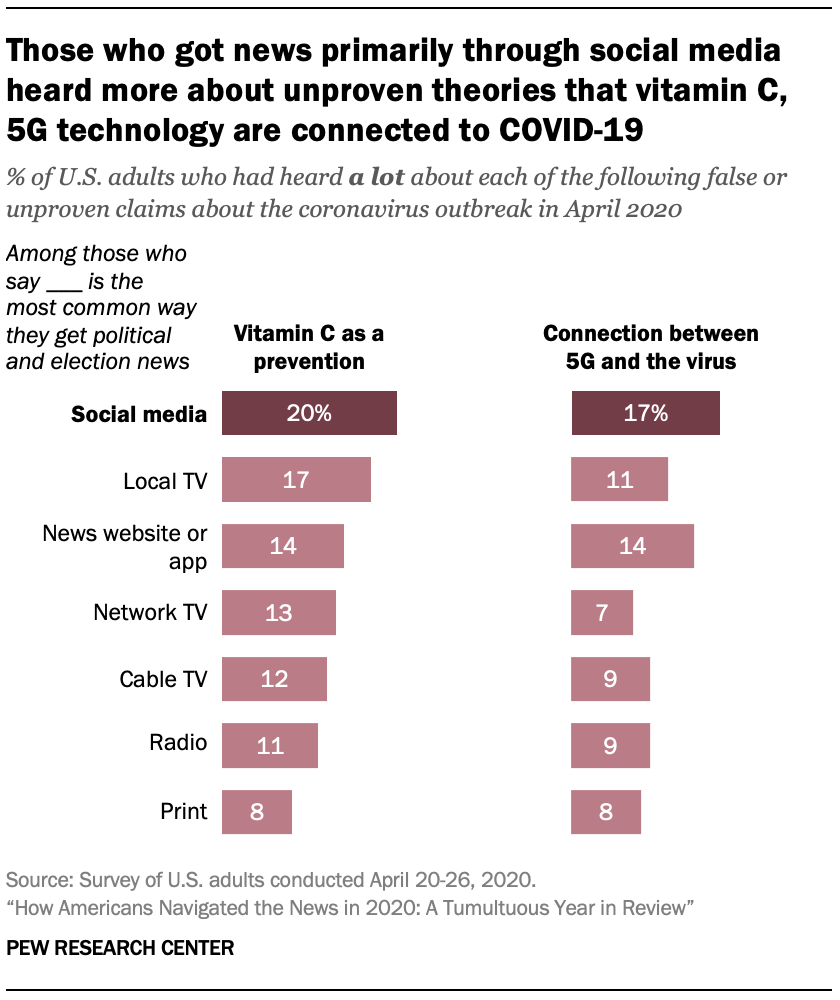
Takeaway #4: Americans who primarily got their political news from social media were more likely to have heard about some unproven claims and theories
In some cases, false and unproven claims about the coronavirus – such as the idea that there could be a connection between the virus and 5G technology, and the notion that vitamin C could prevent infection – were more likely to reach Americans who got their political news primarily from social media. U.S. adults who said they often turned to social media for coronavirus news specifically also were more likely to say they had heard about the unproven theory that powerful people had intentionally planned the COVID-19 outbreak.
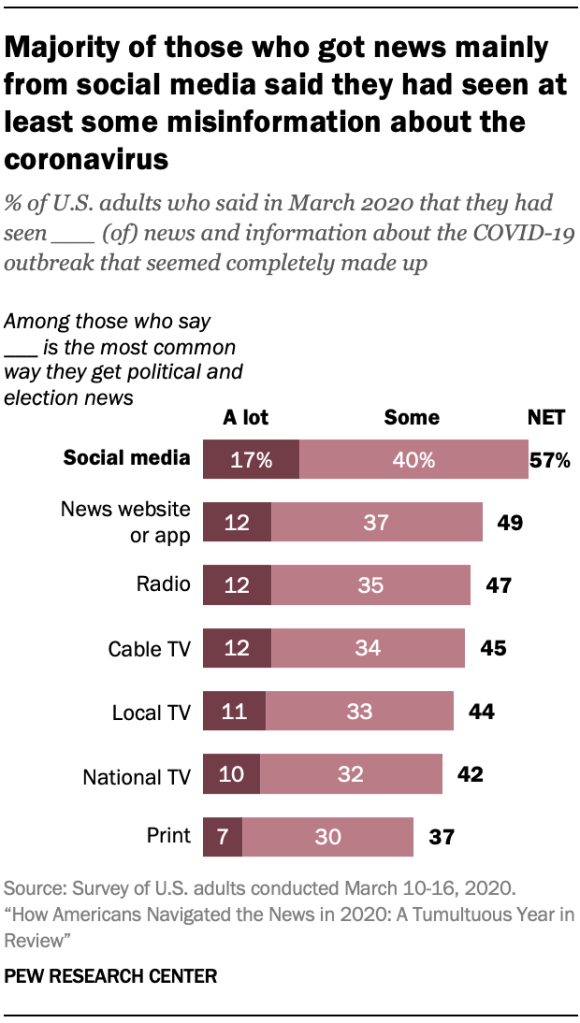
Social media news consumers also were more likely to say that they had seen misinformation about the virus in general – 57% said they had seen at least some, versus 49% or fewer among those who used other platforms as their most common way to get political news.
Though Americans who turn to social media appear to be more aware of unproven claims and exposed to more misinformation, this doesn’t translate to more concern about the effects made-up news can have. In a November 2019 survey, this group was actually less likely than most others to be concerned about the effects made-up news could have on the 2020 election.
5. Republicans’ views on COVID-19 shifted over course of 2020; Democrats’ hardly budged
At that time, 53% of Democrats (including those who lean Democratic) were following news of the pandemic very closely, as were nearly as many Republicans and Republican leaners (48%). But by late November, after the presidential election, a large partisan gap had developed. While about half of Democrats (47%) still reported that they were following coverage of the pandemic very closely, about three-in-ten Republicans (28%) said the same – a gap of 19 percentage points.
This finding fits a pattern seen in a series of surveys administered in 2020 as part of the Center’s American News Pathways project. Over time, Republicans’ responses shifted on a number of COVID-19-related issues. Generally speaking, they paid less attention to the coverage, became more critical of the media and grew more likely to say the pandemic was being exaggerated. They also appeared to adopt less favorable views of the Centers for Disease Control and Prevention (CDC) and other public health officials.
Conversely, Democrats’ responses on those issues – which in most cases differed from the Republicans’ – remained largely unchanged over time.
Takeaway #1: Republicans’ attention to COVID-19 news dropped over time
For Republicans, attention to news about the COVID-19 outbreak diminished throughout the year.
The percentage of Republicans paying very close attention to that coverage dropped modestly from mid-March to late April – from 48% to 43%. And by early June, there was another decrease, as the share paying very close attention slid to 35%. When surveyed again in early September, even fewer Republicans (26%) were paying very close attention to news of the outbreak. That’s roughly where the number remained, with 27% of Republicans paying very close attention in early October and 28% doing so in late November, even as the country was experiencing a serious spike in new cases.
Democrats’ overall level of attention to COVID-19 news remained much steadier, with modest dips. From the 53% who were following coronavirus coverage very closely in March, the percentage fell slightly to 49% in April and registered at 44% in June and September. In October and November, about half of Democrats (47%) were following news about the outbreak very closely.
Takeaway #2: Over a period of six months, Republicans’ views of media coverage of the pandemic turned notably more critical
Many surveys have revealed that, in general, Republicans hold more negative views of the media and how journalists do their job than Democrats. That is also the case with assessments of pandemic coverage in 2020, although Republicans’ views of that coverage changed substantially more than Democrats’ over time.
At the outset of the outbreak in March 2020, 59% of all Republicans (including independents who lean Republican) said the media were covering the outbreak “very well” (25%) or “somewhat well” (34%), numbers that remained similar into June. But by September, fewer than half of Republicans (45%) said the media were doing their jobs very well (10%) or somewhat well (35%) covering the outbreak.
Democrats (including Democratic leaners) offered much more positive – and consistent – assessments of the media’s performance. In March, 80% of Democrats said news organizations had done very well (35%) or somewhat well (44%) on the COVID-19 story. In September, the portion of Democrats saying the media had done at least somewhat well was still high, at 81%, although the share who said the media had done very well slipped slightly, to 28%.
Takeaway #3: In spring 2020, Republicans became more convinced that outbreak was exaggerated
One question asked on several occasions in 2020 was whether the COVID-19 pandemic had been made into “a bigger deal than it really is,” had been made into “a smaller deal than it really is” or had been “approached about right.”
When that question was first asked in late April, Republicans already were more inclined to say the pandemic had been overblown (47%) than to give any other response. But as the year went on, the percentage of Republicans saying the outbreak had been exaggerated jumped even higher, to 63% in June and 66% in September. In November, with coronavirus cases surging, the share of Republicans who saw the pandemic as overblown dropped, but most (58%) still took this position.
Once again, Democrats’ views on this issue were very different and more stable. Throughout the year, the vast majority of Democrats either said that the pandemic had been made into a smaller deal than it really was (ranging between 34% and 46%) or that it had been approached about right (between 40% and 48%).
Takeaway #4: Republicans grew more skeptical of public health officials over time
There also is some evidence that Republicans’ views of the coronavirus response by public health officials soured over time.
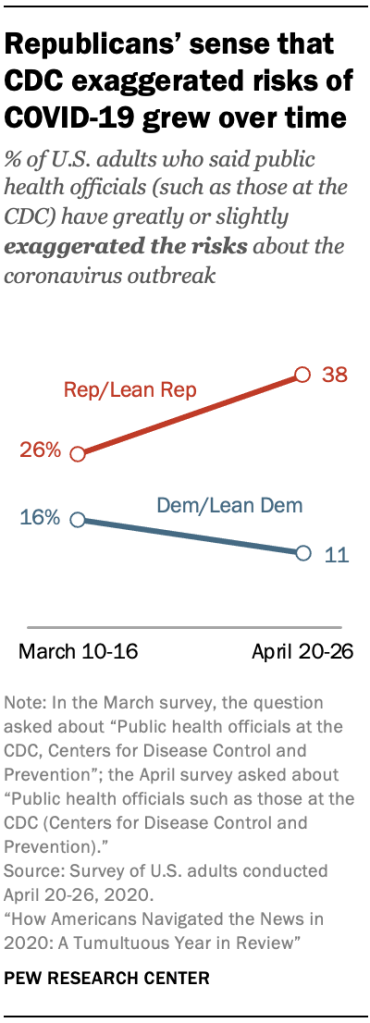
In mid-March 2020, about a quarter of Republicans (26%) said that public health officials at the CDC had “greatly” or “slightly” exaggerated the risks of the coronavirus outbreak. When asked again in late April, that percentage had grown to 38%.
Democrats, for their part, moved a bit in the opposite direction, with 16% saying public health officials had exaggerated the risks in March and that number dropping to 11% in April.
Similarly, back in March, fully 87% of Republicans said they were “very” or “somewhat” confident that public health officials at the CDC were doing a good job responding to the pandemic. That was even higher than the percentage of Democrats who agreed (80%) – with 48% of Republicans very confident, compared with 33% of Democrats. Within the GOP, confidence in the CDC was about on par with confidence that Donald Trump was doing a good job responding to the outbreak (82% were at least somewhat confident).
After the November elections, in a somewhat different question, respondents were asked to grade the job done by a number of key players in the pandemic. But by then, Republicans’ assessments were far more negative than Democrats’: 58% said public health officials such as those at the CDC had done an “excellent” or “good” job, compared with 75% of Democrats.
Appendix: Measuring news sources used during the 2020 presidential election
At three points during the 2020 election season, the American News Pathways project classified Americans’ news diets according to the political leanings of the audiences of the news outlets they used to get political and election news.
For the analysis in Chapter 1, respondents’ news diets from three surveys conducted in November 2019, September 2020 and November 2020 were combined to give a general sense of who consistently turned to news outlets with audiences that largely share their politics and who turned to outlets with more politically diverse audiences throughout the 2020 presidential election season. (Click on the links for each survey to see the details for how news diets were calculated at each point.)
The first survey asked about 30 separate news sources, while the second and third focused on eight of the top sources in that survey (used by about 10% or more of U.S. adults). Full lists of the outlets for each survey are available below.
All outlets were classified according to the political partisanship and ideology of their audiences in surveys conducted before the election in November 2019 and September 2020. An outlet is considered to have a left-leaning audience if the proportion of all audience members who identify as liberal Democrats is at least two-thirds higher than the proportion who identify as conservative Republicans. Alternatively, an outlet is considered to have a right-leaning audience if the proportion of all audience members who identify as conservative Republicans is at least two-thirds higher than the proportion that identify as liberal Democrats. An outlet is classified as having a mixed audience if neither liberal Democrats nor conservative Republicans make up at least two-thirds more of the audience than the other. (More details on how news outlets were classified are available in the appendices linked at the end.)
Based their news diets from these three surveys, Republicans and Democrats (both including independents who lean toward the party) are assigned to one of six groups:
Among Republicans and Republican-leaning independents:
Republicans who turned only to news sources with right-leaning audiences in at least two out of three surveys
Republicans who turned to news sources with politically mixed and/or left-leaning audiences in at least two out of three surveys. (These Republicans may also have used outlets with right-leaning audiences in addition to those with mixed or left-leaning audiences.)
All other Republicans
Among Democrats and Democratic-leaning independents:
Democrats who turned only to news sources with left-leaning audiences in at least two out of three surveys
Democrats who turned to news sources with politically mixed and/or right-leaning audiences in at least two out of three surveys. (These Democrats may also have used outlets with left-leaning audiences in addition to those with mixed or right-leaning audiences.)
All other Democrats
Appendices explaining how news diets were classified in each of the three surveys are available here:
The American News Pathways project was made possible by The Pew Charitable Trusts. Pew Research Center is a subsidiary of The Pew Charitable Trusts, its primary funder. This initiative is a collaborative effort based on the input and analysis of the following individuals. Find related reports online at https://alpha.pewresearch.org/pewresearch-org/topics/election-news-pathways/.
Research Team
Amy Mitchell, Director, Journalism Research
Baxter Oliphant, Senior Researcher
Katerina Eva Matsa, Associate Director, Journalism Research
Elisa Shearer, Research Associate
Mark Jurkowitz, Senior Writer
Michael Lipka, Editorial Manager, Religion Research
Mason Walker, Research Analyst
Michael Barthel, Senior Researcher
Jeffrey Gottfried, Senior Researcher
Galen Stocking, Computational Social Scientist
Maya Khuzam, Research Assistant
Kirsten Worden, Research Assistant
Andrew Mercer, Senior Research Methodologist
Dorene Asare Marfo, Survey Research Methodologist
Scott Keeter, Senior Survey Advisor
Claudia Deane, Vice President, Research
Nick Bertoni, Panel Manager
Courtney Kennedy, Director, Survey Research
Editorial and Graphic Design
David Kent, Senior Copy EditorMargaret Porteus, Information Graphics Designer
Alissa Scheller, Information Graphics Designer
Peter Bell, Design Director
Andrea Caumont, Digital Engagement Manager
John Gramlich, Senior Writer/Editor
Bruce Drake, Senior Editor
Communications and Web Publishing
Rachel Weisel, Senior Communications Manager
Hannah Klein, Communications Manager
Calvin Jordan, Communications Associate
Andrew Grant, Communications Associate
Sara Atske, Associate Digital Producer
Shannon Greenwood, Digital Producer
Stacy Rosenberg, Associate Director, Digital
Seth Rubenstein, Lead Web Developer
Benjamin Wormald, Web Developer
Carrie Elizabeth Blazina, Associate Digital Producer
Kelly Browning, User Experience Manager
Michael Piccorossi, Director, Digital Strategy
Methodology
The data used in this report was collected from nine surveys conducted between November 2019 and November 2020 on Pew Research Center’s American Trends Panel (ATP). The surveys were all a part of the Center’s American News Pathways project, in which the same 12,043 panelists were surveyed repeatedly between November 2019 and November 2020 on topics related to their news consumption habits.
About the American Trends Panel
The American Trends Panel (ATP), created by Pew Research Center, is a nationally representative panel of randomly selected U.S. adults. Panelists participate via self-administered web surveys. Panelists who do not have internet access at home are provided with a tablet and wireless internet connection. Interviews are conducted in both English and Spanish. The panel is being managed by Ipsos.
Details about data collection, sample design and specific response rates for each wave can be found in the individual methodologies for each wave:
The ATP was created in 2014, with the first cohort of panelists invited to join the panel at the end of a large, national, landline and cellphone random-digit-dial survey that was conducted in both English and Spanish. Two additional recruitments were conducted using the same method in 2015 and 2017, respectively. Across these three surveys, a total of 19,718 adults were invited to join the ATP, of whom 9,942 (50%) agreed to participate.
In August 2018, the ATP switched from telephone to address-based recruitment. Invitations were sent to a random, address-based sample of households selected from the U.S. Postal Service’s Delivery Sequence File. Two additional recruitments were conducted using the same method in 2019 and 2020, respectively. Across these three address-based recruitments, a total of 17,161 adults were invited to join the ATP, of whom 15,134 (88%) agreed to join the panel and completed an initial profile survey. In each household, the adult with the next birthday was asked to go online to complete a survey, at the end of which they were invited to join the panel. Of the 25,076 individuals who have ever joined the ATP, 13,568 remained active panelists and continued to receive survey invitations at the time this survey was conducted.
The U.S. Postal Service’s Delivery Sequence File has been estimated to cover as much as 98% of the population, although some studies suggest that the coverage could be in the low 90% range.1 The American Trends Panel never uses breakout routers or chains that direct respondents to additional surveys.
Weighting
For the analysis of Republicans and Republican-leaning independents who relied most on Donald Trump and the White House coronavirus task force for news about COVID-19, custom weights were created for the subset of panelists who participated in each wave. New weights were created for the five pairs of surveys that were analyzed using that question. To ensure consistency across waves for panelists’ demographics, analysis of panelists who responded to both Wave 66 and Wave 68 was additionally restricted to those who remained active panelists as of Wave 72.
For the analysis of media diets across the November 2019, September 2020 and November 2020 surveys, a custom weight was created for the subset of panelists who participated in all three waves. These weights used the population benchmarks listed in the accompanying table. For details about how individual waves were weighted, refer to the full methodologies linked above.
These weights are trimmed (typically at about the 1st and 99th percentiles) to reduce the loss in precision stemming from variance in the weights. Sampling errors and tests of statistical significance take into account the effect of weighting.
Specific weighting design and parameters for the individual panel waves can be found in each wave’s methodology.
The following table shows the unweighted sample sizes and the error attributable to sampling that would be expected at the 95% level of confidence for different groups in the survey:
Sample sizes and sampling errors for other subgroups are available upon request.