Pew Research Center

FOR RELEASE SEPTEMBER 16, 2020

Political Divides, Conspiracy Theories and Divergent News Sources Heading Into 2020 Election

43% of Republicans identify fraud as a major problem with voting by mail versus 11% of Democrats

BY Amy Mitchell, Mark Jurkowitz, J. Baxter Oliphant and Elisa Shearer

FOR MEDIA OR OTHER INQUIRIES:

Communications Department
202.419.4372
www.pewresearch.org

RECOMMENDED CITATION

Pew Research Center, September 2020, "Political Divides, Conspiracy Theories and Divergent News Sources Heading Into 2020 Election"

About Pew Research Center

Pew Research Center is a nonpartisan, nonadvocacy fact tank that informs the public about the issues, attitudes and trends shaping the world. It does not take policy positions. The Center conducts public opinion polling, demographic research, computational social science research and other data-driven research. It studies politics and policy; news habits and media; the internet and technology; religion; race and ethnicity; international affairs; social, demographic and economic trends; science; research methodology and data science; and immigration and migration. Pew Research Center is a subsidiary of The Pew Charitable Trusts, its primary funder.

© Pew Research Center 2026

Table of contents

  • About Pew Research Center
  • Political Divides, Conspiracy Theories and Divergent News Sources Heading Into 2020 Election
  • 1. Legitimacy of voting by mail politicized, leaving Americans divided
  • 2. Attention to candidates increases, but what Americans know and think about them diverges by party, media sources
  • 3. Most Americans who have heard of QAnon conspiracy theories say they are bad for the country and that Trump seems to support people who promote them
  • Appendix: Grouping respondents by major news sources
  • Acknowledgments
  • Methodology

Political Divides, Conspiracy Theories and Divergent News Sources Heading Into 2020 Election

43% of Republicans identify fraud as a major problem with voting by mail versus 11% of Democrats

How we did this

Pew Research Center’s American News Pathways project conducted this study to understand how Americans are engaging with and perceiving news coverage of the 2020 presidential election.

For this analysis, we surveyed 9,220 U.S. adults between Aug. 31-Sept. 7, 2020. Everyone who completed the survey is a member of Pew Research Center’s American Trends Panel (ATP), an online survey panel that is recruited through national, random sampling of residential addresses. This way nearly all U.S. adults have a chance of selection. The survey is weighted to be representative of the U.S. adult population by gender, race, ethnicity, partisan affiliation, education and other categories. Read more about the ATP’s methodology.

See here to read more about the questions used for this report and the report’s methodology.

Visit our interactive data tool to access the questions included in this report, as well as content about the coronavirus outbreak and the 2020 presidential election.
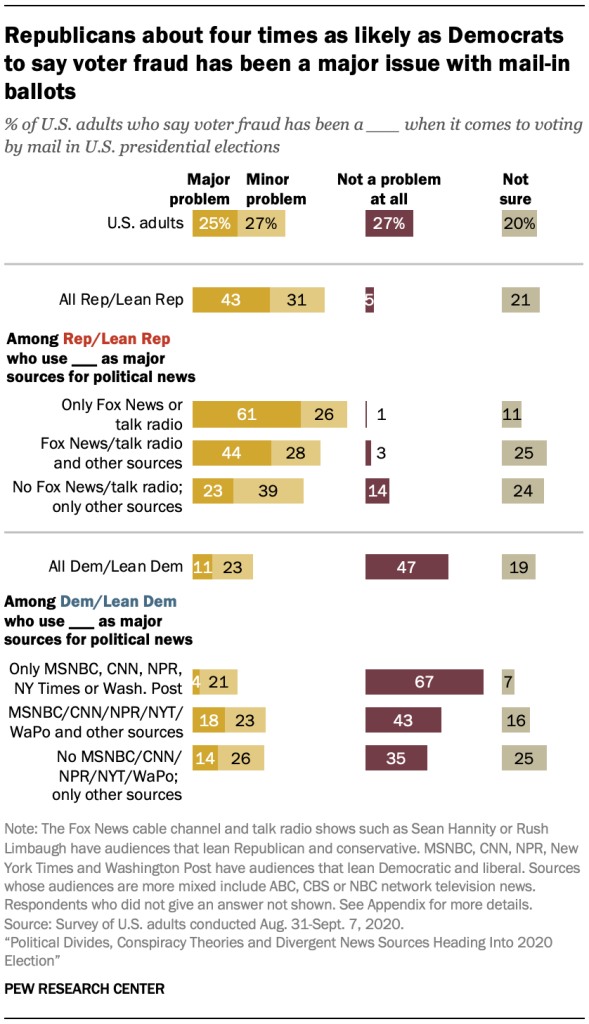
Republicans about four times as likely as Democrats to say voter fraud has been a major issue with mail-in ballots

As the nation heads toward Election Day in the midst of a persistent pandemic and simmering social unrest, a new Pew Research Center survey finds that Americans’ deep partisan divide, dueling information ecosystems, and divergent responses to conspiracy theories and misinformation are all fueling uncertainty and conflict surrounding the presidential election.

While Americans across the political spectrum have been getting information about key election-related storylines, their knowledge and opinions about these issues – as well as the candidates themselves – differ strikingly based on their party affiliation and key news sources, according to the new survey, conducted Aug. 31-Sept. 7, 2020, as part of the Center’s American News Pathways project.

One central issue creating confusion in this campaign is the reliability of voting by mail, which figures to be more widespread than ever this year as people try to avoid crowded polling places during the coronavirus outbreak. President Donald Trump has repeatedly promoted the unsupported idea that mail-in voting will lead to significant fraud and has put the U.S. Postal Service in the campaign spotlight.

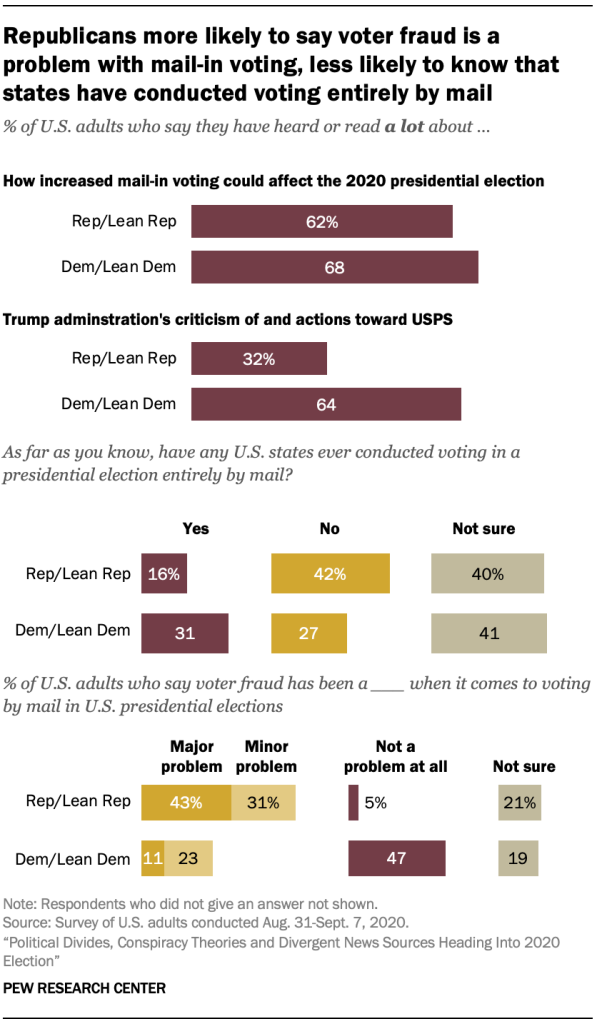
While evidence indicates that mail-in voting is associated with only minuscule levels of fraud, 43% of Republicans and Republican-leaning independents identify voter fraud as a “major problem” associated with mail-in ballots. By contrast, only 11% of Democrats and Democratic-leaning independents say the same thing.

Moreover, Republicans’ views vary dramatically depending on the news sources they use. The survey asked respondents whether eight news providers are major sources of political and election news for them. Researchers then grouped these responses based on the political composition of the outlets’ audiences. For example, Republicans were analyzed based on the degree to which they get political news from the outlets with conservative-leaning audiences, and Democrats were categorized based on the degree to which they get news from the outlets with liberal-leaning audiences. (See the box below for details on the study design.)

Partisans’ major news sources

The categories in this analysis come from research on the major sources Republicans and Democrats use for political and election news.

Respondents indicated whether they use eight prominent news sources as a major source, a minor source or not a source for political and election news. The sources are Fox News cable channel, CNN, MSNBC, national network TV (ABC, CBS or NBC asked together), NPR, The New York Times, The Washington Post, and talk radio (examples of Sean Hannity or Rush Limbaugh were given).

Respondents’ major news sources are grouped according to the political composition of their audiences – defined here as the respondents who say it is a major source for political and election news. A source is considered to have a left-leaning audience if the portion of those who say it is a major source who are liberal Democrats (including leaners) is at least two-thirds greater than the portion who identify as conservative Republicans (including leaners); if the reverse is true, the source is classified as having a right-leaning audience, and if neither is true, the source is classified as having a more mixed audience.
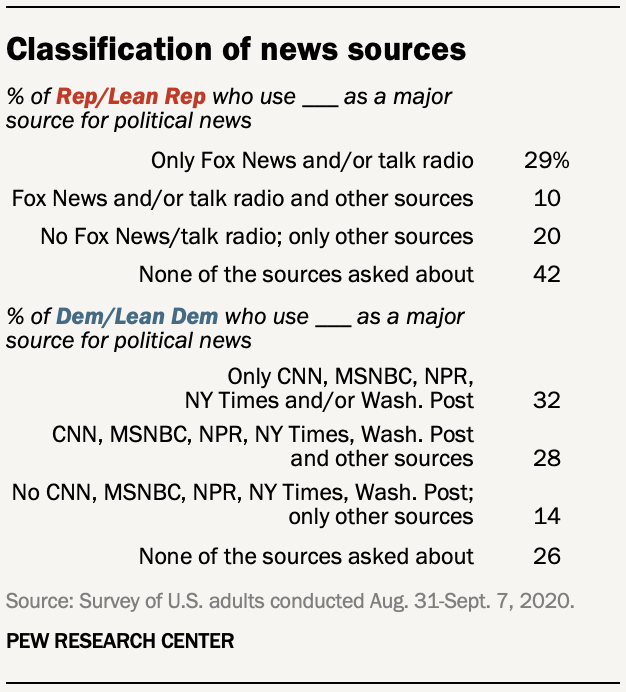
Classification of news sources

Using this method, two of the eight news sources analyzed have audiences who lean to the right politically (Fox News and talk radio); five have audiences who lean left (CNN, MSNBC, NPR, The New York Times and The Washington Post); and one group has a mixed audience (national network TV, such as ABC, CBS and NBC). (Previous research has found that Republicans and Republican-leaning independents generally use fewer news sources than Democrats and Democratic leaners.)

Democrats and Democratic-leaning independents (Dem/Lean Dem) and Republicans and Republican leaners (Rep/Lean Rep) are each divided into four groups based on which news sources they turned to as major sources for political and election news. The classifications within each party also include a group for those who do not use any of the eight sources asked about. The portion of partisans in each group is as follows:


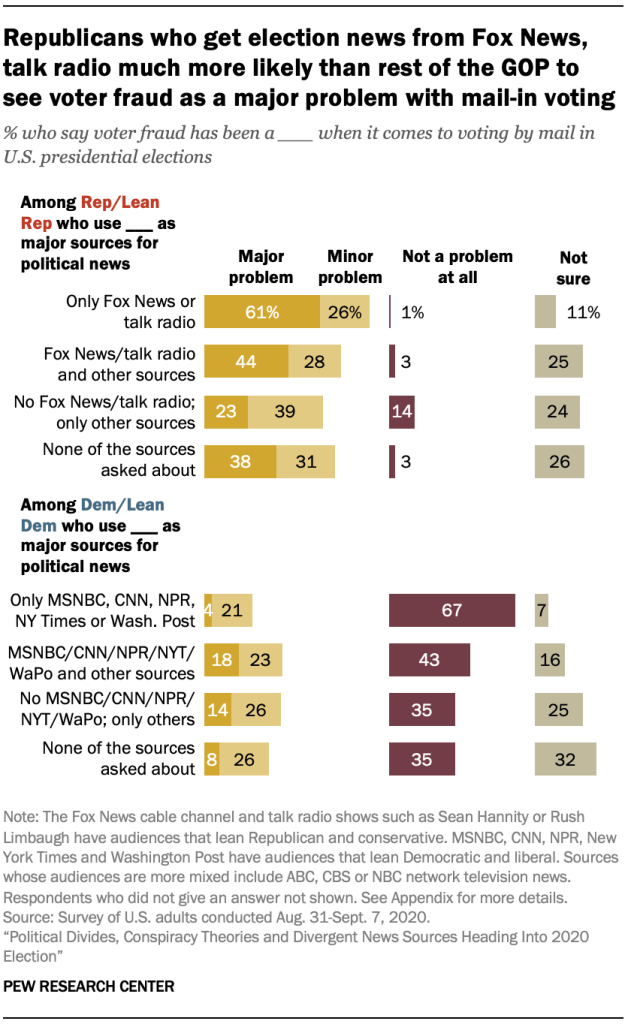
About six-in-ten (61%) of the Republicans whose only major sources of election news (among the eight asked about) are those with right-leaning audiences – talk radio and/or Fox News – say mail-in voter fraud is a major problem. But that figure falls to 23% among Republicans whose major news sources do not include talk radio or Fox News.

Among Democrats, meanwhile, those who get election news only from one or more of the five major sources with left-leaning audiences (MSNBC, CNN, NPR, The New York Times and The Washington Post) are about twice as likely as those whose major sources do not include any of these outlets to say that mail-in voter fraud is “not a problem at all” (67% vs. 35%).

Other factors beyond media diet may impact people’s views of election-related issues, including the potential for fraud in mail-in voting. And someone’s media diet can be selected to fit their existing political views or be a significant factor in shaping those political views. Still, the data shows a clear connection between news diet within party and views on this issue.
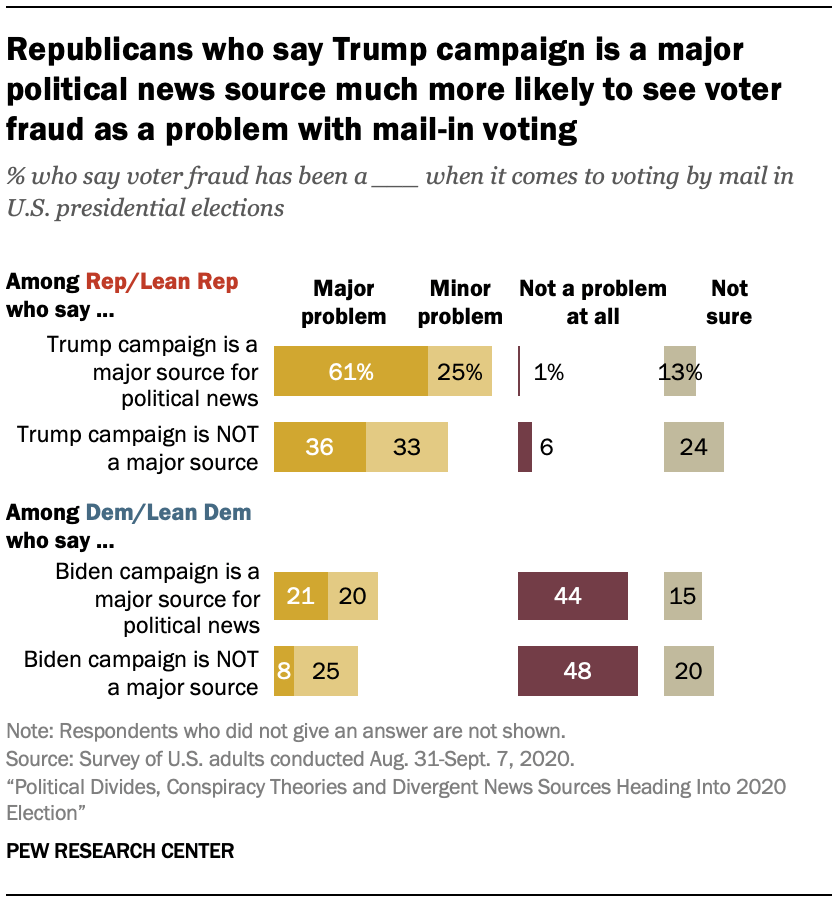
Republicans who say Trump campaign is a major political news source much more likely to see voter fraud as a problem with mail-in voting

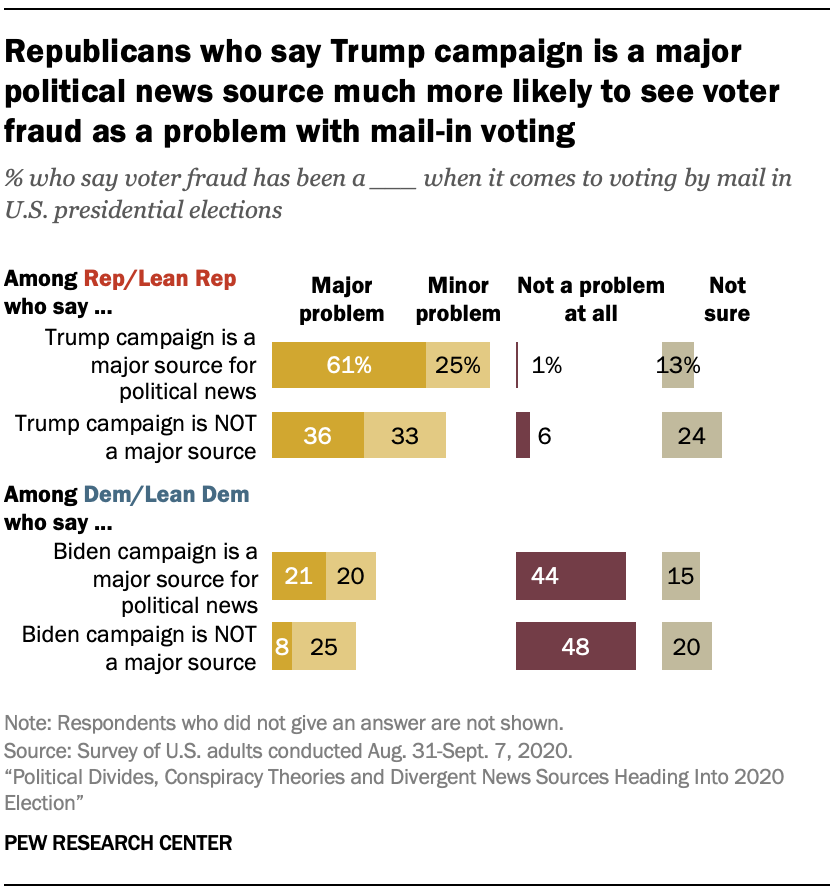
Another factor associated with perceptions among Republicans is whether the Trump campaign itself is a major source of political and election news for them. Of those who say it is, 61% see mail-in fraud as a major problem. But among Republicans who do not use the Trump campaign as a major source of news, far fewer (36%) say the same.

There is little to no difference among Democrats based on whether or not they turn to Joe Biden and his presidential campaign as a major news source.

Conspiracy theories in the election’s backdrop
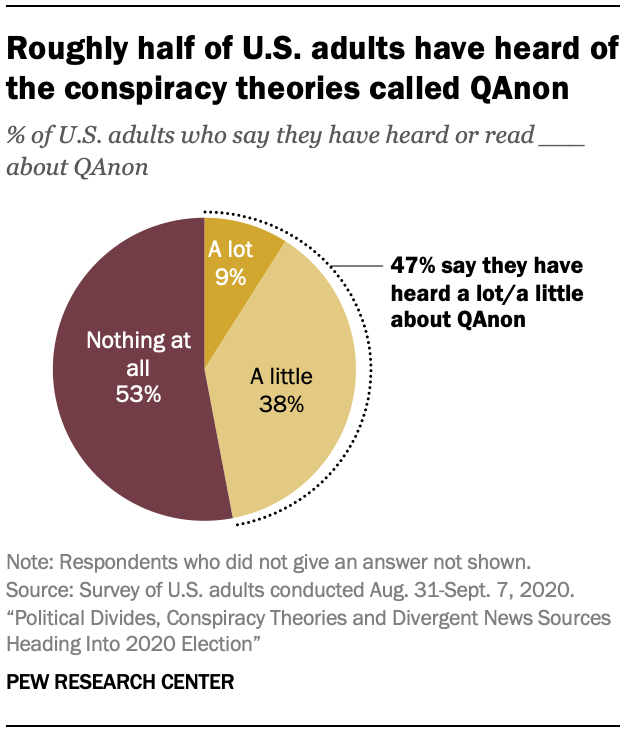
Roughly half of U.S. adults have heard of the conspiracy theories called QAnon

During this campaign, public attention to the once-obscure QAnon – a collection of connected conspiracy theories that has been declared a domestic terror threat by the FBI – has grown, with a few “Q” proponents running for Congress and Trump expressing support for at least one of them. The percentage of Americans who say they have heard “a lot” or “a little” about QAnon has roughly doubled from 23% in March to 47% in the new survey.1 Democrats are somewhat more likely to have heard at least a little about these theories than Republicans (55% versus 39%, respectively).
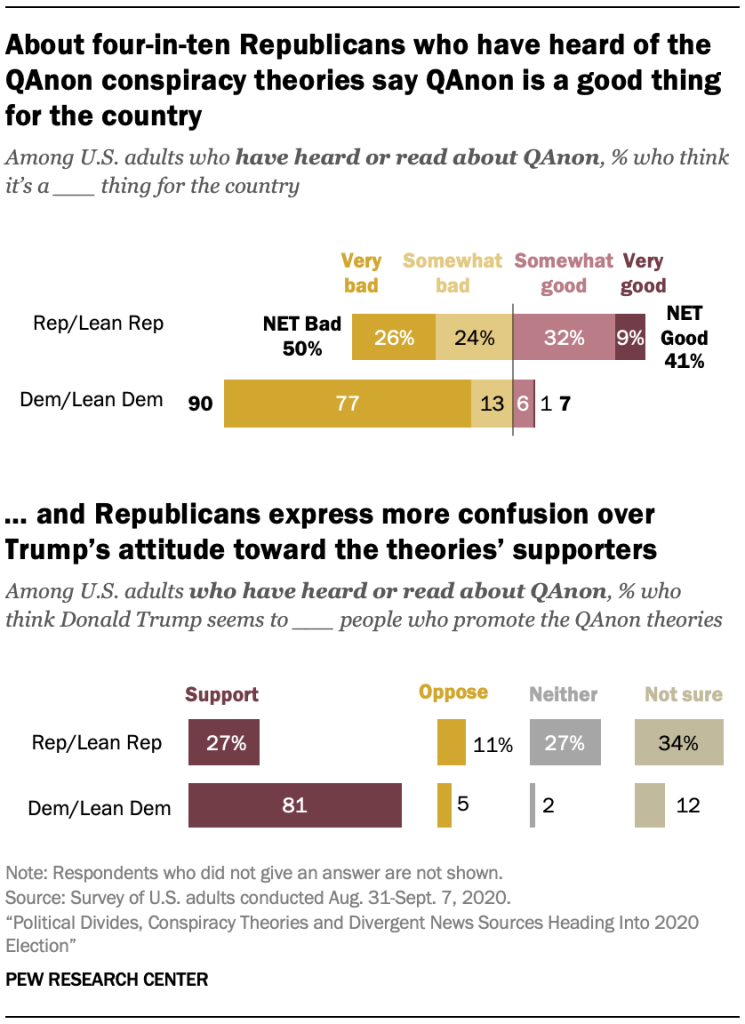
About four-in-ten Republicans who have heard of the QAnon conspiracy theories say QAnon is a good thing for the country

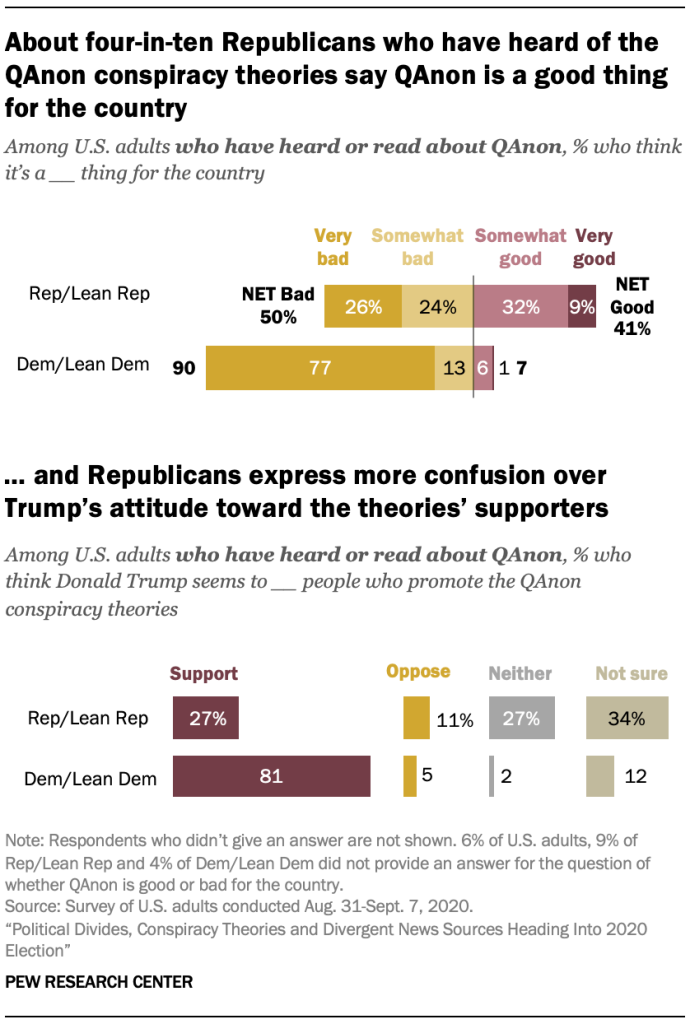
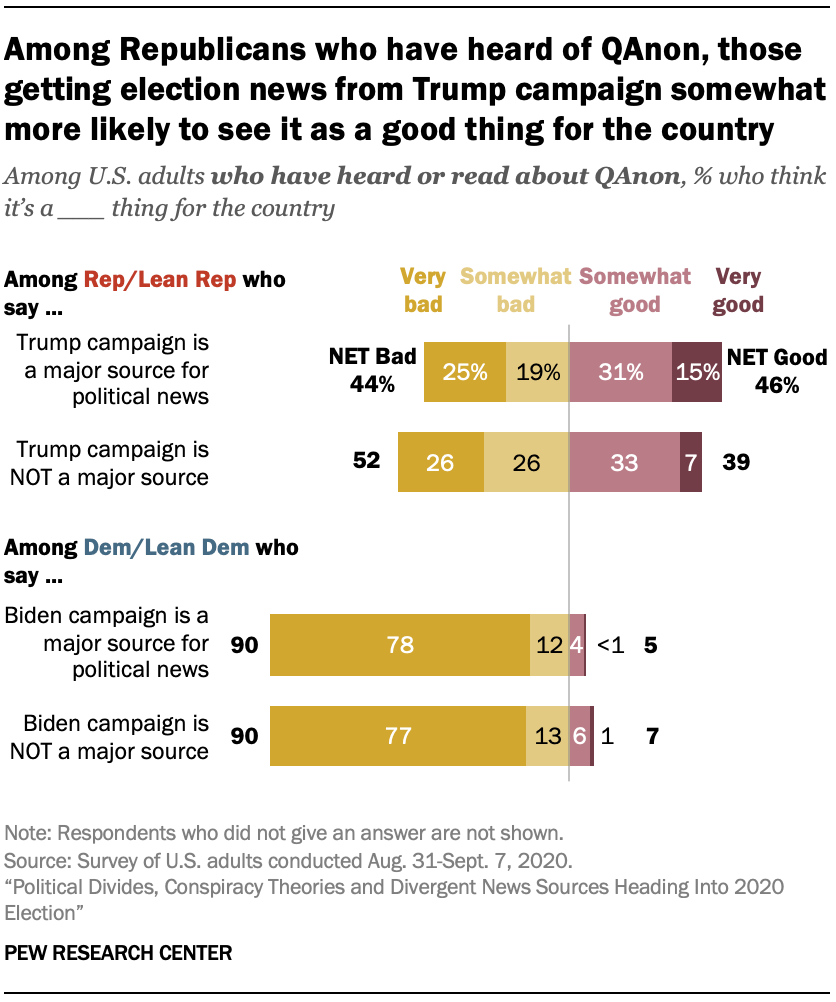
In this environment, the QAnon conspiracy theories have become another area of partisan divide. An overwhelming majority of Democrats who have heard something about QAnon (90%) say it is at least “somewhat bad” for the country, including 77% who say it is “very bad.” But 41% of Republicans who have heard something about it say QAnon is somewhat or very good for the country, modestly fewer than the 50% who think it is at least somewhat bad.

Democrats who have heard at least a little about QAnon are united in the perception that Donald Trump seems to support people who promote the conspiracy theories, with 81% taking this position. Just 27% of Republicans agree with this statement, and even fewer (11%) say Trump opposes QAnon promoters; the remainder say he neither supports nor opposes them (27%) or that they aren’t sure (34%).

Americans’ views of candidates, issues diverge by party and political news sources
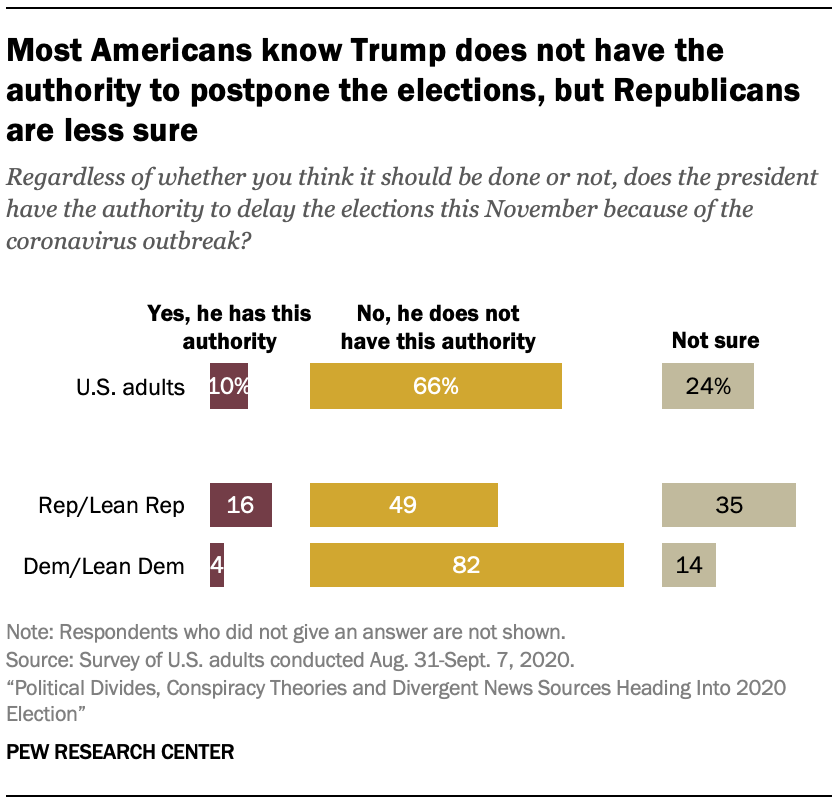
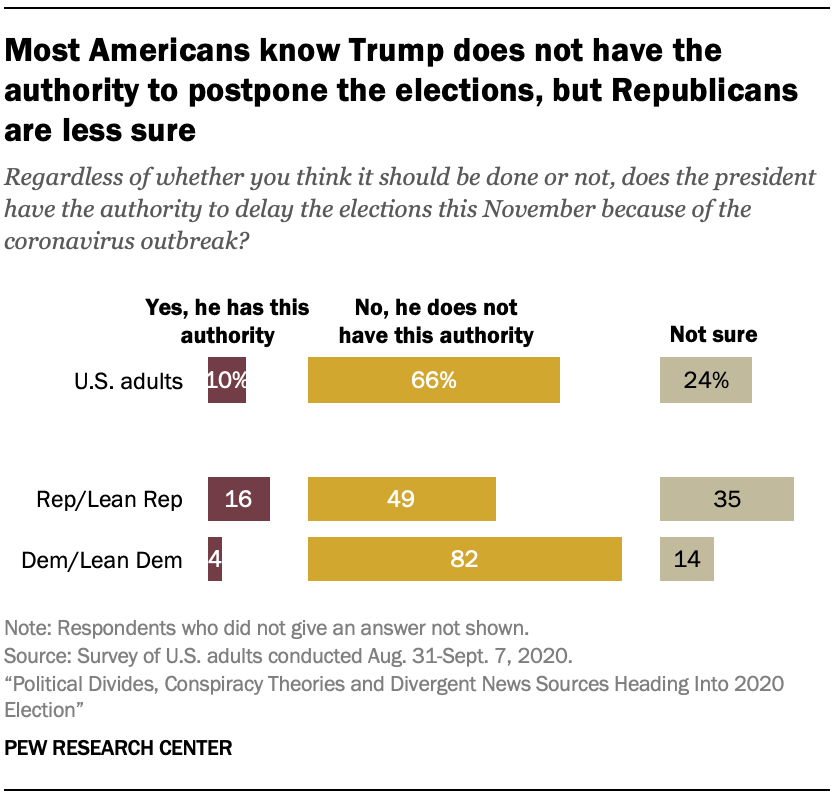
Most Americans know Trump does not have the authority to postpone the elections, but Republicans are less sure

For much of this year, this presidential election has been conducted against the backdrop of two nation-altering events – a once-in-a-century pandemic and widespread social justice protests sparked by the police killing of George Floyd. Both are potentially decisive issues in the presidential campaign. (For more on the public’s attitudes about the protests, click here.)

Americans’ responses to questions connecting the candidates to these issues reflect profound differences not only in perception, but sometimes in knowledge and understanding of central facts.

With Trump having raised the specter of delaying the elections because of the pandemic, a large majority of Democrats (82%) correctly say he does not have the legal authority to do so under current laws. About half of Republicans (49%) say the same, but the remainder say either that he does have the authority (16%) or that they are unsure if he does (35%).

In light of the social justice protests and some violence that has accompanied them, the Trump campaign has accused Biden of wanting to defund the police, a position that has been embraced by some activists. Biden has said he does not support defunding the police, but would consider redirecting some police funds to services like mental health counseling.
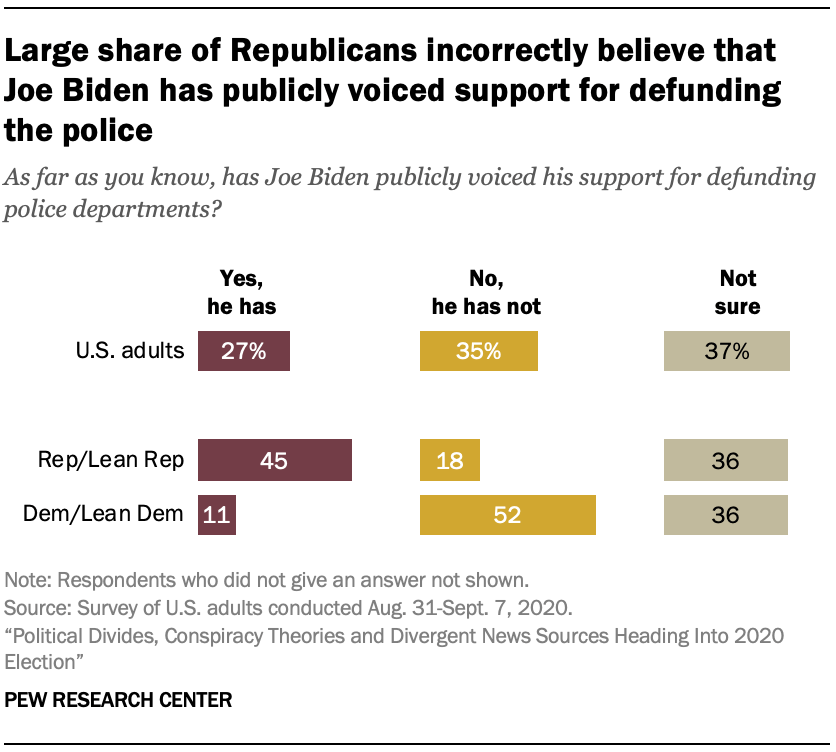
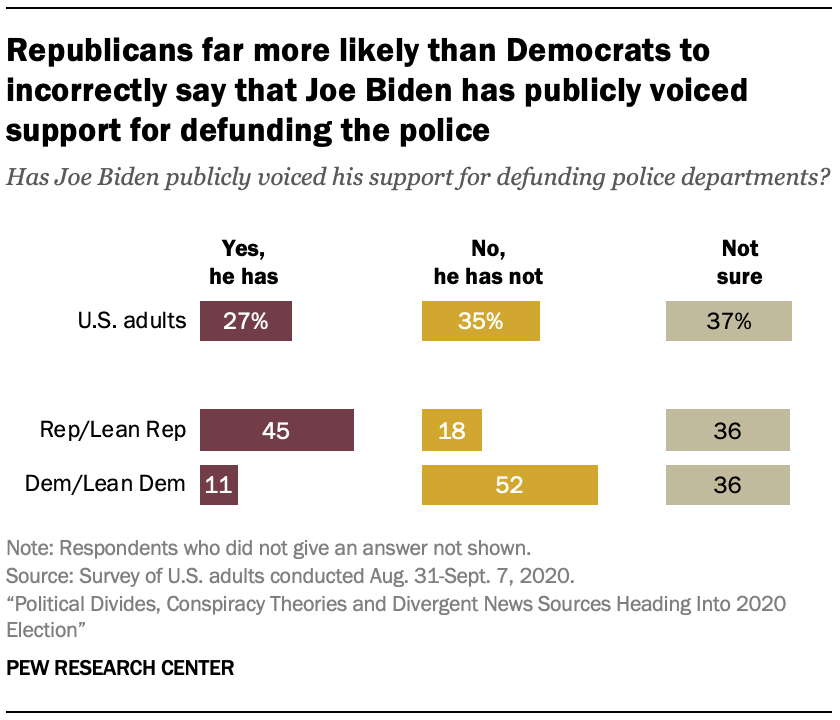
Large share of Republicans incorrectly believe that Joe Biden has publicly voiced support for defunding the police

About half of Democrats (52%) say that Biden has not publicly voiced his support for defunding police, nearly three times the percentage of Republicans who say the same (18%). And Republicans who use Fox News and/or talk radio as their only major sources of political news are far more likely than those who rely only on other news sources to say Biden has come out in support of defunding the police (66% vs. 27%).

There also are differences among Democrats based on their news diets: Those who rely only on at least one of the five major outlets with left-leaning audiences are more likely than Democrats relying on other sources to say that Biden has not publicly supported defunding the police (71% vs. about half or fewer). Democrats whose major news sources do not have a left-leaning audience are divided between those who say Biden has not voiced his support for defunding the police (43%) and those who are unsure (44%).
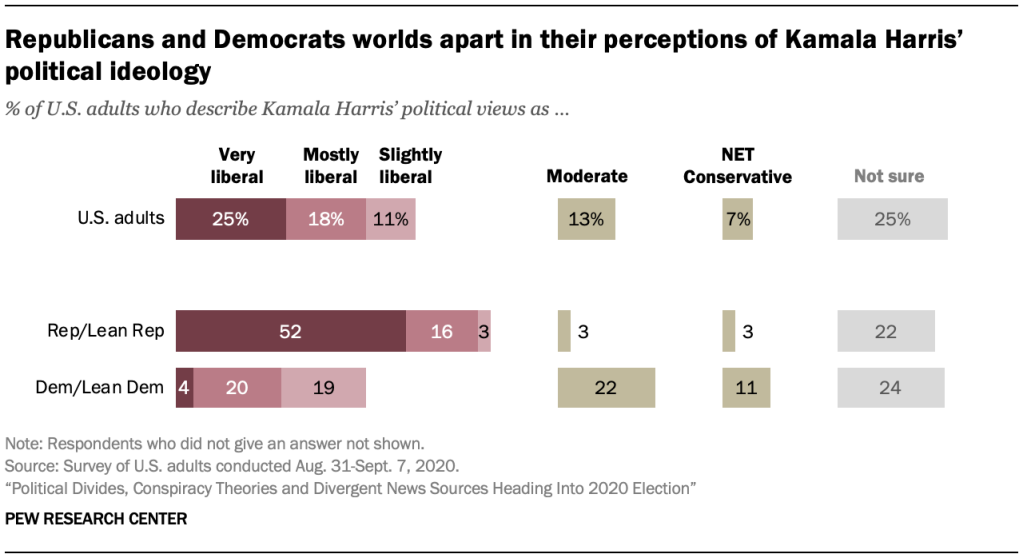
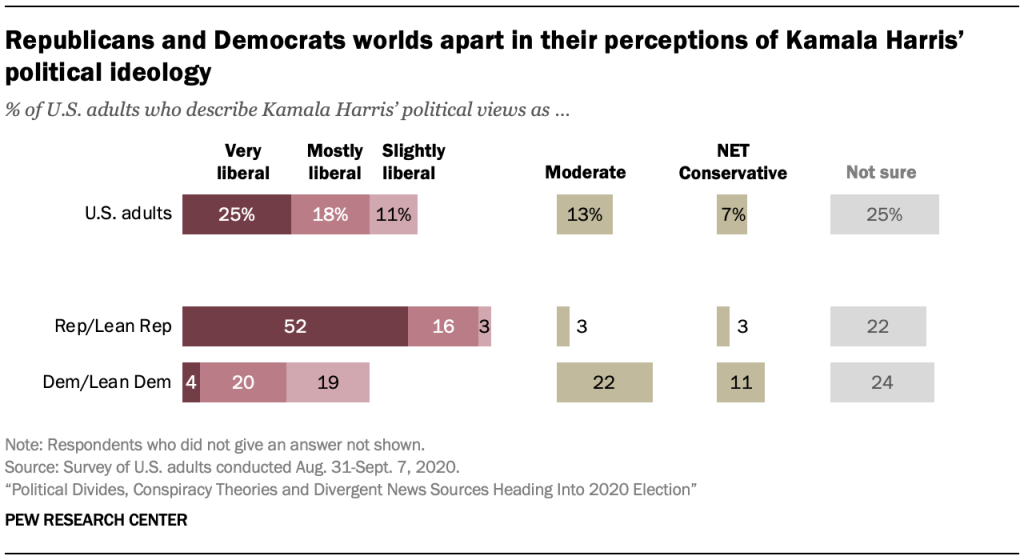
Republicans and Democrats worlds apart in their perceptions of Kamala Harris’ political ideology

The Republican campaign has also at times criticized the Democratic ticket as too far left. In the case of Democratic vice presidential nominee Kamala Harris, about half or more in both parties correctly identified her as a former California attorney general. But on the question of her ideology, as can often be the case, there are huge gaps between the party that nominated her and the one running against her.

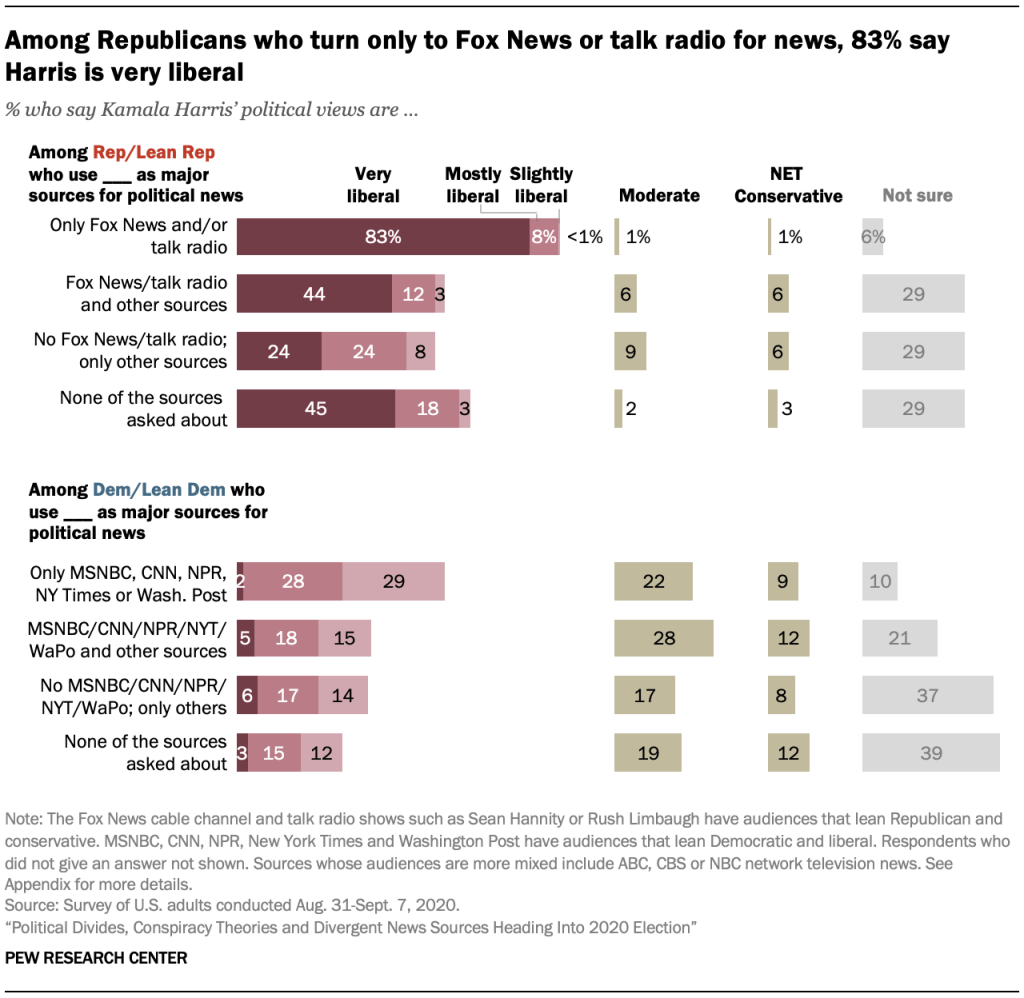
While a tiny fraction of Democrats (4%) see Harris as holding “very liberal” views, about half of all Republicans (52%) characterize her as very liberal. To Republicans, she appears to be liberal, while Democrats see her as more moderate. Among Democrats, 20% say she is “mostly liberal,” 19% say she is “slightly liberal” and 22% say she is “moderate.” Additionally, about one-in-ten Democrats (11%) say that Harris is a conservative.

Evaluations of Harris’ ideology also highlight differences within the GOP by media source. Fully 83% of Republicans who use only talk radio and/or Fox News as major news sources say Harris is very liberal. But only about half as many Republicans who use Fox News or talk radio along with a mix of other outlets (44%) characterize her that way. And among Republicans who do not use either Fox or talk radio as major sources, only about quarter (24%) describe Harris as very liberal. Among Democrats, there are minimal differences based on media diet.
 

1. Legitimacy of voting by mail politicized, leaving Americans divided

The months-long coronavirus outbreak has impacted virtually all aspects of American life, including the 2020 presidential election – with many states and jurisdictions promoting the expanded use of mail-in ballots as a way to vote while avoiding the risks of infection for polling center volunteers or for voters standing in long lines and inside voting booths.

Yet as with so much of the environment in the U.S. today, voting by mail has become politically charged. Donald Trump has repeatedly decried voting by mail as an invitation for widespread fraud – though experts say there is almost no meaningful fraud associated with mail ballots – and Americans’ views on voting by mail now show a large partisan divide.

Most Americans are very aware of discussions about the impact of increased mail-in ballots on the election and of Trump’s public criticism of the U.S. postal system. But people come away with a very different sense of the facts surrounding that process – including whether mail-in ballots bring voter fraud – depending on their party and media diet.
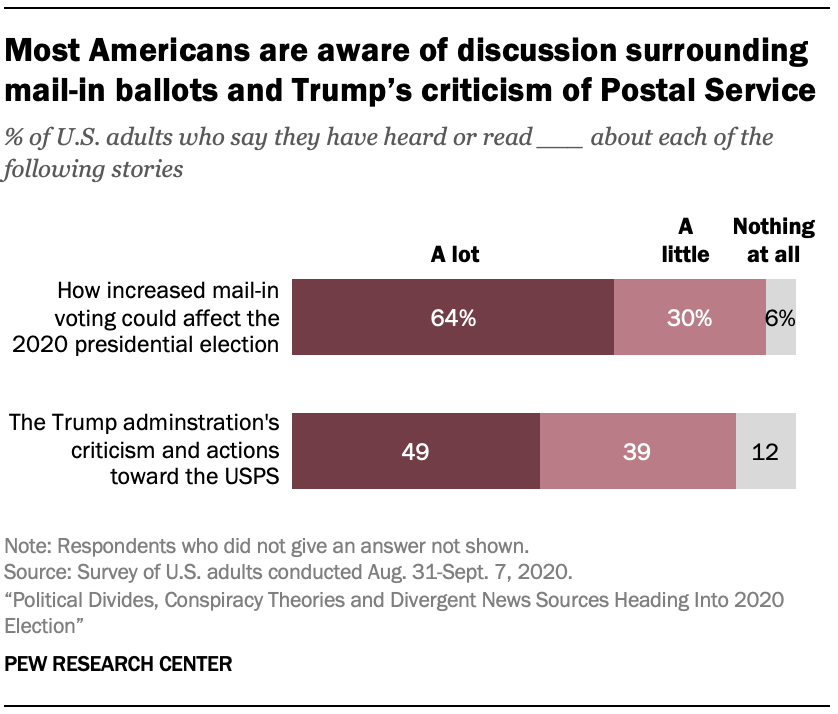
Most Americans are aware of discussion surrounding mail-in ballots and Trump’s criticism of Postal Service

About two-thirds of U.S. adults (64%) say they have heard “a lot” about how increased mail-in voting could affect the 2020 presidential election. Another 30% have at least heard a little bit about it – leaving only 6% who haven’t heard anything at all. Most also are aware of Donald Trump and his administration’s criticism of and actions against the U.S. Postal Service: About half of U.S. adults (49%) have heard a lot about this and another 39% have heard a little.

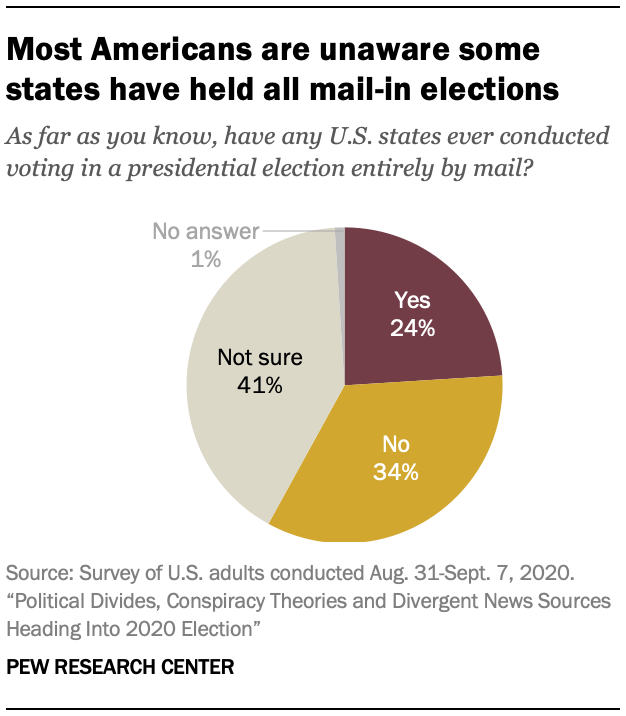
Most Americans are unaware some states have held all mail-in elections

The survey finds broad uncertainty about whether states have held elections entirely by mail in the past, and whether that practice has increased voter fraud. Most U.S. adults either say that no U.S. states have ever conducted presidential voting entirely by mail (34%) or that they are unsure whether this has ever happened (41%). About a quarter of adults (24%) answer correctly that states have done this in past. (Four states have done so – Colorado, Oregon, Utah and Washington – and Hawaii will join as a fifth this year.)

One-in-four Americans think voter fraud has been a major problem with voting by mail, contrary to evidence

While experts say that there is minimal risk of increased voter fraud by mail, a quarter of U.S. adults say voter fraud has been a major problem when it comes to voting by mail. Another 27% say it’s been a minor problem, and an identical share say it has not been a problem at all. The remaining 20% say they are unsure.

Partisans share awareness of mail-in ballot debates, but disagree on the connection to voter fraud

Republicans more likely to say voter fraud is a problem with mail-in voting, less likely to know that states have conducted voting entirely by mail

Awareness of the potential impact of increased voting by mail cuts across party lines, with majorities of both Republicans and Democrats having heard a lot about this in recent weeks. But while roughly two-thirds of Democrats and independents who lean Democratic (64%) say they have heard a lot about Trump’s criticism of the U.S. Postal Service, the same is true of only half as many Republicans and Republican leaners (32%). Still, a large majority of Republicans (86%) have heard at least a little about this topic.

Democrats are more likely than Republicans to know that some states have conducted presidential elections entirely by mail (31% vs. 16%). Conversely, 42% of Republicans say no states have ever done this, versus 27% of Democrats. Roughly four-in-ten in each party say they aren’t sure.

When it comes to potential fraud associated with mail-in ballots, about four-in-ten Republicans (43%) say collecting votes through mail-in ballots has been a major problem, and another 31% say it’s been a minor problem. Again, the evidence shows only miniscule voter fraud issues – though just 5% of Republicans say it is not a problem.

Among Democrats, 47% answered that mail-in ballots have not been a problem for voter fraud. About one-in-ten (11%) say it’s been a major problem and 23% say it’s been a minor problem.

About two-in-ten on both sides of the aisle say they are not sure of the impact on voter fraud.

Republicans who rely only on news sources with right-leaning audiences see bigger problem with voter fraud from mail-in voting

Within political parties, another area of difference emerges based on the news sources people rely on most. Respondents were asked whether each of eight news providers is a major or minor source of political and election news for them – or not a source at all. Researchers then grouped people within each party based on their mix of major news sources.

In this analysis, there are four media-usage groups among Republicans (including leaners): those who only indicated Fox News and/or talk radio shows like Sean Hannity and Rush Limbaugh as major news sources for political and election news (these are the two sources among the eight asked about whose audiences lean to the right politically); those who cited Fox News and/or talk radio as well as at least one of the other six news sources asked about; those who did not cite Fox News or talk radio as a major source but selected at least one of the others as a major source; and those who said that none of the eight providers mentioned in the survey are major sources of political news for them.

There also are four groups among Democrats (including leaners): those who cited only MSNBC, NPR, The Washington Post, The New York Times and/or CNN as a major news source (these are the five providers whose audiences lean left politically); those who cited one of the five as well as any of the others; those who did not cite any of the five but did cite at least one other; and those who did not cite any of the eight as major sources of political news. (For more details on how the news outlets were classified and the categories of news consumers, see the appendix.)

Again, other factors beyond media diet may influence people’s views of election-related issues, including the potential for fraud in mail-in voting. And someone’s media diet can be selected to fit their existing political views or be a significant factor in shaping those political views. Still, the data shows a clear connection between news diet within party and views on this issue.

Among both Republicans and Democrats, those who only rely on outlets with right- or left-leaning audiences, respectively, as key sources are the most likely to have heard a lot about the potential impact of mail-in ballots on the election.

Republicans who get election news from Fox News, talk radio much more likely than rest of the GOP to see voter fraud as a major problem with mail-in voting

People’s news sources also are linked with what they know and perceive about the impact and use of mail voting. Fully 61% of Republicans who only cite Fox News and/or talk radio shows as key news sources say that fraud has been a major problem when mail-in ballots are used. That figure drops to 44% for Republicans who cite other outlets alongside Fox News and/or talk radio as major sources, then down to about a quarter (23%) among Republicans who don’t rely on Fox News or talk radio (but select at least one of the six other sources mentioned in the survey). Figures pop back up again among those who don’t select any of the eight outlets as major sources: 38% say fraud has been a major problem.

Democrats who cite only outlets with left-leaning audiences as key sources of political news are by far the most likely to say that voter fraud has not been a problem associated with mail-in ballots: 67% say this, compared with 43% of those who rely on some of these sources but also others. Democrats who don’t rely on any of the outlets with left-leaning audiences (or, in some cases, any of the eight major news sources mentioned in the survey) express greater uncertainty on this issue than other Democrats.

Democrats who rely on MSNBC, CNN, NPR, New York Times and/or Washington Post more likely than others to know states have held elections entirely by mail

As noted above, Democrats overall are more likely to know that some states have held elections entirely by mail, but differences emerge among them based on their news sources.

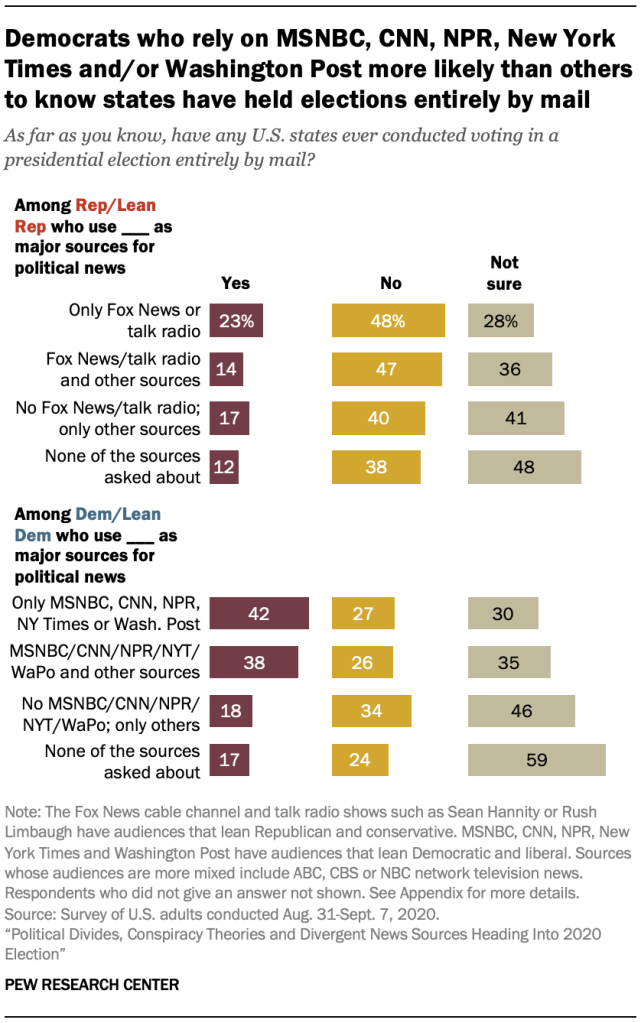
Democrats who only rely on an outlet or outlets with left-leaning audiences as major news sources are far more likely than Democrats who don’t rely on any of these sources to answer correctly: about four-in-ten vs. about two-in-ten. Those who don’t turn to any of these sources with left-leaning audiences are more likely to say they are unsure.

Differences by news diet are more modest among Republicans, with no more than 23% in any media group correctly answering that states have held vote-by-mail elections.

Direct messaging from candidates and campaigns linked with views on voter fraud

Republicans who say Trump campaign is a major political news source much more likely to see voter fraud as a problem with mail-in voting

The 27% of Republicans who say Donald Trump and his campaign are a major source of election news for them share many of the same sentiments as those who cite only Fox News and talk radio as key sources of election news. Indeed, the same portion of both groups – 61% – say voter fraud has been a major problem surrounding mail-in voting. Another quarter say it has been a minor problem, while a mere 1% say it has not been a problem at all.

Among Democrats, there are more modest differences on this question between those who see Biden and his campaign as a major source of information for them (who make up 21% of all Democrats) and those who do not look to Biden’s campaign for election news – although Democrats who get news from the Biden campaign are somewhat more likely than others to see voter fraud over the mail as a major problem (21% vs. 8%).

2. Attention to candidates increases, but what Americans know and think about them diverges by party, media sources

With the national nominating conventions concluded and the election cycle entering its closing stretch, Americans are now following news about the presidential candidates more closely than they were a few months ago. And while there are virtually no partisan differences in how closely Americans are following the election, there are some distinctions within parties depending on where people get their political news.

Americans’ interest in election news rises as election draws nearer

Overall, 66% of U.S. adults now say they are following news about the candidates very closely (30%) or fairly closely (35%). When surveyed in early June, 54% of Americans were following candidate news very closely (21%) or fairly closely (32%), and in April, about half (52%) were doing so.

Throughout this election year, news about the presidential candidates has competed with several mega-stories, in particular the coronavirus pandemic and the ongoing protests over social justice that were triggered by the killing of George Floyd in late May. In June, for example, about half of Americans (54%) were following election news very or fairly closely, while 84% said they were doing so for news about the protests and 86% for news about the COVID-19 outbreak.

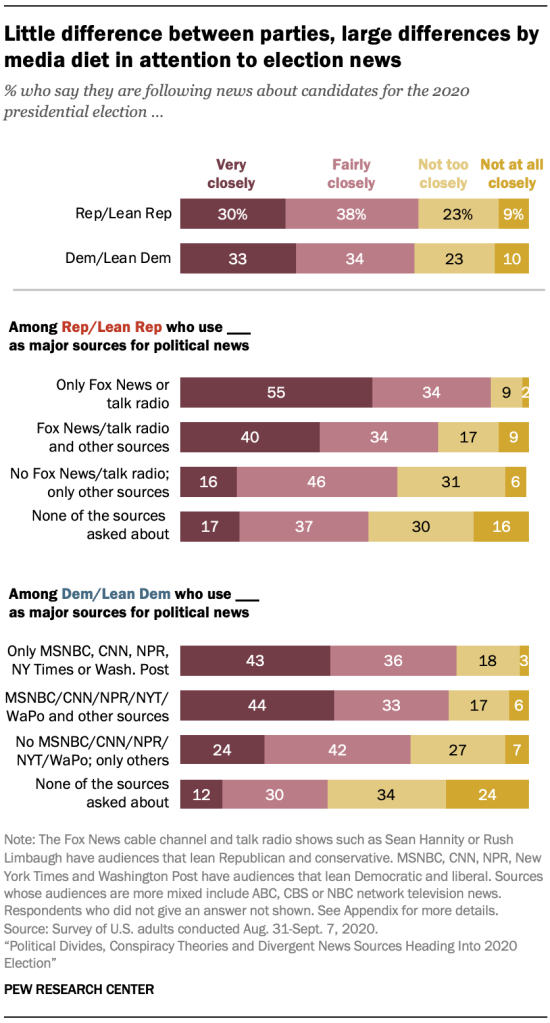
As of early September, members of both major political parties show very similar levels of interest in news about the candidates. Among Republicans and independents who lean Republican, 30% say they are following that news very closely, with 38% following it fairly closely. Among Democrats and independents who lean Democratic, 33% are following candidate news very closely, with 34% following it fairly closely.

But within the parties themselves, there are differences in how closely people are following news about the candidates based on the major sources they use for political and election news.

In this analysis, there are four media-usage groups among Republicans (including leaners): those who only indicated Fox News and/or talk radio shows like Sean Hannity and Rush Limbaugh as major news sources for political and election news (these are the two sources among the eight whose audiences lean to the right politically); those who cited Fox News and/or talk radio as well as at least one of the other six news sources asked about; those who did not cite Fox News or talk radio as a major source but selected at least one of the others as major sources; and those who said that none of the eight providers mentioned in the survey are major sources of political news for them.

There also are four groups among Democrats (including leaners): those who cited only CNN, MSNBC, NPR, The New York Times and/or the Washington Post as a major news source (these are the five providers whose audiences lean left politically); those who cited one of the five as well as any of the others; those who did not cite any of the five but did cite at least one other; and those who did not cite any of the eight as major sources of political news. (For more details on how the news outlets were classified and the categories of news consumers, see the appendix.)

Little difference between parties, large differences by media diet in attention to election news

Among those Republicans (and leaners) whose major sources for political news only include Fox News or talk radio shows like Sean Hannity or Rush Limbaugh, more than half (55%) say they are following news about the candidates very closely. That compares with 40% of Republicans whose major sources include a mix of Fox News or talk radio plus other outlets. And among Republicans whose major sources for political or election news are a mix of sources that does not include Fox News or talk radio, the percentage following news about the presidential candidates very closely drops to 16%.

Among Democrats and Democratic-leaning independents whose major sources are only outlets with left-leaning audiences – CNN, MSNBC, NPR, The New York Times and The Washington Post – 43% say they are following election news very closely. But attention levels are similar (44%) among those Democrats whose major political news sources include a mix of these sources and other sources asked about. And the proportion paying very close attention falls to 24% among Democrats who cite only major sources other than the outlets with left-leaning audiences.

Major partisan gaps on questions about Trump’s election powers and Biden’s police position

Several questions designed to track Americans’ knowledge about the election and candidates revealed significant partisan gaps between Democrats and Republicans.

Citing safety and fairness issues connected with voting during a national pandemic, Trump publicly mused about the idea of delaying the Nov. 3 election – an authority the president does not hold. Asked whether he has the authority to do that, Democrats and Republicans offer markedly different responses.

Most Americans know Trump does not have the authority to postpone the elections, but Republicans are less sure

About two-thirds of all adults (66%) correctly say that the president does not have that authority, with only 10% saying he does – and the remaining 24% say they are unsure. But only about half of Republicans and Republican-leaning independents (49%) say the president cannot delay elections, while 16% say he can and about one-third (35%) say they are not sure. An overwhelming majority of Democrats and Democratic leaners (82%) say he cannot delay the election, with only 4% saying he can.

For the most part, there are few differences in responses to this question by media diet within parties.

Republicans far more likely than Democrats to incorrectly say that Joe Biden has publicly voiced support for defunding the police

A second question about Joe Biden’s position on what has become a significant and heated campaign issue not only produces wide partisan divergence but also highlights differences within parties depending on the news sources being used.

While Donald Trump and his campaign have accused Biden of wanting to defund the police, a position supported by some activists, the Democratic nominee has stated that he does not support defunding the police, but would consider redirecting some police funds to services like mental health counseling.

Among all Americans, 35% correctly respond that Biden has not voiced support for defunding the police, while 27% say he has. Another 37% say they are not sure.

Democrats are far more likely to say Biden has not voiced support for defunding the police (52%) than Republicans (18%). On the other hand, 45% of Republicans say that Biden has voiced support for defunding police, versus just 11% of Democrats who say the same. About a third in each party (36% of both parties) say they are not sure about Biden’s position.

Knowledge that Biden has not supported defunding police departments varies by media diet

On this question, there are large differences among Republicans with different media diets. About two-thirds (66%) of those who only named Fox News or talk radio as their major sources of political news say Biden voiced support for defunding the police, far more than the 48% in the group that uses a mix of Fox News, talk radio and other outlets asked about, and the 27% in the group that relies on major sources other than Fox News or talk radio who provide the same answer.

Among Democrats, regardless of media usage, only between 8% and 16% say Biden voiced support for defunding police. But while 71% of Democrats whose main sources include only left-leaning outlets say he has not publicly supported this, along with 51% of Democrats who get their news from sources with left-leaning audiences and other sources, fewer than half (43%) of Democrats who use no sources with left-leaning audiences give that answer. In that group, 44% say they are not sure whether Biden has supported it or not.

Democrats and Republicans about equally aware of Harris’ resumé but hold very different perceptions about her ideology

At least half of both parties know Kamala Harris served as attorney general of California

Although she had competed earlier in the crowded 2020 Democratic presidential contest, Sen. Kamala Harris was reintroduced to the nation when Biden announced her selection as his running mate six days before the party’s convention. At the convention, Harris devoted part of her speech to her personal history and story.

A question about Harris’ resumé produced similar responses from Democrats and Republicans, but one that asked about views of her ideology highlighted varying partisan perceptions as well as differences by media sources.

Among all Americans, 52% correctly answered that Harris had been the California attorney general before being elected to the Senate, with similar portions of Republicans (51%) and Democrats (56%) responding correctly. Still, a substantial minority of both parties – 41% of Republicans and 34% of Democrats – are not sure of the answer.

When asked to characterize Harris’ political views, 43% of all adults say she is either very liberal (25%) or mostly liberal (18%), while 25% say they are not sure. But when broken out by party, Republicans are more than 10 times as likely as Democrats to describe her as very liberal.

Republicans and Democrats worlds apart in their perceptions of Kamala Harris’ political ideology

Among Republicans, two-thirds (67%) characterize her views as very liberal (52%) or mostly liberal (16%). In stark contrast, only 24% of Democrats say she is very or mostly liberal (4% say Harris’ views are very liberal, with another 20% saying they are mostly liberal). Instead, 19% of Democrats say she is slightly liberal, 22% say she is moderate and 11% say she is conservative.

Among those Republicans who only use Fox News or talk radio as a major source, a full 83% say her views are very liberal. That number is nearly halved (44%) among Republicans who also get news from other sources, and it falls to 24% among Republicans whose major sources do not include either Fox News or talk radio, slightly behind the percentage who are not sure about her views (29%).

Among Republicans who turn only to Fox News or talk radio for news, 83% say Harris is very liberal

The percentage of Democrats within each of the four media diets who say Harris is very liberal is in the single digits. About six-in-ten of those whose major sources have only left-leaning audiences say she is very, mostly or slightly liberal (59%) – higher than Democrats in other groups who say the same (39% or fewer do). And for Democrats whose major sources do not include any in the left-leaning audience group, a plurality are not sure about her ideology (37%).

Americans about three times as likely to have followed own party’s political convention than the other party’s event

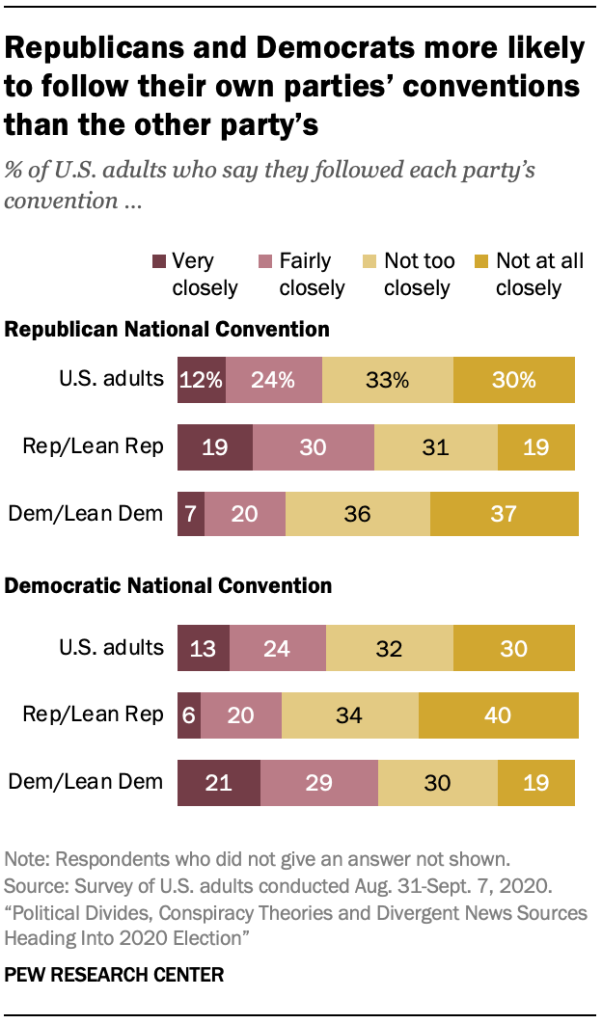
Republicans and Democrats more likely to follow their own parties’ conventions than the other party’s

This year’s national nominating conventions, held during the last two weeks in August, had to be reinvented as COVID-19 forced many events to be held virtually or as a hybrid of in-person and virtual staging. Gone was much of the pomp and circumstance, as well as some of the audience that traditionally tunes in to these events.

Among all adults, there was very little difference in the attention paid to the two 2020 conventions. The percentage of Americans who followed the Democratic convention very closely (13%) was virtually the same as the percentage who followed the Republican convention very closely (12%). And majorities say they followed those events not too closely or not at all closely – 62% for the Democratic convention and 63% for the Republican event.

People were much more likely to follow their party’s political convention more closely than the other party’s convention. While 21% of Democrats say they followed their convention very closely and another 29% followed it fairly closely, only 6% of Republicans say they followed the Democratic event very closely, with another 20% following it fairly closely.

Conversely, the percentage of Republicans who followed the GOP convention very closely (19%) was also higher than the percentage of Democrats who did (7%). In addition, another 30% of Republicans followed their convention fairly closely, compared with 20% of Democrats.

Put simply, Democrats were about twice as likely as Republicans to follow the Democratic convention very or fairly closely (50% to 26%), and Republicans, by almost the same margin, were more likely than Democrats to follow the GOP convention very or fairly closely (49% to 27%).

Large party gaps in the assessment of campaign media coverage, and among Republicans, big differences by media diet

Partisan divides in assessment of media coverage of the election

Overall, the media seem to get passing grades when it comes to covering the general election. But as previous research has shown with evaluations of media performance, Republicans offer a much more critical assessment than Democrats. And among Republicans, those whose main election sources include only talk radio or Fox News gave the media far lower grades than fellow party members with different media diets.

Among all Americans, 12% say the media have done very well covering the election, with a solid plurality (46%) saying they have done somewhat well. Another 41% say they have done not too well (27%) or not at all well (14%).

Democrats and independents who lean Democratic offer a generally positive overall assessment, with about three-quarters (76%) saying the media have done either very well (18%) or somewhat well (58%) in covering the election. But only half as many Republicans and Republican leaners (38%) say the media have done very well (5%) or somewhat well (34%). And about six-in-ten Republicans (61%) say news organizations have either not done too well (36%) or not done at all well (24%) in chronicling the 2020 elections.

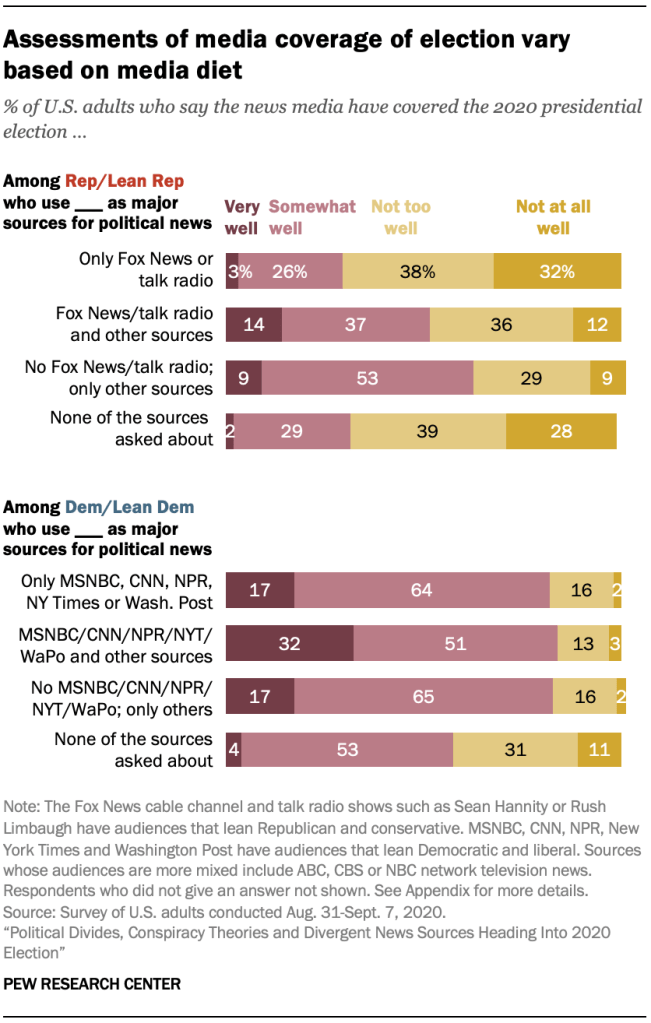
Assessments of media coverage of election vary based on media diet

Republican views of the media’s work on the election differ substantially depending on their major sources for political and election news. Of those whose major sources only include Fox News or talk radio, three-in-ten say news organizations are doing their job very well (3%) or somewhat well (26%). That number climbs to about half (51%) of the Republicans who use Fox News or talk radio as well as other outlets as major sources of news – with 14% saying the media have done very well and 37% saying they have done somewhat well. And more Republicans who only have major sources other than Fox News or talk radio say journalists have done very well (9%) or somewhat well (53%) covering the election.

In contrast, there is less variation in Democrats’ view of media performance based on news diets – about eight-in-ten of the Democrats who use any of the sources asked about as a major source say the news media are doing at least somewhat well. Indeed, 82% of Democrats whose major sources included only outlets with left-leaning audiences say the media have done very well (17%) or somewhat well (64%). Among those whose sources include the left-leaning audience outlets and others, the percentage saying the media have done very well is higher (32%), with 51% saying the media have done somewhat well – for a total of 83%. And 82% of those Democrats who only have major sources outside of the left-leaning group say the media have done very well (17%) or somewhat well (65%). The exception here is the group of Democrats who don’t use any of the sources asked about, 57% of whom say the media are doing very or somewhat well.

Among Democrats and Democratic leaners, those who cite the Biden campaign as a major source for political and election news are far more likely to give the media positive reviews of their election coverage. Four-in-ten of those Democrats who say the Biden campaign is a major source say that the media have done very well covering the presidential election, compared with just 12% of other Democrats. Among Republicans (including leaners), ratings of the news media’s election coverage are relatively low, regardless of whether they say the Trump campaign is a major news source or not.

3. Most Americans who have heard of QAnon conspiracy theories say they are bad for the country and that Trump seems to support people who promote them

Americans’ awareness of a collection of conspiracy theories known as QAnon has roughly doubled since March to nearly half of U.S. adults.2 A solid majority of those who have heard about QAnon say it is a bad thing for the country and also say Donald Trump seems to support people who promote the theories. Those sentiments, however, are not shared equally across party or among those with differing sources for political news.

Originating on message boards, the cluster of conspiracy theories connected to QAnon have now been declared a domestic terror threat by the FBI, publicly espoused by congressional candidates and talked about with interest by Trump.

A majority of U.S. adults who have heard of the QAnon conspiracy theories say they’re a very bad thing for the country

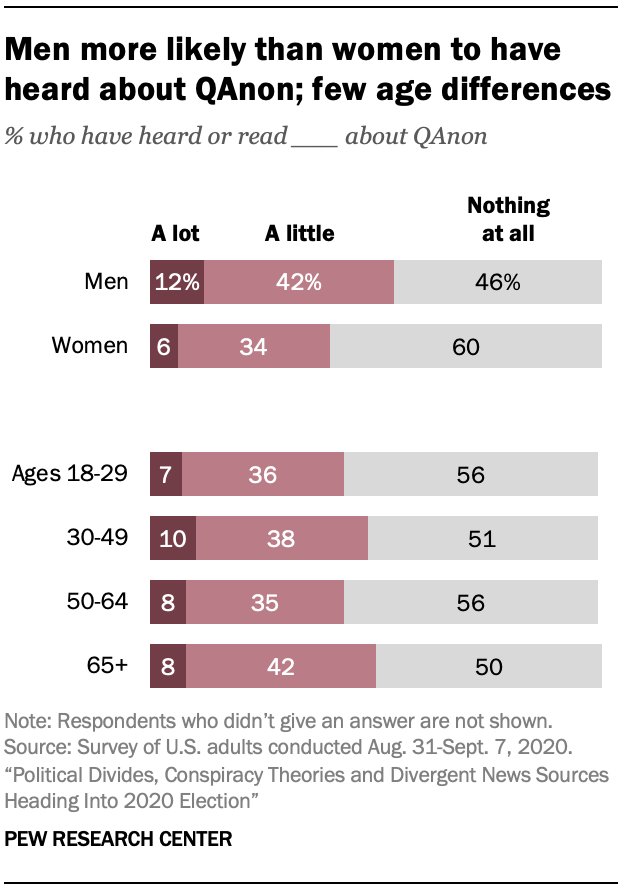
While few U.S. adults – just 9% – have heard a lot about this group of conspiracy theories, far more (38%) have heard at least a little, amounting to roughly half (47%) of Americans who are familiar with QAnon. That figure has roughly doubled since early March, when 23% had heard at least a little about it.

Among those who are aware of QAnon, 57% say it is a “very bad” thing for the country. Another 17% say it is “somewhat bad,” for a total of 74% who see it as bad for the country. That compares with 20% who say it is somewhat or very good thing (6% did not answer).

A solid majority of Americans who have heard of the theories (60%) also say that Trump seems to support individuals who promote those conspiracy theories, such as Marjorie Taylor Greene, who recently won the Republican primary in Georgia for a U.S. House seat and campaigned publicly on some of these themes. Just 7% say Trump seems to oppose people who promote these theories, while 11% say he neither opposes or supports them and the remainder say they are unsure (21%).

One node of these conspiracy theories makes unfounded accusations about high-level officials and pedophilia. While about half (47%) of U.S. adults have heard at least a little about QAnon specifically, about seven-in-ten (71%) have heard or read news coverage about the extent of child abuse or trafficking. While many of these stories may be about fact-based examples of these problems, the high share registered here may also suggest that some of these conspiracy theories may be reaching Americans beyond just those who know of QAnon by name.

Sizable minority of Republicans who have heard about QAnon say it is a good thing for the country

Democrats’ awareness of the QAnon conspiracy theories somewhat outpaces that of Republicans (55% and 39%, respectfully), and there are larger party differences when it comes to their views about QAnon.

About four-in-ten Republicans who have heard of the QAnon conspiracy theories say QAnon is a good thing for the country

Fully 77% of Democrats who have heard of QAnon say it is a “very bad” thing for the country, and another 13% say it is a somewhat bad thing. That feeling is shared by far fewer Republicans. Only about a quarter of Republicans (26%) who have heard of QAnon feel it is a very bad for the country, while another 24% say it is somewhat bad. Indeed, roughly four-in-ten Republicans who have heard of QAnon (41%) say it is a good thing for the country (32% somewhat good and 9% very good).

Democrats are also much more likely than Republicans to say that, based on what they’ve seen or heard, Trump seems to support people who promote QAnon theories – though few Republicans say he opposes them. Roughly eight-in-ten Democrats who have heard of QAnon (81%) say that Trump seems to support people who promote those theories. Republicans who are aware of QAnon express much greater uncertainty about where the president stands. The largest segment of Republicans say that based on what they’ve seen or heard they are not sure where Trump stands. Another 27% say he seems to neither support nor oppose them. The same percentage (27%) say he seems to support them, more than twice as many as the 11% who say he opposes people who promote the QAnon conspiracy theories.

Democrats relying on news outlets with left-leaning audiences are the most aware of QAnon

Awareness of QAnon varies broadly across the news sources Americans use as their major sources for political and election news – ranging from nearly 80% to less than a third across types of news consumers.

Democrats who turn to certain sources more likely than other Democrats to have heard about conspiracy theories called QAnon

Democrats and independents who lean toward the Democratic Party who use only news outlets with left-leaning audiences (MSNBC, CNN, NPR, The New York Times or The Washington Post) as major sources for political and election news are the most aware of QAnon: Fully 76% of this group say they have heard at least a little about these conspiracy theories, though fewer than one-in-five (18%) say they have heard a lot about them. About half (51%) of Democrats who use these outlets with left-leaning audiences plus other outlets (either Fox News, national broadcast TV news or talk radio) have heard about QAnon, while 45% of Democrats who do not use any of the outlets asked on the survey as major sources say they have heard of QAnon at least a little. Democrats who use only outlets other than those with left-leaning audiences are the least aware in their party: 29% have heard about QAnon.

Among Republicans who have heard of QAnon, those getting election news from Trump campaign somewhat more likely to see it as a good thing for the country

Awareness of QAnon is highest among Republicans and Republican leaners who either only cite outlets with right-leaning audiences (Fox News or talk radio) as major sources or do not use any of the outlets asked about (45% and 42%, respectively, have heard at least a little). About a third of Republicans who use outlets with mixed or left-leaning audiences in addition to Fox News or talk radio (35%) have heard about QAnon, as have about three-in-ten (29%) Republicans who do not use outlets with right-leaning audiences (see the appendix for more details).

Republicans who rely on Trump and his campaign as a major election news source are somewhat more likely to see the QAnon conspiracies as positive for the country

Republicans who say Donald Trump and his campaign are a major source of political news for them are somewhat more likely than other Republicans in their view of the QAnon conspiracy theories. Among Democrats, however – and again as seen with the question of voter fraud – those who turn to Biden and his campaign as a major source for political news show little difference in this question.

Republicans who have heard of QAnon (including those who lean Republican) and for whom the Trump campaign is a major source are somewhat more likely than other Republicans to view QAnon as a positive thing for the country. Indeed, 46% of Republicans who call Trump and his campaign a major source of news say QAnon is either a very good (15%) or a somewhat good (31%) thing for the country. Among other Republicans – those who do not call Trump and the campaign a major news source – only 7% say QAnon is a very good thing, with another 33% who say it is a somewhat good thing – for a total of 39% who put it in a positive category.

Among Democrats, there is no difference across any of the four responses options between those who turn to Biden and his campaign as a major source for news and those who do not.

Young adults no more likely to have heard of QAnon

Men more likely than women to have heard about QAnon; few age differences

More than half of men in the U.S (54%) have heard at least a little about the conspiracy theory compared with 39% of women. But when it comes it age, few differences emerge. Between 43% and 50% of all age groups have heard at least a little about QAnon, with no more than 10% in any group who have heard a lot.

Among those who have heard about the conspiracy theories, adults under 30 are the most likely to say it is a good thing: 29% of those ages 18 to 29 say this, compared with 20% or less of any other age group.

More comparative data on these questions can be found in the American News Pathways data tool.

Republicans more likely than Democrats to say activist groups and journalists create a lot of completely made-up election news

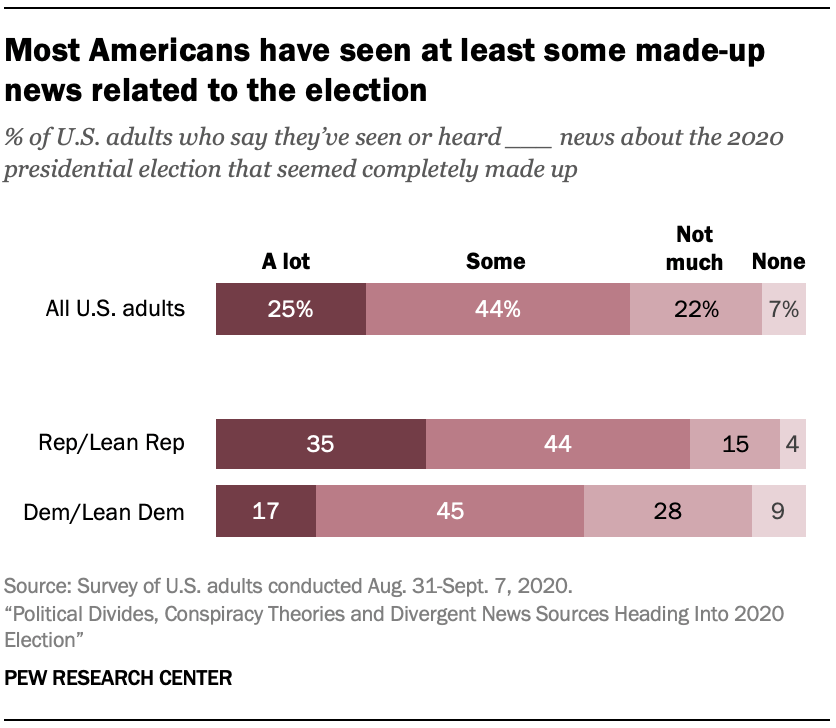
Most Americans have seen at least some made-up news related to the election

Many Americans say they have come across made-up news related to the 2020 presidential election, though this differs depending on where people get their political news. There are also party-line differences, including who each side sees as the main creators of made-up news.

About seven-in-ten U.S. adults (69%) say they have come across at least some completely made-up news related to the election.

That breaks down to a quarter who say they have come across a lot and 44% who say they’ve come across some. Another 22% say they’ve come across “not much,” while only 7% say they’ve seen no made-up election news at all.

As past research has found, Republicans and those who lean Republican are more likely to say they’ve come across completely made-up news than their Democratic counterparts. About a third of Republicans (35%) say they’ve seen a lot while another 44% have seen some. About half as many Democrats and Democratic leaners (17%) say they’ve seen a lot, and 45% have seen some.

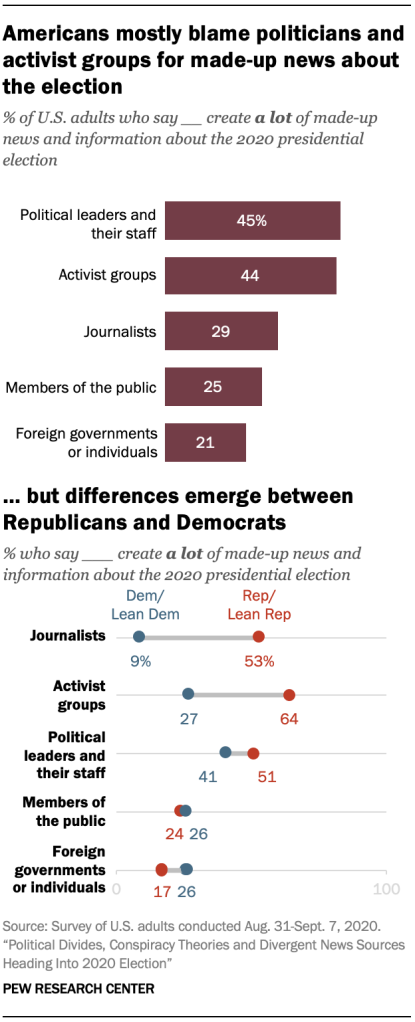
Americans mostly blame politicians and activist groups for made-up news about the election

Bigger differences emerge in who each partisan group thinks creates a lot of made-up news related to the 2020 election.

Overall, Americans put the greatest blame on political leaders and their staff as well as activist groups. Just under half say that each of these groups creates a lot of completely made-up news related to election 2020. About three-in-ten (29%) say journalists create a lot of it, while a quarter say this of members of the public. And, similar to an earlier study, despite warnings from the U.S. counterintelligence agency that foreign nations are trying to influence U.S. voters, foreign governments or foreign individuals get the least blame among the groups asked about: 21% of U.S. adults say these governments or individuals create a lot of made-up news related to the 2020 election.

Republicans are far more likely than Democrats to blame activist groups and journalists for the creation of made-up news. About two-thirds of Republicans (64%) say activist groups create a lot of completely made-up election news, while 53% say this of journalists. Democrats are far less likely to call out either of these groups, with 27% saying activist groups create a lot and 9% saying this of journalists. Republicans are also somewhat more likely to say that made-up election news comes from political leaders and their staff (51% vs. 41% of Democrats). Democrats place somewhat more blame on foreign governments than Republicans do, but by a narrow margin (26% and 17% respectively).

The one area of partisan agreement lay in the role the public plays. About a quarter of both Republicans and Democrats say members of the public create a lot of made-up news about the presidential election.

Republicans with different media diets see different amounts, creators of made-up news

Republicans whose major sources of news are Fox News or talk radio say they see more made-up news

Democrats (and independents who lean Democratic) with different media diets show only modest differences in their perception of made-up election news. That is not the case among Republicans and Republican leaners: There are wide gaps between Republicans who say Fox News or talk radio are their major sources for political news and Republicans who turn to outlets with less conservative audiences.

About half of Republicans who, among the eight sources asked about, rely only on Fox News or talk radio for political news (49%) say they have seen or heard “a lot” of news and information that seemed completely made up. About a third or fewer among Republicans who use these two outlets as major sources in addition to others (36%) or do not rely on any of these outlets (33%) say they have seen a lot. Republicans who rely only on news outlets other than Fox News and talk radio (17%) are the least likely in their party to say they’ve seen a lot.

In addition, Republicans who use only Fox News or talk radio as major sources are more likely than others in the party to say journalists, activist groups and political leaders or their staffs create a lot of made-up news and information. For example, 77% of these Republicans say journalists create a lot of made-up news, compared with half or fewer of Republicans with other major sources or none at all.

Republicans who say Trump is a major source of news are more critical of journalists than other Republicans

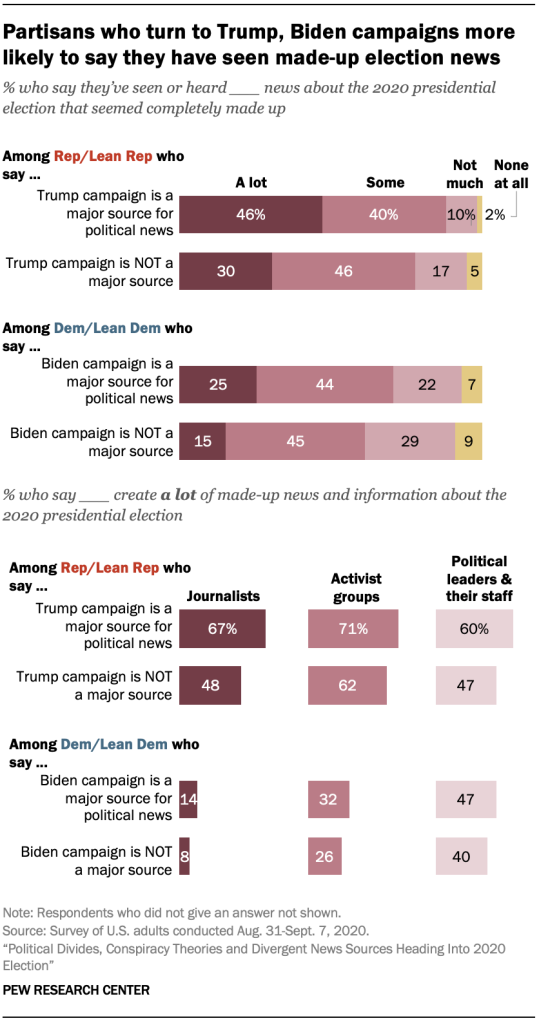
Partisans who turn to Trump, Biden campaigns more likely to say they have seen made-up election news

Republicans who rely on Trump and his campaign as a major source of political news are more likely than other Republicans to say they have come across a lot of made-up news, and they place more blame on certain groups for creating it.

Republicans who turn to Trump and the campaign as major sources for news are more likely to say three of the five groups asked about create a lot of made-up news: politicians, activist groups and journalists. But the greatest discrepancy occurs around journalists. Two-thirds (67%) of Republicans who say Trump is a major source of news say journalists create a lot of made-up news. That is nearly 20 percentage points higher than among other Republicans (at 48%).

Again, differences between Democrats who say Biden and his campaign are major sources of news and those who do not say this are smaller.

Demographically, young adults are less likely to call out politicians, activist groups and journalists as creators of completely made-up news. About a third (32%) of 18- to 29-year-olds say political leaders and their staff create a lot of made-up news. That compares with 42% of 30- to 49-year-olds and half or more of those ages 50 to 64 (50%) and 65 and older (56%). Similarly, a quarter of 18- to 29-year-olds say activist groups create a lot, less than the 41% of those ages 30 to 49 and the half or more of the two oldest age groups who say the same. And just 20% of those under 30 say that journalists create a lot of made-up election news, about on par with those ages 30 to 49 (24%) but lower than those ages 50 to 64 (34%) and those 65 and older (39%).

Appendix: Grouping respondents by major news sources

The survey asked whether respondents use any of eight news sources as a major source, minor source or not a source for political and election news. (Responses for all eight sources are available here.) The sources identified as major sources were combined with the respondents’ partisanship to identify those who get news from only sources with audiences that lean toward their party (i.e., Republicans who get news only from sources with right-leaning audiences and Democrats who only get news from sources with left-leaning audiences) or another mix of sources. Those who do not use any of the eight sources asked about as a major source for political and election news are in a separate category.

The eight sources asked about are:

  • Fox News cable channel
  • CNN
  • MSNBC
  • ABC, CBS or NBC national network TV
  • NPR
  • The New York Times
  • The Washington Post
  • Talk radio, such as Sean Hannity or Rush Limbaugh

Sources were selected from among the top responses (used by about 10% or more of U.S. adults) to a question from November 2019 asking if respondents got news from each of 30 different sources in the past week. More details about this measure and what it reveals about Americans’ news habits are available here, and all data for the question is available here.

The eight sources asked about were then classified according to the political partisanship and ideology of their audiences. For this analysis, respondents who call each source a “major source” for political and election news are considered part of its audience.

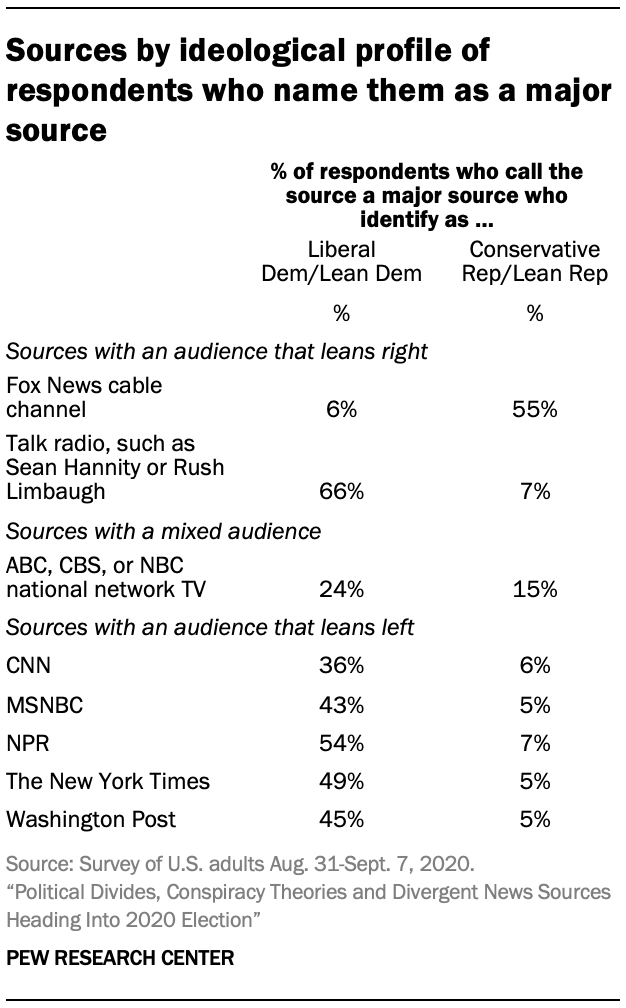
An outlet is considered to have a left-leaning audience if the proportion of all audience members that identify as liberal Democrats is at least two-thirds higher than the proportion who identify as conservative Republicans. Alternatively, an outlet is considered to have a right-leaning audience if the proportion of all audience members who identify as conservative Republicans is at least two-thirds higher than the proportion that identify as liberal Democrats. An outlet is classified as having a mixed audience if neither liberal Democrats nor conservative Republicans make up at least two-thirds more of the audience than the other.

Data for classifying the ideological composition of these source’s audiences is below:

Sources by ideological profile of respondents who name them as a major source

Two of the eight outlets – Fox News and talk radio – have right-leaning audiences in this data, meaning the proportion of their audience who identify as conservative Republicans (including leaners) is at least two-thirds higher than the proportion that who are liberal Democrats, including leaners. Five of the eight outlets – MSNBC, CNN, NPR, The New York Times and The Washington Post – have left-leaning audiences, meaning the share of liberal Democrats using them is at least two-thirds higher than the share of conservative Republicans. The last group of sources (ABC, CBS or NBC national network TV) are those with a mixed audience; the share of liberal Democrats using them is not two-thirds higher than the share of conservative Republicans, and vice versa.


Acknowledgments

The American News Pathways project was made possible by The Pew Charitable Trusts. Pew Research Center is a subsidiary of The Pew Charitable Trusts, its primary funder. This initiative is a collaborative effort based on the input and analysis of the following individuals. Find related reports online at https://alpha.pewresearch.org/pewresearch-org/topics/election-news-pathways/.

Research Team

Amy Mitchell, Director, Journalism Research Baxter Oliphant, Senior Researcher Katerina Eva Matsa, Associate Director, Journalism Research Elisa Shearer, Research Associate Mason Walker, Research Analyst Mark Jurkowitz, Senior Writer Michael Lipka, Editorial Manager, Religion Research Michael Barthel, Senior Researcher Jeffrey Gottfried, Senior Researcher Galen Stocking, Computational Social Scientist Maya Khuzam, Research Assistant Kirsten Worden, Research Assistant Andrew Mercer, Senior Research Methodologist Dorene Asare Marfo, Survey Research Methodologist Scott Keeter, Senior Survey Advisor Claudia Deane, Vice President, Research Nick Bertoni, Panel Manager Courtney Kennedy, Director, Survey Research                    

Editorial and Graphic Design

David Kent, Senior Copy Editor Margaret Porteus, Information Graphics Designer Alissa Scheller, Information Graphics Designer Peter Bell, Design Director Andrea Caumont, Digital Engagement Manager John Gramlich, Senior Writer/Editor Bruce Drake, Senior Editor

Communications and Web Publishing

Rachel Weisel, Senior Communications Manager Hannah Klein, Communications Manager Calvin Jordan, Communications Associate Andrew Grant, Communications Associate Sara Atske, Associate Digital Producer Shannon Greenwood, Digital Producer Stacy Rosenberg, Associate Director, Digital Seth Rubenstein, Lead Web Developer Benjamin Wormald, Web Developer Carrie Elizabeth Blazina, Associate Digital Producer Kelly Browning, User Experience Manager Michael Piccorossi, Director, Digital Strategy

Methodology

The American Trends Panel survey methodology

The American Trends Panel (ATP), created by Pew Research Center, is a nationally representative panel of randomly selected U.S. adults. Panelists participate via self-administered web surveys. Panelists who do not have internet access at home are provided with a tablet and wireless internet connection. Interviews are conducted in both English and Spanish. The panel is being managed by Ipsos.

American Trends Panel recruitment surveys

Data in this report is drawn from the panel wave conducted Aug. 31 to Sept. 7, 2020. A total of 9,220 panelists responded out of 9,810 who were sampled, for a response rate of 94%. This does not include two panelists who were removed from the data due to extremely high rates of refusal or straightlining. The cumulative response rate accounting for nonresponse to the recruitment surveys and attrition is 5%. The break-off rate among panelists who logged on to the survey and completed at least one item is 1%. The margin of sampling error for the full sample of 9,220 respondents is plus or minus 1.7 percentage points.

The subsample from the ATP consisted of 9,810 ATP members that responded to the Wave 57 survey and the annual profile survey and were still active. Panelists who had not yet completed the annual profile survey were ineligible.

The ATP was created in 2014, with the first cohort of panelists invited to join the panel at the end of a large, national, landline and cellphone random-digit-dial survey that was conducted in both English and Spanish. Two additional recruitments were conducted using the same method in 2015 and 2017. Across these three surveys, a total of 19,718 adults were invited to join the ATP, of whom 9,942 agreed to participate.

In August 2018, the ATP switched from telephone to address-based recruitment. Invitations were sent to a random, address-based sample of households selected from the U.S. Postal Service’s Delivery Sequence File. In each household, the adult with the next birthday was asked to go online to complete a survey, at the end of which they were invited to join the panel. For a random half-sample of invitations, households without internet access were instructed to return a postcard. These households were contacted by telephone and sent a tablet if they agreed to participate. A total of 9,396 were invited to join the panel, and 8,778 agreed to join the panel and completed an initial profile survey. The same recruitment procedure was carried out on August 19, 2019, from which a total of 5,900 were invited to join the panel and 4,720 agreed to join the panel and completed an initial profile survey. Another recruitment using the same procedure was carried out on June 1, 2020, from which a total of 1,865 were invited to join the panel and 1,636 agreed to join the panel and completed an initial profile survey. Of the 25,076 individuals who have ever joined the ATP, 15,373 remained active panelists and continued to receive survey invitations at the time this survey was conducted.

The U.S. Postal Service’s Delivery Sequence File has been estimated to cover as much as 98% of the population, although some studies suggest that the coverage could be in the low 90% range.3 The American Trends Panel never uses breakout routers or chains that direct respondents to additional surveys.

Weighting

Weighting dimensions

The ATP data was weighted in a multistep process that accounts for multiple stages of sampling and nonresponse that occur at different points in the survey process. First, each panelist begins with a base weight that reflects their probability of selection for their initial recruitment survey (and the probability of being invited to participate in the panel in cases where only a subsample of respondents were invited). The base weights for panelists recruited in different years are scaled to be proportionate to the effective sample size for all active panelists in their cohort. To correct for nonresponse to the initial recruitment surveys and gradual panel attrition, the base weights for all active panelists are calibrated to align with the population benchmarks identified in the accompanying table to create a full-panel weight.

For ATP waves in which only a subsample of panelists are invited to participate, a wave-specific base weight is created by adjusting the full-panel weights for subsampled panelists to account for any differential probabilities of selection for the particular panel wave. For waves in which all active panelists are invited to participate, the wave-specific base weight is identical to the full-panel weight.

In the final weighting step, the wave-specific base weights for panelists who completed the survey are again calibrated to match the population benchmarks specified above. These weights are trimmed (typically at about the 1st and 99th percentiles) to reduce the loss in precision stemming from variance in the weights. Sampling errors and test of statistical significance take into account the effect of weighting.

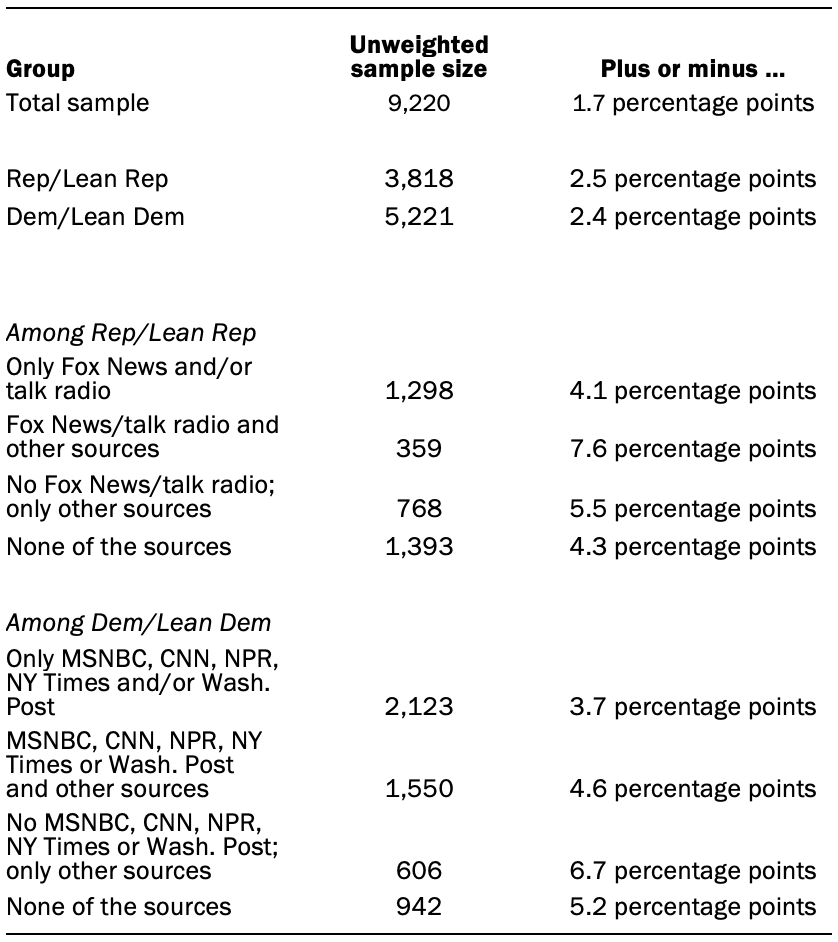
The following table shows the unweighted sample sizes and the error attributable to sampling that would be expected at the 95% level of confidence for different groups in the survey:

The unweighted sample sizes and the error attributable to sampling

Sample sizes and sampling errors for other subgroups are available upon request. In addition to sampling error, one should bear in mind that question wording and practical difficulties in conducting surveys can introduce error or bias into the findings of opinion polls.

© Pew Research Center, 2020