Pew Research Center

FOR RELEASE JUNE 12, 2020

Majorities of Americans Say News Coverage of George Floyd Protests Has Been Good, Trump’s Public Message Wrong

Among black adults, 72% say coverage has been good or excellent and 85% say Trump’s message has been completely or mostly wrong

BY Amy Mitchell, Mark Jurkowitz, J. Baxter Oliphant and Elisa Shearer

FOR MEDIA OR OTHER INQUIRIES:

Communications Department
202.419.4372
www.pewresearch.org

RECOMMENDED CITATION

Pew Research Center, June 2020, "Majorities of Americans Say News Coverage of George Floyd Protests Has Been Good, Trump’s Public Message Wrong"

About Pew Research Center

Pew Research Center is a nonpartisan, nonadvocacy fact tank that informs the public about the issues, attitudes and trends shaping the world. It does not take policy positions. The Center conducts public opinion polling, demographic research, computational social science research and other data-driven research. It studies politics and policy; news habits and media; the internet and technology; religion; race and ethnicity; international affairs; social, demographic and economic trends; science; research methodology and data science; and immigration and migration. Pew Research Center is a subsidiary of The Pew Charitable Trusts, its primary funder.

© Pew Research Center 2026

Table of contents

  • About Pew Research Center
  • Majorities of Americans Say News Coverage of George Floyd Protests Has Been Good, Trump’s Public Message Wrong
  • 1. About four-in-ten U.S. adults are following news about George Floyd protests very closely and discussing it with others often
  • 2. In protest response, Americans say Donald Trump’s message has been wrong, news media coverage good
  • 3. Large partisan divide on news media’s performance and the president’s message, smaller divide on attention to events
  • Acknowledgments
  • Methodology

Majorities of Americans Say News Coverage of George Floyd Protests Has Been Good, Trump’s Public Message Wrong

Among black adults, 72% say coverage has been good or excellent and 85% say Trump’s message has been completely or mostly wrong

How we did this

Pew Research Center’s American News Pathways project conducted this study to understand how Americans are engaging with and perceiving news coverage of the demonstrations to protest the death of George Floyd, a black man killed in police custody in Minneapolis.

For this analysis, we surveyed 9,654 U.S. adults between June 4-10, 2020. Everyone who completed the survey is a member of Pew Research Center’s American Trends Panel (ATP), an online survey panel that is recruited through national, random sampling of residential addresses. This way nearly all U.S. adults have a chance of selection. The survey is weighted to be representative of the U.S. adult population by gender, race, ethnicity, partisan affiliation, education and other categories. Read more about the ATP’s methodology.

See here to read more about the questions used for this report and the report’s methodology.

Visit our interactive data tool to access the questions included in this report, as well as content about the coronavirus outbreak and the 2020 presidential election.

The killing of George Floyd while in custody of Minneapolis police and the protests that ensued across the country have dominated news coverage that had for the past few months been consumed with the coronavirus pandemic.
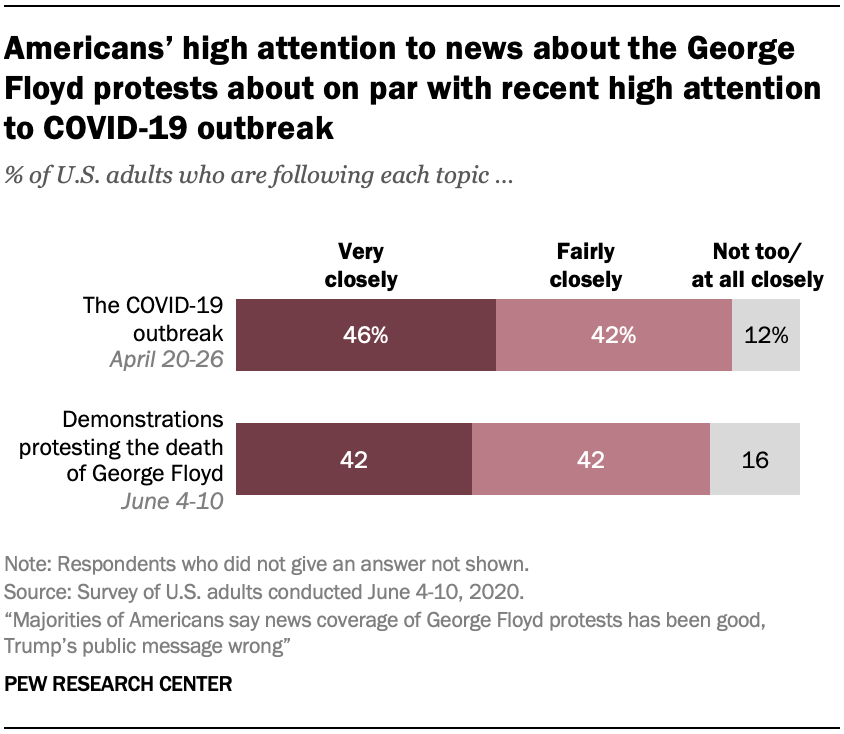
Americans’ high attention to news about the George Floyd protests about on par with recent high attention to COVID-19 outbreak

Americans have been following news of Floyd’s death and the demonstrations that followed nearly as closely as they had been keeping up with news related to COVID-19, and many are discussing it frequently with others, according to a new Pew Research Center survey of 9,654 U.S. adults on the American Trends Panel, conducted June 4-10, 2020,  as part of the Center’s American News Pathways project.
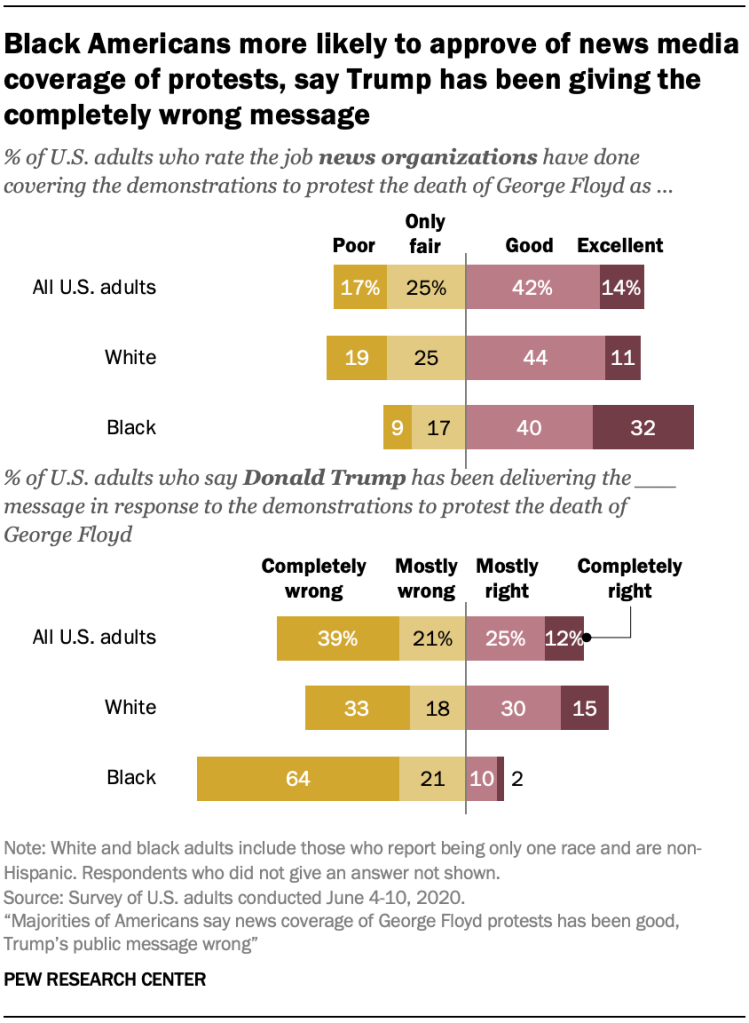
Black Americans more likely to approve of news media coverage of protests, say Trump has been giving the completely wrong message

Amid this intense interest, the public has differing assessments of the news media’s coverage and the message being delivered by their president. Fully six-in-ten U.S. adults say Donald Trump’s message in response to the protests has been wrong, including about four-in-ten (39%) who say it has been “completely” wrong. Fewer (37%) say his message has struck the right tone, with just 12% saying Trump has delivered the “completely” right message.

Related: Amid Protests, Majorities Across Racial and Ethnic Groups Express Support for the Black Lives Matter Movement

When it comes to news coverage of the demonstrations, on the other hand, more Americans offer a positive assessment than a negative one. Most U.S. adults (57%) say news organizations have done a “good” or “excellent” job, compared with 42% who give the news media an “only fair” or “poor” assessment.

Differences in the evaluations of Trump and the news media are particularly dramatic when it comes to black Americans. A full 85% say the message Trump has been putting out is mostly (21%) or completely wrong (64%), while only 13% say it is right. Conversely, about seven-in-ten black adults (72%) say the media have done a good or excellent job covering the demonstrations in the wake of George Floyd’s killing.

White Americans are more closely divided, though still give a more negative (52%) than positive (45%) assessment of Trump’s message, and a more positive (55%) than negative (44%) rating of media coverage of the protests.
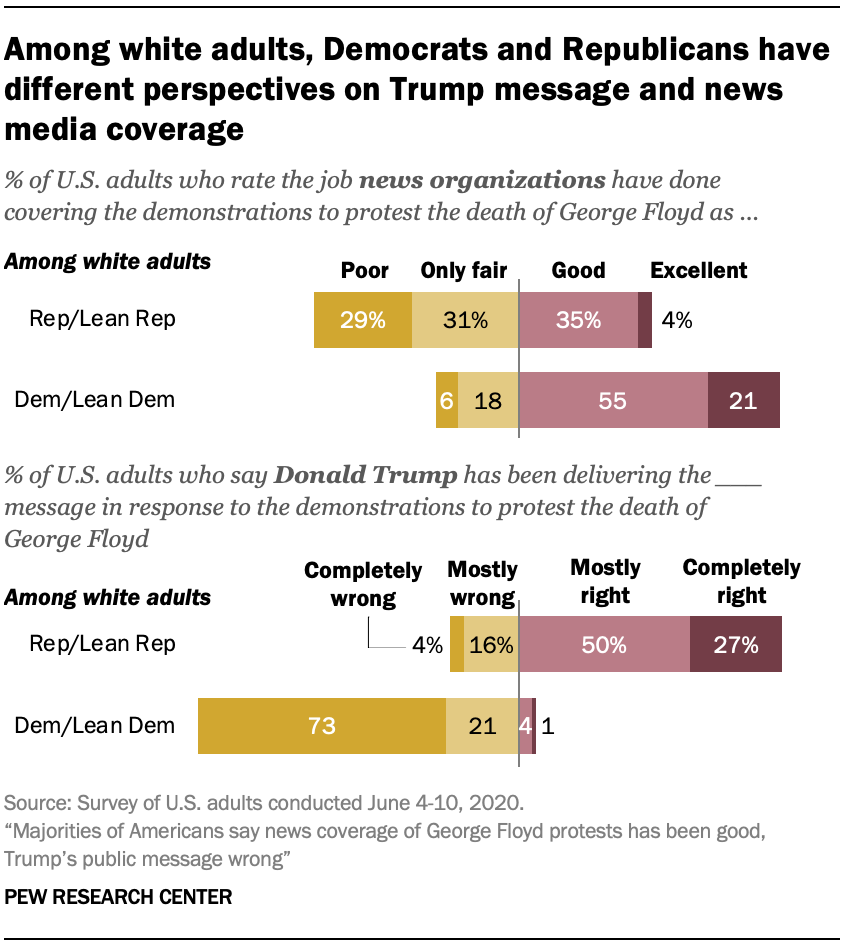
Among white adults, Democrats and Republicans have different perspectives on Trump message and news media coverage

Much of what divides white adults in this case is political.1 White Americans who are Democrats or lean Democratic and those who are Republicans or lean Republican express very different views on both Trump’s messaging and media coverage around the protests. A total of 76% of white Republicans say Trump’s message has been mostly or completely right, in contrast with almost unanimous agreement among white Democrats (94%) that it has been wrong (including almost three-quarters who say Trump’s stance has been completely wrong). And while 60% of white Republicans say the news media have been covering the protests only fairly or poorly, 76% of white Democrats say journalists have been doing a good or excellent job.

There are similar patterns by party affiliation overall – beyond differences among white adults. Democrats and those who lean Democratic, regardless of race or ethnicity, are more likely than Republicans and Republican leaners to be very closely following coverage of the demonstrations, and partisans have starkly different assessments of the media coverage and Trump’s message than Republicans.

On balance, Americans say too much news coverage has focused on acts of violence during protests, too little on nonviolent protests

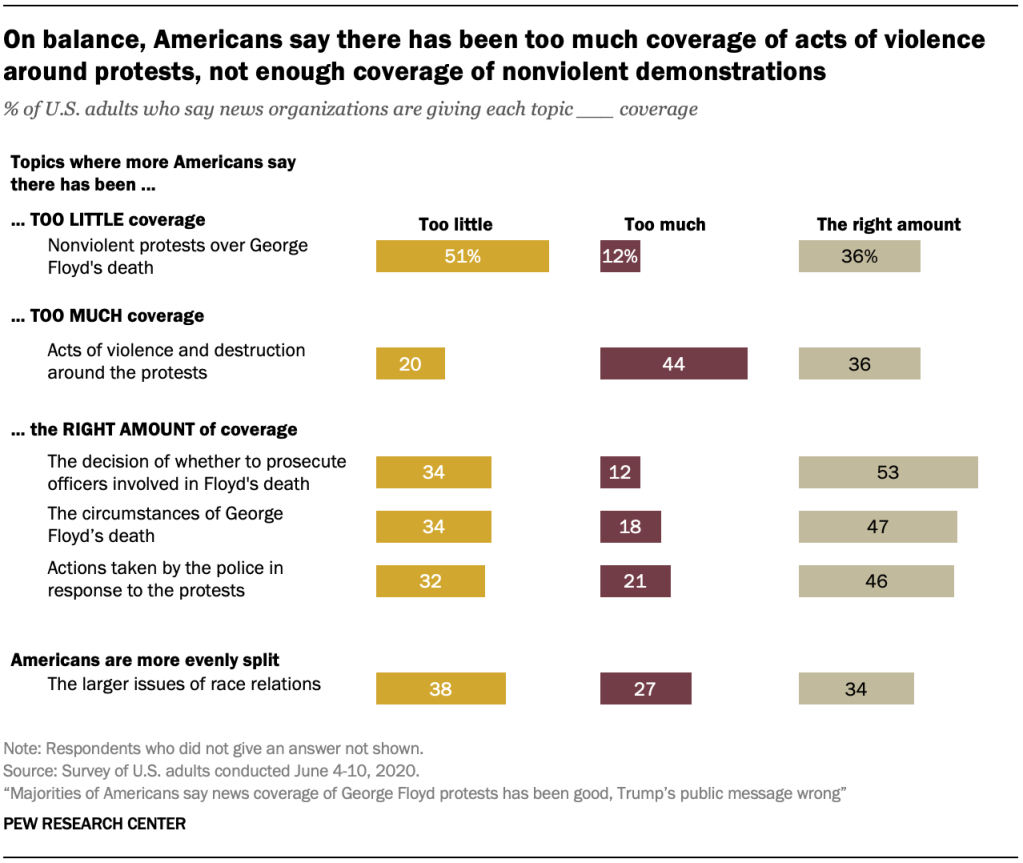
In addition to news media coverage overall, the study asked the public’s thoughts about the amount of coverage news organizations have devoted to six specific storylines related to the demonstrations. Acts of violence and destruction that have occurred around the protests is the only storyline of the six that a plurality of Americans say is receiving too much news coverage. More than four-in-ten U.S. adults (44%) say this element of the story is getting too much attention, compared with about half as many (20%) who say coverage is too light and 36% who say the level of coverage has been about right.

Conversely, about half of U.S. adults (51%) say nonviolent protests are getting too little coverage, with another 36% saying they are getting the right amount of coverage and far fewer (12%) who say there has been too much coverage of nonviolent demonstrations.

Roughly half of Americans say the level of coverage has been appropriate on three topics: the decision of whether to prosecute the officers involved in George Floyd’s death (53%), the death of Floyd himself (47%) and the actions taken by the police and National Guard in response to the protests (46%). In each case, more Americans say these stories have been getting too little coverage rather than too much.
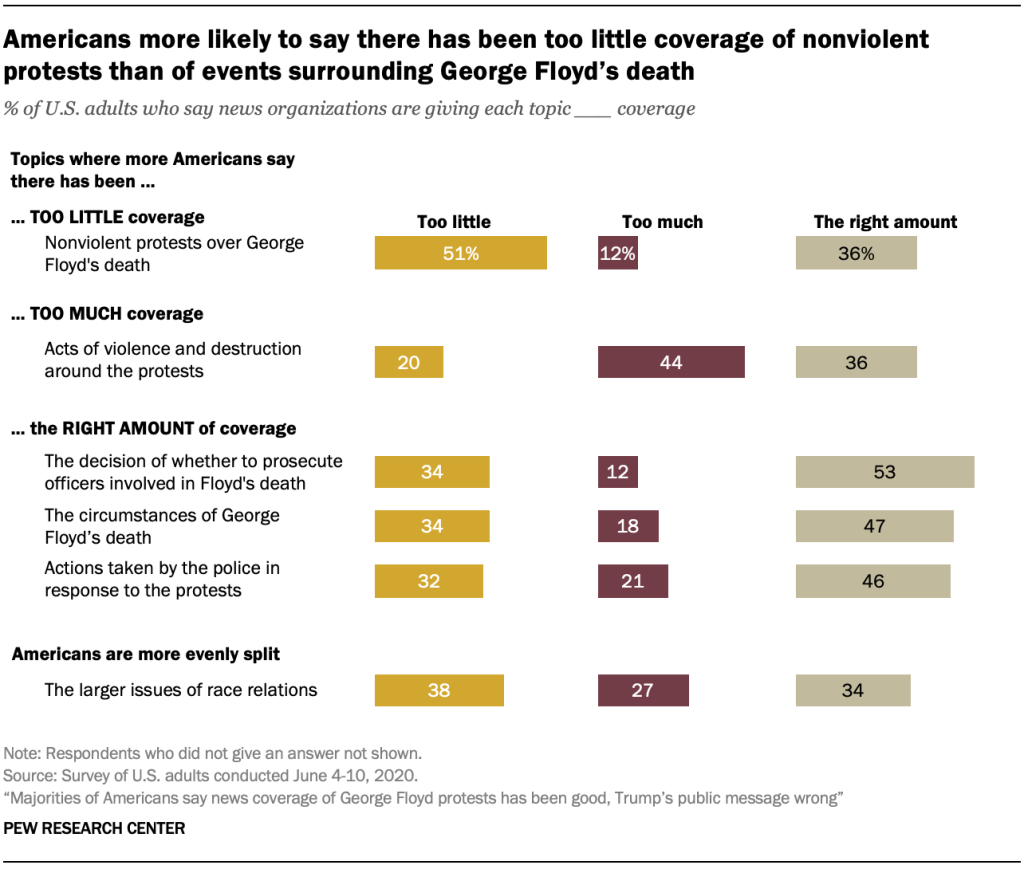
Americans more likely to say there has been too little coverage of nonviolent protests than of events surrounding George Floyd’s death

Black and white adults offer varying perspectives on the amount of coverage the news media are giving to some of the storylines. For example, about half of black adults (51%) say there has been too little coverage of the decisions around whether to prosecute Minneapolis police officers for Floyd’s killing, while just 28% of white Americans agree.

Black and white adults vary on opinions of news coverage of several aspects of the protests

A similar gap exists on the larger issue of race relations – 55% of black Americans say that subject has not been receiving enough attention, compared with 33% of white Americans who say the same. Among white adults, there are large differences between Democrats and Republicans on this question. About half of white Democrats (51%) and just 19% of white Republicans say that broader subject of race relations has not gotten enough coverage; meanwhile, 50% of white Republicans say it has gotten too much attention, compared with only 9% of white Democrats.

There is no consensus among Americans overall about news media coverage of race relations more broadly: 38% say there has been too little, 27% say there has been too much, and 34% say there has been about the right amount.

Young adults stand out for discussing the protests more than older adults, being particularly negative on Trump’s message and wanting more coverage of most issues

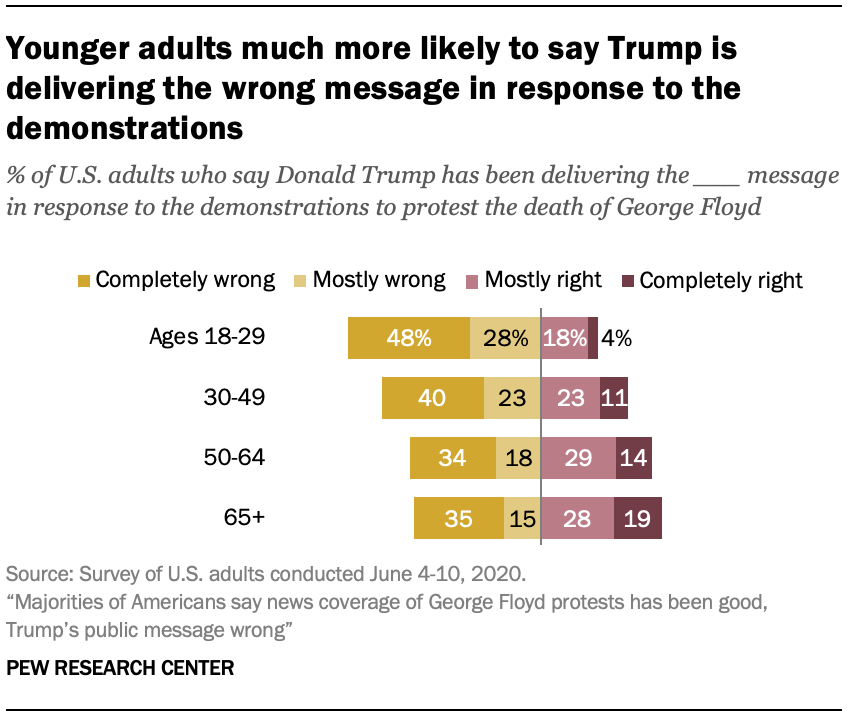
In evaluating responses to the events surrounding George Floyd’s death by age, one group clearly stands out — America’s youngest adults. They give Trump’s public response the most negative assessment of any age group, with 76% saying he is delivering a mostly or completely wrong message on the demonstrations. That contrasts with the 49% of Americans 65 and older who offer the same evaluation.

Younger Americans give more negative ratings of Trump’s message, news media coverage of protests

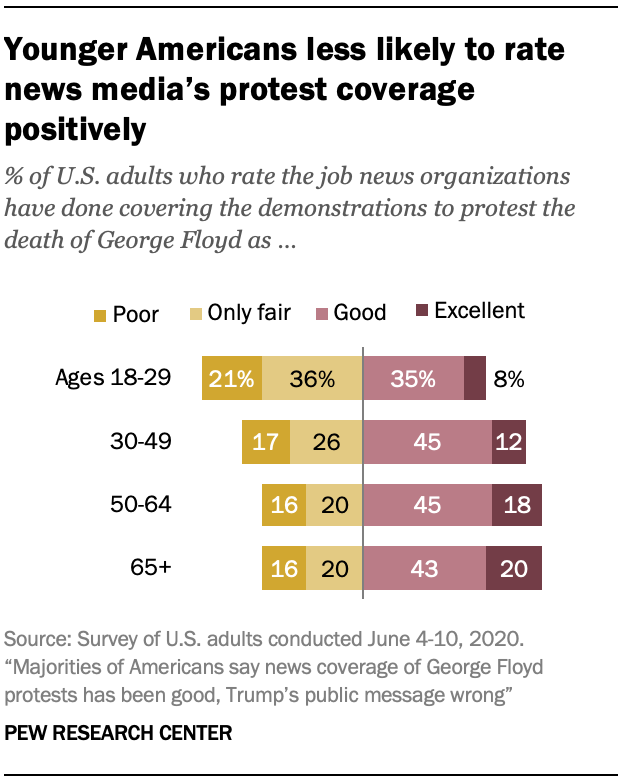
At the same time, adults under 30 also are more critical of the news media’s coverage than any other age group, with 43% rating it as excellent or good and 56% giving it a fair or poor grade. Among older Americans, majorities give the news media a positive assessment.
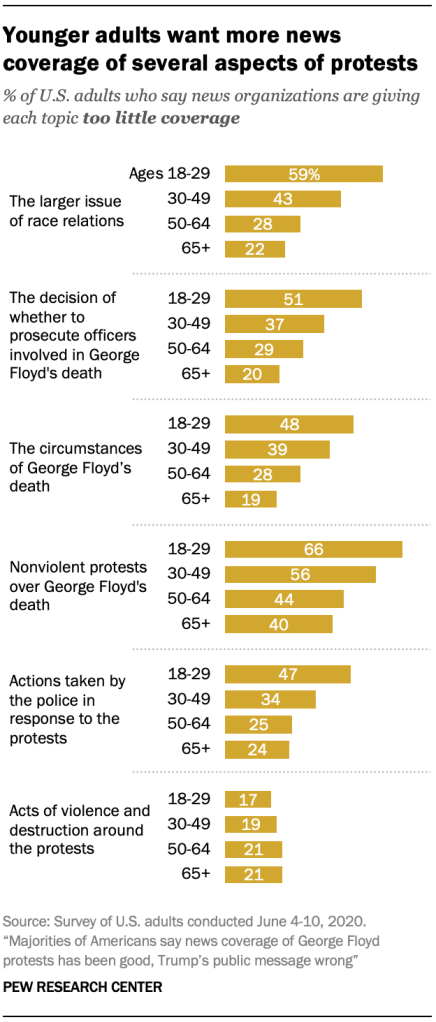
Younger adults want more news coverage of several aspects of protests

That negative assessment of the news coverage from young adults may be connected to their view that a number of important storylines have not been getting enough media attention. Americans ages 18 to 29 are more likely than their elders to say five of the six storylines explored in the survey have received insufficient coverage. That includes 66% who say there has been too little coverage of nonviolent protests and 59% who say the larger issue of race relations is not getting enough attention.

The only exception is the question about violence surrounding the protests: About one-in-five adults under 30 say the news media should be covering this more, similar to other age groups.

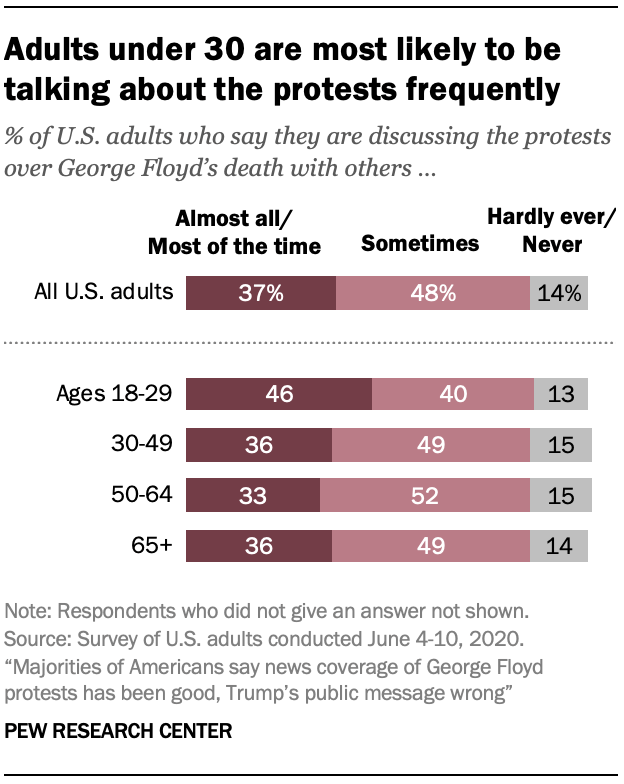
And in keeping with their overall news media consumption habits, Americans 65 and older comprise the age group most likely to follow the demonstrations very or fairly closely (90%). But it is 18- to 29-year-olds who are most likely to be discussing them with others – nearly half (46%) say they discuss the protests almost all of the time or most of the time.

1. About four-in-ten U.S. adults are following news about George Floyd protests very closely and discussing it with others often

Most Americans are following news about the nationwide demonstrations to protest the death of George Floyd, a black man killed while in Minneapolis police custody. More than eight-in-ten U.S. adults say they are following the story “very” (42%) or “fairly” closely (42%), while far fewer say they are following it “not too” (14%) or “not at all” closely (3%). The levels of interest in the protests nearly match the shares of Americans who were following news about the coronavirus outbreak in late April, before Floyd’s death.2

Interest in news about the protests over George Floyd’s death is high across all racial and ethnic groups studied. Around eight-in-ten white (83%), Hispanic (82%) and Asian adults (84%) are following the protests very or fairly closely.3 And about nine-in-ten black adults (89%) are following at least fairly closely, including a majority of blacks (61%) who say they are following this news very closely.

While partisan differences often emerge among white adults, interest is high among both white Americans who identify with or lean toward the Democratic Party and white Republicans and Republican leaners. About eight-in-ten or more white Democrats and white Republicans are following the protests at least fairly closely, though white Democrats are more likely than white Republicans to be following the story very closely (48% vs. 34%).

Oldest Americans paying more attention to news about the protests

As seen in news habits more broadly, the oldest group of Americans are more engaged with the story than younger Americans. Fully nine-in-ten U.S. adults ages 65 and older (90%) say they are following it at least fairly closely – including half who say they are following it very closely. Adults ages 18 to 29, 30 to 49, and 50 to 64 are somewhat less engaged; still, large majorities of all these groups say they are following the protests.

Black Americans, young adults most likely to talk to others about the protests

Majority of black Americans say they are talking about the protests most or all of the time

In addition to following the news closely themselves, most Americans are spending time talking with others about the protests over George Floyd’s death. Roughly four-in-ten U.S. adults (37%) say they are talking about it “almost all” or “most” of the time. Another 48% say they “sometimes” discuss it with others, while just 14% “hardly ever” or “never” discuss it.

The protests are a more common topic of conversation for black Americans than other racial and ethnic groups. A majority of black adults (59%) say they are discussing the protests with others at least most of the time, including 30% who say they are talking about them almost all of the time. Fewer white adults, 33% in all, say they are talking with others about the story almost all (8%) or most (25%) of the time. Hispanic and Asian Americans fall in between blacks and whites – about four-in-ten in each ethnic group are talking frequently about the protests.

Just as they are following the story of the protests more closely, white Democrats are more likely than white Republicans to discuss the protests with others. About four-in-ten white Democrats (42%) say they are discussing the story all or most of the time, compared with 27% of white Republicans.

Adults under 30 are most likely to be talking about the protests frequently

While adults ages 65 and older are the most likely to follow news about the protests over Floyd’s death, it is the youngest adults, ages 18 to 29, who report talking about the protests with others most often.

Slightly less than half of adults ages 18 to 29 (46%) say the protests come up almost all the time or most of the time in their conversations. The share saying the same is about 10 percentage points lower in each of the other age groups.

2. In protest response, Americans say Donald Trump’s message has been wrong, news media coverage good

Amid close attention to the news surrounding the death of George Floyd and ensuing protests, a majority of the public says Donald Trump’s messaging about the demonstrations has been wrong, while a similar portion says the news media’s coverage of the protests has been good.

Six-in-ten Americans say Trump has been delivering the wrong message to the country in response to the protests, including about four-in-ten (39%) who say his messaging has been “completely” wrong and 21% who say it has been “mostly” wrong. Fewer (37%) say his message has been right, including just 12% who say it has been “completely” right.

Overall, 85% of black Americans say Trump has delivered the wrong message, including nearly two-thirds (64%) who say his message has been completely wrong. Just 13% of black Americans say Trump has delivered the right message (with a mere 2% who say his message has been completely right). Hispanic and Asian Americans give almost as negative an assessment, with about seven-in-ten or more in each group saying Trump has been delivering the wrong message.

White Americans also are more likely than not to say Trump’s message has been wrong, though by a much smaller margin. About half of white Americans (52%) say his message about the protests has been mostly or completely wrong, compared with 45% who say the message has been right.

Among white adults, there is a stark divide by party. Fully 94% of white Democrats (including self-described independents who lean Democratic) say Trump has been delivering the wrong message about the protests, while 76% of white Republicans say Trump has delivered the right message. Still, white Democrats are more than twice as likely to say Trump’s message has been completely wrong (73%) than white Republicans are to say the president has been completely right (27%).

Younger adults much more likely to say Trump is delivering the wrong message in response to the demonstrations

The youngest U.S. adults, those ages 18 to 29, have the harshest assessment of the message Trump has been delivering about the protests. About three-quarters (76%) of those ages 18 to 29 say his message has been wrong, including close to half (48%) who say it has been completely wrong. Just 22% say it has been right.

Americans ages 65 and older, meanwhile, are evenly divided between those who say Trump’s message has been wrong (49%) and those who say it has been right (47%).

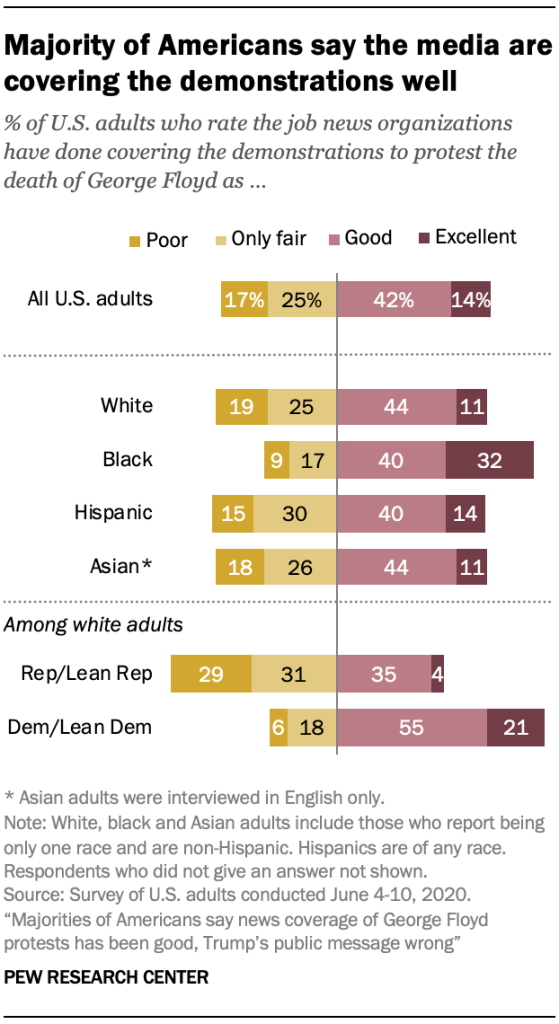
Majority of Americans say the media are covering the demonstrations well

The public’s negative view of Trump’s public statements stands in contrast to its more positive assessment of media coverage of the recent protests. Overall, 57% of U.S. adults say the news media have done an “excellent” (14%) or “good” (42%) job of covering the demonstrations to protest the death of George Floyd. About four-in-ten say the media have done an “only fair” (25%) or “poor” (17%) job.

Black Americans give a particularly strong assessment of news coverage, which is in stark contrast to their rejection of Trump’s message. Fully 72% of black adults say the news media have done at least a good job, including about a third (32%) who say they have done an excellent job. By contrast, in a telephone survey conducted in 2015 about the demonstrations to protest the death of Freddie Gray, a black man who died in police custody in Baltimore, just 11% of black adults said the news media had done an excellent job covering the story; another 35% said at the time it had done a good job. (Overall, the public generally gave the news media less positive ratings in 2015.)

White Americans also give more positive than negative assessments of news coverage, with 55% saying the news media have done a good or excellent job and 44% rating their performance as fair or poor. But as seen in the assessment of Trump’s public messaging on the issue, strong party divides exist among white Americans. While 76% of white Democrats say the news media have been doing well covering the protests, about half as many white Republicans say the same (39%). Instead, a majority of white Republicans say the media have been doing a fair (31%) or poor (29%) job.

Hispanic and Asian Americans fall a little closer to white Americans in their assessment of media coverage, with small majorities saying the news media are doing at least a good job covering the protests.

Younger Americans less likely to rate news media’s protest coverage positively

Young adults exhibit a more critical eye toward news coverage of the protests than their elders – although they are not as negative toward the news media as they are toward Trump. Still, a majority of 18- to 29-year-olds (56%) say the media coverage of the protests has been only fair or poor, compared with 43% who say it has been good or excellent. Among all other age groups, majorities give a positive rather than negative assessment.

Half of Americans say demonstrations have gotten the right amount of attention; about four-in-ten say there is too much focus on the protests

About two-thirds of black Americans say the protests have been getting the right amount of attention

All in all, half of Americans say the demonstrations protesting the death of George Floyd have been getting the right amount of attention. The remainder is much more likely to say the demonstrations have gotten too much attention (38%) as opposed to too little (11%).

Black Americans are more likely to approve of the level of attention given to Floyd’s death and the following protests, with 67% saying the demonstrations have gotten the right amount of attention. In contrast with the general public, black adults are more likely to say the protests have gotten too little attention (21%) rather than too much (11%). White adults, meanwhile, are five times as likely to say the protests have gotten too much attention (43%) as they are to say too little (8%).

Again, there is a strong partisan divide among whites. About seven-in-ten white Democrats (71%) say the demonstrations have gotten the right amount of attention, while a similarly large share of white Republicans (65%) say they have gotten too much attention.

Older Americans also are more likely than young adults to say too much attention has been paid to the protests.

The survey also asked a series of questions about whether news organizations specifically are giving too much coverage, not enough coverage or about the right amount of coverage to several aspects of the broader story surrounding Floyd’s death.

Acts of violence and destruction that have occurred around the protests are the only storyline of the six that a plurality of Americans say is receiving too much coverage. More than four-in-ten U.S. adults (44%) say this element of the story is getting too much coverage, compared with about half as many (20%) who say coverage is too light and 36% who say the level of coverage has been about right.

Conversely, about half of U.S. adults (51%) say nonviolent protests are getting too little coverage, with another 36% saying they are getting the right amount of coverage and far fewer (12%) saying there has been too much.

During the time the survey was conducted (June 4-10), roughly half of Americans said the level of coverage was appropriate on three topics: the decision of whether to prosecute the officers involved in George Floyd’s death (53%), circumstances surrounding the death of Floyd himself (47%) and the actions taken by police in response to the protests (46%). In each case, more Americans say these stories have been getting too little coverage rather than too much.

U.S. adults are less likely to say larger issues of race relations are getting about the right amount of coverage (34%). But there is no strong consensus on what the media should be doing: 38% say there has not been enough coverage given to race relations more broadly, while 27% say there has been too much coverage.

On balance, Americans say there has been too much coverage of acts of violence around protests, not enough coverage of nonviolent demonstrations

Black Americans say decision about prosecuting Minneapolis officers and larger issue of race relations should get more coverage

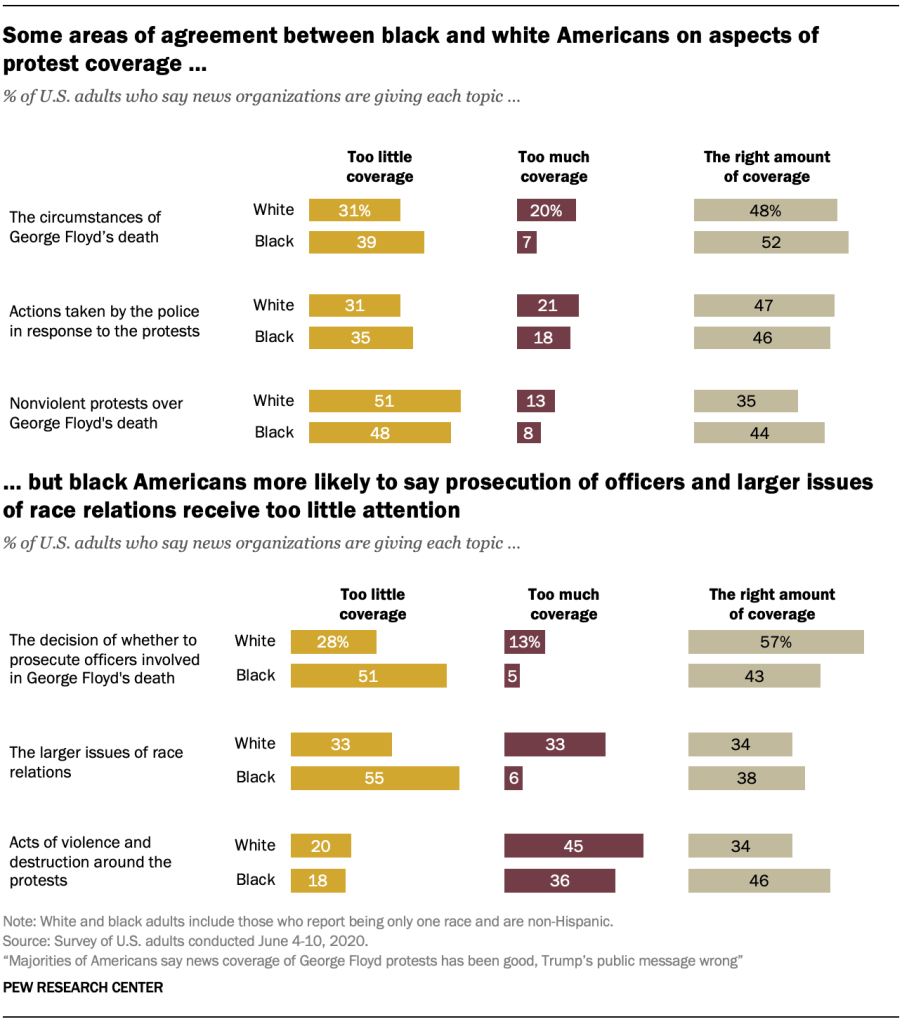
Black and white Americans express some general agreement in the level of attention the news media have been giving to some elements of the story. But black Americans are more likely than white Americans to say too little coverage is being given to the decision of whether to prosecute the officers involved in George Floyd’s death and to the issue of race relations more broadly. White adults, on the other hand, are more likely to say too much coverage is going to the acts of violence and destruction during protests.

The two storylines where black and white Americans express the most similar sense of coverage are the death of Floyd itself and police actions in response to protests. Close to half of both groups say the amount of coverage in these areas has been about right. And among those who say it hasn’t been right, larger portions of each group say there has been too little coverage as opposed to too much.

Similarly, about half of both black (48%) and white (51%) Americans say the news media have produced too little coverage of nonviolent protests. Black adults are somewhat more likely than white adults to say the level of coverage has been about right (44% vs. 35%), but only small minorities of each group say there has been too much coverage.

The two angles where black and white adults diverge the most are the decision of whether to prosecute the officers involved in Floyd’s death and the larger issue of race relations. Half or more of black Americans say the news media are giving too little coverage to each of these issues, with most of the remainder saying the level of coverage has been about right and very few saying there has been too much coverage. On the other hand, only 28% of white Americans say there has been too little coverage of whether to prosecute the officers; a majority of whites (57%) say the level of coverage has been about right. When it comes to coverage of race relations more broadly, white Americans are about equally likely to say the media’s level of coverage has been about right (34%), too great (33%) or too small (33%).

Black and white Americans also express somewhat different views about the level of attention given to the violent aspects of the protests. In this case, white Americans are more likely than black Americans to say there has been too much coverage of violence surrounding the protests (45% vs. 36%). Still, both black and white adults are more likely to say there has been too much coverage of this, rather than too little.

Some areas of agreement between black and white Americans on aspects of protest coverage …

Here again, some partisan differences emerge among white adults. The angle where views vary the most is in coverage of the larger issues of race relations: Fully half of white Republicans say there has been too much coverage of the larger issues of race relations, while only 9% of white Democrats agree. Instead, roughly half of white Democrats (51%) say there has been too little coverage of race relations more broadly (compared with 19% of white Republicans who feel this way).

Differences also arise in the level of coverage given to the circumstances surrounding George Floyd’s death. A solid majority of white Democrats (61%) feel the level of coverage has been right, followed by 30% who say there has been too little coverage and just 9% who say there has been too much. White Republicans, meanwhile, are much less likely than white Democrats to say the level of coverage of Floyd’s death has been about right (39%) and much more likely to say there has been too much coverage (28%).

White Republicans are more likely than white Democrats to say that there has been too little coverage of violence surrounding the protests (28% vs. 10%), while white Democrats are more likely to say the coverage of this has been about right (46% vs. 25%). Still, a plurality of white Republicans (47%) say there has been too much coverage of violent acts.

White Democrats and white Republicans largely agree that there has been too little media coverage of the nonviolent protests and about the right amount of coverage about the decision of whether to prosecute the police officers involved in Floyd’s death.

Partisan differences across all U.S. adults are discussed in Chapter 3.

Among white adults, many Republicans say news media have given larger issues of race relations too much coverage, but few Democrats agree

Young adults most likely to say there has been too little coverage of nearly all storylines

Younger adults consistently more likely to think too little coverage is given to various aspects of protests

Some of the most consistent disagreement on the level of attention the news media have been giving different elements of the events around Floyd’s death is between younger and older Americans.

On five of the six topics asked about in the survey, U.S. adults under 30 are more likely than all other age groups to say that they received too little coverage. There are particularly large divides between the oldest and youngest Americans: those 18 to 29 are more than twice as likely as those 65 and older to say there has been too little coverage of the larger issue of race relations (59% vs. 22%), the decision of whether to prosecute the officers involved in Floyd’s death (51% vs. 20%) and the circumstances surrounding Floyd’s death (48% vs. 19%).

About two-thirds (66%) of the youngest adults, along with 56% of those ages 30 to 49, say there has been too little coverage of the nonviolent protests, compared with fewer than half of those ages 50 to 64 (44%) and 65 and older (40%). Additionally, 47% of those ages 18 to 29 say that the news media are giving too little coverage to actions by the police and National Guard in response to the protests, higher than any of the older age groups.

The only topic that does not follow this pattern is coverage of acts of violence and destruction around the protests. Younger adults are slightly more likely than their elders to say that there has been too much coverage of violence and destruction.

3. Large partisan divide on news media’s performance and the president’s message, smaller divide on attention to events

Reactions to the events surrounding and following the death of George Floyd also have some significant differences by party and party affiliation across U.S. adults overall. This analysis offers a look at differences by party overall, a lens used for much of the Center’s work connected to the American News Pathways project.

By several measures, Democrats and those who lean Democratic are more closely following and more engaged with the news surrounding Floyd’s killing than Republicans and those who lean Republican. Wide partisan gaps emerge between members of the two parties when evaluating the performance of the news media and Donald Trump’s response to the protests. And there are also differences between Republicans and Democrats on their evaluations of the amount of media coverage devoted to several key storylines, most notably the broader issue of race relations in the country.

Democrats more likely to follow and discuss news of the demonstrations

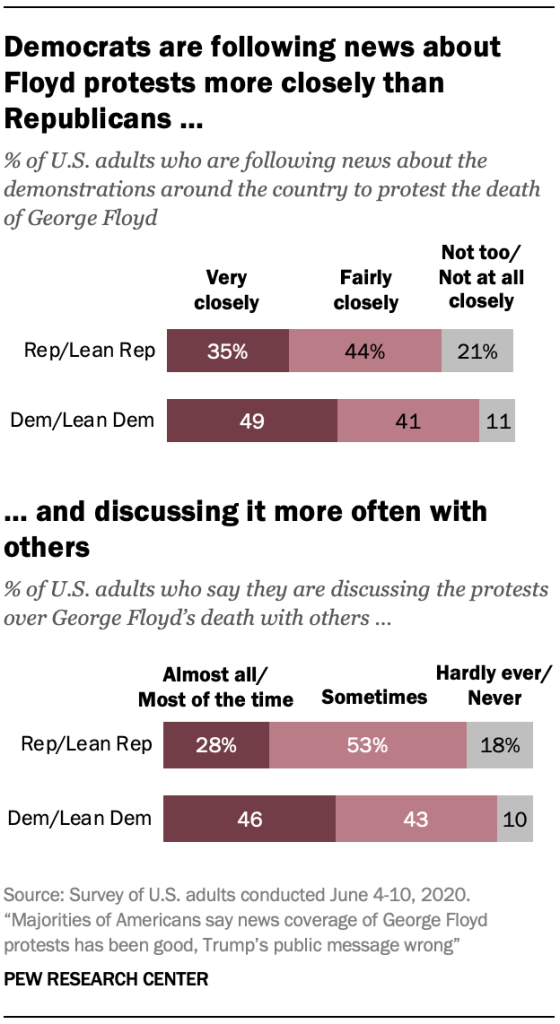
Democrats are following news about Floyd protests more closely than Republicans …

Democrats and Democratic-leaning independents outpace Republicans and Republican leaners on the overall question of how intently they are following news of the demonstrations to protest Floyd’s death. About half of Democrats (49%) say they are very closely following these events, compared with 35% of Republicans. Still, vast majorities of both groups are following this news at least fairly closely (89% of Democrats and 79% of Republicans).

There is also a gap between Democrats and Republicans when it comes to discussing the protests and demonstrations with others. Somewhat less than half of Democrats (46%) – compared with 28% of Republicans – say they are discussing the protests with others almost all or most of the time.

Democrats and Republicans offer dramatically different assessments of news coverage and Trump statements about the protests

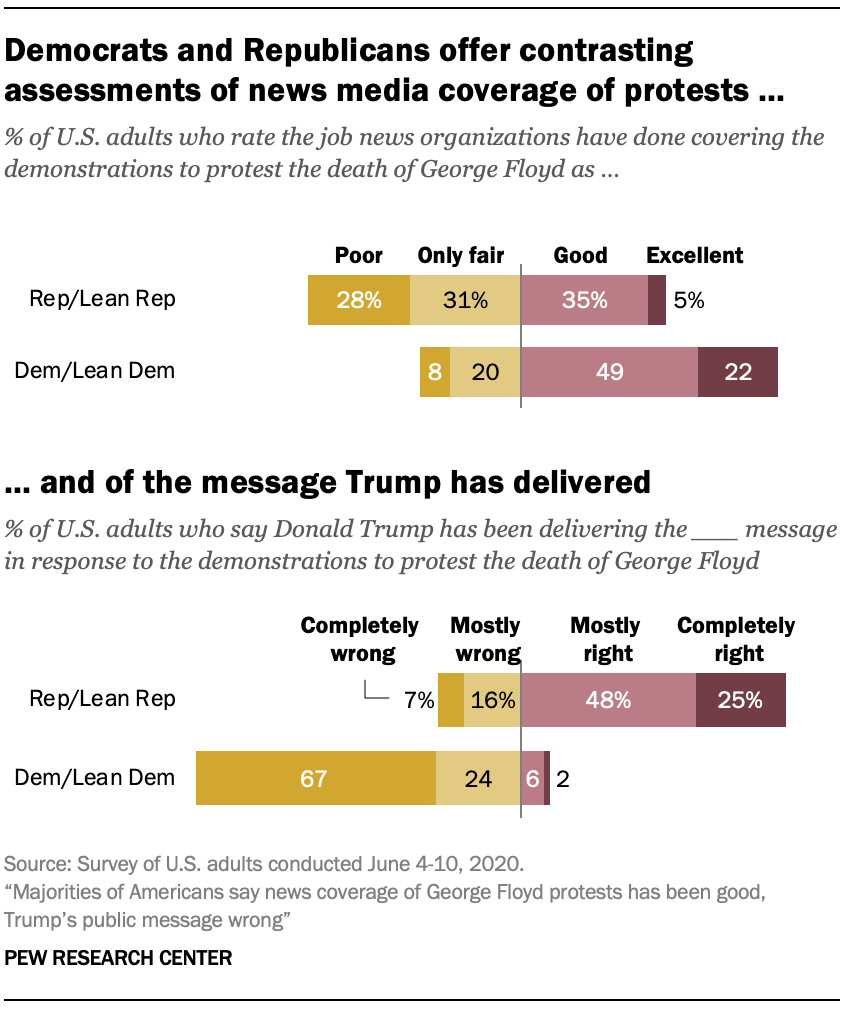
Democrats and Republicans offer contrasting assessments of news media coverage of protests …

Roughly seven-in-ten Democrats and Democratic leaners (71%) say news organizations have done a good (49%) or excellent (22%) job covering these events. But among Republicans and Republican leaners, the number awarding good or excellent assessments of the news media’s coverage falls to 40%, while 58% give the coverage a fair or poor evaluation.

The differences are even more stark on assessments of the message delivered by Donald Trump during the protests. While 73% of Republicans say his message has been completely or mostly right, only 8% of Democrats agree. Instead, the vast majority of Democrats (91%) say Trump’s message has been wrong, including about two-thirds (67%) who say he has delivered a completely wrong message – a sentiment shared by just 7% of Republicans.

Republicans and Democrats also have very different views of the attention the protests are receiving. A majority of Republicans (63%) say the demonstrations to protest George Floyd’s death have been getting too much attention; just 16% of Democrats say the same. Conversely, 66% of Democrats say the amount of attention being paid to these events is appropriate, a sentiment shared by about half as many Republicans (32%).

When asked about media attention to specific aspects of the coverage of the demonstrations, partisan differences vary, depending on the topic.

No storyline asked about generates more partisan disagreement than coverage devoted to the larger issue of race relations surrounding the killing of George Floyd and the subsequent protests.

Nearly half of Republicans (47%) say that subject has gotten too much media attention, but only one-in-ten Democrats (10%) agree with that statement. Conversely, about half of Democrats (52%) say the news media have given the topic too little attention, a view that is shared by only 21% of Republicans.

While 55% of Democrats say the news media are paying the right amount of attention to the circumstances surrounding Floyd’s death, fewer Republicans (39%) agree. Democrats also are more likely than Republicans to say that the media are devoting the right amount of coverage to acts of violence and destruction around the protests (44% vs. 25%, respectively), although substantial segments of both parties (46% of Republicans and 43% of Democrats) say there has been too much coverage of this violence.

For several storylines, broadly similar shares of both parties the amount of news media attention is about right. For example, 42% of Republicans and 48% of Democrats say that the actions of the police and National Guard are receiving the right amount of attention. That’s the case even though about twice as many Republicans (28%) as Democrats (15%) say journalists have devoted too much coverage to that storyline.

Similarly, 52% of Republicans and 53% of Democrats agree the news media have paid the proper amount of attention to the decision about whether to prosecute the Minneapolis police officers involved in George Floyd’s death. Again, however, Republicans are more likely than Democrats, by a margin of 19% to 7%, to say there has been too much focus on that storyline.

Democrats (55%) and Republicans (48%) also largely agree that there has been too little attention paid to the nonviolent protests by demonstrators, though more Republicans (20%) than Democrats (6%) say the media have spent too much time on that aspect of the story.

Republicans and Democrats disagree on the amount of attention the news media should give to larger issues of race relations

Acknowledgments

The Election News Pathways project was made possible by The Pew Charitable Trusts. Pew Research Center is a subsidiary of The Pew Charitable Trusts, its primary funder. This initiative is a collaborative effort based on the input and analysis of the following individuals. Find related reports online at https://alpha.pewresearch.org/pewresearch-org/topics/election-news-pathways/.

Research Team

Amy Mitchell, Director, Journalism Research Baxter Oliphant, Senior Researcher Katerina Eva Matsa, Associate Director, Journalism Research Elisa Shearer, Research Associate Mason Walker, Research Analyst Mark Jurkowitz, Senior Writer Michael Lipka, Editorial Manager, Religion Research Michael Barthel, Senior Researcher Jeffrey Gottfried, Senior Researcher Galen Stocking, Computational Social Scientist Maya Khuzam, Research Assistant Kirsten Worden, Research Assistant Andrew Mercer, Senior Research Methodologist Dorene Asare Marfo, Survey Research Methodologist Scott Keeter, Senior Survey Advisor Claudia Deane, Vice President, Research Nick Bertoni, Panel Manager Courtney Kennedy, Director, Survey Research

Editorial and Graphic Design

David Kent, Copy Editor Margaret Porteus, Information Graphics Designer Alissa Scheller, Information Graphics Designer Peter Bell, Design Director Andrea Caumont, Digital Engagement Manager John Gramlich, Senior Writer/Editor Bruce Drake, Senior Editor

Communications and Web Publishing

Rachel Weisel, Senior Communications Manager Hannah Klein, Communications Manager Calvin Jordan, Communications Associate Andrew Grant, Communications Associate Sara Atske, Associate Digital Producer Shannon Greenwood, Digital Producer Stacy Rosenberg, Associate Director, Digital Seth Rubenstein, Lead Web Developer Benjamin Wormald, Web Developer Carrie Elizabeth Blazina, Associate Digital Producer Kelly Browning, User Experience Manager Michael Piccorossi, Director, Digital Strategy

Methodology

The American Trends Panel survey methodology

The American Trends Panel (ATP), created by Pew Research Center, is a nationally representative panel of randomly selected U.S. adults. Panelists participate via self-administered web surveys. Panelists who do not have internet access at home are provided with a tablet and wireless internet connection. The panel is being managed by Ipsos.

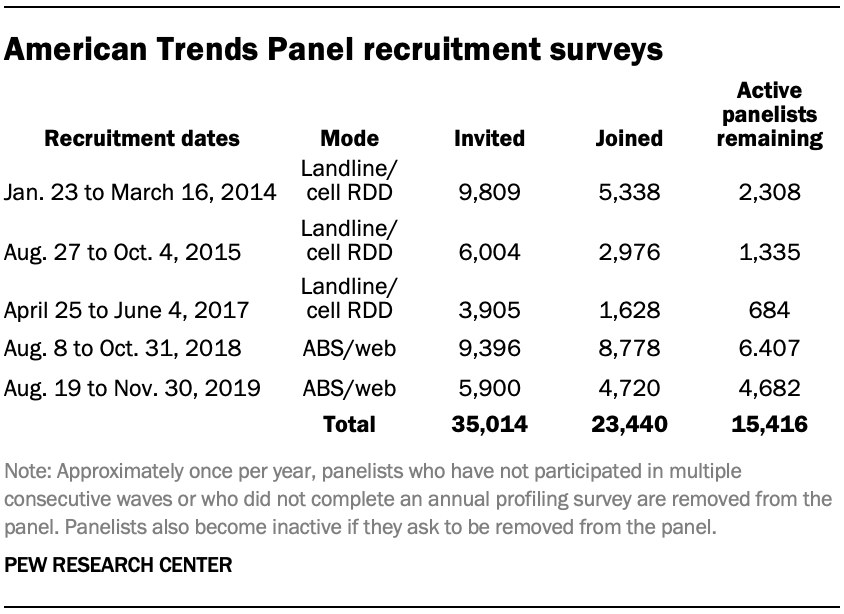
American Trends Panel recruitment surveys

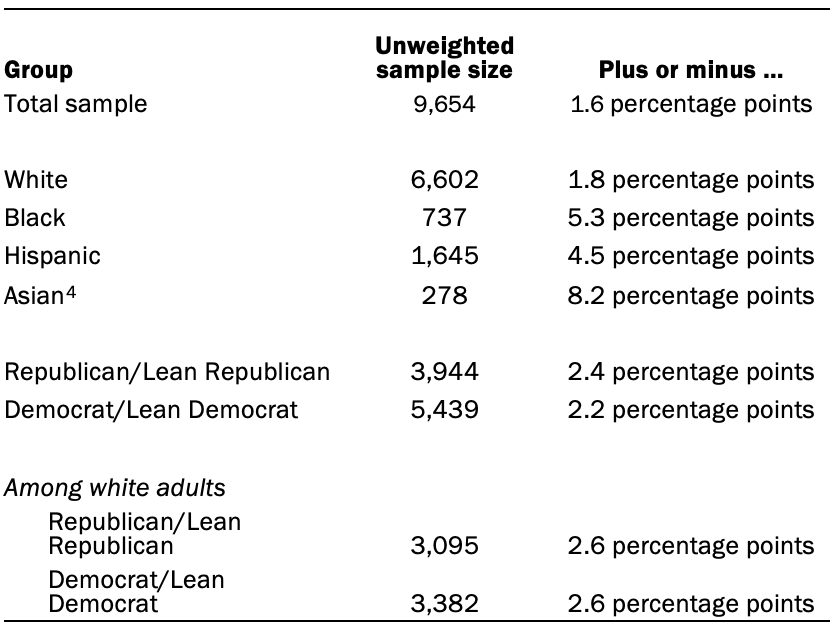
Data in this report is drawn from the panel wave conducted June 4 to June 10, 2020. A total of 9,654 panelists responded out of 11,013 who were sampled, for a response rate of 88%. This does not include two panelists who were removed from the data due to extremely high rates of refusal or straightlining. The cumulative response rate accounting for nonresponse to the recruitment surveys and attrition is 4.7%. The break-off rate among panelists who logged on to the survey and completed at least one item is 1.6%. The margin of sampling error for the full sample of 9,654 respondents is plus or minus 1.6 percentage points.

The subsample from the ATP consisted of 11,013 ATP members that responded to the Wave 57 survey and were still active.

The ATP was created in 2014, with the first cohort of panelists invited to join the panel at the end of a large, national, landline and cellphone random-digit-dial survey that was conducted in both English and Spanish. Two additional recruitments were conducted using the same method in 2015 and 2017, respectively. Across these three surveys, a total of 19,718 adults were invited to join the ATP, of which 9,942 agreed to participate.

In August 2018, the ATP switched from telephone to address-based recruitment. Invitations were sent to a random, address-based sample (ABS) of households selected from the U.S. Postal Service’s Delivery Sequence File. In each household, the adult with the next birthday was asked to go online to complete a survey, at the end of which they were invited to join the panel. For a random half-sample of invitations, households without internet access were instructed to return a postcard. These households were contacted by telephone and sent a tablet if they agreed to participate. A total of 9,396 were invited to join the panel, and 8,778 agreed to join the panel and completed an initial profile survey. The same recruitment procedure was carried out on August 19, 2019, from which a total of 5,900 were invited to join the panel and 4,720 agreed to join the panel and completed an initial profile survey. Of the 23,440 individuals who have ever joined the ATP, 15,416 remained active panelists and continued to receive survey invitations at the time this survey was conducted.

Weighting dimensions

The U.S. Postal Service’s Delivery Sequence File has been estimated to cover as much as 98% of the population, although some studies suggest that the coverage could be in the low 90% range.3  The American Trends Panel never uses breakout routers or chains that direct respondents to additional surveys.

Weighting

The ATP data was weighted in a multistep process that begins by calibrating the entire panel so that it aligns with the population benchmarks identified in the accompanying table to create a full-panel weight. For ATP waves in which only a subsample of panelists are invited to participate, a wave-specific base weight is created by adjusting the full-panel weights for subsampled panelists to account for any differential probabilities of selection for the particular panel wave. For waves in which all active panelists are invited to participate, the wave-specific base weight is identical to the full-panel weight. The next step in the weighting uses an iterative technique that aligns the sample to population benchmarks on the dimensions listed in the accompanying table.

Sampling errors and test of statistical significance take into account the effect of weighting. Interviews are conducted in both English and Spanish.

In addition to sampling error, one should bear in mind that question wording and practical difficulties in conducting surveys can introduce error or bias into the findings of opinion polls.

The following table shows the unweighted sample sizes and the error attributable to sampling that would be expected at the 95% level of confidence for different groups in the survey:

The unweighted sample sizes and the error attributable to sampling that would be expected at the 95% level of confidence for different groups in the survey

Sample sizes and sampling errors for other subgroups are available upon request.4

A note about the Asian American sample

This survey includes a total sample size of 278 Asian Americans. The sample includes English-speaking Asian Americans only and, therefore, may not be representative of the overall Asian American population (74% of our weighted Asian American sample was born in another country, compared with 77% of the Asian American adult population overall). Despite this limitation, it is important to report the views of Asian Americans on the topics in this study. As always, Asian Americans’ responses are incorporated into the general population figures throughout this report. Because of the relatively small sample size and a reduction in precision due to weighting, we are not able to analyze Asian American respondents by demographic categories, such as gender, age or education.

© Pew Research Center, 2020

CORRECTION (September 2020): A previous version of this methodology statement contained an incorrect description of the base weighting for this survey. None of the study findings or conclusions are affected.