Americans Who Rely Most on White House for COVID-19 News More Likely to Downplay the Pandemic
People in this group are most likely to say the outbreak has been made too big of a deal, journalists have been exaggerating the risks
BYAmy Mitchell, Mark Jurkowitz, J. Baxter Oliphant and Elisa Shearer
About Pew Research Center
Pew Research Center is a nonpartisan, nonadvocacy fact tank that informs the public about the issues, attitudes and trends shaping the world. It does not take policy positions. The Center conducts public opinion polling, demographic research, computational social science research and other data-driven research. It studies politics and policy; news habits and media; the internet and technology; religion; race and ethnicity; international affairs; social, demographic and economic trends; science; research methodology and data science; and immigration and migration. Pew Research Center is a subsidiary of The Pew Charitable Trusts, its primary funder.
Americans Who Rely Most on White House for COVID-19 News More Likely to Downplay the Pandemic
People in this group are most likely to say the outbreak has been made too big of a deal, journalists have been exaggerating the risks
As the COVID-19 crisis continues to command Americans’ attention, views of the media’s performance and details about what people have seen or heard differ substantially depending on which sources they rely on most for news and information about the pandemic.
Among five groups of news consumers examined for this report, one group clearly stands out: Americans who rely most on President Donald Trump and the White House coronavirus task force for news about COVID-19. On each of seven questions concerning the media’s coverage of the COVID-19 pandemic, those who rely on Trump and the task force give, by a wide margin, the most negative assessments of any group, according to a new Pew Research Center survey conducted April 20-26, 2020, of 10,139 U.S. adults who are members of the Center’s American Trends Panel. Only about a quarter of this group (24%), for example, say media coverage of the outbreak has been largely accurate, while nearly three-quarters (72%) say journalists have been exaggerating the risks of the virus and that coverage has been too negative (73%).
Americans who rely most on Trump and the task force also stand out in the coronavirus topics they have been following and claims they are aware of. They are focusing more attention than other groups on the economic impact of the pandemic (with six-in-ten following that topic very closely) and the federal government’s response (49%). And six-in-ten also have heard a lot about the unproven claim that the anti-malaria drug hydroxychloroquine could be useful in treating the virus, a higher portion than any other group.
In addition, about half (51%) of those who rely most on Trump and the task force say the outbreak has been made a bigger deal than it really is, compared with just 8% who say it’s been downplayed too much (40% say it’s been approached about right). In no other group do more than a third say the coronavirus outbreak has been blown out of proportion; those who rely mainly on public health organizations and officials for coronavirus news are more likely than other groups to say that the outbreak has been underplayed.
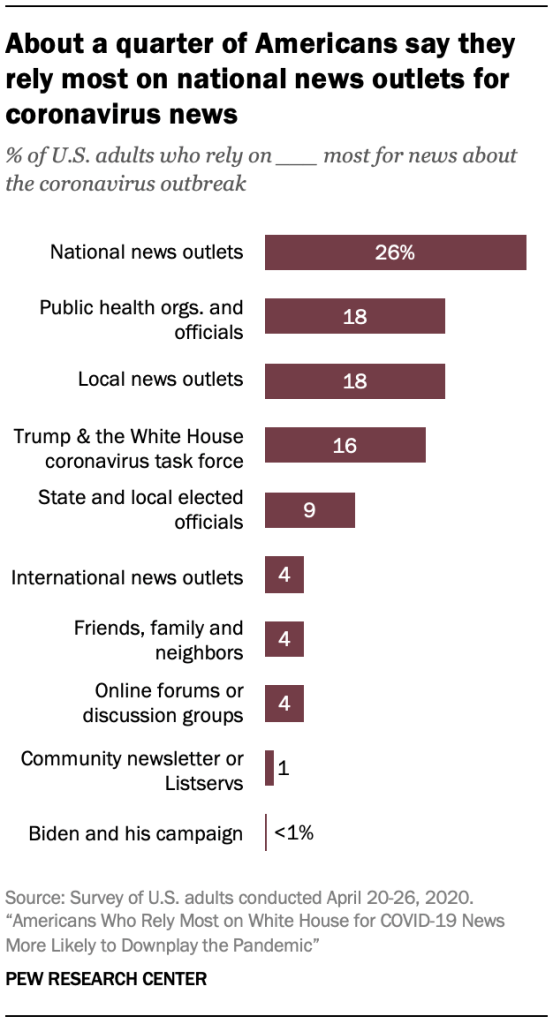
Overall, those who rely most closely on the White House for coronavirus news make up 16% of all U.S. adults. The group is almost entirely Republican or Republican-leaning (92% of this group, accounting for 32% of all Republicans), overwhelmingly non-Hispanic white (82%), and older than the public overall. Indeed, of all five news sources analyzed, those relying on the task force include the largest percentage of adults 65 and older (39%) – an age group especially vulnerable to the effects of COVID-19. It is worth noting that the views of people relying on the White House may be formed not only by what they hear from the president and his task force, but also by the information they get from other sources, their political ideology and party identification, life experience, and prior beliefs that they bring with them as an audience.
This report, part of Pew Research Center’s American News Pathways project, also examines in depth the makeup, attitudes and news consumption of Americans who rely primarily on four other sources of information about the outbreak: national news outlets, local news outlets, local and state officials, and public health officials and organizations.
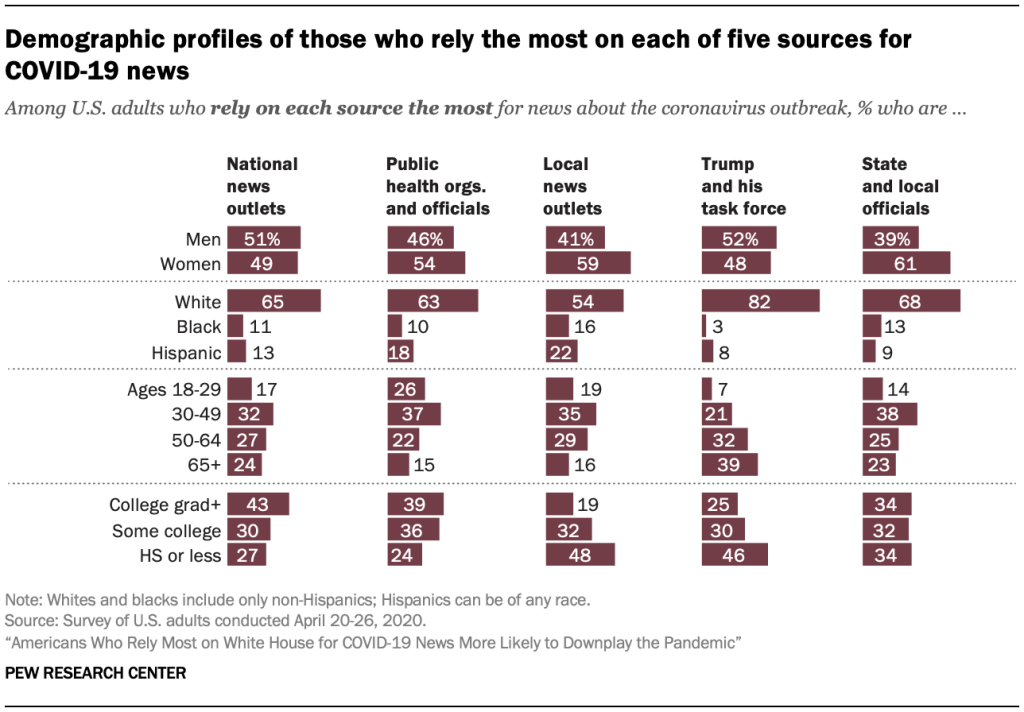
Certain characteristics emerge for these groups as well. Roughly four-in-ten Americans who rely on national news outlets – the largest group, at 26% of the public – hold college degrees (43%), which is about on par with those who rely on public health organizations (39%) but higher than for all other news groups. Those U.S. adults who mainly rely on public health organizations and officials are also relatively young: 26% are between 18 and 29. And the group that relies most on local news outlets has the highest percentage of racial and ethnic minorities, with nonwhite adults accounting for 45% of the group (including 16% who are black and 22% who are Hispanic).
In contrast to those who rely mainly on Trump and the task force, those who turn to national news outlets consistently give the news media high marks for their coverage. About eight-in-ten (83%) say the media have done “very” or “somewhat” well covering the outbreak. And nearly two-thirds of that group (64%) say the media’s coverage is helping the country, as opposed to hurting it, during the crisis. Still, the other groups – those who rely on public health organizations, local news outlets, or state and local officials – are all more positive in their assessments of the media than the group that turns to Trump and the task force.
1. How Americans’ main sources for COVID-19 news relate to their demographics, politics
From national news outlets to public officials to health organizations, Americans are turning to a broad mix of sources for news and information about the coronavirus outbreak. But when asked which source they rely on most, distinctions emerge. And the composition of who relies most on these different sources varies by certain political and demographic characteristics.
The survey asked respondents which of 10 sources or groups of sources they use for news about the coronavirus outbreak, and then following those answers, asked which of these they rely on most for this news. This analysis further examines five that are the primary source for 5% or more of U.S. adults: National news outlets, public health organizations and officials, local news outlets, Donald Trump and the White House coronavirus task force, and state and local elected officials and their offices. (The five groups of sources without sufficient sample sizes to further analyze are international news outlets; friends, family and neighbors; community or neighborhood newsletters or Listservs; online forums or discussion groups; and Joe Biden and his campaign. See Overview for details.)
A deeper examination of these groups reveals demographic and political patterns in their composition, some of which are more evident than others.
The most dramatic political divide occurs among those who rely most on Trump and his coronavirus task force. Fully 92% of U.S. adults in this group are Republicans or Republican-leaning independents, while just 6% are Democrats or Democratic leaners. In other words, there are about 15 times as many Republicans as Democrats who say they rely most on Trump and his task force for COVID-19 news. What’s more, 71% of people in this group are self-described conservative Republicans.
Democrats make up a larger portion of each of the other four groups than do Republicans, but by much smaller margins. Indeed, the group with the highest proportion of Democrats includes about twice as many Democrats as Republicans: Democrats account for 66% of those who rely most on national news outlets, compared with 31% who are Republicans. The group relying most on local news outlets is the most evenly mixed, though it still is more Democratic: Democrats make up about half of the group (52%) and Republicans about four-in-ten (42%).
Attention to news about the coronavirus outbreak varies across the groups turning to these sources. The most engaged groups are those who rely most on national news outlets (56% are following coronavirus news very closely) and those who rely most on Trump and his task force (55%). The Americans who are least attentive are those who say they rely most on local news outlets: 35% say they are following news about the outbreak very closely.
Those who rely most on Trump and the White House task force are more likely than other groups to be older and also more likely to be white and non-Hispanic, which generally aligns with their political makeup and the demographic characteristics of Republicans overall. About four-in-ten (39%) are ages 65 and older, compared with no more than a quarter among the other groups. On the other hand, those who rely on public health organizations and officials are more likely to be young adults (26% in that group are ages 18 to 29).
The group turning mostly to Trump and the task force for coronavirus news also is by far the most likely to be white (82%). The most racially diverse group is those who rely on local news outlets: 45% are nonwhite, which includes about one-in-five (22%) who are Hispanic and 16% who are black.
The groups relying on different outlets vary in their educational attainment as well. Americans who turn most to local news organizations have the lowest share who have a college degree (19%). On the other hand, more than twice as many people who rely most on national news outlets have at least a college degree (43%). A similar share of those who primarily rely on public health organizations and officials (39%) are college graduates.
2. Americans who rely on Trump for COVID-19 news have the harshest views of media performance by far
Several questions in the April 20-26 survey seek the public’s view of the media’s performance in covering the COVID-19 pandemic – from a variety of perspectives. The questions range from assessments of the tone and accuracy of media coverage to the impact and role of journalists.
Broadly speaking, the overall responses to these questions reveal a public that, while still harboring some questions and doubts about the media’s coverage of the outbreak, tends to offer more favorable than unfavorable assessments. But when examining these responses by Americans’ most relied-upon sources for COVID-19 information, a crystal-clear pattern emerges.
On the whole, highly positive evaluations of the media’s coverage of COVID-19 consistently come from those Americans who rely most on national news outlets for information about the pandemic. At the opposite end of the spectrum are Americans who rely most on President Trump and his task force for that news, a group that consistently delivers harsh evaluations of the media.
News consumers who rely most on public health organizations and officials, state and local officials, or local news outlets for their information about the outbreak are situated between the national news group and the Trump group. But their responses – which are often similar across the three groups – tend to be closer to the views of those who rely on national news than of those who look to the White House.
Americans who rely most on national news outlets for COVID-19 coverage largely give media high marks
The survey finds that when asked about the overall quality of coverage, Americans are relatively positive. About seven-in-ten (69%) say journalists have done “very well” or “somewhat well” in covering the COVID-19 outbreak.
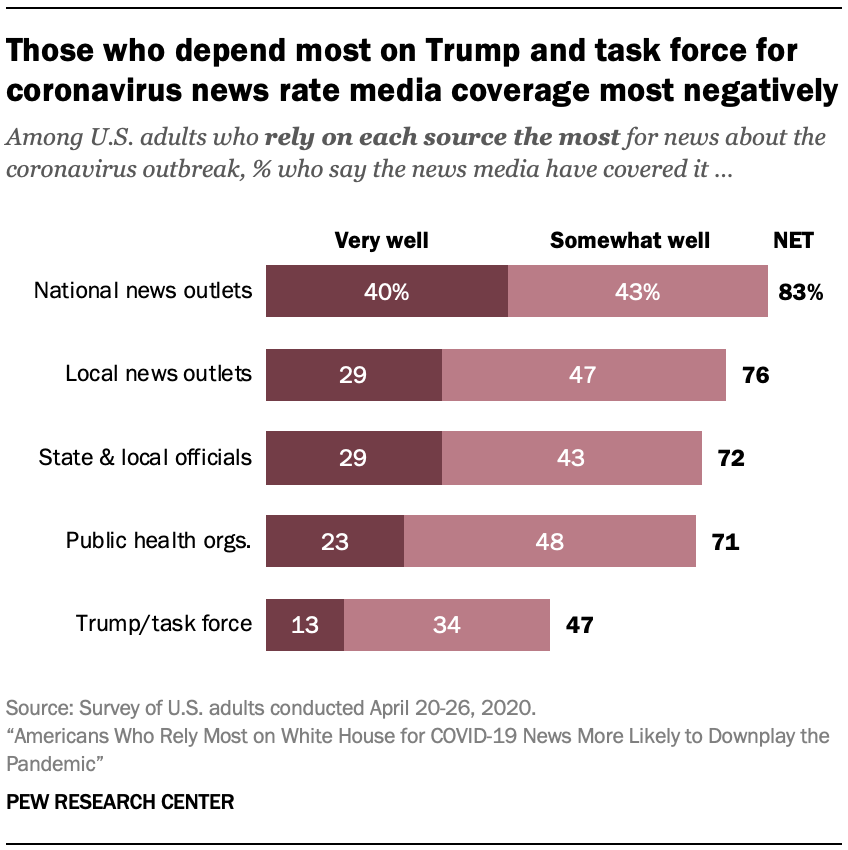
Those who rely most on national news outlets for news about the pandemic are most likely to say that journalists have done at least somewhat well, at 83%, followed in a tight cluster by those who most rely on local news outlets (76%), state and local officials (72%), and public health organizations and officials (71%) for COVID-19 news.
The national news group includes 40% who say the media have done very well, notably higher than the shares in any other group who say the same.
For those who rely most on Trump and his task force for news of the pandemic, that grade is much lower. Roughly half (47%) say the media have done at least somewhat well covering the crisis, including only 13% who say they have done very well.
Overall, about half (48%) of all Americans say the media have either slightly or greatly exaggerated the risk associated with the COVID-19 pandemic, a number that has dropped notably from 62% in March.
Looking by media group, those who most rely on public health organizations, local news outlets and local elected officials for coronavirus news are about equally likely to say that the media have exaggerated the risks somewhat and that journalists have gotten it about right. For example, among those who rely most on public health organizations and officials, 43% say the media have exaggerated the risks and 42% say they’ve gotten it about right. Far fewer – 15% – say they have underplayed the risks.
Americans who rely most on national news outlets have more favorable attitudes toward the media’s work in this area, with 53% saying they have gotten the risks about right and 37% saying they have exaggerated the risks (including just 14% who say journalists have greatly exaggerated the risks).
In stark contrast, only 15% of U.S. adults who rely most on Trump and the task force for coronavirus news say the media have gotten the risks about right. Nearly three-quarters (72%) of them believe journalists have exaggerated the risks, including about half (49%) who say they have greatly exaggerated the risks of the virus.
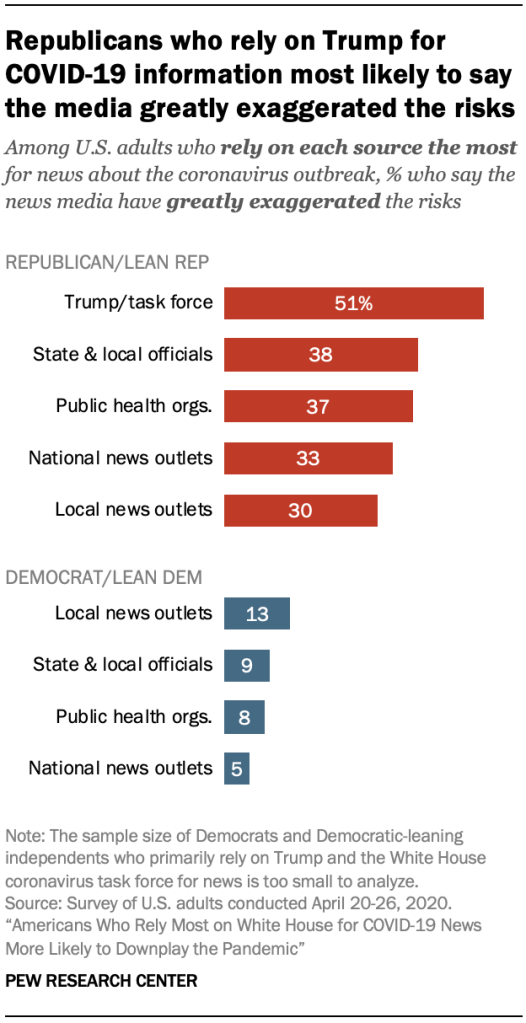
Some of the difference between groups here is connected to the fact that people who rely on Trump for COVID-19 information are far more likely to be Republicans – who in general are more likely than Democrats to say that the media have exaggerated the risks in their coverage of the coronavirus. But even among Republicans and Republican-leaning independents, there is a difference in attitudes toward the media coverage depending on which sources they rely on most for coronavirus news. Republicans who rely primarily on Trump and the task force are more likely to say that the media have greatly exaggerated the risks (51%) than Republicans who turn primarily to other sources.
Views about the quality of media’s reporting differ by news source
The survey also probed views of the quality of the media’s reporting on the COVID-19 pandemic in several other ways, including the question of how accurate that reporting is.
Overall, as reported in an earlier Pew Research Center analysis, Americans are about twice as likely to say that media coverage of the outbreak has been largely accurate (49%) than largely inaccurate (24%), while another 26% say neither option applies.
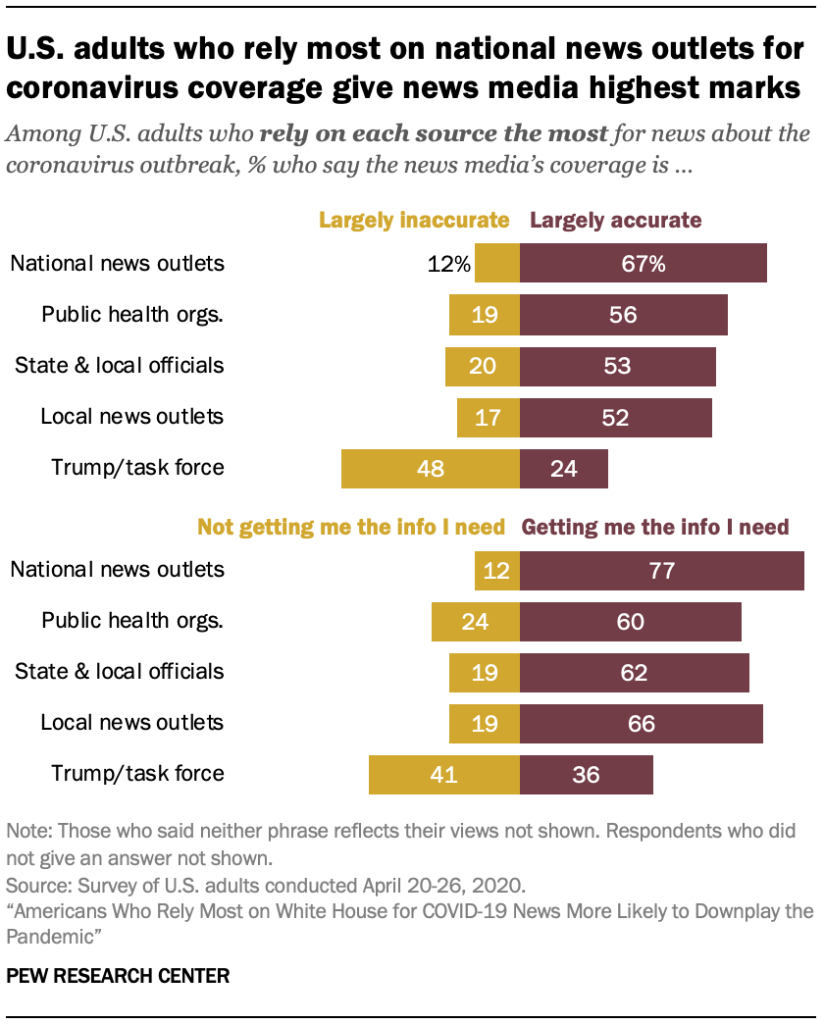
Four of the five media-consumption groups examined are far more likely to say that the coverage is accurate than inaccurate. More than half of those who rely mainly on public health organizations and officials for coronavirus news (56%) say the news media’s reporting has been largely accurate, compared with 19% who say it has been largely inaccurate. The numbers are similar for those who rely on state and local officials and those who look to local news outlets.
Assessments about the accuracy of the media’s reporting on the outbreak are even more positive among those who rely mostly on national news outlets, with those news consumers more than five times as likely to characterize coverage as accurate (67%) rather than inaccurate (12%). But those who rely on Trump and the task force see COVID-19 coverage as far more flawed than the other groups. They are twice as likely to say that coverage has been largely inaccurate (48%) as largely accurate (24%).
A related question asked whether the media’s coverage of the COVID-19 story is getting people the information they need. Again at the high end of the scale, about three-quarters of those who rely on national news outlets (77%) say they are getting the information they need from the media, compared with only 12% who say they are not. By contrast, those who rely on the president and his task force again give the media coverage lower ratings; among that group, 36% say the media’s coverage is providing the news they need, and 41% say it is not.
The other groups’ responses cluster between these two extremes, although somewhat closer to those in the national news cohort. About two-thirds (66%) of those who rely most on local news outlets say they get the information they need from the media, as do 62% of U.S. adults who rely mainly on state and local officials and 60% who rely on public health officials and organizations. Few in each group say the coverage is not getting them the information they need.
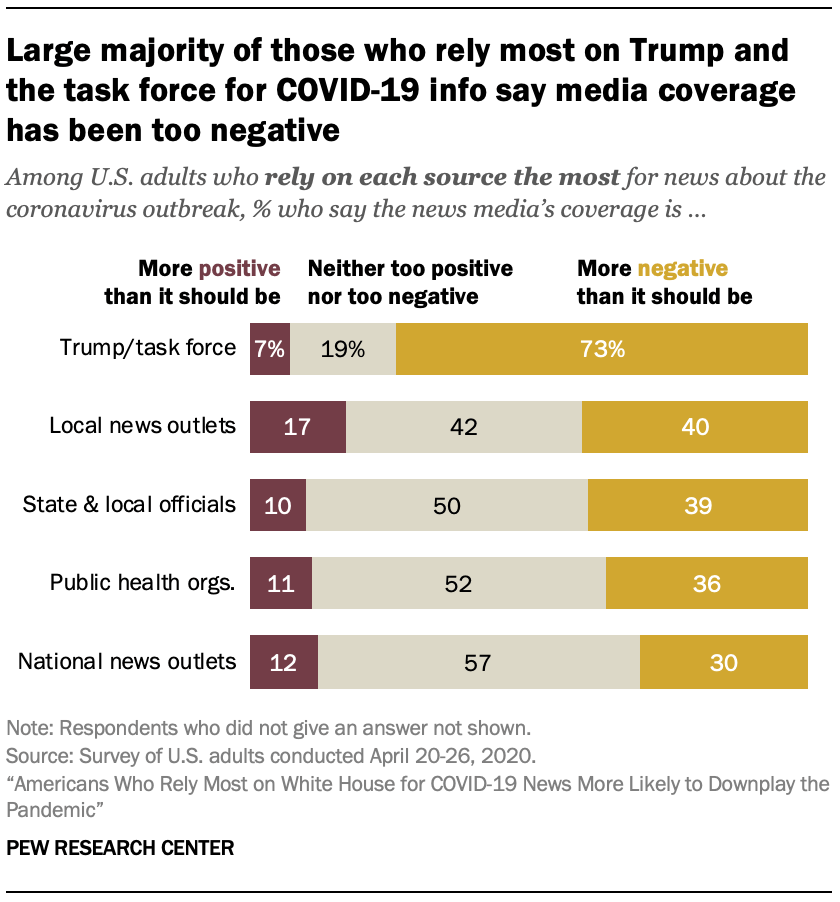
Another question focused on the tone of the media’s coronavirus coverage. The survey asked Americans if that coverage was more negative or more positive than it should be, or whether neither applies.
In this case, there is not much divergence across media-consumption groups about whether media coverage is unduly positive. But there are more significant differences on whether coverage is too negative. Those who rely most on national news outlets for pandemic news are among the least likely to say the coverage is too negative (30%) and among the most likely to say that the media’s coverage has been neither too positive nor too negative (57%). Meanwhile, nearly three-quarters of those who turn to the White House (73%) say coverage has been unduly negative – by far the highest share of any group. Fewer than half in the local news group (40%), the group that relies on state and local officials (39%) and the group that turns to public health officials (36%) agree with that criticism.
Those who rely most on national outlets and those who rely on Trump split on whether media coverage works to benefit media or the public
Two of the survey questions related to the media’s coverage of the COVID-19 crisis gauged Americans’ perceptions of journalists’ role and impact on society.
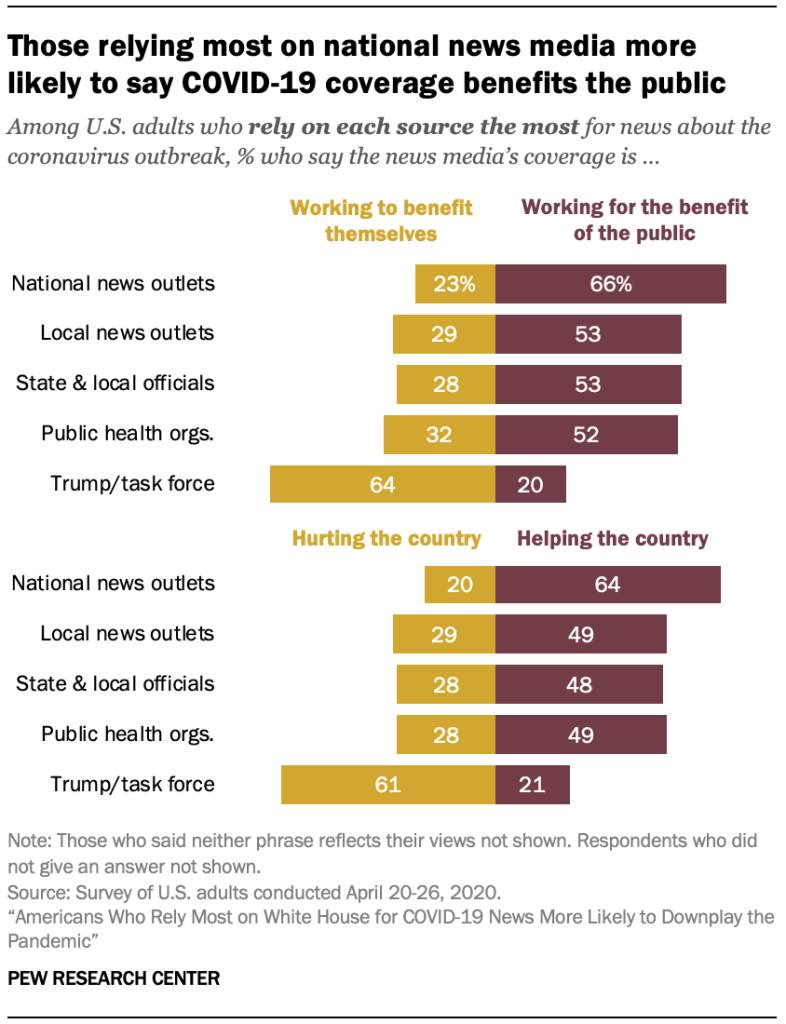
When asked whether, based on their COVID-19 coverage, journalists are working more for the benefit of the public or working to benefit themselves, 48% of all adults say they are working to benefit the public, while 36% say they are working to benefit themselves. Another 15% say neither option applies.
Those who rely most on national news outlets are again the most positive about the media – fully 66% of Americans in this group say journalists are working for the benefit of the public, as opposed to 23% who respond that they are working to benefit themselves. Americans who rely most on public health officials, local news outlets and state and local officials also are more likely to say journalists are working to benefit the public rather than themselves, albeit by smaller margins.
But the group that relies most on Trump and the task force again has, by far, the most negative view of the media. Almost two-thirds (64%) believe journalists are working for their own benefit, roughly three times the portion (20%) who say they are working to benefit the public.
Respondents also were asked to assess the media’s impact on the country at a time of national crisis, based on their coronavirus coverage. Given the choice between saying that the media are helping the country or hurting the country, 46% of all Americans say the coverage is helping, 34% say it is hurting and 20% say neither choice applies.
In this case, those who rely most on national news outlets were the most likely to say the media’s coverage is helping the country (64%), while one-in-five say they are hurting it.
The responses of those who rely most on the president and his task force for news of the pandemic are nearly the reverse: Among the Trump group, only 21% say the media are helping the country with their pandemic coverage, while almost three times as many (61%) believe they are damaging the nation.
There are virtually no differences on this question in the responses of those who rely most on public health organizations and officials, local news outlets, or state and local officials. Roughly half in each group say journalists’ coverage is helping the country, while about three-in-ten say it is doing more harm than good.
Has the pandemic been overblown or underplayed?
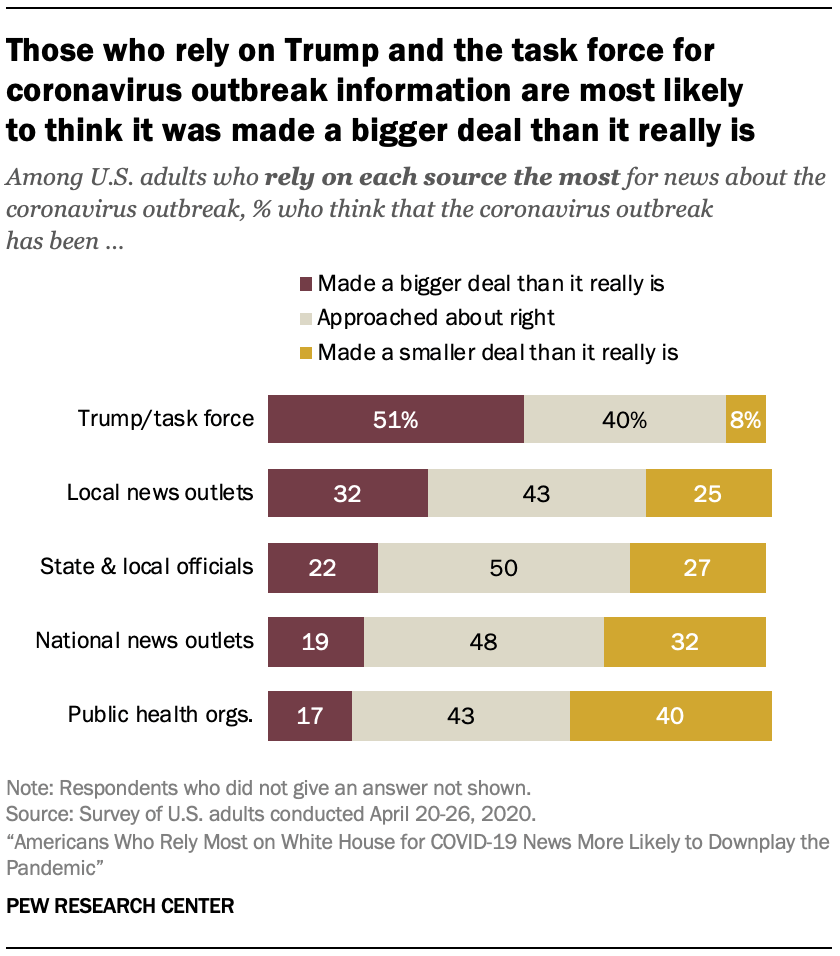
In an overarching question that asked whether the appropriate amount of emphasis has been placed on the outbreak, stark differences again emerge. For this question, which was phrased more broadly and not specifically framed around journalists or the media, those who rely most on Trump and his task force again stand out: About half (51%) say the outbreak generally has been made a bigger deal than it really is, while just 8% say it’s been underplayed.
At the other end of the spectrum are those who turn most to public health organizations and officials. Four-in-ten in this group say it has been made a smaller deal than it really is, while just 17% say it has been overblown.
The two groups most likely to say the appropriate level of attention has been placed on the pandemic are those who rely mainly on state and local officials for COVID-19 news (50%) and those who look mostly to national news outlets (48%).
3. Some claims about COVID-19 treatments reach certain news groups more than others
Within the near-constant flow of coronavirus news and information has been a stream of claims about possible treatments, causes or ways to end the outbreak – some with spotty evidence, some closer to speculation and still others deemed by experts to be actively dangerous. The survey asked about six of these claims to get a sense of how widely they have reached news consumers across the United States. Two of them in particular vary based on the sources people say they rely on most for coronavirus news.
Americans are most likely to be familiar with the claim that use of the anti-malaria drug hydroxychloroquine could be useful in treating the virus – a claim touted by Trump and other prominent figures, though the drug was linked to dangerous side effects. While 44% of all U.S. adults have heard a lot about this, that figure rises to 60% among Americans who rely most on Trump and his task force for coronavirus news. Closer to half of those who rely most on national news outlets (52%) have heard a lot about this claim. The figure falls further to 45% among those who rely mostly on public health organizations, 40% among those who rely most on state and local officials and 28% among those who turn most to local news organizations.
Three-in-ten Americans overall have heard a lot about the use of a new, but not fully tested, treatment that uses blood plasma transfusions from recovered patients for patients currently suffering from the virus. Those who mainly rely on the White House for coronavirus news are more likely than other groups to have heard about this claim, though political party and ideology play more of a factor here than on other measures. Two groups less likely to have heard about this claim are people who rely on local news outlets and those who turn to public health organizations (such as the Centers for Disease Control and Prevention). About a quarter in each group (25% of those who rely on local news outlets and 28% of those who rely on public health organizations) have heard a lot about plasma treatments.
Fewer differences by news source emerge around the four less commonly known claims, including that warmer weather could make the virus go away, or that there is a connection between coronavirus and 5G cellphone technology. And very few in any group say they have heard a lot about the idea of using diluted bleach as a treatment. (The majority of the survey was completed beforeTrump’s comments about using disinfectants to treat the virus on April 23.)
All in all, those who rely most on Trump and his task force and who rely on local news outlets place high levels of belief in the effectiveness of at-home treatments for serious cases of the coronavirus. Close to half (46%) of people in each of these groups say they think at-home treatments for serious cases are “somewhat” or “very” effective. That compares with closer to three-in-ten among those who rely most on public health officials (32%) or national news outlets (29%).
The coronavirus issues Americans are following differ depending on which source of news they rely on most
Americans overall are closely following a wide range of topics related to the coronavirus outbreak, with those issues varying depending on people’s primary news source.
Among those whose main sources of COVID-19 news are public health organizations and officials, it figures that most (60%) say they very closely follow news about current guidance from the CDC and other health organizations. About four-in-ten in this group say they are very closely following the health impact of the virus on people like them (42%), the economic impact of the outbreak (41%) and the number of confirmed cases and deaths (41%).
Those who rely most on Trump and his task force express greater interest in keeping up with news coverage of the economic impact of the outbreak, with six-in-ten following this topic area very closely. About half (49%) report very closely following federal government actions and statements related to the virus.
Other groups tend to most closely follow the economic impact of the coronavirus outbreak and the “health impact of the coronavirus on people like me.” Around half of people who turn most to national news outlets follow each of these topics very closely. Those who rely most on state and local officials and local news outlets for COVID-19 news are less likely to closely follow some of the national topics but are more interested in certain local topic areas. For example, those who rely most on local news outlets or state and local officials for coronavirus news are more likely than other groups to say they are very closely following news about the availability of food and other essentials in stores. (You can see the full list of local topics asked about in the data tool.)
Acknowledgments
The American News Pathways project was made possible by The Pew Charitable Trusts. Pew Research Center is a subsidiary of The Pew Charitable Trusts, its primary funder. This initiative is a collaborative effort based on the input and analysis of the following individuals. Find related reports online at https://alpha.pewresearch.org/pewresearch-org/topics/election-news-pathways/.
Research Team
Amy Mitchell, Director, Journalism Research
Baxter Oliphant, Senior Researcher
Katerina Eva Matsa, Associate Director, Journalism Research
Elisa Shearer, Research Associate
Mason Walker, Research Analyst
Mark Jurkowitz, Senior Writer
Michael Lipka, Editorial Manager, Religion Research
Michael Barthel, Senior Researcher
Jeffrey Gottfried, Senior Researcher
Galen Stocking, Computational Social Scientist
Maya Khuzam, Research Assistant
Kirsten Worden, Research Assistant
Andrew Mercer, Senior Research Methodologist
Dorene Asare Marfo, Survey Research Methodologist
Scott Keeter, Senior Survey Advisor
Claudia Deane, Vice President, Research
Nick Bertoni, Panel Manager
Courtney Kennedy, Director, Survey Research
Editorial and Graphic Design
David Kent, Copy EditorMargaret Porteus, Information Graphics Designer
Alissa Scheller, Information Graphics Designer
Peter Bell, Design Director
Andrea Caumont, Digital Engagement Manager
John Gramlich, Senior Writer/Editor
Bruce Drake, Senior Editor
Communications and Web Publishing
Rachel Weisel, Senior Communications Manager
Hannah Klein, Communications Manager
Calvin Jordan, Communications Associate
Andrew Grant, Communications Associate
Sara Atske, Associate Digital Producer
Shannon Greenwood, Digital Producer
Stacy Rosenberg, Associate Director, Digital
Seth Rubenstein, Lead Web Developer
Benjamin Wormald, Web Developer
Carrie Elizabeth Blazina, Associate Digital Producer
Kelly Browning, User Experience Manager
Michael Piccorossi, Director, Digital Strategy