Pew Research Center

FOR RELEASE APRIL 29, 2020

About Seven-in-Ten U.S. Adults Say They Need to Take Breaks From COVID-19 News

61% give equal attention to national and local coronavirus news

BY Amy Mitchell, J. Baxter Oliphant and Elisa Shearer

FOR MEDIA OR OTHER INQUIRIES:

Communications Department
202.419.4372
www.pewresearch.org

RECOMMENDED CITATION

Pew Research Center, April 2020, "About Seven-in-Ten U.S. Adults Say They Need to Take Breaks From COVID-19 News"

About Pew Research Center

Pew Research Center is a nonpartisan, nonadvocacy fact tank that informs the public about the issues, attitudes and trends shaping the world. It does not take policy positions. The Center conducts public opinion polling, demographic research, computational social science research and other data-driven research. It studies politics and policy; news habits and media; the internet and technology; religion; race and ethnicity; international affairs; social, demographic and economic trends; science; research methodology and data science; and immigration and migration. Pew Research Center is a subsidiary of The Pew Charitable Trusts, its primary funder.

© Pew Research Center 2026

Table of contents

  • About Pew Research Center
  • About Seven-in-Ten U.S. Adults Say They Need to Take Breaks From COVID-19 News
  • 1. Americans are turning to media, government and others for COVID-19 news
  • 2. COVID-19: Both a national and local news story
  • 3. Majority of Americans feel they need breaks from COVID 19 news; many say it takes an emotional toll
  • 4. Some claims about ways to fight COVID-19 reach more Americans than others
  • 5. Some components of first stimulus bill understood by most Americans, others not so much

About Seven-in-Ten U.S. Adults Say They Need to Take Breaks From COVID-19 News

61% give equal attention to national and local coronavirus news

Public health officials play large role alongside national news orgs. as a source of coronavirus news

Americans continue to pay close attention to news about the coronavirus outbreak both nationally and locally. In doing so, they rely on a broad mix of media, government and other providers of news, according to a new Pew Research Center survey conducted April 20-26, 2020, of 10,139 U.S. adults who are part of the Center’s American Trends Panel.

But the continuous news churn has had an impact. A majority of Americans say they need to take breaks from it, many say it makes them feel worse emotionally and half say they find it difficult to sift through what is true and what is not, according to the survey, which is a part of the Election News Pathways project.

About nine-in-ten Americans (87%) are following coronavirus news fairly or very closely, a figure roughly on par with surveys conducted in March. In getting this news, more than half the public (56%) says national news outlets are a major source, and nearly as many (51%) say this of public health organizations and officials.

Want to see more data on these questions?

To analyze these survey questions by additional media habits and demographic characteristics, visit the dataset.

Local news outlets are a major source of COVID-19 news for 46% of the public, while 36% say state and local elected officials are a major source for them. About three-in-ten U.S. adults (31%) say President Donald Trump and the White House coronavirus task force are a major source of news about the outbreak.

Americans are focusing attention on both national and local news related to the pandemic. About six-in-ten (61%) say they pay about equal attention to news at both levels, while 23% tune in more to state and local news on the outbreak and 15% follow national news on the topic more.

Large majority of Americans say they feel they need to take breaks from COVID-19 news

But it can be difficult to stay focused on this life-disrupting crisis. About seven-in-ten Americans (71%) say they need to take breaks from news about the coronavirus, and 43% say the news leaves them feeling worse emotionally. Half of Americans say they find it difficult to determine what is true and not true about the outbreak, while 49% say they find that task easy. And close to two-thirds of adults (64%) say they have seen at least some news and information about the coronavirus that seemed completely made up.
Measuring reach of questionable claims about ways to fight the coronavirus

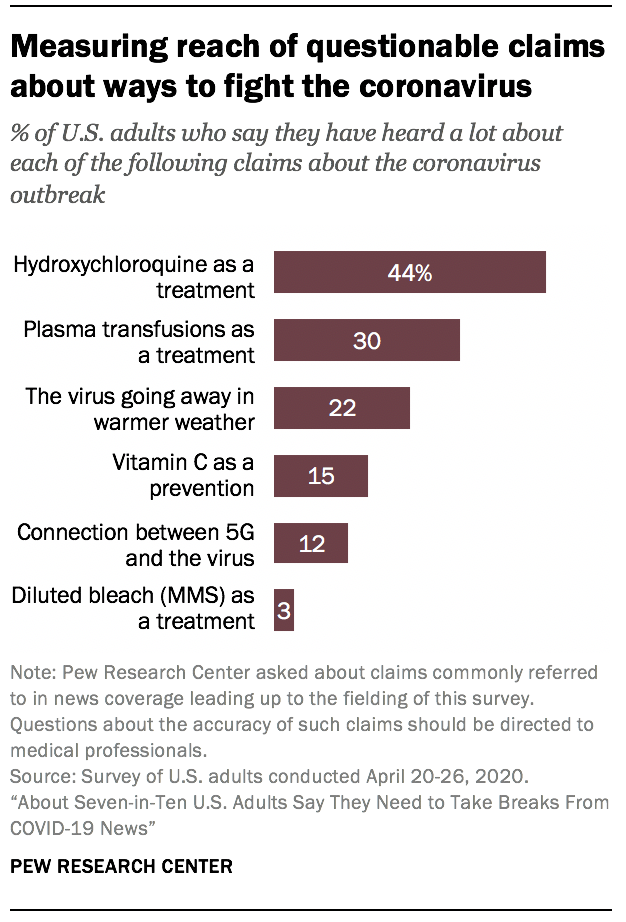
Within the rapid flow of news and information has been a stream of claims about COVID-19 – some with spotty evidence, some closer to speculation and still others deemed by experts to be actively dangerous. The survey asked about six of these purported treatments or causes to get a sense of how widely they had reached across the United States. Of the six, Americans were most likely to be familiar with the claim that use of the anti-malaria drug hydroxychloroquine could be useful in treating the virus: 44% have heard a lot about this.

Three-in-ten U.S. adults have heard a lot about the use of plasma transfusions from recovered patients as a treatment. Fewer have heard a lot about vitamin C as a prevention (15%). In the survey, only 3% said they had heard a lot about the widely discredited claim that drinking a form of diluted bleach sometimes called “miracle mineral solution” is a way to treat current cases. (The majority of the survey was completed before Trump’s comments about using disinfectants to treat the virus on April 23.)

More broadly, 59% of Americans say at-home treatments for serious cases of the coronavirus are not too or not at all effective; 38% say they are somewhat or very effective.

Americans did express a fair amount of knowledge about some of the basic elements of one of the first actions taken by the federal government to help limit damage from the economic downturn: the CARES Act, signed into law by President Trump on March 27. About nine-in-ten (91%) know the bill includes $1,200 for many American adults, about half (51%) identify the amount of money with the aid package as either $2 trillion or $2.5 trillion and nearly two-thirds (64%) know it increased unemployment benefits.

Still, there is confusion about what else might and might not be in the fast-moving legislation. While 52% know the bill does not include federal aid for undocumented immigrants, another 40% aren’t sure and 7% think it does. Few Americans (8%) incorrectly say the bill included pay raises for members of Congress, but 54% say they are not sure. Most U.S. adults (56%) also say they are unsure whether the bill placed restrictions on aid to businesses owned by Trump, which it does.

These findings are a part of Pew Research Center’s yearlong Election News Pathways project. You can find all the data from this report in the Pathways data tool, analyze it alongside other data points and even download the entire dataset.

1. Americans are turning to media, government and others for COVID-19 news

The fast-moving coronavirus story has maintained Americans’ rapt attention. Roughly nine-in-ten U.S. adults (87%) are following news about the virus very or fairly closely, with just under half (46%) doing so very closely.

Americans are also turning to a broad mix of sources for this news, whether traditional media outlets – national, local and international – or other sources such as public health organizations.

National news outlets are a major source of coronavirus news for the largest segment of U.S. adults (56%). But nearly as many (51%) say this of public health organizations and officials. That is followed by 46% who rely on local news outlets as major sources of news, and, at the more local level, 36% who say state and local elected officials are major sources of COVID-19 news. About three-in-ten (31%) say Donald Trump and the coronavirus task force are a major source of news about the outbreak.

With the outbreak affecting countries around the world, 25% of the American public turns to international news outlets as major sources of news.

About a quarter say they rely most on national news outlets for coronavirus news

A smaller portion of Americans (16%) say friends, family and neighbors are a major source of news for them (another 54% say these individuals are a minor source). Closer to one-in-ten rely heavily on online forums and discussion groups (10%) as well as community newsletters and Listservs (8%), while presidential candidate Joe Biden and his campaign are a major source of coronavirus news for just 5% of Americans.

Respondents were next asked which of these 10 sources they rely on the most for coronavirus news. National news outlets rank first at 26%. Next come a group of three that are all at about the same level: public health organizations and officials (18% rely on them most), local news outlets (18%) and Trump and the task force (16%).

Nearly four-in-ten Americans (37%) say that in keeping up with coronavirus news, they have turned to different news sources than normal.


2. COVID-19: Both a national and local news story

As evidenced in the mix of sources Americans rely on for news, the coronavirus outbreak is touching people’s lives both nationally and closer to home.

A majority of U.S. adults (61%) say they are giving about equal attention to both national and state and local coronavirus news. About a quarter (23%) are paying closer attention to state and local elements of the outbreak, while 15% are most engaged in national-level news.

Within the news coverage, many Americans are closely following a wide range of topics, again with both national and local orientations.

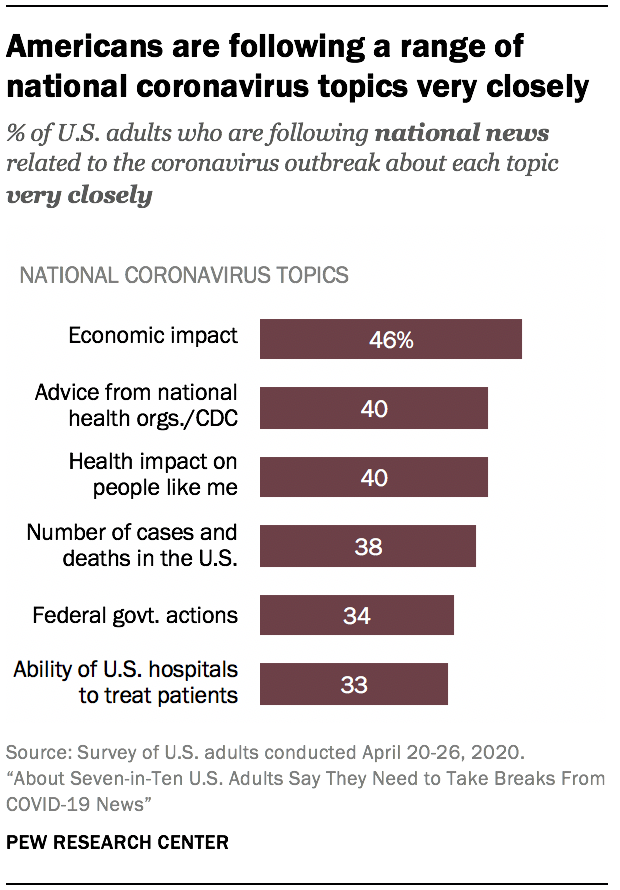
Among six national-level storylines asked about, roughly four-in-ten or more U.S. adults are very closely following the economic impact (46%), advice from national health organizations such as the Centers for Disease Control and Prevention (40%), the health impact on people like them (40%) and the tally of cases and deaths (38%). About a third are following the actions and statements of the federal government very closely (34%) and the ability of hospitals across the country to treat patients (33%).

Americans are following a range of national coronavirus topics very closely
Among local COVID-19 topics, government actions and the stocks at local stores are most closely followed

Americans are following each of seven local and state coronavirus topics asked about quite closely as well, though at percentages a bit lower than for the national storylines.

The two local storylines followed very closely by the largest segments of U.S. adults are actions by state and local governments (42%) and the availability of food and other essentials in local stores (38%). About three-in-ten are very closely following the status of local schools (30%), businesses (29%) and hospitals (28%) and the availability of COVID-19 tests (29%). The availability of unemployment benefits and other aid is being very closely followed by a quarter of Americans.


3. Majority of Americans feel they need breaks from COVID 19 news; many say it takes an emotional toll

The constant churn of news updates, events and asserted claims related to the outbreak has left most Americans feeling a need to take a break from COVID-19 news from time to time. And many say keeping up with this news has a negative impact on their state of mind.

About seven-in-ten (71%) say they feel the need to take breaks from news about the outbreak, compared with about three-in-ten (28%) who say they need to stay tuned in.

At the same time, about four-in-ten U.S. adults (43%) say that keeping up with the news makes them feel worse emotionally. Only 7% say it makes them feel better emotionally, while about half (49%) say it doesn’t change their emotions.

Overall, Americans are about evenly split between those who say they find it easy to determine what is true and not true about the outbreak (49%) and those who find it difficult to do so (50%).

About two-thirds of Americans say they’ve seen at least some made-up news about COVID-19

More broadly, close to two-thirds of adults (64%) say they have seen at least some news and information about the coronavirus that seemed completely made up. (Another 27% have seen “not much,” while a small segment, just 8%, say they’ve not come across any.)

These encounters with perceived made-up news related to the coronavirus are accompanied by a vast majority of Americans worrying that bad information is creating confusion about the basic facts surrounding the outbreak. About half (49%) say made-up news has led to a great deal of confusion among Americans about the basic facts. Another 37% say it has caused some confusion, while very few (12%) say it has led to not too much confusion or none at all.

To add to this uncertainty about whether information is credible, about four-in-ten (38%) say they came across made-up information that they at first thought was true but later learned it was false.


4. Some claims about ways to fight COVID-19 reach more Americans than others

Since the beginning of the coronavirus outbreak, a nearly continuous stream of information has flooded news headlines, personal conversations and social media feeds with possible causes, treatments and endings for the outbreak – some with more truth behind them than others. Fact checkers themselves have struggled to keep pace.

One way to gauge the impact of various coronavirus narratives is to see how many Americans have heard about them. This survey asked about several false or thus far unproven claims about possible causes, treatments and endings for the outbreak: treating the coronavirus using the medicine hydroxychloroquine, or blood plasma transfusions from recovered patients, or a potentially dangerous form of diluted bleach; taking vitamin C to prevent getting the virus; the possibility that the coronavirus may go away in warmer weather; and an alleged connection between 5G mobile phone technology and the coronavirus. (The majority of the survey was completed before Donald Trump’s comments about using disinfectants to treat the virus on April 23.)

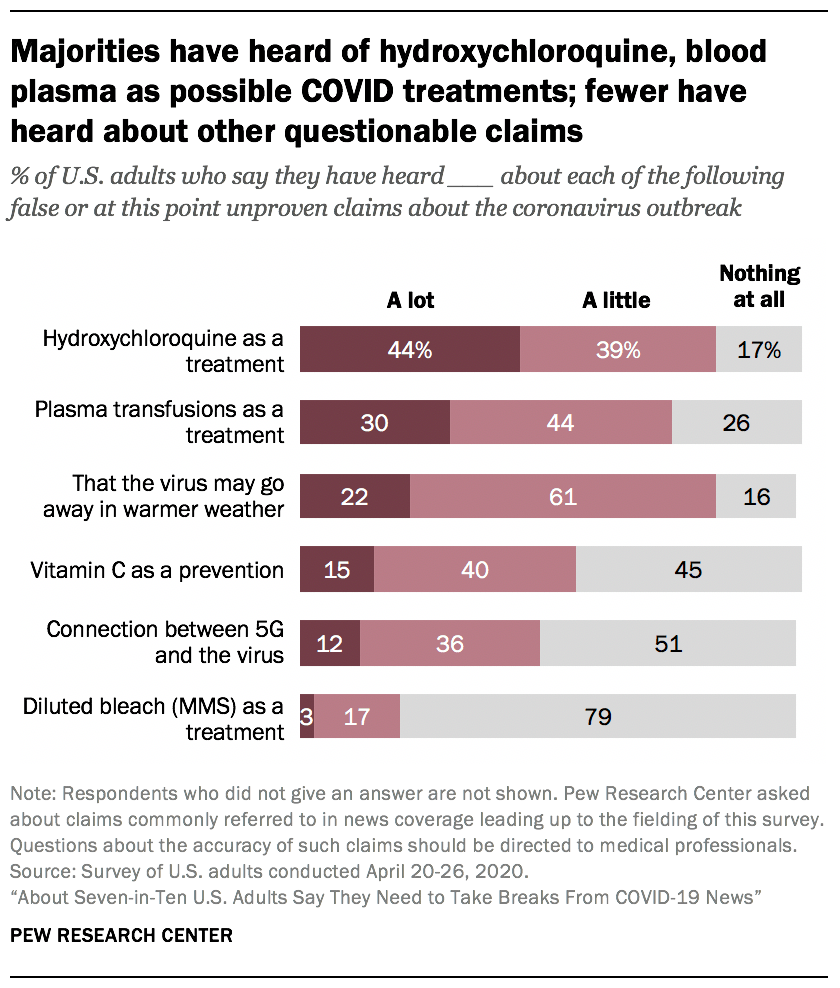
Majorities have heard of hydroxychloroquine, blood plasma as possible COVID treatments; fewer have heard about other questionable claims

More Americans have heard a lot about the anti-malaria drug hydroxychloroquine as a possible treatment for COVID-19 than about any of the other five claims. Slightly more than four-in-ten U.S. adults (44%) have heard a lot about the drug, which was touted by Trump and other prominent figures as a promising treatment (but has been linked with dangerous side effects). Another 39% have heard a little about this drug as a way to treat the coronavirus, while a minority (17%) have heard nothing.

Smaller shares of Americans have heard a lot about the remaining claims asked about.

Three-in-ten Americans have heard a lot about a new, but not fully tested, treatment that uses plasma transfusions from recovered patients for patients currently suffering from the virus. Fewer (22%) say they have heard a lot about the virus possibly going away in warmer weather, though about six-in-ten (61%) say they have heard a little about this potential development.

The public has heard less about claims that taking vitamin C prevents catching the coronavirus (15% have heard a lot) and about unsubstantiated concerns that there is a connection between 5G wireless technology and the coronavirus (12%). Very few people have heard a lot (3%) – or even a little (17%) – about a diluted form of bleach (sometimes known as “miracle mineral solution” or MMS) being touted by some on social media as protection against the virus.

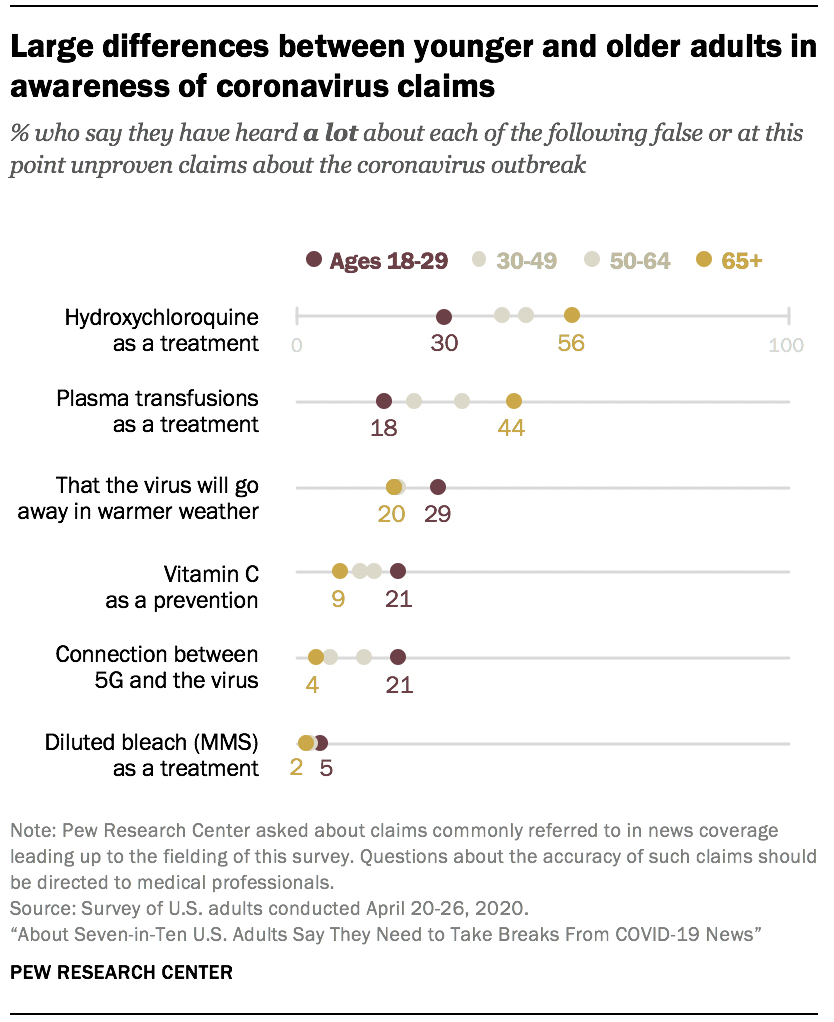
Large differences between younger and older adults in awareness of coronavirus claims

There are large differences in how much the oldest adults – those ages 65 and older – and the youngest adults – those ages 18 to 29 – have heard about each of these items. (Adults in the two middle groups largely fall in between these two groups.)

Americans ages 65 and older have heard significantly more than those ages 18 to 29 about hydroxychloroquine and blood plasma transfusions as possible treatments for the coronavirus. Somewhat more than half of adults ages 65 and older (56%) say they have heard a lot about hydroxychloroquine, versus 30% of those ages 18 to 29. Similarly, 44% of adults 65 and older have heard a lot about plasma transfusions as a treatment, but just 18% of 18- to 29-year-olds say the same.

On the other hand, adults ages 18 to 29 were more likely than those 65 and older to say they’d heard a lot about the virus possibly going away in warmer weather (29% of ages 18 to 29 vs. 20% of ages 65+), the claim that vitamin C prevents the virus (21% vs. 9%) and unsubstantiated rumors of a connection between the outbreak and 5G technology (21% vs. 4%). There was no substantial age gap in how much the public reports hearing about the potentially dangerous treatment of taking a form of bleach to treat the virus.

These differences by age still hold even when looking at just those in each age group who say they are following news about the coronavirus outbreak very closely. For example, 66% of adults 65 and older who say they are following this news very closely have heard a lot about hydroxychloroquine as a potential treatment, compared with 53% of those 18 to 29 who say they are following coronavirus news very closely.

You can explore these survey questions by additional demographic groups, such as party identification, in the data tool.

Americans mostly skeptical of at-home treatments for COVID-19

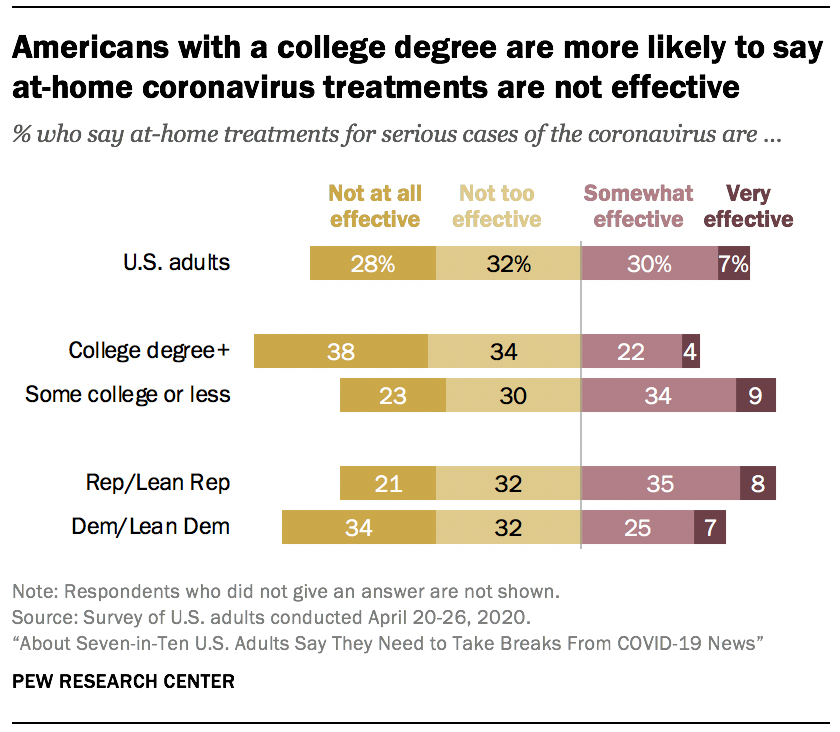
Americans with a college degree are more likely to say at-home coronavirus treatments are not effective

A majority of Americans say “at-home treatments” for serious cases of the coronavirus are either not too effective (32%) or not at all effective (28%). Another 30% say at-home treatments are somewhat effective. Few (7%) say these treatments are very effective for serious cases.

Education connects to views of at-home treatments’ effectiveness. Americans who have a college degree broadly doubt these treatments can work: 38% say they are not at all effective, while an additional 34% say they are not too effective. Among Americans who do not have a college degree, about half say they are either not too (30%) or not at all effective (23%).

Republicans and Republican-leaning independents are somewhat more likely than Democrats and Democratic leaners to say at-home treatments for serious COVID-19 cases can be somewhat effective (35% vs. 25%). On the other hand, Democrats (34%) are more likely than Republicans (21%) to say they are not at all effective.

Those who are paying the closest attention to news about the outbreak – those following this news very closely – are the most likely to say at-home treatments are not at all effective.

5. Some components of first stimulus bill understood by most Americans, others not so much

When it comes to one of the first major steps the U.S. government took to provide economic aid to people across the country – the CARES Act, signed into law by President Trump on March 27 – Americans know some of the basics but are much less clear on other aspects of the law. (Previous Center research finds that the economic aid package overall is widely supported.)

Majorities of Americans correctly identify $1,200 checks and expanded unemployment benefits as parts of March economic aid law

The survey asked respondents whether five items were part of the economic aid bill. Three of the items were signed into law as parts of the bill: $1,200 in stimulus money for many American adults, restrictions on businesses connected to Donald Trump and other administration officials receiving aid, and increased unemployment benefits for the next four months. Two items were not part of the bill but were rumored to be included: pay raises for members of Congress and federal aid and benefits for undocumented immigrants.

Of the three items that were part of the bill, majorities know that two are part of the law. An overwhelming majority (91%) correctly identifies $1,200 in aid for many American adults as part of the law. Nearly two-thirds (64%) correctly identify increased unemployment benefits for the next four months as part of the March law as well – though about three-in-ten (29%) are not sure if it expanded unemployment benefits.

When it comes to whether the law restricted access to aid for companies connected to Trump and the administration, about the same portion of Americans correctly answer that it did (22%) and incorrectly that it did not (21%), while slightly more than half (56%) indicate they are not sure if the law restricts federal aid to businesses owned by Trump or other administration officials.

Of the two items not included in the law, there exists considerable uncertainty among the public. The largest share of Americans (54%) say they are not sure if the law included pay raises for members of Congress; few say it did (8%), while fewer than four-in-ten (37%) correctly answer that it did not. About half (52%) correctly say that the law does not give federal aid to undocumented immigrants, but 40% are not sure.

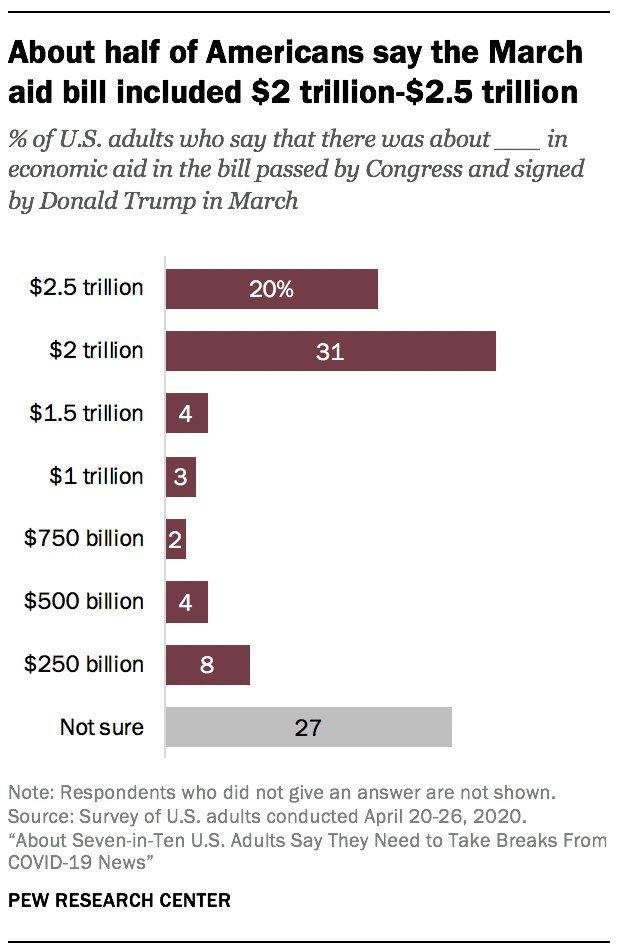
About half of Americans say the March aid bill included $2 trillion-$2.5 trillion

Older adults are generally more knowledgeable about the CARES Act than younger adults. Furthermore, there are not large gaps in knowledge of the law between Republicans and Democrats.

The economic aid bill passed into law in March authorized about $2 trillion in spending to address the coronavirus outbreak.

About three-in-ten Americans (31%) correctly identify about $2 trillion as the amount of aid in the bill, while another 20% say the bill authorized about $2.5 trillion in aid, which approximately aligns with the CARES Act funds plus $484 billion in supplemental aid passed by Congress and signed by Trump on April 24 while the survey was being conducted.

About a quarter of the public (27%) say they are not sure how much aid was included in the law passed in March. About two-in-ten offered other incorrect amounts for the size of the aid package.

These measures and more can be explored further in the Election News Pathways data tool, where all of the data associated with this project is available for public use. You can read more about our research on public opinion of COVID-19 here.

Data from this analysis comes from a survey conducted April 20-26, 2020. See the survey questions and methodology, or access the dataset.

Acknowledgments: The Election News Pathways project was made possible by The Pew Charitable Trusts. Pew Research Center is a subsidiary of The Pew Charitable Trusts, its primary funder. This initiative is a collaborative effort based on the input and analysis of a number of individuals and experts at Pew Research Center.