Pew Research Center

FOR RELEASE SEPTEMBER 20, 2017

Science News and Information Today

A majority of Americans rely on general outlets for science news but more say specialty sources get the facts right about science

BY Cary Funk, Jeffrey Gottfried and Amy Mitchell

FOR MEDIA OR OTHER INQUIRIES:

Communications Department
202.419.4372
www.pewresearch.org

RECOMMENDED CITATION

Pew Research Center, September 2017, "Science News and Information Today"

About Pew Research Center

Pew Research Center is a nonpartisan, nonadvocacy fact tank that informs the public about the issues, attitudes and trends shaping the world. It does not take policy positions. The Center conducts public opinion polling, demographic research, computational social science research and other data-driven research. It studies politics and policy; news habits and media; the internet and technology; religion; race and ethnicity; international affairs; social, demographic and economic trends; science; research methodology and data science; and immigration and migration. Pew Research Center is a subsidiary of The Pew Charitable Trusts, its primary funder.

© Pew Research Center 2026

Table of contents

  • About Pew Research Center
  • Science News and Information Today
  • 1. Most Americans express curiosity in science news, but a minority are active science news consumers
  • 2. General news outlets are the most common science news source; most-seen stories highlight discoveries and “weird” findings
  • 3. Niche information sources are most trusted to get the facts right about science
  • 4. Most Americans see at least some science posts on social media but tend to distrust what they see
  • 5. Most Americans see science-related entertainment shows and movies in either a neutral or positive light
  • 6. Citizen science, science-related hobbies and participation in informal science activities
  • Acknowledgments
  • Methodology
  • Appendix A: Detailed tables and regression analysis

Science News and Information Today

A majority of Americans rely on general outlets for science news but more say specialty sources get the facts right about science

At a time when scientific information is increasingly at the center of public divides, most Americans say they get science news no more than a couple of times per month, and when they do, most say it is by happenstance rather than intentionally, according to a new study by Pew Research Center. Overall, about a third, 36%, of Americans get science news at least a few times a week, three-in-ten actively seek it out, and a smaller portion, 17%, do both.

And while Americans are most likely to get their science news from general news outlets and say the news media overall do a good job covering science, they consider a handful of specialty sources – documentaries, science magazines, and science and technology museums – as more likely to get the science facts right.

Public debates over science-related policy issues – such as global climate change, vaccine requirements for children, genetically engineered foods, or developments in human gene editing – place continuous demands on the citizenry to stay abreast of scientific developments. In terms of how these and other scientific research issues get communicated, at least four-in-ten U.S. adults see significant problems stemming from media practices, researcher practices and the public, themselves. But when pressed, Americans put more overall blame on the way media cover scientific research than on the way researchers publish or share their findings (73% to 24%).

Social media, while prominent as a general news source, appear to play a modest role in informing Americans about science. Most social media users see science-related posts on these platforms, though only a quarter (25%) see “a lot” or “some” science posts; and a third (33%) consider this an important way they get science news. About a quarter of social media users (26%) follow science accounts; these users are much more likely to click through to articles on science posts and to consider social media an important way they get science news. Beyond news and social media, most Americans encounter science-related information through entertainment media and informal science learning venues such as museums or parks. And, amidst a growing array of options, some 16% have directly engaged with science research by participating in a type of citizen science research activity, themselves.

These are some of the findings from a survey conducted among a nationally representative sample of 4,024 adults, ages 18 or older, from May 30-June 12, 2017. The survey asked about a range of issues from how the public encounters science news and assesses what and who to trust to other ways that people engage with science information in everyday life, including participation in citizen science research projects, hobbies, and consumption of entertainment programing built around science, medicine or technology. The margin of sampling error based on the full sample is plus or minus 1.6 percentage points. For details, see the Methodology.

Most Americans lean on general news sources to learn about science but see specialty sources as more likely to be accurate

General news outlets – those that cover a range of different topics each day – are the largest providers of science news to Americans, even in this era when there is an increasing array of specialty science outlets.1 A 54% majority of Americans regularly get their science news from general sources, higher than any of the 10 source types asked about in the survey. Even the most active of science news consumers regularly get science news from these general news outlets.

But general outlets, by a longshot, are not considered the most accurate – that distinction goes to specialty sources, specifically documentaries, science magazines, and science and technology museums. Fewer Americans regularly rely on these specialty sources for science news, but roughly half of Americans think that each of these three specialty sources get the facts right about science most of the time. Just 28% say the same of the general news outlets.

Americans see the media as largely doing a good job covering science but also see a range of problems in what and how the public learns about scientific research

More than half (57%) of Americans say the news media do a good job covering science. This is consistent with earlier assessments of coverage of specific science topics, notably childhood vaccines, but stands in contrast to other more negative general assessments of the news media, such as their impact on the country.

At the same time, sizable shares of the public see problems in news coverage of scientific research stemming from the media and from researchers, as well as the public themselves, though less than half name any of eight potential problems as major ones. Still, when pressed to choose, nearly three-quarters of the public (73%) says the way the news media cover scientific research is a bigger problem than how researchers publish and share their findings (24%).

Twice as many social media users distrust science posts on these sites than trust them

Social media – a now prominent way in which people encounter and share news and information, particularly among younger Americans – appear to play a modest role in informing Americans about science news. Most social media users see science-related content but only a quarter (25%) see “a lot” or “some” science posts on these sites, and only a third (33%) consider it an important way they get science news.

What’s more, about twice as many social media users say they mostly distrust rather than trust the science posts they see on these sites. This finding is in line with internet users’ very low assessment of the trustworthiness of information more generally that they see on social media.2

Still, about a quarter of social media users (26%) say they follow science related pages and accounts. And this group places both more importance and comparatively more trust on science news that comes to them through social media.

A minority of Americans turn to family and friends for science news

Another social aspect of science news – interactions with family and friends – also plays a relatively modest role. A third (33%) of Americans say they regularly get their science news from family and friends, and even fewer (17%) talk with others about science news at least weekly, far lower than shares found in past surveys focused on talking about news generally or discussions of politics.

And, just 16% of Americans perceive their family and friends to be accurate sources of science news, far fewer than say general news outlets and most specialty sources get the facts right about science news most of the time. This finding is broadly consistent with a 2016 report that shows that more Americans perceive the news they get online from news organizations to be accurate than say the same of people they are close with online.

A core group of active science news consumers track an array of niche sources and tend to engage in science activities

A small but active group of science news consumers is embedded within the general public; they are distinctive in how they use and evaluate science news.

Roughly one-in-six U.S. adults (17%) both get science news at least a few times a week and tend to seek it out.

These active science news consumers enjoy following science news more than news on other topics, turn to more types of science news providers, are more likely to discuss science with others, and those on social media are more likely to follow science pages or accounts.

This group also has a greater tendency to think that each of the nine source types asked about in the survey is accurate. More than seven-in-ten active science news consumers say science and technology museums (74%), science documentaries (73%) and science magazines (72%) get the facts right most of the time. In contrast, minorities of uninterested science news consumers think each of these sources is accurate more than half the time.

Active science news consumers are more likely than other Americans to have been to a park, museum or other informal science learning venue in the past year, to have a science-related hobby, and to have participated in a citizen science activity such as collecting data samples or making observations as part of a science research project.

This group tends to be more educated and to have higher incomes. Men are more likely than women to be active science news consumers (22% vs. 12%, respectively), consistent with men’s somewhat higher level of interest in science news. But there are no differences by age and no more than modest differences by race or ethnicity in the share of active science news consumers.

Republicans and Democrats are equally likely to be active science news consumers, but Democrats are more likely to think the media do a good job covering science

Despite wide political divides in views connected with climate change, energy, and funding for science research, as well as over trust in news about government and politics more generally, there are few differences between political party groups in how people consume science news. Republicans and Democrats (including independents who lean to each party) are equally likely to be active science news consumers (17% and 18%, respectively). And, roughly seven-in-ten of each party says they are very or somewhat interested in science news. The vast majority of both groups say they often or sometimes consume science-related entertainment media, whether about criminal investigations, medical shows or science fiction.

Political divides emerge in judgments about science news. Roughly two-thirds of Democrats (64%) say the news media do a very or somewhat good job in covering science, while Republicans are more evenly divided.

And, when asked about potential problems in coverage of scientific research a larger share of Republicans (53%), especially conservative Republicans, find fault with media coverage, saying it is a big problem that the news media are “too quick to report research findings that may not hold up.” Just 36% of Democrats say the same.

By the same token, Democrats (34%), especially liberal Democrats, are more likely to think that news outlets covering a range of topics get the facts rights about science most of the time than are Republicans (22%).

Science-related entertainment media reaches most Americans

Medical and forensic television shows and movies – such as Grey’s Anatomy, House and the CSI franchise – have popularized diverse fields of scientific research. And, science fiction shows and movies, a now commonplace genre in entertainment offerings, capture the public imagination – as well as that of some inventors – with a portrait of what could be.

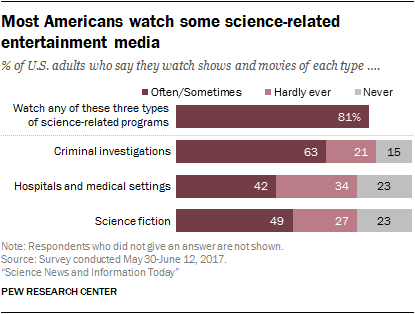
In contrast with science news consumption, a wide swath of Americans see science-related content through entertainment media. Fully 81% of U.S. adults say they watch one or more of these types of programming (shows or movies about criminal investigations, hospitals and medical settings, or science fiction) at least sometimes.

Many in the scientific community have worried over how such media influence public impressions of, support for and understanding of science.3 The new Pew Research Center survey finds that while most Americans believe such sources sacrifice realism for entertainment, most Americans believe such shows and movies do no harm to their understanding of science; and more people think such shows and movies help rather than hurt their understanding.4

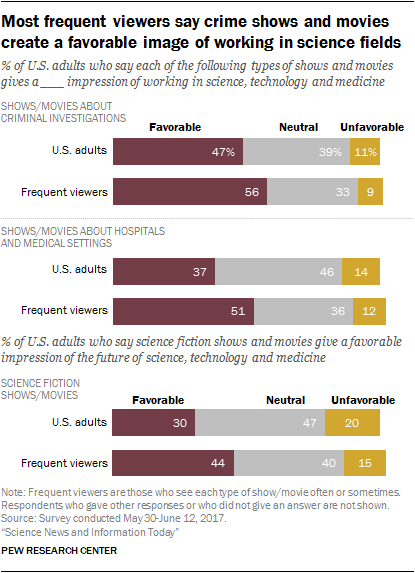
Further, the survey finds viewers of science-related entertainment believe that these films and shows provide, on the whole, a positive impression of working in science, technology and medicine. For example, 56% of Americans who watch shows about criminal investigations at least sometimes say these programs give a positive impression of working in science, technology and medicine; by contrast just 9% of these frequent viewers say the shows and movies create a negative impression, a third (33%) say they give a neutral impression.

Informal science venues and activities

Most Americans (62%) have encountered science information in the past year at an informal learning venue such as a park, zoo, or science and technology museum, including majorities of those with and without minor age children.5

About two-in-ten adults (18%) have a science-related hobby or interest such as outdoor and naturalist activities, astronomy, computer programming and technology-related hobbies.

And about one-in-six Americans (16%) say they have participated in a citizen science research activity, whether helping to collect data samples for a science research project, contributing to an online crowdsourcing activity, or participating in a maker movement or hack-a-thon.

Those with higher levels of education and income are more likely to participate in each of these kinds of science activities, consistent with past studies.6 As noted above, active science news consumers are more likely to have been to an informal science venue, to have a science-related hobby, and to have participated in a citizen science activity. Younger adults (ages 18 to 29) are modestly more likely than older adults to have done these things.

1. Most Americans express curiosity in science news, but a minority are active science news consumers

About seven-in-ten Americans express at least some interest in science news – in fact, they report greater interest in science stories than news about business, entertainment and even sports, though more report interest in local and government news.

But regardless of interest levels, a minority (36%) of the public gets science news regularly, and most encounter it by chance rather than actively searching for it. Taken together, one-in-six adults (17%) both get science news regularly and seek it out, whereas about half (49%) get science news infrequently and primarily happens upon it.

Most Americans have at least some interest in science news, though only one-in-four are very interested

Science news garners a fair amount of interest among Americans. About seven-in-ten (71%) have at least some interest in the news topic, though far fewer (25%) say they are very interested.

Overall, of the news topics asked about, interest in science falls somewhere in the middle. More Americans are very interested in local (41%) and political news (30%) than are very interested in science news, but science outpaces business (18%), sports (17%) and entertainment news (10%).

These findings track with previous Pew Research Center surveys in 2016 and 2014 as well as surveys on behalf of the National Science Board.7

Additionally, about half of Americans (52%) express enjoyment in science news over other topics, — though only 8% say they do a lot more.

Within science news, Americans are most interested in health and medicine

Science spans a wide range of subject areas. Of seven specific science topics asked about, five of them garner interest from at least half of Americans. But one stands out from the others: health and medicine. Seven-in-ten Americans express interest in health and medicine, with nearly three-in-ten (28%) rating it as the science news topic they are most interested in.

Health and medicine is followed by food/nutrition and technology – each chosen as the most interesting topic by 17% of U.S. adults. Fewer name energy and environment, the mind and brain, and space and astronomy as the topic that interests them most (9% each), while just 2% say this of evolution and 1% mention some other science topic.

Overall, the vast majority of Americans express interest in at least one of the seven specific science news topics. But when asked about the science news they get, about half (49%) say they follow just a couple of science news topics.

Interest in science news higher among men and the more educated

Across demographic groups, the higher educated and men exhibit greater levels of interest in science news. About four-in-ten (38%) of those with postgraduate degrees and 32% with college degrees are very interested, compared with a quarter or less of those who have some college education or less. Men are also more likely than women to be very interested (30% vs. 20%).

Differences emerge as well in interest in the specific science news topics. Women are more likely to be most interested in health, nutrition and the mind, whereas men favor technology and astronomy. Younger Americans are more likely to show an affinity for technology, whereas their elders prefer health-related subjects. Those with at least college degrees are more likely to name technology as their favorite topic. And while Democrats and Democratic-leaning independents are somewhat more likely to say energy and environment is a science topic of interest to them, few in either party consider this a topic of “most interest” (11% of Democrats/leaning Democrats and 6% of Republicans/leaning Republicans). For more details see Appendix A.8

About one-in-six adults (17%) actively seek out science news and consume it at least a few times a week; most get science news infrequently and happen upon it

While most Americans show at least some interest in science news, this doesn’t translate into high levels of active science news consumption.

The survey examined the intensity of science news consumption in two ways – frequency of consumption and whether people seek it out. The results show that a greater portion of Americans tend to be more passive than active in their science news habits.

Most Americans are not frequent consumers of science news. About two-thirds (64%) get news about this topic a few times a month or less. The remaining 36% get news more often, with just one-in-ten doing so nearly daily.

And when Americans do get science news, most do so by happenstance. Nearly seven-in-ten (68%) get their science news mostly because they happen to come across it, while three-in-ten mostly do so because they look for it. Americans tend to be more passive in how they get science news than they are about news more generally; a 2016 Pew Research Center report found that when Americans are asked about how they get their online news, 44% said they mostly seek out their news online, whereas 55% mostly happen upon it.

Taken together, a minority of Americans (17%) are what can be termed “active science news consumers,” those who seek out science news and get it at least a few times a week. About half (49%) of U.S. adults, on the other hand, are “uninterested science news consumers” – they get science news infrequently and mostly come across it. The remaining 32%, the “casual science news consumers,” fall somewhere in the middle; they either frequently get science news or seek it out, but not both.

Similar to interest levels, the two demographic groups that stand out for being somewhat more likely to be active science news consumers are men and the more educated. About a quarter of those with postgraduate degrees (27%) and those with college degrees (24%) are active consumers, compared with 16% of those with some college education and about one-in-ten (11%) of those with high school diplomas or less.

Men are also more likely than women to be active consumers (22% vs. 12%, respectively), consistent with their higher level of interest.

There are no differences by age or political party identification in the share of active science news consumers, though Republicans and independents who lean to the GOP are slightly more likely to be uninterested science news consumers than are their Democratic counterparts.

Curiosity is a key driver for why people get science news; most parents cite children’s interests as a reason

When U.S. adults are asked about why they follow science news, curiosity outpaces any other reason. About eight-in-ten adults (81%) cite their curiosity about what’s happening in science as a reason that they follow news on the topic, with 39% saying it’s a major reason.

Other reasons cited by smaller majorities are that science news helps them make decisions about their everyday lives and that they enjoy talking about science with others. Additionally, parents tend to cite their children’s interests and activities as a reason; some 61% of parents with children under 18 say this, with nearly a quarter (24%) saying it’s a major reason they follow science news.

Overall, more called each of these a “minor” rather than a “major” reason they follow science news.

On the flip side, there are many factors that discourage Americans from following science news more often. Though, of eight possible reasons asked about, none is cited by a majority as even a minor reason. The two most common reasons why people don’t follow science news more frequently are that they are too busy (46%) or because the sources they regularly follow don’t cover science a lot (43%).

Science news is not a particularly social experience

Few Americans have regular discussions about science news topics with their friends, family and acquaintances. The majority of Americans (55%) say they discuss science news less than a few times a month, while just 14% do so a few times a week and 3% do daily. This finding is in line with the fact that only a minority of adults actively consume science news.

Americans seem to discuss science news with others less than they do other forms of news. A 2016 Pew Research Center report found that 73% of Americans discuss news generally – whether about science or some other topic – at least a few times a week. And in March 2016, nearly six-in-ten (59%) U.S. adults said they had talked about government and politics with others at least a few times a week.

Additionally, most people who discuss science news with some regularity (i.e., “at least a few times a month”) do not consider themselves drivers of these conservations. Nearly two-thirds, 63%, of those who discuss science news at least a few times a month say they usually listen more than lead conversations about science news, while only 36% of this group says they see themselves as leading these conversations. Similarly, more than half (54%) of those who discuss science news at least a few times a month say they typically turn to others for science news, compared with 44% of this group who say that others typically turn to them for science news.

Active science news consumers much more likely to enjoy science news, cite a number of reasons for following it, and talk about it with others

Active science news consumers stand out for their high interest in science news and the ways they consume it. An overwhelming majority (88%) of active science news consumers say they enjoy following science news more than other types of news; this compares with 63% of casual consumers and just one-third (33%) of the uninterested consumers.

Active science news consumers are especially likely to cite curiosity as a motivating factor for following science news; nearly every active consumer (97%) cites it as a reason, with 77% saying it’s a major reason. And most say they follow science news about a lot of different science topics.

Finally, this group is particularly likely to have conversations about science news. Fully 44% of active science news consumers report talking about science news with others at least a few times a week, about twice that of casual consumers (21%) and far more than the uninterested science news consumers (6%). This group of active consumers is also much more likely to see themselves as the drivers of these conversations. Most active science news consumers who discuss science news with some regularity (61%) say that others turn to them for science news — in contrast to 42% of casual and 29% of uninterested science news consumers who discuss science news at least a few times a month. Similarly, about half of active science news consumers who discuss science news with some regularity (47%) say they lead more than listen in these conversations, compared with 35% of casual and a quarter (25%) of uninterested science news consumers who have these conversations at least a few times a month.

2. General news outlets are the most common science news source; most-seen stories highlight discoveries and “weird” findings

Even as news has diversified into multiple types of platforms and niche outlets, the general news media play an important role in providing the public news about science.9 This is true for active science news consumers as well, though they are more likely to also turn to specialty outlets.

Beyond the topics of science news, the most common science stories people see are reports on new discoveries, followed by stories about “strange or weird” research findings.

General news outlets outpace other sources for science news

More Americans rely on news outlets that cover a range of topics for science news than on specialty outlets.

When asked whether they rely more on general news outlets or specialty outlets for science news, 72% of Americans say general news sources; 24% say they get most of their science news from specialty sources.

A similar propensity towards general news outlets emerges when asking more specifically about 10 different types of sources for science news. Some 54% of Americans regularly get science news from outlets that cover a range of topics. The next most common source is documentaries or other science video programs (45%), while roughly one-quarter of Americans rely on websites and blogs focused on science (26%) or science magazines (25%). Far fewer Americans regularly rely on science specialty radio programs or podcasts (12%), science and technology museums (12%), online discussion forums about science (11%), government agencies (10%) or advocacy organizations (6%) for science news.

There is an ongoing concern, particularly in the medical and public health communities, about the extent to which the public attends to alternative medical information, rather than conventional sources. When asked separately about these types of sources, just 8% of Americans say they regularly get science news from “sources that provide alternative perspectives to conventional science or medical research.”

Many of these sources for science news and information – general news outlets, specialty sources, and alternative sources – can also be reached via social media. Most social media users (79%) say they see science-related posts there, even if not very many. A detailed analysis of people’s use of social media for science news and information can be found in Chapter 4.

Most Americans commonly rely on general news outlets, but active science news consumers also tend to rely on specialty sources

Active science news consumers are much more likely to rely on specialty sources than casual and uninterested consumers – but, even among this group, a 54% majority say, overall, they mostly rely on general news outlets for science news, while 45% say they get most of their news from science specialty outlets. By far, the majority of casual (71%) and uninterested science news consumers (81%) rely on general news sources for most of their science news.

When asked separately about 10 specific source types, similar shares of active, casual and uninterested science news consumers say they regularly get science news from news outlets that cover a range of topics and from family and friends. But active consumers rely more heavily on specialty science sources than do either casual or uninterested science news consumers. For example, active science news consumers are roughly two times more likely than uninterested news consumers to regularly get science news from documentaries or video programs (67%, compared with 34%). They are also much more likely to frequently get science news from science magazines and science-focused websites and blogs.

Active science news consumers get their science news from more source types. On average, active science news consumers regularly get their news from 3.7 out of 10 source types considered in the survey, compared with 2.7 among casual consumers and 1.8 among uninterested science news consumers.

Finally, as with other news sources, active science news consumers are also more likely to rely on sources that provide alternative perspectives to conventional science or medical research (19%) than either casual (8%) or uninterested science news consumers (4%).

Most Americans say they see news about scientific discoveries and about half see strange research findings

Science news covers a wide range of scientific fields whether biology, medicine, physics or something else. Some have criticized science journalism for too much emphasis on “gee-whiz” writing that, while enticing, gives too little attention to the relevance of science for the average person or the quality of the research.

The data here indicate that there is a bit of both going on. Most Americans (56%) see scientific discoveries, and more than a third of Americans (37%) say they see science news stories that help them make decisions about everyday life for themselves and their family.

Still, about half (48%) see science news articles about “strange or weird scientific research findings.”

When asked to describe a recent science news story that helped them make everyday decisions, the most frequent topics mentioned were about medicine and health stories followed by food and nutrition stories. For example, one respondent mentioned a radio program about the shingles vaccine led them to get vaccinated and another mentioned a story about a correlation between eating red meat and propensity for chronic disease that led them to change their eating habits. A smaller share of those seeing such stories mention stories about climate change and the environment leading to decisions in their everyday life.

Science news also sometimes contains contradictory information or notes disagreement among scientific experts. Some 41% of Americans report having seen news stories with scientific information that conflicts with earlier findings on the same topic. About three-in-ten Americans (29%) have seen news stories noting disagreement among scientific experts; among this group, climate change stories are most commonly cited (32%).

Fewer U.S. adults report seeing science news stories about a science researcher’s misconduct (15%) or about scientific research findings that seem completely made up (18%). Those that have seen this kind of story mentioned a number of topics including climate change, extraterrestrials and a variety of other topics.

There are no more than modest differences across demographic and educational groups in the types of science news seen. Further, there are only modest differences between Republicans and Democrats (including independents who lean to each party, respectively) in the kinds of science stories encountered. For example, 32% of Republicans say they see news that reports disagreement among scientific experts, as do 27% of Democrats. Some 22% of Republicans say they see news reports about scientific research that seem completely made up – only modestly higher than the 16% of Democrats who say the same.

3. Niche information sources are most trusted to get the facts right about science

Americans offer a mixed evaluation of how well the news media cover science, but more say that overall they do a good, rather than a bad job. When delving more deeply, however, Americans show skepticism in the accuracy of general news outlets, instead placing more trust in specialty information sources. And, while many see problems in coverage of scientific research stemming from a range of players, when asked to choose, most Americans say the bigger problem stems from how reporters cover scientific research than from the way researchers publish their findings.

Most Americans say the media do a good job covering science news

A majority (57%) of U.S. adults say the news media are doing a good job covering science, while about four-in-ten (41%) say the news media are doing a bad job.

While this finding is in keeping with the relatively positive assessments in previous Pew Research Center surveys of how the media cover specific science topics, notably childhood vaccines, it stands in contrast to the mostly negative views Americans hold of how the news media, generally, affect the country.10

Democrats and independents who lean to the Democratic Party are more likely than Republicans and those leaning Republican to say the news media are doing a good job (64% vs. 50%). This political difference is in line with general assessments of the news media.

Older Americans are modestly more likely than their younger counterparts to say news media are doing a good job covering science (65% of those ages 65 and older say the news media is doing a good job, compared with 53% of those younger than 50).

When it comes to rating the accuracy of science information, however, Americans are most likely to say niche science sources get the facts right.

At the top for accuracy are science and technology museums, documentaries or other science video programs, and science magazines, each of which roughly half of Americans say get the facts right most of the time (either “almost all” or “more than half” of the time).

Next are the trio of government agencies, science radio/podcasts and general news outlets, which about three-in-ten adults say get the facts right most of the time. Although far more Americans (42%) acknowledge they don’t know enough about science audio programs to rate their accuracy. Among those who were knowledgeable about such radio/podcasts, the balance of opinion is these programs get the facts right more than half or almost all the time (51% of those who gave an opinion), which would outpace both government and general news outlets.

Still, it is family and friends and online discussion forums that sit at the bottom. Only one-in-six U.S. adults (16%) say their family and friends get the facts rights about science almost all or more than half the time, while about twice as many (31%) say their family and friends are accurate less than half the time. Similarly, 16% of U.S. adults say online discussion forums get the facts right about science most of the time, though about four-in-ten (41%) say they did not know enough about these sources to give an opinion.

Active science news consumers see information sources as more accurate; political differences in views of accuracy are less pronounced

Overall, majorities of active (55%), casual (58%) and uninterested (59%) science news consumers say the news media are doing a good job covering science. But when it comes to the individual sources types, active science news consumers generally have greater trust in the accuracy of each of the sources asked about than do casual and uninterested science news consumers. And particularly large differences emerge among the types of science news consumers when they are asked to rate niche science sources.

About three-quarters (74%) of active science news consumers say science and technology museums, documentaries, and science magazines get the facts right most of the time. In contrast, no more than half of uninterested science news consumers think each of these sources is accurate more than half the time. This pattern also holds when accounting for the greater familiarity that active science news consumers have with many of these sources.

When it comes to science information, liberal Democrats stand out as more likely to trust both general and niche sources for accurate science information.

Similarly, 41% of liberal Democrats say news outlets that cover a range of topics get the facts right about science most of the time, compared with 22% of conservative Republicans.

Political differences tend to be smaller than differences between types of science news consumers, however.

Many Americans see problems in coverage of scientific research stemming from scientists, the news media and themselves

Americans see a range of problems in how scientific research is disseminated and understood, but they spread the blame across themselves, the news media and scientific researchers.

Many Americans say the public’s limited knowledge about science – as well as the way the public interprets science news – are problems. Some 44% of Americans say it is a big problem that the public doesn’t really know enough about science to understand research findings in the news. At the same time, 42% of U.S. adults say the public’s tendency to jump to conclusions about how to apply new research findings is a big problem.

Still, a similar share of Americans express concern about how the media report on scientific research: 43% of U.S. adults say it is a big problem that the news media are “too quick to report research findings than may not hold up.” A smaller share (30%) says that media oversimplifying scientific research is a big problem, while another 42% say this is a small problem.

Many Americans also believe that researchers affect the quality of science news coverage. For example, four-in-ten Americans (40%) say it is a big problem that there are so many research studies being published that it is hard to distinguish between high- and low-quality studies.

Conservative Republicans and liberal Democrats are about equally likely to consider the public not knowing enough about science to be a big problem for coverage of scientific research. But, conservative Republicans are more likely than liberal Democrats to name every potential problem stemming from news coverage or scientific research as a big problem.For example, more than half (57%) of conservative Republicans think it is a big problem that the news media are too quick to report findings that might not hold up, compared with 38% of liberal Democrats. For details, see Appendix A.

When asked, however, to choose whether the bigger problem rests in how media cover research or how researchers publish or share their findings, many more Americans put the onus on the media than on scientific researchers (73% vs. 24%), as do large majorities of both conservative Republicans (80%) and liberal Democrats (74%).

4. Most Americans see at least some science posts on social media but tend to distrust what they see

Social media are a prominent source of online news that allow Americans to curate the types of information they see on a daily basis. But social media appear to play a modest role in how Americans stay informed about science. While most social media users see posts about science on these sites, a smaller core of users see a sizeable quantity of posts or actively follow science pages.

Social media platforms are proving themselves to be value-added sources of science information for some. Among social media users, 44% say they at least sometimes see science news they wouldn’t see elsewhere. But, many are also highly skeptical of the news they are seeing. Only about a quarter (26%) of social media users say they mostly trust the science posts they find on these sites, compared with twice that (52%) who mostly distrust them.

Most social media users see science-related posts but fewer follow social media pages about science

About seven-in-ten Americans say they use social media, a figure that has gone up steadily over the past decade. Among that group, 79% (55% of all U.S. adults) report seeing science-related posts on social media – but only 25% see “a lot” or “some” science posts, while about half (53%) see “not many” (21% of users see no posts about science).

A minority of Americans are actively seeking science information on social media. About a quarter (26%) of social media users (18% of U.S. adults) say they follow any pages or accounts that focus on science.

Few say social media are a primary avenue for science news

One third of social media users (33%) say that these sites are the most important (6%) or an important way (28%) that they get science news; 45% say social media are not very important in how they get science news.

Younger adults are more likely to rely on social media for their science news. Roughly four-in-ten social media users ages 18 to 49 (41%) consider this an important way they get science news, compared with 22% of social media users ages 50 or older.

An ongoing question about social media is whether they amplify news also seen in other venues or expose users to new content. The survey finds 44% of social media users see content unique to that platform at least sometimes, though 8% say they do so often. A smaller share of users, 34%, say what they see on these platforms is hardly ever or never something they would not have seen elsewhere.

About two-in-ten social media users (18%) say they follow accounts that “provide alternative perspectives to conventional science or medical research.” Most of these users say they also follow traditional science pages (13% of social media users follow both a science account and an “alternative” science account; 5% of users only follow an alternative account).

Most social media users click through to articles about science news outside of the sites themselves; 54% at least sometimes go beyond the post, clicking on external links to science information but, as with seeing posts overall, few do this often (10%).

Many social media users see science-related posts, but about half distrust what they see

Most social media users are skeptical about the science content they see on these platforms. About a quarter (26%) of social media users say they mostly trust the science posts they see on these sites, compared with twice that (52%) who mostly distrust them.

The relatively low levels of trust is broadly in keeping with past studies by Pew Research Center on general news consumption; a 2016 survey found internet users to be less trusting of news found on social media than they were of other sources, including local and national news outlets.11

Social media users report seeing stories about “weird” science and new discoveries as well as celebrities’ health remedies

In terms of the specific types of science information that people get on social media, “strange or weird” scientific findings and new scientific discoveries are, by far, the most common types of posts seen on these platforms.

About a quarter (27%) of social media users have seen health or medical advice from celebrities on social media, a phenomenon with the potential to both help and hurt public understanding on these topics.12

A similar share of users (26%) report seeing science posts that they disagree with or that seem completely made up (24%). The survey asked respondents about any of five possible responses they have to posts they see that seem made up. The most common way people respond is to search for more information or, to a lesser extent, ignoring or hiding the story. Altogether, some 18% of social media users report taking any of five actions in response to science posts that seemed completely made up: commented on the story, searched for more information, shared the story to show that it is wrong, ignored or hid the story, or unfollowed/blocked the person or organization that originated the story.

Fewer social media users report seeing posts about scientific misconduct (7%) or disagreement among scientific experts (15%).

The 26% of social media users who follow science-related accounts are especially likely to see and trust science news on social media

There are wide differences among social media users in the degree to which they engage with science news on social media platforms and the value they find in social media as a source for science information. The 26% of social media users who follow at least one science account see more science content on social media – and, they are more likely to engage with science posts they see and to consider social media an important source for their science news. Key differences between social media users who follow a science page and those who don’t:

  • Fully 87% of science account followers click on science posts for content either often or sometimes, compared with 42% of those who do not follow such pages.
  • 64% of social media users who follow a science account consider social media an important source of their science news, compared with 22% of other social media users.
  • Social media users who follow science accounts are more likely to report seeing stories they wouldn’t have encountered elsewhere (69% say this occurs often or sometimes vs. 35% of social media users not following a science page).
  • Those who follow science pages or accounts are closely divided over whether they mostly trust or distrust the science posts they see (49% to 49%). By contrast, 19% of those who do not follow science pages say they mostly trust the posts about science that they see there.
  • When these more science-engaged social media users see posts they disagree with, they are more likely to report taking some kind of action in response. About a third (34%) of users following a science account have done at least one of the five actions considered in the survey: made a comment, searched for more information, shared the story to show that it is wrong, ignored or hid the story, or unfollowed/blocked the person or organization that originated the story. In contrast, just 14% of other social media users say they have done any of these things in response to a science post they disagreed with.

5. Most Americans see science-related entertainment shows and movies in either a neutral or positive light

Medical and forensic television shows – such as Grey’s Anatomy, House and the CSI franchise – have popularized how diverse fields of research, including DNA profiling, differential diagnosis and forensic anthropology, enable investigators to solve crimes and identify diseases. And, over the decades, inventors of the mobile phone, tablet computer, and even spacecraft propulsion systems have credited science fiction, like Star Trek, as the source of their ideas; this genre now is commonplace in entertainment media offerings.

Still, most Americans believe that science-related TV shows and movies focus more on entertainment than getting the facts right – an assessment that they apply to both science fiction and more “realistic” genres. And, although these programs and films frequently employ poetic license in their portrayal of science, viewers credit them with creating a favorable image of how science, technology and medicine work.

Science-related entertainment media draw a diverse audience

The vast majority of Americans watch science-related entertainment media. About eight-in-ten (81%) U.S. adults say they at least sometimes watch one or more of three types of shows and movies: criminal investigations, hospitals and medical settings, or science fiction. About two-in-ten (18%) say they hardly ever or never watch these three categories of entertainment.

People who watch these types of shows and movies at least sometimes encompass all demographic, educational and political groups. For example, a roughly equal share of men and women, as well as highly educated and less educated adults view at least one of these genres fairly regularly (i.e., “often” or “sometimes”). Further, 78% of uninterested science news consumers report viewing one or more of these types of programs at least sometimes, as do 82% of casual and 90% of active science news consumers.

Viewers of science-related entertainment media tend to see such shows as giving a positive impression of work in science, technology and medicine

While popular entertainment can inspire and inform, it can also create misconceptions. Many in the scientific community have worried over how such media influence people’s impressions of, support for, and understanding of scientific inquiry, knowledge and careers in these fields.13 For example, some express concern that Hollywood’s portrayal of science creates unrealistic standards for criminal evidence in the public mind. Although studies about this “CSI effect” remain inconclusive,14 the issue was deemed serious enough to merit inclusion in a report published by the National Academies of Sciences, Engineering, and Medicine and helped launch an advisory network to connect scientists and engineers with entertainment industry professionals.15

This study finds viewers of science-related entertainment believe that these films and shows provide, on the whole, a positive impression of working in science, technology and medicine. A majority of Americans (56%) who fairly regularly watch shows about criminal investigations say these programs give a positive impression of working in science, technology and medicine; by contrast just 9% say the shows and movies create a negative impression. A similar pattern occurs among viewers of shows focused on hospitals and medical settings. About half (51%) of those who watch such shows at least sometimes say they provide a positive image of working in science, technology and medicine; just 12% say they create a negative image.

And, while science fiction sometimes presents a dystopian view of the future, 44% of Americans who fairly regularly watch such shows and movies say the genre offers a favorable impression of the future of science, technology and medicine. Only 15% of this group says science fiction creates an unfavorable impression, and four-in-ten say the overall impression is neutral.

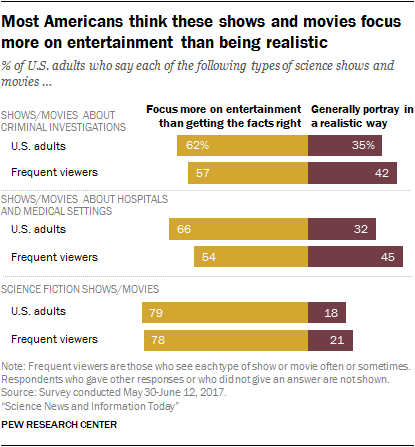
When it comes to realistically portraying science, majorities of Americans say that each of these types of science-related entertainment tend to focus more on entertainment than on getting the facts right. For example, when it comes to science fiction, 79% say such shows focus more on entertainment, while only 18% say that these programs portray science, technology and medicine in a realistic way.

While such views might be expected with regards to science fiction – a genre that purposefully veers from reality – the public holds similar perceptions of crime and medical shows. By a margin of roughly two-to-one, Americans think medical-oriented shows and movies prioritize entertainment (66%) over accuracy (32%). Similarly, Americans say crime shows focus more on entertainment than portraying science, technology and medicine in a realistic way by a margin of 62% to 35%.

Most Americans see entertainment media as doing no harm; more say it helps than hurts their understanding of science, technology and medicine

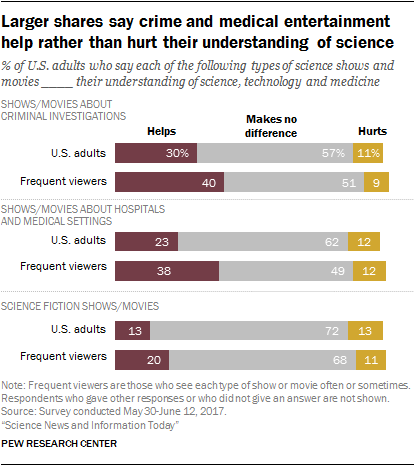
A central question surrounding science-related entertainment is whether the tendency of this genre to take poetic license undermines public understanding of science. From the public’s perspective, the answer appears to be no. Most Americans say that both crime and medical shows and movies have no particular effect on their understanding of science, technology and medicine; those who do are much more likely to consider the effect positive than negative.

About half of frequent viewers of crime-focused shows (51%) say these programs have no effect on their own understanding of science, technology and medicine. More say these shows help than hurt their understanding by a margin of 40% to 9%.

Frequent viewers of medicine-oriented programs judge the effect of these shows on their own understanding in a similar way. About half of this group (49%) says these shows and movies make no difference to their own understanding of science, technology and medicine, 38% say these shows help and just 12% say these shows hurt their understanding.

When it comes to science fiction, nearly seven-in-ten (68%) of frequent viewers say these shows and movies make no difference to their understanding of science, technology and medicine.

6. Citizen science, science-related hobbies and participation in informal science activities

Participation in science-related activities serves as another source for informing the public. The past two decades have seen a resurgence in direct public engagement with science – especially through citizen science and crowdsourcing activities – as a way to learn about the process of scientific inquiry and foster a deeper dialogue around the relationships between science and society.16

Citizen science encompasses a diverse range of activities, such as birdwatching, weather monitoring, processing and analyzing astronomical data, and do-it-yourself science projects.

Overall, 16% of U.S. adults report having done at least one of the following citizen science activities: made observations or collected data samples as part of a science research project, contributed to a science-related online crowdsourcing activity, or participated in a maker movement or hack-a-thon.

A similar share (17%) of adults have participated in a medical or clinical research study. One of the most common ways that Americans directly engage with medical care and research is by donating blood (40% of Americans say they have done this at least once). A quarter of Americans (25%) have donated money to support medical or science research.

Some 45% of parents with minor-age children (and 36% of all adults) have helped a child with a science project for school or an outside activity.

18% of Americans engage with science through hobbies, interests and activities at home

About one-in-five Americans (18%) report they have what they consider to be a “science-related hobby, interest or activity they do outside of work.”

Among the most popular:

  • 5% of Americans pursue hobbies related to the environment and nature, such as outdoor and naturalist activities, gardening, and botany.
  • 3% of Americans have interests in aviation or rocket building, astronomy, and star-gazing.
  • 3% of Americans have technology hobbies, such as computer programming and robotics.

Most Americans have been to a park, museum or informal science event in the past year

There are a number of other ways people encounter science information in their everyday lives and, potentially, learn about science through informal environments.17 Visits to parks and museums are foremost among them.

Altogether, 62% of U.S. adults have encountered science through one of these informal institutions or events in the past year: a national, state or county park (47%); a zoo or aquarium (30%); a science and technology center or museum (18%); a natural history museum (16%); or a science lecture (10%).

Participation in these science-related activities is common among parents with children under age 18 (69%) as well as those without minor-age children (59%).

By comparison, about four-in-ten Americans have been to a public library (43%) or an event with live music in the past year (41%). Fewer have been to a sporting event (35%) or visited an art museum or art gallery in the past year (24%).18

Active science news consumers, the highly educated and more affluent are particularly likely to have a science hobby, participate in citizen science and other science-related activities

The 17% of Americans who are active science news consumers – saying they typically seek out science news and consume it at least a few times each week – are particularly likely to have participated in science-related activities. They are far more likely than uninterested news consumers to say they have a science related hobby (42% vs. 7%), to have participated in a citizen science activity (31% vs. 10%), or to have been to any of five informal science venues in the past year, such as a park or museum (77% vs. 54%).

Adults with more education and higher incomes levels are also more likely to have participated in any of these informal science activities and to have a science-related hobby. For details see Appendix A. This is in keeping with a number of past studies showing a tendency for those with higher education and income levels to visit science-related museums or participate in other informal science learning activities.19

Visits to science-related museums are frequently associated with activities for children. A 69% majority of parents with children under age 18 have visited a park, museum or gone to a science lecture in the past year but so, too, have 59% of adults with no minor children.

Younger generations are more likely than their older counterparts to report having a science-related hobby (23% of those ages 18 to 29 vs. 12% of those ages 65 and older) and to have participated in a citizen science activity (23% of those ages 18 to 29 vs. 11% of those ages 65 and older), but there are only modest differences by age in visiting an informal science institution. Further, older adults are more likely than younger adults to have been in a clinical or medical research study and to have given money to support medical or science research, even after controlling for income and other factors.

Acknowledgments

This report is made possible by The Pew Charitable Trusts. This report is a collaborative effort based on the input and analysis of the following individuals. Find related reports online at: pewresearch.org/pewresearch-org/science.

Primary research team

Cary Funk, Director, Science and Society Research Jeffrey Gottfried, Senior Researcher Amy Mitchell, Director, Journalism Research Brian Kennedy, Research Associate Elisa Shearer, Research Analyst Meg Hefferon, Research Assistant

Collaborating research team

Claudia Deane, Vice President, Research Lee Rainie, Director, Internet and Technology Research

Editorial and graphic design

Mark Strauss, Writer/Editor Shannon Greenwood, Copy Editor Margaret Porteus, Information Graphics Designer

Communications and web publishing

Tom Caiazza, Communications Manager Rachel Weisel, Communications Manager Hannah Klein, Communications Associate Shannon Greenwood, Associate Digital Producer

Outside advisers

We received valuable advice from Timothy Caulfield, Canada Research Chair in health law and policy at the University of Alberta, and from John Besley, associate professor and Ellis N. Brandt Chair in public relations at Michigan State University.

Methodology

The analysis in this report is based on a nationally representative survey conducted from May 30 to June 12, 2017, among a sample of 4,024 adults 18 years of age or older. The margin of error for the full sample is plus or minus 1.6 percentage points.

The survey was conducted by the GfK Group in English and Spanish using KnowledgePanel, its nationally representative online research panel. KnowledgePanel members are recruited through probability sampling methods and include those with internet access and those who did not have internet access at the time of their recruitment (KnowledgePanel provides internet access for those who do not have it, and if needed, a device to access the internet when they join the panel). A combination of random-digit dialing (RDD) and address-based sampling (ABS) methodologies have been used to recruit panel members (in 2009 KnowledgePanel switched its sampling methodology for recruiting members from RDD to ABS).

KnowledgePanel continually recruits new panel members throughout the year to offset panel attrition as people leave the panel. All active members of the GfK panel were eligible for inclusion in this study. In all, 6,667 panelists were invited to take part in the survey. All sampled members received an initial email to notify them of the survey and provided a link to the survey questionnaire. Additional follow-up reminders were sent to those who had not responded as needed.

The final sample of 4,024 adults was weighted using an iterative technique that matches gender, age, race, Hispanic origin, education, region, household income, home ownership status and metropolitan area to the parameters of the Census Bureau’s March 2016 Current Population Survey (CPS). This weight is multiplied by an initial sampling or base weight that corrects for differences in the probability of selection of various segments of GfK’s sample and by a panel weight that adjusts for any biases due to nonresponse and noncoverage at the panel recruitment stage (using all of the parameters described above).

Sampling errors and statistical tests of significance take into account the effect of weighting at each of these stages.

The tables show the unweighted sample sizes and the error attributable to sampling that would be expected at the 95% confidence level.

Sample sizes and sampling errors for other subgroups are available upon request. In addition to sampling error, one should bear in mind that question wording and practical difficulties in conducting surveys can introduce error or bias into the findings of opinion polls.

Pew Research Center is a nonprofit, tax-exempt 501(c)(3) organization and a subsidiary of the Pew Charitable Trusts, its primary funder.

Appendix A: Detailed tables and regression analysis