Pew Research Center

FOR RELEASE FEBRUARY 9, 2017

How Americans Encounter, Recall and Act Upon Digital News

When following links, online news consumers could recall the name of the news outlet 56% of the time

BY Amy Mitchell, Jeffrey Gottfried, Elisa Shearer and Kristine Lu

FOR MEDIA OR OTHER INQUIRIES:

Communications Department
202.419.4372
www.pewresearch.org

RECOMMENDED CITATION

Pew Research Center, February 2017, "How Americans Encounter, Recall and Act Upon Digital News"

About Pew Research Center

Pew Research Center is a nonpartisan, nonadvocacy fact tank that informs the public about the issues, attitudes and trends shaping the world. It does not take policy positions. The Center conducts public opinion polling, demographic research, computational social science research and other data-driven research. It studies politics and policy; news habits and media; the internet and technology; religion; race and ethnicity; international affairs; social, demographic and economic trends; science; research methodology and data science; and immigration and migration. Pew Research Center is a subsidiary of The Pew Charitable Trusts, its primary funder.

© Pew Research Center 2026

Table of contents

  • About Pew Research Center
  • How Americans Encounter, Recall and Act Upon Digital News
  • 1. Part I: An analysis of individuals’ online news habits over the course of one week
  • 2. Part II: Characteristics of news instances
  • Appendix: Key concepts
  • Acknowledgments
  • Methodology

How Americans Encounter, Recall and Act Upon Digital News

When following links, online news consumers could recall the name of the news outlet 56% of the time

Anyone who wants to understand today’s news environment faces a challenge: How to discern the nuances of digital news habits when Americans’ attention spans are fractured, human memory is naturally limited and news comes at them every which way.

To tackle this complex question, Pew Research Center, in association with the John S. and James L. Knight Foundation, took on the unusual task of staying in touch with more than 2,000 U.S. adults who get at least some news online over the course of a week. The study ran from Feb. 24 to March 1, 2016. Respondents were asked twice a day whether they got news online within the past two hours and, if so, were asked about their experience with that news. This technique was used to improve the chances that respondents would be able to accurately recall their recent news interactions and allowed researchers to ask about sources and behaviors with a high level of detail. This amounted to up to 14 completed surveys per person for a total of 25,602 interviews – 13,086 of which included online news consumption.

While there are a number of pathways Americans use to get news online, two in this study stand out as the most common: social media and direct visits to news organizations’ websites. When asked how they arrived at news content in their most recent web interaction, online news consumers were about equally likely to get news by going directly to a news website (36% of the times they got news, on average) as getting it through social media (35%). They were less likely to access news through emails, text messages or search engines. And most people favored one pathway over another. Nearly two-thirds (65%) of online news consumers had one preferred pathway for getting most of their online news.

The study also sheds light on whether people are actually aware of the sources of news they consume – a question all the more relevant in light of the prevalence of fabricated news stories during the final weeks of the 2016 election. It reveals that when consumers click on a link to get to news, they can often recall the news source’s name. Individuals who said they followed a link to a news story were asked if they could write down the name of the news outlet they landed on. On average, they provided a name 56% of the time. But they were far more able to do so when that link came directly from a news organization – such as through an email or text alert from the news organization itself – than when it came from social media or an email or text from a friend. It was also the case that 10% of consumers, when asked to name the source of the news, wrote in “Facebook” as a specific news outlet.

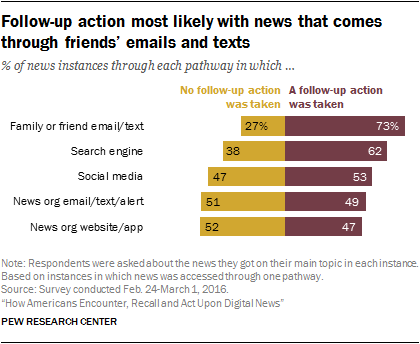
Another critical issue facing the industry is identifying which news experiences tend to inspire follow-up actions such as sharing, searching for more information or talking about it with others. This study suggests differences based on both the pathway used to get the news and the topic of news itself. Among the five pathways studied, news instances spurred by emails and texts from friends or family elicited the most activity; nearly three-quarters (73%) of these instances were acted upon in some way. That outpaced even social media and direct visits to a news organization’s website, where a follow-up action occurred in about half of news instances (53% and 47%, respectively). Overall, talking with someone offline, whether in person or over the phone, was the most common action taken with digital news.

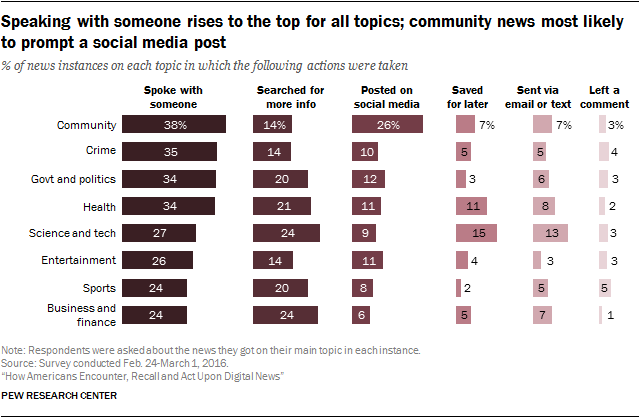
As for the topic of the news, community and health news spurred follow-up action about two-thirds of the time, while entertainment, sports and business news did so only about half the time. The type of follow-up action taken also varied with news topic. Stories about community affairs stand out for their social nature and were shared via social media at a far higher rate than any other topic. Science news, on the other hand, was bookmarked or saved for later or sent to someone via email or text at a higher rate than most other topics. Still, for all pathways and topics studied, speaking with someone offline about the news rises to the top.

It is important to keep in mind that this is self-reported data, and activities even as recent as the last two hours can be hard for some people to recall. At the same time, though, while a repeated survey like this can make people more aware of their online activities, little evidence of this emerged. This unique approach provides a deeper and more tangible window into how Americans learn about current events in the digital age, and speaks to some of the challenges news organizations have in establishing a relationship with digital audiences.

Other interesting patterns that emerged include the following:

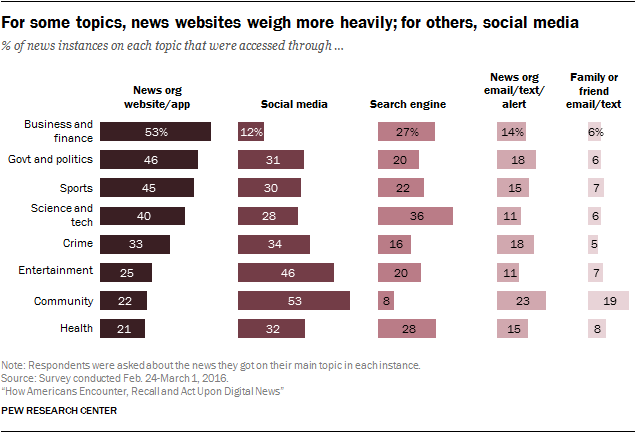
  • Just as individuals tend to favor one digital pathway over others, certain topics in the news are more likely to be learned about through one method over another. Business and finance news, for example, is more likely to be accessed by going directly to a news website. About half of business and finance news instances (53%) occurred through an individual going directly to a news website or app, compared with just 12% that came through social media. Community news, on the other hand, was much more likely to be discovered through social media (53%) than on a news website (22%).
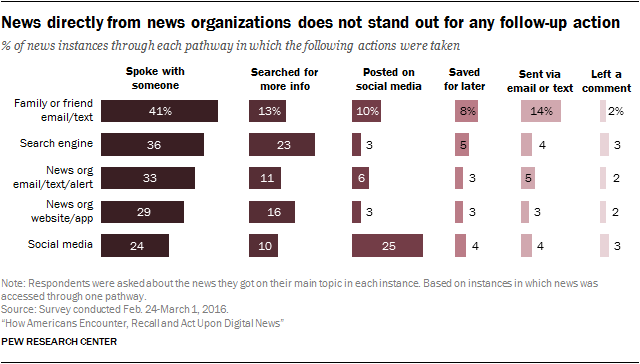
  • Social media, search engines and friends’ emails and texts all succeed in engaging news consumers within the bounds of each venue. About a quarter (23%) of the instances in which news came through a search engine resulted in searches for additional information, a higher share than any other pathway. Similarly, 14% of news instances from friends or family led to sending news via email or text, compared with 5% or less of the instances from any other pathway. And when people got news through social media, they went on to re-share that news on social media one out of four times. On the other hand, no single digital action stands out for news that came from a direct connection with a news organization.
  • Younger and older online news consumers follow news links at the same rate, but younger adults are less likely to remember the source. When 18- to 29-year-old online news consumers clicked on news links, they remembered the source about half the time (47%), at least 10 percentage points less than their elders (57% for 30- to 49-year-olds and 61% for those 50 and older). And these younger online news consumers got their news through social media 47% of the time on average, about double the rate of those 50 and older (23%), and about on par with those ages 30 to 49 (42%). Those 50 and older, on the other hand, stand out for their heavier reliance on news organizations’ emails, texts and alerts.

Details of the study

Over the course of one week (Feb. 24 to March 1, 2016), a nationally representative sample of online news consumers received two short surveys per day (14 total) asking about the news they got online, if any, in the past two hours.

The respondent pool comes from a survey conducted Jan. 12-Feb. 8, 2016, among 4,654 U.S. adults ages 18 and older who are members of Pew Research Center’s nationally representative American Trends Panel. In this February survey, those who indicated that they get news digitally (on a desktop or laptop computer or mobile device) were asked to participate in a weeklong study of their online news consumption. Of these individuals, 3,827 agreed to participate.

A total of 2,078 respondents completed at least 10 of the 14 mini-surveys during the week, of which 2,004 said that they got news online in at least one survey. These respondents are representative of online news consumers in a given week.

The structure of this study allows for analyses at two different levels:

  1. Online news consumer level:

    Average behavior of the 2,004 online news consumers surveyed over the course of the week. For example, the report looks at how often, on average, consumers got news by going directly to a news website versus getting it through social media.
  2. Instance level:

    The characteristics of the 13,086 total news instances that occurred during the week studied. For example, the report looks at whether news accessed through social media is more likely to be acted upon than news from a news organization’s website.

The report is divided accordingly into these two distinct parts, and the relevant icon – from the two above – appears at the start of each section to help readers keep the analytical frame in mind.

1. Part I: An analysis of individuals’ online news habits over the course of one week

The first part of this report examines individuals’ online news tendencies over the course of one week.

To do this, as indicated in the illustration below, the frequency of each respondent’s behavior was calculated as a percent of all the times he or she reported getting news online. For example, if someone got news 10 times, and did so through social media three of those times, that person got news through social media 30% of the time. Researchers then combined the figures for all 2,004 online news consumers and calculated the average rate of each behavior.

News websites and social media equally common as pathways to news; most consumers partial to one method

Past research by Pew Research Center revealed that the way Americans find digital news can impact the overall news experience. This study delves further by examining pathways used over the course of a week as well as which ones tend to be associated with other news habits such as sharing or source recall.

The study asked about five separate pathways: news organizations’ websites and apps; social media; search engines; emails, texts and alerts from news organizations; and emails and texts from friends or family. Each mini-survey asked online news consumers to indicate any and all pathways used to get news about the topic they got most in the past two hours.

Overall, social media and news organizations’ websites and apps were used far more than the other three. On average, 36% of the times individuals got news online, they did so by going directly to a news organization’s website or app. That’s about the same rate at which they got news through social media (35%). Less common was getting news through search engines (20%); through emails, texts and alerts from news organizations (15%); and through emails and texts from friends or family (7%).

In addition, most people tended to favor one pathway over the others. About two-thirds (65%) of online news consumers got news through the same pathway more than half of the times they got news.1 Again, social media and news organizations’ websites and apps were the most common. About a quarter (26%) of online news consumers consistently got news through social media, and about the same portion (23%) did so from news organizations’ websites and apps. Less than one-in-ten consistently got news through search engines (8%); through news organizations’ emails, texts and alerts (7%); or through the emails and texts of friends or family (1%).

The remaining 35% of online news consumers did not have a preference for one of the five pathways asked about – either grazing across pathways or using some other means of finding news, such as through a news aggregator or browser home page.

A later section shows how the pathway can impact the way individuals engage with that news.

As for the topic of the news, politics was by far the most popular during the week studied (Feb. 24 to March 1, 2016), which came at the height of the presidential primary and included Super Tuesday. On average, 40% of the times people got news, government and politics was their primary or only news topic (i.e. their main news topic). All other topics fell far behind, with entertainment, the next highest, at just 16%. No other topic – including community, business and finance, or sports news – was the main topic more than 10% of the time.

On average, when consumers got news, it was about just one topic 47% of the time. They got news on two topics a quarter of the time on average, and on three or more topics 28% of the time. However, over the course of the study, respondents reported getting fewer topics, which might be in part due to asking the survey multiple times over the week.

Source recall: Common, but not a given in the digital realm

In this era of shared news, many have questioned the degree to which people are aware of the actors (traditional media organizations and otherwise) that produce the news they get online – particularly when news is shared via links and often not identified with the brand name in the same way as on a news site.

This weeklong study reveals that when individuals followed a link to a news story, they were more often than not able to associate that link with a particular news source.2 If they had followed a link, individuals were asked to name the specific news outlet(s) they were taken to. On average, online news consumers named a source 56% of the time.

Still, this means that a little less than half of the time someone followed a news link (44% on average), he or she could not remember the source. And, as discussed later, where the link comes from impacts recall.

The source names provided reveal a wide range of outlets that people linked to and also showed that some identified the social media site Facebook as a specific news outlet.

CNN was named at least once over the week by 14% of those who followed links, similar to the 12% who named Fox News and 10% who named Facebook, even though Facebook does not produce the news stories distributed on the site. An additional seven sources were named by at least 3% to 6% of those who clicked on links: The New York Times, The Huffington Post, MSNBC, Yahoo, ESPN, The Washington Post and CBS. No other individual source was named by more than 3% of those who clicked on links.

It was also true that those who followed links more frequently had greater source awareness. Those who followed news links three or more times throughout the week remembered the source about two-thirds (64%) of the time, compared with 48% for those who followed a link only one or two times throughout the week.3

Some of this is perhaps tied to the fact that most of those who frequently click on links return to the same sources, showing loyalty to specific outlets. When asked to provide the name of a link’s source, nearly six-in-ten (59%) of those who frequently clicked on links named at least one news outlet multiple times during this week.

While this is self-reported data and the survey did not allow for verification of the sources named, the high rate at which individuals indicated that they did not remember (44%), as well as the wide range of sources named, suggests at least an intention to honestly answer the question.

People take action with their news about half the time

One feature of the digital news experience is the ability to respond to the news in a number of ways, both online and offline. The survey asked about six different types of follow-up actions: speaking with someone either in person or over the phone; searching for additional information; posting, sharing or commenting on a social networking site; sending an article to someone by email or text message; bookmarking or saving the news for later; and commenting on a news organization’s webpage.

Online news consumers in the study were about as likely as not to take some kind of action in response to the news they got, acting upon news 52% of the time on average, and not acting upon it 48% of the time.

Speaking with someone in person or over the phone was the most common action to take, occurring 30% of the time on average (as noted in an earlier report).

Among the digital actions, the most common one was personal, rather than social: Searching for more information occurred 16% of the time, on average. That was followed by two social actions: posting on social media (10%) and sending the news story to others via email or text (5%).

Individuals saved a news story for later 4% of the time on average (though other research indicates that many never go back to stories they save for later), and commented on a story just 2% of the time.

Happening upon news is common, though sometimes it stems from other news intake

Past studies have found a strong incidental nature to the digital news experience – finding news mixed in with other online activities, rather than specifically seeking it out.

This study probes more deeply to examine the extent to which people happen upon news online while in the midst of getting other news – for example, stumbling across entertainment news while already reading an article about business. This could come through prompts on websites, links within news stories or as a result of additional searching.

The findings reveal that consumers do occasionally come across news while already getting news about something else. Nearly a quarter (24%) of the time, on average, people learned about their main topic of news after getting news about another news topic. But that was less often than purposefully seeking news out (39% of the time on average) or happening upon it while doing something else online (36% of the time).

Age and gender differences across a week of online news behaviors

Pathways to news

Consistent with previous findings, younger online news consumers are more likely than older ones to get news through social media. On average, 18- to 29-year-old online news consumers got their news through social media 47% of the time, about double the rate of those 50 and older (23%), and about on par with those ages 30 to 49 (42%). The one pathway in which older online news consumers (those 50 and older) stand out, on the other hand, is news organizations’ emails, texts and alerts. The other three pathways were accessed at about the same rate by all age groups.

Looking at gender, women who consume news online got news through social media somewhat more often than male online news consumers – 39% versus 30% of the time, on average. Younger women particularly stand out. Women ages 18-29 and 30-49 got news through social media about half of the time on average (47% and 49%, respectively), compared with 28% for women 50 and older. Men, meanwhile, stand out for a greater tendency to go directly to a news website or app.

Source recall

Even though younger and older online news consumers follow links at about the same rate, younger adults are less likely to remember the source of these links. When 18- to 29-year-old online news consumers clicked on news links, they remembered the source about half the time (47%), at least 10 percentage points less than their elders (57% for 30- to 49-year-olds and 61% for 50 and older).

In addition, the oldest online news consumers are the most loyal. Among those who followed news links three or more times in the week, 74% of consumers ages 50 and older named at least one source multiple times, compared with half of those ages 18 to 29 and 30 to 49.

There was no difference between genders in the extent to which they remembered the source of news links. When it came to loyalty, though, men who followed news links at least three times were more likely than women to name at least one source multiple times (66% vs. 52%).

Seeking versus happening upon news

Older online news consumers are somewhat more deliberate in how they get news. On average, consumers ages 50 and older sought out their news 42% of the time, more often than those 18 to 29 (35% of the time), but on par with those 30 to 49 (38% of the time).

Additionally, men tended to be more deliberate than women in how they get news online. Men sought out their online news 45% of the time, compared with 33% for women, on average.

There were no notable age or gender differences in the frequency or type of action taken after getting news.

2. Part II: Characteristics of news instances

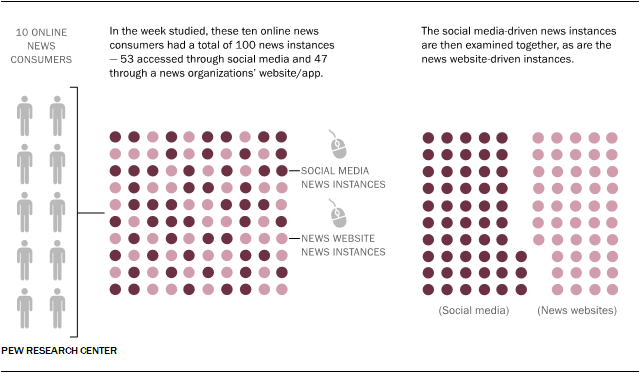
Throughout the week studied, online news consumers reported a total of 13,086 instances with online news – i.e. they got at least some news online within the two-hour window asked about. To get the best sense of how the pathway used to get news and the topic of the news may impact the full news experience, Part II of this report examines the data based on these news instances rather than individuals’ average behavior.

For example, this section looks at whether instances in which news came through social media are more or less likely to result in follow-up action than instances when it was accessed from a news organization’s website. The illustration below, using these two news pathways as an example, lays out how the data are organized at the instance level:

How people get to news impacts the full online news experience

Another clear takeaway from this real-time study is that people behave differently depending on the pathway they use to get their news, whether social media, emails, news alerts or direct website visits.

For example, news that comes directly through a news organization tends to result in better source recall but, at the same time, is less likely to elicit action afterwards – such as discussing, sharing or commenting. Instead, news that comes through email and texts from friends or family is most likely to prompt follow-up action.

Additionally, the follow-up actions taken online tend to remain within the digital arena in which the news originated. In other words, news found on social media is more likely to then be shared on social media sites, while news that comes through search engines is more likely than news through other pathways to lead to additional search activity.4

News encountered through emails and texts from family or friends is most likely to inspire follow-up action

While emails and texts from friends or family are a less common way to land upon news than other means, they are most likely to trigger some kind of follow-up action.

Nearly three-quarters (73%) of the instances in which news came through a friend’s email or text were acted upon in some way, higher than any other pathway. News through search engines was the next highest, which was acted upon in 62% of instances.

News directly from news organizations does not reach the same level of engagement: Whether through their emails, texts and alerts, or websites and apps, news directly from a news organization was acted upon in about half of instances (49% and 47%, respectively). Perhaps counterintuitively, this was about on par with social media-driven news instances, which led to follow-up actions in 53% of news instances.

The specific follow-up actions that stand out for each pathway suggest that social media, search engines and friends’ emails and texts all have success in engaging their consumers within the bounds of their own universes. For example, about a quarter (23%) of the instances in which news came through a search engine led to searching for additional information, a higher share than any other pathway. Additionally, 14% of news instances from friends or family led to sending news via email or text, compared with 5% or less of the instances for any other pathway. And while news through social media was one of the least likely to be discussed with someone offline, it was shared on social media itself in a quarter of instances.

There is no single digital action that stands out for news that comes from a direct connection with a news organization, which could suggest an area of challenge for news organizations in terms of how they connect with and engage audiences.

Source recognition is lower for news accessed through social media and friends, family

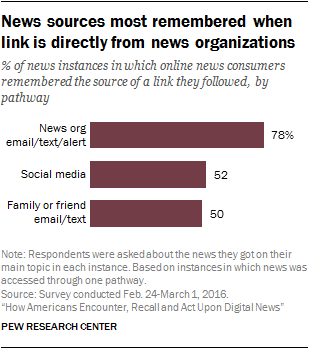
While news directly from news organizations may not encourage a high level of follow-up action, brand awareness of this news is much higher. People’s ability to remember the source of a link within a two-hour window is greater when that link comes directly from a news outlet than when it comes through another pathway.

In 78% of the times news links came directly from a news organization’s emails, texts and alerts, the individual could name a source for that link. That far outpaced source recall when a link came through social media (52% of such instances) or a friend’s email or text (50%). These differences persist even when accounting for the fact that younger online news consumers (who are less likely to remember sources) are more likely to get news through social media. These data reveal a potential challenge for news producers in creating brand awareness among those who land on their content from links sent or posted by others.5

The content of the news impacts how people engage with it online

Beyond how news is accessed digitally, the online news experience also varies depending on the topic of news learned about. Community news, for example, is a highly social experience. Compared with many other topics, consumers are more likely to find it through social media or a friend’s email or text and are also more likely to share it with others on social media.

Business news, meanwhile, is more likely than any other topic to be intentionally sought out. Additionally, it is one of the topics with the highest source awareness. However, it is one of the least likely to be acted upon.

Behaviors associated with political news don’t particularly stand out. News on this topic falls in the middle of the pack in the extent to which it is sought out and acted upon.6

Business news more sought out than other topics, usually by going directly to a news website

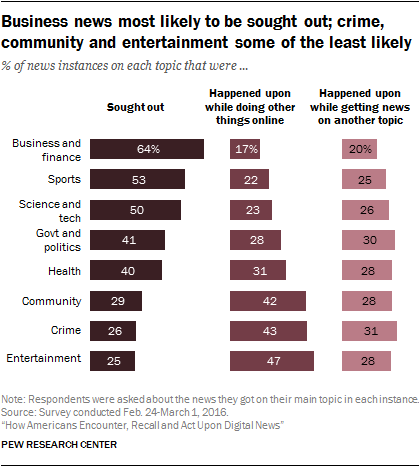
Getting news on certain topics tends to be much more of a deliberate experience than getting news on others. Business news is intentionally sought out more than any other topic. About two-thirds (64%) of news instances about business and finance were deliberately sought out. This was followed by sports (53%) and science news (50%).

On the other hand, the topics most likely to be happened upon while doing other things online are community, crime and entertainment news – between 42% and 47% of instances.

There were few differences across topics in the degree to which people happened upon news while already getting news about something else (business news being the one exception, lower than most other topics).

This tendency connects closely to the specific pathways used most often for each news topic. About half of business and finance news (53%), for example, came from a news website or app, about four times the rate at which this news came through social media (12%). Conversely, entertainment (53%) and community news (46%) were both much more likely to be found through social media, versus about a quarter of instances through news organizations’ websites for both topics.

For the other pathways, community news again emerges as a social online news experience. In addition to being found on social media at a high rate, community news was at least twice as likely as any other topic to have come from a friend’s email or text – 19% of instances, compared with 8% of instances or less for other topics. Science news, meanwhile, was one of the topics most likely to be found through a search engine (36% of instances).

Business and political news have some of the highest source recall

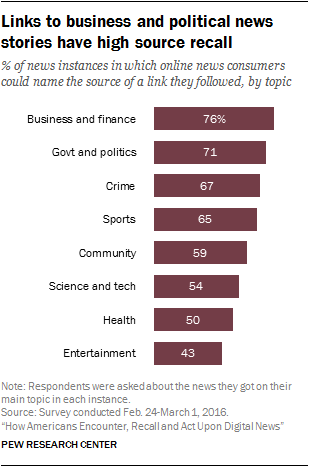
Business news, along with government and politics also carries with it high source awareness.

When respondents were asked to name the source of news links followed in the past two hours, they remembered those that linked to business and political news stories about three-quarters of the time (76% and 71%, respectively). This is higher than the share of instances in which the source was remembered for three other topics: entertainment (43%), health (50%) and science news (54%). The sources of news links were remembered between 59% and 67% of the time for crime, sports and community news.

Topics more sought out are often not those with greatest follow-up activity

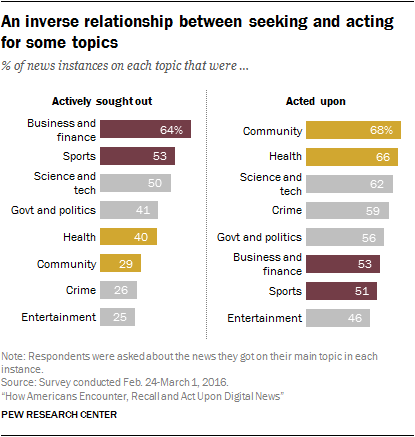
Topics that are more actively sought out are often the least likely to lead to follow-up action, and vice versa.7 For example, while community and health news are not sought out at a high rate compared with the other topics, they are among the topics most likely to be acted upon afterwards. About two-thirds of the news instances on these two topics produced some kind of follow-up action.

Conversely, business and sports news are two of the most deliberately sought out topics, but were not the topics most likely to inspire follow-up action.

Some topics, though, show more alignment between seeking and acting. Entertainment news fell to the bottom for both, while science and political news remained in the middle for both.

Just as speaking with someone offline is the most common action overall, it also rises to the top of actions taken for every topic, with community, crime, politics and health at the top of the list. Community news also stands out again for its social nature, shared via social media at a far higher rate than any other topic (26% of news instances, compared with no more than 12% of other topics). Science news was bookmarked or saved for later (15% of instances) or sent to someone via email or text (13%) at a higher rate than most other topics.

Appendix: Key concepts

Respondents in study: Those who completed at least 10 of the 14 short surveys over the course of the week studied.

A news instance: Each two-hour window (asked about in a short survey) in which a respondent said that they got at least some news online.

Online news consumers: All respondents who said they got news in at least one mini-survey (i.e. had a news instance over the course of the week studied; 2,004 individuals). The results in this study are representative of online news consumers in a given week.

Main news topic: The subject area about which respondents got all or most of their news in a news instance. Respondents were first asked to indicate which of eight topics they got news on in the past two hours and then, if they indicated more than one topic, which one they got the most news on. The topics asked about are politics, community, sports, business, science and technology, entertainment, crime and health.

News pathway: The access point through which online news consumers got news in each news instance. Respondents were asked to indicate which of five pathway(s) led to the news on their main news topic. Respondents could indicate more than one. The five pathways asked about were: news organizations’ websites and apps; social media sites; search engines; news organizations’ emails, texts and alerts; and emails and texts from friends or family.

Follow-up action: Any action a respondent took after getting news on their main topic in each news instance. The actions asked about were: speaking with someone, whether in person or over the phone; sending an article to someone by email or text message; posting, sharing or commenting on an article on social media; commenting on a news organization’s webpage; searching for additional stories or information about the news gotten; or bookmarking or saving the news in some way.

Acknowledgments

This report was made possible by The Pew Charitable Trusts, which received support for the project from the John S. and James L. Knight Foundation.

This report is a collaborative effort based on the input and analysis of the following individuals.

Amy Mitchell, Director, Journalism Research Jeffrey Gottfried, Senior Researcher Elisa Shearer, Research Analyst Kristine Lu, Research Assistant Michael Barthel, Research Associate Allison Becker, Research Assistant Rachel Weisel, Communications Manager Margaret Porteus, Information Graphics Designer Michael Keegan, Information Graphics Designer Shannon Greenwood, Associate Digital Producer Travis Mitchell, Digital Producer Courtney Kennedy, Director, Survey Research Andrew Mercer, Senior Research Methodologist Kyley McGeeney, Senior Research Methodologist

Methodology

The American Trends Panel Survey Wave 14.5

The experiential study consisted of 14 short online surveys that were administered two per day from Feb. 24 through March 1, 2016. The January wave of the panel was conducted by Pew Research Center in association with the John S. and James L. Knight Foundation. Survey invitations were sent at different times each day, and responses were accepted for two hours after the invitations were sent. Panelists who completed the January wave on the web and reported that they get news online (from a desktop or laptop computer or mobile device) were asked to participate in the experiential study. Of the 4,236 respondents who were asked, 3,827 agreed to participate in the experiential study.8 The analysis in this report relies on the 2,078 panelists who completed at least 10 of the 14 surveys.

For the experiential study, the data were weighted using a similar process to the full January wave. The base weight accounting for the initial probability of selection was adjusted to account for the propensity to have completed 10 or more of the experiential study surveys. The data were then weighted to match all online news users from the January wave on the following variables: gender, age, education, race and Hispanic ethnicity, region, population density, telephone service, internet access, frequency of internet use, volunteerism, party affiliation and the use of 10 different social networking sites for news.

Repeated questions over a week could theoretically condition respondents to answer differently. To test this, we compared the responses of users (who had answered at least 10 surveys) in the beginning of the week to those at the end of the week. One case where there was a key decrease in a type of response is that respondents were more likely to say that they had gotten news on three or more topics and less likely to get news on one topic in the first survey than all other surveys. This may be due to respondents noticing that when they did choose multiple topics, they were prompted to choose which was their main topic – and the questions thereafter only referred to their main topic. To the extent that this may have occurred, the conclusions of this report are unaffected because our analysis is only focused on these main topics. Additionally, in the last survey, seeking out news and getting news about politics was higher than in most other surveys throughout the week. This is likely due to the fact that the last day of the study fell on Super Tuesday (March 1, 2016).

For the person-level analysis, the following table shows the unweighted sample sizes and the error attributable to sampling that would be expected at the 95% level of confidence for different groups in the survey:

Sample sizes and sampling errors for other subgroups are available upon request.

For the instance level analysis, it is not possible to report a single margin of sampling error because news instances are clustered within respondents. Because of this clustering, the margin of error is different for each question depending on the extent to which individual respondents tend to answer the same way across all of their instances. All statistical tests and estimates used to produce this report were performed using methods that accounted for the effect of this clustering.

In addition to sampling error, one should bear in mind that question wording and practical difficulties in conducting surveys can introduce error or bias into the findings of opinion polls.

The experiential study had a response rate of 55% (2,078 responses among 3,803 who were eligible and agreed to participate). Taking account of the combined, weighted response rate for the recruitment surveys (10.0%), attrition from panel members who were removed at their request or for inactivity, and agreement to participate in the experiential study, the cumulative response rate for the January ATP wave is 1.4%.9