Pew Research Center

FOR RELEASE JULY 14, 2015

The Evolving Role of News on Twitter and Facebook

Americans are more likely to get news on Twitter and Facebook than ever before. Our new study explores the similarities and differences in the role of news on these two social networks.

BY Elisa Shearer, Michael Barthel, Jeffrey Gottfried and Amy Mitchell

FOR MEDIA OR OTHER INQUIRIES:

Communications Department
202.419.4372
www.pewresearch.org

RECOMMENDED CITATION

Pew Research Center, July 2015, "The Evolving Role of News on Twitter and Facebook"

About Pew Research Center

Pew Research Center is a nonpartisan, nonadvocacy fact tank that informs the public about the issues, attitudes and trends shaping the world. It does not take policy positions. The Center conducts public opinion polling, demographic research, computational social science research and other data-driven research. It studies politics and policy; news habits and media; the internet and technology; religion; race and ethnicity; international affairs; social, demographic and economic trends; science; research methodology and data science; and immigration and migration. Pew Research Center is a subsidiary of The Pew Charitable Trusts, its primary funder.

© Pew Research Center 2026

Table of contents

  • About Pew Research Center
  • The Evolving Role of News on Twitter and Facebook
  • News Use on Facebook and Twitter Is on the Rise
  • News Habits on Facebook and Twitter
  • Methodology

The Evolving Role of News on Twitter and Facebook

Americans are more likely to get news on Twitter and Facebook than ever before. Our new study explores the similarities and differences in the role of news on these two social networks.

The share of Americans for whom Twitter and Facebook serve as a source of news is continuing to rise. This rise comes primarily from more current users encountering news there rather than large increases in the user base overall, according to findings from a new survey. The report also finds that users turn to each of these prominent social networks to fulfill different types of information needs.

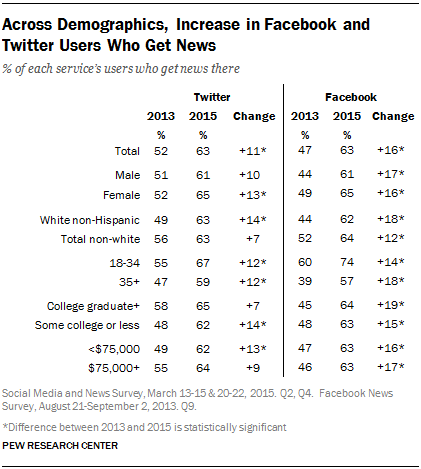
The new study, conducted by Pew Research Center in association with the John S. and James L. Knight Foundation, finds that clear majorities of Twitter (63%) and Facebook users (63%) now say each platform serves as a source for news about events and issues outside the realm of friends and family. That share has increased substantially from 2013, when about half of users (52% of Twitter users, 47% of Facebook users) said they got news from the social platforms.

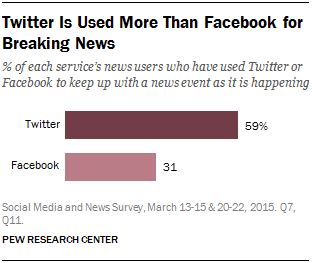
Although both social networks have the same portion of users getting news on these sites, there are significant differences in their potential news distribution strengths. The proportion of users who say they follow breaking news on Twitter, for example, is nearly twice as high as those who say they do so on Facebook (59% vs. 31%) – lending support, perhaps, to the view that Twitter’s great strength is providing as-it-happens coverage and commentary on live events.

These findings come at a time when the two social media platforms are increasing their emphasis on news. Twitter is soon set to unveil its long-rumored news feature, “Project Lightning.” The feature will allow anyone, whether they are a Twitter user or not, to view a feed of tweets, images and videos about live events as they happen, curated by a bevy of new employees with “newsroom experience.” And, in early 2015, Twitter purchased and launched the live video-streaming app Periscope, further highlighting their focus on providing information about live events as they happen. Meanwhile, in May, Facebook launched Instant Articles, a trial project that allows media companies to publish stories directly to the Facebook platform instead of linking to outside sites, and, in late June, Facebook started introducing its “Trending” sidebar to allow users to filter by topic and see only trending news about politics, science and technology, sports or entertainment.

As more social networking sites recognize and adapt to their role in the news environment, each will offer unique features for news users, and these features may foster shifts in news use. Those different uses around news features have implications for how Americans learn about the world and their communities, and for how they take part in the democratic process. This examination of Facebook and Twitter sheds light on the similarities and differences of these two prominent social media platforms.

Among other key findings in the report:

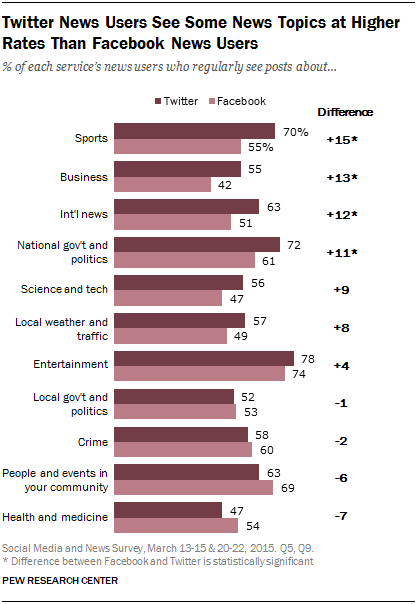
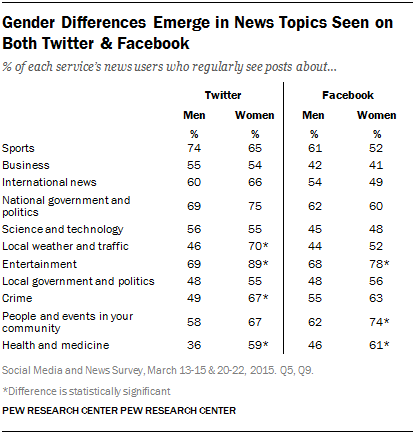
  • Twitter news users are more likely than their counterparts on Facebook to report seeing news about four out of 11 topics: national government and politics (72% vs. 61%), international affairs (63% vs. 51%), business (55% vs. 42%) and sports (70% vs. 55%). Twitter and Facebook news users are roughly comparable for the remaining seven topics covered: people and events in your community, local weather and traffic, entertainment, crime, local government, science and technology, and health and medicine. On Facebook, women are more likely to regularly see posts about health, entertainment and people and events in their community, while posts about weather, entertainment, crime, and health are more commonly seen by women on Twitter – a finding that is in line with our past research.
  • The rise in the share of social media users getting news on Facebook or Twitter cuts across nearly every demographic group. Use of Twitter for news, for example, grew among both users under 35 (55% to 67%) and those ages 35 and older (47% to 59%). And on Facebook, news use grew among both men (44% to 61%) and women (49% to 65%). These data also reveal that news exposure is relatively equal within all demographic groups, with the exception of age. Though news usage among those under 35 increased at roughly the same rate as among those ages 35 and older, on Facebook, younger users are more likely to see news than older users.
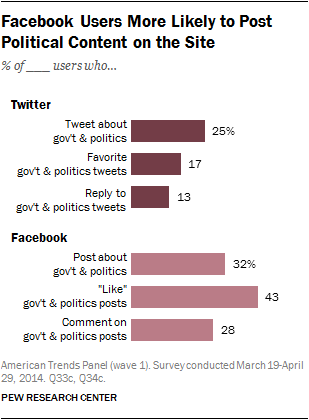
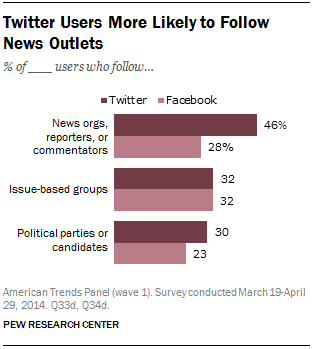
  • When it comes specifically to news and information about government and politics, Facebook users are more likely to post and respond to content, while Twitter users are more likely to follow news organizations. About one-third of Facebook users (32%) say they post about government and politics on Facebook, and 28% comment on these types of posts. That compares to a quarter of Twitter users (25%) who tweet about this news topic and 13% who reply to tweets on this topic posted by others. But following news outlets directly is more common on Twitter. About half (46%) of Twitter users follow news organizations, reporters or commentators, compared with about three-in-ten (28%) of Facebook users.

This is the newest project in a series of research reports that examine the role of news on social media platforms. This report is based on a survey of 2,035 U.S. adults, including 331 Twitter users and 1,315 Facebook users. The survey was conducted over two weekends: March 13-15, 2015 (N=1,018) and March 20-22, 2015 (N=1,017). (Many Facebook-related questions were asked only on the second weekend; for more information, see topline.)

About This Report

This report is part of a series by Pew Research Center aimed at understanding how news and information habits relate to the use of Twitter and Facebook among the American public. The main source of data for this report is a survey fielded over two weekends, March 13-15, 2015 and March 20-22, 2015, among a sample of 2,035 adults 18 years of age or older. Analysis from other Pew Research Center surveys is included where there is relevant data.
News Use on Facebook and Twitter Is on the Rise

On both Facebook and Twitter, more users are getting news than in the past. As of early 2015, 63% of Facebook and Twitter users get news on their respective sites. This is up substantially from 2013, when about half of each social network’s users (47% for Facebook and 52% for Twitter) reported getting news there.

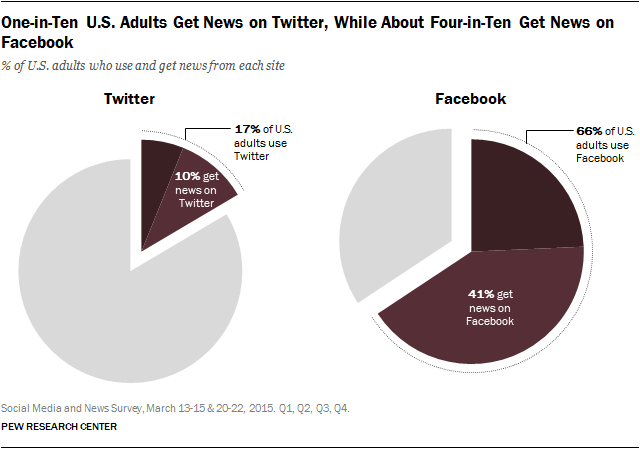
One-in-Ten U.S. Adults Get News on Twitter, While About Four-in-Ten Get News on Facebook

News Use Overlap

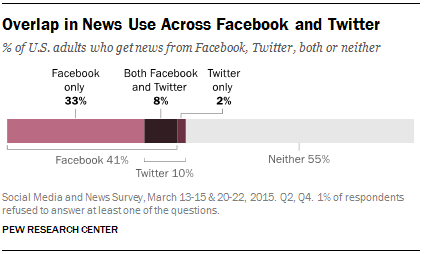
Overlap in News Use Across Facebook and Twitter

To what extent do users of Facebook or Twitter as a news source also use the other social site for news? The data suggest that there is a fair amount of overlap. One-in-five Facebook news users also get news on Twitter, and fully 78% of the smaller population of Twitter news users also get news on Facebook. That results in 8% of U.S. adults getting news on both Facebook and Twitter. (We found a similar overlap in 2013.)

Increase in News Use Cuts Across Most Demographics

Strikingly, this increase in the portion of users getting news on each platform cuts consistently across nearly every demographic measured – gender, race, age, education and household income. There was not, in other words, any one demographic driving the shift.

Use of Twitter for news, for example, grew between 2013 and 2015 among all age groups: users under 35 (55% to 67%) and those 35 and older (47% to 59%). On Facebook, news use grew among both males (44% to 61%) and females (49% to 65%) as well as households with incomes less than $75,000 per year (47% to 63%) and those making $75,000 or more (46% to 63%).

Across Demographics, Increase in Facebook and Twitter Users Who Get News

These data also reveal that, with one exception, the portion of users from each demographic group getting news on each site is fairly consistent. For example, 63% of both white and non-white users now get news on Twitter, as do 62% of white and 64% of non-white Facebook users. The one area where there is still considerable difference is age among Facebook users. While users in all age groups are more likely to use the site for news in 2015 than in 2013 (and in roughly equal proportions), younger users (adults under 35) are still more likely to see news there than users 35 and older (74% vs. 57%).

News Habits on Facebook and Twitter

When asked about specific news habits on each social site, users demonstrate some common tendencies as well as distinctions in how they use the sites. To some degree, this can be expected: The two services have different sets of technical features (Twitter has the live-streaming app Periscope, while Facebook has Instant Articles), and distinct cultures have arisen among their users. The nature of the differences revealed here clarifies the role each service plays in the news landscape.

Breaking News More Common on Twitter

Twitter Is Used More Than Facebook for Breaking News

Facebook news users under 35 show somewhat more inclination than those 35 and older to use the platform for breaking news (37% vs. 27%), a difference that does not emerge on Twitter.

Twitter News Users See a Wider Variety of News

Twitter News Users See a Variety of Topics

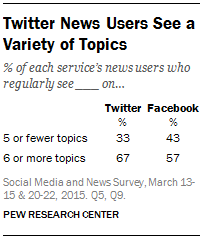
Another area of difference is in the mix of news topics seen on each platform. Twitter news users overall see a somewhat greater mix of topics. Roughly two-in-three Twitter news users (67%) report regularly seeing at least six of the 11 news topics asked about, compared with 57% of Facebook news users.

Twitter News Users See Some News Topics at Higher Rates Than Facebook News Users

Nearly all of the topics asked about are seen by at least half of news users on each platform. But there are four topics that Twitter news users report seeing at higher rates than Facebook news users: sports (70% vs. 55%), business (55% vs. 42%), international news (63% vs. 51%) and national government and politics (72% vs. 61%). Twitter and Facebook news users are roughly on par with each other for the remaining seven topics: science and technology, local weather and traffic, entertainment, local government, crime, people and events in your community, and health and medicine.

Gender Differences Emerge in News Topics Seen on Both Twitter & Facebook


Twitter, Facebook News Users Just as Likely to Post About News

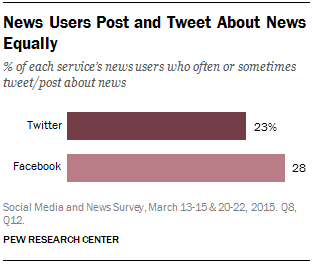
One area of commonality across the two sets of news users is the portion that tends to post about news. Roughly a quarter of both Facebook (28%) and Twitter (23%) news users at least sometimes post or tweet about news.

News Users Post and Tweet About News Equally

On both sites, news users with household income under $75,000 are more likely to post about news than those in higher-income households. One-third of Facebook news users with household income of less than $75,000 a year post about news on the site at least sometimes, compared with 22% of those with higher household income. On Twitter the figures are 34% and 13%. Also, on Twitter, 18-34-year-old news users are about twice as likely to tweet about news sometimes as users 35 and over (26% vs. 12%) and non-white Twitter news users are more likely to tweet about news at least sometimes (36%) than non-Hispanic whites (15%) – differences that did not emerge among Facebook news users.

There are a number of ways to ask social media users about how they engage with news on these sites, particularly when it comes to the activity of posting or tweeting, and the academic community is still learning how audiences respond to differently worded questions on this topic. In 2013, for example, Pew Research Center asked a series of questions about news-related activities on Facebook (including discussing, commenting on and posting news), and the responses there suggest a somewhat different interpretation of posting about news than responses to the question in this survey. In that study we found that 43% of Facebook news users said they at least sometimes post or share links about news stories on the site – a larger share than indicated here (28%). Posting about news may have indicated to respondents a higher and more involved level of activity than posting or sharing links about news stories. The larger takeaway from this survey’s findings, then, is the degree to which responses were similar across the two sites. In both cases, more than two-thirds indicated they had posted about news at least at some point in their use of the site.

Similar Levels of Importance Cited for Twitter and Facebook as Sources of News

Both Sites Are Secondary Sources of News, but More Important for the Young

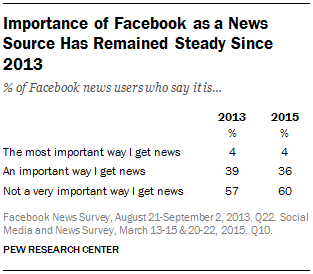
Importance of Facebook as a News Source Has Remained Steady Since 2013

Both Twitter and Facebook serve as important sources of news for some users, but only a small core consider them a top source of news. Four-in-ten Twitter and Facebook news users say their respective sites are the most important or an important way they get news, while six-in-ten describe it as not a very important news source. (Twitter news users are somewhat more likely to describe Twitter as the most important way – 9% vs. 4% of Facebook news users.)

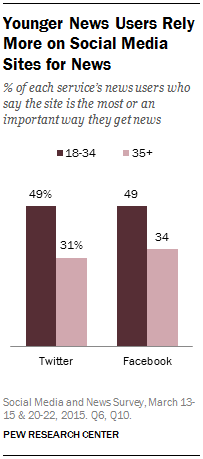
Younger News Users Rely More on Social Media Sites for News

The level of importance of Facebook as a news source has remained about the same since 2013, when 39% said it was an important way of keeping up with the news and 4% said it was the most important way. While a greater share of the social network’s users get news there than did so two years ago, its importance as a news source to those news users has not changed.

These data reveal, though, that on both social sites, younger users place greater importance on it for news. Nearly half (49%) of Twitter news users under 35 years of age say the site is the most important or an important way they get news, compared with 31% of those 35 years of age and over. This same relationship is true when it comes to Facebook (49% vs. 34%). This reinforces findings from another recent report by Pew Research, which found that Facebook was relied on as a source for political news among Millennials more than any other news source, and at a far higher rate than both Gen Xers and Baby Boomers.


Facebook Users Engage with Political Content; Twitter Users Follow Sources of Political News

Facebook Users More Likely to Post Political Content on the Site

To get a deeper sense of how users on Twitter and Facebook engage with news, we looked at separate survey data not yet analyzed, which asked specifically about users’ interactions with content related to politics and government.1

Twitter Users More Likely to Follow News Outlets

Twitter users, on the other hand, are more apt to seek out political content directly from news organizations and political parties. Choosing to follow news organizations, reporters or commentators (by following, friending or liking a page) is more common on Twitter (46% of users) than Facebook (28%). The same is true, though to a lesser extent, when it comes to following political parties or candidates (30% on Twitter, 23% on Facebook), though issue-based groups are followed at the same rate (32%) on both services.

Methodology

Social Media and News Survey

The main source of data for this report comes from a survey that was fielded over two weekends, March 13-15, 2015 and March 20-22, 2015, among a sample of 2,035 adults 18 years of age or older. The survey was conducted by GfK through OMNIWEB, a nationally representative omnibus online survey using GfK’s KnowledgePanel. GfK panel members are recruited through probability sampling methods (address-based samplings and random digit-dialing telephone samplings) and include both those with internet access and those without. For non-internet households, internet access and a laptop for the completion of online surveys are provided.

GfK continually recruits new panel members throughout the year to offset panel attrition as people leave the panel. The survey was conducted in English. The completion rate for the first weekend was 33.5%, while for the second weekend it was 30.2%.

The final sample was weighted using an iterative technique that matches demographic distributions to parameters from the 2014 Census Bureau’s Current Population Survey (CPS). This weight is multiplied by an initial sampling or base weight that corrects for differences in the probability of selection of various segments of GfK’s sample and by a panel weight that adjusts for any biases due to nonresponse and noncoverage at the panel recruitment stage. Details about the GfK panel-level weights can be found at http://www.gfk.com/Documents/GfK-KnowledgePanel-Design-Summary.pdf.

Of the 2,035 adults in the full sample who completed the survey, 66% were identified as Facebook users, and 41% were identified as Facebook news consumers; 17% were identified as Twitter users, and 10% were identified as Twitter news consumers. A majority of the questions were asked over both weekends, but many of the Facebook-related questions were asked only on the second weekend (which is indicated in the topline).

The accompanying table shows the unweighted sample sizes and the error attributable to sampling that would be expected at the 95% level of confidence for selected groups discussed in the report.

Sample Size and Margin of Error for Social Media and News Survey

In addition to sampling error, one should bear in mind that question wording and practical difficulties in conducting surveys can introduce error or bias into the findings of opinion polls.

Some of the data in the report is drawn from a study conducted using GfK’s KnowledgePanel in 2013. For the methodology of the 2013 Facebook and News study, click here.

American Trends Panel

The American Trends Panel (ATP), created by Pew Research Center, is a nationally representative panel of randomly selected U.S. adults living in households. Respondents who self-identify as internet users (representing 89% of U.S. adults) participate in the panel via monthly self-administered Web surveys, and those who do not use the internet participate via telephone or mail. The panel is being managed by Abt SRBI.

Data in this report are drawn from the first wave of the panel, conducted March 19 to April 29, 2014 among 2,901 web respondents. All current members of the American Trends Panel were originally recruited from the 2014 Political Polarization and Typology Survey, a large (n=10,013) national landline and cellphone random digit dial (RDD) survey conducted January 23 to March 16th, 2014, in English and Spanish. At the end of that survey, respondents were invited to join the panel. The invitation was extended to all respondents who use the internet (from any location) and a random subsample of respondents who do not use the internet.

Of the 10,013 adults interviewed, 9,809 were invited to take part in the panel. A total of 5,338 agreed to participate and provided either a mailing address or an email address to which a welcome packet, a monetary incentive and future survey invitations could be sent. Panelists also receive a small monetary incentive after participating in each wave of the survey.

The ATP data were weighted in a multi-step process that begins with a base weight incorporating the respondents’ original survey selection probability and the fact that some panelists were subsampled for invitation to the panel. Next, an adjustment was made for the fact that the propensity to join the panel varied across different groups in the sample. The final step in the weighting uses an iterative technique that matches gender, age, education, race, Hispanic origin and region to parameters from the U.S. Census Bureau’s 2012 American Community Survey. Population density is weighted to match the 2010 U.S. Decennial Census. Telephone service is weighted to estimates of telephone coverage for 2014 that were projected from the January to June 2013 National Health Interview Survey. It also adjusts for party affiliation using an average of the three most recent Pew Research Center general public telephone surveys, and for internet use using as a parameter a measure from the 2014 Survey of Political Polarization. Sampling errors and statistical tests of significance take into account the effect of weighting. The Hispanic sample in the American Trends Panel is predominantly native born and English speaking.

The following table shows the unweighted sample sizes and the error attributable to sampling that would be expected at the 95% level of confidence for different groups in the survey:

Sample Size and Margin of Error for American Trends Panel (Wave 1)

Sample sizes and sampling errors for other subgroups are available upon request.

In addition to sampling error, one should bear in mind that question wording and practical difficulties in conducting surveys can introduce error or bias into the findings of opinion polls.

The Web component of the first wave had a response rate of 61% (2,901 responses among 4,753 Web-based individuals enrolled in the panel). Taking account of the response rate for the 2014 Survey of Political Polarization (10.6%), the cumulative response rate for the first ATP wave is 3.6%.