In-depth case studies in three disparate cities (Denver, Macon and Sioux City) show that local news still matters, with nearly nine-in-ten city residents following it closely.
About Pew Research Center
Pew Research Center is a nonpartisan, nonadvocacy fact tank that informs the public about the issues, attitudes and trends shaping the world. It does not take policy positions. The Center conducts public opinion polling, demographic research, computational social science research and other data-driven research. It studies politics and policy; news habits and media; the internet and technology; religion; race and ethnicity; international affairs; social, demographic and economic trends; science; research methodology and data science; and immigration and migration. Pew Research Center is a subsidiary of The Pew Charitable Trusts, its primary funder.
In-depth case studies in three disparate cities (Denver, Macon and Sioux City) show that local news still matters, with nearly nine-in-ten city residents following it closely.
Whether in a tech-savvy metropolis or a city where the town square is still the communication hub, local news matters deeply to the lives of residents. Across three disparate metro areas in the U.S., nearly nine-in-ten residents follow local news closely—and about half do so very closely, according to a new, in-depth Pew Research Center study, conducted in association with the John S. and James L. Knight Foundation. About two-thirds of the residents in each city discuss local news in person a few times a week or more.
During a period of tremendous technological change—change that is far from complete—this study takes a microscope to the information streams in three news environments across the United States: Denver, Colorado—a highly educated urban area of more than 2 million with internet adoption above the national average and a large Hispanic population (19%); Macon, Georgia—a metro area of 175,000 with a substantial share of black residents (41%), an unemployment rate above the national average, and a local university working to serve as a hub for journalism innovation; and Sioux City, Iowa—a city that spans three states and has a predominantly white population of just 125,000. These cities are not meant to be extrapolated to the United States as a whole, but rather serve as a set of case studies on the ebb and flow of daily local news that speak to the diversity of modern American cities.
Studying the ways that local news flows in a city’s population requires more than one tool in the social scientist’s tool kit. For this particular project, the Center employed multiple types of quantitative research in each metro area, including a landscape audit cataloging the full range of news providers operating in the area; a content analysis of the actual news output produced over a week’s time; a public opinion survey of residents focusing on their local news habits and civic engagement; and an experimental examination of Facebook and Twitter posts in each area.
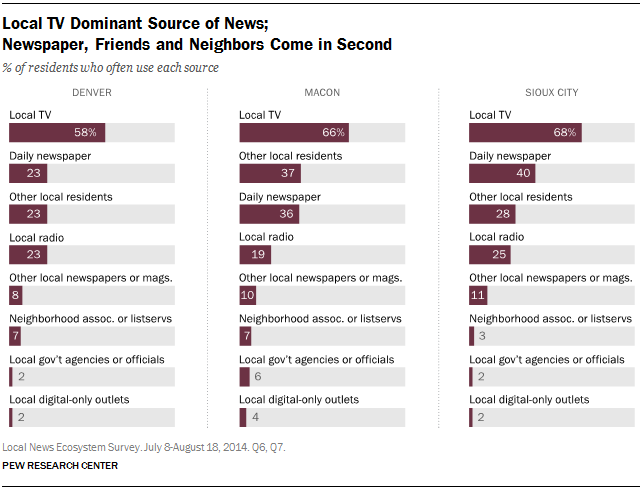
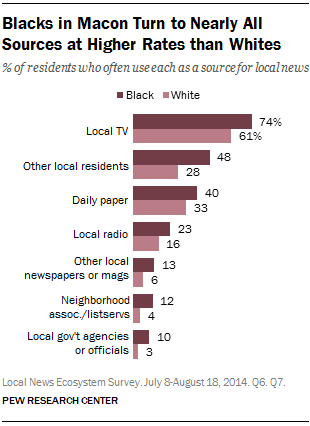
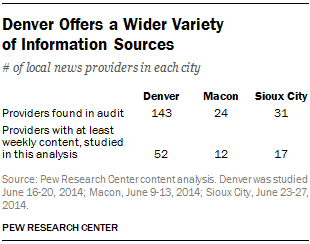
Perhaps the most obvious way that local news climates differ across U.S. cities is in terms of volume and choice, the former of which may well have an impact on the latter. Denver’s 140+ identified news providers—including 25 digital-only outlets—is about 2.5 times that of Macon (24) and Sioux City (31) combined. And that seems to have some impact on the dominance of legacy providers in each city. In choice-rich Denver, somewhat fewer residents often rely on local TV for news (58%, compared with 66% in Macon and 68% in Sioux City), though local TV still attracts a greater share of the audience than any other type of news source.
More striking, only a quarter (23%) of Denver residents often get local news from their main daily paper, compared with 40% of Sioux City residents and 36% of Macon residents. This is evidenced further in the sources residents say they turn to most for various local news topics. In Sioux City, the newspaper ranks first in six different topics, while in Denver the same is true of just a single topic area–development issues. Nonetheless, the reliance on nontraditional news outlets is still the exception rather than the norm. In all three cities, the portion of residents who often get local news from neighborhood associations, government agencies or officials, or digital-only outlets is in the single digits.
The study also suggests that some populations are more engaged with their local news stream, and that this holds across a broader range of topics. Macon residents, for example, stand out for closely following most topics at higher rates than Denver or Sioux City residents. Nine out of 12 topics covered—from weather to education to the local economy—are closely followed by at least 20% of Macon residents, while that is true of just six topics in Denver and five in Sioux City. This higher rate of interest from Macon residents exists in civic-oriented topics such as education and government as well as local crime. But civic issues resonate everywhere. At least four-in-ten residents in each city say they often discuss local government and politics or the local economy.
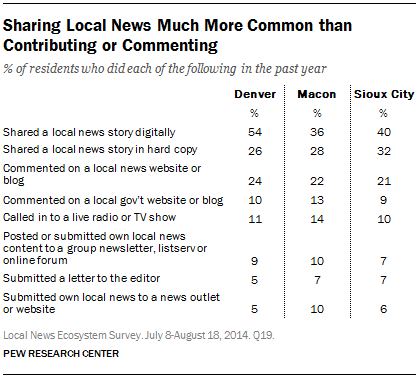
Across these three cities, the study picks up traces of the start of direct participation in the news process, and at fairly equal levels. No more than 10% in each city have submitted their own local content to a news provider in the past year; about 10% have called in to a local radio or TV show; roughly two-in-ten have commented on a local news blog. But it is in the small metro area of Sioux City where residents are most likely to have spoken with or been interviewed by a local journalist (29%, compared with 23% in Macon and 16% in Denver).
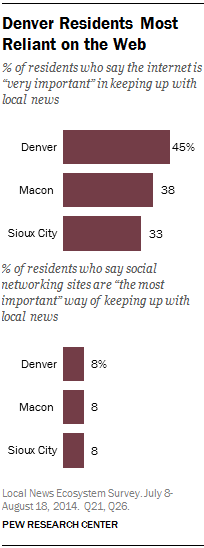
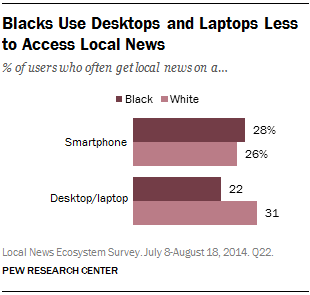
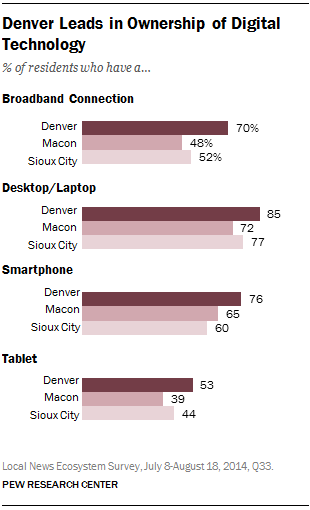
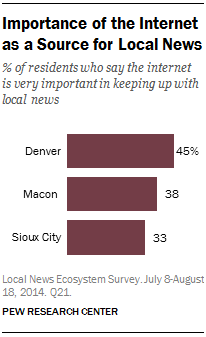
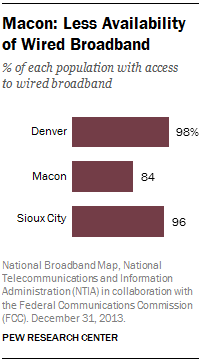
The case studies also find that digital technology has impacted news habits in all three cities, but at different levels. More than half of residents in Sioux City and two-thirds in Macon and Denver access at least one local news provider digitally: 68% of Denver residents, 66% in Macon and 56% in Sioux City. But, residents of Denver, with their heightened broadband adoption (70% have it in their home, compared with 48% in Macon and 52% in Sioux City) are most likely say the internet is very important in keeping up with local news (45% compared with 38% in Macon and 33% in Sioux city), the most likely to use at least one digital device for news (79% versus about two-thirds in Macon and Sioux City) and to have shared a news story digitally in the past year (54%, compared with 36% in Macon and 40% in Sioux City), suggesting that in more wired cities news may literally travel faster. Nevertheless, while roughly equal percentages in each city—about a quarter of the population—say they get some local news through online social networks, it is Macon residents who are most likely to access at least one local provider through a social networking site. Sioux City residents, meanwhile, show the least reliance on a digital news stream: 22% of Sioux City residents often get local news on a desktop or laptop compared with 37% in Denver and 27% in Macon.
Digital differences also stand out among the news providers in each city. Only six of the 24 news providers in Macon and seven of the 31 identified in Sioux City offered daily digital content. Among just the digital only outlets in Denver, there were more offering daily content – 11 of the 25. Denver news providers also demonstrate a greater use of digital opportunities. In five days of content studied in each city, 31% of online news stories in Denver (excluding traffic, weather and sports) contained at least one embedded link compared with 3% of online stories in Macon and 1% in Sioux City.
Among the other major findings:
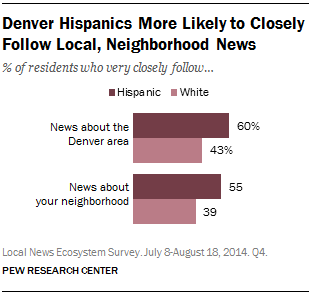
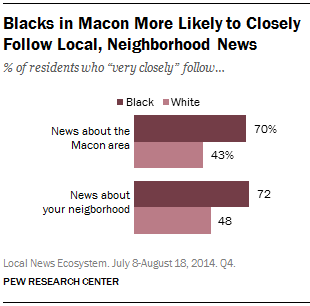
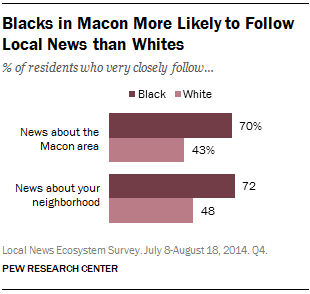
One of the greatest disparities occurs not across metro areas, but within them: that of race and ethnicity. Both Hispanics in Denver and blacks in Macon closely follow local and neighborhood news at higher rates than their white counterparts. In Denver, 60% of Hispanics compared with 43% of whites closely follow news about the local area. In Macon that is true of 70% of blacks compared with 43% of whites. Each of these groups is also at least twice as likely as whites in their respective city to feel they can have a big impact on the city (42% of Hispanics in Denver compared with 21% of whites; in Macon, 36% of blacks vs. 14% of whites). Denver and Macon differ in at least one major way when it comes to news sources targeted toward these populations: Researchers identified nine outlets in Denver aimed at Hispanics and/or Spanish speakers. In Macon, researchers found just one that appeared to cater directly to the black community.
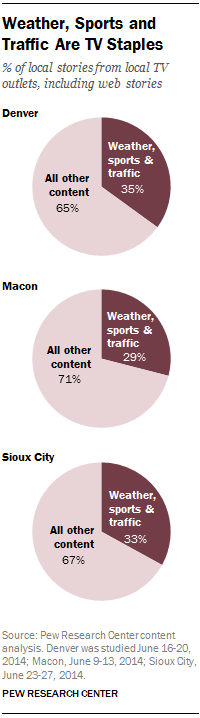
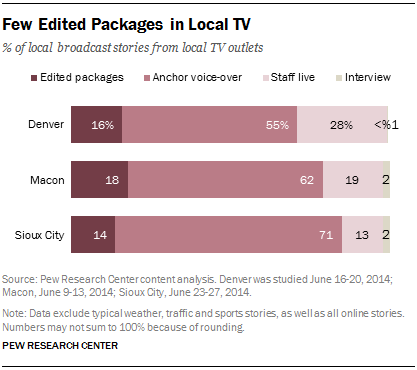
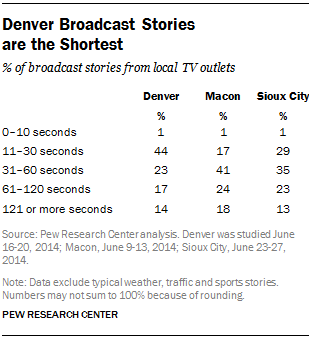
Local TV is the single most visible presence in the news space, though a majority of stories produced are short anchor reads that require little reporting. Denver alone offers nine different local TV stations, including two Spanish-language outlets. Combined, they produce more than 25 hours of news each weekday – and at this point, on-air programming is far more of a draw than TV websites. The study of five days of content in each city finds that routine traffic, weather and sports segments accounted for about a third of the airtime. In the remaining programming, anchor “voice-overs”— the short items an anchor tends to read from a teleprompter—accounted for 71% of story segments in Sioux City, 62% in Macon and 55% in Denver. The reliance on anchor reads plays out in the length of stories, though the averages here did vary by city. Nearly half, 45% of non-sports, weather and traffic stories on Denver stations were 30 seconds or shorter, compared with 29% in Sioux City and 17% in Macon. Fewer than two-in-ten stories in each city were more than two minutes long.
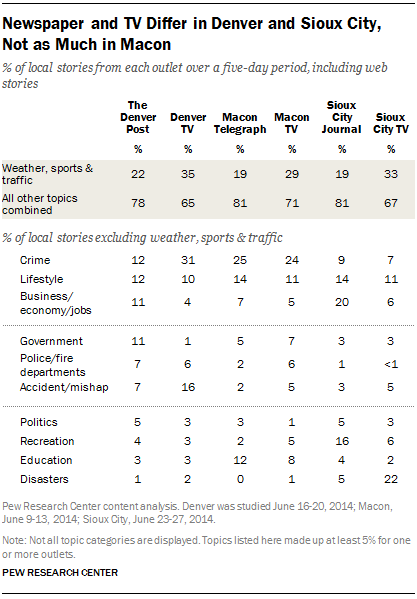
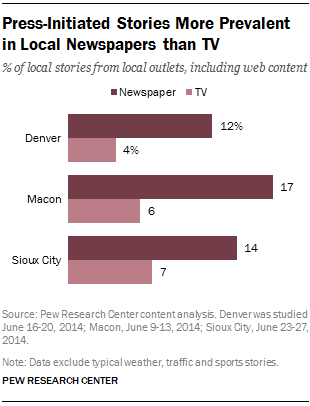
The role of the main daily newspaper varies from city to city, but in each the emphasis is on more civically oriented and press-initiated coverage than found in local TV. In a five-day snapshot of coverage, 30% of Denver Post stories focused on government, politics, economics or education (excluding traffic, weather and sports stories), as opposed to 11% devoted to those topics on local TV. In Sioux City, the daily devoted 30% of its stories to these topics, versus 14% on local TV. In Macon, the differences between the two were smaller, 26% in The Telegraph and 21% among the local TV stations. But in all three, the level of press-initiated reporting was twice that of the local TV stations as whole: 17% compared with 6% in Macon, 14% to 7% in Sioux City and 12% to 4% in Denver. This does not always equate to investigative or civic-oriented reporting, but it does speak to a less reactive approach to the news it covers.
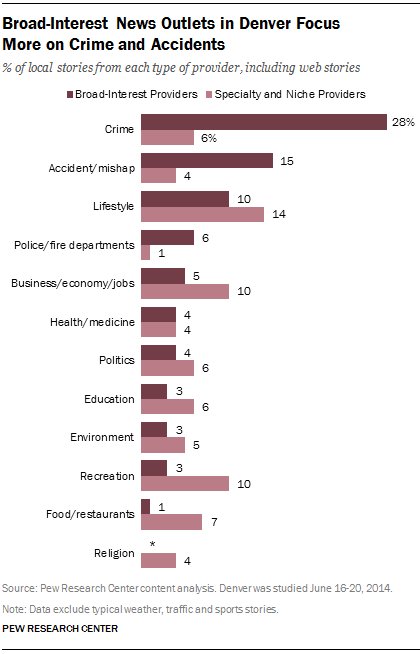
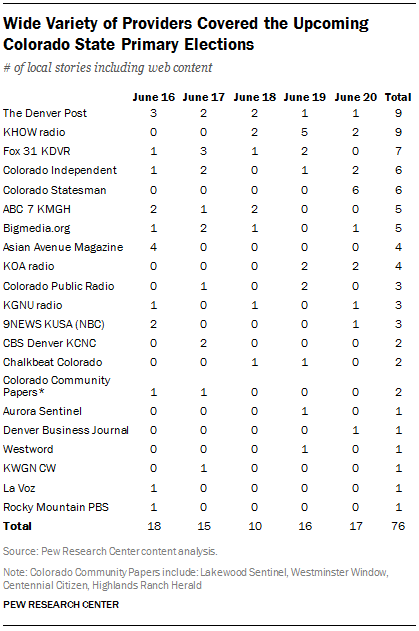
One distinct element of Denver’s news ecology is the breadth of coverage offered by its wider mix of new and alternative news providers. This is particularly true when it comes to longer term, more issue-based news items such as the lead story during the week studied—the upcoming Colorado primaries. Fully 21 different news outlets covered that story in the five days studied. This included the online nonprofit Colorado Independent, which produced six pieces on the election in the time period studied, and Asian Avenue Magazine, whose June issue devoted four stories to the topic, three of them geared toward the Asian-American community. Denver also displays the greatest difference in the coverage offered by three daily papers compared with the mix of their respective local TV stations. Four of the five stories that got the most attention from TV and newspapers in the five days studied were different.
In all three cities, some local entities outside of journalism, particularly within government, are using the Web in part to serve as news providers. In Macon, the county government streams official proceedings online, and the Facebook page of U.S. Rep. Austin Scott, a Georgia Republican, ranks among the most-liked and most-commented on over a two-week period. In Sioux City, a local congresswoman had more comments on her Facebook page than any of the news organizations studied. And in Denver, six of the 10 websites featuring access to data sets were those operated by local municipalities, such as Jefferson County’s financial data search tool.
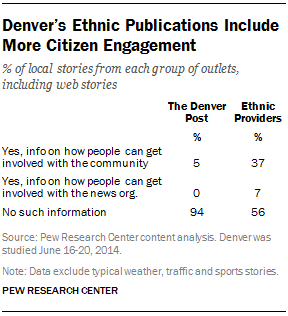
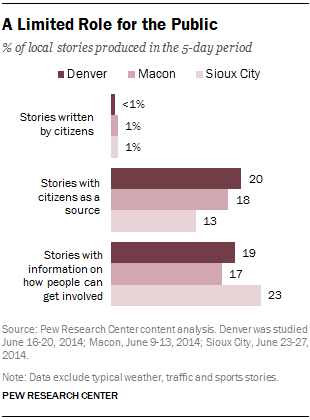
Citizens are a part of the news process but mainly as quoted sources or as disseminators of news in social media. In all three cities, citizens were the most commonly cited source in news stories studied over a five-day period (excluding traffic, weather and sports): 20% of the Denver stories, 13% of Sioux City stories and 18% of Macon stories contained at least one citizen source. But no more than 1% of stories studied in any city had citizen bylines. In social media, an analysis of two weeks of content from the Facebook pages of local news providers reveals that users comment on only a minority of posts (32% in Macon, 31% in Sioux City and 43% in Denver). And comments to any one story tend to peter out within 24 hours.
Civically engaged residents are more connected with their local news and are drawn to a more diverse set of news sources than are residents who are less civically engaged. In each city, roughly a quarter of residents took part in at least four civic and community activities in the past year. These civically engaged residents follow local news topics at higher rates than the less civically engaged. In Macon, the very engaged follow 11 of the 12 topics asked about at higher rates; the same is true of eight of the topics in Sioux City, and seven in Denver. Additionally, while local TV is a prominent source of news across all levels of engagement, the daily newspaper and conversations with other local residents are more common sources of news for the very engaged. In Macon, for example, 52% of the very engaged often get news from The Telegraph, compared with 33% of the somewhat engaged and 26% of the unengaged.
Taken together, the data illustrate that when it comes to news ecologies, the greater digital orientation and array of providers in Denver widen the local news system somewhat with less reliance on the major legacy providers, especially the local newspaper, and a greater mix of coverage more often driven by enterprising work from journalists. The portion of the population finding that enterprising work, though, remains small. Overall interest in local news, meanwhile, is highest in the city with the most limited number of offerings and the lowest level of education and household income. And the greatest level of satisfaction with the role of the news media is expressed in the city with the least diverse population and the greatest connection to those local journalists. Again, these three cities are not meant to be extrapolated to the nation as whole, but they do indicate the degree to which local factors—from digital infrastructure to economics to civic engagement to race, ethnicity and education—contribute to the mix of providers that emerge, the public that supports them and the ways they interact.
About the Study
The full study consisted of six separate analyses, each with its own methodology.
In an Audit of the News Landscapes, researchers took several steps to identify the broadest possible universe of local news providers in each of the three cities—including mainstream legacy media, neighborhood and community newspapers, ethnic and alternative media outlets, civic organizations, nonprofits and municipal institutions. Analysts consulted existing lists and databases of news outlets, conducted multipronged web searches with standardized search terms, and contacted experts familiar with the metro areas. Outlets that were primarily listings of entertainment events or sports scores, public relations vehicles, advocacy organizations, local businesses or news aggregators were excluded from the audit. A total of 198 news providers were identified. Of those, 170 were included in a website audit to identify key digital features such as frequency of updates or volume of original content on the home page. The majority of audits were conducted in July of 2014, with follow-up audits conducted in September and December 2014-February 2015.
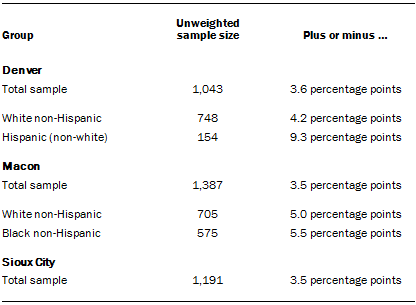
The Survey of City Residents, conducted between July 8 and August 18, 2014, used an address-based sampling method. Residents in each of the three cities were mailed paper and pencil questionnaires asking primarily about their attitudes of and consumption of local news in their city. A total of 1,043 Denver residents, 1,387 Macon residents and 1,191 Sioux City residents, all adults, completed and mailed back the survey.
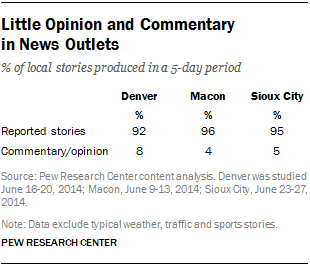
The Analysis of News Content collected and analyzed news coverage from each city over a five-day period, Monday through Friday. The specific dates for each city were Macon, June 9-13; Denver, June 16-20; and Sioux City, June 23-27. All providers identified as producing at least weekly content were analyzed. That amounted to a total of 81 providers: 52 from Denver, 17 from Sioux City and 12 from Macon. In all, 6,416 stories were captured and coded.
Site Visits and Interviews were conducted in each of the three metropolitan areas to supplement the other quantitative data sets. Visits to the cities were made in September 2014. Direct interviews (in-person and by phone) were conducted with a range of individuals in each community, representing local government, civic life, business, academia and journalism. A total of 18 interviews were conducted between June and October of 2014.
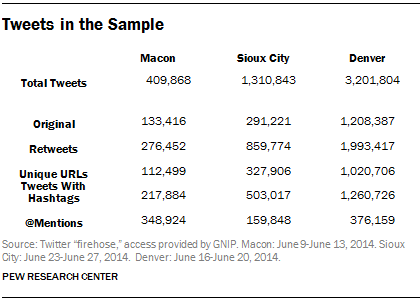
Exploratory Analyses of Facebook and Twitter Posts involved several steps. First, researchers examined the Facebook pages and tweets of all the news outlets, public figures, government departments, and civic groups identified in the landscape audit of each city. Second, public Facebook pages and Twitter users connected to the first list were identified. All of the tweets and Facebook pages were then pulled for each entity in the list. The Twitter data were pulled for a five-day period for each city (Denver, June 16-20, 2014; Macon, June 9-13, 2014; and Sioux City, June 23-27, 2014). The Facebook pages were pulled over a slightly longer time period for each city (Denver, June 11-25, 2014; Macon, June 4-18, 2014; and Sioux City, June 18-July 2, 2014). Several rounds of analysis were then conducted on each data set to understand the flow of content.
The City Selection—This report analyzed the local news environment in three cities: Denver, Colorado; Macon, Georgia; and Sioux City, Iowa. The cities were selected from 210 DMA (designated market area) as defined by Nielsen, with an aim of studying one from each third of the list according to size (rankings 1-70, 71-140 and 141-210).1 Denver falls in the top third (ranked 17th), Macon is in the middle third (120th) and Sioux City is part of smallest third of markets (147th) on the 2013 Nielsen DMA list. In settling on these three cities, researchers examined a wide range of variables including population size, demographics, broadband penetration (by county), the presence of news providers and geography. As noted, these cities are not meant to be representative of the United States as a whole, but rather serve as detailed case studies of local news in three specific, unique areas in the U.S.
The News Environment in Denver, Colorado
Prosperous and cosmopolitan, Denver holds rank among the largest metropolitan areas in the United States.
In the 1850s, the gold rush led hopeful prospectors to the city, nestled at the foot of the Rocky Mountains’ Front Range. More than a century and a half later, 2014 ushered in a new wave of entrepreneurial energy into the Mile High City (so named for the town’s location roughly 5,280 feet, or one mile, above sea level). This time, investors are arriving to cash in on new opportunities created by the state’s legalization of marijuana.
Unemployment within the Denver area itself is 5.2% as of July 2014, lower than the national average. (For a display of all city demographics, click here. But the metro’s key employers are not associated with commerce or consumerism. Four of the region’s top five employers (by numbers of workers) are linked to governmental services: the U.S. government, the state of Colorado, the University of Colorado, and Denver Public Schools. Including Boulder, the Denver region has also emerged as a tech startup hub, headquarters to MapQuest, Photobucket, Datalogix and others.
While 40% of households in Denver earn $75,000 or more per year, the higher annual salary also reflects higher costs of urban living. Despite widespread prosperity, roughly 29% of Denver households earn less than $35,000 annually.
More than 2 million people live in the Denver metropolitan area, which stretches across 10 counties in North Central Colorado and 185 registered neighborhoods within Denver. One-fifth (19%) of the area’s residents are Hispanic. Residents of the Denver metropolitan area are young, highly mobile and highly educated. The 55+ population is smaller, relatively, than that of the nation overall, and one-in-three Denver-area residents have completed a college degree (bachelor’s or more).
Sources of News and Information
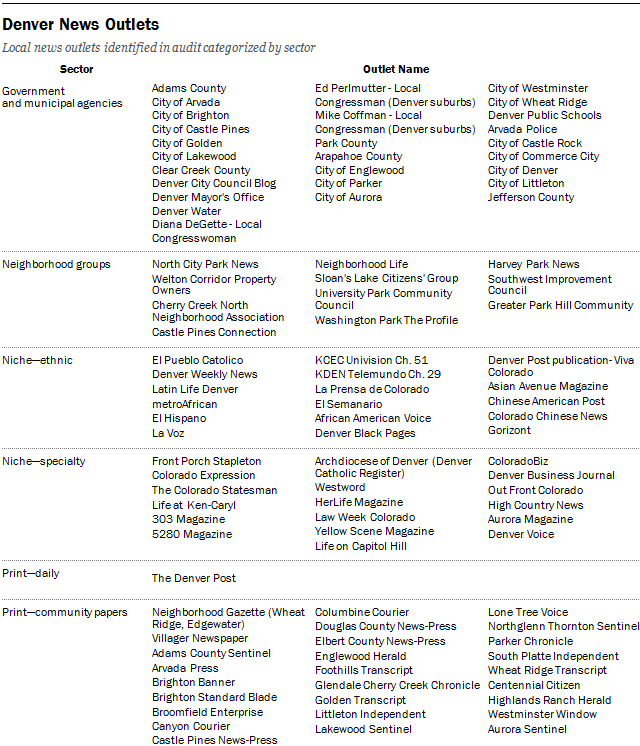
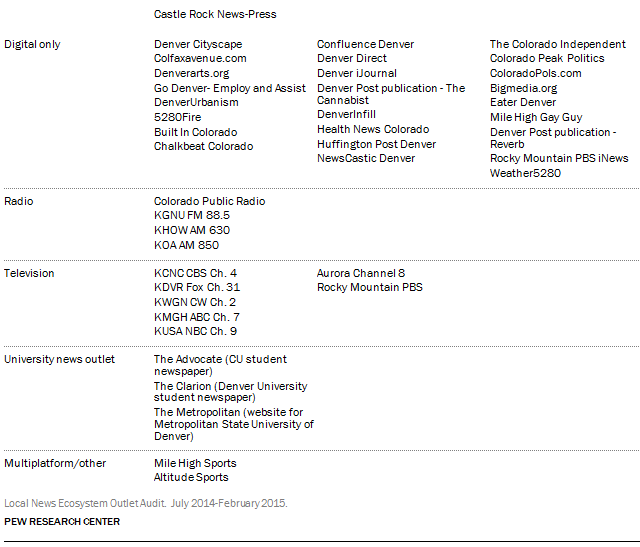
The Denver media market serves a sprawling and diverse population, thus a defining trait is its abundance of offerings. Researchers identified nearly 150 news sources across the metro area, from print and digital publications to television and radio broadcast operations.
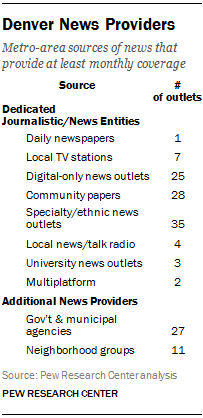
Perhaps owing to its status as a tech hub, combined with its younger population, the area is also immersed in digital media. Of the 143 news sources identified, 25 are “digital-only outlets,” as opposed to legacy organizations based in print or television.
Finally, the size of the region’s population has allowed communities of interest to emerge as part of the media landscape, in addition to the geographically bound communities that are served by hyperlocal media. News sources focused on niche topics germane to the Denver region, such as business, law, development and others, serve the area alongside general interest outlets.
As in most metropolitan communities, the major daily (in this case, The Denver Post) and local broadcast affiliates of major networks continue to exert significant newsgathering horsepower and audience market share. But the long tail of other news sources, some of them journalistic publishers, others not, help make the Denver area into a diverse media ecosystem.
Dedicated Journalistic/News Entities
The Major Daily Newspaper
For more than 100 years, Denver had a pair of vigorously competing daily newspapers: The Denver Post and The Rocky Mountain News. The dueling publications engaged in an all-out newspaper war for the city’s readers. But the battle was costly. Denver’s papers were hemorrhaging cash and could not sustain slashing ad rates and newsstand prices in order to compete with one another. In 2001, the two papers entered into a joint operating agreement—an arrangement in which the competing publications shared facilities and presses, while maintaining editorial independence.
The cost-saving measures, though, were not enough. The Rocky Mountain News continued to struggle, losing $16 million in 2008 alone. Consequently, E.W. Scripps, the paper’s parent owner, opted to place the paper on the auction block in 2008. The only potential buyer, however, “did not offer a viable plan.” Without a suitor, The Rocky Mountain News—Colorado’s oldest newspaper—published its last edition on February 27, 2009. As a result, Denver (within city limits, at least) became a one-newspaper town.2
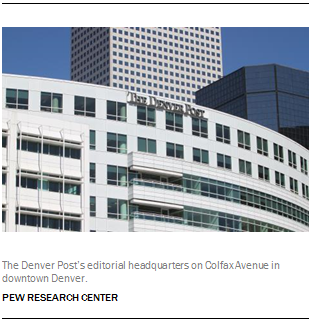
As the metropolitan region’s primary daily newspaper, The Denver Post, now owned by Digital First Media, ranks as the 11th largest in the nation, with a Monday-to-Friday circulation of 351,240, according to the Alliance for Audited Media.
The Denver Post has a prominent web presence within the region and updates its site throughout the day. Beyond its primary web domain, the paper has launched two standalone verticals—The Cannabist, which chronicles the city’s marijuana beat, and Reverb, which focuses on Denver’s arts and entertainment scene. Both of these sites are routinely updated with new content several times a day. The Denver Post also hosts 10 blogs on topics ranging from health care to religion, and offers online podcasts, including The Press Box—a weekly radio program hosted by Post columnists, which is also streamed online every weekday.
Local Broadcast News
As a television market, Denver has seven stations that produce local news: ABC, CBS, NBC, Fox, PBS, CW and at least one public access station in the metropolitan area.
Five of these television outlets—the city’s ABC, CBS, NBC, Fox and CW stations—update local content on their respective home pages several times a day. (Denver’s Fox and CW affiliates share online news content—so their webpages appear identical).
Like The Denver Post, several of the city’s broadcast affiliates have developed verticals and blogs within their sites to provide expanded web-only content, such as CBS Denver’s local weather site.
Digital-Only News Outlets
Arts, lifestyle, health, politics and beyond—the Denver media environment has given rise to blogs and other digital media that informs communities united by a common interest, and allows them to have a conversation. Here, Denver stands out compared with the other two cities studied—Macon and Sioux City—for its sheer numbers and variety.
Pew Research identified 25 active stand-alone news websites in the Denver metro area, though there are undoubtedly additional ones.3 Of these, just seven may be classified as general interest in nature. The rest focus on narrower subjects such as politics, arts and entertainment, or real estate and development.
National outlets, such as the Huffington Post and Eater, have established Denver-specific landing pages, containing a selection of locally focused stories.
Independent bloggers and citizen journalists are also contributing to the digital news environment. A few sites, such as 5280Fire, rely heavily upon user-generated content as editorial fuel. Such engagement has increased the diversity of editorial voices in the city’s media ecology.
One of these—denverarts.org—illustrates how some of these sites have emerged out of a perceived lack of attention to certain beats by legacy media. Ken Hamel, director of Denver Arts (a volunteer operation), told Pew Research that the number of local arts reviewers employed by local media has decreased over the years.4 Seven years ago, Hamel launched Denver Arts to “fill that vacuum” by providing news, commentary and event listings tracking the local gallery scene for a small but dedicated audience.
The closure of The Rocky Mountain News acted as the catalyst for numerous digital media startups—several of which were developed by alumni of the defunct paper. One of region’s oldest news nonprofits, the Rocky Mountain Investigative News Network, was founded by a former staffer of The Rocky Mountain News. Also known as I-News, the newsgathering organization joined forces with the city’s public television and radio outlets in 2013.
Other news nonprofits jointly operate with local universities, for example, Health News Colorado, an extension of the University of Colorado. And a few nonprofits have chosen to go it alone. Chalkbeat Colorado (once known as EdNews Colorado) has replicated its nonprofit model of education coverage in New York, Indiana and Tennessee. The site is not affiliated with a legacy platform or university.
All but six of the digital-only news sites identified published new content on at least a weekly basis, with 11 publishing daily. Twenty-three of the 25 sites offered comment sections on their stories, though in only eight cases did readers use them during the period studied.5 Fourteen of the 25 sites were actively using Twitter, compared with 16 that were updating Facebook regularly.
Community Newspapers
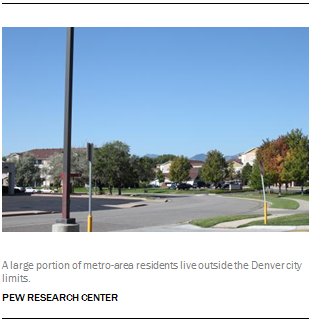
A large portion of the Denver metropolitan area’s residents live in the sprawling suburban communities that make up the nine surrounding counties, which include the sizable communities of Westminster, Arvada, Thornton, Centennial and Aurora. These communities are largely served by the dozens of community newspapers—most of them weekly—that blanket the region.
Altogether, researchers tallied 28 community newspapers in the Greater Denver region. Some are independent, but many are owned by Colorado Community Media—the second-largest multimedia group in the state, according to the Denver Business Journal. Of these, the Aurora Sentinel is the only daily paper. The rest are weeklies.
All of these papers publish news on the Web, though the majority of them do not update their home pages with new content on a daily basis. Of the 28 identified, only six were updating their home page on a daily basis. Many others were posting new content several times a week, or about weekly.
For these community papers, digital audience engagement is limited. At least 24 of the papers studied offer comment sections below stories, but only one contained any recent comments.6 Just five of the papers operate an active Twitter feed. Facebook is more common, though still not ubiquitous, with 18 of the papers regularly updating their pages.
Specialty and Ethnic News Outlets
The Denver area has sizable ethnic enclaves as well as critical mass around specific topics of interest. Each of these is large enough to allow for specific niche media outlets to serve those populations. Analysts identified 35 such news providers in the Denver area.
Ethnic News
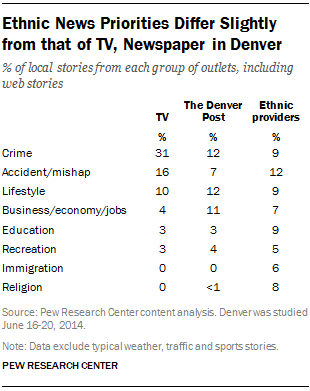
With about a fifth of the population identifying as Hispanic, many publications and outlets cater to this group. Of the 17 ethnic news outlets identified in the metro area by researchers, about half of them (nine) cater specifically to Hispanics and Spanish speakers. These include El Hispano and La Prensa de Colorado as well as The Denver Post’s Spanish-language edition, Viva Colorado. Univision and Telemundo’s local broadcasts round out the offerings to this community.
Other ethnic publications serve the Asian community (such as Colorado Chinese News), the African-American community (African American Voice) and the Russian community (Gorizont).
By and large, ethnic news in the Denver area is heavily focused on legacy platforms, which are mostly print, with some broadcast. Of the 17 outlets identified, 11 were updating their websites with local news content on at least a monthly basis at the time of study, and just one was updating daily. On the whole, the news outlets appeared to be slightly more active on social media than on their home page.7 Five outlets were actively using Twitter at the time of study, and 11 were doing so on Facebook.
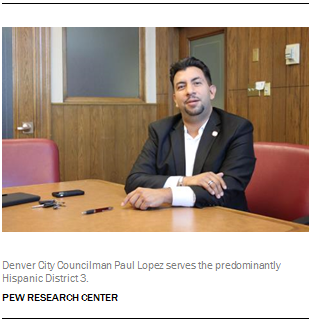
Paul Lopez, a Denver city councilman who represents the predominantly Hispanic District 3, explained what he observes as a persistently large gap in technology among his constituents. That is why, he says, radio and television—and for his office’s outreach efforts, door-to-door visits—are some of the most effective ways to reach Hispanics in Denver with news and information. (In an interview, though, Lopez noted that younger Hispanics appear to be much more engaged with social media than their elders.)8
Thus, while a number of local media outlets exist in the Denver area to serve the Hispanic population, and social media offers a way to connect, Lopez thinks that direct contact, in places such as schools and churches, is the best delivery mechanism for information in that community. “That’s where folks are engaged. That’s where they’re getting their information. That’s where they’re understanding civic life,” he said.
Other Specialty News
Beyond general interest newspapers and ethnic publications, the Denver metropolitan region hosts a broad range of printed media, including an alternative weekly (Westword), a number of city magazines, and trade publications. Researchers identified 18 of these serving the metro area.
Seeking to capitalize on youth consumer spending power, Greater Denver’s lifestyles magazines (including 303 Magazine, Yellow Scene Magazine, 5280 Magazine) are geared toward reaching the region’s under-40 set. In addition, Out Front Colorado serves as the area’s primary print publication aimed at the lesbian, gay, bisexual and transgender (LGBT) community.
The business community is served by the Denver Business Journal, Colorado Real Estate Journal, ColoradoBiz, Law Week Colorado and others.
Radio
Researchers identified four major local radio stations airing local news on a regular basis.
Broadly speaking, terrestrial radio stations in the city lacked expansive websites and did not appear to produce web-exclusive content. Colorado Public Radio—the network of National Public Radio member stations in the state—occasionally posts a story about the Denver area, but did not dedicate (as of July 2014) daily editorial energy to local content production.
One exception should be noted, however. Community radio KGNU reposts content from its locally produced morning show each weekday.
University News Outlets
Finally, three university publications offer coverage of campus life and the surrounding areas: the University of Denver’s The Clarion, University of Colorado Denver’s The Advocate and Metropolitan State University of Denver’s The Metropolitan.
Additional Providers of News and Information
In addition to dedicated news entities, many local areas have a range of organizations that provide some kind of news-related offering. Denver is a tech-saturated area, and its municipal and civic institutions reflect that in their efforts to inform their communities. What is represented here is not necessarily the activity of professional journalism, but it offers additional ways for local residents to stay informed about current and civic affairs.
Government and Municipal Agencies
Pew Research analysts identified and studied 27 local government websites around the metropolitan area that regularly updated their websites with information about issues and events in the community or press releases about their own policy stances or legislative activities.9 These included the websites of local members of Congress, the mayor, regional counties and towns, as well as some police departments and other public service providers.
These sites themselves are fairly active. About half (13 of 27) update their home page at least several times per week. Ten of the sites had video or audio links on the home page, while six offered access to some kind of publicly available data set.
In general, the content provided by these sources is a mixture of practical information (how to pay a speeding ticket), community event listings, and news releases about need-to-know information. In the case of elected officials, content often includes press releases tracking the official’s activities. Rep. Mike Coffman’s website, for example, posts press releases and news coverage about the congressman’s recent activity. During the week sampled for content analysis, the site posted several press releases as well as a Denver Post story about the congressman’s request that the Department of Veterans Affairs investigate the agency’s treatment of a Denver veteran. And Rep. Ed Perlmutter’s page issued one e-newsletter that updated readers on the third installment of funding from the U.S. Treasury Department awarded to Colorado as a part of the State Small Business Credit Initiative.
As part of a citywide transparency initiative devised by the city’s 13-member city council and mayor, government officials from the consolidated city-county have opened access to more than 100 data sets (known as the city’s “open data catalog”), including full access to the city’s “open checkbook”—a real-time look into municipal financials. City offices have also worked to provide interactive maps that show locations of city services, such as bike shares, dog parks and electric vehicle charging stations.
For these local government-related sites, audience engagement seldom takes the form of comments the way it does on typical news sites. Instead, about one in three sites offer opportunities for citizens to provide tips and feedback. On social media, 22 of 27 sites operate an active Twitter feed, about the same number that maintain a Facebook profile (23).
Neighborhood Groups
While many neighborhood associations—formal and informal—maintain an active social media presence in the Denver area, a handful also publish regular news items on their websites, or in some cases, print a newsletter and distribute it to residents. Researchers identified 11 such organizations in Denver.
One of those communities—Cherry Hills Vista on the south side of the city—is presided over by George Gramer, a 62-year-old retiree who has “time to do things,” such as hold and attend community meetings and publish a quarterly newsletter that includes local advertising.10 Gramer noted, however, that the association’s Facebook page is maintained by a local high school student.
The News Environment in Macon, Georgia
Located in the state’s geographic center, about an hour and twenty minutes’ drive southeast of Atlanta, Macon is known as “the Heart of Georgia.” The city along the Ocmulgee River traces its founding to a 19th-century fort at the waterway’s mouth. The region’s military roots endure today, as neighboring Robins Air Force Base continues to serve as a home to for the 78th Air Base Wing. To the world outside of central Georgia, Macon may be known best for its music history—once the home of Otis Redding, Little Richard and the Allman Brothers.
The region surrounding and including Macon, encompassing five counties in central Georgia, is home to 175,662 adult residents. (For a display of all city demographics, click here.)11 The Greater Macon area is also home to a sizable African-American population: 41% of its adult population is black.
While Macon’s top employers today—Navicent Health (formally The Medical Center of Central Georgia), GEICO, the Bibb County school district, Coliseum Health System and the city of Macon—have created jobs for thousands of residents, the region’s unemployment rate remains relatively high: 8.6% as of July 2014, outpacing the then-national average of 6.2%. Additionally, one-in-five households (21%) in the Macon area earn less than $15,000 per year, and less than half of adults (46%) have either some college education or a degree. Still, efforts by a core group of engaged locals, along with investments from foundations such as the John S. and James L. Knight Foundation, the Peyton Anderson Foundation and the Community Foundation of Central Georgia, are breathing life into the core downtown area.12
Aside from Macon—the principal city within the Greater Macon metropolitan area—this region of central Georgia is largely rural.
Sources of News and Information
The Macon area’s news environment revolves largely around a relatively small list of traditional, established media organizations as well as some municipal websites and social media pages that offer ways for residents to keep up with local affairs.
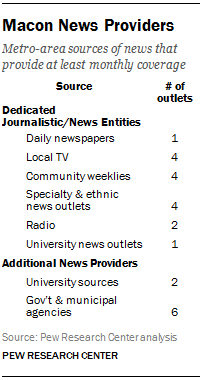
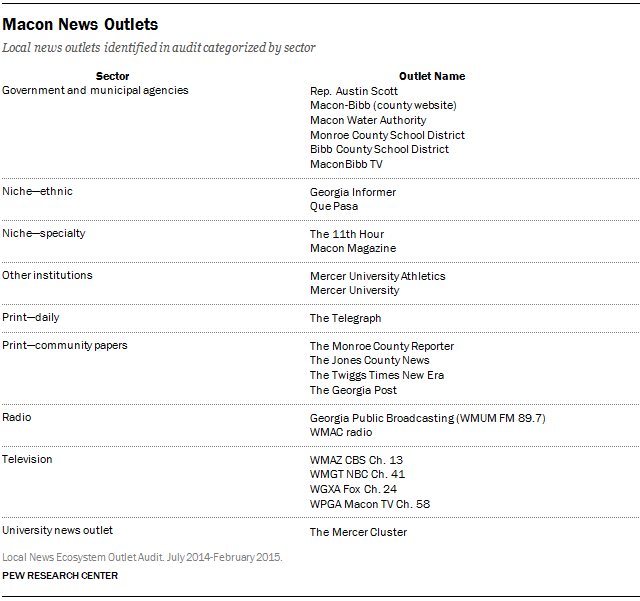
Researchers identified 16 dedicated news operations that provide the majority of the reporting power in the city of Macon and the suburban and rural communities that encircle it. These include 10 print publications, from the leading daily newspaper to weekly community papers and niche publications, along with a university newspaper. While there is relatively little radio news presence, three of the major network television broadcasters operate in the metro area, along with an independent station.
The majority of local publishers have some form of web presence, but it is limited. All of the local broadcasters maintain a website. But of the print publications, just four have active websites updated with local news on at least a weekly basis. Others either publish less frequently, have gated access, or simply offer the website as a way to subscribe to the print edition. The area has no major digital-native news publishers.
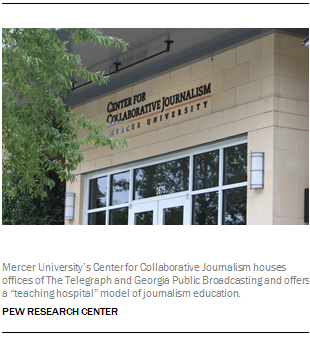
When it comes to social media, the majority of local outlets operated and regularly updated their social media pages, including Facebook and Twitter, at the time of study. In many ways, the heart of journalism innovation is emerging from Mercer University, whose Center for Collaborative Journalism (CCJ) is home to Groundsource, a mobile community engagement tool, and other initiatives to connect residents, students and professional journalists.
In addition to the dedicated journalistic enterprises, Pew Research analysts identified eight sources that, within their offerings, provide original news and issue-related (local) content at least monthly. In Macon, these ranged from municipal websites and news services of a local university to the page of a local congressman. While sites that provide event listings or services like bill paying are valuable elements of community information, they are beyond the purview of this study and not tallied here.
Dedicated Journalistic/News Entities
The Major Daily Newspaper
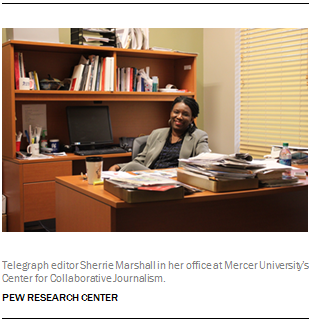
The Telegraph remains the region’s primary paper and a key source of news production. It launched as a weekly paper in 1826. While other area newspapers and magazines (such as The Atlanta Journal Constitution and Georgia Trend magazine) may occasionally run a story featuring Macon, these publications lack dedicated manpower in central Georgia. However, The Telegraph’s footprint is smaller than it used to be. According to the executive editor, Sherrie Marshall, 13 years ago, The Telegraph was a “regional paper” with a presence in more than 30 counties and an office in Atlanta. Now, she says, the paper focuses its resources primarily in five core counties. (The paper is still circulated in about 28 counties, though, and provides some coverage—such as sports and public safety—in many of them.)13 The Telegraph has a daily circulation of almost 34,000.
In an interview, Marshall described the core identity of The Telegraph as that of a “watchdog,” holding local institutions accountable. And increasingly, in part spurred by its partnership with Mercer’s CCJ, the paper has taken steps to ramp up its community outreach efforts. One such effort, called Macon in the Mirror, had journalists and students fan out into the community conducting around 600 interviews with local residents to ask them questions about their concerns (the most consistent answer: blight).
Local Broadcast News
Macon’s television viewers can choose content from three primary newsgathering outfits. As Central Georgia’s first VHF station on the air in 1953, Macon’s CBS affiliate WMAZ originally broadcast from Mercer University (its call letters, in fact, stand for Watch Mercer Attain Zenith). Today, the Gannett-owned station dominates the ratings within Macon, drawing about seven times as many viewers as its closest competitor, according to data obtained from Nielsen Media Research. The CBS affiliate also garners the greatest Facebook activity of the region’s broadcasters, attracting nearly 90,000 “likes” at the time of study. WMAZ shares its content with the local CW affiliate.
Macon’s CBS station did not gain a news competitor until 1968, when an NBC affiliate joined the fray (the station originally had the call letters WCWB but changed to WMGT in 1983). In 1992, the NBC affiliate, seeking to cut costs, closed its news department. For more than a decade, the station did not produce local news in Macon. The station, better known to local viewers today as 41 NBC, chose to revive its news department in 2004.
Network affiliations have been quite fluid in Macon. After its purchase in 1995, WGXA switched network affiliations from ABC to Fox in 1996. The owners of WGXA, GOCOM Communications, began broadcasting an ABC affiliate (locally known as ABC 16) from its digital subcarrier in 2010. The two affiliates share news content and production facilities. In 2010, the two stations began airing NewsCentral, which is broadcast four times daily. A fourth outlet, WPGA (or Macon TV), is operated by Radio Perry—an arm of Register Communications, a local, family-owned business. The station does not have a major network affiliation and airs a mixture of syndicated programming along with a morning newscast called “Mix in the Morning.”
Community Weeklies
Beyond The Telegraph and local TV affiliates, four community papers serve smaller towns in the Macon metropolitan area: The Monroe County Reporter, launched in 1972, calls itself the “No. 1 source for news and advertising in Monroe County.” The Jones County News, launched in 1895, focuses on Jones County and the city of Gray with a staff of six full-time employees and two part-timers. The Georgia Post and Twiggs Times New Era also serve smaller communities, and unlike the other two, are limited in their web offerings: The Times New Era offers a replica edition to subscribers only, and the Georgia Post does not appear to have any website at all.
Specialty and Ethnic News Outlets
In addition to The Telegraph, residents living in and around Macon have access to a trio of niche publications with more targeted readerships. The 11th Hour, an alt-weekly with zoned editions in three areas of central and southern Georgia, is available free on newsstands. The paper is known for its offbeat columnists and its in-depth coverage of the region’s arts and entertainment scene. Readers in the area also can access Macon Magazine, a bimonthly publication covering lifestyle and culture in the area.
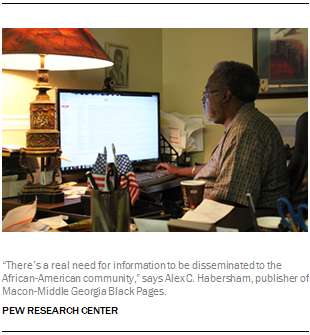
Although roughly four-in-ten Macon residents are African American, the black press is not a large part of the Macon news ecosystem. The Georgia Informer, an African-American monthly that began in 1982, produces a monthly edition. Another, the Macon Courier, appears to have gone dormant; when researchers tried to contact the paper, the phone number had been disconnected. Researchers did not find other active online news providers geared toward Macon-area minorities. One weekly radio program, called “Ask Elaine,” hosted by District 3 Commissioner Elaine Lucas, is popular for some in the local African-American community, according to Gwen Westbrook, the local NAACP chapter president.14
“There’s a real need for information to be disseminated to the African-American community,” said Alex C. Habersham, a prominent community member and publisher of the Macon Black Pages, an annually published local business directory and resource guide.15 “There’s a tremendous vacuum.”
The local Hispanic community is served by a monthly publication covering central and southern Georgia called ¿Que Pasa?.
Digital-Only News Outlets
Within the Macon area, researchers did not identify a single active, digital-only outlet devoted to news reporting.
There are some local and regional blogs, such as We Are Politics and Peach Pundit. However, neither of these was posting local content at least monthly during the period of analysis. Macon Community News, which once had a vibrant web presence, curtailed operations in March 2014. As of July 2014, very little neighborhood-level content is routinely published within and around Macon. And Macon and its surrounding communities lack a single news nonprofit.
University News Outlets
During the academic year, Mercer University’s student paper, The Cluster, covers campus life and the surrounding neighborhoods. It claims a bimonthly print circulation of 1,300 copies, distributed around campus and in Mercer Village and downtown Macon.
In addition, Mercer’s Center for Collaborative Journalism is ground zero for journalism innovation in Macon, housing offices of The Telegraph and Georgia Public Broadcasting, and serving as a “teaching hospital” model of journalism education for students at the university. CCJ is also the home of Groundsource, a project being launched by CCJ entrepreneur-in-residence Andrew Haeg. Currently in beta form, the effort seeks to integrate community members into the local information ecosystem via mobile devices.
Radio News
Finally, the local radio news market is quite small. Georgia Public Radio’s WMUM-FM 89.7 provides general news and information for the area’s residents, and, according to Tim Regan-Porter, director of CCJ, reaches about 30,000 listeners.
Another local news/talk station, WMAC, offers local news updates on the hour.
Additional Providers of News and Information
In addition to dedicated news entities, many local areas have a range of organizations that provide some kind of news-related offering. The content produced tends not to be original news reporting but instead provides updates on policies or planning initiatives, such as ways residents can save water during a drought, or explaining the political activity of a local leader. In Macon, the most active of these is the Macon-Bibb county government.
Government and Municipal Agencies
Elected leaders in Macon-Bibb County have pledged to continue investment in municipal broadband, with the hope of creating a “wireless core” in the city’s downtown.
In its strategic plan, the newly formed Macon-Bibb government also placed direct communication to citizens through its website and social media accounts as a top priority. However, city agencies (as well as the county’s public schools system and public library) post to their respective webpages rather infrequently. The city’s emergency management website, in fact, was dormant for several months in late spring 2014. And while other community organizations, such as the city’s Chamber of Commerce and the Macon Arts Alliance, provide monthly or quarterly updates to the community, these outlets are not primary sources of news and information for those living in Macon.
MaconBibb TV broadcasts committee meetings and public forums online and on its television channel. According to Chris Floore, who deals with public affairs for the county, it was averaging 19,000 web visits per month at the time of research.16 (Earlier, the county was producing 50 to 60 hours of programming per week but was securing little audience reach. It still broadcasts from channel 14, but the Web is what leads.) MaconBibb TV offers several shows dedicated to local news, including public affairs programs such as “Up Next With” and “A Call to Action,” which residents can watch on demand through YouTube and Vimeo.
In addition to a handful of local municipal offerings, one local member of Congress, Rep. Austin Scott, publishes occasional news and information, largely consisting of press releases, to his website.
Aside from its student newspaper, the Cluster, Mercer University maintains two websites, one focusing on university news and the other on Mercer sports. Both websites remain active during the summer.
The institution spotlights its athletics teams, producing near-daily coverage—including full stories and profiles—during the academic year. As the university reinstated Division I football effective in the fall of 2013 and as the Mercer Bears basketball team had a Cinderella-esque run deep into the NCAA Tournament in spring 2014, the production of sports news appears to be an area of growing content in the city.
The News Environment in Sioux City, Iowa
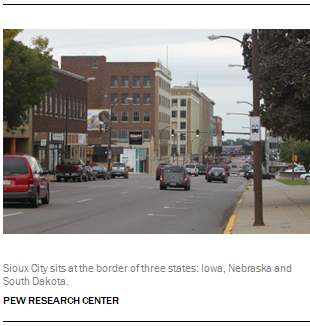
A 100-mile drive from Omaha, Nebraska, Greater Sioux City—or “Siouxland” as the nearly 125,000 locals know it—straddles the borders of three states. (For a display of all city demographics, click here. Technically speaking, Sioux City’s metropolitan statistical area spans two counties in Iowa, two in Nebraska and one county in South Dakota.
In the summer of 1804, Sioux City was a midway stopping point for the Lewis and Clark expedition. Fueled by the Midwest’s railroad building boom later in the century, Sioux City thrived as a Midwestern trading point for liquor during Prohibition. And in the 20th century, as riverboat gambling was legalized in Iowa (the first state to do so), Sioux City—given its location on the Missouri—became a prime stakeholder in the state’s emergent casino economy (as of July 2014, the city had two casinos).17
Currently, Sioux City has lower-than-average unemployment (4.6% as of July 2014). The city’s distribution across income levels is similar to the national average, though the percentage of adults who have a college degree is low (18% compared with 26% nationally). Additionally, Sioux City is predominately white: About eight-in-ten (82%) residents are white, though there
is a growing Hispanic population (12%).
The city has promoted housing growth, establishing tax incentives for new development in recent years. The region is still struggling to find a solid, economic driver, however. While top employers—Tyson Fresh Meats, Mercy Medical Center, Sioux City Community School District, UnityPoint Health and the city itself—provide a solid workforce, 12% of the area’s households have an income of less than $15,000.
Sources of News and Information
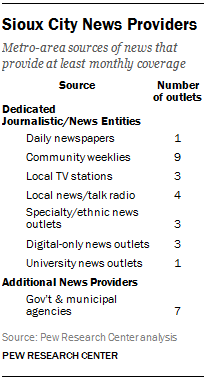
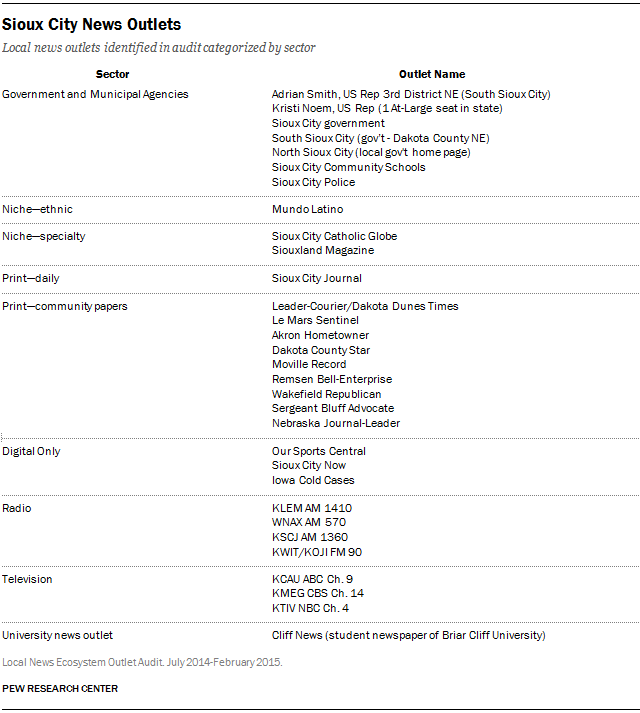
The Sioux City region is a small media market, centered largely around its daily newspaper and broadcast TV channels. Researchers identified 31 news providers serving the region, across print, radio, television and digital platforms. Of these, 24 would be considered dedicated news operations. The other seven serve other civic roles, but provide some news-related content on a regular basis within their other offerings.
Among the journalistic operations, 14 are print-based publications—a daily paper and some community weeklies, as well as a few specialty outlets and a local university newspaper. Three television outlets and four radio stations air news. Researchers identified three web-only outlets and blogs providing at least occasional coverage of the region.
In addition to the news operations, researchers identified seven local government and municipal websites distributing news releases and civic information.
Dedicated Journalistic/News Entities
The Major Daily Newspaper
The city’s daily newspaper, the Sioux City Journal, is one of the city’s key news sources. The paper, which printed its first edition in 1864, far exceeds other local print publications with a daily circulation of 26,626.
Predating the waves of convergence that would define the news industry in the early 2000s, the Sioux City Journal was part of a unified newsgathering operation as early as 1954. NBC affiliate KTIV and news-talk radio station KSCJ (whose call letters reflect its affiliation with the paper) were referred to as the electronic “arm” of the newspaper. Lee Enterprises, the current owner of the Journal, sold off the TV station in 1989 (now owned by family company Quincy Newspapers Inc.) and the radio station in 1996 (now owned by Powell Broadcasting and an affiliate of Radio Iowa).
Even though the paper’s content sharing in broadcasting has since ceased, the Sioux City Journal continues to repurpose its works across multiple print and digital publications and platforms.
The work of Journal reporters appears in the city’s business journal (Siouxland Business Journal), monthly lifestyles magazines (Siouxland Life and Siouxland Prime), a weekly real estate supplemental (Siouxland Homes) and a free newsstand tabloid (Weekender). On the digital side, the paper acts as the hub for several blogs, including SUX 911 (a crime blog; SUX is Sioux City’s designated airport code), and Politically Speaking (a blog covering the region’s public affairs news).
The Journal manages an active website, updating it throughout the day, as it does with its Twitter feed and Facebook page.
Local Broadcast News
The Sioux City area is home to affiliates of all the major broadcast networks—NBC, ABC and CBS, with the latter operating in a content-sharing agreement with the local Fox affiliate. (Iowa Public Television, IPTV, also broadcasts in Sioux City, but the programming orientation is statewide rather than local to the Siouxland region.)
Of the three network websites serving the Siouxland region, the home pages of both the ABC and NBC affiliates (KCAU and KTIV, respectively) are updated several times a day. The shared website of the CBS and Fox affiliates (KMEG and KPTH) is updated less frequently than its competitors’ sites, but it is updated at least daily. Each outlet is active on both Twitter and Facebook.
Of the five outlets studied in the Sioux City region featuring citizen content, two were local TV station websites. KCAU had a small section for photos from Facebook fans, and, at the time of analysis, KTIV had posted a “submitted” item on its home page—a picture of an osprey.
Community Weeklies
Outside the compact downtown corridor of Sioux City, past the strip malls and small businesses, the landscape quickly turns to farms and rolling fields. The small communities that dot this landscape are served by a number of weekly community newspapers.
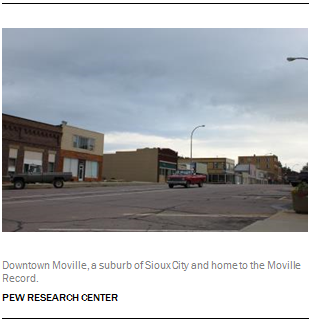
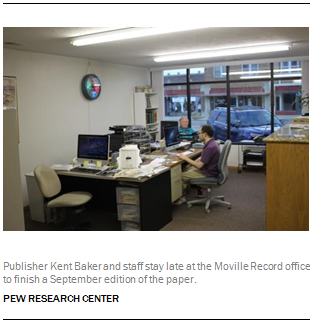
There are nine of them, down from 11, after the Moville Record recently purchased two other local papers and consolidated the publications. Kent Baker, the publisher of the Moville Record, spoke with the Pew Research Center about his paper’s coverage of schools and town meetings.18 “It’s unusual, in a small town, for there to be government coverage,” he said. “People love it.” Moville is the biggest community his papers serve, with a population of about 1,600. It is a small community, but “we can always get news,” Baker said.
While some of the community papers serving the Greater Sioux City region have some kind of web presence, three of the papers—the Remsen Bell-Enterprise, Sergeant Bluff Advocate and Nebraska Journal-Leader—are print-only publications.19 Iowa’s Le Mars Daily Sentinel is updated several times a week, while the rest are primarily updated with new content just once a week to coincide with the release of the print editions.20 Researchers found Facebook pages identified with eight of the papers studied, with four of them having updated those pages within the previous week at the time of study. Twitter handles were found for four newspapers, and two of them had posted within the previous week at the time of study.21
Only one of the community papers—the Le Mars Daily Sentinel—had a designated space for user discussion on its home page, but during the period of analysis, no discussion was present.
Specialty and Ethnic News Outlets
Niche and ethnic media are scarce in the Sioux City region.
The Catholic Globe publishes a biweekly print edition as well as news briefs online. And one independent news outlet, Mundo Latino, targets Spanish speakers in Sioux City.
Sandra Lopes-Gutierrez, who runs Mundo Latino, works out of a MetLife insurance agency that doubles as a newsroom where her niece serves as community reporter. Lopes-Gutierrez described the local Hispanic community as one cut off both culturally and geographically from Greater Sioux City.22 “The locals like Spanish TV,” she said, which they often get via satellite. That leaves some without access to local broadcast TV news in their homes. Lopes-Gutierrez says that the local Hispanic community stays largely on the Nebraska side of the river, where the Tyson chicken plant, a major employer, is located, and where the county feels friendlier.
The other divide is generational. Lopes-Gutierrez notes that the younger Hispanics in her community are more active online than older people. But Mundo Latino is “not at that level.” She said that she lost her designer, and so her paper’s web presence has suffered.
Digital-Only News Outlets
As host of the first in the nation presidential contest, Iowans are keenly attuned to political news, particularly on the national stage. However, the Sioux City region lacks ideological and partisan-based digital news outlets that cover political news. And although there is a statewide nonprofit news outlet (IowaWatchdog.org), Sioux City does not have one of its own.
Two of the Siouxland area digital-only sites are oriented around local lifestyle interests. Sioux City Now features local food, arts and entertainment news and regularly highlights a “Pet of the Week” available for adoption from a Siouxland animal rescue organization. The Sioux City home page of OurSports Central focuses exclusively on regular coverage of the local alternative and minor league teams (Sioux City Bandits, Sioux City Explorers and Sioux City Musketeers).
And Iowa Cold Cases—which over time, has taken on a broader statewide focus—was launched in 2005 by a reporter for the Sioux City Journal as a website offering information on a handful of Sioux City cold case summaries. Today, Iowa Cold Cases is a uniquely structured site that works to educate the public about open crime cases by providing information and sharing resources.
Radio
Four news-talk radio stations broadcast within Greater Sioux City. KSCJ, which syndicates programming from conservative hosts like Rush Limbaugh and Sean Hannity, also produces local news content as part of Radio Iowa, a newsgathering operation with more than 50 member affiliates. This network of stations is separate from National Public Radio, which also has a member affiliate in Sioux City, KWIT. In addition, KLEM and WNAX distribute local news programming in the communities surrounding Sioux City.
While the local radio broadcasters have limited offerings on the Web, KLEM offered some kind of opportunity on its home page to submit a news tip: “Tell us something we should know about,” it says.
University News Outlets
Briar Cliff University, a small liberal arts institution in Sioux City, houses a student-produced publication called Cliff News, which has an active website when the university is in session.
Additional News Providers
Pew Research analysts identified seven websites of local municipal and government agencies and officials that offered some form of regular news and civic information to local residents.
Two websites belonged to the U.S. representatives of the relevant counties within the Sioux City area, and both of the sites sought to localize their home page content. The home page of Rep. Adrian Smith, representing the 3rd District of Nebraska tended to offer news items highlighting accomplishments of his constituents, while that of Rep. Kristi Noem, a representing the entirety of South Dakota’s at-large district, takes a slightly different approach and highlights her weekly column, which works to weave a hometown perspective into an issue of broader, national or international interest.
Of the seven government or municipal home pages studied, four were not updated very frequently, but the home page of the Sioux City government was much more active, with weekly updates. Of all the government sites examined, the official website of Rep. Smith was updated the most frequently (several times a week).
Both of the members of Congress on the list of news providers were present on Facebook and Twitter and had been active on those platforms in the week prior to the analysis.
The local-level municipal government organizations examined, however, presented a much less uniform picture in their social media use. All three of the Sioux City organizations—the city government, the police department and the community school district—were present on Facebook and Twitter and active on both platforms in the week prior to our assessment. But the South Sioux City government in Nebraska had only a presence on Facebook and had not been active in the week it was analyzed. And the government of North Sioux City in South Dakota was not present on either Facebook or Twitter.
[communities]
Local News Interest High Across the Board; Specific Habits Vary
This section of the study reports on findings from three original public opinion surveys, one from each of the three metro areas being studied—Denver, Macon and Sioux City. These surveys probe residents about their news habits, civic engagement and attitudes about the city and the media that serve it. Because each city received its own customized survey, the data are kept separate rather than being combined, and comparisons are made from one metro area to the next.
If there is one overarching finding to emerge from the three surveys, it is that there is a pervasive interest in local news across these metro areas. In all three cities, nearly nine-in-ten residents follow news about their local area very or somewhat closely, and roughly half follow it very closely, with Macon showing the highest rates of the three. There is more differentiation when it comes to news at the neighborhood level, as about four-in-ten (41%) Denver residents follow neighborhood news very closely, compared with 58% of Macon residents and 49% of residents in Sioux City.
In the ways that residents keep up with and engage in local news, Denver shows some clear signs of greater digital connection. But many news habits are strikingly similar from city to city. Traditional news outlets still dominate, even in Denver, though certain niche or government entities make a mark in each city. Across the three cities, residents comment on news websites or blogs, call into news programs and share news in social media at roughly the same rates. Local government and politics as well as the local economy are discussed often by about half of the residents in each city. And the most civically engaged consistently show a greater connection to local news.
The Staying Power of Large Legacy Media, Even in Media-Rich Denver
Local TV, with multiple channels and news programs throughout the day, has the broadest reach in each city—a reach that far exceeds even that of the local daily newspapers.
In both Denver and Macon, residents are about twice as likely to report getting news from local TV as from their daily newspaper: In Macon 66% often gets news from at least one of the four local stations, compared with 36% who turn to the paper, The Telegraph. In Denver, home to nine local TV stations (not including two dedicated sports stations), 58% often get news from local TV, while 23% often turn to The Denver Post for local news. Local TV also outpaces the daily in Sioux City, though not to quite the same degree—68% vs. 40%. The daily newspaper overall hits a much smaller portion of the Denver population (23%) compared with Macon (36%) or Sioux City (40%).
Fellow residents also play a substantial role as a source for news. They play the largest role in Macon, with 37% of residents often relying on friends and neighbors for local news, as do 28% of Sioux City residents and 23% of Denver residents. In Macon and Denver, these percentages are on par with the portion of the public who turn to the daily newspaper.
Digital-only outlets, neighborhood associations and local government agencies register only in the single digits as sources that residents often turn to for local news.
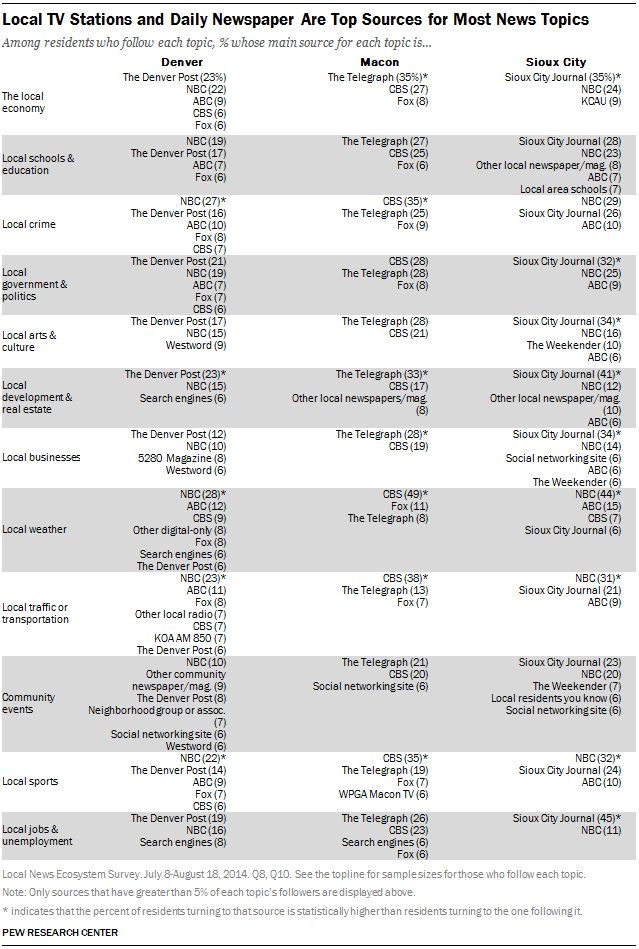
City residents, of course, don’t always turn to one local news outlet to fulfill all their news needs. Instead, they may look to one source for political news and another to learn about local crime. For this reason, the surveys explored news consumption by topic area, particularly when it came to the competition between newspapers and local TV for dominance. Here there are striking differences between Denver and Sioux City, with Macon falling in between. In each city, the daily newspaper and the top-ranking TV station consistently rank among the most named outlets, but where one outranks the other varies by both topic and by city, reinforcing a much greater reliance on the newspaper in Sioux City than in Denver.
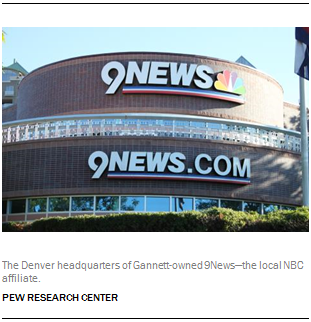
The Denver Post ranks above the top TV station (9NEWS KUSA, an NBC affiliate) on only one subject—local development issues. It is on par with other sources at the top on seven other issues, including government, the local economy, jobs and unemployment, and local arts and culture. In Sioux City, meanwhile, the Journal ranks above the top TV station in six topics—all of those mentioned above as well as local businesses. Macon falls in between with The Telegraph, outpacing the CBS affiliate on three topics and stands at the top with the CBS affiliate on five others.
The topic areas where the leading TV affiliate ranks first are—in all three cities—traffic, weather and sports. In Denver and Macon, the leading affiliate also ranks first for crime.
These data also reveal that for many of the topics asked about, Denver residents turn to a somewhat more diverse mix of outlets than do residents in Macon or Sioux City. The Denver Post and local TV networks still rise to the top, but for several topics, smaller outlets also appear. Among those who follow news about local business, for example, the daily paper is the main source for a far smaller portion of residents (12%) than in Macon (28%) or Sioux City (34%). And while the top network affiliate in Denver, NBC’s KUSA, is named as the main source by 10% of those who follow business, other sources were named at almost the same rate, including 5280 Magazine and Westword. Among those following business news in Macon and Sioux City, the top network affiliate garners more than double the following of the next main source that residents turn to.
These findings offer an intriguing update to a national survey we conducted in 2011 on local news habits. At that time, newspapers ranked first on seven topics—largely civic oriented—and tied for first on four others. Local TV ranked first for only two topics—weather and breaking news—and tied on two others. The data could not be broken down to a city level, but regionally the findings were consistent.
Those 2011 findings line up pretty closely with the current findings in Sioux City but not in Denver. Several elements may be at play here. First is the greater number of news options in Denver. As is evidenced in the table above, for most topics, Denver residents turn to a wider mix of sources. While few of these ever garner a double-digit following, they do add up and could be taking a portion of followers away from the large legacy providers—in this case, the daily newspaper more so than local television. Indeed, as our State of the News Media reports have tracked, average weekday newspaper circulation has declined 11% since 2006 while local TV overall has experienced a much smaller decline in most time slots. In Denver specifically, Denver Post circulation fell 35% from 2006 to 2014 as did circulation for the Macon Telegraph, according to data collected from Editor & Publisher Year Book. The Sioux City Journal had a slightly smaller decline of 29%. Finally, until 2009 Denver was a two-newspaper town with both the Post and the Rocky Mountain News competing for audience. The Rocky’s closure in 2009 coincided with the recession, growth in digital habits and the largest wave of digital only and nonprofit news startups. This does not mean the stories or the news gathering produced by newspaper outlets do not reach people in other ways, but as a primary source they are not as prominent in residents’ minds.
In the Local Topics People Follow, Weather is Ubiquitous; Other Interests Vary
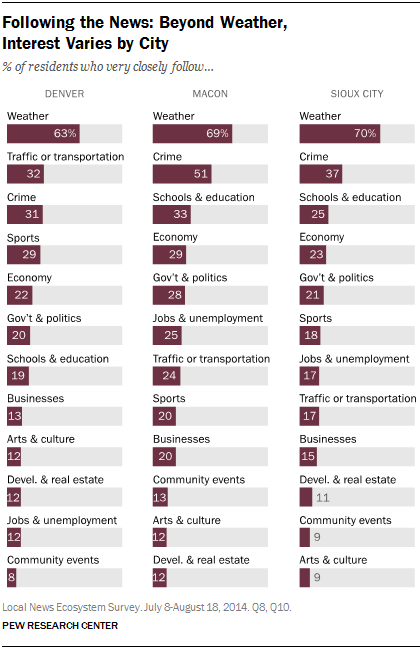
Also at play in the connection between residents and news providers is what share of the population follows various news topics. Local weather, for example, is by far the most closely followed topic in all three cities. About seven-in-ten residents in both Macon and Sioux City follow it very closely, as do 63% of Denver residents. Thus, the sources turned to for weather—local TV ranks at the top in each of these cities—ultimately reach a larger portion of the residents.
Beyond weather, there is some variation from city to city in the most closely followed topics. In Macon, about half (51%) of residents follow crime news very closely, substantially higher than in the other two cities studied. Macon residents also stand out somewhat from the other two cities for their close attention to what is happening in local schools, the local economy, local government and politics, and local jobs and unemployment. At least a quarter of residents in Macon very closely follow each of those topics, outpacing residents in Denver and Sioux City.
In Denver, traffic stands out as disproportionately important to news consumers. Along with crime and sports, traffic news rank high with about three-in-ten residents following each very closely. But, with household income higher than the national overall (40% earn $75,000 or more compared with 33% who do so nationwide) and unemployment rate below the national average, these residents express less interest than Macon or Sioux City residents in local jobs and unemployment.24 Just 12% follow that kind of news very closely, which is about half of that in Macon (25%) and somewhat lower than Sioux City (17%).
In Sioux City, the only topic other than weather followed very closely by more than a third of respondents is crime at 37%. About a quarter of residents follow local education and the local economy very closely. Traffic and transportation is of much less interest than the other two cities at only 17% very closely following it. Otherwise, residents of Sioux City tend to be on par or in between Macon and Denver in the rates at which they follow topics very closely.
The topic areas that consistently rank the lowest in terms of following them very closely are community events, arts and culture, and local development.
The Emergence of Digital
Despite the heavy reliance on legacy providers, there are signs in each city of the digital space becoming a part of the news landscape, though its influence varies.
About seven-in-ten Denver residents (71%) get local news on a digital device—desktop/laptop computer, smartphone and/or tablet computer—at least sometimes. That is also true of nearly six-in-ten residents in Macon (59%) and Sioux City (59%).
[89%]
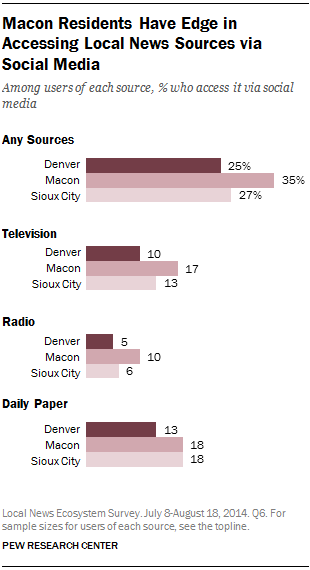
Social media is also becoming a part of the digital news experience. Roughly a third of Macon residents (35%) access a news source through a social networking sites, compared with 25% in Denver and 27% in Sioux City. And 8% of residents in each city (roughly three-in-ten social network news users) say that these sites are the most important way they get local news.
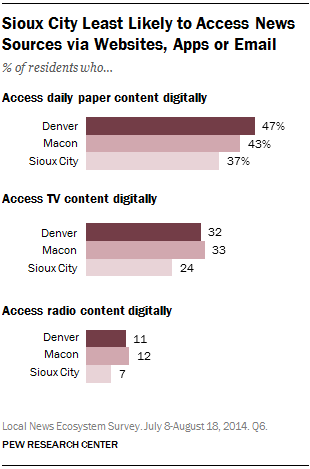
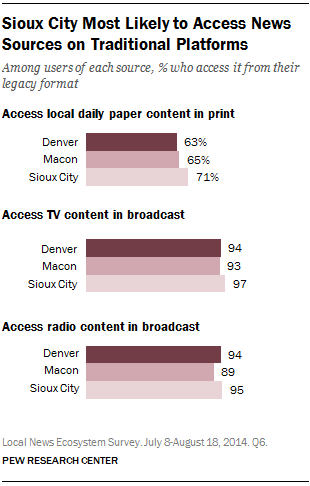
When residents were asked how they access different types of local news sources, legacy platforms dominate, but both the Web and social media are making their marks, particularly in Denver and Macon. Nearly everyone who relies on local TV gets it in its legacy form, but only about one-third of residents who get local TV news in Macon and Denver and one-fourth in Sioux City access a local TV outlet via a website, app or email and between 10% and 17% do so through social networks.25
For newspapers the digital space stands out far more—especially in Denver. The native outlet is still the most popular: 63% of Denver readers, 65% of Macon and 71% of Sioux City readers get news from the traditional paper product. But nearly half of Denver Post readers (47%) access it via the Web, app or email, as do 43% of Macon residents and 37% of residents of Sioux City. Between 13% and 18% in each city access the daily paper via social networks.
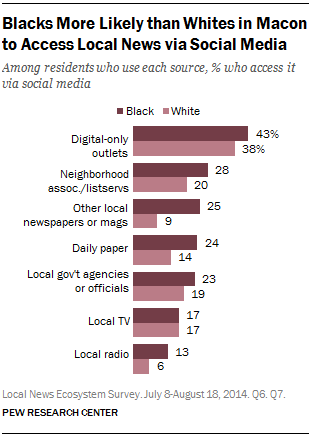
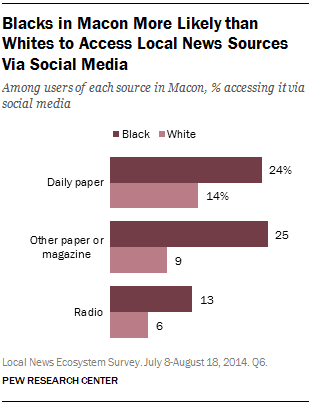
The Web is obviously the main access point for digital-native publications, though as noted above, very small percentages in each city turn to these kinds of news outlets. For those who do, social media is a relatively popular means of access, especially in Macon. About four-in-ten Macon residents (41%) who use local digital-only outlets access them via social networking sites, as do 34% in Sioux City and 26% in Denver.
On social networking sites, much of the local news that individuals encounter comes through friends or other fellow users who pass this news along. But users can also directly follow various types of news providers; of these, dedicated news organizations or individual reporters are the most common.
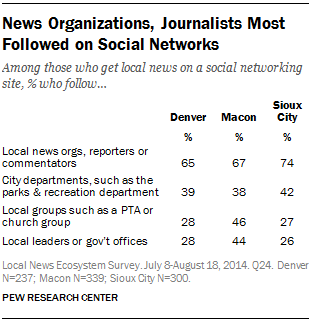
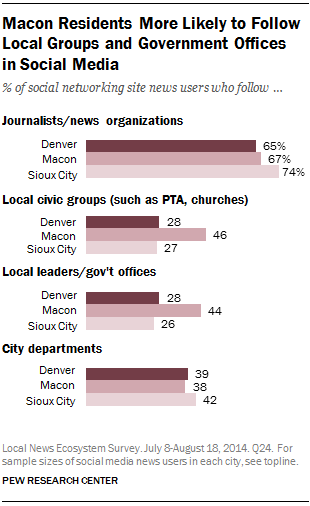
In each city, majorities of those who get local news on a social networking site follow news organizations, reporters or commentators: 65% in Denver, 67% in Macon, and 74% in Sioux City. Other types of news providers are followed as well but at much lower rates. About four-in-ten social media local news users in each city follow city departments. And in Macon, about as many follow local civic groups (46%) and official government offices or local leaders (44%). These groups are less likely to be followed by social networking site users in Denver and Sioux City; only about three-in-ten of social media local news users in both cities report following these kinds of news providers.
Discussing & Participating in Local News
When it comes to residents’ engagement with news, the similarities across the three cities are strong.
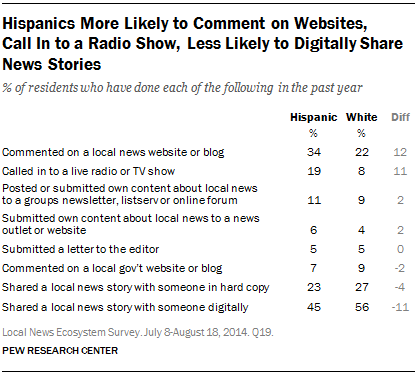
At least one-in-five in each city has commented on a blog or website in the past year. Commenting on a local government site, calling in to a live radio or TV show, submitting content to a newsletter or listserv or to a news organization are less common, though each drew activity from about one-in-ten respondents over the past year.
Denver residents stand out for the role they play in passing along the news digitally. About half (54%) have shared a story digitally in the past year. The same is true of 40% of Sioux City residents and 36% of Macon residents. In all three cities, sharing a news story digitally is more common than sharing one in hard copy—done by 26% of residents in Denver, 32% in Sioux City and 28% in Macon.
Looking specifically at social media, more than half of those in each city who get news on social networking sites often click on links to local news stories (54% in Macon and 55% in Denver and Sioux City). Deeper engagement and sharing, however, is less common. About three-in-ten social networking site news users in each city often share or re-post news stories, images, or videos, and at least 15% often share photos or videos of a local news event that they personally took.
Discussing the News: While Weather and Crime Dominate, Many Talk Economics, Business
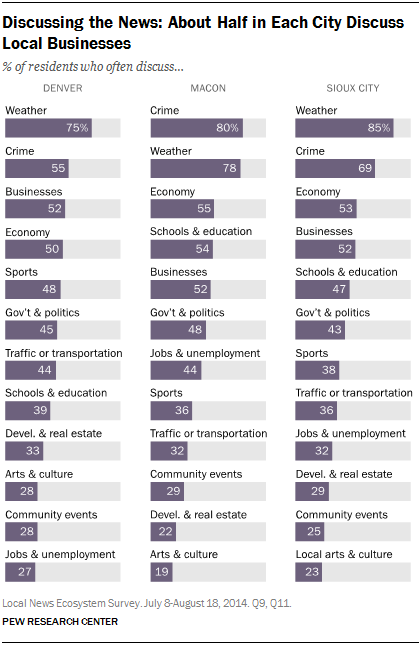
Confirming a nationwide truism, at least three-quarters of respondents in all three cities report they often discuss the weather with others.
But, residents in each city have conversations about a lot of other local issues as well. In Macon, crime is on par with weather as a topic of conversation. Eight-in-ten residents often discuss the topic. The same is true of 69% of Sioux City residents and just over half (55%) of Denver residents.
In all three cities, the local economy and local government and politics are often discussed by at least four-in-ten residents. And while local businesses are not followed as closely as other topics, they are a popular topic of conversation, with about half in each city often discussing them.
Residents in these cities tend to have most conversations about local news in person. Roughly three-in-ten Sioux City and Macon residents and a quarter of Denver residents discuss local news in person every day. Phone, text, email and social media are all far less common as a means to discuss local news, though Macon residents are more apt than residents of Denver or Sioux City to have a phone conversation about local news—12% do so daily, compared with 6% in each of the other two cities.
Engagement in Local Groups, Activities Similar from City to City
How do the local environments play out when it comes to civic life? Residents were asked if they are members of various local groups and organizations, such as community, parent or church groups, and if they have taken part in certain activities in the past year, such as attending public hearings or neighborhood meetings. Overall, roughly a quarter of residents in each city (24% in Denver, 26% in Macon, 22% in Sioux City) are very engaged in civic life in their city—being members of or having taken part in four or more of the 15 groups and activities asked about in the survey. About the same share (28% in Denver, 27% in Macon, 30% in Sioux City) have not taken part of in any of the groups or activities. As discussed below the most engaged in each city show stronger connections with local news.
Residents in each city also expressed a similar sense of empowerment over making their city’s future better. Despite starting out with very different rankings of their cities as place to live, roughly a quarter of residents in Denver and Macon feel they can have a big impact on making it a better place to live. Sioux City residents fall slightly behind at 17%. Few residents in any of the cities feel they can’t have any impact at all (5% in Denver, 11% in Macon and 9% in Sioux City).
Satisfaction with the City and the Local Media Differs
Denver residents are by far the most likely to give their city an excellent rating, but it is Sioux City residents who express the greatest satisfaction with their local news media. These residents are also the most likely to have had contact with a local journalist, suggesting perhaps that the interests and expectations of news media in a small, close-knit area are different from those in a sprawling and growing city.
Overall, half of Denver residents (49%) say that the city is an excellent place to live. That is true of just a quarter (24%) of Sioux City residents and a mere 9% of Macon residents. Instead, 43% of Macon residents describe the Macon area as a fair or poor place to live—about six times as many as in Denver (7%) and more than twice that of Sioux City residents (19%).
Residents’ views of the job their local news media are doing stack up somewhat differently. Sioux City residents are the most likely to think that their local media do an excellent job of meeting the needs of their local community—nearly three in ten (28%) express this view. Macon residents come in just behind, with 21% saying their local media do an excellent job meeting the needs of the community (two times as many as give the city overall an excellent rating as a place to live).
In Denver, despite having a wider array of news and information options, residents are not as satisfied with their local news media as they are with their city. Just 18% say the local media do an excellent job of meeting the community needs, on par with Macon residents and lower than those in Sioux City.
Still, other Pew Research data has found that people tend to give higher ratings to people
or offices with which they have a personal connection, such as rating their local congressional representative higher than the institution of Congress overall. Along those lines, while only a minority of residents in each city say they have ever spoken with or been interviewed by a local journalist, it is least common in Denver, where 16% report having spoken with a journalist, compared with 23% of Macon residents and 29% of those in Sioux City.
Nevertheless, majorities across the board say that all in all, their local journalists are mostly in touch with the local community: 71% in Denver, 69% in Macon and 83% in Sioux City.
Race and Ethnicity in the Local News Ecosystem
Two of the three metropolitan areas studied here contain racial and ethnic subpopulations large enough to study on their own—in the case of Denver, those who identify as Hispanic, and in the case of Macon, those who identify as black.26 In both cities, distinct patterns emerge across racial and ethnic divides—some of them overlapping, others unique to their respective metropolitan area. Specifically, the surveys find that blacks in Macon and Hispanics in Denver express a greater interest in local news than do whites, and the local news topics these groups follow differ somewhat from those followed most closely by whites. In addition, blacks and Hispanics express a greater sense of agency when it comes to improving their community, and in Macon, blacks display a greater propensity toward using social media to get news.
Denver: Whites, Hispanics and Local News
Hispanics in Denver—comprising 19% of the population—espouse a distinct set of attitudes about their city and local media as well as news behaviors and information preferences compared with the majority white population.
In particular, Hispanics are much less likely than whites to say Denver is “an excellent place to live” (38% vs. 55% of whites). At the same time, however, they are more likely to feel a sense of agency in changing that situation, with twice as many (42% vs. 21% of whites) saying they can have a big impact in making their city a better place to live.
The Denver metropolitan area supports a number of publications and broadcast outlets that cater directly to Hispanics. Of the 17 ethnic media outlets identified in the metro area by researchers, nine cater specifically to Hispanics and/or Spanish speakers. One of these is The Denver Post’s Spanish-language edition, Viva Colorado. Univision and Telemundo’s local broadcasts, along with a few Spanish-language radio programs, round out the offerings to this community.
A snapshot analysis of five days of content in Denver’s ethnic media finds a different focus of coverage from the local mainstream broadcast and print media. Education, religion and immigration were among the most prominent topics covered by the eight outlets—seven of which are aimed at the Hispanic and/or Spanish-speaking community—in the period studied.27 In contrast, immigration was not covered at all in the sample collected for The Denver Post or television outlets, and there was only a single religion-focused story.
And while Hispanics in the region gravitate to some of the same broad-interest news outlets turned to by the general population, a range of notable differences emerge in the sources favored by this group.
Following and Discussing Local News: Topics and Sources
More Denver-area Hispanics closely follow local news than do whites. Six-in-ten Hispanics very closely follow news about the city, and nearly as many (55%) follow news about their neighborhoods very closely, compared with 43% of whites following city news very closely and 39% who say the same for news about their neighborhood.
When it comes to specific news topics, Hispanics are notable in their interest in a handful of particular topics: about twice as many Hispanics as whites very closely follow local crime, jobs and education.
In addition to some key differences in the local news topics being followed, there are differences in the topics that whites and Hispanics most frequently discuss.
Whites are more likely than Hispanics to often discuss four of the 12 topics asked about, including the local economy, businesses and development. Hispanics discuss two local issues at a much higher rate than do whites. Crime is often discussed by 70% of Hispanics, compared with about half (49%) of whites, and jobs and unemployment are discussed by about twice as many Hispanics (45%) as whites (21%).
Sharing Local News
As for the ways that residents interact with local news, sharing a story with someone digitally ranks among the most common practices among both whites and Hispanics in the Denver area. More than half (56%) of whites said they have done this in the past year, somewhat higher than the 45% of Hispanics who reported the same. Hispanics, though, are more likely than whites to have commented on a local news website or blog or called in to a live radio or TV show.
Macon: The Black-White Gap in News Interest
Roughly four-in-ten residents (41%) in the Greater Macon area identify as non-Hispanic black.
While blacks are nearly twice as likely as whites to rate Macon as “an excellent place to live,” that rating still hovers at a relatively low 13% (compared with 7% for whites). Black residents are also more likely than the white population to feel that they can have a large impact on the city, and they are more engaged in their community as a group.
Unlike Denver, where at least nine local news providers cater specifically to Hispanics and/or Spanish speakers, Macon supports a relatively small number of sources aimed at the African-American community. The Georgia Informer, a monthly paper, serves the Macon area. A local commissioner for the county government, Elaine Lucas, hosts a weekly radio program focusing on issues of concern in Macon’s African-American community. And the Macon Black Pages connects the community through its annual business directory and local events e-mail service.
Following and Discussing Local News
The black population in Macon follows local news much more closely than does the white population. Seven-in-ten blacks say they very closely follow news about the Macon area, compared with just 43% of whites. This large gap also exists for news at the neighborhood level.
When it comes to specific local news topics, weather and crime stand out as the two that are followed the most among both groups. Nearly two-thirds of blacks (63%) follow crime very closely, as do 43% of whites. Local weather is followed by more than two-thirds of both blacks (68%) and whites (72%). Overall, a greater proportion of blacks follow nine of the 12 topics asked about—from schools to transit to jobs—at higher rates than whites.
Another way in which the black community in Macon demonstrates strong interest in local news is in the news topics they discuss. Twice as many blacks (62%), for instance, report they often discuss local jobs and unemployment as do whites (29%). And more than a third of blacks (37%) often discuss community events, compared with 21% of whites.
There are also differences in the types of news sources being used. For example, blacks in Macon (74%) are somewhat more likely than whites (61%) to say they often use local TV for news.
They are more likely to often turn to other local newspapers or magazines aside from the major daily (13% vs. 6% among whites), to radio (23% vs. 16%), and to nontraditional sources such as local government agencies, neighborhood associations, and other residents in the community.
And while the native platforms of these sources (such as the print edition of a newspaper) are still the most prominent among both blacks and whites, blacks are often more likely to access news sources through social media. For example, blacks in the Macon area who get local news from The Telegraph are more likely than whites to access the site via social media (24% vs. 14%). Among consumers of other print publications beside the major daily, blacks are nearly three times as likely to have gotten there via social media than whites (25% vs. 9%). And about twice as many blacks (13%) who get news on local radio access it through social media than do whites (6%).
Indeed, while the numbers are small over all, twice as many blacks (12%) as whites (6%) say social media is the most important way they get news about Macon.
When it comes to the kinds of digital devices each population users, blacks lag behind whites in desktop and laptop usage for news (often used for local news by 31% of whites, but just 22% of blacks) but are on par with whites in smartphone use (28% of blacks in Macon often use it for local news, as do 26% of whites).28
Sharing Local News
Whites, who are also more likely to be internet users, are somewhat more likely than blacks (41% vs. 30%) to have shared a local news story with someone digitally in the past year.
But there are a few ways in which blacks surpass whites when it comes to sharing local news. Blacks, for instance, are more likely than whites to have called in to a live TV or radio show (21% vs. 5%). They are also somewhat more likely to have commented on a local government website or blog (17% vs. 9%) and to have submitted their own content about local news to a news outlet or website (12% vs. 7%).
Digital Differences Across Local Communities
Digital technology plays a role in the news environments of all three metropolitan areas studied, though not an equal one. A number of factors, including internet access, demographics and the news offerings that are available play a part in the development of digital news habits.
Denver: A Digitally Enabled City
Two of the most fundamental elements at play are device ownership and internet access, both of which have a strong link to higher levels of education and income. By these measures, Denver—a tech startup hub that is headquarters to MapQuest and Photobucket, among others—clearly stands apart.
The Denver population is more affluent and more highly educated than that of Macon or Sioux City and also owns various digital devices at higher rates. Fully 85% own a laptop or desktop computer, 76% own a smartphone and 53% own a tablet. These ownership rates surpass Macon and Sioux City by eight to 16 points. In fact, residents of Denver are more likely to own a smartphone and a tablet than the nation overall.29
Denver residents also report higher levels of broadband adoption and internet use than Macon or Sioux City residents. Seven-in-ten Denver-area residents (70%) report having a broadband connection in their home, compared with only about half of Macon (48%) and Sioux City (52%) residents. And while majorities in each city use the internet at least occasionally, Denver residents do so at higher rates (89%) than Macon (76%) or Sioux City (80%) residents.
Denver’s news offerings reflect the area’s digital orientation, including nearly 40 neighborhood and municipal websites offering regular news items as well as at least 25 digital-only news outlets and blogs. Digital-only outlets produced 75 stories in the five-day period studied. In stark comparison, researchers could not find a single “digital-native” outlet in Macon or Sioux City that produced local, original material on a weekly basis during the content analysis sample period.
The digital focus occurs in both large and small outlets.
The Denver Post, alongside its numerous blogs and online podcasts, operates standalone sites (The Cannabist and Reverb) that publish several times a day. But aside from those, the city is served by nearly two dozen digital-only news outlets, covering a range of subjects such as real estate and development, health, and education. Nearly half of these publish new, local news content daily on their home page.
Amidst these digital opportunities, the Web emerges as more a part of the fabric of local news in Denver—not by leaps and bounds but by layers of gradation.
About eight-in-ten Denver residents (79%) get local news on at least one digital device, compared with 69% in Sioux City and 67% in Macon. And, nearly half of Denver residents (45%) say the internet is very important in their ability to keep up with local news issues and events, compared with 38% in Macon and 33% in Sioux City.
Further, more Denver residents have shared a local news story digitally in the past year (54%) than have residents in Macon (36%) and Sioux City (40%).
Denver residents also stand out for accessing non-journalistic providers of news through the Web. Among Denver residents, 44% ever get news from a neighborhood association. Of those who do, 43% access this news through their website, app or email, compared with 33% of users in Macon and 23% in Sioux City. For those who get news from local government agencies, about six-in-ten (61%) in Denver say they access them by the Web—much higher than in Macon (35%) and Sioux City (29%).
While legacy outlets and platforms still attract the greatest portion of the population in Denver, these data reveal a city with more rooted digital habits—particularly in the first generation of the digital experience of desktop and website connections.
Macon: The Importance of Social Pathways to Local News
The metropolitan area of Macon, Georgia, faces at least one digital obstacle not encountered in Denver or Sioux City. According to data from the Federal Communications Commission (FCC), nearly all residents in Denver (98%) and Sioux City (96%) have access to an internet connection that meets the FCC definition for a “broadband” internet connection by modern standards.30 In Macon that falls to 84%—still a vast majority, but lower than the other two cities.31
The array of digital news offerings in Macon is far more limited than that of Denver and is closer to being on par with Sioux City. One of the area’s only digital-native news sites closed in 2014. While the majority of local news outlets have some sort of web presence, just six of the 24 news providers studied were publishing online content daily. Four of the local news providers identified by researchers did not publish local news online at all (a fifth did, but its content was placed behind a pay wall). Still, efforts are afoot to connect the community through technology, such as the Center for Collaborative Journalism at Mercer University, home to Groundsource, a tool for mobile engagement.
Despite a less digitally enabled infrastructure, Macon residents’ reliance on digital news tends to lie between that of Denver and Sioux City residents. And when it comes to social networking sites, Macon residents show early signs of outpacing both Sioux City and Denver.
While the same share of residents in each city (8%) say that social networking sites are the most important way they get local news, Macon residents are more likely to name specific sources that they turn to in this space. Fully 35% of Macon residents access a news source through a social networking site, outpacing both Denver (25%) and Sioux City (27%).
Looking at specific sources of news, 17% of Macon residents who get news from local TV channels do so through social media, compared with 10% of residents in Denver and 13% of those in Sioux City. A similar pattern emerges for local radio. Macon residents who read the daily newspaper (18%) are just as likely as Sioux City residents (18%), but slightly more likely than those in Denver (13%), to access the daily paper through social media. A similar pattern is found with all other print-based publications, such as magazines, as well as digital news outlets and neighborhood associations.
A subset of the total population in each city—residents who get news on a social networking website—were asked a series of questions about who they follow. And here, Macon stands out for its use of social media as a way of connecting to news from nontraditional types of news providers.
Solid majorities of these social news users in each city follow local news organizations, reporters or commentators, but Macon’s social news users are more likely to follow other kinds of local groups. More than four-in-ten of them (44%) follow local leaders or government agencies, compared with 28% in Denver and 26% in Sioux City. Similarly, nearly half (46%) of social news users in Macon follow local groups such as the PTA or churches, compared with 28% of Denver users and 27% of Sioux City users. Users in all three cities are similar when it comes to following city departments.
Race as a Contributing Factor in Macon
That Macon keeps apace with Denver, and in some cases surpasses it when it comes to local digital news behaviors, is notable given the more limited access its residents have to digital technology and news offerings. Some of this could be tied to the finding that Macon-area residents in general follow local news more closely than those in Denver or Sioux City—overall and for a number of specific news topics.
This strong interest in local news particularly stands out among the black population in Macon. Seven-in-ten blacks in Macon follow news about the local area very closely, compared with less than half (43%) of whites. Blacks are also more likely than whites to say they follow neighborhood news very closely (72% vs. 48%).
And while white residents in Macon are more likely to own a desktop computer (80% vs. 60%) or tablet (42% vs. 32%), have broadband internet (58% vs. 35%), or use the internet at least occasionally (82% vs. 67%), blacks are on par with whites when it comes to smartphone ownership. Smartphone ownership among blacks in Macon is on par with their ownership of desktop/laptop computers (65% vs. 60%).
The reliance on smartphones may be tied to another area where blacks in Macon stand out—their use of social media for news. Traditional pathways like print and broadcast still dominate, but among daily newspaper users in Macon, blacks (24%) are more likely than whites (14%) to access the paper through social media. About a quarter of Macon blacks (25%) who use other kinds of print publications do so through social media, compared with 9% of whites. And more blacks who use local radio news sources accessed those sources through social media than do white audiences (13% vs. 6%). (For local TV, digital-only outlets, local government agencies and neighborhood associations, the access points were similar for both groups.)
The racial divide offers a less clear pattern when it comes to other digital access points such as websites, apps and email.
Though the numbers are small across the board, blacks in Macon are also more inclined than whites to use digital technology to discuss local news, with 13% of black residents discussing local news nearly every day by text or instant message, compared with a mere 4% of whites. They are also more likely than whites to use social networking sites and email to talk about local news with others.
Sioux City: A More Traditional Local News Experience
Despite having roughly equal broadband access as Denver, Sioux City on many fronts reflects less of a digital orientation than Denver or Macon.
As in Macon, there is little by way of local digital publishers. Sioux City Now is the rare hyperlocal blog that focuses on local issues. There are statewide sites, such as IowaWatchdog.org and Iowa Cold Cases that occasionally cover Sioux City affairs, but their focus is generally much broader. Only seven of the 24 websites studied updated their home page at least daily. Just 11 had comment sections on their home page, none of which contained any user comments during the period studied.
Sioux City residents are the least likely to say the internet is very important for keeping up with local news (33%, compared with 38% among Macon internet users and 45% in Denver). And only 22% of Sioux City residents get local news on a desktop or laptop compared with 37% in Denver and 27% in Macon.
Sioux City residents are less likely than those in the other two cities to access local TV or the daily paper through websites, apps or email.
About a quarter of Sioux City residents who get news from local TV (24%) access that content through a TV station’s website, app or email, compared with about a third in both Denver and Macon. And 37% of local newspaper consumers in Sioux City say they often get content from the main daily paper via the Web, compared with 47% in Denver and 43% in Macon.
By contrast, Sioux City residents are more likely than those in the other two metro areas to say they access the local daily paper by traditional means. Among Sioux City residents who read the daily paper, 71% access it in print, compared with 63% in Denver and 65% in Macon.
It is not as if Sioux City news functions wholly outside of the digital realm. The local daily paper updates its website and Twitter feeds multiple times per day, as do the network TV affiliates, though the posting rate at the shared website for the local CBS and Fox affiliates is closer to once a day. The majority of news providers that were identified had regularly updated Facebook pages. And some municipal and government sources of information maintain robust online presences. The official website of Nebraska Rep. Adrian Smith featured new content several times a week.
Still, however, there may be something about the smaller size of Sioux City, and its culture, that lend the population to more traditional ways of gathering information. Rick Arnold, president of the Sioux City Neighborhood Network, argues that in Sioux City, the internet “is not as critical because you’re never very far away from anything.” In his observation, Siouxlanders are “more relationship-oriented, and like to talk.”32
Engagement in and Satisfaction with One’s City Connect to Stronger News Habits
A consistent finding across these metro areas is that individuals with strong engagement in local civic and community life as well as those who give their city a high rating as a place to live display stronger local news habits.
Civic Engagement and News
In each of the three diverse cities studied, the most engaged residents are more likely to follow and discuss local news, take part in a number of different news activities, and are somewhat more digital in their local news than residents who are less engaged. They also differ in the news sources they choose to use.
To measure local engagement, residents were asked if they are members of various local groups and organizations, such as community, parent or church groups, and if they have taken part in certain activities in the past year, such as attending public hearings or neighborhood meetings. Overall, roughly a quarter of residents in each city (24% Denver, 26% Macon, 22% Sioux City) are members of or have taken part in four or more of the 15 groups and activities asked about. For this report, those individuals are termed the “very engaged.” About the same share (28% Denver, 27% Macon, 30% Sioux City) have not taken part of in any of the groups or activities—termed “the unengaged.”
With only one exception, the most civically engaged in each city are more likely to closely follow local and microlocal news than are those who are less engaged. (The one exception is news about the Denver area.)
The very engaged also closely follow and discuss a greater number of local news topics. On average, the very engaged in Macon very closely follow 5.1 topics (compared with 3.2 of the somewhat engaged and 2.4 of the unengaged), 3.5 topics in Denver and 3.9 topics in Sioux City, higher than both the somewhat and unengaged in each city.
In Macon, the very engaged follow 11 of the 12 topics asked about at higher rates; the same is true of eight of the topics in Sioux City, and seven in Denver. For example, across all three cities, local government, arts and culture, and schools and education are closely followed at higher rates by the most engaged.
The same trend holds true when it comes to talking about news topics with other residents. The very engaged in Macon often discussed eight of the 12 topics at greater rates—from local government and politics to local development and real estate to local sports—than the somewhat and unengaged, six in Sioux City, and four in Denver.
In addition to following local news more closely, the engaged are more likely to take part in a number of different news activities, including both the high and low tech. In fact, more than half of the very engaged in each city have shared a story digitally in the past year. And while the numbers overall are lower for calling in to a live radio or TV program or submitting letters to the editor, the very engaged are about twice as likely or more to do so than those less engaged.
TV for All, Newspapers and Personal Conversations for the Engaged
Across all levels of engagements and in all three cities, local TV is the top source of local news. In both Macon and Sioux City, about two-thirds of residents in each engagement group often get local TV news. In Denver, at least half of each group often uses local TV as a source for local news.
The city’s main daily local newspaper, meanwhile, is more prominent among the engaged than the unengaged. In Denver, a third (33%) of the very engaged often turn to The Denver Post, compared with 20% of the somewhat engaged and 19% of the unengaged. About half (52%) of the very engaged in Macon often use The Telegraph, substantially higher than the somewhat (33%) and the unengaged (26%). And in Sioux City, about equal numbers of the very (47%) and somewhat engaged (43%) often get news from the Sioux City Journal, compared with only three-in-ten of the unengaged.
Another source for local news that stands out among the engaged is fellow residents. Across all three cities, the very engaged are more likely to often turn to other residents for local news. This especially true in Macon, where 52% of the very engaged say that they often turn to their fellow residents for local news.
Other types of sources that are less frequented overall also stand out among the engaged. In all three cities, the most engaged are more likely to often turn to neighborhood associations or listservs. The same is largely true for local newspapers or magazines beyond the main daily. And, in Macon and Sioux City, while still at relatively low rates, more of the very engaged often use local government agencies and officials as local news sources. Reliance on radio news is a bit more muddied. Engaged residents in Sioux City are more likely to rely on it often than are other residents, but the trend is not as consistent in Denver or Macon.
The very engaged are also somewhat more digitally focused in their local news media habits. In Denver and Macon, very engaged residents who use the internet are more likely to consider it an important platform for local news than the somewhat and unengaged, and more so than the unengaged in Sioux City.
The Grumpy Engaged in Denver
One striking difference among the very engaged in Denver, compared with other cities, is their low evaluations of their local news sources. Fully 44% of very engaged Denver residents say that the local news media do a fair or poor job, compared with about a quarter of the somewhat engaged (26%) and the unengaged (25%).
Further, about a quarter (24%) of very engaged Denver residents who have lived there at least five years say that the quality of local news coverage has declined in the past year, compared with 13% of the somewhat engaged and just 6% of the unengaged.
In Macon and Sioux City, there is little difference in their evaluation of the job that the media are doing and whether the quality of local news coverage has gotten better or worse.
City Satisfaction and News
As with civic engagement, there are clear relationships between thinking a city is an excellent place to live and connection to local news. In all three cities, those who describe their city as an excellent place to live are much more likely than others to think their local news media do an excellent job and to enjoy keeping up with local news.
More than half of Sioux City (53%) and Macon residents (54%) who rate the city as excellent say the local media do an excellent job in meeting the needs of their community. That falls to about a quarter among those who say their city is a good place to live and just one-in-ten among those who say it is fair or poor. In Denver, the percentage are smaller overall, but there is a similar falloff—from 23% of those who describe Denver as an excellent place to live to just 13% among those who rate the city less than excellent.
Those who give the highest city rating are also the most likely to enjoy keeping up with the local news. As previously noted, Macon residents overall express more interest in keeping up with local news than do residents of the other two cities. Eight-in-ten of those who give the city an excellent rating say they enjoy keeping up with news a lot, as do about six-in-ten (58%) who rate the city as good, compared with only a third (34%) of those who describe it as fair or poor. Among Sioux City residents, three-quarters of those who say the city is an excellent place to live enjoy keeping up with local news a lot, compared with 44% of those who rate the city as good and roughly a quarter (24%) of those who rate the city fair or poor. In Denver, the figures fall from about half of those who describe the city as excellent to about four-in-ten (39%) of those who describe it as less than excellent.33
In Sioux City, and to a somewhat lesser degree in Denver and Macon, high ratings of the city as a place to live also connect closely with news habits.
In Macon and Sioux City, Those Who Give City Highest Marks Follow and Discuss More News Topics
In Sioux City and Macon, those who rate their city as an excellent place to live are more likely to follow and discuss local news topics. For example, residents who rate Sioux City as an excellent place to live very closely follow on average 4.0 topics (compared with 2.5 of those who rate it as good and 2.3 of those who rate it as fair or poor). In Macon, those who gave the city an excellent rating average 4.9 topics that they follow very closely (compared with 3.5 who rate the city as good and 3.1 who rate it as fair or poor).
Looking at the specific topics, Sioux City residents who rate the city as an excellent place to live very closely follow nine of the 12 topics at higher rates than those who rate the city as good or fair/poor. The same is true for often discussing seven of the topics. Some of the topics that stand out as having large differences between the most satisfied and those less satisfied include the local economy, local schools and education, and local government and politics. In Macon, those who rate the city as excellent are more likely than others to very closely follow eight of the 12 topics but to discuss only one of the topics at higher rates.
There is a hint of a similar trend in Denver, but the difference between those who rate the city as excellent and those who rate it as less than excellent are not as pronounced as in the other two cities. This may be due to the large percentage of residents who rate their city as excellent compared with the other two cities. For the individual topics, those who give the city an excellent rating are more likely to very closely follow three topics and often discuss four topics at higher rates than those who rate the city as less than excellent.
Differences in News Media Sources by City Rating
When it comes to the local news sources, newspapers again stand out. In Macon, for example, nearly two-thirds (65%) of those who rate the city as excellent often use The Telegraph for local news, compared with 41% of those who rate it as good and 26% of those who rate it as fair or poor. And in Denver, while fewer overall get news from the daily newspaper than in the other two cities, those who rate the city as excellent do turn to the Denver Post at a higher rate.
In Sioux City, this pattern of greater news consumption among those who give their city the highest rating holds true for local TV, local radio, other local newspapers and magazines, local government agencies or officials, neighborhood associations or listservs, and other local residents. In other words, even if the mix of available outlets is not as great Sioux City as Denver, the residents there who give their city an excellent rating take fuller advantage of what’s there.
It should be noted, though, that consistent with the finding that local TV rises to the top across all three cities, local TV news use across all levels of city satisfaction remains high. More than half of every group level of city satisfaction in each city said they often go to local TV for news.
Facebook and Twitter—New but Limited Parts of the Local News System
As the three city surveys reveal, small segments of residents in each have added social media to the variety of ways they keep up with local news. In this section of the study, we turned from asking city residents where they get the news to closely examining social media itself. Specifically, we focused on Facebook and Twitter.
First, we looked at the Facebook pages and tweets of all the news outlets, public figures, government departments and civic groups identified in the landscape audit of each city. Second, we identified public Facebook pages and Twitter users connected to the first list.
The starting point for the Facebook study was the list of public Facebook pages collected during the audit of each city’s media landscape, such as those linked to local TV channels or municipal organizations. This list was enhanced by using Google advanced search to conduct several rounds of searches on Facebook for any public pages that used keywords referencing news in each city. That process added many more pages into the mix, from local advocacy groups to music bloggers to local journalists’ personal Facebook pages. In total, across the three cities, the center identified a total of 299 total pages, though 66 of those pages had no posts at all during the 14 days studied. (For the full list of keywords and methods, see the Methodology page).
Researchers then used the Facebook public Application Program Interface (API) to download a data file containing all of the posts from these pages during the date range for each city. This contained information about the page itself, the content of each post on the page and metadata associated with each post (such as the number of comments and likes on each post) and the text of all comments. The analysis below is based on this set of pages, posts and comments.
The Twitter analysis began with a list of Twitter handles gathered during the audit of each city’s media landscape, such as that of the local TV stations, local members of Congress and the mayor’s office. Then, using the Twitter firehose (a tool contracted through GNIP that provides full access to all content on Twitter), researchers pulled all of the tweets from each of those handles during the date range for each city. This resulted in around 4.7 million tweets across the three cities.
From there, researchers identified any account that retweeted or @ mentioned any of those handles and added this group of news sharers to the sample. This technique, sometimes referred to as “snowball sampling,” is a way to identify Twitter handles beyond structured providers of news.34 This resulted in a total of more than 4 million tweets across all three cities. Those tweets and all of their metadata are analyzed below.
Analyses of social media data are inherently messy. The second round of handles pulled from Twitter and the additional pages from Facebook were selected for their potential connection to each community, but due to the vast number of handles and pages captured it is not possible to determine how strong that connection is in every case. As such, these analyses should be treated as an exploratory, experimental addition to the more traditional survey research and content analyses contained in other sections of the report.
Facebook: An Active but Isolated Distribution Channel
The multi-step analysis of public Facebook pages of news outlets, public figures, government departments and facilities, and civic groups finds that while a number of nontraditional providers compete with large legacy outlets in popularity, the stories they are covering are in many ways the same as those in other, more traditional platforms. The analysis also suggests that user comments focus on a minority of posts and tend to peter out after
the first 24 hours of a post’s life.
In Macon, researchers identified 65 active Facebook pages—though 17 of these did not post during the time period. From these pages, researchers collected 1,829 posts across a 14-day period from June 4 to June 18. These posts received a total of 42,744 likes, 10,825 shares, and 7,596 comments.
In Denver, 184 active pages were found, with 46 of those pages having zero posts within our time frame. On those pages from June 11 to June 25, researchers captured 4,579 posts, 18,330 commenters, and 37,319 comments.
And in Sioux City, researchers identified 50 pages—three of which had no posts during the time frame. These 50 pages have been “liked” a total of 175,485 times. Between June 18 and July 2, 1,737 posts appeared on these pages, accruing a total of 18,675 likes, 5,036 shares, and 3,371 comments. A total of 1,915 users made comments on these pages.
In terms of “likes” (or followers), local TV stations and daily newspapers tend to dominate, but outliers in each city draw a following. The data also suggest that activity alone does not always lead to greater popularity.
In Macon, the local CBS affiliate, WMAZ, is by far the most popular news source on Facebook, just as in the broadcast realm. The main page has over 90,000 likes, far more than any other page—and its chief meteorologist ranks fourth with 17,767. But the page is not the most active in terms of posts: It published 234 during the time studied, less than the ABC affiliate (250) and the local daily paper (247). But these 234 posts garnered 4,547 comments, for an average of 19 per post—again far outpacing any other page.
One non-media page that stands out in Macon is that of Rep. Austin Scott. His page had 17 total posts during the time period studied, but has more likes than every news provider except CBS, and he has the fourth-highest number of comments. (Scott’s website contains no news, only press releases and thus it was not considered a news provider.) Several Facebook pages for Mercer University are also among the top 10.
In Denver, the top two pages—9NEWS KUSA and The Denver Post—together have more likes than the next 14 pages combined. While they have a similar amount of fans and posts, the Post received about twice as many comments (more than 6,700). It was the local Fox affiliate, though, that generated the most comments—11,580. The station achieved this high number by posting disproportionately about national stories. Of the top 20 most commented posts in Denver, three of the six KUSA stories were about local news. Of the 12 from Fox31, only four were about local issues.
Beyond these top sites, there are several non-legacy pages that stand out. One is the cultural weekly, Westword, which also ranks in the top outlets Denver residents turn to for arts and culture, local businesses and local community events. Westword’s Facebook page has been liked more than 78,000 times, and the 228 posts made during the two-week sampled period received nearly 2,000 comments. An even more prominent standout is the online magazine 303. Only 11 survey respondents consider it a primary source for various local news topics, but its online focus has allowed it to accumulate more likes than many of its legacy competitors: just over 59,000 likes, and about 200 comments over 80 posts. Finally, the Denver airport emerged as a surprisingly active Facebook nexus for local information. While its large number of likes (over 50,000) may be linked to the large number of out-of-town travelers who pass through, the page also posted more often��and generated more comments—than several news providers, such as Colorado Public Radio or local CW affiliate KWGN.
And in Sioux City, while the most popular page, KTIV NBC4, was the news source most often mentioned by residents as their top source for local news, the news media made up a minority of the 10 most popular Facebook pages. The remaining slots are filled by politicians such as Republican Rep. Kristi Noem (more than 23,000 likes and 738 comments over 239 posts) and civic organizations such as the school district (over 3,000 likes, but only nine comments across eight posts).
Stories Posted on Facebook Reflect Traditional Media Coverage
Across the three metro areas, the stories trending on Facebook were the same ones covered by the news media more broadly. In Macon, for instance, the firing of a deputy for a grocery store shooting had the most posts on Facebook and the second-highest number of stories in a five-day study of news coverage. In Denver, a house explosion received the third most frequent attention on Facebook, while this story was the fourth most covered in the five-day analysis. And in Sioux City, a scandal at a local casino received the second-highest number of posts on Facebook.
Audience Comments: Highly Concentrated, Short-Lived and Driven by Requests to Engage
An examination of the comments across these posts reveals first and foremost that a minority of posts generate any comments: 43% do in Denver, 32% in Macon and 31% in Sioux City. Far fewer garner more than 10 comments—12% in Denver, 8% in Macon and 4% in Sioux City.
The concentration is even greater when it comes to the pages that generate those comments. As the accompanying figure shows, the majority of comments in each city were concentrated in a handful of pages. The most popular public-facing Facebook page in Denver garnered 11,580 comments, the fifth most popular page got 1,993 comments, and the tenth most popular got only 401.
In all three cities, 50% of the total number of comments came on the top three most commented pages; in Macon, 50% of the comments were from the most popular page alone (13WMAZ.com).
For those posts that did attract at least one comment, more than 85% were left in the first day after posting. Additionally, less than 15% of commenters left more than two comments in the week we studied. If individuals are having conversations on Facebook, it does not appear to be a frequent occurrence in these official forums.
While there is no clear pattern to the kind of post that generates comments, one frequent element was that local news generated more interest than stories from outside the area. Of the 100 most commented posts in each city, between half and three-quarters (58% in Denver, 71% in Macon, 54% in Sioux City) are about local news.
And in Denver, 50% were spurred by some form of audience outreach, such as questions, requests for photos or videos, and polls. But this did not seem to be much of a factor in the other cities: This was true of just 28% of the most commented posts in Sioux City and 20% in Macon.
The types of engagement put forward in these posts varied. The most commented post in Denver, from the local CBS affiliate, asked “Would you like to see Hillary as president?” (564 likes, 639 comments), while the third most commented post asked if residents would be interested in trying a very large waterslide (1,538 likes, 615 comments).
Another, arguably higher, level of interaction is to allow users to post their own stories on the Facebook wall of a provider. A resident, for example, would be allowed to post about a news issue on The Denver Post’s Facebook wall—a post that all of the 300,000-plus people who follow the Post on Facebook could potentially see in their newsfeeds. While most pages allowed members of the public to make posts (89% in Denver, 68% in Macon, 76% in Sioux City), the majority of posts were from the owners of the page, not members of the public (77% in Denver, 88% in Macon, 73% in Sioux City). Whether this is due to few submissions, site moderators that do not approve them or some combination of the two is unclear—though the end result is few pages with much citizen content.
However, the exceptions showcased the possibility of Facebook as a public information hub—or at least a page filled with more external than internal content. The page of South Dakota Rep. Kristi Noem was filled during the time studied with 230 posts from citizens, compared with just nine from the page’s owners (though Sioux City is in Iowa, the Sioux City metropolitan area includes parts of South Dakota and Nebraska as well). And the conversation that emerged through those posts was about politics more generally rather than about Noem’s own actions or policies. For example, citizen posts included a link to a YouTube video on immigration; a photo of the results from a Quinnipiac poll; quotes from the Hobby Lobby court decision (without a link); questions for Noem about the war in Syria; and a link to a Yahoo story about Congress’ work schedule.
At the same time, however, the majority of these user-generated posts came from a handful of people. While 14 users made posts on Noem’s page over these 14 days, 80% were made by just three people, suggesting that the number of individuals who take advantage of these kinds of options can be quite limited.
One other distinction on Congresswoman Noem’s page is the degree to which even her own posts linked to outside content. Of the eight links posted by Noem in the time period, just two went to her own site. Contrast this to her fellow member of Congress, Steve King, whose official Facebook page features no citizen posts. Of the nine posts on his page with links, six went to his own home domain.
The distinctions of this one page had a large impact on the breakdown of overall Facebook content coming from Sioux City news providers. Across the 50 pages studied, fully 69% of links went to outside content. That is four times the percent of links from Macon news providers and also more than Denver. Instead, more than half of links from posts made on the pages of Denver news providers went to their own websites; in Macon, the figure was even higher (83%).
Most Posts Contain More than Text
A Facebook post can have two different elements to it: a text-based post (such as posting “Happy birthday!” to your friend’s wall), and non-text content, such as a link to a news story or YouTube video, or embedded photo or video (made by clicking “Add photos/video” while composing the post). A link or photo can be posted by itself, or it can be posted with accompanying text that might explain, provide context or add information.
In general, posts rarely contain only text (18% in Denver, 30% in Sioux City and Macon). But the cities differ in whether this additional content stands alone or is paired with some explanatory text. In Denver, the most digitally adept city in our study, about three-quarters of posts use both text and additional content. In Sioux City, however (which was generally less engaged with the digital space), about 20% of posts contain only this additional content, such as a photo or link without any added text by the poster.
This additional content consists primarily of photos or videos in Denver and Sioux City, but primarily of links in Macon. Overall, six-in-ten posts with additional content in Sioux City and five-in-ten posts in Denver contained photos or videos. In Macon, however, only 41% of posts with additional content contained photos or videos, while 56% contained a link.
In two cities, the post with the most likes is a photo with accompanying text. In Denver, it is a post from the Denver Police Department with a picture of a baby who’d been rescued and cared for by officers. In Sioux City, it’s a picture of a double rainbow posted by local CW affiliate KTIV; given the recent flooding, the picture had special resonance for residents. In Macon, the most liked post is text only: an update from WMAZ anchor Frank Malloy on the health of his wife, who was in the hospital after a car accident. (She was later charged with DUI in connection with the accident.)
The Twitter-verse in Denver, Macon, and Sioux City
The more public nature of Twitter compared with Facebook allows for a different kind of analysis focused more on the organic ways in which local news providers and residents use the platform.
The Pew Research Center, through a contract with GNIP, has access to all Twitter content—known as the Twitter “firehose.” One of the biggest challenges in studying Twitter is narrowing in on posts stemming from each geographic area.
Researchers first identified the Twitter handles of all news providers identified in the landscape audit of each city. These included news organizations, individual journalists, government entities, schools, neighborhood associations and any other organization that produces original local news content. Then researchers pulled from GNIP all the tweets generated from those handles over a five-day period for each city.35
From that corpus of tweets, researchers made a list of all new handles that @ mentioned or retweeted any tweet from the first round data and then pulled all of the tweets from this second, and entirely new, set of handles and added them into the first data set. That amounted to a total of nearly 5 million tweets and over 30,000 Twitter users. There were 409,868 total tweets in the Macon sample, 1,310,843 in Sioux City, and 3,201,804 in Denver.
The goal of this process was to collect a group of Twitter users (and their tweets) who are connected to each community. To define “connected,” we collected Twitter users who interacted with our original list of news organizations, civic leaders and other information providers in each city.
From here researchers worked to refine the list to get as close as possible to what could be identified as local content. This involved analyzing the URLs contained in tweets to better understand the stories being shared as well as looking at what hashtags were being used. In Macon it was possible to review the tweets individually as well, but this kind of analysis was impossible in Sioux City and Denver given the volume of tweets.
Finally, to facilitate the analysis, researchers separated posts that contained URL links and those that did not. Dividing the tweets this way served two purposes. The first was to understand how news stories are shared on Twitter. By looking only at tweets that included a URL, researchers were able to better understand how local news outlets are shared on Twitter and how national outlets compare. The second was to simplify the process by isolating the more difficult to analyze tweets that did not include a URL link. Researchers looked at hashtags that were used and read the tweets that were shared the most, though it was clearly not possible to read all the tweets included in the massive data set.
Overall, the analysis found little discussion of the local news stories covered most by the local news providers. Instead, conversations tended to focus on content that would not be classified as news—such as conversations between local residents. When posts did relate to news and information, they were more often national in scope than local—and most often tended to be political in nature. The top national URLs are all the same stories that were in the national press that week, and the top hashtags in tweets without URLs were all nationally oriented hashtags: #tcot, #bringbackourmarine, #renewui, #HR803, #immigrationreform.
One standout story occurred in Macon, where a local pop band participated in a VH1 contest.
In Macon, One Major Local Thread Emerges
For the week of June 6 through June 13, 2014, the Twitter conversation around Macon focused heavily on a single story. A local band called Good Night Alive was competing in a VH1 contest called “Make a Band Famous.” The show aired on Wednesday, June 11, in the middle of the week studied in Macon, and part of the band’s success in the contest depended on how many users tweeted about the band.
Of the over 400,000 tweets studied, researchers identified 77,427, or 19%, that were about Good Night Alive.36 No other subject came close to that number of tweets.
Of the 77,427 tweets about the band, 12% contained URLs. The most shared was a link to a song by the band hosted on Soundcloud (shared 3,486 times), and the second was to the band’s section of the VH1 contest page (shared 2,302 times). These were also the most shared URLs for the entire week studied—and shared far more than any other story in Macon.
No other story, local or national, came close in size to the story about Good Night Alive.
Third, at 1,102 shares, was not a news story at all but a link to happybabyworkout.com, a site about helping mothers with young children exercise with their kids. After this came a link to a tweet voicing opposition to a bill in Congress that would require the Department of Agriculture to not issue licenses to employees at horse shows, sales or auctions that “sore” horses.37
As noted above, it was challenging to find any local stories, other than the stories about Good Night Alive, during the week studied. The next most shared local story was shared just 22 times during the five-day capture. The story, posted by a local TV station, was about a full moon visible on the Friday of our capture dates and was shared 24 times during the capture. All of the other local stories that were shared using a URL appeared only one time during the time period studied. These included a story about a local party in downtown Macon on June 28 and a link to the site middlegeorgiaceo.com that featured a story about challenges facing businesses in the Macon area.
Hashtags Point to a Similar Focus as URLs
While the main focus of this analysis involved the study of tweets containing a link to a website, nearly half of the tweets that were collected in Macon (44%) did not include a link. This side of the Twitter conversation is much harder to study. Twitter users in the three cities fell into the sample because they at some point retweeted or engaged with one of the news or civic accounts identified, but because all their tweets were pulled in, many conversations that were not about the news were also included. And many of the tweets were parts of longer conversations and thus it was hard to decipher their meaning.
Despite these challenges, there are some telling statistics about this group of tweets. While they did not include a URL, many of them did include hashtags. Here again in Macon the story is clear; the Good Night Alive story was also dominant in tweets without URLs. In total the combination of #mabf and #goodnight live was used more than 65,000 times (this includes various spellings and capitalizations of the two hashtags).
The other popular hashtags in Macon were nationally relevant hashtags such as #renewui, which means “renew unemployment insurance,” or #bringbackourmarine, a hashtag campaign to bring back a U.S. Marine who was being held in a Mexican prison.
Sioux City: National News Supersedes Local
In many ways Twitter activity in Sioux City over the week studied resembled Macon’s—aside from the Good Night Alive story thread. Among the tweets captured, the top shared news is national, local news is shared rarely, and Twitter is used as often for conversation between users as it is to share news.
The local content with the most shares on Twitter was weather, with a link to a live weather cam from Iowa Weather Now (that link appeared 24 times). The next most shared stories in Sioux City were three stories that each appeared eight times over the week studied: a story about a Sioux City resident who won a gold medal at the Special Olympic Games, the Hard Rock Casino assembling a giant guitar, and an obituary for a local sports icon.
Compared with national news stories and other content, these local stories appeared far less often. The top shared URL during the time period was a Rock the Vote effort by votelatino.com that was shared 1,600 times (the site has since been taken down). The top news story URL was an article from The Hill about how Republicans in the House killed the latest immigration reform bill. In fact, of the top 10 URLs by number of times they appeared during the week studied, all either linked to a story about a political topic or linked to a Twitter status about a political topic.
Hashtags Cross City Boundaries
Of all the tweets analyzed in Sioux City, 42% did not contain a URL. As mentioned above, this lack of a URL makes it harder to judge what the full set of tweets is discussing (it totaled around 550,000 tweets).
Of tweets that did not contain a URL, 44% were original posts and 56% were shares. This rough pattern fits with Macon, as does the number of @ mentions. More than 90% of the tweets without URLs contained an @ mention.
In Sioux City the top hashtag was #renewui, a hashtag that was popular in Macon as well. This refers to the effort to renew unemployment insurance. Other top hashtags in Sioux City were related to this topic such as #hope4jobs and #HR803 (referring to the bill in Congress that would renew unemployment insurance). All of these hashtags grouped together were tweeted more than 100,000 times—9% of all the hashtags used during the week studied.
Like the top URLs, there is a very long tail of hashtags. Of the 84,404 unique hashtags that week, 51,234 (61%) were used a single time.
Other top hashtags included #TCOT, which is a common hashtag on Twitter used to denote conservative political tweets. As in Macon, #bringbackourmarine was a common hashtag referring to a U.S. Marine being held in a Mexican prison. Finally, hashtags referring to immigration reform appeared many times in the most used hashtags. There were no hashtags shared more than once that referred directly to local events in Sioux City.
Denver: Local News has a Somewhat Larger Place in the Twitter Talk
In keeping with Denver’s more digital nature, local news appears more often there and is more likely to be shared on Twitter than in the other two cities studied. That said, nonlocal news and other content still outpace local news in terms of sharing, even in Denver.
A local sports story about a player for the Denver Broncos who was incorrectly reported as being arrested in Dallas led the list of shares in Denver. That URL appeared 237 times.
The next local story—about a shooting at an outdoor concert venue outside Denver called Red Rocks—also appeared on mainstream local outlets like local TV. The story was covered in 11 local outlets (and their websites) and was shared 116 times on Twitter. Most of the conversation about the shooting at Red Rocks included a link to a single Denver Post story.
Still, national and other nonlocal news far outpaced local news among this group of Twitter users connected to the Denver community. The top URLs during the week studied were mostly non-news URLs, with the exception of a Washington Post article about various Republicans talking about the possibility of impeaching President Obama. The top shared link overall was a Rock the Vote effort at a site that targets Latino voters called votelatino.org (the same URL as in Sioux City).
This pattern shows that while local news rises to the top more often in Denver, it is still competing with many other content types on Twitter. As in the other two cities, political topics rose to the top of stories that were shared the most on Twitter in Denver. Unlike the other two cities, immigration reform was the center of the national political topics being discussed in Denver. The URL that appeared the second most often was to a site that allows users to easily find out who their representatives and senators are in Congress and contact them directly about immigration reform.
In terms of hashtags, the 50 most used were dominated by national politics. However, a few were explicitly local. #Denver was the 24th most used hashtag overall, with 6,432 instances. #copolitics came in 38th with 5,159, and #cowx, a hashtag for discussion Colorado weather, was 45th with 4,584.
Complicating matters in Denver was the fact that two national issues were of particular local interest: marijuana legalization and immigration. The hashtag #marijuana was the 40th most used hashtag in Denver, with 5,018 instances, though we cannot say for sure what percentage of these tweets were strictly political. And of the top 50 most used hashtags, nine were about immigration, by far the biggest single subject addressed in these hashtags.
Tweets Without URLs in Denver
In many ways tweets in Denver without a URL look very similar to those in Macon and Sioux City. In tweets without URLs, 28% were @ replies. This seems to be the most common alternative to including a URL in a tweet. In tweets that did have URLs, only 2% were @ mentions.
As with Macon and Sioux City, many tweets without URLs discussed local issues using hashtags. The 50 most used hashtags in tweets without URLs included only one of the three explicitly local hashtags (#copolitics, 1,662 tweets, #42), and the semi-local #marijuana did not appear.
As in Macon and Sioux City, the nationally relevant subject of immigration, however, was more prevalent: 12 of the 50 most used hashtags in tweets without URLs were about immigration.
Legacy Outlets Drive the News Agenda, but Specialty Providers Diversify the Ecosystem
A close examination of five consecutive days of coverage in Denver, Macon and Sioux City suggests that the large, legacy daily news providers still delivered the vast amount of reporting, but the providers beyond those—especially in Denver’s larger media landscape—added a second layer of vibrancy not found in the smaller cities. Indeed, Denver’s constellation of blogs, nonprofit organizations, ethnic media and specialty publications dug into current issues in alternative ways and pushed a range of other subjects into competition for the public’s attention. A larger ecosystem, in other words, is not simply a super-sized version of its smaller brethren. It is also a more diverse one when it comes to who is providing coverage and how.
This snapshot analysis also reveals differences in both the news agenda and level of press-initiated reporting offered by the two main legacy providers—the daily newspaper and local TV. Those differences are again the starkest in Denver, where the daily paper’s focus on public affairs issues differed markedly from the breaking news orientation of local TV. In the smaller communities of Sioux City and Macon, the distinctions blur.
For this portion of the study, researchers captured and analyzed five days of local news content produced by all organizations in each city dedicated to news and which offered at least weekly content. In Denver, six of the 28 community newspapers (all but one of which are weeklies) were added to the sample as a representation of those types of hyperlocal providers. In total, researchers captured and analyzed 52 outlets in Denver, 12 in Macon and 17 in Sioux City. The content captured for each type of outlet was as follows: for print, all content across the entire publication; for websites, all stories on the home page and the top three on other landing pages; for local TV, an hour of morning and evening news, as well as a half hour of late-night news when available; for radio, large portions of news or talk programs that were identified as having local coverage. Within this content, all local stories were coded. (For more details, see the methodology)
Local TV—A Commanding Presence that Tends Toward Short, Reactive Stories
Just as residents in all three cities turn to local TV at higher rates than any other news source, local TV is in many ways more omnipresent.
One reason for this commanding presence is the sheer number of stations in each area. There are three commercial TV channels that serve the Sioux City area: KCAU ABC, KTIV NBC and KMEG CBS. In Macon, there are four commercial stations: WGXA Fox, WMAZ CBS, WMGT NBC and WPGA. Denver has five commercial television properties that report on the region: KCNC CBS, KMGH ABC, KUSA NBC, KDVR Fox and KWGN CW.
In addition, all three cities are served by statewide public broadcasting TV stations whose coverage area extends well beyond Denver, Sioux City and Macon. During the five-day period studied, one of these—Rocky Mountain PBS—offered some local Denver coverage on its website.
With news programs broadcast at various times of day, a total of 25.5 hours of local news is produced each weekday in Denver by those five commercial stations. In Macon, 14 hours of local news is produced each weekday, and in Sioux City, 11 hours. While some of the day’s stories get repeated across multiple newscasts, the sheer amount of air time on television, still the most commonly turned to news source, plays a central role in defining the stories residents hear about day in and day out. To get a better sense of what the local stations offer and how they are similar or different across the three cities, Pew Research analyzed 35 total hours of local commercial TV news in Sioux City over the five-day period, 40 hours in Macon and 57.5 hours in Denver, plus stories on each station’s website and the website for Rocky Mountain PBS.
Indeed, in this analysis, more than half (57%) of the news stories studied in Denver came from local TV properties. In Macon, 66% were produced by television outlets, as were about half (48%) in Sioux City.
The stories that got the most attention from local TV providers tended to be event-driven items with strong visual components. The story that got the most attention from the Denver stations was the disappearance of a 19-year old woman from a Denver suburb. The various outlets produced 50 stories on the subject. It was the third-biggest story for the city’s media overall, but a news item that The Denver Post reported on just twice during the same period. In fact, just one of the Denver TV stories—the skiing injury sustained by swimmer Amy Van Dyken-Rouen—was also a top story in the Post. That was not the case in Macon or Sioux City, where most of the top TV stories were also the top stories in the local paper.
From Macon’s local TV providers, residents were most likely to see a story on the Macon-Bibb budget cuts announced that week. This was some of the more civic- and policy-oriented coverage that appeared on the local TV programs studied in this analysis. The stations produced 30 stories in all, 11 of which were packaged pieces and ranged from what parts of the community might be impacted by the budget cuts to reports from a public hearing to a two-and-a-half-minute package on the effect on indigent care in medical centers. The other top stories were more crime- and scandal-driven: the firing of a local official, a robbery that resulted in a death and the scandal involving a local mayor. Sioux City, in the five days studied, was dealing with the fallout of two major weather-related incidents that commanded heavy media attention across the board with the greatest presence of local TV. Severe flooding, the most covered news story of the week, accounted for 16% of TV news stories (excluding traffic, routine weather and sports). Those stories made up nearly two-thirds (65%) of all the stories about the flooding that week.
Another way to analyze the attention given to different news events is by the portion of time devoted to that event rather than number of stories. This can highlight when a source may produce fewer but longer stories on a particular subject—or vice versa. In the programming studied here, the list of stories that got the most attention according to time does not differ much from the list of those that emerge in the story count. The greatest difference occurred in Macon, where the attention to the budget cuts stand out even more. In Denver, there was a slight reordering of the top five. For a discussion of the leading stories in each city during the time period studied, see the appendix.
Even as local TV stations gave a lot of air time and some online space to the major stories of the week, these broadcasters also devoted their resources to three staples of local TV: weather, traffic and sports. In Denver, 35% of the broadcast and web stories studied were about these routine subjects.38 In Macon, these topics combined amounted to 29% of all stories studied, and in Sioux City, 33%. By way of contrast, 22% of newspaper stories in Denver, 19% in Macon, and 19% in Sioux City focused on weather, traffic or sports.
Coverage is often brief and reactive
We use several measures to get a sense of the investment in newsgathering: what leads them to cover the story in the first place, the format a station uses to air its stories and the length of stories.
In the five-day periods studied, stations tended to react to breaking events rather than initiate coverage through enterprise or investigative reporting. In Denver, 31% of broadcast and web stories produced by the TV outlets were triggered by a crime activity (excluding routine weather, traffic and sports), 16% by an accident or some other mishap, and 21% by something that a government agency or official did or said. By contrast, just 4% of stories were initiated by the outlets themselves. In Macon, 41% of stories were triggered by a local government action, 19% by a crime, and just 6% by the outlets themselves. In Sioux City, 23% of stories were triggered by government, 22% by unusual weather events, and 16% by the actions or statements of a business or business leader. Just 7% were triggered by TV news staff.
When it comes to how stations report on and produce the stories of the day, the format and length of broadcast stories is revealing (web content is not included here since the unit of measure is different in text-based content than video). Anchor voice-overs—the brief news items that an anchor reads through—made up the majority of their broadcast reports. These reads accounted for 55% of non-sports, traffic or weather broadcast stories in Denver, 62% in Macon and fully 71% in Sioux City. Edited packages—a technique that can allow for more depth but require a fair amount of newsroom resources to produce—were rare. Just 16% of TV stories in Denver, 18% in Macon and 14% in Sioux City were packages. An earlier study of the local news ecosystem in Baltimore in 2009 found that as much as 34% of local TV stories were edited packages (including traffic, weather and sports). And additional research on changes in local TV programming has found a marked decrease in the number of edited packages aired.
The reliance on anchor reads plays out in the average length of broadcast stories. Denver stations averaged the shortest stories. Nearly half, 45%, of non-sports, traffic and weather stories studied on local Denver stations were 30 seconds or shorter. That was true of 29% of stories studied on Sioux City stations. Macon stations were far less likely to have the very short stories, at just 17%, though 41% of stories ran between 31 and 60 seconds.
At the other end of the spectrum, only 14% of TV stories in Denver, 13% in Sioux City and 18% in Macon were over two minutes.
While much of the content was quite similar from station to station, at least one commercial station’s coverage in each market stood apart from the rest. In Sioux City, during a week that was dominated by severe weather news, CBS affiliate KMEG (the lowest-rated station in the market) devoted far less attention to that topic. Just 15% of KMEG’s coverage was devoted to flooding and tornado recovery efforts compared with more than a quarter on the other two stations. Macon’s local Fox station, WGXA, did not have regular sports segments in its broadcasts. And in Denver, the topic mix of ABC affiliate KMGH was similar to others, but the station produced far fewer packages—just 4% of stories compared with at least 13% across the other stations. A result of fewer packages is shorter stories overall—38 seconds on average for KMGH compared with 57 seconds or more at the other Denver stations.
Statewide Public Television Offers Supplemental Local Coverage
In part because the coverage area of PBS stations is spread across states and regions, local metropolitan coverage was rare during the time period studied here. The local news offerings that were produced, however, stood apart from other local broadcast news.
In Denver, the local Rocky Mountain PBS station provided Denver-area coverage on its website—six stories during the five days studied. Rather than cover breaking news, the lengthy stories were generally investigative in nature, the fruits of its recent merger with a regional investigative nonprofit operation known as Rocky Mountain PBS I-News. These stories averaged 1,070 words each, and most of them focused on issues faced not only by the large metro-Denver area, but also the entire state. For example, a June 18 story discussed a new potentially life-saving drug for patients with hepatitis C and how cost issues could prevent its use in Colorado. While Rocky Mountain PBS does not air daily local newscasts, it does broadcast two weekly shows on Fridays —“Colorado State of Mind” and “Colorado Quarterly”—that are devoted to statewide stories.
And while Iowa Public Television and Georgia Public Broadcasting offer some statewide public affairs programming on a regular basis, no programs aimed at the local Sioux City or Macon area were found during the time period studied.
Newspapers Offer Greater Degree of Enterprise Coverage and Civic Affairs
Earlier studies by the Pew Research Center have found the local newspaper to be both a go-to source for civic news and a community leader in enterprise and in-depth coverage.
This analysis of newspaper content (in both print and online) finds a degree of continuity with those earlier findings, but not at levels that set the daily paper as far apart from local TV, or in some cases, from smaller, niche outlets. In addition, the content provided and role filled by each of the three dailies differs from city to city, suggesting, albeit based on one snapshot in time, that cuts in newsroom resources may be having an impact on daily coverage and that in a media-rich environment others may be filling some of the enterprising role.
Daily Newspapers Emphasize Civic News
In the course of the five days studied, local news events seldom drew the kind of wall-to-wall coverage in the local daily newspaper that they did in local TV. The mix of coverage placed a greater emphasis on government, politics, business and economics. And the major stories the local dailies dug
into tended to focus on the institutions and structures tied to public life.
Comparing the stories produced by the newspaper to those from local TV—not including routine traffic, weather and sports segments which account for 29-35% of TV coverage—reveals the heavier emphasis on these issues. In Denver, about three-in-ten Post stories focused on government, politics, economics or education, as opposed to 11% devoted to those topics on local TV. In Sioux City, the Journal devoted 32% of its stories to these topics, versus 14% on local TV (though the Journal also outpaced local TV in coverage of a lighter kind of subject—recreation). In Macon, the differences between the two were smaller, with 26% of The Telegraph’s stories devoted to those topics vs. 21% among the local TV stations.39
Looking at the specific stories of the week, The Denver Post paid more attention to four local issues than it did to any other event or story: the Colorado state primary elections, controversial comments about gun laws made by the governor, a ballot initiative over fracking and drilling, and the legalization of marijuana. Of the nine stories about the state elections, seven focused on fundraising and campaign advertising and in doing so drew on campaign finance reports that had come in earlier in the week.
The Post’s marijuana coverage included nine stories during the week (seven of which focused on the policy angle), compared with the total of 15 produced by four different local TV stations. Coverage took several different directions, with one story exploring the impact on child custody cases, others depicting legalization as a campaign issue, and still another tracing the decline of burglaries at local dispensaries. One day, the Post editorial board held a forum entitled “Colorado and Retail Marijuana: How is the New Era Going?” looking back over the first 18 months of legalized pot in the state. The paper’s website featured a 94-minute video of the forum. Indeed, in analyzing the attention by the portion of total space (or words), the marijuana coverage tops the list, accounting for 13% of the total coverage, followed by the controversial mayoral comments at 11% (the spike in attention to the mayor’s comments come from raw video that was included in the online version of the story).
In Sioux City, two local news events received substantial coverage from the Sioux City Journal: The paper produced 13 stories in a five-day period on the impact of local flooding—a breaking news story that captivated all the major media outlets in the area (local TV stations produced 95 stories on the subject). The Journal also devoted a fair amount of attention to another story—a controversy over the local Argosy Casino, with six of its eight stories on the topic focusing on the business and economics aspect of the local gaming industry.
Finally, in Macon, three stories drew sustained coverage in The Telegraph (and an even greater amount of coverage in local TV). Local budget cuts at the county level became the subject of six different stories during the week studied, with the paper exploring various angles including the impact on local economics, transportation and lifestyle, in addition to scrutiny over the Macon-Bibb government itself. The firing of a local official—Deputy Clayton Sutton—also received play in The Telegraph. Though criminal activity was involved, three of the four stories probed the local municipality as opposed to straightforward reporting 0n the incident in question. The difference in stories covered between The Telegraph and local TV stations was less distinct than that in the other two cities. For instance, a second story The Telegraph gave ample space to was the arrests of local murder and robbery suspects—a straightforward breaking news crime event.
Press-Initiated Coverage More Apparent in Newspapers than TV
In addition to emphasizing different topics than local TV, the major daily papers offered a greater share of stories than their local TV counterparts that were initiated by the news organizations themselves, as opposed to stories that were triggered by outside events, individuals or institutions. Press-initiated coverage does not necessarily equate to investigative or more civic-oriented reporting, but it does suggest a less reactive kind of news coverage, and in some cases, a more enterprising kind of journalism.
In The Denver Post, 12% of the stories studied (26 in all) were driven by the newspaper staff compared with 4% among local TV stations—again, not including routine weather, traffic and sports items. Seven of the 26 Post stories focused on civic issues such as government and education.40 In Macon, the divide was even wider, with 17% of Telegraph stories (31 in all) being press-initiated versus 6% among TV stations. Nine of the 31 focused on civic issues. And twice as many of the Sioux City Journal’s stories were press-initiated compared with local TV (14% vs. 7%), with 20 of the 28 stories focused on civic issues.
However, some of the other local providers were on par with or exceeded the level of press-initiated coverage offered by the daily paper. In Denver, 22% of stories from cultural publications such as the alternative weekly Westword were initiated by the news organization itself, almost twice the rate of the Post.41 The same was true of 13% of stories produced by the six community newspapers studied here. And while the total number of stories studied were few—just 27—one in three (nine) public media stories were initiated by the outlets themselves.
Much less content was produced by the smaller number of nontraditional outlets in Macon and Sioux City, but the tendency toward enterprise work holds true. In Macon, 13 of 20 stories studied in local cultural publications were initiated by the publications themselves. And in in Sioux City, 10 of 50 stories in local cultural publications were press-driven.
How “Local” Is the Local Daily?
In general, local news providers in the three cities studied overwhelmingly focused their news coverage on a single, specific neighborhood (as opposed to stories about the city or region as a whole). In both Sioux City and Macon, the local daily paper was a leader in this regard. In Denver, however, the major daily was slightly less likely to go hyperlocal, and rather more likely to focus on statewide affairs.
In addition to being the state capital, the Denver metropolitan area encompasses about half of the state’s population. A week’s worth of content studied suggested that the Post—by far the largest circulation paper in the state—was responding to both hyperlocal matters rooted in neighborhoods (60%) and statewide affairs (23%).
In Macon, by contrast, 82% of The Telegraph’s stories in the space of a week were focused on a single neighborhood, with fewer focused on citywide (3%) or statewide (7%) issues. The Sioux City Journal likewise devoted 84% of its coverage to events and issues in a specific neighborhood or hyperlocal community, compared with 6% on citywide or 8% on statewide affairs.
Local Wire Coverage Minimal, but Not Absent
With the days of local newspapers operating bureaus around the United States and abroad largely over, wire services such as the Associated Press now fill pages and websites of local newspapers with coverage from afar.
A week’s worth of news in the three local daily papers studied here suggests that by and large, the major daily paper still “owns” its coverage area. In Denver, just 2% of the bylines in all of the Post’s local stories came from a wire service. In Macon, the share was similar, at 3%.
But while a large majority of the Sioux City Journal’s local coverage in the five days studied was produced by its own staff, a notable 15% (a total of 30 local stories) came from a wire service, and appeared only in the print edition. These stories covered a range of topics: About half focused on breaking news and lifestyle issues, while the other half dealt with more civic-oriented subjects such as government, politics and local economics.
Just five of the 30 wire stories addressed the major news events in Sioux City that week: the tornado recovery, flooding, and the Argosy Casino. Many of the stories were focused on regional events or issues rather than ones specifically tied to Sioux City proper. Perhaps reflecting the fact that the Sioux City area sits at the nexus of three states, 23 of the wire stories contained datelines from neighboring Nebraska and South Dakota.
Specialty News Sources Add a Second Layer to Denver’s News Environment; Smaller Presence in Macon and Sioux City
Beyond mass legacy outlets, Denver’s news landscape stands out for a wide mix of community-based, web-only and niche-focused producers. Forty-four different outlets of this type were included in the study, including eight aimed at minority communities, three trade publications, multiple lifestyle magazines and even a website devoted entirely to the coverage of marijuana. That compares with only six such outlets in Macon and 11 in Sioux City.
Over the week studied, that amounted to 778 news stories about Denver (excluding routine weather, sports and traffic) produced by these nontraditional or specialty outlets—more than 1.5 times as many produced by similar outlets in Sioux City and about six times as many as in Macon. And within this group, the Denver’s 14 digital-only outlets produced 73 unique stories over the five-day period, while there were no such digital-only outlets in Macon or Sioux City that were active enough to meet the criteria to be included in this study.
While in each city, the large, broad-interest news providers (daily newspapers, broadcast TV and commercial radio) accounted for the bulk of the coverage studied, these specialty outlets still left an impression. In Denver, slightly more than a third (35%) of stories during the five-day period came from specialty outlets—a similar proportion to that of Sioux City (37%). In Macon, the proportion of stories coming from these kinds of niche outlets was smaller, 11%.
Denver Specialty Outlets Reflect a Diverse News Landscape
When it comes to what gets covered, the specialty outlets had a vastly different news agenda in Denver than the broad-interest legacy news providers (newspaper, TV and commercial radio). Crime and accidents made up more than 40% of the stories studied in Denver’s broad-interest media, compared with just 10% among these specialty news providers. Conversely, the specialty sources as a whole spent more time during the five days studied on issues involving local culture such as recreation (10% vs. 3%) and restaurants (7% vs. 1%).
There were large differences, though, within this group of niche sources.
The outlet that produced the most stories, for example, Westword, a website and weekly print publication that “both covers the cultural scene—and uncovers where the deals are going down,” produced 107 articles about the cultural and recreational activities going on in the city. The Denver Catholic Register, a newspaper produced by the Denver Catholic Church since 1900, produced 35 stories, while the nonprofit website covering Colorado’s school systems, Chalkbeat Colorado, contributed 18 and Out Front Colorado, one of the oldest LGBT-focused newspapers in the country, published 20.
Perhaps the best way to illustrate the role of these specialty news providers in Denver is to examine the largest single story over the five days studied—the Colorado state primaries.
Primaries were being held on June 24 for governor, U.S. House seats, state Senate seats and the Colorado State Board of Education.
Unlike most other major story threads, especially in Macon and Sioux City, local television did not drive the coverage. In fact, 20 different news providers produced stories over the five-day period, more than any other Denver story. Almost half of all of the election stories (34) focused on the gubernatorial race, while three highlighted the race for seats on the Colorado State Board of Education.
The Denver Post produced nine stories on the election during the five days studied, most of which focused on the amount of fundraising that was conducted by various candidates. And the Post’s website included a page devoted to local politics, which was a major location for news on the election for consumers.
Of the 18 stories on commercial television, seven came from one station, Fox 31 KDVR. Most of the eight stories that appeared on television (as opposed to an affiliate’s website) were limited to anchor voice-overs; just one (aired on KWGN) was an edited package. And of the 10 TV stories found online, four came from a wire service.
It was radio, though, that stood out during the time period studied for being the only segment of the media to present interviews with any of the candidates. Conservative talk show host Mandy Connell’s show on KHOW aired eight segments, six of which were interviews with three of the Republican gubernatorial candidates—Bob Beauprez, Scott Gessler and Mike Kopp. And KGNU radio offered aired a discussion between two Democratic candidates for the State Board of Education.
Several stories from niche news outlets offered a different angle than those in the mainstream media. The June issue of the monthly Asian Avenue Magazine featured a “Get Out the Vote” design on its cover and devoted five of its 32 pages to four separate election-related stories—three of which were geared toward the Asian American community. One of these highlighted an analysis of the Asian-American electorate, another featured a statement of why it was important for Asian Americans and Pacific Islanders to get involved in elections, and a third focused on an Asian-American candidate for the U.S. Congress from Colorado’s 2nd District.
The online nonprofit Colorado Independent and the Colorado Statesman, a weekly nonpartisan political newspaper, each offered six pieces on the election.
These two outlets offered stories that were much longer on average—706 words for the Statesman and 1,238 words for the Independent—than other text-based stories studied. The longest piece from the Colorado Statesman was a 1,250-word, three-page article focusing on Democrat Ed Perlmutter as he kicked off his campaign in Wheat Ridge for a fifth term in the U.S. Congress. This piece was accompanied by 16 photographs from the congressman’s campaign. And the second-longest (around 1,500 words) provided a detailed examination of how the defeat of U.S. House Majority Leader Eric Cantor and the issue of immigration reform might impact the 6th District race between Republican Mike Coffman and Democrat Andrew Romanoff. The Independent’s longest piece (almost 3,000 words) was an article that combined descriptive text with a 10-minute video produced by reGENERATION Colorado, a millennial generation political advocacy group. The video took viewers along on a visit to the homes of three of the four Republican gubernatorial candidates.
Macon and Sioux City Specialty Outlets Play Different Roles
While Sioux City is a smaller media market than Macon, its news ecosystem is in some ways more diverse, with a slightly higher number of specialty outlets serving its population and a greater share of a week’s worth of coverage emerging from those outlets.
In Sioux City, the top local story during the week of analysis—severe flooding in Iowa and South Dakota—was covered heavily by all the major media outlets. Here, though, community weeklies offered some additional coverage of satellite towns that were affected by the floods. All told, 10 stories appeared in weekly papers from Dakota, Akron, Le Mars and North Sioux City—nearly as many as appeared in the Journal (13) on the subject.
And in the wake of another severe weather event—a tornado that touched down in Pilger, Nebraska—the local Hispanic weekly paper, Mundo Latino, added two stories on the tornado, in Spanish.
One of the biggest stories in Macon during the week studied were budget cuts at the county level. While this was almost entirely a TV and newspaper story, the local alternative weekly, 11th Hour, published an 800-word op-ed by Macon-Bibb County Commissioner Larry Schlesinger. He said that the county had to make cuts to comply with a balanced budget law passed by Atlanta. While Schlesinger defended some of the cuts, he made clear that he wished the cuts did not have to be made.
Ethnic Media: Vibrant in Denver, Limited Elsewhere
With the growth of ethnic populations in the U.S. over the recent decades, particularly among Hispanics, there has also been an increase of publications aimed at those audiences. Spanish-language media has undergone a large evolution that has altered the country’s overall media environment in major ways. Large media companies have moved aggressively into certain local markets, which has created more options in cities with large ethnic populations.
Denver is one city that has a vibrant collection of news outlets focused on minority populations. In the Denver sample, researchers gave a close examination of seven Spanish-language outlets, including affiliates of the popular television stations Telemundo and Univision. The sample also included Asian Avenue Magazine, a print publication focused on the Asian-American community.42
By contrast, Sioux City only had one such publication—a Spanish-language newspaper called Mundo Latino. In Macon, despite the large number of African Americans, no media outlets were aimed specifically at that community, aside from the Georgia Informer, which publishes infrequently.
In Denver, these ethnic publications offered a different news agenda from the leading news outlets in three major ways.
First, a number of topics were covered more in the ethnic outlets. Education (9%), religion (8%) and immigration (6%) were among the largest subjects covered by the ethnic press (excluding stories about routine weather, sports and traffic).
Looking beyond those stories, ethnic publications offered far less crime coverage (9%) than the television outlets (31%), and slightly less than
The Denver Post (12%).
Second, ethnic publications stood out for their outreach to readers. Some 44% of the ethnic stories studied included information about how a reader could participate in some activity. For example, the Telemundo affiliate KDEN had a number of stories about local fans celebrating the World Cup, and they included options for viewers to send in their own pictures to be aired or posted on the KDEN website. Univision affiliate KCEC aired several stories about a program at the Denver Civic Center to encourage residents to get active.
The non-ethnic publications in Denver did not include as many of these types of connections with viewers. In The Denver Post, for example, only 5% of the stories included such information.
Third, ethnic publications were even more focused on the local community than most other publications, both in what was reported and where those reports came from. Fully 81% of the stories in the ethnic media were about events in a single neighborhood, as opposed to issues that involved the entire city or state. In The Denver Post, that share was 60%, while on television platforms, it was 76%.
And the datelines for the ethnic publications—the locations where the stories were reported from—were much more centralized. In these outlets, 94% of the stories originated from Denver itself. In The Denver Post, 81% came from Denver and 18% came other locations throughout Colorado. For the TV stations, 80% were from Denver and 19% were from other Colorado locations.
Hyperlocal News in the Denver Suburbs
Beyond the Denver City line, the greater metropolitan area extends to a number of densely populated suburban communities. Researchers identified 28 community newspapers in the Denver area, the vast majority of which serve this outer suburban ring, including a daily paper serving the town of Aurora (the rest are weeklies). In addition, researchers identified and studied 19 municipal websites outside of the city that were regularly producing news updates about their communities. While these municipal sites were not included in the content analysis—which was limited to outlets whose primary role is that of a news provider—they are described here to offer a sense of the role they play in these communities’ information environment.
To learn more about the kind of local news these suburban communities have available to them, researchers focused on a sample of news providers from four of the largest communities surrounding Denver: Lakewood in Jefferson County, Westminster in Adams County, Centennial in Arapahoe County, and Highlands Ranch in Douglas County.
Lakewood is served by a community paper—the Lakewood Sentinel—as well as a municipal website operated by the town. As with the other weekly papers studied, the Sentinel publishes a print edition weekly but updates its website several times per week. The four weeklies studied here share a common owner and thus share some overlapping coverage. During the week of June 16-20, the sample period used by researchers, the Sentinel covered a local bill signing, the election of a new county superintendent and a local crime initiative.
The city of Lakewood, during the period of analysis, was updating its website home page with news updates a little less often than once per week. During the week of analysis, the site had posted a notice soliciting tips on a homicide case, while the other items focused on announcements such as office closures or a new class being offered.
Westminster’s weekly paper—the Westminster Window—covered the expansion of a local park, a city announcement about irrigation audits and a local hockey benefit game. The town’s municipal website was updating its home page with news items several times a week during the time period studied. During the week of analysis, the site published a release on the news that Westminster had been named the “state’s top solar friendly city” and an announcement that an electrical project had caused a water outage.
Centennial’s paper, the Centennial Citizen, covered aviation week and a local school library and spotlighted a local Special Olympian. Its municipal website at the time of study had posted information about upcoming events.
Finally, the town of Highlands Ranch is served by the Highlands Ranch Herald, another community weekly owned by Colorado Community Media. During the week of study, the Herald covered local issues such as the status of a football camp, an upcoming art show, a lawsuit and a local commissioner vacating a seat. The town’s municipal website during the time of study was advertising promoting an upcoming ice cream social. The town also offers a quarterly print newsletter focusing on community issues.
In each of these communities, municipal websites communicate important information beyond news updates. The sites connect residents to local services and resources as well.
Public Radio Supplements Coverage and Sometimes Goes Deep
The relatively small amount of local news available on public radio in each city served more of a supplemental rather than primary role. As is true with most types of news outlets, Denver had more original reporting than the other two cities. Colorado Public Radio (CPR) offered listeners a different type of in-depth reporting that was not found elsewhere.
Specifically, CPR featured lengthy interviews and articles that went in-depth into specific topics, rather than covered the breaking news stories of the day. CPR focused its reporting on topics such as farming, sports, music and books. (This study included two podcasts a day from the program called “Colorado Matters” that were available on the Colorado Public Radio site, along with text-based stories posted on that site.)
These broadcast and online stories were much longer than most news available on other types of providers. The average CPR broadcast interview lasted more than 13 minutes, while the average online article was more than 1,800 words long. On June 18, for example, “Colorado Matters” included a 13-minute interview with the author of a book about Alan Berg, a Denver radio host who had been killed by a white supremacist 30 years earlier.
In Macon and Sioux City, however, the NPR affiliates offered very little local news. In both cases, public radio offered only brief headlines segments repeated throughout breaks in national shows, most of which focused on weather. These stories came during the breaks of national NPR programming such as “All Things Considered” and “Morning Edition.”
In Macon, the headlines stories on NPR affiliate Georgia Public Radio were focused more about the statewide issues than they were about Macon. During the week examined, one-third of these local headlines were about weather, and 87% of the rest were about Georgia state issues as opposed to local happenings in Macon. These headlines were short—the average length was 29 seconds—and the same stories were often repeated each hour or the next day. The stories were heavily focused the state legislature as two-thirds of the non-weather stories were triggered by a government action.
KWIT, the NPR affiliate located in Sioux City, was similar. The station’s local content also appeared during the breaks of the national shows. These headlines averaged 35 seconds in length, and nearly two-thirds (62%) were reports about weather.
Citizens Are a Part of the Process but Mostly as Quoted Bystanders
While Denver’s ethnic media offered a number of ways that citizens could get involved with their community or the news organization itself, the overall media did not include everyday members of the public in the news-producing process in many ways.
In all three cities, the general relationship between the news outlets and citizens was similar: Citizens are a part of the news process, but only in narrow ways.
Non-journalists had very little opportunity to produce or write stories. In all three cities, no more than 1% of the local stories were written by members of the general public. Instead, across all three cities, more than nine-in-ten stories were written by staff. This includes digital platforms. Citizens, then, had few chances to express their thoughts on issues without a filter, or to act as citizen journalists.
A number of websites included places for readers to submit news tips, such as the CBS affiliate in Denver and the Macon Telegraph, but those tips went to the organizations and were not available for the public to consume directly.
Citizens were often quoted in stories, but within narrow limitations. In Denver, one-fifth of the stories cited a citizen as a source, mostly as a witness or bystander to an event. In these stories, the comments from the general public are included in a way that is constructed by the reporters or editors.
One way that media engaged citizens was by requesting that their audience perform some sort of action. In all three cities, roughly one-in-five stories contained information on how a reader could take part in some activity—either with the news organization itself or with a group in the community.
In Sioux City, for example, these requests appeared most often in stories about severe weather and cleanup, recreational news and charities. A story about flooding damage from the Sioux City Journal’s print edition on June 23 asked readers to visit the paper’s website for the latest weather forecast. Another story from KMEG CBS on June 26 called for volunteers to help clean up a community farm after flooding damage.
For the TV outlets in Sioux City, these types of requests appeared more often on their web stories (37%) than on their broadcast pieces (24%).
Commentary and Opinion Do Not Permeate Local News
A quality of local news shared by all three cities was the relative lack of commentary and opinion about local events. Denver (8%) had a slightly higher percentage of opinion-based stories than the other cities, but the differences were small.
The overwhelming majority of those opinion pieces in Denver (91%) were written by staff writers and editors. The Denver Post had the most opinion pieces with 29—most of which were staff editorials with a few letters to the editor. The second highest number of opinion pieces appeared on KHOW, the talk radio station that featured commentary from its talk show host and some calls from listeners.
The low amount of opinion and commentary in the local press is in contrast to trends in the national media. With cable news, talk radio, blogs and social media, the national trend is to include more opinion and interpretation in information providers. However, that trend does not seem to have taken hold on the local level.
Acknowledgments
Many individuals contributed to this report. Amy Mitchell, the director of journalism research, and senior researcher Jesse Holcomb oversaw the effort and served as lead authors of the report. The development of the survey instrument was led by research associate Jeffrey Gottfried and the survey’s methodological strategy was led by research methodologist Kyley McGeeney. The news providers and website audit was conducted by research analysts Nancy Vogt and Monica Anderson. The Facebook and Twitter analysis was led by research associate Kenneth Olmstead, alongside research associate Michael Barthel and interns Alex Williams and Martin Shelton. Senior data architect Johnathan Hege and data architect Michelle Atkinson assisted in pulling data from the Twitter firehose, provided by GNIP. Interviews and site visits were conducted by Holcomb. The content analysis was managed by senior researcher Paul Hitlin. Coding and content analysis were conducted by Faith Jegede, Tatevik Sargsyan, Margaret Schmidt and Tori Vogel. Administrative coordinator Mark Hvizda provided Spanish to English translation. The city selection process was led by former research associate Jan Boyles who also helped in the study design.
Holcomb, Hitlin, Gottfried, Olmstead, Barthel, and research associate Katerina Eva Matsa managed the data analysis and wrote sections of the report. Matsa, Gottfried and information graphics designer Margaret Porteus developed the charts and graphics. The report was number- and fact-checked by Barthel, Olmstead, Vogt and research assistants Elisa Shearer and Kristine Lu.
Matsa and Holcomb served as the project managers. Scott Keeter, the director of survey research, provided research and editorial guidance. Communications manager Dana Page handled outreach for the project.
Pew Research President Michael Dimock helped guide the project, and Claudia Deane, the director of research practices, provided thoughtful feedback. Many Pew Research staffers provided communications, digital, editorial and graphics counsel and support, including Vice President of digital and communications Robyn Tomlin; administrative manager Cheryl Elzey; social media editor Andrea Caumont; senior digital editor Sara Goo; director of digital strategy Michael Piccorossi; art director Diana Yoo; and associate digital producer Joanna Brenner. Marcia Kramer copy-edited the study.
Methodology
The study involved five separate research methodologies in each city, each of which is detailed below.
City Selection Process
The three cities studied as a part of Local News in a Digital Age are not meant to be representative of the United States as a whole, but rather serve as detailed case studies of local news in three specific, unique areas in the U.S. The process for selecting the combination of these three cities followed precise and detailed steps outlined below.
The sampling frame consists of 210 designated market area (DMA) regions, as defined by Nielsen.43 First, the list of DMAs was divided into thirds:
1-70: Large cities
71-140: Medium cities
141-210: Small cities
The top 15 DMAs (1-15) were eliminated because the inventory and content collection would be too arduous, it would be extremely difficult to achieve a complete account and working explanation of the media environment, and many of these cities (Philadelphia, Chicago) have been the subjects of similar academic inquiries. Also eliminated were the following: DMAs that contained multiple cities (as that would conflate our unit of analysis); areas in which newspapers do not publish daily; Alaska and Hawaii due to cost constraints; Columbia, South Carolina, because it was announced at the time as the FCC pilot city; and Madison, Wisconsin, because the University of Wisconsin has conducted similar research there.
Following this logic, the first 10 cities in each DMA grouping were selected as potential candidates for inclusion in the study. The variables used to evaluate each city included:
Population size
Geographic location
Demographics
Broadband penetration (by county)
Presence of TV affiliates
Newspaper circulation size
Community newspapers
Alt-weeklies
Ethnic newspapers
Nonprofit news outlets
NPR stations (producing original content)
Presidential election results (by county) in 2004, 2008 and 2012
Presence of a community foundation
Median income/income distribution
Unemployment rate
John S. and James L. Knight Foundation “resident city”
With an interest in having diversity across the variables listed above, multiple city combinations were considered. The team of researchers settled on Denver, Colorado; Macon, Georgia; and Sioux City, Iowa, based on the following key attributes.
Consideration of population density.
As most of Americans live in urban areas, the inclusion of Denver enables an examination of how news diffuses through a metropolitan ecosystem. The addition of smaller cities—Macon and Sioux City—to the mix will help fill a gap in the scholarly literature. Prior studies have almost exclusively focused on large cities. Therefore, by expanding this study to include smaller localities, we can greatly broaden the understanding of how news is produced and consumed within local communities.
Stratification of geographic/demographic variables.
Denver, Macon and Sioux City target three distinct geographic segments of the country (West, South and Midwest). Furthermore, these cities are demographically diverse, adding another dimension to our analysis.
Inclusion of a “Knight resident city.”
In light of the association with Knight Foundation, the project aimed to include at least one Knight resident city. Many of these Knight resident cities are large metropolitan regions that would be unwieldy for the current research. In addition, several of the Knight locations have previously been the subject of similar ecological research. Macon, then, is a manageable-sized Knight resident city that also meets the other criteria and provides city characteristics distinct from Denver and Sioux City.
Inquiry of emergent sectors/news nonprofit.
To reflect the fluid landscape of news production in the digital age, the project sought to include a city with considerable entrepreneurial energy—a region in which newsgatherers are experimenting with new business and delivery models. As news nonprofits gain ground, we purposely selected a location in which this type of activity would be present. As detailed below, Denver’s media market is emblematic of such journalistic innovation.
Survey
Much of the analysis in this report is based on surveys conducted July 8 through August 18, 2014, in the metropolitan statistical areas (MSAs) of Denver, Colorado (N=1,043); Macon, Georgia (N=1,387); and Sioux City, Iowa (N=1,191). An MSA is a Census-designated area consisting of the named city as well as towns and cities in the surrounding vicinity. The survey was conducted by hard-copy paper and pencil questionnaires mailed to respondents’ homes. The questionnaire, which was developed by researchers at the Pew Research Center, primarily asked respondents about their attitudes and consumption of local news in their city. The survey was conducted by SSRS.
An addressed-based sample was used. The sample in each city was generated by Marketing Systems Group (MSG). A list of addresses within each MSA was drawn from the U.S. Postal Service’s Computerized Delivery Sequence File (CDSF) and divided into strata. The stratification accommodated clustering of ethnic/racial groups and younger residents, specifically blacks, Hispanics, and those under 35 years of age. A random sample was then drawn from each strata with oversamples in strata whose populations are harder to reach (e.g. non-whites and younger respondents).
All respondents received an initial mailing containing a one-page cover letter, a $2 prepaid incentive, a questionnaire in English and a postage-paid return envelope. Respondents from high-density Hispanic strata in Denver and Sioux City were also provided with a questionnaire translated into Spanish. In addition to the eight-page questionnaire, respondents were provided with a card listing local news sources that were used to complete several of the questions. Reminder postcards were sent to non-respondents to the first mailing. Finally, a second full mailing was sent to any remaining non-respondents, which contained the same contents as the first mailing with the exception of the incentive. Mailings were addressed to “Recipient” rather than any individual member of the household. Respondents were instructed to have the adult (18 years or older) who has had the most recent birthday complete the survey. The results are representative of randomly selected adults living in households within each MSA.
The samples for each city were weighted separately through a multi-step process. Responses were weighted to account for their probability of selection and non-response by strata, including oversampling in certain strata, and the number of adult residents in the household. Following this, a post-stratified weight was calculated using an iterative technique that matches gender, age, education, race and Hispanic origin to parameters from Claritas from the first quarter of 2014. Claritas utilizes U.S. Census data with other sources to update Census counts each quarter from release of each Census to the next one. Sampling errors and statistical tests of significance take into account the effect of weighting.
The response rate for each city was as follows: Denver, 24%; Macon, 23%; and Sioux City, 28%.
The following table shows the unweighted sample sizes and the error attributable to sampling that would be expected at the 95% level of confidence for different groups in the survey:
Sample sizes and sampling errors for other subgroups are available upon request.
In addition to sampling error, one should bear in mind that question wording and practical difficulties in conducting surveys can introduce error or bias into the findings of opinion polls. For detailed information about our survey methodology, see https://alpha.pewresearch.org/pewresearch-org/packages/about-our-research-methods/
Content Analysis
One portion of Pew Research Center study Local News in a Digital Age was an analysis of news coverage produced over a snapshot period of five days in 2014. The specific dates for each city overlapped with the survey field time. They were: Macon, June 9-13; Denver, June 16-20; and Sioux City, June 23-27.
Human Coding of News Media
Sample Design
News providers were included in the five-day analysis if they published original local content at least once a week. There were two main exceptions.
Outlets dedicated solely to sports news coverage were accounted for as news providers but not included in the content sample.
In the Denver area, researchers discovered 28 weekly community papers, plus one daily community paper (the Aurora Sentinel). Many of the weekly papers share some content. Due to the large number, six of the papers were included in the sample to represent the content included in community papers in general.
Four of the weekly papers included were ones in the most populated suburban communities and are part of the Colorado Community Media company: Lakewood Sentinel, Westminster Window, Centennial Citizen and Highlands Ranch Herald. These four weekly papers share some, but not all, content. Also included were the one weekly based within the city limits, The Villager Newspaper, and the one suburban daily, the Aurora Sentinel. Each of the five weekly papers that were included averaged around 10 unique local stories during the week studied. Based on that average, the best estimate is that the inclusion of those other hyperlocal outlets would have added roughly 6% to the total number of stories studied in the Denver sample.
In addition, a few outlets could not be captured due to technical reasons.44
In total, 81 providers were included in this sample for content analysis: 52 from Denver, 17 from Sioux City and 12 from Macon. In all, 6,416 stories were captured and coded.
For outlets that had multiple platforms, such as a TV station with a website, researchers captured and coded stories from both platforms. The data in the report combine stories from all platforms captured. For example, the broadcast news programs on Denver station CBS Denver were included, along with stories appearing on the website denver.cbslocal.com. (In a few instances, only one platform was available. See list of providers below for details about which platforms were included.)
Content Capture
Every effort was made to collect the entirety of the content from each provider in its primary form.
For print publications such as magazines and newspapers, whenever possible, hard copies were delivered to the center’s Washington, D.C., office. Some print publications had digital versions of their entire print version on their websites, and in those cases researchers used those versions. In a few cases, neither a hard copy nor a digital version of the hard copy was available. In those instances, stories posted on the outlet’s website were used.
For web-only publications, researchers manually captured and saved digital versions of the websites each morning between 9 and 11 a.m. ET. Each site’s home page was captured, along with all inside landing pages that included regular local news. For example, for the Aurora Sentinel, the home page was captured along with the following inside sections: News, Metro Aurora News, Aurora Business, Colorado News, Holmes Trial, Your News, Opinion, Sports, Aurora Preps, College Sports, Pro Sports, Guide, Colorado Table, Wellness, Music, Screen, Stage & Comedy, and Travel.
To view and analyze the local television broadcasts in each city, the center used the media monitoring service Critical Mention, which records and saves all original local content on stations around the country. The independent Macon television station WPGA was not available on Critical Mention. Therefore, web content only was included for this station.
Radio shows were captured through online feeds on the stations’ websites when such feeds existed. Researchers captured programs that featured local content according to the information available on their websites. For news or talk shows that were two hours long, the first hour of the broadcast was captured. For shows that were three hours or longer, the first two hours were included.
For three Denver stations—KGNU, KHOW and Colorado Public Radio—no online feed was available. Instead, the available podcasts of their local programming were captured and studied as well as relevant website stories. In all three instances, the podcasts included the majority of each station’s local news programming.
For the local affiliates of National Public Radio, local news inserts that appeared during the breaks of NPR’s national programming were captured and studied.
The following are the providers included in this analysis along with the platforms that were captured:
Denver
Daily newspaper
The Denver Post (print and website)
Television
KMGH ABC 7 (TV and website)
6-7 a.m., 5-5:30 p.m., 10-10:30 p.m.
KCNC CBS Denver (TV and website)
6-7 a.m., 6-7 p.m., 10-10:30 p.m.
KDVR Fox 31 (TV and website)
8-9 a.m., 5-6 p.m., 9:30-10 p.m.
KWGN CW (TV and website)
8-9 a.m., 7-8 p.m.
KUSA NBC 9 (TV and website)
6-7 a.m., 5-5:30 p.m., 6-6:30 p.m., 10-10:30 p.m.
Rocky Mountain PBS (website only)
Radio
Colorado Public Radio (radio and website)
Entirety of the local podcasts, usually 20-30 minutes each weekday
KGNU radio (radio)
Entirety of the local podcasts, usually 35-40 minutes each weekday
KHOW (radio and website)
First 2 hours of the podcast version of the Mandy Connell show, which airs 5-10 a.m.
KOA radio (radio and website)
First 2 hours of the podcasts versions of Colorado Morning News, which airs 5-7 a.m.
Digital only
5280Fire
Bigmedia.org
Built In Colorado
The Cannabist—Denver Post publication
Chalkbeat Colorado
The Colorado Independent
Confluence Denver
Denver Direct
Denver iJournal
Denver Infill
Health News Colorado
Huffington Post Denver
NewsCastic Denver
Weather5280
Ethnic publications
Asian Avenue Magazine (print)
El Hispano (print)
El Pueblo Catolico (print)
La Prensa de Colorado (print)
La Voz (website and print)
KDEN Telemundo (TV and website)
5:30-6 p.m., 10-10:30 p.m.
KCEC Univision Colorado (TV and website)
10-11 p.m.
Viva Colorado (website and print)
Specialty publications
303 Magazine (print and website)
5280 [The Denver Magazine] (print and website)
The Colorado Statesman (print)
ColoradoBiz (print)
Denver Business Journal (print)
Archdiocese of Denver (Denver Catholic Register) (print and website)
Denver Voice (print)
Westword (print and website)
HerLife Magazine (print)
Law Week Colorado (print)
Out Front Colorado (print)
Yellow Scene Magazine (print)
Community papers
Aurora Sentinel (website)
Colorado Community Papers (websites only)
Lakewood Sentinel
Westminster Window
Centennial Citizen
Highlands Ranch Herald
The Villager Newspaper (online)
University news outlets
The Metropolitan (website for Metropolitan State University of Denver)
Macon
Daily newspaper
The Telegraph (print and website)
Television
WGXA Fox/ABC (TV and website)
8-9 a.m., 5-6 p.m., 10-10:30 p.m.
WMAZ CBS (TV and website)
6-7 a.m., 5-5:30 p.m., 6-6:30 p.m., 11-11:30 p.m.
WMGT (TV and website)
6-7 a.m., 6-6:30 p.m., 11-11:30 p.m.
WPGA (website only)
Radio
WMUM FM 89.7 GA Public Broadcasting (radio and website)
6-8:30 a.m., 4-6:30 p.m.
Specialty publications
The 11th Hour (print)
Macon Magazine (print)
Community papers
The Georgia Post (print)
The Jones County News (print and website)
The Monroe County Reporter (print)
The Twiggs Times New Era (print)
Sioux City
Daily newspaper
Sioux City Journal (print and website)
Television
KCAU ABC (TV and website)
6-7 a.m., 5-5:30 p.m., 6-6:30 p.m., 10-10:30 p.m.
KMEG CBS (TV and website)
6-7 a.m., 5-5:30 p.m., 10-10:30 p.m.
KTIV NBC (TV and website)
6-7 a.m., 5-5:30 p.m., 6-6:30 p.m., 10-10:30 p.m.
Radio
KLEM AM Le Mars (radio and website)
6-8 a.m.
KSCJ (radio and website)
6-7 a.m., 8-9am, 10-11 a.m.
KWIT/KOJI FM – NPR affiliate (radio)
6-9 a.m.
WNAX radio (website only)
Ethnic publications
Mundo Latino (print)
Specialty publications
Sioux City Catholic Globe (print and website)
Siouxland Magazine (print)
Community papers
Akron Hometowner (print)
Dakota County Star (print and website)
Le Mars Daily Sentinel (print and website)
Leader-Courier/Dakota Dunes Times (print and website)
Moville Record (print)
Remsen Bell-Enterprise (print)
Story Selection
The unit of analysis for this study was the story.
For all the providers collected, news stories that were focused on local events or broader issues with a local element were included in the study. If 50% or more of the time or space of a story was focused on events beyond the surrounding area, the story was excluded from the study. Also excluded were advertisements, calendars and other standard components of print publications such as weather forecasts.
Stories produced during the five-day period were examined. If content appeared on a website during the week but was originally produced prior to the start of our study, it was not included.
For print publications that also had websites, stories that appeared in both places were included in the study once, as long as the text of the article was identical in each location.
Four weekly community papers in Denver—the Lakewood Sentinel, Westminster Window, Centennial Citizen and Highlands Ranch Herald—are all part of the Colorado Community Media company and shared some, but not all, content. Stories that appeared in more than one of the papers were counted once in our sample.
For websites, every story that appeared on the home page of the site was coded, along with the top three stories located on the inside pages (as long as they were not duplicates of stories on the home page). Weather widgets or other automated elements such as sports scores or stock information were excluded.
For broadcast content, every local story that appeared during the time frame examined was coded. For television stations that offered more than one news program per day, the latest hour of local news broadcast in the mornings, the latest hour of early evening news if it existed (5-7 p.m.), and 30 minutes of the late night news (10 p.m. or later) were included.
For all Spanish-language content, both broadcast and print stories, a fluent Spanish speaker translated the articles into English so that a member of the coding team could analyze each story accordingly.
Note: All local stories that met the above criteria were captured and coded, regardless of topic. Due to the prevalence and commonality of sports, traffic and weather forecast stories, much of the data in the report are reported excluding those three topics. The report notes whether each data reference includes or excludes those categories of stories.
Story Codes
The data in this study were created by a team of six experienced coders under supervision by a senior researcher.
The method of coding was the same that had been used in many previous Pew Research studies and has been refined over years of research.
Word Counts
To determine the word counts for print and online stories, whenever text was available in a digital format, researchers copied the text into Microsoft Word and recorded the result. When text was available only in hard copy, researchers counted the number of lines in the story and estimated the total word count accordingly.
For online stories that had audio and/or video components, the word count value was determined by adding the number of words in text to a value derived from the length of the audio or video piece. To arrive at that value, the length of the story in seconds was multiplied by four. Therefore, a 30-second long video would be given a value of 120 words. Pew Research has tested this method before and found it is an effective way to weight online videos accurately. (Some websites included long videos that lasted 30 minutes or more. Any video that came to a value of more than 10,000 was changed to equal 10,000 so that no single page had a disproportionate impact on the overall totals.)
Intercoder Testing
Each coder trained with a senior researcher for approximately two weeks to learn the codebook for this project.
All “housekeeping” variables (such as source, date, byline, start time, end time and format) have been used in many previous Pew Research studies and tested on numerous occasions. Those variables each consistently reach a level of agreement of at least 80%, and usually much higher.
To demonstrate the validity of the coding rules that were specific for this project, intercoder testing was conducted on all the complex variables.
For the following codes, 33 randomly selected stories were coded by all members of the coding team. The percent of agreement on each variable was:
Dateline—85%
Word count—87%
Reported story vs. opinion/commentary: 92%
Geographic focus—81%
Broad story topic—83%
Story trigger—84%
Big story/major storyline—100%
Citizen engagement—91%
Embedded links (online only)—87%
Referral to other internal content—95%
Referral to external content—90%
Presence of the 30 different categories of sources cited (combined)—95%
One of the biggest challenges for coding broadcast content is how to break up stories during various news segments. Pew Research has perfected a method to do this over years of reports. However, it is important to conduct tests to for every project to ensure consistency. For this project, all coders were given three separate television shows to code, and 89% of the time they agreed on how to break up the stories.
Identification of News Providers and Website Audit
This report—a study of the local news ecosystem in three American cities—involved a number of different research components, including a survey of residents, content analysis, social media data-mining, site visits and direct interviews.
One of the initial steps involved the identification of news providers in each locale (Denver, Macon and Sioux City). After news providers were identified and cataloged, researchers conducted an audit of their websites.
Provider identification began in May 2014 and was largely concluded in July, though a handful of providers were discovered later and added to the study. The majority of audits were conducted in July 2014, with additional audits conducted between September 2014 and February 2015.
Identification of the Universe of Local News Providers
Researchers took several steps to identify the universe of local news providers in each of the three metropolitan areas. The goal was to identify not only the traditional providers that were a part of the mainstream legacy media (newspapers, magazines, local TV stations, commercial and public radio) but also digital-only news websites, blogs, and civic and political institutions that provide some original news amid their other offerings. The various steps, which overlapped some in timing, were as follows:
Database Aggregation: Analysts consulted existing lists and databases of news outlets compiled by external sources as well as those that had been produced for earlier Pew Research projects. Among the sources consulted were:
J-Lab Knight Community News Network
Michele McLellan’s list of promising local news sites
Nieman Journalism Lab Encyclo
Columbia Journalism Review Guide to Online News Startups
Investigative News Network member list
Editor & Publisher Data Book
BIA/Kelsey
Local Leader Consultation: Researchers consulted with local leaders in the business, philanthropic and academic communities for information about key local news providers in each respective city.
Web Searches: Researchers conducted multipronged web searches with standardized search terms to identify any other possible of news providers in each city.
[city name]
[town]
[city name]
Politics
Government
Crime
Business
Real estate
Environment
Transit
Transportation
Education
Religion
Health
Technology
Tech
Gay
Gay and lesbian
African American/Hispanic
Senior citizen
Labor
Homelessness/homeless
Immigration
Entertainment
Arts
Music
Traffic
Sports
Weather
Researchers also searched for potential news providers among a range of civic and municipal organizations in each of the three metropolitan areas using the following standardized list:
Regional government
City/County government
Mayor/City council
Public schools/Board of Education
Emergency management/Weather
Firefighting
Police
Public utilities (water, gas, electric)
Chamber of Commerce
Visitors and/or Convention Center
Parks and Recreation
Airport
Public transportation (bus, rail)
Analysts conducted similar broad web searches to identify state-level news outlets that may have been producing news about the Denver, Macon or Sioux City metropolitan areas.
Blogger identification: In addition to these targeted web searches, researchers specifically queried two popular blogging platforms—blogspot.com and wordpress.com—for each city. Using Google’s advanced search tool, we searched each platform using the city and state names. To prevent restaurant websites from clouding our searches, our results filtered out webpages that contained the word “menu.” For each city, the top 200 results were reviewed. At that point, the decision to continue was based on whether any of the last 40 results had yielded a webpage that met criteria for inclusion. As a result, in Denver, the top 530 blogging websites on these platforms were reviewed. In addition, we then queried the local newspaper archives to examine whether they had cited a local blog in the past.
News Provider Classification
The assessment of whether or not to include an outlet as a news provider was based on the following predetermined set of guidelines.
A local news provider was included in the study if all of the following criteria were met:
It produced original content, including news reports, multimedia, commentary or analysis that was produced by the outlet being analyzed
It had published within the past 30 days
It provided timely content of interest to the local community—accounts of events and issues that matter to Denver, Macon, Sioux City and their surrounding suburbs
If a state-level provider, it had published news about the local community of interest within the previous seven days
Blogs or verticals within a legacy outlet that had a standalone website independent of the legacy parent
Researchers excluded outlets that were primarily listings of entertainment events or sports scores, public relations vehicles, advocacy organizations, local businesses or news aggregators.
In all, analysts identified a total of 198 outlets: 143 in Denver, 24 in Macon and 31 in Sioux City. Of these, the websites of 170 were analyzed further, in an audit.
Website Audit Protocol
Pew analysts audited the websites of all identified news providers—or a modified audit in cases where outlets had only a minimal web presence or none at all—using a codebook specifically designed for this phase of the study. The codebook had a total of 13 variables:
Source (name of outlet)
Date of audit
Link to website home page
Frequency of updates: How often was the website updated with local news content? For example, was it updated several times a day, at least daily, several times a week, etc.
Volume of original content: How much original content appears on the home page? Were there 1-5 stories, 6-10 stories, 11-20 stories or more than 20 stories?
Level of original content: What was the level of original content on the home page within the last week? Was it all original content, some original content, or none?
Type of news outlet or organization: Classifies the outlet as print, television, radio, digital only, multiplatform/other.
Geographic focus of outlet: Does the outlet typically focus on news that is single- neighborhood, multiple neighborhoods, city or county-wide, or statewide?
Focus of coverage: What is the primary focus of coverage of the outlet? Is it general interest news, politics and government, sports, lifestyle, public services, education, crime, business, religion or other?
Requests for user-generated content: Does the outlet provide a vehicle for community engagement, and if so, in what form? For example, options for community engagement included a comment section, a discussion section, a place to invite user tips or a place on the site for citizen-generated content.
Video/audio: Is video or audio available on the home page?
Open data: Are there any open data sets available on the home page, and if so, what kind?
Facebook/Twitter presence: Does the outlet have a presence on Facebook and/or Twitter? If so, has there been any activity within the past seven days?
Social Media
As a part of the Local News in the Digital Age project, Pew Research Center examined two social networks—Facebook and Twitter—to better understand how local news is shared and discussed on social media. Both of these sites present different research challenges. The same procedures were followed for each of the three cities included in this project.
The social media landscape is complex and large, making it difficult to provide a completely exhaustive account even for an individual town or city. The steps detailed here were taken to reliably identify as many Twitter accounts, webpages, blogs and organizations that are active on social media. While there may be some omissions, they are few and far between and are unlikely to significantly alter the analysis.
Twitter
The goal of this portion of the project was to analyze conversations on Twitter that occurred in the three geographic areas studied. However, location data from tweets is sparse and unreliable. Previous studies suggest about 2% or fewer of Twitter users have opted in to the feature that geotags their tweets.
Most studies that rely on this geotagging are able to map only a small portion of the activity on Twitter. For this study, researchers attempted to get as full a picture of all Twitter activity in the given areas. Researchers used a thorough strategy to gather as many tweets as possible, even if they had no geographic metadata available.
Researchers began the process by creating a list of Twitter handles gathered from the audit portion of the media ecosystems project. This list consists of all the Twitter handles we could find for news organizations, government entities, schools, neighborhood associations and any other organization connected to the community that was included in the audit and had a Twitter handle. For this initial list there were 109 handles in Denver, 19 in Sioux City and 22 in Macon. This list is referred to as the “audit list” below.
All Twitter data were pulled using the Twitter “firehose,” which is Twitter’s application programming interface (API) access to all tweets and associated metadata. Access to the firehose was provided to the Pew Research Center by GNIP.
From there researchers took the following steps:
Researchers pulled all of the tweets from the audit list. Researchers collected the tweets for the same five-day range for each city on which the content analysis took place in 2014 (Macon, June 9-13; Denver, June 16-20; Sioux City, June 23-27). There are restrictions on how much data can be pulled from the Twitter firehose at any given time. These time periods were chosen to limit the total amount of data pulled, as well as coincide with the content analysis portion of the study.
Researchers analyzed the resulting corpus of tweets for any Twitter handles that either @mentioned a handle in the audit list or retweeted a tweet from the audit list. This resulted in roughly 30,000 new Twitter handles across the three cities. All of the tweets were then pulled for these new handles for the same date range noted above. This method is sometimes referred to as “snowball sampling” or “chain sampling.”
This process created a very large corpus of around 4.7 million tweets across the three cities.
Many of the tweets were not related to the geographic areas being studied. Researchers then applied several filters to the data set. The goal was to narrow the Twitter conversation as much as possible to “local” news and discussion of local topics or events. To further refine this process we eliminated Twitter handles and tweets using several criteria:
Tweets not in ASCII characters (this would include languages such as Arabic or Chinese).
Tweets sent from outside the United States (based on the small minority of tweets that were geotagged).
Twitter handles self-identified as living outside the United States.
Tweets in each city were analyzed using a tool designed by the analytics company Crimson Hexagon to determine the top hashtags and terms being used during the time frame. (For Macon, additional analysis was done in Excel with researchers reading each tweet and associated metadata. Sioux City and Denver had far too many tweets for this method.) From those results a list of terms was created to exclude tweets based on topics that were obviously national or international in nature and therefore not locally oriented. For example, the World Cup was happening during the time period so #worldcup tweets were removed.
Once these tweets were collected and culled, researchers used several tools to help analyze this large data set. Part of the analysis was done in Excel and part was done in the statistical package R, which was used to handle a much larger volume of tweets than is possible in Excel.
Facebook
The study of Facebook provides different challenges than the study of Twitter. What content is accessible to the public, and therefore accessible for this study, is up to each Facebook user individually.
To analyze the diffusion of news stories across on Facebook in the three cities, researchers began with targeted news pages as a point of entry. Researchers collected our corpus of related Facebook pages through Facebook’s API.
Researchers first conducted targeted searches on Google for each town and possible news topics (e.g. “Macon politics,” “Macon health”). Researchers also searched blogspot.com and wordpress.com, two of the most popular blog domains, for “Macon Georgia,” or the name of the respective town. After identifying whether the webpages within these search results contained local news, we identified whether any of the relevant websites had Facebook pages.
To supplement our initial list, researchers attempted to find additional pages through Facebook’s search function. However, the results were difficult to navigate. Facebook’s search is designed to give personalized results depending on the searcher. Therefore, researchers used Google’s advanced search function to search Facebook’s domain for “Macon Georgia news” and “Macon Georgia community.” The identical search process was used for Sioux City and Denver. The results captured Facebook pages of organizations that likely had a large presence on Facebook in the correct geographic areas.
Lastly, researchers used the initial list of page’s “likes” to create a snowball sample of Facebook pages for related politicians, journalists, news personalities and public figures whom we did not previously have. This is a similar tactic to what was done with Twitter. It was an attempt to find accounts connected to the audit list, in the case of Facebook using “likes.” The analysis contains data collected from this corpus.
It is important to note that there will be a small number of comments that cannot be captured due to individual privacy settings or deletions. There are also a small number of posts that will have been deleted or changed between the captures of Facebook pages, creating minor differences between the post counts for the various levels of granularity of the data. Because the differences are so small, they will not significantly alter our analyses.
Using the public Facebook API, researchers gathered up to 250 of the most recent posts to the target Facebook pages within the time window. Researchers also limited collection to 5,000 comments per individual post. The data include posts from page administrators and, if the administrators allowed, individuals who may also post on the pages.
Macon
Researchers collected data for posts to targeted Facebook pages made June 4-18, 2014, a two-week window including a few days before and after the five-day target time of June 9-13, when the content analysis portion of the study was conducted.
The data were collected on July 28-29 using the public Facebook API.
The corpus includes 65 pages, with 17 of those pages having zero posts within our time frame, resulting in 48 pages for further analyses.
The 48 pages include 1,829 posts, 4,475 commenters, and 7,608 comments. A total of 259 comments could not be captured due to privacy settings or deletion, resulting in the content of 7,349 comments.
Denver
Researchers collected data for posts to targeted Facebook pages made June 11-25, 2014, a two-week window including a few days before and after the five-day target time of June 16-20, when the content analysis portion of the study was conducted.
The data were collected July 25-27 using the public Facebook API.
The corpus includes 186 pages, with 46 of those pages having zero posts within the time frame, leaving us with 140 pages for further analyses.
The 186 pages include 4,785 posts, 20,693 commenters and 40,989 comments. A total of 11 posts and 4,448 comments could not be captured due to privacy settings or deletion, resulting in the content of 4,774 posts and 36,541 comments.
Sioux City
Researchers collected data for posts to targeted Facebook pages made June 18-July 2, 2014, a two-week window including a few days before and after the five-day target time of June 23-27, when the content analysis portion of the study was conducted.
The data were collected August 25-27.
The corpus includes 50 pages, with three of those pages having zero posts within the time frame, resulting in 47 pages for further analyses.
The 50 pages include 1,737 posts, 1,915 commenters and 3,371 comments. A total of 99 comments could not be captured due to privacy settings or deletion, resulting in the content of 3,272 comments.
Appendix: Descriptions of the Week’s Major Storylines for Each City
While conducting detailed analysis of the local news for each of the three cities, Pew Research also tracked the major issues that were covered during the weeks examined. In both Denver (June 16-20, 2014) and Macon (June 9-13, 2014), no specific themes dominated the news agenda. In particular, no single storyline accounted for more than 3% of the week’s stories (excluding sports, traffic and regular weather forecasts).
Sioux City, however, was different because of the multiple weather events that plagued the area leading into the week of June 23-27, 2014. Three of the top five stories involved damage and recovery from flooding, storms and tornados. More than one-in-ten stories (11%) in Sioux City was about the area’s flooding. Combined, the three major weather-related subjects accounted for 17% of all stories.
In all three cities, the coverage of the major stories was generally driven by commercial television and to a lesser extent by news radio and newspapers.
Top Storylines in Denver: June 16-20, 2014
The subject matter of the five most-covered Denver storylines for the week varied widely—from the upcoming Colorado primary elections to the recovery of an injured Olympic swimmer to the legalization of marijuana. But no individual storyline dominated the week’s agenda, and the amount of attention given to each of the top five stories was similar. The number one subject had 76 stories—3% of all of the Denver stories (excluding sports, traffic and weather), while the number five subject had 52 stories—2%.
Number one story of the week: Colorado state primaries to be held on June 24
The storyline that received the most coverage during the week of June 16-20 was the upcoming statewide primary elections the following Tuesday, June 24. Primaries were being held for governor, U.S. House seats, state Senate seats and the Colorado State Board of Education.
These elections attracted media attention across a wide variety of Denver news sources—including commercial legacy outlets, community newspapers, cultural publications and web-only sites. Two aspects of the coverage differentiated this storyline from virtually all the others: first, the story was covered by more individual news providers (21) than any major story in any of the three cities examined, and second, the local television outlets were not leading the way.
The Denver Post produced nine stories on the election during the five-day period. Most of those stories focused on the amount of fundraising that was conducted by various candidates. And the Post’s website included a page devoted to local politics which was a major location for news on the election for consumers.
Virtually the same number of election stories was offered on radio (19) as on commercial television (18). Seven of the TV stories came from one station, KDVR Fox 31. Close to half of the radio stories (8) appeared on conservative talk show host Mandy Connell’s show on KHOW, six of which consisted of interviews with three of the Republican gubernatorial candidates—Bob Beauprez, Scott Gessler and Mike Kopp. KGNU radio offered one very different type of story—a discussion between two Democratic candidates for the Board of Education. No media sector other than radio presented any interview-based election stories during the week leading up to the primary.
Almost half of all of the election stories (34) focused on the gubernatorial race, while just three highlighted the race for seats on the Colorado State Board of Education.
Throughout the week, most of the stories focused on overviews of the races, differences over issues, fundraising details, or commentary about specific campaign ads. One exception was the June issue of the monthly Asian Avenue Magazine, which featured a “Get Out the Vote” design on its cover and devoted five of its 32 pages to four separate election-related stories—three of them geared toward the Asian American community. One of these highlighted an analysis of the Asian-American electorate, another featured a statement on why it was important for Asian Americans and Pacific Islanders to get involved in elections, and the third focused on an Asian-American candidate for the U.S. Congress from Colorado’s 2nd District.
Two small niche publications in Denver provided more expansive coverage of the state election than most of the other outlets—the online nonprofit Colorado Independent and the Colorado Statesman, a weekly nonpartisan political newspaper. Each of these publications offered six pieces on the election.
Stories on these two outlets were much longer on average—706 words for the Statesman and 1,238 words for the Independent—than the stories from either the websites of the broadcast networks or the web or print versions of The Denver Post. Of the two longest stories run by the Colorado Independent, for example, one (around 1,500 words) was a detailed examination of how the defeat of U.S. House Majority Leader Eric Cantor, the Virginia Republican, and the issue of immigration reform might affect the 6th District race between Republican Mike Coffman and Democrat Andrew Romanoff. Another substantial piece in the Independent was an article that combined descriptive text with a 10-minute video produced by reGENERATION Colorado, a millennial generation political advocacy group. The video took viewers along on a visit to the homes of three of the four Republican gubernatorial candidates.
The longest piece from the Colorado Statesman was a 1,250-word, three-page article focusing on Democrat Ed Perlmutter as he kicked off his campaign in Wheat Ridge for a fifth term in the U.S. Congress. It was accompanied by 16 photographs from the congressman’s campaign.
Considering the entirety of the election coverage, state-level agencies or politicians were the most cited sources. State-level agencies or politicians were cited in 22 stories (31%), while citizens were cited in about half that many stories (17%). City-level politicians were cited in 10%, while voices of national politicians were present in 8%.
Number two story of the week: Swimmer Amy Van Dyken-Rouen’s injury and recovery
The number two story in Denver was driven by television, whose coverage generally consisted of brief updates.
Amy Van Dyken-Rouen, a 40-year-old, six-time Olympic gold medalist swimmer, severed her spine in an all-terrain vehicle accident in Arizona on June 6. Van Dyken-Rouen, a native-born Denverite who is married to former Denver Broncos punter Tom Rouen, is well known in the area.
The commercial television stations were responsible for 75% (46) of all of the stories on the subject, either on their broadcasts or websites. The local CBS affiliate led in terms of volume of coverage with 14 stories, while the ABC affiliate was second with 10. Eight stories were carried on commercial radio (KOA) and five in The Denver Post. The remaining two stories appeared in community newspapers.
The framing of the coverage shifted from day to day as the story evolved. Stories on Monday and Tuesday concentrated on general details of Van Dyken-Rouen’s recovery, her departure from the intensive care unit and the news that she was expected to travel back to Colorado for rehab. Coverage of the story spiked on Wednesday as she arrived in Colorado and was brought to the Craig Hospital in Denver to begin therapy. Thursday’s stories continued a focus on her return but with an emphasis on her positive attitude, her shout-out to fans and her activity on social media. By Friday, attention to the story dropped sharply.
While most of the stories were short, there were a few exceptions. For example, a 2,000-word story on the Denver Post website included interviews with two paralyzed athletes—one of whom was a high school friend of Van Dyken-Rouen and is now head coach for the U.S. Paralympics Swimming National Team—to get their perspectives on what she might be going through.
Number three story of the week: the arrest of Christopher Waide for the disappearance of Lea Porter
The subject with the third-largest coverage in Denver was about a missing person, and it was covered almost exclusively by television.
On June 5, a 19-year-old woman named Lea Porter from Pueblo had been reported missing after visiting a high school acquaintance, Christopher Waide, in Westminster, a northwest suburb of Denver. The reasons for her visit were not immediately clear, and it was subsequently determined that she had actually gone missing on June 3. Her car was located in the parking lot of Chris Waide’s apartment complex. Waide was arrested on June 12 and charged with suspicion of sexual assault and murder. His first court date was Monday, June 16. Then on Thursday, June 19, Waide was formally charged with murder, even though Porter’s body had not been found.
Of the TV stations, the CBS affiliate devoted the most attention to the case with 15 stories, and the ABC station was second with 13 stories. The local NBC, Fox and CW stations offered much less coverage, with eight, seven and seven stories, respectively. The only other outlets to cover the story were The Denver Post (two stories), radio station KOA (one story) and Telemundo Denver (one story).
Media attention to the case fluctuated widely over the course of the week. Almost half of all of the stories (26) appeared on Monday, the day that Waide made his first appearance in court, even as the search continued for Porter’s body. Ten stories ran the following day and none at all on Wednesday. Interest in the story picked up again toward the end of the week, with eight stories on Thursday—when Waide was formally charged with first-degree murder—and 10 more stories on Friday when Waide made another appearance in court.
Almost half (43%) of all of the stories contained the voices of ordinary citizens, many of whom were people who were connected to the events. A Fox KDVR report aired on June 16, for example, included clips of Porter’s stepfather describing how he felt that Waide would not be in jail if he—along with a few other individuals—had not taken it upon themselves to go to speak with Waide.
Number four story of the week: house explosion in Thornton
The fourth story was a “made for TV” house explosion in a suburban neighborhood that provided dramatic live images that were broadcast in close to real time.
On Thursday, June 19, shortly after 3 p.m., a house in Thornton exploded near 131st Street and Monroe Drive. Debris was found a full block away. There was no immediate word on what caused the blast. One person was missing, and early reports suggested a cadaver dog might have found a body. As of the next day, the missing person had not been publicly identified.
(Months later, the police determined that the blast resulted from Gary Pine, 59, trying to kill himself using natural gas.)
Ten news outlets in the Denver area carried stories about the house explosion. Seven of the ten were television outlets that, together, produced 81% of all of the coverage. Unlike two of the other big stories identified in Denver for the week, here, three of the four major networks (KMGH ABC, KCNC CBS and KUSA NBC) all produced the same number of stories (nine). KDVR Fox and the KWGN CW produced five and six stories, respectively.
Among those commercial TV stations, this was also overwhelmingly a broadcast story rather than an online one—37 of the 43 stories (86%) they produced were for broadcast (including the two Spanish-language stations).
Apart from the TV stations, three other outlets provided coverage of this story on Friday. The Denver Post produced one print story; 5280Fire, an online-only news source dedicated to firefighting in Colorado, had one story; and KOA radio had eight short anchor reads in its morning segments.
Ordinary citizens were cited in 62% of the stories. These were primarily neighbors who recounted where they were at the time of the blast, what they were thinking, what they heard or witnessed and how they reacted. A KCNC CBS late news report that aired on June 19 contained an emotional interview with one of the homeowners, Susan Smith, who told how she had learned of the explosion that destroyed her home as she drove back from work. She voiced concern about her missing roommate as well as her two missing dogs. One of the dogs, an eight-pound Chihuahua, was later found to have survived the blast.
Number five story of the week: marijuana laws
Unlike most of the top stories, the fifth-largest was not focused on one specific event or thread. Instead, the legalization of marijuana in Denver drew a variety of coverage with many different angles. On January 1, the first recreational cannabis stores opened in Colorado, and the issue drew consistent coverage.
Twelve news outlets reported on the issue of marijuana, producing a total of 52 stories over the week studied. And two of the smaller outlets, Denver Westword and The Cannabist, a Denver Post standalone vertical, produced almost as much related content as did the TV stations.
The individual mainstream outlets paid varying amounts of attention to the story. The ABC affiliate was the clear leader among the television stations—producing 10 stories and at least one story each day (the only outlet to do so). The ABC website also offers a marijuana vertical under its “News” tab, although that page is rarely updated with news stories. Three other TV stations (CBS, NBC and Fox) paid comparatively little attention to the issue, producing only one or two stories each, and the CW station did not produce any stories at all.
The metro area’s major daily newspaper, The Denver Post, offered nine stories that touched on a variety of marijuana-related issues. For example, on Monday readers would have seen a wire story about how legal pot growth can be used as evidence in child custody cases and another story saying that burglaries at Denver marijuana shops are at the lowest level in three years. On Wednesday there was a story about how Tom Tancredo’s position had become a campaign issue (the former congressman was running for governor) and on Friday there was a story about a shipment of hemp seeds bound for Colorado that had been seized at the border.
Two radio stations also paid attention to the marijuana issue—notably on Mandy Connell’s KHOW talk show. On Wednesday, within the first two hours of her show, the conservative host had six segments for a total of almost 15 minutes where callers voiced their opinions. This discussion followed a lengthy interview with gubernatorial candidate Mike Kopp. Several callers weighed in on Kopp’s stance on marijuana, as well as whether they felt it was hypocritical to be a small government conservative and also oppose the legalization of pot.
On Thursday, KGNU’s “Morning Magazine” presented a lengthy interview with a cannabis correspondent for Boulder Weekly that focused on a survey about risks for teenagers as well as some problems with a Drug Enforcement Administration report.
There are two niche outlets in the Denver area that feature significant amounts of coverage about marijuana—Denver Westword, an alternative news publication with a marijuana vertical, and The Cannabist, which focuses on all aspects of marijuana. Together, these two publications produced 14 stories about pot over the course of the week—which constituted close to 30% of the overall coverage. For example, Denver Westword offered an opinion from an advocate saying police officers should be allowed to smoke marijuana, a review of a medical marijuana dispensary and stories on how Denver plans to spend tax revenue on marijuana. The Cannabist produced pieces focusing on Pope Francis’ opposition to the legalization of marijuana, how Vail had extended the moratorium on recreational sales for another year and that a hotel posted a sign saying how it was “friendly” for marijuana users.
Top Storylines in Macon: June 9-13, 2014
In Macon, the role of legacy, daily news providers in shaping the largest stories of the week was even more evident. With only minor exceptions, the only news platforms to cover the top stories of the week were the Macon Telegraph and the television outlets. The community papers and topic-focused outlets gave almost no coverage to these stories during the week studied.
Number one story of the week: Macon-Bibb budget cuts
The most covered story the week of June 9-13 involved the consequences of potential budget cuts. Almost none of the nontraditional outlets covered the story, which meant that the information available to the public about the budget came almost exclusively from legacy news providers. All but one of the 37 stories on the topic came from daily, traditional news outlets.
On the morning of Tuesday, June 10, the first Macon-Bibb County consolidated budget was approved by commission’s Operations and Finance Committee. Because of state law, the committee had to come up with a balanced budget. To do this, the committee proposed a number of funding cuts to areas such as transit and medical centers. Tuesday evening, the commissioners held an open hearing and heard criticism from groups worried about possible funding cuts.
The Macon Telegraph ran six stories, while the television stations produced 30. Only one other outlet, the 11th Hour, an alt-weekly magazine, had any news about the controversy during the week examined.
The situation had been an ongoing subject in the community, but the news this week focused mostly on the Tuesday night hearing. The day prior, there were only three stories in anticipation of the vote on the budget—one was a 104-second anchor voice-over story on WGXA Fox, while the other was a story on the WGMT website.
On Tuesday, the three major television stations produced 11 stories. Those stories averaged 102 seconds, and six of them were edited packages. All the stories focused on what parts of the budget might get cut, such as museums and health care.
Wednesday was the busiest day in terms of coverage as the public hearing became the focus. The lead story in the morning print edition of the Telegraph was about the hearing, as was the most prominent story on its website. Television carried nine stories, and two of the television sites’ web pages also had stories.
By late in the week, coverage of the issue decreased. On Thursday, the Telegraph had an opinion piece on the subject, while only one television network (WMAZ CBS) produced a piece—a two-and-a-half minute package on the effect on indigent care in medical centers.
Friday, the story was given a new angle as hospital employees signed a petition opposing the proposed cuts for medical care. The TV stations aired four shorter anchor voice-over stories (with an average length of 72 seconds) on the petition.
The only other news outlet to have any coverage of the issue was the entertainment magazine the 11th Hour. Each edition of the magazine has one op-ed on a different subject. For this week, there was an 800-word op-ed on page 12 written by Macon-Bibb County Commissioner Larry Schlesinger. He said that the county had to make substantial cuts to comply with a Georgia state balanced budget law. While Schlesinger was clear that he did not want to make many of the cuts, in “dire circumstances,” he argued, “we had no choice but to face the music and do what we had to do to keep the city afloat.”
Of the 37 stories about the subject throughout the week, 54% quoted a city politician or agency. Interestingly, the party affiliation was not noted for any of the politicians cited.
Number two story of the week: Bibb County Deputy Clayton Sutton fired
The firing of Clayton Sutton—the week’s second-most-covered subject—was notable because he had been involved in several high-profile incidents in the recent past. And as was true with the budget cuts, this story was covered only by the major news outlets.
Sutton, a white Bibb County sheriff’s deputy, shot and killed a black man outside a Pio Non Avenue Kroger on December 12, 2013. The incident sparked political and racial unease in Macon. (Sutton was later cleared of wrongdoing.) In March 2014, Sutton was involved in another shooting incident with a dog and was ordered to desk duty. Then, on June 4, he disobeyed the sheriff’s orders when he engaged in law enforcement activity by stopping people who were “acting suspiciously.” Finally, on Tuesday, June 10, Sutton was fired.
The firing was announced that afternoon. All three of the TV stations aired multiple stories, and that night a story appeared on the Telegraph’s website.
The story was also a front-page story on the Telegraph’s print edition on Wednesday, and television coverage continued. WMAZ CBS produced six stories, while WGXA Fox produced three and WMGT one.
On Thursday, all three television stations reported on Sutton’s appeal. WMGT was the only outlet to stay with the story on Friday, as it aired two more stories also regarding the appeal.
The vast majority of the sources cited in these stories came from official police statements (79%), although the Telegraph did get a quote from Sutton on Wednesday in which he stated he was not allowed to talk to the media without approval from the department. About a quarter (28%) cited a citizen. Besides those two groups, no other type of source was quoted among the categories examined for this study.
Number three story of the week: robbery led to deaths of Arika Jarrell and Ralph Heard
The third-largest story of the week involved a violent and tragic crime. The nature of the crime and the police department’s dramatic announcement placed the story at the forefront of TV and newspaper coverage early in the week.
On Monday, June 9, Macon police arrested three people for an attempted robbery and murders that occurred on May 29. The sheriff referred to the suspects as “thieving hoodlums” and said they were known criminals in the community. Vincent Lewis, Quintavious Everett and Rayshawn Reanaldo Lucas were arrested in the slayings of Arika Jarrell, 23, and Ralph Heard, 32. During the incident, the robbery suspects exchanged gunfire with the victims, and one of the robbery suspects, Terrance Dent Jr., was fatally wounded.
The Monday news conference announcing the arrests was a large media event. The Telegraph website had a story about the charges and offered a video of the entire presentation. That evening, all three television stations reported on the story and included footage from the news conference.
The Telegraph put the story on the front page of its print edition on Tuesday, and its website posted a gallery of 23 pictures from the news conference and previous events, such as the memorials for the victims. Two of the television stations (WMGT and WGXA Fox) aired follow-up stories, both reporting on the continuing search for a fourth suspect, Lewis Cheney, who had not yet been found.
On Wednesday, all of the outlets except for WMGT continued reporting on the story. The Telegraph’s website posted a story suggesting that Vincent Lewis was tied to another assault-rifle attack.
Thursday, WMAZ CBS and WGXA Fox aired stories about the continuing search for Lewis Cheney.
As was the case with the Sutton firing, the only sources cited in these stories were police (59%) or citizens (11%), suggesting that the reporting on this subject relieved heavily on official sources for information.
Number four story of the week: Veterans Affairs (VA) health care scandal
The fourth-largest story of the week did not involve Macon directly but was newsworthy because it came on the heels of a national story and involved several medical centers throughout Georgia. The story was unique because it was the only one of the week’s most covered issues where the local public radio station devoted any coverage—albeit not very much. Another difference was that each outlet that provided coverage did so in different ways.
The U.S. Department of Veterans Affairs released a report on Monday, June 9, that showed that the average wait time for new patients at the Atlanta VA Medical Center was about 64 days for a primary care doctor, nearly 53 days for a specialist and almost 27 days for a mental health professional. Recent criticism of the national VA system for the same issue added to the visibility of this report.
The three VA medical centers in Georgia were flagged for review. However, all three are more than 50 miles from Macon, so it was a statewide story, rather than a local one.
Unlike the other major stories of the week, this subject was reported in very different ways by the traditional outlets. Some, such as WMAZ CBS, gave a fair amount of coverage to the subject, while others, such as the Telegraph, did not report on it at all.
On Georgia Public Broadcasting, the story was frequently reported as part of the local inserts in the middle of the national NPR broadcasts. All of these stories were fairly short and consisted solely of anchor reads. On Monday, GPB aired the same 20-second story twice. On Tuesday morning, GPB repeated the same story again. However, by Tuesday afternoon, the station was reporting that VA officials in Georgia had resigned. On Wednesday, the station ran a different 20-second story saying that a Georgia congressmen wanted to look further into the VA problems.
On television, the stations approached the subject differently. WMAZ CBS covered the story the most. On Monday, the station aired four stories (average length 65 seconds) and posted one on its website. The focus was the Dublin hospital that had been marked for further review. On Tuesday, the station aired three stories, average length of 63 seconds, about the waiting times for veterans at the Dublin hospital. The station then aired two investigative stories on Wednesday about the bonuses given to the top employees at the Georgia VA hospitals. The stories were slightly longer and averaged 90 seconds.
WMGT aired three stories on Monday. However, the focus was different. In two of them, the reports included a claim by Vietnam War veteran Herbert Dennard that the care in Georgia VA hospitals was excellent. On Tuesday, the station followed up with a 23-second story about 187 veterans who had been waiting three months for medical attention.
WGXA Fox, meanwhile, did not broadcast any stories on the subject. There was one story on its website on Tuesday. (The text was from the Associated Press, although there was a short, 36-second video report on the same page.)
The Telegraph did not report on the story at all during that week. This is probably because of the three VA hospitals in Georgia, one is in Dublin (50 miles away), one in Atlanta, and one in Augusta; none is in Macon itself.
Number five story of the week (tie): Gordon Mayor Mary Whipple-Lue scandal
The fifth-largest story of the week focused on Gordon, Georgia, a city about 20 miles from Macon. The television stations were the only outlets to cover the story during the week studied.
A group of seven people in Gordon filed a lawsuit in the spring aimed at removing Mayor Mary Ann Whipple-Lue. They argued that she was breaking the law by holding illegal meetings, spending money without authorization and mishandling city personnel records. Whipple-Lue was removed from her position as mayor after Judge Robert Reeves entered a temporary restraining order on June 2.
On Monday, June 9, Whipple-Lue’s attorney filed a motion seeking to remove the judge who suspended her from the case. Her lawyer asserted that Whipple-Lue would not get a fair trial if Judge Robert Reeves presided over it.
Virtually all 17 stories about this case were focused on the lawyer’s filing to remove the judge.
On Monday evening, the three TV stations aired a combined nine stories that averaged 60 seconds in length.
Tuesday morning, WMGT ran two more TV stories while WMAZ CBS and WGXA Fox each aired one on their broadcasts. Both the WGXA and WMAZ websites also had stories. There was little new information in these stories compared with the previous night.
The only story the rest of the week was on Friday evening when WMGT aired a 23-second voice-over piece reporting that Whipple-Lue may have been removed from office in an illegal way.
The Macon Telegraph did not cover this story this particular week. However, a search of the Telegraph’s own website showed that the paper did cover the story before and after the week studied here.
Number five story of the week (tie): Milledgeville hospice nurse Diane Godfrey accused of prescription fraud
The other fifth-largest story was a straightforward arrest. All of the major outlets in Macon reported on the story, but none devoted much time or resources to it.
On Wednesday, June 11, a Baldwin County hospice nurse was arrested in Macon on accusations that she falsified prescriptions. Diane Godfrey, 58, was charged with 54 felony counts of fraudulently obtaining controlled substances.
On Thursday evening, all three television channels aired stories on the arrest. Of the seven broadcast stories, six were voice-overs only. The only other story was a package on WMGT. In all, those seven stories averaged 48 seconds in length.
That same day, the WGXA and WGMT websites each had a single story on the topic.
On Friday morning, WMGT broadcast two stories on the subject, while WGXA aired one. WMAZ did one in the evening. The average length of all of those stories was 38 seconds. (WPGA had a story on its website that day but did not broadcast one on television.)
The Macon Telegraph published a story about the arrest on its website on Thursday. The following day, the print version had a 110-word story in an inside section of the paper.
Top Storylines in Sioux City: June 23-27, 2014
The aftermath of severe storms and flooding dominated news in Sioux City, Iowa, for the week of June 23-27. Three of the five biggest narratives of the week revolved around recovery efforts in and around the Sioux City area. The other two stories were both about casinos, a topic that had its own vertical on the website of the Sioux City Journal.
Number one story of the week: area flooding
By far, the largest story of the week in Sioux City—and the largest story of the week in any of the three cities examined—was the severe flooding that occurred in Iowa and South Dakota as a result of heavy rains and rising rivers. Unlike any other of the major issues, this subject received coverage from the majority of news outlets in the area.
On June 17, Iowa Gov. Terry Branstad (R) issued a disaster proclamation for six Iowa counties. After another week of heavy rains and rising rivers, the Big Sioux River crested on June 22. Although the worst of the damage occurred prior to the week studied, the fallout and recovery efforts received media attention throughout the five days examined.
Even though the amount of coverage provided by different outlets varied greatly, the content of most of the stories were similar. Most focused on the most recent developments regarding the flooding and where people were offering help to those affected.
The majority of coverage came from traditional, legacy news sources. TV stations and their websites produced 95 stories, while 29 stories came from commercial radio properties and 13 stories originated from Sioux City Journal. Community papers combined for a total of 10 stories.
While all the TV stations covered the subject, the amount differed. KTIV NBC (43 stories) and KCAU ABC (40 stories) covered flooding news much more than other outlets. The third TV station, KMEG CBS, had far less coverage, with only 12 stories about the flooding.
On Monday, there were 46 stories, the highest amount among the five days studied. Local TV combined for 32 stories. A majority of these stories were voice-overs, and only KTIV NBC provided live coverage with two staff reports. Most stories focused on the sustained flooding in Rock Valley and Akron, Iowa, and recovery efforts. The Journal produced five stories that day.
Tuesday had fewer stories (20), Wednesday saw an increase in coverage (37 stories) as many sources focused on the removal of the Riverside levee that began that day. Officials of the Federal Emergency Management Agency visited the damaged area on Thursday, which also drew widespread coverage.
News coverage trailed off some by Friday. Most of the 10 stories that day focused on volunteers’ cleanup efforts.
An examination of the coverage of the story in its entirety shows that politicians and members of the public were the most cited sources. State and local politicians were cited in 39 stories (27%), while citizens were cited in 32 (22%).
Number two story of the week: tornado recovery
The second-largest story in Sioux City carried a similar theme. Several tornadoes touched down in Pilger, Nebraska, between June 16-18, and the coverage of the cleanup and recovery was heavy at the beginning of the week. Unlike the flooding recovery, however, there was a noticeable drop-off in stories after Monday, June 23. Almost as many outlets covered the tornado recovery (nine) as did the flooding (11), although the overall number of stories was about half as much.
An even greater proportion of the coverage of the tornado aftermath came from the television networks, as 80% of the 76 stories were produced by the stations or their websites. Unlike the flooding story, that meant there was far less coverage in other outlets. Commercial radio produced only seven stories, while the Sioux City Journal had four.
In another similarity, the CBS affiliate devoted less of its coverage (seven stories) to the tornado recovery during the week than the other two commercial channels.
Monday had the most coverage, but the story trailed off after that point. There were 38 stories on Monday, June 23, but by Tuesday there only 14. The next three days saw fewer than 10 a day. Only one provider, KCAU ABC, had a story all five days of the week studied.
On Monday, most of the coverage stories focused on residents returning to damaged homes and community meetings aimed at organizing the cleaning of the debris. Most of these stories were broadcast anchor voice-overs, and there was no live coverage. The rest of the week included coverage of the impact of the weather and some contained information about how viewers could help with the cleanup efforts.
Unlike the flooding stories, the tornado-focused stories cited everyday citizens more than any other type of source. In total, 31 stories cited an everyday citizen, while 14 cited a representative of the city.
Number three story of the week: Argosy Casino controversy
The third-largest story in Sioux City was of a very different nature—a controversy over gambling. And although the focus was on a riverboat located in Sioux City, it was an issue that involved a statewide agency. Since it was a controversy with differing opinions, the story was a good topic for one particular talk radio station. That outlet, however, was the only place were members of the public could weigh in on the topic.
In April, Iowa’s Racing Gaming Commission ruled that Argosy Casino was in violation of a law that requires casinos to partner with a nonprofit group, and therefore the commission did not renew the riverboats’ license. On June 23, Argosy Casino sought an emergency stay against the motion so that it could stay open. The Monday hearing drew some press coverage, and several media outlets discussed the issue throughout the week. On June 25, Argosy’s request was denied.
While television stations produced 39 stories on the subject, the issue was especially popular on commercial talk radio station KSCJ. The station featured 14 segments on the topic, six of which came on the show called “Good Morning Siouxland.” Five others appeared on the locally focused “Open Line with Charlie Stone.” Stone devoted a large portion of his Thursday program to the issue where he declared his opposition to gambling businesses and allowed callers to share their feelings on the issue.
KSCJ was the only place where an opinionated conversation about the issue could be found in the sample studied. All of the reports coming from the other providers were straight reports rather than editorial pieces—demonstrating that despite the clear controversy, local citizens had few opportunities in the media to share their views.
On Monday and Tuesday, there were only a few stories about the casino’s move. The story picked up on Wednesday after news broke that the appeal to stay open was denied. Of the 21 stories reported that day, two-thirds were produced by local TV stations.
On Thursday, there were 28 stories that focused on the aftermath of the appeal’s rejection. That day, the Sioux City Journal produced four stories, one of which appeared online and polled its readers on whether the casino should stay open.
By Friday, the coverage had died down to only eight stories. These mostly wrapped up the latest details of the casino’s closing, including what date it would be shut down. Only local TV and local radio covered the story this day.
Number four story of the week: Hard Rock Casino receives giant guitar
The fifth-largest story focused on a feat of human ingenuity. The Hard Rock Hotel & Casino Sioux City on June 23 received sections of a 50-feet guitar to display outside its building.
The story was made for TV because of its interesting visual. Of the 36 stories about the project, all but eight came from one of the commercial TV properties. Most of these stories were short pieces with footage of the construction while anchors provided a voice-over.
All three of the TV stations covered the story, but to different degrees. The ABC affiliate devoted at least one story a day all week and produced 14 stories overall. The NBC and CBS affiliates offered eight and six, respectively.
The story received coverage for five straight days, despite the fact that there were no major developments. Stories focused on the assembly and installment of the guitar, and that work proceeded each day without significant new details emerging.
There was also little depth to the coverage. Ten stories quoted a business figure, mostly from the casino itself—which provided the viewpoint of the business. No other kinds of people were used as sources, and 26 stories had no sources at all, signaling that the coverage offered no other perspectives to the creation of the large symbol.
Number five story of the week: recovery from other severe storms
As if the region did not experience enough difficult weather, the fifth-largest story of the week involved damage and debris left by storms other than the tornados. Storms in northeast Nebraska along with parts of Iowa and South Dakota caused damage to many farms and added to flooding in the area.
All the stories on this topic appeared on the three commercial television stations. On Monday, stories tended to focus on the damage and debris left from the storm. The three stories on Friday focused on volunteerism and impact, including one story on KTIV NBC that discussed how the storms might affect the Siouxland school district for the next academic year.
Once again, the CBS station aired only one story while the other two stations offered more. However, the story on KMEG CBS was the only one of the nine reports to be an edited package rather than a brief anchor read. On June 23, KMEG led its evening broadcast with a two-minute report on farms that had been destroyed by the storms.