Pew Research Center

FOR RELEASE FEBRUARY 5, 2015

Investigative Journalists and Digital Security

Perceptions of Vulnerability and Changes in Behavior

BY Jesse Holcomb and Amy Mitchell

FOR MEDIA OR OTHER INQUIRIES:

Communications Department
202.419.4372
www.pewresearch.org

RECOMMENDED CITATION

Pew Research Center, February 2015, "Investigative Journalists and Digital Security"

About Pew Research Center

Pew Research Center is a nonpartisan, nonadvocacy fact tank that informs the public about the issues, attitudes and trends shaping the world. It does not take policy positions. The Center conducts public opinion polling, demographic research, computational social science research and other data-driven research. It studies politics and policy; news habits and media; the internet and technology; religion; race and ethnicity; international affairs; social, demographic and economic trends; science; research methodology and data science; and immigration and migration. Pew Research Center is a subsidiary of The Pew Charitable Trusts, its primary funder.

© Pew Research Center 2026

Table of contents

  • About Pew Research Center
  • Investigative Journalists and Digital Security
  • Investigative Journalists’ Perceptions About the Surveillance Climate
  • Impact of Security Concerns on News Reporting
  • Adoption of Digital Security Tools
  • Journalist Training and Knowledge About Digital Security
  • Heightened Concerns Among National Government/Security/Foreign Affairs Journalists
  • Weighing Surveillance Against Other Concerns
  • Methodology

Investigative Journalists and Digital Security

Perceptions of Vulnerability and Changes in Behavior

About two-thirds of investigative journalists surveyed (64%) believe that the U.S. government has probably collected data about their phone calls, emails or online communications, and eight-in-ten believe that being a journalist increases the likelihood that their data will be collected. Those who report on national security, foreign affairs or the federal government are particularly likely to believe the government has already collected data about their electronic communications (71% say this is the case), according to a new survey of members of Investigative Reporters and Editors (IRE) – a nonprofit member organization for journalists – by the Pew Research Center in association with Columbia University’s Tow Center for Digital Journalism.1

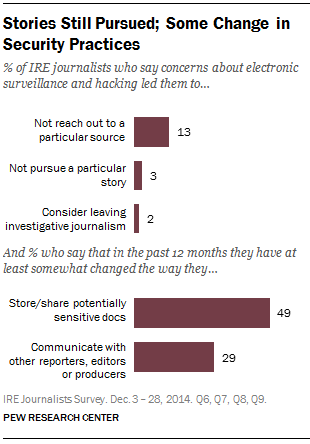
Thus far, concerns about surveillance and hacking have mostly fallen short of keeping many journalists from pursuing a story or a source; Just 14% say that in the past 12 months, such concerns have kept them from pursuing a story or reaching out to a particular source, or have led them to consider leaving investigative journalism altogether.
Stories Still Pursued; Some Change in Security Practices

Still, these concerns have led many of these journalists to alter their behavior in the past 12 months. Nearly half (49%) say they have at least somewhat changed the way they store or share sensitive documents, and 29% say the same of the way they communicate with other reporters, editors or producers.

And among the 454 respondents who identify as reporters, 38% say that in the past year they have at least somewhat changed the way they communicate with sources.
Most Investigative Journalists Have Little Confidence That ISPs Can Protect Their Data

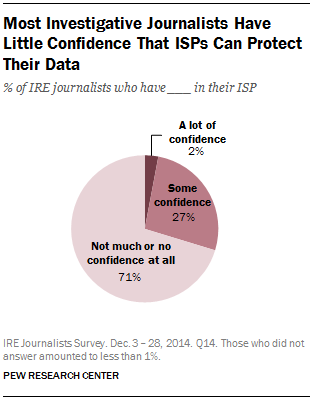
When it comes to external protection from digital threats like surveillance and hacking, these investigative journalists do not put much stock in their internet service providers (referred to as ISPs). Just 2% have “a lot of confidence” their ISP can protect their data from being accessed by unauthorized parties, while 71% have not much or no confidence at all.
Journalists Split on How Well Their Organizations Protect Them Against Surveillance and Hacking

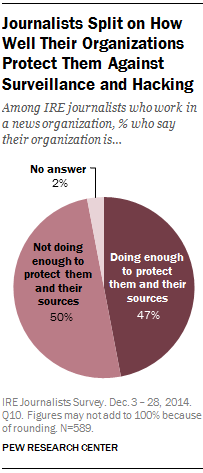
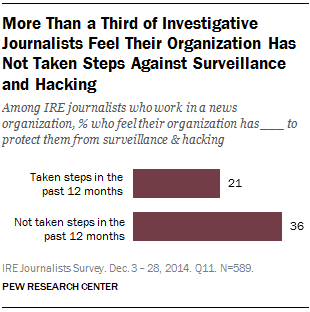
News organizations get mixed reviews for their ability to protect the security of their employees’ communications. Among those who work for news organizations (589 of the 671 journalists surveyed), half say their employer is not doing enough to protect journalists and their sources from surveillance and hacking, while about the same share (47%) says they are doing enough. Just 21% say their organization has taken steps or implemented policies in the past year to protect journalists and their sources, while 36% say their organization has not, and 42% do not know. About half (54%) report getting no formal training or instruction on electronic security issues from professional sources such as journalism associations, news organizations or journalism schools.

Still, other issues are more pressing for the profession than surveillance and hacking. When asked to rank four challenges facing journalists today, an overwhelming majority (88%) of journalists identify decreasing resources in newsrooms as their top concern. No other issue comes close. Following far behind are: legal action against journalists (5%), electronic surveillance by governments or corporations (4%) and hacking targeted at journalists or news organizations (1%). Furthermore, relatively few journalists (27%) have spent at least “some time” in the past 12 months researching how to improve their electronic security.

Overall, these data paint a complex picture in which investigative journalists on the whole feel vulnerable to surveillance and hacking, but not to the degree that most are changing their journalistic practices dramatically or investing energy into figuring out how to do so. And nearly all of those surveyed (97%) say that for today’s journalists, the benefits of digital communication like email and cellphones outweigh the risks. Just 3% say the risks outweigh the benefits.

About This Survey

The analysis in this report is based on an online survey conducted from December 3-28, 2014, with a representative sample of 671 journalists who are members of Investigative Reporters and Editors, Inc. (IRE). The 671 investigative journalists include a mix of reporters, producers, editors, data specialists, photojournalists and others, and comprise a wide range of coverage areas.

The survey was written and analyzed by Pew Research Center staff, and field work was conducted by Princeton Survey Research Associates International (PSRAI). Email invitations containing individualized survey links to access the online study were sent to 2,723 investigative journalists in the United States who are members of IRE. Journalists also had the option of returning a print version of the survey through the mail. For more detailed information, see the Methodology section.
Investigative Journalists’ Perceptions About the Surveillance Climate

About two-thirds of IRE journalists (64%) believe that the U.S. government probably has collected data about their own phone calls, emails or online communications. This perception is especially prevalent among those who cover national security, foreign affairs or the federal government. Fully 71% of this group says the government has likely collected this data.

Eight-in-ten of all journalists surveyed (80%) express the belief that being a journalist increases the likelihood that their data will be collected by the U.S. government.

Despite a majority believing they may be electronically surveilled, particularly because of their work in journalism, open-end responses reflect wide-ranging views about the real possibility of the government collecting data about their communications. While some journalists clearly feel vulnerable or work under the assumption that all electronic communications can be monitored (“I figure everything I do is tracked”), others see this monitoring as such a remote possibility that it does not warrant much attention (“I don’t worry too much”). Many assert that only journalists focusing on national issues or government investigations would be monitored, and some feel the likelihood of being monitored in the U.S. is small compared with the likelihood of experiencing it in other countries.

Expecting Protection from Employers and ISPs

More Than a Third of Investigative Journalists Feel Their Organization Has Not Taken Steps Against Surveillance and Hacking

IRE journalists working for news organizations are evenly split on whether their employer is doing enough to protect them and their sources from things like surveillance and hacking. While 47% of these journalists say the organization they work for is doing enough to protect journalists and their sources, 50% say they are not doing enough.

About one-in-five respondents who work for a news organization (21%) say their employer has taken steps or changed policies in the past year to protect journalists from electronic surveillance and hacking, while 36% say their employer has not done this. Another 42% are not sure if their employer has taken any steps or changed any policies in this area.

Respondents’ verbatim responses indicate that while some organizations appear to be doing a lot, others appear to be taking few, if any, steps. In a world of diminishing newsroom resources, some respondents say the issue has not risen to a level where it can be treated as a budgetary priority. Comments also show that while some journalists view these issues as being the responsibility of the IT department and something they do not pay much attention to, others are actively encouraging their organizations to improve.

Majority of Journalists Believe ISP Would Share Their Data With the U.S. Government

A majority of IRE journalists have little or no confidence that their ISPs can protect their data. Just 2% of all journalists surveyed have “a lot of confidence” their ISP can protect their data from being accessed by unauthorized parties, with 27% having “some confidence.” In contrast, 44% have “not much confidence,” and another 26% have “no confidence at all.”

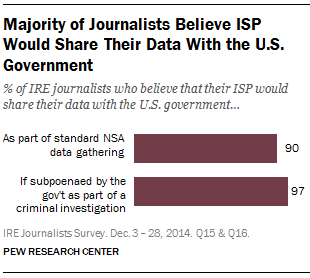
Moreover, the vast majority of respondents (90%) believe their ISP would share their data with the U.S. government as part of standard National Security Agency (NSA) data gathering, and 97% believe their ISP would share their data if subpoenaed by the government as part of a criminal investigation.

Impact of Security Concerns on News Reporting

On the whole, few IRE journalists say concerns about surveillance and hacking have changed the stories or sources they pursue, but those who identify as reporters do feel an impact when it comes to their sources’ willingness to share information.

Just 13% say concerns about surveillance and hacking have led them to not reach out to a particular source, and even fewer say concerns have led them to not pursue a particular story (3%) or to consider leaving investigative journalism (2%). In addition, only a quarter report being very (5%) or somewhat (18%) concerned that they or the organization they work for will lose a story to a journalist or organization with more sophisticated security measures, while the majority say they are not too (53%) or not at all (24%) concerned about this.

Reporters’ Communications With Sources

Looking specifically at the cautions that some IRE reporters are taking provides a greater sense of the way communications with sources may, or may not, be changing. Roughly four-in-ten (38%) have, in the past year, at least somewhat changed the way they communicate with sources.

One-third of these reporters (33%) say that over the past year, it has become harder to find sources willing to go on the record, a term that means what the source says can be reported, published or aired.

Meeting In Person Most Common Way to Protect Sources

There has been less impact on the willingness of sources to talk off the record, which means that what a source says may not be used for direct publication. About three quarters (74%) report no difference over the past year, while 8% say it has become easier, and 12% say it has become harder. These off-the-record sources are common today. Roughly four-in-ten IRE reporters (42%) use off-the-record sources in some of their stories they produce, and 19% use them in all or most.

When it comes to the specific actions journalists may or may not take to protect their sources, the most common technique by far – practiced among 59% of IRE reporters – is to meet them in person. That is followed by turning off electronic devices when meeting sources (18%), avoiding the use of third-party email servers when communicating with sources (17%), using email encryption (14%), using “fake” or anonymous email and online accounts (14%), and using voice encryption on phones (2%).

In most cases, there are more reporters who have used these techniques for more than a year than reporters who began using them within the last year. The exceptions are email encryption and voice encryption, which are fairly new tools and are only recently being adopted by IRE reporters.

IRE reporters age 40 and older are more likely than younger reporters to say it has become harder to find sources willing to go on the record (40% say this, compared with 29% of those under age 40). They are also more likely to meet sources in person (65% v. 55%), turn off electronic devices when meeting a source in person (23% v. 13%), and avoid using third party email servers when communicating with sources (23% v. 13%).

Adoption of Digital Security Tools

Beyond specific questions about how IRE reporters are communicating with their sources is a broader one: What kinds of steps are survey respondents taking to protect their own data, devices, and communications — not just with sources, but with each other? The survey finds that fully half (49%) of all respondents indicate that in the past year they have changed the way they share and store sensitive documents “a lot” (17%) or “some” (32%). Three-in-ten have changed the way they communicate with colleagues.

The survey asked about a range of practices these journalists might adopt, such as clearing their browser history, and then separately about a range of tools or software they might use to protect their digital privacy.

Using Different Passwords for Different Online Accounts Most Common Practice to Protect Digital Privacy

Half or more of all respondents said they engage in each of five specific practices asked about. The most commonly used technique is the simple step of using different passwords for different online accounts (91%), followed by changing privacy settings on social network sites (73%) and turning off the geolocation feature on mobile devices (67%). Most respondents who report using these approaches say they have done so for more than a year.

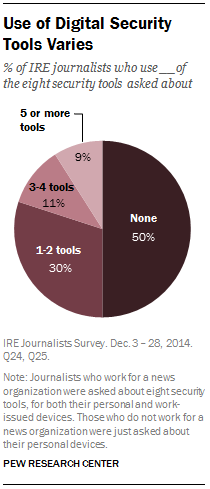
Use of Digital Security Tools Varies

Usage of specific tools and software is less common.

Respondents were asked about eight different tools they could employ on their home or work computers, tablets or cellphones, as well as whether they had adopted them recently. While we do not list these tools individually due to concerns expressed by those surveyed, they included everything from turning off geolocation on mobile devices to using email encryption or privacy-enhanced search engines.2

Half of respondents (50%) do not employ any of the eight measures on their personal or work-issued devices, while just one-in-ten (9%) employ five or more. Three-in-ten (30%) employ one or two.

Journalist Training and Knowledge About Digital Security

Overall, fewer than half (41%) of IRE journalists have received training or instruction from outside sources about ways to protect themselves and their sources.

The most common source of training for this group is a journalism conference or seminar. Nearly one-third (30%) say they have learned about digital security from this type of training. That compares with just 15% who say they have received training or instruction from a news organization they work for or have worked for in the past. Fewer than one-in-ten investigative journalists (4%) have received training or instruction about these issues in journalism school.

Outside of any formal training, these investigative journalists report spending little time conducting research on their own about digital security. When asked how much time they’ve spent over the past year researching what they can do to secure their communications, the majority of journalists (73%) say they have spent not much time or no time at all. About a quarter (23%) have spent some time doing so, and just 3% say they spend a great deal of time.

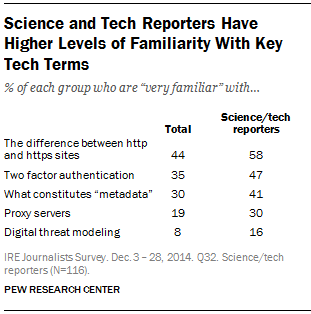
Science and Tech Reporters Have Higher Levels of Familiarity With Key Tech Terms

Despite the apparent dearth of training and information, most respondents claim to have at least some familiarity with key tech security concepts:

  • 77% are familiar with what constitutes “metadata”
  • 76% are familiar with the difference between HTTP and HTTPS sites
  • 65% are familiar with proxy servers
  • 59% are familiar with two-factor authentication
  • 37% are familiar with digital threat modeling

As one might expect, some of the highest levels of familiarity with these concepts are reported by journalists who cover science and technology, as well as by those who cover national security, foreign affairs or the federal government.

Heightened Concerns Among National Government/Security/Foreign Affairs Journalists

As noted earlier, many IRE journalists perceive issues of digital security — particularly stemming from government surveillance programs — as a serious concern mainly for journalists who cover national security, foreign affairs or the federal government. Survey data confirm this perception to some degree, with journalists working in these sensitive national and international areas expressing more concern about their digital security and making more behavioral changes in response to recent events than other journalists. Throughout this section of the report, this group is referred to as “national government/foreign affairs” journalists.

National Gov’t/Security/Foreign Affairs Journalists Stand Apart From Others

Of the 671 survey participants, 164 are journalists who focus on national security, foreign affairs and/or the federal government. Among this group, 71% believe the government has collected data about their phone calls, emails and other online communications. That is higher than the 62% of IRE journalists covering other topics who believe their data has been collected as part of government surveillance programs.

These national government/foreign affairs journalists are also more likely than others to have changed their behaviors in the past year with regard to how they store potentially sensitive documents and how they communicate with colleagues.

They are also more likely to have spent time in the past year researching digital security, and are more likely to be adopters of a wide variety of security enhancement tools.

National Gov’t/Security/Foreign Affairs Reporters Stand Apart From Others

More than four-in-ten national government/foreign affairs journalists rank surveillance as the Number one or number two challenge for their profession among four different challenges asked about. And one-third worry about losing a story to a competitor with more advanced digital security protocols in place. In both cases, fewer investigative journalists who deal with other topics express these concerns.

And among the national government/foreign affairs journalists who work for a news organization, 58% tend to feel their organizations are not doing enough to protect journalists and their sources from surveillance and hacking, compared with 48% among other investigative journalists who work for a news organization.

Reporters Who Cover National Security, Foreign Affairs and Government

Of the 164 national government/foreign affairs journalists surveyed, 111 identify themselves specifically as reporters. This group was asked a range of questions that pertain especially to their circumstances.

This group is more likely than other IRE reporters to employ the following measures to protect their sources’ identities: turning off electronic devices when meeting sources in person, using email encryption, using phone encryption, and communicating with sources through “fake” or anonymous email accounts, online profiles or chat room identities. At the same time, they are more likely than other reporters (18% vs. 10%) to say it has gotten harder in the past 12 months to find sources willing to speak off the record.

Looking back over the past year, these reporters are also more likely than other investigative reporters surveyed to have changed the way they communicate with sources and in how they use the internet to research stories.

Weighing Surveillance Against Other Concerns

Despite concern expressed by some respondents about the potential impact of government data collection programs and criminal hacking, other issues clearly outweigh surveillance for the bulk of these journalists.

IRE journalists were presented with a list of four challenges facing today’s journalists and asked to rank them in order from the biggest challenge to the smallest. Of these four choices, the vast majority of respondents (88%) place “decreasing resources in newsrooms” at the top of the list. None of the other options was named as the top priority by more than 5% of these journalists.

Legal action against journalists was most commonly named as a second place priority; 56% place it second. And while just 4% see electronic surveillance as the biggest of these challenges, another 28% place it second on their list. Most revealing, 61% of respondents rank hacking of journalists or news organizations as the smallest challenge of the four, making it the clear lowest priority.

To underscore these findings, nearly all of these investigative journalists (97%) say that the benefits of digital communications like email and cellphones outweigh the risks. This belief cuts across all subgroups of respondents. Even among respondents whose own work has been impacted by concerns about electronic surveillance and hacking, just 7% say the risks posed by digital technologies outweigh the benefits.

Methodology

The analysis in this report is based on an online survey conducted from December 3 – 28, 2014, among a representative sample of 671 journalists who are members of Investigative Reporters and Editors Inc. (IRE). The survey was written and analyzed by Pew Research Center staff, and field work was conducted by Princeton Survey Research Associates International (PSRAI). The report was produced in association with Columbia University’s Tow Center for Digital Journalism.

The universe of potential respondents for this study was defined as investigative journalists in the United States who are members of Investigative Reporters and Editors (IRE). Founded in 1975, IRE is a nonprofit association “dedicated to improving the quality of investigative reporting,” according to its website. For the purpose of this study, the total member list was filtered, and members who were not based in the United States, or who did not identify themselves as practicing journalists (educators or students, for instance) were excluded from further sampling. After an initial list of domestic, practicing journalists was pulled (a total of 2,734 records) from the IRE database, eleven records were removed because they had no email address, were based outside of the United States or contained generic contact information for an unnamed respondent. No sampling was done among the remaining 2,723 records. All domestic, practicing investigative journalists were asked to participate in the study. The overall response rate was 24.6%.

[N=2,723]

The 671 investigative journalists includes a mix of reporters, producers, editors, data specialists, photojournalists and others, and comprises a wide range of coverage areas — a mix of national, local and international, including (but not limited to) government and politics; crime and law enforcement; national security; foreign affairs; education; the environment; business; and science and technology. According to the survey, a majority of respondents (88%) say they work for a news organization, as opposed to freelancing. One-in-five (21%) cover primarily national news, and 63% cover mainly local news; the remainder cover international news (3%) or report no geographic focus to their work (12%). The sample includes a mix of new, mid-career and veteran journalists and is evenly divided between those under age 40 (49%) and those age 40 and older (49%).

To assess representativeness of these 671 journalists against the total population surveyed (2,723), a series of tests were conducted based on available, anonymized membership data on both groups (a different source of member information than the survey itself). First, the groups were sorted by employment status: Among respondents, 92% listed a specific organization as their employer, while the remainder were either listed as “independent” or had a blank field (among the total population, 93% listed a specific organization as their employer). Second, the state of residence for each member was tallied and sorted. Out of the top 10 states listed for each group, nine were the same for both respondents and non-respondents (California, New York, the District of Columbia, Florida, Texas, Illinois, Virginia, Massachusetts and Pennsylvania). Third, members were sorted by region of the country and density of the city they listed — the differences between those of respondents and non-respondents were not significant. Fourth, members’ employers were classified into categories and assessed for frequency. Among the group of respondents, print-based organizations were the most frequently listed, at 47%, followed by broadcast (24%), ‘Other’ (19%) and wire services (3%). Independent journalists or blank fields accounted for 8%. Among the total population, print was also the most frequently listed, at 43%, followed by broadcast (29%), ‘Other’ (17%), and wire services (4%). Independent journalists or blank fields accounted for 7%. Finally, aggregate data on one demographic characteristic — sex — was compared between the group of respondents and the entire IRE membership. Among all IRE members who completed this field (including international and student/academic members), 56% are male and 44% are female. Among respondents (which do not include international or student/academics), 55% are male and 45% are female.

[N = 671]