Pew Research Center

FOR RELEASE JUNE 17, 2013

News Coverage Conveys Strong Momentum for Same-Sex Marriage

News stories focused on support for same-sex marriage outnumbered those opposing it by roughly 5-to-1 in the two months marked by Supreme Court deliberations on the issue, according to the latest study in Pew Research's LGBT in Changing Times series. Did statements of support vary by media sector? Did reactions on Twitter differ from the news media? How was the topic covered in LGBT outlets? The new study offers answers.

FOR MEDIA OR OTHER INQUIRIES:

Communications Department
202.419.4372
www.pewresearch.org

RECOMMENDED CITATION

Pew Research Center, June 2013, "News Coverage Conveys Strong Momentum for Same-Sex Marriage"

About Pew Research Center

Pew Research Center is a nonpartisan, nonadvocacy fact tank that informs the public about the issues, attitudes and trends shaping the world. It does not take policy positions. The Center conducts public opinion polling, demographic research, computational social science research and other data-driven research. It studies politics and policy; news habits and media; the internet and technology; religion; race and ethnicity; international affairs; social, demographic and economic trends; science; research methodology and data science; and immigration and migration. Pew Research Center is a subsidiary of The Pew Charitable Trusts, its primary funder.

© Pew Research Center 2026

Table of contents

  • About Pew Research Center
  • News Coverage Conveys Strong Momentum for Same-Sex Marriage
  • In News Media Accounts, Statements of Support Dominate
  • Arguments in the News Coverage
  • What News Coverage Focused On
  • Chronology
  • Voices Heard in the Coverage
  • Differences by Media
  • Huffington Post – Vast & Heavily Supportive Coverage
  • LGBT Outlets
  • Reactions on Twitter
  • “Gay Marriage” and “Same-Sex Marriage”
  • Methodology
  • Press Release
  • Topline
  • Storify: How the Media Covered Same-Sex Marriage During Supreme Court Deliberations

News Coverage Conveys Strong Momentum for Same-Sex Marriage

News stories focused on support for same-sex marriage outnumbered those opposing it by roughly 5-to-1 in the two months marked by Supreme Court deliberations on the issue, according to the latest study in Pew Research's LGBT in Changing Times series. Did statements of support vary by media sector? Did reactions on Twitter differ from the news media? How was the topic covered in LGBT outlets? The new study offers answers.

In a period marked by Supreme Court deliberations on the subject, the news media coverage provided a strong sense of momentum towards legalizing same-sex marriage, according to a new study by the Pew Research Center. Stories with more statements supporting same-sex marriage outweighed those with more statements opposing it by a margin of roughly 5-to-1.

In the coverage studied, the central argument among proponents of same-sex marriage was one of civil rights. Arguments against were more varied, but most often voiced the idea that same-sex marriage would hurt society and the institution of traditional marriage.

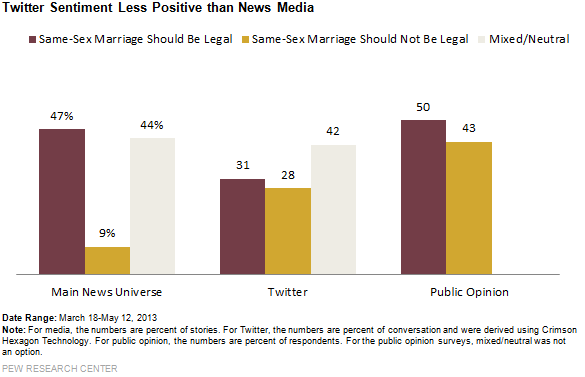
Almost half (47%) of the nearly 500 stories studied from March 18 (a week prior to the Supreme Court hearings), through May 12, primarily focused on support for the measure, while 9% largely focused on opposition and 44% had a roughly equal mix of both viewpoints or were neutral. In order for a story to be classified as supporting or opposing same sex marriage, statements expressing that position had to outnumber the opposite view by at least 2-to-1. Stories that did not meet that threshold were defined as neutral or mixed.

[1]

This news media focus on support held true whether the stories were reported news articles or opinion pieces, and was also the case across nearly all media sectors studied. All three of the major cable networks, for instance, had more stories with significantly more supportive statements than opposing, including Fox News.

In addition to the main set of news media, this study also examined same-sex marriage coverage in three other media segments: Twitter, the Huffington Post – which has a dedicated microsite to “Gay Voices” and produced so much coverage that it was examined separately from the rest of the news media – and a mix of LGBT news outlets.

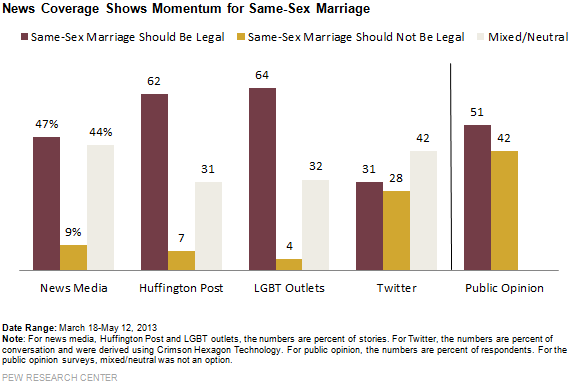
Twitter postings on the subject were nearly evenly split between support and opposition for the measure, aligning much more closely with public opinion than with the news media. Coverage on the Huffington Post, on the other hand, was even more tilted towards support of same-sex marriage than the rest of the news media. Indeed, 62% of the 365 stories on the site were dominated with statements of support – very close to the level of support in the LGBT news outlets studied.
Within the media debate on the subject, this report found that those arguing for same-sex marriage had a more consistent message than those arguing against.

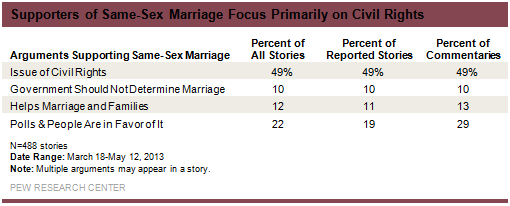
Among supporters of same-sex marriage, the main argument was framed around civil rights. Nearly half (49%) of the stories studied in the news media included the argument that same-sex couples should be allowed to marry because it is an issue of equality. This was also the most common argument to appear in the LGBT media as well as on HuffingtonPost.com.

The arguments against tended to vary more. The most common opposing argument was the idea that same-sex marriage would hurt society and harm traditional marriage, though less than a fifth of stories (18%) included this claim. Other arguments against the measure included the idea that homosexuality is immoral and that the government should not impose a new definition of marriage that strays from the traditional notion of one man and one woman.

These are among the key findings from a new study of more than 1,080 stories and more than 2.4 million tweets by the Pew Research Center on how the media has covered the issue of same-sex marriage from March 18, 2013 – a week before the Supreme Court hearings, through May 12. The main news sample includes a mix of six websites from Politico to Buzzfeed to Gawker, 11 newspapers, news programs from the three main network news outlets along with PBS, and a mix of programs on the three cable television channels, talk radio, NPR and syndicated radio headlines. Researchers also examined and separately analyzed coverage on the Huffington Post, coverage across a mix of leading LGBT news publications and the tone of the discussion on Twitter. Except for LGBT publications and Twitter, outlets were captured on a rotating basis. For newspapers, the LexisNexis database does not include wire copy or syndicated columns, but coding of a random sample of wire stories during this period produced findings very similar to the newspaper numbers overall. (See the full methodology for details.)

Among other findings in the study:

  • Most of the attention to the subject came in the five days surrounding the Supreme Court hearings (March 25 – 29). Of the main news media stories studied, 55% were produced in that period. The same was true for 44% of the stories on the Huffington Post and nearly half (47%) of the conversation on Twitter. The LGBT outlets, on the other hand, were somewhat more consistent in the amount of attention devoted to the subject throughout the eight weeks studied.
  • In addition to the main arguments for and against the issue, the notion that the Supreme Court should not have taken up gay marriage was a common theme. About one-in-six (17%) of the stories in the main news media studied included this claim. In most instances, this case was made by legal scholars and the Supreme Court justices themselves as they wrestled with the legal questions. On a few occasions, however, the argument was used by opponents of same-sex marriage.
  • Despite the preponderance of supportive coverage across media sectors, the level of mixed or neutral coverage varied among individual outlets. In cable news, for example, MSNBC produced 30% mixed, 64% supporting and 6% opposing, among the stories studied. The coverage on Fox News was 63% mixed, 29% supportive of the measure and 8% opposing. And on CNN, the break was 57% mixed, 39% supporting and 4% in opposition. In newspapers, the Wall Street Journal and USA Today stood out for higher levels of mixed or neutral reporting, 70% and 67%, respectively, and more even ratio of supporting versus opposing stories.
  • While expressing strong support for the measure, LGBT news outlets focused on a different element of the story than any of the other media studied. A full quarter, 25%, of the coverage in the 11 LGBT outlets studied focused on local and state laws, an element that made up just 10% of the other news coverage. Generally, those stories detailed developments in marriage legislation on the state level.
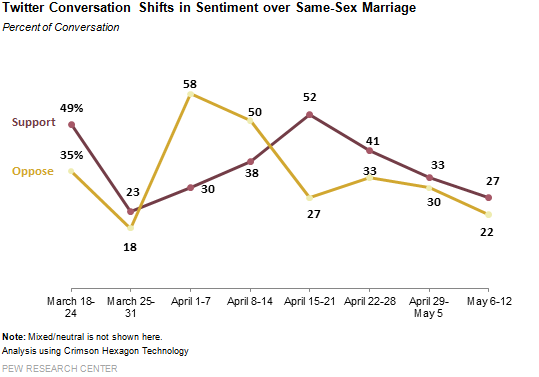
  • On social media, the opinions expressed on Twitter were closely split between those that supported (31%) and those that opposed (28%). There were, however, significant shifts in the sentiment over the nine weeks studied. During the week prior to and the week of the Court hearings, more of the Twitter conversation favored same-sex marriage. The two following weeks saw a reverse with more posts in opposition. Then, during the last month of the study, assertions in favor of the measure once again took the lead.
  • Journalists and citizens following the subject on the Internet used different terms when discussing the subject. An analysis using Google Trends, a service that tracks the phrases used during Google searches, revealed that citizens searched more often for “gay marriage” than “same-sex marriage.” Journalists, on the other hand, used “same-sex marriage” more frequently – according to searches of the LexisNexis database. The term “marriage equality” was not used by either as much, but did see an increase over time.

The findings show how same-sex marriage supporters have had a clear message and succeeded in getting that message across all sectors of mainstream media. Other elements may have also added to the greater focus on support versus opposition. Many of the newsmaking events in this time period indicated momentum towards same-sex marriage. These included endorsements from politicians, legislation at the state level and shifts in public opinion tracked by surveys.  Second, during the week of the hearings, when most of the coverage occurred, the media offered many profiles of the plaintiffs or members of the LGBT community with few voices of opposition mixed in. Finally, commentators who favored same-sex marriage, such as Rachel Maddow and Chris Matthews, spent more time discussing the issue than commentators who opposed it, such as Sean Hannity and Bill O’Reilly.


Footnote

[1]
In News Media Accounts, Statements of Support Dominate

[1]

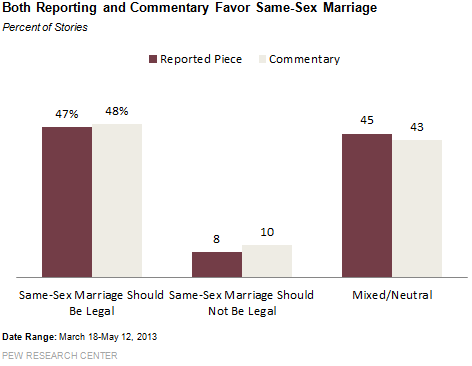
This pattern is true for reported stories and for editorials and commentary. For reporting, 47% featured mainly support, while 8% featured opposition and 45% were mixed or neutral. Similarly, nearly half (48%) of opinion pieces, including newspaper op-eds and editorials as well as cable and talk radio commentary, were clearly in support, compared to 10% that opposed and 43% that were neutral.

Many of the news stories identified as supportive of same-sex marriage focused on evidence that it was gaining more acceptance. For example, a March 19 edition of the PBS NewsHour included a three-minute edited package that discussed polls showing increased acceptance across all demographics. The same show also featured a longer piece that discussed the endorsements of same-sex marriage from people such as President Obama and Senator Rob Portman, and how younger people were at the forefront of changes in public opinion.

Many of the stories that featured more statements of opposition included profiles of individuals or groups, and the reasons behind their views. For example, a March 20 story on Politico quoted Republican National Committee Chair Reince Priebus as he reiterated his party’s opposition to same-sex marriage, while also calling for greater tolerance. The rest of the story discussed how the GOP would handle differences of opinion within the party.

The commentary pieces offered personal expressions of support or opposition. For example, Mary Meeks, an Orlando civil rights and constitutional law attorney, wrote a guest column in the April 12 Orlando Sentinel. “I am hopeful that the court will honor the equal protection guarantee of the 14th Amendment to our Constitution by invalidating blatantly discriminatory laws that deny gay Americans the fundamental right to marry,” she wrote.

And in his March 26 program, conservative talk radio host Rush Limbaugh expressed the hope that the Supreme Court would not legalize same-sex marriage. “Do you realize how stupid this is?” he asked. “The problem is that nine exalted lawyers are determining something that has been a tradition since the beginning of time…the Left is forcing their agenda on us, pure and simple.”


Footnote:

[1]

Arguments in the News Coverage

In order to understand the language and ideas used by supporters and opponents of same-sex marriage, Pew Research tracked the presence of specific arguments in news stories and commentary.

Supporters largely framed the issue as a question of civil rights and equality. In the main news media studied, nearly half (49%) of the stories on the subject included someone making that case.

[California’s law]

On the March 26 edition of CNN’s Anderson Cooper 360, civil rights leader Julian Bond compared his support for same-sex marriage with previous equality movements. “These are the same issues and the same struggle among the same people,” Bond declared. “There’s not a black civil rights movement and a gay civil rights movement. There are civil rights, all Americans have civil rights, all Americans ought to enjoy civil rights, and whatever the court does today, we are going to move a step closer to everyone enjoying these rights.”

The notion that polls have been moving in favor of same-sex marriage for sometime was also quite common, with 22% of the stories including statements discussing that trend.

The arguments against same-sex marriage were more diffuse. The most common was the idea that same-sex marriage was bad for traditional marriage and society. Close to one-in-five (18%) of the stories included this argument – one that the opposition lawyers delivered in court. Both the argument that homosexuality is immoral and that the government should not impose a “new” definition of marriage to allow same-sex couples to marry appeared in 10% of the stories.

As Rev. William Owens of Memphis explained in a March 22 USA Today article, “I go from a Biblical standpoint and a social standpoint, knowing the damage that has already been done to the black family.” The threat of same-sex marriage, he added, represents “another nail in the coffin for black families.”

One common legal argument, present in 17% of all the same-sex marriage stories, was the idea that the Supreme Court should not have taken the case, and that the issue should be left up to the states. In most of the cases when this argument appeared, it was expressed as an explicit legal question that did not speak to a view for or against the measure itself. Samuel Alito was widely quoted during the hearings regarding the lack of historical information. “You want us to step in and render a decision based on an assessment of the effects of this institution, which is newer than cell phones or the Internet?” Alito asked. “I mean we…do not have the ability to see the future.”

In a few instances, however, the argument was made by an opponent of same-sex marriage. Charles Cooper, the attorney who defended California’s ban on same-sex marriages, argued that the Court should not act because individual states need time to wrestle with the country’s changing attitudes. As a March 26 Wall Street Journal blog post described, “While some opponents of gay marriage are determined not to see the practice adopted anywhere, Mr. Cooper took a different road, suggesting that California voters simply were looking to hit a ‘pause button’ when they saw marriage laws changing too quickly. Mr. Cooper begged the justices to give states time to deal with what he called an ‘agonizingly difficult issue.'”

Despite the widespread notion among citizens that the legalization of same-sex marriage is inevitable, that argument was not included widely in the news coverage. A Pew Research May 2013 poll of the public, however, showed that 72% of Americans saw legal recognition of same-sex marriage as inevitable, including 85% of those who are in favor and 59% who are opposed. Yet, only 7% of the stories included this idea.

What News Coverage Focused On

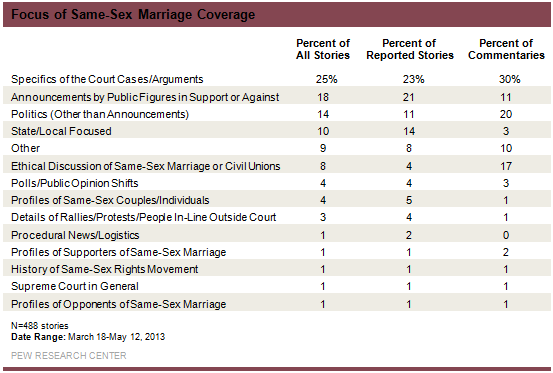
Researchers also examined the focus of the same-sex marriage debate in each story. Here, the largest category involved the specifics of the Supreme Court cases and arguments during the hearings. One quarter (25%) of the stories were on that topic, most of which occurred during the week of the Supreme Court proceedings. And while there were more stories filled with supportive statements of same-sex marriage (25%) than opposing ones (8%), the majority of such coverage was mixed or neutral (67%), laying out the arguments from both sides often with direct quotes from the justices and lawyers. 

The next largest subject – 18% of the stories – involved announcements by public figures, most of the time stating support for the measure. According to Yahoo News, ten Democratic Senators, plus Sen. Portman and former Secretary of State Hillary Clinton, came out in favor of same-sex marriage during the first quarter of 2013. Those stories tended to relay the statements of support without bringing in voices from the other side. Of all the stories focused on these types of declarations, 67% were largely supportive of same-sex marriage, while 12% were opposed and 20% were neutral.

A March 25 post on the New York Times blog, The Caucus, for example, explained why Sen. Portman decided to support same-sex marriage and why he delayed the announcement. The story also quoted Sen. McCaskill’s reasons for coming out in support, but there were no quotes from any individuals who opposed same-sex marriage.

The third most-discussed subject, at 14%, involved the politics of the issue (other than public figures announcing their positions). These articles were more common among opinion-focused pieces (20%) than for reported stories (11%). And nearly half (48%) of the stories that focused on politics favored same-sex marriage, while only 12% opposed and 41% were neutral.

Some of the political discussion emphasized the Republican Party’s stance on the issue. On the March 25 edition on MSNBC’s PoliticsNation, for example, NBC’s Mark Murray discussed how the GOP was slightly shifting their stance. “It’s not a question of polling,” he stated. “It’s a question of progress and it’s a question of how younger Americans feel about this issue versus older Americans, and we`re starting to hear Republicans…use different language around this issue. And that is why we know Republicans are changing.”

One area to receive little attention in the media, just 8% of the stories, was the morality or ethics of same-sex marriage. Most of these were commentary pieces voicing support for the measure.

Chronology

The Lead-up (March 18-24)

In anticipation of the Supreme Court hearings, the issue of same-sex marriage began to generate media attention. In the lead-up, most of the focus was on two components: announcements from public figures and the politics of the issue. Almost a third (29%) of the stories in the media (not including those from the Huffington Post or LGBT outlets) were of announcements. In particular, the decision by Republican Sen. Rob Portman to declare his support for same-sex marriage after learning his son is gay – the first Republican Senator to take such a position – and the endorsement from Hillary Clinton generated much of the media buzz.

That same week, 20% of the stories were about how same-sex marriage would play as a political issue, especially in relation to Clinton’s potential run at the White House and the impact on the Republican Party.

The Supreme Court Hearings (March 25-29) 

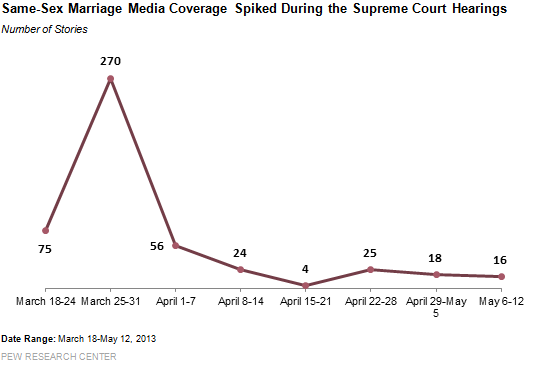
On Tuesday, March 26, and Wednesday, March 27, the Supreme Court heard two separate cases involving the legality of same-sex marriage. Those hearings led to a firestorm of coverage. Of all the stories examined in this study, 55% came during those five weekdays.

The stories during the week of the hearings were mostly neutral (55%), though supportive stories outweighed opposing ones (38% to 7%).

Many of the stories that week (41%) focused on the specifics of the court case and explained both sides of the arguments used by the lawyers before the court. Announcements by public figures (11%) and politics (10%) were the next two largest, but trailed by significant margins.

After the Hearings (March 30 – May 12)

By the following week, coverage of the same-sex issue declined dramatically. With few new developments, the news media moved on to other topics. And by the time the bombings at the Boston Marathon occurred on April 15, the issue disappeared almost entirely.

By early May, the focus shifted from the Supreme Court hearing and national laws to happenings on a state level. During this entire stretch, the largest component was on state and local laws (28%), as both Rhode Island and Delaware legalized same-sex marriage during the first seven days of May. Announcements by public figures (26%) and politics (18%) were the other major topics covered.

Even though there were fewer stories on the topic during this period, the tone was even more supportive. From March 30 to May 12, fully 58% of the stories were in favor, compared with 10% opposed and 32% neutral – a ratio of almost 6-to-1.

Voices Heard in the Coverage

Of all the stories about same-sex marriage that appeared in the main news media universe studied, one-fifth (21%) of them included someone who was clearly identified as a member of the LGBT community.

The LGBT individuals who appeared in the most stories on same-sex marriage were Edith Windsor, the 83-year-old plaintiff in the Supreme Court case, and Thea Spyer, Windsor’s deceased wife. The two filed suit because Windsor was forced to pay $363,000 in federal estate taxes on her inheritance from Spyer’s estate because the state of New York did not recognize their marriage.

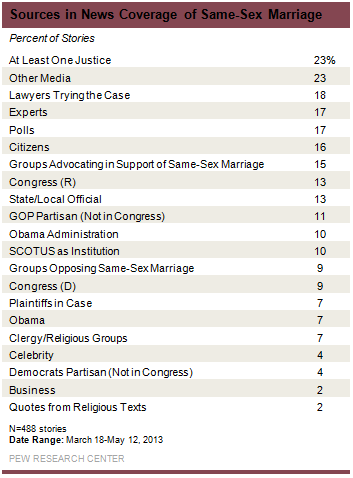
An examination of the more specific mix of sources cited in the coverage (whether LGBT or not) shows a fairly wide mix. Roughly a quarter, 23%, of the stories featured a quote from at least one of the nine Supreme Court justices – most of which came from their questions and comments at the hearings. Justice Anthony Kennedy was the most quoted (14%), followed by Justice Elena Kagan (9%) and Justice Antonin Scalia (8%).

Kennedy is frequently a subject of discussion among Court watchers because he is often the swing vote on contentious topics. Certain memorable quotes, such as Kagan’s questioning of the argument that the state’s interest in marriage was to foster child-rearing, were cited frequently. “Suppose a state said that, because we think that the focus of marriage really should be on procreation, we are not going to give marriage licenses any more to any couples where both people are over the age of 55,” Kagan suggested. “Would that be constitutional?”

President Obama or a representative of his administration was a source in 13% of the stories. Most of that attention, however, came in the week prior to the March 25 Supreme Court hearings. Aside from the Obama administration, Republicans were quoted more often than Democrats, 19% versus 13% – though many of those quotes were from Republicans coming out in favor of same-sex marriage.

Of the stories with a GOP source, 57% were supportive of same-sex marriage, while 11% were opposed. For stories with a Democratic source, 78% were in favor, while only 3% were opposed.

Differences by Media

[1]


The only exception was on the two conservative talk radio programs studied: Sean Hannity and Rush Limbaugh. In the sample studied (the first hour of every second day), Limbaugh aired nine segments on the subject. None were in support, 33% were in opposition and 67% were neutral. Hannity did not address the subject in the sample studied.

While other sectors of the media offered more coverage dominated by statements of support, the level of neutral coverage and degree of supportive coverage varied among individual outlets.

[1]

In cable news, where the rotating sample included an hour of daytime programming and four of each channel’s primetime news programs, all three channels had more supportive coverage than opposing. The prominence of supportive stories varied, however. MSNBC, with its liberal prime-time hosts, had by far the highest percentage of support (64%) and the fewest neutral stories (30%). Fox News, on the other hand, had the lowest percentage of supportive stories (29%) and the highest level of neutral (63%). The CNN’s mix was closer to Fox than MSNBC, with 39% largely voicing support and 57% neutral or mixed. 

For the three major commercial networks (ABC, CBS and NBC) as well as PBS, the sampling of morning and evening news shows (which included the first hour of morning news and full 30 minutes of evening every other day) did not include a single story that had significantly more statements in opposition than in support. Of the 27 stories included from those channels combined, 12 were in support while 15 were neutral.

On radio news programs, which included stories on National Public Radio’s All Things Considered or Morning Edition and the ABC or CBS News radio headlines, there were 21 total stories. Of those, 29% were supportive, while 14% were opposed. But by far the highest percentage, 57%, were neutral or mixed.  


Footnotes:

[1]

[1]

Huffington Post – Vast & Heavily Supportive Coverage

The digital native Huffington Post site produced far more content than any other media outlet studied. The Google searches, conducted every other day from March 18 to May 12, generated 365 different stories over the eight-week period. That compares to 153 newspapers stories in the rotating sample across the same eight-week period. On March 27 alone, the second day of the Supreme Court hearings, the Huffington Post produced 77 separate pieces on the subject.

Most of the Huffington Post coverage appeared on a dedicated page, Gay Voices, launched in October 2011 to “cover the complexities of the LGBT community, from family and faith to politics and sexuality.”  The Gay Voices page contains a lead story, a collection of recent blog posts, roughly three dozen unique stories from staff, newswires, or other news outlets on its center and right columns, and links to 25 individual LGBT-focused blogs. Blog content on the site itself is produced by Huffington Post staff, celebrities, advocacy groups, authors, experts in professional fields, and everyday citizens who may or may not identify as LGBT individuals themselves.  

The strong support for same-sex marriage on the Huffington Post stood out even more than the main news universe studied. Fully 62% of the site’s stories were supportive, compared with 7% that were opposing and 31% that were neutral or mixed.

While both the reported stories and the commentary were more supportive of same-sex marriage, there was a noticeable difference. For opinion pieces on the site, 72% were supportive of same-sex marriage, compared to 5% opposed and 23% neutral. For reported stories, on the other hand, 49% were supportive, 10% were opposed and 40% neutral.

Huffington Post stories also more often included people identified as a part of the LGBT community (31%) than in the other news media studied (21%).

On the Huffington Post, as with the main news universe, the civil rights argument was the most popular (54%), followed by the notion that polls and public opinion were moving in the direction of support (25%). On March 29, for example, swimmer and journalist Diana Nyad wrote a guest blog declaring that same-sex marriage is “the civil rights issue of our time.” “As a human rights issue, same-sex marriage is an emblem of crucial, individual entitlement to the pursuit of happiness,” she wrote.

The aspects of the story covered on Huffington Post, though, did differ from the main news universe in one major way. The Huffington Post included far more stories featuring a discussion of the ethics of same-sex marriage, the vast majority of which were in favor.

Opposition to same-sex marriage was rare on the site, but was most found primarily in reported pieces. On April 8, for example, a story on the Religion section of the Huffington Post quoted senior Mormon apostle Boyd K. Packer as warning against “the weakening of the laws of the land.” “Tolerance is a virtue, but, like all virtues, when exaggerated it transforms itself into a vice…We need to be careful of the ‘tolerance trap’ so that we are not swallowed up in it,” he said.

LGBT Outlets

Pew Research also examined relevant stories from 11 of the leading LGBT news outlets from around the country (ten newspapers and one magazine) – seven of which were published weekly and four of which were published bi-monthly.

One major difference was the sustained nature of the coverage, especially when compared to the rest of the news media. While 55% of all the news media stories about same-sex marriage in this sample were published in the week of the hearings, only 23% of the stories in the LGBT outlets were.

The tone of the coverage was, not surprisingly, overwhelmingly supportive of same-sex marriage. Overall, 64% of the stories included twice as many supportive statements as opposing, compared to only 4% that had opposition statements outnumbering supporting by at least 2-to-1 (32% were neutral).

The coverage also included more voices from people identified as members of the LGBT community. In these outlets, 34% of the stories had an LGBT person as a source, compared to 21% of stories in the larger news media. (It is possible that these stories included more representatives of the LGBT community, but did not identify them as such.)

And the LGBT media differed significantly from other media in terms of the focus of the same-sex marriage debate.

One quarter (25%) of the LGBT articles discussed developments in state and local jurisdictions pertaining to marriage legislation. Chicago’s Windy City Times, for example, had a March 27 front page story about the hearings at the Supreme Court, but also a lengthy report on page 8 about the upcoming vote in the Illinois State Legislature on same-sex marriage being pushed to April. The May 1 edition led with an interview with Illinois Gov. Pat Quinn about his support and the reasons for delays in the Legislature.

Two of the largest areas of focus for the rest of the media were less important in LGBT outlets – specifics of the Supreme Court case and announcements by public figures. While 25% of the stories in other outlets detailed the Supreme Court case, that was true of only 14% of stories in LGBT outlets. And 11% of the LGBT stories were on declarations by public figures compared with 18% in other outlets.

If the focus of the coverage was different, the arguments used were similar. By far, the most common argument was that same-sex marriage should be legal because it is an issue of civil rights and equality. In LGBT outlets, this idea appeared in 50% of articles, nearly identical to the 49% in other media.

For example, an April 1 story in Frontiers LA regarding California’s Prop 8 included a quote from California Attorney General Kamala Harris when she appeared on MSNBC. “I don’t think we can allow such a conversation as ‘a small step toward equality,'” she argued. “We either step toward equality or we don’t.”

A front page story in the March 29 edition of the Philadelphia Gay News included a quote from one of the plaintiffs being represented in front of the Supreme Court. Kris Perry said, “In this country as children, we learn that there is a founding principle that all men and women are created equally. We want this founding principle.”

The notion that polls and public opinion were in favor of same-sex marriage showed up in 18% of the LGBT stories, compared with 22% of the news media stories.

There were only eight stories in the LGBT sample that included more opposing statements. All were reported pieces that included quotes from opponents of same-sex marriage with little or no commentary. For example, the April 17 Windy City Times included a story quoting an email from Illinois State Rep. Tom Morrison that compared same-sex marriage to statutory rape. “If one male and one female is discriminatory, then isn’t limitation of marriage to just two people discriminatory, too?” Morrison wrote. “Could a man marry a consenting 9-year old girl? Why not? To refuse them would be discrimination. Again, where would you draw the line?”

Overall, much of the commentary around same-sex marriage included optimism, regardless of the outcome of the Supreme Court cases.

“No matter how the Supreme Court rules, it is clear that it’s no longer radical to believe gays and lesbians deserve full equality,” wrote reporter Justin Snow in the April 4 edition of Washington, D.C.’s Metro Weekly.

Reactions on Twitter

In its entirety, the reaction on Twitter was more closely aligned with public opinion than with the news media, Huffington Post or LGBT outlets. Pew Research used software from Crimson Hexagon to track the tone and volume regarding the same-sex marriage issue on Twitter.

During the eight weeks studied, the conversation was almost equally divided between support and opposition (31% versus 28%) – along with a solid portion (42%) that was neutral or more evenly mixed. This ratio is close to recent polls of the public which showed that 51% of Americans support same-sex marriage, compared to 42% that opposed.

However, looking at the Twitter opinions on a week-by-week basis reveals a more nuanced story with large swings of opinion. During the week of the Supreme Court hearings, when the largest amount of Twitter posts on the subject occurred (48% with roughly 1.2 million tweets), statements favoring the measure slightly outweighed those opposed (23% to 18%).

From April 1 to April 14, opinion on Twitter shifted dramatically in the direction of opposing same-sex marriage. For those two weeks, 55% of the conversation was opposed, while 32% was in favor and 13% was neutral.

Another shift occurred starting April 15. From that date through the next four weeks, statements in support outnumbered those in opposition, 43% to 26% with 30% neutral – though no single event seemed to drive the shift. 

The content of tweets in support of same-sex marriage ranged from politically-focused opinions to personal expressions. Some were addressed to specific laws and politicians, such as a tweet by @QueerSpring2013, “@CoryBooker get @GovChristie to sign marriage equality in NJ because #LGBT Americans are born with right to unalienable rights” or this by @LogoTV, “United GAY-tions Alert! Rhode Island passes marriage equality! It’s a small state, but we’re not size queens.”

Some addressed personal feelings like that from @beelynmcdizzle, “Gay and lesbian people deserve the exact same rights as straight people! At the end of the day we’re all human I just don’t see the problem.”

Tweets expressing opposition to same-sex marriage also varied in focus-from politics to religion to the more personal. Many noted their personal religious and ethical beliefs, such as this tweet from @_carmensitaaa, “so someone put on fb yesterday ‘Gay is NOT from GOD. Same sex Marriage is made up by satan. GOD establish Man & Women marriage,” or this one from @Atlantis0712, “@speak_forth gay marriage is a crime against human rights.”

“Gay Marriage” and “Same-Sex Marriage”

Not only were the various sides in the same-sex debate arguing over the ethical and legal merits, but even the words used to describe the institution have become contentious. Many supporters of same-sex marriage, for example, preferred the use of the term “marriage equality” because it incorporates the idea of equal rights into the label.

A comparison between the terms used by individuals as they search the web and those used by journalists shows a noticeable difference. The general public has used the term “gay marriage” most often while journalists have preferred “same-sex marriage.”

One proxy for understanding the language used by members of the general public is to track search terms using Google Trends. Over the past five years, the term “gay marriage” was far more popular than “same-sex marriage.” And for most of that time, the term “marriage equality” was hardly searched for at all.

However, those who advocate for the term “marriage equality” achieved a small victory during March 2013 – the month of the hearings – when, for the first and only time, that term was used in more searches than “same-sex marriage.”

[1]

“Marriage equality,” however, was not nearly as common. Through the first quarter of 2011, that term was used only an average of about 70 times per quarter. After that point, the usage increased to about 200 times per quarter, a number still much smaller than the other two phrases.


Footnote:

[1]

Methodology

About This Study

A number of people at the Pew Research Center’s Project for Excellence in Journalism worked on Pew Research’s “News Coverage Conveys Strong Momentum for Same-Sex Marriage.” Senior Researcher Paul Hitlin, Acting Director Amy Mitchell and Associate Director Mark Jurkowitz and wrote the report. Coding and data analysis were conducted by Researchers Steve Adams, Monica Anderson, Emily Guskin and Nancy Vogt. Katerina Matsa and Monica Anderson created the charts. Jan Boyles copy edited the report. Dana Page handles communications for the project.

Methodology

This special report by the Pew Research Center’s Project for Excellence in Journalism examined news media coverage of the same-sex marriage issue from March 18 through May 12, 2013.

The study employed four different methodologies.

Data regarding coverage in the main news media sample, the Huffington Post and LGBT outlets were derived from the Pew Research Center’s in-house coding operation.

Data regarding the tone of conversation on Twitter were derived from a combination of the Center’s traditional media research methods, based on long-standing rules regarding content analysis, along with computer coding software developed by Crimson Hexagon. That software is able to analyze the textual content from millions of posts on social media platforms. Crimson Hexagon (CH) classifies online content by identifying statistical patterns in words.

Data regarding the terminology used during Google searches and the language used by newspapers were derived by the use of Google Trends and searches of LexisNexis.

Human Coding of News Media

Sample Design

The sample of mainstream news included outlets from newspapers, online news, network TV, cable TV and radio. In total, there were 58 outlets studied, which followed the system of rotation listed below.

Because the Huffington Post produced so much material on same-sex marriage, the data from that site were treated separately throughout the report. The LGBT outlets were also treated separately.

Newspapers (11 in all)

Coded two out of these four every weekday; one on Sunday The New York Times Los Angeles Times USA Today The Wall Street Journal Coded two out of these four every weekday; one on Sunday The Washington Post The Denver Post Houston Chronicle Orlando Sentinel Coded one out of these three every weekday and Sunday Traverse City Record-Eagle (MI) The Daily Herald (WA) The Eagle-Tribune (MA)

Websites (Coded every other weekday)

  • Huffington Post
  • Slate
  • Buzzfeed
  • Gawker
  • Newser
  • Politico
  • The Daily Caller

Network TV (Seven in all, Monday-Friday)

Morning shows – coded one or two every weekday ABC – Good Morning America CBS – Early Show NBC – Today

Evening news – coded two of three every weekday ABC – World News Tonight CBS – CBS Evening News NBC – NBC Nightly News

Coded two consecutive days, then skip one PBS – NewsHour

Cable TV (15 in all, Monday-Friday)

Daytime (2:00 to 3:00 p.m.) coded two out of three every weekday CNN Fox News MSNBC

Nighttime CNN – coded one or two out of the four every day

Situation Room (5 p.m.) Situation Room (6 p.m.) Erin Burnett OutFront Anderson Cooper 360

Nighttime Fox News – coded two out of the four every day Special Report w/ Bret Baier Fox Report w/ Shepard Smith O’Reilly Factor Hannity

Nighttime MSNBC – coded one or two out of the four every day PoliticsNation Hardball (7 p.m.) All In with Chris Hayes The Rachel Maddow Show

Radio (Seven in all, Monday-Friday)

NPR – Coded one of the two every weekday

Morning Edition All Things Considered

Radio News ABC Headlines CBS Headlines

Talk Radio Rotate between:

Rush Limbaugh Sean Hannity

Coded every other day Ed Schultz

LGBT Outlets

Weekly Newspapers

  • The Bay Area Reporter (San Francisco)
  • Bay Windows New England (Boston)
  • Metro Weekly (Washington, DC)
  • Washington Blade (Washington, DC)
  • Windy City Times (Chicago)
  • The Dallas Voice (Dallas)
  • Philadelphia Gay News (Philadelphia)

Bi-monthly newspapers and magazines

  • OutFront Colorado (Denver)
  • Georgia Voice (Atlanta)
  • Gay City News (New York)
  • Frontiers LA (Los Angeles)

From that sample, the study included all relevant stories:

  • From the entirety of newspapers, websites, evening network TV, radio news programs (headlines and NPR) and LGBT outlets
  • In the first hour of network morning news and all cable programs

Sample Selection

Stories were included in the study if 50% or more of their content was on same-sex marriage. To find the relevant stories in all outlets (except for radio programs and LGBT outlets), researchers used a broad set of keyword searches to collect potential stories. Then, researchers read or watched each story to see if the 50% of the story or more was on same-sex marriage.

For newspaper stories, researchers searched LexisNexis with the following terms to find potential stories:

(marriage AND same-sex) OR (marriage AND “same sex”) OR (marriage AND traditional) OR (marriage AND gay) OR (marriage AND equality) OR (marriage AND homosexual) OR (marriage AND defense) OR DOMA OR (gay AND rights) OR “proposition 8” OR “prop 8”

Note: The LexisNexis database often does not include wire and syndicated articles from other sources, even if those stories appeared in the print editions of the newspapers. Pew Research conducted a test to see if the newspaper data for tone would have been impacted had wire and syndicated stories been added to the sample. A test of 22 randomly selected stories from various wire services found 55% with supportive statements outweighing opposing by a margin of 2:1, none that had the opposite and 45% that were evenly mixed or neutral. These numbers suggest that had wire and syndicated stories been included, the percentages would not have been impacted dramatically. In fact, the percent of supportive stories in newspapers would have increased and the percent of opposing stories would have decreased.

For websites, the same terms used for newspapers were also searched using Google News to find all stories produced by each site.

For cable and network television programs, closed-captioning text was searched using the following terms (stories that came up were then viewed by coders):

Marriage OR DOMA OR “proposition 8” OR “prop 8” OR “prop eight” OR “proposition eight” OR (gay AND rights)

For NPR programs, researchers examined the run-downs of each show provided on the NPR.org website to find relevant stories.

For radio headlines, talk radio programs and the LGBT outlets, the entire publication or program was examined by a researcher to determine which stories should be included in the study.

This process resulted in a sample of 1,081 stories.

Human Coding of Stories

The data in this study were created by a team of six experienced coders. We have tested all of the housekeeping variables (such as source, date, opinion vs. reporting and format) on numerous occasions, and those variables each reached a level of agreement of 80% or higher.

The method of measuring support/opposition was the same that had been used to measure tone in previous Pew Research studies.

The unit of analysis for this study was the story. Each story was coded for tone indicating whether the story in total offered more support of same-sex marriage, opposition, or a more even mix between the two (or no views at all).

The support/opposition variable measures whether a story’s tone is constructed in a way, via use of quotes, assertions, or innuendo, that results in supportive, neutral or opposing coverage related to same-sex marriage. While reading or listening to a story, coders tallied up all the assertions that were either clearly in support of same-sex marriage, or clearly in opposition. Direct and indirect quotes were counted along with assertions made by journalists themselves.

In order for a story to be coded as either “supportive” or “opposing,” it must have either twice the amount of supportive comments to opposing comments, or twice the amount of opposing comments to supporting comments. If the headline or lead had a supportive or opposing tone, it was counted twice into the total value. Also counted twice for tone were the first three paragraphs or first four sentences, whichever came first.

Any story in which the ratio of supportive to opposing was less than 2-to-1 was considered a “neutral” or “evenly mixed” story.

The 2-to-1 ratio sets the bar even higher for a story to be coded as either supportive or opposing. The goal was to only code stories as supportive or opposing when that story was clearly emphasizing one point of view more often than the other.

Intercoder Testing

In addition to the main intercoder testing conducted on all housekeeping variables, supplemental testing was conducted on the additional variables used in this portion of the study. For the following codes, 25 randomly selected stories were coded by all members of the coding team.

The percent of agreement for each variable was as follows:

  • Focus: 82%
  • LGBT Source: 92%
  • Tone (support/oppose/neutral): 88%
  • All other sources combined: 95%
  • Individual arguments:
  • Issue of Civil Rights – 92%
  • Government Should Not Determine Marriage – 96%
  • Helps Marriage and Families – 92%
  • Polls & People Are in Favor of It – 82%
  • Homosexuality Is Immoral – 82%
  • Hurts Society or Traditional Family – 76%
  • Public Has Voted Against It – 93%
  • Civil Unions Are “Good Enough”- 96%
  • Government Should Not Impose New Definition – 96%
  • Public Support Has Increased Because of Obama – 100%
  • GOP Will Support Someday – 93%
  • It Is Inevitable to Become Legal – 88%
  • SCOTUS Should Not Have Taken the Case/Left to the States – 100%
  • Coding of the Tone on Social Media Using a Computer Algorithm

The sections of this report that dealt with the social media reaction employed media research methods that combine Pew Research’s content analysis rules developed over more than a decade with computer coding software developed by Crimson Hexagon. This report was based on an examination of more than 2.4 million tweets.

Crimson Hexagon is a software platform that identifies statistical patterns in words used in online texts. Researchers enter key terms using Boolean search logic so the software can identify relevant material to analyze. Pew Research draws its analysis samples from all public Twitter posts. Then a researcher trains the software to classify documents using examples from those collected posts. Finally, the software classifies the rest of the online content according to the patterns derived during the training.

According to Crimson Hexagon: “Our technology analyzes the entire social internet (blog posts, forum messages, Tweets, etc.) by identifying statistical patterns in the words used to express opinions on different topics.”  Information on the tool itself can be found at http://www.crimsonhexagon.com/,  and the in-depth methodologies can be found here http://www.crimsonhexagon.com/products/whitepapers/.

Crimson Hexagon measures text in the aggregate. The unit of measure is the ‘statement’ or assertion, not the post or Tweet. One post or Tweet can contain more than one statement if multiple ideas are expressed. The results are determined as a percentage of the overall conversation.

Pew Research Center spent more than 12 months testing CH. To test the validity of the software, two human researchers coded 200 stories that were also coded by the algorithm. The human coders and algorithm agreed on the coding 81% of the time.

In addition to validity tests of the platform itself, Pew Research conducted separate examinations of human intercoder reliability to show that the training process for complex concepts is replicable. The first test had five researchers each code the same 30 stories, which resulted in an agreement of 85%.

A second test had each of the five researchers build their own separate CH projects to see how the results compared. This test involved not only testing coder agreement, but also how the algorithm handles various examinations of the same content when different human trainers are working on the same subject. The five separate monitors came up with results that were within 85% of each other.

For Twitter, Pew Research used the following Boolean search filter to collect potentially relevant Tweets:

(marriage AND same-sex) OR (marriage AND “same sex”) OR (marriage AND traditional) OR (marriage AND gay) OR (marriage AND equality) OR (marriage AND homosexual) OR (marriage AND defense) OR DOMA OR (gay AND rights) OR “proposition 8” OR “prop 8”

Google Searches

The portions of the report that explained how often specific terms were searched for in Google were created using data from Google Trends. The tool indicates the number of web searches for each term relative to the total number of searches on Google. Data have been normalized, and are based on a scale of 0 to 100.

The following phrases were entered into Google Trends to determine the number of searches in the United States only:

  • gay marriage
  • same sex marriage
  • marriage equality

LexisNexis Searches for Use of Terms by Journalists

The portions of the report that dealt with terms used by journalists were derived using keyword searches in the LexisNexis database. Researchers searched 24 of the 25 most widely circulated newspapers for the following terms:

  • “gay marriage”
  • “same sex marriage” or “same-sex marriage”
  • “marriage equality”
  • Note: The Wall Street Journal was not included because its contents are not available in LexisNexis.

Press Release

Contact:  Amy Mitchell, Acting Director, Pew Research Center’s Project for Excellence in Journalism amitchell@pewresearch.org, 202-419-3650

Pew Research: Amid Supreme Court Deliberations, News Coverage Conveyed Strong Momentum for Same-Sex Marriage

June 17, 2013 – News stories focused on support for same-sex marriage outnumbered those opposing it by roughly 5-to-1 in the two months marked by Supreme Court deliberations on the issues, according to a Pew Research study of nearly 500 news media stories related to the issue.  

Indeed, 47% of the stories studied from March 18 through May 12 focused on support for same-sex marriage, while 9% largely focused on opposition and 44% were offered a fairly even mix of support and opposition or no views at all. In order for a story to be classified as supporting or opposing same sex marriage, statements expressing that position had to outnumber the opposite view by at least 2-to-1.

This news media focus on support held true whether the stories were reported news articles or opinion pieces, and was also the case across nearly all media sectors studied. All three of the major cable networks, for instance, had more stories with significantly more supportive statements than opposing, including Fox News.

Despite the preponderance of supportive coverage across media sectors, the level of mixed or neutral coverage varied among individual outlets. In cable news, MSNBC produced 30% mixed, 64% supporting and 6% opposing among the stories studied, while Fox News produced 63% mixed, 29% supporting and 8% opposing. And on CNN, the break was 57% mixed, 39% supporting and 4% in opposition. In newspapers, The Wall Street Journal and USA Today stood out for higher levels of mixed reporting, 70% and 67%, respectively, and a more even ratio of supporting versus opposing stories.

In the media coverage, supporters of same-sex marriage had a more consistent message than those arguing against it. Nearly half (49%) the stories studied in the news media included the argument that same-sex couples should be allowed to marry because it is an issue of equality. Among opponents, the most common argument was the idea that same-sex marriage would hurt society and traditional marriage; but it appeared in 18% of the stories. Other arguments against the measure included the idea that homosexuality is immoral (10%).

“This study shows how same-sex marriage supporters have had a clear message and succeeded in getting that message across all sectors of mainstream media,” said Pew Research Center’s Project for Excellence in Journalism Acting Director Amy Mitchell. “In addition, many of the events during the period studied, such as announcements by politicians and state legislation, reflect movement toward same-sex marriage.”

At the same time, public opinion, while shifting towards greater acceptance, shows significant opposition remains. That also comes through in the analysis of Twitter conversation included in this study.

Statements on Twitter were closely split between those that supported (31%) and those that opposed (28%). There were, however, significant shifts in the sentiment over the nine weeks studied.  During the week prior to and the week of the Supreme Court hearings, more of the Twitter conversation favored same-sex marriage. The two following weeks saw a reverse with more posts in opposition. Then, during the last month of the study, assertions in favor of the measure once again took the lead.

These are some of the conclusions from the study that examined coverage of the same-sex marriage debate in the mainstream press, in LGBT outlets and on Twitter. The main news sample included a mix of websites, newspapers, news programs from PBS, the three main network and cable news outlets, talk radio, NPR and syndicated radio headlines. Separately, researchers examined and analyzed coverage from the Huffington Post (which produced such a large amount of coverage on the topic that to include it with the rest of the news media would have overshadowed the results), coverage across a mix of leading LGBT news publications and the tone of the discussion on Twitter. This report is a part of Pew Research Center’s ongoing LBGT in Changing Times series.

 Among other findings in the study:

  • Most of the attention to the subject came in the five days surrounding the Supreme Court hearings (March 25 – 29). Of the main news media stories studied, 55% were produced in that period. The same was true for 44% of the stories on The Huffington Post and nearly half (47%) of the conversation on Twitter. The LGBT outlets, on the other hand, were somewhat more consistent in the amount of attention devoted to the subject throughout the eight weeks studied.
  • In addition to the main arguments for and against the issue, the notion that the Supreme Court should not have taken up gay marriage was a common theme. About one-in-six (17%) of the stories in the main news media studied included this claim. In most instances, this case was made by legal scholars and the Supreme Court justices themselves as they wrestled with the legal questions. On a few occasions, however, the argument was used by opponents of same-sex marriage.
  • Huffington Post, including its dedicated page Gay Voices, produced far more coverage than any other media outlet studied. Fully 365 stories about same-sex marriage appeared during the time period studied (every other day from March 18 – May 12), including 77 on March 27 alone, the second day of the Supreme Court hearings. Overall, the coverage showed more momentum toward same-sex marriage than the rest of the news media-62% of the stories were dominated with statements of support, very close to the level of support in the LGBT news outlets studied.
  • While expressing strong support for the measure, LGBT news outlets focused on a different element of the story than any of the other media studied. A full quarter, 25%, of the coverage in the 11 LGBT outlets studied focused on local and state laws, an element that made up just 10% of the other news coverage. Generally, those stories detailed developments in marriage legislation on the state level.
  • Journalists and citizens following the subject on the Internet used different terms when discussing the subject. An analysis using Google Trends, a service that tracks the phrases used during Google searches, revealed that citizens searched more often for “gay marriage” than “same-sex marriage.” Journalists, on the other hand, used “same-sex marriage” more frequently – according to searches of the LexisNexis database. The term “marriage equality” was not used by either as much, but did see an increase over time.

###

Pew Research Center is a nonpartisan source of data and analysis, and takes no advocacy positions. Its Project for Excellence in Journalism tracks the transformation of journalism in a changing information landscape through its annual State of the News Media report and other special reports.

Topline


Please click here for a PDF of topline data tables.


Storify: How the Media Covered Same-Sex Marriage During Supreme Court Deliberations

[View the story “How the Media Covered Same-Sex Marriage During the Supreme Court Deliberations” on Storify]