Pew Research Center

FOR RELEASE JUNE 10, 2013

Nonprofit Journalism: A Growing but Fragile Part of the U.S. News System

As the economics of commercial journalism have been upended and newsrooms have shrunk, a variety of funders have sponsored nonprofit news operations to fill perceived information gaps. A report finds that while they voice optimism about the future, many organizations worry that they don’t have sufficient business-side resources.

BY Amy Mitchell, Mark Jurkowitz, Jesse Holcomb and Monica Anderson

FOR MEDIA OR OTHER INQUIRIES:

Communications Department
202.419.4372
www.pewresearch.org

RECOMMENDED CITATION

Pew Research Center, June 2013, "Nonprofit Journalism: A Growing but Fragile Part of the U.S. News System"

About Pew Research Center

Pew Research Center is a nonpartisan, nonadvocacy fact tank that informs the public about the issues, attitudes and trends shaping the world. It does not take policy positions. The Center conducts public opinion polling, demographic research, computational social science research and other data-driven research. It studies politics and policy; news habits and media; the internet and technology; religion; race and ethnicity; international affairs; social, demographic and economic trends; science; research methodology and data science; and immigration and migration. Pew Research Center is a subsidiary of The Pew Charitable Trusts, its primary funder.

© Pew Research Center 2026

Table of contents

  • About Pew Research Center
  • Nonprofit Journalism: A Growing but Fragile Part of the U.S. News System
  • The Landscape
  • The Financial Portrait
  • Taking Care of Business: A Catch-22
  • What is Financial Health in Nonprofit News?
  • Independent News Nonprofits: More Revenue, Bigger Staffs
  • The Road Ahead for Nonprofit Journalism
  • Methodology
  • Topline
  • Press Release

Nonprofit Journalism: A Growing but Fragile Part of the U.S. News System

As the economics of commercial journalism have been upended and newsrooms have shrunk, a variety of funders have sponsored nonprofit news operations to fill perceived information gaps. A report finds that while they voice optimism about the future, many organizations worry that they don’t have sufficient business-side resources.

The growing nonprofit news sector is showing some signs of economic health, and most leaders of those outlets express optimism about the future, according to a new study by the Pew Research Center.  But many of these organizations also face substantial challenges to their long-term financial well-being.

The report finds that large, often one-time seed grants from foundations help many of these nonprofit news outlets get up and running. But as those grants expire, many organizations do not have the resources or expertise necessary for the business tasks needed to broaden the funding base.

More than half of the nonprofit news organizations surveyed by the Pew Research Center in late 2012 (54%) identified business, marketing and fundraising as the area of greatest staffing need, compared with 39% who said the top need was for more editorial employees. In addition, nearly two-thirds of the nonprofits (62%) cited “finding the time to focus on the business side of the operation” as a major challenge-compared with 55% who cited “increasing competition for grant money.”

Most nonprofit news organizations are small, with minimal staffs and modest budgets. Indeed, 78% of the survey respondents reported having five or fewer full-time paid staffers-including 26% with none. About one-fifth (21%) said they generated $50,000 or less in annual revenue in 2011, the latest year for which data were available at the time of the survey,  and another 26% earned between $50,001 and $250,000. And roughly half of the outlets produced 10 or fewer pieces of original content in the two-week period studied.

Through a multi-step process, the Pew Research Center identified 172 digital nonprofit news outlets that launched since 1987. The sites identified here range from the nationally known to the hyperlocal. Their editorial focus includes everything from investigative reporting to coverage of health and the environment. Two have won Pulitzer Prizes. Their funding sources range from nationally known philanthropic foundations, to ideologically aligned organizations, to individuals.  And, as our earlier research in 2011 showed, some fit squarely into the traditions of independent news gathering while others lean more toward what might be considered partisan news.

The classification as a nonprofit, in other words, speaks to the tax status and financial structure of an organization rather than the kind of news produced. This study examines the growing sector largely from that financial perspective.

A detailed survey completed by 93 of the 172 organizations includes some positive economic signs.  Most of those that reported revenues and expenses for 2011, the latest year for which data were available, said they brought in more money than they spent. In addition, a majority of outlets reported having cash reserves on hand that experts say are sufficient for the nonprofit sector. That may help explain the high levels of confidence about the future, with 81% of the organizations saying they were very or somewhat confident they’d be financially solvent five years down the road.

At the same time, the self-reported data also reveal the substantial economic challenges these organizations face and the overall fragility of their environment. Given the uncertainty of grant funding, one way these organizations are trying to build financial stability is by diversifying their revenue streams. But revenue diversity is a work in progress, and in what may be most telling of all, many of the nonprofit news operations surveyed told Pew Research that they don’t have the business-side resources needed to effectively expand their revenue base.

“We need to invest in a business staff that can sustain a business model,” acknowledged one.

[funders]

Among the key findings:

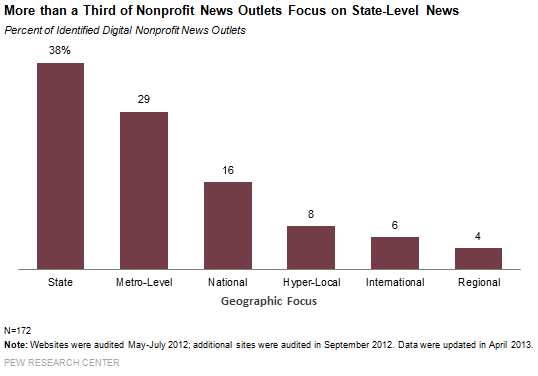
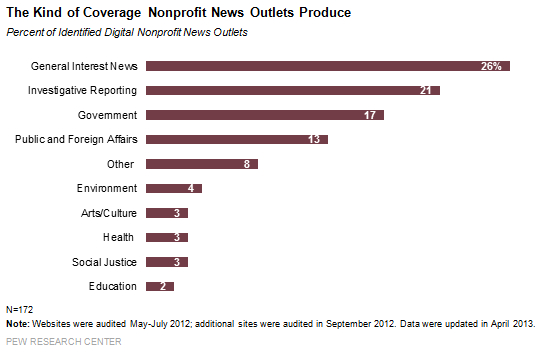
  • The study finds that all but nine states in the U.S. have at least one nonprofit news outlet. Most are not trying to replicate all the editorial functions of mainstream media, but instead work in specialized journalism niches. About one-fifth (21%) focus on producing investigative reporting, which can look at a range of topics, while another 17% concentrate specifically on government. Other areas of focus include public and foreign affairs (13%), the environment (4%), health (3%) and arts and culture (3%). And the geographic orientation tends to be either state (38%) or metro level (29%).
  • While many nonprofits initially rely on big grants, that funding source may not provide long-term sustainability. Nearly two-thirds of the survey respondents (61%) began with a startup grant that accounted for at least one-third of their original funding-and a majority of those grants were for $100,000 or more. But at the time of this report, only 28% of those organizations reported that the funder had agreed to renew that grant to any degree.
  • Nonprofit outlets are taking steps toward diversifying revenue streams, but even many of those with multiple streams still rely heavily on one main source for the bulk of their funds. According to the survey, a majority of outlets that responded to the questions (58%) are drawing upon at least three separate revenue streams-including grants, individual donors, advertising, media partnerships and events. But about half of those organizations are still generating at least 75% of their income from a single revenue stream, almost always foundation grants.
  • Finding the time for staff to work on developing new revenue streams is proving to be a challenge for many nonprofit news organizations. While 80% of the outlets say that business, advertising and marketing work consumes some staff time, nearly one-third of them said that kind of work consumed less than 10% of their staff time, and more than half said that business-side tasks accounted for between 10% and 24% of staff hours. In contrast, 85% of the outlets say that editorial tasks consumed at least half their overall staff time.
  • Roughly two-thirds of the 172 nonprofit news outlets are sponsored by another organization; just one-third are independent. But in the survey responses, those independent organizations stood out as being less reliant on major seed grants. Fewer than half (15 out of 32) of the independent outlets in the survey started with a major seed grant as opposed to more than two-thirds (42 out of 61) of the outlets sponsored by another nonprofit, news organization or university. In addition, more than three-quarters (25 out of 32) of the independents reported having at least three different revenue streams, far more than the sponsored nonprofits.
  • Optimism is the prevalent feeling among those working at nonprofit news organizations. Four times as many outlets predicted they will hire new staff in the coming year (40%) than said they will reduce staff (10%). And combined, 81% said they are either “very confident” (26%) or “somewhat confident” (55%) that they will be financially solvent five years down the road. Only 4% were “not at all confident” that they would be financially solvent in five years.
[1]

[4]

This study builds off of an earlier 2011 Pew Research study of nonprofit news sites, which examined the funding transparency and ideological nature of the news content produced. That study covered a smaller swath of these sites-four dozen sites with a national or state-level orientation launched in 2005 or later. It found overall that the more ideological sites tended to be funded mostly or entirely by one parent organization. The most consistently ideological content appeared in the two formally organized families of sites-the American Independent News Network sites, which had a liberal tone to their coverage, and the Watchdog.org operations, whose content carried a conservative tone.


Footnotes

[1]

2] Some outlets originally appeared to be nonprofit, but upon closer inspection, may have either simply been independent and noncommercial in nature. Outlets were deemed inactive if their websites had not published any new material in the previous three months.

[3]

[4]
 

The Landscape

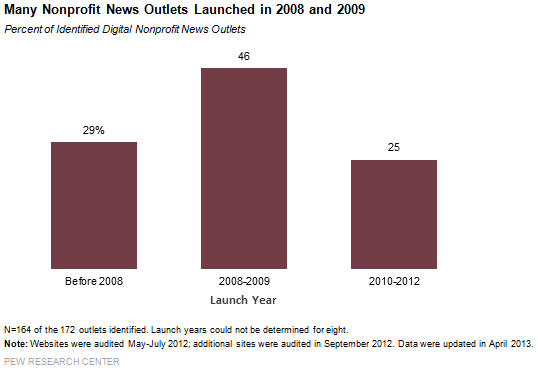
The majority of the 172 outlets identified by Pew Research were founded during and after the recent recession, a period in which traditional media outlets have been losing reporting resources.  Many of these outlets (46%) were launched at the height of the recession in 2008 and 2009.  Another quarter (25%) started since then (2010-2012), while the rest (29%) were founded before 2008.

Most of the younger outlets are not seeking to replace or replicate newspapers or other traditional news media, but rather to fill certain gaps.

In the survey, one nonprofit outlet described its editorial mission as “filling the holes that chain media outlets swerve around.”

The majority of outlets limit their reporting efforts to a state (38%), a city (29%) or a smaller community or neighborhood (8%). Many of them are clustered around big population centers and the coasts. Still, all but nine states have at least one nonprofit news organization, according to the Pew Research audit.

In contrast to legacy media, particularly newspapers and television outlets, most of the nonprofits studied have niche orientations-they focus on one topic or type of reporting. Only 26% of the 172 nonprofits cover general interest news. The bulk of them focus on narrower topics to fill one particular gap or another. The most prevalent of these niche areas, at 21%, is investigative reporting, which aims to fulfill the time-honored watchdog role of the news media. Other niche areas include government, health, education and the environment.

Content Production

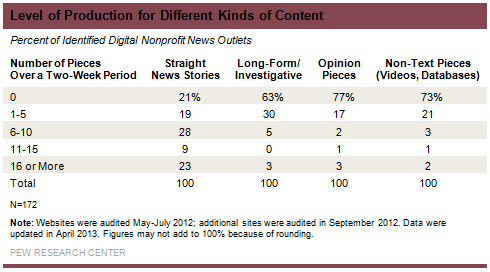
So what do these outlets produce? To get a sense of the kinds of content nonprofit news outlets create, researchers examined the websites over a two-week period, tallying the number of stories published. Researchers looked for several types of content, including straight news accounts, long-form and investigative pieces, opinion articles, and non-text items such as videos or databases.  

[1]

Long-form journalism stories, which contain some deeper reporting or analysis and tend to be more than 1,000 words long, appeared even less frequently. In the two-week period, about two-thirds (63%) of the outlets did not produce a single long-form piece; 30% produced between one and five long-form pieces, and 8% produced more than five. Of the 64 outlets that produced at least some long-form content over the two-week sample period, 10 did not produce any shorter, straightforward news accounts.

Opinion and commentary is clearly not a part of the main mission of these nonprofits. An overwhelming majority-77%-produced no opinion pieces during this time period; 17% produced between one and five, and 6% produced more than five. This is different than the measure of ideology in the earlier 2011 report which was identified in the reported news stories through the range of viewpoints represented in stories, themes in the coverage, and the individuals or institutions that were targeted in investigative pieces.

Also rare was non-text journalism. Only about a quarter (27%) of the outlets studied posted non-text pieces such as databases or video on their site. 

When it came to overall editorial output, many nonprofits produced a modest level of stories and commentary, far less than in traditional news organizations. Indeed, the website audit found that close to half (44%)  of the nonprofit outlets examined produced 10 or fewer pieces of original content in the two-week period studied.

The nonprofit journalism field is fairly diverse. Many outlets operate independently, funded by grants from major charitable organizations such as the John S. and James L. Knight Foundation or the Robert R. McCormick Foundation, as well as a wide array of major donors and members. Others are sponsored by colleges and universities. Some are affiliated with think tanks or nonprofit advocacy organizations.

[2]

Another network of state-based websites, the American Independent News Network (AINN), “emphasizes the positive role of democratically elected government.” It was found to be somewhat more transparent than the Franklin Center network but just as politically oriented in its content. This network seems to have downsized from nine identified AINN outlets in 2011 to just three identified and studied here.

A third network of sites identified in 2011, the Statehouse News Network, seems to have largely dissolved, though some of the outlets in that network live on.

[3]

Predictably, newer organizations were somewhat more likely to see audience growth than older ones: More than 80% of the outlets launched in 2008 or later (46 out of 56 sites) said their audience had grown in the year before the survey, compared with two-thirds (eight out of 12) of those that started before 2000.

Staffing

The staffs of most outlets are quite small. Staffing figures obtained through the survey revealed that about three-quarters of the 93 responding organizations have no more than five paid, full-time staffers for everything from editorial to administration to business duties-and one-quarter have none at all. Only 8% of the sites have more than 10 paid, full-time employees and just 6% (six in all) have more than 25.

To a great extent, it is the older and more established outlets that have built up the larger staffs. Of the eight outlets that have more than 10 paid, full-time employees, seven of them were launched in 2007 or earlier.

All but the largest nonprofit staffs are dwarfed by most of the nation’s daily newspapers. The 1,386 daily print newspapers in the United States employed an average of 29 journalists full time in 2011, according to an annual census performed by the American Society of News Editors. That is down from an average of 39 in 2001, when more journalists were employed at newspapers than at any other time in the past two decades, according to ASNE. But it still outpaces nearly all of these nonprofit news outlets. And at mid-size city papers with circulations between 100,001 and 250,000, the average rises to 124 full-time journalists.

Part-time employees are also a part of the mix for nonprofits, though they tend to still be small in number. A little more than half of the nonprofits have between one and five paid, part-time employees, and 15% have six or more. Twenty-three percent have none at all. In most cases, outlets that have part-time staff also have full-time employees.

Volunteer staff is as common across these organizations as paid staff and in many cases outnumber them. Nearly three-quarters (71%) use unpaid volunteers, interns or contributors-typically five or fewer. But 15% of the sites surveyed use more than 25. Volunteer staff is most prevalent among sites without any paid staff. Of the 24 organizations that have no paid, full-time employees, 22 report using unpaid volunteers or contributors. But, still, four of the eight outlets surveyed with more than 10 full-time staff members also use unpaid help.

Many of these organizations expressed optimism about enlarging, or at least maintaining, their staffs in the near future. About nine out of 10 expect to maintain their staff size (48%) or increase it (40%) in the next 12 months. Only 10% said they would have to trim their staffs. Yet, as the section on business-side challenges explains, having staff and figuring out the best way to employ them can be two very different things.


Footnotes

[1]

[2]

[3]


The Financial Portrait

One sign of fragility in this new sector is the modest level of revenue that many work with, leaving them more vulnerable to economic shifts. Of the 77 outlets that responded to a question about revenue, 55 said they brought in no more than $500,000 in fiscal year 2011, while just 14 reported income of more than $1 million. And these modest figures may in some cases be designed to cover more than one year of operations. Accepted accounting practices for nonprofit organizations dictate that they list the full amount of a grant on the books the year it’s committed, regardless of whether they receive the entire grant at that time or whether they plan on using it all in that one year.

In addition, most of these outlets get off the ground with the help of seed money-startup grants from foundations, often coupled with donations from wealthy individuals. Sixty-one percent of the outlets that participated in the Pew Research survey reported having received startup grants that accounted for one-third or more of their original funding, and most of the grants were large. More than one-third of them (37%) were for $250,000 or more and another 18% were between $100,000 and $250,000.

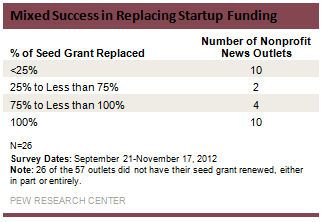
But the terrain is uncertain and brings with it the near-constant need to replenish expiring grants and drum up new sources of funding. In the survey, nearly three-quarters of the outlets that received significant startup grants said those grants had expired-47% before 2012 and 25% by the end of that year. Just 28% of them (16 in all) had their grants renewed, with 12 of the 16 granting the same amount of money the second time around. That group of 12 is quite diverse. Their 2011 revenues-the last year for which figures were available-ranged from about $54,000 to $3.4 million, and their staffs varied from 10 employees to zero with an average of five. They also focused on a wide variety of topics, including international news, the environment, health, books and general interest stories.

[1]

And just because an organization receives a large seed grant does not mean it will raise a lot of additional revenue. Although most seed grants were reported to total $100,000 or more and roughly one-third were for at least $250,000, these organizations were not represented among the highest revenue earners. Indeed, revenue figures from 2011 (which may or may not include the seed grant money depending on when it was granted) show that 34 out of 57 outlets with large seed grants said they generated $500,000 or less that year, while only 11 reported revenue of $500,000 or more.

All in all, then, while seed grants may help an outlet get up and running, they don’t seem to help long-term sustainability.

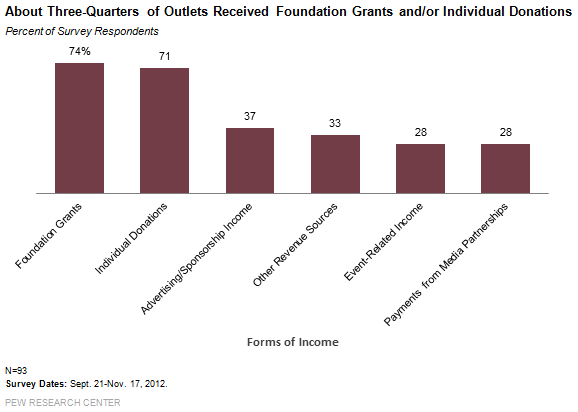
How do these organizations raise money, and from whom? There are two main sources. First and foremost are foundations, followed by individuals.

[2]

Almost as many organizations received donations from individuals, 66 of the 93 (71%). But when we examined their submitted 2011 revenue figures, donations from individuals tended to be smaller and to constitute a less significant proportion of most organizations’ revenue than foundation grants. The bulk of the organizations-38 out of 63 that answered this question-said contributions from individuals represented no more than one-quarter of their revenue. Just eight said those donations made up more than three-quarters of their revenue that year-and those eight tend to be small in both staff size and total revenue.

Other forms of income pale by comparison. Thirty-seven percent of the respondents said they currently raised money from advertising or sponsorship, 28% from events, 28% from payments they receive from media partners and 33% from other sources. But these income streams are relatively small, generally constituting no more than one-quarter of total revenues, according to responses based on 2011 data.

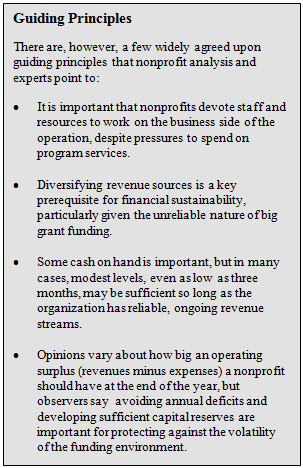
Due in part to the unpredictable nature of foundation giving, many experts say that diversifying revenue streams is the key to economic sustainability. The survey responses suggest the nonprofit organizations are taking steps to try to broaden their revenue base, but in most cases, there is still a heavy reliance on one or two streams of income.

[3]

But a breakdown of the income from these various revenue streams illustrates the challenges nonprofits have in weaning themselves from a heavy reliance on one or two sources. Nearly half of the organizations with at least three streams generated 75% or more of their revenue from just one of those-almost always foundation grants. And about one-third of the others-those that did not derive three-quarters or more of their revenue from just one stream-generated at least 90% from just two streams.

Those numbers indicate that for many nonprofit news organizations, achieving revenue diversification, while a clear goal, is still a formidable task.

Within this rather unstable financial environment, the reported numbers in the survey suggest most outlets are keeping a close eye on their balance sheets. Tracking the expense and revenue flow of nonprofits can be tricky. Accepted accounting principles call for a grant to be booked the year in which is it committed, even if that grant covers multiple years-though it is unclear whether the outlets followed this practice in responding to the survey. In addition, nonprofits can show a surplus in a given time period, but then must ultimately reinvest that money back into the organization. Keeping this in mind, the reported revenues and expenses for 2011 show 43 outlets taking in more money than they spent; 17 reported that they broke even and 11 outlets ran at a deficit in 2011. Like for-profit news outlets, nonprofits spend the largest segment of their money on salaries, benefits and other compensation. Eighty-six percent of the outlets that participated in the survey said they currently spent money that way, 44% said they spent money on advertising and promotion and 41% spent money on fundraising (not including salaries). Two-thirds of the outlets also said they had other types of expenses.

Of the 67 outlets that answered a question about how they apportion their expenses, more than three-quarters-or 55-said salaries and employee compensation accounted for greater than 50% of their total expenditures in 2011. For about half-35 in all-this category made up more than three-quarters of their expenditures.

The survey also asked the nonprofits about their cash reserves. Not only were there large variations, but as discussed in detail in “What Financial Health Means for Nonprofits” how much one should have on hand is far from clear. While analysts suggest a modest amount of cash on hand is sufficient, the nonprofits themselves often get mixed messages and are sometimes even penalized for having too much stored away. Among the outlets that participated in this survey, one-third  (33%) said they have enough cash on hand to stay in business for one year or more without additional money-and half of those said they could pay their bills for two years or more. Another one-third (31%) reported having enough cash on hand to stay in business for six months to one year, and 19% said they could operate on their reserves for two to six months. Just 13% said their cash reserves amounted to less than two months of expenses.

In another sign of the optimism that many of these organizations voice, more than four out of five (81%) said they were very or somewhat confident that their organization would be financially solvent five years down the road.


Footnotes

[1]

[2]

[3]

Taking Care of Business: A Catch-22

When one small nonprofit news organization discussed its ongoing struggle to raise money, the message was simple. “We don’t have time to do this,” it reported. “And we don’t know how.”

That response highlights one of the most significant challenges facing nonprofit news organizations. The majority of respondents to the survey are small outlets-with five full-time employees or less. Many were founded and are staffed largely by editorial personnel looking to fill a perceived reporting gap rather than by marketing and business experts. And nearly two-thirds of the respondents to the survey identified “finding the time to focus on the business side of your operation” as a major challenge to their financial success-placing it as a bigger problem than even the intense competition for grant money.

In effect, some of these nonprofits describe operating in a kind of economic catch-22. They don’t have sufficient business-side resources to develop the revenue streams that would help them hire the business employees needed to help achieve financial sustainability. At the same time, they may feel pressure not to devote resources to raise revenue because of a nonprofit culture that prizes spending on services over business development.

One way to measure this is to look at the staff time devoted to various tasks. A large majority of the nonprofits surveyed, 80%, say that business, advertising and marketing work consumes some staff time. And 83% said that fundraising also took up some staff time.

But while most organizations are understandably focusing the majority of their time on journalism, the time spent on business tasks often pales in comparison. While 85% of the organizations said that editorial work consumed at least half of their overall staff time, not a single one reported that business, advertising and marketing work took more than 49% of its staff time. Indeed, nearly one-third of them said that kind of work consumed less than 10% of their staff time, and more than half said that business-side tasks accounted for between 10% and 24% of staff hours.

The same phenomenon was true for staff time spent on fundraising. Only one outlet reported devoting at least half its staff time to fundraising, while about a quarter spent less than 10% on that task. The vast majority reported that fundraising consumed between 10% and 24% of their employees’ time.

There are other activities that consume staff time that, while not directly business-oriented, affect the bottom line. Of the 45 nonprofits that reported spending staff time on tasks other than editorial, business, marketing, advertising and fundraising, a little over half (24) devoted time to at least one of the following: community outreach activities, teaching and training or administrative tasks. However, the overwhelming majority said they spent less than one-quarter of their staff time on these other tasks unrelated to editorial or business activities.

When asked about their most important current staffing need, 39% of the outlets said it was on the editorial/reporting side. But more than half (54%) identified revenue-side needs such as business, advertising and marketing fundraising.

In the same vein, Pew Research asked the organizations to evaluate whether certain factors represented a challenge to their financial health. Finding time to focus on business activities was described as a “major” challenge by 62%, while 55% said this about increasing competition for grant money. In addition, only 12% of the nonprofits did not see the need to spend more time on business activities as any kind of challenge.  

While finding the time to focus on business operations is a common problem, the survey data reveal the outlets most likely to identify that as a major challenge are also the youngest, smallest and most cash-strapped.

Of those nonprofits launched in 2008 or later, two-thirds (38 in all) identified the lack of time for business tasks as a major challenge. For those launched before 2000, about half the outlets (seven out of 12) said the same. Similarly, among nonprofits with no full-time staff, nearly three-quarters (17 out of 24 outlets) said finding the time to focus on business was a major challenge, while of those outlets with more than 10 full-time staff, only a quarter (two out of eight outlets) said it was.

Outlets with fewer cash reserves and smaller revenues also tend to be the most concerned about insufficient time for business tasks. Of the nonprofits that had only enough cash on hand to last up to six months, more than two-thirds (21 out of 30 outlets) said it was a major challenge, a number that fell to a little over half (17 out of 31) among those with more than a year’s worth of cash on hand. Among outlets with $100,000 or less in annual revenue in 2011, four-fifths (22 out of 28 outlets) identified this as a major challenge. Of those that brought in more than $1 million in revenue, only three out of the 14-about one-fifth-said it was.

Frustration over finding the time and people to focus on revenue also came through clearly in survey responses to a question about “the biggest current challenge to your organization’s financial health.” Of the 88 nonprofits that responded to that question, 70 (or 80%) said they needed more fundraising and revenue streams. A number of them also mentioned the desire to hire more staff or set aside more time for those tasks.

The executive director of one nonprofit with four full-time employees wrote that “finding the elusive sustainability model…is also a matter of capacity…Editing, fund raising, development and back office work falls largely on my shoulders.” 

But the problem was evident with some larger nonprofit news outlets as well.

One organization with 10 full-time employees and annual revenues of nearly $900,000 declared, “We need to invest in a business staff that can sustain a business model.”

Another nonprofit, which was an outlier in terms of size and earned $5 million in annual revenue, expressed the same concern. It identified “finding new donors and new revenue” as the biggest challenge to its financial health. When asked why that represented such a challenge, the organization cited “a lack of time” and the need to create “a strong infrastructure to manage opportunities outside of the core journalism.”

Some of the same sentiments were seen in the response to a question about what business-related decision the nonprofits wished they had made differently.

“We would have budgeted for a dedicated fundraiser rather than lumping that duty into the editorial side,” declared one small nonprofit.  “We should have consulted with a firm to develop branding and marketing strategies,” said another.

“Hire a business promotion staffer to help us chart strategy,” one organization responded. “Though given our limited resources, this wasn’t in the cards when we started.”   

What is Financial Health in Nonprofit News?

According to a number of industry experts and analysts, evaluating the financial health and future prospects of a nonprofit organization is more an art than a science. There are few magic numbers or hard and fast benchmarks that define economic health, and a number of factors that contribute to an organization’s financial well-being.

Business-Side Focus: The finding that 62% of the nonprofit news organizations find it hard to make time for business activities does not come as a surprise to nonprofit analysts. 

Indeed, experts on the nonprofit sector say this lack of focus on business-related tasks is pervasive, worrisome and exacerbated by a philosophy that rewards spending on program services over spending on business sustainability.

Even though she considers running a deficit to be a “red flag” for a nonprofit organization, Ruth McCambridge, editor in chief of Nonprofit Quarterly, describes the lack of resources devoted to revenue generation as “much more of a problem…I think anybody who is not playing around with emerging sources of revenue at this point is being pretty silly.”

But in a way, the lack of attention to business needs is a response to the priorities and culture of the nonprofit sector. Analysts say monitoring organizations rate nonprofits based on how much money they spend on program services as opposed to administrative costs. And they reward them for not spending on business staffing-something these experts view as counterproductive.

[to funders]

[profit and loss statement]

Funding Sources:  The analysts who talked to Pew Research about the nonprofit sector were unanimous in identifying one crucial goal for organizations looking to build a sustainable economic model- diversify revenue streams.

The survey results make clear the significance of major philanthropy in the nonprofit sector. Indeed, 61% of the news nonprofits say they started with a grant that accounted for at least one-third of their initial funding. And nearly three-quarters say they are currently receiving foundation revenue, which in some cases makes up more than 75% of their overall income.

But the nonprofit analysts say these organizations cannot rely on a continuing steady stream of big grants. “As crazy as the earned revenue situation is, it is usually harder to predict the flow of philanthropic money,” says McCambridge. “The thing we know about philanthropy is that it is often fad driven and impatient…They see themselves as seeding endeavors.”

Big grants are “an unreliable source,” adds Barr. INN’s Davis divides income into three basic buckets. One is “big philanthropy,” or major grants. Another is “earned revenue,” which includes everything from training programs and sponsoring events to advertising. The third is “small philanthropy or consumer revenue.” That is money that comes from the communities the nonprofits news outlets serve, be it in the form of small donations or subscriptions. It is this third bucket that Davis thinks has the most growth potential and may end up being the most important in deciding the fate of many news nonprofits.

It is crucial, he says, to have “a brand that your target community appreciates and supports.”

The survey provides evidence that nonprofits are generating income from individual donations. But, as stated above (LINK), individual donations comprise a small portion of most outlets’ revenue. Of the outlets that provided detailed information about their revenues, a majority (36 out of 60) said that foundation grants accounted for more than half of their overall revenue in 2011. By contrast, only a small portion of the outlets said that individual donations (nine out of the 63 that provided information) accounted for a majority of their overall revenue that year.

Cash Reserves: In the survey data collected by Pew Research, there was a fairly wide variance in the amount of cash reserves reported by nonprofit news organizations. One-third of the organizations (32%) reported having less than six months’ worth of cash on hand, roughly another third (31%) reported having between six months and a year, and another third (33%) said they have enough cash on hand to operate for a year or more without additional income.

While some of those numbers might be worrisome if applied to the for-profit sector, analysts say that they seem pretty robust for the nonprofit sector.

Charles Lewis, the founder of the Center for Public Integrity and the Investigative Reporting Workshop at American University, says it’s not unusual for a nonprofit to have very little cash on hand.

“The younger your group is, the less established your group is, you have almost no cash on hand,” he adds. “You live hand to mouth.” Given the relative youth of most journalism nonprofits, Lewis says he would expect cash reserves to be relatively small.

“There’s not an absolute yardstick,” for what constitutes healthy cash reserves, adds Kate Barr of the Nonprofits Assistance Fund. But she does characterize the finding that two-thirds of the nonprofit news organizations had six months or more as “kind of stunning” and considerably better than average for the nonprofit sector.

McCambridge of Nonprofit Quarterly adds another wrinkle. She says the key to interpreting cash reserves is knowing an organization’s prospects for reliable future funding. The more steady and certain the flow of income, the less critical it is to have big reserves. And in some cases, cash on hand, according to McCambridge, could imply “a conservatism when it comes to investment in the financial base of the enterprise.”

Some things to consider, then, are how long an outlet has been in existence-newer nonprofits haven’t had time to build up large reserves-whether they expect additional grants to come in, their business-side investments and whether they are operating in the red or in the black.

Operating surplus: Experts also say that while there is no magic number for appropriate surplus margins (which ultimately will be invested back into the organization) and one year does not tell the whole story, running a deficit is a warning sign.

[but]

[surplus]

Without an operating surplus, Davis added, “how does one put together a war chest for rainy days?”

Of the 71 nonprofit news outlets that provided relevant data in this survey, 11 reported operating at a deficit in 2011. Another 17 finished the year with a zero balance and more than half (43) reported a profit. Again, some of those numbers may reflect the fact that an organization must put a grant on the books in the year in which it is committed, even if plans to spend the money over a longer period of time.

Independent News Nonprofits: More Revenue, Bigger Staffs

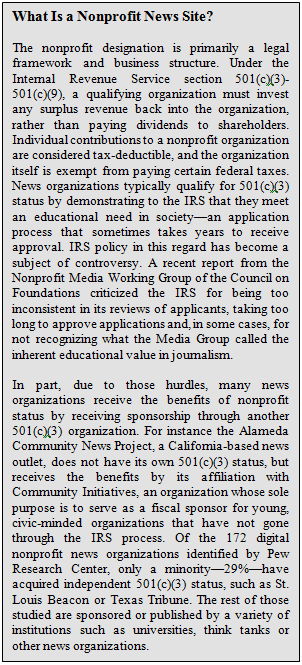
Though many of the 172 journalism nonprofits identified in the landscape audit of the Pew Research study operate autonomously, only about a third are fully independent, meaning they have 501(c)(3) tax status. Those include a number of well-known outlets, such as the Center for Investigative Reporting, the St. Louis Beacon and the Texas Tribune. The remaining two-thirds are sponsored-and in some cases, published-by other organizations. The most common type of sponsoring organization is another nonprofit, such as the Henry J. Kaiser Family Foundation or the Franklin Center for Government & Public Integrity, followed by universities and other news organizations. (While the 93 outlets that completed the survey largely mirror the 172 that were identified, the two groups differ in that the survey sample contains a smaller proportion of outlets sponsored by non-news organizations.)

Pew Research Center’s survey shows that, generally speaking, these independent 501(c)(3) organizations stand out in a number of ways. They are less likely than other organization to launch with large seed grants; instead, they pull in money from more diverse revenue sources and, in doing so, raise more money overall. They also have bigger operating surpluses. The finding that independent outlets may be in better financial health than organizations attached to sponsors may help explain why some in the nonprofit sector are asking the IRS to open up its process for granting 501c3 status.

Unlike most of the outlets sponsored by universities and other organizations, the majority of independent outlets did not receive large seed grants to help them get off the ground. Sixty-one percent of all the journalism nonprofits that responded to the Pew Research Center survey said they received start-up grants amounting to at least one-third of their original funding. But less than half (15 out of 32) of the independent outlets received that much seed money, a far cry from the four-fifths (22 out of 27) of university-sponsored organizations that did.

Perhaps out of necessity, independent organizations have been particularly successful at diversifying their sources of revenue, which often is essential for long-term survival. About three-quarters (25 out of 32) reported that they have at least three revenue streams. That compares with less than half (10 out of 23) of those sponsored by non-news organizations and a third (nine out of 27) of those sponsored by universities.

They also, on average, brought in more money overall. Nearly a third of the independent organizations (nine out of 31 that responded to the question) generated more than $500,000 in revenue in 2011, which was the case for only two university-sponsored outlets. In fact, about half of university-sponsored outlets (nine out of 17 that responded to the question) did not generate even $100,000 that year.

With bigger budgets, many of the independent organizations have more paid employees than the smaller, sponsored outlets. Four of the five nonprofits with the largest number of paid, full-time employees-ranging from 15 to 70-are independent.  

Independent nonprofits are often more profitable than their sponsored counterparts. Seven of the 10 outlets in the survey that had the largest operating surpluses in 2011-ranging from 27% to 72%-were independent.

Independent outlets tend to have smaller cash reserves than outlets sponsored or published by other organizations. As discussed earlier in this report LINK, cash reserves are a tricky element to assess. Within the nonprofit news realm, reserves of even three months may be sufficient, particularly among younger organizations and those with few employees. That said, the independents surveyed here do stand out for having fewer reserves than outlets sponsored by other organizations and universities. More than half (18 out of 32) of the independent outlets reported having less than six months’ cash on hand. That compares with about a third (four out of 11) of nonprofit outlets sponsored by other news organizations and far fewer (three out of 27) among those sponsored by universities. Indeed, more than half (15 out of 27) of university-sponsored outlets said they had enough money set aside to operate for a year or more without additional revenue.

It is worth noting, however, that some of the organizations with only a few months’ worth of cash on hand also have been around as long as a few decades and are unlikely to disappear anytime soon.

Do independent nonprofits have a different editorial focus than those sponsored by other organizations? Not particularly. Independent organizations, like others, cover many different subjects. The two areas in which they are particularly strong-general interest news and investigative reporting-reveal more about the breadth and depth of what they do than about a preference for specific issues. Among the 50 independent outlets, about a third (16) cover general interest news, 15 specialize in investigative reporting, four cover government and two cover the environment. Indeed, independent outlets specialize in investigative reporting, which is time-consuming and expensive, more than any other type of organization. Of the 45 outlets that report on general interest news, 16 are independents and 18 are sponsored by universities.

Geographically speaking, the largest segment of organizations-65 outlets, or 38% of the 172 nonprofit news outlets-covers statewide issues, including government. But state coverage is dominated by 40 outlets that are sponsored by other nonprofits. This category is significant because many legacy outlets have reduced or eliminated their coverage of state governments. Another 50 of the 172 outlets, or 29%, cover metro, or city and suburban, news. Sixteen percent cover national news; 8% cover hyper-local news, which often is at the neighborhood level; 6% cover international news; and 4% cover regional, or multi-state news.

Among the 50 independent organizations, the picture is slightly different.  The largest group of independent outlets-19 of them-covers metro news. Another 14 cover state news and seven cover national news. 

The Road Ahead for Nonprofit Journalism

Despite the challenges, an overwhelming number of the survey respondents are optimistic about their future. Eighty-five percent reported that they are on stable footing now, and about the same proportion said they were either “very” (26%) or “somewhat” (55%) confident that they’ll be financially solvent in five years. Just 14% said they are not too confident they’d be solvent in five years, and 4% were not at all confident. Only 10% thought that they’d be reducing their staff over the coming year, while the rest expected to maintain or even grow their staff.

Some kinds of nonprofits were more optimistic than others. Older outlets, those launched before 2008, expressed stronger confidence in their future. Outlets that are generating bigger revenues are more confident in their future than those with small revenues. And those with diverse revenue streams were more likely to express strong confidence in their future.

But what stands out more than anything is how nearly universal the sense of optimism is among this sector. The optimism is found among outlets with sizeable revenue, as well as small; outlets with substantial foundation support and those with little; outlets with many staff and large operations as well as those that operate mostly with volunteers. In other words, financial stability is not a prerequisite for a sense among editors and directors that their nonprofit news outlet would survive well into the future.  Indeed, there was virtually no difference in optimism between outlets that had their startup grant renewed and those that did not have their grant renewed.

Yet the distance between the present and five years from now seems far in some respects. The majority rely-in some cases, heavily-on foundation grants, even as competition for those grants continues to ratchet upward. Meanwhile, finding the time and making the effort it takes to cultivate additional revenue sources and to build the business is difficult; indeed, for the majority of outlets surveyed, finding such time was perceived to be the single biggest challenge facing their news outlet.

Even some of the outlets that expressed higher degrees of confidence in their future did not see a perfectly clear path forward: “All experimentation welcome,” wrote one.  Said another, “It seems to us that sustainability, meaning very little dependence on grant funding, is a long way off.”

Methodology

This study, “Nonprofit journalism: a growing if fragile part of the U.S. news system,” involved three major research components. The first was thorough landscape audit to identify nonprofit news outlets launched since 1987; the second was a detailed analysis of the websites of nonprofit news organizations; the third was a survey of editors and managers of those news organizations.

Landscape Audit

The first element of this study was to indentify landscape of the field of digital, nonprofit news outlets around the U.S. launched between 1987 and 2012.

To do this, researchers took several steps to get as close as possible to the total number of digital nonprofit news outlets in the U.S. In April 2012, researchers aggregated lists and databases of digital news operations. A total of nine such lists yielded 1,810 nonprofit news websites.

Lists and databases consulted for sample definition:

  • J-Lab Knight Community News Network Directory of Community News Sites: 1,266 sites.
  • Michele McLellan’s list of promising local news sites: 145 sites.
  • Nieman Journalism Lab Encyclo: 109 sites.
  • Columbia Journalism Review Guide to Online News Startups: 100 sites.
    American University Investigative Reporting Workshop: 76 sites.
  • Investigative News Network member list: 61 sites.
    Project for Excellence in Journalism interactive guide: 46 sites.
    Harvard’s Hauser Center for Nonprofit Organizations list of nonprofit news orgs: 39 sites.
  • Statehouse News Network: 7 sites.

Next, researchers performed exploratory research on the web to search for any remaining non-profit outlets that had not been picked up by any of the above lists. This yielded an additional 31 sites, for a total of 1,849 sites.

Researchers then eliminated duplicate listings and commercial/for-profit operations, as well as websites that may have been noncommercial, but not formally affiliated with a 501c organization.

In addition, the following criteria were implemented to further define the sample:

  • Outlets must be domestic. They may cover international affairs, but must be based in the U.S. or a U.S. territory.
  • Outlets must be active, though they do not need to be publishing new content on a regular basis to be included in the study. Outlets that, at the time of the audit, had not published new material in the previous 90 days were eliminated.
  • Outlets must be young. The study included outlets launched in the previous 25 years, or between 1987 and 2012. This rule was established to guide the focus of the study toward a newer generation of digital-first and digital-native news outlets, though there are reputable legacy nonprofit news institutions that exist outside the purview of this study, such as the Associated Press, Texas Monthly and Mother Jones magazine, as well as public broadcasting. (An exception-the Center for Investigative Reporting-was included in the website analysis even though it was launched in 1977. CIR’s identity and finances are intertwined with two younger outlets, California Watch and Bay Citizen, and thus eliminating CIR would have made it difficult to study the latter two outlets.)
  • Outlets must be primarily digital. While some outlets in the study may produce a print newsletter, or create video content that is distributed on television networks, to be included, they must be primarily a digital operation.
  • Outlets must produce original reporting. Websites based entirely on aggregation or purely opinion content were eliminated.
  • Outlets sponsored by an institution must produce journalism that focuses beyond its own walls. There are nonprofit organizations such as churches, universities or advocacy groups that also publish a news service, but one that reports exclusively on the activities of the parent organization. Such outlets were removed from the study.

This process produced a refined universe of 172 nonprofit news outlets.

Recognizing there could be a few sites that were missed even in the exhaustive steps listed above, researchers took an additional step to gauge whether the universe we had identified was relatively comprehensive. This step was akin to snowball sampling-a method used in sociology to identify members of an unknown population by first contacting known members who assist in identifying others who are unknown to the researcher.

In October 2012, researchers identified 23 nonprofit news outlets-five from each region of the country and three focused on national or international subject matter. Outlets with the biggest monthly web traffic (using data from Compete.com) were selected for contact. These 23 outlets were contacted by researchers asking them to name any additional nonprofit news outlets that they were aware of in their state, or in the case of national-level outlets, around the country. Of those 23, 10 responded. Most of those listed outlets that had already been identified by Pew Research. Two of them identified a total of four outlets that had not been identified by researchers, one of which upon inspection was commercial in nature, and another had not yet launched.

The results of all these measures suggest that the Pew Research sample is thorough and robust, even if it is not 100% exhaustive.

Website audit

Once the universe was identified, three trained researchers conducted analysis of each of the 172 nonprofit news websites selected for study. The ‘audit’ was conducted between May and July of 2012, as well as in September for additional sites identified by Pew Research. All data were then re-evaluated and updated as needed in April of 2013.

Researchers evaluated the websites based on the following series of variables:

  • Nonprofit tax arrangement. This variable allowed research to identify whether the outlet is an independent nonprofit (501c3 in most cases), or a subsidiary of another institution such as a foundation or think tank. Researchers did further analysis using the Guidestar nonprofit database to verify information that was not clear from the outlet’s website.
  • Year launched. Researchers determined the year of launch by searching the ‘about’ section of an outlet’s website, supplemented by additional web searches and in some cases, using survey data for outlets that participated.
  • Editorial focus. Researchers determined the primary type of content an outlet produced by evaluating how the outlet describes its own work in its mission statement or ‘about’ section. If the focus of the site was still unclear, researchers would make a determination based on scanning the content on the outlet’s home page.
  • Geographic focus. This variable denotes an outlet’s reach, such as hyperlocal, metropolitan, state or beyond. Researchers deduced the geographic focus from the outlet’s name and/or its ‘about’ section or mission statement.
  • Content production. This variable assesses how much content an outlet produced in a 14-day time span. Researchers tallied (within various range categories)the number of original, reported straight news stories; the number of long-form investigative or enterprise pieces; the number of non-reported opinion pieces; and the number of non-text products such as videos and databases.

The results of this analysis were tabulated and discussed in the section of the report titled “The Landscape of Nonprofit Journalism.”

Survey of nonprofit executives and editors

The survey of executives, directors and editors of nonprofit news organizations was conducted from September 21, 2012-November 17, 2012.

Survey administration

The administration and data coding of the survey was handled by Princeton Survey Research Associates International (PSRAI). The survey was sent to all of the 172 nonprofit news outlets identified for the study. Of those, representatives at 93 of the outlets completed the survey, a response rate of 54%. The target sample was contacted several times to ensure maximum participation.

The schedule of survey administration was as follows:

  • An invitation e-mail message was sent to the sample on September 21, 2012, which included a link to the online survey questionnaire.
  • A first reminder e-mail was sent on September 27. Additional reminder messages were sent on October 4, 11 and 17.
  • Pew researchers sent e-mail messages and phone calls to the remaining unresponsive outlets, requesting participation.
  • Survey was taken offline on November 17, 2012.

In the end, representatives from 93 of the organizations completed the survey. Researchers compared the audit characteristics of the 93 responding organizations with the full 172. On the vast majority of measures, the responding organizations were very similar to the full population. Differences were observed on three characteristics. Compared with the full population of 172 sites, somewhat fewer of the responding organizations were sponsored by non-news organizations, fewer focused on state level news, and fewer focused on news about government.

Questionnaire design

The questionnaire was designed by the Pew Research Center in consultation with the staff at PSRAI. All respondents were granted anonymity in their responses to survey questions.

The questions in the survey were designed to solicit a mixture of hard financial data from the nonprofit news outlets, as well as attitudes about financial health. The survey targets were also asked questions about their staffing and operations, and about their organizational mission. (See the complete topline questionnaire here.)

Topline

Please click here for a PDF of topline data tables.

Press Release

Contact:  Amy Mitchell, Acting Director, Pew Research Center’s Project for Excellence in Journalism amitchell@pewresearch.org, 202-419-3650

Mark Jurkowitz, Associate Director, Pew Research Center’s Project for Excellence in Journalism mjurkowitz@pewresearch.org, 202-419-3650

Pew Research Study of the Economics of Nonprofit News Outlets Reveals a Growing but Fragile Part of the Media Landscape

June 10, 2013 – As the business model for commercial journalism has been upended and newsrooms have shrunk, a comprehensive new Pew Research Center study finds that nonprofit news outlets represent a growing new source of information – but one facing substantial challenges to its long-term financial sustainability.

The new study identifies and audits 172 active nonprofit news sites launched from 1987 to 2012 and funded by a variety of sponsors, including charitable foundations, individuals and ideological groups.  While some nonprofit news operations have achieved national recognition, the study – which did not measure editorial quality – found that that most are small, with minimal staffs and modest budgets. And, a majority of nonprofit news site operators are concerned about a lack of sufficient business skills and resources.

In a survey completed by 93 of the nonprofit outlets, more than half (54%) identified business, marketing and fundraising as the area of greatest staffing need – compared with 39% who named editorial needs. Nearly two-thirds (62%) cited “finding the time to focus on the business side of the operation” as a major challenge, even more than the 55% who named “increasing competition for grant money.” 

A number of nonprofit experts and nonprofit news leaders say that improving business side operations is a key to diversifying revenue streams going forward.  Indeed, almost two-thirds began with a startup grant that accounted for at least a third of their original funding, and foundation funding remains the predominant source of revenue for nonprofits.

Despite these concerns, nonprofit news site operators express optimism about their future, and most see themselves filling gaps left by shrinking commercial news media outlets. Fully 81% of the organizations surveyed said they were “very” or “somewhat confident”  they’d be financially solvent in five years.  And 4-in-10 predict they will hire new staff in the coming year, compared with just 1-in-10 that said they will reduce staff.

“These nonprofit outlets are a growing and potentially important source of news, but just like commercial journalism, they face financial challenges,” said Amy Mitchell, a co-author of the study and acting director of Pew Research Center’s Project for Excellence in Journalism. “One clear takeaway from our new survey is that many of those running nonprofit news outlets do not feel sufficiently equipped to manage long-term business needs.”

“Our research shows that large seed grants often help nonprofit sites to get started, but after the grants expire, many sites lack the expertise and resources to tackle the business challenges and broaden their funding base,” said Mark Jurkowitz, a co-author and associate director of Pew Research Center’s Project for Excellence in Journalism

The new study, by the Pew Research Center’s Project for Excellence in Journalism, is based on an audit of 172 active nonprofit digital news outlets launched since 1987; a survey about structure, staffing and financial health completed by 93 of the outlets; and in-depth interviews with industry analysts. An interactive component that includes a map of nonprofit news site locations and a sortable database accompanies the report.

Among the key findings:

  • The majority of U.S. states have at least one nonprofit news outlet; most work in specialized journalism niches. The study identified nonprofit news outlets in all but nine U.S. states. Fully 21% of those outlets focus on producing investigative reporting, while another 17% concentrate specifically on government. Other areas of focus include public and foreign affairs (13%), the environment (4%), health (3%) and arts and culture (3%). And the geographic orientation tends to be either state (38%) or metro level (29%).
  • The scale of many nonprofit news organizations is modest. More than three-quarters of the survey respondents (78%) report having five or fewer full-time paid staffers-including 26% with none. On the revenue side, 21% of the outlets say they generated $50,000 or less in 2011, and another 26% generated between $50,001 and $250,000.
  • Many nonprofits initially rely on big grants, but that funding source may not provide long-term sustainability. Nearly two-thirds of the survey respondents (61%) began with a startup grant that accounted for at least one-third of their original funding-and a majority of those grants were for $100,000 or more. But at time of this report, only 28% of those organizations reported that the funder had agreed to renew that grant to any degree.
  • Finding staff time to develop new revenue streams is a challenge. While 80% of the outlets say that business, advertising and marketing work consumes some staff time, nearly one third of them said that kind of work consumed less than 10% of their staff time and more than half said that business-side tasks accounted for between 10% and 24% of staff hours. In contrast, 85% of the outlets say that editorial tasks consumed at least half their overall staff time.
  • Cash reserves reported by nonprofit news organizations vary. One-third of the organizations (32%) reported having less than six months’ worth of cash on hand; another 31% reported having between six months and a year and another 33% said they have enough cash on hand to operate for a year or more without additional income. While those numbers might sound worrisome, analysts say that they seem pretty robust for the nonprofit sector.
  • About two-thirds of the 172 nonprofit news outlets studied are sponsored or published by another organization; just one third are independent. In the survey responses, independent 501(c)(3) outlets stood out as being less reliant on major seed grants. Fewer than half (15 of 32) of the independent outlets in the survey started with a major seed grant as opposed to more than two-thirds (42 of 61) of outlets sponsored by another nonprofit think tank, news organization, or university. More than three-quarters (25 of 32) of the independent outlets reported having at least three different revenue streams, far more than the sponsored nonprofits.

###

Pew Research Center is a nonpartisan source of data and analysis, and takes no advocacy positions. Its Project for Excellence in Journalism tracks the transformation of journalism in a changing information landscape through its annual State of the News Media report and other special reports.