Pew Research Center

FOR RELEASE NOVEMBER 28, 2012

Arab-American Media

At a time of major news developments in the Middle East and North Africa, the Arab-American media’s efforts to meet the demands of its audience have been complicated by declining ad revenue, new technology, and growing competition from Arab outlets in the Middle East and North Africa, according to a new PEJ study.

BY Heather Brown, Emily Guskin and Amy Mitchell

FOR MEDIA OR OTHER INQUIRIES:

Communications Department
202.419.4372
www.pewresearch.org

RECOMMENDED CITATION

Pew Research Center, November 2012, "Arab-American Media"

About Pew Research Center

Pew Research Center is a nonpartisan, nonadvocacy fact tank that informs the public about the issues, attitudes and trends shaping the world. It does not take policy positions. The Center conducts public opinion polling, demographic research, computational social science research and other data-driven research. It studies politics and policy; news habits and media; the internet and technology; religion; race and ethnicity; international affairs; social, demographic and economic trends; science; research methodology and data science; and immigration and migration. Pew Research Center is a subsidiary of The Pew Charitable Trusts, its primary funder.

© Pew Research Center 2026

Table of contents

  • About Pew Research Center
  • Arab-American Media
  • Arab-American Population Growth
  • Print Media
  • Print Media’s Digital Presence
  • Audio
  • Television
  • Arab Satellite News
  • Covering the Arab Uprisings in the Arab-American Community
  • The Role of Social Media in the Arab Uprisings
  • Press Release

Arab-American Media

At a time of major news developments in the Middle East and North Africa, the Arab-American media’s efforts to meet the demands of its audience have been complicated by declining ad revenue, new technology, and growing competition from Arab outlets in the Middle East and North Africa, according to a new PEJ study.

Bringing News to a Diverse Community

If it were just a matter of population growth, the story of the Arab-American media would be a simple tale of opportunity. Over the last decade, Arab Americans have become one of the fastest growing ethnic groups in the United States.

But the story of the media trying to serve that audience is more complicated than that: The Arab-American population across the United States is ethnically diverse. Arab-American media are being buffeted by the same technology and economic trends as the news media generally, as well as a more challenging advertising market. And, advancements in technology have brought new competition from Arab outlets located in the Middle East and North Africa.

Overall, the current Arab-American news media are relatively young. Newspapers and news websites are currently the most prominent sector, with much of the coverage focused on community news and events. There is also coverage at the national level, though, and recently, the Arab uprisings have given rise to more international coverage of news from “back home.”

While there is little solid data for this media sector, PEJ’s independent research, content audits and numerous interviews reveal clear trends in Arab-American news media.

A number of papers are seeing rising circulation. Some new publications have even launched.  However, most papers are still struggling to recover financially from the economic recession of 2007 and at the same time keep up with the trends in digital technology and social media.

The story is more challenging for radio. Overall, radio programming aimed at Arab Americans is declining in the face of even more limited advertising revenue. For one radio program, sponsorship from a few individuals within the Arab-American community is enabling market expansion, but it is unclear if this is an industry-wide solution. Other outlets are increasing their audio content online, averting the high costs of broadcasting on air altogether.

Arab-American television news remains almost nonexistent.  And now, interested viewers can turn to satellite programming and online television from Arab countries.

The recent uprisings in the Middle East and North Africa have created some new opportunities for Arab-American media, particularly as attention to that subject by the mainstream media faded.

Social media also played an important part in the uprisings. New research suggests that the primary role was in spreading news outside of the region, connecting a global audience to the events through tools such as Twitter, Facebook, and YouTube. This has not been entirely positive for Arab-American news media, as their audiences are now presented with an abundance of alternative sources of information online.
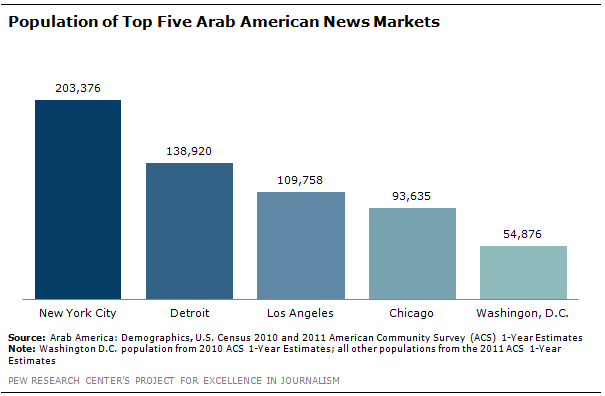
Arab-American Population Growth

[1]

[3]


Footnotes

[1]

  de la Cruz, Patricia and Angela Brittingham. “The Arab Population: 2000.” Census 2000 Brief. Dec.

  2003.

[2]

[3]

Print Media

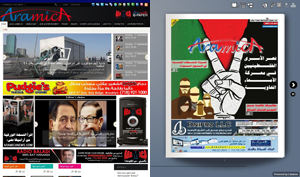
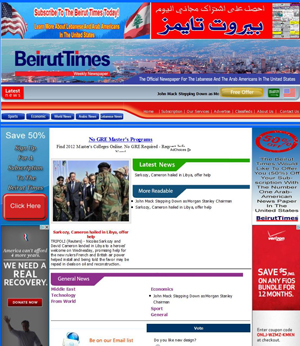
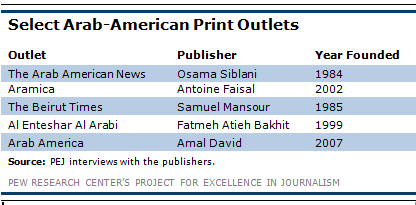
Trends across most print outlets point to a shift toward online and the importance of maintaining community news coverage, even while trying to increase coverage of the Middle East and North Africa. And for the most part, Arab-American newspapers are offering both Arabic and English content to their changing readership.

[1]

[2]

[content]

[4]

[6]

[7]

[same]

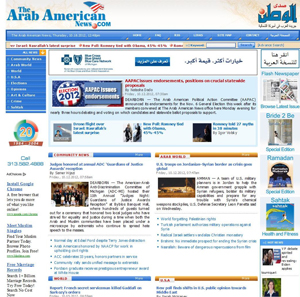
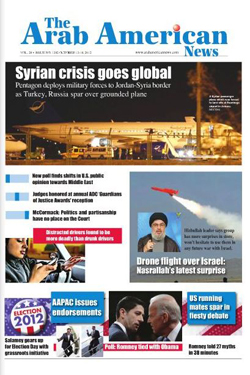
Community news is a growing part of The Arab American News’ original content, which makes the paper stand out from outlets that are increasing international coverage. Siblani explained that the high cost of sending reporters into the field is making it difficult for the paper to keep up with mainstream media coverage of national and international events. Additionally, Siblani reasons, if Arab-American media are to offer something their audiences cannot get elsewhere, it is in community news and information.                                                      

[10]

[11]

[12]

[14]

[community members’]

[17]

[19]

[20]

The paper is comprised of international political news, entertainment, economic news, community events, and some religious content, with a significant portion devoted to international events since the onset of the Arab uprisings.

[there were]

[the paper]

[23]

[24]


Footnotes

[1]

“Overview of Arab American Media in the United States.” National Arab American Journalists Association. 2009.

[2]

[3]

[4]

[5]

[6]

[7]

[8]

[9]

[10]

[11]

    2007. Re-posted on Arab Journalism.

[12]

    2012.

[13]

[14]

[15]

[16]

[17]

[18]

[19]

[20]

[21]

[22]

[23]

[24]

Print Media’s Digital Presence

[1]

[3]

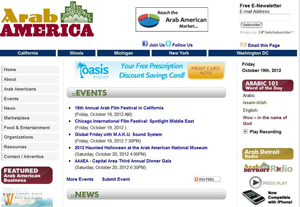
The site covers national and international news as well as local news from five major U.S. cities with concentrated Arab-American populations. The publication does so by offering multiple community

sites linked to from its main webpage, arabamerica.com. The community pages are for geographic areas with large Arab-American populations-California, Illinois, Michigan, New York, and the District of Columbia. Each of the pages highlights community events in those areas, national and international news, an Arab-American business directory for the region, and a national directory of Arab-American organizations.

[and the]

[5]

[6]


Footnotes

[1]

[2]

[3]

[4]

[5]

[6]

[7]

[8]

Audio

Arab-American radio is in a more fragile state than print.

[1]

[2]

[3]

[5]

[7]

[8]

[9]

[11]


Footnotes:

[1]

[2]

[3]

[4]

[5]

[6]

[7]

[8]

[9]

[10]

[11]

[12]

Television

[1]

[2]

[4]

[5]

[6]


Footnotes

[1]

[2]

[3]

[4]

[5]

[6]

Arab Satellite News

[1]

[3]

[4]

[6]

[9]

[10]

[12]

[14]

[15]

[16]

[17]

[19]

[20]

[21]

The political tension in the Middle East and North Africa is not only apparent in Arab outlets. It also transfers over to the relationship between Arab-American communities and their news media. As Arab-American outlets step in to provide news about the ongoing unrest and political upheaval back home, they can fill a void left by the mainstream U.S. news media, whose reporters are no longer in those countries. However, they are also faced with the challenge of covering politically and religiously charged events within a diverse community. The growing use of social media in accessing and disseminating information presents another interrelationship-one between the events in Arab countries, Arab-American media outlets, and the Arab-American community at large.


Footnotes

[1]

[2]

found at Free to Air Satellite Channels in the U.S.

[3]

[4]

Kivelin, Ian. Interview with PEJ. Aug. 29, 2012.

Siblani, Osama. Interview with PEJ. Aug. 24, 2012.

[5]

[6]

[7]

13, 2011 in Sultan Al-Qassemi. “Breaking the Arab News.” Foreign Policy. August 2, 2012.

[8]

[9]

[10]

Stelter, Brian. “Al Jazeera English Arrives on N.Y. Cable.” Aug. 1, 2011.

[11]

[12]

[13]

[14]

[15]

[16]

May/June 2011.

[17]

Sept. 30, 2012.

[18]

[19]

[20]

[21]

[22]

Covering the Arab Uprisings in the Arab-American Community

[1]

[2]

[3]

[4]

[events]

[6]

[7]


Footnotes

[1]

[2]

[3]

[4]

[5]

[6]

[7]

[8]

The Role of Social Media in the Arab Uprisings

[1]

[2]

Now, research is emerging that reexamines in a more detailed way the role that social media played in the Arab uprisings. 

[5]

[or social]

[7]

[8]

[and]

Arab-American news outlets find they must compete with this abundance of online content in order to evolve alongside readers who are increasingly turning to the internet for information. Newspapers have made the greatest inroads here so far, with most offering at least some form of digital content, while still maintaining print versions for older generations and those who prefer a physical newspaper. Radio programs, in light of the continuing challenge to find advertising sponsorship, are beginning to shift online.  Arab-American television, on the other hand, has yet to even really find a place amid the satellite programming available from Arab countries.


Footnotes

[1]

   Journalism.” Multiple original stories published on Storify. June 2012.

   Raziq, Abdul. “Syrian Citizen Journalists Risk All to Bring Stories from the Frontlines.” PR Watch, the

   Center for Media and Democracy. May 28, 2012.

   Sutter, John D. ” ‘SNN,’ YouTube Help Amplify Voices in Syria.” CNN. May 28, 2012.

[2]

[3]

[4]

    Assistance, the National Endowment for Democracy. 2012. 

[5]

[6]

     and Conflict After the Arab Spring.” Peaceworks: United States Institute for Peace. July 2012.

     The authors use the term “new media” instead and not “social media” in the report. There is some debate

     about which term is most appropriate when referring to these technologies-“new media,” “social

     media,” “information communication technology (ICT),” “user-generated platforms,” “digital media,” and “Web 2.0

     technology” are some of the more commonly used phrases.

[7]

[8]

Bennett, Shea. “Exclusive: “The Twitter User Who Broke News of Whitney Houston’s Death and Hour Before the

      Press.” Mediabistro. Feb. 15, 2012 in Olmstead, Kenny, freelance journalist Jane Sasseen, Amy Mitchell, and Tom

      Rosenstiel. “Digital: News Gains Audience but Loses Ground in Chase for Revenue.” PEJ State of the News Media. 2012.

[9]

Manneh, Suzanne. E-mail correspondence with PEJ. Oct. 25, 2012.

Press Release

Contact:  Tom Rosenstiel or Amy Mitchell, PEJ, 202.419.3650

Arab-American Media:
Bringing News to a Diverse Community

Wednesday, November 28 – At a time of major news developments in the Middle East and North Africa, the Arab-American media’s efforts to meet the demands of its audience have been complicated by declining ad revenue, new technology, and growing competition from Arab outlets in the Middle East and North Africa, according to a new study by the Pew Research Center’s Project for Excellence in Journalism.

This report examines the state of the Arab-American news media as it seeks to serve a growing and diverse population. In 2011 the U.S. Census Bureau reported that there were close to 1.8 million Arab-Americans living within the United States, an approximately 47% increase in population size from 2000. This estimate however, is believed by some to be a significant undercount. Arab-Americans are of varying religious backgrounds and have complex historical, cultural, and political ties to nearly two dozen nations.

Among the findings:

  • Print: Trends across most print outlets point to a shift toward digital and to maintaining community news coverage, even while trying to increase coverage of the Middle East and North Africa. In general, Arab-American newspapers are suffering from a significant drop in advertising revenue triggered in part by the recent economic recession. Most are free if picked up at a newsstand or store, though there is usually a fee attached to having a newspaper home delivered.
  • Radio: Radio serving the Arab-American community is in a more fragile state than print. Most content is “brokered programming,” meaning the show’s producer pays a radio station for airtime. And advertising is even harder to come by here. Access to Arab-American broadcast radio is limited geographically. Some radio programming is moving online, which means lower production costs and a potentially wider audience, but it is unclear if this is long-term solution.
  • Television: Arab-American television news programming is almost nonexistent, and the few channels that do exist are largely overshadowed by satellite news from the Middle East and North Africa. Numerous Arab satellite channels and networks can be accessed in the United States online, as well as over satellite because they are “free-to-air” feeds. Al Jazeera English is carried by a handful of cable providers, and continues to push for wider inclusion in the cable market.
  • Arab uprisings: The Arab uprisings provided a unique moment for Arab-American news media. When the mainstream U.S. media’s attention eventually shifted away from the uprisings, Arab-American outlets were presented with an opportunity to fill that void. Social media – which was a story in its own right – offered ways for the Arab-American media to reach its audience, but the user-generated content also posed a threat to smaller outlets by providing an abundance of alternative online information.

The Project for Excellence in Journalism tracks the transformation of journalism in a changing information landscape through its annual State of the News Media report and other special reports. As part of the nonpartisan, non-advocacy Pew Research Center, it does not take positions on policy issues.

Read the complete study.