Pew Research Center

FOR RELEASE OCTOBER 1, 2012

Future of Mobile News

The percent of Americans with mobile access to the internet has jumped dramatically in the last year—a trend that has major implications for the news industry. A new survey of news use on mobile devices by PEJ in collaboration with The Economist Group examines how tablets and smartphones have changed news consumption habits and what that might mean for the future of news.

FOR MEDIA OR OTHER INQUIRIES:

Communications Department
202.419.4372
www.pewresearch.org

RECOMMENDED CITATION

Pew Research Center, October 2012, "Future of Mobile News"

About Pew Research Center

Pew Research Center is a nonpartisan, nonadvocacy fact tank that informs the public about the issues, attitudes and trends shaping the world. It does not take policy positions. The Center conducts public opinion polling, demographic research, computational social science research and other data-driven research. It studies politics and policy; news habits and media; the internet and technology; religion; race and ethnicity; international affairs; social, demographic and economic trends; science; research methodology and data science; and immigration and migration. Pew Research Center is a subsidiary of The Pew Charitable Trusts, its primary funder.

© Pew Research Center 2026

Table of contents

  • About Pew Research Center
  • Future of Mobile News
  • Device Ownership
  • Mobile Activity: News Ranks High
  • Mobile News is Still Consumed at Home and at Habitual Times
  • The Most Popular Times of Day Vary
  • Mobile News Habits Remain Strong
  • In-depth News Reading on the Tablet
  • Are New Devices Adding to News Consumption?
  • Revenue
  • Advertising
  • Data Plans Help in Tablet Spending
  • The App vs. Browser Debate Continues
  • Tablet Only, Smartphone Only, or Both – Digital Divides
  • Once-a-Day Mobile Users vs. News Throughout the Day
  • Social Networking and Mobile Devices
  • Ethnicity and News Consumption
  • Methodology
  • Topline
  • Press Release

Future of Mobile News

The percent of Americans with mobile access to the internet has jumped dramatically in the last year—a trend that has major implications for the news industry. A new survey of news use on mobile devices by PEJ in collaboration with The Economist Group examines how tablets and smartphones have changed news consumption habits and what that might mean for the future of news.

The era of mobile digital technology has crossed a new threshold.

Half of all U.S. adults now have a mobile connection to the web through either a smartphone or tablet, significantly more than a year ago, and this has major implications for how news will be consumed and paid for, according to a detailed new survey of news use on mobile devices by the Pew Research Center’s Project for Excellence in Journalism (PEJ) in collaboration with The Economist Group.

At the center of the recent growth in mobile is the rapid embrace by Americans of the tablet computer. Nearly a quarter of U.S. adults, 22%, now own a tablet device-double the number from a year earlier. Another 3% of adults regularly use a tablet owned by someone else in their home. And nearly a quarter of those who don’t have a tablet, 23%, plan to get one in the next six months. Even more U.S. adults (44%) have smartphones, according to the survey, up from 35% in May 2011.

News remains an important part of what people do on their mobile devices-64% of tablet owners and 62% of smartphone owners say they use the devices for news at least weekly, tying news statistically with other popular activities such email and playing games on tablets and behind only email on smartphones (not including talking on the phone). This means fully a third of all U.S. adults now get news on a mobile device at least once a week.

Mobile users, moreover, are not just checking headlines on their devices, although nearly all use the devices for the latest new updates. Many also are reading longer news stories – 73% of adults who consume news on their tablet read in-depth articles at least sometimes, including 19% who do so daily. Fully 61% of smartphone news consumers at least sometimes read longer stories, 11% regularly.

And for many people, mobile devices are adding how much news they consume. More than four in ten mobile news consumers say they are getting more news now and nearly a third say they are adding new sources.

These findings and others in this report build upon a comprehensive study conducted by PEJ and The Economist Group a year ago that provided an in-depth look at news consumption on tablets among early adopters. The new report, which is based on a survey of 9,513 U.S. adults conducted from June-August 2012 (including 4,638 mobile device owners), probes mobile news habits more deeply across the wider population of users, looks at smart phone use as well, and examines the financial implications of those habits for news.

The survey also finds that consumers have yet to embrace certain features that mobile devices offer. While mobile technology allows people to get news anywhere, and any time, most people get news on these devices when they are at home-and roughly half of mobile news users get news on their device just once a day. Similarly, the use of news apps on mobile devices, which many publishers hoped would be a way to charge for content, remains limited. Most people still use a browser for news on their tablet.

Perhaps most pressing for the industry, the survey shows continued resistance to paying for content on mobile devices. More mobile news users have print-only subscriptions than have digital ones. Just 24% of them are considering exchanging their print subscription for a digital one (though these tend to be younger subscribers, which suggests their numbers will grow).

When it comes to advertising, there are suggestions that ads seeking to deliver a message or reinforce a brand may have more potential than those tied to e-commerce.

Taken together, the data reveal that, even with a broadening population owning mobile devices that offer a range of activities, owners are still drawn heavily to news. What’s more, there is a sizable cohort using mobile devices to broaden and strengthen their news experience, particularly male mobile news consumers who employ both apps and browsers, have a wireless data plan, get news multiple times throughout the day, and across a wide variety of platforms.

Among the detailed findings of the study:

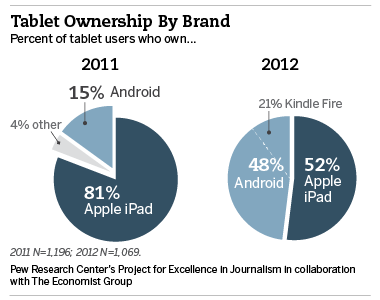
  • The advent of the new lower-priced tablets in late 2011 brought in a new crop of tablet owners. Now, just over half, 52%, of tablet owners report owning an iPad, compared with 81% a year ago. Nearly half, 48%, now own an Android-based device; about half of them, 21%, Kindle Fires. iPad owners, however, stand out from Android owners: they use their tablet more often in general and more often for news. Android users are more likely to use social networks and follow news that comes from friends and family.
  • Rather than replacing old technology, the introduction of new devices and formats is creating a new kind of “multi-platform” news consumer. More than half, 54%, of tablet news users, for instance, also get news on a smartphone; 77% get news on a desktop/laptop; 50% get news in print, and a quarter get news on all four platforms. Among smartphone news users, 47% still get news in print, while 75% get news on the laptop/desktop device and 28% get news on a tablet.
  • There is growing evidence that mobile devices are adding to how much news people get. As many as 43% say the news they get on their tablets is adding to their overall news consumption. And almost a third, 31%, said they get news from new sources on their tablet. The increases in news activity is heaviest among those who use all four of the major text-based media for news-computers, smartphones, tablets and print. And when people are asked to recall time spent, the evidence suggests multi-device users spend as much time on each platform as other news users-not substituting one for another.
  • People who get news on both a smartphone and a tablet may carry added appeal for news organizations. These people tend to be more engaged news users than those who get news on just one device. They are more likely to read deeply (fully 82% sometimes or regularly read in-depth articles on their tablet compared with 62% of those who get news on just the tablet), to send or receive news through email or social networks and to read past issues of magazines. And, while the numbers are still small, dual-device mobile news user are also more likely than others to have paid for digital news content.
  • Similarly, those who get news throughout the day on their mobile devices are more engaged news consumers. People who get news on their devices multiple times per day, on either the smartphone or tablet, tend to turn to more sources, get news from new sources, read in-depth news articles, watch news videos, and send and receive news through email or social networks. Tablet news consumers who get news more than one time during the day are also twice as likely as those who get news once a day to have paid for news on their tablet (10% versus 4%).
  • Two distinct news audiences have emerged on tablets-new-found digital customers and customers who also remain loyal to the print product. Nearly a fifth of mobile news users, 19%, have paid for a digital news subscription of some kind in the last year, and a third of tablet news users with digital subscriptions have added new subscriptions since they acquired the device. But even more mobile news users, 31%, have print-only subscriptions, and three quarters of these have no plans to give them up. These print subscribers also prefer their app-based news to be more like a traditional reading experience rather than to have high-tech features. For the news organizations, this brings both the potential for new audiences as well as the challenge of accommodating the differing styles and approaches of these distinct audiences.
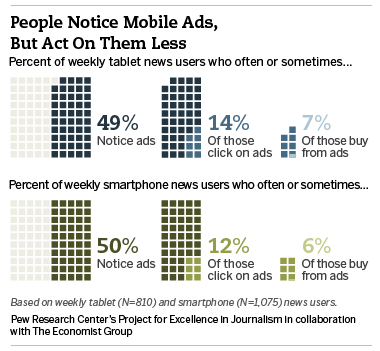
  • People notice ads on mobile devices and may be even more likely to click on them than they are to click on other digital ads. Half of mobile news users (49% of tablet news users and 50% of smartphone news users) sometimes or often notice ads when they are getting news on their mobile device. Following or acting on these ads is less common: Roughly 15% click on ads when getting news on one of the mobile devices and about 7% actually buy something. These figures, however, outpace other digital click-through rates. A recent study by Ad Age finds click-through rates on browser-based display ads to be less than 1%.
  • There has been movement over the last year toward using the browser rather than apps for tablet news consumption. Fully 60% of tablet news users mainly use the browser to get news on their tablet, just 23% get news mostly through apps and 16% use both equally. In 2011, 40% got news mostly through a browser, 21% mostly through apps and 31% used both equally. But as was revealed in the 2011 survey, app news users-and those who use both apps and the browser equally-remain in many ways more engaged and deeper news users than those who mostly use their browser. The browser is preferred on the smartphone as well (61% get news mostly through a browser, 28% mostly through apps and 11% use both equally).

These mobile news users were also asked about their news habits on the conventional laptop/desktop computer. Their responses suggest that even as the population of tablet owners broadens, the idea that we have entered a post-PC era is overstated-at least when it comes to news. The desktop computer remains an enduring part of people’s news consumption-perhaps because during weekdays it is a work tool. Despite all of the convenience of mobile, fully 41% of mobile users who still get news on the laptop and print prefer the conventional computer for doing so. Tablets rank second at 25%, followed by print. The smartphone ranked last. This is a shift from the very early adopters surveyed in 2011 who showed strong passion for their new devices, and it may speak to both the broadening population and a natural settling down as the “newness” factor wears off.
 

Device Ownership

Over the last year, tablet ownership has steadily increased from 11% of U.S. adults in July of 2011 to 18% in January of 2012, according to PEJ data. Currently, 22% own a tablet and another 3% regularly use a tablet owned by someone else in the home. This number is very close to new data, released here for the first time, conducted in a separate survey by the Pew Internet & American Life Project on July 16 through August 7 2012 that found 25% of all U.S. adults have a tablet computer.

The growth in tablet adoption is likely related to the advent of the lower-priced tablets in late 2011. Overall, about two-thirds of tablet-owning adults, 68%, got their tablet in the last year, including 32% in 2012 alone.

[1]

This survey was also conducted before the introduction of Google’s Nexus 7 or Amazon’s Kindle Fire HD.

Even before these, the influx of Android-based devices has changed the tablet market, much as it did for smartphones over the past several years. Of the 44% of adults who have a smartphone, 46% have an Android phone, 38% have an iPhone and 10% have a Blackberry.

Among those who have both a tablet and smartphone, there is some operating system loyalty. A majority of iPad owners who also have smartphones have an iPhone (57%); just 32% have an Android phone. Similarly, 66% of those who have an Android tablet have an Android phone; 29% have an iPhone.


Footnote:

[1]

Mobile Activity: News Ranks High

Despite the growth in tablet ownership and diversity of devices available, recent tablet owners seem to be embracing the devices in ways similar to the first generation of tablet owners.             

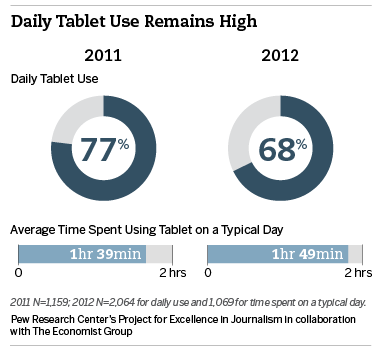
Most who own tablets-both early and late adopters – have integrated the devices into their routines on a daily basis. About two-thirds (68%) use their tablet every day, down from 77% a year ago. They also use them for a significant amount of time each day. In all, tablet owners spend an average of 1 hour and 49 minutes on their tablet on a typical day. That is nearly identical to the average of 1 hour and 39 minutes in 2011.

iPad owners, according to the data, use their device more than Android owners. About half, 54%, of iPad owners use their tablet several times a day, compared with just a third, 33%, of Android owners (and 40% of Kindle Fire owners.) These differences may ease over time, however, as more tablets are introduced with hardware, battery life and capabilities equivalent to those of the iPad.

How people use their tablet also has remained substantially the same, even as the tablet-owning population has doubled.

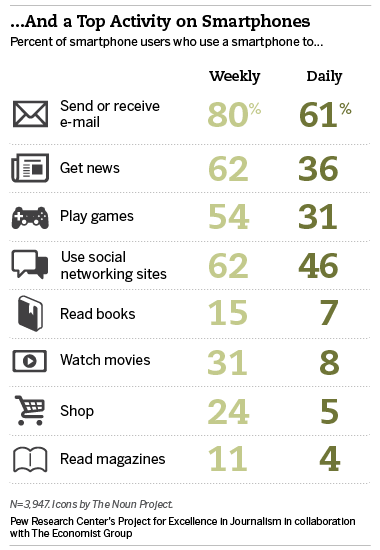
News is a large part of what people do with their mobile devices. Fully 64% of tablet owners get news on their devices at least weekly, including 37% who do so daily. The numbers are similar for smartphone owners – 62% consume news weekly or more and 36% do so daily. For both tablets and smartphones news is among the top activities people engage in on the devices.

The amount of time spent on these devices getting news is also substantial. Mobile news consumers spend an average of 50 minutes or more getting news on their tablet or smartphone on a typical day.


For activities other than news, though, people tend to look to one device more heavily than the other. Far more use their smartphones, for instance, for sending or receiving email – 61% do so daily on their phone, compared with 44% on the tablet. More also turn to their phones for daily social networking updates – 46% versus 34% who do so on the tablet.

Perhaps not surprisingly, for reading – both books and magazines – people look to their tablets, but not exclusively. The survey found that 7% of smartphone owners read books on their phones daily and 15% do so weekly. That compares with 18% of tablet owners who read books daily on their tablet and fully 43% who do so at least once a week. These tablet numbers remain about on par with a year ago – even with the introduction of technically advanced e-readers, such as the Kindle Fire.

[1]

The new survey suggests that while news remains one of the most popular tablet activities, the number consuming news regularly on the devices is lower now among this broader population using a wider array of devices than it was a year ago among the first adopters. Weekly news consumption, for instance, has declined from 77% of tablet owners to 64% in the new survey. Daily news consumption on the tablet has also declined. Some of this decline may be tied to lower daily news consumption among Android tablet owners, the data indicate. Only 29% of Android owners get news daily compared with 43% of iPad owners.  

Android owners also are less likely to use their tablets for many other activities on a daily basis, including social networking (28% vs. 38% of iPad owners) and email (34% vs. 56% of iPad owners). On the other hand, Kindle Fire owners are the most likely to read books daily (34% vs. 13% of iPad and 13% of other Android owners).

There are also some differences in tablet use by gender. Men are more likely to get news on their tablets every day than women (43% versus 32%). Women on the other hand are twice as likely as men to never user their tablet for news (21% versus 11%). Men also are more likely to get news daily on their smartphones. Those numbers conform with historical data about news consumption by gender generally, particularly newspapers.


Footnote

[1]

Mobile News is Still Consumed at Home and at Habitual Times

Part of the power of mobile technology is that activity can occur anywhere; in transit, at a sports game, at work and at home. We are no longer tethered by place to the internet. To what degree are people taking advantage of this? When it comes to news at least, home still dominates.

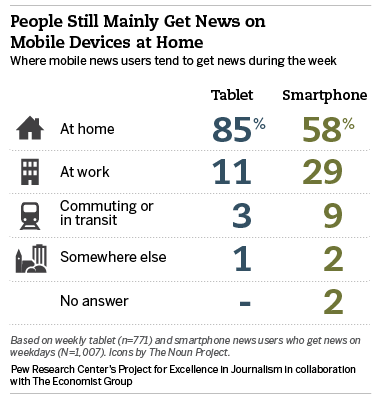
On tablets, fully 85% of news users say they tend to be at home when they get news on their tablet during the week (and even more, 92%, tend to be home during the weekend). Just 11% during the week are at work when they get news, and a mere 4% say they get news when they are on the go. Some of that may have to do with the fact that most tablets do not come with cellular connectivity (it is usually optional) and therefore require Wi-Fi , which is commonly available at home and work but less so in places in between. Yet the data show that even for people who don’t have that limitation, home is still the dominant place for tablet news consumption. Those who have a data plan are just as likely as those who do not to consume news on their tablet while at home.

The findings for smartphone news consumption are similar. Even though most smartphones can give you internet access anywhere, just 9% say they tend to get news on it during the week while they are commuting. Far more tend to be at home (59%) or at work (28%) when they use their smartphone for news.

In short, while mobile technology allows people to get news on the go, relatively few people do so.

The lure of home as a place for news consumption is also linked to the findings about when people get their news. Even though mobile devices make it easier to get news whenever you want, mobile device owners still seem to have habitual times of day when they consume news. And for about half of mobile news users on each device, it is just a single time each day.

These numbers may not fully capture whether news is becoming an ongoing activity. Many people also continue to get news on other

platforms (print, TV, radio and computer) at other times of day in addition to the news they get on their mobile devices. But the idea that people are turning to the news continually on their mobile devices has not emerged, at least not yet.

The majority of tablet news consumers, 56%, say they usually consume news on the device just one time a day on weekdays; 38% do so multiple times a day. The pattern is nearly identical for news consumption on the weekends (55% once a day vs. 34% multiple times).

Even smartphone news consumers are more likely to check in with the news just one time a day, even though they likely have their phones in their pocket much of the time. During the week, 52% of smartphone news users said they get news on that device just one time a day while 42% do so multiple times. And on the weekends, frequent news consumption is even less common; 52% get news once a day and 32% do so multiple times.

The Most Popular Times of Day Vary

When is the time of day people consume news? (And by implication, when is the best time for potential advertisers, or political actors, to try to reach mobile news consumers?)

Here we find that mobile technology is changing behavior patterns, but in ways that might be more subtle than some might have expected.

To begin with, among those who get news on tablets just once a day during the week, (again just over half of tablet news consumers) the times they check in are fairly traditional ones, similar to those when Americans watched the evening news or read the morning newspaper: 39% get their news on the tablet in the evening between 5 and 9 p.m., while 18% get news early in the morning, before 8 a.m. Another 21% get news on their tablets later in the morning, between 8 a.m. and 12 p.m. Fewer get news late at night, after 9 p.m. (11%).

On the weekend, the one-time-a-day tablet news consumers are split more evenly throughout the morning, midday or evening (with very few consuming news early in the morning or late at night).

However, the behavior of those who check in for news on the tablet multiple times during the day (roughly one-third of tablet news users) is quite different. For these people, the beginning and the end of the day are much more important during the week, perhaps due to the easy, on-demand nature of the devices. About two-thirds of these tablet-based continuous news consumers, 66%, get news in the evening (5 to 9 p.m.) and 56% get news first thing in the morning (before 8 a.m.); 50% check again late at night. And 43% get news later in the morning, between 8 a.m. and noon.

Most of those who get news on the tablet multiple times on a typical weekday also do so more than once on the weekends. But on the weekend, news consumption is spread more evenly throughout the day, though very few check news early in the morning.  

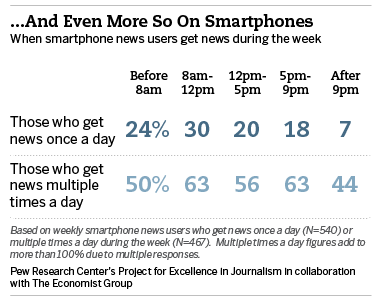
The preferred times for smartphone news use are more varied. For those who check in once a day, more prefer sometime before noon to the evening. About a quarter, 24%, of smartphone news consumers who get news once a day do so before 8 a.m., and 30% check in from 8 a.m. to 12 p.m. Far fewer get news in the evening (18%) or late at night (7%).

Among those who get news on their phone multiple times per day, the device is a way to start and end the day with news -but not quite to the same degree as with tablets. During the week, half (50%) of these consumers use their smartphones to check in early morning, and 44% do so late at night, but this is smaller than the percent who check in at other times of day (when more than half say they are consuming news). In other words, the smartphone is a way for the continuous news consumer to get the news throughout the day-morning, day and night.

The other finding is that people who get news through the day on one device tend to behave that way whether they have a tablet in their hand or a smartphone.  The same is true for once-a-day news consumers. Among respondents who get news on both devices, those who get news just once a day on their tablet are also more likely to get news just once a day on their smartphone, and vice versa. 

In short, mobile technology is turning news into an activity that can increasingly occur at any time. For more people than not, that still occurs mostly once a day-at least on the mobile devices. But a sizeable number, roughly a third of tablet news consumers and slightly more for smartphone news consumers, are taking advantage of this “always on” feature of mobile devices.

Mobile News Habits Remain Strong

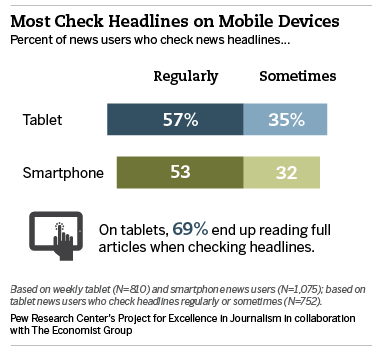
For almost everyone, mobile technology is a way to get breaking news. People use both mobile devices (tablets and smartphone) heavily for checking headlines: 57% of tablet news users do so regularly and another 35% sometimes. The pattern is nearly identical on smartphones with 53% regularly checking headlines and 32% doing so sometimes.

While headline-checking seems like an obvious activity on mobile devices, a major question that accompanied the devices’ growing popularity was the impact that tablets and smartphones might have on how people in the digital space read and value longer articles. This not only has implications related to the dissemination of knowledge, but also to the financial opportunities for news and information organizations focused more on long-form content than headlines; would  people notice the advertising and  would they value a news provider?

This was a major issue on the first generation of digital devices, the desktop and laptop computer. Most research and usage data found that people did not read stories on computers for very long and they tended to skip over advertising.

In our initial survey of the first wave of tablet users a year ago, we found substantial evidence that the earliest adopters of the tablet did use the devices to read long-form articles. This year, we probed deeper into the kinds of in-depth reading people are doing and the extent to which this kind of news consumption also occurs on the smaller-screen smartphone. 

In-depth News Reading on the Tablet

The findings suggest there is some difference between smartphone and tablet news use when it comes to reading longer stories. But the behavior is occurring on both devices to a degree.

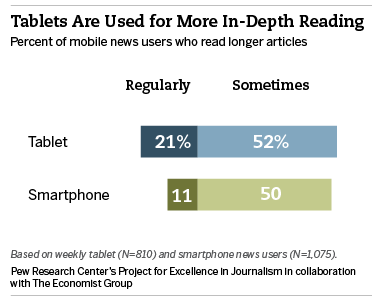
Twice as many tablet news users regularly read in-depth articles on their tablet as do smartphone news users, 21% versus 11%, and 19% of tablet users even do so daily.

It does appear that compared with a year ago, the current, broader population of tablet news consumers may be reading long-form less often than the earliest adopters, of whom 42% said they did so “regularly.” But, that fall-off largely disappears when the timeframe is broadened out to those who “sometimes” read long articles. Another 52% of tablet news users “sometimes” read in-depth articles on their tablet, bringing the total to 73%.

An even larger group of people read long-form news on their smartphones at least sometimes, 62%, which brings that total also to 73%.

Tablet news users in particular appear to be a relatively engaged group. To begin with, even when just checking headlines, tablet news users often end up reading full articles. Nearly seven in ten, 69%, end up reading one or more articles at least a fair amount of the time, including 17% who do so almost all of the time).

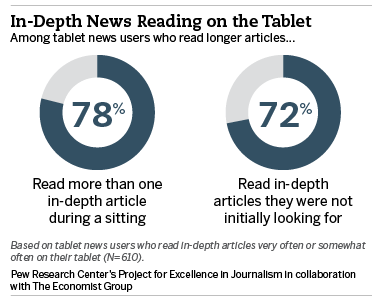
And looking at the three-quarters of tablet news users who at least sometimes read in-depth articles, the majority read more than one article in a typical sitting. About six-in-ten (61%) read two to three articles in a sitting and another 17% read four or more. And these are often articles they did not set out to read. Close to three-quarters, 72%, say they read in-depth articles that they weren’t looking for at least somewhat often (including 17% who say that is very often the case).

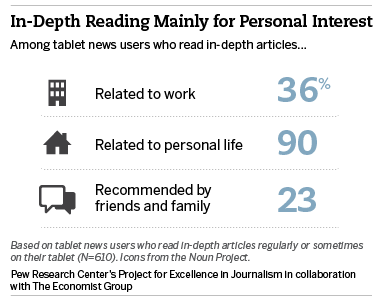
We also find that much of the long-form reading of news on tablets is the kind that is done to satisfy personal curiosity rather than professional need. More than half of tablet news users, 56%, say most of the in-depth articles they read are for personal interest versus just 6% who say most of them are for work. That does not necessarily mean it is social reading, however. Only 3% say most of the longer articles were recommended by friends or family (20% say some were and 38% say just a few of them were). Android users are more likely to read news that was recommended to them from friends or family. A third of all Android news users, 32%, say some or most of their news comes to them this way (including 38% of Kindle Fire owners), compared with 19% of iPad users.

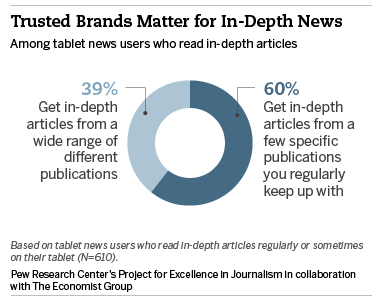
We also probed, in the survey, where people go when they want to read longer articles. For most of their long-form reading, people have regular sources that they turn to. Close to twice as many tablet news users say the in-depth articles they read tend to come from a few specific publications as come from a wide range of places (60% versus 39%). iPad users are more likely than Android users to get in-depth articles from a few trusted publications, 67% versus 54% of Android users (and 52% of Kindle Fire users specifically).

The survey also found that people turn to these sources often. Fully 90% of those who usually turn to a few news publications for reading longer articles do so at least weekly; almost half, 45%, turn to them daily.

The news brands that people turn to on their tablets also tend to be those they turn to on other conventional computers. Nearly two-thirds, 63%, tend to also turn to these publications via their desktop/laptop. The numbers drop, however, when it comes to smartphone and print. Just 30% of adults go to the same sources on their smartphones as they do on tablets, and just 25% said they go to those same sources in print.

As news organizations move toward promoting cross-platform digital subscriptions, we may see more effort to drive consumers who get news on one platform to also connect with that outlet elsewhere.

Another question that some publishers have wondered about on the tablet is whether people will read back issues-particularly of magazines. If the physical print publication is not stacking up on the nightstand or coffee table-but rather is filling up out of sight inside the digital device, will people ever read back copies? And if not, does that reduce the value of a publication for them? The findings show that even for this expanding population of tablet owners, 28% read back issues, down somewhat from 38% in 2011.

Are New Devices Adding to News Consumption?

What does the growing expansion of mobile mean for news consumption overall? Are people who own mobile technology getting more news now that they have more ready access to it? Or are they merely replacing one platform with another? Here, the findings are as strong as in 2011, and in some cases even stronger, in suggesting that mobile technology is increasing news consumption.

While most, 55%, of tablet news users say the news they get on their tablet is replacing news they would have gotten in other ways, nearly as many, 43%, say the news they get there is adding to the overall news they consume.  And when we look at those who get news across all four of the platforms we asked about (tablet, smartphone, laptop/desktop and print), a solid majority, 58%, said their tablet news is adding to the overall amount of news they consume.

In addition, almost a third of respondents, 31%, said they are spending more time getting news now that they have a tablet. That is nearly identical to the 30% who responded that way in 2011. Just 12% say they get less news now.

Similarly, 31% say they are getting news from new sources on their tablet. Again, that is nearly identical to 2011, at 33%.

This year, we also asked people to tell us how much time they spent with news on a typical day

on each device to see how their habits were changing. Asking people to recall time spent on a typical day can be complicated and hard for them to remember.  What we found was that people who get news on multiple devices and platforms reported spending about the same amount of time on each of those platforms as people who just use one. Even if multi-device users are not getting news on all these devices every day, the findings strongly suggested that multi-device users spend more time overall with news.

For example, tablet-only news users spend, on average, 51 minutes getting news on that device on a typical weekday. Those who get news on both the tablet and smartphone average 64 minutes on the tablet. In addition, those consumers who get news on both devices spend just as much time getting news on the smartphone as those who are phone news users only (54 minutes each on a typical weekday.) And, consumers who get news across all platforms asked about-tablet, smartphone, laptop/desktop, print-add in even more time, reporting typical times of 77 minutes getting news on the tablet, 51 minutes getting news on the smartphone, 76 minutes on the laptop/desktop and 56 minutes with print.

Even if these recollections are imprecise, the numbers strongly suggest that multiple-device users are spending more total time with digital news.

Revenue

One of the biggest questions about mobile technology-especially tablets-is whether it would establish or re-establish a deeper relationship for consumers with news content. Past research has found that on desktop and laptop computers, people read or watched quickly, even fleetingly.

If the pleasure and convenience of reading on a mobile device that people can hold in their hands and lean back with leads them to stay longer, that might influence people’s willingness to pay for that content. They also might be more likely to notice and even appreciate the advertising accompanying that content.

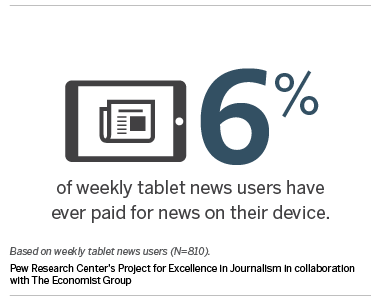
The survey suggests that the broadening of the tablet universe has not made people more likely to pay for content – or at least to pay for news. Indeed, this broader population of tablet owners was somewhat less willing to pay than the first generation of adopters. Just 6% said they have ever paid for news on their tablet, compared with 14% in 2011. 

But the picture is a little brighter when mobile news users (those who get news on a tablet and/or a smartphone) are asked specifically about paying for digital subscriptions.

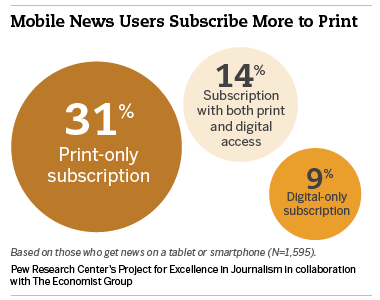
In all, 19% of mobile news users have some kind of digital news subscription: 14% bundled with print and 9% digital only, with some overlap of those who have both.

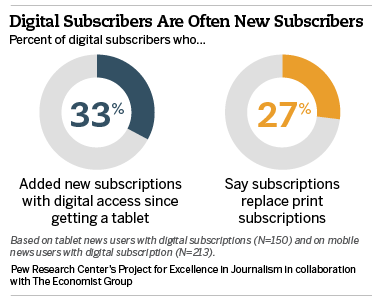
The tablet also seems to have created some momentum toward these subscriptions. A third of tablet news users with digital subscriptions, 33%, say they have added some kind of new digital subscriptions since getting their device. But only a quarter, 27%, say their digital subscriptions have replaced those they used to get in print, suggesting that a majority of these digital subscribers represent a new source of revenue for news.  

At the same time, though, there appears to be another set of mobile news users who carry a strong loyalty to print news publications. Nearly a third, 31%, of mobile news consumers pay for a print-only subscription, twice the number who said they had paid for a bundled digital print subscription and three times those who pay for digital only, at 9%. The higher print-only rate is true of both tablet news users and smartphone news users.

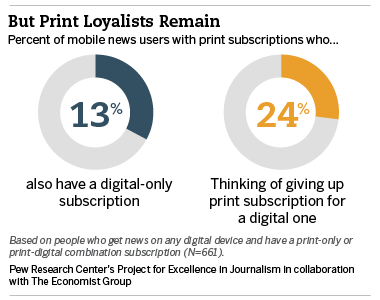
These print subscribers are also loyal to the paper version, even though they own mobile devices. A majority has a bundled subscription of some sort, but just one in ten has a digital-only subscription. And only a quarter of print-only subscribers, 24%, say they have thought about giving up their print subscription in favor of subscribing to the same publication(s) digitally.

In other words, there are two distinct audiences in mobile, the new digital subscriber and the print loyalist. Mobile is creating new subscribers among the first group and probably increasing the total amount of news consumption of the second. Yet the extent to which the two groups have different preferences and interests represents both an opportunity and a challenge for news organizations.

And increasing the number of new digital subscribers may not be that easy. Of the mobile news users who don’t have any news subscriptions at all, print or digital, only 3% say they are considering paying for one.

Who is likely to have digital subscriptions? Lower-income users reported more often than wealthier users to have paid for a digital-only subscription (19% of those with household incomes of $30,000 or less versus 8% of households earning $75,000 or more). Conversely, tablet news users with higher incomes were more likely to buy a print-only news subscription; 37% of those earning $75,000 or more paid for a print subscription, versus 23% of those earning less than $30,000.

Advertising

The other main hope for revenue on mobile devices is advertisements. On computers, years of research have raised significant questions about whether consumers are irritated by or even notice online ads. And there are so many new websites launching all the time that the price that any news producer can charge for ads online keeps dropping. Does the tablet change the calculus? Do ads on tablets, with their higher resolution and more print-like interface, change the way people react to them?

There are some encouraging signs in the data for those hoping ads will gain more of a foothold for news on tablets, or even smartphones, than they have on news websites. To begin with, about half of tablet news users, 49%, sometimes or often notice ads when getting news on their tablet (35% hardly ever and 15% never notice ads).

This may hold particular promise for customized ads as well as those designed mainly to deliver a message and create brand recognition.

Digital ads can also be built around e-commerce, in which users click through to a new domain and ultimately make a purchase of some sort.  

Here the numbers are smaller, but do seem to be higher than click-through rates on the conventional computer. Overall, 49% of tablet news users say they notice ads and 14% sometimes click on them.  And fewer still, 7% of tablet news users, buy things at least sometimes. That amounts to 2% of all U.S. adults who often or sometimes buy goods or services by clicking through ads they saw while getting news on their tablet.   

While these numbers may seem small, recent data from Ad Age reports click-through rates for display ads to be less than 1%, meaning that the tablet may be a much more effective advertising delivery platform than conventional computers have been.

Despite the difference in screen size, the survey found that the numbers about ads for smartphone news use are strikingly similar: 50% sometimes or often notice ads when getting news there; of those who notice them, 15% at least sometimes click on them and from there 20% at least sometimes buy things. That amounts to 6% of all smartphone news users buying things from ads they notice at least sometimes (about 3% of all adults).

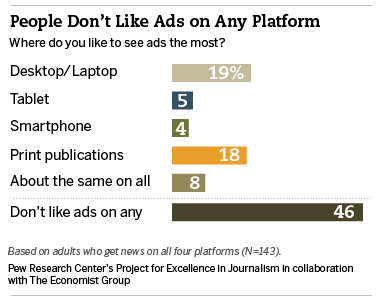
Even if they notice ads and even click through them at decent rates, mobile news users are no fonder of them in the mobile realm than elsewhere. When those who get news on all four platforms (tablet, smartphone, laptop/desktop, print) are asked to compare ads across platform, no platform comes out on top. People are somewhat more likely to notice ads on a conventional computer, but overall they say they don’t like ads on any platform. When asked which platform they like ads on the most, nearly half, 46%, said none of them.

Still, while people don’t much enjoy seeing ads on their mobile devices – or anywhere for that matter, they are becoming accustomed to shopping through these mobile devices. About a third of tablet owners (36%) shop at least weekly on that device. That is even a slightly greater rate than seen on the smartphone, where a quarter of owners shop at least weekly.

This raises the question of whether some other kind of economic equation, beyond advertising, might be part of the formula for monetizing digital news content. The options here are harder to imagine, but they could include sharing consumer information for use in tailoring content, or trying to become better connected to digital retail directly. Another option may be to make the experience feel more like shopping than seeing an ad. 

Data Plans Help in Tablet Spending

One group that stands out for being more inclined to spend money via their tablet are those who have a mobile data plan-those who have paid to access the internet from their tablet anytime and virtually anywhere.

Overall, just 26% of tablet owners have a data plan on their tablet. But this survey was conducted before new “data sharing plans” became available from wireless carriers, which could quickly expand the population that has internet access on their tablet at all times.  It is a population worth watching as their habits stand out in many ways. They are more likely to have iPads than those who do not have a plan (65% versus 48%) and are more likely to get news on their tablet multiple times a day (50% versus 33% for those who don’t have a data plan). 

Perhaps what stands out most, though, is the potential they seem to carry in terms of revenue. These users are far more likely to have subscriptions of all kinds; 43% have a print only-subscription, versus 30% who don’t have a plan; 25% have a subscription that gives both print and digital access (versus 15% who don’t have a plan) and 16% have a digital-only subscription, double that of those who don’t have a plan (7%) – and higher than for mobile news users overall (11%).

[1]

Those with data plans are also more likely to engage in e-commerce through tablet ads. Fully 28% who click at least sometimes, buy things – versus 13% without a plan and 18% overall. Across the wider population this means that 14% of all people with a data plan sometimes buy things from ads they see versus 5% of all those who do not have a plan.


Footnote

[1]

The App vs. Browser Debate Continues

Another element of the revenue question is how much to build content inside apps – applications that come pre-loaded and that people can download to the devices.  Many believe that apps, purposefully built for the  touch screen environment, better set up  for reading (at least initially) and offering the ability to read offline, would appeal to users and perhaps provide a way to begin to monetize digital content in the mobile space in a way that has proven elusive on conventional computers. This could be particularly important for smartphones, where the efficacy of advertising is even more of a question because of the size of the screen. But apps also require a whole new set of programming for each operating system and screen size, which means more staff and budget resources. 

The survey finds that while apps are pervasive on mobile devices, they are far from the universal choice, at least for news. In fact, over the last year, tablet news users moved more toward browsers. The survey even revealed some confusion over what apps even are. When tablet news users were initially asked if they had news apps on their tablet about half, 48%, said yes. The other half of tablet news users who initially said they did not have news apps (52% overall) were provided with a definition of an app and then asked again if they have any. An additional 22% of tablet news users (71% of those who received the follow-up question) then said they in fact had news apps. These users, however, were far more likely to turn to the browser than the apps for news – and to display tablet news habits more in line with other browser users.

Overall, the majority of mobile news users get most of their news on mobile devices through browsers – 60% of tablet news users and 61% of smartphone news users. Less than half as many, 23% of tablet news users and 28% of smartphone news users, mainly go through apps. And 16% and 11%, respectively, say they use apps and the browser equally.

Use of apps is greater on Apple devices – for both tablet and smartphone news users. Fully 72% of tablet news users who use apps and the browser equally have an iPad, as do 66% of those who mostly use apps. Among those who mostly use the browser, about as many have an Android tablet (49%) as have an iPad (52%).  For smartphone news users, it is just those who mostly use apps who are more likely to have an iPhone, 54% versus 36% among than those who mostly use the browser and 35% of those who use both equally.

[1]

[2]

First, people who use apps for news are more likely to use their tablet every day. In all, 89% of those who mostly use apps get news on their tablets daily, as do 88% of those who use apps and the browser equally. Fewer, 74%, of those who mostly use their browser get news daily. And they are more likely to be adding specifically to their news time. Fully 43% of those who mostly use apps, and 43% of those who use apps and the browser equally, say they spend more time getting news now that they have a tablet (versus 25% of those who mostly use the browser).

App news users also turn to more sources – 29% of those who mostly use apps and 21% of those who use both equally and regularly – get news from four or more sources, compared with just 11% of those who mostly use the browser. And, they turn to new news sources.  About half of mostly app users (54%) and those who use apps and the browser equally (46%) get news from new sources. Just 19% of mostly browser users say they get news from new sources.

There are also a few places where app-only tablet news users stand out even from those who use both equally, and vice versa.

Mainly app tablet news users stand out for their in-depth news habits. Fully 90% read in-depth news articles at least sometimes, compared with 74% of those who use both equally and 68% of mostly browser users. And fully 83% of mainly app users read in-depth articles they were not initially looking for (versus 74% of those who use both equally and 67% of mostly browser users). App news users also stand out from browser users in reading one or more articles at least a fair amount of the time when they are checking headlines (82% of mostly app users and 80% of those who use both equally versus 63% of those who get news mostly through their browser).

Those who use both equally seem to have a greater appreciation for what technology can bring to the content. They are nearly evenly split between wanting a traditional print-like experience and wanting interactive components (49% to 51%) while those who mostly use apps lean more toward wanting a print experience (63% to 37%). 

Perhaps most promising for news organizations, the data suggest that tablet news users who use apps to either degree are more likely to pay for news. They are about twice as likely to have a digital subscription – 38% of those who mostly use apps and 36% of those who use both equally have a digital news subscription-compared with just 17% of tablet news users who mostly use the browser. And those who use news apps on the tablet are more likely to have paid for news there, with those who use the browser and apps equally the most likely of all: 17% of that group said they have paid for news on their tablet, versus 9% of mainly app users and just 2% of mostly browser users.

There are far fewer differences between those who use apps on their smartphone and those that mostly use their browser. But when it comes to news activities, those who mostly use apps or use both equally are more likely to check headlines and read in-depth articles. Fully 83% of those who use both equally read in-depth articles on their phones, as do 73% of mostly app users. That compares to only about half, 52%, of mostly browser users. But on two other activities – just those who use both equally stand out. They are more likely to watch news videos (54%, versus 29% of mainly app and 29% of mainly browser users). They also are more likely than the mainly apps users to receive news through email or social networking (54% vs. 40%).


Footnotes:

[1]

[2]

Tablet Only, Smartphone Only, or Both – Digital Divides

As mobile and digital platforms continue to explode, one set of differences news organizations and advertisers will be interested in are the news habits of those who choose one device over another and those who get news on multiple mobile devices. Already, the data show some clear distinctions.

In addition to spending more total time with news, dual-device news users are more drawn to using apps for news on their tablet. Fully 58% of those who get news on both a tablet and smartphone have news apps on their tablet, compared with 37% who just get news on the tablet. And, more than a quarter, 27%, mostly get news through apps, versus 18% who just get news on the tablet. Conversely, 54% mainly use the browser, compared with 66% of tablet-only news users. On the smartphone, these differences don’t come through as about half of each group (those who just use the smartphone and those who use both), have news apps and a majority of each get news mostly through the browser.

Dual-device news users are also more active news consumers on each of their devices than are those who just use one device. On the tablet, nearly all in both groups read headlines regularly, but dual-device news users are more likely to follow those headlines and read full articles (76% of dual-device news users who check headlines do so at least a fair amount of the time versus 60% of tablet-only news users). Those who get news on both mobile devices are also more likely to at least sometimes read in-depth articles on their tablet (82% versus 62%). Dual-device users are more likely to read past issues of magazines on their tablet, 35% versus 19% of tablet own mobile news users. 

Using the tablet for social networking is also much greater among dual-device news users. They are more likely to get news through email or social networking (47% versus 28%) and to share news that way (38% versus 24%). And nearly a quarter, 23%, regularly or sometimes post comments to news articles versus just 9% of tablet-only news users.

On the phone, the only difference that stands out is greater video news watching among dual-device news users (39% versus 29% of those who just get news on a smartphone).

Perhaps the difference that stands out most is willingness to pay. Dual-device users are more likely than tablet-only news users to have paid for news on the tablet (though still only 9% of dual device news users have paid, compared with 2% of tablet only news users).  

In addition, those who get news on both mobile devices are more likely to have a news subscription of any kind – print or digital. About half, 51%, have a news subscription, compared with 38% of tablet only news users and 36% of smartphone only news users.  Those who get news on a tablet and smartphone are more likely to have print and digital news subscriptions. What’s more, these dual mobile device news users are considering giving up their print subscriptions at a far higher rate, 38%, than those who just use one of the mobile devices but also have a print subscription (20% tablet only news users; 17% smartphone only news users).

Cross-Platform Use-Desktops Remain Important

PEJ has documented in the past that as people expand their mobile news landscape, they are not abandoning older platforms. The data in this new survey confirm those findings and add greater insight into the appeal of these cross-device and cross platform news users to both news organizations and those that advertise with them. 

Close to half, 45%, of mobile news consumers (those who gets news on a tablet, smartphone or both) get news on a desktop/laptop daily and 75% do so at least weekly. Print is not nearly as popular, with 45% getting news from print publications weekly and just 18% doing so daily (25% never do).

When asked about the platform they prefer most for different kinds of news consumption, a fondness for these older forms comes through. A majority (56%) of digital news consumers who also get news on the laptop/desktop but not in print prefer the desktop most for news. But digital news users who also get news in print are more divided – 38% prefer print and 34% the desktop or laptop with even fewer preferring the tablet (16%) or smartphone (12%).  

For longer articles, the preference for print among those who get news that way is even stronger; 57% of digital and print news consumers prefer reading in-depth articles in print while just 26% prefer the desktop/laptop computer. And among the digital news consumers who do not get news in print, fully 72% prefer their conventional computer for reading in-depth articles.

Mobile news consumers also still turn to their desktop or laptop for their social networking use. More digital news consumers use their computer (58%) most often for sharing and receiving news through social networks than their smartphone (24%) and their tablet (13%).

Once-a-Day Mobile Users vs. News Throughout the Day

While only a minority (38% of tablet news users and 42% of smartphone users during the week) get news multiples times throughout the day, their news habits stand out from those who check in just once a day. And this continuous news consumer group probably carries a good deal of appeal for both news organizations and advertisers.

Tablet news users who get news multiple times per day during the week turn to more sources or apps, on their tablet and get news from new sources more often. About a quarter, 27%, turn to four or more sources versus 10% of those who get news just once a day. Instead, a full quarter of once-a-day tablet news users have just once source or app they turn to regularly, and another 11% say they don’t have any regular news sources on their tablet. In addition a full 43% of several-times-a-day tablet news users regularly get news from new sources, compared with just 26% of those who tune in once a day. 

Those who get news more often are far more active tablet news consumers. They are more likely to sometimes or regularly read in-depth news articles (85% versus 68%) to watch news videos (63% versus 50%) receive news through email or social networks (49% versus 32%) and to share news with others (41% versus 26%). They are more likely to check headlines daily and when they do so, to end up reading full articles (84% do so at least a fair amount versus 60% of once a day news users).And these multiple-times-a-day news consumers who read in-depth articles are more likely to say they  read articles that they were not initially looking for (80% at least somewhat often versus 67% of one-time-a-day tablet news users) and twice as likely to read back issues of magazines, 44% versus 19%. Heavy majorities of both groups say some or most of the in-depth articles they read are for personal interest, but these multi-time users are twice as likely to read things recommended to them from friends or family (31% versus 16%) and to read things for work (43% say some or most are for work versus 30% of once a day news users). 

These several-times-a-day tablet news users also exhibit much more willingness to spend. These more frequent news users are twice as likely to have paid for news on their tablet: 10% versus 4% among those that tend to get news just once a day. Both groups of users notice ads when getting news on their tablet to the same degree but the more frequent users click on the ads they notice more often (26% often or sometimes versus 11% of those who get news one time a day) and end up buying form the ads they click on (26% versus 11%). More frequent tablet users are not more likely to have news subscriptions in general, but they are twice as likely to have a digital only subscription (16% vs. 8%).

Smartphone news users who get news throughout the day during the week show similar tendencies in the range of news activities. They turn to a wider range of sources: 20% regularly turn to four or more versus 6% of once-a-day smartphone news users – 43% of whom turn regularly to just once source. Nearly three quarters, 72%, read in-depth articles regularly or sometimes on their phones versus 57% of once a day news users. They are also more likely share news through email or social networking 41% vs. 31%.

But they don’t exhibit the same greater tendency to interact or purchase things from the ads on their phone or to have digital only subscriptions.

And in what is perhaps the clearest depiction yet of the 21st Century news junky, getting news on mobile devices throughout the day does not make you less likely to turn to print or to your laptop/desktop. Those who get news throughout the day on either the phone, the tablet or both are just as likely to get news on a laptop/desktop and to get news in print as those who use mobile devices once a day for news.  

Social Networking and Mobile Devices

[read more here]

Just over half, 56%, of tablet owners use their devices at least weekly for social networking. That is the same as in the summer of 2011 and is on par with playing games but higher than reading books or watching video. On the smartphone, 62% use social networks at least weekly. But most of these, 46% of all owners, use their smartphone for social networking on a daily basis.  Only one third of tablet owners access their social networks through their tablets each day.

When it comes to social networking and news, smartphone owners again rely on social networks a bit more for news. Nearly half of smartphone news users, 47%, receive news through email or social networks sometimes or regularly while 35% share news this way at least sometimes. On the tablet, somewhat fewer get news this way, 39%, while a similar percentage shares news through social networking, 32%. 

For both kinds of mobile news users, though, the conventional computer remains the preferred place for sharing and receiving news through social networks. Roughly half of those who get news on more than one digital device, 48%, prefer the laptop most for sharing and receiving news via social networks. Just under a quarter named tablets or smartphones (24% and 13% respectively).

Ethnicity and News Consumption

The data also contain some hints that mobile technology is possibly being embraced by minority populations as a news source for reading in ways that newspapers never were.

While overall, blacks are somewhat less likely to own a tablet than are whites (14% vs. 22%), those who do are more likely to get news on it daily (56% of black tablet owners are daily news consumers on the devices versus 36% for whites).

Hispanics are just as likely to own a tablet (24%) as are whites, and just as likely, too, to be daily news consumers on the devices (37%).

And Hispanics are also more likely than whites to own smart phones (51% vs. 40%), and just as likely as whites (36% each) to be daily news consumers on them. 

This higher level of news consumption by blacks on tablets, and the relatively equal level of news consumption on both tablets and phones by Hispanics, stand in contrast to data going back many years about newspaper readership. In its biennial media consumption survey this year, for instance, the Pew Research Center for the People & the Press found that whites were more likely to be daily print newspaper readers (34%) than were either African Americans (24%) or Hispanics (13%).

The mobile news consumption data thus may hint at something new. Perhaps tablets and smartphones, which provide ready access to news from any source at lower cost of entry than desktop computers, may translate into a powerful news consumption tool for populations that felt underserved by the media in legacy forms.

Methodology

The analysis in this report is based on a survey conducted June 29-August 8, 2012 among a sample of 9,513 adults, 18 years of age or older. The survey was conducted by GfK Knowledge Networks (KN) among a random sample of households in their nationally representative online research panel. KN panel members are recruited through probability sampling methods and include both those with internet access and those without (KN provides internet access for those who do not have it and, if needed, a device to access the internet when they join the panel). A combination of random digit dialing (RDD) and address-based sampling (ABS) methodologies have been used to recruit panel members (in 2009 KN switched their sampling methodology for recruiting panel members from RDD to ABS). The panel includes households with landlines and cell phones, including those only with cell phones, and those without a phone. Both the RDD and ABS samples were provided by Marketing Systems Groups (MSG). KN continually recruits new panel members throughout the year to offset panel attrition as people leave the panel. The survey was conducted in English.

Respondents were selected randomly from eligible adult household members of the panel. A total of 9,513 adults responded to the initial screener questions to determine whether they owned a smartphone or tablet computer; the 4,875 who did not own either device were terminated and did not receive any additional questions. To reach target sample sizes, sample selection procedures were used to terminate certain respondents. Of the 2,013 adults who own and use a tablet computer and the 3,947 adults who own a smartphone, 45% of smartphone owners (including those who also own a tablet) were randomly selected to continue with the survey (while the other 55% were terminated) after answering questions about how often they did certain activities on their tablet (Q.14) and/or smartphone (Q.54), including get news on their devices; the order of the tablet and smartphone series was randomized for those with both devices. All of those who got news on their mobile device weekly or more continued with the remainder of the interview while 33% of those who did not consume news on their device weekly continued (and 67% were terminated). This resulted in a sample of 810 tablet news users and 1,075 smartphone news users who received the full survey, including the detailed questions about news consumption on their mobile devices and other platforms. The survey was fielded in two parts. The first phase was conducted from June 28-July 17,, 2012 with 2,051 adults interviewed. After analysis of the preliminary data and a few telephone follow-up interviews were conducted, a few small changes were made to the questionnaire (and are noted in the topline), and the second phase was conducted August 1-8, 2012 with 7,462 adults interviewed. All sampled members received an initial email to notify them of the survey and provide a link to the survey questionnaire. Additional follow-up reminders were sent to those who had not yet responded as needed.

The final sample of 9,513 adults was weighted using an iterative technique that matches gender, age, race/ethnicity, education, region to parameters from the June 2012 Census Bureau’s Current Population Survey (CPS). In addition, the sample is weighted to match household income to a parameter from the March 2011 CPS survey and to match current patterns of internet access from the October 2010 CPS survey. This weight is multiplied by an initial sampling or base weight that corrects for differences in the probability of selection of various segments of KN’s sample and by a panel weight that adjusts for any biases due to nonresponse and noncoverage at the panel recruitment stage (using all of the parameters described above as well as home ownership status and metropolitan area from the June 2012 CPS). Details about the KN panel-level weights can be found at http://www.knowledgenetworks.com/knpanel/KNPanel-Design-Summary.html.

Because of the differential selection procedures employed in the survey, an additional weighting step was taken to correct for any potential bias introduced by these selection procedures (even though random selection procedures were employed). This step weighted the sample of 1,928 mobile device owners selected for the complete survey to match the characteristics of the full sample of 4,638 device owners screened. The sample was weighted using an iterative technique that matches gender, age, race/ethnicity, education, region, metropolitan area, household income, internet access and news consumption among tablet-only owners, smartphone-only owners and those that own both devices to targets derived from the weighted sample of all device owners screened.

Sampling errors and statistical tests of significance take into account the effect of weighting at each of these stages. The margin of sampling error at the 95% confidence level is plus or minus 3.4 percentage points for results based on tablet users (n=2,013) and 5.4 percentage points for tablet news users (n=810). The margin of sampling error is 2.4 percentage points for smartphone owners (n=3,947) and 4.7 for smartphone news users (n=1,075). Sample sizes and sampling errors for other subgroups are available upon request.

In addition to sampling error, one should bear in mind that question wording and practical difficulties in conducting surveys can introduce error or bias into the findings of opinion polls.

Topline

Please click here for a PDF of topline data tables.

Press Release

CONTACT:
PEJ Deputy Director Amy Mitchell, Director Tom Rosenstiel at PEJ or Amy Jaick, The Economist Group Communications Manager at 212.641.9834

The Future of Mobile News

New Study Finds Half of U.S. Adults Have Mobile Internet – With Big Implications for News


October 1, 2012
-The percentage of Americans who have mobile internet access has risen dramatically in the last year, a trend that is rapidly changing how people get news and the implications for how to finance it, according to a new, detailed survey of news use on mobile devices conducted by the Pew Research Center’s Project for Excellence in Journalism (PEJ) in collaboration with The Economist Group.

The study is based on a survey conducted from June 29 to August 8 among 9,513 adults including 4,638 mobile device owners.  The survey updates trends from a comprehensive, first-of-its-kind study of news consumption habits on tablets conducted a year ago by both organizations.

Nearly a quarter (22%) of adults now own some kind of tablet computer, double the number a year ago (11%), and smartphone ownership is up nine points, from 35% to 44%.  As a result, half of all Americans (50%) now have mobile internet access through either a tablet or a smartphone.

Fully 64% of tablets owners and 62% of smartphone owners say they use the devices for news at least weekly, according to the survey.  And a third of all U.S. adults now get news on a mobile device at least once a week. And Americans are doing more than just clicking headlines on their mobile devices: 73% of adults who consume news on their tablet read in-depth articles at least sometimes, including 19% who do so daily.

“Even with the broadening population and wide range of competing activities, mobile owners are drawn to news on their tablet and smartphones,” said PEJ deputy director Amy Mitchell. “The evidence is also mounting that mobile devices are adding to, rather than replacing, how much news people consume,” said Mitchell.  In all, 43% of tablet news users say their tablets are adding to the amount of time they spend with the news and 31% say they are getting news from new sources they didn’t use before.

At the same time, consumers are not yet taking advantage of all the aspects of mobile technology.  For instance, while mobile devices would allow people to get news wherever they are, most people use their tablets and smartphones for news at home, and usually just once a day.

The survey also explores the financial implications of mobile news consumption.  Nearly a fifth (19%) of mobile news consumers has paid for a digital subscription of some kind in the last year.   Still, a greater percent, 31%, report having a print only subscription and many of them remain loyal to print.   Just a quarter (24%) of those with print subscriptions are considering giving them up for a digital one.

“There are a variety of activities one can do on a mobile device today,” said Paul Rossi, managing director and executive vice president of The Economist Group, Americas.”However, even with all those options, reading is still one of the most popular activities. With more people than ever before using these devices, this clearly represents an incredible opportunity for publishers across the country.”

Among other findings:

  • Just over half, 52%, of tablet owners report owning an iPad, compared with 81% a year ago. Fully 48% now own an Android-based device, including two in ten, 21%, who own a Kindle Fire.
  • Rather than replacing old technology, the introduction of new devices and formats is creating a new kind of “multi-platform” news consumer. More than half, 54%, of tablet news users also get news on a smartphone; 77% also get news on a desktop/laptop and 50% get news in print. What’s more, 25% of get news on all four platforms.
  • Those who get news throughout the day on their mobile devices are more engaged news consumers. People who get news on their devices multiple times per day, on either the smartphone or tablet, tend to turn to more sources, get news from new sources, read in-depth news articles, watch news videos and send and receive news through email or social networks. Tablet news consumers who get news more than one time during the day are also twice as likely as those who get news once a day to have paid for news on their tablet (10% versus 4%).
  • There has been movement over the last year toward using the browser rather than apps for tablet news consumption. Fully 60% of tablet news users mainly use the browser to get news on their tablet, just 23% get news mostly through apps and 16% use both equally. In 2011, 40% got news mostly through a browser, 21% mostly through apps and 31% used both equally. But as was revealed in the 2011 survey, app news users—and those who use both apps and the browser equally—remain in many ways more engaged and deeper news users than those who mostly use their browser.  The browser is preferred on the smartphone as well (61% get news mostly through a browser, 28% mostly through apps and 11% use both equally).
  • Two distinct news audiences have emerged on tablets-new-found digital customers and those who originally turned to that outlet in print form and are still loyal to the print product. Nearly a fifth of mobile news users, 19%, have paid for a digital news subscription of some kind in the last year, and a third of tablet news users with digital subscriptions have added them since they acquired the device.  But even more mobile news users, 31%, have print-only subscriptions, and three quarters of these have no plans to give them up.  These print subscribers also prefer their app-based news to be more like a traditional reading experience rather than to have high-tech features.  For the news organizations, this brings both the potential for new audiences as well as the challenge of accommodating the differing styles and approaches of these distinct audiences.
  • A sizable percentage of people notice ads on mobile devices. Half of mobile news users-49% of tablet news users and 50% of smartphone news users-sometimes or often notice ads when they are getting news on their mobile device. But roughly 15% click on ads when getting news on one of the mobile devices and about 7% actually buy something.

In addition to the main report, PEJ and The Economist Group released an infographic of the main findings, and invited designers to offer their own accurate, clear and innovative data visualizations through a data visualization challenge. Selected infographics will be featured on PEJ’s website, The Economist‘s Tumblr, Pinterest, and Facebook pages, and The Economist‘s Graphic Detail blog.   

###

The Project for Excellence in Journalism tracks the transformation of journalism in a changing information landscape through its annual State of the News Media report and other research reports. As part of the nonpartisan, non-advocacy Pew Research Center, it does not take positions on policy issues.

About The Economist Group

The publications and services delivered under The Economist brand are The Economist magazine, Economist Digital, Economist Intelligence Unit, Economist Conferences, The World In series and Intelligent Life. The Group’s other brands include CQ Roll Call and European Voice (aimed at decision-makers on Capitol Hill and in Brussels respectively), EuroFinance, a cash and treasury management event business, digital media agency TVC Group and an online advertising network, the Ideas People Channel. The Economist Group is privately owned.