Pew Research Center

FOR RELEASE JULY 16, 2012

YouTube & News

News is becoming a major part of what Americans watch on YouTube. In the last 15 months, a third of the most searched terms on the video sharing site were news related. A new study by the Project for Excellence in Journalism explores the character of news on YouTube.

BY Pew Research Center: Journalism & Media staff

FOR MEDIA OR OTHER INQUIRIES:

Communications Department
202.419.4372
www.pewresearch.org

RECOMMENDED CITATION

Pew Research Center, July 2012, "YouTube & News"

About Pew Research Center

Pew Research Center is a nonpartisan, nonadvocacy fact tank that informs the public about the issues, attitudes and trends shaping the world. It does not take policy positions. The Center conducts public opinion polling, demographic research, computational social science research and other data-driven research. It studies politics and policy; news habits and media; the internet and technology; religion; race and ethnicity; international affairs; social, demographic and economic trends; science; research methodology and data science; and immigration and migration. Pew Research Center is a subsidiary of The Pew Charitable Trusts, its primary funder.

© Pew Research Center 2026

Table of contents

  • About Pew Research Center
  • YouTube & News
  • Top Stories
  • News Videos Compared with the Top Videos
  • YouTube Video Creation–A Shared Process
  • Who Posts the Videos
  • Edited Footage vs. Raw Footage
  • Not a Celebrity Medium–When it Comes to News
  • Philip Franchina–A YouTube Phenomenon
  • Qualities of Engagement
  • Video Length
  • Leading Topics
  • A Visual Discussion of the Study
  • Methodology
  • Press Release

YouTube & News

News is becoming a major part of what Americans watch on YouTube. In the last 15 months, a third of the most searched terms on the video sharing site were news related. A new study by the Project for Excellence in Journalism explores the character of news on YouTube.

A New Kind of Visual News

See a visual discussion of the findings.

[1]
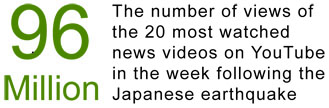
In the seven days following the disaster (March 11-18), the 20 most viewed news-related videos on YouTube all focused on the tragedy-and were viewed more than 96 million times.

What people saw in these videos also represented a new kind of visual journalism. Most of that footage was recorded by citizen eyewitnesses who found themselves caught in the tragedy. Some of that video was posted by the citizens themselves. Most of this citizen-footage, however, was posted by news organizations incorporating user-generated content into their news offerings. The most watched video of all was shot by what appeared to be fixed closed-circuit surveillance camera at the Sendai airport.

The disaster in Japan was hardly a unique case. Worldwide YouTube is becoming a major platform for viewing news. In 2011 and early 2012, the most searched term of the month on YouTube was a news related event five out of 15 months, according to the company’s internal data.

What is the nature of news on YouTube? What types of events “go viral” and attract the most viewers? How does this agenda differ from that of the traditional news media? Do the most popular videos on YouTube tend to be videos produced by professional news organizations, by citizens or by political interest groups or governments? How long does people’s attention seem to last?

[2]

The data reveal that a complex, symbiotic relationship has developed between citizens and news organizations on YouTube, a relationship that comes close to the continuous journalistic “dialogue” many observers predicted would become the new journalism online. Citizens are creating their own videos about news and posting them. They are also actively sharing news videos produced by journalism professionals. And news organizations are taking advantage of citizen content and incorporating it into their journalism. Consumers, in turn, seem to be embracing the interplay in what they watch and share, creating a new kind of television news.

At the same time, clear ethical standards have not developed on how to attribute the video content moving through the synergistic sharing loop. Even though YouTube offers guidelines on how to attribute content, it’s clear that not everyone follows them, and certain scenarios fall outside those covered by the guidelines. News organizations sometimes post content that was apparently captured by citizen eyewitnesses without any clear attribution as to the original producer. Citizens are posting copyrighted material without permission. And the creator of some material cannot be identified. All this creates the potential for news to be manufactured, or even falsified, without giving audiences much ability to know who produced it or how to verify it.

Among the key findings of this study:

  • The most popular news videos tended to depict natural disasters or political upheaval-usually featuring intense visuals. With a majority of YouTube traffic (70%) outside the U.S., the three most popular storylines worldwide over the 15-month period were non-U.S. events. The Japanese earthquake and tsunami was No. 1 (and accounted for 5% of all the 260 videos), followed by elections in Russia (5%) and unrest in the Middle East (4%).
  • News events are inherently more ephemeral than other kinds of information, but at any given moment news can outpace even the biggest entertainment videos. In 2011, news events were the most searched term on YouTube four months out of 12, according to YouTube’s internal data: the Japanese Earthquake, the killing of Osama bin Laden, a fatal motorcycle accident, and news of a homeless man who spoke with what those producing the video called a “god-given gift of voice.” Yet over time certain entertainment videos can have a cumulative appeal that will give them higher viewership.
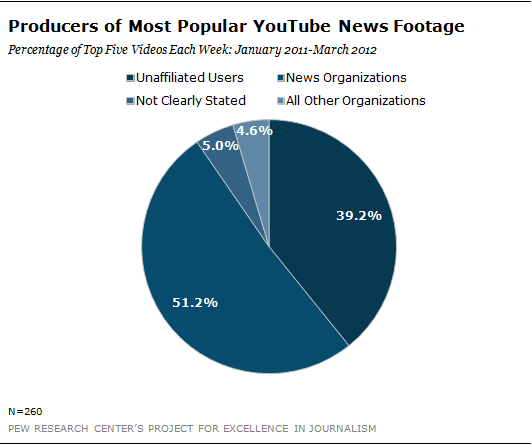
  • Citizens play a substantial role in supplying and producing footage. More than a third of the most watched videos (39%) were clearly identified as coming from citizens. Another 51% bore the logo of a news organization, though some of that footage, too, appeared to have been originally shot by users rather than journalists. (5% came from corporate and political groups, and the origin of another 5% was not identified.)
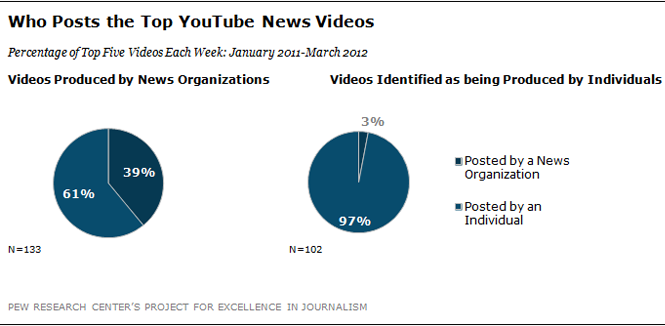
  • Citizens are also responsible for posting a good deal of the videos originally produced by news outlets. Fully 39% of the news pieces originally produced by a news organization were posted by users. (The rest of the most popular news videos of the last 15 months, 61%, were posted by the same news organizations that produced the reports.) As with other social media, this has multiple implications for news outlets. Audiences on YouTube are reshaping the news agenda, but they are also offering more exposure to the content of traditional news outlets.
  • The most popular news videos are a mix of edited and raw footage. Some pundits of the digital revolution predicted that the public, free to choose, would prefer to see video that was unmediated by the press. The most viewed news videos on YouTube, however, come in various forms. More than half of the most-viewed videos, 58%, involved footage that had been edited, but a sizable percentage, 42%, was raw footage. This mix of raw and edited video, moreover, held true across content coming from news organizations and that produced by citizens. Of videos produced by news organizations, 65% were edited, but so were 39% of what came from citizens.
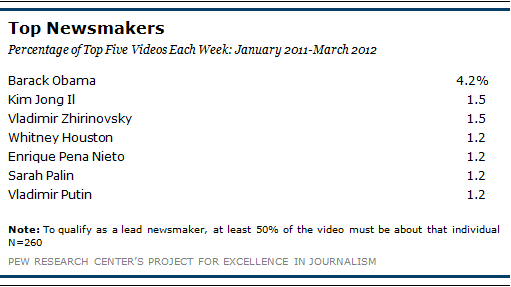
  • Personalities are not a main driver of the top news videos. No one individual was featured in even 5% of the most popular videos studied here-and fully 65% did not feature any individual at all. Within the small segment of popular videos that are focused on people, President Barack Obama was the most popular figure (featured in 4% of the top videos worldwide). These ranged from speeches posted in their entirety to satirical ads produced by his political opponents.
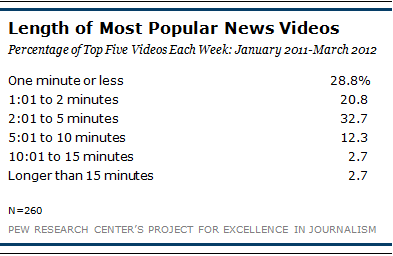
  • Unlike in traditional TV news, the lengths of the most popular news videos on YouTube vary greatly. The median length of the most popular news videos was 2 minutes and 1 second, which is longer than the median length of a story package on local TV news (41 seconds) but shorter than the median length on national network evening newscasts (2 minutes and 23 seconds). But the variation in the length of the YouTube videos stands out even more. While traditional news tends to follow strict formulas for length, the most popular news videos on YouTube were fairly evenly distributed-from under a minute (29%), one to two minutes (21%), two to five minutes (33%) and longer than five (18%).[4]

The news viewership on YouTube is probably still outpaced by the audience for news on conventional television worldwide. While those top 20 tsunami videos were viewed 96 million times worldwide the week of the disaster, for instance, more people almost certainly watched on local and national television around the globe. Twenty-two million people on average watch the evening news on the three broadcast channels each night in the United States alone, and larger numbers watch local TV newscasts.

But YouTube is a place where consumers can determine the news agenda for themselves and watch the videos at their own convenience-a form of “on demand” video news. In the case of the Japanese earthquake and tsunami, audience interest continued for weeks. The disaster remained among the top-viewed news subjects for three straight weeks. Based on the most viewed videos each week listed by YouTube, it was also the biggest news story on the site for 2011.

[5]

Seven years after it was developed by three former employees of PayPal, the reach of YouTube is enormous. The video sharing site is now the third most visited destination online, behind only Google (which owns YouTube) and Facebook, based on data compiled by Netcraft, a British research service. According to the company’s own statistics, more than 72 hours of video are uploaded to YouTube every minute. The site gets over 4 billion video views a day. Slightly under a third of those, 30%, come from the United States.

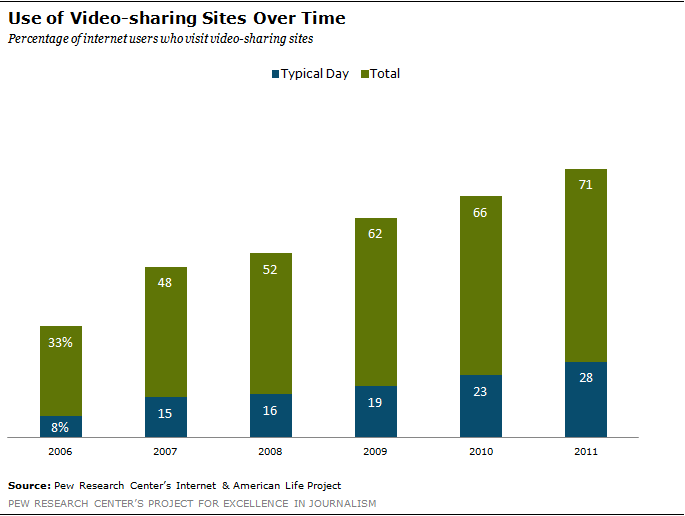
YouTube has also become a part of the lives of most Americans. Fully 71% of adults have used sites like YouTube or Vimeo at some time, according to a 2011 survey by the Pew Research Center’s Internet & American Life Project. That is up from 66% in 2010. And 28% visit them daily.
Bought by Google in 2006 for $1.65 billion in stock, YouTube has moved from being a repository of videos to becoming a force that is investing in content creation (if not doing the creation themselves). In 2007, the company created a Partner Program, which shares revenues with content creators in order to encourage the production of more creative content. That program now has more than 1 million partners in 27 countries, including news organizations such as CBS, the BBC and National Geographic. In addition, the company has given direct grants to a smaller group of news content producers as a further way of promoting new ideas and production models.

So far, the approach from news organizations has been a blend of participation and resistance. Many news outlets have developed their own YouTube channels and are avidly posting content. The Associated Press, for example, created its channel in 2006 and now boasts more than 250,000 followers and more than a billion views of its videos. (A user becomes a follower of a YouTube channel by hitting the ‘subscribe’ button, which places updates from that channel on the user’s homepage.) The New York Times’ news channel has more than 78,000 followers while Russia Today has more than 280,000. Some news services, such as ABC News, put on YouTube many of the same stories that appear on their television channel.

[6]

Some content producers have combined both approaches, posting their own content but also blocking it from being viewed in certain countries. They may choose to do this for copyright preferences or to prevent certain content from being viewed in countries that might consider it culturally insensitive.

Some non-news organizations, including governments, have also attempted to restrict the availability of their content on YouTube, mostly for political reasons. In March 2009, for example, the government of Bangladesh blocked access to the site entirely after a recording of a private meeting between the Prime Minister and army officers was uploaded. The incident occurred two days after an attempted mutiny by border guards left more than 70 people dead. Government officials insisted it was in the country’s “national interest” to block the site and more videos might worsen the tense situation. China, Libya, Pakistan and Iran have also all attempted at one point or another to block YouTube content.

The evolving government and media policies toward YouTube make understanding the nature of what news content is on the site and which is most popular all the more important.


Footnotes

[1]

[2]

[3]

[4]

[5]

[6]

Top Stories

Japan Earthquake and Tsunami

The most viewed news event on YouTube between January 2011 and March 2012 was the earthquake and tsunami that struck Japan in March 2011. For three weeks, the disaster accounted for at least one of the five most watched news videos, although the video at the top of the list shifted each week. The first week, the most watched video was what appeared to be surveillance footage of the tsunami wave hitting Sendai airport. The second week, the top video came from Britain’s Channel 4 News and showed two minutes of the waves rushing into Miyako City. The third week, the top video was footage taken from a Japanese Coast Guard vessel heading straight into a wave to avoid damage. 

After falling out of the top news videos for a week, the tsunami returned to the list for two more weeks in April. The video that attracted most attention those two weeks was footage from Russia Today showing a dog reunited with its owner three weeks after the disaster.

The video that attracted the most attention of the disaster on YouTube during these five weeks came from various sources. Some of the footage came from eyewitnesses who happened to have a camera on-hand when the disaster struck (many of these were then broadcast by Russia Today without either narration or editing).

Another form of popular video was surveillance footage from closed -circuit cameras that happened to be recording at the moment the tsunami struck as well as footage shot by official photographers in helicopters recording the waves as they crashed the coastline and destroyed buildings.

Still a fourth popular source of video were news stories broadcast by news organizations such as Al Jazeera English that summarized the events and included narration from reporters. Such videos were sometimes posted on YouTube by the news organizations and sometimes by audiences who wanted to share them. Even with some editing to provide context, what stood out in these stories, too, was the power of the raw pictures and images. The essence of these videos was their visual character rather than interpretive or explanatory components.

Russian Elections

The second biggest news storyline on YouTube during the 15 months studied was the Russian parliamentary and presidential elections. This event was drawn out over a longer period of time than the tsunami videos and was made up of two parts. The election for 450 seats in the State Duma took place on December 4, 2011. Related videos began showing up in September, four months before. Then, in the month leading up to the March 4, 2012, presidential election, there were seven videos that ranked highly on YouTube’s lists.

Overall, 12 different election-related videos that varied in content and focus made the list. Only one of the videos was a traditional broadcast news report-a September 2011 story showing Prime Minister Vladimir Putin attending the International Exhibition of Arms. Two of the videos consisted of  presidential debates posted in their entirety, suggesting that hundreds of thousands of people watched the debates on YouTube rather than on traditional television.        

Some of the footage came from surprising moments of the campaign. One was a six minute clip from a February debate in which Vladimir Zhirinovsky, the candidate of the right-wing nationalist Liberal Democratic Party of Russia, insulted singer Alla Pugacheva, a supporter of independent candidate Mikhail Prokhorov.  Zhirinovsky, who is known for strong rhetoric, responded to a comment from Pugacheva by saying, “You artists, like prostitutes, lie underneath any leader for money. You all lay under Brezhnev, under Gorbachev, under Yeltsin, under Putin. Tomorrow, I will enter the Kremlin, you will all lie under me and I will spit on you and wipe my feet on you.” Even though Zhirinovsky was never considered a strong candidate (he received only 6% of the final vote), his fiery pronouncement drew 1.5 million views the week of the debate.

YouTube also served as a platform for users to give voice to their views about the election, either in a serious or satirical manner. Many of these also contained complex digital altering, such as a 50-second fake news clip posted in February which used special effects to make it appear as if Prime Minister Vladimir Putin was on trial for corruption and terrorism. The piece, which made the list of most popular videos on YouTube for two consecutive weeks, used news footage from the 2010 trial of businessman Mikhail Khodorkovsky to produce the effect.

Middle East Unrest

The unrest, protests and violence throughout the Middle East that became known as the “Arab Spring” was the third biggest news story on YouTube during the 15 months studied. These events continued to get heavy viewing for 10 months in 2011. Early in the year, the focus was on dramatic scenes from the turmoil in Egypt. One clip, viewed more than 1.8 million times the week of February 7-11, was a cellphone video of a diplomatic car that ran through a crowd of protestors, injuring at least 20. Another from the same week depicted footage of an unidentified protestor shot and killed in the streets of Alexandria, reportedly by Egyptian police. (Warning, both videos contain graphic images.)

Three weeks later, events in Libya spurred the next round of viewing. First-person footage of gunfire in a Libyan city and an edited collection of clips from the United Nations Refugee Agency showing tensions between migrants on the border of Libya and Tunisia were among the most popular. 

Events in Libya then fell from heavy viewing for seven months but came back onto the radar in October 2011 when multiple versions of exclusive footage of the capture of former Libyan leader Col. Muammar Gaddafi, shot by an independent cameraperson and distributed by GlobalPost, received more than a million views. (Warning, the video contains graphic images.)

As with the videos regarding the Japanese quake, the most popular Arab Spring videos captured dramatic visual moments of the news as it was happening, including close-up views of violent exchanges.

News Videos Compared with the Top Videos

According to YouTube executives, there are two different paths a video can take to become viral. First is the classic viral curve-which is more in the shape of a bell or steep mountain peak. In this case a video is posted and at some point (perhaps after sitting on the site for quite a while) is “discovered” by a popular individual and takes off. There is a very fast, massive spike in views. The views reach their highest point very quickly and then fall off just as quickly, mostly vanishing.  The second style of viral video is that which has remarkable staying power. It may rise to popularity much the same way but then remains popular for months and even years, getting hundreds of thousands of views every day.

Only a small number of videos ever meet either of these scenarios. And news, which by its nature changes day to day and even hour to hour, has an even harder time. Still, certain news events have broken through. The Japanese tsunami fit the classic viral spike. The top Japanese earthquake-related video received about 1.8 million views a day during its first week. It remained a top-viewed video for the three weeks that followed. Then it declined to an average of 16,000 views a day over the subsequent 15 months. The death of Osama bin Laden also followed this classic curve. Combined, two versions of President Barack Obama’s speech announcing the killing of the al Qaeda leader were viewed roughly 680,000 times a day for the first two weeks. That fell off to an average of about 3,500 times a day in the following 14 months.

[1]


Footnote

[1]

YouTube Video Creation–A Shared Process

When it comes to the creation and posting of videos, there are three different steps: the actual capture of the video itself, putting it into a format for sharing under an individual or organization name-at times with editing or mixing of multiple videos and sometimes as raw footage-and then posting the video to YouTube.

Sometimes these steps are all done by one news organization or citizen, while sometimes each step is done by a different entity or individual. Other times it is unclear. Often hardest to discern, especially in breaking news videos, is who recorded the original footage-especially if a news organization then obtained it and then produced a video bearing its logo. Even if guidelines for giving credit appear on the YouTube site, some users and news organizations do not follow them.

Nonetheless, there is a synergy on YouTube in which eyewitnesses, journalists and audiences are interacting in a dependent loop. Citizens are creating their own video but also actively sharing news videos produced by professionals that they consider powerful. At the same time, news organizations are becoming conduits for sharing citizen video along with their own professional journalism.

Because the first step in the YouTube process-capture-can be difficult to establish, this analysis gives a general sense of who shot a particular piece of footage. It can provide a firmer sense of who posted the video and whether it involved some kind of journalistic editing.

The Capture:

Footage of news events can be recorded by many different types of people. Sometimes the person who videotapes or captures the footage-the person actually holding the camera-is a reporter or videographer working for a news organization. Other times, the video might be captured by a freelance journalist or an eye-witness citizen who happens to have a camera on-hand. In still other instances, including some of the most popular videos studied here, the video can come from a stationary camera (such as surveillance video), that may come from a municipal or even a corporate source.

Viewing the finished product, it is often impossible to determine who captured the original video.  This proved especially true in the case of natural disasters and other breaking news events.

In the most viewed videos during this time period, the events were of a magnitude that their validity was in little doubt. The videos offered visual evidence of events that had already been well established. More broadly, though, uncertainly over the authorship of a video could raise questions about credibility.  

There are cases when individuals get credit for recording footage, but that level of transparency was more the exception than the rule. One example was a video of the capture of former Libyan leader Col. Muammar Gaddafi. In the video, GlobalPost clearly identified the videographer, Ali Algadi, at the start of the piece. (Warning, the video contains graphic images.) This type of clear attribution is not common, however, suggesting that protocols or ethical expectations for transparency and assignment of credit and responsibility of the sort that might be expected in more traditional settings such as scholarly work or even conventional journalism has not evolved yet in video sharing, at least on YouTube.

News Video Producers:

After a video is captured, some person or organization takes that footage and puts it into a format that can be viewed by others. At times, this is done by the person or group who captured the video. At other times, a second party obtains and packages the footage.  

In looking at the identifications attached to these most viewed videos, the range of “producers” on YouTube falls into three broad categories, news outlets, citizens and outside organizations.

Of the three, news organizations played the largest role in creating the popular news content on YouTube, but citizens played a role almost as large. Groups of a political or organized nature played a much smaller role.

In all, news organizations produced 51% of these most popular news videos across the 15 months studied, meaning the video bore the logo of a news organization and offered no obvious sign that the video had been shot by a citizen. It is clear, though, that in some cases, such as the Tsunami, a news organization obtained some raw video from a freelance journalist or citizen witness, which it then used in a news video.

Yet at least some of the most popular video produced by news organizations was posted on YouTube not to praise the news producer to but mock it.   

Meanwhile, citizen-produced videos accounted for 39% of the most watched videos, most of which were live eyewitness news moments.

An additional 5% came from political or activist organizations, including political parties and advocacy groups such as Concerned Women for America. And the sources for 13 videos (or another 5%) were not clearly stated.

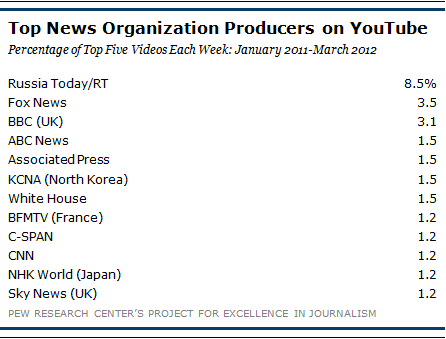
A relatively new news organization, Russia Today, produced far more videos on the list than any other-22 of the most viewed 260.

[1]

Russia Today has developed a large online following through a combination of factors. The network has actively promoted its online content. The RT YouTube channel has more than 280,000 followers and the videos in its official channel have been viewed more than 740 million times, a number far greater than many other well-known sources such as Al Jazeera English (380 million views), Sky News (52 million) and Fox News (23 million). Other prominent news organizations have far fewer followers, such as ABC News (111,000), the New York Times (78,000) and ITN News (54,000).

On a number of occasions, Russia Today has, as the New York Times described it in 2010, taken a “dip into conspiracy theories.” The channel has regularly reported on rumors, for instance, that the attacks on New York on September 11, 2001, were committed with cooperation of the United States government.

Most of Russia Today’s popular videos (68%) were not edited news packages in any traditional sense. Nor were they about Russia. Instead, they consisted of first-person video accounts of dramatic worldwide events such as the Japanese earthquake or the June 2011 riots in Vancouver following the Stanley Cup Final. The people who shot these videos may not be Russia Today reporters, but the organization acquired the footage and broadcast it, using its own dissemination tools and graphics. In that sense, Russia Today is functioning as a kind of video-sharing service itself, on television, which it then turns around and shares again on YouTube.

[2]

One video that drew attention in January 2011 was a clip featuring conservative journalist Tucker Carlson. Acting as a substitute host for Sean Hannity, Carlson argued that NFL star Michael Vick should have been executed for abusing and killing dogs. Most people sharing the video commented that Carlson’s opinion was too extreme.

Another of the most viewed Fox clips was an interview with Hank Williams, Jr., a country and western star, in which the singer compared President Obama to Hitler on Fox & Friends in October 2011. All but one of the most watched Fox News clips came from the station’s talk-show programs.


Of the citizen-produced videos, many came about as people found themselves to be eyewitnesses of natural disasters, accidents or riots-and thought to turn on their recording device. Of the 102 videos that were shot and produced by citizens with no formal affiliation with a news organization, 21 of them (21%) captured live disasters or major accidents. These included footage of a January 2011 flood in Toowoomba, Australia, shot by an individual with the user name “whitelightbringer,” and a quick shot taken by an iPhone of a stage collapsing at the August 2011 Pukkelpop music festival in Belgium. The next largest category, protests and riots, made up 13 of the citizen-produced videos.

What emerged less frequently among these top videos were planned pieces that individuals set out to investigate and produce-the citizen journalists if you will. There was editing by citizens, but most of this was not the kind of extensive editing journalists do to produce full packaged pieces. Instead, the editing in these cases was mostly the cutting up of eyewitness footage. Citizens, in other words, have carved out an important role as eyewitnesses more-so than citizen-reporter.  


Footnotes

[1]

[2]

Who Posts the Videos

The symbiotic relationship between citizen observers, audiences and news professionals carries through to who posted the videos once they were produced. But here, citizens played a larger role than news organizations.

Almost two-thirds of the most viewed videos on YouTube (64%) were posted by citizens; 36% were posted by organizations. In other words, while news organizations played a larger role in creating the most popular news content on YouTube, citizens were the primary agenda setter in terms of posting it.

This in part is because nearly four-in-ten of the professional news videos were posted by viewers. In these instances, then, the news organization either did not object to having its content enter the YouTube stream or had not bothered to track its content.

On the flip side, however, almost all of the videos produced by individuals (97%) were also posted by individuals as opposed to a news organization.

Edited Footage vs. Raw Footage

Another question that surfaced when the prospect of video sharing began was whether it would represent a way for people to see the news for themselves, without the filter of journalistic editing. The answer appears to be yes, but there is equally a place in this platform for edited journalistic story telling. Users of this platform, in other words, view both styles of videos, depending on the news event. 

In all, more than half (58%) of the most-viewed videos were those that were edited in some way before they were uploaded to YouTube. This means those videos consisted of different shots assembled together to provide meaning or context. Some included narration while others did not.

News organizations were much more likely to include edited news stories than raw footage without narration, but pure footage was part of their tool set. Of the 133 videos produced by news organizations, 65% were edited while 35% were unedited. 

The format of videos from various organizations also differed, depending on the content. Of the 22 videos produced by Russia Today 15 were composed entirely of unedited footage. All nine of the videos produced by Fox News came off of their broadcasts and were edited in some way, as were all eight of the videos from the BBC and the four from ABC News.

Citizens, on the other hand, were more likely to shoot and share raw footage, but this, too, was not the only way that they delivered news to YouTube. The majority (61%) of the most popular videos produced by individual users (of which there were a total of 102) were made up of raw, unedited footage, and a little more than a third (39%) were edited.

In short, we see a merging of styles on YouTube, in which news organizations lean toward traditional storytelling but, led by organizations such as Russia Today, incorporate citizen documentary in its raw form as part of their news content. Citizens, meanwhile, lean toward being documentary eyewitnesses, but in sizable numbers are turning to journalistic storytelling that involves the tools of editing and narration. And consumers seem comfortable moving from one style of video to the next-viewing based on the news event rather than on the entity providing the video or the format used to produce it.

Not a Celebrity Medium–When it Comes to News

While pop stars often receive millions of hits for their videos and interviews on YouTube, the lure of personality was less of a draw for news and political videos. Fully 65% of the most watched news videos did not feature any individual. And no single person was featured in even 5% of the most popular studied here.

President Obama was featured in more of the most popular news videos than any other individual. (The audience for YouTube is 30% U.S.-based and 70% from other countries.) That is almost three times as many as the next most watched newsmaker here (North Korean leader Kim Jong Il). Still it was not a large number. In all 4% of the 260 videos studied here, 11 videos in all, or just over 10% of those that featured a dominant newsmaker, focused on the president. 

The content of the 11 videos that featured Obama varied widely. Four were speeches by the president offered in their entirety: his comical April 11, 2011, address at the White House Correspondents’ Dinner, two versions of the announcement that Osama bin Laden had been killed, and an enhanced video of his 2012 State of the Union Address that included annotation provided by the White House. Two videos captured informal moments: his brief singing of an Al Green song at a New York fundraiser and an instance where he accidentally spoke over Queen Elizabeth during a banquet at Buckingham Palace. A 50-minute interview presented by YouTube and Google+ also made the list in January 2012, as did a March 2011 satirical ad produced by the Republican National Committee that criticized the president’s record. Of the 11 videos featuring Obama, five of them were produced by the White House, while the rest came from other sources.

Beyond Obama, only two other people appeared in even four of the most popular videos studied. Kim Jong Il, the late leader of North Korea, was featured in clips from the state news agency of North Korea (KCNA). Those videos showed citizens grieving over his December 2011 passing and sparked an online debate about whether the mourners actually felt sad over the death or whether the North Korean government shaped the clips to promote a certain perspective.

The other person to appear in four videos was controversial Russian politician Zhirinovsky, who made a name for himself using fiery rhetoric during the presidential campaign.

Of the 260 most popular videos in the news category, 5%, or 14 videos, related to celebrity news. Over the 15-month period studied, one entertainment-focused story was among the most popular for more than one week, the February 2012 death of singer Whitney Houston, including a breaking ABC News report that chronicled the star’s troubled career.

Philip Franchina–A YouTube Phenomenon

One other individual who stood out among these more viewed videos was Philip Franchina, better known by his stage name Philip DeFranco. He is an American video blogger (known as vlogging), who rose to popularity with low-tech, sarcastic videos consisting primarily of monologues directed toward the camera.

DeFranco’s popularity is not as a newsmaker himself, but because people wanted to hear his opinions on contemporary topics of the day in his self-produced videos. Those topics run the gamut from pop culture to politics.

[1]

For the first half of 2011, nine of his videos were among the most watched news clips. One of the most popular videos was DeFranco’s January 12 monologue on former vice presidential nominee Sarah Palin, Apple and truTV. (Warning, the video contains adult language.) A month later on the February 7 edition, he gave his opinions about Super Bowl commercials, AOL’s acquisition of the Huffington Post and the flu vaccine among other subjects.

In June 2011, DeFranco switched the tag of his vlogs from “news & politics” to “entertainment,” thus taking them out of the news ranking. (The person who posts the videos determines how they are categorized. If DeFranco had continued his tagging as a news video, more of his videos would likely have appeared on this list.) A few observers, such as Robert Slonaker of Yahoo! Voices, have credited DeFranco’s success to the way he mixes humor with information and to his videos’ fast-paced format.


Footnote

[1]

Qualities of Engagement

What draws people to certain types of news videos and not others?

PEJ created a broad list of the visual appeal that came through in the videos.   

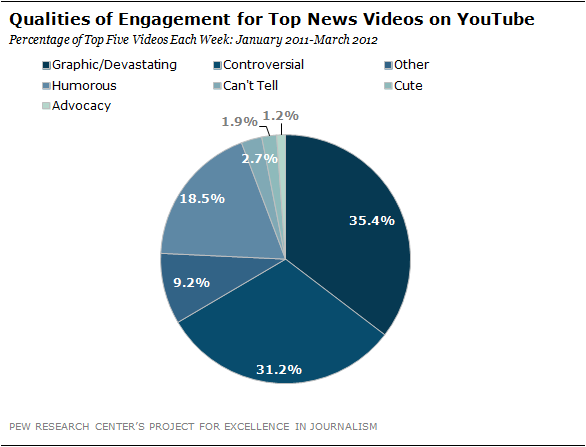
More than a third (35%) of the videos depicted devastating or intensely graphic images. These included videos that demonstrated the dramatic impact of the Japanese tsunami or the violence that occurred during some Middle East protests.

Another roughly one-third of the most popular videos (31%) spoke to a controversy of some kind. In some cases, the video was presented in a mocking manner. For example, one shared video was a 2011 news report detailing Sarah Palin’s re-telling of the story of Paul Revere that suggests Palin “got a bit confused on the details.” Others informed viewers of details regarding an ongoing controversy such as President Obama’s July 2011 message about the debt agreement he reached with Congress.

Not all of the controversies were political in nature. One, for example, was a 2011 appearance by celebrity Ricky Gervais on CNN’s Piers Morgan Tonight in which he shared his views on religion and atheism. The video drew almost 400,000 views. (The video has since been removed due to copyright issues.) 

Humor was at the heart of 18% of the most popular news videos. One was a July 2011 video of a Lithuanian mayor driving over illegally parked cars with a tank. Another tagged as “news” was a montage of Obama speeches edited together to make it seem as if he was singing the words to a song by pop singer Lady Gaga.

Video Length

[1]

In a television platform that allows the video to be as long as makes sense for that particular story and in which audiences can render clearer judgments about what length of content they will watch, what is the verdict?

The answer, at least according to this analysis, is that audiences are willing to watch content of differing lengths. Indeed, there was significant variation in the length of the popular news videos on YouTube.

[3]

But the median does not fully tell the story. There is fairly little variation in the length of stories in the format of a commercial television broadcast. Most packages fit into fairly strict formulae in terms of length. We see a good deal more variation in the most watched videos on You Tube.

More than a quarter were fairly short. Fully 29% of the YouTube videos were one minute or less in length. Half were no more than two minutes long.

But half of the most popular videos were more than two minutes, and 18% were longer than five minutes. Four videos, such as the broadcast of the February 2012 Russian presidential debate between representatives for Vladimir Putin and Mikhail Prokhorov, lasted more than 50 minutes.

There is also a strong connection between the qualities or features of the video and its length. Shorter videos were more likely to include graphic images than anything else, such as the tsunami or the crash of an Italian cruise ship. Fully 43% of videos two minutes or less, and 41% five minutes or less, were graphic in nature. None of the videos that lasted longer than 10 minutes were in that category.

Longer videos, by contrast, were more likely to be humorous or involve controversy. Of the videos longer than five minutes, 15 depicted controversies (33%). One was a February 2011 prank phone call to Wisconsin Governor Scott Walker by The Buffalo Beast’s Ian Murphy, posing as conservative activist David Koch, which lasted 10 minutes. In October 2011, a video from the website conservARTive.com of a group of protesters at an Occupy Atlanta rally refusing to allow U.S. Congressman John Lewis to speak to the crowd lasted 10 and a half minutes.

Humor was also associated with longer videos. Of the videos longer than five minutes, 13 were humorous (28%), such as the editions of the Philip DeFranco show and President Obama’s speech at the 2011 White House Correspondents’ Dinner in which he took jabs at the birther movement, Donald Trump, National Public Radio and potential GOP presidential candidates.


Footnotes

[1]

[2]

[3]

Leading Topics

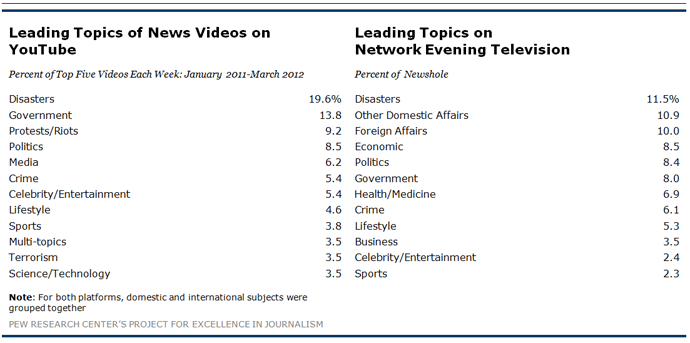
The study also grouped the most popular videos into broader news categories, such as politics, celebrity or disasters. Videos about the 2012 Russian election, for instance, tended to fall into the government category. Most of the videos about the Arab Spring fit into the category of political protest.

Together, government and politics accounted for 22% of the most popular videos over the 15 months studied.

That was followed by footage of disasters (20%), fueled in large part by the Japanese earthquake and tsunami, as well as the stage collapse at the August 2011 Indiana state fair and the January 2012 crash of an Italian cruise ship.

Video of protests and riots made up 9% of the top videos, including the protests in the Middle East and the London riots of August 2011.


The most watched topics on YouTube did not differ much from the news agenda of visual mediums in the mainstream press during the same time period, according to PEJ’s News Coverage Index. Compared with the three major network evening newscasts (ABC, CBS and NBC), many of the same topics received the bulk of the attention.

Disasters were the most covered subject on both network evening news (11% of the airtime for those 15 months) and YouTube. Politics and government were each among the top four topics on YouTube, and among the top six on the networks. Overall, of the twelve top subjects watched on YouTube, seven of them were also among the top twelve on the evening news programs.

The subjects where the two platforms did not overlap are noteworthy, however. Protest, for example, was the second most popular topic on YouTube but was not among the leading subjects on network evening news. And four subjects that might be described as less strictly visual-foreign affairs, economics, health and business-were all subjects that received more coverage on the evening programs than they did attention on YouTube.

A Visual Discussion of the Study

[youtube https://www.youtube.com/watch?v=SpvwpYKFzuY]

Watch PEJ’s Director, Tom Rosenstiel, discuss the study’s findings on PBS NewsHour. http://dgjigvacl6ipj.cloudfront.net/media/swf/PBSPlayer.swf

Watch Pew Study: More Viewers Choose YouTube for Breaking News on PBS. See more from PBS NewsHour.

Click here for more video content from Pew Research Center.

Methodology

About This Study

Several people at the Pew Research Center’s Project for Excellence in Journalism worked on the PEJ report “YouTube & the News: A New Kind of Visual Journalism.” Deputy Director Amy Mitchell and Senior Researcher Paul Hitlin wrote the report. Researcher Sovini Tan collected and coded the content. Monica Anderson built the graphics. Dana Page handles the communications for the project. Tom Rosenstiel was the editor.

Methodology

The data for this report were initially collected as part of the Pew Research Center’s Project for Excellence in Journalism’s ongoing New Media Index reports. That was supplemented with data supplied upon request by YouTube.

To track the audience for videos in real time, PEJ researchers monitored the most popular news videos on YouTube weekly, which became the basis for this expanded study. Each Friday at noon EST, a PEJ staff member captured the list of most viewed videos over the previous week on YouTube’s “news and politics” list. These videos were categorized as such on the YouTube site by those posting the videos. PEJ determined the top five most viewed videos of the week as listed on YouTube’s page at the time of capture. This list of the five most viewed videos allowed researchers to identify the audience for news as it was breaking and also to compare that with the cumulative audience for videos over 15 months.

The sample for this study was made up of videos appearing on the most viewed list from January 1, 2011, through March 30, 2012.

PEJ originally captured 295 news videos during this 15-month period. However, when going back to conduct the additional analysis for this study 35 videos had been  removed from the site for various reasons including copy right and accounts being shut down. Therefore, the universe for this analysis is 260 videos.

The percentages of videos throughout the report refer to the percent of videos that appeared among those 206 top five videos in any given week.

A detailed methodology for the New Media Index in its entirety is located here.

Coding Team & Variables

A team of two of PEJ’s experienced researchers worked to complete the coding for this study.

In addition to housekeeping variables (such as date, length and source), each story was coded for the following complex variables:

Big Story tracks the narrative storylines that were frequently covered throughout the sample period
Lead Newsmaker refers to the person who is the central focus of at least 50% of the story

Geographic Focus captures the geographic area to which the topic is relevant

Topic captures the general subject matter of the story
Qualities of Engagement captures the primary appeal of the video that draws a viewer to a particular video

Format captures whether a video was an edited collection of footage or raw video without editing

Three of these variables (big story, lead newsmaker and geographic focus) have been used as part of PEJ’s ongoing coding for the News Coverage Index. PEJ conducts regular intercoder testing of these variables, and the results of agreement for each are at acceptable levels of 84% or higher. (A detailed explanation of PEJ’s regular intercoder testing process can be found here.)

Additional intercoder testing was conducted for the three additional complex variables (topic, qualities of engagement and format). Each coder was given the same 28 randomly selected videos to make up the intercoder sample. The rates of agreement were as follows:

Topic: 96%

Qualities of Engagement: 93%

Format: 96%

Press Release

CONTACT:
PEJ Deputy Director Amy Mitchell or Director Tom Rosenstiel
202.419.3650

PEJ: YouTube & News:  A New Kind of Visual Journalism Is Developing, but Ethics of Attribution Have Yet to Emerge

July 19, 2012-A new kind of visual journalism is developing on the video-sharing site YouTube, one in which citizens are sharing in content creation with news organizations, a new study by the Pew Research Center’s Project for Excellence in Journalism finds.

News is becoming a major driver of attention on YouTube, the site founded seven years ago and once best known as a place where people posted videos of a more personal nature. Over the 15 months studied, indeed, roughly a third of the most searched terms each month on YouTube were news related, according to company data.

Of the most watched news videos on YouTube during that period, more than a third (39%) were produced by citizens who often found themselves witnesses to breaking news, while 51% were produced by news organizations. Some of those professional news videos, moreover, clearly contained footage captured by citizens, though it was not explicitly attributed as such. Another 5% of the most-watched videos came from newsmakers themselves, and 5% were not labeled in a way that made was possible to know the producer.

While YouTube has guidelines about attribution, they are not consistently followed by those using the site. One of the study’s conclusions is that clear ethical protocols about attribution have not developed and users may at times have no clear way of knowing the source.

“News has found a place on this video-sharing platform and in ways that are opening up the flow of information and forging new areas of cooperation and dialogue between citizens and news outlets,” said PEJ Deputy Director Amy Mitchell.

These are some of the conclusions from the study, designed and conducted by PEJ, which examined 15 months’ worth of the most popular news videos on the site from January 2011 to March 2012.

Among other findings:

  • Citizens are responsible for posting a good deal of the videos originally produced by news outlets. Fully 39% of the news pieces originally produced by a news organization were posted by users. (The rest of the most popular news videos of the 15 months studied, 61%, were posted by the same news organizations that produced the reports.)
  • The most popular news videos tended to depict natural disasters or political upheaval-usually featuring intense visuals. The three most popular storylines over the 15 month period were non-U.S. events (70% of YouTube’s audience is international). The Japanese earthquake and tsunami was No. 1 (and accounted for 5% of all the 260 most-watched videos), followed by elections in Russia (5%) and unrest in the Middle East (4%).
  • The most popular news videos are a mix of edited and raw footage. More than half the most-viewed videos, 58%, involved footage that had been edited while a sizable percentage, 42%, was raw footage. This mix of raw and edited video, moreover, held true across those coming from news organizations and those produced by citizens. Of videos produced by news organizations, 65% were edited, but so were 39% of what came from citizens.
  • Personalities are not a main driver of the top news videos. No one individual was featured in even 5% of the most popular videos studied here – and fully 65% did not feature any individual at all. Within the small segment of popular videos that are focused on people, President Barack Obama was the most popular figure (featured in 4% of the top videos worldwide.) These ranged from speeches posted in their entirety to satirical ads produced by his political opponents.

###

The Project for Excellence in Journalism tracks the transformation of journalism in a changing information landscape through its annual State of the News Media report and a series of special reports. As part of the nonpartisan, non-advocacy Pew Research Center, it does not take positions on policy issues.