Pew Research Center

FOR RELEASE FEBRUARY 13, 2012

Digital Advertising and News

With digital ad revenue projected to overtake all other platforms by 2016, it is the key to the financial future of news. Are news organizations transitioning their legacy advertisers to online platforms? A PEJ report analyzing more than 5,000 ads from 22 news outlets offers answers.

BY Kenneth Olmstead, Katerina Eva Matsa, Amy Mitchell and Tom Rosenstiel

FOR MEDIA OR OTHER INQUIRIES:

Communications Department
202.419.4372
www.pewresearch.org

RECOMMENDED CITATION

Pew Research Center, February 2012, "Digital Advertising and News"

About Pew Research Center

Pew Research Center is a nonpartisan, nonadvocacy fact tank that informs the public about the issues, attitudes and trends shaping the world. It does not take policy positions. The Center conducts public opinion polling, demographic research, computational social science research and other data-driven research. It studies politics and policy; news habits and media; the internet and technology; religion; race and ethnicity; international affairs; social, demographic and economic trends; science; research methodology and data science; and immigration and migration. Pew Research Center is a subsidiary of The Pew Charitable Trusts, its primary funder.

© Pew Research Center 2026

Table of contents

  • About Pew Research Center
  • Digital Advertising and News
  • Who is Placing Ads?
  • The Financial Industry is the Most Prevalent Buyer of Ads on these News Websites
  • Online-only Outlets
  • Targeting
  • Use of Discount Sites/Coupons
  • Format
  • Buying Digital Advertising: A Brief Overview
  • Methodology
  • Press Release
  • Topline

Digital Advertising and News

With digital ad revenue projected to overtake all other platforms by 2016, it is the key to the financial future of news. Are news organizations transitioning their legacy advertisers to online platforms? A PEJ report analyzing more than 5,000 ads from 22 news outlets offers answers.

Who Advertises on News Sites and How Much Those Ads are Targeted

Between 2011 and 2015, revenue from digital advertising in the United States is expected to grow by 40% and to overtake all other platforms by 2016.[1]

Yet how much of that growth will go to underwrite news remains in doubt and throws into question the financial future of journalism as audience continue to migrate online. What will happen pivots in part on whether the news industry can move into the more lucrative areas of digital advertising, particularly using consumer data to target ads, persuading major legacy advertisers to also advertise online and moving into new revenue areas.

A new study of advertising in news by the Pew Research Center’s Project for Excellence in Journalism finds that, currently, even the top news websites in the country have had little success getting advertisers from traditional platforms to move online. The digital advertising they do get appears to be standard ads that are available across many websites. And with only a handful of exceptions, the ads on news sites tend not to be targeted based on the interests of users, the strategy that many experts consider key to the future of digital revenue.

Of the 22 news operations studied for this report, only three showed significant levels of targeting.  A follow-up evaluation six months later found that two more sites had shown some movement in this direction, but only some, from virtually no targeting to a limited amount on inside pages. By contrast, highly targeted advertising is already a key component of the business model of operations such as Google and Facebook.

These are some of the findings of the study, which analyzed the advertising in 22 different news operations and 5,381 ads representing a cross section of media. Researchers compared website ads to the advertising in legacy platforms. They also measured the level of ad customization online by having different researchers visit the sites at the same time. In addition, the report also contains a companion report by Professor Joseph Turow of the University of Pennsylvania’s Annenberg School for Communication that offers a primer on digital advertising.

Overall, the analysis finds that while news organizations have tried to persuade their advertisers to buy space across multiple platforms, there was little evidence that they had succeeded. The kinds of products and services being advertised online were quite different than in legacy platforms, and often were seen across multiple websites.  On CNN cable television, for instance, the top three advertising categories were motion pictures and television, insurance, and telecommunications companies; on CNN.com they were financial ads, toiletries and cosmetics, and job search.

Professor Turow notes that the absence of legacy advertisers from the Web domains may reflect a problem. “Figuring out what they are doing instead, and why, might be a first step in trying to get some of them back.”

Among the findings:   

  • In-House ads, ads selling or promoting a news organizations own products, fill more space across these news websites than any other advertising category. Nearly a quarter, 21%, of all the ads captured were for the news organization’s own products. The practice occurs most among the media sectors with direct subscription sales-newspapers and magazines. At time.com, for example, ads promoting their own products accounted for 56% of the ads captured in the study. This practice was less common at sectors with no direct consumer subscription, such as those from network television and cable television[2].
  • The finance industry is represented far more than any other on the news websites studied. Ads from the financial industry numbered nearly three-times that of the next biggest category, toiletries and cosmetics. What stood out even more was that the financial industry’s strong presence on news Web domains is matched by a fairly limited presence in the legacy platforms. Every sector except magazines experienced a greater portion of financial advertising on the website than in the legacy platform. On abcnews.com these ads made up fully 45% versus 13% in the morning and evening broadcasts studied.
  • Discount or coupon advertising such as Groupon was fairly limited. Just as the long-term viability of discount companies has come into question, their prevalence on news websites in limited as well. The year 2011 saw the rise of discount/coupon companies like Groupon or Living Social, which many news organizations hoped might become a major new revenue source. The study found that such coupons were not a major presence among these 22 news sites. Discount ads, where discounters like Groupon pay the news organization to carry their ad, made up more than 10% of the ads on only five sites. Of the three that used it the most, two (the Toledo Blade and the LA Times) did so through their own discount programs. Yahoo News was the other news site to rely heavily on this type of advertising, largely through Groupon.
  • Most of the news sites did not feature ads targeted to consumers based on their online behavior. Just three of the 22-CNN, the New York Times and Yahoo News-employed high levels of targeting, delivering different ads to the researchers based on that person’s recent online activity. A handful of other sites had some limited targeting, mostly in the form of smaller ads on internal news pages. For sites that do target their ads, the practice of erasing one’s browser history, or “cookies,” had virtually no effect. The same level of targeting occurred.
  • News organizations tend to rely most heavily on static banner ads. Rich media ads that make use of techniques like popping up in the screen or animating the content in the ad are rare on news sites. So too are video ads, one of the fastest growing types of ads on the Web. EMarketer predicts video advertisings will increase 43% in 2012 while static banner will grow just 18% and is expected to level off as consumers are drawn to newer, more eye-catching formats. Yet static banner ads remain the style most prevalent on these key news sites. [3]
  • Even though search ads don’t appear on most news sites, Google’s advertising presence is still strong there. A popular style of ad on these sites, accounting for 38% of all ads captured, is the sponsored link box-small boxed-in ads that usually have between three and seven lines of text. On most sites this box is powered by Google.

The study examined advertisements on the homepage and key inside landing pages (from the top five stories on homepage) for a cross section of 22 different news operations. Researchers analyzed 5,381 ads. They examined the industry placing the ad, the style of ad and the relevant importance of discount programs. The study also had different researchers visit the same news websites at the same time to test whether one researcher received a different mix of ads from another. The outlets studied included 11 newspapers, four magazines, the three cable news outlets, the three commercial network broadcasts and two online-only outlets, Yahoo News and The Huffington Post.[4] On the legacy platforms, ads were pulled from the front section of the newspaper, the afternoon and evening cable news programs, the morning and evening network news programs and one full issue of each magazine. Ads for newspapers and television were captured between June 10 and June 15, 2011. Ads from magazines were captured from the July 7 issue of each magazine. The corresponding websites were coded on the same day as the traditional outlet. For example, if the CNN television shows coded aired on June 10, then CNN.com was captured on the same date. On Jan. 27, 2012, PEJ researchers revisited each site to test for any new evidence of targeting. The level of targeting was consistent with PEJ’s earlier findings. Two sites, however, did show more targeting than in the earlier study: theatlantic.com and latimes.com. In January, research showed that roughly 10% more of the ads were different between two users than in the earlier research in 2011 – moving them from having virtually no targeting to mid-level on the inside pages.


Footnotes

[1] eMarketer, October 2011 and Forrester Research September 2011

[2] Users/Viewers of cable news do pay for their cable subscription through their cable bill, but they have no choice to pay for a specific channel or not.  A consumer does not have the choice to pay for MSNBC but not for Fox News. In contrast they do have a choice to pay for the New York Times, or not to pay for it.

[3] None of the sites studied produced video stories as one of the top five on the days studied. Therefore, there were no actual pre-roll video ads (those embedded inside video stories). Instead, the video ads that appeared were stand alone. Since the study, Yahoo News created a content partnership with ABC News which included plans to feature more video amid Yahoo News’ top news stories.

[4] The study covers the three network TV broadcasts but only two of the corresponding sites because NBC Nightly News and MSNBC Today Show are both under msnbc.com.

Who is Placing Ads?

Who is buying ads on news sites? The answer reveals part of the trouble the news industry is having findings its way in the new marketplace. Across these 22 news sites, the biggest single advertiser is the news organization itself or its parent. Ads promoting the organization’s own products, known as “in-house ads” in industry terms, accounted for 21% of the online ads studied-more than any category. Most of this came from news sites tied to legacy print products-newspapers and magazines. And -they advertised primarily subscription offers for their print product. There were also occasional ads for online subscriptions (mainly for the tablet or e-reader), bundled print and digital subscriptions, and ads promoting their Facebook pages and Twitter feeds.

While ads from the news organization itself accounted for the greatest percentage of ads, they did not take up the most prime real-estate. Three quarters of these ads appeared on inside pages of the website that one would get to by following a link on the homepage or a link sent by a friend to a direct news story. 

The magazine websites studied here (time.com, newsweek.com, economist.com and theatlantic.com) ran the largest percentage of in-house ads, fully 50% overall, from economist.com at 40.1% on the low end to time.com at 56% at the high end. In the print version of these magazines, by contrast, 10% of the ads were promoting the magazine or its company (Time magazine 11%, The Economist 13%, Newsweek 4%, and The Atlantic’s print edition contained no self-promoting ads).

Newspapers contained the second-highest level of self-referencing advertising, 21% of the Web-based ads versus 9% of their print ads. Here, though, the differences among the news organizations were greater, and those differences did not seem connected to the reach of their audience. The newspaper websites that used the most self advertising were the Wall Street Journal and the Toledo Blade (50% and 40% respectively). The Wall Street Journal, incidentally, has the longest standing and steepest paywall among any major news outlet. It has also been one of the most profitable digitally. A large part of its audience has been paying for its online product since 1997 (more than a decade before the New York Times would implement a much “softer” paywall strategy.)

For both the Journal and the Blade, self promoting ads were largely nonexistent in their print versions, accounting for just 5% of the ads in the first section of the Wall Street Journal print editions on the days studied and none at all in the first section of the Toledo Blade.

On the other end of the spectrum were The Hour (a newspaper in Norwalk, Conn.) and the Arizona Republic websites. In-house or self-referencing ads made up 6% of the online ads studied. The New York Times website fell in the middle at 17%.  

Self promotion ads were far less common on television websites, both network and cable. Foxnews.com carried the most, 12%, while all others were in the single digits (CNN.com 5%, MSNBC.com 3%, cbsnews.com 7% and abcnews.com 5.4%). The absence of these ads may have a lot to do with the lack of direct subscriptions in these legacy genres, as cable television “subscriptions” are paid for in bulk through the main cable provider.   

[1]

[2]


Footnotes

[1]

[2]

The Financial Industry is the Most Prevalent Buyer of Ads on these News Websites

The second biggest category of advertising online was one that played a fairly small role for news in legacy platforms, the financial industry. Ads for financial products or services accounted for 18% of all Web ads captured, more than triple that of the next biggest category, toiletries and cosmetics (5%). And on more than half of the sites, 12 out of 22, financial ads ranked first-above self-promotion.

Abcnews.com carried the greatest proportion of financial ads, 44.6%. Economist.com carried the smallest (1.8%). Most of these financial ads were for products or services related to debt management (credit cards, consumer loans) rather than for financial savings like investments and retail banking.

[1]

Movies and entertainment, telecom, cars and insurance were all bigger.

Similar differences emerge in the Web versus legacy domains of the other news genres.   

In print newspapers, clothing and accessories was the top category (at 17%) but ranked 18th on newspaper websites (at only 2%).  Close behind in print were house appliances (12% of the ads), which online accounted for just 2%.  

Financial ads ranked second both on the websites and in the print publications. Online, though, they accounted for a greater percentage of the ads (17.1% versus 12.8%) and represented a wide range of financial products, from home loans to credit cards to free checking accounts.  And first on the websites were the papers’ own ads.

When it came to network TV news, the heavy presence of the prescription drug industry on broadcast did not carry over to the Web. This industry accounted for 16% of the ads on network morning and evening news programs, but just half that on the Web. (MSNBC.com serves as the website for NBC News, containing content from both the news network and its cable channel MSNBC. The digital platform is co-owned by NBC Universal and Microsoft) The next three TV-based categories also carried far less presence on the websites. Financial advertising dominated on the two broadcast TV websites, with more than three times the portion of ads than the next biggest category, at 31.3%. On network TV shows financial ads were 10th at only 4.3%.

Magazines contained a fair amount of financial advertising both online (6%) and in print (9%), but differed in other ways. The largest category in print magazines was travel and hotels (at 16.7%) while on websites these kinds of ads did not appear at all.  Online the top category was in-house advertising, taking up five times the ad space as in the print publications.  

The findings on ad categories suggest that for the time being, at least, the Web and the legacy environments are different ad markets. What lies behind those differences is less clear. As Prof. Turow commented, “Why don’t the mainstay print advertisers show up in this new environment?” Whatever the reason, what comes with that is likely a heavier workload for the ad sales team responsible for multiple platforms and reduced revenue for those that turn primarily to ad networks for online ad sales.   


Footnotes

[1]

Online-only Outlets

There were also three online-only outlets included in the sample: Google News, Yahoo News and The Huffington Post (which is now also AOL’s official news channel).

Google News does not have any ads beyond in-house ads promoting its own products. Unlike on some of the legacy news sites, its house ads were not for subscriptions and things users could purchase, but rather for Google services like ways to “personalize” your Google News experience.

Yahoo News and The Huffington Post carried a full array of advertising. Their ads not only looked similar to one another, but also to the category of ads that appeared on legacy news websites.  

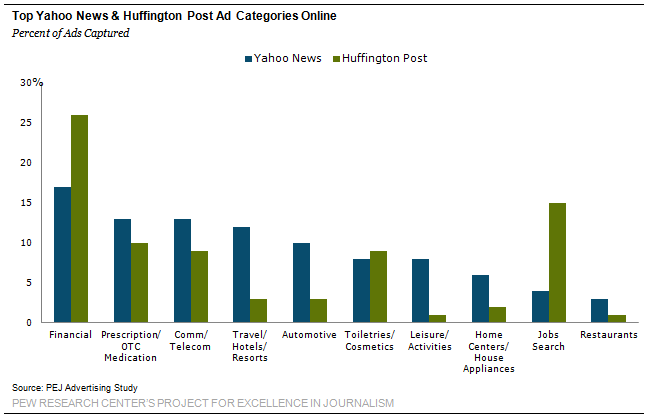
Yahoo News and The Huffington Post contained few in-house ads promoting their companies, but mirrored news websites from legacy media in other ways. On both sites, for instance, financial ads were the largest category, accounting for more than a quarter of the ads on The Huffington Post (26%) and 17% on Yahoo News.

Ads from telecom and pharmaceuticals were also sizable categories. One area where The Huffington Post stood out was in job search ads, which ranked second (14% of the ads captured).

Targeting

The customization or targeting of ads based on audience data is one of the newer ways to serve advertisers interests-helping those selling goods to reach consumers perceived to be the most likely to be interested in and thus to act on their ads. In targeted advertising, in other words, the ads one person gets will differ from what another person receives, depending on their online purchase history, location and/or personal habits, even if they click on the same website at essentially the same time.

The advertising industry has consistently suggested to digital publishers that offering more precise and actionable information about their visitors will result in publishers’ ability to charge higher prices per thousand impressions (CPMs) served. As Joe Turow shows in his new book, The Daily You, the huge competition among publishers and advertising networks has tended to push down CPMs despite continual increases in targeting publishers offer. As Turow notes, an entire ecosystem of organizations-including supply-side platforms, yield optimizers and premium-publisher consortia-counteracts this downward pricing spiral.

To what extent have news organizations adopted the practice? And to what extent can users eliminate the targeting by taking certain steps like clearing their “cookies,” a small text file that tracks and saves the user’s behavior.

To try to answer this, researchers examined each website through multiple user identities.

Overall, only a handful of sites exhibited high levels of targeting. A few more had a moderate level of targeting. Most showed no signs of targeting at all.   

The study also found that for the sites that do target, the common step of removing cookies did not eliminate the targeting.     

[1]

[3]

[4]

CNN, Yahoo News and The New York Times, all in the top 10 new websites in audience, had the highest degree of targeting. Different users visiting from their regular computer were served different ads, and the ads each received matched up with their recent online activity. For nytimes.com and CNN.com, nearly half (47% and 45% respectively) of the ads were different for the two users. On Yahoo News the targeting was even more prevalent; roughly two-thirds, 67%, of the ads differed for each person.

The ads that tended to be the same on these sites were the in-house ads, promoting the organization’s own products. On nytimes.com, for example, all users received the same ad for a New York Times subscription. They also received the same financial industry ads (all on the homepage). Beyond those, however, all other ads were tailored to the user-both the number of ads and what ads they saw.

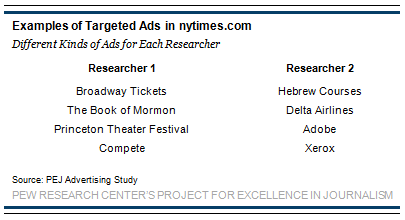
User 1, who regularly follows the communications industry, received 13 telecom ads across two visits; User 2 saw only two telecom ads. User 1 also saw nine ads that dealt with schools and colleges (while the other user saw two), and he received ads for Broadway tickets, which he was looking to purchase in the past days. The second user instead saw ads on Hebrew classes, something for which she had been searching recently, as well as for Delta airlines, on which she often travels. The ads served to each person indicate not only a high level of targeting but also targeting very closely tied to interests and activities. Similar levels of difference between the two users occurred on CNN.com and Yahoo.com.

On three other news websites, CBS, USA Today and MSNBC, the researchers encountered more moderate levels of targeting. On usatoday.com, for example, both researchers received the same financial ads (GE Capital and consumer refinance ads) and self-promotion ads (USA today subscription options) more than any other ad. Some ads did differ, though. User 1 received ads for schools and colleges (NYU and Cornell), consumer electronics (Casio and HTC), and cars (consumer auto source ads). The ads that appeared for User 2 came primarily from broad private corporate companies (Cargill, Ebay and UPS) as well as the communications (Verizon) and insurance (State Farm) industries.

On 15 more sites, researchers found only limited signs of targeting, 10% or less. For these, the top four categories of ads were nearly identical from one user to the next. These news sites with lowest level of targeting, if any at all, were local newspapers and magazines-especially the Toledo Blade, The Hour, Joplin Globe and Newsweek. 

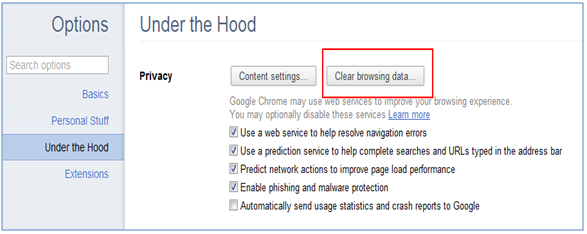
Once researchers identified the six sites with high and medium levels of targeting, they then took the next step of seeing whether entering the site from a “clean” or unidentified browser made a difference. In other words, did it negate the ability to target ads? The short answer is no.  The most conventional means for a user to opt out of tracking cookies proved ineffective here.

For all six of these sites, the advertisements the user received remained the same even after taking steps to erase signs of their identity or history from the browser. On news.Yahoo.com, for example, clearing a user’s history had no impact on the ads served, and those ads were very different across the two users. User 1 repeatedly got ads by Kayak, a travel search engine, Verizon and Bank of America, while User 2 saw ads by LivingSocial, Hyatt and TransUnion, one of the largest credit bureaus in the U.S. 

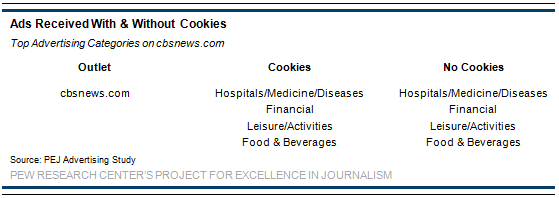
In the case of CBS News, cookies also had no influence on the level of targeting. Each researcher got the same ads whether entering through the cookie-enabled or cookie-stripped browser. Users kept getting the same ads when they individually visited the site; however, when compared, the ads between the two users were different. User 1 received health and medicine related ads from the Coleman Institute and Everyday Lifestyles, regardless the usage of cookies and the kind of browser. These ads did not appear for User 2, who instead saw prescription drug ads regarding joint relief and aging (Instaflex and Proleva).

One question that emerges is whether targeting has more or less natural appeal on some websites than others. In other words, do national sites with their larger and more diverse audience pools lend themselves more naturally than smaller sites to the benefits of ad targeting? On the Toledo Blade’s site, for example, are there enough people to fit into different ad cohorts to make targeting worthwhile? The sites with the higher levels of targeting were the larger more nationally oriented sites. At the same time, though, that could just as likely be a function of greater in-house technical knowledge and resources to spend developing the online ad system. It takes not only a diverse audience but also technical know-how to establish these parameters. 

Finally, on a few sites, there was evidence of another method of targeting-not according to users but according to news story. On a number of occasions, there was a close relationship between the content of the story and the ads displayed. For instance, on July 11, 2011, when The Atlantic online was studied, there was a story entitled “The Navy’s Green Devices: Coming to a Store Near You?” which discussed military green initiatives. The ads surrounding the story were by Shell and specifically promoted clean energy and natural gas. Same case with the Arizona Republic, where the first story studied was about Arizona’s Clean Car Program and most of the ads were by the automotive industry.


Footnotes

[1]

[2]

[3]

[4]

Use of Discount Sites/Coupons

If targeting online advertising is one potential method for news sites to get more revenue from online ads, discount sites like Groupon or other similar services were seen as another possible revenue stream for news.

The initial popularity of Groupon and then of competing discount sites like LivingSocial was seen by many in the news business as a promising way to bring in new ad revenue. Several news organizations even started their own coupon-style services to get a larger cut of potential revenue. But recent events, such as lower-than-projected revenue in the third quarter for Groupon and LivingSocial and the troubled IPO of Groupon, have cast doubts on whether these businesses will be as significant a revenue source in the future as initially anticipated.

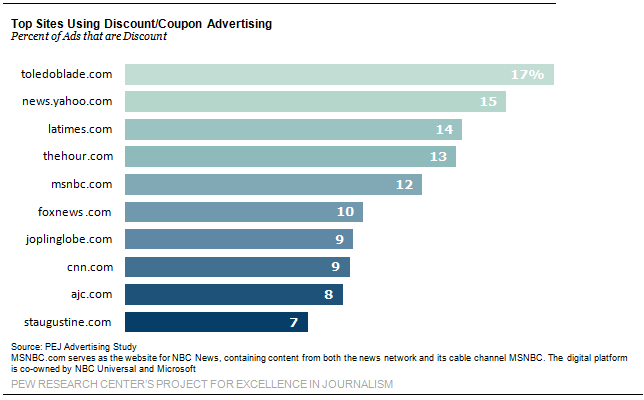
About half of the sites studied, 16 of the 22, carried some discount/coupon advertising. But on only five did discount ads make up more than 10% of all the ads studied. For the most part, sites that created their own discount programs tended to rely on these ads more.   

Among nationally oriented sites, Yahoo News carried the greatest percentage of discount/coupon advertising, 15% of the ads studied. The majority of these were from the national services Groupon and LivingSocial.

The other two sites with the highest use of discount advertising, the Toledo Blade and Los Angeles Times, have created their own daily deal operations to compete with the national companies.

Proprietary programs offer obvious benefits for the sites. The site can retain all the revenue from these kinds of ads rather than sharing part of each sale to the coupon partner. Second, the Toledo Blade and Los Angeles Times already have a base of local advertisers with whom they have built relationships. They may think they are better positioned than a company like Groupon to offer their customers more relevant local deals. Finally, if they can make the case that they have a loyal readership in their geographic area, they may also attract larger national brands that are looking for a more targeted daily deal than Groupon can offer.

These were the only two sites in our sample that had tried their own daily deal style business, but they are certainly not alone. Various papers now have their own Groupon-like services, such as Philly.com (the website for the Philadelphia Inquirer), which has launched its own deals site called DealYo. DealYo’s deals are for the Philadelphia area and cover a wide range of goods and services, from restaurants, to museums, to local sporting events. NJ.com (a group website for a family of New Jersey-based newspapers, including the Star-Ledger and The Times of Trenton) offers a similar deal site that is more akin to traditional coupons.  

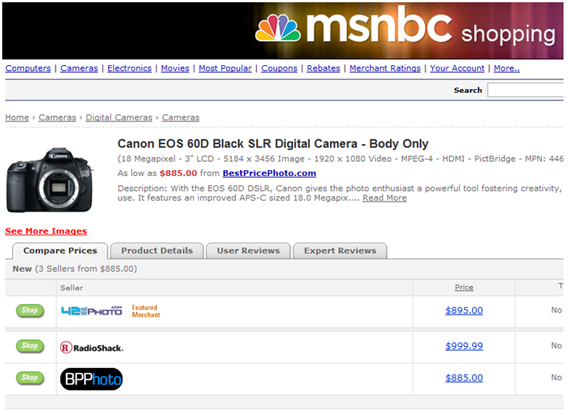
MSNBC had the most novel approach to this discount/coupon model. Rather than carrying ads for coupons, it features a section of its website where users can see various products, from electronics, to toys, to books and many other things, compared in price at different stories and online retailers. 

The page, operated jointly with PriceGrabber.com, compares the price of the item across a few sites and shows where the best deal is.


Format

Another major factor industry professionals consider critical in the future of digital revenue, beyond the level of targeting, is the format of a digital ad. Some in the industry have high hopes for the growth of video ads, for instance. By contrast, after a decade of the internet, some are skeptical about the future of static banner advertising, ads that include text and some kind of unanimated image such as a company logo or a photograph. The format can dramatically affect the price the news organization can charge for the ad.

Paid search is the dominant form of advertising on the Web, but it does not naturally work well with news content. (Paid search works by advertisers choosing to have their products associated with keywords. In news this is a challenge because keywords that might appear in most news headlines do not normally also associate with product advertisements.) That leaves banner ads, classifieds, video and rich media as the four main kinds of ads news sites can offer advertisers.

Banner ads, the oldest form of advertising on the internet, make up the second largest percentage of ads on the internet (24% of total online advertising revenue). Going forward, most market analysts expect banner ads will represent a smaller portion of online advertising than search, but the category is still expected to grow. For instance, eMarketer predicts that banner ads will increase from $7.6 billion in 2011 to $11.7 by 2015, a bright spot for the news online.

In this sample, banner ads were by far the most common kind of ad on news sites, making up 46% of all the ads on the news sites studied. 

Across these 22 news sites, that same tendency toward banner ads emerged; static banner ads made up nearly half (46%) of all the ads on news websites. Some differences in the style of ads used did emerge-mostly according to the legacy media genre, though individual sites did at times stand apart from their media brethren. 

Magazine websites relied on static banner ads most in this sample, where they accounted for nearly 60% of all the ads captured. Of the four magazines, The Atlantic website strayed from the use of banner ads the most. On theatlantic.com rich media ads made up almost half the ads on the site, far more than any of the other magazines.

Static banner ads were common across the newspaper sites studied. The three papers with the highest percentage of these ads were: The Wall Street Journal (100%), The Toledo Blade (78%) and the Joplin Goble (75%).

The Washington Post, on the other hand, relied on banner ads for just 18% of the ads studied. Instead, the site used sponsored links far more than others, 66%. Two other national papers, USA Today and the Los Angeles Times, also used sponsored links more than static banner ads.

And the website of the Connecticut newspaper The Hour created more than half of its ads as rich media ads. The New York Times used rich media advertising the least, in only 12% of its advertising. 

Video ads are still a relatively small part of the online ecosystem, accounting for just 7% of the total online ad market based on the first three quarters of 2011 (behind search, banner and classifieds). But online research firms expect this kind of advertising to grow rapidly. EMarketer predicts that video ads will grow 43% in 2012, by far the largest growth rate of any kind of ad. By 2015 eMarketer predicts that video ads will be $7.11 billion, the third most lucrative kind of ad behind search and banner ads.

[1]

They were most common on cable news websites, but they still made up only 2.5% of the ads.  Video ads made up even less on Network TV sites, 1.2% on cbsnews.com and less than 1% on abcnews.com.

Network TV websites favored two other types of ads more than the other sectors: sponsorship and sponsored links. Sponsorship is where an article or section of a website is “brought to you by…”; these types of ads made up 13.1% of the ads on network TV websites and only 1.8% on news websites overall. Another style of ad is known as the sponsored link, which is a small, boxed-in ad that usually has between three and seven lines of text. Sponsored links made up 37% of the ads on the news sites studied-and about half (49%) of the ads on network TV sites. These ads are normally purchased through Google or through the news site itself-and are much more likely to carry the Google brand. When a news organization uses Google to power its sponsored links box, it is using the Google service and sharing the revenue from the ad with Google. If a person clicks on a link in the sponsored links box, Google shares a portion of the revenue with the news organization. Thus, even without search ads, Google’s presence can be strong.

Where does that leave the news industry? In Prof. Turow’s words, “The data point out the disjuncture between the historical nature of newspaper advertising and the direction it has taken in the digital age. It is a topic that those in the newspaper industry are probably aware of-and certainly need to be.” For more on the digital advertising landscape, Professor Turow’s essay that accompanies this report provides a broader look.


Footnote

[1]

Buying Digital Advertising: A Brief Overview

By Professor Joseph Turow, Ph.D., University of Pennsylvania

Advertising in the digital era functions very differently than in the past. A myriad of new factors weigh in on an advertiser’s decision making process based on the products, goals of the campaigns, nature and location of the target audiences, budgets, and competition. 

[i]

In this environment, an enormous transformation is taking place regarding the ways marketers and their agencies approach paid media. For those entities-including journalism firms-trying to sell paid ads in the digital realm, understanding the new dynamics is essential. The following paragraphs sketch key avenues through which marketers are now reaching out to current customers and potential new customers: through search-engines, premium publishers, advertising networks, advertising exchanges and social media. All these vehicles are both competitors with journalism firms as well as opportunities for revenue. Even beyond the paid media complexities, marketers have been delving deep into the new opportunities with earned and owned media. Successes here may well lessen marketers’ need for investment in paid media-that is, the advertising that has traditionally been the life blood of news organizations.

Search-engine advertising

The search engine is an important digital-advertising channel that marketers try to use for owned and earned as well as paid approaches to audiences. When most people use the phrase search engine, they are probably referring to organic search results. That is the list of links to website pages (including newspaper site pages) that appears on Google, Bing and smaller competitors when you type keywords into the search box. In response to those terms, the engine’s formulas determine which page links will appear on the list and, depending on a material’s relevance, how near the top. Searches are done both for products like “flat-screen TVs” and for news topics like “Swine flu deaths.” For publishers, the organic search can bring them traffic as well as ultimately provide an opportunity for advertisers to reach that publisher’s audience. Publishers may think of organic search as a way for people to come into contact with the publisher’s output. If a link to a newspaper’s article shows up when a searcher types “Swine flu deaths” into the search box and if the searcher clicks on the paper’s link, the paper has an opportunity to earn advertising revenue by serving an ad to the person visiting the page. One of the problems for news publishers, though, is that the words searched don’t often fit with current events, and so there is less opportunity for search-engine advertising. 

Marketers, though, often exploit search directly. They can use two approaches, search-engine optimization (SEO) and paid search. The first aims to utilize the organic results. A firm hires a search-optimization firm-one that specializes in understanding the search-engine’s rules-to reshape the client’s site so as to raise its visibility (and therefore its products’ prominence) on the list that shows up when someone types certain key words into the search box. In addition to direct SEO of a company’s owned media (the website), a marketer also often works to persuade popular product-based websites to carry a link to its site.

These owned and earned strategies carry a good deal of uncertainty. Many marketers consequently also turn to the second approach, paid-search advertising. This process involves an auction. Companies bid on words people type into the search box with the hope that those words indicate intention to purchase, or at least interest in, particular products. The firm winning the auction receives the right to have its ads show up prominently alongside the organic search results. For the television manufacturer Toshiba, for example, the purchased terms might be as generic as “HDTV” and as specific as “Toshiba LED” or “Samsung.” Toshiba’s digital-advertising agency would present its bids for the terms to the search engine firm electronically, and the search engine would evaluate the bids in relation to those it receives from other companies. Companies sometimes bid on thousands of words. The search engine’s choice of the winner for each word is based on a complex and changing combination of factors, such as the relevance of the product to the firm’s bidding words, the bid amount, and the degree of success (measured via clicks) that other such ads (for example, other Toshiba ads) have already. Currently Google arrays its auction winners immedi­ately above the organic search findings (usually three ads) as well as to the right (up to eight ads). Google and most search engines use a paid-click revenue model: Every time someone clicks on one of these ads, the advertiser pays Google the agreed-upon amount.

Advertising via Premium Publishers

Although Google makes the largest proportion of its revenues through advertising connected to its search engine, it is also heavily involved in selling advertising as a publisher through its sites such as YouTube and Google Maps. In new-media parlance, a publisher is an organization that produces or distributes news, entertainment, educational or other informational materials. The online advertising world is split between publishers that  advertisers recognize as “premium” and a sea of other publishers with audiences advertisers may want but with much less ability to connect with media buyers directly. The lists of premium and non-premium publishers include those whose brand is built around creating original content (so-called legacy publishers) as well as those that draw most of their material from outsiders.

Publishers that score high on Web-ratings charts parlay their numbers into revenue by selling advertisements in guaranteed page positions. Some publishers offer positions to advertisers on a cost-per-click (CPC) or cost-per-action (CPA) basis. That is, the sponsor pays only if a visitor clicks on the ad or (in cost per action) performs a subsequent deed, such as phoning the company or buying the product. Most publishers, though, sell adver­tising space on a cost-per-thousand-impressions (CPM) basis. The interactive industry defines an impression as a basic advertising unit that is delivered to a computer. Every time an advertisement loads onto a user’s screen, it is counted as one impres­sion. When publishers adopt the cost-per-thousand-impressions system they get paid whether or not the individuals click on the ads. They use this approach because even though the raw CPC and CPA prices are far higher than CPM costs, the percentage of visitors who actually click on ads is typically less than 1%.  

Publishers believe they can charge higher CPMs if they offer advertisers specific, desirable audience segments. They therefore often take a host of steps, including incentives, to find out about their visitors. Even a thin amount of personal information such as a name, email address and ZIP code can enable the site to begin a personal file that the publisher can build over time. Some publishers purchase data about their registrants from information vendors such as Experian and Acxiom and append them to their files. The data may directly involve the individual (profession, credit status, number of airline flights) as well as the individual’s household (number of kids, age ranges, home value). Information purchased from other companies may help the site make life­style inferences about a person. Then there is the all-important behavioral data that websites create by making inferences about visitors’ interests and even their personalities based on the links they click and the topics they view. A person who tends to read articles about health might be tagged as having specific health interests; a sports reader might be placed in that bailiwick.

[1]

But even major sites with millions of individual visitors per month have found that they can’t sell all their advertising positions by themselves. Some in the industry call the unsold space “remnant ads.” Because of this oversupply, virtually all sites link up with at least a few of the hundreds of advertising networks that have emerged to profit from the need for such intermediaries. 

Advertising via Networks and Exchanges

Advertising networks connect many of the millions of small, and most of the big, sites on the Web so that they can make money from advertisers. The networks typically sell their affiliate sites’ ad space on a CPM basis, though CPC and CPA opportunities exist. Google, Yahoo, Microsoft and AOL have networks that include their own properties and millions of other sites; ValueClick and AdBrite are other major networks. Many publishers allow more than one network to place ads on their sites in order to generate revenue from multiple sources. 

[iii]

Despite such promised benefits, both marketers tend to have a love-hate rela­tionship with advertising networks. For marketers, one reason is that, with just a few exceptions, ad networks do not guarantee the placement of ads on particular sites or in particular positions on sites. Still, marketers and their media-buying agencies like networks because they are extremely inexpensive on a cost-per-thousand-impressions basis-typically between fifty cents and a dollar compared with several dollars or more for premium space sold by the publishers directly. News publishers need the ad networks to help sell the oversupply of digital space, but then must give the networks a portion of the revenue.

[iv]

Social Media as Marketing Platforms

Targeting consumers with commercial messages increasingly means using social media for owned, paid and earned activities. Social media are Web-based and mobile technologies that encourage interactions among the parties that use them. Although social media takes many forms-think Facebook, Twitter and Foursquare-their common hallmark is that users generate the content and pass along content from others that they find valuable or products they like. Recognizing this fact, marketers themselves have become heavy users with the aim of interacting with current and potential customers. Commercial messaging via Twitter has become a preoccupation for many firms. It is a way to try to earn viral interest in their activities as well as to listen and respond to discontent among present and potential customers.

The largest social network, Facebook, is both a boon and frustration to advertisers. It is a boon because of its huge global population of more than half a billion and its ever-growing cache of data about its members. It is a frustration because its tight control over its environment allows it to husband much of the audience information advertisers get access to when they advertise on standard websites. Nevertheless, Facebook is a marketing hub. Marketers treat the platform as an owned, earned and paid medium. For example, a national restaurant chain might set up its Facebook “fan page” (owned) where it displays menus and gives out coupons. To get a coupon, the restaurant might require a visitor to join and “like” the fan page, an action that captures data about the visitor and generates a message to the visitor’s Facebook friends that the person has kind feelings toward the restaurant. In the wake of this activity, the marketer might pay for a Facebook ad-a “sponsored story”-targeted at the visitor’s friends with a message that underscores the interest he or she has in the restaurant. The sponsor hopes the ads will encourage earned actions: that the friends will visit and “like” the fan page, and that they will message one another about the restaurant, its menu and its discount.

Like marketers, news publishers have moved heavily into Facebook as a way to distribute their content and reach new audiences. But the possibility of earning revenue from paid advertising sales is non-existent. Facebook fully controls the ad space within the network-including the margins surrounding individual Facebook pages like those of the Des Moines Register or CNN.com.  

The Local Publishing Market

During the past few years, social media, ad networks, exchanges and publishers’ websites have increasingly paid attention to the audience’s location. The ability to target specific neighborhoods via the Web, as well as to reach individuals on their mobile devices as they move in and around specific places, has led in the past few years to an uptick in competition for small businesses operating within territories local newspapers have long called home. Digital-media firms as diverse as Facebook, Google, Coupons.com, Groupon and the Indianapolis Star (owned by Gannett) consequently vie for local advertisers. Small and mid-sized papers can sell various print and digital packages that allow for discounts in both domains. The papers typically offer digital rate cards that vary their CPM based on the size of the ad, its location (e.g., homepage, main news, sports) the length of the contract and a small number of targeting variables such as ZIP code, age and gender.

One way these publishers can offer more targeting choices is if they affiliate with the Yahoo Newspaper Consortium. Yahoo may designate a newspaper its sales arm in a particular region. The paper’s sales force can sell their local businesses ads on Yahoo using the wide variety of data Yahoo has about individuals in that area; Yahoo and the paper share the proceeds.

Despite a local digital newspaper’s relatively narrow geographic focus, search engines do sometimes point faraway audiences to its site. One marketing executive for a mid-sized paper owned by a chain noted that when a local advertiser buys a run-of-site position, that advertiser will be charged for an impression even when the visitor is from another city and enters the site through a search-engine link. The overriding aim, though, is to bring local audiences to its digital advertisers-“the small woman’s dress shop,” in the words of the marketing executive. Sometimes, the resources of a parent firm can help local targeting. Sites affiliated with Gannett, for example, can sell local employment ads on CareerBuilder.com, which Gannett partly owns.

The Future: Digital Television

[v]

The transformation of the living-room television set into an outlet for the new media-planning-and-buying system will amplify what advertisers, their agencies and their data providers are already doing in Web and mobile spaces. Consider, then, that the online advertising developments as they unfolded through 2011 represented a kind of Spanish Civil War-that is, an armament testing ground-for marketers. It was the place where funda­mental components for future engagements across new territories were intro­duced, tested, altered, honed and put into regular use on the Web. Now a variety of technology firms are trying to ensure that marketers will be able to apply to the home television screen the strategies, tactics and technologies used to reach audiences on the Web and mobile devices. When they succeed there will be little difference between the “internet” and “televi­sion” in terms of advertisers’ approach to people and their data. The impact on the current digital publishers-including those from newspaper firms-is likely to be profound. 

Professor Joseph Turow

Joseph Turow is Robert Lewis Shayon Professor of Communication at the University of Pennsylvania’s Annenberg School for Communication.

Professor Turow is an elected Fellow of the International Communication Association and was presented with a Distinguished Scholar Award by the National Communication Assn.  A 2005 New York Times Magazine article referred to Professor Turow as  “probably the reigning academic expert on media fragmentation.” 

He has authored nine books, edited five books, and written more than 100 articles on mass media industries. Yale University Press has just released his new book, The Daily You: How the New Advertising Industry is Defining Your Identity and Your Worth. In 2010 the University of Michigan Press published Playing Doctor: Television, Storytelling and Medical Power, which is a history of prime time TV and the sociopolitics of medicine.  Routledge recently published the fourth edition of his text Media Today: An Introduction to Mass Communication.  Other books reflecting current interests are Niche Envy: Marketing Discrimination in the Digital Age (MIT Press, 2006). Breaking Up America: Advertisers and the New Media World (University of Chicago Press, 1997; paperback, 1999; Chinese edition 2004); and The Hyperlinked Society: Questioning Connections in the Digital Age (edited with Lokman Tsui, University of Michigan Press, 2008). He has authored eight books, edited five books, and written more than 100 articles on mass media industries. 

Professor Turow’s continuing national surveys of the American public on issues relating to marketing, new media, and society have received a great deal of attention in the popular press as well as in the research community.  He has written about media and advertising for the popular press, including American Demographics magazine, The Washington Post, Boston Globe and The Los Angeles Times.  His research has received financial support from the John D. and Catherine T. MacArthur Foundation, the Kaiser Family Foundation, the Robert Wood Johnson Foundation, the Federal Communications Commission and the National Endowment for the Humanities, among others.

Professor Turow was awarded a Lady Astor Lectureship by Oxford University. He has received a number of conference paper and book awards, has lectured widely and been invited to give the Pockrass Distinguished lecture at Penn State University and to be a Chancellor’s Distinguished Lecturer at LSU.  He has served as the elected chair of the Mass Communication Division of the International Communication Association.  Professor Turow currently serves on the editorial boards of the Journal of Broadcasting and Electronic Media, Poetics, and New Media & Society.


Footnotes

[1]

[i]

[ii]

[iii]

[iv]

[v]

Methodology

The study, Digital Advertising and News, contains two main elements: The central research study conducted and written in-house by PEJ researchers and an accompanying essay by Professor Joseph Turow, Ph.D., Robert Lewis Shayon Professor of Communication at the University of Pennsylvania’s Annenberg School for Communication. Professor Turow is an expert in media fragmentation and author of several books including the newly released, The Daily You: How the New Advertising Industry is Defining Your Identity and Your Worth. Professor Turow’s full bio is below.

For the main research study, the primary PEJ staff members working on the report were research analyst Katerina-Eva Matsa, research analyst Kenny Olmstead and Deputy Director Amy Mitchell. Sovini Tan helped conduct the research. Dana Page, communications and creative design manager, managed publicity. Tricia Sartor created the visuals and Molly Rohal copy edited the report.

The Universe

[i]

Capture and Phase I Coding 

The initial phase of coding measured the mix of advertisement and style of ads across both traditional media and their website counterparts. For one week in June 2011 three coders from PEJ coded a mix of ads in each outlet according to the following schedule:

Legacy outlets: For Cable and Network TV, each show being studied was captured and coded one day during the week of June 28thth-July 1st, 2011.  Newspapers followed the same pattern. The full print edition of each paper was coded by one coder on one day of the same week.

For the news magazines which do not publish daily, the timing was slightly differently. For The Atlantic, a monthly publication, the June/July issue was coded. For the Economist, Newsweek, and Time Magazine the week of June 28thth-July 1stwas coded. 

All ads appearing within the program or publication were captured and coded.

Websites:  The websites for Network TV, Cable TV and Newspapers were coded on the same day that the traditional outlet was coded. For news magazines the corresponding week was coded. (For the Atlantic only June 29th which was the Wednesday of the week of June 28thth-July 1st was coded, despite the magazine covering all of June/July in its print edition.) For the website of each outlet the homepage and the first five stories on the site were coded.

Each ad that was captured according to the criteria above, was coded for the following variables:

Broad Topic of the story associated with the article- Determines the type of broad topic categories addressed by a story such as crime, education, economy, etc.    

Placement- Designates where ads are located within a publication, on a website, or within a broadcast.  The location reflects whether an ad is in the front page of a publication and website or the pages connected to the news stories. Also, the location reflects whether the ad is in the first, second etc. natural break of the broadcast.

Size/Type of the Ad- this code determined the size or length of the ad. For newspapers it was how much of the page the ad took up, full page ad, half page, etc. For broadcast ads it was the length of the ad, 30 seconds or more than 30 seconds. For online ads it reflected the location of the ad, including if the ad was a pop up ad or a roll down ad (also referred to as the window shade ad).

Format of the ad- this applied only to online ads and it determines the type of online ad, static banner, rich media, video, sponsored ads or sponsored link boxes.

Ad category- this variable reflects what the ad was for, for example an ad for a car would be coded as “automotive”.

Company name- determines the name of the company in the advertisement.

Ad describer- Here the coder inputs a short description (approximately 5-15 words) of the content of each ad. The purpose of these describers is to examine whether an industry would use different ads for targeted audience.

Discount ad- Designates whether Groupon or other similar ads or coupon offers appear.

Part of an advertorial- applies only to magazines. This code determined whether the ad was part of an advertorial-an advertorial is a multi-page ad in a magazine that is formatted like a story but is sponsored by a specific product and the “story” is really about the product and not produced by the publication. 

Phase II Coding:

The second phase of coding was to determine the level of targeting for online ads. For this phase each website was coded by two separate coders. Each coder coded the site 2 times, for a total of 4 passes on each site.

For the first round of coding on a site a coder would use the regular web browser he or she uses to surf the internet on a daily basis. For the second phase the coder would use a “clean” browser, or one where the cookies/history/cache was cleared and the coder was signed out from any personal accounts, such as Google, email and/or subscription accounts. In addition in the second phase the cookies/history/cache was cleared every time before a new site was coded. The purpose of this was to determine the level of targeting each site has. By clearing the cookies/history/cache, PEJ was attempting to control for the most common ways in which sites target.

In order to determine the level of targeting the researchers applied three steps:

  • a) For each website the researchers classified the ad categories that appeared for each user (both when the users used a “clean” browser or their own). Then, the researchers compared the ad categories between the two users and also those that appeared for the same user when coded through different browsers. In the case that the top four ad categories were identical for both users regardless of clearing their cookies/history cache, those websites were identified as low or no signs of targeting. In the case, that the ad categories were somewhat different, then the researcher employed an additional step.
  • b) The researchers compared the ads that appeared for each user, according to the following variables: company name and ads describers. The ads that did not appear in both users were classified as different. The researchers calculated the percentage of the different ads out of the total number of ads that users received. The higher the level of “difference” the higher the targeting.
  • c) Finally, throughout the process the researchers kept personal notes in regards to the ads that they came across. They identified the ads that seemed targeted based on their browsing history and then compared those specific ads to each other, to determine whether the other user also received those ads.

Targeting Follow Up

On January 27th, 2012 PEJ researchers revisited each site to check the levels of targeting. To do this 2 researchers went to each site using their regular browser and took screen shots of the homepage and the top five stories. Then the ads on each page were compared between the 2 researchers to determine if the level of targeting had changed. In general PEJ found that the level of targeting had not changed on the news sites studied, only two sites (latimes.com and theatlantic.com) showed slightly higher levels of targeting.

Outlets/Shows Coded

Cable TV


CNN

Fox News

MSNBC

5 p.m.

Situation Room

——

——

6 p.m

John King, USA

Special Report w/Bret Baier

PoliticsNation

7 p.m

Erin Burnett OutFront

Fox Report w/ Shephard Smith

Hardball

8 p.m.

Anderson Cooper 360

The O’Reilly Factor

The Ed Show

9 p.m.

——

Hannity

The Rachel Maddow Show

10 p.m.

——

——

—— 

Newspapers

The New York Times
USA Today
The Wall Street Journal
The Los Angeles Times
The Washingtonpost
The Hour
The Toledo Blade

Online Outlets

Yahoo News

Google News

HuffingtonPost.com
MSNBC.com 
CNN.com
FoxNews.com

NYTimes.com
LATimes.com

USAToday.com
WashingtonPost.com
ABCNews.com

CBS.com
Wall Street Journal Online
Thehour.com
Toledoblade.com

Atlanta Journal Constitution Online

The Arizona Republic

St. Augustine Record

Time,com

Newsweek.com

TheAtlantic.com

TheEconomist.com

Network TV (Seven in all, Mon-Fri) 

Morning shows – Code1 or 2 out of 3 every day

ABC – Good Morning America 
CBS – Early Show 
NBC – Today

Evening news

ABC – World News Tonight 
CBS – CBS Evening News 
NBC – NBC Nightly News

Magazines

Time

Newsweek

The Atlantic

The Economist


Footnote

[i]

Press Release

Digital Advertising and News: Who advertises on news sites and how much those ads are targeted

Monday, February 13, 2012 – News organizations are having only limited success persuading their key traditional advertisers to move online and few news websites demonstrate the kind of sophisticated targeting of advertising that many consider the future of digital advertising, according to a new report by the Pew Research Center’s Project for Excellence in Journalism. 

The mix of advertisers buying space on news organizations’ websites are vastly different than those whose ads appear in the legacy platforms, the study, which examined 5,381 ads at 22 news outlets found. On CNN cable television, for instance, the top three advertising categories were motion pictures and television, insurance, and telecommunications companies; on CNN.com they were financial ads, toiletries and cosmetics, and job search.

What’s more, the ads on these news sites rarely take advantage of the technology already used by Google and Facebook to match ads with the individual interests of users. 

These are among the findings from a two-part report that examines who places ads with news organizations, what types of ads are used and on which platforms those ads appear.  

Between 2011 and 2015, revenue from digital advertising in the U. S. is expected to grow by 40%. A year later, in 2016, digital ad revenue is projected to overtake the dollars going to all other platforms. How much of that growth will go to underwrite news remains in doubt and throws into question the financial future of journalism. What will happen pivots in part on whether the news industry can move into the more lucrative areas of digital advertising, particularly using consumer data to target ads, persuading major legacy advertisers to also advertise online and moving into new revenue areas. 

“News organizations are still in many ways trying to catch up with the digital ad marketplace, both in luring their core advertisers and in bringing the value of their audience into what they offer,” says Amy Mitchell, Deputy Director of the Pew Research Center’s Project for Excellence in Journalism. “Neither of which bode well for the figuring out the economic future of the industry.” 

Among the Other findings:   

  • In-House ads, ads selling or promoting a news organizations own products, fill more space across these news websites than any other advertising category. Nearly a quarter, 21%, of all the ads captured were for the news organization’s own products. The practice occurs most among the media sectors with direct subscription sales-newspapers and magazines. At time.com, for example, ads promoting their own products accounted for 56% of the ads captured in the study. This practice was less common at sectors with no direct consumer subscription, such as those from network television and cable television.
  • The finance industry is represented far more than any other on the news websites studied. Ads from the financial industry numbered nearly three-times that of the next biggest category, toiletries and cosmetics. What stood out even more was that the financial industry’s strong presence on news Web domains is matched by a fairly limited presence in the legacy platforms. Every sector except magazines experienced a greater portion of financial advertising on the website than in the legacy platform. On abcnews.com these ads made up fully 45% versus 13% in the morning and evening broadcasts studied.
  • Discount or coupon advertising such as Groupon was fairly limited. Just as the long-term viability of discount companies has come into question, their prevalence on news websites is limited as well. The year 2011 saw the rise of discount/coupon companies like Groupon or Living Social, which many news organizations hoped might become a major new revenue source. The study found that such coupons were not a major presence among these 22 news sites. Discount ads, where discounters like Groupon pay the news organization to carry their ad, made up more than 10% of the ads on only five sites. Of the three that used it the most, two (the Toledo Blade and the LA Times) did so through their own discount programs. Yahoo News was the other news site to rely heavily on this type of advertising, largely through Groupon.
  • Most of the news sites did not feature ads targeted to consumers based on their online behavior. Just three of the 22-CNN, the New York Times and Yahoo News-employed high levels of targeting, delivering different ads to the researchers based on that person’s recent online activity. A handful of other sites had some limited targeting, mostly in the form of smaller ads on internal news pages. A follow-up evaluation six months later found that two more sites had shown some movement in this direction, but only from virtually no targeting to a limited amount on inside pages. For sites that do target their ads, the practice of erasing one’s browser history, or “cookies,” had virtually no effect. The same level of targeting occurred.
  • News organizations tend to rely most heavily on static banner ads. Rich media ads, which make use of pop ups or animated content, are rare on news sites. So too are video ads, one of the fastest growing types of ads on the web. eMarketer predicts video advertisings will increase 43% in 2012 while static banner will grow just 18% as consumers are drawn to newer more eye-catching formats.
  • Even though search ads don’t appear on most news sites, Google’s advertising presence is still strong there. Accounting for 38% of all ads captured, the sponsored link box-small boxed-in ads that usually have between three and seven lines of text- proved a popular style of advertising. On most sites this box is powered by Google.

Accompanying the examination of U.S. news websites and legacy outlets is an essay by Professor Turow of the University of Pennsylvania’s Annenberg School for Communication. His essay provides a background sense of the online advertising landscape and context into where news fits in.    

The Project for Excellence in Journalism is a part of the Pew Research Center, a nonpartisan, nonprofit fact tank that provides information on the issues, attitudes and trends shaping America and the world. The Pew Research Center does not take positions on policy issues. It is funded by the Pew Charitable Trusts.

Read the complete study.

Topline

Please click here for a PDF of topline data tables.