<p>The presidential hopefuls are using their web sites for unprecedented two-way communication with citizens. But what are voters learning here? Is it more than a way to bypass the media? A new PEJ study of 19 campaign sites finds Democrats are more interactive, Republicans are more likely to talk about “values,” and neither wants to talk about ideology.</p>
About Pew Research Center
Pew Research Center is a nonpartisan, nonadvocacy fact tank that informs the public about the issues, attitudes and trends shaping the world. It does not take policy positions. The Center conducts public opinion polling, demographic research, computational social science research and other data-driven research. It studies politics and policy; news habits and media; the internet and technology; religion; race and ethnicity; international affairs; social, demographic and economic trends; science; research methodology and data science; and immigration and migration. Pew Research Center is a subsidiary of The Pew Charitable Trusts, its primary funder.
<p>The presidential hopefuls are using their web sites for unprecedented two-way communication with citizens. But what are voters learning here? Is it more than a way to bypass the media? A new PEJ study of 19 campaign sites finds Democrats are more interactive, Republicans are more likely to talk about “values,” and neither wants to talk about ideology.</p>
Candidate Web Sites, Propaganda or News? – A PEJ Study
In 2004, former Vermont Governor Howard Dean gained early momentum in his bid for presidency by using a new political tool, his campaign Web site. Setting new standards along the way, he used the Web to help raise roughly $50 million, to communicate directly with supporters through a blog, create a legion of new political activists called “Deaniacs,” and even organize gatherings called “meet ups.”
Three years later, Howard Dean’s campaign is best remembered for its sudden end, but his legacy may be something else. In 2007, all 19 candidates for president have Web sites, and blogs are the least of it.
Nearly all of the sites now have pages on MySpace, the social networking Web site. Online fundraising has become standard—Barack Obama in the second quarter of 2007 alone raised $10 million on his Web site, a third of his total. Several candidates used their sites to kick off their campaigns, rather than staging an old-fashioned campaign event designed to get press coverage.
It all has raised new questions about the evolving communications of American politics and the role of the Web in particular as a way of sidestepping the scrutiny of traditional journalism.
[1]
What we found is that one can learn a good deal about individual candidates from these sites. Users can also interact here with the campaigns and other citizens, and even move in many cases to grassroots activity. The emphasis of candidate sites is also more on issues and biography, with little of the horse race and tactical focus that critics decry is an emphasis of traditional media. Rather than bypassing the mainstream media filter, the candidate sites try to exploit the traditional press by using their material selectively in self-serving ways. What is missing is balance, any effort to get below spin—and the ability to compare one candidate with another.
Among the key findings:
• Candidate Web sites have fully embraced politics as a two-way conversation with voters. Twelve sites also offer the opportunity for visitors to turn that dialogue into grassroots action (organizing their own events, fundraisers, etc). Add dialogue and action together and Democrats have the most interactive sites, led by Barack Obama, followed by Hillary Clinton, John Edwards and Bill Richardson.
• Perhaps the most fundamental grassroots activity of all, registering people to vote, is lacking here. Only four candidates—Hillary Clinton, John Cox, John McCain and Barack Obama—offer tools or information about how to register.
• Blogs, a novelty in 2004, are now mainstream. Fifteen of the 19 sites feature their own official weblogs, and seven offer users the chance to start their own. Mitt Romney has his five sons author his campaign blog. Sam Brownback lets users contribute to his. John Edwards lets them write diaries.
• Savvy visitors may even be able to determine leading candidates from the so-called lesser ones. The top candidates—those with the most money and poll popularity—have the most technically sophisticated sites, update more often, use more video and include more news articles. They also focus on fewer issues. Edwards features the fewest issues (six). Dennis Kucinich has the most (91), and is the only candidate to talk about hemp and animal rights.
• When it comes to language, the biographies of the GOP candidates differ from those of the Democrats. The GOP bios emphasize “leadership,” “taxes,” and “values;” Democrats stress “children,” “family” and “protect.” And Republicans are much more likely than Democrats to name the party to which they belong.
• Some words are missing altogether in the biographies, including “God,” “moral,” and “progressive.” No Democrat uses the word “liberal”, and even Republican front runners shy away from using “conservative.” The only ones who do are candidate notably trailing the polls. For her part, Hillary Clinton almost entirely avoids reference to her husband at all.
[2]
First, how did each site try to engage users and to what extent did it exploit the potential of digital technology to create a dialogue with users, moving beyond the traditional one-way communication offered by TV or radio commercials, billboards, bumper stickers and direct mail?
Second, to what extent are sites trying to bypass the filter of traditional media, becoming their own information outlets, controlled by the campaigns, and appealing to voters directly?
What are the different delivery options the sites use to reach voters, beyond traditional Web sites?
Finally, in an age of product testing, what are the words each candidate uses to describe him- or herself—and what words does each avoid?
1. Republican Fred Thompson announced his possible intention to announce his bid for president on May 30, 2007, after this study began. Therefore his site is not included in the analysis.
One of the biggest trends in online information is the two-way conversation. To what extent did the candidate Web sites take advantage of the potential for users to “converse” with candidates and the campaign?
To a greater extent than many information sites. All candidates offer at least one way for users to “converse” with the candidate or the campaign. The majority even let voters talk to each other. And, unlike most of the mainstream press, the candidates have gone one step further. They have found a way to turn the dialogue into action—putting the user to work for them.
PEJ assessed the degree of engagement and participation at two levels. First, we looked to see if the Web sites offered any of three main features that allow visitors to engage in the conversation: commenting on blogs, creating their own citizen blogs and being able to connect with the candidates on various social networking sites.
Next, we measured the degree to which citizens were then encouraged to turn the dialogue into grassroots action. Here, we looked for three different components: raising money, hosting community gatherings or registering to vote.
Finally, we tallied how many of the six different features each site contained and ranked them accordingly.
Blogs
In 2004, Howard Dean gained significant attention and generated a cadre of youthful workers to his campaign through the use of a blog on his Web site. The notion that a candidate would regularly speak directly to supporters struck observers as exciting and new.
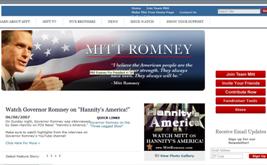
Three years later, campaign blogs are mainstream. Fifteen of the 19 sites contain them—including all of the top-tier candidates. Most of the blogs appear to be authored primarily by one or two campaign staffers, though Mitt Romney’s blog is written by his five sons and focuses more on family updates than the campaign.
Two of the four candidates who do not have blogs—Dennis Kucinich (D) and John Cox (R)—offer similar alternatives: user-based forums or links to outside blogs.
Blogs on Candidate Web sites
Source: PEJ Content Analysis, June 11-12, 2007
In fact, it is no longer enough just to blog. Now, “readers” want—or rather expect—to be able to join in. And, here again, candidate Web sites have excelled. Of the 15 candidates who have official campaign blogs on their sites, all but two (Rudy Giuliani and Ron Paul) allow users to post comments on blog entries.
Campaign 2008: State of Blogging
Official Campaign Blog with Comments
Alternative Blog with Comments
Official Campaign Blog without Comments
No Campaign Blog
Biden (D)
Cox (R)
Giuliani (R)
Hunter (R)
Brownback (R)
Kucinich (D)
Paul (R)
Thompson (R)
Clinton (D)
Dodd (D)
Edwards (D)
Gilmore (R)
Gravel (D)
Huckabee (R)
McCain (R)
Obama (D)
Richardson (D)
Romney (R)
Tancredo (R)
Source: PEJ analysis, June 11-12, 2007
Citizen-Initiated Blogs
Some candidates have taken blogging even one step further in 2007. Just over one-third of the Web sites encourage supporters to stir up community support by starting their own blogs on the site. Seven of the 19 candidates—though only two front runners (both Democrats)—host citizen-initiated blogs: John Edwards (D), Barack Obama (D), Bill Richardson (D), Duncan Hunter (R) and Sam Brownback (R). Serving a very similar function, Dennis Kucinich (D) and Mike Gravel (D) host community-based discussion forums on their sites.
Candidate sites with Citizen Initiated Blogs
Edwards (D)
Obama (D)
Gravel (D)
Kucinich (D)
Richardson (D)
Brownback (R)
Hunter (R)
Source: PEJ analysis, June11-12, 2007
The Web site of Barack Obama, for example, allows users to create their own personal blog, similar to services like blogspot.com and livejournal.com. John Edwards gives users the tool to establish their own “diary,” a feature similar to that offered by the popular liberal blog, Daily Kos. On Sam Brownback’s campaign site, visitors are invited to become members (by registering a profile) and to contribute posts to the official blog. On all these sites most visitors use the platform to voice their support for the candidate or to inform their peers of upcoming events.
Social Networking
Most notably perhaps, social networking sites—the latest phenomenon in online communication—have taken the 2008 election by storm.
Social networking sites like MySpace (the most popular), Facebook, YouTube, Meetup and Flickr facilitate interaction among people who share something in common—in this case, interest in a particular candidate. Users who register on one of these sites can then “meet” and network with any other registered user, including the presidential candidates. On MySpace and Facebook, networks are established by becoming “friends” with other users and posting comments to them.
[1]
Most candidates offer links to a number of different networks, but Democrat John Edwards surpasses others in the ability to ‘connect’ with him. His site features 23 unique social networking sites and a full page dedicated to these networks.
To gauge the magnitude of social networking among candidates, PEJ tallied the number of “friends” each candidate had on the MySpace Impact page. The Democrats took the lead: Barack Obama had three times as many “friends” as John McCain, the leader in “friends” for the Republicans.
Presidential Candidates on MySpace
Source: MySpace Impact Page, June 21, 2007
Presumably, social networking creates enthusiasm, drives traffic, and might translate into both fundraising and votes. In theory, it might be particularly helpful in caucus states, such as Iowa, where getting someone to actually turn out for you involves more than just going to a polling place for a few minutes to cast a quick vote.
Grassroots Activity
What about moving beyond networking to community activity—everything from hosting fundraisers, organizing community events and learning where to register to vote—not to mention, the old standard of soliciting donations?
All 19 candidates use their Web site to solicit donations, but many go several steps further.
Eight candidates (four Republicans and four Democrats) provide supporters with tools for hosting fundraisers. Bill Richardson, for instance, allows users to create and manage their own fundraising page. Rudy Giuliani offers an email form letter that supporters can send to their friends to encourage them to donate to the campaign.
In addition to fundraising, 12 of the 19 campaign Web sites help supporters organize grassroots events such as house parties in their communities to help raise awareness and support for the candidates. Six of the eight Democrats promote such activity and five of the eleven Republicans do the same.
The least common tool, though perhaps one of the most fundamental, is information on registering to vote. Only four candidates provide this: John McCain (R), Barack Obama (D), Hillary Clinton (D) and long-shot candidate John Cox (R). Cox offers a PDF document explaining the process while Barack Obama provides a link to an external site, govote.org, where citizens can complete the registration process online and mail in their forms.
Grassroots Activity by Candidate
Candidate
Option for Community Events
Fundraising Option
Voter Registration Info.
Biden (D)
X
Brownback (R)
Clinton (D)
X
X
X
Cox (R)
X
X
Dodd (D)
Edwards (D)
X
X
Gilmore (R)
X
X
Giuliani (R)
X
X
Gravel (D)
Huckabee (R)
Hunter (R)
X
X
Kucinich (D)
X
McCain (R)
X
X
Obama (D)
X
X
X
Paul (R)
Richardson (D)
X
X
Romney (R)
X
X
Tancredo (R)
Thompson (R)
Source: PEJ analysis, June 11-12, 2007
Site Comparisons
[2]
Republican candidates were far less likely to have participatory features, even those leading in the polls. Mitt Romney had four of the six features, John McCain had three, and Rudy Giuliani had two. Surprisingly, long-shots Duncan Hunter and Jim Gilmore scored pretty well on the scale, featuring four of the six participatory tools that PEJ identified (Hunter did not feature a campaign blog with comments while Gilmore did not offer citizens the ability to establish their own blog on the site; and neither offered tools to register to vote).
Comparing Candidates: Engagement and Participation Number of Opportunities to Engage and Participate on Web sites
Source: PEJ analysis, June 11-12, 2007
1.Rudy Giuliani has a MySpace page, but he does not promote it from his campaign Web site. You can find it by visiting the Impact MySpace page (www.impact.myspace.com), which displays those candidates who host a page. Mike Huckabee also has a MySpace page, which one can find by visiting an alternative campaign Web site called Team Huckabee (www.teamhuckabee.com/blog).
2.These six features include: user comments on campaign blogs, opportunity to establish citizen-initiated blogs, fundraising, community events, voter registration information and social networking sites.
Candidate Sites as Information Sources
To what extent are sites trying to bypass the filter of traditional media by becoming their own information outlets, controlled by the campaigns, and appealing to voters directly?
The study assessed this by examining six different elements: candidate biographies, issue pages, links to mainstream news media reports, press releases, videos and the frequency of updates. All 19 candidate Web sites offer some kind of biographical page and a dedicated section on issues. Most also offer at least one other feature, though the depth of the information and the frequency with which new content is added varies a great deal.
All told, the candidate Web sites really do serve as an information destination for the politically curious, with one important caveat. The campaign holds the editorial reins, and for that, most of the content is patently self-serving, generally highlighting the positive and ignoring the negative. Even when the candidates draw on the mainstream news for content, the selection of articles is always positive or, at most, neutral.
My Biography, My Way
The biographical sections allow the candidates to project the image of themselves they most prefer—their personal and public story about why they should be president. It is not surprising then that this is one element that all 19 candidates featured prominently on their sites, as one of the first items in the main menu-bar, or, on a few lesser known candidate sites, part of the home-page content itself. If running for president is about telling a story, this is where the candidates can do that. It is also why we choose this one area to further probe for their choice of words.
What kind of stories do they tell? Other than at least some mention of spouse and family, the focus varies according to the areas each candidate wants to highlight.
New York Senator Hillary Clinton touches upon five distinct aspects of her life, from “Hillary’s Story” and “Growing Up” to “Mother & Advocate,” “First Lady” and “U.S. Senator.” While most candidates devote a portion of their bios to their spouses, Clinton almost completely avoids mentioning her husband and former President, Bill Clinton, referring to him by name only twice in reference to their early Arkansas days together—“Hillary chose not to pursue offers from major law firms. Instead she followed her heart and a man named Bill Clinton to Arkansas.”
Arizona Senator John McCain, offers four subsections: his “Lifetime of Service,” in the Navy and the U.S. Congress, an interactive timeline, a section devoted to his wife (complete with recipes and “Cindy’s Journal”), and one to his family.
New Mexico Governor Bill Richardson’s biography, expanded in late May, focuses on the different phases of his public service along with one section devoted to his wife. On the other hand, Republican and former Mayor of New York City, Rudy Giuliani keeps it simple with “Rudy’s Story,” just one section that tells of his different skills. There is one paragraph about his current wife. Tom Tancredo (R- Colorado) and Ron Paul (R- Texas) are the only candidates who offer their voting records in their otherwise brief biographies.
Later in the report, we examine the use and avoidance of certain buzz words in campaign 2008.
Issues
Issues were the only other feature common to all 19 candidate Web sites other than the biography pages—though Hillary Clinton didn’t add a section outlining her positions until late May.
Issue pages are also an area that mainstream news Web sites have developed extensively in the last two election cycles—allowing users to compare candidates on an array of different issues. Here the candidate sites differ from those of news organizations. They don’t compare themselves to other candidates. They promote their agenda—what he or she would do to advance education, for example, or to end the Iraq War.
Some issues are common to all candidates. All 19 candidates detail their position on Iraq, and all but one (Barack Obama) highlight a major element of domestic economic policy. Fifteen candidates discussed their position on the environment, global warming or energy policy. By this standard, the major issues as defined by the candidates are Iraq, the economy, the environment/energy policy, education, immigration, health care and abortion/family values.
Issues at a Glance by Candidate
Iraq
Security
Health Care
Environment & Energy
Economy
Ethics in Government
Abortion/ Family Values
Education
Immigration
Biden (D)
X
X
X
X
X
X
Brownback (R)
X
X
X
X
X
X
X
X
Clinton (D)
X
X
X
X
X
Cox (R)
X
X
X
X
X
X
X
X
X
Dodd (D)
X
X
X
X
X
Edwards (D)
X
X
X
X
Gilmore (R)
X
X
X
X
X
Giuliani (R)
X
X
X
X
Gravel (R)
X
X
X
X
X
X
X
Huckabee (R)
X
X
X
X
X
X
X
X
Hunter (R)
X
X
X
X
X
Kucinich (D)
X
X
X
X
X
X
X
McCain (R)
X
X
X
X
X
X
X
Obama (D)
X
X
X
X
X
X
X
Paul (R)
X
X
X
X
Richardson (D)
X
X
X
X
X
X
Romney (R)
X
X
X
X
X
X
X
Tancredo (R)
X
X
X
X
X
X
X
Thompson (R)
X
X
X
X
X
X
X
Source: PEJ research of candidate Web sites, June 21, 2007
Issues that are not so prevalent include government reform/ethics in Washington, international trade, women’s rights, agriculture policy, judicial activism and public safety. Dennis Kucinich is the only candidate talking about animal rights and hemp.
The clearest difference among the sites lies between the top-tier candidates with the most money and name recognition and those who are lesser-known. In general, the top candidates focus on fewer issues (six to 12) and talk more in depth about them. The lower-tier candidates tend to talk about more issues, and have less to say about them.
Former Democratic Senator John Edwards, for instance, highlights just six issues, with special sections for three: health care, eliminating poverty and fighting global warming. In his section on health care, he provides a summary of his plan, a link to a document called the “Edwards Plan for Universal Health Care,” which is over 3,000 words long, and links to other articles and sources for more information.
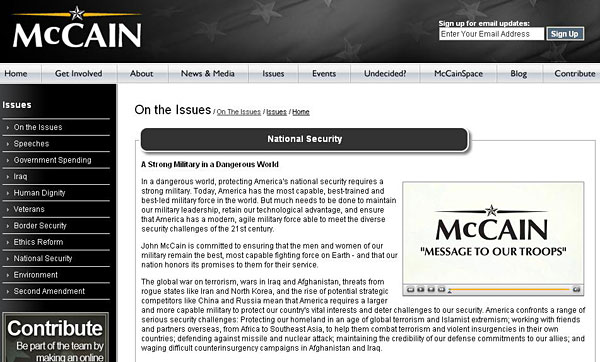
John McCain details his plan on nine issues, providing not just text, but also video and links to related speeches. He devoted the most text stating his position and plan on national security (2,203 words), and the least on his environmental position (364 words), with an average of 1,160 words across all nine issues. Each of his issue positions also has a video component to further articulate his stance.
In the 12 issues he focuses on, Barack Obama goes on the longest about his plan for affordable and universal health care, with 3,000 words on his main issues page, a 15-page PDF of the details of his plan, a plan overview, a health care Q&A and a blog specifically targeted to discussing health care policy issues.
Hillary Clinton, the latecomer to posting an issue section, is more abbreviated about policy. She devotes the most text (501 words) to the issue of women’s rights, followed by care for veterans (449 words). Nine of the ten issues that she highlights are accompanied by Webcasts in which she talks directly to a camera or video recordings of public speeches.
Rudy Giuliani is short on the textual explanations of his ten identified issue positions, but also makes use of web video. The text of his issues all run less than 100 words (with tax cuts barely taking the lead with 92 words), but are expanded upon in video clips that are part of a speech called, “Rudy’s 12 Commitments.”
Of all the frontrunners, Mitt Romney goes into the least detail on the 10 issue positions that he discusses. “Defeating the Jihadists” is the issue he highlights with the most depth, at 677 words. More than half of his issue content comes from brief news article quotes, and unlike most of the other frontrunners, he has no video in this section.
Less popular candidates tend to talk about a much broader swath of issues but in minimal detail. Illinois Republican and entrepreneur John Cox mentions 18 separate policy issues, and Republican Senator Sam Brownback of Kansas and Republican congressman Tom Tancredo of Colorado talk about more than a dozen each.
It is Democratic Congressman Dennis Kucinich of Ohio, however, who overshadows them all with 10 “key” issues and a staggering 81 sub-issues.
The ‘Newsroom’
Candidate Web sites are not entirely trying to bypass the mainstream press. All but one of the sites (Republican Governor Mike Huckabee of Arkansas), indeed, include mainstream news media articles in their content. But here the campaigns are the editors choosing which articles to publish.
The news articles in general tend to feature the candidates’ positions on issues, their event schedules and sometimes, editorial praise of their performance and potential success as a candidate for the White House.
Overall, the selected articles work to further promote the candidate. Recent news headlines on Obama’s site, for example, were a July 9 article from the Sacramento Bee, “Race for ’08: Obama banks on charisma, ability to motivate” and a piece from The Oskaloosa Herald on the same day, “Obama: ‘People are hungry for change.’” Similarly, McCain posted the June 29, 2007 National Review piece, “McCain’s courage,” by U.S. Senator Tom Coburn, “McCain’s Courage.” And Giuliani posted a June 30 Wall Street Journal article, “Of Tax Cuts and Terror: New York’s former mayor makes his case to be Reagan’s heir.” And for Clinton: “A Softer Hillary Emerging,” from the Foster’s Daily Democrat on July 7, 2007.
[1]
These same 16 candidate Web sites also post internally produced press releases of upcoming events or wrap-ups of recent events.
The frequency of these posts varies and is discussed in more detail below. Generally, candidates update their press releases more often, especially the top-tier candidates. McCain, Mitt Romney (R-Massachusetts), Clinton and John Edwards (D-North Carolina) all add two to three press releases on their Web sites daily.
When it came to news reports, John McCain did the most updating during the weeks monitored, with an average of four per day. Barack Obama and lesser recognized candidates Joe Biden and Jim Gilmore were the only other candidates to average at least two news stories a day.
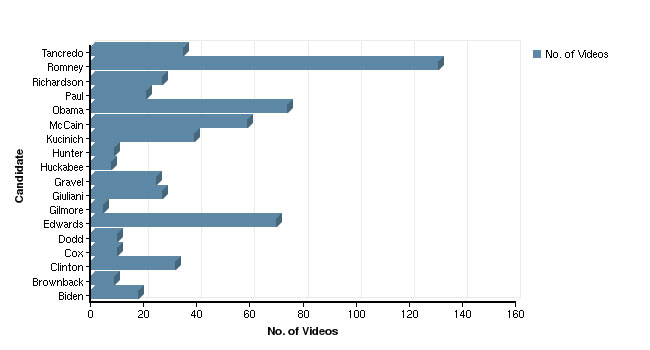
Video
Nearly all of the candidates (17) showcase a video component on their front-page. Several of them even have branded ‘channels’ on their sites, where you can dig into their video archives. Such channels include: ‘BarackTV’ (Obama), ‘MittTV’ (Romney), ‘TomTV’ (Tancredo) and the upcoming ‘DTV’ (Chris Dodd).
Videos on Campaign Web Sites
Source: PEJ Content Analysis, June 12, 2007 Note: Several candidates also have additional videos embedded in their blog posts, but these were not calculated in the totals here. Dodd, for instance, has more video found on his news media page, and alerts visitors that a video channel, “DTV,” is coming soon.
[2]
New Content
How good are these sites at staying current, or adding new information for returning visitors?
[3]
Despite fluctuations, the front runners tended to update their sites more often. Barack Obama had an average of about 6 new pieces per day and John Edwards’ site averaged almost 5 new pieces per day. Between May and June, Mitt Romney’s average rose, increasing from four to seven new pieces of new content.
Spanish language translation
[4]
1. Republican and former Virginia Governor Jim Gilmore and Republican U.S. Senator from Texas Ron Paul do not have designated places for archiving news articles featuring their candidacies, though Gilmore’s site does identify a “press center” which is “coming soon,” while Paul includes many mainstream news pieces on his blog.
2.All video totals were tallied during the first week of June, and included all videos except those that were posted exclusively in blog entries.
3.Content pieces calculated here include mainstream news articles, press releases and blog posts.
4.In our May analysis, Chris Dodd (D) offered Spanish translations of some of his site, but it was no longer available in our June analysis.
On-Demand Access
As much as Web sites are judged these days by their levels of interactivity, they are also judged by the different ways a consumer can access the information most conveniently for their lifestyle.
Here the 2008 presidential campaign Web sites seem a little further behind some national news media outlets.
We looked at six different ways that candidates provided the consumer access to their content: email updates/alerts, RSS (Real Simple Syndication) feeds, podcasts, mobile device delivery, search function and customizable content on the site.
E-mail alerts and RSS feeds are nearly universal (Duncan Hunter’s lack of RSS is the only exception). Other delivery options, though, are largely absent. Just four candidates have podcast options. Content delivery to mobile devices like cell phones or PDA’s (a popular feature of most major news outlets), is even harder to find. In May not a single site offered this option. By June, though, there were signs of candidates moving in this direction. Hillary Clinton and John Edwards added this option, featuring it on their home pages as a way for supporters to get campaign updates on their phones.
On-demand Access Options by Candidate
Candidate
RSS Feed
Podcasts
Mobile Delivery
Customiz- ation
Biden (D)
X
Brownback (R)
X
X
Clinton (D)
X
X
Cox (R)
X
X
Dodd (D)
X
Edwards(D)
X
X
X
Gilmore (R)
X
X
Giuliani (R)
X
Gravel (D)
X
X
Huckabee (R)
X
Hunter (R)
X
Kucinich (D)
X
McCain (R)
X
Obama (D)
X
X
Paul (R)
X
Richardson (D)
X
X
Romney (R)
X
Tancredo (R)
X
Thompson (R)
X
Source: PEJ analysis, June 11-12, 2007
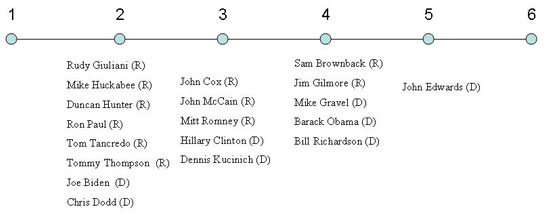
John Edwards offers the most delivery options (five of the six features). Three Democrats and two Republicans fall in the second highest category: Brownback (R), Jim Gilmore (R), Mike Gravel, (D) Barack Obama (D) and Bill Richardson (D) with four of the six features. Well over one-third, however, (eight of the 19 candidates) fall in the lowest group, without a search tool, customization or mobile delivery of content.
The following scale offers a glimpse of how the candidates stacked up in terms of how they offered access to Web site content, where one is low and six is high. Overall, the Democrats again do slightly better than the Republicans in providing their supporters with multiple means of accessing and customizing content. Democratic candidates scored an average of 3.4 while Republicans average 2.6.
Comparing Candidates: On-Demand Access
Number of Methods to Access/Customize Site Content
Source: PEJ Content Analysis, June 11-12, 2007
Image Control
One thing Web sites clearly promote and project is an image of the candidate that they (and their strategists) think will work best. So what are those images? What buzz words are popular this year—and which ones define which parties?
[1]
The Most Frequent Words
[2]
The words “children” and “family” are the next most popular. They appear 124 times in the 19 biographies (and one of the two terms appears in all 19 profiles).
Together, these mom and apple pie terms outpace Iraq, health care, or anything else.
Most Frequently used Words (number of times used)
Children (66)
U.S. (61)
Family (58)
America (54)
American (49)
The word “children”, though, was the most popular single word (66 mentions). Appearing in 15 of the 19 biographies, it is a top word among both Democrats and Republicans, though it is the Democrats who focus on it most in legislative terms.[3]
For most candidates, mentions of children occur when they are talking about their own. But it is also often used as a way to talk about their work or allude to an issue. Mitt Romney, for example, talks of his five sons and ten grandchildren and then also of how his wife, Ann, is “dedicated to improving the welfare of children, both locally and internationally.” John Edwards and his wife Elizabeth are not just parents of four children, but “passionate advocates for children and families.”
Avoided Words
And what words are not playing well this year?
The words ‘God’ and ‘religion’ were not mentioned at all. Neither was the word ‘moral.’ A related keyword, ‘ethics,’ is largely absent as well, appearing only once across all candidates. (It is used by Democrat Barack Obama, who talks of being a leader in “championing ethics reform that would root out Jack Abramoff-style corruption in Congress.”)
Even the word ‘faith,’ which often carries a broader connotation of loyalty and trust, appears only eight times. And, the candidate who uses it most, Mitt Romney, is mostly referring to his wife’s active involvement in “faith based organizations” and being a member of the “Faith and Action committee” rather than his own Mormon practices.
Absent Keywords
God
Liberal
Moral
Progressive
Religion
The other area where candidates across the board seem hesitant to tread is in the use of ideological identifiers. Democrats have altogether avoided the terms “progressive” and “liberal” in their biographies. And Republicans have shied away from the use of the term “conservative.” Indeed, the top-tier candidates—John McCain, Mitt Romney and Rudy Giuliani—avoid the term all together (it appears just eight times in the biographies of four fringe Republican candidates).
If the Web sites are any hint, in other words, this may be the campaign in which candidates are trying, at least so far in the process, to move beyond ideology or traditional party identifiers.
Republicans vs. Democrats
Beyond these broad tendencies, there are clear party-line differences in the buzz words of campaign 2008. The concepts of “children” and “family” dominate the Democratic profiles, while those of the Republicans emphasize “taxes.”
Among the Democratic candidates, the words children and family often occur together to emphasize both the candidates’ family values and to highlight work they’ve done. Hilary Clinton gives the concept the most play with 28 mentions in her biography alone, most of which refer to her child-related initiatives. Indeed, her section on being a mother and advocate is full of her work for and interest in children:
“Next came Yale Law School, where Hillary focused on questions about how the law affected children and began her decades of work as an advocate for children and families. As a law student, Hillary represented foster children and parents in family court and worked on some of the earliest studies creating legal standards for identifying and protecting abused children. Following graduation, she became a staff attorney for the Children Defense Fund.”
Later on, she also highlights her work with the Arkansas Advocates for Children and Families and her stint on the Children’s Television Workshop.
But she’s not the only Democrat putting forth a cause—Chris Dodd talks of being a “tireless advocate for helping children and families”, while John Edwards has “dedicated his career to representing families and children…”. Barack Obama talks about his specific efforts to “help working families get ahead by creating… state Earned Income Tax Credit, which in three years provided $100 million in tax cuts.”
Democrats seem to place the next biggest stress on the nation—referencing both American and America generously in their profiles. From the complexities of the American foreign policy (Biden) to a commitment to health care for every American (Clinton) and from exciting the next generation of young Americans (Kucinich) to solving the challenges of everyday Americans (Obama), Democrats are keen to stress their identity as patriots.
Inside the Republican biographies, quite a different picture emerges.
Top 5 Words by Frequency
Democrats (no. of times used)
Republicans (no. of times used)
Children (45)
Family (39)
American (38)
America (34)
Senator (33)
U.S.(32)
Governor (29)
Republican (26)
Taxes (24)
Leadership (22)
There is much less focus on children and family. While eight of the eleven Republican candidates use the term, only four of them mention them in relation to any legislative work.
They do, however, also focus on patriotism. It comes up when talking of U.S. defense jobs or being a United States senator or even as James Gilmore puts it, being “the answer to the question… “Is there a strong, steady, electable, conservative Republican candidate for President of the United States?”
Republican biographies are the only ones that explicitly mention ‘traditional.’ They also use ‘values’ much more than Democrats. For example, James Gilmore talks of family values or traditional values four times in his biography alone. Mike Huckabee puts forth his vision of “American values and priorities” while Ron Paul talks of being an “unwavering advocate of pro-life and pro-family values.”
The second-most frequently word on GOP sites was governor. Much like the use of senator among the Democrats, it reflects the ranks of the candidates—Jim Gilmore, Mike Huckabee and Mitt Romney were all governors of Virginia, Arkansas and Massachusetts respectively. Their constant references to themselves using the prefix or their deeds as governor add up to a total of 29 mentions.
Key Terms in Candidate Biographies
Source: PEJ Analysis, May 8 2007
Unlike the Democrats (reference to their party affiliation ranks 14th place) the Republicans draw attention to their party label repeatedly. Appearing 26 times in the 11 biographies, “Republican” is their third most frequently used word.
Sam Brownback proudly cites an Economist article that calls him a “Wilberforce Republican,” while Tom Tancredo calls himself a “solid pro-life, pro-gun, small government Republican.” James Gilmore is less specific, but declares that he has “exactly the credentials that most Republicans are looking for in their nominee for President”. Rudy Giuliani boasts of how he was the “first Republican elected Mayor of the City of New York… in which Democrats outnumbered Republicans five to one.” The party-term is definitely favored over the ideological descriptive, ‘conservative’ which appears just 8 times, and only among long shot Republican candidates Sam Brownback, Jim Gilmore, Mike Huckabee and Tom Tancredo.
If children and family is the domestic issue Democrats refer to in their biographies, for Republicans it is taxes. GOP candidates invoke it repeatedly – making it their fourth most frequently used word – and in most cases, with promises to reduce them. Jim Gilmore, who calls tax cuts a traditional Republican principle, mentions it repeatedly, with some justification—he “signed into legislation five different tax cuts including a 70 percent cut of the infamous car tax by $1.1 billion, the largest tax cut in Virginia history.” Mike Huckabee, a self confessed fiscal conservative, also talks at length about his proposed “Property Taxpayers’ Bill of Rights” and how he “cut taxes and fees over 90 during his ten and a half years as Governor.”
Number of Candidates Using Key Terms
Source: PEJ Analysis, May 8 2007
Individual Candidates
Beyond looking at the most frequent words of each candidate, we tried to see what, if any, was the thread among the top-tier candidates. It seems they’re more alike than different.
John McCain and Hillary Clinton are similar in their emphasis on children and the nation, while Barack Obama and Mitt Romney are noteworthy in their use of the word community—both have it as the third most frequently used word in their profiles. Four of the six have the state (or city) they’ve worked in as a top word, stressing their local experience as a platform for their national aspirations.
Top Words: Top-Tier Candidates
Candidates
Top Word
Second Word
Third Word
Hillary Clinton (D)
Children
Family
America
John Edwards (D)
Elizabeth
North Carolina
Senator
Rudy Giuliani (R)
Mayor
New York
New York City
John McCain (R)
Cindy
U.S.
Children
Barack Obama (D)
Michelle
Chicago
Community
Mitt Romney (R)
Governor
Massachusettes
Community
Source: PEJ Analysis, May 8, 2007
Three of them have their spouses’ names as a top word. The doting husbands are McCain (15 mentions of Cindy), Edwards (12 mentions of Elizabeth) and Obama (11 mentions of Michelle). Both Giuliani and Romney have a separate section on their wives even though they may not take their name as much, but Hillary Clinton mentions her husband just twice, buried within sentences, even despite a whole “First Lady” sub-section in her biography.
Presidential Candidates: Top Words
Candidate
Top Word
Second Word
Third Word
Fourth Word
Fifth Word
Biden (D)
American
Crime
America
Women
Against
Brownback (R)
Senate
Kansas
President
US
America
Clinton (D)
Children
Family
America
Legislation
First
Cox (R)
Chicago
Illinois
Board
Firm
Republican
Dodd (D)
Senator
American
Legislation
Senate
America
Edwards (D)
Elizabeth
North Carolina
Senator
Country
Law School
Gilmore (R)
Virginia
Republican
Chairman
Taxes
Elected
Giuliani (R)
Mayor
New York
New York City
Attorney
Award
Gravel (D)
US
Senator
Democracy
Served
Alaska
Huckabee (R)
Arkansas
Governor
State
Healthy
Year
Hunter (R)
Border
Committee
San Diego
America
Community
Kucinich (D)
Cleveland
Peace
America
Treaty
US
McCain (R)
Cindy
US
Children
Senator
Arizona
Obama (D)
Michelle
Chicago
Community
Law
Father
Paul (R)
Never
Voted
Dr.
Congressional
House
Richardson (D)
Governor
Mexico
Energy
Years
Chair
Romney (R)
Governor
Massachusetts
Community
Company
Children
Tancredo (R)
National
Immigration
Years
American
Colorado
Thompson (R)
Wisconsin
Families
Health
Nation
Led
Source: PEJ Analysis, May 8, 2007
1.All candidates also had an issue section but those varied greatly in topic, format, focus and length.
2.18 candidates have the term ‘U.S.’, while 16 use the term ‘America’ and 15 of the 19 presidential hopefuls have the term ‘American’ in their profiles.
3.Only 4 candidates have no mention of the term ‘children’. Barack Obama, the only Democrat not to use the term, refers to his family sporadically but confines mentions of his children to a sentence about his two daughters. Of the three Republicans don’t use the word children—Gilmore, Giuliani and Tancredo—Gilmore and Tancredo have a brief line on their families, but no more than that.
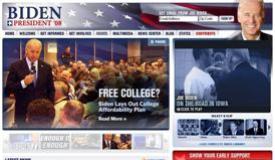
Joe Biden’s red, white and blue home page is dominated by news and a series of slide shows as well as opportunities to make financial contributions. There are four different opportunities just on the homepage, one of which is an attention-grabbing red button placed in the middle right hand side. His campaign blog is frequently updated with an an average of six new posts a day.
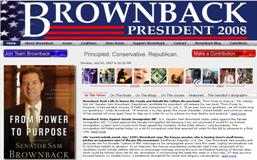
Beneath the words “Principled, Conservative, Republican,” Sam Brownback’s Web site is heavier on text than most, and in some ways less technologically refined. A large banner dominates the home page, declaring grandly, “Brownback President 2008,” with an American flag in the background. The home page uses ‘tabs,’ each of which is essentially a long list of content pieces like news articles, blog posts and issues. The Web site also prominently promotes his book, “From Power to Purpose.”
Well organized, tech-savvy and active, the first thing one might notice about this site is that the candidate is called Hillary—the word Clinton is absent. There are “8 Things You Can Do,” from “Join Team Hillary (i.e. sign up for emails and give personal information), to “Be A Hillraiser” (i.e. fundraiser), “Join/Start a Group (social networking) to “Start a Blog.” Also featured are videos, her blog and the latest news, (the site averages three new pieces of content daily). Much of the content speaks to her take on issues—even though she was the only candidate with no dedicated issue section until late May 2007.
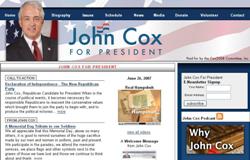
As someone who was left out of all the Presidential debates by cable news channels, much of the focus of John Cox’s Web site is to establish first, his identity and second, his credibility. A picture of him dominates the upper half of the home page, followed by a video of a television interview in New Hampshire headlined, “The Man Who Wasn’t There: Candidate for President.” Overall, the Web site remains pretty static day-to-day with only infrequent updates. Cox is also one of only two candidates who do not participate in the world of social networking.
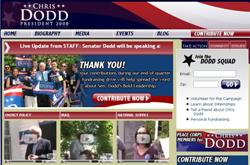
In May, Chris Dodd’s campaign Web site seemed technologically undernourished. By the end of the month, his campaign must have come to the same conclusion. In a late May redesign, his blog became much more active (going from an average of less than one post a day to over three), he added video and became more active on the social networking circuit. It now emphasizes video and how to join the “Dodd Squad.” With the redesign, however, the site, done in the most typical red, white and blue, also dropped some features, including Spanish language translation of content.
The continuously revolving slideshow that dominates John Edward’s home page gives the site a very active feel from the start. The action continues with a vast “Multimedia” section including video, audio, podcasts, photos and more as well as a “Take Action” menu item with 13 separate ways to get involved and links to 23 social networks sites. The site also stands out for forgoing the usual red, white and blue pattern. Here, the national colors are combined with yellows and greens.
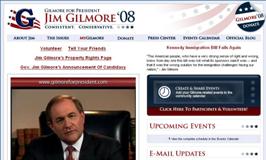
Jim Gilmore’s Web site lacks some of the sophistication that defines the Web sites of the leaders in the polls. Users are immediately greeted by a video introducing the candidate seated at a desk, “I’m Jim Gilmore, former governor of Virginia….” He updated the site in early June to add more interactive and customizable features like offering users the chance to create their own blogs, joining and creating online community groups and fundraising. But overall, the site is primarily comprised of more traditional text features like news and blog post headlines.
JoinRudy2008 is direct and to-the-point. Easy to navigate, a large lead content piece usually features a video screen-shot with a picture of “Rudy” (the last name isn’t promoted) displayed prominently. There are many ways users can get involved in the campaign, though interaction through the Web site is less of an emphasis. The site does not promote his MySpace page and doesn’t allow users to participate in the exchange on his blog. But uniquely it does encourage supporters to call in to talk radio stations and he even offers a database of local station contacts. Users can also sign up for a “live feed” of recent campaign news, press releases and blog posts. The site also brands all content pieces with icons that identify the content type (for example, a heart to volunteer and an envelope to raise money) and a store where you can buy ‘Rudy Gear.’
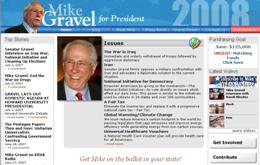
The centerpiece of Mike Gravel’s Web site is a smiling picture of the Senator next to six statements on “issues,” ranging from a withdrawal of troops from Iraq to universal health care vouchers. Overall, his site is heavier on text and shorter on easy-to-navigate icons and graphics, but it offers some notable exceptions. Gravel’s site is one of few to offer podcasts. It also engages visitors in a unique, continuously updated political “poll” at the bottom of the page. And the middle of the homepage offers these words from Thomas Jefferson: “Each generation has a right to choose for itself the form of government it believes most promotive of its happiness.”
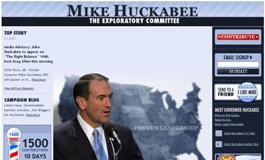
The only individual in the study whose candidacy is still in the exploratory stage, Mike Huckabee’s Web site is spartan in its layout and content. There is no top menu bar, and instead, a nearly screen-size image of the candidate looms in the center of the homepage, flanked by two sidebars that contain links to the other components of his site—including his blog, stand on key issues and a biography of him and his wife. He is the only candidate to offer no links to mainstream media and one of the few with no social networks highlighted.
Like those of other candidates trailing in the polls, Hunter’s site has few frills, essentially functioning as a way to build his base and get his position across. His lead item (‘latest news’) is always an opinion poll that reflects his stance on an issue and asks visitors to vote for or against his stance. His three key issues are also upfront, as is an endorsement from legendary test pilot Gen. Chuck Yeager. Other than that, the home page is dominated by ways to get people involved—with appeals for contributions leading the pack (indeed, donating money to Hunter qualifies you to be an “eDonor Leader”). Hunter distinguishes himself as the one candidate Web site that doesn’t have RSS.
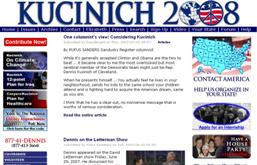
Kucinich’s site is aiming for substance over style. Text heavy, with minimal graphics/visuals, the home page displays all new content chronologically down the middle – almost blog like. Flanking this main column on either side are ways to contribute and state-level campaign efforts (using a very crude map). One of four candidates who doesn’t have a blog, he instead boasts an active, if confusing, “forum” – a virtual town hall where visitors can discuss issues at will. Kucinich does, however, make the most of YouTube and has one of the most exhaustive issue sections (covering 91 topics in all).
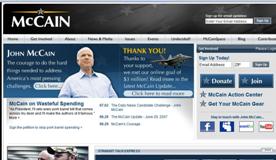
One of the four sites not to feature a red, white and blue color scheme (opting instead for a black, gray and white motif), John McCain’s Web site is packed with information—to the point of being overwhelming. Video plays a heavy role on the front page, and has its own well-organized “Multimedia” archive. Also highlighted is a slideshow of stories from the campaign trail, his “Straight Talk Express.” McCain’s web campaign staff seems to be increasing the number of ways to get voters engaged. Between May and June 2007, several citizen-centric sections were added including “Involving You,” “John McCain Supporter Spotlight” and a poll, as well as information on how to register to vote.
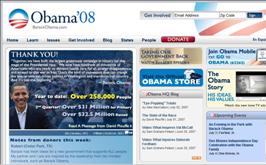
Barack Obama’s site suggests inclusion. The site focuses on community involvement, from citizen stories and pictures, to community blogs, to viewer-submitted videos. It is frequently updated with new content, featuring a new lead story in the upper left-hand corner every day, if not more frequently. In fact, even the layout of the page shifts frequently, though the core features remain the same: “MyBarackObama.com,” “In the News,” “BarackTV,” “Obama HQ Blog” the Obama store and upcoming events. The site is among few that are offered in Spanish and help citizens register to vote.
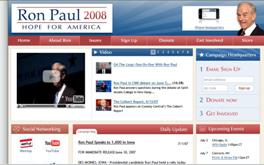
Ron Paul’s official Web site began as the most bare-boned and light on content, but has been changing rapidly—which seems to fit with his campaign’s reputation of aggressive Internet activism. Between May and June 2007 he redesigned his site by adding more color, structure and video. He also included four more social networks, giving supporters seven ways to network with the campaign. All new content on his site—even press releases and media mentions—appears on his campaign blog, the “Daily Update.”
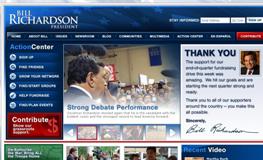
Governor Richardson’s site stresses outreach and image-building. The home page is split between the many ways to get involved (volunteering, social networking, attending speeches) and the many things the candidate is up to (in the form of video, news or blog posts). Richardson confirmed his foray into the presidential race on May 21, 2007 and his site saw a consequent makeover. By June, he had added new sections (Multimedia, for one), energized his blog by allowing comments, allowed for user customization of the page and changed the color scheme from dark red to a more ‘patriotic’ blue Star – Spangled Banner look.
An image of the ex-governor speaking as a flag waves behind him, along with a stirring quote, dominates Mitt Romney’s Web site. Romney manages to combine family values, technology and lots of positive imagery in a clean and casual Web site. The informal feel of the site is seen in the bio section titled, “Learn about Mitt,” the campaign which is branded “Team Mitt” and his campaign blog “Five Brothers” which is authored by Romney’s five sons rather than staff or any professional. Where Romney stands out is his use of video—apart from relying on YouTube (which he links to), the site has its own extensive streaming video channel, “Mitt TV,” that is subdivided into categories like issues, the trail and even, “fun.”
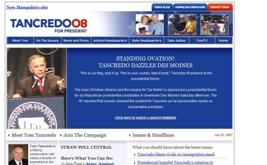
Tom Tancredo’s site is clearly laid out to emphasize one, who he is and two, where he stands on key issues—especially illegal immigration, which gets its own menu-section. Dominating the home page is a large picture of Tancredo accompanying the “lead” story that could be either a recent campaign event or an issue statement. Options for involvement are limited to appeals for donation and e-mail alerts. His blog is tucked away on a tab at the top of the page, and it’s here that you find links to social networks. Tancredo offers a branded video channel, “Tom TV,” that streams selections of mainstream media appearances.
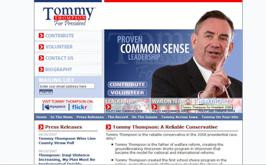
Another no frills site, Tommy Thompson’s site seems, instead, to be focusing on establishing his identity. The home page is dominated with an image of him along with the campaign theme of him being a “reliable conservative” who has “proven common sense leadership” and a profile of his appears just below. In terms of features, the campaign Web site stands out more for what it lacks than what’s present. With no video, no blogs of any sort and only the minimal delivery options, Thompson’s site scores low on both on-demand access and voter engagement.
In addition to the Web sites as a whole, PEJ conducted a text analysis of each candidate’s biography section. At each download, coders made an electronic copy of the homepage, as some Web sites were not printer-friendly. Biographies were copied and saved as Word documents.
Capture Timing
Web sites were initially coded on May 8, 2007. To compare results for accuracy and to make note of significant changes made to the Web sites over the course of a month, each Web site was tracked for a month and then coded again on June 12, 2007. There were few changes, and where they appeared, results reflect the site as of June 12.
For three specific variables–blog posts, mainstream media articles (newsroom) and press releases–we measured the frequency of updates in the following manner: We looked at the total number of items in each section’s archive (present on all 19 campaign Web sites) for the week previous to our coding day. Thus, we looked at April 30-May 4 when we coded on May 8, 2007 and June 4-June 8 when we coded on June 12, 2007. We then calculated the average for the week.
The biography sections were downloaded and coded on May 8, 2007. They were also re-read during our second round of coding on June 12, 2007. The only change to a biography occurred on Bill Richardson’s Web site—the biography was expanded into seven sections from two.
Coding Scheme and Procedure
Web site Analysis: To create the coding scheme, we first worked to identify the different kinds of features available on a campaign Web site. These ranged from tools to organize fundraisers to candidate positions on the issues. After several weeks of exploratory research, we identified 22 different quantitative measures and developed those into a working codebook. Coding was performed at the PEJ by two professional research analysts. They were trained on a standardized codebook that contained a dictionary of coding variables, operational definitions, detailed instructions and examples. Excel coding sheets were designed and used consistently throughout the process. Meetings were held throughout to discuss questions, and monitor consistency of coding. Where necessary, additional Web site captures took place to verify findings. Coders followed a series of standardized rules for coding and quantifying Web site features.
Certain variables merit an explanation of their working definition as applied in the coding scheme:
• Newsroom—the section on the site that lists articles not authored by the campaign. These are predominantly articles about the candidate that appear in the mainstream media (including editorials) and appear as either links to an external site or the article as a whole with the source. If these sections included press releases by the campaign, they were counted as a separate variable. We coded for presence of a newsroom section, and also coded the total number of items in the archived section for the previous week. • Official campaign blog—in counting a blog as a campaign blog, we coded only those authored and/or specifically endorsed by the candidate’s campaign. Grassroots and/or community blogs and blogrolls were not counted here. We coded for the presence of an official campaign blog, and also coded the total number of blog posts in the archive for the previous week. • User comments on campaign blogs—this variable identified whether campaign blogs permitted space for users to add their comments to the official campaign blog posts. We coded for presence of comments on the blog. • Citizen-initiated blogs—in addition to the official campaign blog, several candidates provided a tool for users to establish their own blog to show their support for the candidate. These were coded as citizen-initiated blogs. We coded for the presence of citizen initiated blogs. • Site customization—this variable looked at whether a visitor could tailor the homepage/ Web site based on their personal preferences. This feature always required users to register, and included the ability to create and access personal profiles, personal messages, personal blogs and more. • Spanish language translation—we also coded for whether or not campaign Web sites offered an option to translate content into a second language. Spanish was the only language offered for such translations at the time of publication. It should be noted that this did not necessarily include a translation of all the content on the Web site. • Grassroots activity—we coded for presence of options for grassroots activity. This variable had three dimensions: fundraising, organizing community events and voter registration information. We coded for presence of all three dimensions. • Social Networking—we coded for the presence of “social networks” and also the number of social networks that a candidate displayed on his/her Web site (on the homepage or elsewhere). They were embedded links that led the user to the candidates’ profiles on respective external social networking Web sites such as MySpace, Facebook, Flickr or YouTube.
Biography Page Key Word Search: The program CatPac® was used to analyze the candidate biographies. CatPac is a “self-organizing artificial neural network” that has been optimized for reading text (Doerfel and Barnett, 1999.) By assigning a neuron to each major word in the text, the program is able to identify the most important words in the text by measuring their frequency and co-occurrence. CatPac also contains a default “exclude” file, which contains prepositions, articles, conjunctions and transitive verbs (such as ‘and’, ‘when’, ‘he’ etc.) that do not bear any meaning and produce clutter within the text. Thus, when the analysis is carried out, these words are excluded by the program, so that they don’t complicate the results. Our sample consisted of the biographies of all 19 candidates. For candidates who divided their sections into more than one page, the text was combined into one text file, so that there was just one file per candidate. These were then fed into the CatPac program.
Analysis
Rankings: In analyzing the data, there were two different areas in which we tallied results and ranked the various Web sites:
• Engagement and Participation: To gauge how the campaign Web sites were engaging visitors PEJ assessed six variables: campaign blogs and whether they allowed comments, citizen initiated blogs, social networks and grassroots activity (fundraising, community events and voter registration). • On Demand Access: We looked at six variables again to help gauge how candidates disseminated their content: email updates/alerts, RSS (Real Simple Syndication) feeds, podcasts, mobile device delivery, search function and the ability to customize the Web site.
The PEJ research analysts produced an Excel template to tally the scores (summing the variables) for each Web site within the two categories. Thus for each of the two categories, each Web site had a final score on a scale ranging between one and six.
Key Word Usage: Our text-analysis of the candidate biographies had two inter-related components. The first was identifying and analyzing the most frequently used or top words in each biography. These were spontaneously generated by the program. The number of most frequent words analyzed for the study was set at 15. Indeed, according to the program, in most studies the first 1% of the total number of words is sufficient for text-analysis. In this case, 15 words were more than 1% of the total text analyzed.
The search was run for each candidate, and then for certain broader categories – Republicans, Democrats and all candidates combined. In our final analysis, we looked only at the top five words for individual candidates and the top five for the broader groups.
The second component was looking beyond these top words for 27 specific words important to the presidential campaign. These were chosen by the research team and were explicitly included irrespective of whether they actually occur in the candidate profiles.
These were (in alphabetical order): Bush, change, child, children, community, conservative, defend, ethics, faith, freedom, God, independent, leadership, liberal, moral, patriotism, progressive, protect, Reagan, renewal, safe, safety, strong, terrorism, traditional, values and Washington.
1. Republican Fred Thompson was not included in the study because he had not formally announced his candidacy, and only announced a preliminary intention to run at the end of May.