
Pew Research Center

FOR RELEASE JUNE 21, 2007

A Media Mystery

<p> The 30,000 employees of Private Security Companies currently operating inside Iraq represent a new element in modern-day warfare. They are armed, suffer casualties, are paid by the U.S. government, and perform tasks once done by the nation’s military. But a new study by PEJ reveals that for the most part, these forces have operated below the media radar. </p>

BY Pew Research Center: Journalism & Media staff

FOR MEDIA OR OTHER INQUIRIES:

Communications Department
202.419.4372
www.pewresearch.org

RECOMMENDED CITATION

Pew Research Center, June 2007, "A Media Mystery"

About Pew Research Center

Pew Research Center is a nonpartisan, nonadvocacy fact tank that informs the public about the issues, attitudes and trends shaping the world. It does not take policy positions. The Center conducts public opinion polling, demographic research, computational social science research and other data-driven research. It studies politics and policy; news habits and media; the internet and technology; religion; race and ethnicity; international affairs; social, demographic and economic trends; science; research methodology and data science; and immigration and migration. Pew Research Center is a subsidiary of The Pew Charitable Trusts, its primary funder.

© Pew Research Center 2026

Table of contents

  • About Pew Research Center
  • A Media Mystery
  • Issues Around the Use of Contractors
  • Character of the Coverage
  • In-Depth Coverage
  • Coverage over Time
  • Coverage Differences Among Outlets
  • Methodology

A Media Mystery

<p> The 30,000 employees of Private Security Companies currently operating inside Iraq represent a new element in modern-day warfare. They are armed, suffer casualties, are paid by the U.S. government, and perform tasks once done by the nation’s military. But a new study by PEJ reveals that for the most part, these forces have operated below the media radar. </p>

Private Security Companies in Iraq – A PEJ Study

Exactly how many Americans are serving in Iraq and what they are doing there might not seem like complicated questions. Stories in the media regularly talk about the 150,000 U.S. military personnel in the Iraq theater. Coverage of events inside Iraq, which includes the actions of U.S. troops there, was the third-biggest news story in the American media for the first quarter of 2007, according to PEJ research.

But those numbers do not include some 30,000 employees of U.S. and European-based Private Security Companies (PSCs), who work in some of Iraq’s most dangerous areas.

These PSC employees are not like other contractors in Iraq. Many of them carry weapons and are hired to protect important people, facilities and convoys. They have been involved in firefights and scores of them, the exact number is unclear, have perished. Yet there are many basic unanswered questions about these armed forces, which add by 20% the number of foreign troops in the country.

As a starting point, the financing can be difficult to track. Some PSC personnel are paid directly by the U.S. government, while others work as sub-contractors or sub-sub-contractors for other companies doing business in Iraq.

The issue of who is in charge of them in the field also can be confusing. While PSCs work alongside the U.S. military in Iraq, ultimately they serve at the discretion of the groups that hire them. Those employers may be the government, but they could also be some third party.

One thing is clear. Private security companies are doing jobs once largely undertaken by the military. And experts say they are being used in unprecedented numbers in the war in Iraq.

“This is something new, this level of involvement” says Deborah Avant, a professor of political science at George Washington. Avant, who has closely studied the role of contractors in the conflict, says their numbers and the tasks they are performing make them unique in the history of U.S. military conflicts.

The extensive reliance on PSCs in the Iraq conflict appears to represent a significant new element in 21st Century warfare.

So what does the American public know about them? That raises the issue of how well the American news media are covering the story of the PSCs in Iraq.

In June 2007, both USA Today and the Washington Post published major front-page piece stories examining the growing use of PSCs in Iraq. But by and large, there are formidable obstacles for journalists trying to cover private security companies, and the media appear to be playing a game of catch-up.

To begin with, given the dangerous security situation throughout Iraq, it is difficult for reporters to locate PSC forces and spend time with them. For another, as private entities, the PSCs are under no obligation to cooperate with the media and their activities are hard to track. Certainly journalists are less likely to be able to embed with them as they do with standard military.

How much has the press covered this new element of the war? To answer that, PEJ examined coverage of this issue over the four-plus-year course of the war, using the searches of the Lexis/Nexis database.

The findings, put briefly, show Private Security Companies are a relatively unknown commodity in the mainstream media’s Iraq reportage.

[1]

In total, out of well over 100,000 stories dealing with the war over that period, PEJ found 248 stories dealing in some way with the topic of PSCs. And most of that coverage could be characterized as tangential references to private security contractors or companies inside larger stories about other Iraq-related issues or events. If one uses the most-heavily covered PSC – Blackwater USA – as a sole search term with the word “Iraq,” a greater number (more than 440 stories) appear. That would still place the tally at less than 1% of Iraq war coverage.

These are some of the findings of a Lexis/Nexis search of mainstream news outlets over those 49 months. Among the other findings:

  • Even the total of 248 stories overstates the coverage in a sense. Some of those were the same story that ran in different outlets or a repeated airing of the same story. In June 2006, for example, CNN aired eight stories on PSCs, but five of those airings were actually the same report re-aired over a three-day time span. Of those 248 stories, 20 were also op/eds, meaning they were submitted by outside writers or written by editorial boards – and meant as commentary.[2]
  • One news event, the March 2004 ambush of a team of Blackwater USA security contractors that ended with their burned bodies hanging from a bridge in Fallujah, accounted for more than a quarter (27%) of all the reporting on private security forces.
  • Overall, print outlets dominated the coverage. Fully 81 of the 93 outlets that carried even a single story on PSCs were print. Five broadcast and cable outlets aired a total of 29 stories. Four online outlets posted a total of six pieces. Two wire services ran 10 stories. The remaining 203 appeared in newspapers and magazines.
  • In all, 16 outlets did four or more stories that used the key search terms about PSCs beyond brief accounts describing injuries or deaths. Most of these stories were either tied to Blackwater or came from regional outlets with geographic connections to the Moyock N.C.-based security company. The Virginian-Pilot, based in nearby Norfolk, VA, was nominated for a Pulitzer Prize for a six-piece series on PSCs focusing on Blackwater. The News & Observer in Raleigh, NC, also stood out for its coverage.
  • A handful of outlets stood out for their longer, more in-depth reportage. The Virginian-Pilot ran its lengthy series on PSCs. The New York Times published 17 stories, including the single longest one on the issue, an 8,000-word Sunday magazine piece. But most of the coverage took the form of spot news stories focused on specific PSC-related events.
  • In the national media, NPR programs like Fresh Air and Talk of the Nation stood out for airing frequent coverage on the issue, though much of it came in the form of interviews with one person—P.W. Singer, an analyst from the Brookings Institution.

[1] PEJ looked for coverage on the Lexis/Nexis database by searching for “Iraq” with four different terms “private military contractors,” “private military companies,” “private military firms” and “private security companies”

[2] Many of the pieces in our 250-story count were duplicates that ran in different outlets. For instance, on April 2, 2004, shortly after the attack on the Blackwater PSCs in Fallujah, we found 13 stories, but seven of those were different edits of the same story from the Knight-Ridder newspaper chain. In September of 2003, the media chatter about the contractor Haliburton led five papers to publish a story from the New York Daily News about a call for an investigation of the company on Capitol Hill. And the four stories we counted on March 31, 2006 were all reprints or edits of the same story that ran March 30 in the Virginian-Pilot. In June 2006, CNN aired eight stories on PSCs, but five of those airings were actually the same story re-aired over a three-day time span.
Issues Around the Use of Contractors

How important are PSCs? There are many issues related to the war in Iraq that compete for coverage on a daily basis. U.S. military personnel and their families far outnumber private military contractors. Still, funding for PSCs comes, directly or indirectly, from taxpayer dollars. And even within the military there is heated debate about the use of PSCs.

Supporters of the reliance on PSC forces say they are better-trained for certain tasks—such as convoy protection
or personal security—than U.S. military personnel, whose primary focus is often engaging the enemy in battle.

[1]

On the other side of the argument, critics of PSCs in Iraq say their independent operating guidelines can make them harder to control and monitor. Avant points out, for instance, that despite the high number of contractors in Iraq, only one has been prosecuted for any wrongdoing.

Beyond the debate over the pros and cons of PSCs, there is the broader issue of whether the public is adequately informed about their role in Iraq. Many PSCs are sub-contractors or even further removed from the government contract that is technically paying them for their services. For example, they are hired as security by construction firms that have been hired by bigger construction firms to build roads and buildings. The government doesn’t keep track on their personnel or budgets.

As Rep. Jan Schakowsky (D-Ill), told USA Today, “There is no visibility on these contractors. Meaning no clue how much money we’re spending.”

In an interview with PEJ, Lawrence Peter, head of the Private Security Company Association in Iraq, expressed frustration with the reporting on PSCs. He said coverage is extremely limited, and the stories that emerge, he argued, often center on how they are “mercenaries and hired guns” with little attention to how much they are needed.

Whatever the nature of the coverage, the lack of it means it has been largely left it to a small group of lobbyists, advocates and dissenters to scrutinize what these firms do, how many personnel they have in theater or how much public money is subsidizing them.


[1] Parker, Laura, “What Exactly Happened That Day in Fallujah,” USA Today, June 11, 2007.

Character of the Coverage

Even when they were covered, PSCs were often tangential aspects of larger stories about other Iraq-related issues or events. Many sprang from U.S. government actions or reports, such as the Washington Post’s April 23, 2005 story “Contractor, Army Office Fell Short” which ran on the front of the financial section.. Another example was USA Today’s July 29, 2005 story “U.S. Contractors spent $766 M on Security in Iraq, GAO says.” Pieces like these discuss problems with contractors, but don’t delve heavily into what the contractors are doing in Iraq.

Other stories about PSCs were often less about what exactly the companies were doing in Iraq than questions about financial accountability. The first piece the Washington Post did that used any of our search terms was an October 9, 2003 story headlined, “Spending On Iraq Sets off Gold Rush,” with the subhead “Lawmakers Fear U.S. is Losing Control of Funds.”

Some articles just touched on the use of PSCs as they focused primarily on the war. For instance, in “War, Just a Click Away,” which ran on Washingtonpost.com on August 10, 2005, contractors are just a small part of an essay on the growth of war coverage online. Or consider the New York Times piece “One Maker Looks Inside, Not to Hollywood,” which ran on May 8, 2006. It was about a new video game about PSCs, but didn’t address the issue in a larger context.

The cable news outlets dealt with the issue mostly in broad strokes. In June 2006 CNN several times aired a report on “Civilian Contractors in Iraq,” but that report largely focused on the dangers contractors were facing in the country, not specifically the use of PSCs as stand-ins for U.S. troops. Fox News aired two stories that touched on the issue – and one of those was a December 2, 2005 segment of the show Hannity & Colmes that was a broad “Analysis of the Situation in Iraq.” The discussion, in part, centered on a video that purported to show British PSC employees firing on civilians.

Most local newspapers barely touched the topic of PSCs. Even among big metro dailies, like the Dallas Morning News, Seattle Times and San Diego Union-Tribune (which each ran one story), the PSC issue received very little attention. If they published any at all, most local papers ran one piece on the issue, often in the opinion pages and by non-journalists.

The Richmond Times Dispatch, for instance, ran an op/ed from a student at American University on August 22, 2005 headlined, “How Do Private Contractors Fit Military’s Mission?” The Orlando Sentinel ran an op/ed from a contributor on August 8, 2005 with the headline, “Expect Private Military Forces to Flex More Muscle.” The Chicago Sun-Times published an Op/Ed piece from an outside contributor on September 10, 2006 headlined, “5 of the Worst War Profiteers: There’s Money to be Made – By Any Means Necessary.”

Other stories that included a mention of our key words and phrases were company or personality profiles, specific allegations against a firm or reports of death or injury.

[1]

These deaths and other incidents did generate stories. National papers and the bigger metro dailies reported big gun battles and casualties. Smaller local papers published stories about injured or killed members of their communities. And other local papers based closed to big PSC companies wrote stories when their local employer suffered casualties.

As part of this examination we entered the names of all the members of the Private Security Company Association of Iraq through the Nexis database over the same time period we checked our key phrases. The searches generated a few hits for some PSCs and dozens for others. The stories we found were a mix of things, but incident stories dominated.

[2]

Two newspapers located near Blackwater headquarters, the Virginian-Pilot in Norfolk Virginia and the News & Observer in Raleigh, North Carolina, accounted for a good deal of the coverage of that firm. To get a sense of how those outlets covered the best-known PSC, we searched any stories they published that contained the term “Blackwater” over the time period of our study. The News & Observer published 75 stories with the word “Blackwater” and the Virginian-Pilot ran 83 articles that included that term. Only about a quarter of the coverage was about the issue and role of PSCs as private military forces.

More of the News & Observer coverage focused on Blackwater’s ties to Halliburton, the giant military contractor firm that hired Blackwater to provide security for its personnel, facilities and convoys.  The coverage often examined the issue of cost overruns and billing. Many of these stories broke new ground on that financing issue. Also noteworthy was a six-part series in 2004 on the deaths of the Blackwater personnel in Fallujah, “The Bridge,” some of which dealt with the larger questions around PSCs. The Virginian-Pilot primarily covered Blackwater as a local business, reporting on everything from the company requesting permits for roads and firings ranges to its place in the world of private security companies. Its 2006 six-part series, “Blackwater: Inside America’s Private Army,” also delved into the question of PSCs being used as soldiers.


[1] Number was reached by adding together all the contractors killed who were listed as “security contractor,” “security expert,” “security consultant,” “security specialist” or “security guard.”

[2] This 400 number is higher than out 248-story count because it includes that just mentioned Blackwater but none of our key search terms. These stories included accounts of Blackwater incidents and casualties.

In-Depth Coverage

While the bulk of the coverage treated PSCs as secondary factors in stories about other Iraq-related issues, there were over the course of the four years, a handful of notable in-depth pieces.

The Virginian-Pilot’s coverage, in particular, is a case of how the location of an outlet can play a large role in its content – even on an issue as big and complicated as PSCs. Much of the paper’s coverage can likely be attributed to the fact that the Pilot is based in Norfolk, Va., is just 29 miles up Route 168 from Blackwater in Moyock, N.C.

Much of that paper’s PSC reportage grew out of a six-part 2006 series that looked at Blackwater as a way into the issue of private security companies. The story list: “A New Breed of Warriors,” “Profitable Patriotism,” “On the Front Lines,” “When Things go Wrong,” “On American Soil,” “New Horizons.” The series, a 2007 Pulitzer Prize finalist, looked at PSCs through several lenses combining colorful anecdotal reporting with issues.

Take this section from the “On the Front Lines” piece:

“Executives of the North Carolina-based company landed a meeting with Paul Bremer III, the diplomat chosen by Bush to head the Coalition Provisional Authority, Iraq’s interim government.

Nobody had really figured out exactly how they were going to get him from D.C. and stand him up in Iraq,” Blackwater President Gary Jackson said. “The Secret Service went over and did an assessment and said, ‘You know what? It’s much, much more dangerous than any of us believed.’ So they came back to us.”

In August 2003, Blackwater was awarded a $21 million no-bid contract to guard Bremer, and U.S. agencies have been tapping the Blackwater well ever since. The company now has about 1,000 contractors in Iraq – the most it has ever had.

Other players also have rushed in to meet the demand. Last month, the government estimated that there were at least 180 security companies operating in Iraq…the largest private military deployment in history.”

The stories the Pilot ran became a source of content for other outlets as well. The Greensboro (North Carolina) News & Record, Pittsburgh Post-Gazette, Seattle Times, Orlando Sentinel and Contra Costa Times all published stories that first ran in the Pilot.

Among the national outlets, the New York Times Magazine ran an 8,000-word piece in its August 14, 2005 issue that looked at the growth of PSCs – “The Other Army.” The Washington Post ran a front-page piece on September 10, 2005 – “Security Contractors in Iraq Under Scrutiny After Shootings” – that mentioned the number of PSCs along with some of the complicating factors in their use. And the April, 2007 Vanity Fair ran a 5,000-word piece on contractors as “the second-largest army in Iraq.” But ultimately, these stories were few and far between.

National Public Radio’s coverage was arguably the most issue driven. Coverage specifically about PSCs was relatively frequent on the radio network, which aired 17 stories on the subject. Those pieces were usually not on Morning Edition or All Things Considered (NPR’s morning and evening news programs) but rather on talk programs such as Fresh Air and Talk of the Nation. And many of these segments were largely interviews with one person – often the Brookings Institution’s P.W. Singer. While these pieces examined the PSC question in depth, they usually featured the perspective of one analyst, albeit a knowledgeable one.

Coverage over Time

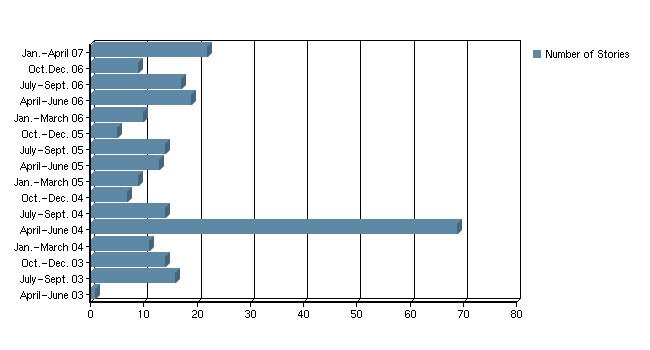
Over the course of the conflict in Iraq the coverage of PSCs has remained on the fringe – save for a big spike in 2004 that was linked to the infamous Fallujah attack. The group was traveling with a supply truck near a U.S. military air base in Habbaniya when they were attacked by insurgents on March 31. Bodies were dragged through town and strung up on a nearby bridge.

Mainstream Media Coverage of the PSCs Over the Course of the Conflict

The year the war began, 2003, saw few stories mentioning PSCs – 31 in total from the March 20 start of the war through the end of the year. The initial phases of combat were less about securing the country than straight combat, taking land and the push to Baghdad.

The following year, things changed. The primary story line focused on the efforts to get control of the country. And there was a boom in stories about the firms in mid-2004 after the killing of the Blackwater security consultants. Stories about the grisly murders led to a rush of coverage about PSCs. In the media outlets we examined, there were 13 stories on April 2 using one of our search terms – the highest tally of any single day. There were 36 stories in total that month, the highest monthly tally.

Coverage continued at a higher level for the next several months, for a total of 90 stories over the course of nine months. Yet, as the months of 2004 went by, there were fewer and fewer pieces. By 2005, the number was down to the pace it was on before the Blackwater incident – with only 41 stories using our terms that year.

The number climbed back up again in 2006 to 55 stories, though that bump up was largely the result of two things – CNN’s repeat of its story on PSCs in June and the Virginian-Pilot’s stories on the issue that summer.

Through the first four and a half months of 2007, the numbers are on track to largely comport with what we have seen other years. We found 22 stories that used one of our terms, which would put the figures on track to be somewhere in the mid-60s by year’s end. The slight uptick is again largely due to Blackwater, specifically the publishing of the book “Blackwater: The Rise of the World’s Most Powerful Mercenary Army” in February. Author Jeremy Scahill has written op/eds and appeared on the radio to promote his book.

Coverage Differences Among Outlets

Throughout the entire period examined, print outlets dominated the coverage. The overwhelming majority of stories, 202, came from print outlets. And 82 of the 93 outlets that carried even a single story on PSCs were print.

Coverage by Genre
Print and Other Outlets

Broadcast and cable outlets aired 29 stories in five different outlets. More than half of stories came from one outlet, National Public Radio. Nine stories came from the wires. Most of these stories were pegged to the release of a report or the actions of Washington policymakers who were interested in monitoring PSCs. There were, however, occasional bigger pieces of enterprise reporting like the May 7, 2004 AP story headlined “Pentagon Memo Warned in 2002 about lax oversight of Army Contractors.”

Seven stories came from the four online outlets that posted stories discussing PSCs. (These outlets – including washingtonpost.com, Slate, Salon and MarketWatch.com – were the only news Web sites searchable in the Lexis/Nexis universe of this study).

On the whole the PSC story existed on two tracks. It generally attracted ongoing and, at times, in-depth coverage in the nation’s larger, best-known outlets. The other source of fairly frequent coverage was the smaller newspaper located near a key PSC.

In total we found 105 stories with a reference beyond death or injury to PSCs in 29 different large outlets— they include television and cable news networks, NPR, and papers with a greater national reach and impact such as the New York Times, Washington Post, and Los Angeles Times.

Additionally, we found 10 AP and UPI stories, which we counted separately because even though they appeared on the Lexis/Nexis search, there no way to confirm that they actually were published.

That’s not a huge number, but ultimately it was a few of the nation’s largest newspapers and National Public Radio that led the way in examining the major issues surrounding PSCs. The Washington Post ran 19 stories mentioning one of our key terms. The New York Times published 17. NPR aired 17 segments. The Los Angeles Times ran nine stories.

Number of PSC Stories
Major vs. Local Outlets


Number of Outlets Reporting on PSCs
Major vs. Local

Local outlets actually had more stories about PSCs, 133, but they were in only 62 of the 388 local outlets searched. – for an average of roughly two per outlet. It should also be noted that while we labeled these outlets as “local,” they include among their ranks some big metro dailies that have regional audiences, such as the Dallas Morning News and Boston Globe.

Of the 62 outlets that published or aired something, most of these ran just one story while three smaller papers carried the bulk of the reportage. The Charleston (W.V.) Gazette ran eight stories, the News & Observer in Raleigh carried 10 and Virginian-Pilot totaled 17. These were not wire service pieces laid into the pages, but original work by staff reporters.

Broadening the search to include the word “Blackwater” for the two outlets based close to that security contractor—the News & Observer and Virginian-Pilot—turned up  somewhat more stories that addressed the subject of PSCs functioning as paramilitary forces. Using that expanded search, the total of stories that focused on the role of private security forces rose to 20 articles for the News & Observer and 24 for the Pilot. Those numbers do not include other stories that the papers did about outsourcing to contractors, cost overruns and more.  

Those numbers suggest that the people most exposed to information about the role of private security companies in Iraq may be those that live closest to them. For the rest of the country, the issue has received relatively scant coverage.


Methodology

This analysis examines the mainstream media’s coverage of private security companies (PSCs) in Iraq over the course of the war. It looked at stories that appeared in mainstream media outlets that are archived on the Lexis/Nexis database.

The time period examined was from the start of the war Thursday, March 20, 2003 to Thursday, April 1, 2007 – a period of 49 months.

There were 441 domestic outlets included in PEJ’s Lexis/Nexis search, which mirrors the Lexis/Nexis universe for general news sources. This list was then cut down to focus solely on domestic mainstream local and national news outlets, removing foreign and specialty publications, TV and radio programs and Web sites.

To gauge the coverage over the 4-plus years of the war PEJ paired the word “Iraq” with four key search phrases: “private security companies,” “private military contractors,” “private military firms,” and “private military companies.”

In total PEJ found 93 out of the 441 U.S. media outlets that aired or published stories including at least one of these four key search terms. Removing straight news accounts about casualties or incidents, we were left with a small list of “issue” stories that at least touched on the idea of PSCs in the U.S. media.

“Private security companies” turned up in 102 accounts in U.S. outlets. “Private military contractors” showed up in 122 pieces. “Private military companies” appeared in 61 stories. The phrase “private military firms” appeared in 27.

Those stories were then culled to remove duplicates and to count only once stories that used two or more of the PEJ search terms – such as a story that used both “private military contractors” and “private military firms” to address the issue of PSCs. The same story appearing in different newspapers was counted each it appeared. And the same story appearing on a TV outlet at different times was counted each time it aired.

Using this system, PEJ arrived at 248 stories in 93 mainstream outlets over the 49 months we searched.

A list of the outlets that ran at least one story is listed below:

Associated Press

ABC News

Albany Times-Union

Albuquerque Journal

American Prospect

American Spectator

Asheville (NC) Citizen-Times

Atlantic Monthly

Austin American Statesman

Baltimore Sun

Baltimore Daily Record

Bangor Daily News

Boston Globe

Boston Herald

Buffalo News

Business North Carolina

Business Week

Charleston (WV) Gazette

Charleston (SC) Post and Courier

Charlotte Observer

Chattanooga Times Free Press

Chicago Tribune

Chicago Sun Times

Cleveland Plain Dealer

Contra Costa Times

CNN

Christian Science Monitor

Daily Bruin

Dallas Morning News

Deseret Morning News

Durham (NC) Herald-Sun

Economist

Foreign Affairs

Foreign Policy

Fox News

Ft. Lauderdale Sun Sentinel

Ft. Worth Star Telegram

Grand Rapids Press

Great Falls Tribune

Greensboro News & Record

Harpers

Houston Chronicle

Kansas City Star

Los Angeles Times

Lebanon (PA) Daily News

Lexington (KY) Herald Leader

Las Vegas Journal Review

Market Watch

Miami Herald

Nation

Newark Star Ledger

NewsHour

Northern Star

Norwich Bulletin

National Public Radio

New Yorker

(NY) Daily News

New York Post

New York Times

Orlando Sentinel

People

Philly Inquirer

Philly Tribune

Pittsburg Post-Gazette

Raleigh News & Observer

Richmond Times

St. Louis Post-Dispatch

St. Paul Pioneer Press

Salon

San Mateo Times

San Diego Union-Tribune

Seattle Post Intelligencer

Seattle Times

Slate

San Francisco Chronicle

San Jose Mercury News

The State (Columbia S.C.)

Tacoma News Tribune

Tallahassee Democrat

Time

Toledo Blade

Tulsa World

USA Today

UPI

Vanity Fair

Virginian Pilot

Washington Post

Washingtonpost.com

Washington Times

Washington Monthly

Weekly Standard

Wichita Eagle

Wichita Business Journal