
Pew Research Center

FOR RELEASE APRIL 30, 2001

The First 100 Days

<p>Did George W. Bush really get an easier ride from the media in his first months in office? </p>

FOR MEDIA OR OTHER INQUIRIES:

Communications Department
202.419.4372
www.pewresearch.org

RECOMMENDED CITATION

Pew Research Center, April 2001, "The First 100 Days"

About Pew Research Center

Pew Research Center is a nonpartisan, nonadvocacy fact tank that informs the public about the issues, attitudes and trends shaping the world. It does not take policy positions. The Center conducts public opinion polling, demographic research, computational social science research and other data-driven research. It studies politics and policy; news habits and media; the internet and technology; religion; race and ethnicity; international affairs; social, demographic and economic trends; science; research methodology and data science; and immigration and migration. Pew Research Center is a subsidiary of The Pew Charitable Trusts, its primary funder.

© Pew Research Center 2026

Table of contents

  • About Pew Research Center
  • The First 100 Days
  • The Invisible President
  • Tone
  • Bush, The Managed Presidency
  • Clinton’s Runaway Ship
  • The Tactical Clinton vs. The Ideological Bush
  • The Insider vs. The Man of the People
  • Strengths and Weaknesses
  • Television
  • Newspapers
  • Methodology
  • Final Topline

The First 100 Days

<p>Did George W. Bush really get an easier ride from the media in his first months in office? </p>

Contrary to Democratic complaints, George W. Bush has not gotten an easier ride from the American media in his first 100 days than Bill Clinton did in his famously rocky start, according to a new study of press coverage. Despite a very good first month, Bush’s coverage overall was actually less positive than Bill Clinton’s eight years ago, the study by the Project for Excellence in Journalism found.

But the impression the American public has of Bush at this point may be fairly shallow and transitory. Bush is dramatically less visible than Clinton was with fully 41% fewer stories about Bush on network TV, in newspaper section fronts, opinion pages and in one major newsweekly in the first two months in office.

As a whole, the press has depicted Bush as a skillful manager, more comfortable as an insider than a man of the people, who is stubbornly pursuing a sincere, conservative ideological agenda even if it is controversial.

By contrast, a much larger percentage of the coverage of Clinton depicted him as a politician of the people whose actions and policies were often highly calculated but also more popular.

Tone of Stories for Bush and Clinton
Bush Clinton
Positive 22% 27%
Neutral 49 44
Negative 28 28
Satire 1 1
Total 100 100

These are a few of the findings of the new study, which examined 899 stories at four network television news stations, two major newspapers and one major newsweekly during the first 60 days of the Bush Administration and, by comparison, the Clinton Administration in 1993. The study included every odd day and all Sundays of the nightly newscasts of ABC, NBC, CBS and PBS, the section fronts and opinion pages of the New York Times and the Washington Post, and all issues of Newsweek magazine.

While overall the coverage of Bush’s early days is actually less positive than Clinton’s, many may sense the opposite because of the power of first impressions.

Bush had a far better first month than Clinton. Positive stories outweighed negative (27% to 23%), while for Clinton, it was more than reversed (32% negative, 22% positive).

The coverage of Bush has become more critical since then, as the focus turned from his basic competence to his policy and ideological agenda. In his second month, the coverage was twice as negative as positive (36% to 17%).

Tone of Bush Coverage
1st month 2nd month
Positive 27% 17%
Neutral 49 47
Negative 23 36
Satire 1 0
Total 100 100

If one were to exclude editorial and opinion pages as well as Newsweek, which researches found to be a hybrid of news and opinion, and look only at hard news pages and broadcast news, Bush and Clinton received essentially similar percentages of positive stories (24% Bush versus 23% Clinton), while Clinton’s coverage was markedly more negative (18% Bush versus 28% Clinton). But given the growing amount of commentary in the media culture today—on TV, radio and print—it seems more appropriate to examine the coverage in total. Hard news may account for less and less of how people form their impressions of public figures.

Bush also may have benefited initially from the expectations game, the data suggests. After expressing clear doubts about Bush’s intelligence and competence during the 2000 campaign1, the press gave the new president high marks when the Administration managed a smooth transition, particularly during the cabinet appointment process.

That began to give way when Bush’s budget plans were released and more of his policy positions became clearer, including on such issues as global warming, water pollution, bankruptcy law and mining cleanup.

Clinton, in contrast, was hammered in his early days for missteps over gays in the military and botched appointments, which were all the more surprising for a candidate depicted as one of the most skillful politicians in generations. His coverage became more positive because his policy positions on the budget, free trade, health care and reinventing government were depicted as widely popular.

Among other findings in the study:

  • The press had a tendency to view Clinton’s policies as tactical and strategic. It tends to view Bush’s policy agenda as a more genuine expression of his worldview. While this has led to critical coverage at times, it could soon benefit the new president. If his policies prevail in Congress, he may be depicted as someone who stood on principle and won rather than someone who might have been paying off political debts or shoring up his base.
  • Coverage of Clinton was twice as likely to deal with his relationship to American citizens as Bush’s. Bush’s coverage has focused far more on his relationship with insiders in Congress. This was even truer on television, perhaps because Clinton staged events with citizens while Bush, when he does public events, tends to do them with political figures.
  • Bush has enjoyed much more success controlling his message than Clinton. All five of the major stories about Bush were those that he initiated or were part of the budget process he knew to plan for. By contrast, only two of the top five stories about Clinton’s early days-both budget related–were expected. The three others were all unanticipated problems, two of them self-inflicted.
  • There is a clear pattern to how the press has covered the last two new presidents. It starts by focusing on whether the man is up to the job. Then policy takes over, especially budget issues. Overall the basis upon which the media assessed the two administrations was strikingly similar. Six-out-of-ten stories assessed ideological agenda. Roughly a third focused on leadership qualities (more so at the start). Just 5% or less of stories assessed presidential character.
  • In print, Bush had a much harder time than Clinton on the opinion pages. Half of all editorials have been critical of him, while only 20% have been positive. While these results come from the New York Times and Washington Post, reputedly liberal papers, the problem was roughly the same on the op-ed pages, where four-in-ten stories were critical and only 16% positive.
  • Clinton fared much better. Only two-in-ten editorials were plainly negative while more than 40% were positive. His op-ed pieces were more evenly mixed, with negative stories slightly outweighing positive (35% to 30%).

Much was made in 1993 of the swift judgments that seemed implicit in the press coverage of Clinton. The notion of a presidential honeymoon period, some analysts suggested, might have become obsolete in the age of 24-hour news. Presidential aide turned journalist David Gergen joined the Clinton Administration after a few months and decried what he called the new “rush to judgment” in the press.

This study was designed to examine how the press was assessing the new president, to break down the basis of those assessments and to compare this early period with Clinton’s. What is it the press now focuses on? Is the presidential honeymoon really an artifact of the past? What does the coverage tell us about Bush versus Clinton?

To accomplish this, the study examined the following:

  1. How many stories were done?
  2. What was the basic topic of each story and where did it run?
  3. What underlying area of the presidency was the story assessing—was it the president’s leadership abilities, his ideology or his personal character?
  4. What was the tone of those assessments—was it neutral/balanced, demonstrably negative or demonstrably positive?
  5. What narrative technique was the story built around—conflict, explaining policy, explaining tactics, a reality check, etc?
  6. What political relationship did the story focus on—the president’s relationship to his staff, to members of Congress, to the office of the presidency, to interest groups, to citizens?

The study examined coverage over the first 60 days of the presidency beginning January 21, the day after the inauguration, through March 21. In all, the study examined 333 stories about Bush and 566 about Clinton. Princeton Survey Research Associates consulted on the project design and statistical analysis.

1 A Question of Character: How the Media Have Handled the Issue and How the Public Has Reacted, Project for Excellence in Journalism, July 27, 2000
The Invisible President

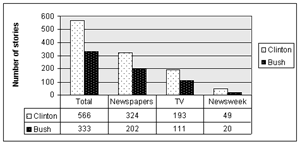
The most striking single statistic is the drop in the amount of coverage of Bush versus Clinton in their early days.

The drop-off is across the board—across TV, newspapers and newsweeklies. Network television was down 43%, newspapers 38%.

Bar Graph

Newsweek magazine alone had 59% fewer stories about Bush in its pages than it carried about Clinton eight years earlier, just 20 stories in the eight issues from the beginning of February to the beginning of April, compared with 49 stories about the new president in the first eight issues in 1993.

Only one news organization stood out for its consistency. The News Hour with Jim Lehrer actually showed a slight increase in coverage of Bush over Clinton in their first two months in office.

While some analysts have suggested that this may be a function of Bush shrewdly keeping a lower profile2, it also may reflect in part changes in the nature of the media culture. The selection of stories in the media is now often lighter, with a movement away from politics, other studies have found. One sign of this is that, in looking at the total number of stories, the president is still a dominant figure on op-ed and editorial pages, but dominates stories on the front pages, newscasts and financial pages less often.

Some, including the president’s press secretary, have suggested that this will serve the president well, since people will appreciate his decision not to exploit situations such as the return of the American military personnel from China.3

But if he is pushing an agenda on taxes or clean air that does not have broad support, this lower profile may also make it harder to quickly rally citizen support when he needs it.

While the drop off in coverage was general, within newspapers it was clearly more pronounced in some areas more than others. In particular, there was a big decline in the amount of coverage on the front of the financial sections (from forty-three stories about Clinton to just five about Bush).

Whether by design or accident, Clinton was attached in news pages to the economic downturn of 1993. That may have been because Clinton, as a Democrat who had campaigned on the economy, felt a need to carry through with the promise that he would be more responsive to economic changes than his predecessor.

Regardless, it did not do him much good, as Clinton earned little credit for the economic turnaround that occurred in 1994 and Democrats suffered in the Republican landslide of November that year. Bush, by contrast, offered some early comments on the economy, but now seems to have pulled back from doing so. One possible reason, along with the fact that Bush has broader support in the business world, is that economic news has changed somewhat in eight years, becoming more about companies and the stock market and somewhat less tied to federal economic indices.

Even editorial writers at the Washington Post and New York Times write less about Bush than they did about Clinton. The two papers wrote 74 editorials about Clinton, versus just 46 about Bush, in the sample studied.

The one area where there was no drop off in coverage was among columnists and op-ed writers. The Times and Post wrote 60 about Clinton, and 62 about Bush. If newspapers and television are covering the presidency less, columnists and guest columnists are just as focused on the White House as they once were.

2 Michael Kelly, “The Quiet Man,” Washington Post, April 18, 2001

3 John Harris, “Leading Actor Bush Avoids Center Stage,” Washington Post, April 14, 2001.

Tone

Taking the first two months in office as a whole, Bush’s coverage has been slightly less positive than his Democratic predecessor’s (22% positive stories for Bush versus 27% for Clinton)4.

For both presidents, the bulk of stories were neutral (49% Bush, 44% Clinton). The percentage of negative stories for both presidents was identical (28%).

In praising Bush, stories tended to applaud his leadership skills.

In a story about Bush’s unexpected visit to the Congressional Democratic retreat, for instance, Newsweek reporters Bill Turque and Howard Fineman wrote, “Bush seemed to steal their oxygen, staging unprecedented drop-ins to preach the bipartisan gospel. “Bush has not only seized the momentum; he’s done it with the Democrats’ ideas.”5

In an ABC News story on Feb. 3, anchor Elizabeth Vargus led into a story about Bush’s outreach to Democrats by saying “there’s not much question now” about Bush’s style succeeding in “politically savvy Washington.” After supportive quotes from Senator Ted Kennedy and David Gergen, reporter Terry Moran offered, “The tactic is typical of Bush, say Texans who for years have watched him leverage his sunny temperament into political victories.”6

Criticism for Bush often focused on his ideology and policy decisions. A March 15, page one story at the Washington Post read, “Bush appeared to send mixed signals about the U.S. economy. To reporters, he said he was concerned about the market turmoil but has ‘great faith in our economy.’ Later, in a speech, he declared: “Our economy is beginning to sputter.”7 Soon after Bush became much more guarded when the issue of the economy arose.

For Clinton, praise tended to be attached to his policy statements, as in a page one story in the Washington Post on February 3, about Clinton’s pledge on welfare reform. After quoting Clinton’s speech, the story then quoted several governors, including Republican governors Tommy Thompson and John Engler, as “very excited,” Senator Moynihan as “hugely gratified,” and welfare analyst Robert Rector as calling it “a very dramatic departure from Democratic proposals in the past.”8

[drug]

[Republicans will say:]

Clinton was also harshly criticized for his agenda over gays in the military. In a New York Times page one story on the Joint Chiefs’ strong opposition to this policy, critical comments that the plan would “wreck morale, undermine recruiting, force devoutly religious service members to resign and increase the risk of AIDS for heterosexual troops,” disproportionately outweighed arguments for the policy from gay advocates or the administration.11

The more striking figures about tone are when and where the judgmental stories appear.

As stated earlier, Bush got off to a fast start but gradually began to falter. For Clinton, it was the reverse.

The second notable difference is where the judgments came. Bush has had the better time in news stories. Again, looking only at hard newspaper stories and all broadcast news, most of the Bush stories have been neutral (57%) and positive stories have outweighed negative (24% to 18%).

On January 28, the front of the New York Times carried the headline, “Bush’s Transition Largely a Success, All Sides Suggest,” and wrote in the lead, “As President Bush completes his first week in office, prominent Republicans and even many Democrats agree that he has presided over one of the most orderly and politically nimble White House transitions in at least 20 years.”12

Bush’s harsher stories were on the opinion pages, at least in the New York Times and Washington Post. There, critical columns and editorials outweighed praiseworthy ones 46% to just 18%. About a third (35%) have been neutral or mixed.

Editorials in both the Post and the Times criticized Bush’s budget. A Washington Post editorial on March 5 concluded that the administration’s budget is “the wrong policy. His administration should tend to the programs first; eat its spinach, then dessert. This budget is the other way around.”13

Tone of Editorials and Op-Eds
  Bush Clinton
Positive 18% 37%
Neutral 35 37
Negative 46 26
Satire 1 0
Total 100 100

A week earlier, the New York Times editorial board wrote that Bush’s budget plan, “is twisting the entire budget out of shape in a very unhealthy way. It is too big, too weighted toward the rich and too unlikely to be an immediate help to the economy.”14

For Clinton, the opinion pages were much kinder. Favorable columns outweighed unfavorable (37% versus 26%) and equal to neutral or mixed reviews (37%).

A Washington Post editorial praised Clinton’s trade policy as “heartening” and establishing “the direction—and it is the right direction—in which he means to exert American leadership in the world’s economy.”15

Tone of TV and Newspaper News Only
  Bush Clinton
Positive 24% 23%
Neutral 57 47
Negative 18 28
Satire 1 2
Total 100 100

But looking only at the news coverage in the papers and on TV, the new Democratic president suffered from more unfavorable news stories than favorable (28% versus 23%) and less than half of all news stories were neutral (47%).

But in this study of traditional media, the opinion pages of the Washington Post and New York Times may well be more liberal in tone than a range of commentary that one would here on talk radio and cable news, not included in this study. The more conservative tone of those outlets may have added to the general impression that Bush in enjoying better press than Clinton. It is interesting to note that two networks who’s programming have often proved hostile to the Clinton administration, MSNBC and FOX were not on the air at the start of the Clinton administration.

The decided advantage Bush has enjoyed in the news pages versus the opinion pages may reflect the liberal attitudes of the Times and Post editorial pages versus their news coverage. In that regard, the study would suggest that the difference journalists insist exists between the news and editorial pages, but which some conservatives doubt, is actually demonstrable.

4 To measure tone, researchers counted all the assertions by journalists themselves or comments by their sources in the story that were either clearly negative or positive. For a story to be considered anything but neutral, the positive or negative comments within it must outnumber each other by a ratio of at least two-to-one. For example, for a budget story to be considered positive for Bush, there would have to be eight positive assertions for every four negative ones.
5 Bill Turque and Howard Fineman, “Wandering in the Wilderness,” Newsweek, February 12, 2001
6 ABC World News Tonight, February 3, 2001, transcript
7 Glenn Kessler and Paul Blustein, “With Words, Bush Runs Economic Risk,” Washington Post, March 15, 2001
8 Ruth Marcus, “President Pledges to Reform Welfare; Jobs Would Be Required After 2 Years,” Washington Post, February 3, 1993
9 NBC Nightly News, February 1, 1993, transcript

10 NBC Nightly News, January 27, 1993, transcript
11 Eric Schmitt, “Joint Chiefs Fighting Plan To Allow Homosexuals in Military,” New York Times, January 23, 1993
12 Richard L. Berke, “Bush’s Transition Largely A Success, All Sides Suggest,” New York Times, January 28, 2001
13 Editorial, “Spinach Before Dessert,” Washington Post, March 5, 2001
14 Editorial, “Mr. Bush’s First Battle,” New York Times, February 25, 2001

15 Editorial, “Trade — Looking Outward,” Washington Post, February 28, 1993

Bush, The Managed Presidency

Bush’s relative success in the news sections may also reflect a greater skill in managing the beat coverage of the Presidency than Clinton had.

In tracking the topics covered, the study identified the top five ongoing stories for each president.

Much of what the press has covered about Bush is the message he wanted to have them cover, the study found.16 Of the top five continuing Bush stories, three were his own creation: his education plan, his faith-based initiative, and his budget address to Congress. The other two were items he planned for—the budget process. All together these five Big Stories accounted for more than a third of his coverage.

Top 5 Bush Stories
(as % of all stories)
Budget passage 11%
Budget assessment 10
Education plan 6
Faith based initiative 6
Budget speech 4
All Other 63
Total 100

Bush has also done a more competent job of managing to keep the most controversial actions of his presidency from becoming stories that spin out of control. Of those events—the nomination of John Ashcroft and his controversial environmental policies—none ignited into a major media conflagration. Ashcroft accounted for just 2% of the stories in our sample, and the environmental policies together—arsenic, global warming, mining cleanup and wildlife refuges—accounted for just 3%.

This carefully managed coverage also led to positive stories. In the two discretionary issues he rolled out first, education and his faith-based initiative, coverage was quite good. In fact, in education stories, it was twice as positive as negative and mostly neutral or balanced.

Tone of Top 5 Bush Stories
  Positive Neutral Negative Total
Budget passage 11% 57 32 100
Budget assessment 9% 38 53 100
Education plan 31% 58 11 100
Faith based initiative 21% 63 16 100
Budget speech 7% 64 29 100

Where he ran into trouble was over his budget priorities. Stories assessing Bush’s budget plans were strikingly critical—53% negative, compared with just 9% positive. While the Bush Administration knew the budget was coming, it had little success in selling it to journalists and the experts they quoted.

This criticism was also true of stories that considered the likelihood of the budget passing—which were 32% negative and only 11% positive.

Whether criticism of the policy led to doubts about passage or the other way around is impossible to know. In Washington, substantive criticism of an issue often rises when its political fortunes begin to be in question.

16. See “A Question of Character: How the Media Have Handled the Issue and How the Public Has Reacted,” Project for Excellence in Journalism, July 27, 2000 and “The Last Lap: How the Press Covered the Final Stages of the Campaign,” Project for Excellence in Journalism, October 31, 2000

Clinton’s Runaway Ship

Clinton, in contrast, did much better on the big task confronting all new presidents, the budget. While stories assessing his budget still tended to the negative (37%) fully a quarter of them were positive (versus 9% for Bush). The tone became even more positive in stories about whether his budget would pass (32% positive versus 23% negative). Clinton ran into trouble over issues he never intended to have happen—accidents, albeit some self-inflicted.

Top 5 Clinton Stories
(as % of all stories)
Budget assessment 12%
Budget passage 11
Gays in the military  7
Bosnia intervention  7
Attorney general nominations  6
All Other 57
Total 100

These early missteps received significant coverage. His handling of gays in the military, his ongoing quest for an Attorney General and the airdrops in Bosnia ranked just behind the budget in the amount of coverage they received. Together these three made up 20% of all his early stories. What’s more, they were decidedly negative in tone. Better than four in ten stories on these topics were critical.

Tone of Top 5 Clinton Stories
  Positive Neutral Negative Satire Total
Budget assessment 25% 37 53 1 100
Budget passage 32% 45 23 0 100
Gays in the military 12% 38 50 0 100
Bosnia intervention 16% 42 42 0 100
Att’y gen. nominations 6% 47 44 3 100

The Tactical Clinton vs. The Ideological Bush

Perhaps in part encouraged by Clinton’s initial missteps, and Bush’s seeming surefootedness, or perhaps because of a sense of one man being so clever, and the other being less so, the press clearly framed more of the Clinton coverage around maneuvering. Indeed, one of the most striking differences in the overall coverage of the two presidents is that nearly a quarter (22%) of all Clinton stories were framed around possible tactics, motives and strategy for what he did. For Bush, only 14% of stories were framed around these matters.

In contrast, nearly half of all Bush stories, 48%, were framed as explaining where he wants to take the country. For Clinton, only about a third, just 35%, were framed around his agenda.

In almost all other areas, the way in which stories were framed was essentially identical, though there was a slightly higher percentage of “reality check” stories assessing the veracity of what Clinton said than Bush (5% of Clinton stories, versus 2% for Bush).

This tendency to view Clinton as tactical and Bush as ideological is even more pronounced when the press was specifically evaluating each president’s ideology and policies. The press was twice as likely to frame stories about Clinton’s agenda around his tactics than they were for Bush (15% of Clinton policy assessment stories, 6% for Bush).

Most Common Journalistic Frames
  Bush Clinton
Policy explained 48% 35%
Tactics and strategy 14 22
Battleground 14 11
Performance 13 13
Historical outlook/trend  3  5
All other  8 14
Total 100 100

One reason may be that the Bush team, older, and more experienced, is already gaining a reputation for being tight-lipped about how policy is formed. The young Clinton team earned something of a reputation in Washington for talking openly about their strategy, a foolish kind of bragging.

Another reason may be a general distrust on the part of the press toward Clinton’s ideological consistency, which was developing from the earliest days.

The Insider vs. The Man of the People

Another distinction embedded in the coverage is a subtle sense of Bush as the inside man compared with Clinton.

A notably larger percentage of the stories dealt with Bush’s relationships with other insiders, such as members of Congress, while Clinton’s coverage dealt significantly more with his relationship to the American people.

Overall, Clinton stories were twice as likely as Bush stories to be concerned with how his actions related to the American people (16% Clinton versus 8% Bush).

But the difference is even more pronounced when it came to certain kinds of stories.

Consider the budget, the biggest single issue in the period studied. Roughly half of all Bush budget stories were about relations with Congress. Only 12% related him to citizens.

In contrast, less than a third (30%) of Clinton budget stories were Congressional while a full quarter were about how his budget plans related to and affected citizens.

Strengths and Weaknesses

The study found distinct differences in where Bush versus Clinton earned praise. Bush won high marks when the area of his presidency being assessed had to do with leadership, but had a harder time than Clinton when it came to ideology.

Overall, positive stories concerning Bush’s leadership outweighed negative by more than two-to-one (32% versus 14%).

Assessment of Bush
  Leadership Ideology Character
Positive 32% 17% 46%
Neutral 53 47 31
Negative 14 36 15
Satire 1 0 8
Total 100 100 100

For Clinton, in contrast, negative stories about his leadership outweighed positive (30% negative, 23% positive). When it came to their policy agenda, Bush saw almost the reverse. Just 17% of stories were positive while 36% were negative.

The tone of the coverage about Clinton’s policies was equally divided (28% positive and 28% negative).

Assessment of Clinton
  Leadership Ideology Character
Positive 23% 28% 31%
Neutral 45 43 42
Negative 30 28 15
Satire 2 1 12
Total 100 100 100

Both men fared well when it came to assessments of their character, but Bush fared better. Nearly half of all stories, 46%, were positive for Bush and just 15% were negative. For Clinton, less than a third were positive, (31%), while just 15% were negative.

The possible explanations for the differences are varied. It may be, as some conservatives might argue, that journalists have an unconscious distrust of Bush policies, which is reflected in the numbers.

It may also be, however, that Bush has staked out policies that are less moderate than Clinton did, which accounts for the comments in stories weighing somewhat more heavily against him.

Television

Television news coverage was less judgmental than eight years before. Fully 62% of stories about Bush were neutral in tone, compared with 48% eight years earlier. The big change: the percentage of negative stories dropped by half (from 30% to 16%).

It is impossible to know, yet, whether this is because of some change in television or some difference between Bush and Clinton. If television news has a penchant for focusing on gaffes and controversies, however, one thing that is clear is that Bush offered less in the way of such fodder in his early days than Clinton.

Another factor is that Bush did less in the way of made-for-television appearances, staying more behind the scenes and behind the ropes.

One interesting fact is that from 1993 to 2001, television doubled the percent of stories produced around the theme of conflict, from 13% to 25%. This held true at every network, suggesting that television may have made up for the increase in neutrality by offering viewers a “fight” yet to be won.

NBC
NBC saw the greatest change in tone. In general, its stories have been much more positive or neutral toward Bush than they were toward Clinton. Only 9% of its stories were negative in tone in Bush’s first two months, compared with 42% of its stories of Clinton eight years earlier. The percentage of stories that were neutral surged. (from 40% to 65% in 2001). In turn, its positive coverage increased from 18% for Clinton to 26% for Bush.

PBS
In addition to bucking the trend in network TV in the amount of coverage between 1993 and 2001, the News Hour with Jim Lehrer was also decidedly different than that of the other networks in tone.

It was the only network to become less neutral (63% to 58%) in covering Bush than in covering Clinton. (Its favorable coverage grew from 29% for Clinton to 34% for Bush, while its negative coverage declined slightly.)

And in both years, its critical coverage was starkly less than that of the other networks. Just 9% of its Clinton stories were negative in 1993, compared with 30% for networks overall. This year, just 8% of Bush stories were negative, compared with 16% overall.

The Topics on TV

In choosing the topics to cover about each president, the networks significantly cut back on the number of character stories in covering Bush versus what it produced about Clinton (16% compared with 25%). In addition, coverage of domestic policy rose (69% up from 55%), while coverage of the president and foreign affairs, already dwindling on network TV, also declined (to 13% from 16%).

Again the shifts at NBC stood out, putting it much more in line with the other networks by 2001. Its domestic policy coverage more than doubled, from 29% to 70%. Character stories on the network fell from nearly half, 45%, of Clinton coverage to only 17% of Bush coverage, and the president’s foreign policy was cut in half, from 18% to 9%.

Newspapers

The Topics in Newspapers

Both papers covered different topics about Bush than Clinton.

The New York Times stood out in that it a greater percentage of its coverage was about Bush’s character than it about Clinton’s (30% versus 22%). Also a greater percentage of its stories were about Bush’s budget than Clinton’s (27% versus 20%). In the meantime, it wrote less about his foreign and defense policies than Clinton’s (20% versus 26%). The Washington Post on the other hand, wrote less about Bush’s character (21% versus 28% Clinton), less about his budget (19% versus 27% Clinton) and more about foreign affairs and defense (22% versus 18%).

At the Post, a greater percent of Bush stories appeared on page one and fewer were on the editorial page than was the case for Clinton.

How They Wrote Them

Though the topics they wrote about differed, the two papers demonstrated similar changes in the way they framed their stories. In covering Bush, about half of the stories at both papers were explaining Bush’s policies, up from just over a third for Clinton.

Both papers wrote less about the tactics of Bush than Clinton. The Times framed 13% of their Bush stories around tactics versus 23% for Clinton. The Post also framed 13% of their Bush stories around tactics, versus 19% for Clinton.

Both papers also slightly decreased the percent of stories written as conflict. At the Times, just 9% of Bush stories were built around conflict, down from 13% in 1993. At the Post, just 6% of stories were built around conflict, compared with 8% in 1993.

Despite the old adage that the press is fixated with conflict, that was not true at the Times and the Post, either this year or in 1993.

Methodology

Sample Design

Seven media outlets—2 newspaper, 1 news magazine and 4 broadcasts—were monitored for 120 days—two sixty day periods. The first extended from January 21st, 1993 to March 21st, 1993, inclusive; the second extended from January 21st, 2001 to March 21st, 2001, inclusive.

Outlets were selected to develop a sample of coverage provided by the national press: two newspapers, the New York Times and the Washington Post; one weekly magazine, Newsweek, and four broadcast television programs: ABC World News Tonight; the CBS Evening News; NBC Nightly News; and the PBS Newshour.

Inclusion and Screening

Our sample included stories published or broadcast on odd days of the month (e.g., January 21st, January 23rd, etc.), and all stories published or broadcast on Sundays. All Newsweek issues published during the period were used in the study, including editions published the week after March 21st but with stories based on events that occurred during the study period.

Newspaper stories were drawn from section front pages (i.e. national news, style, metro, Sunday review), editorials and op-ed pieces. Complete newscasts and complete issues of Newsweek were the basis for the sample of television and magazine stories. It should be noted that the PBS Newshour only airs from Monday through Friday, while the three broadcast networks air newscasts every day of the week. Also, there were three pre-empted NBC newscasts in 1993: January 31st, February 7th, and March 21.

For 1993, both print and broadcast sources were monitored via the use of the Lexis-Nexis advanced search tool. Search criteria were designed to cast the widest possible net. Any appearance of the name Clinton qualified a story for inclusion in the original sample. Since NBC was not available on Lexis-Nexis in 1993, their transcripts were purchased from Burrelle’s and screened for inclusion.

For 2001, hard copies of newspapers and Newsweek were examined and any story with the name Bush qualified for inclusion in the original sample. For Newsweek, the edition carried by Lexis-Nexis in 1993 was the U.S. edition. This is the same edition we examined in 2001, though it is now called the national edition.

Television newscasts were monitored via Lexis-Nexis, and any story with the name Bush qualified for inclusion in the original sample.

Next, those stories were screened for agreement with the project’s inclusion rules. Stories less than 50% about the then-President or less than 100 words long, or the purest form of straight news such as were excluded.

The resulting sample of stories from both 1993 and 2001 was then screened again, and all stories that were the purest form of straight news, such as one-on-one interviews or speech transcripts with no dominating narrative frame were removed.

The resulting project sample consisted of 899 stories, all of which were fully coded and are included in the final data analysis.

In some limited cases Lexis-Nexis will not deliver stories or columns produced by news services unaffiliated with a particular outlet. This study includes all relevant stories under the editorial control of the seven media outlets that were monitored. All stories written by staff reporters, OpEd Pieces, and “specials to the news publication” are part of this analysis.

Coding Process

Researchers worked with a detailed, standardized codebook. All stories were first coded for basic inventory variables—source, date, and placement (front page, editorial, etc.; this variable only applied to newspaper stories). Next, stories were coded for topic, frame, and arena. For these three variables, the simple plurality rule was used: researchers coded each paragraph individually, variable by variable, and the code that appeared most often was used to classify the story. Where two codes appeared with equal frequency, the code that occurs earliest in the story was used.

  • Topic refers to the general subject matter of the story: for example, crime, the environment, or the nomination process.
  • Frame describes the narrative technique used by the journalist (whether consciously or not) to inform readers or listeners about the subject at hand.
  • Arena describes to whom the story related the president. For example, a story about the president’s budget (topic) might be written in a way that relates him to Congress (e.g., describing White House staff meeting with Senators) or to interest groups (e.g., reporting on the efforts of lobbyists who support or oppose the plan) or to his cabinet (e.g. how closely did Bush work with his cabinet on final figures compared to other president’s. Another possible relationship is that of the office of the president. These are stories that focus internally and look at Bush or Clinton in their new role.

Finally, stories were coded for Theme and for Tone. Theme refers to what journalists were assessing about the president. Three possible themes of presidential evaluation were developed: leadership, an assessment of the president’s political skills or decision-making ability; ideology, an assessment of the president’s agenda; and character, an assessment of the president’s personal mores and system of values. Researchers coded comments from sources (including the president himself) and journalists’ innuendoes to determine which theme a story belonged to.

Next, researchers coded each comment and innuendoes pertaining to that particular theme for it tone: positive, negative or neutral. Extra weight was given to text in the headline or lead paragraph of a story. When the ratio of positive to negative comments, or negative to positive comments, equaled or exceeded 2:1 a story was coded as a positive or negative assessment of the president. All other stories were classified as neutral.

All subjective variables were reviewed and confirmed by a senior manager.

Final Topline

SELECTED RESULTS

Clinton Stories N=566
Bush Stories N=333
1. SOURCE
  CLINTON STORIES
(#)
BUSH STORIES
(#)
ALL PRINT 373     222    
  ALL NEWSPAPERS   324     202  
    Washington Post     182     100
    New York Times     142     102
  ALL NEWSWEEK   49     20  
  ALL BROADCAST   193     111  
    ABC World News     56     24
    CBS Evening News     64     26
    NBC Nightly News     38     23
    PBS Newshour     35     38
2. DATE
  CLINTON STORIES
(%)
BUSH STORIES
(%)
  Clinton First Half 57 –
  Clinton Second Half 43 –
    100  
  Bush First Half – 57
  Bush Second Half – 43
      100
3. PLACEMENT (Newspapers only)
  CLINTON STORIES
(%)
BUSH STORIES
(%)
  Front page 34 34
  Front business/financial page 13 3
  Front page/ inside sections 4 5
  Sunday Review/Outlook 7 5
  Editorial 23 23
  Op/Ed 19 30
  Newspaper/Other – –
    100 100
4. TOPIC
  CLINTON STORIES
(%)
BUSH STORIES
(%)
ALL POLICY ISSUES 71     74    
  All Domestic Issues   51     56  
    Budget Issues Only     25     27
  All Foreign/Defense Issues   20     18  
ALL PROFILE/CHARACTER ISSUES 26     22    
OTHER 3     4    
    Abortion/Family planning 1     2    
    Agriculture –     –    
    Budget/Taxes 25     27    
    Business/Economy (non-budget) 6     2    
    Campaign Finance 1     2    
    Civil rights/liberties *     –    
    Crime incidents or trends –     –    
    Crime/Gun policy *     *    
    Culture/Arts –     *    
    Defense–US 2     3    
    Disasters –     *    
    Education *     6    
    Election Process –     2    
    Environment *     6    
    Foreign policy & US Intervention 16     14    
    Foreign Trade 3     1    
    Gays in the Military 7     –    
    Health Care/The elderly 5     2    
    Immigration *     *    
    Labor 2     2    
    Poverty 1     –    
    Religion –     5    
    Science/Technology 1     –    
    Women’s Rights 1     –    
 
    Personal profile/character 4     4    
    Presidential appts./nom.-official 7     3    
    Political skills/management 11     11    
    Political philosopy/ideology 4     4    
    Other 3     4    
      100     100    
5. FRAME
  CLINTON STORIES
(%)
BUSH STORIES
(%)
    Calendar/Process   3     3  
    Future Implication (longterm)   1     –  
    Historical Outlook/Trend   5     3  
    Battleground   11     14  
    Performance   13     13  
    Policy explored/explained   35     48  
    Official Reaction/Response   3     *  
    Reality Check   5     2  
    Tactics & Strategy   22     14  
    Wrongdoing exposed   *     1  
    Other   2     2  
6. POLITICAL ARENA
  CLINTON STORIES
(%)
BUSH STORIES
(%)
President and:    
    Cabinet/Advisors/VP   10     5  
    Federal Employees/Agencies   3     1  
    Congress   14     25  
    Courts   1     1  
    State Officials/Gov’t   1     2  
    Military rank & file   2     2  
    Foreign Leaders/affairs/markets   16     16  
    Business/Financial Markets   9     3  
    Interest Groups (organized)   4     7  
    Citizens/Subgroups (not formally organized)   16     8  
    The Media   1     1  
    Family & Friends   2     1  
    Office of the President   20     27  
    Other   20     27  
        100     100  
7. UNDERLYING THEME
  CLINTON STORIES
(%)
BUSH STORIES
(%)
    Leadership Ability/Skills   37     31  
    Core Ideology/Agenda   58     65  
    Character/Personality/Temperament/Honesty   5     4  
        100     100  
8. TONE OF THEME
  CLINTON STORIES
(%)
BUSH STORIES
(%)
    Positive   27     22  
    Neutral   44     49  
    Negative   28     28  
    Satire   1     1  
        100     100  
9. BIG STORY
  CLINTON STORIES
(%)
 
CLINTON-1993      
    Inauguration ’93   3  
    Budget Speech to Cong   2  
    Budget Plan Assessment/Explanation   12  
    Budget Plan Passage (re. Congress or Citizen)   11  
    Energy Tax   2  
    Reducing/ “Reinventing” Gov’t   2  
    Jobs Program   1  
    Industrial/Tech. Policy   2  
    Base Closings   1  
    Abortion   1  
    Health Care Plan   3  
    Health Care Task Force   2  
    Gays in the Military   7  
    Welfare Reform   1  
    Bosnia Intervention   7  
    Iraq Intervention   1  
    Russian Aid   3  
    Free Trade   3  
    Attorney General nominations   6  
    FBI Director W. Sessions removal   *  
    Justice White/Supreme Ct. nomination   1  
    Not a Big Story   29  
        100  
    BUSH STORIES
(%)
BUSH-2001      
    2000 Election Controversy   2  
    Inauguration   4  
    Budget assessment   10  
    Budget Passage   11  
    Budget Speech to Congress   4  
    Estate Tax Specific   1  
    Defense Review   3  
    Abortion   1  
    California Power Crisis   1  
    Education Plan   6  
    Energy Crisis   1  
    Environmental Policy/Global Warming   3  
    Faith Based Initiative   6  
    Hanssen Spy Capture   –  
    Patient’s Bill of Rights   1  
    Blair meeting   1  
    Iraq Intervention   4  
    Israel/Middle East Policy   1  
    Mexico Policy & Meeting w/ Fox   2  
    USS Greeneville Fishing Trawler   *  
    Bush Reaching Out/Crossing Lines   3  
    Role of Bush Cabinet/Advisors   2  
    Ashcroft Nomination   2  
    Clinton Scandals   1  
    Not A Big Story   30  

ADDITIONAL COMPARATIVE RESULTS

TOPIC
  CLINTON STORIES (%) BUSH STORIES (%)
  All Newspapers All Newsweek All Television All Newspapers All Newsweek All Television
ALL POLICY ISSUES 71 67 71 69 80 82
  All Domestic Issues 49 47 55 48 65 69
  All Domestic Issues 22 20 16 21 15 13
PROFILE/CHARACTER ISSUES 25 33 25 26 15 16
OTHER 4 – 4 5 5 2
  100 100 100 100 100 100
FRAME
  CLINTON STORIES (%) BUSH STORIES (%)
  All Newspapers All Newsweek All Television All Newspapers All Newsweek All Television
Calendar/Process 2 2 5 3 5 1
Future Implication (longterm) 1 2 1 – – –
Historical Outlook/Trend 6 6 3 5 5 –
Battleground/Conflict 10 12 13 7 15 25
Performance 13 16 12 16 10 9
Policy explored/explained 38 19 35 51 50 42
Official Reaction/Response 2 2 3 – – 1
Reality Check 5 10 4 2 – 3
Tactics & Strategy 21 29 21 13 15 16
Wrongdoing exposed – – 2 – – 2
Other 2 2 1 3 – 1
  100 100 100 100 100 100
POLITICAL ARENA
  CLINTON STORIES (%) BUSH STORIES (%)
  All Newspapers All Newsweek All Television All Newspapers All Newsweek All Television
President and:
  Cabinet/Advisors/VP 12 12 8 8 – 2
  Federal Employees/Agencies 2 6 3 1 – 2
  Congress 15 6 17 17 30 39
  Courts 1 – 2 1 – –
  State Officials/Gov’t 1 – 2 2 5 1
  Military rank & file 1 – 3 2 – 2
  Foreign affairs/markets 17 19 13 20 15 11
  Business/Financial Markets 12 2 5 2 5 5
  Interest Groups (organized) 4 6 3 5 25 8
  Citizens/Subgroups (not formally organized) 12 12 23 7 – 12
  The Media 1 4 – 1 – –
  Family & Friends 1 2 3 1 – –
  Office of the President 19 29 18 32 20 18
  Other 2 2 – 1 – –
UNDERLYING THEME
  CLINTON STORIES (%) BUSH STORIES (%)
  All Newspapers All Newsweek All Television All Newspapers All Newsweek All Television
  Leadership Ability/Skills 34 51 39 32 15 31
  Core Ideology/Agenda 60 47 58 63 80 67
  Character/Personality 6 2 3 5 5 2
    100 100 100 100 100 100
TONE OF THEME
  CLINTON STORIES (%) BUSH STORIES (%)
  All Newspapers All Newsweek All Television All Newspapers All Newsweek All Television
  Positive 30 22 22 22 30 22
  Neutral 42 39 48 43 35 62
  Negative 26 39 30 34 35 16
  Satire 2 – – 1 – –
    100 100 100 100 100 100