Pew Research Center

FOR RELEASE OCTOBER 1, 2000

Local TV News Project 2000

<p>Quality sells, but commitment — and viewership — continue to erode.</p>

FOR MEDIA OR OTHER INQUIRIES:

Communications Department
202.419.4372
www.pewresearch.org

RECOMMENDED CITATION

Pew Research Center, October 2000, "Local TV News Project 2000"

About Pew Research Center

Pew Research Center is a nonpartisan, nonadvocacy fact tank that informs the public about the issues, attitudes and trends shaping the world. It does not take policy positions. The Center conducts public opinion polling, demographic research, computational social science research and other data-driven research. It studies politics and policy; news habits and media; the internet and technology; religion; race and ethnicity; international affairs; social, demographic and economic trends; science; research methodology and data science; and immigration and migration. Pew Research Center is a subsidiary of The Pew Charitable Trusts, its primary funder.

© Pew Research Center 2026

Table of contents

  • About Pew Research Center
  • Local TV News Project 2000
  • Campaign 2000
  • Audience Retention
  • Enterprise Reporting
  • Topic Range and Story Length
  • What Is Quality?
  • Magic Formula
  • The Future of Local TV News
  • Let’s Go to the Video Tape
  • Who’s Best in 2000?
  • Brought to You by… Sponsor Interference
  • Bucking the Trend: Lessons for Thriving in a Declining Market
  • At 6 A.M. It’s Morning Lite
  • News in Prime Time
  • Who Did the Study
  • What Is a “Good” Newscast?

Local TV News Project 2000

<p>Quality sells, but commitment — and viewership — continue to erode.</p>

Local television news has reached a crossroad.

Viewers are beginning to abandon the medium, especially to the Internet, much as network news began to lose audience more than a decade ago with the advent of cable.

But in response the industry is headed toward making a fateful mistake.

A major ongoing study of local television news reveals that the business is cutting back on precisely the elements that attract viewers — including enterprise, localism, breadth, innovation, and sourcing. A major reason is that the business is committed to maintaining profit margins it enjoyed in an earlier era.

Without needing to, local television news is driving Americans away from what was long the most popular and trusted source of information in the country.

These are some of the key conclusions of Year Three of the continuing study of local television news by the Project for Excellence in Journalism, a think tank affiliated with Columbia University Graduate School of Journalism and funded by the Pew Charitable Trusts.

The study, which this year examined 49 stations in 15 cities, continues to provide empirical evidence repudiating many of the conventional assumptions and current business trends in local television news.

Does Quality Sell?

Once again, the study finds that quality sells — better than any other approach. Over three years, across 146 different stations of varying sizes, the case is clear: Overall, 64% of “A” quality stations were building ratings, a higher percentage than any other grade and nearly double most grades.

The problem is that not enough stations produce quality. In those three years, just 10% of stations in our main study earned “A” grades. Most earned “Cs.” And that percentage is even lower if we include prime-time hours and early-morning news. This lack of faith in quality is the issue.

Consider these other key findings of the study, produced by the Project and a team of local TV journalists, university scholars and professional content researchers:

  • Quality is the best way to retain or increase lead-in audience. And the surest way to lose lead-in audience is to trick up newscasts with easy gimmicks — eye candy, ratings stunts and hype. In a test of 28 stations, only one “A” station was failing to add to its lead-in. Only two with a “C” grade or lower were adding to it.
  • The best way to build or keep audience is to cover a broader range of issues and topics. Stations that cover less of the community, or aim newscasts at specific audiences, are the most likely to be losing ratings. This challenges one of the popular programming strategies today in broadcasting: demographic targeting, which is done to please advertisers.
  • Local news seems to be moving in the wrong direction. In particular it is getting thinner. The amount of enterprise, already shrinking, is withering to almost nothing. The amount of out-of-town feeds and recycled material is growing. The majority of stories studied this year were either feeds or footage aired without an on-scene reporter.
  • Local TV ignores whole sectors of society. The poor have all but disappeared. Out of 8,095 stories studied this year, only seven concerned the disadvantaged. By comparison, 336 concerned entertainers. Over three years, and some 25,000 stories, only 35 focused on the needy.

This year the study examined newscasts in 15 cities during a February sweeps week and a March non-sweeps week, some 49 stations in all. A team of professional coders analyzed 8,095 stories from 500 broadcasts, or 300 hours of local news. The results were then statistically analyzed by researchers at Wellesley College and Princeton Survey Research Associates and interpreted by a team of journalists.

In eight of these cities we studied the most popular news time slot, as we have in earlier years. In four markets, we examined the hour-long primetime news, and in three other cities the 6 a.m. news. In two other cities, where we had earlier studied 11 p.m. news, we studied 6 p.m. We also looked at innovative newscasts from two stations for comparison purposes: KTVU in Oakland, and WBBM in Chicago.

In the morning, when audiences (and thus ad rates) are small, newscasts are produced on the cheap, and it shows. While local morning news is heavy on traffic and weather, it’s light on original reporting, enterprise and even sourcing (see At 6 A.M., It’s Morning Lite).

In prime time, the assumption is that it may be the only broadcast people see, and so there is more national and international news. But the shows are surprisingly light on ideas, heavy on crime and celebrity.

One program, Oakland’s KTVU, showed how good these hours can be (see Bucking the Trend). Most seem to be aiming fairly low. A former TV news consultant offers concrete suggestions to improve primetime broadcasts (see News in Prime Time.)

We also did our annual survey of stations and found some deeply alarming trends. Among them, a third of stations now report being pressured to slant the news in favor of advertisers (see Sponsor Interference).

Campaign 2000

Campaign 2000

Our study this year happened to coincide with the presidential campaign, and nearly two-thirds of our stations — 32 in all — were in states holding primaries during one of the two weeks in which we taped. This gave us an unusual opportunity to study how local TV covers presidential politics, especially when it comes to town.

The results were not inspiring. There was a fair amount of coverage. In total, 8% of stories concerned the presidential race, elevating politics to No. 2 two behind crime as the most popular topic this year.

Top Five Local News Topics in 2000

But given that, the coverage demonstrated almost no initiative, imagination or enterprise. In all, 93% of those stories were about the horse race or tactics of the campaign, as opposed to what the candidates stood for, how their proposals might affect people locally, or how local people were working in the campaign or felt about the country. Earlier years of the study show that this kind of horse-race political coverage is associated with lower ratings.

The coverage was also of the most reactive kind. Ninety-five percent of the stories were either wire feeds or the station going to a staged campaign event — and remember, this is not some distant campaign but a primary happening in one’s own community.

In short, few stations built stories around local people or their concerns. They defined the campaign as the candidates and their rhetoric.

We did see one wrinkle about ratings. When they went to these prearranged campaign events, those stations building ratings were much more likely to interview local voters at the scene (they did so in 21% of their stories) than those stations dropping in ratings (6%). The implication: politics about candidates is a turnoff. Politics as it affects local people is more interesting.

Audience Retention

Audience Retention

One of the most striking findings this year had to do with audience retention. By finding ways to hold onto or build upon “lead-in audience,” stations have managed to justify ad rate increases even as audiences have decreased.

Better journalism is the surest way not only to hold the audience you inherit but to improve on it.

In eight cities, we measured how much lead-in audience was retained throughout the whole newscast and correlated that to quality scores and ratings.

Once again, across 28 stations, only one with an “A” grade was failing to add to its lead-in audience.

In Atlanta, WXIA earned an “A” for quality and beat its lead in by 33%. In Denver, KUSA put on the best broadcast in town and beat its lead-in by an average of 21%. In Phoenix, KTVK had the best 6 p.m. newscast in the market, the best ratings and more viewers than the show that preceded it.

And again, only two stations with a “C” or lower were succeeding in adding to their lead-in.

We also measured this audience retention over time. Again, we found “A” stations had the best long-term record of building on their lead-in audience.

In short, stations can try to win audience two ways. By hitchhiking on the popularity of the show that came before, which tends to put a ceiling on the potential viewership. Or by trying to build their own intrinsic audience, which is loyal regardless of what shows the networks or others may provide.

The data show clearly that quality is the way to build loyalty.

And it’s not enough to hold onto people for the first 15 minutes, as stations often promise advertisers they’ll do. The study measured how well a station holds its audience through an entire newscast. TV news reasearchers agree. Norman Hecht of Norman Hecht Research says retaining audience is “crucially important.”

Losing people later in the broadcast suggests viewers are losing interest, or maybe even becoming irritated by teases and promos. Stations that offer people value all the way through are the most likely to have those viewers come back, researchers said. “It’s important to retain people to the end,” said Harry Kovsky of Kovsky & Miller Research, a television research firm.

Enterprise Reporting

One of the most disappointing findings is the discovery that the enterprise reporting that stations are so quick to promote is not only a tiny percentage of the work, but is continuing to disappear.

This is especially noticeable in the most popular news time slot, for which we have three years of data. Now, more than half of all news stories (53%) are either feeds from elsewhere or are covered with video but no reporter. That has doubled since 1998, and is up 30% from a year ago.

The percentage of original investigative reporting, already tiny, is vanishing. Out of nearly 4,000 stories studied this year, only 0.9%, just 36 stories, were investigative pieces.

The percentage of tough interviewing on camera, which was also only three percent of all stories in 1998, has dropped to less than one percent over two years. Out of those 4,000 stories we watched this year, we found only 30 that included substantive questioning of sources on camera.

The commitment to covering breaking news, which requires a lesser but still notable level of effort, has leveled off at one in five stations, but it is still down 27% since 1998. This is ironic, given that local TV news considers breaking news its strength. Consider the classic promo, “Live, Local and Late Breaking.”

And feed material — stories like, say, the heartwarming rescue of an elk from an ice floe in Latvia — is on the rise. Last year 20% of stories came from out-of-town feeds. This year the figure is up to 24%.

The trend seems to be true across the board — at high-quality stations rising in ratings, at low-quality stations dropping in ratings and everywhere in between.

Stations Going Nowhere: 1998-2000

Why? The most obvious answer is that it’s cheaper to down-link, or download, a story from your network or feed service than it is to field a team of your own reporters.

The problem is, the data suggest, that using more out-of-town feeds is a business model that bows to short-term gain rather than building long-term audience loyalty.

Last year we discovered that another likely factor in the decline of enterprise was that newsroom finances were being squeezed, especially by forcing stations to fill more airtime without commensurate budget increases. That pressure is only likely to continue if the industry sees a rash of further mergers, in which companies pay premiums for station groups and then have to increase profitability to service the debt or justify the price. In an environment in which most stations are seeing declining ratings, budget increases are even more unlikely.

If audiences genuinely respond to a station covering more of the community, working harder to source stories well and reporting with balance, the industry’s refusal to provide its viewers with well-researched stories will lead it down a suicidal path.

Topic Range and Story Length

Three years ago our design team of local TV news professionals told us that the most important mission for a newscast was to cover the entire community. The obligation — and what viewers wanted — was a full picture of the life of a place each day, from murders to museum exhibits, from fires to finance.

This might seem to run counter to the idea of targeting newscasts for the most appealing audiences, such as women and youth, and skipping unpopular topics, such as politics.

Best and Worst Stations in 2000

But the data suggest that targeting is a mistake. Viewers, it turns out, like breadth.

This year, stations with rising ratings covered notably more of their communities — about 10% more, according to our formula — than those whose ratings were falling.

The better a station does at covering the full spectrum of news and events in its community — and not ignoring certain topics because they’re difficult or unpopular — the more likely the station is to be gaining in ratings.

This same finding, at a slightly less pronounced rate, holds true over three years.

Story Length

The deepening discovery that viewers like breadth is matched by the finding over three years that people like depth.

Many stations try to create the illusion that they are covering the whole community by jamming more stories into the broadcast, like KNXV in Phoenix, which crams 27 stories, on average, into the usual 13 minutes of general news — about a story every 30 seconds.

Longer Stories Build Ratings

But viewers hate it, and KNXV’s ratings are heading south. The data suggest that viewers like stations that air more long stories and minimize the number of very short stories.

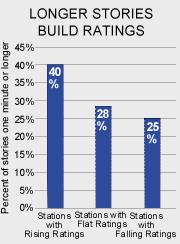
  • At stations building ratings, 37% of stories are a minute or longer. At stations falling in ratings, the figure is 24%.
  • At stations rising in ratings, just 39% of stories are 30 seconds or shorter. At stations falling in ratings, 55% are.
  • And stations losing ratings air almost twice as many super-short stories, less than twenty seconds long.

This finding, that viewers like depth and context, is not new. We found the same thing in our first year, and, to a lesser degree, in our second year. We will continue to watch. But over three years, the implication is getting clearer: too many short stories don’t provide the information or context viewers want. Regardless of the style of a broadcast, viewers want a significant number of stories to be long.

This may, ironically, explain why the famous experiment at Chicago’s WBBM, in which the newscaster Carol Marin produced a so-called serious newscast, hasn’t succeeded. The station tended to run a lot of very long stories — 27% were over two minutes. But it also tended to run a lot of very short stories — nearly half were 30 seconds or less — and it aired more stories each night than most newscasts. Rather than provide a lot of news in some depth, in other words, WBBM gave viewers a great deal about a few things and gave short shrift to almost everything else.

The lesson of WBBM’s difficulties may not be that people don’t like depth. To the contrary, they don’t like depth across the board sacrificed for the sake of just a few stories a night.

What Is Quality?

Our definition of quality is the same established by our design team of local TV news professionals three years ago. We stress the basics: A newscast should reflect its entire community, cover a broad range of topics, focus on the significant aspects of stories, be locally relevant, balance stories with multiple points of view, and use authoritative sources.

We continue to use the system developed by separate teams of university scholars and professional researchers to grade newscasts by a point system matched to these criteria (see Who Did the Study). As in years past presentation is a very minor factor. So that grading can be accomplished objectively, stories score well based on an accumulation of the simple journalistic values mentioned above.

In this third year of the Local TV News Project we also continue to correlate a station’s quality scores to Nielsen Media Research household ratings that encompass a three-year period beginning in May 1997 and ending in February 2000.

This year, as in years past, we have examined the most watched half-hours of news in a core group of cities randomly selected after ensuring population and geographic balance. We have also looked at early-evening news in Atlanta and Los Angeles, markets where we previously studied late news.

A year ago we found that the six o’clock news programs in New York and Boston scored much better than their 11 P.M. counterparts. The same holds true this year. In Atlanta, the early evening news broadcasts scored an average 144 points higher than the late news broadcasts we studied in 1998. In Los Angeles, the six o’clock broadcasts were 57 points higher.

Over three years we’ve found that, contrary to newsroom lore and the claims of critics, all local news is not the same. Our best station in the most watched time slot, Tucson’s KGUN, scored 291 points more than our worst station, KNXV in Phoenix.

The same is true of the time slots we added this year. The best in the morning, WGME of Portland, Maine, scored 145 points higher than the morning’s worst, WBRC of Birmingham. Oakland’s KTVU, the best of the primetime hour-long newscasts, earned a whopping 292 points more than Los Angeles’s KTLA.

Quality Versus Ratings

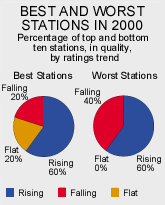
How sure are we that quality is the best path to ratings? Eight of the ten best stations we studied this year were either going up in ratings (60%) or at least holding their own (20%). Put in another way, if you practice basic good journalism, as defined by our design team of industry professionals, your station is four times as likely to be gaining or holding ratings as losing. In a television environment that has steadily decreased in viewers, hanging on is not the worst thing in the world.

Percentage of Stations by Grade, 1998-2000


It’s riskier to be a bottom-ten station in this study. While 6 out of 10 stations on the bottom have positive ratings trends, four are clearly failing. Unlike the better stations, there is no holding your ground here. It’s either up or down.

Magic Formula

Is there a special recipe for building ratings? The data show there are some key elements — across all stations and across all years — that we can now say are key steps in serving viewers. Interestingly, they are also steps to quality. Two we’ve outlined above:

  • Cover more of the community.
  • Produce more longer stories and fewer very short stories.

In addition, four other key steps to building ratings are clear from the data over three years:

  • Focus more stories around the major public and private institutions in town.
  • Do fewer stories targeted at demographic subsets of your audience.
  • Use fewer sources who are anonymous or referred to only in passing.
  • Send a reporter, not just a camera crew, to cover stories. Viewers seem to prefer hearing the latest events from reporters on the scene rather than listening to anchors providing voiceovers for canned footage.

Other steps build ratings, depending on which style of news a station wants to pursue — high quality or more racy tabloid.

Each year we have broken good stations from the most popular time slot in each city into two groups: “Master” stations are those with high quality (A or B grades) and rising ratings (one or two up arrows). “Earnest” stations have A or B grades and declining ratings (down arrows; charts, pp. 89, 90-92).

In addition to the six ideas above, master stations over three years share these other qualities. They:

  • Air fewer crime stories.
  • Air more local stories.
  • Do more investigative work, news series and tough interviews.
  • Use less feed material.
  • Air more person-on-the street interviews.
  • Do less horse-race-style political coverage.

As we have already pointed out, stations can use a “down-market” strategy to seize viewers’ attention and win their loyalty. But our data on audience retention shows that across the board, low-quality stations lose viewers from their lead-in, while our best stations were more likely to be keeping viewers over time. The down-market approach may work, but it may not have as much staying power.

Another interesting discovery over three years is that there seem to be no set criteria for winning ratings using a down-market approach. Except for the things that help any station win ratings — like doing more long stories and using fewer anonymous sources — we can find no common characteristics among the down-market stations with rising ratings that hold over three years.

The implication is that the success of the tabloid approach is somewhat haphazard.

We can identify reliable ways to build ratings with quality. We cannot over three years quantify reliable ways to build ratings with a tabloid or low-quality approach.

Three-Year Markets

We have studied thirteen stations now for three years. In general, these stations have become more locally relevant and now cover more of their communities than they did three years ago. Most have also shown notable improvement in giving different points of view in their stories. One of the most disturbing findings all along in this study, and one that has bothered practitioners, has been the one-sidedness of so much of the news. Whether these improvements are the result of being scrutinized we have no idea.

But the commonalities end there. Some stations have improved and begun to gain market share, like Minneapolis’s WCCO. Some have slipped in quality and viewers, like Minneapolis’s KARE. And some have both improved in quality and lost in viewers, like New York’s WABC.

There is one other generalization we can make. Ratings for these stations over a five-year trend show what every general manager already knows. Most of these stations, like local TV news in general, are seeing their audience shrink.

The Future of Local TV News

The future of local TV news is not pretty. Of the 178 stations we have studied, 128, or 72%, have experienced overall ratings declines over three years. Twenty-six percent have added viewers. Two percent are flat.

At the Radio-TV News Directors Association convention this year, news professionals were already saying that young people find little worth watching in local TV news. Those discussions are borne out by data from the Pew Research Center for the People and the Press that show young people abandoning local television news in favor of the Internet. TV is suffering the loss more than other news media.

This year, as part of the project, we co-sponsored a survey with our affiliate NewsLab of people who watch little TV news. Of the many reasons, including being too busy or not home, 70% had to do with substantive complaints about content, particularly that local TV news covered too few topics and was too superficial and too repetitive.

“Avoidance of local news has doubled in the past ten years,” the TV news consultant Scott Tallal of Insite Research has found. One reason: “More than half of those surveyed feel that most stations spend too much time covering the same stories over and over again.”

Three years of data in our study show viewers are right. Enterprise is vanishing. Programs are getting thinner. Stations are targeting their newscasts at demographic groups based on artificial and frankly insulting stereotypes. A whole range of what people expect from journalism — like helping the disadvantaged or being a watchdog over the powerful — is ignored.

The fact is that many of the conventional ideas about what works in TV news — high story count, flashy production, emotion over substance, targeting — are demonstrably wrong.

These false ideas are driven by outdated beliefs and by following the interests of advertisers rather than viewers. They’re reinforced by audience research often based on poorly conceived or even misused surveys and focus groups. And they are institutionalized by short-sighted profit demands that force news directors to cut the very things that build viewership over time — such as enterprise reporting and building staff.

And now those demands are prompting newscasters to sell out their independence to advertisers.

The numbers make clear a frightening prospect: most stations are selling off their future.

But the data also show a way out. Enterprise sells. Depth sells. Breadth sells. Courage sells. The problem is there is not enough of those things in local TV news, and they’re getting scarcer.

If the industry does not begin soon to change, if it continues to insist on profit margins that can be sustained only by gutting newsrooms, the evidence strongly suggests the biggest loser in the Internet revolution will not be newspapers but local broadcast television news.

If so, broadcasters will have only themselves to blame.

Tom Rosenstiel, director of the Project for Excellence in Journalism, is a former media critic for the Los Angeles Times and Washington correspondent for Newsweek. Carl Gottlieb, the Project’s deputy director, is a former broadcast news executive with the Tribune Co. and Fox. Lee Ann Brady is senior project director at Princeton Survey Research Associates, one of the nation’s leading news-media research firms.

Let’s Go to the Video Tape

By Dan Rosenheim

Some of our design team members screened shows from five stations that earned top scores for their individual stories and offered their subjective reactions.

At first blush, the most striking characteristic of this year’s top-scoring newscasts may be how little they have in common.

Some eschew crime; others thrive on it. Some favor live, breaking stories; others are more cerebral, relying on lengthy packages. Some are unadorned and straightforward; others are fast-action tabloids, replete with video effects and audio swooshes.

At WXIA in Atlanta, the lead story may be the baseball pitcher John Rocker’s return to face hostile crowds in New York City. In the 6 o’clock news at Tucson’s KGUN, it’s a big snowstorm. At action-packed WNYW in New York, it’s a gunman ambushing firefighters. These stories reflect profoundly different news philosophies, but each one is consistent with the overall tone and approach of the newscast it leads. In each case, strong storytelling, technical excellence and consistency of tone combine to tell the viewer: “This is a station that knows what it’s doing and does it well.”

At one end of the spectrum, WNYW’s anchors and reporters share a tough, wry, no-BS style that feels very New York. The station is heavy on crime and heavy on live, but the crime stories are intrinsically interesting and high-profile, not the meaningless accidents and fires that pass for news on too many stations.

“I never felt lost or left behind,” said one design team member, Alice Main. “The content kept up with the story count, and the shows looked good.” John Cardenas, another team member, labeled the newscast “big, bold, clear and concise.”

On the other coast, KTVU in San Francisco also came up a winner in this year’s scoring. Because my station competes directly with KTVU, I’ll refrain from characterizing their newscast, but instead offer two comments from design team members.

“I like the way live shots are produced on these newscasts,” says Main. “It has the effect of seamlessness and keeps me interested.” Jim Snyder’s comment: “I was shocked to see how stodgy and predictable the KTVU show I saw was.”

At the unadorned end of the spectrum stand KGUN and Chicago’s WBBM, two serious newscasts that explore issues in depth. Carol Marin, WBBM’s solo anchor, whom design team member Jim Snyder calls “one of the brightest anchorwomen in the country,” helped to shape the 10 o’clock news’s retro format. WBBM sets out to provide context for the day’s events, with as many as three long debriefs a newscast between Marin and a reporter or a guest. It’s a noble experiment, incorporating excellent coverage from WBBM’s veteran reporters. But there is a thin line between virtue and sanctimony, and too often WBBM seems to boast, “Look, Ma, I’m being serious and important!”

Meanwhile, KGUN made a commitment to an important story without bogging the newscast down with long, taped “packages.” Coverage of a February snowstorm moved deftly from live reports to a weathercast, anchor reads and a reporter on a virtual set. KGUN’s anchors are engaging and authoritative, with flashes of humor, but you sense they feel they are less important than the stories. Weather tools like satellite imagery are used to tell the story, not to hype the brand.

It was encouraging to see how many of the top-scoring shows made education an important part of their coverage. Good consumer reporting (not cheesy formula alerts) was also evident. Another welcome characteristic is a willingness to encourage viewer comments and criticism, and to fess up when newscasts did wrong.

Dan Rosenheim is News Director at KPIX in San Francisco.akpertill

Who’s Best in 2000?

Brought to You by… Sponsor Interference

By Marion Just and Rosalind Levine

At a time of growing concern about commercial influence in the news, there is new evidence that the problem of sponsor interference may be more widespread than many journalists realize.

A third of news directors surveyed in this year’s local TV study report being pressured to kill negative stories, or do positive ones, about advertisers.

In many cases, perhaps most, the pressure is coming internally from station management.

We sent questionnaires to all 49 stations studied in this year’s report and received responses from 25. While those numbers are small, the answers about sponsor interference are troubling.

A third of news directors answering the question said they “were discouraged or interfered with” editorially “because of concerns about sponsors.”

One news director vividly described “strong internal pressure to drop negative stories or do positive ones” on a variety of topics including “consumer, investigative, and medical” news.

[even]

[the]

Not all news departments succumbed. At least one news director reported that he was pressured to help advertisers, “but we say NO!”

The finding of widespread pressure within TV stations to slant the news both to protect and promote advertisers is part of a growing concern in the industry.

Last year’s study found that more than two thirds of stations now run sponsored news segments, many where the sponsor has a commercial interest.

The Indianapolis Motor Speedway recently refused to let local stations send their own cameras to cover a major race, insisting that they air the highlights as edited by race organizers. Three out of four stations agreed. In another city, a local theme park wanted the weather report to say skies would be partly sunny, rather than partly cloudy, because it might encourage more visitors. The station declined.

New Media

The other major finding in this year’s survey concerns the growth of the Internet. Every station responding to our survey now has a World Wide Web site.

However, forty-six percent said they were being given no new funds to finance their sites. The money had to come out of the existing newsroom budget.

Funding Local News Web Sites

In addition, at no station surveyed were any proceeds from the Web returned back to news. Only a few Web sites had turned a profit, and the amounts were small. Still, even in its infancy, the Web was expected to add immediately to the bottom line of the station.

[the site]

According to our survey the average number of Web updates was seven per day, but the range was considerable —from stations that only updated once a day to those that updated “constantly.” The results seem encouraging. Stations reported a median of 400,000 visitors per month to their Web sites.

The great majority of stations provide weather for radio or other news programming. A like number provide news either for an affiliated broadcast or cable network.

The local news Web staff was small, averaging two persons per station. Likewise the budget investment was small ($15,000 to $200,000), averaging two percent of the budget.

When asked how to integrate new and old media, news directors agreed that mechanisms ought to be found to encourage communication between the staffs. News directors thought the Web should be “part of the daily news operation.” Local news Web and newsroom staff should “work side by side.” It was not clear, however, who should be in charge.

Talent

Only a small number of stations in our survey were willing to detail how they allocated their budgets. Of those stations that did respond, we noted that the greater the percentage of budget spent for on-screen talent, the lower the station’s quality scores — and the results are statistically highly significant.*

In other words, spending more on anchors at the expense of producers, writers, editors and camera crews tends to hurt quality.

What’s more, contrary to conventional wisdom, we found no correlation between spending more on high-priced talent and building ratings.

Marion Just is a professor of political science at Wellesley College and a research associate at the Shorenstein Center on the Press, Politics, and Public Policy at Harvard. Rosalind Levine is an attorney in Boston.

Bucking the Trend: Lessons for Thriving in a Declining Market

By Marty Haag

Not long ago I came across an internal station memorandum from a local TV news operation that said: “We are an oasis in a sea of change.” Perhaps that’s the problem. We don’t know what we are in local TV news anymore — even metaphorically. No question plagues television news executives more than the dimension of change when ratings are falling, station loyalties are eroding and technologies threaten the broad-based audience we once had. What will the newscast be like five years from today? As one who is contemplating retirement after more than thirty-five years in local television news, I see parallels to Reuven Frank’s lament that network news pre-eminence, unlike the Roman Empire, didn’t fall; it petered out. Is this happening to local television news?

In the roiling conditions of the 1980’s, the strengths of network news fell away: appointment viewing went the way of the TV dinner. A cable news operation seemed able to respond to breaking news minutes before the networks could crank up. Local stations had the advantage of being local but also could bring in satellite feeds from anywhere.

Now, local television journalism is bombarded regularly with charges of being shallow, shoddy and crime-ridden. Many see local TV as irrelevant, particularly 18-to-24-year-olds and those comfortable with the Internet.

This year’s results from the local television news study by the Project for Excellence in Journalism offer “benchmarks” for success in analyzing the products of four stations: KTVU in Oakland, KTVK in Phoenix, KGUN in Tucson and WXIA in Atlanta. All four stations earned “A” grades in the study and have been enjoying ratings success for the past three years. Once again, the PEJ study holds out hope that leaders with higher ideals than the cast of “Survivor” will preserve the core of excellent journalism while accommodating change.

In the light of the setting afternoon sun, the view from the KTVU newsroom in Oakland — the bay, the sailboats, the bridge (not that one, the other one) and the towering skyline of San Francisco — is spectacular. It’s not bad on the inside either. KTVU, Channel 2, earned the highest marks in this year’s PEJ local news study and scored more than 100 points above the next-best station.

The source of the station’s excellence is no mystery. The architect of Channel 2’s product, Fred Zehnder, was in charge for 20 years as news director before retiring last year. The general manager, Kevin O’Brien, has been leading his troops for more than 14 years. The lead news anchor, Dennis Richmond, has had the title since 1976. “Most of the people here have lived and worked in the Bay Area for years,” says the current news director, Andrew Finlayson, “and they know where Point Richmond is, and they know the institutions of the area. They have experience that you can’t buy.” When Finlayson gets audition tapes, they are put in two stacks — those who have lived and worked in Northern California and those who haven’t.

The breakdown of what KTVU, a Fox affiliate, puts on the air tells us much. The station aired few crime stories. A relatively high percentage (13.3%) of the hour-long broadcast’s stories were about economics and business. KTVU has two business reporters, one for morning, one for evening, and one of them is the nationally syndicated expert Brian Banmiller. Another reporter, Randy Shandobil, does politics exclusively. Finlayson points out that a question about political coverage probably wouldn’t get enthusiastic response from a focus group, but in the hands of a talented writer, the results might differ. KTVU stories are long, averaging between two and three minutes. More than half the stories used three or more sources. With metronome precision, the “number one prime time news in the country,” as the station describes itself, ticks off the day’s top stories in more than ample detail: first, hackers hitting eBay; next, new details on an airplane crash, an exclusive local story; then, a Bush primary win. One senses that a viewer seeing the next morning’s paper would think to himself, “knew that, knew that, knew that,” and so on.

“Fred preached one thing over and over,” Finlayson says of Zehnder, “and that was to give time to all of the communities of the Bay Area. We have more voices; we speak to all communities. We don’t just aim for the BMW demographic.”

There is one other thing. KTVU doesn’t have a helicopter or satellite news-gathering truck.

“We couldn’t cover a car chase even if we wanted to,” Finlayson crows.

Thus Lesson Number One: It’s about people.

Moving east from the Bay Area, the next top-scoring station in the study this year was KTVK, Channel 3, the market leader for news in Phoenix. I have a confession to make here: This is a Belo station. Still, there are lessons to be learned from KTVK’s success: Know your market, stake out a clearly defined direction, and don’t fear being “out there.” And, of course, an outstanding, stable management team helps. When Bill Miller left another Phoenix station to run KTVK nearly 15 years ago, he assembled a talented behind-the-scenes team — including Phil Alvidrez and Dennis O’Neil, who run the news division, and Sue Schwartz, who succeeded Miller this year as general manager. The group has proved it has a talent for entrepreneurship. In January 1995, ABC yanked the station’s affiliation, making Channel 3 a pure independent. Fearing that loss of network status would relegate the station to secondary status in the viewer’s mind, Miller and his crew labeled KTVK “the place with more stuff.” The logo was a jiggling TV set with rabbit ears.

The station has been criticized for little coverage of issues and “lots of frothy news” by the Arizona Republic’s TV critic, Steve Wilson. PEJ’s study found an unusually low percentage of stories (3.3%) that focused on ideas, issues or policies. And only 3.3% of the content resulted from station-initiated investigations. Breaking news rules. More than a third (37.4%) of the stories in the newscasts surveyed were responses to spontaneous events. About a third of the stories were about crime. Understandably, there are more national stories and longer stories in a typical KTVK newscast; the station does eight hours of news a day Monday through Friday.

In a 6 p.m. broadcast screened for this article, uniqueness abounds. The photography is inventive. Lower-third supers are rainbow colors and in script. The consumer segment is labeled “Consumer Stuff.” The helicopter pilot/reporter is a bona fide star.

The late news at 10 p.m. was recently expanded to one hour and labeled “The NewShow.” Here again, except for another in Alvidrez’s collection of attractive anchor people, convention is thrown to the wind. The single anchor stands in a tiny studio next to a TV monitor and flits through an hour by herself, veering from a hard-news story to a live-shot feature and back. It is as if the broadcast were formatted with the aid of a dart board. But it works. Not only is it fun, it is informative. This baby is niched.

Lesson Number Two: At a time when we are told all newscasts appear alike, difference can matter. Don’t be a commodity. Could you replicate KTVK in another market? Maybe not.

According to one researcher, only one station in the country has improved its rank order in news and held that position for three ratings periods without a significant change in lead-in. That hasn’t happened in Tucson yet either, but a significant change is in the wind. KGUN’s 6 p.m. newscast took over first place in July. Three years ago, KGUN, Channel 9, did not have a 6 p.m. broadcast and the 5 p.m. trailed by 12 rating points.

The reason for the new 6 p.m.’s success may be found on the tapes from the early March recording period. The station sends a reporter to nearby Mt. Lemmon to cover the snowfall but also to report the impact on water rationing; a full-screen graphic or an over-the-shoulder box conveys important information. Sen. John McCain withdraws from the presidential race. School closings are revealed, as is information on a Salvation Army coat drive. This broadcast fulfills the expectations of 6 p.m. news as a local news broadcast of record. The results from Super Tuesday are reported with remarks from a local campaign coordinator. In succeeding days, the news department turns to a story on the first-ever online voting in Arizona, and the effect of the snowfall on the poor section of Nogales, just across the border in Mexico.

KGUN, an ABC affiliate, was far above average in stories on ideas, issues and policy. In fact, at 22.2%, it was twice the average. The essential element in KGUN’s turnaround, according to the voluble news director, Forrest Carr, is a concerted effort to connect with the viewers. The station has a “Viewers’ Bill of Rights” which is “a public statement of principles,” Carr says, “and in the Viewers’ Representative, or ombudsman, we have their representative in the newsroom who covers reaction to our news coverage decisions once a week.” So passionate is Carr’s belief in reflecting community values that he is often criticized for being “holier than thou.”

Carr says, “I admit to being a crusader, and journalists aren’t supposed to be crusaders.” Carr has adopted rules for covering crime like those promulgated several years ago at KVUE-TV in Austin by the late Carole Kneeland. Like KVUE, the station declares that it “will not stalk innocent victims of tragedy or crime.”

Lesson Number Three: Have a vision and pursue it passionately.

The fourth benchmark selection is the Gannett-owned station in the highly-competitive Atlanta market, WXIA-TV. Two strong stations, WSB-TV and WAGA-TV, were not included in this year’s study because the Project does not measure one-hour broadcasts against half-hours, like WXIA, in the same time slot. At 6 p.m., nearly a third of the stories on WXIA were about crime, and all of them were about local crime. In fact, only one other station, KCAL in Los Angeles, covers more crime, but WXIA, Channel 11, seemed to stand out by providing a balance of sources and providing stories on a diverse range of topics anyway. The newscast is heavy on live shots, seemingly with a small cadre of first-rate, experienced reporters.

Under news director Dave Roberts, the station attacks head-on subjects that are often denigrated: WXIA does many stories featuring state legislators, and it covers local institutions at length (twice the national average). And there is Bill Liss, the business editor. Liss is a former top airline executive who looks the part of a tough newspaper columnist.

In market after market these days news departments are running scared. Among evening newscasts, the typical story length is 21 to 30 seconds — almost one in four fall within this range. TV land lives in fear of itchy fingers on the remote. Your news is not appealing to younger demographics? Well, make it “look like MTV.” Is your news not relevant? Maybe the viewer won’t notice if wallpaper video flashes by.

But the taciturn Roberts has hired and maintained a veteran staff. The most experienced reporters (six have between 10 and 20 years’ experience) invariably turn up in the 6 p.m. broadcast. As with the other three outstanding stations, story length was in the 2-to-3-minute range at WXIA. For some reason, I recall reading a story years ago arguing that the 20-second voice-over piece is akin to racing through a residential neighborhood at 35 to 40 miles per hour. No time for context, only pictures. One can see only the front of a house; there isn’t time to peek inside to see more than a façade. The two-minute package, on the other hand, is like stopping and going inside the house to meet the family.

Lesson Number Four: Let it breathe.

Robert (Shad) Northshield, who worked at NBC and CBS for years, died recently. Shad came up with the idea of the closing shots on the CBS Sunday broadcast, which were just scenes of nature and natural sound. No voice track, no music. Yet people wrote to the broadcast saying how beautiful was the choice of Vivaldi. This year’s four benchmark stations also offer similar suggestions to stem the hemorrhage in viewers. In a sea of change, have the vision to set on a clear course and have the courage to stick to it.

As a newly hired anchor once said, “I know I can win the ratings; it’s not rocket surgery.”

Marty Haag is Executive Vice President of Content and Innovation for Audience Research & Development, and former Executive Vice President for Broadcast News for A. H. Belo.

At 6 A.M. It’s Morning Lite

By Susan Truitt

There’s no way to make getting up in the morning easy, but local television news tries. Probably too hard. In most cases, cheerfulness and chat outdistance serious news. TV executives think the pre-eminent concern at that hour of the day is knowing whether to dress warmly and which route to drive to work.

For the first time, this year’s local news study included half-hour morning newscasts. In TV news’ fastest-growing time slot, researchers looked at the half-hour beginning at six a.m. in three cities: Detroit (the ninth largest market in the country), Birmingham (39) and Portland, Maine (80), eight stations in all.

It wasn’t a pretty sight from the perspective of the traditional evening newscast. The best broadcast in the study could muster only a grade of B. That went to the No. 2 station in the smallest market reviewed, WGME in Portland. The rest earned “C’s” or lower.

Here are some key findings:

  • Ninety-four percent of all morning news coverage was reactive, more than local news overall.
  • About half the morning news stories used unnamed sources or no sources, compared with a third in other time slots.
  • More than half the stories in the morning were about everyday incidents or everyday crime and were not connected to broader issues. That’s 15 percent more than the average of all newscasts in the study.

Morning news has a hard time scoring on the quality scale devised for evenings because, by and large, the stations choose to play a different game at that hour — a game that depends on good humor and service delivered in a package with a thin veneer of news.

Does quality sell in this time slot? The results are inconclusive. In Detroit, where all three stations received grades of “C”, the highest “C” (WJBK) had the best ratings trend. In Birmingham the results were mixed: the best grade in town was a “D,” for WCFT, which had positive ratings, but the “F” station, WBRC, was also thriving.

First and foremost, the decision to put service first translates to “morning news gives the weather.” And then more weather. Weather leads every broadcast. The current temperature is constantly on the screen (with a clock) and many stations now run a lower-third crawl updating the forecast frequently.

And it’s ever so important to have the right messenger for all this service. My six years of producing morning television reinforced the conventional wisdom that the morning viewer is more likely to let a buddy into the house than some strong authority figure. Most ratings winners follow the “let your buddies help you get ready” formula.

In major metropolitan areas, “service” also includes traffic. In Detroit, weather and traffic make up about 45 percent of the half-hour broadcasts. Combine the cheerfulness and chat of your buddies with weather and traffic and there isn’t much time for the kind of coverage that ranks high with the local TV professionals who established the study’s quality scale.

Portland stations pay scant attention to traffic and score higher on the quality scale. Rush-hour traffic is not a major factor in Maine so the newscasts in the market have more time for the kind of reporting that the PEJ scale values.

Programming consultant Bill Carroll of Katz Television Group calls the conventional a.m. style “the ‘we’re-sharing-a-cup-of coffee’ approach.” Carroll, who has studied the dramatic growth and the content of local morning news over the last five years, says the viewer is the same as for later newscasts “but has very different expectations.”

In the age of 24-7 news access, does this conventional wisdom still hold? Maybe not. Consider the growing popularity of no-nonsense Web sites, or business-dominated networks like CNBC.

The truth is that money, not just viewer habits, also explains “morning news lite.”

At 6 a.m. in most communities, the number of households using television is about half of what it is at 6 p.m. and 11 p.m. This means stations can charge only a fraction as much for advertising spots in the morning; the difference can be as great as tenfold. At most stations, this translates into fewer resources for morning news than for evening news.

In last year’s study we reported on the clear correlation between staff size and news quality. Staff for writing and producing those early morning broadcasts is generally bare bones. And, to add to the producing problems, the staff often includes many inexperienced team members willing to work in the middle of the night to get their start in television.

You get the picture: this small, often very hard-working group gets the broadcasts on as best it can. It fills those half-hours with rewrites of material from the day before, updating with word changes here and there, but without the staff time to really improve or advance the material. And enterprise is the casualty of necessity. A classic example: one morning last February the top-ranked morning newscast, Maine’s WGME, kicked off with a high-quality background piece, clearly from the day before, on a popular school superintendent who’d been killed several days earlier in an automobile accident. The next morning’s update simply consisted of giving the conditions of the others hurt in the crash and the date of the memorial service. Of course if there is a big overnight story, many of these early newscasts report it. And in the bigger markets the early reporter will do a live shot. The Fox station in Detroit, WJBK, covered a dramatic overnight robbery of two casino winners on their way home, with a reporter live at 6 a.m. describing the action from one of the locations involved. But more often than not, the early reporter is re-packaging yesterday’s news.

At stations that don’t join network programming at 7 a.m. (like many Fox stations), morning staff size is often larger. And some staff members work all day preparing special material exclusively for the next day’s morning show. But we saw little evidence of that kind of work in the eighty broadcasts studied here.

Morning News Is…

  • FAST-PACED: two-thirds of stories under 45 seconds
  • REACTIVE: only 2% of stories based on in-depth reporting
  • “GLITZY”: more pop culture stories than other time slots
  • CAUTIOUS: over 40% of stories about non-controversial events
  • CHEERFUL: more celebration, how-to, and cooking segments than anyone else
  • AVERAGE GRADE: C


WGME’s morning newscast in Portland stood above the others in this study for three reasons:

  • The station focused 21 percent of its stories on ideas, issues, or policy. That’s close to double the average in the overall PEJ study.
  • WGME received an A for its range of topics.
  • And 15% of WGME’s stories had three or more sources. That’s three times the average of all morning news shows reviewed and it matches the average of those in other time slots.

WGME’s 6 a.m. broadcast includes a daily, live call-in segment co-produced with a local talk-radio team. The topics are generally about news stories that are already generating local debate. We heard segments on the high cost of home heating oil, and the propriety of using the nickname “Redskins” for a high school football team. The segment clearly gives voice to a variety of viewpoints and underscores the station’s commitment to cover issues with local relevance.

WGME’s news director, Ron Wolfe, is on the same track as the news professionals who put the PEJ scale together. I asked him what he thought would help most to improve the a.m. ratings and his answer was short and sweet: “Quality, quality, quality.”

WGME, a CBS affiliate, may be doing a strong job of bucking the trend toward “morning lite,” but it is struggling in the ratings game against the local competition, WCSH, the NBC affiliate. This may be at least in part the result of its network’s failure to come up with a viable early show. WCSH pulled a 55 share of the audience in February to WGME’s 15 share. In most markets, the strong ratings of NBC’s “Today” appear to give a major boost to the lead-in local morning fare.

But clearly WCSH is doing something right beyond being on NBC.

WCSH’s general manager, Steve Thaxton, says his 6 a.m. is the most “attuned” newscast, “well tailored to Mainers.” And he proudly points to the 90-plus share the station gets when it goes into full “Stormcenter” mode during severe weather. He calls weather “the ultimate news story” that helps build and keep a high trust level.

But on most days, the 6 a.m. newscast at this Gannett station is pretty standard fare — headlines, a day-old package, lots of weather and a CNBC business report.

There is one unusual element, a daily four-minute, pre-packaged homily produced by the nonsectarian First Radio Parish of America in the middle of the newscast. WCSH, the market’s traditional ratings leader, has been airing the “Daily Devotions” segment for decades.

During the last decade, stations discovered that morning was one of the few time slots left with growth potential.

Katz Media estimates that the morning audience has increased by about 20 percent in the last five years. But Carroll, the programming consultant, notes that while many more viewers are now turning on their sets, average ratings for morning news have stayed just about the same.

Stations in at least three large markets — Los Angeles, Chicago and New York — have been successful with audiences by going to highly stylized and somewhat zany formats to meet the multiple demands of local morning news. These stations also bank on attracting viewers beyond the traditional news watcher, people who like a little spice along with the information they need.

Carroll says we should not be surprised if we see more non-traditional elements in the morning newscasts as producers search for ways to “scrap for attention” now that the arena is nearing full size. He adds, “It’s not like the winners are already known.”

Susan Truitt, a 30-year TV journalist, successfully fought the local morning news battle at WTTG in Washington as Executive Producer and Producer for 6 years.

News in Prime Time

By Tom Dolan

Reporter Jaime Garza of KCAL in Los Angeles positioned his live shot in El Cajon Pass with care. Not only was it a scene-setter for the 10 p.m. news, but it also helped to explain visually the story of the day and let you know tomorrow’s commute might be even worse in the fog.

Garza set up cones at 25-foot intervals to show the distance at which drivers could see one another, in order to dramatize the need to drive under 30 m.p.h to avoid collisions. That day motorists who had been driving at twice that speed caused an enormous pile-up.

Garza showed how the news of the day could be made memorable, not a rehash of the “6 p.m. newscast of record.” Unfortunately, from what I see, such imagination is too often lacking in primetime news.

As part of the Project for Excellence in Journalism’s 2000 Study, we wanted to see how stations in selected markets used their extra time to produce an hour of local news versus a traditional half-hour. I found newscasts that do not take advantage of extra time for preparation to advance stories, and often fail to come up with new angles to important pieces, or to generate new material targeted to the primetime audience. Here are some exceptions, along with suggestions for fresh approaches.

Going Live in Primetime

Virtually all markets in the country place a premium on immediacy and the importance of live reporting from the scene. This usually means reporters stand in the dark, or at a crime scene, hours after the story has gone cold. It doesn’t have to be that way. KCAL’s Garza isn’t standing in an empty road. His traffic cone demonstration effectively illustrates what to expect in the next morning’s fog.

Anchor Role in Newscast

Market research shows that anchors are one of the top reasons people watch local news. It is surprising they are not used as primary storytellers in any of the five markets we studied. All special reporting is handled by reporters.

Stations may want to consider using anchors to report stories, build short background pieces, or do those “smart anchor tags” with useful follow-up information. They might even take advantage of a health or consumer warning to simply stand at the key wall, using graphics to explain why the geography of a story may be important.

Primetime News is…

  • WELL-SOURCED: 1 in three stories have multiple sources, compared to 1 in 4 nationwide
  • GENERIC: 30% of stories are feed material
  • SENSATIONAL: full of stories on everyday crime and bizarre mishaps
  • POPULAR: 60% are gaining viewers vs. 35% of traditional local news shows
  • AVERAGE GRADE: C

News of the Day

The study shows that primetime news programs often failed to use their extra time to initiate investigations, report on investigations by others, or even conduct tough interviews. It also found that almost half of primetime news stories were feed material or prearranged events covered with no on-camera personnel.

You may want to look at “news of the day” with stories angled in a more thoughtful way, one in which audiences are able to recognize the enterprise. This would give viewers a clearer sense of differentiation among competitors, and certainly provide an opportunity to promote the top stories besides “they happened.”

In New York, WPIX, WWOR and WNYW all covered the latest in a rash of murder-suicides in the region as a top story. They all appeared to be solid, well-packaged stories. However, all three had live “wraps” with no produced live element. Each seemed a case of the day’s events covered without significant new detail. For example, no one went to the dead young man’s neighborhood to learn what may have motivated him.

Stations with primetime news should not only take advantage of the extra time within a newscast, they should also employ the four-or-so-hour advantage they have over 6 p.m. news to produce more forward-thinking news. If the story is strong enough to lead with, it should be strong enough to do real “team” reporting.

For example, a WPIX reporter, Mary Murphy, took a story most stations would air as a promo — the sexy appearance of the “7th Heaven” star Jessica Biel in Gear magazine — and showed good enterprise. Murphy’s well-written piece followed Biel’s transition from a minister’s daughter on a WB family show — using file tape from an appearance at the toy store FAO Schwarz — to someone who does a sultry spread to change her image for Hollywood. She made a WB station’s “mandatory” piece on a WB program into good journalism.

Original Reporting

  • WNYW: Although there appeared to be little original reporting across the five cities, a couple of stations have committed staff. New York’s WNYW produced a good special report on contamination in packaged food at transit-stop restaurants. Reporters traveled to three of New York’s major transit hubs and documented the problems on camera. But after one vendor challenged the station to come back once he had cleaned up his act, WNYW failed to make clear whether it intended to do so. When an allegation is aired, a journalist’s obligation is to follow up. Not doing so can affect a station’s credibility with viewers. The station agrees it may have been “a missed opportunity.”
  • WAGA: Atlanta’s WAGA also scored low for enterprise but did some good individual stories. “Shocked,” by reporter Dana Fowle, exposed how Atlanta is lax in policing street-lamp vandalism: many lamp pole covers are missing or hanging off their hinges, exposing live wires. This was a great story, well produced and well documented. Fowle interviewed a Philadelphia teen who had almost been electrocuted and then had an expert test the open “hot boxes” using a special device.
    But the station also undermined a good effort in two ways. It waited until a short tag after a long story to tell the viewer why these covers were missing: vandals were stealing them to sell for scrap metal. It also teased the temporary solution for part two, when the importance of the story demanded more treatment the same night.
  • WWOR: WWOR’s Joe Collum produced an I-Team piece to test the N.Y.P.D.’s sensitivity program “Courtesy, Professionalism, Respect.” His key finding: twenty percent of callers to the police radio response unit were told to call back. Some were treated with anything but respect. A former Internal Affairs officer posed, in one instance, as a Hispanic caller. One policeman was overheard saying in response: “How come no matter what color the soap is, the suds are always white?” — a racist remark implying that whites will always be in charge. The department responded to the report by saying it would not tolerate this type of behavior by officers. Great assignment and handling by the station as well as gutsy demonstration of enterprise.

Special Target Subjects – Useful to my Life

  • Health: Most research points to health as a beat that audiences value. With rare exceptions, stations in the study did not commit to it as an important segment.
    The exceptions show the potential when a commitment is made. WNYW did a good spot on ear infections from the perspective of what parents should watch for. WAGA investigated a product that promised breast size growth, but an expert warned that tumors might grow from the resulting estrogen stimulation. Another expert stated there is no evidence the device works. Reporter Melissa Jue found that the manufacturer’s biology degree is only honorary.
  • Managing Your Money: The three most popular Web sites on the Internet in prime time are all money related. Meanwhile, viewing is up 20% for business networks CNBC, CNNfn, and Bloomberg. WNYW and WWOR appear to be the only newscasts in the study producing a segment on finance.

    WWOR delivered a good enterprise story about Warner-Lambert’s merger with Pfizer to form the world’s second- largest pharmaceutical company. They sold it to a primetime audience with the connecting copy: “You probably have some of their products in your medicine cabinet, but how will the union of two big companies affect you?”

    The WWOR team made it relate by reporting on the merger of the makers of Listerine and Viagra. WWOR dealt with the plight of Warner-Lambert’s company town, Morris Plains, N.J., contrasting the fates of employees who would be laid off with the Warner CEO who stood to receive a six-million-dollar golden parachute.

    WNYW uses a street.com expert to do market analysis every night, a kind of play by play on where the market is going after a post-mortem on the trading day. It’s helpful. The point of view is, “A lot of people are making money, how can you make money too?”

Using the Internet

National surveys find that many local news viewers begin prime time by scanning their favorite Web sites. If you think of your potential late news audience in that way, you may be able to drive viewers from the Internet to your money segment. How are you addressing what your viewers are doing before the news, to drive them to your broadcast?

Los Angeles’s KTLA addresses this issue with a segment called “Kurt Smith, Cyber Guy.” One February series put the reporter in a converted bus to demonstrate how to survive for a week using only the Internet. He ordered food, silverware and clothing and proved that the Internet is so diverse you can literally live that way if you want to.

Weather

While the study does not grade for weather, why not devote some time or special treatment to weather explainers like the syndicated product “Weather in Motion,” or have local graphic artists animate topically driven weather news? You may want to think about producing weather differently with an hour of prime news to give your viewers something value-added versus the traditional half-hour format.

Over 80% of the producers I interview say they watch the NBC “Nightly News,” in part because of Robert Hager’s explainer pieces. They also appreciate the network’s pieces that focus on the impact of breaking news, not just “what happened.” Whether it is news or weather, market research and 25 years in local TV news show me that viewers respond to unique content.

Original Content

Some stations try to offer an alternative to the six p.m. newscast-of-record approach. But these efforts seem superficial. KMSP in Minneapolis aired a six-minute segment of a kind many stations include to appear hip. “The Buzz” included scenes from a play opening in town, the Disney character Tutter touring locally, Steven Spielberg having kidney surgery, clips from a band playing a benefit concert for missing kids as well as a series of movie trailers.

If you are trying to brand a new product, or trying to develop a new brand of localism, you may want to avoid simple “cookie-cutter” program elements like these, or produce them with your own material. Most of the video appeared to be syndicated or handout. The station says “The Buzz” is its segment to differentiate itself and show its “commintment to the local arts scene.”

Looking Forward

Knowing it is up against primetime news magazines and well-produced entertainment, Fox’s KTVI, in St. Louis, has just launched a newscast that will be a “showcase show.” News Director Brad Remington says it will utilize several special projects producers to deliver unique content, produced for the time period with a very local feel. The newscast, Remington says, will go well beyond “the 6 p.m. news” and also tell the viewer what to expect tomorrow. So far, the early ratings look good.

Tom Dolan is President of Dolan Media Management. He has also been a vice president at Broadcast Image Group and News Director at WLS TV in Chicago.

Who Did the Study

Meet the 2000 Local TV News Project Team

This study was conducted by the Project for Excellence in Journalism, a journalists’ group in Washington, D.C., affiliated with the Columbia Graduate School of Journalism and funded by the Pew Charitable Trusts. The scholar team that developed the methodology included Lee Ann Brady of Princeton Survey Research Associates; Marion Just, Ph.D., Professor of Political Science at Wellesley College; Michael Robinson, Ph.D., formerly of Georgetown University; Ann Crigler, Ph.D., Director of the Jesse M. Unruh Institute of Politics at the University of Southern California, and Sherrie Mazingo, Ph.D., of the University of Minnesota. Todd Belt of USC measured the ratings trends.

Evan Jenkins edited the articles. Researchers at Princeton Survey Research Associates coded the newscasts and prepared the initial statistical data under the supervision of Brady. Abigail Sturges designed the layout and graphics. Atiba Pertilla and Chris Galdieri of PEJ were the project researchers.

Design Team

The following local news professionals developed the criteria of quality for this study and signed off on major decisions:

John Cardenas
News Director, WBNS, Columbus, Ohio

John Corporon
Board of Governors, Overseas Press Club

Randy Covington
News Director, WIS TV, Columbia, S. C.

Marty Haag
Vice President, Audience Research & Development

Natalie Jacobson
Principal Anchor, WCVB TV, Boston

Alice Main
former Executive Producer, WLS TV, Chicago

Gordon Peterson

Principal Anchor, WUSA TV, Washington, D.C.

Jose Rios
Vice President of News, KTTV, Los Angeles

Dan Rosenheim
News Director, KPIX TV, San Francisco

Jim Snyder
Retired Vice President of News, Post Newsweek Stations

Kathy Williams
News Director, WKYC TV, Cleveland

Gary Wordlaw
President and General Manager, WTVH TV, Syracuse

What Is a “Good” Newscast?

The project assembled a “design team” of local TV news professionals to define what makes a “good” newscast. Its members answered questionnaires, spent a day in New Orleans to refine their work and were consulted on all major decisions along the way. Then, a group of researchers and scholars designed a set of measures to analyze newscasts according to the design team’s definitions. Here is the synthesis of what makes a good newscast and how it was measured.

Topic Range

Reflecting the community in its totality was the preeminent concern. No topic should be considered off limits. The problem is what local TV “doesn’t cover.” So one yardstick is a ratio of the topics covered in a newscast divided by the number of stories. The greater the range of topics, the better the index.

Story Focus

Newscasts should be significant and informative – as well as interesting. Topic mattered less than treatment. Thus, the study measured the focus of each story. Was it a larger issue or trend that affected a lot of people? Was it public malfeasance? Was it a major unusual event? Or was it an everyday incident, an everyday crime, human interest, celebrity/scandal or popular culture.

Enterprise Level

Being gutsy, providing depth and context, showing initiative, and demonstrating enterprise were also prime values. This variable measured how much effort went into a story. Was it a station-initiated investigation, an interview, or a series? Was the station responding to spontaneous or pre-arranged events? Or was the story simply taken from a wire or a feed from another source, or was it based on rumors or gossip? The more enterprise, the higher the score.

Number of Sources

Being accurate, credible, fair, balanced and honest were important. As a first step, this measurement simply counted how many sources there were in a story, or whether any sourcing was even required.

Viewpoints

As a second way of measuring balance, fairness and credibility, this index noted whether the story had multiple points of view (no one view accounted for 75% of the story), made only a passing reference to a second point of view, or contained only one point of view. Stories presented as undisputed (a fire, the weather) were noted separately.

Source Expertise

Newscasts should be authoritative to be credible. A good yardstick is the quality of one’s sources. This variable noted whether the source on the given topic was a credentialed expert, impartial data, the major actor in the story, a person on the street, an unnamed source, or finally whether no source was cited.

Local Relevance

Because reflecting the community and being relevant stood out with accuracy and fairness as primary values, this variable measured the local connection. Did the story affect citizens in the whole area, important institutions in the area, major demographic or geographic groups in the area, smaller subgroups? Or was it interesting but with no direct connection to the community? The study also coded stories, though for minimal points, for presentation. Was the story understandable or not. The study, finally, also noted whether or not stories were sensational, which was defined as replaying video or graphics beyond the point that added new information. The design team did not think all stories should be alike. A story about big ideas might get more points than one about a commonplace event, but any story done well scored high. Stations that covered a lot of topics well scored the highest. What didn’t win points was notable. Topic was considered neutral. A crime story might score as high as a science piece. Stories earned no points for length. Production techniques were considered just tools and not rated. The study avoided rating subjective qualities such as tone or negativity.