Pew Research Center

FOR RELEASE MARCH 6, 1998

Changing Definitions of News

<p>Is there really a trend toward entertainment as news? </p>

FOR MEDIA OR OTHER INQUIRIES:

Communications Department
202.419.4372
www.pewresearch.org

RECOMMENDED CITATION

Pew Research Center, March 1998, "Changing Definitions of News"

About Pew Research Center

Pew Research Center is a nonpartisan, nonadvocacy fact tank that informs the public about the issues, attitudes and trends shaping the world. It does not take policy positions. The Center conducts public opinion polling, demographic research, computational social science research and other data-driven research. It studies politics and policy; news habits and media; the internet and technology; religion; race and ethnicity; international affairs; social, demographic and economic trends; science; research methodology and data science; and immigration and migration. Pew Research Center is a subsidiary of The Pew Charitable Trusts, its primary funder.

© Pew Research Center 2026

Table of contents

  • About Pew Research Center
  • Changing Definitions of News
  • What was Studied
  • Differences in Media

Changing Definitions of News

<p>Is there really a trend toward entertainment as news? </p>

Is there really a trend toward entertainment as news? If there is, what form does it take?

We decided to find out by conducting a two-part content study of the so-called traditional mainstream national news media that examined what topics it covered and what was the emphasis of those stories.

One part of the study compared coverage in newspapers, nightly news and news magazines over a 20 year span. The second part looked at a larger universe of news media, including all the prime time network news magazines, over a seven week period in 1997 to identify what audiences are getting today. In all, the study, conducted by the Project for Excellence in Journalism and the Medill News Service Washington Bureau, examined 6,020 stories in 16 news outlets ranging over a span of 20 years.

Overall Findings

  • There has been a shift toward lifestyle, celebrity, entertainment and celebrity crime/scandal in the news and away from government and foreign affairs. But infotainment still comes nowhere near dominating the traditional news package.
  • There is an even more pervasive shift toward featurized and people-oriented approach to the news, away from traditional straight news accounts. This tends to make the news more thematic and make the journalist more a story teller and mediator than a reporter.
  • The news media are dividing into market-based niches, with a result that a citizen’s perception of society can vary greatly depending on the source of news. Prime time network news magazines, which have replaced documentaries on network television, have all but abandoned covering traditional topics such as government, social welfare, education and economics in favor of lifestyle and news-you-can-use. News magazines which once concentrated heavily on coverage of ideas have moved heavily toward celebrity. Newspapers continue to cover government, foreign policy and domestic policy as a staple. The network news has become a hybrid of all the others.

Moreover, if one expands the definition of news media to include the universe of everything on television or the news rack, celebrity, entertainment and scandal have become a much larger percentage of what audiences get. Consider the proliferation of such programs as Entertainment Tonight, Extra, Access Hollywood or the pseudo news programs like Inside Edition or Hard Copy, as well as the expanding universe of prime time network news magazines that have replaced documentaries on network television.

While content studies have their limits, and the question of what is entertainment and what is news is open to interpretation, the data clearly indicates that there have been major shifts in how the news media define the news.

We are not attempting to make definitive judgments about whether these trends are necessarily positive or negative. In many cases, there are sound reasons for these shifts. The news media are clearly now covering more of the society, moving away from institutional coverage of buildings and trying to make the news more relevant to audiences. With the end of the Cold War and other social and economic changes, the relevance of many traditional stories change, naturally moving the press in other directions. Some of the changes occur more in some media than others; as audiences fragment, different news outlets find different niches. As a basis for beginning a discussion, this study tries to quantify just what changes occurred in the various news media categories of newspapers, weekly news magazines, and television network news.
What was Studied

The first part of the study compared coverage from 1977, 1987 and 1997 in seven media outlets. It looked at all the coverage on the three main network newscasts for one month (March) of each of those years, as well as the front page coverage of the New York and Los Angeles Times, and the cover stories in Time and Newsweek for the entire years of 1977, 1987 and 1997, some 3,760 stories in all.

The second part looked at 15 media outlets over six weeks in the fall of 1997, the three nightly newscasts, every prime time network news magazine, every story in Time and Newsweek and five newspapers’ front page coverage, some 2,260 stories in all.

In both parts of the study, we examined the stories according to two basic categories. What were they about (subjects such as government, entertainment, foreign affairs)? And what was the theme emphasized in the story (themes such as personality, lifestyle, policy, war, political process)?

 A Shift in Emphasis

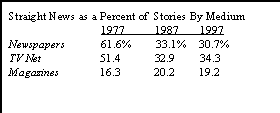
 Twenty years ago, coverage was dominated by straight news accounts of events–what happened yesterday. Today, the news tends to have a more mediated or thematic approach to stories. In 1977, more than half of all stories (52%) were basically straight news accounts of what had happened. By 1997, that figure had fallen to less than one in three stories (32%), a 40% drop.

The thematic emphasis of stories today has moved away from such concerns as the political process, war and peace, policy and from updating or analyzing in depth continuing events–what might be called traditional news emphasis. The emphasis on people, human interest and news you can use. There is also a new emphasis on scandal, the bizarre and fear about the future. For instance, in 1977, stories with a traditional news emphasis outweighed stories with a feature or scandal emphasis by two to one, 32% traditional versus 15% feature. (See table.)

Twenty years later, that relationship was essentially reversed. Only one in four stories concerned these traditional hard news themes while more than four in ten emphasized the softer or more sensational themes.

 Story Topics

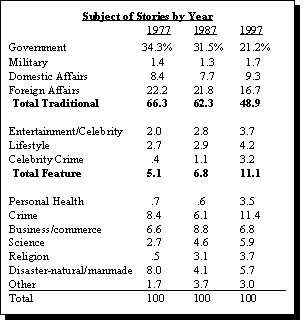
Subjects of Stories by Year

If you look at simply what the stories were about–the subject rather than the thematic emphasis–there are similar shifts.

The number of stories about government dropped by 38% from 1977 to 1997, from one in three stories to one in five, still a sizable number, but lower.

The number of stories about foreign affairs dropped by 25%, from nearly one in four stories to about one in every six.

The number of stories about celebrity, entertainment or celebrity crime tripled from one in every 50 stories to one out of every 14; the total number is still not huge, but it is rising.

The news media also began covering other topics more. Coverage of science, religion and also rose, though not to particularly high numbers, less than one in ten combined.

Clearly these shifts in topic and thematic emphasis represent the media covering a broader spectrum of news, searching for new relevant topics in the face of declining audience share.

One question not answered here is whether that broadening is helping to provide audiences with more of the information they require in a democratic society or whether we are moving too far in the direction of amusement.

 News Magazine Cover Appeal


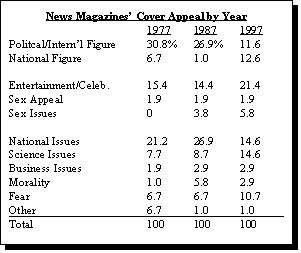
News Magazines' Cover Appeal by Year

We also found, looking at the covers of the news magazines themselves, that there has been a change in the way stories are sold to readers. Serious topics are sometimes presented through a Hollywood prism. Brad Pitt fronts a story about Buddhism in Time; Robin Williams fronts a story about brain research in Newsweek, coinciding with his role as a mad professor in the recent movie Flubber, though the story says nothing about the movie or Robin Williams. It was unclear in some instances whether there was a real predicate for some of these stories. Was there really a move toward Buddhism in America, or was this a way of putting Brad Pitt on the cover? Why not Islam rather than Buddhism, which is a larger, growing religion in America?

In 1977, political or international figures represented nearly one in three of all the Time and Newsweek covers. By 1997, that number fell by more than 60% to one in ten covers. Interestingly, much of that shift occurred between 1987 and 1997.

Covers that sold the story with celebrities, a sexy man or woman or an image story about sex itself doubled from 1977 to 1997, from one in six one in three. Covers about new ideas in science doubled from 1977 to 1997, from 8% of covers to 15%. Interestingly, covers about people who were not necessarily leaders but who had become known, perhaps momentarily, such as the parents of septuplets, nearly doubled from 7% to 13%.

The shift toward celebrity can be seen by another benchmark as well. Time and Newsweek had the same cover as People magazine seven times as often in 1997 as in 1977. Interestingly, People moved away from celebrity and entertainment somewhat over the last twenty years, with seven trend or news covers in 1997, versus none twenty years ago. Yet only one of those did it have in common with Time and Newsweek, the cult mass suicide in Southern California.

Differences in Media

Today, what Americans know may differ greatly depending on their source of news. In the second part of the study, looking at a broader universe of the news media in the fall of 1997, we also found different kinds of news media offering markedly different definitions of news depending on what they perceived their market niches to be.

Prime Time Magazines

Prime time network television news magazines, the growth area of network news, is a genre oriented around people stories, lifestyle/behavior, news you can use and celebrity entertainment. Overall 55% of their stories concerned these issues.

They also covered crime and justice heavily, 23% of the time.

What is also striking is what the TV news magazines don’t cover. Only eight percent of the stories on the prime time news magazines concern the combined areas of education, economics, foreign affairs, the military, national security, politics or social welfare issues.

Such an emphasis on people stories and away from politics, foreign affairs arts, education and religion may not be surprising given that these programs are set against prime time entertainment programming, and often are aimed at audiences that do not watch network news. They might, in that sense, be considered the “back of the book” of TV network news.

It is important to remember as well, however, that the prime time magazines have supplanted documentaries on network television; also, most of television’s in-depth news coverage and the vast majority of its investigative reporting occurs on these programs. It means, however, investigative work in network television today for the most part does not concern education, economics, foreign policy, military, social welfare, government, politics or the military.

Profiles and crime were the most popular categories of stories on the news magazines, followed closely by stories about consumer news, then health and medicine and law and justice.

Print Magazines

The print news magazines, Time and Newsweek, have seen broad shifts in emphasis. One of the most notable is a decline in coverage of ideas. In 1977, nearly one in five cover stories (18%) concerned policies or ideas. By 1987, that had fallen to just one in twenty covers, where it remains.

Straight News as a Percent of Stories by Medium

Today, Time and Newsweek most often have cover stories in the area of consumer and health news and celebrity entertainment. Consumer and health news emerged as the largest category of news, ahead of government, with celebrity entertainment a close third.

The longitudinal study suggested the changing style of the news weeklies cannot be attributed to the rising speed with which news is delivered as is often suggested. The emphasis on straight news accounts in the news magazines remained steady–unlike on TV or in newspapers. (It actually increased 3 percentage points).

Network News

Network newscasts have become a hybrid. They have moved somewhat in the direction of the prime time news magazines, toward consumer and health news. Yet they have also maintained a relatively sizable commitment to areas not covered elsewhere on television, such as foreign affairs.

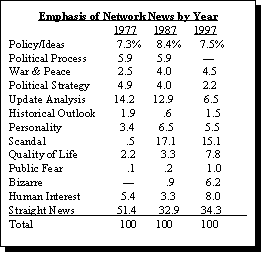
Emphasis on Network News by Year

The greatest new shift in emphasis of network news was a marked rise in the number of stories about scandals, up from just one-half of one percent in 1977 to 17% in 1987 and 15% in 1997. That increase in scandal related stories also is true for other media as well. As a point of context, the 1987 coverage studied occurred in the middle of the Iran Contra scandal, whereas 1997 did not come at a moment of particular peak for any one scandal. That suggests that scandals have become a fixed category of news over the last two decades.

The next biggest shift in emphasis in network news is a rise in human interest and quality of life stories. (Human interest was defined as stories not related to any particular news event or trend but were feature stories about people that were simply interesting. Quality of life stories were defined as stories whose emphasis was largely how to improve one’s life, health or safety.) On network TV, human interest and quality of life stories doubled from 8% of the stories that appeared in 1977 to 16% in 1997.

Unlike the print news magazines, the networks saw a substantial decline in stories that were either straight news or were in depth-analysis or updates, falling from seven in ten stories in 1977 to four in ten by 1997.

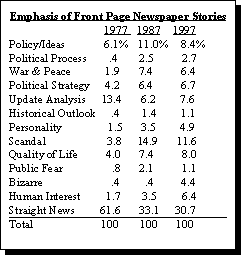
Emphasis on Front Page Newspaper Stories

Interestingly, network news saw a decline in political horse race and strategy stories, an area of persistent criticism among academic critics.

Front page newspaper stories saw some changes in emphasis similar to the shifts in network TV, but not to the same degree. Straight news accounts decreased by 50% from six in ten in 1977 to three in ten in 1997. The percent of stories that emphasized scandal increased from one in twenty-five to one in eight. Quality-of-life stories doubled from one in 25 to one in twelve. Stories that emphasized the bizarre grew four-fold from one in 200 to one in twenty-five. Human interest stories on the front page grew from one-in-fifty to one in seventeen. If you combine stories that emphasize human interest, quality of life, the bizarre, personality, and public fear into a broad category of features, they rose from accounting for just 8% of newspaper front page stories to nearly 25% today. Very possibly, newspapers included some of these types of stories deeper in the paper in 1977, but by 1997 they had become front page material.

Newspapers

Subjects of Front Page Newspaper Stories by Year

Despite the shift in emphasis, front page newspaper stories remained most oriented around traditional news categories. Though the percentage fell slightly, a plurality of the stories were about government or foreign affairs in 1977 (60%), 1987 (60%) and in 1997 (50%). Stories on domestic affairs were also prominent, counting for 14% of the front page stories in 1997.

The trend in the subjects of newspaper stories was supported in the focused look at 1997. In that six week study, over half (59%) of the stories were about government, foreign affairs, the justice system or social welfare.