Pew Research Center

FOR RELEASE APRIL 20, 2023

AI in Hiring and Evaluating Workers: What Americans Think

62% believe artificial intelligence will have a major impact on jobholders overall in the next 20 years, but far fewer think it will greatly affect them personally. People are generally wary and uncertain of AI being used in hiring and assessing workers

BY Lee Rainie, Monica Anderson, Colleen McClain, Emily A. Vogels and Risa Gelles-Watnick

FOR MEDIA OR OTHER INQUIRIES:

Communications Department
202.419.4372
www.pewresearch.org

RECOMMENDED CITATION

Pew Research Center, April 2023, "AI in Hiring and Evaluating Workers: What Americans Think"

About Pew Research Center

Pew Research Center is a nonpartisan, nonadvocacy fact tank that informs the public about the issues, attitudes and trends shaping the world. It does not take policy positions. The Center conducts public opinion polling, demographic research, computational social science research and other data-driven research. It studies politics and policy; news habits and media; the internet and technology; religion; race and ethnicity; international affairs; social, demographic and economic trends; science; research methodology and data science; and immigration and migration. Pew Research Center is a subsidiary of The Pew Charitable Trusts, its primary funder.

© Pew Research Center 2026

Table of contents

  • About Pew Research Center
  • AI in Hiring and Evaluating Workers: What Americans Think
  • 1. Americans’ views on use of AI in hiring
  • 2. Americans’ views on use of AI to monitor and evaluate workers
  • 3. Americans’ views on use of face recognition in the workplace
  • Acknowledgments
  • Methodology
  • Appendix A: Impact, outcomes of AI use by demographics
  • Appendix B: Awareness of AI applications by demographics

AI in Hiring and Evaluating Workers: What Americans Think

62% believe artificial intelligence will have a major impact on jobholders overall in the next 20 years, but far fewer think it will greatly affect them personally. People are generally wary and uncertain of AI being used in hiring and assessing workers

How we did this

Pew Research Center conducted this study to understand Americans’ views of artificial intelligence and its uses in workplace hiring and monitoring. For this analysis, we surveyed 11,004 U.S. adults from Dec. 12 to 18, 2022.

Everyone who took part in the survey is a member of the Center’s American Trends Panel (ATP), an online survey panel that is recruited through national, random sampling of residential addresses. This way, nearly all U.S. adults have a chance of selection. The survey is weighted to be representative of the U.S. adult population by gender, race, ethnicity, partisan affiliation, education and other categories. Read more about the ATP’s methodology.

Here are the questions used for this report, along with responses, and its methodology.

The rapid rise of ChatGPT and other artificial intelligence (AI) systems has prompted widespread debates about the effectiveness of these computer programs and how people would react to them. At times, Americans are watching the general spread of AI with a range of concerns, especially when the use of AI systems raises the prospect of discrimination and bias.

One major arena where AI systems have been widely implemented is workplace operations. Some officials estimate that many employers use AI in some form of their hiring and workplace decision-making.

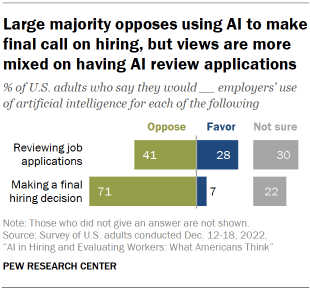
A new Pew Research Center survey finds crosscurrents in the public’s opinions as they look at the possible uses of AI in workplaces. Americans are wary and sometimes worried. For instance, they oppose AI use in making final hiring decisions by a 71%-7% margin, and a majority also opposes AI analysis being used in making firing decisions. Pluralities oppose AI use in reviewing job applications and in determining whether a worker should be promoted. Beyond that, majorities do not support the idea of AI systems being used to track workers’ movements while they are at work or keeping track of when office workers are at their desks.

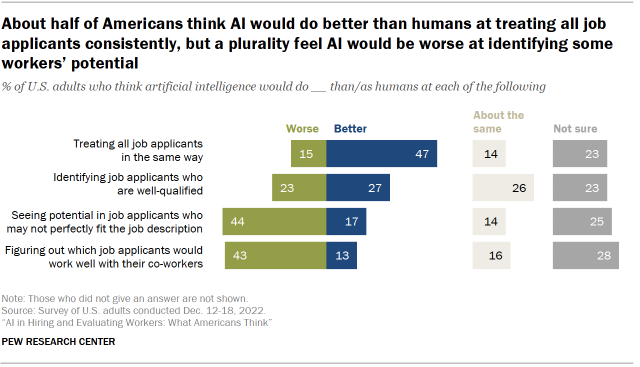
Yet there are instances where people think AI in workplaces would do better than humans. For example, 47% think AI would do better than humans at evaluating all job applicants in the same way, while a much smaller share – 15% – believe AI would be worse than humans in doing that. And among those who believe that bias along racial and ethnic lines is a problem in performance evaluations generally, more believe that greater use of AI by employers would make things better rather than worse in the hiring and worker-evaluation process. 

Overall, larger shares of Americans than not believe AI use in workplaces will significantly affect workers in general, but far fewer believe the use of AI in those places will have a major impact on them personally. Some 62% think the use of AI in the workplace will have a major impact on workers generally over the next 20 years. On the other hand, just 28% believe the use of AI will have a major impact on them personally, while roughly half believe there will be no impact on them or that the impact will be minor.

Chart shows about six-in-ten Americans believe AI will have a major impact on workers generally, but only 28% believe it will have a major effect on them personally

Asked about potentially beneficial or harmful effects of AI in workplaces in the next 20 years, a higher share say it will hurt more than help workers than say the inverse. About a third of Americans (32%) think the benefits and harms will be equally split for workers generally, while 22% are not sure about its potential effect.

At the personal level, 38% of Americans say they are not sure what the outcome of AI use in workplaces will be for them personally. Three-in-ten say the use of AI in these places will even out – the help and the hurt will be equal. Some 16% of adults think they themselves will be more helped than hurt, and 15% believe they themselves will be more hurt than helped.

When it comes to Americans’ opinions about the impact of AI use in the workplace on the overall U.S. economy, 56% think over the next 20 years the impact will major, while 22% believe it will be minor. A small fraction (3%) say there will be no impact and 19% are not sure. (For details by demographic groups on these questions, please see Appendix A.)

These broad results come from a Center survey of 11,004 U.S. adults conducted Dec. 12-18, 2022. These findings set an overarching framework for more contextual findings related to three specific work-related activities that are explored more fully in the poll: hiring processes, worker monitoring and evaluation efforts, and the use of face recognition in workplaces.

Other survey reports and blog posts on artificial intelligence and society

This is part of a series of publications that looks at the increasing role of AI in shaping American life. For more, read:

  • 60% of Americans Would Be Uncomfortable With Provider Relying on AI in Their Own Health Care
  • How Americans view emerging uses of artificial intelligence, including programs to generate text or art
  • Public Awareness of Artificial Intelligence in Everyday Activities
  • Older Americans more wary than younger adults about prospect of driverless cars on the road
  • U.S. women more concerned than men about some AI developments, especially driverless cars
  • How Black Americans view the use of face recognition technology by police
  • AI and Human Enhancement: Americans’ Openness Is Tempered by a Range of Concerns
  • 5 key themes in Americans’ views about AI and human enhancement

Majorities oppose employers using AI in making final hiring decisions, tracking employees’ movements
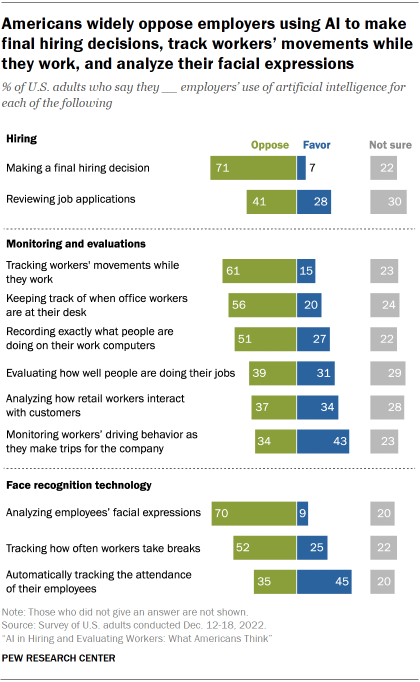
Chart shows Americans widely oppose employers using AI to make final hiring decisions, track workers’ movements while they work, and analyze their facial expressions

Americans have a range of views about the use of artificial intelligence systems by employers. They strongly oppose some possible applications of AI, but they also are more supportive of others.

They reject the idea that AI would be used in making final hiring decisions, by a ratio of roughly ten-to-one. A smaller plurality (41%) also opposes the use of AI in reviewing job applications. These findings line up with a theme in Center research: that people are not comfortable ceding final decision-making to a computer program.

Relatedly, U.S. adults are more opposed than favorable toward the idea of employers using AI analysis in determining other major employee-related decisions. By a 55%-14% margin, adults oppose the prospect that employers would use information collected and analyzed by AI about their workers’ job performance to decide whether someone should be fired from their job. And a 47% plurality opposes the notion that AI analysis of worker performance would be used in deciding if an employee gets promoted (22% favor this). 

Beyond uses of AI in decision-making about hiring, firing and promoting workers, employers have access to AI systems that are able to track worker behavior – including when they are working remotely – and provide evaluations of their performance. U.S. adults oppose some key aspects of monitoring workers’ activities, but one application draws more support than opposition.

Americans are notably more likely to oppose than support employers using AI to track workers’ movements while they work, keep track of when office workers are at their desks, and record exactly what people are doing on their work computers. Views are mixed when the issue is the use of AI to evaluate how well people are doing their jobs: 39% oppose this use, 31% favor it and 29% are not sure. When it comes to organizations using AI to analyze how retail workers interact with customers, 37% oppose it, 34% favor it and 28% say they are not sure.

Still, there is an aspect of employer use of AI programs analyzing workers that draws more public support than opposition: By a 43%-34% margin, people favor employers using AI to monitor workers’ driving behavior as they make trips for the company.

When it comes to using face recognition technology to monitor workers, Americans – by 70% to 9% – oppose this as a way to analyze employees’ facial expressions. They are also more likely to oppose using face recognition to track how often workers take breaks (52%-25%). At the same time, a 45% plurality favors face recognition being used by employers to automatically track the attendance of their employees (35% oppose it).

It is important to note that as the public confronts these questions about uses of AI in hiring and monitoring workers, notable shares of the population say they are not sure of their positions.

About two-thirds of Americans say they would not want to apply for a job if AI were used to help make hiring decisions

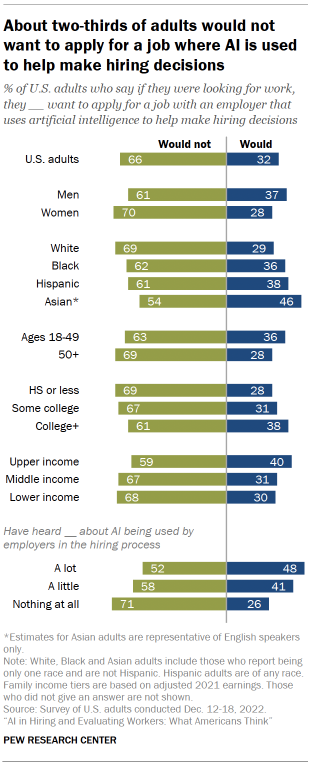
At a personal level, many U.S. adults say they would not want to apply for a job with an employer that used AI to help make hiring decisions: 66% say they would not want to apply for a job under those circumstances, compared with 32% who say they would want to apply.

Across demographic groups, people are more likely to say they would not want to apply for a job where this technology is used than say they would. At the same time, there are some differences based on age, gender, race and ethnicity, and income. For example, 70% of women say they would not apply for a job with an employer that used AI in hiring decisions, compared with 61% of men who would not apply for a job at such a workplace. 


Would you want to apply for a job that uses AI to help make hiring decisions?

% of U.S. adults who say they would or would not want to apply for a job with an employer that uses artificial intelligence to help in hiring decisions

66% say No

32% say Yes

In open-ended responses to this question,
people shared why they said “yes” or “no”

Why no?

AI lacks the human touch

“It would lack/overlook the human factor. What if I don’t have the ‘right’ keywords on my application? Would I be dismissed outright? I would need to learn more about AI to feel comfortable with it.”

— WOMAN, 40s

Why YES?

AI can be less prejudiced

“I am an older worker, and I have encountered prejudice from potential employers. I do think AI would be more objective and less prejudiced in regard to applicants for jobs.” 

— WOMAN, 70s

Why no?

AI can’t capture everything

“An in-person hiring decision allows for the employer to use a broad range of the wisdom from personal and job experience, and the ability to gather nonverbal information that would be helpful in ways that AI cannot because it only operates with the narrower parameters programmed into the AI database.” 

— MAN, 60s

Why YES?

AI use wouldn’t stop me from applying

“For me it would be just simply having the opportunity. I can’t control their methods of hiring, but I can at least apply. I’d be going after the job, not not applying because they use AI. If you don’t even apply then there’s no way you’ll get the job. Personally, I don’t care what they use.”

— WOMAN, 20s

Why no?

AI can add its own biases

“AI as it is usually applied today looks for specific words or qualifications that often miss the whole picture. AI is also as biased as the people who designed it, allowing structural biases based on race or socioeconomic status to persist unchallenged.” 

— MAN, 30s

Why YES?

AI could see things humans might miss

“I feel AI might see my qualities better than a person. I don’t have a traditional work history and I think humans might pass me up for opportunities I could definitely do successfully.”

— MAN, 40s

Note: Those who did not give an answer are not shown. For a full discussion of the coded open-end responses, please see Chapter 1.
Source: Survey of U.S. adults conducted Dec. 12-18, 2022.
“AI in Hiring and Evaluating Workers: What Americans Think”

Pew Research Center


Asked to describe in their own words the main reason why they would or would not want to apply for a job if AI is used to help with the hiring process, Americans cite a number of reasons. Some who would not want to apply to an organization that incorporates AI into hiring express concerns that the use of AI systems would remove the “personal touch” from the hiring process. Others say they worry that computers could not pick up on job applicants’ personalities or discern whether job seekers would fit in well with co-workers. Another fear is that AI systems can introduce bias or other problems into hiring processes.

Among those who would want to apply to an organization that uses AI in the hiring process, people cite potential positives. The views include the ideas that AI systems would evaluate job applicant skills more thoroughly and accurately than humans; that such systems would be more fair and objective; and that AI programs might save time in the hiring process. Some of those who would be willing to apply if AI were involved also say its use would not stop them from applying or does not matter to them. A full rundown of the data and themes sounded by respondents is covered in Chapter 1.

Public believes AI would be better than humans in treating applicants equally but would struggle with seeing potential in candidates

AI has been billed by advocates as a time-saving tool for screening applicants and a way to circumvent biases embedded in human decision-making. Still, critics argue AI-based recruitment tools could reinforce the very prejudices companies are trying to eliminate. At the same time, some warn AI could disadvantage nontraditional job candidates who may only meet some of the predetermined qualifications.

When asked if AI would fare better than humans at assessing applicants in four kinds of measurements, Americans have more confidence in AI to evaluate job seekers equally but are less convinced it could outperform humans in identifying qualified applicants or evaluating applicants in more nuanced and less quantifiable ways.
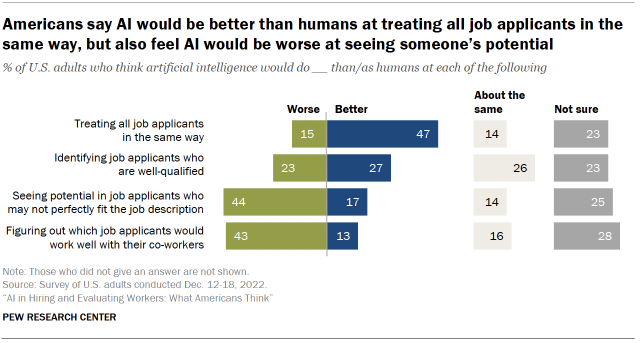
Chart shows Americans say AI would be better than humans at treating all job applicants in the same way, but also feel AI would be worse at seeing someone’s potential

Roughly half (47%) say AI would be better than humans at treating all applicants similarly, while just 15% say it would do a worse job. By contrast, the public is more likely to believe AI would do worse than humans at seeing potential in job applicants who may not perfectly fit the description or at figuring out which applicants would work well with their co-workers. And views on identifying whether a candidate is well-qualified are decidedly more mixed, with somewhat similar shares saying AI would do better, worse or about the same as humans.

There is also a level of uncertainty on this topic, with about one-quarter saying they are not sure of the type of job AI would do for each of these tasks.

Can AI help combat racial and ethnic bias in hiring?

Americans widely believe racial discrimination in hiring is a problem, and for those holding this view, AI is seen as a promising way to address the issue.
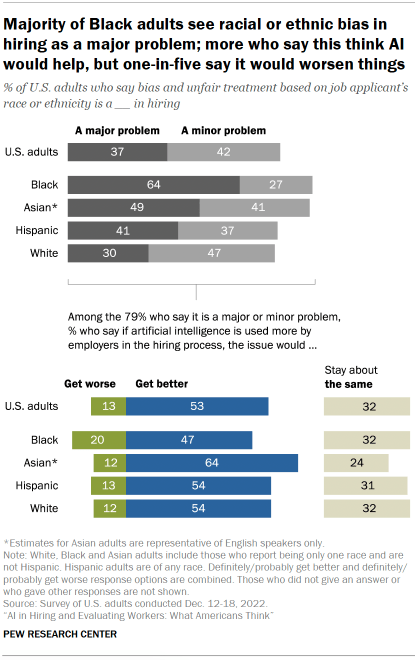
Chart shows Majority of Black adults see racial or ethnic bias in hiring as a major problem; more who say this think AI would help, but one-in-five say it would worsen things

Roughly eight-in-ten (79%) say bias and unfair treatment based on an applicant’s race or ethnicity is a problem, but the degree to which they see this as an issue varies widely by race and ethnicity. While 64% of Black Americans describe racial bias in hiring as a major problem, that share drops to 30% among White adults. These sentiments among Asian or Hispanic Americans fall in between these two groups.1

Some companies have utilized AI to help increase racial and ethnic diversity in their workforce. Still, there are long-standing debates about whether AI eliminates or amplifies bias in hiring.

This survey finds the public taking the more optimistic view. Among those who say racial and ethnic bias in hiring is a problem, 53% think bias and unfair treatment based on race and ethnicity will improve with increased use of AI by employers in the hiring process, while much smaller shares (13%) believe AI will make the issue worse. About one-third say this problem would stay the same.

Across racial and ethnic groups, relatively large shares who view bias in hiring as a problem say this issue would improve rather than worsen with increased use of AI in hiring. Still, there is somewhat more skepticism among Black Americans than other racial or ethnic groups: 20% of Black adults who say racial bias in hiring is a problem believe AI being more widely used by employers would make the issue worse, compared with about one-in-ten Hispanic, Asian or White adults.

Similar patterns are present when asking about using AI to assess how people are faring on the job. Among those who see racial and ethnic bias in evaluating workers’ performance as a problem, more say workplaces relying more on AI for performance evaluations would better rather than worsen the situation. And while there is a belief across racial and ethnic groups that AI would be more helpful than detrimental in combating these biases in performance reviews, Black adults are again more likely than their counterparts to think AI would make the issue worse.

Surveillance, data mismanagement, misinterpretations are among potential outcomes the public foresees in AI-enabled workplaces

AI is not only utilized during hiring, it can also be used to evaluate and observe those already in the workplace. Companies increasingly rely on these systems to monitor everything from truck drivers’ movements to call center conversations.

When asked to evaluate possible impacts of using AI in this way, Americans see both benefits and downsides. But the potential negative consequences resonate most strongly with the public.
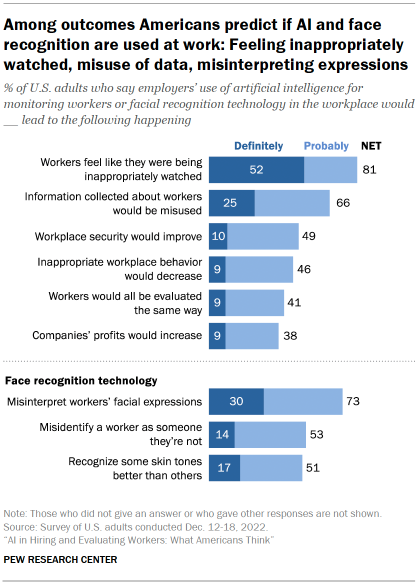
Chart shows among outcomes Americans predict if AI and face recognition are used at work: Feeling inappropriately watched, misuse of data, misinterpreting expressions

Indeed, there is consensus that employees would think Big Brother is watching: 81% of adults say this would lead to workers feeling inappropriately watched, including about half who say this sentiment would definitely be present. Concerns about data security are also common, with two-thirds saying information collected about workers’ performance would definitely or probably be misused if employers used AI.

By comparison, smaller shares believe this technology will be a plus for security and curtailing bad behavior. Some 49% say the use of AI in the workplace would lead to improvements in workplace security, while a somewhat similar share (46%) say the same for decreasing inappropriate workplace behavior. And about four-in-ten say jobs deploying AI would result in workers being evaluated in the same way and lead to companies turning a higher profit.

When it comes to assessing the impacts of a particular form of AI – face recognition – a majority of Americans (73%) say utilizing this technology in the workplace would lead to facial expressions being misinterpreted, while about half think it’s likely that face recognition systems would misidentify a worker as someone they’re not and that such programs would not recognize some skin tones as well as others.

Some views about AI use in the workplace differ by income, gender, race and ethnicity, age, and awareness of the topic

In addition to exploring how different groups view issues of workplace bias and discrimination in the context of AI use, the survey revealed other demographic and group differences on certain issues:

Income: Those with different household incomes at times have contrasting views about the use of AI in workplaces. For instance, Americans with upper incomes (38%) are more likely than those with middle (29%) or lower (20%) incomes to favor AI being used to review job applications. But adults with middle and upper household incomes are more likely than those with lower incomes to oppose employers using AI systems to decide whom to promote or fire. Nine-in-ten upper-income adults say workers would probably or definitely feel inappropriately surveilled if AI were used to collect and analyze information about how workers are doing their jobs, compared with 84% of those in middle-income households and 70% of those in lower-income families. A similar pattern plays out when the issue is the likelihood that data on workers collected and analyzed by AI would be misused.2

Gender: Men are more likely than women to see specific benefits and downsides to AI’s use in the workplace. For example, larger shares of men than women feel that if employers used AI to analyze information about how workers are doing their jobs, workers would feel like they were being inappropriately watched (85% vs. 77%). And men are more likely than women to believe that information collected about workers would be misused (72% vs. 60%). At the same time, men are more likely than women to think workplace security would be improved and company profits would go up with AI monitoring systems in place.

Beyond that, higher shares of men than women oppose certain uses of face recognition technology: analyzing workers’ facial expressions (74% vs. 68%); tracking how often workers take breaks (56% vs. 49%); and automatically tracking the attendance of employees (37% vs. 31%).

Race and ethnicity: Different racial and ethnic groups sometimes see applications of AI in hiring and workplace situations in diverse ways. For instance, White and Asian adults are more likely to see potential downsides for workers if AI were used to monitor them. They foresee workers feeling inappropriately watched or the information collected from this surveillance being misused. Smaller shares (albeit still majorities) of Hispanic adults and Black adults think these things would happen.

Asian adults stand out for their opposition to several types of AI monitoring in the workplace. Asian adults are also more likely than other racial or ethnic groups analyzed to oppose AI being used to track worker movements, desk time and computer habits. Conversely, Asian and Hispanic adults are more likely than their White or Black counterparts to see some potential benefits if AI were used in workplaces. Those benefits include improved security at workplaces and fewer inappropriate behaviors.

There are also differences by race and ethnicity when it comes to uses of face recognition covered in the survey. For instance, Black (25%) and Asian adults (23%) are more likely than White or Hispanic adults (16% each) to say face recognition technology definitely would recognize some skin tones better than others in a workplace setting.

Age: Opposition to various types of AI monitoring in the workplace varies across age groups. For instance, adults ages 18 to 29 are consistently more likely to oppose each of the six types of AI surveillance at work explored in this survey than those 65 and older. One of the striking gaps between these groups is on whether adults favor or oppose the use of AI to track what people are doing on their work computers: 64% of those ages 18 to 29 oppose it, compared with 38% of those 65 and older.

Adults under 50 are more likely to see AI systems as an improvement over humans in the consistent treatment of job applicants (50% vs. 43%). In the other direction, adults under 50 are also more likely to say AI would be worse at seeing the potential of job candidates (48% vs. 39%) or figuring out if an applicant would fit well with co-workers (46% vs. 39%).

Awareness about AI’s possible use in work-related activities is often tied to people’s opinions: Overall, majorities of American adults say they have heard nothing about the ways AI systems can be used in the hiring process or evaluating employees. About six-in-ten say they have heard nothing about AI use in the hiring process (61%) or about its use in collecting and analyzing information about how workers are doing their jobs (62%). Some 38% say they have heard nothing about employers’ use of facial recognition technology in the workplace.

These differences in awareness are associated with people’s answers in questions about these subjects. For instance, those who heard nothing at all about these uses of AI are more likely to say they are not sure of their views on some questions related to AI use in organizations in the hiring process or worker-monitoring systems.

By contrast, those who have heard a lot about the use of AI in hiring or in evaluating worker performance or the use of face recognition in workplace settings are more likely than others to think that AI will have a major impact on workers generally, on themselves personally and the U.S. economy. In addition, those who have heard a lot about some key uses of AI in workplaces are more open than those who have not heard anything to applying for a job where AI is used in the hiring process. And those more aware of AI use in workplaces are more likely to favor using these computer programs to review job applications.
1. Americans’ views on use of AI in hiring

People seeking employment must increasingly put their “best foot forward” not just to a hiring manager, but to a computer program with power to weed them out or deliver them to the next step of the process. The use of artificial intelligence in hiring is commonplace and can take a number of forms, from screening applicants to conducting interviews. But increasing use of AI by employers has led some to question the fairness, quality and accuracy of hiring decisions made in this way –  even as others tout AI as an improvement over human involvement.

Americans’ views on these topics are infused with skepticism and uncertainty, but there are notes of optimism as well. People are more likely to oppose than favor AI’s involvement in reviewing job applications – and for final hiring decisions, adults decisively want human judgment to prevail. A majority say they, themselves, would not want to apply to a job where AI helps make hiring decisions. Still, when it comes to AI’s potential impact, people hold some views that are more optimistic. For instance, they lean toward thinking AI systems would be better than humans at treating all applicants the same and that AI would improve problems of racial bias and unfair treatment in hiring if it were used more.

The public remains relatively unaware of AI’s use in hiring. The majority of Americans (61%) have heard nothing at all about AI being used by employers in the hiring process. Still, 39% of Americans say they have heard at least a little about this, including 7% who have heard a lot.

Awareness of AI’s use in the hiring process varies across different groups. Those with a bachelor’s degree or more, for example, are more likely to have heard about this compared with those with some college experience or a high school diploma or less. Asian adults are most likely among racial and ethnic groups to have heard at least a little, followed by Hispanic or Black adults and a smaller share of White adults. And half of those who have applied for a job in the past 12 months have some awareness of AI’s role. (See Appendix B for full demographic details.)

Americans are more opposed than not to AI’s involvement in the hiring process, especially in making final decisions

AI can play a range of roles in hiring – from scanning and evaluating resumes to scoring candidates or conducting interviews. While some argue humans will always be needed in the process, companies’ moves to embrace AI’s role have inspired discussion and debate about how far its influence in hiring will go.

This Pew Research Center survey takes Americans’ temperature on AI’s use at two places in the hiring process – reviewing applications (a place where experts say AI’s use is growing) and making a final decision about extending a job offer to an applicant.

Chart shows large majority opposes using AI to make final call on hiring, but views are more mixed on having AI review applications

While views vary somewhat based on the stage in question, Americans lean negative when asked about either. A majority of Americans (71%) oppose AI making a final hiring decision, while just 7% favor it and 22% are not sure. By comparison, views of using AI to review job applications are more mixed: A plurality (41%) opposes employers doing so and 30% are not sure what they think about this issue. But another 28% are in favor of this.

The more familiar people are with this technology, the more supportive they are of its use. For example, 43% of those who’ve heard a lot about using AI in the hiring process support its use in reviewing applications, compared with 37% who’ve heard a little and 21% who’ve heard nothing at all. Still, even those with a higher level of awareness are about evenly split between favoring and opposing this.

Chart shows Americans with higher household incomes are more likely to favor AI reviewing job applications than those with lower incomes

Americans with relatively high incomes (38%) are also more likely than those with mid-range (29%) or lower (20%) incomes to favor AI being used to review applications.

There are also differences by race and ethnicity. Asian adults are more likely than Hispanic, Black and White adults to favor AI reviewing job applications. When it comes to using AI in making the final decision, Asian, Hispanic and Black adults are more likely than their White counterparts to express favor – though relatively small shares say so in each group.

Those who are currently working are more likely to oppose a final decision being made with AI than those who are not (75% vs. 65%). However, there is variation among workers by whether they are full time or part time: 76% of full-time workers oppose this, while part-time workers (69%) hold similar views to those who are not working (65%). And those not working are more likely than people working full or part time to say they are not sure of their views about AI’s use in both stages of the hiring process.

About half of Americans say AI would do a better job than humans at treating all job applicants in the same way

One of the major issues surrounding AI systems of all kinds is whether they can improve on human performance. Similar questions arise in the hiring process: Can AI programs eliminate potential flaws in human judgments? Or, will AI systems miss candidates who might be a good fit in ways not immediately apparent from their application?

Asked how AI would measure up to humans in several respects, some see places where AI might improve on humans’ abilities – for example, in treating applicants consistently. At the same time, there is considerable skepticism when it comes to looking beyond what’s on paper to see potential or assess how people will interact; on balance, people envision AI doing worse than humans at these tasks.

Out of the four topics explored in this comparison, U.S. adults are most likely to say that AI can improve over humans when it comes to holding people to a common standard. Some 47% say AI would do a better job than humans at treating all applicants in the same way – about three times the share of those who say it would do worse (15%). Some 14% say it would do about the same job.

Chart shows about half of Americans think AI would do better than humans at treating all job applicants consistently, but a plurality feel AI would be worse at identifying some workers’ potential

There is no consensus when it comes to how people think AI would perform relative to humans in identifying job applicants that are well-qualified: 27% say AI would do a better job and 23% say a worse job, while 26% say about the same.

On the other hand, people are more skeptical that AI would be an improvement over humans when it comes to thinking outside the box: 44% say AI would be do a worse job at seeing potential in job applicants who may not perfectly fit the description. This is far greater than the shares who say it would do a better job (17%) or about the same job (14%).

And even as some AI tools aspire to assess employees’ “soft skills,” people are relatively skeptical about how they measure up to humans on these nuanced matters. Some 43% say AI’s judgments about who might work well with coworkers would be worse than the judgments humans would make – 30 percentage points higher than the share who think it would be an improvement over the human touch.

Still, segments of the public are uncertain about these issues. On each of the four considerations explored, about a quarter are not sure whether humans or AI would do a better job.

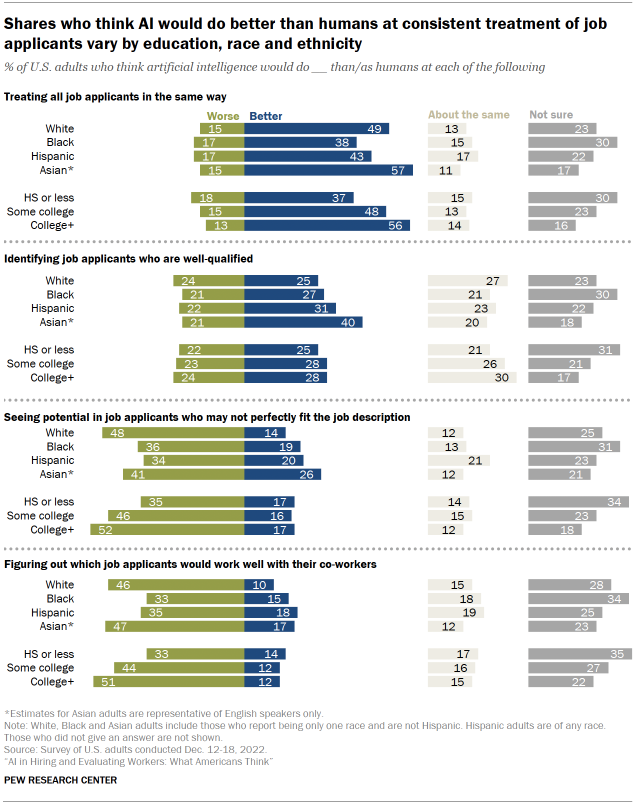
There is variation in these views across groups – with some of the largest differences by formal education, race and ethnicity.

Chart shows Shares who think AI would do better than humans at consistent treatment of job applicants vary by education, race and ethnicity

Americans with a bachelor’s degree or higher are more likely than those with some college experience or a high school diploma or less to say AI would be an improvement over humans in treating all applicants in the same way. But pessimism rises with formal education when it comes to the job AI would do figuring out who would work well together or gauging job seekers’ hidden potential – those with a bachelor’s degree or more are about 20 points more likely than those with a high school diploma or less to say AI would do worse than humans at each.

Racial and ethnic differences in these views are also apparent. When it comes to seeing potential in job applicants and assessing their possible fit with co-workers, Black, Hispanic and Asian adults are all more likely than White adults to say AI would be an improvement over human judgment. On the other hand, Black and Hispanic adults are less likely than White or Asian adults to think AI would be an improvement over humans in treating applicants in the same way.

Further, while pluralities of Americans regardless of employment status say AI would improve on the job humans do at treating applicants consistently, those who are working full time (53%) are somewhat more likely to say this than those working part time (45%) or not working (41%). Yet full-time workers are more skeptical on other matters: For example, those working full time (49%) are more likely than those working part time (43%) or not working (35%) to say AI would be worse at figuring out who would work well with co-workers. Workers generally are also more likely to say AI would be worse at seeing potential compared with those not working (49% vs. 37%).

There are also differences by age, with adults under 50 more likely than older adults to see AI as an improvement over humans in consistent treatment of job applicants (50% vs. 43%); but also more likely to say AI would be worse at seeing the potential of job seekers (48% vs. 39%) or figuring out whether they would fit with co-workers (46% vs. 39%).

Majority of Americans would not want to apply for a job with an employer that uses AI to help make hiring decisions

Experts, regulators and human resource professionals alike are in agreement that AI is changing the way some companies hire. But how interested are Americans in actually being evaluated – in whole or in part – by a computer?

Chart shows about two-thirds of adults would not want to apply for a job where AI is used to help make hiring decisions

The survey reveals that Americans largely are not convinced an AI-driven hiring process is for them. About two-thirds (66%) say they would not want to apply for a job with an employer that uses AI to help make hiring decisions, while 32% would want to do so.

These preferences vary by how much people have heard about the topic. Some 71% of those who have heard nothing at all say they would not want to apply to a job where AI was involved in making the decision. This compares with 58% of those who have heard only a little and 52% of those who have heard a lot.

About seven-in-ten White adults say they would not want to apply in this case, greater than the shares of other racial and ethnic groups who say the same. Black adults are next with about six-in-ten (62%) saying they would not want to apply, greater than the share of Asian adults (54%) who say so. (The share of Hispanic adults who are opposed to applying – 61% – is statistically similar to the shares of Black or Asian adults.)

While majorities of Americans regardless of age would not want to apply for a job where AI helped with hiring, Americans 50 and older are more skeptical than those under 50 (69% vs. 63%). This age pattern is apparent when just looking among Black adults – 67% of Black adults ages 50 and up would not want to apply, versus 58% of Black adults under 50 – but not among White or Hispanic adults.

Looking at age and gender together, women 50 and older (73%) stand out from other groups in their opposition, followed by similar shares of younger women (66%) and men 50 and older (64%). A smaller share of men under 50 (58%) say they wouldn’t want to apply.

Finally, greater shares of those with lower or middle incomes would not want to apply for a job like this when compared with Americans in the upper income tier.

In broad terms, these findings are in line with earlier Center research on related topics. In a 2017 Center survey, the vast majority of Americans also said they would not want to apply for jobs that use a computer program to make hiring decisions.3

Lack of ‘human factor’ is most common reason for not wanting to apply for job that uses AI in the hiring process

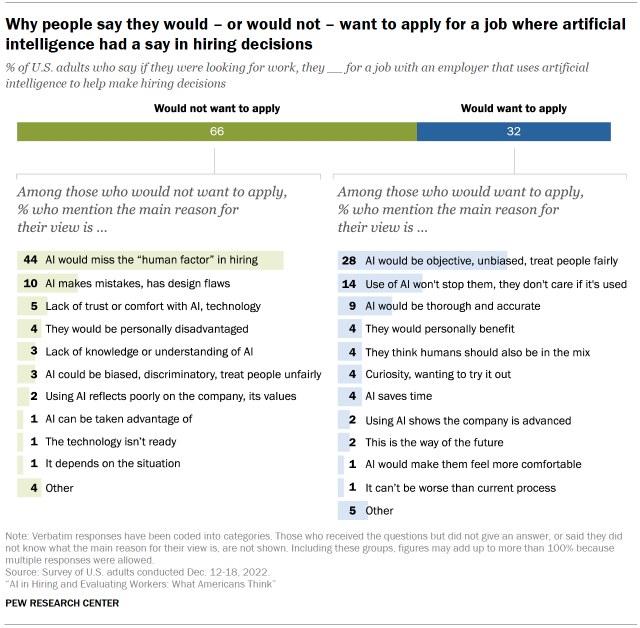
When Americans are asked to give the main reason they would or would not want to apply for a job where AI is used in hiring, their own words reveal a range of potential pros and cons about the way AI would function in this process.

Bar chart showing that the top reason U.S. adults say they WOULD NOT apply for work with an employer that uses AI in hiring decisions is that AI would miss the human factor in hiring. The top reason people WOULD apply for this job is that AI would be objective, unbiased, or fair

Among the 66% of adults who would not want to apply, a plurality (44%) mention ways AI-aided systems might ignore the “human side” of evaluating job applicants – or that they would just prefer the human touch.

Some express concern about AI’s inability to make human-like judgments or to see “intangibles” that they consider important to hiring:4

“AI can’t factor in the unquantifiable intangibles that make someone a good co-worker … or a bad co-worker. Personality traits like patience, compassion and kindness would be overlooked or undervalued.” – Man, 60s

Without humans in the hiring mix, people fear the process would become impersonal and that the lack of person-to-person interaction would be detrimental to both the employer and the prospective employee. Some discussed these concerns generally, while others noted that certain fields require qualities AI cannot see:

“That takes all the personalization out of it. I wouldn’t want to make a decision whether or not to join a company without being personally selected and without meeting my potential employer directly, and without them meeting me to see if I would be a good fit for their employees.” – Woman, 30s

“I work as a bartender. My job requires me to be social, current on social and timely topics. I also need to multitask at times, and get along as a team player. I’m not sure AI will see those attributes.” – Woman, 50s

Another 10% of people who say they would not want to apply describe concerns that the design of AI could be flawed – for some, it is too focused on keywords or absolutes, screening people out unnecessarily:

“[To AI] … I’m not a person, just a series of keywords and if I don’t fit the exact hiring model I’m immediately discarded. Hiring manager doesn’t care, they don’t actually read anything.” – Man, 40s

Others in this group discuss more fundamental problems with AI’s design or the data it uses.

“It’s a ‘garbage in, garbage out’ problem. AI in itself could be useful, but in general the parameters that it’s given are poor. There has always been a gap between the Human Resources personnel and the supervisor or team who know the actual needs, and that is exaggerated with AI. Who do you think programs the AI?” – Woman, 50s

And another 3% specifically mention design flaws in AI systems that could lead to bias, unfair treatment or discrimination:

“AIs are typically trained on real-world data which can be (and often is) inherently and systemically biased to favor privileged groups. Use of AI for decision-making perpetuates the biases we have in human decision-making. Hiring is an area where biased decision-making is especially dangerous for our society.” – Man, 20s

Small shares of those who would not want to apply also express a more general wariness, saying they do not trust AI or feel comfortable with technology (5%); worry they would not fare well if AI were used (4%); or feel too “in the dark” about what AI is or what it can do (3%).

Turning to the 32% of Americans who say they would want to apply for a job like this, the most common reason relates to the prospect that AI could be objective, fair, have little to no bias or treat everyone equally. Some 28% of those open to applying mention one of these factors as the primary reason:

“If the AI were properly informed, it could remove/minimize any personal bias of the human who would otherwise be making hiring decisions.” – Woman, 70s

Another 14% of the individuals open to applying for a job with AI in the hiring decision process say that fact is not going to stop them from applying or does not matter to them.

“If I was looking to change jobs, I would apply to potential employers because of the quality of their culture and how the job that is being offered matched my goals and skill sets, and much less how AI is used in the selection process.” – Man, 60s

“Because I need a job if I am applying. It’s not like I have much of a choice.” – Woman, 20s

About one-in-ten (9%) of those open to applying argue that AI would be thorough and accurate – possibly more so than humans:

“I think the AI would be able to evaluate all my skills and experience in their entirety where a human may focus just on what the job requires. The AI would see beyond the present and see my potential over time.” – Man, 50s

Still, 4% of this group say humans should still be involved at some level. And small shares also note positives like AI giving them personally a leg up, being curious to try it or making hiring efficient (4% each).

“I have been part of a company’s hiring process in the past, and having to sort through thousands of applications was time consuming and tedious. Using AI to streamline that process sounds like a good advancement.” – Woman, 20s

A majority say racial and ethnic bias in hiring is a problem, and about half of them say increased use of AI would help ease those issues

The rise of AI in hiring has spurred societal debates about what it means for diversity, discrimination and bias in the hiring process – especially when it comes to applicants’ treatment based on race or ethnicity. AI’s advocates say it could eliminate unconscious bias and improve diversity in the workplace. But others sound alarms, raising concerns about AI’s potential to entrench existing biases and make discriminatory decisions.

These issues are being actively debated by lawmakers and regulatory bodies alike, and companies are facing lawsuits over alleged algorithmic discrimination in hiring. They are also situated amid broader concerns about diversity and discrimination in the workplace based on race and ethnicity.

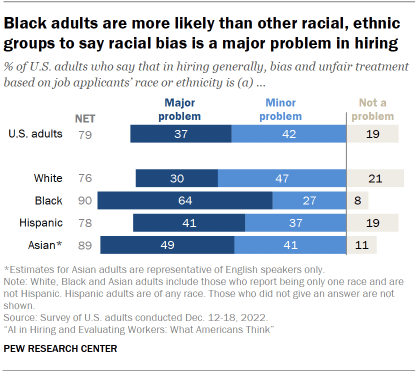
Chart shows Black adults are more likely than other racial, ethnic groups to say racial bias is a major problem in hiring

In this survey, a majority of Americans (79%) say that in hiring generally, bias and unfair treatment based on job applicants’ race or ethnicity is a major (37%) or minor (42%) problem. Some 19% believe this type of discrimination in hiring is not an issue.

Black adults stand out from other racial and ethnic groups in thinking this is a major issue. About two-thirds of Black adults (64%) say bias and unfair treatment based on race or ethnicity is a major problem, as do smaller shares of Asian (49%) and Hispanic (41%) adults. White adults are least likely among racial and ethnic groups to say this (30% think it is a major problem). Among White adults, this view differs by age, with White adults under 50 more likely to think it is a major problem than their counterparts who are 50 and older (34% vs. 26%). Among Black or Hispanic adults, there are no age differences in viewing this as a major problem.

Chart shows about half of Black adults who view racial bias in hiring as a problem say AI would have positive impact, even as they are more skeptical than other groups

Americans who think bias and unfair treatment is a problem in hiring are, on balance, optimistic about AI’s potential to improve things if it plays a greater role in the process. Far more among this group say this problem would definitely or probably get better with increased use of AI in hiring (53%) than say it would definitely or probably get worse (13%). About a third (32%) say things would stay about the same.

Across racial and ethnic groups, about half or more of those who think bias and unfair treatment based on race or ethnicity is a problem say that this will get better with increased use of AI. Asian adults who believe this is a problem are more likely than other groups to say it would improve, followed by equal shares of their White or Hispanic peers who say so.

One-in-five Black adults who say this is a problem think it will get worse with increased use of AI, compared with about one-in-ten of those who are Asian, Hispanic or White. Still, 47% of Black adults who say this is a problem are optimistic about the impact of AI’s increasing use.

Looking at these issues among the general population, 42% of all Americans say racial and ethnic bias in hiring is a problem and that this would get better with increased use of AI; 10% say it is a problem and this would get worse; and 25% say it is a problem but would stay the same. Another 19% say it is not a problem to begin with.

2. Americans’ views on use of AI to monitor and evaluate workers

A variety of digital tools are being used to monitor workers across various industries, some of which use artificial intelligence (AI) to try to gain insights into workers’ performance. These tools can track what workers do on their computers, how they are driving on the job, their movements within the workplace and even their tone of voice when speaking with customers.

In the new Pew Research Center survey, most Americans report unease or uncertainty when contemplating six potential uses of AI by employers to monitor workers. For example, majorities oppose tracking workers’ movements while they work or keeping track of when office workers are at their desks. Majorities also expect that if employers used AI to monitor and evaluate workers, it would lead to employees feeling like they are being inappropriately watched or that the information collected about workers would be misused. Further, Americans express discomfort with AI being used by employers to help make promotion and termination decisions.

That is not to say that Americans don’t think there is potential for improvement. A majority of Americans feel that bias and unfair treatment in performance evaluations due to workers’ race and ethnicity is a problem. And of those who see it as a problem, more believe AI may be able to help rather than hurt in addressing these bias issues – but a notable share thinks AI wouldn’t make much of a difference.

Similar to AI use in hiring, Americans report a general lack of familiarity with AI’s use by employers to monitor how workers are doing their jobs. Some 37% say they have heard or read about employers using AI to collect and analyze information about how workers are doing their jobs, with only 6% having heard or read a lot. A majority (62%) report no familiarity with the topic at all. In fact, roughly half or more of each demographic group analyzed report having heard or read nothing at all about employers’ use of AI to collect and analyze information about how workers are doing their jobs. (For individual demographic groups’ views on this question, see Appendix B.)

Americans have a range of views about AI being used to monitor workers

More Americans oppose than favor use of AI to track workers’ movements, desk time, computer use

Americans hold varied views about the six different applications of AI for workplace monitoring that are explored in this survey. The public is most accepting of the idea that AI be used by employers to monitor workers’ driving behavior as they make trips for their organization.

Some advocates say AI-based monitoring of drivers is a way to improve driver safety. And some companies have already deployed AI solutions to monitor the driving behavior of their delivery drivers and long-haul truckers. Americans favor using AI to monitor drivers by 43% to 34%.

The public is more divided when it comes to employers using AI to analyze retail workers’ interactions with customers – 34% favor AI being used in such a way while 37% oppose it. This split comes as AI systems are being used at some firms to monitor (and even influence) workers’ interactions with customers.

Pluralities report opposing the use of AI to evaluate how well people are doing their jobs (39%) or recording exactly what people are doing on their work computers (51%). In addition, majorities of Americans oppose AI tracking workers’ movements (61%) or keeping track of when office workers are at their desks (56%). These AI solutions are often promoted as a way to better assess employee productivity.

A notable share of the public is uncertain about the use of AI monitoring practices in the workplace. For each of these uses, between 22% and 29% of Americans report being unsure of whether they would favor or oppose employers using AI in that way.

Opposition to types of AI monitoring in the workplace varies across demographic groups. For example, adults under the age of 65 are consistently more likely to oppose each of the six types of AI surveillance at work than those 65 and older. And aside from performance evaluations, adults under 30 stand out from those 30 and older in their opposition to AI surveillance.

Paid workers, younger adults are particularly likely to oppose AI surveillance in the workplace, especially to monitor workers’ movements, desk time, computer habits

When looking at opinions by employment status, paid workers (i.e., full- and part-time workers) are more likely than those not currently working for pay (whether retired, unemployed or unable to work) to oppose each use of AI monitoring in the workplace. Full-time workers are also more likely than part-time workers to say they oppose employers using AI to track workers’ movements while they work, keep track of when office workers are at their desks or record exactly what people are doing on their work computers. For example, 68% of full-time workers oppose employers’ using AI to track workers movements, compared with 60% of part-time workers and 54% of those not currently working.

Asian adults stand out for their opposition to several types of AI monitoring in the workplace. Asian adults are more likely than other racial or ethnic groups to oppose AI being used to track worker movements, desk time and computer habits. Specifically, 71% of Asian adults oppose tracking workers’ movements, compared with about six-in-ten White adults (63%), who in turn are more likely to oppose tracking workers than Black or Hispanic adults (58% and 54%). A somewhat similar pattern is seen for racial differences in opposition to employers using AI to track when office workers are at their desk. In addition, 68% of Asian adults oppose AI being used to record what people do on their work computers, while about half of White (51%), Hispanic (49%) and Black adults (48%) say the same. Racial differences on the other items are less pronounced.

Adults are more likely to think worrisome things will happen, rather than beneficial things, if AI systems are used to evaluate workers

Beyond favoring or opposing AI being used to monitor how workers are doing their jobs, Americans foresee a greater chance of potential downsides than upsides to AI’s use in workplace settings. If AI were used to collect and analyze information about how workers are doing their jobs, about eight-in ten say workers would definitely (52%) or probably (29%) feel like they were being inappropriately watched. A majority also agrees this would lead to the information collected about workers being misused (66%).

Majorities say AI use by employers to evaluate workers would lead to employees feeling inappropriately watched, collected information being misused

Smaller shares say potentially beneficial outcomes would also likely occur. About half say security in the workplace would probably or definitely improve, and 46% say inappropriate behavior in the workplace would likely decrease. Additionally, 41% say workers would all be evaluated in the same way.

Still, about a third of the public (35%) does not think using AI would lead to equitable evaluations, and 28% think it would be ineffective at curbing inappropriate behavior.

Americans express the greatest uncertainty when it comes to how this AI use would affect companies’ bottom lines. About four-in-ten U.S. adults say they are not sure how companies’ profits would be affected, while a similar share say they think profits would probably or definitely increase.

Racial and ethnic differences emerge for each of the six possible outcomes asked in the survey. White and Asian adults are more likely to see potential downsides for workers if AI was used to monitor them. They foresee workers feeling inappropriately watched or the information collected from this surveillance being misused. Smaller shares (albeit still majorities) of Hispanic adults share this view, and they are more likely than Black adults to think these things would happen.

Upper-income adults are more likely than those with lower incomes to think workers would feel inappropriately surveilled or that information would be misused if AI were used by employers to evaluate workers

Conversely, Asian and Hispanic adults are more likely than their White or Black counterparts to think AI being used to monitor workers would lead to improved security, fewer inappropriate behaviors and equal treatment for all workers.

When it comes to AI’s possible effects on the bottom line, Black, Hispanic and Asian adults are more likely to think company profits would go up with AI monitoring than White adults.

Men are more likely than women to see certain impacts if employers use AI systems in the workplace. Larger shares of men than women report feeling that if AI were used in this way, workers would feel inappropriately watched and information collected would be misused. However, they also are more likely to think workplace security would be improved and profits would go up. Similar shares of both men and women think use of AI in the workplace would lead to equitable treatment of all workers during evaluations (41% and 40%, respectively) and less inappropriate behavior (47% and 45%).

One other group difference: Nine-in-ten upper-income adults say workers would probably or definitely feel inappropriately surveilled if AI were used to collect and analyze information about how workers are doing their jobs. By comparison, 84% of adults in middle-income households followed by 70% of those in lower-income families say the same. A similar pattern of opinions is seen regarding misuse of information collected by AI, with greater levels of income being associated with thinking this would likely be the case.

Relatively few Americans think information gathered from AI monitoring in the workplace should be used to decide who gets promoted or fired

AI monitoring tools have made news in the past as companies have used these systems to make termination decisions. Conversely, AI has also been used to evaluate workers’ future potential.

Many Americans are hesitant to let AI be used in decision-making about worker terminations or promotions. Some 55% say they oppose employers using information collected and analyzed by AI about how people are doing their jobs to decide whether someone is fired, and 47% report opposing AI being used in this way to decide if someone gets a promotion.

Americans largely oppose – or are unsure about – AI being used by employers to help decide who gets promoted or fired

While Americans are somewhat more open to the use of AI surveillance to aid in promotion decisions than terminations, few say they favor AI involvement in determining promotions (22%) or terminations (14%). There is also uncertainty about using AI to inform promotions and termination decisions. About three-in-ten say they are not sure how they feel about AI being used for each of these options (30% and 29%, respectively).

In all, about half of adults or more across major demographic groups oppose the use of AI in firing decisions, and pluralities across these groups oppose it being used for promotion decisions.

While few differences in favoring AI’s use emerge, there are demographic differences in the level of opposition and uncertainty expressed by these groups. For example, compared with Hispanic adults, larger shares of White and Asian adults oppose the use of AI for both promotion and termination decisions. While White adults are more likely than Black adults to oppose AI being used for promotions, the share of Black adults who oppose it being used in this way exceeds the share of Hispanic adults who say this. Black adults do not differ from any of the other three groups in opposing AI use in firing someone.

Adults with middle and upper household incomes tend to oppose employers using AI systems to make decisions about whom to promote or fire at higher rates than those with lower incomes. Income is also related to expressing uncertainty, with adults in lower-income households more inclined than their more affluent counterparts to say they are unsure of whether they favor or oppose AI’s use in these decisions.

Similarly, women are more likely than men to express uncertainty about both of these possible uses.

Majority of Americans say racial, ethnic bias is a problem in performance evaluations; nearly half who say this think AI can help

Racial biases in the workplace are a well-researched phenomenon. And these biases can lead to discrepancies in how workers are evaluated, compensated and promoted.

Roughly nine-in-ten Black adults say racial or ethnic bias is generally a problem in performance evaluations, with 56% saying it’s a major problem

Some 74% of U.S. adults say bias and unfair treatment based on workers’ race or ethnicity is a problem in performance evaluations, with 31% saying this is a major problem. Some 23% say this is not an issue.

Majorities across demographic groups believe that racial or ethnic bias is a problem in worker evaluations. But Black adults stand out for thinking this is a major issue: Some 56% say racial or ethnic bias is a major problem in worker evaluations, while about four-in-ten Asian or Hispanic adults and 23% of White adults say the same.

Experts debate whether AI might curb or exacerbate racial discrimination in the workplace. Those skeptical of AI systems’ capacity to root out bias make the case that AI may not be human, but that does not mean that AI is fully immune to human bias. AI is designed by humans and may replicate existing racially biased practices. At the same time, proponents contend it can be easier to address bias in AI than in humans. As such, some AI advocates have argued that AI could be a potential solution for addressing bias in workplace practices.

Across racial and ethnic groups, those who think bias is a problem in worker performance evaluations are more likely to say AI would help rather than hurt

In this survey, those who think racial and ethnic bias is problem were asked a follow-up question about whether they think the use of AI in worker evaluations would make things better or worse. Some 46% of adults who say bias and unfair treatment based on race or ethnicity is a problem in evaluations feel that AI might be able to help address this issue, while 13% feel AI may make things worse and 40% say AI’s involvement would not affect racial or ethnic bias in performance evaluations. (Overall, this means that about one-third of all U.S. adults say it’s a problem and that it would get better with AI; 10% say it’s a problem and would get worse; and 29% say it’s a problem that would stay about the same.)

Across racial and ethnic groups, AI is predicted to benefit the evaluation process rather than be a detriment to it. Those who foresee benefits exceed those who anticipate detriments by notable margins. And Black adults who say racial and ethnic bias is a problem in evaluations are more likely than other racial or ethnic groups to think AI would make things worse.

Among those who say bias and unfair treatment based on workers’ race or ethnicity is a problem in performance evaluations, people who favor AI’s use in promotions or terminations are more likely than those who oppose each to say AI could help curb racial and ethnic biases and mistreatment. For example, seven-in-ten who favor AI’s use for promotion decisions think AI would help curb racial bias in performance evaluations, while about half as many who oppose AI’s use for promotions agree (34%). A similar pattern is seen between those who favor versus oppose AI’s use in terminations (72% vs. 38%).

3. Americans’ views on use of face recognition in the workplace

Many people stare down face recognition technology every day as they unlock their smartphones. But this technology also has applications in people’s places of work. Employers can use it to clock workers in and out, screen candidates during the hiring process or even monitor employees’ productivity. While some employers say this technology will increase efficiency, others worry about bias. Critics point to many systems’ lower accuracy rates for identifying people with dark skin complexions. Some programs are also designed to infer emotion from facial expressions, which some studies suggest is hard, if not impossible.

These varying views show up in the new Pew Research Center survey. The majority of U.S. adults oppose employers’ use of face recognition technology to analyze employees’ facial expressions, but views are more mixed about using the technology to track employee attendance. And Americans are not convinced of face recognition’s accuracy, with a majority saying it would misinterpret expressions and about half saying that it would misidentify workers or recognize some skin tones better than others.

Amid debates over the ethical use of workplace face recognition and a hodgepodge of state regulations governing it, there are differences among Americans in their awareness of the technology. Six-in-ten adults say they have heard or read at least a little about employers’ use of face recognition technology in the workplace. This includes only 14% who have heard a lot about this practice.

Some groups are more likely than others to say they have heard about the use of face recognition in the workplace. For example, men are more likely than women to report they have heard a lot or a little. Majorities across racial and ethnic groups say they have heard about face recognition in the workplace, though Asian adults are more likely than Hispanic, Black or White adults to say so. College graduates are also more likely than those with some college experience or a high school education or less to have heard about this technology. See Appendix B for full demographic details.

A majority of adults oppose employers using face recognition to analyze employees’ expressions

Americans are far more likely to oppose using face recognition for analyzing employees’ facial expressions than for tracking attendance

Americans’ attitudes toward face recognition vary based on the reasons employers are using the technology. For example, seven-in-ten adults say they oppose employers using face recognition to analyze workers’ facial expressions. Fewer Americans are skittish about the use of face recognition to track how often employees take breaks, although roughly twice as many oppose this as favor it. And while about a third of Americans oppose employers using face recognition to automatically track the attendance of their employees, a larger share (45%) favor this action.

It is important to note that for each of these use cases, about one-fifth of respondents say they are not sure how they would feel about employers using face recognition in these ways.

Younger men tend to oppose employers’ use of face recognition for a variety of purposes

Americans’ views on face recognition in the workplace differ across demographic groups, including age and gender. While there are few age-related differences in opinion when it comes to analyzing employees’ facial expressions (roughly seven-in-ten adults oppose this in each age group), younger adults oppose tracking workers’ breaks or attendance with face recognition at higher rates than older adults.

Younger men stand out for their opposition to employers using face recognition technology to track how often workers take breaks

Overall, men are more likely than women to say they oppose all three of these uses of face recognition technology. This difference is present among younger Americans, but not for older adults: Among Americans 50 and older, men and women do not diverge significantly in their opposition levels. In contrast, for all three of these use cases, men under 50 stand out from older men – and from women regardless of age – for their opposition to face recognition technology. For example, a majority of men under 50 (64%) oppose employers using face recognition to track workers’ breaks. About half or fewer of men over 50 and women in either age group say the same.

There are also some differences by race and ethnicity when it comes to workplace applications of face recognition. Larger shares of Asian adults than of Black or Hispanic adults report opposing each of these uses. And White adults are more likely than Black or Hispanic adults to oppose analyzing facial expressions and attendance.

Views also vary by employment status: Those working for pay disagree with employers’ use of face recognition technology in all three of these ways at higher rates than those not currently working. And opposition rises with more formal education: For example, 63% of adults with a bachelor’s degree or higher oppose using face recognition to track breaks, versus 54% of those with some college experience and 40% of those with a high school diploma or less. Those with less education, on the other hand, are more likely than others to say they are not sure how they feel in this instance (29% of adults with a high school diploma or less say so, versus 20% of those with some college experience and 16% of those who have a bachelor’s degree or higher.)

For all of these applications of facial recognition, those more familiar with the use of this technology in the workplace tend to have an opinion on its use, be it positive or negative. For instance, roughly three-in-ten of those who have heard nothing at all about facial recognition in the workplace (31%) say they are not sure whether they would favor or oppose tracking attendance with this technology. This share drops to 14% for those who say they have heard a little and 8% for those who have heard a lot. Adults who have heard anything about face recognition in the workplace are both more likely to favor and more likely to oppose all three uses when compared with those who have heard nothing at all.

Plurality of adults say employers’ face recognition technology would make mistakes in various ways

Even as face recognition technology develops at a rapid pace and gains more applications, public concerns swirl about its potential for error. Some question technology’s ability to interpret humans’ emotions from their facial expressions, while others point to evidence of racial bias in the systems.

Roughly three-quarters of Americans say employers’ face recognition technology would misinterpret workers’ expressions; about half say it would recognize some skin tones better than others

When asked about some ways in which facial recognition might make mistakes, large shares of Americans say the technology would have a range of problems. A majority (73%) say face recognition technology used by employers definitely or probably would misinterpret workers’ facial expressions. Roughly half of adults say it is likely that this tool would misidentify a worker as someone they’re not or recognize some skin tones better than others. Still, about a quarter of adults say that they do not think face recognition technology would misidentify workers.

Notable shares are uncertain whether some of these scenarios would happen. About a third of Americans (31%) say they are not sure if employers’ face recognition technology would recognize some skin tones better than others. In contrast, more adults have an opinion on whether face recognition would misinterpret workers’ expressions: Some 17% report uncertainty on whether this would happen.

Black and Asian adults are more likely than White or Hispanic adults to say face recognition tech definitely would recognize some skin tones better than others

There are some racial and ethnic differences in how adults think about the likelihood of these potential outcomes from the use of face recognition systems. Black (25%) and Asian adults (23%) are more likely than White or Hispanic adults (16% each) to say face recognition technology used in the workplace definitely would recognize some skin tones better than others. Roughly one-in-five Black, Asian and Hispanic adults say that face recognition technology definitely would misidentify workers, versus a smaller share of White adults who say the same. About three-in-ten adults in each racial or ethnic group say face recognition would definitely misinterpret workers’ expressions.

Opinions on the plausibility of these mishaps occurring also vary by age. Adults under 50 are more likely than older adults to think face recognition technology used by employers would definitely misinterpret facial expressions (35% vs. 25%), recognize some skin tones better than others (21% vs. 13%) or misidentify workers (17% vs. 11%).

Acknowledgments

This report is a collaborative effort based on the input and analysis of the following individuals. Find related reports online at pewresearch.org/pewresearch-org/internet.

Primary researchers

Lee Rainie, Director, Internet and Technology Research
Monica Anderson, Associate Director, Research
Colleen McClain, Research Associate
Emily A. Vogels, Research Associate
Risa Gelles-Watnick, Research Assistant

Research team        

Michelle Faverio, Research Analyst
Olivia Sidoti, Research Assistant
Jordan Lippert, Research Assistant

Editorial and graphic design

Margaret Porteus, Former Information Graphics Designer
Peter Bell, Design Director
David Kent, Senior Copy Editor

Communications and web publishing

Haley Nolan, Communications Manager
Kelsey Beveridge, Communications Associate
Sara Atske, Associate Digital Producer
Reem Nadeem, Associate Digital Producer

In addition, the project benefited greatly from the guidance of Pew Research Center’s methodology team: Courtney Kennedy, Andrew Mercer, Dorene Asare-Marfo, Ashley Amaya, Arnold Lau and Dana Popky. This project also benefited from feedback by the following Pew Research Center staff: Cary Funk, Alec Tyson, Brian Kennedy, Kim Parker, Juliana Horowitz and Rakesh Kochhar.

Methodology

The American Trends Panel survey methodology

Overview

The American Trends Panel (ATP), created by Pew Research Center, is a nationally representative panel of randomly selected U.S. adults. Panelists participate via self-administered web surveys. Panelists who do not have internet access at home are provided with a tablet and wireless internet connection. Interviews are conducted in both English and Spanish. The panel is being managed by Ipsos.

Data in this report is drawn from the panel wave conducted from Dec. 12 to Dec. 18, 2022. A total of 11,004 panelists responded out of 12,448 who were sampled, for a response rate of 88%. The cumulative response rate accounting for nonresponse to the recruitment surveys and attrition is 4%. The break-off rate among panelists who logged on to the survey and completed at least one item is 2%. The margin of sampling error for the full sample of 11,004 respondents is plus or minus 1.4 percentage points.

Panel recruitment

American Trends Panel recruitment surveys

The ATP was created in 2014, with the first cohort of panelists invited to join the panel at the end of a large, national, landline and cellphone random-digit-dial survey that was conducted in both English and Spanish. Two additional recruitments were conducted using the same method in 2015 and 2017, respectively. Across these three surveys, a total of 19,718 adults were invited to join the ATP, of whom 9,942 (50%) agreed to participate.

In August 2018, the ATP switched from telephone to address-based recruitment. Invitations were sent to a stratified, random sample of households selected from the U.S. Postal Service’s Delivery Sequence File. Sampled households receive mailings asking a randomly selected adult to complete a survey online. A question at the end of the survey asks if the respondent is willing to join the ATP. In 2020 and 2021 another stage was added to the recruitment. Households that did not respond to the online survey were sent a paper version of the questionnaire, $5 and a postage-paid return envelope. A subset of the adults who returned the paper version of the survey were invited to join the ATP. This subset of adults received a follow-up mailing with a $10 pre-incentive and invitation to join the ATP.

Across the five address-based recruitments, a total of 23,176 adults were invited to join the ATP, of whom 20,341 agreed to join the panel and completed an initial profile survey. In each household, one adult was selected and asked to go online to complete a survey, at the end of which they were invited to join the panel. Of the 30,283 individuals who have ever joined the ATP, 12,448 remained active panelists and continued to receive survey invitations at the time this survey was conducted.

The U.S. Postal Service’s Delivery Sequence File has been estimated to cover as much as 98% of the population, although some studies suggest that the coverage could be in the low 90% range.1 The American Trends Panel never uses breakout routers or chains that direct respondents to additional surveys.

Sample design

The overall target population for this survey was non-institutionalized persons ages 18 and older, living in the U.S., including Alaska and Hawaii. All active panel members were invited to participate in this wave.

Questionnaire development and testing

The questionnaire was developed by Pew Research Center in consultation with Ipsos. The web program was rigorously tested on both PC and mobile devices by the Ipsos project management team and Pew Research Center researchers. The Ipsos project management team also populated test data that was analyzed in SPSS to ensure the logic and randomizations were working as intended before launching the survey.

Incentives

All respondents were offered a post-paid incentive for their participation. Respondents could choose to receive the post-paid incentive in the form of a check or a gift code to Amazon.com or could choose to decline the incentive. Incentive amounts ranged from $5 to $20 depending on whether the respondent belongs to a part of the population that is harder or easier to reach. Differential incentive amounts were designed to increase panel survey participation among groups that traditionally have low survey response propensities.

Data collection protocol

The data collection field period for this survey was Dec. 12 to Dec. 18, 2022. This survey included a postcard experiment in which postcard notifications were mailed to half of ATP non-tablet household panelists with a known residential address on Dec. 12. The other half of ATP panelists did not receive any postcard mailings. The survey-level response rate was 89% among those mailed the postcard and 88% among those who were not mailed the postcard.

Invitations were sent out in two separate launches: soft launch and full launch. Sixty panelists were included in the soft launch, which began with an initial invitation sent on Dec. 12. The ATP panelists chosen for the initial soft launch were known responders who had completed previous ATP surveys within one day of receiving their invitation. All remaining English- and Spanish-speaking panelists were included in the full launch and were sent an invitation on Dec. 13.

All panelists with an email address received an email invitation and up to two email reminders if they did not respond to the survey. All ATP panelists that consented to SMS messages received an SMS invitation and up to two SMS reminders.

Invitation and reminder dates, ATP Wave 119

Data quality checks

To ensure high-quality data, the Center’s researchers performed data quality checks to identify any respondents showing clear patterns of satisficing. This includes checking for very high rates of leaving questions blank, as well as always selecting the first or last answer presented. As a result of this checking, eight ATP respondents were removed from the survey dataset prior to weighting and analysis.

Weighting

American Trends Panel weighting dimensions

The ATP data is weighted in a multistep process that accounts for multiple stages of sampling and nonresponse that occur at different points in the survey process. First, each panelist begins with a base weight that reflects their probability of selection for their initial recruitment survey. These weights are then rescaled and adjusted to account for changes in the design of ATP recruitment surveys from year to year.  Finally, the weights are calibrated to align with the population benchmarks in the accompanying table to correct for nonresponse to recruitment surveys and panel attrition. If only a subsample of panelists was invited to participate in the wave, this weight is adjusted to account for any differential probabilities of selection.

Among the panelists who completed the survey, this weight is then calibrated again to align with the population benchmarks identified in the accompanying table and trimmed at the 1st and 99th percentiles to reduce the loss in precision stemming from variance in the weights. Sampling errors and tests of statistical significance take into account the effect of weighting.

The following table shows the unweighted sample sizes and the error attributable to sampling that would be expected at the 95% level of confidence for different groups in the survey.

Sample sizes and margins of error, ATP Wave 119

Sample sizes and sampling errors for other subgroups are available upon request. In addition to sampling error, one should bear in mind that question wording and practical difficulties in conducting surveys can introduce error or bias into the findings of opinion polls.

A note about the Asian adult sample

This survey includes a total sample size of 371 Asian adults. The sample primarily includes English-speaking Asian adults and, therefore, may not be representative of the overall Asian adult population. Despite this limitation, it is important to report the views of Asian adults on the topics in this study. As always, Asian adults’ responses are incorporated into the general population figures throughout this report. Because of the relatively small sample size and a reduction in precision due to weighting, we are not able to analyze Asian adults by demographic categories, such as gender, age or education.

Adjusting income and defining income tiers

To create upper-, middle- and lower-income tiers, respondents’ 2021 family incomes were adjusted for differences in purchasing power by geographic region and household size. “Middle-income” adults live in families with annual incomes that are two-thirds to double the median family income in the panel (after incomes have been adjusted for the local cost of living and household size). The middle-income range for the American Trends Panel is about $43,800 to $131,500 annually for an average family of three. Lower-income families have incomes less than roughly $43,800, and upper-income families have incomes greater than roughly $131,500 (all figures expressed in 2021 dollars).

Based on these adjustments, 28% of respondents in Wave 119 are lower income, 46% are middle income and 18% fall into the upper-income tier. An additional 6% either didn’t offer a response to the income question or the household size question.

For more information about how the income tiers were determined, please read this Methodology.

Dispositions and response rates

Final dispositions, ATP Wave 119
Cumulative response rate as of ATP Wave 119

© Pew Research Center, 2023

Appendix A: Impact, outcomes of AI use by demographics

How Americans see the outcomes of AI in the workplace

Appendix B: Awareness of AI applications by demographics

62% of U.S. adults have not heard of AI being used to monitor how workers are doing their jobs
Majority of Americans have heard about employers’ use of face recognition technology in the workplace